Archive for May, 2018

One more time: Economics of Waste

May 31, 2018

(Based on a reply to a comment)
In the last post I argued pollution erupts everywhere there:

a) is no support for ecological thinking;
b) where the costs of pollution are not factored into the economic process; and
c) where there has been conquest.

I should have added a point

d) that pollution appears to be a strong part of developmentalism wherever it operates, whether in capitalist, socialist, communist, or nationalist systems.

Making products or energy by cheaply destroying the ecology is an easy way to make money, and generate the products associated with development. Again the ecology (and often the people who depend on it) are sacrificed to the gods of development, which are usually material prosperity (for some more than others), modern technology, industrialism and military power.

The more speedy the development the more pollution seems to occur, and if it takes force or law to overwhelm those who resist, then force or law will nearly always be used. This was first illustrated in 19th century England where people were poisoned and restrained by law, and the environment was polluted on a visible scale perhaps never seen before and rarely replicated since – although parts of the communist world which did similar development in an even shorter time were probably up there with it. Its hard to compare descriptions, and to measure the past.

Developing countries can see attempts to reduce their pollution as attempts to keep them undeveloped – particularly when countries like Australia refuse to diminish their own pollution.

It may be possible to make the argument that capitalism is now often justified by its ideologues in terms of it being a major force for development, which is why it is so bad for the environment. Both the demand for profit and the desire for development give each other support in their destructiveness.

If pollution was only marginal to capitalism we probably would not have had so much political action trying to justify pollution and make it sacred. How often do we hear something like: “If we stop polluting then the economy will crash. We can’t afford these restrictions?” Likewise, I have not seen that many companies protest against President Trump’s attempts to ‘free the market’ by making it easier to pollute and poison people, but I dare say there may be some – after all being capitalist does not mean a person is inherently evil.

The days in which ‘the people’ could use ‘their State’ to attempt to unambiguously reduce pollution, or enforce costs onto business use of pollution seem pretty dead, as the idea of the ‘free market’ fossilises corporate power, and any such anti-pollution movement is accused of wanting to bring about poverty and primitivism- that is they are said to be “anti-development.”

The ability of people as consumers to affect capitalism is probably limited – after all they still have to buy something to live… but if the consumer wants less pollution, they have to find correct information about pollution and who is making it (which companies may try to hide) and find a difference between companies with similar products. They must also be able to afford buying products with less pollution. There is no sense they should participate in the processes of the State to gain enough power to enforce less pollution, as that might diminish the liberty of the powerful to pollute on those less powerful.

We should also probably note that in capitalism the word ‘cost’ usually means ‘monetary cost’ alone. If the creatures and the land do not belong to anyone who both cares and is wealthy enough to go to law, or to make law, to protect them, then there is no recognisable cost; even if the destruction may be fatal to humans in the long term. If the person destroys their “own land” then everyone should be happy, as it is their ‘private property’ to destroy as they will, as if that property was separate from everything else in the world. Non-monetary cost, or cumulative dysfunction, seem difficult concepts to deal with once monetary profit becomes the only mark of virtue and success. If something is priceless, then it has no value.

In response to these kind of arguments, some people will appear to argue that there can be an ideal capitalist market in which problems dissolve, ie we just get rid of State regulations and protections for the environment and workers. This is bold, but the problem is that this ideal process never arises, and all the talk of free markets appears to do, is justify a more stringent plutocracy. So I assume that producing plutocracy is the function of that talk.

I may be wrong, but it does seem to be the case that the more pro-free markets the political party claims to be, the more they defend pollution and ecological destruction with vigour. They see themselves as vigorously defending capitalism and development, and demonstrate why we have to be careful with both of those institutions.
Economics of waste again

May 29, 2018

Why do humans pollute?

Firstly, because these particular people don’t think ecologically or systemically. They think that dumping their individual or organisation waste products into the environment will not harm anything that much. They may ask, ‘how much difference can one person/organisation make?’ The answer is, over years, and with other people thinking and acting similarly, a lot.

Secondly, pollution can be encouraged by society when the costs of polluting are not factored into the economic process. If it is cheaper to pollute, there is no penalty for polluting, and it does not seem to harm them directly then people will pollute. The more that profit becomes a god the more people are likely to cut costs by polluting. The freer the market, the more intense the pollution, as those who can buy the laws and ethics make the laws and ethics.

Thirdly, if one group has conquered another and they can direct their pollution at the weaker group then they will often do so. I suspect this comes from both the brutal joy in displaying power, the aim of further weakening the conquered, and a lack of consideration for others -especially ‘the weak’. It was traditional for the wealthy to live on the top of a hill and sewerage to flow down and accumulate, and the most polluting factories and mines tend not to be in wealthy areas.

A relatively equitable society, with friendly relations with its neighbours, that did not value money above all else would probably not have as many pollution problems. If people also thought ecologically, realised that individual actions were rarely individual or unique, did not emit more than the ecology could process and turn back into ‘goods’, realised that all such processes are uncertain, ‘complex’, unpredictable, often irreversible, and cumulative and that you need to factor in lots of ‘slack’ for systems to stay relatively stable, then it would almost certainly not be poisoning itself, and would make polluters take responsibility for their waste.

Can this happen without some kind of revolution in the capitalist west? I don’t know. Let’s hope so. Otherwise our lives will be driven not by constructive production, but the production of waste.

The difficulty of thinking Ecologically

May 17, 2018

Last night I attended a panel run by the International Panel on Social Progress, effectively launching their soon to be released three volume report called “Rethinking Society for the 21st Century” This report involves 269 different authors from all over the world and aims to change the game in thinking about society.

There were 6-7 authors launching it. Not one of them mentioned ecology. Not one.

When I made a query about this, they said the report was big, and well there may have been something about it somewhere. Someone said they had mentioned the sustainable development goals. (These have very little to do with ecology, and ecology is not sustainable – it changes, its called ‘evolution’).

The point is not that ‘environment’ should be tacked onto social and economic thought as an extra, which it can, it is fundamental to social existence, and thinking ecologically in terms of interrelationships, complexity, surprise, conflicting systems, and the importance of the planet, etc. is something which cannot be marginal to any future politics and social thinking. If it is marginal, then we simply reproduce the kinds of mess that we are in nowadays….

That this international multi-authored ‘report’ (and it was emphasised that authors had the capacity to make input everywhere, and had to sign off on the whole thing) seems to have ignored this completely, or made it marginal, shows the problems we face in generating constructive change…

Donut Economics

May 17, 2018

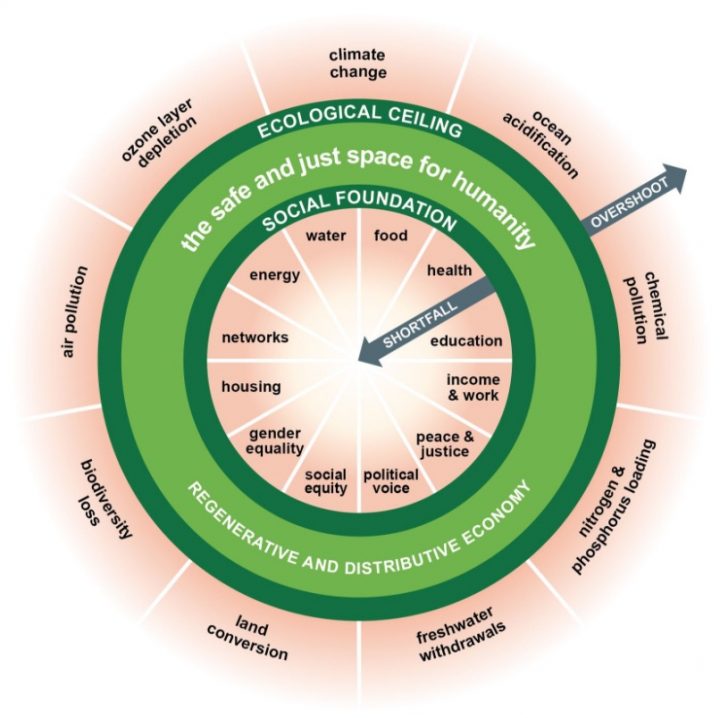
Kate Raworth’s ‘donut’ presents a relatively new way of looking at the economy, which has attained some fame. See the picture below.

the donut

As you approach the hole in the middle, you have an economy which does not satisfy people’s needs such as water, food, housing, relative equity, liberty, education and so on.

As you approach the edge of the image you begin to destroy the ecologies of the planet that the economy depends upon, producing events such as biodiversity loss, climate change, disruption of nitrogen and phosphorus cycles, destruction of fertile land, and so on.

Whereas without such a diagram, the capitalist economy is perceived as a matter of self-contained markets isolated from ecology, she argues that the aim of economics should be to satisfy people’s needs without destroying that planetary ecology.

Normal economic theory, can argue that inequality decreases as growth increases, and that growth cleans up economies, because the economic model looks at the world in isolated ways. Some economies appear to clean up ecologies, but they do so at the expense of other ecologies, and businesses are always happy to lower the costs of pollution and increase profit when offered an opportunity.

People may object that it is impossible to meet the needs of everyone – especially while respecting the planetary boundaries, but at least in this model it appears as something which can be discussed as a major concern. Just as we can ask “What is the economy for? What is it about?” and get a reasonably useful answer.

The old economics had an extremely confining view of human nature, it was humanity stripped of everything but the profit motive. This was a decision originally taken to distinguish economics from other fields such as history or philosophy, and to make things simpler, but it became the model of humanity. Under it we are *just* individual profit seekers. We only cooperate in order to make personal profit, we naturally destroy for profit, we have fixed preferences which we neutrally evaluate, and we have no purpose, happiness or virtue other than wealth seeking.

This view is simply not true, or adequate. Humans co-operate as naturally as they compete. We are social as much as individual, we do not naturally only value money and we do not destroy what we share. We are creatures with many purposes and many aims. Wealth is usually only important to the extent it brings about those other purposes and we are not made happy by consumption.
Raworth’s model, to me, is reasonably obvious and elegant and allows humans to be complex. It is not reductive.

It does have a few problems.

1) It does not explicitly recognise that the current economy is a mode of power, situated within frameworks of power relations, and that historical evidence appears to show that those who benefit from this mode of power will do almost anything to preserve it – including wreck the earth.

Nearly all forms of organisation are nowadays reduced to economic/capitalistic organisations. Media and information is controlled by capitalists, the law is controlled by capitalists, the State is controlled by capitalists, education is controlled by capitalists, and so on. Paying attention to the “bottom line” (measured in terms of money) is a mantra that both permeates society, and ignores reality.

It will be hard to move against inertia and the active power dedicated to preserving existing hierarchy. The model does not easily provide for the distortions that power puts into economics – any more than standard economics does. But as standard economics aims to preserve that power it is not a handicap for it, but a strength, as its users can pretend that inequality of outcome is always proportional to inequality of talent.

2) More importantly, the model does not provide a set of simple positive instructions for politicians. It does not give them an easy and painless set of action slogans and programs, whereas conventional economics does.

Conventional economics says: business is always good and always delivers, you must increase growth, nature is limitless or unimportant, commons don’t work so sell them off to business, government is inefficient so hand it over to business, rich people are talented so give them more support and protection (and pick up the rewards), reduce taxes, stop government services, increase charges, abandon poor people as they are without virtue, and individual wealth and its owners should be worshiped.

Donut economics, just says don’t destroy the world, and let everyone participate. Neither is easy under the current power relations, and these actions do not reward players in the State. The model grinds to a halt.

It needs simple and positive directives.

So time to think what those might be….