Kate Raworth’s ‘donut’ presents a relatively new way of looking at the economy, which has attained some fame. See the picture below.
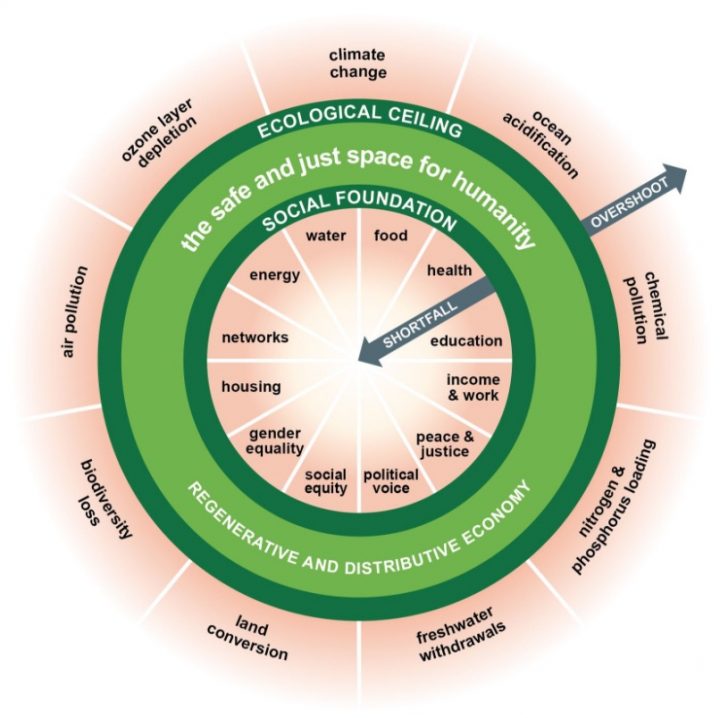
As you approach the hole in the middle, you have an economy which does not satisfy people’s needs such as water, food, housing, relative equity, liberty, education and so on.
As you approach the edge of the image you begin to destroy the ecologies of the planet that the economy depends upon, producing events such as biodiversity loss, climate change, disruption of nitrogen and phosphorus cycles, destruction of fertile land, and so on.
Whereas without such a diagram, the capitalist economy is perceived as a matter of self-contained markets isolated from ecology, she argues that the aim of economics should be to satisfy people’s needs without destroying that planetary ecology.
Normal economic theory, can argue that inequality decreases as growth increases, and that growth cleans up economies, because the economic model looks at the world in isolated ways. Some economies appear to clean up ecologies, but they do so at the expense of other ecologies, and businesses are always happy to lower the costs of pollution and increase profit when offered an opportunity.
People may object that it is impossible to meet the needs of everyone – especially while respecting the planetary boundaries, but at least in this model it appears as something which can be discussed as a major concern. Just as we can ask “What is the economy for? What is it about?” and get a reasonably useful answer.
The old economics had an extremely confining view of human nature, it was humanity stripped of everything but the profit motive. This was a decision originally taken to distinguish economics from other fields such as history or philosophy, and to make things simpler, but it became the model of humanity. Under it we are *just* individual profit seekers. We only cooperate in order to make personal profit, we naturally destroy for profit, we have fixed preferences which we neutrally evaluate, and we have no purpose, happiness or virtue other than wealth seeking.
This view is simply not true, or adequate. Humans co-operate as naturally as they compete. We are social as much as individual, we do not naturally only value money and we do not destroy what we share. We are creatures with many purposes and many aims. Wealth is usually only important to the extent it brings about those other purposes and we are not made happy by consumption.
Raworth’s model, to me, is reasonably obvious and elegant and allows humans to be complex. It is not reductive.
It does have a few problems.
1) It does not explicitly recognise that the current economy is a mode of power, situated within frameworks of power relations, and that historical evidence appears to show that those who benefit from this mode of power will do almost anything to preserve it – including wreck the earth.
Nearly all forms of organisation are nowadays reduced to economic/capitalistic organisations. Media and information is controlled by capitalists, the law is controlled by capitalists, the State is controlled by capitalists, education is controlled by capitalists, and so on. Paying attention to the “bottom line” (measured in terms of money) is a mantra that both permeates society, and ignores reality.
It will be hard to move against inertia and the active power dedicated to preserving existing hierarchy. The model does not easily provide for the distortions that power puts into economics – any more than standard economics does. But as standard economics aims to preserve that power it is not a handicap for it, but a strength, as its users can pretend that inequality of outcome is always proportional to inequality of talent.
2) More importantly, the model does not provide a set of simple positive instructions for politicians. It does not give them an easy and painless set of action slogans and programs, whereas conventional economics does.
Conventional economics says: business is always good and always delivers, you must increase growth, nature is limitless or unimportant, commons don’t work so sell them off to business, government is inefficient so hand it over to business, rich people are talented so give them more support and protection (and pick up the rewards), reduce taxes, stop government services, increase charges, abandon poor people as they are without virtue, and individual wealth and its owners should be worshiped.
Donut economics, just says don’t destroy the world, and let everyone participate. Neither is easy under the current power relations, and these actions do not reward players in the State. The model grinds to a halt.
It needs simple and positive directives.
So time to think what those might be….
Tags: 'nature', Anthropocene, complexity, economics
 Climate, technology and chaos Blog
Leave a comment