Archive for May, 2019

Denying consensus

May 27, 2019

There was comment on the Guardian site recently which shows at least some of the problems with the Left.

It ran something like:

Three really good reasons to deny the science of climate change:

  • 1. Ignorance
  • 2. Stupidity
  • 3. Insanity
  • This formulation tells us nothing. It offers no strategy for persuasion or action. Perhaps, it makes the writer feel better, and heavens we all need to feel better, but it succeeds in making the likelihood of communication and problem solving even less, by name-calling and making barriers and reactions. It puts people who disagree with the speaker(and even some others who might be friendly to those speakers) into dismissible social categories and prevents people from hearing each other.

    It creates problems, it does not diminish them.

    Let’s look at some other reasons people might have for not being active, which are slightly less closed.

  • Fear. People don’t want to think about climate change, because there are no obvious things they can do. It threatens their children and grandchildren, and that is not easy to face. If correct it could be terrifying. Yet we have lived with the threat of nuclear war, population increases and so on, and so far everything is all ok. I spent my youth terrified and nothing happened. Maybe this will be ok, as well?
  • Lack of fear. Everything is in the hands of God. The world is too big to hurt. How is this tiny amount of a perfectly normal gas I breathe out every day going to massively disrupt the whole Earth? It doesn’t make sense. Humans are insignificant in the scheme of things. I cannot change what will be.
  • Sense of probable loss. Loss is painful, and over the last 40 years we have lost out over and over. The promises we were given have not eventuated. You guys trying to stop climate change could take even more away from me and my family. This is another loss. Let’s hope it is as unreal as the promises we were given.
  • Uncertainty as to whether remedies will work. Do we have any guarantees these remedies will work? No? In reality we don’t. It may even now be too late, and plenty of people assure us the costs are way to great to take action without certainty. What are you asking that we should give up again? Why is it always us that are giving up our prospects?
  • Uncertainty about change. Futures are not predictable any more. Who could have guessed this would be happening? Who would guess contemporary technology? Polls are always wrong. Guesses at the future are just guesses, and you are probably using your guesses to gain power over me, and persuade me to act against my interests, like everyone else. Why should I trust you?
  • Experts are often wrong. This is obvious. All of you promised that “free markets” would deliver liberty and prosperity but they haven’t. Even vaguely. They said war in the Middle East would be easy and successful, but its been a total mess, hurt lots of people, and made things worse. Even doctors change their minds every five minutes about what is good or bad for us. They promise cures that never come. These experts are just con-artists without common sense. Everyone makes mistakes you know.
  • Life is overwhelming. I have to make too many decisions. I have pressures from work all the time. My wages and conditions are being cut. I never get any holidays. My boss is a total dickhead. My company is corrupt. I’m not feeling well. My spouse is unhappy. I’m one or two pay days away from family disaster. My kids are acting weird, and I don’t know what to do to help. I’ve too much on my mind. Go away… I don’t need this climate bullshit.
  • Immediate pressures. [Pointed out by Alice Suttie] I have to provide for people around me today. I have to deal with real problems now, not decades, or even just years, in the future. My mother is really sick, I have debt collectors at the door, the electricity may be going to be cut off. I’m busy. I don’t have time to worry about irrelevancies. If you can’t help me now, or propose policies that help me now, then trouble someone else will you?
  • You people are just rude. You obviously don’t understand me. You are obviously not going to listen to me. Why should I listen to you? You are up yourselves, you f+@in alarmist morons
  • There is almost certainly more that could be said here. The advantage of some of these formulations is that the speakers are seen as relatively rational (as people are). We are not dealing with stupidity or insanity which cannot be altered. The statements are largely based on real remarks I have read from people. They are specific, not catastrophizing, not foreclosing of all solutions, like ‘madness’ is. They suggest that some of the problems might be generated by the activist approach, so the approach may need to change. They also suggest that there are specific questions and dialogues which need to be opened and pursued, and that people might be persuadable.

    Now these dialogues may not be easy. They may involved being abused. But the possibility of dialogue and failure also suggests the possibility of learning something new together.

    And that might get somewhere. At least further than thinking the opposition is ignorant, stupid or mad.

    Conservatives and the Left vs the Right

    May 26, 2019

    This post makes use of the political triad (Right, Conservative, Left) proposed in a previous post.

    What seems clear is, that over the last 40 years of the Pro-Corporate Right (and its talk of ‘markets’) being dominant, ‘ordinary people’ have been marginalised from political and economic processes. Median wages have stagnated, share of wealth has declined, housing has become largely unaffordable, social services have become persecutory, developers can over-ride locals with impunity, people’s objections are largely ignored, and so on. Yet we are all are surrounded by displays of great wealth and squander. Over these last 40 years, the Right has engineered massive change to benefit the wealthy, to break any ties of obligation the wealthy have to any other portion of society, and to break any checks and balances the system had developed. They have succeeded in that aim, to a greater degree than they probably thought possible, yet they appear to want to continue that path until the end of the world.

    Both Conservatives and the Left are unhappy with this result. However, rather than blame their own attempts at allying with the power of the Right, they both blame the other.

    Conservatives wonder why minorities are supposed to get priority when white workers are loosing out, and the Left saying “white privilege”, while true, is not an answer; everyone should feel they are advancing together. They will never feel that under the Right, because, to the Right, wages are a cost and ordinary people are a potential obstruction; both should be eliminated no matter what hardships that brings. Today, hard working people can hold two jobs and still only just support their families. The current system is failing everyone.

    Conservatives are suspicious about climate change as, so far, all the big changes put forward by the Right have not benefitted any ordinary people. It is reasonable to suspect that if climate change is dealt with in the normal way, it will hurt people yet again – that is how things work nowadays. If the left makes dealing with climate, a matter of capitalism as usual, then this is probably going to be true. If they make it a matter of challenging capitalism, then they also face problems of gaining support as it is unclear how change will be carried out.

    Conservatives generally fear that if they break with their support of the Right, then they will completely loose influence, or they try and convince themselves that they will eventually win over the Right, but all that happens is that they become corrupt and throw conservation aside. They may need to remember that there is no compromise between God and Mammon. Wealth is not ‘the good’.

    The Left tends to blame the supposed stupidity, racism and small mindedness of Conservatives for their failure. The apparent inability of Labor to analyse its failings in the last election, and the number of Labor supporters apparently blaming the Greens is extraordinary. The Greens did not lose Labor’s election, Labor did.

    But again, this ‘stupid’ attack on Conservatives misses the reality, that ordinary people are resentful of their decline in power, income and position, and are suspicious of grand plans and experts who have harmed them (remember all those experts who said free markets would benefit everyone?). That the Left also attempted to ally with the Right, does not help here. As is the case with conservatives, the alliance only ends in corruption, and support for plutocracy not democracy. The whole point of Left existence is lost.

    I’m not denying that Conservatives and the Left have real disagreements, what I am suggesting is that those disagreements are not more severe than the disagreements they both have with the Right. The Right is good at lying, making false promises, and running the other two sides against each other, so distrust is easily stirred. However, if either Conservatives or the Left wish to survive, then they have to ally with each other. There is no future for either of them if they don’t – at best we will get more of the same. However, 40 years of Right dominance, show that it is much more likely that things will get far worse for the rest of us if we allow things to continue as they are. There is no chance anything will spontaneously recover.

    Climate justice is not the answer

    May 26, 2019

    Climate justice is a framework that is commonly used to conduct political campaigns for reform which are trying to help people adapt to, and mitigate, climate change.

    The problem for me, is that the framing is not clear, and that I suspect it is not constructive.

    Firstly, it appears that nearly all contemporary refusals to act on the ecological crisis depend on ‘justice’ or ‘fairness’ arguments.

    For example, people often say that Australia issues just over 1% of all emissions, therefore we have negligible effect on the world and it is not ‘just’ nor fair to ask us to do anything. People can also say this will put up the cost of electricity, cause social processes to collapse and so on. why should ordinary Australians pay all the cost? Sure we can answer that Australia has much less than 1% of the world’s population, that it has a very high emissions rate per head, and that it exports lots of fossil fuels which are not counted in this total, but the argument can still stand: it’s not ‘just’ to act, especially given the bad consequences of action are not known in detail.

    People in India and China, or other developing countries can argue that while it is true their emissions are likely to tilt the globe over the edge, it is ‘just’ to let them continue. The West had years of unconstrained growth, so should the developing nations so they can catch up. Attempts to stop them from polluting are evidently attempts to stop poverty reduction, and attempts by the West to maintain their world domination. Allowing this pollution is a matter of justice. The West should cut back to zero first, otherwise it is unfair.

    Given that China and India are not cutting back, then people can argue that the US should not cut back, because where is the justice or fairness in crippling their economy and hurting their people, to allow others to pollute massively?

    ‘Justice’ means finding someone to blame, and people will reject the blame when it hits them: “we are not criminal, we are just acting as we have always done. Other people are worse than us.” People will usually deny there is a problem long before they will admit that they are the problem, and so it delays their action even further if they think they might actually be behaving badly, and others they don’t like disapprove.

    Justice, as it is normally practiced, depends on a system of violence. People who are ‘convicted’ are forced to accept punishment, and there is enough respect for the violence deployed that sympathetic people will not actively object to the sentence. There is no ideal to justice that does not depend on this kind of violence. There is no international violence that is respected in that way. If Country x is convicted of climate injustice by other countries, then we have no way of enforcing the decision except for war, or possibly trade sanctions, but given history, it is unlikely that either will work, and they will disrupt the apparent virtue of the justice format.

    In other words, justice does not motivate people to act, leads to people providing excuses for not acting, and for waiting until others act and acting becomes fair. It primarily implies a rhetoric for keeping things as they are and very few countries do anything.

    Wanting a purely ‘equitable’ and ‘just’ situation to arise will take for ever. It is a mode of exchange which does not work while people do not trust each other.

    However, there are other ways of proceeding.

    It might be better to agitate for “Climate Generosity”. This is the idea that we give to others, we act without waiting for fairness, we act because it is the way we do things to get things done.

    This is pretty standard human behaviour. Parents give to children without demanding equal return immediately. People in many societies give generously to others in order to persuade the others to give in return. Sometimes the deal does not work; sometimes no obligation is built up, sometimes people break the deal, but mostly it works and works well.

    In seeing others acting, people come to think they can act themselves. Generosity is usually defined as good, hence people may tend to emulate those being generous, and add to the climate gifts that are becoming available and solving the problem.

    Yes some people will attempt to take advantage of generosity, but if you are in a generous frame of mind this does not stop you, or bother you that much – things are happening. You might give more carefully in future, but you keep giving, keep getting the emulation, keep getting the status, and keep getting the results you are aiming for.

    With justice you have to wait for a framework for justice, but with generosity you just go out and do what you need to fulfil the aim. If you give solar panels or wind turbines, nobody loses, everybody benefits including yourself. The idea we don’t need harmful pollution to live becomes more common and acceptable, and eventually it seems odd not to support it.

    Climate justice digs a pit, climate generosity builds a way out.

    Three forms of contemporary politics?

    May 26, 2019

    The Triad

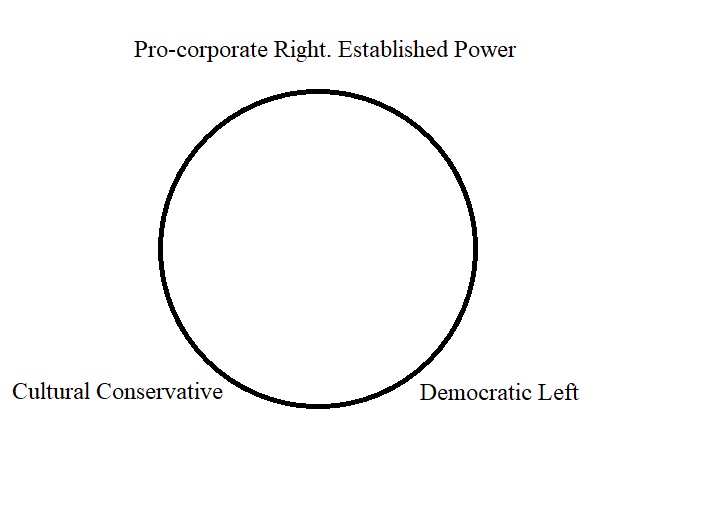
    It could be useful to think of contemporary Australian, and probably US, politics in terms of a triad:

    (Currently Pro-corporate) Right
    Cultural Conservative
    Democratic Left.

    Using a triad rather than a set of binaries helps us to avoid seeing these factions as opposites. They all share things with each other, can move from one position to another, and ally with one another.

    political circle 02

    In brief:

    The (pro-corporate) Right support established wealth and power. They consider that the powerful are virtuous, and justified in that power, by virtue of that power and wealth. Given that the main contemporary power resides in the corporate sector they tend to support that sector and its justification within so-called ‘free markets.

    Cultural conservatives support what they see as traditional culture, and traditional power relations.

    The Democratic left supports ‘the people’, against entrenched power and entrenched ‘irrational’ culture. They tend to see themselves as the supreme judges of what is entrenched.

    In more detail:

    The Right tends to attack the rights, incomes and conditions of ordinary people in order to support established power and hierarchy.

    Power must be maintained, and society geared towards providing the best conditions for the powerful to do their stuff (whatever that is; make money, use violence, own land, spout theology etc.), as that is supposedly best for everyone. They are anti-democratic at heart.

    They oppose any kind of benefits for the poor, which are not a form of charity which requires genuflection towards the rich, or other elite, and hence reinforces the power system. To them mutual obligation means the obligation of the poor not to accept help that costs the elite anything, or for the poor not to challenge the elites.

    They also oppose to any traditional culture or set of values, which acts to restrain the power they support which, as stated above, in our society is the corporate sector.

    They encourage culture wars to maintain separation between conservatives and the left, and use conservative respect for established power to persuade conservatives that they are both on the same side.

    If contemporary rightists have a religion it tends to assume that wealth is God’s reward for virtue and faith, and that a person’s prime responsibility is for their own salvation and then, perhaps, their family’s.

    The main problem the right face is that they know they are right. They think all information is PR and you make it correct by PR, will and effort, or sleight of hand. They are extremely good at sales and marketing in an economic system in which false advertising and hype is normal. They tend to think any counter evidence is evidence of bias, and must also be made up. The problem for them is that eventually reality cannot be denied, and bites everyone, including them.

    Conservatives tend to be suspicious of innovation.

    Nowadays, living in corporate capitalism, innovation occurs all the time, destroying traditional culture and place, so life is difficult for them.

    Capitalism also tends to reduce all value and virtue to money. This often seems fundamentally wrong to conservatives.

    While tending to support single authorities, conservatives can also like a balance of social powers to act as restraints. Thus they can support professional organisations, teaching organisation, religious organisations, business organisations, military organisations and conservation organisations having input into government. Whoever is the ‘King’ should have loyal and fearless advisers.

    They also tend to think that power involves responsibility towards both the established rules and laws of government and to the ruled. The rulers should cultivate noblisse oblige, protection for the ruled, charity, justice and so on. Ideally while everyone should know their place, there should be mutual respect. Mutual obligation is not one sided.

    Religion is often considered vitally important in cultivating virtue, generosity, judgement, content with one’s place and is supposed to act as a restraint on human selfishness.

    Cultural conservatives tend to like traditional boundaries for gender, profession, task and so on, especially when tied into religion.

    They often consider that traditional culture carries a wisdom, which cannot be easily summarised intellectually, and that breaking traditional culture and its mores carries unsuspected dangers. This can lead them to support functional ignorance, as new knowledge might be dangerously mistaken.

    They are strongly suspicious of people for being different, and can team up to put down any difference, thus limiting a culture’s range of potentially constructive responses. This is a weakness.

    Another weakness is thinking that by allying with established corporate power, primarily against the left, they are defending cultural wisdom against difference, and that this gives them real power. In other words they often think that established power must inherently be virtuous and conservative. What they eventually discover is that if they get in the way of money making, or whatever the right’s hype of the moment is, then they will be over-ridden completely.

    More on conservative philosophy here

    The Democratic Left tends to be suspicious of everything that oppresses, or could oppress, people and which only has backing in tradition or raw power. They tend to think that what seems like arbitrary power and culture should be destroyed.

    For them ordinary people are as wise as anyone else and should be supported in their efforts to better themselves. People should not be ignored or suffer simply because they are poor or outcast – this is unjust.

    The problem for the left is that revolutionary leftists, if the revolution succeeds, become the new rightists. They support the new forms of established power and run roughshod over those who oppose them.

    On the other hand, moderate leftists tend to accommodate to the power of the right, and thus end up cautiously supporting oppression to receive funding. They may also accept established power relations in return for what appears to be the ability to moderate that power. This position can achieve something, but without them encouraging another set of power bases, they cannot hold the achievement. This is clear from Hawke and Keating in Australia, Blair in the UK and Obama in the US.

    Leftists are often conservative; they don’t want to reduce every virtue and value to money, they tend to like balance of powers, and they often support the achievements of the past which have now been swept away by the Right: for example the Menzies idea that social insurance was a right, and that people should not be humiliated or harassed for accepting it, or the idea that workers form a valuable community rather than a disposable resource. They also tend to support environmental conservation and oppose destruction of land and place.

    Their main problem is the tendency to want to overthrow traditional culture rather than improve it. This is one reason, that ‘modern art’ holds so little popular appeal; much of it only rebels. Conservatives are probably correct that culture holds some evolutionary adaptive organisations, but that it may well need to change as circumstances change.

    Leftists are easily persuaded that conservatives support harm for the marginalised, are racist, sexist, superstitious and stupid – which helps drive the culture wars, started by the Right, and which tends to throw them on the mercies of the right.

    Consequences

    The point of all this is to suggest that there is perhaps as much commonality between left and conservatives as there is between conservatives and the right, or the right and the left. There is room to be flexible. However allying with the right is likely to prove disastrous for the other two sides, partly because the right has no respect for reality, only wealth. Both the left and conservatives have weaknesses which sabotage them, but which have a chance of being corrected by the other.

    Historically it could be argued that the successful 19th and early 20th century reform movements, that lead to public education and protection against misfortune for the working class, arose through an alliance through the democratic left and the conservatives both recognizing that unconstrained capitalism was destroying traditional life, interconnections and responsibilities. That this economic system was demeaning the working men and women of the country, and that it was Christian to try and help people live lives which were not full of abject misery and poverty.

    This alliance was largely successful, despite obvious frictions. It is not impossible that a similar movement against the corruption of public life through money and the destruction of land, water and air could motivate another successful alliance.

    The only thing that seems guaranteed, is that if the Right remains dominating, then everything will end badly.

    More reflections here…

    Climate and conversation

    May 22, 2019

    These are a few suggestions based on reading and occasional interaction…
    This is not a research article.

    Lets begin with the don’ts.

    Don’t talk about climate change.
    If people do not “believe” in climate change, you are not going to persuade them otherwise.
    Groups are already polarised on this issue, and it brings up lots of reasons not to talk to each other, suspicions and so on. It becomes a matter of identity and allegiance. You need to go beyond this.

    Don’t go on about the evidence.
    They have rejected the evidence, and you personally are probably not a climate researcher.
    Both of you are taking the evidence to a large extent based on authority.
    They believe a different authority, or think they are “independent thinkers”.

    Some psycho-social research shows that counter-evidence to what people already believe, is rarely compelling and sets up resistance especially when its tied in with identity politics (which seems to be the case on both sides).

    Another obvious point: Talking about people or telling people they are ignorant, stupid or easily conned is harmful to communication. That they already call you similar things does not excuse this. Only do it, if you want to waste your time.

    If you are a politician speaking to a wide audience, then its different. You have to clearly say what you will do and why its not harmful.
    You need to lower fear and scare. And climate change is scary (even if you deny it, the you are probably scared of what those other people might do to stop it).

    For example Bill Shorten, Australian Labor Party leader, could have said, and as far as I can tell did not say:

    “The Adani mine will not bring jobs. In court, talking about the big mine, Adani promised less then 1,500 job *years* of work for people in the mine or as a result of the mine. This is not very many, especially given the project is supposed to last 25 to 30 years. There are 750 two year jobs for example. We will actively compensate for and exceed these few jobs in Central Queensland, with useful projects (names a few).
    “The Adani mine, being open cut, is likely to pollute the Great Artesian Basin and that could damage water supplies and agriculture down large parts of east coast Australia. We cannot risk that loss of jobs, food security and prosperity. If water safety cannot be guaranteed, or we find the CSIRO were pressured to give a particular result, the mine will not go ahead. We will also not support Adani being given unlimited rights to water, this is suicidal given current climatic conditions
    “We want to encourage electric cars, not force people to buy them. As usual the Government is lying.”

    This still will not get your message through the Murdoch Empire. They will lie about you whatever you do, but keep on trying – people don’t have to depend on them.

    What can you do?

    First off.

    Talk and building connection is more important than persuasion.

    You might even learn something if you are not trying to persuade people. They may still try and score points off you, but just keep talking, making some kind of connection. They may even say things you can agree with, and that can build bonds.

    You don’t have to agree with people on everything to like them, or talk to them. This idea is quite radical in itself in our society 🙂 It is also a lot easier to say, than to do. Our society does not encourage discussion, it encourages telling people each other where they are wrong (This is a “think about doing what i say, not what i do” post 🙂

    Face to face is probably better.
    You can talk in groups, many people find it easier, but it can also open old fractures, so get ready to damp that down. That people turned up, means they are interested in talking.

    Sense of Place Nearly everyone has some kind of tie to a place they love, means a lot to them, or is their home. What is it about that place? What do they do there? Is it the same as it was? If not, how has it changed. How could it be protected?

    Again, the point is to explore relation to place. It is not about cause or blame, unless the others introduce that.

    People who may deny climate change can talk about lengthening drought, changes in wildlife, the decline in bird species, the difficulties with water, the greater amounts of fertiliser they have to use, the increase in dirt (particulate pollution?). What other changes affect their lives? Are you both gardeners? – that can lead to ecological connection, although it does not have to. All these are important, but they won’t talk if they feel you are trying to manipulate them or sell them something. So don’t. People’s experience of place and change is interesting in itself – its actually vital.

    There is no ecological thinking without an awareness of the environment – and awareness of environment leads to new questions and thinking.

    Talk about your own experiences apolitically – give back. What might you share?
    If you live in a country area, you probably know the place they are talking about, and can probably relate to them.

    What remedies might they have tried? If nothing, then fine, but it is likely they have tried something; like cleanups, changing the water flows, rotating crops, tree planting, opening a wind farm, having an Airbnb to raise cash, moving to a different place etc. How did it work? How do they find the bank, or government (or other) services? What have they heard about, but is really not practical?

    There is lots of stuff to talk about. Perhaps they are as depressed/distressed as you, but about other things.

    In ecology everything is connected. Surprising things happen. Maybe they got in a rainmaker and it worked. Maybe turtles appeared out of nowhere. It’s good to relate to a special place and notice changes.

    The point is this is a long process requiring patience. Its about building relationships, building communities, that have been (I suspect) deliberately broken, largely by pro-fossil fuel organisations and political opportunism. Be prepared for things to go wrong. In some cases people have a lot invested in preventing conversations. You just start again, maybe with different people.

    It is not about winning. We either get through this together or not at all, and we can all learn.

    Green Paradox

    May 21, 2019

    German Economist Hans-Werner Sinn identifies a ‘green paradox‘.

    This is that the more we discuss lowering, and act to lower, CO2 emissions from fossil fuels to reduce climate turmoil, the more temptation there is for fossil fuel companies to excavate fossil fuels to sell them and make money out of them, before the assets become unsellable and worthless. I suspect that this is one of the reasons the Right in Australia is so keen on new coal mines, to protect mining giants and get support from them in turn.

    We can add, that acting to reduce CO2 also increases the temptation the companies have to broadcast false information to delay action and keep the sales going as long as possible. Both selling to damage the market, and emitting misinformation to influence the market, are part of normal capitalist functioning.

    Furthermore, if plenty of green power is available, then the price of fossil fuels may come down (especially given the pressure to sell them) so even more fossil fuels get burnt. If Countries have not committed to green energy, then they can freeload on the cheap fuel created by those who have rejected fossil fuel. This can then lead to further lock-in of fossil fuel technology in those countries.

    Another way of phrasing this is “The more we need to go green, the harder it will become”.

    Solutions are difficult, but apart from overthrowing capitalism which is not going to happen, we could have a worldwide carbon tax, which is also going to be hard (misinformation problems), we could reduce the massive subsidies that go to fossil fuels for historical reasons (we tried to make supply safe for social good), or we could simply buy, or nationalize the reserves (which is also going to be difficult).

    What the green paradox tells us, is that we cannot solve the problem of greenhouse gases and energy without legislating, or finding some other ways, to keep coal in the ground. That has to be the aim

    The Australian Election

    May 20, 2019

    I was uncertain for the whole last week that Labor would win. Partly because the movement of the polls was in the wrong direction, partly because of the relentless misinformation, and partly because Bill Shorten’s speeches were not precise, and did not say what Labor would not do – which was vital. Labor should also have broken with the misinformation that coal mines bring jobs…. but for whatever reason that seemed impossible.

    However the main reason for my despair was reading right wing internet groups. Some of this reading was deliberate and some of this was because I was getting quite a lot of promotional material on Facebook without asking for it. Please note, any remarks here are impressionistic and not a mark of extended research…

    The appearance of these groups is of seething hatred and dedication, together with apparent loathing of general uncertainty and uncertain boundaries in particular.

    Groups tend to argue by abuse and by flat statement as a way of reinforcing boundaries (if you can’t take it then you are not one of ‘us’), but expressions of disgust and certainty are not uncommon online. The point is that ‘we’ are the righteous, and need to expel the different to keep the boundaries going.

    According to participants, nearly everything bad that happens to normal people happens as a result of some left wing policy. Low wages and unemployment, because of restrictions on the economy, migrants, refugees, positive discrimination, green tape and so on. Corporate power is a problem, because the left is all on board and wealthy (a point Tony Abbott made in his retirement speech – it is wealthy electorates who are concerned about climate change, while real people understand the Coalition and know the Coalition is best). Cultural crisis occurs because of cultural marxists, radical homosexuals and transsexuals destroying ‘our culture,’ and weakening its self-preserving boundaries by insisting that foreign Islam, other races and gender constructions are acceptable. It is also felt that Leftists are snobs, hate ‘us’ and make no attempt to understand ‘us’ (or that such attempts are aimed at undermining ‘us’) – and indeed the common left lament that the people have failed has more than a hint of this. Green policies are further attempts to sacrifice working people to rich people’s needs, radical lies and snobbery. Taxation is theft, and its always the working people who get taxed by high taxing parties, which is pretty true; only its the Coalition that does this.

    It is common to see people in these groups blame corruption in the Church, the police or politics on leftist values, or the sixties. There is a single handy explanation for everything, despite 40 years of largely right wing dominance.

    This blaming merges with scapegoating of particular groups, as a form of avoidance of responsibility. And indeed, one of the problems of the modern world is that we are all responsible. Some more than others perhaps, but not ourselves ever – and we all often fight to avoid recognising that part-responsibility.

    The Israel Folau issue (the sacking of a very expensive footballer for claiming gays would go to hell) was surprisingly important because it clearly ‘showed’ oppression of religion, or at the least suppression of authenticity, while demonstrating that the left had joined with the corporate sector in attacking working people who expressed righteous anger with people who attacked gender roles, boundaries and certainties. Again the scare campaign that Labor was going to force our kids to be gender fluid only makes sense in this kind of environment, of existential boundary fear. However, it is a mistake to think that traditional gender roles have much support either, even if people claim they do. Its more complex and flexible than that.

    In a few academic articles I have got into trouble with reviewers for arguing that trust in authority has little to do with belief. While these groups fiercely distrust the left they don’t trust the political right either. If their own side is irrefutably shown to have lied or schemed against them, the response is not to consider the possibility of being wrong, but to state “all media lie,” “all politicians lie,” “both sides are the same” or something similar. This allows people to keep their opinion while dismissing evidence that it may be false. This is what contemporary skepticism (or ‘independent thinking’) means, being skeptical of counter-evidence to your own, or group’s, position.

    People seek to defeat the uncertainty of a complex crumbling society by being stable, righteous, and avoiding responsibilty by finding scapegoats, who, if removed would solve all the problems people face. For the left it might be capitalists or neoliberals, for the right it is leftists, feminists, gays, transsexuals and sometimes abortioneers. Obviously I think the first position is more likely to be correct

    The Coalition campaign made fertile use of these trends – they are much better than Labor at it, perhaps because it avoids criticising real power. More and more, Labor depends on the powers that undermine them, for funding, publicity and respectability.

    The basic assumptions of these groups were supported by the Murdoch press and other media promoting the general social fantasies they depend on such as ideas that the coalition manage the economy better, the economy is primary, virtue involves identifying or punishing out-groups. The Labor party ignored this part of life, or perhaps they did not see it or dismissed it as the work of a few fanatics, rather than of a relatively large group of people, who would support anyone who promised to get rid of what they perceived as the leftist challenge to their existence.

    Due to communication having to involve interpretation rather than transmission of meaning, it is more or less impossible for such groups to actually hear what people on the other side are saying. Once identified as from that other side, then the boundaries are to be reinforced: that person’s comments are to be attacked, and the person ideally driven away if they cannot be converted. This then leads to a shouting war which tends to reinforce the separation and the further rejection of ‘good communication’.

    What to do? The first thing is to admit these groups exist, and that they are powerful and real expressions of ordinary people’s lives. Even intellectuals can often be quick to blame the left for problems or for hostile fanaticisms… Rather than convert them intellectually, they need to be listened to and understood, and then argued with, with some understanding rather than just a condemnation which reinforces their boundaries and life worlds. This requires patience.

    It is another example of the paradox that if we are to do anything democratically it will be slow (perhaps too slow), but if we don’t do it democratically and bring people along, then we will fail.

    Energy and Economy

    May 16, 2019

    Another attempt to theorise what seems to be both obvious and undertheorized…. This material is very basic and possibly wrong.

    As I have argued elsewhere economies require the transformation of materials and energy, together with exchange from one person to another. The more energy that is available, through technologies of energy production, the more that can be done by those with access to that energy.

    Energy production can mark military security, as it allows action at a distance, rapid manufacture of complicated weaponry and so on (assuming access to the materials etc). Most States take action to ensure they have excess energy and can defend themselves, or extend their range of attack, as well as extend the influence and power of their nation’s businesses.

    All energy on Earth largely originates in two sources:
    as ‘Interspatial energy‘,
    or as ‘Planetary Energy

    Interspatial Energy (IE) comes primarily from the Sun as electromagnetic energies, light and heat. There are also gravitational tides from the Moon, which affect planetary weather and water movements – this is energetically important. The consequences for the Planetary system of IE is huge, but the return effects of Planetary systems on IE is, so far, negligible.

    Planetary Energy can come from weather, the water cycle, winds, tides and so on, which result from interaction between the Planetary system and Interspatial Energy. Other sources of Planetary energy, include Geothermal energy, fire, the interactive properties of materials, and potential nuclear energy. I want to summarise all this with the term ‘Planetary Energy and Materials’ (PEM). PEM largely depends on the existence of IE. This is an example of the laws of thermodynamics in action. Without continual energy input from an external source, the Earth system will run down. It would not have much available energy, and there is little likelihood of life evolving into anything particularly complex (not completely zero chance, we have hope for the moons of Saturn, but little chance).

    The PEM leads to Planetary Ecological Cycles (PEC), which are complex living systems in which everything interacts with everything else, sometimes directly, sometimes indirectly.

    Complex systems have numerous properties in general. Some of the important ones, are

  • that they are in flux and evolve
  • they can reach temporary equilibrium states
  • they are subject to accident, and rapid change at tipping points and
  • they are (humanly) unpredictable in specific (we might be able to predict trends and general events, but not specific events).
  • Eventually, the living system covers the planet, becoming planet wide, and we have something approximating the Gaia idea. PEC and PEM are linked. PEC depends on both PEM and IE, and can affect PEM on some occasions – as when early life changed the chemical composition of the atmosphere.

    PEC provides us with coal, natural gas and oil from the long time decay and death of plants and animals. These materials are all stores of ‘Carbon’ in various forms, as that is one of the major materials of Earthly life. When burnt, or released into the atmosphere, they release stored material which forms Greenhouse gases, and effects the functioning of the PEC.

    Eventually we end up with humans and human organisation. Human organisation involves technologies, relations of power, relations of kinship, relations of labour, relations of knowledge and so on (all of which we often lump together and call ‘culture‘), which make use of, and are influenced by, PEC and PEM. We will call this level the Social Economy (SE), it depends upon the workings of all ‘previous’ stages, and can influence the workings of those stages.

    In ‘simpler’ economies the main energy source is human labour, powered by available food and water, and perhaps fire which primarily makes more potential food edible and safe, drives away dangerous animals, allows deliberate or accidental changes in ecology and may allow some processing of minerals (copper, bronze, iron etc), which then have unexpected consequences for human lives. The use and harnessing of animals also boosts energy availability, which affects the possible scale of agriculture, population density, warfare and so on. The more organised the labour the more energy is available. However, slave (or indentured) labour appears to have been the energy basis of many large scale societies prior to widespread use fossil fuels. People also use technology to tap the power of geography and weather with river power (water wheels) and wind power (sails and windmills). This again adds to possible production, and people work to use the technology when the power is available.

    Then we get the use of fossil fuels and technology to generate steam power, mechanical motion and electricity. Finally we get nuclear energy and renewable power – all stages build on the complexities of earlier stages, and multiple paths are available, both taken and not taken – for example, many nations have not used nuclear energy. Each stage in this development comes with different forms of social and work organisation, and relationship to environment (including the capacity to damage it).

    The more available energy becomes, the more people can do, the wider and more integrated their organisations can become, the quicker, longer and more voluminous trade routes can become, the more separated in space the relationships that can be built, the faster armies can move and damage be delivered, and the greater the distinction in class that becomes possible: those that own or control vs those who labour, or are controlled. With plenty of cheap energy it is possible to develop mass consumption societies, with large numbers of goods.

    The State, where it exists, is part of the social economy, and often promotes and protects energy systems for the obvious reasons of building trade and production that is beneficial for it and its ruling factions, and to extend military security and aggression (often to increase easy access to raw materials and energy). The State also exists to protect unequal divisions of wealth internally. The State has tended to provide slaves, protect relations of slavery (along with other forms of property), promoted navies, wind power, river power, and subsidised coal and oil production and infrastructure, and also has often supported nuclear energy because of its costs and risks. Eventually, these subsidies and supports become familiar and invisible, and support for new energy sources (not managed or owned and controlled by the same people) can become a political issue. For example the IMF advises us that fossil fuel subsidies globally amount to US$5.2 trillion or 6.5% of global GDP. This is far more than given to renewable energy generations. The subsidies include estimations for the damage from pollution, which is both a silent subsidy, and an approval of the pollution as it is not penalized.

    As proposed, initially organisation of human labour and food (energy) availability, together with a set of relationship to the environment determined what could be done and what could be produced. This is the domain in which the labour theory of value is almost correct, given the addition of cultural and religious values. Relations of power are also important in influencing value, but I shall discuss all of these factors elsewhere.

    Labour is simply one form of energy generation. As economies get more complex, other forms of interconnection and energy generation are added, together with issues of supply, demand, control and power. Also it is quite clear that with easily available energy people may produce more of an item than there is a market for, and it does not really matter how much labour/energy goes into the item, it can still not bring a return on a cash/commodity market. So exchange value is not directly equivalent to labour or other energy expenditure.

    One important concept for consideration of energy in the economy is ‘Energy return on energy investment’ (EREI). I prefer the phrase ‘Energy return on energy input,’ (same initials) as it avoids using financial terms with very specific meanings. This idea refers to the ratio of the amount of energy you have to input into a technical system, when compared to the amount you get out. The higher the ratio, (or the more energy is emitted per unit of energy input), then the more easily available energy there is. If the energy input is continually higher than the energy output, the system is likely to eventually grind to a halt.

    EREI is also dependent on organisation, or the direction, of energy expenditure. Uncontrolled energy expenditure is not the same as energy availability, just as the directed energy expenditure in a nuclear reactor is different to the energy expended in nuclear bomb. Energy availability may also be directed towards particular social groups; aluminium factories amy get supported by higher prices for other people; those who can afford energy may get more of it, and so on. There is, inevitably, a social component, and restrictions, to energy availability.

    Fossil Fuels radically changed social EREIs. Fossil Fuels have been easy to extract, relatively easy to transport and process, and emit huge amounts of easily deployable energy in return. This availability has allowed transport of food from distant locations, world trade, world empires, world war, mass manufacturing, industrialisation, mass electrical technology and mass computing. It has allowed technology to become incredibly complicated and small. All of these procedures require, and use, cheap and easily obtainable energy – they also require a large and complicated back drop of production and skills – so technology is enmeshed in complex systems. Cheap easy energy has increased the possibilities of general prosperity, especially when coupled with organised labour.

    It might also be the case, that the more freely energy became available, the more extraction can shift into destructive modes, as it becomes relatively easy to destroy ecologies (especially distant ecologies), transport the extracted materials anywhere, and to protect oneself as destroyer (temporarily) through more technology and energy expenditure.

    Human energy and technology use can, fairly clearly, have consequences for the PEC, and thus affect human life.

    In some cases, of long residence, it can appear that human life styles are ecologically harmonious, or even determined by ecologies. In these cases, the interactive system as a whole generates an implicit knowledge of how to survive, which may not be explicitly known by anyone. Such local harmonious systems are hard to replicate or transport elsewhere. They may also only be harmonious until external forces disrupt the system, or the success of particular internal forces generates tipping points.

    Finally we get into the recognition of waste and pollution which we have discussed in other posts. Briefly, ‘waste‘ is defined as the by-products of production and consumption, which can (in relatively brief time) by reprocessed by the economy or the PEC. ‘Pollution‘ is defined as the by-products of production and consumption which cannot be processed by the economy or the PEC, and which has the capacity to disrupt or poison those processes. The more destructive the extraction processes, the less able ecologies are able to process waste and that waste becomes pollution. Pollution is often distributed according to relations of power, and dumped upon poorer or less powerful people, and poorer less visible places. Pollution eventually feeds back into the complexity of the PEM and PEC and affects a society’s ability to survive – at the least it generates changes in the Social Economy.

    The problem we face is that pollution is changing the PEC to such a degree that the civilisation we participate in could fall apart in many ways. This is not that unusual. Previous civilisations have destroyed their ecologies by determined accident. In our case one of the prime dangers is the pollution from fossil fuels.

    The same processes which give us a huge EREI and hence cheap, plentiful energy, will cause massively turbulent weather, storms, droughts, flooding, sea water rise and so on.

    These are severe problems for us. It will be hard to tackle these problems if the EREI goes down, which it seems to be, and the problems will also increase if we continue with fossil fuels to try and keep the EREI up.

    Oil and gas are no longer as easy to find and extract as they were, hence the use of tar sands and fracking. Their EREI is declining. Quite a lot of people, who claim to be experts, argue that rates of discovery of new oil and gas fields has declined since the early seventies. Some consider that no new massive oil fields are likely to be discovered in the future. Desperate attempts to keep going, may mean that oil companies are becoming overburdened with debt, which they will never be able to repay from profitable discoveries. Lack of oil will affect supply chains which largely depend on it for transport. Coal is now gained by open cut and other explosive techniques which are far more destructive of the environment and poisoning of nearby people. Any increased efficiency of use of fossil fuels is likely to require a fair amount of energy expenditure to implement, and may not be economic. Renewable technologies require far more energy input for their energy output than fossil fuel energy, at least at the beginning of their lives.

    So far, the amount of coal and gas fueled energy is increasing at similar rates as solar and wind, increasing emissions.

    There is a further economic theory which is of use here; the Jevons Paradox. This is disputed, and not everyone accepts it. Some of the rejection seems to stem from the recognition that, if correct, it has unpleasant consequences.

    The Jevons paradox is basically that “The more, available, efficient or cheaper the energy, the more it will be used.” This implies that energy efficiency can result in greater consumption of fuel, rather than less consumption, and hence greater emissions. It is also in the interests of corporations who sell energy, to boost sales of energy, rather than to have unused energy on hand, so there are a few social drivers operating here, few of which favour reduction of pollution.

    One consequence of the above, is that new renewable energy may not displace fossil fuel energy. Energy use may merely go up, as new renewable energy adds to energy availability, and is accompanied by even more Fossil Fuel burning – which seems to be what we are currently observing. India and China are building huge amounts of both renewable and fossil fuel power, and organisations may cut fossil fuel use at home and encourage it elsewhere in the world, where there are fewer controls. Renewable energy technology also requires energy input, for extraction, production and transport and this has been provided by fossil fuels. This increases Greenhouse gases. If fossil fuels remain stable, then building renewables at the rate required lowers energy available to run the rest of society. Any decline of the availability of fossil fuels, (due to shortage or phase out) may also mean that we cannot build renewables with the speed and financial return required to keep civilization going.

    If we succeed and the percentage of renewables relative to fossil fuel increases then the amounts of cheaply available energy will sink, and the world will head for ‘degrowth’ and disconnection, whether voluntary or involuntary.

    Involuntary degrowth could be disastrous. If emissions are to be reduced that will take legislation and regulation and a likely cut in living standards and the cut back of world trade, which may be culturally hard to accept. At the moment, working to satisfy consumption urges, drives the system. It is unlikely that this can be maintained, and that requires cultural work and change to make acceptable – and we are not good at doing this deliberately.
    Considerations on Technology

    May 15, 2019

    Another attempt at working out the basics….

    Any consideration of technology has to at least five factors:

    1) The Material-ecological basis. What we call the physical, chemical, biological (and so on) processes of the world. Technology depends on properties of the world and interacts with ecologies. The world does not have to be understood accurately for technology to be made. The properties of the world, and lack of understanding, mean that technology does not always produce the results intended, and has the possibility of side-effects. Not every imagined technology is possible, at every stage of technological development, and it may not be possible at all. Surprisingly, standard economics seems to assume that when a technology is needed it will arise, and arrive in the form and at the cost we would prefer. Technology may arrive, it may not.

    2) Energy requirements or production. All technology requires energy to make, or to power, and some technology generates energy. The amount of energy generated for the amount of energy invested in the technology, is a relatively important indicator of how much impact the technology can have. We have to look at the energy available (human, animal, thermal, weather, fossil fuel, nuclear etc) to understand the possibilities of a technology. Even the most basic technology magnifies the effect or precision of the users actions.

    Ecologies also require energy circulations, and that circulation can form part of the systems of technology, and be disrupted by those systems of technology.

    3) Social organisation. Every technology comes from a form of social organization, which may influence its design and effects. It also interacts with the social organisation. Social organisation can be fundamental to the technology as, for example, when building pyramids. The organisation of labour-energy is just as important as the tools used. Technology can change or restrict forms of social organisation. Social organisation can disrupt technology as when managers assume that they can define the requirements of a software system without consultation with people doing the work, and design software incapable of being smoothly integrated into work.

    • 3a) Social Struggle. Take it as a likely heuristic (or guide) that every form of social organisation, involves a form of social struggle. Technology is often used to extend and resist social power. It is designed to reinforce patterns of work, obedience and decisiveness. It may be being used to enforce cosmologies, and religious power. What does the design and implementation do in political terms? Who is intended to benefit? Who suffers? How are risks allocated? How is pollution and other forms of harm allocated.

    4) Symbolism, art, magic, rhetoric. Technology is often designed to have a particular ‘look’ and this look or ‘decoration’ becomes inseparable from the technology and its use. Technology can act as a metaphor for the way we think about the cosmos and life. Not long ago the universe was supposed to be like a clock, nowadays it may be thought of as like a computer. Minds can be seen in terms of software etc. Technology can be used to impose and reinforce social distinctions, as with 19th Century hall furniture. Technology can be used to persuade us of the rightfulness of social actions, as when imagined Carbon Capture and Storage is used to keep fossil fuels burning. Geoengineering assumes that manipulating the world ecology is easier than changing social systems, thus defending the social systems that produce pollution and probably undermining Geoengineering’s success. In the case of CCS and Geoengineering, the imagined technology may also function as a social psychological defense mechanism, and suppress the awareness of the danger of the current situation and its social generation. Magic can be seen as a way of coordinating activity, changing people’s consciousness, focusing attention and so on, and so it can be difficult to separate what we call magic from what we call technology. Traditional Balinese irrigation systems, seemed to depend on religion for their co-ordination and functional, largely non-conflictual, distribution of water. Something which collapsed when the traditional system was abandoned as a result of taking on the magic of capitalism.

    Technology can be part of the rhetoric involved in imagined futures. Or in futures hoped for by some particular social group. In that sense it can also enter into social struggle.

    5) Unintended consequences. Because technology arises within complex systems and is used in complex systems its use, especially new usage, can result in unintended consequences and unintended disorders. One obvious example is that producing technology can result in pollution, or use of technology can result in pollution. These consequences are, in a way, also part of the technology. People can use them to learn more about the world, or they can dismiss them as accident (even if they are recurrent), or say that they have nothing to do with the actual technology usage.

    Technology is rarely straightforward and simple. It is embedded within and generative of complexity.

    A kind of definition of technology:

    A combination of material (involving chemical, physical biological processes), organisational, communicational, symbolic, artistic, magical, and other, processes which expands, magnifies, or makes more precise human actions and their consequences (intended or otherwise). Technology is intimately tied up with energy production and magnification.

    Pollution and Extraction

    May 10, 2019

    Climate Change is not our main problem. Climate change is symptomatic of two other major problems:

    1) Pollution and
    2) Extraction

    1) Let us define ‘waste’ as the byproducts of production and consumption that can be ‘re-cycled’ or processed by either the economic system or ecological system.

    ‘Pollution’ is then defined as the byproducts of production and consumption that cannot be ‘recyled’ or processed by the economic or ecological systems.

    Sometimes, what would normally be waste can be produced in quantities which exceed the capacity of the ecology or economy to reprocess and it becomes pollution, as has happened with CO2 emissions. It is theoretically possible that pollution could likewise become waste, but I’m not sure this has ever happened easily or well. It is often hard to make reprocessing pollution profitable or even cheap (financially or energetically).

    The changes to geological markers which define the Anthropocene are largely down to pollution. Climate change is mostly generated by pollution from excess greenhouse gas emissions made from energy production.

    2) Extraction is the process of extracting food, minerals, materials, fuels etc. from the earth’s ecologies.

    Extraction can likewise be of two types.

    ‘Tame extraction’ which allows the ecological system to repair itself after the extraction occurs. This takes time.
    ‘Excessive extraction’ which damages the ecological system, either through straightforward destruction, or through not allowing the ecology the time to regenerate.

    The more ecologies are damaged the less they can process and recycle waste, therefore excessive extraction increases the chance that waste will become pollution.

    For example, the amount of carbon dioxide we can produce safely goes down as we increase deforestation and poisoning of the oceans. Instead of being absorbed, as it should be, CO2 increases and traps in heat, changing the climate. This is compounded by massive increases in the amounts of CO2 and other Greenhouse gases being emitted, largely through burning fossil fuels (or dead forests), but emissions from warming seas and tundras are also starting to accelerate, and the weather becomes more tumultuous and unstable.

    Politics of pollution and extraction

    Pollution has both an economics and a politics. Pollution is emitted because it is cheaper to emit it than to restrain it, or to reprocess it. Pollution increases profit. We might say a key technique of capitalism is to freeload costs onto taxpayers or those who cannot resist. This is why pro-corporate politicians, such as President Trump, often boast about how they are reducing green tape and making it easier to pollute and poison people. So any political or economic system with people in power who consider reprocessing pollution too expensive, too diminishing of corporate (or other) profit, or as inhibiting some other beneficial project, will increase pollution, and that will have consequences; in some cases that will include direct harm to people. One, not yet recognized problem for polluters, is that some forms of pollution cannot be confined; they affect everyone detrimentally.

    The politics of excessive extraction is similar. It is cheaper and more profitable (in the short term) to destroy ecologies than it is to preserve them. This is especially the case if the companies involved do not have a local base. They can then move elsewhere leaving a trail of destruction behind them. A good example of this is coal mining in Australia. Anyone who travels to the Hunter Valley can observe this, if they are careful, as the destruction is often hidden by high green mounds alongside the roads. We also have massive over-fishing in the world’s oceans because it is cheaper to take huge amounts of fish than to fish selectively. This is helping to causing a complete destruction of ocean ecological cycles, which is furthered by plastic, oil and other pollution. Small fisher peoples cannot compete and they end up having to change their lives and buy the fish they used to catch or starve. It is no longer true that if you teach a person to fish you feed them for a lifetime.

    The politics of pollution and the politics of extraction mean there is a tendency to put the pollution and the destruction from excessive extraction onto relatively powerless people. Powerful people, by definition, often have the ability to push poison and mess away from themselves, and the wealth to import food from places that have not yet been destroyed. It is almost always the poor, or those living in relatively remote places that suffer poisoning, or destruction of their land and surroundings. However, the effects of destruction cannot always be confined (it spreads) and as poor and remote areas get destroyed, the destruction is likely to move into more prosperous areas. For example, with the NSW government’s determination to poison residents, and destroy their homes, with the Westconnex highway and tunnel system so a toll company can tax travel forever. Pollution may also have a psycho-political component as putting it on others indicates dominance over those others, and is a literal way of making a mark on the world – hence the apparent joy some people appear to take in polluting.

    The problems we face increase because pollution and destruction go hand in hand. They reinforce each other, or feedback into each other, making the situation worse. They further reinforce and are reinforced by relations of power. Governments want to encourage business, economic growth and development and, in current terms, that means pollution and excessive extraction. There is little corrective available, unless governments can be recaptured by the people being damaged, and regulations imposed on the amount of pollution that can be emitted and the amount of destruction that will be tolerated. This in itself generates a problem in an age of international neoliberal capital. Capital will likely move to them areas of lowest regulation and highest permissible destruction, because this is more profitable, leaving the area without the investment. The oceans are a particular problem as it is easy to escape observation of destruction and pollution at sea, and there is confusion over who controls what is done.

    So while local regulation is important, it is also important to have international regulation, and then international competition for capital and investment can get in the way.

    Unfortunately, neoliberal governments tend to believe that the State exists to protect and encourage corporate business and wealth, and regulations are only worthwhile when they prevent opposition to business, or protect established business, and hence the idea that business should be regulated for the general good, or for self-protection is anathema, and hard to achieve. People also tend to think that more consumption is good, and this supports destruction by business.

    This implies nothing will change without a general change in philosophy, as well as encouragement and support for those who are resisting pollution and excessive extraction in their local areas.

    To reiterate, climate change is, itself, not the problem. The problem is that we are destroying and overloading our ecologies through pollution and excessive extraction, and this is occurring for political and economic reasons; often to reinforce the power and wealth of the corporate elites. Climate change is just a very destructive symptom of these processes, which makes everything worse.