Archive for January, 2020

Earth Climate Dreams Book Launch

January 26, 2020

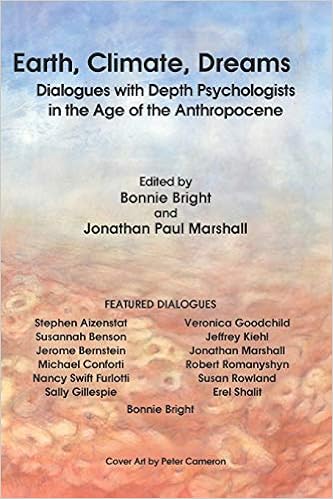
Bonnie Bright and Jonathan Paul Marshall (eds) Earth, Climate, Dreams: Dialogues with Depth Psychologists in the Age of the Anthropocene. Depth Insights Press.

0997955023 and 9780997955026
From: Amazon.auAmazon.com ; Amazon.co.uk

Bookdepository ; Wordery ; Barnes and Noble

The book, as should be obvious, reports on what 13 Depth Psychologists have to say in response to the Anthropocene. It is a collection of interviews with people like Stephen Aizenstat, Jerome Bernstein, Veronica Goodchild, Jeff Kiehl, Susan Rowland, Robert Romanyshyn, Erel Shalit, and other important people, and finishes with a multi-logue between seven of the participants.

[For descriptions of the interviews, and some critical responses, see an earlier blog post]

These people are all major contemporary figures in Depth Psychology, as some of you will know.

I’m going approach this launch in three ways. Firstly I will talk about the background question of the book, then one of my problems with the book and, thirdly, what is great about the book, and why you should buy it.

The fundamental issue

The background issue is that in the West, and most likely elsewhere, we are facing what can be called an existential crisis. That is, we are coming to recognise that our whole modes of being, living in the world and preparing for our future, is undermining our capacity to exist in the world. If we keep on living, acting and thinking as we do, we face destruction generated by those ways of living and thinking. The Anthropocene (the world-systems changing effect of humanity) marks a problem for our whole existence, and undermines our future.

The existential crisis presents a problem at all levels of our being: it is a psychological problem, it is a sociological problem, it is an economic problem, it is a technological problem, it is a cultural problem, a problem for all our relationships to everything. Once recognised, it is both hard to ignore and disorienting, to put it mildly – approaching trauma might be more accurate.

This crisis is the starting point for the book, and the necessary starting point for almost any relevant discussion about the future. The conversations are conducted with Depth Psychologists, because Depth Psychology attempts to deal with the total span of human existence, which includes all that I have just mentioned, from psychology to the world. Depth psychologists are uniquely in a position to approach these issues from a non-specialist position, and to offer tools to help people work with the problems, from their experience of group and individual therapy, from symbolic work with art, literature, and dreams, and from their sense of the intertwining of individual and collective.

My issue

Let me begin discussion of this book by talking about one of the things I find slightly problematic about it, and show why it turns out not to be that problematic, and how it generates insight, when approached with fewer assumptions.

My problem in reading this book was that, sometimes, I thought people found it much too easy to talk as if ‘spirituality’ (whatever that is) was a solution to our problems.

As I argue in the introduction, some types of spirituality might help constitute our problem, and this has to be faced. It cannot be suppressed, and I don’t think anyone in the book would want to suppress this issue.

As a culture, we in this room, have a religious or spiritual history, and in that history people have primarily been taught to see the world as a prison, a testing ground, a den of sin and iniquity. We have been taught to see our human destiny as leading us somewhere else, not this Earth. We are heading for heaven or hell or, at best, the new World after the Day of Judgement. We are not fundamentally creatures of Earth, born with the earth and tied to the Earth. In that sense, the Earth has to be fought against and dismissed for our salvation. If you actually love the world, you are being distracted from your love of God who is not ‘material’; you are loving something inferior and fallen.

This form of spirituality constitutes a problem, it could well be part of the reason it is Christendom that has led the charge into ecological destruction as an unintended consequence of its otherworldly spirituality. If so, then implying that a move from ‘materiality’ to ‘spirituality’ is a solution to the problems of the Anthropocene, is not a solution. Spirituality is part of the problem. Rather than just ‘spirituality’ itself, we need a new psychological and spiritual orientation to the world and to our actions within it.

However, if you actually listen to what people in the book are talking about, and remove the assumption that you know what they talking about, then you can begin to see what they actually mean, and the kind of psychological orientation they are pointing towards, and how this is not just a matter for our consciousness, will power, or decision.

In our society, because of our (spiritual and other) heritage, ‘natural processes’ are largely seen as disposable or replaceable or, to use Heidegger’s term ‘to hand,’ as resources for our own use and mastery of. In our dominant ideology, natural processes only exist for us to exploit. If they cannot be exploited and turned into profit, then they have no value. Natural processes are not something we should have a relationship with. You can see this attitude everywhere, with things like the Westconnex tollway, where we chop down every tree, undermine housing foundations, dispossess people, and fill the air with smog and noise, while providing a tax on travel in Sydney. Or with mining under water tables, rampant landclearing, mining in agricultural regions and so on. Natural processes are, officially, a lifeless backdrop to be pillaged for profit. They have no other value. The world is to be subdued to consciousness and will. The world is secondary to what we can make of it.

Yet this is not humanly true at any deep level. It does not resonate with real human being. Almost every human I have ever met has some kind of relationship to other natural processes, whether living forms, place, or to their own part in the system. They might only notice the connection when the creature or plant or animal has gone, but that is part of our disconnection from reality. This relationship may be to individual animals (their pets, or the dog down the street), to specific trees they feel connected to, to landscape that may seem to be part of us, and so on. Even those people busy despoiling other people’s environments and landscape, can have deep feelings for their own.

This is not really strange, because we think with, and in, this world. We use objects in the world to think with, to feel with, to learn with. We cannot live outside the world. It shapes us. We cannot escape from it. Nature and ecology is part of us, we are part of it; we are plural and connected by our existence, in a living network beyond our understanding.

When we realise this, then instead of treating nature, or other people, as resource objects, we can approach this world with reverence and awe; with a sense of mystery, recognising that we do not fully comprehend it, that it is a being that is both independent of us and impinging upon us. It is us and not us.

We can approach the world with our full ‘psyches’ and, in this, recognition of ‘complexity’ and interconnectedness, are themes which keep recurring in the interviews.

Why use the term ‘psyche?’ Because when we use other terms like ‘psychology’, ‘mind’, or ‘soul’, we already think we know what we are talking about. But we don’t. We don’t consciously know how our minds function, as they function. At least I don’t. I don’t know how my mindbody functions, how one thought gets linked to, or progresses into, another, how language works, how brain action generates mouth and arm action, how my skin heals, my stomach digests, my lungs process air, and so on. Much, probably most of the important things in life, operate outside of our limited awareness, and necessarily so.

“Psyche” plunges us back into the unknown, the entangled complex, interconnected, mess which is reality. We are inextricably if vaguely linked; my psyche does not exist without your psyche. I did not invent the language or all the ideas I use. Interaction with and talking to other people and to world culture has shaped me, and I have presumably shaped some others for better or worse.

We are both collective and individual at the same time. Even a sense of heroic individualism is collective at its base; something we share with others. Our psyches are already alive and part of natural processes. Our full psyches include the land, spill out into the land, into other people, into the processes that are everywhere.

And a realistic view of our selves needs to include all of this material, our culture has generally defined as extraneous, to help us to successfully resist the notion of natural process as a thing to turn into resources to make profit out of. In this new mode, with new practices and ways of perceiving, we can begin to move towards rejecting the system of thought that is destroying the world that we live in. This destructive system no longer makes sense. It seems psychotically limited and self-destructive. That awareness opens a psychological, cultural and activist position. The more we become aware of unconscious process, the less we seem driven by them, and the more free we become.

Let us return to an earlier point. As already implied, there are many unconscious processes. We are not aware of most of what is happening, although we may be more aware than we consciously know. That lack of conscious awareness of how our minds work, and how our physiology works, and how mind and physiology connect at this moment, implies unconscious processes. Some of these happenings I will have perceived, but not made conscious, perhaps because my thought or culture focuses my attention elsewhere, perhaps because there is so much to perceive that I cannot hold it all in my awareness. Even if I perceived it all, I can’t understand everything that is happening, and affecting us, even in this room. Most of life’s ongoing processes are essentially and inevitably outside my consciousness, and therefore unconscious to me.

However, I can become more aware of what is happening or more sensitive to it. I can attempt to perceive reality in different ways. I can turn attention to my neglected or repressed perceptions and drives. Recognising this possibility and being open to the strange and the unknown is what Depth psychology is about. It is fundamental to the process of discovery.

This is why Depth Psychologists pay attention to dreams, which are in some ways messages from the unconscious and the world; from our unconscious perceptions, pattern detections, and ways that we symbolise the unknown. Dreams often require work to understand. It is not always easy, but it can become more so the more we take these fleeting images and stories seriously and treat them as beings themselves. Paying attention to these, and other, neglected processes (fantasies, spontaneous images, scribbles, slips of the tongue, senses of unease, neglected feelings, suppressed thoughts) becomes a way of getting, or admitting, more understanding and data. It starts a new process of being in the world. If we repress our bodies and our dreams, we are likely to repress our awareness of the world. The more we attend to them, the more likely we are to be able to perceive messages in natural processes which are now hidden to us. Our tools for learning can expand outwards…

This new attention can represent a complete change in how we regard ourselves and experience our role in, and on, Earth. We can call this change spiritual if we want to. We can analyse and live our lives from that point of view. We might even be able to see this realisation as having much in common with reports we have classed as mystical.

This awareness involves experience of paradoxes, similar paradoxes to those around reported experiences of God, We are part of the world but separate from it. It is greater than us but still within us. The depths can lead to the heights. We are double sided: our goodness might be cruelty; our aspirations can be unreal or unsatisfying. Reality is ultimately unsayable, but it is pointable too through images and word, and it can be experienced, if we are open to it as it is. This is a new way of being, which can be called spiritual if you wish, or not if it makes you uncomfortable.

So even in the bits I personally have problems with, the book is still full of insights. Full of ways of proceeding. You may have problems too, but encountering this book may help you ponder them and open you. That is why this book is important.

The Good Bits

Let us now turn to the unproblematic virtues of the book. Its chapters are edited and concentrated conversations. They are generally excellent conversations. The primary interviewer Bonnie Bright is really good at her work. She participates in conversations. She contributes to the conversations as process. She draws people out. She listens carefully, and gets people to explain when needed. You could not have a much better interviewer for dealing with issues which could otherwise be quite difficult.

Reading these conversations, you will learn something about a family of understandings of how psyche works, through the dynamics of imagery, metaphor and feeling, and the effect of the unintended consequences of particular modes of consciousness which repress things you need to know about. As I have implied, if you take this seriously and start some of the practices, then you might gain a new view of the world. You might find a way out of the existential crisis, or a way to flourish in that crisis.

Depth psychology is important, because its mode of being, continually deals with problems that the conscious ego cannot understand. This is especially useful for facing the paradoxes, complexities and dilemmas of the Anthropocene.

Topics vary throughout the book, apart from the obvious topics of climate change and ecological destruction, subjects discussed range from discussions of pilgrimage, the aspirations of Dr. Frankenstein and what that tells us about modern life, the collapse of Mayan civilisation, colony collapse disorder in bees and its metaphorical connection to culture collapse in humans, the ways that politics and psyche interacts, the driving cultural complexes of capitalism, systems theory, unconscious forces, communication with the world, and the uses of dreams to gain insight into the world and relate to the world.

The book argues strongly, in various different ways that we need to engage with our full range of psychological processes, and perceptions, to deal constructively with the changes and problems we are facing. We need to understand how the systems we participate within, condition our minds when we suppress awareness of what is happening. If we stay in the psychology of mind we are conditioned to have, then psychological inertia, denial or other processes of repression or projection of problems and hostility onto others are likely to win out. Even if we manage a revolution we will probably replicate the problems we have, plus we will project our guilt onto others, and solve our problems through revenge.

This book explores possible tools to move beyond these psychological limitations and barriers.

Depth psychology can prove useful in this quest, because it tends to focus on neglected aspects of life and assumes that our individual psychology is at least partly collective, and it works through encouraging creativity, imagination, art and symbol production for their own sake, irrespective of judgement or profit..

As well as enlightening, this process of approaching reality is potentially fun and enjoyable; it can also be pretty horrible too, but everyone has the possibility of life changing realisations for themselves and for everyone else. As we are collectively facing similar problems, solutions to personal problems, or the symbols around those solutions, can turn out to be effective solutions for collective problems…. especially when we are working in and with groups. Anyone has the potential to contribute to our collective solutions. You go in and bring the solution back out. It is a cyclic process.

The book tries discuss ways of opening what may be a new way of perceiving the world, and approaching the world, and the role of human psyches within the world, and the way we all could develop.

This is, simply, vital work….. That is why I hope that this book will reach a large audience, even if they disagree with it, it could start discussions.

Climate change as religion?

January 26, 2020

One of the arguments put forward by quite a few people is that acceptance of climate change as being real is a religion. Thus Tony Abbott, ex Pm of Australia and authoritarian Catholic (he does not like the current pope), says:

If you think climate change is the most important thing, everything can be turned to proof. I think that to many it has almost a religious aspect to it.

A few years previously Abbott said

Environmentalism has managed to combine a post-socialist instinct for big government with a post-Christian nostalgia for making sacrifices in a good cause. Primitive people once killed goats to appease the volcano gods. We’re more sophisticated now but are still sacrificing our industries and our living standards to the climate gods to little more effect…

so far, it’s climate change policy that’s doing harm; climate change itself is probably doing good; or at least, more good than harm.

Fox news host, David Web claims that

Climate change revision is the reformation of the new global warming cult. It’s the religion of the Left…  America the prosperous is the Satan.  Hey, every religion needs a Satan… [It helps] scaring the younger generations… They’re easy to frighten, just tell them their world is ending… but do all these climate strikers know what they’re protesting for? Seems the discussion is more often centered around [carbon dioxide] than the environment at large… Our environment is everything around us including and importantly, our economic environment.  We have to be able to afford the things we want to do,” 

We may have to be able to afford the consequences of doing the things ‘we’ want to do, as well. The economy depends on the ecology. Without a working ecology we will have severe problems. However, protecting the economy and its power structures from this ecological realisation, seems vital to this set of ideas. Perhaps it is the challenge to those structures that is the main problem for these people?

Sky News host James Morrow says climate change is “as much about a new materialist religion of globalism” than it is about anything else. 

These kind of statements seem to be a fairly standard rightist line – taken to imply that climate change is irrational dogma. Strangely they don’t make that implication about ‘real’ religion, but it indicates how they think.

However, if the act of accepting that climate change is real is a religion, then its not a comforting religion, or a religion that promises salvation. The religion gets even less comforting as time and resistance to action by the power elites continues.

The faith that is comforting is the joint faith that climate change is not happening and that what neoliberals call ‘free markets,’ working through the “invisible hand” of their God, will deliver liberty and prosperity and solutions to all problems. This faith forms what we might call the ‘Religion of Mammon’. With this religion we don’t have to do anything, or we can fight to keep emitting pollution and poison, and can thank their Lord that the corporate power elite have our best interests at heart, so we can be joyful when neoliberals give these masters of the universe even more power.

We might wonder if characterizing this ‘Religion of Mammon’ as a real religion is problematic? That might be so, if it were not for the well known Protestant “prosperity gospel” or “prosperity theology” which seems quite related to it. Prosperity preachers often seem to have a predatory relationship to their followers, in that they can sometimes claim the more a worshipper gives to the Church financially, the more they will receive from God. Worshippers should finance their private jets for the Lord’s work. In this religion poverty is a sin, and God’s favour is measured by wealth and success. Holding onto the faith that the economy will serve you well is central.

The prosperity religion fits well with neoliberalism and anti-welfare, while psychologically compensating for the effects of neoliberalism and its massively unequal distribution of wealth, and the struggle of ordinary people to move up, or even keep their jobs. It assumes you can worship both God and Mammon (because Mammon is God), and that a wealthy person can get through the eye of a needle as easily as anyone else, perhaps more easily as God is rewarding them. 

While I have not yet done the research, all the prominent prosperity evangelists I am aware of, seem unworried about climate change. Everything is in God’s hands; humans have no capacity to destroy the world without the consent of God. If climate change comes it is part of the end times and the faithful will be saved. For example, evangelical pastor Mark Driscoll stated that there was little need to look after the environment as Jesus was returning. He declared: “I know who made the environment… He’s coming back, and he’s going to burn it all up. So yes, I drive an SUV” (quoted in Veldman The Gospel of Climate Skepticism).

Australia’s Prime Minster has worked in marketing, and is an open follower of the Prosperity Gospel, attending the biggest Church preaching this kind of theology in Australia. It is unusual for Australian politicians to make a big public noise about their religion, so that marks it as special. He also appears to be unconcerned about climate change, and wishes to promote coal mining and coal energy for the benefit of the established economy. If Jesus is coming, then why bother trying to save the Earth? Saving the Earth, might even be going against God’s will and therefore be sinful.

In general, Mr. Morrison also seems quite comfortable with the conjoined Religion of Mammon. I certainly have never seen him criticise it at all, but if people can tell me where he does I will be interested.

Following on from these parallels, it seems fairly straightforward to assert the hypothesis that the prosperity gospel is both comforting, and supportive of the Religion of Mammon; it gives it backing and blends into more or less seamlessly.

The main, non religious, logic that backs the Religion of Mammon, is the idea that a consensus about the evidence from scientists who study the subject of climate change must be wrong, and that the lack of consensus from economists and social scientists about the evidence for benefits of neoliberal economics is irrelevant.

In both cases the Mammonist response is “sinister conspiracy,” and this seems to emphasise that faith in their doctrine comes first, before the evidence of the world.

With the Religion of Mammon life is easy. The correctness of science can be decided by whether it supports the elites of this religion’s favoured brand of corporate domination or not. If it does, it is real, and if it doesn’t, it must be imaginary. This position seems part of the way they try to make sure we all get ruled by their favoured big corporations and the few of the wealth elite, and never the people. Entrenched corporations must never be curtailed. They could well be the expression of divine will.

As David Web implies above, the most important part of our overall environment is the economic system, and that must not be altered. Any attempts to alter it can then be condemned as ‘socialist,’ because the neoliberals have spent 40 years telling us socialism is bad, and equals state communism. As he says “every religion needs a Satan.”

But if you think all climate scientists are socialists, you probably don’t know many scientists, or you think socialism is scientific – which I do not, although it is a better theory of life than neoliberalism, which would not be hard…

However, this politicization is unreal. The idea that the science of climate change is legitimate, is not exclusive to the left, there are quite a few people on the right who think it is worth taking note of, even though they get shouted down, and told they are not proper members of the Church of Mammon. A YouGov survey implies that only 15% of people in the US think climate is not changing or humans are not partly responsible for the change. A recent Pew Report claims that 67% of people in the US think the government is doing too little to reduce the effects of global climate change, and 77% think the US should be developing Renewable Energy in preference to expanding fossil fuels.

So there is a reasonable number on the political right who seem like they would support action, but then many Republicans do not seem keen on neoliberalism either, (or they protest against its effects), and many non prosperity gospel Christians are now facing up to climate change, and talking about the importance of not destroying God’s creation. [1], [2], [3], [4], [5], [6], [7], [8]. The Religion of Mammon may be becoming more isolated, but that could make it stronger, as it clamps down on communication with sinners.

Perhaps because of the comfort provided by their religion, the Mammon elites do not seem interested in preparing for natural risks; this is a weakness which may affect support for them in the long run. They are capable of preparing for other risks, but not environmental ones. They even seem happy creating new risks as with releasing more poisons, such as coal ash and so on. This is odd. And the only explanation I can think of is that they feel they must support the corporate mining elite, or they are bought by that elite – so what if a few peasants get sick?

We are faced with the simple fact that because of their ideology, that Mammonists in Australia, cut back on fire prevention, refused to talk to worried fire chiefs, ignored all the warnings from scientists, ignored the severity of the drought, and hindered preparations… As a result the East coast burned, the worst it has apparently ever burned. Farms and forests gone. Rainforests that have not burnt in hundreds, maybe thousands, of years have burnt.

I guess they must be pleased that they ignored all the alarmists, and kept the faith with their comforting religion of free market denial, despite the fact it seems to be getting hotter every other year, and never returns to ‘normal.’

This is why they still want to violate their supposed ‘free market’ principles, and pour taxpayers’ money into coal energy and coal mines, because no private company will build coal power without subsidy, but it makes sure that taxpayers are subsidising the right people.

The system is self reinforcing, as it means that the reason for the solutions to climate change looking socialist is that, until recently, very few non-socialist types of solutions have been presented to the general public – other than leave it to the market, which it seems the Church of Mammon does not believe either. The question is whether those non-socialist solutions have been actively suppressed, or whether they have been ignored, with the aim of squeezing a bit more fossil fuel profit from the disaster. Of course it may be possible neoliberal theory is so inadequate it cannot deal with environmental disasters at all, and so its holders have to pretend it is not happening.

Oh, and on the other side of the business sector. The high employing tourism industry is estimated, by Australian Financial Review, to have lost about AU$4.5 billion, as a result of the fires. But they are mostly small business and so to be abandoned. The Religion of Mammon only respects the massively wealthy, as they clearly have the approval of their Lord.


Bushfire regeneration and transhumanism

January 21, 2020

Earlier I wrote a post about the possible difficulties for the regeneration of the bush.

I’m now interested in the continuing idea that the bush will regenerate without problems, without any human help. This idea seems quite common, but often hides a disregard for what is currently present, or for creatural suffering.

For example, one person wrote:

The bush will always recover. It always does.

Now that appears to be a non-problematic statement, even if it might be false, but it is problematic for a number of reasons we can observe in what I’ll call ‘denier’ literature. It implies no change, but when pressed it appears lack of change is not what is meant. The sentence comes from a disregard for any kind of change in ‘nature’. It becomes transhuman, or post-human, in the sense that humans are rendered irrelevant spectators; they are just another unimportant species which could cheerfully go extinct. Humans do not matter, and have no effect on anything, and it is merely a conceit to say they do. However, it can appear that support for human irrelevance is accompanied by an apparent horror of change in economics or power relations.

My response to this was much as I wrote in the previous post:

If the fire was too hot in some places, then it could destroy seeds, so the bush won’t regenerate. It could have killed the insects so there is no pollination, and it could have killed the birds so there is no seed distribution, animals will not dig up the soil… We shall have to see. It is, in any case, unlikely the rainforests will regenerate quickly.

The response was:

This has never been seen in the history of earth. Although it could be possible. The earth always regenerates. If not exactly as before but as new species emerge. Never doubt the amazing ability of nature to re-emerge. Otherwise mamals like us would still be scurrying in fear in our burrow.

There is an initial comforting suggestion that nature will go on and recover (as such failure is apparently unseen “in the history of the earth”), but in the end the suggestion implies that the person is really arguing that humans cannot kill life on earth. The latter point is probably true, but it is not even vaguely the same as the former. “Recover” usually means return to something like what it was previously, not become something completely different, even apparently dead or wiped out.

By talking of evolution (and conflating it with progress), and life in general, the suggestion avoids creatural suffering; effectively creatures are just being wiped by natural forces, and there is nothing to worry about or be concerned about. Some other creatures may be impelled to progress and crawl out of their burrow. Being sad at animals and humans being burnt to death, or ecologies being destroyed, is clearly silly, from this transcendent point of view.

So the person recognises the reality that Earth does not always regenerate in ways that are happy for humans or other creatures, or in ways which are similar to what was before. We can add, that this has happened many times in the history of humanity, and civilisations have seemed to collapse as a result of the changes. Failure to recover has been seen many times, even in the short span of human history. So they are contradicting themselves, apparently in order to be comforting, distant and uninvolved.

Failure to recover, can be how deserts form; humans change the environment, say through intensive agriculture, and an unintended consequence is that the land does not regenerate, and people can no longer live there. Perhaps that is helped by wider climatic and ecological changes which are being ignored, I don’t know. However, deserts have been supposedly expanding for quite some time now, and are likely to expand in Australia. One possible sign of this is that after the fires there have been massive dust storms as top soil has blown away.

Evolution is, in current human terms, more or less irrelevant. New species can take tens, maybe hundreds, of thousands of years, or longer, to emerge, although colonising species can move in and produce long term change to previous ecologies pretty immediately. Evolutionary frameworks, when used in a certain way, appear to be yet another mode of distancing oneself from what is going on.

To repeat: in human time-frames, destruction is quite possible, and neither the flora nor the fauna may recover. The change could come with an extinction of species, that might otherwise not have occurred for considerable amounts of time

The arguers response to this, is to assume that wanting the world to be safe for humans (and as many other creatures as possible) is human arrogance. We can destroy what we will and it does not matter because everything changes, and hey no individual species is of any import.

Nature does not aim to please our arrogant species. It will regenerate in ways that best suit the new environment. Simple. We may find it tragic, but that is purely subjective. The very notion that we somehow know what is best for nature is dangerous at least.

If this is the case, which is probably correct, then saying the flora and fauna will recover is misleading, because it may not.

It is much more accurate to say, the old ecology could possibly be destroyed, and a new ecology may eventuate. This may be bad for a whole heap of plants and creatures, and good for some others. Change happens. There is no straightforward recovery. But this is not what is being said on the surface – and it is odd that it is not being said, because it is not difficult to say, and this silence implies some other rhetoric is in play.

While the idea that whatever happens after human induced destruction is ok, may be extremely dangerous, it could be comforting to the destroyers. Perhaps this is a quietist response to the recognition that humans (including ourselves) are destroying the world?

So, it may not be surprising, when it turns out the person does deny human induced fires, and posits that the bushfires are a purely natural process (which they are of course).

However, this position obscures the role of humans in the fires, and the politics of that role. Not only climate change or accident was responsible. Humans lit some fires. The government cut back on fire fighting services, refused to listen to advice that the coming season could be bad, especially given the drought, made no preparations etc. So the fires were partly human induced, even if we posit that there was no human induced climate change.

This is a post-humanism which acts to excuse human actions, by making everything equally ‘natural’ and humans irrelevant, while pretending that

  • All is well, and normality is not threatened,
  • They have a modest non-interfering model that represents humans as not the dominant species, as opposed to those who would try and direct the actions of nature.

When you push, it appears that they think that altering our destructive tendencies in economic and political behaviour is bad. For them, going along with our economy is natural and apparently not directing the actions of nature. Perhaps the economy is considered more ‘natural’ and immoveable than the Earth itself? Planning mitigation or amelioration, or the politics which might lead to such actions is defined as conceit. We are not to try and disrupt corporate power.

Doing nothing to oppose the routine pollution, and destruction, of ecologies by business and governments is accepting a plan to interfere with natural processes, and to prefer profit for some over survival for all. And perhaps that is the intention.

First: say everything will recover. The earth always regenerates

Second: if pressed, admit ecologies will change and creatures and plants will become extinct.

Third: suggest that any actions or thinking taken to prevent this extinction and harmful change, are conceit and we should quieten down and accept our insignificance, and accept the flow.

Fourth: do not worry about the ecological consequences of corporate and government action, because it does not matter in the long run. Humans are irrelevant after all, and we could have no effect either way. Let it, and the social power relations, continue. Let us submit to fate, or rise above the earth, rather than become political or active.

Mencius on property

January 21, 2020

When Mencius, was visiting King Hwuy of Lëang, the King went and stood with him by a pond.

Looking around on the wild geese and deer, large and small, the King said, “Do wise and good princes take pleasure in these things?”

Mencius replied, “Being wise and virtuous, they have pleasure in these things. If they are not wise and virtuous, although they have these things, they do not find pleasure in them.”

Mencius continued: “King Wan had a park like this, which was for himself and the people. He used the strength of the people to make his tower and pond, and the people rejoiced to do the work, calling the tower ‘the Marvellous Tower,’ and the pond ‘the Marvellous Pond,’ and were glad that he had his deer, his fishes and turtles.

“He had his tower, the pond, birds and animals, but how could he have pleasure alone? The ancients caused their people to have pleasure as well as themselves, and therefore they could enjoy what they had.

Mencius encounters a President

January 21, 2020

The opening chapter of Mencius reworked slightly….

Mencius went to see President Trump, of the Kingdom of the USA. The President said, “I’ve never heard of you. I guess you’ve come a long way to listen to me, like all the best people do. But my advisors tell me you are a smart guy, perhaps you have something to say about how I can profit my kingdom and business?”

Mencius replied, “Why must your Greatness use that word ‘profit’? If your Greatness asks, ‘What is to be done to profit my kingdom, or profit my business?’ then the great CEOs and Ministers will say, ‘What is to be done to profit our families, and our business?’ and the lesser executives and the common people will say, ‘What is to be done to profit our persons?’
“Everyone will try to make the profit out of each other, and the kingdom, or the business, will be endangered.
“If righteousness be put last and profit first, people will not be satisfied without snatching everything they can. It makes a war of all against all.
“Let your Greatness make benevolence and righteousness your only themes—Why must you speak of profit?”

The Great President replied: “You must be a fucking socialist. Completely impractical. Get out. Who brought this idiot?”

A brief comment on the US Democratic primaries

January 19, 2020

People seem to be noticing that Bernie Sanders is either getting a hard time in the media, or he seems to be being ignored, even in the supposedly left media.

This illustrates the proposition that there is no mainstream left-wing media in the US, whatever Fox and its friends declare. To reiterate a point: all mainstream US media is corporately owned, and depends on corporate advertising. It is necessarily corporately controlled and will rarely challenge the interests of its owners and sponsors.

If people can recognise there is no left wing media, then it becomes obvious the media will not treat Mr Sanders well. After all, they could not even bring themselves, in general, to treat Hilary Clinton particularly well, and they participated gleefully in spreading and repeating Republican slurs against her for thirty years. And Hilary Clinton was only a moderate threat to corporate power.

This hostility is nothing to do with the Democrat establishment. It is a fact of life over which they have no control.

From their point of view, the media hostility towards Sanders would become part of his campaign. The hostility is such that Democrats could well decide that it is not worth the risk, unless they were shown otherwise by massive voting for Sanders, and a massive grass roots campaign. People tell me he has the latter, but it may not be enough to get votes from Democrats in the primaries – we do not know yet.

While it seems probable that the media would be hostile and dismissive if Sanders won the nomination – we can guarantee that if he does not get the nomination, the media sphere will be full of stories about how he was betrayed, not by the media (which will not be mentioned), but by the Democrat establishment, so as to try and convince left-inclined people to vote for a third party candidate and put Trump back in, who will then continue his moves to destroy the ecology, destroy health care, destroy protest, destroy the constitution, make money for himself, and have a war.

On the other side, if Sanders wins the Presidency, then the hostile media may have given Sanders useful experience for dealing with a hostile congress and Senate, when the Reps get voted back in.

Problems for oil finance

January 19, 2020

If correct, this is an extraordinary piece of financial news, that deserves maximum publicity.

The Institute for Energy Economics and Financial Analysis reports that:

“ExxonMobil, BP, Chevron, Total, and Royal Dutch Shell (Shell), the five largest publicly traded oil and gas firms, collectively rewarded stockholders with $536 billion in dividends and share buybacks since 2010, while generating $329 billion in free cash flow over the same period.”

This means that

“Since 2010, the world’s largest oil and gas companies have failed to generate enough cash from their primary business – selling oil, gas, refined products and petrochemicals – to cover the payments they have made to their shareholders.”

Pouring money into shareholders is not an obvious investment in future business other than in perhaps suggesting you are a good investment, and trying to increase the share prices, which are often tied to bonuses.

“Asset sales have been a crucial source of funding of dividends and share buybacks for the supermajors.”

This is not using asset sales to make new investments, or carry out new explorations or research into technology or new business ventures – this is odd.

We should also note that oil companies do not pay the tax they should, which also makes them precarious if governments were to insist that they should.

Again from the IEEFA

Australian company Telstra paid twenty times as much tax as all of the oil and gas companies in Australia despite having similar revenues according to the latest data provided by the Australian Taxation Office (ATO).

Companies working in Australia’s oil and gas industry paid just $81 million in tax in 2016-17, while Telstra with a comparative revenue of $26,948 million paid $1,644 million in tax.

“Catherine Tanner, the Chief Executive Officer of BG Group promised around $1 billion a year in taxes and $300 million a year in royalties for its petroleum project in Queensland,” says Robertson.

“The reality is BG Group paid no tax in 2016-17 nor did its parent Shell Australia

IEEFA notes $195 billion of Australia’s natural wealth is being exported with $0.00 royalties or royalty-type petroleum resource rent taxes (PRRT) being collected.

One way of interpreting both pieces of news together, is that oil company executives think they are heading for trouble, and they want to shovel as much money to their established shareholders (including high level executives) as they can, possibly out of defrauding tax-payers, before they collapse.

Problems for Renewables: Apparent costs and ‘lock-in’.

January 18, 2020

Costs of building new renewable energy systems, are difficult to estimate accurately, as are the costs for fossil fuel and nuclear energy generation.

One of the problems of capitalism is that it functions through hype, exaggeration, advertising, PR and so on. The fight over information is part of the fight over sales and subsidies. Subsidies are frequently ignored as part of the costs, or claimed not to be costs, in order to make products look cheaper, or to keep the subsidies from people’s objection. People can also exagerate benefits of particular innovations, or promised innovations, to get research funding or for commerical purposes. This activity makes it more likely for people to hold off purchase, until a product is ready for market, or to purchase an existing product. Few decisions in this arena can be entirely rational, or based on guaranteed useful data.

This is to be expected. While communication is not possible without the possibility of deception, social systems can increase that probability or, possibly, diminish it. We have a problematic system. People have political and economic reasons to misrepresent all kinds of ‘facts’. In our system fake news about almost everything is absolutely normal – especially if the fakery is already established, or supports established power and energy relations. Consequently it is hard to get accurate figures on anything to do with sales of large projects.

We can only look at appearances, and these seem reasonably clear.

In Australia coal mines often depend on taxpayer subsidy. We build rail lines, roads, and offer them free or cheap water at the expense of farmers and towns. We don’t insist upon them rehabilitating the mines; just a few trees around the mine edge, to obscure the views of passers-by, might be enough, if even that much gets done. We don’t require there to be any expenditure to clean up the ongoing pollution they issue. They can destroy our water table and water supply and that is just considered bad luck.

The jobs provided by coal mines are minimal. Adani has a royalty holiday, and Barnaby Joyce even wanted taxpayers to give Adani 1 billion dollars for more or less nothing in return except loss of water from the water gift. As it happens, the IEEFA estimate that Adani is already “set to receive over $4.4 billion of tax exemptions, deferrals and capital subsidies from Australian taxpayers,” assuming a 30 year life for the mine.

In effect, with coal, we seem to pay people to take our minerals and destroy our environment. At the least they get a lot of earnings which are tax free.

Similar events seem true of coal based energy. Burning coal not only produces climate change but it also poisons people and ecologies. I guess we have been using coal for so long that we don’t recognise the dangers. As well, coal gets government support for it to be locked-in. In the US Trump is apparently trying to cut pollution standards to make coal more economic. Death and illness is of no concern.

In Australia, we also face the problem that most coal generation is nearing the end of its life, by 2030 55% of coal fired energy stations will be over 40 years old, and heading into unreliability. We need to build replacement sources of energy, or we will face large-scale shortages of energy. This is simply fact.

Renewables are now said to be, generally, either competitive with coal or cheaper than coal, although there is debate [1], [2], [3], [4].

In Australia, it’s obvious they are more than competitive, because the government has to keep talking about taxpayer subsidy for new coal energy, or talking about forcing people to keep old coal fired energy stations going. No one wants to build coal energy stations on their own bat. The government also appears to have guaranteed to purchase electricity from Gas, to get it going. On the other hand, heaps of companies in Australia seem to want to build renewable farms, and this is despite considerable regulatory inhibition and ambiguity. (The same appears true in the US where, according to Bloomberg, “a total of $55.5 billion were spent in the sector last year, an increase of 28%”, which is apparently a record). In Australia one of our main problems with renewables seems to be government regulation, the political power of the coal mining industry, and ongoing tax concessions and subsidies for coal. Some this regulation is left over from the kind of regulation which helped centralised coal development, and now promotes coal lock-in and hinders coal-exit.

If we balanced the competition by removing the hostile regulation and subsidies for dirty energy, it would probably help renewable growth.

Whatever the case might be here, countries which sell coal seem to be offering subsidies to third world countries to get them locked into coal based energy production, and slow down any renewable transformation. If places never use much coal, then they may not miss it. This is economic power attempting to structure the energy market to give it continuing markets and profits without having to change. Coal companies are fighting for their profits and that involves politics as part of their market action. We should assume that coal producers act similarly in Australia.

Another problem is that network costs are important. It is frequently objected that renewables require new grids and this is costly. A problem we face in Australia is private ownership of the grid by companies who are reluctant to invest in getting the grid to places where the renewable energy, which competes with their energy supply, can be built. This is a lock-in produced by ownership. Ownership also gives power to influence markets.

Existing fossil fuel generation has a legacy of networks which were largely paid for by the taxpayers and then sold on. This should diminish coal costs, and produce lock-in to energy generation at particular locations. However, given that coal energy stations are not being rebuilt or renewed, it does not seem to.

Other forms of energy have the same network problems, but they seem to be ignored. Every time a new gasfield comes online, pipelines have to be developed, and that does not seem a problem to those objecting to networks for new renewable sites.

If governments took climate change seriously, then building new powerlines in consultation with the industry, would probably be the way to go. It would be costly, but still less costly than doing nothing, and could probably be helped to be paid for by removal of subsidies for fossil fuels.

Storage is also a cost issue, but in some places you have to include storage as part of the development, so (in those cases) it is fixed in. Also if we spent more money on R&D we might develop simple cheap solutions (we might not, but we are more likely to). The Scotts are apparently using heavy weights suspended in deep pits. [see also] This works like pumped hydro without the need for water – which would be a bonus in Australia.

Another objection to renewables, in terms of cost, is that they are intermittant, so we have to overproduce to get a stable supply. But if we do over-produce, this is not necessarily a problem. Over production is useful as, for example, when excess power can be directed into making hydrogen as a portable back up fuel, and shut down when heavy demand returns.

People are still arguing that nuclear energy is cheap and effective, but often do not include the expenses of decommission in that cost. But as I have argued before, with nukes, the big trouble is that no-one in the West seems to want to build nuclear, because it is not economical, and most of the nuke companies have gone out of business, or gone out of the business.

The UK government had to guarantee massive electricity prices and taxpayer funded indemnity at Hinkley Point, because no one would insure it. It’s also running massively over budget.

While I could be wrong, I am not aware of anyone prepared to build fossil fuel or nuclear energy supplies, in Australia, without massive subsidy, guaranteed prices (as with the gas energy mentioned above) or even subsidy and diminishment of safety requirements. This indicates to me, that both of these sources are less economic than they once were, and this is before you add in the costs of the ecological destruction or climate change they generate. In practice Renewables are ready to go, especially with a little network planning, or admission that the market does not solve every urgent problem in the right amount of time.

Ultimately we cannot absolutely expect the kinds of service we have now. If we keep on with fossil fuels, and ecological destruction the situation is likely to become untenable – we are already destroying the Earth’s carrying capacity. We have to shift to another source of power. Nuclear does not seem viable. That leaves renewables, which are not yet built in anything like the required amounts, and which may not be continuous, although they can be made close to continuous.

Only thirty or forty or so years ago, power black outs were quite common in Australia, and we managed to live with them. So we can probably manage to live with them now.

Environmental ecology is an important part of the social and economic process. The environment currently keeps us going without much human input. If we keep destroying it through pollution, then it cannot. Everything depends on everything else. We have to either repair the environment, which costs, or make an artificial envionment which probably costs more.

So at all levels, controlled low-pollution production of renewables, seems like a reasonable solution, one that is actually favoured by markets as well as by environmental concern.

Climate paranoia, or the real reality?

January 17, 2020

I have just received an email, that tells me that

“Vatican Societas Iesu and Secular Illuminati controlled City of London, People’s Republic of China, United Nations and Obama led US Senior Executive Service Satanic Occultist SOCIALISTS have initiated WAR AGAINST the population and land of AUSTRALIA”

Yes this is through the bushfires and through generating climate change….

You will notice that everyone evil is a Socialist, a Catholic, a financier, Chinese, black, or Satanist. Goes without saying – but they are really Socialists. This perhaps means the Protestant Right now hates everyone. I wonder if the use of the City of London, is a deflection from Wall Street; so that the financial evil in the world is British, not American? or just an expression of all those US movies in which the villain has a British accent (if they don’t have a Russian or Arabic accent). Have these supposed truth seekers been BOUGHT OUT by US finance?

That the US has a Senior Executive Service Satanic Occultist explains a lot. That must be how Trump got in.

“Drought has been engineered through criminally unconstitutional ‘water harvesting’ privatisation of natural water resources.”

This is possibly correct, and privatisation of water has affected rivers severely. Always good to start with something plausible, but this is soon left behind.

“criminally irresponsible neglect of ‘controlled burn’ forestry management”

Ok that’s from Mr Murdoch and the Coalition, and about as wrong as it gets. the controlled burning did not have much effect, even though the rural fire service in NSW supposedly exceeded their targets. Of course things can always be done better. But 17m Hectares is a lot of burning.

If you want a conspiracy about lack of prevention then you could ask what has happened to Peter Dutton who is head of Emergency Management Australia. EMA is supposed to aim at building “a disaster resilient Australia that prevents, prepares, responds and recovers from disasters and emergencies.” It appears Dutton and his department were warned, after the election, of “more frequent and severe heatwaves, bushfires, floods, and cyclones. These will increasingly occur concurrently.” However, he did nothing, and has disappeared during the fires, leaving Scott Morrison to take the heat and the blame.

Anyway, apart from real politics, we have:

“Stratospheric aerosol injection of aluminum and barium fire accelerants.”

Ingenious.

“Amplified by Ionospheric Microwave Heater Array weaponry”

How good is that?

“The enormous fire disaster in Australia has nothing to do with anthropogenic carbon dioxide emissions ‘climate change’, let alone Australia’s anthropogenic carbon dioxide emissions” [This idea of climate change is promoted by] “celebrity prostitutes and Socialist activists delusionally insist in fervent mass murder”

There you are, trying to stop people destructively changing the earth systems is now to be classed as mass murder.

And this fire disaster represents a political take over by such people as:

“Extinction Rebellion, School Strike 4 Climate and the National Union of Students.”

Yay!!!! But these evil students want

“total conversion to SolarCity and SpaceX/StarLink/NeuroLink ‘Smart Grid’ Neural Implant Integrated ‘Internet of Things’ Electronic Enslavery & Eugenics Extermination 5G ACTIVE DENIAL Microwave Radiation Weapons of Mass Destruction.”

Whatever that is.

Insects are being exterminated via

“MASSIVE MICROWAVE OVEN WEAPON OF MASS EXTERMINATION VIA CARCINOGENIC CIRCUITS & CYBERNETICS”

I guess this is more obvious than insects are dying because of genetic modification of crops, massive use of insecticides or changing ecologies.

“5G Ghz Prelude to 6G Thz Plague
UN Agenda 2030 ‘666’ Terra Hurts ‘Lake of Fire'”

I like Terra Hurts…. and the 666 frequency. But again I understand many people are disturbed by 5G, so we might as well add that to the mix.

“Kevin Rudd & Julia Gillard’s massive donations to Clinton Foundation Pay-to-Play Child Sex & Cannibalism corruption, blackmail and extortion linked to Cardinal Pell”

In case you didn’t know, the first part of this is standard right wing noise. There is precious little evidence presented, but then the Clinton Foundation is not the Trump foundation, which seemed to indicate its charitable object in its name. Anyway, we all know Hillary is crooked, so this just adds to the weight of socialist, Satanist, English, Chinese, Vatican crooks. They all have something in common. We don’t like them.

China is bad, it is growing emissions… but

The rabid, deluded and democidal POLITICAL “climate change” drones refuse to ever direct their efforts against the PRC:

That could be because many of them don’t actually vote in the PRC, or speak Chinese, and they have no political influence there. But plenty of people do criticize China and India, although both countries are expanding their renewables at a considerable rate.

“ACHTUNG ! Stop breathing ! How dare you exhale CO2 ! I said stop breathing !”

This, I presume, is a parody of a person who believes in climate change. Clearly these people have swallowed the idea that CO2 is absolutely harmless under all circumstances, and we can have as much as we like. Here let me show you:

before the beginning of the Industrial Revolution, atmospheric carbon dioxide densities where at near starvation levels for planetary flora whereas the current atmospheric carbon dioxide density is still only 40% of the optimal level for planetary flora.

We need more CO2 its good for you, even if its poisonous. The people who wrote this must be the EXTERMINATING SLAVES of the fossil fuel companies!!!!

We should also probably stop chopping trees down, so they can benefit from all this beautiful CO2, but that is not part of the agenda either, maybe they are fossil fuel bought out loggers. Oh and wasn’t China bad for increasing its emissions? If emissions are good, surely they should be welcomed as saviours of the worlds plant life?

I ran a game once in which the criminal shape changing lizards who ran the world, were trying to terraform Earth to something more suitable to their biology….. Seems like reality has almost caught up….

Climate change is the kind of strange object which for many people seems to make a conspiracy of disparate powerful and non-powerful people, (Catholics, Satanists, socialists, politically diverse scientists, school children with hyper-weaponry), more believable than a conspiracy of neoliberals and established fossil fuel interests, who already have networks, paid for think tanks, paid for politicians and a documented reputation for deception and ruthlessness. Indeed the success of the latter can be shown by the fact that the former have not managed to get any thing done to delay climate change at all, and the latter have managed to do things which should make it worse.

Why is this displacement so?

Dangers of nuclear energy

January 17, 2020

There is quite a lot of space being spent on denying that nuclear energy is dangerous.

One way of doing this is to compare the number of deaths we can attribute to coal to the number of deaths coming from nuclear energy. Unfortunately I cannot paste in the graph from this site, but it alleges death rates from energy production per TWh are as follows:

  • 32.72 for brown coal
  • 24.62 for black coal
  • 18.43 for oil
  • 4.63 for biomass
  • 2.82 for gas
  • 0.07 for nuclear

It is impressive to see how many people die from fossil fuel poisoning.

We should also note that there are quite big disputes about how many people died as a result of Chernobyl (in Ukraine) and Fukushima (Japan). As Wikipedia notes in its current article on deaths in Chernobyl: “From 1986 onward, the total death toll of the disaster has lacked consensus; as peer-reviewed medical journal The Lancet and other sources have noted.”

These deaths are quite hard to measure – unless people have large scale radiation burns, then they could have died from other causes. There are political and business reasons for lowering the death count as well. The initial Soviet reports claimed 2 people had died at Chernobyl. Hardly anyone accepts that figure today. On the other hand, some people might blame unrelated sickness on the accidents. Again people may not have died but may have been sicker than they would have been. The radiation spread quite a long way. In 2016 The World Health Organisation said “more than 11,000 thyroid cancer cases had been diagnosed” in the three most affected countries, but they gave no information as to whether this was much higher than normal, per head of population.

I remember reading the early descriptions of the Fukushima accident which implied quite large amounts of radiation sickness amongst the workers who heroically went back in to try and shut it down. This is no longer mentioned. Hopefully, they all healed, rather than were ignored. However, the big problem is that, in neither Chernobyl or Fukushima, has it yet been possible to clean the site, or seal it permanently. Both sites are still problems.

Anyway, despite the lack of agreed figures, it certainly seems likely that fossil fuels have been more overtly deadly than nuclear energy.

However that does not mean we should automatically go for nuclear. There are still the problems of expense, subsidy and few trustworthy companies wanting to build them. Never mind the lack of enthusiasm people show for living near them. Or the difficulties of guaranteeing waste disposal safety for ever.