I posted this quick analysis of Trump on the 26 March 2017, which is about 2 months after Trump came to power…. It seems pretty accurate for the rest of his reign, although I did not anticipate how much lying and positive thinking would dominate his mode of operations.
*********************
What we have learnt about Republican politics in the last couple of weeks….
1) It appears Trump cannot do deals even with his own people. He makes threats and then withdraws when they don’t agree.
2) The Republicans can criticise something [policies and legislation] for years, but have no idea what to do, when it becomes time to do something.
3) Trump, and his party have no ideas and no plans, just vague directions and value judgements. [I did not guess how harsh, those value judgements would come be, and how they would seem to consign non-agreeing people to the pit].
4) Their directions can be summarised as: always subsidise the rich, always step on the poor. Pollution is good.
5) If anything goes wrong, Republicans will blame the Democrats [mainly Hillary Clinton and Obama], because the failure can’t have anything to do with them. [They are still fighting Clinton].
6) They will probably try and sabotage Affordable Health Care, or any other protective legislation, simply to get revenge and give corporations liberty. [This fight seems to now include being against the right to vote]
7) Trump follows his ‘instinct’ or intuition, and he is always right – even when he isn’t.
8) He does not need any empirical checks or testing. He just ‘knows’, and thinks everyone will come to agree with him eventually.
9) Consequently he hates science.
10) Hypothesis: It would seem there is no dealing with, or reasoning with such people. They can go anywhere their drives, intuition, complexes, or possession, take them – and they will take others with them.
11) There is the possibility that most of them would rather destroy the world than confront their fallibility. [This seems even more true nowadays]
The report comes from the Australia Institute (AI) and the the Victorian Energy Policy Centre, who will undoubtedly be dismissed as a bunch of old lefties, or the socialist dictatorship in hiding.
The Report is being issued ahead of an important meeting scheduled for mid this year in which Australian energy ministers will decide on a new design for the National Electricity Market (NEM), based upon advice from the Energy Security Board (ESB), and which should be implemented in 2025 or thereabouts. The new design is intended to maintain reliability, stability and security. Current politics suggest that the favoured solutions will be new fossil fuel power stations – probably gas, but we cannot predict with certainty. The ESB advice should be published soon, so this report is probably a bit late to have much influence.
The Socio-Technical Problems
Many technological problems turn out to be social problems, in that the technology is designed for particular ends, to intensify power relations, keep challenges to power relations at bay, or to support (or challenge) the established ways of doing things, although these intentions may be undermined by unintended consequences, or by a change in demand (as with the decline of fossil fuel based electricity). The fact that the energy system will be set up, to some degree, by the social intention of some groups of people, makes this claim clear.
Some terminology
However, let us begin with some technical vocabulary, because it is part of the socio-technical imperatives, providing both focus and limitation. For example, the new design for the market could be limited as it apparently does not include emissions reduction as a primary focus.
The ESB’s workstream is focused on inertia and system strength services. Inertia refers to the extent to which the power system resists changes to demand and supply, over microsecond time scales. System strength refers to the extent to which a stable voltage waveform is maintained after disturbances to the system, such as from short circuits.
Security refers to the ability of the power system to stay within safe technical limits…. [and] less synchronous generation does present a system security challenge
In the past coal, gas and hydro were used to produce stability in both frequency (the rate the system oscillates between positive and negative voltage) and voltage. However, that dependency is becoming a problem. Prof Bruce Mountain, Director of Victoria Energy Policy Centre at Victoria University, Founder of BeatyourBill; and Director of Carbon and Energy Markets (Pty Ltd) and part of this research is quoted as saying:
“The business model underpinning coal and gas is collapsing before our eyes…
“Renewables already create the cheapest electricity in the market and the last leg the fossil fuel industry had to stand on was the security services they have historically provided. Now we can see [see below] that even those services are being delivered in a more reliable and affordable way by renewable energy and that trend will only accelerate in the future,”
In the summary of the research (Discussion Paper) Dan Cass remarks:
One of the emerging difficulties is that coal generators are starting to lose money and make financial decisions that harm system security. They will reduce maintenance, generate at a lower level and mothball or ‘decommit’ units, which makes them unavailable even when required for system security
So the system is becoming unstable because fossil fuels are failing financially not directly because of renewables, as is frequently suggested. Fossil fuel generation is starting to lose money primarily because there is less and less demand for electricity during the day, because of rooftop solar, which possibly has something to do with people’s response to climate change. Hence the idea of either letting the system turn off domestic solar, or charge for domestic solar export, which might help bring in extra income and provide a role for fossil fuels.
Renewables may supply stability if the system is configured correctly
As we have seen above, the research claims necessary security and stability services are being increasingly supplied by renewable energy, batteries and demand response, making coal and gas less essential, which probably makes them even less profitable.
Batteries and demand response provided more than a third (38%) of all frequency control markets in Q4 2020, despite comprising just 0.5% of the grid’s generation capacity
Now 38% is not that close to 95% or thereabouts…. so we are nowhere near there yet. However, they go onto claim that Energy Australia’s proposed new 350 MW is “likely” to be able to give three times more stability than was given by the discontinuing 1,480 MW Yallourn coal power station. Which suggests that more large batteries would provide even more stability and possibly all the useful stability we might need.
Over the long term the NEM might not need inertia as conventionally defined at all.
‘Might’ is a hypothetical, suggesting we need more work here. Anyway, the research claims that there is:
no technical obstacle to… replacing the system security which has been provided by coal and gas generators. Innovative new inverter-based sources are already proving themselves cheaper and better than legacy technologies.
Solar, wind and batteries use inverters to convert DC to AC and control power output to the networks and this ‘inverter-based’ class of technologies will <likely> provide most inertia and system strength in the future
These inverters could have advantages if set up properly.
Inverter-based systems can resist system frequency change, like a synchronous generator. Software determines the shape of the frequency response. Inverter based systems can also provide fast frequency or active power response, which does not mimic a synchronous generator and may be as fast as 70 milliseconds [which is a lot faster than the present system]….
The settings on grid-following inverters can be tuned so that instead of creating cascading system strength and inertia problems they can support system strength.
Batteries also can be ‘grid forming’ – “setting frequency not simply following it” and batteries “have inertia in proportion to energy stored”.
Interestingly, the AI adds that “new or stronger interconnections in a network increase inertia” (Cass p.6). This seems to be a suggestion in favour of more “poles and wires” and making a more distributed grid.
They also estimate that:
the cost of system security represents around 2% of the cost of wholesale energy
Which is surprisingly little in my eyes, and suggests a relatively easy transition.
Regulation
However, transition will probably not occur at the moment, as the existing regulatory structure inhibits that transition. Regulation is part of the social background to technology, and usually results from a competition between various social groups. It is not surprising that regulation tends to enforce the ‘markets’ favoured by established and dominant players, to the extent those players have been able to get away with it.
Rules:
governing the provision of inertia and system strength are not fit for purpose for the Post-2025 market. They are a brake on the clean energy transition and undermine state-based Renewable Energy Zones.
A rather unclear example they give suggests that regulations prevent solar farms from using their inverters to provide system strength – but I’m not entirely sure if that is what they mean (cf Cass: p.5).
For them, the:
critical test is whether [the regulation] encourages investors to fund the innovative energy and system security capacity Australia needs as coal exits the stage.
We may also need to think about whether contemporary capitalism can provide the transition which might have been provided by other forms of capitalism, or other forms of investment, but that is a different problem and we cannot expect such considerations in this kind of report.
The preferred solution of the general public?
Finally, only 26% of people surveyed preferred the idea of paying coal powered energy stations for this stability service. I’m not yet sure if they asked about gas.
It does not matter what people prefer, if they are wrong. Many people seem to think that Donald Trump was working for ordinary Americans, and that Republicans can be said to be the party of the working class. This does not mean those statements and preferences are remotely accurate or plausible.
But it does mean that people would like to progress if possible, just as the Trump results suggest that Americans recognise the need for a party that represents working class interests.
If more, and better regulated, renewables is the preferred solution of the public then the indication provided by the mainstream political parties is that the public will have to agitate for this solution, and not entirely leave it to committees which may still live in a fossil fuel universe in which emissions do not matter.
********************
Endnote from a day or two later…
The Clean Energy Council has said that more than 3 gigawatts of new small-scale solar capacity has now pushed the total renewable mix to almost 28 per cent of total supply. The number of individual installations reached 378,451. The average size of installations was 8kW. Renewable generation reached 27.7% of the total production over the whole year for the first time ever.
More Background
The Energy Security Board delivered some public recommendations in January 2021, saying:
The intent of this paper is to set out the direction of work within the Post-2025 work program, rather than elicit stakeholder views at this time. In March 2021, the ESB will consult on potential market designs which are being developed in accordance with the direction in this paper. Various accompanying papers published with this paper are, however, open to consultation
1. Manage exit of coal stations while providing reliability 2. Work out how to provide system services when everything is done by power electronics 3. Work out how to redesign the system so that distributors, communities and household seamlessly integrate with industrial size generators and consumers. 4. Coordinate REZ introduction process and associated transmission 5. Try and herd the States back into the NEM framework
Chair of the Energy Security Board, Dr Kerry Schott, said “years of insufficient action” and “band-aid solutions” have characterised Australia’s response to growth of renewable energy generation….
“The technology and renewables-driven transformation of our energy market is no longer an if or when proposition. It is here and now,”…
“The current set of systems, tools, market arrangements and regulatory frameworks is no longer entirely fit for purpose.
“This pace of change means there are now just months to finalise the redesign of the electricity marketplace so consumers can reap the benefits of this change.”
Professor Ken Baldwin of the ANU’s Energy Change Institute said an integrated energy and emissions reduction policy was needed.
“If there was a consistent policy going forward which had targets milestoned at every decade for the amount of emissions reduction we need to achieve in the electricity sector, that would help,”
The Energy Security Board has apparently delivered its recommendations to the Minister Angus Taylor, and is apparently supposed to be distributed to to state and territory energy ministers before being released publicly for feedback.
One of the apparent problems, is that the Energy ministers meet as part of a ‘national cabinet’, subcommittee which means participants are bound by, strict cabinet confidentiality rules and that external viewers, interested parties, experts etc are excluded from the meetings. Some say that Angus Taylor is the only formal member of this subcommittee, and thus effectively controls the agenda and results. It could mean that blatant giving of taxpayer funds to ‘mates’ could proceed without challenge.
RenewEconomy has made several attempts to request information about the proceedings of the federal cabinet energy subcommittee, only to be denied on the basis that all such material is cabinet-in-confidence.
The record level of renewable investment is in mostly non-dispatchable intermittent energy that works only when the sun shines and the wind blows…. this means there is an urgent need for more investment in dispatchable capacity, and a need to avoid premature and unanticipated closure of thermal generators, which are mainly coal and gas….
The Kurri Kurri gas generator, to be built by Snowy Hydro, will help fill the gap in the market when Liddell closes, if the private sector doesn’t step up. We are working closely with private sector proponents, but with only two years to go, we can’t risk under-supply and the higher electricity prices that would result.
We are strengthening incentives for the private sector to invest in dispatchable generation, whether it is pumped hydro, gas, batteries or just continuing to maintain existing coal and gas generators….
the Energy Security Board is currently working on initiatives that will strengthen dispatchable investment incentives further.
Gas will inevitably provide part of the answer. Opposition to investment in gas generation makes no sense, as generators are now typically [not universally] built to be hydrogen-ready [not much deal if there is no hydrogen] and offer an immediate pathway for decarbonisation <only if gas can be produced without massive leakage>.
The blog is about trying to navigate the problems of ‘solving’ climate change and ecological destruction. Trying to make the problems clear, and trying to point to the politics, psychology and technology of problem solving, energy transition and rethinking the crises. If we can’t solve the problems in time, it hopes to give people a way of living which might be useful in the ‘new world’ we face.
Multiple crises
Climate change is only one consequence of the ecological destruction and pollution that overwhelms our ecologies. We also live in many ecologies in crisis: social relations are disrupted and disrupting, we have precarious economies, our politics inclines towards fascism as we try and impose order, information is repeatedly and sometimes deliberately confused, which produces uncertainty, bewilderment and, sometimes in reaction, over-certainty. There are many problems, and we can ignore some of them if we focus on climate change alone.
Hence I try and situate climate change amongst these other problems. Once we see a mess of crises, then the social, economic, political and technical connections between them all seem clearer, as is the need for something like a thorough social and conceptual change.
Existential Crisis
I’m deeply concerned about the ‘existential crisis’ that arises from people’s recognition of climate change and ecological destruction. Basically, everything we have learnt to do to lead a satisfactory life, is now potentially destructive, or undermining of that life. The problems are so big, and complex, that it is hard to imagine being able to make much difference by anything we do personally. Ways of giving meaning to life are threatened. This sense is overwhelming and confusing at best, and fairly depressing.
We are largely ‘unhomed’ by climate change, it creates unacknowledged anxiety and distress, and may even threaten our existence. We are in a situation in which the future is essentially unknown but disturbing. Even if you deny climate change as a problem, then you realise that your way of life is potentially under threat from other people. These factors can be hard to live with, and I suspect this is why why our responses are so dis-coordinated, confused and slow.
However, it is our thinking, feeling and acting that is as much a problem as what is happening in the world, and this primarily calls out for us to change our thinking, understanding and values – together with the ways we relate to, and connect with, other people. Which can be difficult.
Complexity
One change of thought that is probably required is the recognition that we live within largely unpredictable complex systems. Everything interacts with everything else, and modifies itself and each other. We cannot perceive the whole system, and the only real/accurate model of the system is the system itself. This renders our traditional modes of problem solving, in which we work out a solution and carry it steadfastly out until the bitter end, extremely dangerous.
We may need to use more of the pattern recognition parts of our mind, and less of the linear reasoning parts. If so, we need to recognise that we can detect patterns that are not there, and need to put our understandings to the test all the time. This means we now need an experimental politics, in which we seek out not only what is going right as a result of our behaviour, understanding and policies, but what is going wrong, so that we can modify our behaviour constructively, or even discard our proposed solutions.
Because policies are partial understandings, complexity almost always implies that we will, in part at least, be mistaken. Persisting with mistakes, and ignoring the disorder arising from our attempts to impose order, is probably going to be destructive in most cases, even if there is a social demand to stick to what we recognise as ‘truth’. Accepting the importance of recognising error and disorder and not attempting to deal with it purely by suppression, is now fundamental to being able to live a good life. Everything we do has the potential for unintended consequences. Every situation, amidst these crises, is potentially new, no matter how similar it may look to previous situations.
Ordering practices can produce disorder and unconsciousness
To repeat, what we call disorder is often created by our ordering processes, and by our suppression of recognising vital events because we try to make ourselves socially acceptable to people we like, people who are significant to us, or because our culture and theories direct our attention away from those vital and disorderly events.
To use a dramatic but well known, example: loyal Catholics did not see, or notice, abusive priests. Perhaps they thought the authorities would deal with the issue appropriately, perhaps they did not want to bring the Church (which they thought essentially valuable) into disrepute, or they thought that children were lying and punished them, and so children learnt to shut up, and became more damaged. As a result well-intentioned Catholics could not improve the situation, until people persisted in being attacked and unpopular and brought the events to everyone’s attention.
Similarly this suppression of what we perceive as disorder is the way we create our own personal or cultural unconsciousness – by suppressing drives and behaviour we consider unethical, or even insights, wisdoms and compassion which go against our cultural or political norms. These suppressions often come back to bite us, or consume our energy in keeping awareness and distress suppressed.
Obviously once you have recognised some of the problems it should change the ways that you live and think.
I suspect that paying attention to neglected events like dreams, body sensations or senses of failure, can be useful in expanding your awareness, and hence our ability to live well. This is possibly one of the few great insights of psychoanalysis, or in particular of Jungian forms of analysis.
Technology
Technology is often a mode of ordering, which has unintended consequences as its use interacts with other complex systems, and disrupts them. Sometimes the disruption may be deliberate as when technology is designed to watch over and control workers, and prevent them ‘wasting’ the employer’s time by enjoying themselves, or resting. This is why it is useful to pay attention to the unintended consequences of technology: social, environmental, economic, polluting, destructive and so on. Often because some people like what the technology allows them to do, they ignore the harmful consequences it might have for both themselves or others.
Information mess
What I have called the information mess, arises through a number of factors, and adds to confusion.
The mess arises through information and communication technology and the way it is organised. In the contemporary world Information can be found to justify any position, and it will not be removed if it is false. A significant number of people try to impose political order on the world, not by discussion or finding the truth, but by repeating their claims and attacking those who disagree. To make sense of this information mess, and to save time, we tend to accept information which is accepted by others in our ‘identity’ or ‘information’ groups. Rejecting the information they share can risk our losing our place in the group, or losing our sense of identity. This is reinforced, by ‘winner take all politics,’ and by the politics between States, in which promoting false information of the right type can be seen as destructive towards our opponents. We also tend to be skeptical of information which comes from other groups, particularly outsider groups, or groups which our group defines itself as being against.
Information mess is reinforced by work hierarchies in which bosses are judged on informational competence, appear reluctant to admit they were wrong, and are fed what they want to believe by underlings who know better than to cross them.
Neoliberalism is one of the most important forms of attention direction and deceit in the contemporary world. It leads to harmful forms of common sense, and justifies the eco-destruction that is being pursued as necessary for prosperity and liberty. It helps people ignore the reality that without working ecologies we have no working basis for prosperity or liberty. What I’ve called the ‘neoliberal conspiracy’ is a basic part of the information mess and contemporary politics. It supports contemporary disorder and crisis.
Information mess is fundamental to understanding contemporary society, and our ability to steer our way through the mess is often disrupted by the conviction that we can steer our way through it.
Thoughts and theories
I take the theory dependence of observation quite seriously, and think it is useful to remember that we respond, not only to reality, but to our thoughts about reality which may not be accurate or useful. This is why the information mess is important, what we think directs our attention towards some factors of life, and away from others. What we think is heavily influenced by the groups we belong to, deliberately or accidentally. Being aware of this feature of our social-psychology is often helpful – we can challenge what we think is the case.
This is why it is useful to recognise that popular forms of so-called ‘positive thinking; in which we deliberately, and repeatedly, lie to ourselves in the hope that we will come to shape the world by our lying are probably harmful.
For example, President Trump seemed to want to solve the problems of Covid largely by playing down the danger and keeping people optimistic and alarmed at possible restrictions, and then by encouraging quick vaccine development. It is probable that this approach did not slow the virus very much, especially during that first year. Of course you cannot tell for sure, and what is done is done (so using Trump as an excuse for current failures is pointless), but I think being prepared to be aware of the problems and their complexities helps us to solve them, or bypass them. Denying the problems often does not.
To be clear, the kind of positive thinking I’m protesting about is the kind that tries to impose order on the chaos of life without any attention to what is happening. It’s not necessarily harmful to think that with practice and persistence you can come to do stuff that you currently are not that great at. This latter kind of positive thinking is useful for dealing with crises. It enables us to be open to the perception of the crises, and yet not completely overwhelmed by them, and to think that if we keep persisting and learning then we can help.
Dadirri
This is one reason why I have been talking about Dadirri and other forms of cognitive relaxed attention.
Going into these kind of states of listening, can relax a person’s attachment to programmed thoughts. It can also allow our inner wisdoms, pattern detections and perceptions arise.
This can help reduce the sense of existential crisis.
We can diffuse the urgency with which we can run away from unpleasant feelings or sensations, we can accept them gently, and sometimes that allows events to progress, we can get insight and understanding from not suppressing these unpleasant sensations, the sensations can perhaps move on.
Likewise attention given to spontaneously arising symbols and images can expand our awareness.
All of this can free our creativity, generate new meanings, and allow problems to be solved, by-passed or diminished.
It may not solve everything, but it can help.
We then take our solutions to the world, and see if they can help other people live through the situations we face. If they reject those solutions or find they do not work, that still does not mean we have not contributed something.
To go back to an earlier point, all solutions are experimental, and need to be tested and refined or abandoned. That is how we learn constructively.
The whole process of charging for solar export has to be seen in the context of Australian Politics – and the confusion around policies, or the reluctance to move on from fossil fuels.
I will be expanding this….
But let’s start with a quick point about the Coalition Federal Government:
You might expect a Minister for Emissions Reduction to want to model emissions reduction and find the best way to zero emissions, but apparently not. However, Taylor has initiated yet another inquiry into the transition. It does not seem improbable that the aim of the inquiry is to justify more tax payer subsidy of gas and coal, especially given that it mentions in its title: “future need and potential for dispatchable energy generation,” when for the Coalition ‘dispatchable energy’ has nearly always meant fossil fuels (even if coal power takes quite a while to ramp up and down).
When asked whether agriculture would be excluded from the 2050 emissions goal. The Deputy Prime Minister responded:
Well indeed that could well be one of the options. But as I say, it is a long way off. There are huge challenges in 2021 and we’re not worried, I’m certainly not worried about what might happen in 30 years’ time…. there is no way known that we are going to whack regional Australia, hurt regional Australia in any way, shape or form to get a target for climate in 2050. It’s not going to happen. The Prime Minister has said it’s not going to happen. If we get there, we will get there through technology. We’ll get there though our technology roadmap.
Unfortunately, the main technological roadmap the government seems to support is its “gas-led recovery,” and other ways of supporting fossil fuels. The ABC claims:
The federal government is spending millions of dollars on consultants to advise [it] on how to subsidise the multi-billion-dollar gas industry, despite it employing just 0.2 per cent of the Australian workforce, according to tender documents and ABC sources….
[The Government is] refusing to say what the consultancy fees are for, citing commercially sensitive information.
A request to see the specific terms of the contracts with [the Boston Consulting Group] was denied, despite the AusTender website listing them as “not confidential”….
One of the contracts with BCG, worth more than $2.5 million, was awarded without an open tender
The Boston Consulting group seems to have been commissioned to design the National Gas Infrastructure Plan (NGIP), which will subsidise gas infrastructure with taxpayer funds. It is not clear why the Australian Energy Market Operator could not do the work.
The gas-led recovery means opening gas fields in Narrabri and risking the bore water and local agriculture, and opening massive fields in the Norther Territory, ignoring the protests of those who live on the land. In the October 2020 Budget, the Government budgeted to “unlock five key gas basins. Starting with the one in the Northern Territory and the North Bowen and Galilee Basins in Queensland”. They also promised more money for CCS, which does not work, and for keeping the most polluting coal fired power station in NSW going.
They have tried to use the Northern Australia Infrastructure Facility (NAIF) to provide support for the gas fields in the NT and for taxpayer funded infrastructure for the massive Adani mine in Queensland, which has been struggling to raise private funding.
Independent MP Zali Steggall sought to introduce amendments that prohibited the NAIF from investing in fossil fuel projects, but the government and Labor opposition blocked the changes.
If my amendments had been successful, they would have prohibited taxpayer money being used to fund the fossil fuel industry.
Only Helen Haines, Adam Bandt and Andrew Wilkie supported the amendments. We stared down the rest of the Chamber as both the Government and Labor passed this legislation supporting the fossil fuel industry.
It was the height of hypocrisy to see inner-city southern MPs trying to delay the Bill because the NAIF proudly supports resources projects throughout the north….
NAIF supports a wide range of industries and I look forward to the Bill passing through the Senate so we can deliver new projects for the north as soon as possible
Objecting to producing more climate change through increasing emissions is not even vaguely hypocritical, and they were not interested in stopping the NAIF from supporting a wide range of industries, only in stopping it from supporting fossil fuels.
On the other hand, the Labor Opposition has already announced its support for fossil fuels, particularly gas, but coal is included. Chris Bowen the Shadow Minister for Climate Change, is reported as saying:
“To be honest, gas is not a low emissions fuel. It is not the answer to climate change. I don’t refer to it as a transition fuel either. But it is a very important part, nevertheless, of the transition, and will be for some time to come…
When there’s long periods of no sun or low wind, a battery is great for hours, not for weeks or months. Pumped hydro and hydrogen is better for longer periods. But we’re going to need gas to assist in that process. If you’re not going to have renewables, you’ve really got a limited number of choices: Nuclear, which I don’t support, or an ongoing role for coal. Well, actually, gas has a better role to play…
Should we have that serious conversation about what role coal has in the future? Yes. Do I think it should be providing alternative jobs in diversifying regional economies? Absolutely.
He also made the usual attacks on the Greens, perhaps because they don’t pretend we can nanny the gas industry and achieve climate aims.
The Greens on our left, and the Liberals and Nationals on our right, have taken every opportunity to play identity politics, and it’s still that toxic politics in this country. And we won’t see real climate change action until that ends…
If you are asking for every coal-fired or gas-fired power station to be turned off tonight. I respectfully disagree. We are being powered by one tonight….
Will Australia stop coal exports tomorrow? No, we won’t. Is the international accounting mechanism, which says where those emissions will be counted written by me or the Labour Party or in Australia? No
If I can find a press release from Bowen I will use that, but at the moment, he has not updated his website since last year.
He gives a great set of reasons not to put Labor first in the Senate or House of Reps, even if you have to put them ahead of the Coalition.
Lack of responsibility: It was not the Greens that mucked up Labor’s policies but the Labor party who refused to talk to the Greens about the first carbon price plan, and Labor attempts to wedge the Coalition and support Tony Abbott, who they thought was unelectable.
Straw-manning: Who precisely is “asking for every coal-fired or gas-fired power station to be turned off tonight”? and who is suggesting we stop coal exports “tomorrow”? No one. Phasing out is precisely not stopping “tonight” or “tomorrow”, but over time.
Support for coal: the knowing nod that coal exports don’t count to our emissions because of an accounting trick so export is ok. Let’s be clear here, climate change does not respect national boundaries. Emissions are emissions, and if we help emissions we are helping to make climate unstable. Not too hard to understand.
Then we have the line that implies that coal “should be providing alternative jobs in diversifying regional economies.” Maybe they have a truly clever plan to provide jobs in coal, without mining it and burning it, but that seems unlikely, given they are not mentioning it. The implication is that coal mining could be expanded, no doubt threatening water yet again, and being burnt and raising emissions.
Two way bets, or speaking with forked tongue: “To be honest, gas is not a low emissions fuel. It is not the answer to climate change. I don’t refer to it as a transition fuel either. But it is a very important part, nevertheless, of the transition, and will be for some time to come.” So gas is not a transition fuel but we have to use it to fuel transition.
The Governmental Regime in Australia seems to be devoted to postponing transition or making it difficult.
***************
Added 20 March. I can’t find a transcript for Mr Bowen, so have to rely on other back sources….
In an interview dated 5 March 2021 Mr Bowen said
If you’re voting on the morality of climate change, you’re almost certainly voting left of centre. If you’re a climate-change denier, you’re almost certainly voting right of centre. But there’s a chunk of people in the middle who accept that climate change is an existential threat to the world, but losing their job is an existential threat to them. As a former treasurer and long-standing shadow treasurer, trained with an economics degree, I can bring a sensible economic case.
The only problem here is that the Left of centre voter is probably talking about a “just transition” which means precisely, that workers are looked after, that new well-paying and secure jobs are provided, and that the transition does not disadvantage ordinary people. There are many on the right who claim to accept that climate change is a threat, but it is a lesser threat than the economic one. So this is all a bit of a strawman, a making a false centre, to try and sound reasonable. What we don’t know, is what a “sensible economic case” means to contemporary Labor. Does it mean more mines, tax payer support for emissions producing industries and so on? The excerpts from the later talk, imply that it does. “Sensible economics”, may well be a code word for not challenging powerful players invested in climate destruction.
Asked if 2050 is too late, which it might well be for restrained climate change. Bowen replies:
More than 120 countries around the world have adopted [the 2050 target]; you can’t turn it around overnight. The best time to start dealing with climate change was 25 years ago. The second best time is today.
The idea being that we should not do more than other people. While it is true that it was better to have started 25 years ago, this does not make doing less now, somehow ok.
gas is an important provider of grid reliability as we transition to renewables, so we’re going to need some gas in the system. There are extremes to the argument: the government’s gas-led recovery at one end and the “Let’s get rid of all gas the day after tomorrow” position at the other. I don’t think either end of the spectrum is realistic.
Again this is trying to make a false centre to make himself sound reasonable, and it is avoiding the questioner’s reference to Labor’s $1.5 billion plan to unlock more gas that will create more carbon emissions than Adani’s mine. Looking at the policy is not saying that much. And his comments at the talk imply he is ok with those emissions, just as he is ok with the emissions from burning the coal from the Adani mine. He is certainly not staking a position in opposition to making more emissions, or against doing more damage to country.
******************
Added, 4 April 2021
Richard Marles of the Labor Party, who is essentially the shadow minister for Recovery from Covid, or as he says “focusing on two priorities: jobs, and the future,” gave a talk at the National Press Club, which almost confirms the worries here. His talk on the recovery, although filled with talk about science, did not mention climate change or climate, temperature, weather, energy, renewables, emissions, pollution, ecology or environmental concerns. Not once.
This has to be thought a somewhat deficient view of the future, or a suppressed view of the future, and does not bode well for an ALP government that they cannot talk about any of these subjects.
The Australian Energy Market Commission is recommending new rules which allow people with rooftop solar to be charged for exporting energy to the grid.
This official reasons for this appear to be because:
a) the grid is struggling to cope with the increase in solar energy,
b) the grid was not configured for two way traffic, and
c) 20% of all customers now partly meet their needs through rooftop solar.
Never before has a jurisdiction the size of South Australia been completely run by solar power, with consumers’ rooftop solar systems contributing 77 per cent.
This event was greeted by the announcement that new inverters must have software installed that allows them to be controlled remotely by the power company.
This appears to mean that a person’s own solar panels can be switched off by that power company, and they have to consume energy from the grid. The first such mass switch off occurred in March 2021, five months after the announcement.
with South Australia experiencing “near-record minimum demand levels for electricity from the grid” during a planned outage of circuits feeding the Heywood interconnector which links the state’s grid with Victoria… AEMO instructed transmission company ElectraNet to “maintain grid demand above 400 megawatts” for one hour during the afternoon [by switching people’s solar off].
The ABC quotes a person in a family of four celebrating the charges, saying
“I looked into getting [solar power] because our electricity bill is around $1,300 a quarter, that’s for two adults and two kids,…
“I kind of think, ‘Well, you’re lucky because you might have to pay an extra minimal amount per year but the amount you’re saving is a lot more than what we are saving because we don’t get any savings at all,'” she said.
I suspect that this is inaccurate as one source implies the average annualhome electricity bill in NSW is $1,421. If the $1300 a quarter bill is accurate, then some kind of energy efficiency, power-saving scheme, finding out where that consumption was going, would probably be far more effective in reducing the family bill than charging people with solar. Especially given that the new rules might mean “Australian households could save up to $25 on their bills each year.” This seems to be of trivial advantage (less than 2% reduction) for most people who can afford to pay electricity bills.
On the other hand people with solar panels would see a reduction in their earnings. Solar Citizens argued
It is inequitable to charge solar owners when generators in the transmission network are not charged for accessing the network
The AEMC is essentially making a ‘climate justice’ argument – people who cannot afford solar are supposed to suffer from solar, so to be fair we should continue to use fossil fuels, and charge people using solar. It could also be argued that solar panels provide cheap energy, and that this reduces everyone’s electricity bills. Over-supply is supposed to make a product cheaper. Restricting that supply is supposed to make the product more expensive, especially with ‘necessary products’ as opposed to voluntary consumables. On the other hand if people decide to respond by storing power and going off grid, to avoid being turned off when convenient for power companies (or if the grid collapses) then use of the grid could become less economic, and real problems start.
Some also say that the evidence is that:
proportionately, rooftop solar uptake is the highest in middle and lowest socio-economic areas and the lowest in the highest socio-economic areas. Where then, is the supposed transfer from the rich to poor that needs to be righted?
At this moment, I do not know whether this is true or not in general, but it is true that there is more solar in Lismore, as a percentage of rooftops, than there is in Annandale in Sydney.
The same author comments:
Snowy Hydro will pay nothing towards the (at least) $3 billion of to-be-built “shared network” to get their electricity to market. Instead, electricity consumers in New South Wales and Victoria will pick up the tab at around $560 per connection.
While Snowy Hydro gets away scot-free, the typical household in NSW or Victoria that has solar panels on its roof should, according to the AEMC, be charged around $100 per year to use the grid to export the circa 2,200kWh that we estimate the typical household with rooftop solar exports each year.
I guess Justice issues do not apply to corporations.
Official optimism about power corporations
The AEMC seems to be claiming, that companies will undoubtedly provide different services so people need not fear loss, while others have suggested the charges will provide investment funds to encourage the building of a better grid. It also, for reasons which are not clear, expects this to allow more Australians to install solar.
According to its draft report, the AEMC started its journey with three potential scenarios for consumers in Australia’s booming rooftop solar market: [1] Do nothing to upgrade the grid, pass on no costs, but nobble distributed solar investment and returns in the process; [2] upgrade the grid and spread the costs over all customers; [3] upgrade the grid and recover costs through export charges on solar customers only.
Having summarily ruled out scenario one, the Commission said its analysis of total revenue recovered under the remaining scenarios indicated that the fairest distribution of costs was made under scenario 3; as opposed to scenario 2, where all customers – solar and non-solar – would pay an estimated $14 a year to cover the cost of solar exports.
“The AEMC’s draft decision will help networks support the increasing number of customers who want to connect solar and export their energy into the grid.
“Without changes to how DER (Distributed Energy Resources) is managed, the ongoing growth in solar means networks would increasingly need to restrict power exports or even block solar connections to prevent voltage spikes and even local black outs…
“This rule change will incentivise networks to invest in a smarter grid that can better support a two-way flow of electricity as more customers both consume and export electricity
Despite this kind of claim there is no guarantee that companies will use the money to upgrade the grid, as this would lower their profit, and possibly benefit their competitors. If they improved the grid the companies could not justify getting the extra income from the regulation (?). Able to charge, rather than pay, people for solar exports they would appear to have more incentive to keep a bad grid, and not upgrade it.
The current recommended cost is
2c/kWh for exports in the middle of the day. This would cost up to $100 a year, but it is not recommending a flat or compulsory tariff and wants consumers and networks to negotiate flexible outcomes.
The AEMC modelling suggested that the charges would not significantly reduce solar take-up of systems less than 6-8 Kw. The AEMC announcement of charging people for export:
was promptly labelled a “sun tax” by community interest group Solar Citizens, which called on state energy ministers to “protect solar owners from this discriminatory charge”.
But electricity distribution companies said the proposed reforms would allow more rooftop solar systems and batteries, collectively known as distributed energy resources or DER, to connect on to the grid and provide networks with the incentive to invest in “smarter” management systems for the network.
It is not clear why. After all if people are paying to export, then the companies either make money, or people decide not to export, and thus make more use for fossil fuel back up, and remove the cheaper exports.
Also batteries are reasonably expensive. Choice comments:
Batteries are still relatively expensive and the payback time will often be longer than the warranty period (typically 10 years) of the battery.
This goes against the climate justice argument of penalising the wealthy for having solar. Only the wealthy will afford batteries, as well as the costs of installation. So the wealthy benefit rather than ordinary users.
The Tasmanian Renewable Energy Alliance remarked:
It is also discriminatory. Large power stations are not charged to use the network to export power, neither should solar owners…
There are many positive ways of encouraging consumers to invest in new technology and change their behaviour in ways that benefit all consumers. These include time-of-use tariffs, better feed-in tariffs and virtual power plants…
As long as it penalises solar, and does not use it as an energy source
Currently it looks like we have two systems proposed. One in which solar panel users have to pay for grid electricity they don’t need because their panels are switched off, and a second in which people are charged for exporting electricity. We could have both. In both cases it would appear electricity companies are profiteering off solar generation. There is no proposal for a system in which supposed overloading leads to exports being switched off, or stored, so that people are not being charged extra for having solar panels. If we switched to people with solar, heating their water during the day, that would also reduce input into the grid. Another route would be to encourage the construction of decent grids, perhaps by public utilities, or perhaps all we need is better/redesigned transformers and substations – some of which are getting pretty old. Although, the Australian Energy Market Commission’s chief executive, Ben Barr, said fixing poles and wires would be “very expensive and end up on all our energy bills, whether we have solar or not”, which given the ‘gold plating scandals of a few years ago was not a concern when the sources of power were primarily fossil fuels. Indeed the previous incentives to improve networks were held to be a public good.
If you believe people are driven by profit then charging them extra at your whim, seems to be a way of discouraging uptake. Bruce Mountain, from the Victoria Energy Policy Centre said:
“It is like arguing that bicycles should be charged for using the roads…. The uptake of solar was the one big success we have had in the energy transition.”
The point seems to be not to use solar constructively in a way that does not cause these ‘traffic jams’, but to penalise people with solar for some reason.
Changing distribution networks’ existing incentives to provide services that help people send power back into the grid…. We also propose recognising energy export as a service to the power system in the energy rules to give consumers more influence over what export services networks deliver and how efficiently they deliver them…
Gives networks pricing options they don’t have now, like rewarding solar and battery owners for sending power to the grid when its needed and charging for sending power when it’s too busy. New incentives will give customers more reason to buy batteries or consume the power they generate at busy times on the grid…
Allows each network to design a menu of price options to suit their capability, customer preferences and government policies. Customers could choose things like free export up to a limit or paid premium services that guarantee export during busy times.
None of these points seem to encourage people to export energy to the grid, or make it likely for companies to encourage export to the grid, or make more room on the grid for household solar, other than by stopping exports as opposed to fixing the grid problems.
While perhaps we can agree that “Customer preferences [should] drive network tariff design and the solar export services they get,” that we should “recognis[e] energy export as a service to the power system” and that “planning ahead will avoid costly over investment and crisis solutions down the track” (AEMC) This does not seem to be it. Neither do the results being aimed at seem to be likely to arise from the method being proposed.
********
Endnote
There is some evidence that there are plans to expand the poles and wires, but whether these plans will be useful for connecting new renewable farms to the web, and solve the local grid wiring problems that make small scale export problematic, is difficult to say.
The new projects include:
the Marinus Link, between Tasmania and the Australian mainland, Project EnergyConnect, linking South Australia and New South Wales, HumeLink linking the Snowy 2.0 project with the grid in NSW, and VNI West between Victoria and NSW.
Another report adds that researchers from the University of NSW are going to investigate how distributed energy resources (such as small-scale energy devices, like rooftop solar and battery storage systems), behave during periods of sudden failures in the energy system (including failures of network infrastructure due to fire or lightning strikes or unscheduled outages at large thermal generators), in an effort to boost system resilience and maintain reliable supplies of power.
It is expected that there will be opportunities:
to harness rooftop solar capabilities to help restore power system security. Despite this growing role and potential impact, there is very little data showing how solar PV behaves in the field during such events
“Integrating renewables into the electricity system is a key priority for ARENA, so the tools being developed throughout the project will help to ensure that Australia’s record-breaking solar installations continue to be of benefit to the grid and in helping with system security.”
This functionality may be changed by distributors charging for electricity export or shutting down solar panels…..
****************
Update
Giles Parkinson, founder of RenewEconomy, who is generally a reasonably reliable source, states:
State energy ministers are looking to adopt new protocols that will allow network operators to not just switch off rooftop solar when instructed, but also pool pumps, electric vehicle charging stations, hot water systems and even air conditioners….. the promise is that it will be used rarely – in terms of hours a year. But that remains to be seen.
This is an extension of the idea that people with solar panels must be forced to buy power from the grid when it is convenient for those big operators selling power on the grid.
As Parkinson and others point out this is likely to get people to plug their EVs into the socket.
Another consequence is that rather than the householder being a ‘prosumer’ a producer and a consumer, the corporate aim seems to be to gain control of what happens ‘behind the meter’ so that the company puts its own advantage first, and makes the consumer a paying labourer or producer – an appendage and slave to the system, rather than the other way around….
This is as you would expect. Most people in the developed world, don’t want to change their lifestyles – and given that most people in that world seem to be going downhill due to neoliberal privileging of business, transfer of wealth upwards, and nannying of the wealthy, why would they want to risk going even further backwards because of attempts to fix global warming? This is the usual reason given for working class anger in the US, and for ‘populism’ (assuming that word means anything). Furthermore lots of powerful people do not want to lose the wealth they have tied up in fossil fuels, and they don’t want to risk the possibility that new forms of energy could increase democracy or impoverish fossil fuel companies.
These wealthy and powerful people can buy politicians, can buy media, and can buy the idea that climate change, global warming, massive forest fires, massive flooding, ecological destruction, over-fishing, destruction of agricultural lands, deforestation, loss of animal life etc are not really a problem, or they occur all the time, and that imagined technological invention can save us, without any political or economic change. This seems well documented to me.
They have captured mainstream parties all over the world, with the possible exception of UK conservatives, who actually seem to be trying to reduce emissions – not that this gets reported much outside the UK (remember wealthy people own the media, or advertise in it). UK conservatives, do tend to have a real conservative streak because they believe in conserving things (which is pretty unusual in the Right nowadays), and they don’t always believe in encouraging business to destroy their country….
In the developing world many countries, believe that fossil fuels and ecological destruction are necessary for development, and that it is their turn to engage in destruction for the benefit of their people, and that developed world objections to this are a form of neo-colonial racism. They say something like “get your own world in order before complaining about us.” So, on the whole, many relatively powerful people in the developing world downplay the problems as well.
Again the point is, that if the left is overblowing global warming they are not having much of an impact, and one of the leading forces for emissions reduction is not remotely left wing.
The next implied question is “are the left exaggerating the dangers?” Personally I think it is unlikely that the majority are. Some will be of course, this is what happens. Most scientists and people who study the subject, seem to think that bad things, to very bad things, could happen. Strings of high ’unprecedented’ temperatures in the Antarctic are clearly not good. World wide highly intense and ’unprecedented’ forest fires are not good. Declines in fish population are not good. The apparent death of large expanses of coral reefs is not good. Places having streams of days over 40 degrees centigrade are not good. Strings of destructive storms are not good. And this is with only 1 degree increase. What we will have with another couple of degrees will probably be really bad.
One issue here is that because ecologies and climate are complex systems we cannot predict how bad things will get. We do know, that once you knock the systems out of their balance and equilibrium, they tend to oscillate wildly, which probably means increasing wild weather, but precisely what this will mean, we can’t tell until it happens. However, the chances of good things happening for most people seem remote. I guess, if you are wealthy enough, you can move to and buy somewhere safe and remote and perhaps you can buy the people to provide you with food etc….
I don’t think it is altogether sensible to wait to see what happens before acting, because there almost certainly will be a delay. If we act now, then things will continue to get worse for a number of years. The later we act then the greater the probability that the situation will get worse for longer after we stop. So we have to stop before it gets unendurable.
I personally think the idea that action on global warming or ecological destruction is not particularly left wing at all. Real conservatives should be concerned. Even if you think that global warming has nothing to do with humans, then you might want to think about how we should prepare to adapt to changing circumstances, and how we should lessen the effects. Climate and ecological action is about dealing with, and lessening, anticipated problems, which is pretty normal across the political spectrum.
After all, ordinary people do want forests, do not want to breath coal and oil pollution, don’t want a coal mine next to their house, don’t want flooding, don’t want the price of food to go up and face food shortages, don’t want climate refugees, don’t want (if they live in hot countries) to work outside in 38 degree centigrade (100 degrees F) or more temperatures and so on. However, the wealthy elites have successfully managed to label action on these issues as ‘left wing’, probably in an attempt to make those people who identify as conservative, right wing, or libertarian shy away from action, and not think about what would be a good solution. This helps those sponsoring people maintain their power.
Climate change and eco-destruction is real and does seem to be humanly generated, (which is absolutely obvious in terms of eco-destruction). If we do discuss what to do then the arguments about what we should do, are likely to be political – and this is good.
Personally I would rather have people on the right thinking about solutions, than attempting to sabotage solutions, or attempting to prop up a failed regime, and UK Conservatives show that this is possible…
I had thought that the idea of a carbon budget was easier to understand than emissions intensity. A carbon budget tells us that we can only emit so many tonnes of carbon, before the chance of going over 1.5 degrees centigrade becomes extremely high.
The idea of a carbon budget seems to tell us something straightforward: we can no longer afford to keep emitting Greenhouse gas emissions, and we have to stop soon if we wish to avoid serious climate change.
But this idea gets mired in difficulty and unclarity, largely because of disputes over modelling, and the tendency of people to take probabilities as hard categories. That is, that a 66% chance of avoiding 1.5 degrees, often seems to be taken as if meaning that if we manage to meet that budget then we won’t exceed 1.5 degrees. This assumption could be fatal. It may also not be clear that the more we exceed the carbon budget the worse events will get. Our wealthy people are used to renegotiating loans, getting deferrals, getting assistance and so on. Our politicians are used to blaming the other side for the deficit, ignoring their own, or issuing bonds or even currency, and things keep going. A human budget is rarely ever fixed. However, the carbon budget is not a budget which can be escaped, or put to one side.
Here we have someone at The Guardian:
Time is running out to meet the goals of the Paris Agreement and avoid catastrophic climate change. The 2018 special report of the Intergovernmental Panel on Climate Change (IPCC) “suggests a remaining budget of about 420 Gigatonnes (Gt) of CO2 for a two-thirds chance of limiting warming to 1.5°C.” …. Despite this stark warning, the world keeps emitting over 40 Gt of CO2 per year.
Since we have already drawn down over 120 Gt of CO2 from this carbon budget, we have now less than 300 Gt left. Combining the proved fossil fuel reserves reported in British Petroleum’s Statistical Review of World Energy with CO2 emission factors from the IPCC yields 3,600 Gt of CO2 emissions. This means that we can only afford to burn one twelfth of the fossil fuels we have already found. [Currently there is no sign of this happening]
The policy instruments that are currently being used across the globe to reduce CO2 emissions aren’t working. It is therefore time to ban fossil fuels.
This account does not include natural emissions, such as methane from thawing tundras or sea releases of methane as the ocean temperature warms and currents change, or the likely growing inability of natural carbon sinks to keep up the absorption – especially with growing deforestation and poisoning of the sea. So the situation is far worse than is being portrayed.
Then there is the probability problem mentioned earlier. The “two-thirds chance of limiting warming”. That is an estimate. We have no means of knowing if it is absolutely correct, as opposed to roughly correct, or not. We could have a 99% chance of avoiding the problem, and still be in the 1% range, in which factors make the temperature increase too great for stability. We might, on the other hand, be in the range of being ok, and people might bet on that unrealistically with enough incentive. In any case, a one third chance of going over 1.5 degrees, even if we beat the target, is not small.
The only accurate model of a complex system is the system itself, and we don’t know exactly what will happen until it happens. So we are left with a guess, and the high probability of bad results given that events seems to be getting worse rapidly – although people will acclimatise rapidly to the idea of circumnavigating the north pole, changes in temperature, raging bushfires: “They always happen”.
Furthermore, the figures do not seem easily stable. The ACT/Climate Change Council brochure “What is a Carbon Budget” factors in some of the figures, bypassed in the Guardian report:
The UN International Panel on Climate Change (IPCC) estimates7 [in 2013] that for at least a 66% chance of staying below 2°C, total GHG emissions must be less than 1000 billion tonnes of carbon.
We have already ‘spent’ about 585 billion tonnes (also referred to as gigatonnes) of carbon (Gt C), which reduces the remaining carbon budget to about 415 Gt C. Then we need to account for the other GHGs, principally nitrous oxide and methane. If we don’t reduce them at the same rate as we reduce carbon dioxide we’ll have less of the budget—about 210 Gt C less—to still ‘spend’. That leaves about 205 Gt C. The current rate of emissions of carbon dioxide is about 10 Gt C per year, so at present rates this remaining budget would be used by about 2040…..
As the Earth warms, the oceans and land are no longer able to absorb the same fraction of our carbon emissions that they can at lower levels of warming, an effect due to ‘carbon cycle feedbacks.’ Combining scientific estimates of this effect by two independent groups [9 , 10] indicates that the budget previously calculated must be revised downward by about 75 Gt C. This leaves a remaining carbon budget for keeping global temperature within 2°C at 130 Gt C.
So what do we emit? There is a big difference between 40Gt and 10 Gt. There is a similarity to the figures, but even so, the second model seems far more urgent, because it includes factors left out of the first.
However the models available to us apparently differ considerably, which is inevitable when modelling complex systems (to repeat: the only accurate model of a complex system is the system itself), and that is a problem for knowing how desperate we should be. We have to accept that we don’t know for sure – we only know in general that the situation seems bad. It is of course comforting to use the margin for error to assume we are better off than we are, and that seems to be the common response.
In dealing with complex systems we have to recognise that certainty is gone, and was only ever illusory in the first place.
This is an official summary article, which gets referred to frequently, and which I found incredibly confusing – I would suggest it was not written to be approachable. It was of no immediate use to me – although Forbes tells me it says:
The world has 8% of carbon budget left, which will be exhausted in the coming decade at current emission rates. Any rise beyond this budget would mean that average global temperatures would go over 1.5 deg C at the turn of the century which could lead to catastrophic changes.
To be repetitious again: we may not have to exceed this budget to exceed a 1.5 degree increase in temperature. It is fairly likely before that level and gets more and more likely as we reach or exceed that level.
The same source says 34 Gt of CO2 were added to the atmosphere in 2020. They add that to increase the likelihood that:
average global temperature does not rise beyond 1.5 deg C by the turn of this century, global carbon emissions will have to be cut by 25% to 50% between 2020 and 2030, predict various climate models.
You will probably have noted that one of the sources quoted states, that factoring in all the other problems, we cannot emit more than a total of 130GtCO2 to keep temperature below 2 degrees increase. That implies we have to cut 34 Gt per year significantly now. This is a huge variance in how fast we should move. Again it is comforting to think we can get by at the high end of the emissions, and that is probably the approach that will be taken.
Further more, the article actually makes the elementary mistake of writing “to ensure that the average global temperature does not rise beyond 1.5 deg C…” This is rubbish, for the reasons we have previously discussed. People are routinely turning probabilistic statements into hard category statements probably to reassure themselves. Again we have differences in the models, some require bigger cuts, some may require lesser cuts. We need to ask ourselves and our governments and businesses, whether it is sensible to risk the lesser cuts being appropriate, because we are dealing with probabilities not certainties.
Carbon budgets seem to be used to reassuringly play down the problem.
However, despite these problems, carbon budgets can suggest useful and direct action, unlike carbon intensity figures which can hide how things are getting worse. So they probably are better tools than the intensity measures.
For example, the UKs new carbon budget (issued December 2020), clearly states:
Our recommended pathway requires a 78% reduction in UK territorial emissions between 1990 and 2035. In effect, bringing forward the UK’s previous 80% target by nearly 15 years.
Phasing out high Carbon options, such as cars, trucks and boiler heaters. “By 2040 all new trucks are low-carbon. UK industry shifts to using renewable electricity or hydrogen instead of fossil fuels, or captures its carbon emissions, storing them safely under the sea.” [The capturing is fantasy, and clearly dangerous, how would you know if these emissions were leaking? But the principle seems straight-forward.]
UK electricity production should be zero carbon by 2035, largely through offshore wind. They should explore hydrogen.
Curb waste. Lower air traffic. Farm, and eat, less meat.
Transform agriculture. Plant Trees. Biofuels. [Biofuels seem largely a fantasy as well, in terms of emissions reductions, but who knows?]
Graphs indicate an aim for zero emissions by 2050. The Conservative government possibly thinks this is practicable. especially given that most sources report dramatic falls in the UKs Carbon emissions since 1990 [1], [2], although gas largely used for heating, is now likely to get in the way, and political opposition get boosted. The UK actual emissions reductions are also better than Germanys. If the recommendations are accepted, the UK will be aiming at emissions reduction, relatively quickly, whether quickly enough is another matter.
If they do accept the recommendations then they are going first. They are not waiting for others to catch up to make it fair. They are not worrying about others taking advantage of them, they are simply setting an example. This is how things get done.
Others will follow if it works.
To someone in Australia or the US, this probably all seems unbelievable. A right wing government is taking hard action without trying to pretend everything is ok, and nothing needs to be done. They are accepting responsibility and working towards a target. They are possibly even recognising that there will be problems, and not running away from those problems. Of course, in this part of the world, it is hardly ever reported.
On top of these kinds of actions, it also seems likely that we may need technological carbon removal, although bio carbon removal, stopping deforestation and starting ecologically sensitive reforestation, would be easier. Technological removal will be massively expensive, the carbon will be hard to store or reuse, and we don’t have it, at anything like mass use – but it might be worthwhile expending public research money on it, and keeping the patents in the public domain, to make it useable. As long as it is not used to allow more fossil fuel burning then it will help.
Carbon Budget or not, the basic practice all comes to the same simple points.
No new coal mines. Now. No expansion of existing mines.
No new gas. Now.
No new oil. Now
No new fossil fuel power stations. EVER.
Electrify everything so it can be powered by renewables. Do the research to make this possible.
Replace fossil fuel burning, import and export in your own country, with Renewable Energy by 2030, whether it hurts or not, and then worry about elsewhere. It will hurt if the transition is not well planned and the open market well and transparently regulated.
If possible, agree on a uniform world carbon price, to help phase out fossil fuels.
Help workers in the fossil fuel industry gain new well paying jobs.
Help poorer countries get a renewable electricity infrastructure that does not belong to people overseas, so they don’t have to use coal, or get sold coal by countries wanting to exploit them.
Lower all forms of pollution drastically.
Lower the damage from extraction. Allow living resources to replace themselves.
Of course getting some countries to agree will be difficult, that is why you work in your own country first. But the more who do agree the easier it will be.
Even if this process causes a mess, which it probably will, it is better than the alternative, and we can solve the problems as we encounter them rather than declare it is all too hard in advance.
Please note this post should make more sense, if it is read after the previous post, and the next post. The next post was supposed to be before this, but it got lost in the system.
One of the problems the world faces is that if the developing world attains the same levels of prosperity as the developed, in the same way, with the same amount of extraction damage, pollution and emissions damage per head of population as the developed world then it is extremely likely we all will suffer.
This is deeply unfair for the developing world, or the global South.
Let me be clear. The developed world, in particular, Australia (because that is where I live), should be doing far more than they are to avoid climate change and ecological destruction. There is no excuse for Australian Governmental support of fossil fuels, fossil fuel exports, land clearing, pretending bushfires are ok, and so on. Australia has one of the worst set of figures for carbon emissions per head of population, and this is without counting the emissions in coal or gas exports, or the emissions from the devastating bushfires. We are reasonably wealthy, and have plenty of room to move. We are relatively resilient.
Given this resilience and the peril, Australia should declare: No more coal mines. No more gas wells. All fossil fuel burning and exports to be phased out by 2030.
This is possibly messy and costly, but so is the alternative. All Australians, who can, need to push for action at all levels, local, State, country, and international, to help ourselves and others. This is not a secondary call to anything else.
However, while some other parts of the developed world are doing ok, most of it is not. Most of it, seems to be refusing to change, whatever the peril. We cannot wait for them to act.
Partly this politics of destruction is coming from belief in economic models which insist on eternal growth, and partly because entrenched and previously successful economic organisations and corporations have political power. These people tend to see the peril not in eco-catastrophe, but in cutting back growth and their profits, so they resist change.
Politics is part of the economy, and always will be.
This also means there is nothing unchangeable about the organisation of the economy. However, it is true, that not all organisations of the economy will work – the current one does not.
However, this post, unlike most of my others, is not about the uselessness of the developed world but about the problems of further development in the developing world, and the lack of fairness which is present, because of the urgency of change, and because the limits of the planet are now different, to what they were.
Let us be clear. Developing nations quite possibly should give themselves some leeway with emissions if they choose. That may be necessary, but the levels of leeway need to be thought out carefully.
However, the argument, which is often made by Westerners, that the developing world should be able to do as much polluting and destruction as developing authorities like, because ‘the West’ already did so, is suicidal for everyone. There is no point developing, to find it all crashes down, or your water supplies decline, land mass shrinks and people flee. Something else needs to be done, and the developed world should probably help, without telling people what should be done.
I also have to say that a moral argument of the form:
“Someone else did X (which is morally dubious, or physically harmful), therefore no one can protest about us doing X as well – even when it is not necessary – as we have never done it before,”
is not the most compelling moral argument I have ever heard. E.g:
“You guys got wealthy plundering and starving India and Africa. Now its our turn.”
Really?
[In case it needs to be said, I’m not implying anyone is making that particular argument. It is supposed to illustrate the problems with this kind of argument]
No one needs to build coal energy, or gas energy and the huge infrastructure that it requires. There are other routes.
Again, I’m not denying ‘the West’, or ‘the North’ has greater responsibility for the problem (and indeed a whole load of problems), and should get on with taking responsibility and fixing those problems as best they can, but I’m also asking everyone: “Why don’t we all pursue a different path?” “Why stay on the path of destruction?”
If we know a path will lead to death, inequality, corporate domination, destruction of land and precariousness, as well as material prosperity, why is there such a hurry to take that path, rather than to find something better?
Again it probably comes down to economic power, and conceptual difficulty.
This is one reason for setting clear targets. Faced with known, non-shifting, targets, people tend to get ingenious.
Let’s hope the ingenuity which goes beyond rule bending works quicker.
Because some responses to a comment I made on RenewEconomy indicate people do not get emissions intensity, then I’ll repeat some of those points here. If I’m wrong let me know!
Definitions
First off. I’m doing what academics say you should never do, quote from Wikipedia. This is because it is a source that accepts the ambiguities in the definition of intensity.
An emission intensity (also carbon intensity, C.I.) is the emission rate of a given pollutant relative to the intensity of a specific activity, or an industrial production process; for example grams of carbon dioxide released per megajoule of energy produced, or the ratio of greenhouse gas emissions produced to gross domestic product (GDP).
Emission intensities are used to derive estimates of air pollutant or greenhouse gas emissions based on the amount of fuel combusted, the number of animals in animal husbandry, on industrial production levels, distances traveled or similar activity data. Emission intensities may also be used to compare the environmental impact of different fuels or activities. In some case the related terms emission factor and carbon intensity are used interchangeably. The jargon used can be different, for different fields/industrial sectors; normally the term “carbon” excludes other pollutants, such as particulate emissions. One commonly used figure is carbon intensity per kilowatt-hour (CIPK), which is used to compare emissions from different sources of electrical power.
emissions production relative to the amount of energy generated, or
emissions production relative to the GDP.
For our purposes it does not matter. The more emissions go up to produce the output, the higher the emissions intensity.
The point
1) If people reduce emissions then they almost certainly will reduce ’emissions intensity’, unless they also cut back energy use or GDP, depending on how we are measuring ‘intensity’.
2) If people do reduce emissions intensity to 0, then it implies they should have no emissions.
But this is not a useful measure. Living produces emissions, and intensity is a ratio (a comparison between two figures) not an absolute (I’m not sure you can have zero emissions intensity – zero would seem to be a limit not a result). Therefore:
3) It is possible to reduce emissions intensity without reducing any emissions, or even with increasing emissions. We cannot assume emissions reduction is the outcome of reducing emissions intensity.
4) If people don’t reduce emissions, or if they increase them, they probably lock their country into those emissions for longer than the world has to keep climate stability. This is not a good thing, whoever is doing it.
Lets repeat this again with completely fictitious figures and practices, in the hope of making this clearer. Say we currently produce 100GW of energy, with 100MT of carbon emissions at the beginning. Emissions intensity is 1 (100/100). Say after building more coal and more renewables we have a point in which we produce 300GW of energy and with an increase of 50MT of CO2 to emit a total of 150 MT CO2. Our emissions intensity has halved (150 divided by 300 = 1/2, when compared to 1 previously). We are generating far more electricity for the emissions we issue, but our emissions have actually increased by 50%.
Even if increasing emissions appears to be the “only option” for developing countries, or not, it is still increasing emissions. The global ecology, and the global climate dynamics, are only affected by the absolute amount of Greenhouse gas emissions. They do not ‘care’ about emissions intensity.
As we all should know increasing emissions, risks increasing climate instability. If it did not then few people would be changing energy sources.
By their behaviour, in encouraging more coal burning, more coal energy and more coal mining, the Chinese and Australian governments (among others), are extremely likely to be boosting climate instability, with a resulting massive economic (and social) loss and disruption in the near future.
The ‘Simple Solution’
On the other hand, it is theoretically possible to increase energy and decrease emissions, if government’s and people want to.
They just stop building, or encouraging the building of, fossil fuel energy sources.
They stop this building, whether they are building them as well as, or instead of, renewable sources.
They remove all subsidies from fossil fuels, and they charge a slowly increasing price on carbon emissions.
They electrify as much power-use as possible, then move to deliberately phase out fossil fuel energy altogether.
In reality, it is not this simple because people with power and wealth and investments in fossil fuels or global warming, will oppose any moves. But I don’t think they deserve to have the rest of the globe sacrifice themselves to maintain their profits. However, it will be hard.
There is also the problem of where do you get the energy from to build the PV and Wind from… but that is a different question, and at least it is not a question which inevitably means you simply make climate change worse.
Despite this, people are still optimistic we are heading in the right direction – but there are also obstacles, such as the apparent Chinese support for coal, the Australian government’s lack of interest in transition, potential decline in Wind power in Europe, Covid recovery boosting established paths of growth, corrupt business practice with offsets and ignoring the rebound effect. These all allow emissions to rise irrespective of an increase in renewables.
I discuss the hope and some of the obstacles below
The Hope
The IEA state:
Driven by China and the United States, net installed renewable capacity will grow by nearly 4% globally in 2020, reaching almost 200 GW [of extra energy]. Higher additions of wind and hydropower are taking global renewable capacity additions to a new record this year, accounting for almost 90% of the increase in total power capacity worldwide…..
I presume this is a growth of 4% of the amount of renewables presently in action, not a growth by 4% in total energy supply. Whatever the case, there is still a slight increase in fossil fuel generation, rather than a decrease. As far as I can read the IEA graphs, the world’s total electricity energy production is about 7,500 Twh in 2020, so 200 GW is a small fraction of that (7,500 TWh = 7,500,000 GWh I think!), and if I am reading it correctly, this is only for electricity production, not energy production in total.
The report continues:
Renewables will overtake coal to become the largest source of electricity generation worldwide in 2025. By that time, they are expected to supply one-third of the world’s electricity.
The question is always whether emissions will be decreasing, not just whether renewables are generating more energy. It is also vital that we distinguish total energy consumption from electrical energy consumption, as progress in making electricity renewable may not translate into making total energy consumption significantly renewable.
Wood Mackenzie, a consulting firm, write:
Renewables are the proven zero-carbon technology where much of the capital funding the energy transition will be invested. Over the next 20 years, Wood Mackenzie expects more than 4 terawatts (TW) of wind and solar power to come on stream globally, taking renewables’ share of the world’s power capacity to 30% from 10% today. Of this new capacity, some 2.6 TW will be solar.
Let us be clear. Growth in renewables may not be enough. Our problem has at least two parts. We (1) need to increase renewables to allow us to (2) lower greenhouse gas (GHG) emissions by phasing out fossil fuel driven energy supply of all types.
If we simply increase renewables without reducing fossil fuel emissions significantly, then we are still on track for catastrophic climate change. This IEA graph implies as much, with coal decreasing slightly and methane (“Natural Gas”) increasing – there is no indication of what they expect to happen for oil, but they might appear to expect emissions to remain stable, or decline slightly at best.
It is possible the world might even increase renewables and increase GHGs by continuing to increase fossil fuel energy at the same time as increasing renewables.
The Wood Mackenzie Report continues:
the next decade will be marked by steady technological improvements along the entire solar value chain, both in terms of hardware and digitalisation. Inevitably, as the technology improves, it will become cheaper. The key question is, by how much?
Now it is possible that renewables might become cheaper by a significant amount. It also might not be the case, as implied by the quotation above. Various minerals might go into short supply. Renewable companies could be bought out by fossil fuel companies and prices jacked up. Governments could make hostile regulations. The grid’s may not be improved to cope with the variation in power. It is possible, if unlikely, that we are now close to the most efficient solar and wind panels that are currently practicable in terms of science and manufacturing costs. We don’t know, what we can develop until it is developed. It is not wise to expect technology to appear because we might need it, or because it would be profitable if made….
Even so the expected price drop is not spectacular over 10 years.
Wood Mackenzie expects solar costs to fall another 15% to 25% over the next decade.
So in the crucial decade up to 2030, solar does not become lower cost in a third of the countries modelled.
The not so hopeful
The CO2 readings at Mauna Loa continued to increase over 2020, despite the apparent fall of emissions in the Covid year. This means that despite the supposed collapse of production, we did not lower the cycle of carbon emissions. To lower the levels in the atmosphere, we need far more reductions than produced by the Covid decline.
China and Australia
China is expected to grow its emissions to (at least) 2030. Again this is not going to lower the temperature increase and the climate chaos, because even if they keep expanding their renewables they are also expanding fossil fuels.
China put 38.4 gigawatts (GW) of new coal-fired power capacity into operation in 2020, according to new international research, more than three times the amount built elsewhere around the world and potentially undermining its short-term climate goals.
Including decommissions, China’s coal-fired fleet capacity rose by a net 29.8 GW in 2020, even as the rest of the world made cuts of 17.2 GW, according to research released on Wednesday by Global Energy Monitor (GEM), a U.S. think tank, and the Helsinki-based Centre for Research on Energy and Clean Air (CREA)…..
China approved the construction of a further 36.9 GW of coal-fired capacity last year, three times more than a year earlier, bringing the total under construction to 88.1 GW. It now has 247 GW of coal power under development, enough to supply the whole of Germany.
China dominated investments in new coal power plants in 2020, opening three-quarters of the world’s newly funded capacity. It also accounted for more than four-fifths of newly announced coal power projects.
A total of 38 gigawatts (GW) of new coal – about one large coal plant per week – was added to the grid and a total of 73GW of planned new projects were announced, while less than 9GW was retired.
China’s emissions are extremely likely to increase rapidly given this build and potential build. This could also be seen in China’s emissions response to Covid.
While emissions fell approximately 3% in the first half of the year amid lockdowns, the second half made up for lost time, with emissions climbing more than 4%. In total across 2020, CO2 emissions increased by 1.5% compared with 2019….
Whereas the annual increase of just 1.5% continues the recent downward trend in China’s emissions growth, the surge in the second half of the year points in a different direction….
Policymakers doubled down on the old playbook of stimulating the dirtiest and most energy-intensive sectors – construction, heavy manufacturing – to offset weakness elsewhere.
China is also apparently attempting to finance coal fired energy in other countries.
Chinese state-owned firms are investing billions in coal power abroad, which are not counted in the domestic carbon neutral calculations…
The new carbon-belching power stations already under construction will produce 19 gigawatts of power and emit 115 million tonnes each year, data from Boston University’s Global Development Policy Center showed….
China has nearly three-times more in the pipeline abroad, meaning its overseas plants would emit more than the current emissions of major economies such as Britain, Turkey and Italy, according to figures in British Petroleum’s annual review of global energy.
China is making the overseas coal play as part of its trillion-dollar Belt and Road Initiative, a plan to fund infrastructure projects and increase its sway overseas….
The foreign plants the Chinese firms are currently building include the $3 billion Sengwa power plant in Zimbabwe—one of the largest in Africa… There are also at least eight projects in Pakistan, including a $2 billion plant in the restive region of Balochistan.
The aim seems to be to provide a market for the building of coal energy, and for the sale of coal, keeping up a Chinese industry without it counting towards China’s own emissions. Whether intentional or not, that is the likely result along with massive increase of emissions for many years to come.
This should not be that much of a surprise. Given the remarks of Li Keqiang, member of the Standing Committee of the Political Bureau of the CPC Central Committee, Premier of the State Council, and Director of the National Energy Commission, at a meeting of the National Energy Commission.
Li Keqiang pointed out that it is necessary to base on my country’s basic national conditions and development stages, diversify the development of energy supply, and improve the level of energy security. According to my country’s coal-based energy resource endowment, scientifically plan the layout of coal development, accelerate the construction of large coal and electricity transmission channels, promote safe and green coal mining and clean and efficient development of coal power, and effectively develop and utilize coalbed methane. Increase domestic oil and gas exploration and development efforts, promote reserves and production, and improve oil and gas self-sufficiency. Deepen open, win-win, and diversified international oil and gas cooperation. Enhance oil and gas safety reserves and emergency support capabilities. Develop renewable energy sources such as hydropower, wind power, and photovoltaics to increase the level of clean energy consumption. Focus on shortcomings and promote the construction of major energy projects.
We can note the same strategy in Australia with the Government’s hoped for gas lead recovery and continued sales of fossil fuels to overseas and local markets, and promoted by the Murdoch Empire, for example:
Gas generators needed to fight price spikes
NSW must ramp up gas production to combat huge spikes in power prices following dozens of low electricity supply days in 2020, the federal government has warned.
The Minister Angus Taylor, blamed renewables for these huge spikes in power prices, while we can read that the Market regulator remarked the problem occurred because of the failure of coal generation, and the jacking up of prices of fossil fuel power. The Federal Government resists emissions targets and is ‘technology neutral’, which means it can promote more expensive, and more destructive, fossil fuels as a solution.
There was some hope in China when President Xi Jinping announced China would go carbon neutral by 2060. Some were enthusiastic. But, when the 5 year plan was announced, reports suggested:
China’s five-year plan is “underwhelming and shows little sign of a concerted switch away from a future coal lock-in,” said Swithin Lui, of NewClimate Institute, and the China lead for Climate Action Tracker. The independent watchdog rates China’s efforts as “highly insufficient” to meet the goals of the Paris Agreement….
Chinese premier Li Keqiang… said China will “expedite” its transition to a green development model with “a major push to develop new energy sources” while “promoting the clean and efficient use of coal”.
Premier Li announced a target of reaching 20% of renewable and nuclear energy in total energy consumption by 2020.
‘Clean coal’ is slightly better than dirty coal, but it is not a solution – especially if it is in addition to ordinary coal or lignite, rather than in replacement.
the plan contains no absolute emissions targets, and is light on any detail of comprehensive, workable strategies to make China’s energy sector emissions free… [There was a] target to reduce emissions intensity by 18 per cent by 2025…. [But] China’s emissions have carried on rising over the last five years even with emissions intensity reduction…
If the rest of the world miraculously stopped emitting CO2 overnight, China would still exhaust the whole world’s carbon budget within 30 years – 10 years before it says it will reach net zero.
Emissions intensity can be the measure of emissions with respect to the total energy output, the measure of CO2 per kilowatt hour of electricity consumed, or carbon emissions per unit of GDP. It is often unclear, however, the more energy you output through renewables as a proportion of total electricity consumption, the less ‘intense’ the emissions are, even if those emissions have increased.
The cap on energy consumption which was part of the previous five year plan, seems to have been removed.
Wind Power in Europe
Another problem we face here is the apparent slowdown of Windpower in Europe. The 14.7 gigawatts of new capacity installed over 2020, was down 6% from 2019 and down 19% on Wind Europe’s expectations for the year. Sure Covid was possibly a problem, but Covid is not over, and we are not immune from other crises. In Germany:
six out of the seven onshore wind auctions held in 2020 were undersubscribed. Only 2.7 GW out of the 3.9 GW on offer were awarded because there weren’t enough projects permitted
Wind Europe also remarked that “388 MW [of wind turbines] were fully decommissioned across Europe during 2020, while 345 MW were repowered – a net loss of 40 MW.”
The organisation expects Europe to install 105 gigawatts of new wind power over 2021 to 2025, with 70% of that comprised of onshore wind. However, if governments fail to put in place repowering strategies, loosen permitting and if COVID19 impacts worsen, this could be at or lower than 80 gigawatts.
Just one quote here, as that is depressing enough.
Only a handful of major countries are pumping rescue funds into low-carbon efforts such as renewable power, electric vehicles and energy efficiency. A new Guardian ranking finds the EU is a frontrunner, devoting 30% of its €750bn (£677bn) Next Generation Recovery Fund to green ends. France and Germany have earmarked about €30bn and €50bn respectively of their own additional stimulus for environmental spending.
On the other end of the scale, China is faring the worst of the major economies, with only 0.3% of its package – about £1.1bn – slated for green projects. In the US, before the election, only about $26bn (£19.8bn), or just over 1%, of the announced spending was green….
In at least 18 of the world’s biggest economies…. pandemic rescue packages are dominated by spending that has a harmful environmental impact, such as bailouts for oil or new high-carbon infrastructure…
[For example] Canada… is spending C$6bn (£3.5bn) of its infrastructure funding on home insulation, green transport and clean energy, but its total rescue package is worth more than $300bn and contains measures such as a massive road expansion and tax relief for fossil fuel companies…..
Niklas Höhne, of the NewClimate Institute, one of the partner organisations behind Climate Action Tracker, warned: “What we’re seeing more of is governments using the pandemic recovery to roll back climate legislation and bail out the fossil fuel industry, especially in the US, but also in Brazil, Mexico, Australia, South Africa, Indonesia, Russia, Saudi Arabia and other countries.”
Another problem arises through carbon accounting. We need this to reach “net zero” emissions. Reaching net zero is relatively straightforward for electricity and transport – “are you generating Greenhouse gases or not?” But for some sectors of the economy this is much harder – say agriculture – and for some it its currently impossible – air travel. For such industries we need carbon removal and that is much harder to calculate. Sometimes that will be done by offsets, such as sponsoring re-forestation, or possibly by technology (although not much yet). However, reforestation is tricky. I have seen reforestation projects which looked pretty tatty, and locals told us that the trees had been planted and left to die in the drought, or planted on entirely unsuitable land, with no regard for the normal variety of trees in the area. In some cases offsets can put extra strain on ecologies. The big issue is of course, who verifies that the offsets are real and working? If a private company that leads to possible corruption as they are beholden to those they are checking, and if done by Government, then a pro-corporate government can just cut back funding for checking and it does not happen.
This kind of process can lead to a situation in which people like Shell announce they plan to expand their emissions, rather than decrease them, via offsets, or by selling some of their fossil fuel fields to other people (perhaps cutting their emissions, but not cutting global emissions), or by increasing emissions and simultaneously increasing their use and supply of renewables and thus decreasing their energy intensity. There is effectively no reduction in emissions.
Similarly we can see corporate avoidance here:
Mark Carney, a leading figure behind this year’s global climate talks [said his investment company] “Brookfield is in a position today where we are net zero,”… referring to all of the company’s assets. “The reason we’re net zero is that we have this enormous renewables business,” he added, noting “all the avoided emissions that come with that” had compensated for the planet-warming toll of other investments.
This was so blatant an avoidance that it attracted criticism, but Brookfield stated “it stands by its net-zero claim”. However, avoiding some extra emissions does not lower emissions from other sources.
It is also possible to buy old carbon credits which do not reduce any current emissions.
at the moment, 600 million to 700 million tonnes of old carbon credits could be claimed in the carbon offset market – seven to eight times the current annual demand. Were these all to be claimed it would swamp the market, meaning companies buying cheap credits from projects with little or no additionality, and so little or no climate benefit.
many companies and countries are using “net zero” to justify expanding the production of fossil fuels….
Take Canadian oil giant Enbridge, for example. In November, it committed to a target of “net zero” emissions. In spite of that commitment, the company has pushed forward with blasting and bulldozing a new tar-sands pipeline through sensitive waterways and Indigenous lands… The pipeline, if completed, would have the impact of opening 50 new coal-fired power plants or adding 38m new gasoline vehicles to our roads….
Even as fossil fuel companies admit the climate crisis is a real and pressing issue, they’re continuing to build out infrastructure to support 120% more fossil fuels than the world can burn in a 1.5C scenario. Not to mention that they’re also spending billions of dollars lobbying governments to weaken climate policy.
So, as we might expect, in some cases business would rather fiddle the rules than engage in cutbacks of emissions.
The final part of this blog reports on one paper (that is it is hardly definitative), which reinvigorates debates about energy use by suggesting that the majority of official models for the energy transition are inadequate and way too optimistic.
Rebound and Jevons effects
The rebound and Jevons effects basically assert that the more energy there is, perhaps because of energy efficiency measures, the more people will use it. The new use may significantly reduce the expected savings, or even consume more than is saved. In the 19th Century Jevons noted that efficiency improvement in the steam engine did not lower the demand for coal, but increased it. He famously said:
It is wholly a confusion of ideas to suppose that the economical use of fuel is equivalent to a diminished consumption. The very contrary is the truth… It is the very economy of its use which leads to its extensive consumption.
Paul Brockway and Steve Sorrell give some examples:
energy efficient lighting saves energy, but also makes lighting cheaper, which, in turn, encourages people to light up larger areas to higher levels [of brightness?] over longer periods of time.
Widespread adoption of energy-efficient lighting may also bring down the price of electricity, which could further encourage increased consumption
They give a nice image of the loops in a more fuel efficient car:
Brockway and Sorrell write that:
In a new paper, published in Renewable and Sustainable Energy Reviews, we examine the economy-wide impact of these effects and find they may erode more than half of the potential energy savings from improved energy efficiency.
We also find that these rebound effects are not adequately included in the global energy and climate models used by organisations, such as the Intergovernmental Panel on Climate Change (IPCC) and the International Energy Agency (IEA), which means they may underestimate the future growth of global energy demand.
As a result, there is a risk that global climate action relies too heavily on energy savings that may not materialise.
They point out that, in normal terms, the health of economies are defined in terms of GDP growth, and that often requires expansion of energy use. For example McKinsey Ward state that their research:
suggests that we’re beginning to see a decoupling between the rates of economic growth and energy demand, which in the decades ahead will become even more pronounced [because]… new technologies and larger trends should cause the energy demand curve to flatten…… [They predict]
* a steep decline in energy intensity of GDP, primarily the consequence of a continuing shift from industrial to service economies in fast-growing countries such as India and China
* a marked increase in energy efficiency, the result of technological improvements and behavioral changes
*the rise of electrification, in itself a more efficient way to meet energy needs in many applications
*the growing use of renewables—resources that don’t need to be burned to generate power—a trend with the potential not only to flatten the primary energy demand curve but also to utterly change the way we think about power
The other problem is as they say “Economy-wide rebound effects are extremely difficult to measure.” They studied 21 previous studies which:
gave a mean estimate of 58% rebound, with a median estimate of 55%, implying that more than half of the potential energy savings from the modelled efficiency improvements were not achieved. [Another 12 studies using different measures] found a mean estimate of 71% rebound.
They then researched the models used by BP, Shell, the IEA and the US Energy Information Administration and found “most of these models.. were unable to capture many of the mechanisms contributing to rebound effects”. Some could be said to cut out the possibility of rebound effects completely. In which case, it is unlikely that we will successfully lower energy consumption or find it as easy, as we might think to reduce fossil fuel emissions, even with greater energy efficiency (saving energy) and more renewables. The rebound effect will surprise us.
The next post will treat the problems of the Energy Charter Treaty, which also presents apparent problems for attempts to decrease emissions.
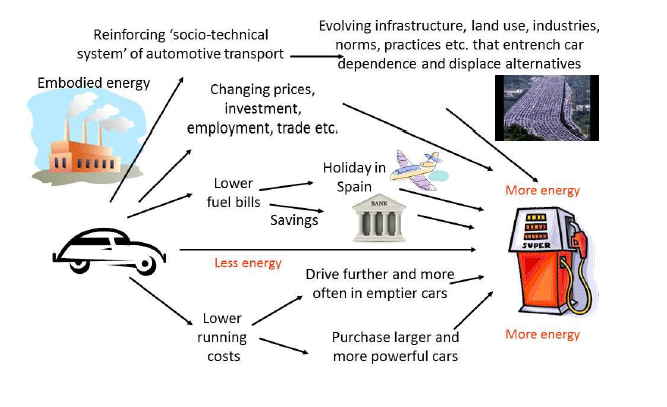
 Climate, technology and chaos Blog