Archive for May, 2023

Technological innovation vs. regulation in climate policy

May 31, 2023

That technological innovation is preferable to government regulation seems a common idea.

However there are a number of problems with this idea:

Technology is not magic, it will not always eventuate because we need it or because it would be nice if it arose. It may not arrive at the right time, at the right price, be easy to use, be usable at the scale required, or not have dire climate side effects.

‘The Market’ is not magic either, whatever you are told by people who are powerful in The Market. There is no reason to assume that innovative tech will be taken up, or that the best tech will be taken up. What counts, and pretty nearly always what counts, is how the company makes extra profit from it.

Because people think of tech as the magic solution, unworkable tech can be used as an excuse to keep on emitting pollution, and destroying ecologies. Indeed the tech does not even have to be installed to have this affect, as with Carbon Capture and Storage.

If PR and empty hype about technology increase profit more effectively than the technology iteself, then PR and hype will be used more than the technology is. There is no reason to think that the technology will be used.

Without regulation, there is no reason for innovative tech, to stop people from doing damage, especially if the corporation is gaining more profit from continuing as it has done in the way it knows how to.

People in corporations like other people, prefer the world to be smooth and stable, and introducing disruptive technology, may disrupt profits without foreseable good consequences. Hence they will avoid it. Computers took off, because they were an obvious way of standardising behaviour, regulating workers and allowed some tasks to be done much quicker than previously. They, in theory, got more work out of workers, which is always a corporate drive. Climate tech on the whole, does not do any of that.

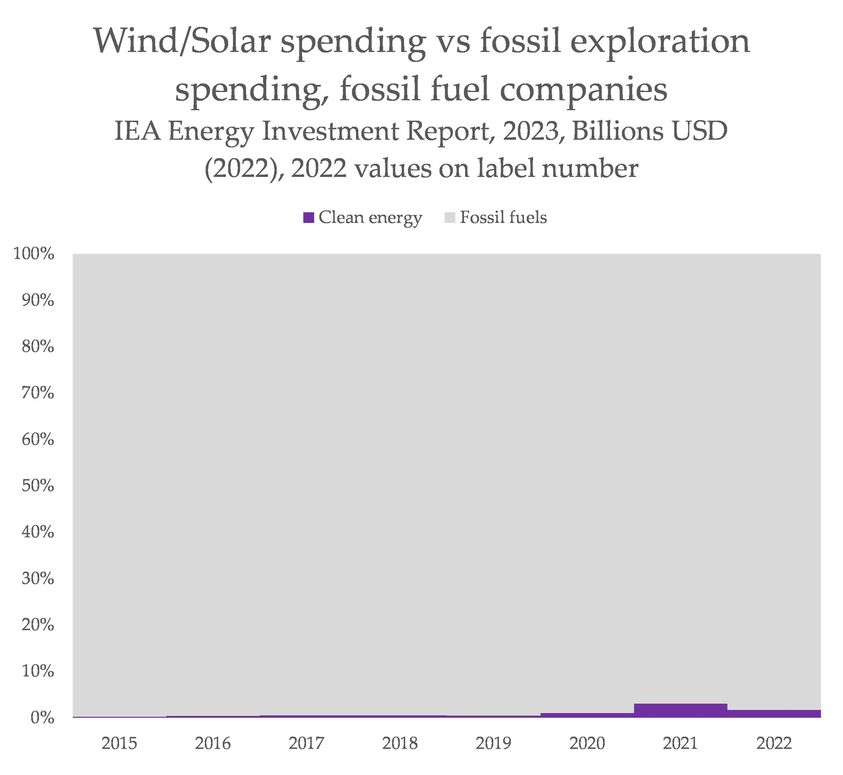
Climate tech, without regulation may do little. For example renewables can be used to increase the energy supply cheaply, without decreasing the amount of fossil fuels that are used. This seems to be standard in many places, and it is standard in fossil fuel company spending – in which spending on exploration and new fossil fuels is at least 15 to 20 times higher than their spending on renewable development, as shown in this graph, The grey area represents expenditure on exploration for fossil fuels.
There is nothing to guarrantee that a technology will only have the effects we want, and will not be commandeered by standard destructive practice.

All markets depend on regulation, and regulation that can be enforced by the State or through the courts. All markets have power imbalances, which affect the market and its regulation. Succesful and rich companies will team up and try and abuse their position of success to make regulations that favour them. This is normal, and makes useful, generally beneficial, regulation difficult.

Without regulation adding to the pressures, most companies will not actually (as opposed to in PR) change their pollution, dispersion or their destructive extraction and climate change will continue to get worse, irrespective of the tech we have, or the tech we might imagine is coming soon.

Technology is useful, but we should work with the tech we have now, rather than imaginary innovative tech that may happen sometime in the future, or may never come.

We should regulate to impose emissions and destruction reduction. Consequences for breaking regulations should be enforced and should affect profit. Hopefully this would give corporations more incentive to work on the problems.

We should also sponsor technological private and governmental research to get better tech rather than leave it to the corporate sector and the market. After all many tech innovations have come from public money, not private money, and are more easily made available if their are no restrictive patents or copyright issues to face.

On Capitalism

May 15, 2023

Capitalism

Capitalism is an organised system of domination, politics and economic power, not just a system of trade.

Capitalism tends towards producing vast inequalities of wealth, that depend upon a person’s place in the system, and not a person’s hard work or talent.

Riches are largely, although not always, decided by birth.

.Accumulation of riches tends to lead to oligopolies, in which small numbers of business control most of their specific markets, and deliberately wipe out competition.

If capitalist ‘free markets’ could exist they would destroy themselves.

In capitalism profit is the only virtue and only mode of evaluation

Capitalism is also a system in which profit is the main virtue and main goal.

If it helps make profit, then pollution, ecological destruction, low wages, industrial accidents, deception, low income misery, low income bad health, and political marginalisation of the populace will be encouraged.

Capitalism reduces all virtue and tradition to profit.

Religion becomes a way of justifying the extraction of riches from the world, or a promise that God favours the saved with riches, and hence that the rich are, as a class, the favoured of God.

This glorification of monetary profit, leads to a sociopathic system which has little care about the damage it produces. The system rewards, and selects for, those people who find it easy not to care for others or the world. Those people then select people who are like them. Consequently the system selects pathologically harmful people to lead it, which intensifies the problems with the system.

A fundamental drive of capitalist profit making is maximising cheapness of production (through low wages, cheap destruction, cheap pollution, cheap resources, cheap dispossession of poorer people etc.) and raising the price of sales.

Capitalism, government and the State

This accumulation of riches leads to plutocracy, where riches can buy any other form of power, and the rich dominate over everyone else and structure the market in their favour.

Capitalists will collaborate with each other and the State to achieve the aims described above, which benefit nearly all of them, because this is how business has to behave within the system.

Collaboration amongst capitalists makes what is called ‘crony capitalism’.

Crony capitalism is not an addition to, or blemish on, capitalism, but fundamental to its political workings and its domination over the State and over government.

As a system, capitalism cycles through boom, bust and bailout.

The rich arrange it so that ordinary citizens and tax payers protect their companies from their unrealistic, destructive or deceptive profit making practices, and the rich have bought the power and credibility to make this assumption fundamental to capitalist practice.

If poorer people suffer from the bust, that is just the price that has to be paid to keep the system going, so who cares?

Without the State to prop it up, capitalism would collapse, or decay into the rule of open violence.

To protect capitalism, the populace have to be misinformed (which is normal given corporate ownership and control over the media, advertising and PR), and people have to be convinced not to co-operate to constrain capitalism in any way.

The people are then led to find scapegoats for the troubles of the system – this can be people of other ‘races,’ other religions, other sexualities, other politics etc. It does not matter who the scapegoat is, as long as it is not the capitalist class in general. It can easily be a billionaire who makes it clear they do not worship capitalism.

Consequently, capitalism destroys social trust, constructive co-operation and compassion, as a matter of course.

Responses

If it seems impossible, or too dangerous, to overthrow capitalism, then for society and its individuals to survive, some other group must organise to restrain capitalism’s destructiveness.

The ‘easiest’ way is to take back the State, and liberate it from lobbyists, corporate bribery and the assumption that corporate elites are the only important part of society, know how to run things and know how to organise every possible process.

Taking back the State, can lead to laws which apply to all business, and encourage sharing of wealth with the workforce, making work places safe, halting environmental destruction and pollution, increasing worker representation in parliament or congress. lessen inequalities of wealth and protect people from busts and the inevitable misfortunes of life as much as possible. This all lowers the likelihood of plutocracy and increases quality of life for most people. This is a minimum.

This actually happened in the 50s, 60s and early 70s of the last century, so it is not impossible.

It should be pretty obvious that some people and parties who pretend to be taking back the State for the people, are deeply embedded in capitalist processes and have no intention of cutting back its normal excesses, even if they criticise some sectors of the economy.

Other systems of resistance, suggest that people should withdraw their support from capitalism, and become self-providing and self-governing communities that deliberately exclude big business (shopping malls, polluters, arms manufacturers, mining companies etc) from their areas, and try to constrain local riches from taking over. When a few such self controlled communities exist, they can start teaming up to become a political force, struggling against surrendering control to capitalism.

There is no reason these two constructive responses to capitalist destruction and domination cannot work together.

Summary

To repeat capitalism is a system of power relations build on top of crimes an dispossession. It needs checking if we are to survive both social and economic collapse, and the collapse of the world’s ecologies.