BNEF has just released a paper called “Australia’s nuclear-powered distraction threatens net zero” I will link to it as soon as I can find a link. This is based upon articles about the article
Summary
The issue is not really whether a case could be made for nuclear in Australia, but whether the Coalition policies will deliver:
- More emissions, and
- More expensive electricity.
That would seem to be the case from the mess of their policy, and their repeated requirement that we trust them to give details after the election.
The plan, even if completely successful will certainly not add that much to Australia’s energy supply, and there is no point going with small amounts of nuclear if we are going to increase emissions through rolling back on renewables.
Political Obstructions?
Despite nuclear energy technology having been banned in Australia since 1998, under Coalition PM, John Howard, with three of the high population states also banning it, the federal Coalition opposition has proposed seven sites for nuclear plants which they claim could be operational as soon as 2035, which is improbable. As Bloomberg states, it will be “a slow and challenging” effort to overturn existing bans, and to force people to accept nukes on the sites selected without consultation.
Nuclear is expensive
Nuclear could reduce emissions, but it is usually a very expensive technology in markets with limited experience, unsupportive politics and uncertain regulation — such as Australia. We have already mentioned that cost overruns are normal even with experienced builders. Another problem is that people cannot be held to contract prices as we do not want cheaply built and unsafe reactors, so we have to assume they are not deliberately underquoting.
Renewables are cheaper and easier
The usual estimates are that renewables are cheaper than Nuclear. Bloomberg said that going by existing nuclear industries in western nations, the cost would be “at least four times greater than the average” for Australian wind and solar plants with storage today.
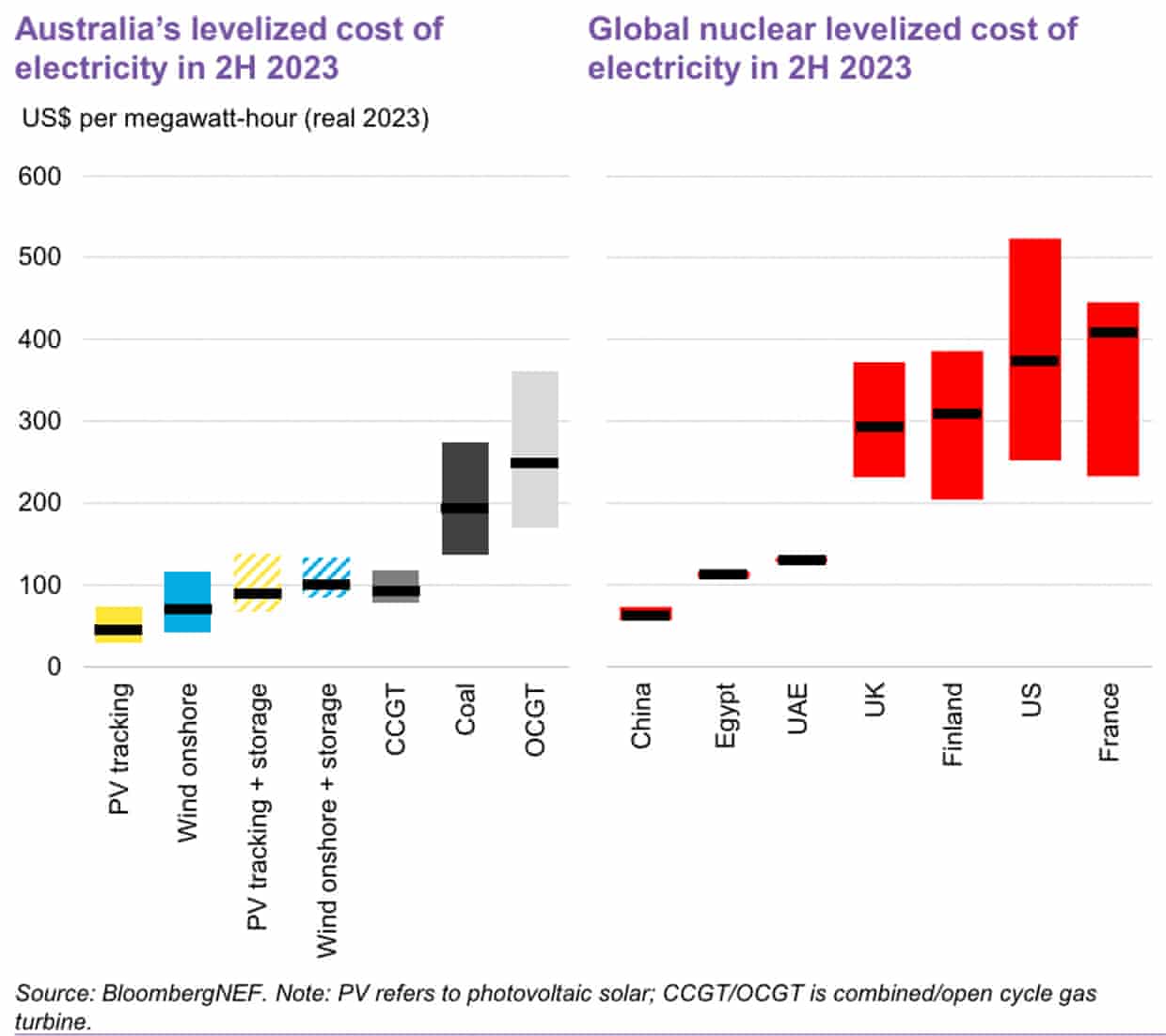
Furthermore, Australia has plenty of wind and solar resources with large areas of semi-vacant land, and lots of people vying to build wind or solar power. There appears, as yet, to be no one volunteering to build nuclear in Australia, certainly not seven power stations worth by 2035.
To repeat, SMRs do not exist commercially so we have no idea what they would cost, or how much energy they would produce. So it is pointless budgeting for them.
Australia’s coal fired power stations will largely be phased out by 2035. So, to avoid power supply shortfalls and high electricity bills between the gradual shutting down of coal energy and the beginning of nuclear, we have to increase renewables and energy storage. If we do not do this, then electricity prices will increase massively or emissions from Gas will increase.
Nuclear will also add significantly to the costs of energy. To pay off the huge capital investment, which it seems will be carried by taxpayers, prices will have to rise.
Conclusion
if the debate serves as a distraction from scaling-up policy support for renewable energy investment, it will sound the death knell for decarbonisation ambitions – the only reason for Australia to consider going nuclear in the first place.
Tags: climate change, Energy, nuclear energy, politics, renewable energy
 Climate, technology and chaos Blog
Leave a comment