Archive for the ‘complexity’ Category

Climate change is an ethical and justice challenge: consequently it will never be solved

October 14, 2018

Climate change and ecological destruction are often framed as ethical challenges, to be solved by a new ethics or a better notion of justice. While I agree that ecological destruction is an ethical challenge, I suggest that this means it will not be solved in the time frame available.

This occurs for four reasons. First there is no basis for ethics which is not already ethical; therefore it is highly improbable we can have an agreed ethics take form across the globe in the needed time frame. Second, we live in complex systems which are unpredictable and not completely knowable, so the results of ethically intended actions are uncertain. Third we influence the meaning of what is good or bad through the context we perceive or bring to the events; given complexity and given cultural variety, the chances of agreeing on a context for these acts and events is small. Four, because context is important and caught in group-dynamics, ethics always gets caught up in the politics between groups, is influenced by those politics and their history, and there is no non-political space in which to discuss ecological destruction.

I prefer to talk about ‘ecological destruction’ rather than ‘climate change’ because, while people can disagree about climate change, there is less chance of disagreement about ecological destruction: it is pretty obvious, almost everywhere, with new highways, new dense housing, destruction of agricultural fields, destruction of forests, accumulation of waste, pollution of seas and over-fishing. We face far more ecological challenges than just climate change. Climate change is a subset of the consequences of ecological destruction and the dumping of products defined as waste, into the air, the ocean or vital water tables. The fact that we live in complex systems also means that deleterious effects in one system, spill out into others, and eventually cannot be kept local; we all interact with each other and the rest of the ecology. Everything is interdependent. Without plants we cannot survive. Without drinkable water we cannot survive. Without breathable air we cannot survive. These are basics for almost everything on earth.

However, given climate change is a moral issue, this decline in human liveability is not necessarily a bad thing. You have to already take the moral position that human survival, or that not harming fellow humans (in some circumstances), is good or the basis of virtue. You could decide that humans should be eliminated for the greater good; that they (or a subset of humans) are destructive parasites who should be exterminated. You might decide that only those humans with some qualification (intelligence, religious purity, dedication to the party, or wealthy, for example) should survive as they are ‘the best’ and the exemplification of what is moral. This is not unusual, most ethical systems do discriminate ethically between different people. Children do not have exactly the same ‘rights and responsibilities’ as adults. People defined as immoral or criminal usually face sanctions, and lessened ethical responsibility from the virtuous – indeed the virtuous may have be said to have the responsibility to harm the immoral.

No moral basis
If human survival is not a fundamental part of morality, then what is? ‘Care?’ why should care be thought of as good? Some moralities argue that care is a corruption, that care encourages bad habits and laziness, or that true care involves violently correcting behaviour defined as ‘bad’. Care is already a moral proposition, not the beginning of a morality. ‘Obedience to God’s rules?’ Assuming that we could agree on what God’s rules were, then why is obedience to God good? Could it be that God is a tyrant and we need to disobey to discover moral reality? Could it be that God expects us to solve problems ourselves, as the rules presumably have a basis other than the mere whim of God – if not why should we assume that whim is good? The idea that we should obey God is already a moral proposition. ‘We should do our best?’ Sounds great, but what is ‘best?’ Is our version of the best, actually the best? what if someone else says it is not the best, or their best contradicts ours? Why does following our inner guide/instincts lead to the best – what if it does not? Should we bring ‘the greatest good to the greatest number?’ leaving aside that this does not resolve what is good, then why is it good to consider the greatest number? Perhaps some minorities need a good that conflicts with the good of the greatest number? Again the proposition assumes the moral position that the more people gain the good, then the better it is – which could be ethically challengeable. Some other people think that taking good and evil as undecidable and therefor not worrying about it is the root of virtue, but who decides this is good? What evidence is there that personal peace is better than personal indecision? Valuing personal peace above all else, is already a moral proposition. Some people may even define what appears as ecological destruction as ecological improvement, partly because it is bringing the natural world under human control. What is destructive or not, is in itself an ethical question which runs into this problem of ethical presuppositions.

There is no way of resolving these dilemmas that I am aware of, and the presence of differing moralities and irresolvable questions, seems to demonstrate this. Moral uniformity, historically seems to depend on violence, and why should we accept that as good?

Complexity
In complexity we have multitudes of interactive systems which interact with each other. Nodes in these systems are constantly being modified by other nodes and events in the systems, or they are modifying their own behaviour and responses to events in the system. Sometimes the modifications are successful, or relatively harmless, and the new shape continues, sometimes they fail and it dies out. This is the basis of evolution, which happens all the time – there is no stability to ecologies.

The multitude of these links between nodes, are usually beyond full comprehension or enumeration by humans. Such systems are constantly in flux, often around recurrent positions, but they are open to sudden, rapid and unexpected change.

Complexity means that we cannot always predict the result of specific actions, especially when other people (and their reactions, and their attempts to ‘game’ the system) are involved, and when the situation is constantly changing and old points of balance are shifting. This change is something we face with ecological destruction. Patterns cannot remains stable. We can predict trends such as the more average global temperature increases, the more unstable the weather, and the more likely that violent weather events will occur. Similarly, the more destruction the more the unstable the ecology will become, and the more pollution the more unstable the ecology will become – unless it reaches the temporary stability of death.

Because so many events occur, are connected and are simultaneous, it may be impossible to tell what the full results of any particular action are. This is often expressed in the metaphor of the butterfly’s wing flaps eventually leading a major storm. Normally we would expect the multitude of butterfly actions to cancel each other out, and they may well do this most of the time, but not always. The reality is that small events can have major consequences, and we probably cannot tell which small events are significant until after the results have occurred. This lack of predictability means that we never have full control over complex system, we always have to adjust our actions given what occurs, should we try and work with the system.

This has particular consequences for ethics, in that the results of ethical actions, and ethical rules will not be predictable. The actions may be well-intentioned, but unexpected consequences are normal. If the consequences of an ethical action cannot be predicted, then how can it be guaranteed to be ethical? You can state that an ethical action is ethical irrespective of its results, but this is already an ethical position, and most people would probably not be completely indifferent to the results of their actions. The flux also means that propositions like the “categorical imperative” do not work, because we cannot assume situations are ‘the same’ or similar even in principle. Complexity means we cannot behave as we would want all others to behave in the same situation, because the situation could be unique. Besides perhaps different classes of people should behave with different intentions and different ethics. Why should ethics be uniform? Uniformity is already a moral decision.

Arguments about the results of actions and the similarity of situations are more or less inevitable.

Context
What this last statement implies is that the context of an event influences our understanding of the event. This is particularly the case given that we do not know all the connections and all the possible responses that parts of the system may make. We cannot list them all. We are always only partially understanding of the world we are living in, and this is influenced by the context we bring to those events. Possible contexts are modified by peoples’ connections to the events, and the cultural repertoire of possible responses and languages they have available. Given the 1000s of different cultures on Earth, and the multitude of different ways people are connected to the events and the people involved, then the possibility of agreement is low.

Politics
One important context is political conflict. One way of giving an ethical statement, ethical decision making, or an event, context is to frame it by your relationship to the people involved. If they are people you identify with, or consider an exemplar of what humans should be, then their statements are more persuasive and they are more likely to seem ethically good to you. If they seem outsiders or people you don’t identify with, or seem to be an exemplar of an out-group, then the less persuasive they will appear to be. Consequently ethics in always entangled in group conflict and group politics. This politics pre-exists and the groups involved may have different relationships to ecological destruction, and so have different politics towards that destruction, and towards other groups involved. Thus we frequently see people in favour of fossil fuels argue that developing countries need fossil fuels to develop, and that preventing the ecological destruction which comes with fossil fuels, prevents that development, and retains people in dire poverty and misery. What ethical right do already developed countries have to do that? What makes this poverty good? in this case developed countries may be considered evil for being concerned about ecology. Similarly developed countries may argue that most of the true destructiveness comes during development, and that while they are stabilising or reducing destruction, the level of destruction from developing countries will destroy us all. In this context, developing countries are wrong, or provide an excuse for inaction. The situation is already caught in the struggles for political dominance and safety in the world, as one reason for development is military security and a refusal to be dominated by the developed world again. There is a history of colonial despoliation involved here – although again to others, the despoliation can be defined (ethically) as bringing prosperity and development.

‘Climate Justice’, does not solve these problems because, in practice, justice involves defining some people as evil (which automatically sets up politics), it cannot limit contexts, and the machinery of justice depends on violence or the threat of violence. If a person is defined as a criminal and either punished or forced to make recompense, that occurs because of the potential of the powerful to use violence to enforce the sentence. In the current world system, there is no organisation or collection of organisations, which can impose penalties, or generate a collective agreement on what justice is in all circumstances, for the kinds of reasons we discussed above. Climate Justice is simply likely to encourage more blame allocation and conflict.

Recap and conclusion

Ecological destruction is embedded in ethical interpretations. These ethical interpretations are influenced by, and undermined by:

  • The difficulty of establishing a universally agreed ethical basis for actions. Ethics problems are essentially irresolvable, and yet all action involves ethics.
  • The complexity which means we cannot predict the results of all actions, we cannot control the system and we cannot understand the system completely.
  • Context, or the meaning which influences meanings, mean that different people will bring different contexts to events and understand them differently, and treat them differently ethically.
  • Context includes politics between groups and the different ethical systems belonging to different groups. Ecological destruction is already tied into different interpretations and different developmental (and other) demands and conflicts.
  • Thus it is extremely unlikely that we will spontaneously develop a universal ethical system which will allow us to decide what actions to take to resolve ecological destruction, or stop ecological destruction. Indeed the ethical conflicts will probably further delay our ability to respond.

    Ethics may well be the death of us.
    Stratospheric Aerosol Injection

    August 15, 2018

    Stratospheric Aerosol Injection is a form of Geoengineering, which is being considered because the climate situation is getting desperate, with extremely high temperatures in the Antarctic, and massive bush fires around the world.

    It involves injecting particles into the upper atmosphere. There are problems with using this technique to modify climate – some technical and some political and some both. This post describes some of them. It incorporates parts of an earlier post on this site.

    1) We have to rely on models for our predictions and understanding of weather, climate and ecology, and models can be wrong.

    2) The system we would be trying to modify is complex and not predictable in specific. So we do not know the exact results of putting the particles into the stratosphere – we would have to find out through doing.

    3) The chances are high that some areas would suffer significant weather changes after the particles reached the stratosphere and these changes would not be uniform. The effects usually discussed are changes in rainfall. For example protecting Europe could lead to major drought in north Africa.

    4) Geoengineering is based in social systems which are also complex systems, and GE could disrupt those systems and their balances.

    5) For example, unintended bad weather effects could lead to massive people movements, which as we know can be considered potential ‘take overs’ and increase social stresses and tensions….

    6) This together with unpredictability, might lead to accusations of weather warfare, whether it was or not, and this might then spill over into more orthodox forms of warfare.

    7) GE is cheap in some sense, in that it might only cost billions a year to implement. While this suggests rogue corporations or states could begin GE, it also suggests that there could be fights over funding. Would those who contributed the most want the best results for their countries as opposed to others?

    8) GE requires some form of international governance to avoid arguments, which has been shown to be hard to establish even with simpler objectives

    9) I have not seen any viable self-supporting GE proposals. Nearly all of them require massive tax-payer subsidies, and some appear to need massive cross-national governance and regulation. We could give massive subsidies to private enterprise and hope they do they job without any oversight, but I doubt that will appeal even to the pro-corporate-power lobby. There is no apparent profit in Geoengineering, other than the potential to threaten people with bad weather. So it is unlikely that corporations would persist with it.

    10) GE once begun must be continued, but warfare, or economic collapse could lead to rapid discontinuation, and hence extremely rapid climate change, which might further reduce biodiversity, as the change would be so rapid. Decline in biodiversity = decline in ecological stability.

    11) It is extremely likely that once GE was implemented, people in power would breathe a sigh of relief and say “oh we don’t have to stop burning fossil fuels anymore”, so the situation gets worse, but they stay in power.

    12) The rational solution to climate change is to lower emissions – we have known this since the 1980s at least. We have the technology to do this now, and it largely seems to work. That we don’t do this, shows we have a destructive set of social organisations and rivalries, and GE will be implemented within this destructive organisation and probably further destruction.

    13) The assumption of GE is that it is easier to modify the complete climate and bio ecologies of the planet without serious unintended effects, than it is to lower emissions. This, in practice seems unlikely.

    14) GE does not stop or ameliorate the results of high levels of CO2, thus ocean acidification and ocean death would continue – which would be calamitous.

    15) The particles which people usually suggest we use are sulphites, these have the potential to further damage the ozone layer. There are plenty of other ecologically destructive actions GE does not ameliorate or stop.

    16) People who support GE tend to be those who deny we should do anything about climate change, consequently the likelihood of point the points about continuing destruction, rather than lessening it, increases.

    Short summary: Stratospheric Aerosol Injection is a largely uncontrollable, unpredictable process embedded in destructive social organisations, that will delay any chances of fixing climate change. Fixing climate change requires changing our social organisation and reducing emissions.

    Thinking on the spot: Algorithms and Environment

    June 1, 2018

    I may, or may not, be asked to participate in a radio show/podcast about algorithms and the environment….

    This is my initial spur of the moment thinking…

    I’d start by talking about the difficulties of getting algorithms for a complex system. The whole point of complex systems is that they are unpredictable in specific, while possibly being predictable in terms of trends. For example, we cannot predict the weather absolutely accurately for a specific place in 3 months, but we can predict that average temperatures will continue to rise. Initial conditions are important to outcomes in complex systems, but there are always prior conditions (ie there is a way in which initial conditions do not exist), and because so much is happening and linking to each other, there are always problems determining what is important to the model, and what the consequences of an action were. Another problem with complexity (as far as I understand it) is that it can only be modelled to a limited extent by any system which is not the system itself.

    Then the model tends to be taken for reality, so we act as if we knew something and are working directly on that system, rather than working on a model which may increasingly diverge from reality with the passing of time….

    Then there is the issue of power relations. We know that one simple way of proceeding with Climate change, is to phase out coal and other fossil fuels and increase the use of renewable energies. However, we can’t even do this transition at the speed we need to because of established power relations and habit (power is often the ability to trigger established pathways of behaviour) – and we cannot guarantee there will be no unexpected side effects even if we could. For example, we may not succeed in replicating something like our current social life with renewables or we construct them in such a way that it harms the environment.

    We also seem to need to absorb greenhouse gases as well as cut back on emissions, but absorption can be used to delay reduction (again through power relations), and there is, as yet, no yet established way of dealing with the GHG that have been removed which is safe or long term. Algorithms cannot successfully model the effects of things we don’t know how to do…

    On top of that there is the potential power consumption of the algorithms – while hopefully this will not be too bad there is some evidence that bitcoin (which is a complex algorithm of a kind) could end up being the most energy hungry thing on the planet…. In which case our efforts to save ourselves could intensify the crisis.

    Now, to be clear, I’m not saying that computational algorithms are never of use, but that they tend to be used without testing because they depend on fictional stories which have a high level of conviction, and are treated as if they are the reality we are working with and not as models of that reality. If the model / algorithm tends to advantage some group more than others, and the appliers belong to people loyal to that group, then it will probably be harder to curb if incorrect, and be more likely to be taken for correct. The same is probably true if the model reinforces some precious group belief. The point of this is that models tend to become political, (consciously or unconsciously) because the axioms seem like common sense.

    According to some theories humans tend to confuse the ‘map’ for the ‘terrain’ (to use the General Semantics slogan) almost all the time unless its visibly and hopelessly not serving them and there is an easy alternative. If so, that could be one reason why science is so difficult and so relatively rare, and so easy to ‘corrupt’ when it becomes corporate science.

    If we are going to model what we do in the world then we absolutely need something like computer modelling, but we also need to emphasise that these models are unlikely to ever be totally accurate, always are going to require modification and change, will get caught in politics and could always be wrong.

    If we don’t do this then the aids to helping us model what we are doing and need to do, could well make things worse.

    Donut Economics

    May 17, 2018

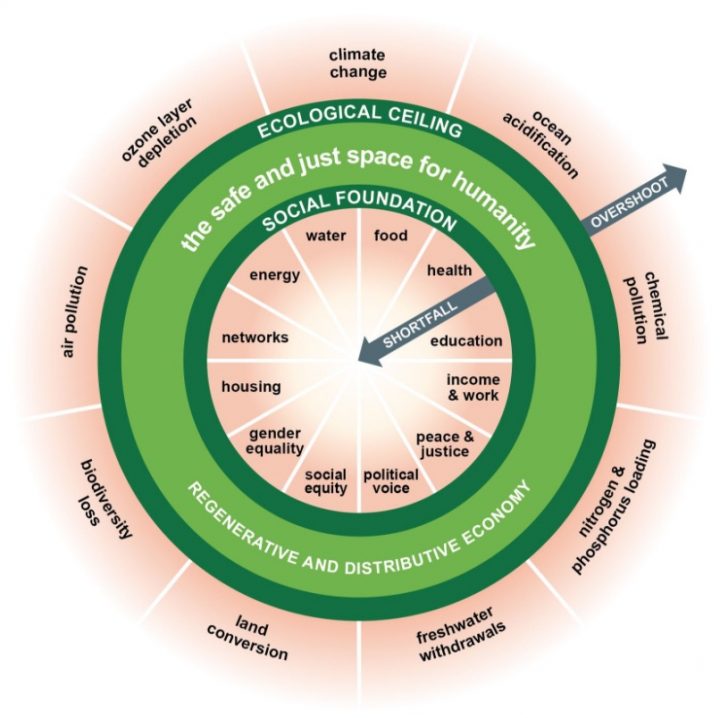
    Kate Raworth’s ‘donut’ presents a relatively new way of looking at the economy, which has attained some fame. See the picture below.

    the donut

    As you approach the hole in the middle, you have an economy which does not satisfy people’s needs such as water, food, housing, relative equity, liberty, education and so on.

    As you approach the edge of the image you begin to destroy the ecologies of the planet that the economy depends upon, producing events such as biodiversity loss, climate change, disruption of nitrogen and phosphorus cycles, destruction of fertile land, and so on.

    Whereas without such a diagram, the capitalist economy is perceived as a matter of self-contained markets isolated from ecology, she argues that the aim of economics should be to satisfy people’s needs without destroying that planetary ecology.

    Normal economic theory, can argue that inequality decreases as growth increases, and that growth cleans up economies, because the economic model looks at the world in isolated ways. Some economies appear to clean up ecologies, but they do so at the expense of other ecologies, and businesses are always happy to lower the costs of pollution and increase profit when offered an opportunity.

    People may object that it is impossible to meet the needs of everyone – especially while respecting the planetary boundaries, but at least in this model it appears as something which can be discussed as a major concern. Just as we can ask “What is the economy for? What is it about?” and get a reasonably useful answer.

    The old economics had an extremely confining view of human nature, it was humanity stripped of everything but the profit motive. This was a decision originally taken to distinguish economics from other fields such as history or philosophy, and to make things simpler, but it became the model of humanity. Under it we are *just* individual profit seekers. We only cooperate in order to make personal profit, we naturally destroy for profit, we have fixed preferences which we neutrally evaluate, and we have no purpose, happiness or virtue other than wealth seeking.

    This view is simply not true, or adequate. Humans co-operate as naturally as they compete. We are social as much as individual, we do not naturally only value money and we do not destroy what we share. We are creatures with many purposes and many aims. Wealth is usually only important to the extent it brings about those other purposes and we are not made happy by consumption.
    Raworth’s model, to me, is reasonably obvious and elegant and allows humans to be complex. It is not reductive.

    It does have a few problems.

    1) It does not explicitly recognise that the current economy is a mode of power, situated within frameworks of power relations, and that historical evidence appears to show that those who benefit from this mode of power will do almost anything to preserve it – including wreck the earth.

    Nearly all forms of organisation are nowadays reduced to economic/capitalistic organisations. Media and information is controlled by capitalists, the law is controlled by capitalists, the State is controlled by capitalists, education is controlled by capitalists, and so on. Paying attention to the “bottom line” (measured in terms of money) is a mantra that both permeates society, and ignores reality.

    It will be hard to move against inertia and the active power dedicated to preserving existing hierarchy. The model does not easily provide for the distortions that power puts into economics – any more than standard economics does. But as standard economics aims to preserve that power it is not a handicap for it, but a strength, as its users can pretend that inequality of outcome is always proportional to inequality of talent.

    2) More importantly, the model does not provide a set of simple positive instructions for politicians. It does not give them an easy and painless set of action slogans and programs, whereas conventional economics does.

    Conventional economics says: business is always good and always delivers, you must increase growth, nature is limitless or unimportant, commons don’t work so sell them off to business, government is inefficient so hand it over to business, rich people are talented so give them more support and protection (and pick up the rewards), reduce taxes, stop government services, increase charges, abandon poor people as they are without virtue, and individual wealth and its owners should be worshiped.

    Donut economics, just says don’t destroy the world, and let everyone participate. Neither is easy under the current power relations, and these actions do not reward players in the State. The model grinds to a halt.

    It needs simple and positive directives.

    So time to think what those might be….

    Organisational Ignorance vs Organisational Stupidity

    April 2, 2018

    I suspect “organisational ignorance” should be distinguished from “organisational stupidity”, even though they are related. Some level of organisational ignorance is normal and inevitable, some levels of organisational stupidity have to be cultivated.

    Knowledge implies ignorance, and in some cases creates ignorance. Firstly people know what ‘knowledge’ is by its socially made contrast with what form of belief or practice serves to illustrate ignorance to the group holding the knowledge. Thus literate groups can assume illiteracy is ignorance of letters, theological groups can assume science is ignorance of God and Salvation, Platonists make Sophism an exemplar of ignorance, and so on. Groups usually do this kind of thing, to reinforce their boundaries, and to give them energy by making some other behaviour or belief ‘bad’.

    Knowledge tends to create ignorance because, in complex interactive systems (and all social and ecological systems are complex), knowledge tends to be incomplete and a simplification. As such, what people know (and are supported in knowing) can actively direct attention away from areas of crisis and change, particularly if the knowledge has been successful, or associated with success (however that is measured) for a long time. We can see this with climate change; modes of waste disposal and profit acquisition which have brought success for the last 200 years are now threatening the conditions for that success. Hence many people are continuing as normal to destroy themselves, because there is no apparent alternative which delivers exactly the same benefits and distribution of benefits. This is also propelled by organisational and hierarchical stupidity, but more later.

    Some knowledge is definitional and relatively easily shared once definitions are agreed, but that does not mean it is always accurate. I would claim mathematics is this kind of knowledge – so it can be very powerful as well – but I’m not particularly bothered to argue about this at the moment.

    So knowledge and ignorance tend to be socially intertwined, and mastery can be a mark of status – in which case new knowledge can be dismissed if it comes from the wrong people – this is one place ‘organisational stupidity’ starts coming in.

    Organisational stupidity is the active structuring of an organisation or a situation, so that new, different, or more accurate, knowledge is rejected. Punitive hierarchy is one way of generating stupidity. If people in a hierarchy routinely punish underlings for diversion from the official line, then everyone ends up ignorant and stupid actions become the norm. The more those actions become the norm, they more they seem part of the cosmos, and the more they probably become intensified to remove the chaos they generate. People at the top don’t tell people what they actually plan, to protect themselves and their knowledge. So everyone operates in a haze of fear, guesswork as to what is going on, and stupidity. This is further reinforced if mastery of organisationally approved knowledge is a mark of status, and those with status try and remove those challenging them, as those challenging them do not see “common-sense” or “understand reality”. Relatively accurate knowledge can become downplayed or even heretical and forbidden, as when Trump refuses to allow information about climate change to appear visibly on government websites.

    Computer software encourages organisational stupidity when managers who have no idea what their underlings do become the consultants during requirements collection and the actual users are ignored, and have to adapt to what was thought to be an improvement.

    “Siloing” is the horizontal form of this structural stupidity, in which people in different parts of an organisation do not know what other parts do, but fantasise about them, and attempt to control what the others do. For instance, when admin tries to control academics, or give them more admin work to encourage “responsibility”, or rewrites computer programs to stop necessary fudging or whatever. Getting others to do your work seems useful initially, but ultimately it stops you from having any quality control over that work.

    Complexity can reinforce stupidity because, as nobody above knows what is possible in an engineering or social sense, and what is their fantasy is usually what is done, so they demand what they would like (even if it is not possible or not yet possible) and accuse people who tell them this is not possible as lacking positivity. Sales people generally don’t know what is possible either and agree to make the deal, because there is a lot of money being thrown around, and if they don’t get it someone else will. So the sale goes ahead and people get locked into the costly process of making the impossible, or the badly designed, work.

    There is a sense in which capitalism furthers organisational stupidity, because;

  • 1) It’s organisations are extremely hierarchical. Even when they are supposedly level, there can be huge differences in power.
  • 2) Only the immediate small-future bottom line counts (but there are many other important things).
  • 3) Wealth becomes the only value, so plutocracy becomes the norm, and anything that produces wealth must be good.
  • 4) It depends on hype about existent and non-existent products to prevent other products being successful. So the environment is constantly full of informational falsity, even above the idea that wealth is the only measure of value and competence.
  • 5) Its managerial structures depend on managers fighting for allocation of internal wealth to allow their section to work and to give them status, and this may obstruct any observation of the external environment the company exists within.
  • 6) Elimination of costs, can eliminate worker satisfaction and competence, and leads to free-loading waste being approved without consideration of long-term consequences. Cost defined something as ‘unpleasant’, not to be observed or investigated, and to be removed forcibly.
  • 7) In takeovers, to establish power and discipline, those people who know how the victim firm works are nearly always sacked, as the victor reckons these people do not know anything, or might challenge their knowledge. So the firm begins its new career being forced into boxes and behaviours that may well not work for them.
  • The contemporary form of governance, which I call “distributed governance” which is power that is diffused through society via networks means that very few people with power have responsibility, or feel they have responsibility. Responsibility is elsewhere, so there is no need to know anything other than how to keep your own power and reinforce your own knowledge, and the chances of feedback overtly pointing out mistakes is extremely low, so managers do not learn from those mistakes. This helps reinforce stupidity.

    If these general points are correct, it does imply that decent knowledge workers may sometimes have to chose to engage in “revolutionary activity” even against their own organisational stupidity, or resign themselves to pointlessness.

    Luck as a social force

    March 28, 2018

    Contingency plays a massive part in social events, indeed in all kinds of events not just our lives; that is why we can tell its important in our lives.

    We rarely control the outcomes of much activity, and we interact with situations that we do not cause and cannot influence much, but do influence some little bit. There are important choices we make, and we may not realise how important they were until we look back on them. At the time the choices may have seemed trivial – going to a particular party, leaving to urinate at a particular time, turning our eyes away from the road, not responding to a phone call, being ill at a particular time. This sort of contingency can affect whole countries, as it affects people who make decisions. We might call it the “for want of a nail effect”, given the famous verse.

    Contingency also affects the coming together of different events at specific time, such as an infrastructure failure compounded by economic crisis and a drought, even if we may say that certain behaviours and policies make this contingency more likely. The effect of the contingent combination may not be predictable – how will people respond? It is exceedingly difficult to see, in advance, how fortuitous circumstances will allow particular social groups to gain an influence that they previously did not have because the new circumstances ‘obviously’ favoured them over others (in hindsight). Any kind of evolution is contingent on circumstances, even if organisms are not controlled by circumstances.

    I’d suggest being skeptical about any non effect of ‘luck’ in social life. The idea that luck is not important is a very convenient ideology for those who are wealthy because it implies that they are were they are, totally because of their abilities and skills, and are thus justified in having wealth while others don’t. While if success involve luck then they are were they are by luck as well as by skill.

    Complexity theory implies that we are incapable of predicting events in detail, although we can predict general trends, because of the massive interconnection of things/events and feedback between things and events. Thus we may predict the decline of the US under the pressures of successful capitalist domination, but we could not predict how it will turn out. In 2010 we could not really have predicted the rise of Trump and his cronies. Whether this unpredictability stems from the human inability to model things completely outside the system itself (so while we cannot predict specific events, if an all knowing God exists then that God may be able to predict successfully), or because it is in the nature of the system (even an all knowing God cannot predict specific events), is irrelevant for human contingency.

    Because of unpredictability and complexity we always contend with unintended effects, some of which may be good, but probably more will appear to be complications – as the number of patterns which seem disordered is far greater than those that seem ordered and beneficial. Social life is precisely about dealing with the unexpected, as well as the expected. Often people deal with the unexpected by pretending it has not happened. This retains the vision of order, but weakens people’s ability to deal with reality. The unconscious has a tendency to strike back.

    The importance of contingency does not mean analysis is impossible, but it does mean that we need to factor in contingency as part of that analysis, and look at rare events rather than be remain happy with what appears to be common. This is particularly so when we appear to be entering a realm, the Anthropocene, where we have no prior experience whatsoever.

    On Truth Part 1

    October 3, 2017

    Truth is a complicated process, which people often try to pretend is simple. And so this is a simple peice trying to pretend to be complicated.

    Firstly, I would try not to use the term ‘truth’ at all, because it is a noun which implies an existent. And people do talk about Truth as if it was an existing thing, which I think is inherently misleading. Truth may not be something you arrive at, but something you work towards….

    I would prefer to talk about the possibility (or likelihood) of making accurate or correct statements – assuming that we all roughly agree on the words employed and the intention behind the use of the words…. In other words we can ask whether a particular statement appears correct and to what extent it appears accurate. This process is not always immediately final.

    I suspect that the idea of Truth as such may tend towards promoting ego-inflation and grandiosity. Compare, for example, the statements. “I know the Truth about the world” and “I can make some correct statements about the world.” The abstract idea of Truth tends to spread; if you know something is True then knowing the Truth implies you know not just something, but the Whole Truth… This is probably harmful to both discussion and finding out what is correct.

    There may well be different types of correctness which it may also be worthwhile distinguishing.

  • Definitional: 1+1=2 seems correct by definition and by coherence with other definitions. We can talk about Goedel’s theorem later 🙂
  • Pragmatic/functional: The words we use in the statement “the dog sat down” are vaguer than in 1+1=2, but we can usually agree as to what we mean, and as to whether this statement was correct at a particular time or not if we have observed the event, or if we trust the witness. The statement is good enough for practical purposes – if we want more accuracy then we can perhaps improve the specificness of the terms (“Jane’s cocker spaniel called Fred, perched on his bottom with his front legs holding up his torso” – this refinement is possibly endless). Because the statement is “good enough”, or “not good enough” for the use we want to make of it, this comes close to being a pragmatist theory of correctness or accuracy.
  • Inter-subjective: The “trusting the witness” part in the last point, tends to imply that at least some of what we accept as correct will be inter-subjective and social. A lot of fake news seems to arise from trusting witnesses, or trusting stories which seem plausible for social (or pre-existing bias reasons). I suspect this kind of thing becomes particularly important in situations of what has been called ‘data smog’ or ‘information overload’.
  • Symbolic/poetic: Jung and Tillich (probably among others) have argued that it is impossible to talk about some important things with complete accuracy because of the complexity of the situation, or the inadequacy of human perceptual and cognitive functions etc., and hence human discourse and feeling often depends on symbols. We may always need to talk symbolically to some extent. In which case the ‘accuracy’ can be said to be ‘poetic’. Poetic accuracy seems really important (sometimes I think it is primary in any complex set of propositions, but that is another argument). Sometimes poetic accuracy can move into more ‘simply’ based accuracy (of the kind stated above) with work and testing. I suspect this happens in science a lot, as we move from fairly vague conceptions and categories to more precise, accurate and testable categories and propositions.
  • We might often still be making symbolic propositions anyway – and again if Jung is correct then this may have as much to do with human psycho-social functioning as reality. There may always be events which are distant from currently precise definition – the field may increase as we increase those areas we can define – I’m not sure, and don’t know how you could test such a proposition. (And I have a sneaking regard for the idea that most propositions we hold to be accurate should be testable in some way, or otherwise we are close to talking about things which automatically may not be correct)

    This hedging does not imply no correct statements can be made, but it does imply that it may be impossible to *only* make correct statements or false statements. In which case correctness is also a continuum or even a plane…

    How can scientists predict future temperatures when they cannot predict the weather accurately?

    September 20, 2017

    Firstly, climate scientists cannot predict the exact temperature of a particular place, in exactly 50 years, easily or at all, any more than they can predict the exact temperature at a certain time, in a specific place, in one month’s time. And while this is problem raised by ‘skeptics’, this predictive ability is not an ability claimed by any climate scientists that I have read, and is of no relevance to the ongoing issues of predicting general increase in average global temperatures.

    Weather systems form complex systems, and prediction in complex systems is notoriously difficult over length of time. We can predict climate trends such as: the average global temperature may rise by a particular order of magnitude, or that sea ice will melt and ocean levels rise, that low lying land will be flooded, and that deserts will expand, that weather will become more tumultuous, that storms are likely to get bigger, and that people will move as a result. But you cannot predict exact weather patterns for particular places. If we could, it would actually make climate change less devastating, as we could plan for it.

    You can also predict that given the continuance of the circumstances we are in, it is extremely improbable that average temperatures will trend towards decrease, or that weather will become simple and nicely warmer everywhere. Indeed the prediction that this will not happen has been born out for years, and there is no sign that such climate beneficence will happen. However, it is possible that as climate patterns change some particular places may get colder – for example, if the gulf stream stops or shifts southward, then this may happen with the UK.

    The point to bear in mind, is that climate and weather are complicated, but continuance of, or return to, the normal weather patterns of 20 years ago seems improbable in the extreme, and it is far more likely that weather events will become even more extreme than they are now, until (possibly) a new ‘steady state’ arises when the forces producing climate change have ceased. However, I am told that when we look at the last time the earth had high levels of CO2 and high temperatures (50 million years ago), massive storms may well have marked that normality.

    We might add that other factors of the Anthropocene (such as peak phosphorus), make the prediction of livability of earth systems even more complex and fraught, but that is another question.

    The Right and Climate Change

    July 28, 2017

    Not all people who identify with the mainstream right refuse to be persuaded by the evidence that climate change is real, or that its humanly generated, or that crisis may be coming. Not all climate scientists are left of centre for one, and I’ve met, and heard of plenty of people on the right who wish their party would do a little more. And, in the US, some Republicans have been getting angry about the way that established powers try to stop them from using cheaper renewable energy and so on. Admittedly you rarely see this news in the corporately owned and controlled media, but you can find it if you bother to search.

    So the question might be “why is the right party elite so opposed to recognizing climate change, and why are the committed deniers so committed to ignoring the evidence, or saying things like ‘climate changes all the time’, as if this was something climate scientists were not aware of?”

    Most obviously, we have a problem in that the build up to climate change is, in human terms slow – its taken at least 50 years (since the 1970s) to get to where we are now. However, when the system changes state it will probably do this in a fairly short period of time, after years of building up. That’s how complex systems behave.

    So until it is too late, it is relatively easy to pretend that its all normal, and the continuing series of hottest years ever recorded, glaciers melting and so on, are not doing that much harm, or are just normal, or just freaky weather events. We also get used to things being different, so people can say “we were snowed out, and thus there is no climate change”, when thirty years ago they would have spent a lot more time being snowed out. We can also spend a lot more on artificial snow for ski resorts that don’t really have the falls they used to – but it looks the same.

    There is another problem that arises, because specific predictions in a complex system are really difficult. Thus we can say the weather will probably become wilder, and significantly different, but we may not quite know in what way. So people get frustrated with some failed predictions (the general trend is more reasonably accurate, if more disturbing than expected) and assume all predictions are worthless. Especially if they are really defending something else….

    Cynics could say that the US Republican Party, or the Australian Liberal Party’s resistance arises because some of their elite are so committed to the liberty of established wealth and power. Anything which might compromise that liberty, or give ordinary people a chance, must be repelled. Indeed we can see members of that elite cheer when corporations are given more freedom to stamp on ordinary people, exploit them, maim or injure them and so on. They cheer when corporations are given extra permission to freeload on others by polluting and poisoning the world. That was almost the first thing the Republicans did when they got a President. They gave corporations more liberty to hurt people. So that position is pretty basic. We have had close to 40 years of praising free markets and corporate power and business competence, and very little has improved, unless you were wealthy to begin with, or thought more corporate power was a good thing. The mainstream right are unashamedly neoliberal in their policies.

    For these people, the problem is that it would seem that the fairly easy actions we could take to lessen the risk of rapid climate change and ecological crisis, might affect the profitability of some established powers in the sacred corporate sector. Personally, I might think they would primarily be affected if they were stupid – but that is the sort of thing you cannot say as the common sense is that business knows best.

    Parties today require funding, and so funding is important, and those established people can spend lots of money (money is power) supporting political deniers, providing dubious research, arguments from principle, or casting doubt on whatever seems real. Their allies in the media can report as if climate change was undecided, or not a threat and so on. The media can more or less ignore it as a problem, as they generally do.

    Members of the establishment probably reckon that if they keep getting wealthy at everyone else’s expense, then they will be able to survive easily enough; wealth remains power when its concentrated. So they don’t have to worry, so what if other people get hurt? They might have more to worry about personally if coal was discontinued for example. Hence we hear Exxon and members of the electricity generating industry have been aware of the evidence for global warming for decades, but did not allow it to get in the way of profit. And profit is the real god.

    For this elite, affecting profit negatively is bad. Lots of people will support this position to be on side, or to make the others evil. Hence nothing will be done, until those who currently control mainstream right parties and their media propaganda decide that profit is not everything, and that it might be nice if normal Americans or Australians had a chance, for a change…

    Self-preservation & Climate Change

    July 26, 2017

    Ideas of “self preservation” or “genetic preservation” (making sure your genes survive in your kids), have been around for a long time and seem popular in a culture of individualism, consumerism and neoliberalism, but they don’t seem to have helped us deal with climate change at all. Nothing. These ideas may even be obstacles to us doing anything constructive. After all, the mainstream right seems to regard these kinds of ideas as fundamental – you, and nobody else, are responsible for your own survival. If you stuff up, then its not in my interests to help you back up, unless I do so charitably.

    Partly I think the problem with self-preservation arises because in a complex system (and ecological and social systems are usually complex) it’s not absolutely clear what actions are in one’s self interest or contribute to self-preservation. Does it help your self-preservation to boost coal consumption as that has helped with lots of things in the past, or is it in your interests, to abandon coal and head for an uncertain future? Sure if you are wealthy and you are making money out of despoiling the world then you might think you should continue that action, as your accumulating wealth is as likely to protect you and your offspring, as anything else is. But that doesn’t help solve the problem, it makes it worse.

    That is also the case for most of our socially approved actions; they seem to be part of the problem. They seem to make things worse. So following self-preservation as your guide could well lead to unresolvable problems, problems in which you try and dump everyone else in it. That is why climate change is an existential problem. We don’t know how to exist in it. We don’t know yet how to imagine life in it.

    On top of that, because climate change is complex and existentially challenging, it can seem like everything is too big. It is beyond us. Actions we can take are actions at a local scale. Who can change the weather? Nothing we do apparently makes any difference. So we don’t do anything. We magnify the opposition, and are rendered incapable. Furthermore, it seems obvious, that individualistic action is not enough. We can only preserve ourselves with others. We depend on others. This is hard if we are focused on self-preservation. These others might free-ride on us, and hold us back.

    So, to me, it seems like there needs to be something beyond self preservation. That is why we I’m arguing that we might need generosity.

    Generosity has been around for a long time, it is a basic human configuration, and has not (as far as I know) been a feature of our cultural response to climate change, while self-preservation and justice have been. With climate generosity, we act without calculation, without fear of losing. We act to inspire. We just give what we can give, beyond what we need to give. We work towards becoming the solution, without expectation or demands on others.