Archive for the ‘Uncategorized’ Category

What is meant by fascism?

November 15, 2024

Intro: Categories

To describe, or define fascism, you have to understand something about categories in the world. Categories are human constructs and ideas. They are not inevitably pointing to a definite ‘thing/process’ in that world. This is not a statement that they can never point at something independent and real.

The first point is that nothing exists alone. Humans exist because of the sun, the physical properties known and unknown of the universe, billions of years of genetic accidents, interactions between creatures, the presence of photosynthesis, the temperature range, the huge amounts of non-genetically related bacteria and viruses in our bodies much of which is essential for our function. Things/processes overlap and constantly change, so a human is entangled with many other processes. This makes definition a process of abstraction from a context.

The second point is that as human constructs categories do not necessarily, refer to things/processes that are all the same in the same way. This has been known since Wittgenstein and Vygotsky, but does not permeate much of our thinking. Wittgenstein talked of family resemblance – people in a family do not always resemble each other in the same way.

So when we are looking at things we can call fascism, they will probably not all be the same in the same way. Italian Fascism was not identical to German Nazism. Mussolini was not Hitler. Spanish and Hungarian fascism were different. In an earlier age, Mussolini might even become regarded as a national hero, along with the Medicis etc.

So there is a family of points which they may, or may not have in common, and which they may have in different degrees. The more of these points they share strongly, the more they have in common and the more ‘ideally’ fascist they are.

Fascism involves

Authoritarianism.

People must be loyal to the leader and the party. The leader knows what is best for you. Discipline must be maintained. Disobedience and disagreement will be punished.

The glory of the leader

The leader has mystical powers of genius. People may not understand his reasons but the reasons will be completely sure. You could follow them if you had equal genius. Faith in the leader is required. [If you don’t share that faith the leader can look crazy].

The leader is chosen by God, or some other mystical force like Fate, Destiny, or National spirit. The leader is the exemplary force of the people and the Nation.

Positions in government are allocated by loyalty to the leader, because loyalty and obedience is paramount.

Contradicting the leader is close to blasphemy.

Religion

Fascism is not anti-religion at all. It supports religions which support it and its policies, declare it to be good and the will of God, and justify the fascist hierarchy and heroic striving to be a better part of that hierarchy. As with everything, religious people who challenge them will be suppressed.

Nationalism

The home Nation is supreme and better than any other nation. It is inherently good, and its real culture has no flaws. If there are things/processes the leader or party declares to be flaws this comes from the power of degenerate others, who must be confined, deported, removed or killed. With the degenerates and other enemies of the leader, or Party, heroically removed, then the nation will be restored to its true glory. It will be Great Again.

Heroism

Heroes are prepared to suffer and lay down their lives for the nation and the leader. Heroism is the great calling for men in particular, but women who have huge numbers of children, and devote themselves to family and nation are also heroes. The nation and the leader are one. Disagreements with the leader are displays of degeneracy (lack of heroism), or deliberate subversion. Heroism in the service of the leader is the supreme virtue.

Racism

Certain people are ideal representatives of the real people of the Nation, by skin colour, facial structures etc. They are superior by way of birth. Other people are ideal representatives of degenerate races, who pollute the blood of the dominant race. They must be confined, deported, removed or killed.
Nothing should be done to further racial equality because racial inequality is a fundamental truth and a real basis of life.

Eventually inferior races will be enslaved, die out or be helped to die out

Sexism

Women and men are completely different creatures. Women exist for the pleasure of superior males, and to bear children. This makes women content and families strong. Women who want a different life are degenerate and threaten the stability of the nation. and must be confined, deported, removed or killed.

Lives of superior race fetuses are far more important than the lives of women.

Hatred of Degeneracy

Disagreement with the leader or a lack of heroic enthusiasm for the leader is a mark of degeneracy and physical and spiritual corruption and decay. Degeneracy must be purged. It is vile.

Prime examples of degeneracy are people who do not embrace their heterosexual gender roles, the more vile and inferior races and mentally or physically deficient people even if of the superior race.

Degenerates are people who lead us to revert to the primal and unheroic slime.

Scapegoating

Fascism depends on purging enemies within. Everything that goes wrong is the fault of degenerate and evil people, who are not the ideal loyal race, gender or politics. In reality, they must belong to a fairly non-powerful group in the Nation, so they can be destroyed with ease, but they are portrayed as powerful and corrupting. Everyone is to be unified in hating the scapegoat. When the scapegoat group is purged, it is probable that another degenerate group will made to replace them, to keep the unity forged going.

Life

True life is obedience. Obedience via one’s free will is true freedom. Dedicated obedience may lead heroes to rise up the party hierarchy to their true level. Everyone occupies the position they do because of their natural abilities or because of degenerate corruption. The latter must be purged.

The lives of those who oppose the Party or the Nation are not sacred at all. They are to be exterminated.

Militarism

Heroism for the party is valued. Beating up opponents is valued. Being in pro-party militias is good.
Military order is good. Everyone must obey their superior without question as long as the instructions do not conflict with the leaders.

Fascists will increase military spending even if cutting spending on everything else.

Eventually the nation will have to reveal its destiny in war and conquest as God plans. The best system must rule its neighbours because of the power of destiny and superiority.

Suspension of Elections

Fascists are suspicious of elections. The only genuine elections are the ones that they win. Eventually they will suspend elections, as elections give the forces of degeneracy a way back in. They might have votes to determine the leader’s acclaim, and the leader will get at least 95% of the vote, but that’s it. The need for elections is essentially a liberal fallacy. Being voted out is an impossibility in a fair system as the leader knowns the people, and they know him, and could not vote him out.

Riches

The rich elites and corporations who support and fund the Party are treasures. They will receive cheap and disciplined labour and regulations favourable to them.
However, they must stay obedient to the leader to maintain their positions. While personal and business profit is expected, business is for the good of the leader and the nation.
The rich initially think they chose and control the party but they soon find out that the party cannot be challenged. It has a life of its own, but they generally accommodate.

***

There may be other features of fascism, but these seem to be the basic points. The more some movement has of them, the more strongly identifiable as Fascist it is.
Making America Great Again

November 9, 2024

I have no idea what this slogan means, because President Trump never seems to explain it. It is probably appealing to people because it sounds good and has no content to disagree with.

However, in Agenda 47, his speeches and past behaviour, he does explain, or demonstrate, the means of getting there, which might be more controversial, and suggest what he means by ‘great’.

To him US greatness is brought about by:

1. Increasing prices and inflation by raising tariffs. This may start a ‘tariff war’ in which other nations put tariffs on US imports and harm US export markets. The upside is that US companies may abandon their capital invested in other countries and come back to the USA, or perhaps they may think the tariffs against US exports will cancel the US market out. We don’t know – we just know inflation will increase.

2. Giving corporations and hyper-rich people even bigger tax cuts, because they are the important people in the USA. Everyone else is perhaps useful for voting in corporate power and providing cheap labour, but without any other value.

3. Getting rid of regulations that stop companies from injuring workers, poisoning communities or harming the planetary systems. Making sure no business, especially any associated with Donald Trump, can ever be convicted of fraud.

4. Preventing shareholders and businesses doing anything about climate change, while handing climate policy over to oil companies.

5. Getting rid of the minimum wage so labour is as cheap in the US as in China or Bangladesh and can compete.

6. Getting rid of Affordable Healthcare and replacing it with something more profitable for companies. Making sure that you can only get vaccinated if you leave the US.

7. Scrap 2 trillion dollars from social services and regulatory enforcement, to make sure people have to work even if they are 90, and to stop the State interfering with corporate activities unless those activities impact the President harmfully. These cutbacks help provide the funds for corporate tax cuts. Musk admits this will hurt ordinary Americans, but the imagined future greatness justifies the acts.

8. Making sure that Donald Trump does not get prosecuted or convicted of any crime at all, no matter what that crime is. Ordering those he appoints to head the FBI and the DoJ to drop all and any charges against him, while proclaiming the charges to be political only.

9. Making sure that the FBI and DoJ go after anyone who has disagreed with, or will disagree with, Donald Trump, to bring harmony and agreement to the US.

10. Deregistering or continually suing media that does not 100% support Donald Trump all the time, as they are clearly unpatriotic. This gets rid of those scum who accuse the President of misrepresenting reality, and stops people worrying about what is being done, what mistakes are being made, and what climate events are happening and the lack of government response.

11. Stopping climate and weather research, as they just make things worse and cause people to worry, or think that maybe we should not be mining more fossil fuels.

12. Getting rid of all people working for the government who might not be completely obedient to President Trump. Loyalty to the Constitution and the USA should obviously be secondary to loyalty to President Trump and to Republican ideology.

13. Arguing the President can terminate, or ignore, the Constitution. It is an old document that does not recognize the need for absolute Presidential power.

14. Making sure to give pro-Trump Christians control of State apparatus, as the USA is a Christian nation, built on Christian principles, and subservient to Christian power (apart from the President of course). Christians who don’t support Trump are atheists, heretics or demon possessed.

15. Hitting sexual deviants as hard as possible to get rid of lesbians, gays, trans people and so on. They probably should be burnt alive to please the Christians, and make America Straight Again.

16. Making sure more women die of complications in pregnancy, by valuing the fetus more than the mother.

17. Deporting tens of millions of “illegals”, many of whom probably do not have anywhere to go back to. This will require rounding people up with armed force (it will be bloody, said Trump), setting up camps to store them, hundreds of millions in transport unless cattle trucks and ships are used. Non-white people will need to make sure they always have identity or citizenship papers, or they may be picked up (and their papers lost). Americans will get used to armed bands rounding people up, so it won’t be noticeable when the Democrats and RINOs go.

18. Building trust and respect overseas by abandoning allies, as was done with those Afghans friendly to the US, Kurds and so on.

19. Handing Ukraine over to Putin and supporting Putin’s expansion of Russia.

20. Helping Netanyahu slaughter Palestinians and start a war with Iran as this will bring about Armageddon and the final days and please the right-Christian electorate.

21. Cuddle up to dictators to preserve world peace and discuss how to bring order to the USA and get rid of undesirables. Become part of the Axis of Evil as that is really cool.

22. Find new ways for Donald Trump to profiteer from Taxpayers. The boarding secret service people at Trump properties at maximum price is wearing a bit thin.

Dutton: energy and economy again

September 27, 2024

It is worthwhile starting this description by repeating the slogan, that if an energy transition does not reduce emissions, then it is not worth doing. Even if its cheap and innovative.

In a previous blog, I have tried to demonstrate that Peter Dutton has made a major mistake by saying that “energy is the economy”, and ignoring all the other factors that make the economy.

Dutton also seems to point to a major weakness in his own nuclear argument saying:

The Coalition’s energy policy is the only plan for cheaper, cleaner and consistent energy.

This is an odd argument to make when many people have pointed out the problems with this:

  • There is no costing of nuclear energy being given by Dutton and his party at all. This implies they do not know for sure it is cheaper.
  • They merely assert it must be less costly than renewables.
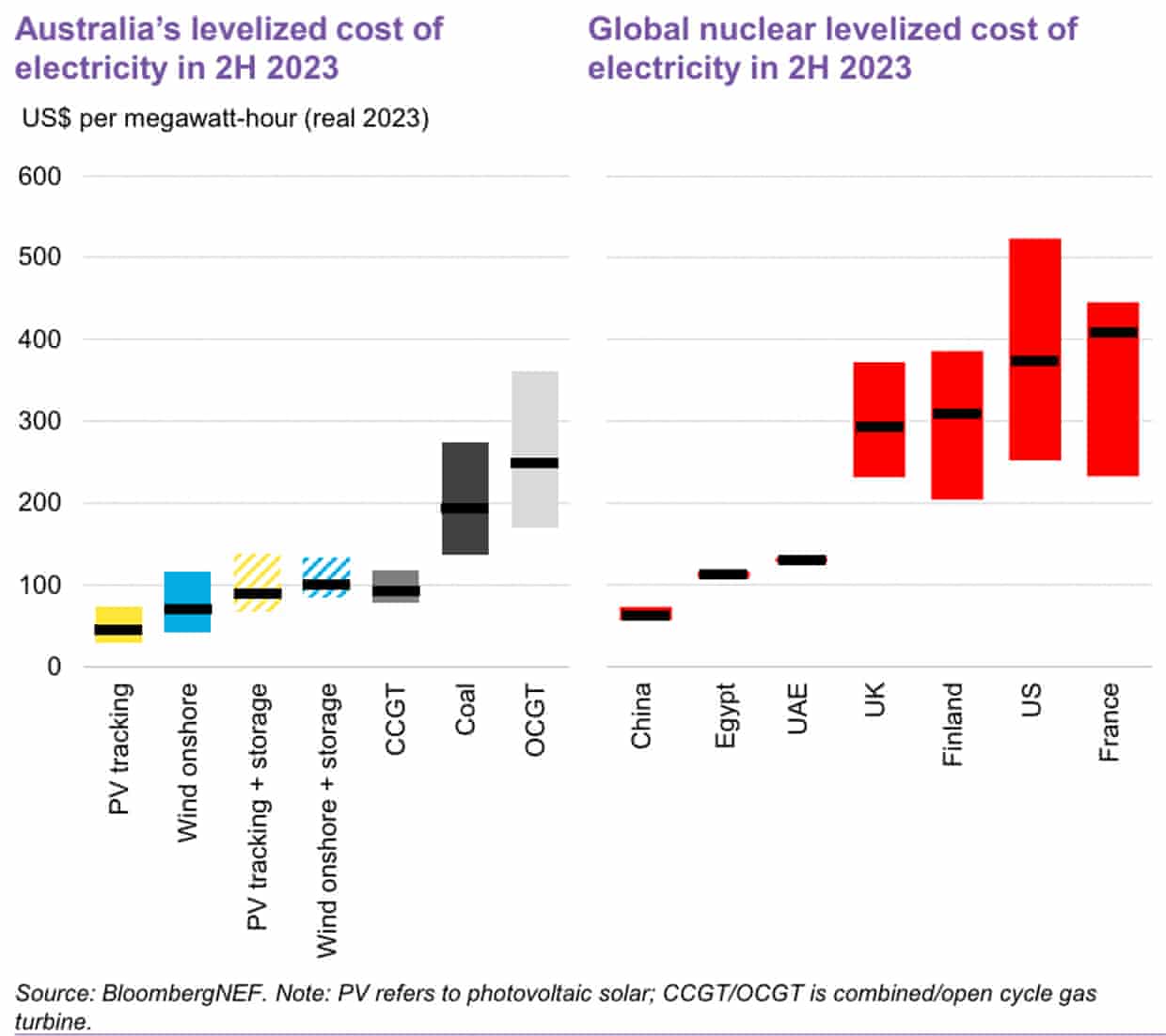
  • However, we have costings for Renewables from reputable sources that insist they are cheaper than nukes [1], [2], [3, 4] and costs of Renewables has been decreasing.
  • In the last 20 or so years the costs of nuclear have regularly turned out to be much greater than the builders estimated. Some projects have been discontinued because of this unexpected extra cost, and there can be no guarantee that the next set of projections will not be under-estimates as well.
  • This greater than expected cost requires an increased the price of electricity to pay the extra cost back.
  • Claims of cheapness are merely optimism about nuclear and pessimism about everything else.
  • There are people and companies wanting to build renewables, but Dutton claims that nuclear will have to be paid for by the taxpayers. Any mistakes or bad planning will be costs to taxpayers and there is no competition.
  • There is no evidence that any private enterprise is even vaguely interested in taking on the costs and dangers of building.
  • Then, we are trying to build at least 7-14 reactors at the same time. Just as large amounts of normal building cause price increases due to materials and labour shortages, so we can expect such increases from building reactors simultaneously. The only countries with experience of building large numbers of reactors together, at the moment, are China and Russia, and it is probably unlikely that Australians wish to entangle their energy future with either of those countries.
  • Nuclear also has ongoing costs, not just of keeping complicated systems functional and avoiding fat tail accidents, but of mining, fuel provision, transport and waste disposal.

More importantly, Dutton ignores the time factor:

  • He makes a big deal of energy costs now (which is high all over the world for many reasons) but nuclear energy would not arrive for at least 15 years (at the very best) and time of construction blow outs seem normal, given other people’s experience, so its likely to be later still.
  • Therefore, even in the unlikely event nuclear reactors will provide cheap energy, this cheapness is hardly going to relieve price issues now.
  • We don’t know how long any particular nuclear reactor can exist before the probability of danger overwhelms the probability of benefit. He is estimating 80 years. That is not 80 years of continual action as they need servicing, and at the end of life the cost of decommissioning is usually very expensive and takes a long time. These costs should be factored into the upfront costs rather than being ignored.
  • Without increasing immediate emissions-reducing power, like renewables, then nuclear will not help reduce emissions, because fossil fuels will have to be used to make up the decline in energy supply as coal phases out. If we don’t start reducing emissions now, then they will accumulate and make climate change worse.

Dutton also ignores the systemic nature of energy.

  • Even 16 nuclear energy sources will make up a small part of the system, especially by the time they are built, unless we reduce energy usage significantly.
  • Because they are a small part of the system, even if they were incredibly cheap, it is probably unlikely they will reduce energy prices.
  • If Australia expands its energy consumption, which is pretty likely, then it almost certainly will need more cabling, even if the nuclear stations use the old coal wires. So one of his arguments for cheapness is likely to be wrong, and the idea that no new cables will be needed shows the inability of the Coalition to look at the system as a whole.

So given this nuclear program is unlikely to reduce emissions, or produce cheaper electricity for a long time, if ever, the main plan for justification is to attack renewables and contemporary prices.

Prices only slowly rose under the Coalition and are massively expensive under Labor. This could be true, but its easy to keep electricity prices even, if you are not doing anything at all to reduce emissions, and think that increasing emissions is actually ok because you deny climate change. He adds to alarm.

The Albanese Government has us on a path towards the hollowing-out of industry and business in our country….. And it’s all because a weak Prime Minister is making decisions aimed at stopping Labor voters defecting to the Greens.,… Labor’s energy policy train wreck is only making it more vital that we include nuclear.

I don’t think anyone with any political awareness, could seriously think Labor is trying to take over Green’s policies. But it does seem from this, that Dutton’s arguments depend on exaggerated rhetoric

Nowhere in the world has a renewables-only policy worked.

This may be true, although people disagree, South Australia will likely shortly become mainly renewables with some gas firming, but no one, certainly not the Labor party is aiming for a Renewables only policy. The question is whether nuclear is the best form of emissions reduction.

He argues:

Germany too has invested heavily in renewables.

Wind and solar account for more than 30 per cent of its mix. But when Russia invaded Ukraine and cut off gas supplies to Europe, Germany was left in a precarious position. It ramped-up its coal-fired power generation.

This shows what many people have said previously, that Germany’s energiewende depended way too heavily on coal, lignite and gas (partly because it did phase out nuclear and energy corporations went for the cheaper and more profitable option of heavily polluting lignite), and Germany should never have made the decision to depend on overseas supplied gas, especially from Russia. However, since then Germany has attempted to boost its Renewable Capacity. It is certainly not going back to nuclear.

As we said earlier the point of the energy transition is not cheapness, although renewables seem cheaper than nuclear, it is emissions reduction. This is almost the only thing that counts. But of course the Coalition use the well known drug dealers defense – ‘We sell good drugs’ – as

[products] will be produced in other countries with weaker environmental standards than Australia.

One interesting part of this speech is that Dutton is almost claiming that nuclear can work with renewables,

The Coalition… sees renewables and nuclear as companions – not competitorsas Labor does.

rather than repeating his earlier position that large-scale renewables will be suppressed and fossil fuels increased to make up for the suppression. How far we can trust this really is a change of anything other than camouflage is uncertain.

The other argument he makes is that renewables are unpopular.

From Bunbury on the west coast to Port Stephens on the east coast, furious residents are protesting offshore wind farms due to their impacts on fishing, tourism and livelihoods….In February and September, farmers flocked to Canberra to rally against the roll-out of industrial scale renewables and transmission lines on their prime agricultural land.

It is correct that there is resistance to wind (in particular), although much of it seems to be about neoliberal implementation practices and lack of consultation or explanation. However there is a political force and encouragement over these protests from the Coalition and from oil company think tanks, and the Coalition, perhaps unsurprisingly, is not interested in encouraging dissent against offshore or onshore mining, that could destroy bore water supplies harm fishing, tourism and so on. Dutton has previously made clear that no protest will be acceptable over nuclear because of “national interest”.

The question arises could Australia use nuclear energy? The answer is clearly yes, but it has to be done along with increasing renewable energy. OR emissions will not decrease, and money is being thrown away for nothing.

By itself nuclear is just expensive and slow to get up. It will need subsidies, if power is to remain cheap and available, whatever the Coalition argue.

There is no point in building 7 nukes, that will almost certainly not produce enough energy to make a difference.

Nuclear is also experimental in the sense that we do not know what will happen when a country with no nuclear power plants tries to build 14 or so at the same time.

More importantly than providing baseload, we need to deal with the problem that large scale solar will produce massive amounts of excess energy which has to be stored. Storage is the number one problem for emissions reduction. If we get enough storage then we might not need ‘baseload.’ However it is also correct we do not know if this is possible at the moment, it just looks probable.

Any kind of transition which actually lowers emissions will be costly, that includes nuclear. To pretend otherwise is dishonest. This possible dishonesty is especially marked when the Coalition have not produced any costings and have simply denied everyone else’s costings with no evidence. Saying that they:

will release our costings in due course – at a time of our choosing. Not at Chris Bowen’s or Anthony Albanese’s choosing – but our choosing

simply implies their costings have been difficult at best, or they want to make sure these costings are not open to long, careful criticism.

Dutton concludes:

Let me conclude on this point; we can’t switch nuclear power on tomorrow – even if the ban is lifted.

Like other countries, we need to ramp-up domestic gas production in the more immediate term to get power prices down and restore stability to our grid.

I think that statement renders the position clear, For the Coalition, nuclear functions to increase emissions now and, likely, forever. Presumably we don’t challenge petrol for cars either. There is no talk of the electrification of everything, or of reducing emissions from other sources. The aim seems to be to keep fossil fuels burning and emissions up.

If there is, as he claims, something visionary about this plan, it is spending lots of money, not changing and everything being ok, probably because climate change is unreal and fossil fuel company profits must be maintained.

‘Historical Materialism’

September 26, 2024

This is a (hopefully) fairly simple explanation, rather than the full deal, and like most simplifications probably has major failings

Historical materialism

Historical materialism is the theory that history is primarily driven by material forces rather than by ideas or ‘great men.’ The theory that history is the working out of ideas alone can often be called something like ‘historical idealism’

Marxism asserts Ideas arise out of the human conditions of life and are generally spread by ‘class representatives’. “The ideas of the ruling class are in every epoch the ruling ideas”. The ideas of the ruling classes get promoted and distributed, whereas other ideas tend to be persecuted or ignored. However, in conditions in which the ruling class is destroying itself, or a new class is rising, alternative ideas can arise out of existing class conflict. Hence Marxism itself was supposed to be able to challenge capitalist ideology, through the rise of the working class and through expressing their understandings and experience of life.

It seems to have failed dismally as, nowadays, most people have no idea what Marxism stands for or argues, they simply know what their rulers and the rulers’ representatives tell them about it 🙂

Important factors in history

Important factors in material history include the ways that people gain survival through the “organization of the means of production.” So the fundamental questions for a Marxist are:

  • How do societies produce food and other products?
  • How do they distribute or trade food and other products?
  • What groups of people does this organization allocate control over the distribution?
  • Who does the system allow to accumulate more than other people?
  • How is this inequality preserved?
  • How does this organization protect itself and enforce itself?
  • How does this organization undermine or destroy itself? These ways of self-destruction are usually called “contradictions.” Marxism implies that contradictions are binary (the “dialectic” because of Hegel :), but there is no reason to assume this is correct. Contradictions could involve multiple forces acting at the same time.

In capitalism, capitalists (deliberately?) confuse capitalism with exchange and trade, which are universal. For Marxists capitalism is a particular set of forms of organization of production, technology, labor, trade, distribution, allocation of prosperity, power and so on. Capitalism is not trade in itself. Otherwise bureaucratic state communism would have to be classified as capitalism, which is not useful, even if both are oppressive in often different ways.

Example: the history of capitalism

The capitalist idea of history is that people become rich because they, or their ancestors, worked hard, were virtuous or brilliant having great ideas. This set of ‘ideologies’ (ideas justifying a particular social organization) feels right to capitalists and makes capitalism ‘good’ which is pleasing to them. It is well known and well distributed. Every American, Britisher, European, Australian has probably heard this ideology repeated over and over until it sounds like common-sense.

Marxists would tend to argue that capitalism arose through violent theft of land by those in power (aristocrats), and through expansion of the aristocracy in the UK to include people who owed their wealth directly to the crown through services they performed. Many of these people used that land to accumulate capital, and start investments in newly invented operations like corporations. These people had the military power and technologies to continue their plunder throughout the world, moving on when they had destroyed land, stealing valuables like labor (slavery), gold. silver and other resources, often with the co-operation of other powers (such as local rulers).

This process of dispossession and investment, created a working class in the UK and elsewhere, who could no longer support themselves through their own food production and farms, craft or traditional labor. The self-reliance of the people was destroyed by capitalism and turned into reliance on transactional capitalist bosses. Eventually traditional aristocrats had to move into business or marry into business, because their lands no longer brought in enough income to live at the level required by their culture and forms of social power.

The State acted to support the rising capitalists and enforce this dispossession and impoverishment. This allowed the workers to be exploited in factories often with working and living conditions so bad, that capitalists were also stealing the health and lives of the workers as they were with slavery.

Eventually this similar experience lead to the working class unifying and struggling against bosses who extracted riches from them, and forming unions, fighting for political rights, political participation and decent working and living conditions

Marx expected these processes to lead to revolution and the abolition of capitalism and its State. There is no capitalism without a capitalist State. Marx rather naively seems to have thought that Communism without the State, would have few contradictions.

However, the processes in the West first led to the post war semi-socialist welfare State, as a defense against the possibilities of revolution, but capitalists fought back, and restored their dominance, as their control of wealth production enabled them to support ‘free market’ ideas through sponsored think tanks, fund politicians, persuade the State to make union life much harder and to repeal the taxes which allowed the welfare state to exist.

This set of pro-corporate political and economic actions is often known as ‘Neoliberalism.’ Some say this counter-revolution happened because capitalists were still afraid of workers’ revolution or the political influence coming from the new freedoms of people to participate politically, or because capitalism had become less profitable. I don’t know what is the case.

Liberty for ordinary people, collapsed and we are now living in a capitalist in plutocracy which is slowly destroying itself by impoverishing the people, destroying the competitive market, and destroying functional ecology. The only ‘solution’ being proposed for current capitalist contradictions seems to be authoritarianism, suppression of dissent and keeping people exhausted at work. Similar solutions were previously tried in the 1930s and did not work that well. There is no reason to assume they will work now.

However, information has been shown to be important. In my experience, many people still believe that the Mueller Report cleared Trump, did not find anything wrong with his behaviour or was a fraud. That Trump is being conspired against by the establishment and the FBI. That Putin is scared of Trump and campaigns for Democrats. That Harris slept her way to the top and is a communist who organised the assassination attempts on Trump, and that a vote for Trump is a far safer and more sensible than a vote for her. This may well give the US election to Trump and have massive effects on world history and the rush to collapse. The relationship of ideas and social forces, may ultimately depend on material forces, but ideas can give victory, although a pure materialist could point out these pro-Trump ideas are driven by corporations. However other corporations oppose them.

Conclusion

Historical materialism claims the main driving factors of history are material ones: material conditions, material and social organization, the possibilities of technology, and the allocation of violence. Ideas are largely secondary to these processes. History is not the expression of Spirit, great men, or God’s will.

Energy and Economy

September 23, 2024

The Leader of the Australian Coalition and opposition party made a recent speech I will be returning to. In this post I simply want to discuss a basic error that he opens with, which I think is dangerous.

He starts

Energy isn’t part of the economy.

Energy is the economy.

He attributes the remark to conservative journalist Chris Ullman and the statement could originate with Vaclav Smil, so this is a borrowed and considered statement, not a brain fart.

However, it is pretty obviously not true. Drop a nuclear bomb on Sydney, will any of that energy make an economy, improve Sydney’s economy or make Sydney’s people (as a whole) prosperous? No. It is more likely to immediately destroy processes than to immediately improve them.

Energy is not the economy, energy is vital to and limiting of economies.

It would seem vital to understand that economies and energy come along with:

  • Social organisation, labour, relations of power and relations of access to energy. These influence the way social wealth is distributed and inhibited. Control over resources such as energy and riches, gives people and organisations power to influence and pattern markets and other parts of society.
  • Available and directable energy. Unavailable and chaotic energy is rarely beneficial unless ordered and processed. As we have learnt recently, energy can be made unavailable to increase profits and lock in production.
  • Time constraints. Food has to be eaten before decay. Building something might take too long for it to be useful, when compared to the speed of the threat arising. How quickly can two different processes adjust to change?
  • Entropy, waste, pollution, increasing disorganisation, or illth. Economies always produce waste and usually produce ‘harms’. Economies can cause levels of destruction which overwhelm their ability to function. The more energy they have, the more destruction and alteration they are capable of.
  • Transport of goods (requires energy), so they can be traded.
  • Ecologies, land, food (which is energy), water, resources, and climate. It is best when the ecologies are working in a relatively harmonious systemic way, with humans and each other. A decaying ecology leads to a decaying economy. Ecologies are probably never completely balanced, but hugely unstable ecologies (often as disrupted by humans) are hard, and costly, to live within.
  • The ways we socially think about and imagine energy, and the way it is used to benefit human life. We may tend to think some apparently unreal energies are real, and that some energy sources are more powerful than they are.

in summary, The Economy is not just energy, but involves a system of systems, which depends on other systems. We have to keep all those systems working reasonably well for survival

These multiple interactions are vital points for understanding an economy, but people generally seem to want to ignore them. The question is why is Mr. Dutton enthusiastic about ignoring them?

I think he tends to answer this in his next passage, which in summary states.

If energy is cheap then all is well. If it is expensive then:

Our manufacturers pay more to produce and package goods.

Our builders pay more to construct homes.

High power prices have inflationary impacts across the economy.

Higher costs are passed on to Australians.

You end up paying more for every product, good and service.

Cheap and consistent energy is critical for more affordable lives and a more prosperous economy.

This is only true if we reduce the complexity of the economy, and refuse to ask what are the consequences of this cheap energy production? What are the power relations in the economy – who gets cheap energy? How destructive is the energy production – what does its pollution do? How available and directable is most of the energy? lots can be wasted. What effects does it have on the rest of the energy system? Does it interfere with other needed energy? What effects, long and short term, does it have on ecologies? How do we think about that energy?

These points make the economy more complex but also more real.

Peter Dutton then asserts that nuclear power is cheap, available and low illth.

He does this by:

  • Ignoring any costings whatsoever, or any need to pay back huge public expenditure through increasing the cost of electricity or something else.
  • Ignoring the time taken for construction and development, and what the state of the electricity system will be by the time nuclear is constructed.
  • Ignoring the issues and costs of waste, breakdown, servicing, decommissioning etc
  • Ignoring the magical socio-psychological appeals of nuclear. Can 7 to 14 nukes really save Australia from energy problems? Will they both replace coal that is going out of business and provided the extra energy we will need by 2050? (No, they are not even enough to replace the lost coal, it is only because nuclear seems magically powerful that this question can be avoided).
  • Dutton is still talking about SMRs which do not exist commercially and which are less powerful than standard nukes. This would imply these imaginings have a magical hold on him.
  • Ignoring any other effects nuclear may have on the economy, ecology, or energy supply, and
  • Discouraging low-cost low-GHG sources of energy, This discouragement will increase the use of gas and hence the production of GHG emissions.

Even assuming that his “hidden data” does make energy cheap. then a change in energy systems which does not reduce GHGs is not worth the money. So we need to know whether nuclear increases pollution and destruction and so on.

We expect a right wing politician to say the economy is society or that it is the important part of society because it makes business the essential part of society, but saying that we don’t need to think about the effects of different types of energies, involves ignoring everything important to human life and not being prepared for the potentially harmful interaction between systems.

Nuclear again and again and again

July 15, 2024

The Coalitions “Nuclear Fantasy” is not generated by concerns about:

  • Energy supply, as the seven nukes will not even replace the coal power generated electricity that is being shut down, never mind grant the increase in energy we will need by 2040.
    • Small Modular Reactors do not exist commercially, so after a lot of blather, they are only going to use two of them, in the hope they will eventually exist. The experimental SMRs also seem to produce less electricity than do normal reactors, so they are not a substitute for normal reactors. We will probably need three times the number of nukes.
    • The Smart Energy Council calculates that the seven reactors will only provide 3.7% of Australia’s electricity demand by 2050. This is pretty trivial, and may not be worth the cost or the risk.
  • Emissions reduction or reducing climate damage, because they also want to cut back large scale renewable projects, and they are abandoning emissions reduction targets. They will have to increase emissions, to get the energy needed, probably from gas burning.
    • Nuclear is not very flexible, it is required to generate a baseload, that means that as with coal, it gets disrupted by high levels of solar generation. This implies that to make it work, cheaper renewable energy has to be turned off. This also implies that the Coalition will need to prevent the regular export of electricity from your rooftop into the grid, so solar will become more expensive to operate.
  • Delay or the electricity generation gap. Given the illegality of nuclear energy in Australia, even assuming best building practice in a country that has never built such a thing, it will take at least 15 years to complete, and many of those years will be without coal power or adequate renewables. So electricity prices will climb, and we will have shortages.
  • Lowering costs of electricity as they seem to be ignoring the costs of building, insuring and decommissioning nukes, and making renewables harder to use. In the UK for example electricity prices from the new nukes are so high (because of the cost of building), that they will massively increase the price of electricity generally.
    • The long delay means that nuclear will do nothing to lower energy prices in the near future, although they are trying to imply it will.
    • The CSIRO GenCost report, finds conventional nuclear power stations will cost about 2.5 times as much as onshore wind and 5 times more than large-scale solar. If so, the electricity price has to be higher to recover the capital cost.
    • Not surprisingly Nuclear reactors cost more to run than wind or solar. They have large numbers of moving parts, materials are dangerous, and a lot of care and precision is required.
  • Communities. They are happy to support opposition to, and veto over, renewable projects (because they oppose renewab;es), but no community will get a veto over nuclear because its in the “national interest”.
    • Coalition policy continues to ignore that the best thing for rural towns is community owned renewable energy, it keeps the money in the town, gives them control over their development and means everyone gets buy in.
  • Issues of taxpayer subsidies which will be required for the build, as there is no evidence that corporations want to build any nuclear energy for themselves, unlike renewables.
  • Costs of insurance and decommissioning. In general, even though nuclear is usually safe, because of the possibility of severe accidents insurance companies are reluctant to cover them, and taxpayers usually end up taking the risk and taxpayers usually pay the billions or more to demolish the reactors safely.
  • Money. As the project will probably be built by foreign companies, most of the money will leave Australia.
  • Nuclear waste. that appears to be something we worry about in the future.

Given the policy is not about anything sensible, it would seem to be about

  • Continuing their war on renewables
  • Supporting fossil fuel companies, and their emissions, for at least another 15 to 20 years

and

  • wasting lots of money, on something which could produce huge problems for Australia.

It appears this is the usual swamp politics of subsidising and protecting the fossil fuel corporate sector from change, at the taxpayers’ expense.

Nuclear might have been a great idea 10 to 20 years ago, but is not now a whole answer, or even a partial answer especially if emissions are being increased and alternatives suppressed.

In other words don’t think that building a few nuclear power stations stops the need for other action.

Australia’s climate emissions

July 7, 2024

This is basically a summary of:

https://www.theguardian.com/environment/datablog/ng-interactive/2022/oct/03/tracking-australias-progress-on-the-climate-crisis-and-the-consequences-of-global-heating

Emissions reduction targets and needs

  • Labor has targets of reducing emissions to 43% beneath 2005 levels by 2030 and reaching net zero by 2050.
  • Climate scientists say the cuts should be at least 50% by 2030, it would be better if they were 75%.
  • The Coalition opposition wants to abandon all 2030 targets so emissions can increase freely. It hopes all necessary emissions reduction will happen between 2040 and 2050 because of 7 nuclear power stations. This is impossible without massive cuts in Australian energy use.
  • The idea of a carbon budget calculates a ‘fair’ level of total GHGs that can be emitted for a country to avoid 1.5C or 2C of warming. The Climate Targets Panel,says Australia has a carbon budget of up to 10.1bn tonnes of greenhouse gas emissions between 2013 and 2050 to help keep heating below 2C.
  • Scientists warn there will likely be a significant and devastating difference in the damage caused by the climate change produced by a heating of 1.5C and the heating produced by 2C.

At current rats of GHG emissions (2024), Australia will have consumed its carbon budget for 1.5C in less than 5 years.

And it will have consumed its carbon budget for 2.0C in about 11 years.

This is according to figures from the Commonwealth Department of Industry and Resources, Climate Change Authority, and Guardian Australia

Current Emissions Reduction

The currently claimed emissions reductions almost completely stem from land use change, which is fairly contentious and hard to measure. However, if those emissions are removed, then it looks as though the emissions reductions since 2005 are trivial.

The emissions from the Australian economy (including electricity, industry, transport, agriculture and waste) have decreased about 2.5% since 2005. This low level of reduction is not unexpected as the Coalition, has ruled over most of this period.

As well, the emissions produced by burning Australian Coal and Gas, overseas is not included in these counts. For example according to the Resources and Energy Quarterly, National Greenhouse Gas Inventories, Australian Energy Statistics, and the IPCC, Australian emissions from black coal are about 156.7 billion tonnes and emissions from Australian black coal sold overseas are 864.4 billion tonnes.

Consequences

2023 was a record-breaking year for average temperatures in Australia and the world, and 2024 has been hotter again, so far.

Global surface temperature of the sea has so far been hotter in 2024 than in 2023, which is the hottest year ever recorded.

In the past 18 months, the extent of sea ice (in millions of kilometres) in the Southern Ocean around Antarctica. have been well below anything previously recorded.

A Table of Australian events which probably were worsened by climate change (Stops at 2020, missing massive floods and further bushfires)

EventType of EventLocationEffect of climate change
Australian bushfires, 2019-20WildfireSouth-east AustraliaMore severe or more likely to occur
Queensland fire weather, 2018WildfireQueensland, AustraliaMore severe or more likely to occur
New South Wales hottest summer, 2017HeatNew South Wales, Southeastern AustraliaMore severe or more likely to occur
Northern Australia marine heatwave, 2016OceansOff Northern AustraliaMore severe or more likely to occur
Western Australia severe frosts, September 2016ColdWestern AustraliaMore severe or more likely to occur
Extratropical Australia wildfire risk, 2015-16WildfireAustraliaMore severe or more likely to occur
Record Australian heat event of October 2015HeatAustraliaMore severe or more likely to occur
South of Australia “exceptional” air pressures, August 2014AtmosphereOff Southern AustraliaMore severe or more likely to occur
Australia high temperatures, spring 2014HeatAustraliaMore severe or more likely to occur
Australia heatwave, May 2014HeatAustraliaMore severe or more likely to occur
Australia record summer temperatures, 2013HeatAustraliaMore severe or more likely to occur
Australia & tropical Pacific warm anomalies, 2013HeatAustralia & far west PacificMore severe or more likely to occur
Eastern Australia record heatHeatEastern inland AustraliaMore severe or more likely to occur
Australia record hot September, 2013HeatAustraliaMore severe or more likely to occur
Australia record temperatures, 2013HeatAustraliaMore severe or more likely to occur
Australia hot summer, 2012-13HeatAustraliaMore severe or more likely to occur
Fitzroy river flooding, 2010Rain & floodingQueensland, AustraliaDecrease, less severe or less likely to occur
Global temperatures and rainfall extremes, 1951-2005HeatEurope, North America, Asia, Australia, and the Northern HemisphereMore severe or more likely to occur
Australian “Millennium Drought”, mid-1990s to late 2000sDroughtAustraliaMore severe or more likely to occur

The Supreme Court and Trump

July 2, 2024

I still have not got around to reading the judgement yet, so please be charitable, but my understanding is that one of the problems of the judgement is that few of the important terms are defined properly, and the bias of the judgement is towards increasing the power of the US President, and to reinforce their lack of responsibility to the American people.

After the Court’s decision, the President is immune from criminal prosecution for all acts that can be interpreted as part of their official “core” duties, and given “presumptive” immunity for all other official acts. This appears to allow the official Presidential core or other capacities to be stretched to provide immunity anywhere. Assuming the President has good advisors, it will be very hard to argue that any action is not a core activity or one with “presumptive immunity”.

So if Trump or anyone else says, “As part of my core activity of protecting the constitution and the stability of the Country, I will declare Martial law and suspend all elections” or “I will prevent all Marxists from participating in elections,” defining Marxists to be people who do not vote Republican (which is pretty much the current FOX position and that of many Republican politicians). He can then suspend all elections and remove all non Republican voters and candidates, to cheers from his media.

We can be sure that the President’s party will ignore impeachment, especially if he can have them killed. So no President will ever be impeached, and the President could presumably have the witnesses or prosecutors ‘disappear’ to protect the State from insurrection.

It already seems to be recognised by the Court that Trump’s attempts to force Pence into not certifying the result, is part of his official job of communicating with the VP. His attempts to force the DoJ to overthrow results is part of his core duties as supervising the DoJ. Possibly his ‘talks’ with the governor of Georgia are part of his duties as President to ‘prevent’ electoral fraud, and so on. We have been told he can only obstruct congress by refusing information, so arranging the assault of members by followers does not count. His earlier attempts to obstruct justice in the Mueller inquiry have been ignored anyway.

In other words, because of vagueness over his core capacities (even without presumptive immunity), it should be relatively easy to rule that the President could assassinate someone, or imprison them without trial, as long as he made the connection to a core activity. What a future this opens.

The judgement should have given hypothetical examples of what might be a crime, especially given that it gave comments which are clearly directed at stopping the cases against Trump, but I guess that would have undone the purpose of the judgement. The members of the Court could, for example, have replied to justice Sotomayor’s objections, by saying the president could be prosecuted for organizing a military coup, trying to overthrow an election, shooting unarmed people, starting a war without consulting Congress, or for taking a payment (or gift) in exchange for a pardon etc. but they didn’t. This implies that the judgement potentially recognises such acts as non criminal when committed by the President.

If any of what I’ve written is remotely correct, then I really had expected better of the Supreme Court, even this one. They, at best, show a remarkable lack of understanding of consequences of their actions. If not now, then later, they have made it legal for the USA to be seized by a dictator. This is a decision which supports the Deep State and tyranny.

***********************

I may be being too narrow. It may be that the Supreme court wants to make it so that the rich-power elites can be immune from buying up the government

Earlier this month they essentially legalised bribery by saying in Snyder v United States that a bribe had to be paid before an advantage was given to the payer, and that gratuities, tips, gifts and other signs of appreciation given afterwards were perfectly legal.

This ruling guts most corruption legislation, and previous cases of corruption.

It also frees some of the Supreme Court from challenges of being corrupt themselves. Which is convenient

Bloomberg New Energy Finance on Nukes in Australia

June 28, 2024

BNEF has just released a paper called “Australia’s nuclear-powered distraction threatens net zero” I will link to it as soon as I can find a link. This is based upon articles about the article

Summary

The issue is not really whether a case could be made for nuclear in Australia, but whether the Coalition policies will deliver:

  • More emissions, and
  • More expensive electricity.

That would seem to be the case from the mess of their policy, and their repeated requirement that we trust them to give details after the election.

The plan, even if completely successful will certainly not add that much to Australia’s energy supply, and there is no point going with small amounts of nuclear if we are going to increase emissions through rolling back on renewables.

Political Obstructions?

Despite nuclear energy technology having been banned in Australia since 1998, under Coalition PM, John Howard, with three of the high population states also banning it, the federal Coalition opposition has proposed seven sites for nuclear plants which they claim could be operational as soon as 2035, which is improbable. As Bloomberg states, it will be “a slow and challenging” effort to overturn existing bans, and to force people to accept nukes on the sites selected without consultation.

Nuclear is expensive

Nuclear could reduce emissions, but it is usually a very expensive technology in markets with limited experience, unsupportive politics and uncertain regulation — such as Australia. We have already mentioned that cost overruns are normal even with experienced builders. Another problem is that people cannot be held to contract prices as we do not want cheaply built and unsafe reactors, so we have to assume they are not deliberately underquoting.

Renewables are cheaper and easier

The usual estimates are that renewables are cheaper than Nuclear. Bloomberg said that going by existing nuclear industries in western nations, the cost would be “at least four times greater than the average” for Australian wind and solar plants with storage today.

Furthermore, Australia has plenty of wind and solar resources with large areas of semi-vacant land, and lots of people vying to build wind or solar power. There appears, as yet, to be no one volunteering to build nuclear in Australia, certainly not seven power stations worth by 2035.

To repeat, SMRs do not exist commercially so we have no idea what they would cost, or how much energy they would produce. So it is pointless budgeting for them.

Australia’s coal fired power stations will largely be phased out by 2035. So, to avoid power supply shortfalls and high electricity bills between the gradual shutting down of coal energy and the beginning of nuclear, we have to increase renewables and energy storage. If we do not do this, then electricity prices will increase massively or emissions from Gas will increase.

Nuclear will also add significantly to the costs of energy. To pay off the huge capital investment, which it seems will be carried by taxpayers, prices will have to rise.

Conclusion

if the debate serves as a distraction from scaling-up policy support for renewable energy investment, it will sound the death knell for decarbonisation ambitions – the only reason for Australia to consider going nuclear in the first place.

More on Dutton and Nukes

June 25, 2024

This is basically a summary of a news article which you should read.

https://www.theguardian.com/australia-news/article/2024/jun/24/coalition-nuclear-policy-peter-dutton-power-plants-100-years-run-time

Plus a few other references. If this summary contravenes copyright, please let me know….

Age

Ted O’Brien, the shadow energy minister, has said the nuclear plants built here will last for between 80 and 100 years.

This is clearly likely to be guesswork as there are no 100 year old plants anywhere in the world…. Nuclear power plants did not exist in 1924.

The mean age of the 416 active nuclear reactors is about 32 years. The average age of the 29 reactors that have shut over the past five years, is less than 43.

16 reactors have been operating for 51 or more years. Mycle Schneider, an independent analyst who coordinates the annual world nuclear industry status report says “There is zero experience of a 60-year-old operating reactor, zero. It never happened. Leave alone 80 years or beyond” (The world’s oldest, Switzerland’s Beznau, has clocked up 55 years with periods of outages.)

CSIRO’s report looked at a 30 to 40 year life for a large nuclear plant as there was “little evidence presented that private financing would be comfortable” with the risk for any longer.

As plants age, maintenance costs are likely to increase (physical entropy or wear), as they have in France. Apparently the US has avoided this problem, although with declining investment over the last decade the average reactor age has increased from 32 to 42 years. So we need to find out how that was done.

What is the state of the global nuclear industry?

Five nuclear reactors opened last year and five were shut down

Over the last 20 years 102 reactors opened and 104 shut down

China has added 49 during that period and closed none. Nuclear energy provides about 5% of China’s electricity, which seems to be slightly more than the Coalition is going for in Australia

Last year, China added 1GW of nuclear energy but more than 200GW of solar.

In the world, solar passed nuclear for total energy production in 2022 while wind overtook it a decade ago.

Schneider says “In industrial terms, nuclear power is irrelevant in the overall global market for electricity generating technology.”

Data from an annual statistical review by the Energy Institute implies there is no global wave of nuclear energy investment or construction. Global generation peaked in 2006, dipped after Fukushima and has stayed about the same since 2000. However, renewables, starting from almost zero in 2000, have now risen to generate 50% more than nuclear.

SMR’s

Bill Gates’ company has been trying to build commercial SMR’s for 18 years and not succeeded yet.

The CSIRO Gencost report noted that the Utah Associated Municipal Power Systems SMR, was cancelled last November. In 2020 its estimated cost of of $18,200/kiloWatt, was more than double that of large-scale plants at $8,655/kW (in 2023 dollars). But by “late 2022 UAMPS updated their capital cost to $28,580/kW” the CSIRO said. “The UAMPS estimate implies nuclear SMR has been hit by a 57% cost increase which is much larger than the average 20% observed in other technologies.”

Nuscale, the only company to have received design approval from US regulators for an SMR, were building SMRs for US Department of Energy’s Idaho National Laboratory. NuScale announced at the start of 2023 that the target cost of power for this project had increased by 53% since 2021 to US$89/ MWh. they had, in one account failed to attract customers at these prices.

Big Economies and Nuclear

The Coalition says that Australia is the only one of the top 20 economies that doesn’t have or isn’t getting nuclear energy. However, Germany has abandoned nukes as is well known, and Germany is also using less coal power than it has in decades. Italy shut down reactors after 1990. Saudi Arabia has been considering developing nuclear for about 15 years but, still has not embarked on it, and has set a goal of 50% of electricity coming from solar by 2030.

It may be that only five reactors have been finished this century. Construction has taken more than twice as long as forecast, with the cost being between two and six times the initial estimates.

Who is still building large reactors?

The 35 construction starts since 2019 were either in China, or were Russian-built in various nations. It is unlikely the Coalition will go to China or Russia for builders.

France?

Nuclear provides almost two-thirds (62%) of France’s electricity. However, the French company EDF has €54.5bn debt and hasn’t finished a plant since 2007.

EDF is building Hinkley Point C in the UK, which has suffered from cost blowouts and delays. The current estimate is that it may not start until 2031 and may cost $90bn to complete. High electricity prices have been promised to keep it solvent.

In 2014, the Government aimed to reduce nuclear’s share of electricity generation to 50% by 2025. This target was delayed in 2019 to 2035, before being abandoned in 2023. Apparently 1 reactor is currently under construction. The amount of energy produced in 2022-3 declined due to necessary repairs [1] and in 2016 all the reactors were offline due to a long-term coverup of manufacturing faults. By the end of April 2022 it was reported that 28 of France’s 56 nuclear reactors were offline

US?

The 4.5GW Vogtle plant reached full capacity in April, making it the US’s largest nuclear power station. Its first two units exceeded $US35bn, with the state of Georgia’s Public Service Commission saying cost increases and delays have “completely eliminated any benefit on a lifecycle costs basis”.

The Virgil C Summer plant in South Carolina was cancelled in 2017 after more than A$13bn had been spent as it became too expensive to justify.

Finland

Finland’s Olkiluoto 3, came online last year, 21 years after it was announced and 13 years after it was expected to be operational.

That leaves us with

Korea?

The Korean company Kepco built the 5.6GW Barakah plant in the United Arab Emirates. As Schneider’s report notes, the UAE “did not agree” to the disclosure of cost, delays or impairment losses. so we have no knowledge of the problems, cost overruns etc…..