This is as you would expect. Most people in the developed world, don’t want to change their lifestyles – and given that most people in that world seem to be going downhill due to neoliberal privileging of business, transfer of wealth upwards, and nannying of the wealthy, why would they want to risk going even further backwards because of attempts to fix global warming? This is the usual reason given for working class anger in the US, and for ‘populism’ (assuming that word means anything). Furthermore lots of powerful people do not want to lose the wealth they have tied up in fossil fuels, and they don’t want to risk the possibility that new forms of energy could increase democracy or impoverish fossil fuel companies.
These wealthy and powerful people can buy politicians, can buy media, and can buy the idea that climate change, global warming, massive forest fires, massive flooding, ecological destruction, over-fishing, destruction of agricultural lands, deforestation, loss of animal life etc are not really a problem, or they occur all the time, and that imagined technological invention can save us, without any political or economic change. This seems well documented to me.
They have captured mainstream parties all over the world, with the possible exception of UK conservatives, who actually seem to be trying to reduce emissions – not that this gets reported much outside the UK (remember wealthy people own the media, or advertise in it). UK conservatives, do tend to have a real conservative streak because they believe in conserving things (which is pretty unusual in the Right nowadays), and they don’t always believe in encouraging business to destroy their country….
In the developing world many countries, believe that fossil fuels and ecological destruction are necessary for development, and that it is their turn to engage in destruction for the benefit of their people, and that developed world objections to this are a form of neo-colonial racism. They say something like “get your own world in order before complaining about us.” So, on the whole, many relatively powerful people in the developing world downplay the problems as well.
Again the point is, that if the left is overblowing global warming they are not having much of an impact, and one of the leading forces for emissions reduction is not remotely left wing.
The next implied question is “are the left exaggerating the dangers?” Personally I think it is unlikely that the majority are. Some will be of course, this is what happens. Most scientists and people who study the subject, seem to think that bad things, to very bad things, could happen. Strings of high ’unprecedented’ temperatures in the Antarctic are clearly not good. World wide highly intense and ’unprecedented’ forest fires are not good. Declines in fish population are not good. The apparent death of large expanses of coral reefs is not good. Places having streams of days over 40 degrees centigrade are not good. Strings of destructive storms are not good. And this is with only 1 degree increase. What we will have with another couple of degrees will probably be really bad.
One issue here is that because ecologies and climate are complex systems we cannot predict how bad things will get. We do know, that once you knock the systems out of their balance and equilibrium, they tend to oscillate wildly, which probably means increasing wild weather, but precisely what this will mean, we can’t tell until it happens. However, the chances of good things happening for most people seem remote. I guess, if you are wealthy enough, you can move to and buy somewhere safe and remote and perhaps you can buy the people to provide you with food etc….
I don’t think it is altogether sensible to wait to see what happens before acting, because there almost certainly will be a delay. If we act now, then things will continue to get worse for a number of years. The later we act then the greater the probability that the situation will get worse for longer after we stop. So we have to stop before it gets unendurable.
I personally think the idea that action on global warming or ecological destruction is not particularly left wing at all. Real conservatives should be concerned. Even if you think that global warming has nothing to do with humans, then you might want to think about how we should prepare to adapt to changing circumstances, and how we should lessen the effects. Climate and ecological action is about dealing with, and lessening, anticipated problems, which is pretty normal across the political spectrum.
After all, ordinary people do want forests, do not want to breath coal and oil pollution, don’t want a coal mine next to their house, don’t want flooding, don’t want the price of food to go up and face food shortages, don’t want climate refugees, don’t want (if they live in hot countries) to work outside in 38 degree centigrade (100 degrees F) or more temperatures and so on. However, the wealthy elites have successfully managed to label action on these issues as ‘left wing’, probably in an attempt to make those people who identify as conservative, right wing, or libertarian shy away from action, and not think about what would be a good solution. This helps those sponsoring people maintain their power.
Climate change and eco-destruction is real and does seem to be humanly generated, (which is absolutely obvious in terms of eco-destruction). If we do discuss what to do then the arguments about what we should do, are likely to be political – and this is good.
Personally I would rather have people on the right thinking about solutions, than attempting to sabotage solutions, or attempting to prop up a failed regime, and UK Conservatives show that this is possible…
I had thought that the idea of a carbon budget was easier to understand than emissions intensity. A carbon budget tells us that we can only emit so many tonnes of carbon, before the chance of going over 1.5 degrees centigrade becomes extremely high.
The idea of a carbon budget seems to tell us something straightforward: we can no longer afford to keep emitting Greenhouse gas emissions, and we have to stop soon if we wish to avoid serious climate change.
But this idea gets mired in difficulty and unclarity, largely because of disputes over modelling, and the tendency of people to take probabilities as hard categories. That is, that a 66% chance of avoiding 1.5 degrees, often seems to be taken as if meaning that if we manage to meet that budget then we won’t exceed 1.5 degrees. This assumption could be fatal. It may also not be clear that the more we exceed the carbon budget the worse events will get. Our wealthy people are used to renegotiating loans, getting deferrals, getting assistance and so on. Our politicians are used to blaming the other side for the deficit, ignoring their own, or issuing bonds or even currency, and things keep going. A human budget is rarely ever fixed. However, the carbon budget is not a budget which can be escaped, or put to one side.
Here we have someone at The Guardian:
Time is running out to meet the goals of the Paris Agreement and avoid catastrophic climate change. The 2018 special report of the Intergovernmental Panel on Climate Change (IPCC) “suggests a remaining budget of about 420 Gigatonnes (Gt) of CO2 for a two-thirds chance of limiting warming to 1.5°C.” …. Despite this stark warning, the world keeps emitting over 40 Gt of CO2 per year.
Since we have already drawn down over 120 Gt of CO2 from this carbon budget, we have now less than 300 Gt left. Combining the proved fossil fuel reserves reported in British Petroleum’s Statistical Review of World Energy with CO2 emission factors from the IPCC yields 3,600 Gt of CO2 emissions. This means that we can only afford to burn one twelfth of the fossil fuels we have already found. [Currently there is no sign of this happening]
The policy instruments that are currently being used across the globe to reduce CO2 emissions aren’t working. It is therefore time to ban fossil fuels.
This account does not include natural emissions, such as methane from thawing tundras or sea releases of methane as the ocean temperature warms and currents change, or the likely growing inability of natural carbon sinks to keep up the absorption – especially with growing deforestation and poisoning of the sea. So the situation is far worse than is being portrayed.
Then there is the probability problem mentioned earlier. The “two-thirds chance of limiting warming”. That is an estimate. We have no means of knowing if it is absolutely correct, as opposed to roughly correct, or not. We could have a 99% chance of avoiding the problem, and still be in the 1% range, in which factors make the temperature increase too great for stability. We might, on the other hand, be in the range of being ok, and people might bet on that unrealistically with enough incentive. In any case, a one third chance of going over 1.5 degrees, even if we beat the target, is not small.
The only accurate model of a complex system is the system itself, and we don’t know exactly what will happen until it happens. So we are left with a guess, and the high probability of bad results given that events seems to be getting worse rapidly – although people will acclimatise rapidly to the idea of circumnavigating the north pole, changes in temperature, raging bushfires: “They always happen”.
Furthermore, the figures do not seem easily stable. The ACT/Climate Change Council brochure “What is a Carbon Budget” factors in some of the figures, bypassed in the Guardian report:
The UN International Panel on Climate Change (IPCC) estimates7 [in 2013] that for at least a 66% chance of staying below 2°C, total GHG emissions must be less than 1000 billion tonnes of carbon.
We have already ‘spent’ about 585 billion tonnes (also referred to as gigatonnes) of carbon (Gt C), which reduces the remaining carbon budget to about 415 Gt C. Then we need to account for the other GHGs, principally nitrous oxide and methane. If we don’t reduce them at the same rate as we reduce carbon dioxide we’ll have less of the budget—about 210 Gt C less—to still ‘spend’. That leaves about 205 Gt C. The current rate of emissions of carbon dioxide is about 10 Gt C per year, so at present rates this remaining budget would be used by about 2040…..
As the Earth warms, the oceans and land are no longer able to absorb the same fraction of our carbon emissions that they can at lower levels of warming, an effect due to ‘carbon cycle feedbacks.’ Combining scientific estimates of this effect by two independent groups [9 , 10] indicates that the budget previously calculated must be revised downward by about 75 Gt C. This leaves a remaining carbon budget for keeping global temperature within 2°C at 130 Gt C.
So what do we emit? There is a big difference between 40Gt and 10 Gt. There is a similarity to the figures, but even so, the second model seems far more urgent, because it includes factors left out of the first.
However the models available to us apparently differ considerably, which is inevitable when modelling complex systems (to repeat: the only accurate model of a complex system is the system itself), and that is a problem for knowing how desperate we should be. We have to accept that we don’t know for sure – we only know in general that the situation seems bad. It is of course comforting to use the margin for error to assume we are better off than we are, and that seems to be the common response.
In dealing with complex systems we have to recognise that certainty is gone, and was only ever illusory in the first place.
This is an official summary article, which gets referred to frequently, and which I found incredibly confusing – I would suggest it was not written to be approachable. It was of no immediate use to me – although Forbes tells me it says:
The world has 8% of carbon budget left, which will be exhausted in the coming decade at current emission rates. Any rise beyond this budget would mean that average global temperatures would go over 1.5 deg C at the turn of the century which could lead to catastrophic changes.
To be repetitious again: we may not have to exceed this budget to exceed a 1.5 degree increase in temperature. It is fairly likely before that level and gets more and more likely as we reach or exceed that level.
The same source says 34 Gt of CO2 were added to the atmosphere in 2020. They add that to increase the likelihood that:
average global temperature does not rise beyond 1.5 deg C by the turn of this century, global carbon emissions will have to be cut by 25% to 50% between 2020 and 2030, predict various climate models.
You will probably have noted that one of the sources quoted states, that factoring in all the other problems, we cannot emit more than a total of 130GtCO2 to keep temperature below 2 degrees increase. That implies we have to cut 34 Gt per year significantly now. This is a huge variance in how fast we should move. Again it is comforting to think we can get by at the high end of the emissions, and that is probably the approach that will be taken.
Further more, the article actually makes the elementary mistake of writing “to ensure that the average global temperature does not rise beyond 1.5 deg C…” This is rubbish, for the reasons we have previously discussed. People are routinely turning probabilistic statements into hard category statements probably to reassure themselves. Again we have differences in the models, some require bigger cuts, some may require lesser cuts. We need to ask ourselves and our governments and businesses, whether it is sensible to risk the lesser cuts being appropriate, because we are dealing with probabilities not certainties.
Carbon budgets seem to be used to reassuringly play down the problem.
However, despite these problems, carbon budgets can suggest useful and direct action, unlike carbon intensity figures which can hide how things are getting worse. So they probably are better tools than the intensity measures.
For example, the UKs new carbon budget (issued December 2020), clearly states:
Our recommended pathway requires a 78% reduction in UK territorial emissions between 1990 and 2035. In effect, bringing forward the UK’s previous 80% target by nearly 15 years.
Phasing out high Carbon options, such as cars, trucks and boiler heaters. “By 2040 all new trucks are low-carbon. UK industry shifts to using renewable electricity or hydrogen instead of fossil fuels, or captures its carbon emissions, storing them safely under the sea.” [The capturing is fantasy, and clearly dangerous, how would you know if these emissions were leaking? But the principle seems straight-forward.]
UK electricity production should be zero carbon by 2035, largely through offshore wind. They should explore hydrogen.
Curb waste. Lower air traffic. Farm, and eat, less meat.
Transform agriculture. Plant Trees. Biofuels. [Biofuels seem largely a fantasy as well, in terms of emissions reductions, but who knows?]
Graphs indicate an aim for zero emissions by 2050. The Conservative government possibly thinks this is practicable. especially given that most sources report dramatic falls in the UKs Carbon emissions since 1990 [1], [2], although gas largely used for heating, is now likely to get in the way, and political opposition get boosted. The UK actual emissions reductions are also better than Germanys. If the recommendations are accepted, the UK will be aiming at emissions reduction, relatively quickly, whether quickly enough is another matter.
If they do accept the recommendations then they are going first. They are not waiting for others to catch up to make it fair. They are not worrying about others taking advantage of them, they are simply setting an example. This is how things get done.
Others will follow if it works.
To someone in Australia or the US, this probably all seems unbelievable. A right wing government is taking hard action without trying to pretend everything is ok, and nothing needs to be done. They are accepting responsibility and working towards a target. They are possibly even recognising that there will be problems, and not running away from those problems. Of course, in this part of the world, it is hardly ever reported.
On top of these kinds of actions, it also seems likely that we may need technological carbon removal, although bio carbon removal, stopping deforestation and starting ecologically sensitive reforestation, would be easier. Technological removal will be massively expensive, the carbon will be hard to store or reuse, and we don’t have it, at anything like mass use – but it might be worthwhile expending public research money on it, and keeping the patents in the public domain, to make it useable. As long as it is not used to allow more fossil fuel burning then it will help.
Carbon Budget or not, the basic practice all comes to the same simple points.
No new coal mines. Now. No expansion of existing mines.
No new gas. Now.
No new oil. Now
No new fossil fuel power stations. EVER.
Electrify everything so it can be powered by renewables. Do the research to make this possible.
Replace fossil fuel burning, import and export in your own country, with Renewable Energy by 2030, whether it hurts or not, and then worry about elsewhere. It will hurt if the transition is not well planned and the open market well and transparently regulated.
If possible, agree on a uniform world carbon price, to help phase out fossil fuels.
Help workers in the fossil fuel industry gain new well paying jobs.
Help poorer countries get a renewable electricity infrastructure that does not belong to people overseas, so they don’t have to use coal, or get sold coal by countries wanting to exploit them.
Lower all forms of pollution drastically.
Lower the damage from extraction. Allow living resources to replace themselves.
Of course getting some countries to agree will be difficult, that is why you work in your own country first. But the more who do agree the easier it will be.
Even if this process causes a mess, which it probably will, it is better than the alternative, and we can solve the problems as we encounter them rather than declare it is all too hard in advance.
Please note this post should make more sense, if it is read after the previous post, and the next post. The next post was supposed to be before this, but it got lost in the system.
One of the problems the world faces is that if the developing world attains the same levels of prosperity as the developed, in the same way, with the same amount of extraction damage, pollution and emissions damage per head of population as the developed world then it is extremely likely we all will suffer.
This is deeply unfair for the developing world, or the global South.
Let me be clear. The developed world, in particular, Australia (because that is where I live), should be doing far more than they are to avoid climate change and ecological destruction. There is no excuse for Australian Governmental support of fossil fuels, fossil fuel exports, land clearing, pretending bushfires are ok, and so on. Australia has one of the worst set of figures for carbon emissions per head of population, and this is without counting the emissions in coal or gas exports, or the emissions from the devastating bushfires. We are reasonably wealthy, and have plenty of room to move. We are relatively resilient.
Given this resilience and the peril, Australia should declare: No more coal mines. No more gas wells. All fossil fuel burning and exports to be phased out by 2030.
This is possibly messy and costly, but so is the alternative. All Australians, who can, need to push for action at all levels, local, State, country, and international, to help ourselves and others. This is not a secondary call to anything else.
However, while some other parts of the developed world are doing ok, most of it is not. Most of it, seems to be refusing to change, whatever the peril. We cannot wait for them to act.
Partly this politics of destruction is coming from belief in economic models which insist on eternal growth, and partly because entrenched and previously successful economic organisations and corporations have political power. These people tend to see the peril not in eco-catastrophe, but in cutting back growth and their profits, so they resist change.
Politics is part of the economy, and always will be.
This also means there is nothing unchangeable about the organisation of the economy. However, it is true, that not all organisations of the economy will work – the current one does not.
However, this post, unlike most of my others, is not about the uselessness of the developed world but about the problems of further development in the developing world, and the lack of fairness which is present, because of the urgency of change, and because the limits of the planet are now different, to what they were.
Let us be clear. Developing nations quite possibly should give themselves some leeway with emissions if they choose. That may be necessary, but the levels of leeway need to be thought out carefully.
However, the argument, which is often made by Westerners, that the developing world should be able to do as much polluting and destruction as developing authorities like, because ‘the West’ already did so, is suicidal for everyone. There is no point developing, to find it all crashes down, or your water supplies decline, land mass shrinks and people flee. Something else needs to be done, and the developed world should probably help, without telling people what should be done.
I also have to say that a moral argument of the form:
“Someone else did X (which is morally dubious, or physically harmful), therefore no one can protest about us doing X as well – even when it is not necessary – as we have never done it before,”
is not the most compelling moral argument I have ever heard. E.g:
“You guys got wealthy plundering and starving India and Africa. Now its our turn.”
Really?
[In case it needs to be said, I’m not implying anyone is making that particular argument. It is supposed to illustrate the problems with this kind of argument]
No one needs to build coal energy, or gas energy and the huge infrastructure that it requires. There are other routes.
Again, I’m not denying ‘the West’, or ‘the North’ has greater responsibility for the problem (and indeed a whole load of problems), and should get on with taking responsibility and fixing those problems as best they can, but I’m also asking everyone: “Why don’t we all pursue a different path?” “Why stay on the path of destruction?”
If we know a path will lead to death, inequality, corporate domination, destruction of land and precariousness, as well as material prosperity, why is there such a hurry to take that path, rather than to find something better?
Again it probably comes down to economic power, and conceptual difficulty.
This is one reason for setting clear targets. Faced with known, non-shifting, targets, people tend to get ingenious.
Let’s hope the ingenuity which goes beyond rule bending works quicker.
Because some responses to a comment I made on RenewEconomy indicate people do not get emissions intensity, then I’ll repeat some of those points here. If I’m wrong let me know!
Definitions
First off. I’m doing what academics say you should never do, quote from Wikipedia. This is because it is a source that accepts the ambiguities in the definition of intensity.
An emission intensity (also carbon intensity, C.I.) is the emission rate of a given pollutant relative to the intensity of a specific activity, or an industrial production process; for example grams of carbon dioxide released per megajoule of energy produced, or the ratio of greenhouse gas emissions produced to gross domestic product (GDP).
Emission intensities are used to derive estimates of air pollutant or greenhouse gas emissions based on the amount of fuel combusted, the number of animals in animal husbandry, on industrial production levels, distances traveled or similar activity data. Emission intensities may also be used to compare the environmental impact of different fuels or activities. In some case the related terms emission factor and carbon intensity are used interchangeably. The jargon used can be different, for different fields/industrial sectors; normally the term “carbon” excludes other pollutants, such as particulate emissions. One commonly used figure is carbon intensity per kilowatt-hour (CIPK), which is used to compare emissions from different sources of electrical power.
emissions production relative to the amount of energy generated, or
emissions production relative to the GDP.
For our purposes it does not matter. The more emissions go up to produce the output, the higher the emissions intensity.
The point
1) If people reduce emissions then they almost certainly will reduce ’emissions intensity’, unless they also cut back energy use or GDP, depending on how we are measuring ‘intensity’.
2) If people do reduce emissions intensity to 0, then it implies they should have no emissions.
But this is not a useful measure. Living produces emissions, and intensity is a ratio (a comparison between two figures) not an absolute (I’m not sure you can have zero emissions intensity – zero would seem to be a limit not a result). Therefore:
3) It is possible to reduce emissions intensity without reducing any emissions, or even with increasing emissions. We cannot assume emissions reduction is the outcome of reducing emissions intensity.
4) If people don’t reduce emissions, or if they increase them, they probably lock their country into those emissions for longer than the world has to keep climate stability. This is not a good thing, whoever is doing it.
Lets repeat this again with completely fictitious figures and practices, in the hope of making this clearer. Say we currently produce 100GW of energy, with 100MT of carbon emissions at the beginning. Emissions intensity is 1 (100/100). Say after building more coal and more renewables we have a point in which we produce 300GW of energy and with an increase of 50MT of CO2 to emit a total of 150 MT CO2. Our emissions intensity has halved (150 divided by 300 = 1/2, when compared to 1 previously). We are generating far more electricity for the emissions we issue, but our emissions have actually increased by 50%.
Even if increasing emissions appears to be the “only option” for developing countries, or not, it is still increasing emissions. The global ecology, and the global climate dynamics, are only affected by the absolute amount of Greenhouse gas emissions. They do not ‘care’ about emissions intensity.
As we all should know increasing emissions, risks increasing climate instability. If it did not then few people would be changing energy sources.
By their behaviour, in encouraging more coal burning, more coal energy and more coal mining, the Chinese and Australian governments (among others), are extremely likely to be boosting climate instability, with a resulting massive economic (and social) loss and disruption in the near future.
The ‘Simple Solution’
On the other hand, it is theoretically possible to increase energy and decrease emissions, if government’s and people want to.
They just stop building, or encouraging the building of, fossil fuel energy sources.
They stop this building, whether they are building them as well as, or instead of, renewable sources.
They remove all subsidies from fossil fuels, and they charge a slowly increasing price on carbon emissions.
They electrify as much power-use as possible, then move to deliberately phase out fossil fuel energy altogether.
In reality, it is not this simple because people with power and wealth and investments in fossil fuels or global warming, will oppose any moves. But I don’t think they deserve to have the rest of the globe sacrifice themselves to maintain their profits. However, it will be hard.
There is also the problem of where do you get the energy from to build the PV and Wind from… but that is a different question, and at least it is not a question which inevitably means you simply make climate change worse.
Despite this, people are still optimistic we are heading in the right direction – but there are also obstacles, such as the apparent Chinese support for coal, the Australian government’s lack of interest in transition, potential decline in Wind power in Europe, Covid recovery boosting established paths of growth, corrupt business practice with offsets and ignoring the rebound effect. These all allow emissions to rise irrespective of an increase in renewables.
I discuss the hope and some of the obstacles below
The Hope
The IEA state:
Driven by China and the United States, net installed renewable capacity will grow by nearly 4% globally in 2020, reaching almost 200 GW [of extra energy]. Higher additions of wind and hydropower are taking global renewable capacity additions to a new record this year, accounting for almost 90% of the increase in total power capacity worldwide…..
I presume this is a growth of 4% of the amount of renewables presently in action, not a growth by 4% in total energy supply. Whatever the case, there is still a slight increase in fossil fuel generation, rather than a decrease. As far as I can read the IEA graphs, the world’s total electricity energy production is about 7,500 Twh in 2020, so 200 GW is a small fraction of that (7,500 TWh = 7,500,000 GWh I think!), and if I am reading it correctly, this is only for electricity production, not energy production in total.
The report continues:
Renewables will overtake coal to become the largest source of electricity generation worldwide in 2025. By that time, they are expected to supply one-third of the world’s electricity.
The question is always whether emissions will be decreasing, not just whether renewables are generating more energy. It is also vital that we distinguish total energy consumption from electrical energy consumption, as progress in making electricity renewable may not translate into making total energy consumption significantly renewable.
Wood Mackenzie, a consulting firm, write:
Renewables are the proven zero-carbon technology where much of the capital funding the energy transition will be invested. Over the next 20 years, Wood Mackenzie expects more than 4 terawatts (TW) of wind and solar power to come on stream globally, taking renewables’ share of the world’s power capacity to 30% from 10% today. Of this new capacity, some 2.6 TW will be solar.
Let us be clear. Growth in renewables may not be enough. Our problem has at least two parts. We (1) need to increase renewables to allow us to (2) lower greenhouse gas (GHG) emissions by phasing out fossil fuel driven energy supply of all types.
If we simply increase renewables without reducing fossil fuel emissions significantly, then we are still on track for catastrophic climate change. This IEA graph implies as much, with coal decreasing slightly and methane (“Natural Gas”) increasing – there is no indication of what they expect to happen for oil, but they might appear to expect emissions to remain stable, or decline slightly at best.
It is possible the world might even increase renewables and increase GHGs by continuing to increase fossil fuel energy at the same time as increasing renewables.
The Wood Mackenzie Report continues:
the next decade will be marked by steady technological improvements along the entire solar value chain, both in terms of hardware and digitalisation. Inevitably, as the technology improves, it will become cheaper. The key question is, by how much?
Now it is possible that renewables might become cheaper by a significant amount. It also might not be the case, as implied by the quotation above. Various minerals might go into short supply. Renewable companies could be bought out by fossil fuel companies and prices jacked up. Governments could make hostile regulations. The grid’s may not be improved to cope with the variation in power. It is possible, if unlikely, that we are now close to the most efficient solar and wind panels that are currently practicable in terms of science and manufacturing costs. We don’t know, what we can develop until it is developed. It is not wise to expect technology to appear because we might need it, or because it would be profitable if made….
Even so the expected price drop is not spectacular over 10 years.
Wood Mackenzie expects solar costs to fall another 15% to 25% over the next decade.
So in the crucial decade up to 2030, solar does not become lower cost in a third of the countries modelled.
The not so hopeful
The CO2 readings at Mauna Loa continued to increase over 2020, despite the apparent fall of emissions in the Covid year. This means that despite the supposed collapse of production, we did not lower the cycle of carbon emissions. To lower the levels in the atmosphere, we need far more reductions than produced by the Covid decline.
China and Australia
China is expected to grow its emissions to (at least) 2030. Again this is not going to lower the temperature increase and the climate chaos, because even if they keep expanding their renewables they are also expanding fossil fuels.
China put 38.4 gigawatts (GW) of new coal-fired power capacity into operation in 2020, according to new international research, more than three times the amount built elsewhere around the world and potentially undermining its short-term climate goals.
Including decommissions, China’s coal-fired fleet capacity rose by a net 29.8 GW in 2020, even as the rest of the world made cuts of 17.2 GW, according to research released on Wednesday by Global Energy Monitor (GEM), a U.S. think tank, and the Helsinki-based Centre for Research on Energy and Clean Air (CREA)…..
China approved the construction of a further 36.9 GW of coal-fired capacity last year, three times more than a year earlier, bringing the total under construction to 88.1 GW. It now has 247 GW of coal power under development, enough to supply the whole of Germany.
China dominated investments in new coal power plants in 2020, opening three-quarters of the world’s newly funded capacity. It also accounted for more than four-fifths of newly announced coal power projects.
A total of 38 gigawatts (GW) of new coal – about one large coal plant per week – was added to the grid and a total of 73GW of planned new projects were announced, while less than 9GW was retired.
China’s emissions are extremely likely to increase rapidly given this build and potential build. This could also be seen in China’s emissions response to Covid.
While emissions fell approximately 3% in the first half of the year amid lockdowns, the second half made up for lost time, with emissions climbing more than 4%. In total across 2020, CO2 emissions increased by 1.5% compared with 2019….
Whereas the annual increase of just 1.5% continues the recent downward trend in China’s emissions growth, the surge in the second half of the year points in a different direction….
Policymakers doubled down on the old playbook of stimulating the dirtiest and most energy-intensive sectors – construction, heavy manufacturing – to offset weakness elsewhere.
China is also apparently attempting to finance coal fired energy in other countries.
Chinese state-owned firms are investing billions in coal power abroad, which are not counted in the domestic carbon neutral calculations…
The new carbon-belching power stations already under construction will produce 19 gigawatts of power and emit 115 million tonnes each year, data from Boston University’s Global Development Policy Center showed….
China has nearly three-times more in the pipeline abroad, meaning its overseas plants would emit more than the current emissions of major economies such as Britain, Turkey and Italy, according to figures in British Petroleum’s annual review of global energy.
China is making the overseas coal play as part of its trillion-dollar Belt and Road Initiative, a plan to fund infrastructure projects and increase its sway overseas….
The foreign plants the Chinese firms are currently building include the $3 billion Sengwa power plant in Zimbabwe—one of the largest in Africa… There are also at least eight projects in Pakistan, including a $2 billion plant in the restive region of Balochistan.
The aim seems to be to provide a market for the building of coal energy, and for the sale of coal, keeping up a Chinese industry without it counting towards China’s own emissions. Whether intentional or not, that is the likely result along with massive increase of emissions for many years to come.
This should not be that much of a surprise. Given the remarks of Li Keqiang, member of the Standing Committee of the Political Bureau of the CPC Central Committee, Premier of the State Council, and Director of the National Energy Commission, at a meeting of the National Energy Commission.
Li Keqiang pointed out that it is necessary to base on my country’s basic national conditions and development stages, diversify the development of energy supply, and improve the level of energy security. According to my country’s coal-based energy resource endowment, scientifically plan the layout of coal development, accelerate the construction of large coal and electricity transmission channels, promote safe and green coal mining and clean and efficient development of coal power, and effectively develop and utilize coalbed methane. Increase domestic oil and gas exploration and development efforts, promote reserves and production, and improve oil and gas self-sufficiency. Deepen open, win-win, and diversified international oil and gas cooperation. Enhance oil and gas safety reserves and emergency support capabilities. Develop renewable energy sources such as hydropower, wind power, and photovoltaics to increase the level of clean energy consumption. Focus on shortcomings and promote the construction of major energy projects.
We can note the same strategy in Australia with the Government’s hoped for gas lead recovery and continued sales of fossil fuels to overseas and local markets, and promoted by the Murdoch Empire, for example:
Gas generators needed to fight price spikes
NSW must ramp up gas production to combat huge spikes in power prices following dozens of low electricity supply days in 2020, the federal government has warned.
The Minister Angus Taylor, blamed renewables for these huge spikes in power prices, while we can read that the Market regulator remarked the problem occurred because of the failure of coal generation, and the jacking up of prices of fossil fuel power. The Federal Government resists emissions targets and is ‘technology neutral’, which means it can promote more expensive, and more destructive, fossil fuels as a solution.
There was some hope in China when President Xi Jinping announced China would go carbon neutral by 2060. Some were enthusiastic. But, when the 5 year plan was announced, reports suggested:
China’s five-year plan is “underwhelming and shows little sign of a concerted switch away from a future coal lock-in,” said Swithin Lui, of NewClimate Institute, and the China lead for Climate Action Tracker. The independent watchdog rates China’s efforts as “highly insufficient” to meet the goals of the Paris Agreement….
Chinese premier Li Keqiang… said China will “expedite” its transition to a green development model with “a major push to develop new energy sources” while “promoting the clean and efficient use of coal”.
Premier Li announced a target of reaching 20% of renewable and nuclear energy in total energy consumption by 2020.
‘Clean coal’ is slightly better than dirty coal, but it is not a solution – especially if it is in addition to ordinary coal or lignite, rather than in replacement.
the plan contains no absolute emissions targets, and is light on any detail of comprehensive, workable strategies to make China’s energy sector emissions free… [There was a] target to reduce emissions intensity by 18 per cent by 2025…. [But] China’s emissions have carried on rising over the last five years even with emissions intensity reduction…
If the rest of the world miraculously stopped emitting CO2 overnight, China would still exhaust the whole world’s carbon budget within 30 years – 10 years before it says it will reach net zero.
Emissions intensity can be the measure of emissions with respect to the total energy output, the measure of CO2 per kilowatt hour of electricity consumed, or carbon emissions per unit of GDP. It is often unclear, however, the more energy you output through renewables as a proportion of total electricity consumption, the less ‘intense’ the emissions are, even if those emissions have increased.
The cap on energy consumption which was part of the previous five year plan, seems to have been removed.
Wind Power in Europe
Another problem we face here is the apparent slowdown of Windpower in Europe. The 14.7 gigawatts of new capacity installed over 2020, was down 6% from 2019 and down 19% on Wind Europe’s expectations for the year. Sure Covid was possibly a problem, but Covid is not over, and we are not immune from other crises. In Germany:
six out of the seven onshore wind auctions held in 2020 were undersubscribed. Only 2.7 GW out of the 3.9 GW on offer were awarded because there weren’t enough projects permitted
Wind Europe also remarked that “388 MW [of wind turbines] were fully decommissioned across Europe during 2020, while 345 MW were repowered – a net loss of 40 MW.”
The organisation expects Europe to install 105 gigawatts of new wind power over 2021 to 2025, with 70% of that comprised of onshore wind. However, if governments fail to put in place repowering strategies, loosen permitting and if COVID19 impacts worsen, this could be at or lower than 80 gigawatts.
Just one quote here, as that is depressing enough.
Only a handful of major countries are pumping rescue funds into low-carbon efforts such as renewable power, electric vehicles and energy efficiency. A new Guardian ranking finds the EU is a frontrunner, devoting 30% of its €750bn (£677bn) Next Generation Recovery Fund to green ends. France and Germany have earmarked about €30bn and €50bn respectively of their own additional stimulus for environmental spending.
On the other end of the scale, China is faring the worst of the major economies, with only 0.3% of its package – about £1.1bn – slated for green projects. In the US, before the election, only about $26bn (£19.8bn), or just over 1%, of the announced spending was green….
In at least 18 of the world’s biggest economies…. pandemic rescue packages are dominated by spending that has a harmful environmental impact, such as bailouts for oil or new high-carbon infrastructure…
[For example] Canada… is spending C$6bn (£3.5bn) of its infrastructure funding on home insulation, green transport and clean energy, but its total rescue package is worth more than $300bn and contains measures such as a massive road expansion and tax relief for fossil fuel companies…..
Niklas Höhne, of the NewClimate Institute, one of the partner organisations behind Climate Action Tracker, warned: “What we’re seeing more of is governments using the pandemic recovery to roll back climate legislation and bail out the fossil fuel industry, especially in the US, but also in Brazil, Mexico, Australia, South Africa, Indonesia, Russia, Saudi Arabia and other countries.”
Another problem arises through carbon accounting. We need this to reach “net zero” emissions. Reaching net zero is relatively straightforward for electricity and transport – “are you generating Greenhouse gases or not?” But for some sectors of the economy this is much harder – say agriculture – and for some it its currently impossible – air travel. For such industries we need carbon removal and that is much harder to calculate. Sometimes that will be done by offsets, such as sponsoring re-forestation, or possibly by technology (although not much yet). However, reforestation is tricky. I have seen reforestation projects which looked pretty tatty, and locals told us that the trees had been planted and left to die in the drought, or planted on entirely unsuitable land, with no regard for the normal variety of trees in the area. In some cases offsets can put extra strain on ecologies. The big issue is of course, who verifies that the offsets are real and working? If a private company that leads to possible corruption as they are beholden to those they are checking, and if done by Government, then a pro-corporate government can just cut back funding for checking and it does not happen.
This kind of process can lead to a situation in which people like Shell announce they plan to expand their emissions, rather than decrease them, via offsets, or by selling some of their fossil fuel fields to other people (perhaps cutting their emissions, but not cutting global emissions), or by increasing emissions and simultaneously increasing their use and supply of renewables and thus decreasing their energy intensity. There is effectively no reduction in emissions.
Similarly we can see corporate avoidance here:
Mark Carney, a leading figure behind this year’s global climate talks [said his investment company] “Brookfield is in a position today where we are net zero,”… referring to all of the company’s assets. “The reason we’re net zero is that we have this enormous renewables business,” he added, noting “all the avoided emissions that come with that” had compensated for the planet-warming toll of other investments.
This was so blatant an avoidance that it attracted criticism, but Brookfield stated “it stands by its net-zero claim”. However, avoiding some extra emissions does not lower emissions from other sources.
It is also possible to buy old carbon credits which do not reduce any current emissions.
at the moment, 600 million to 700 million tonnes of old carbon credits could be claimed in the carbon offset market – seven to eight times the current annual demand. Were these all to be claimed it would swamp the market, meaning companies buying cheap credits from projects with little or no additionality, and so little or no climate benefit.
many companies and countries are using “net zero” to justify expanding the production of fossil fuels….
Take Canadian oil giant Enbridge, for example. In November, it committed to a target of “net zero” emissions. In spite of that commitment, the company has pushed forward with blasting and bulldozing a new tar-sands pipeline through sensitive waterways and Indigenous lands… The pipeline, if completed, would have the impact of opening 50 new coal-fired power plants or adding 38m new gasoline vehicles to our roads….
Even as fossil fuel companies admit the climate crisis is a real and pressing issue, they’re continuing to build out infrastructure to support 120% more fossil fuels than the world can burn in a 1.5C scenario. Not to mention that they’re also spending billions of dollars lobbying governments to weaken climate policy.
So, as we might expect, in some cases business would rather fiddle the rules than engage in cutbacks of emissions.
The final part of this blog reports on one paper (that is it is hardly definitative), which reinvigorates debates about energy use by suggesting that the majority of official models for the energy transition are inadequate and way too optimistic.
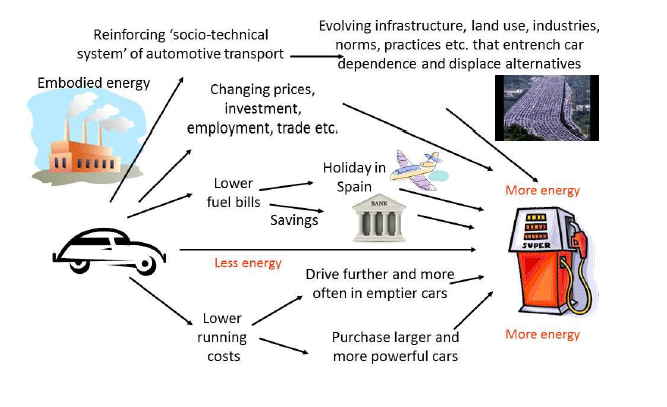
Rebound and Jevons effects
The rebound and Jevons effects basically assert that the more energy there is, perhaps because of energy efficiency measures, the more people will use it. The new use may significantly reduce the expected savings, or even consume more than is saved. In the 19th Century Jevons noted that efficiency improvement in the steam engine did not lower the demand for coal, but increased it. He famously said:
It is wholly a confusion of ideas to suppose that the economical use of fuel is equivalent to a diminished consumption. The very contrary is the truth… It is the very economy of its use which leads to its extensive consumption.
Paul Brockway and Steve Sorrell give some examples:
energy efficient lighting saves energy, but also makes lighting cheaper, which, in turn, encourages people to light up larger areas to higher levels [of brightness?] over longer periods of time.
Widespread adoption of energy-efficient lighting may also bring down the price of electricity, which could further encourage increased consumption
They give a nice image of the loops in a more fuel efficient car:
Brockway and Sorrell write that:
In a new paper, published in Renewable and Sustainable Energy Reviews, we examine the economy-wide impact of these effects and find they may erode more than half of the potential energy savings from improved energy efficiency.
We also find that these rebound effects are not adequately included in the global energy and climate models used by organisations, such as the Intergovernmental Panel on Climate Change (IPCC) and the International Energy Agency (IEA), which means they may underestimate the future growth of global energy demand.
As a result, there is a risk that global climate action relies too heavily on energy savings that may not materialise.
They point out that, in normal terms, the health of economies are defined in terms of GDP growth, and that often requires expansion of energy use. For example McKinsey Ward state that their research:
suggests that we’re beginning to see a decoupling between the rates of economic growth and energy demand, which in the decades ahead will become even more pronounced [because]… new technologies and larger trends should cause the energy demand curve to flatten…… [They predict]
* a steep decline in energy intensity of GDP, primarily the consequence of a continuing shift from industrial to service economies in fast-growing countries such as India and China
* a marked increase in energy efficiency, the result of technological improvements and behavioral changes
*the rise of electrification, in itself a more efficient way to meet energy needs in many applications
*the growing use of renewables—resources that don’t need to be burned to generate power—a trend with the potential not only to flatten the primary energy demand curve but also to utterly change the way we think about power
The other problem is as they say “Economy-wide rebound effects are extremely difficult to measure.” They studied 21 previous studies which:
gave a mean estimate of 58% rebound, with a median estimate of 55%, implying that more than half of the potential energy savings from the modelled efficiency improvements were not achieved. [Another 12 studies using different measures] found a mean estimate of 71% rebound.
They then researched the models used by BP, Shell, the IEA and the US Energy Information Administration and found “most of these models.. were unable to capture many of the mechanisms contributing to rebound effects”. Some could be said to cut out the possibility of rebound effects completely. In which case, it is unlikely that we will successfully lower energy consumption or find it as easy, as we might think to reduce fossil fuel emissions, even with greater energy efficiency (saving energy) and more renewables. The rebound effect will surprise us.
The next post will treat the problems of the Energy Charter Treaty, which also presents apparent problems for attempts to decrease emissions.
It is now almost two months since the riots at Capitol Hill, speaking from a safe distance in time. It seems that:
Trump now owns and controls the Republican Party.
He has persuaded the Republicans to purge the party of dissent, and of those people who stood for principle and reality, against him.
Republicans will no longer even attempt to speak the truth about him, or they are gone.
He is, assuming he survives, a guaranteed candidate for the 2024 election, and if people are not enthusiastic for Biden, then he may well win.
Republicans involved in counting the vote, know the risk they take if they don’t ensure that Trump wins.
Republican states are apparently already increasing their ability to deregister voters and fix elections.
He has earned a considerable amount of money from his fans by portraying himself as the victim of a plot.
Fox has hired people he likes and who worked well with him, so they will be even more pro-Trump, and less of a news station.
He will probably be able to portray criminal charges against himself as anti-Trump mania, and may be able to fix up, or frighten judges or juries.
He may well now be able to threaten people with mob rule, and his capacity for stochastic terrorism is greatly increased.
Other people are being blamed for the riots, so he keeps his supporters.
He has demonstrated, yet again, he can say or do anything. If he becomes the next president, he will have no effective opposition, and nothing to curtail his vengeance, on those who hinted at opposing him.
The riot was his beer hall putsch, and he did not even go to jail. He suffered no inconvenience at all from attempting to steal an election. Not even the slightest. People talked about charges, but so far no sign. We can assume he will continue to increase his hold on the Right and increase his encouragement of direct violence.
If things had gone well for him, or as planned, it is possible that he could have been able to declare a state of emergency and martial law, or at least hurt and damage people who opposed him, or who followed the law like Mike Pence – and it would not have been his fault if Pence had died. “Terribly Sad” he might say.
***********
From an even later period of time, late July 2021, the group identification levels and binaries seem to have increased even further. Democrats now seem to be considered completely untrustworthy and evil by many non-fanatics on the Right.
It is now perfectly acceptable to say that the riot was like a capitol tour, that there was love in the air, that it is the fault of Democrats, that Democrats are communist traitors who are persecuting innocent protestors, that the election was fixed by China (who have taken over the Democrats) and so on.
Many seem to say the riot could not have occurred because conservatives are peaceful, therefore the images are faked or the rioters were not real Trump followers. The beating of police officers is denied, they are “crisis actors” and “angry left-wing political activists”. One black officer is apparently discredited because he thinks there is white racism in the US… talk about cancelling.
It will take real strength of mind not to go along with this and the continuing purge of any dissent from the party.
So the riot both ‘shows’ the anger of ‘conservatives,’ and tells them that they are innocent and being persecuted. It has not harmed Trump at all, and helped to confirm his standing as the next Candidate for President. And he will win if Democrats do not all get out to vote – assuming it is still legal in Republican controlled states… [that is a joke]
I’ve heard this story many times [for example, see here], but here is another version…
The University of Cambridge Centre for Alternative Finance (CCAF) apparently claims that Bitcoin probably has and energy consumption is somewhere between 40 and 445 annualised terawatt hours (TWh), with a central estimate of about 130 terawatt hours.
The UK’s electricity consumption is a little over 300 TWh a year, while Argentina and the Netherlands use about the same amount of energy as the CCAF’s best guess for Bitcoin.
as Bitcoin gets more valuable, the computing effort expended on creating and maintaining it – and therefore the energy consumed – inevitably increases.
We can track how much effort miners are making to create the currency.
Alex de Vries, the founder of the Digiconomist website [says]
All the millions of trillions of calculations it takes to keep the system running aren’t really doing any useful work….”Right now we’re using a whole lot of energy to produce those calculations, but also the majority of that is sourced from fossil energy.”…
“We’d have to double our global energy production,” he says with a laugh. “For Bitcoin.”
He says it also limits the number of transactions the system can process to about five per second.
This doesn’t make for a useful currency, he argues.
In a new research paper published in the journal Nature Communications, researchers from the Chinese Academy of Sciences and Tsinghua University have projected that on current trends, bitcoin mining electricity consumption will more than double from its current levels, peaking in 2024….
bitcoin [will] rank as the equivalent of the 12th largest electricity consumer amongst all countries, higher than the likes of major European economies, including Italy and Spain…. [and Australia].
It is estimated that around 70 per cent of bitcoin miners are located in China…. [and] is responsible for approximately 5.4 per cent of China’s electricity emissions…
[The paper’s authors state:] we find that the carbon emission pattern of Bitcoin blockchain will become a potential barrier against the emission reduction target of China.”
It is rather frustrating to think of how much renewable energy we will have to produce to power this thing on top of everything else we have to power. Bitcoin is a currency essentially based on massive amounts of electricity consumption, and hopes that people will pay real money or real products for more bitcoin.
Like all money its value is a matter of faith that other people will want it.
My only hope is that advertisements are going up on bus shelters saying “If you see bitcoin on a poster, it’s time to buy.” Anyone in finance knows that when you are trying to let the rubes into a secret it’s because those in the know are selling off….
The Parties’ [to the Paris Agreements total GHG emissions are, on average, estimated to be:
By 2025, 2.0 per cent higher than the 1990 level (13.77 Gt CO2 eq), 2.2 per cent higher than the 2010 level (13.74 Gt CO2 eq) and 0.5 per cent higher than the 2017 level (13.97 Gt CO2 eq);
By 2030, 0.7 per cent lower than in 1990, 0.5 per cent lower than in 2010 and 2.1 per cent lower than in 2017.
…the estimates suggest the possibility of the Parties’ emissions peaking before 2030.
[However,]
According to the SR1.5, to be consistent with global emission pathways with no or limited overshoot of the 1.5 °C goal, global net anthropogenic CO2 emissions need to decline by about 45 per cent from the 2010 level by 2030, reaching net zero around 2050. For limiting global warming to below 2 °C, CO2 emissions need to decrease by about 25 per cent from the 2010 level by 2030 and reach net zero around 2070. Deep reductions are required for non-CO2 emissions as well. Thus, the estimated reductions referred to above fall far short of what is required, demonstrating the need for Parties to further strengthen their mitigation commitments under the Paris Agreement.
[The possible good news]
Many Parties provided information on long-term mitigation visions, strategies and targets for up to and beyond 2050, referring to climate neutrality, carbon neutrality, GHG neutrality or net zero emissions. Mindful of the inherent uncertainty of such long-term estimates, the information indicates that: •The Parties’ collective GHG emission level could be 87–93 per cent lower in 2050 than in 2017; •Their annual per capita emissions are estimated at 0.5–1.0 t CO2 eq for 2050, which is 87–93 per cent lower than for 2017, suggesting that by 2050 these per capita emissions will be within the range implied in the 2 ºC and 1.5 ºC with low overshoot scenarios in the SR1.5.
[it would be nice if they stuck with a standardised base line such as 2010 or 1990 rather than shifted about.]
Religious people often assume we could solve the eco-crisis with ‘more God’, or by everyone recognising God as King, Jesus as Saviour, or Mohammed as God’s prime prophet. But these people rarely explore the issue of why it is that more recognition of God would necessarily guarantee sustainable behaviour, or whether it has in the past.
I’ve previously argued that God, or rather ‘holy books’, do not solve the problem of ethics. Indeed we may use our ethics to judge the behaviour attributed to God and wonder if such a God is ethically worthy, of being ‘the’ God. If the God is not judged worthy, then it is probable that belief declines, or the stories become symbols and allegories interpreted to save God from lack of ethics, rather than taken as events demonstrating the power and justice of God. While it is obvious that a desire to please God, or a love of God, can inspire people to do marvelous acts, it also seems correct that people often use God to justify unpleasant, or cruel, things they wish to do to others.
Some features attributed to God, may even (perhaps unintentionally) hinder an ethical relationship to the world:
We might assume that God’s creation is eternal and we need do little to preserve it, as it will continue whatever we do.
We might assume God put humans on this world to subdue it, or master it, rather than care for it.
We might assume the world is something to be left behind (as trash?) as believers ascend to Heaven after death or after the last judgement.
We might assume that we are saved by faith, or by performing the rituals, and our other actions are almost irrelevant, or that the ecology comes way down the list of important things we need to care about – such as purging non-believers, punishing sexual minorities, subduing women, making the law harmonious with the holy books and the interpretation of our favoured scholars, or whatever.
We might assume that eco-destruction is part of God’s plan for the final judgement, and that working to stop this from happening, is working against God or evidence of the failing of pride or presumption.
We might think that God models tyranny, and that leaders should be likewise and discipline everything that exists (including the natural world) without regard to the people or the ecology’s needs.
A person might think that Humans are special in their connection to God, and non-human creation does not matter – certainly it may matter even less than caring for the present lives and comfort of heretics or infidels.
All of these views might derail attempts at preserving ecological functionality and sustainability. They might have that effect, even if people talk about how God commands us to keep balance, look after the land, or plant trees.
Another problem for me, is that I presume that people are currently influenced by their ethics and religion, and this has not prevented us from generating ecological problems. For example Evangelical Protestants and rightwing Catholics have supported Trump and thus have supported Trump’s lessening of environmental protections and pollution control rules; Islamic states have not curtailed the sale of their oil and the destruction that results from its use, or even supported the use of renewables until relatively recently, and they do not seem to take responsibility for the results of the use of that oil, any more than other non-religious oil companies do. Many Catholics seem to oppose Pope Francis because he does not continually praise capitalism and environmental destruction, even if they previously argued that obedience to the Holy Father was fundamental to Catholicism. Few major religious, or ethical, organisations are having great success challenging the crisis – although many are making the effort.
To effectively argue that we need more God to solve the problem, we would need to show that devout and religious countries have treated their environment better, and made it better and more sustainable, than countries that do not have a strong code of belief in God. If you then argue that the US, Italy, Brazil, Saudi Arabi, Iran, Afghanistan and so on, are not really devout enough, then you are probably going beyond human capacity into fantasy, or planning to use more violence to force people into devoutness, which probably means you will use more force on ecologies as well.
If there are God believing countries that have protected their ecology, and have not contributed to ecological destruction or climate change elsewhere in the world, then we need to explore what they have done, and how it ties in with their religion, and what is different in their practice to the practices of those with a similar religion.
Another step in the argument would be to ask what religions are most likely to encourage ecological relationship. We might suggest that some forms of Buddhism (with explicit compassion towards all beings) or non-ritual Taoism (with its efforts towards living in harmony with the flow and non-domination of the world) are promising. Unfortunately, the tendency of some kinds of Buddhism to leave relationship behind, and aim for non-suffering in ’emptiness’ or ‘nothingness’ may sabotage this possibility, and non-ritual Taoism is not really an official religion by its nature. Probably, the most effective religions of relationships and care are indigenous, in which natural beings are relatively equal and have to be respected, honoured, observed, talked to and cared for, and in which relationship with country is fundamental. But these people may not worship God as such, or they may be marginal to God religions, so they are not probably those being recognised by those who want more God.
Perhaps the call (unintendedly) suggests we need a new religion, one that hallows relationships with the natural world, one that situates humans in nature, one that does not promote violence against non-believers because they clearly sin against the true religion and hence deny God, one that does not have a God that lives entirely somewhere else or implies that good humans will leave the world behind, one that does not encourage consumption and wealth accumulation, one that encourages relationship and sympathy with all beings.
It could be logically possible to construct such a religion, but artificial religions rarely take hold. However, acknowledging the apparent failure of existing religions and knowing we could need such a religion, might set creativity, inspiration and discussion going. The New Age, whatever its obvious faults of positive thinking, prosperity by accumulation, or promotion of the idea that there is no reality beyond a person’s thoughts, may be a start in that direction – who can tell at this stage? It is even possible there could be a new reformation in Christianity, or a new understanding of Islam, which does not promote violence against nature and against non-believers.
The final problem is that I’m not even sure that people make decisions based on ethics, or moral instruction. There is the problem that people also seem to choose their ethics to justify what they, or people they identify with, have done or want to do. Although it is now a cliché, religious organisations might not have been expected to protect people in their organisations who were rapists while condemning their victims, if they were ethically concerned at all, but this process seems to have been quite normal and (presumably) ethically justified. We are even learning that despite the scandal, the same attitudes seem to be being taught at elite religious private schools.
While religion may promote morality, it does not guarantee universally valid morals.
This post is based on something I vaguely remember Sally Gillespie [linked in] [twitter] [Routledge] [Johmenadue] saying. This is almost a self help post, but I feel that somewhere there is something I don’t understand about reality lurking beneath. I don’t know what I’m doing here. So please excuse what is crass – or tell me in the comments so this can be better and more focused.
Time is fundamental
Time is like the currency of human life.
What you build and become comes out of time, or emerges from time.
Time is the first thing you have, possibly the only thing you have, no matter how short that time proves to be.
If you want to be a musician you have to devote time to music. If you want to be a sportsperson you devote time to your sport. If you want to be an academic you devote time to thinking, to reading (at least some other academics), observing/participating in what you are interested in and writing. If you want to be a successful or influential academic, sports person or musician, you also probably have to devote time to self-promotion and networking. This can be painful to some of us, but its nearly always true. Even if someone discovers you, you will nearly always still have to spend time in the networking. Think how much time J.K. Rowling had to spend to get her novels published in the first place. Or you can hope someone discovers you after death, and you can live with the difficulties (and advantages) of that. Or you can devote your time to becoming peaceful, or kind, or holy, where being a known success can be unimportant.
Of course devoting time, will not always lead to success, but it seems fundamental to what you become.
Energy and Time
As well as devoting time, you have to devote energy. If you just passively watch sport, you may gain an appreciation of the sport, you may even gain some skill, but you probably will not become a sportsperson. You need to put energy into a practice, an active involvement in doing. If you want to become a sports commentator or an expositor, you need to put energy into doing that.
You cannot use energy without time. You can perhaps use time without that much energy if you are meditating, but even meditating requires some energy and persistence when you had rather do something else. So energy and time seem related. In general ‘productive’ time requires energy.
Paradox of habit
Most of my blogs argue in favour of recognising complexity and even chaos. The main lesson is, I think, correct: humans cannot completely control the world or themselves. We always benefit by paying attention to the inevitable unintended consequences of what we do. We need to flow with reality and work with reality.
The way we spend time nearly always builds some kind of organisation or disorganisation.
It is probably useful, should you wish to build on what you have done, to aim for some kind of organisation in your approach, or what I’ve called creating ‘islands of order’. Sometimes being chaotic can be good. Sometimes being ordered can be good.
Devoting time to ‘something,’ builds organisation of necessity – whether that organisation/disorganisation is useful or not. Building organisation builds habits. Building disorganisation builds habits. Whatever we do in time repeatedly may build habits.
More or less by definition we can say that, ‘well organised habits can give momentum and direction to our work’, and ‘badly organised habits can disrupt momentum and direction’. For example, our society’s current form of economic organisation builds habits which disrupt our attempts to attempt to build momentum and direction for restoration of ecologies. To build momentum and direction we not only need to use time to recognise the complexity of the world, but (paradoxically) we need to take time to build well organised habits which help us observe and react to that complexity, and help build resilience, help reduce the crisis and lead to restored ecologies.
Practicing an hour a day on whatever we care about, will help us succeed. This is using time in an organised way to produce organisation in what we devote ourselves too – and that makes learning easier. This is part of becoming, and again we cannot avoid building habits. If we habitually (but perhaps unintentionally) produce disorder, or self-defeating habits, then that is what we produce.
Sometimes we may have to be prepared to throw habits away to get better, or learn something new, but that does not subvert the basic point. Humans build habits through time and energy, and they build their self-organisation, and approach to the world, in those habits.
This is the paradox. Human use of time and energy makes habit and some kind of organisation, this may not always be constructive or helpful; but it will be there. Habits may undermine what we want to do or need to do. It is probably good to ensure the habits we build are useful to flourishing and survival.
Loss of time
Time is not like a currency, because you cannot accumulate it. When its gone, its gone. As your life is time, your life is gone along with time. You have only what you have built with that time, deliberately or/and otherwise.
Things that ‘steal’ time from you steal your life and energy. Every second, your life is shorter, but every second has given you the time to build something (including habits), to be, or to become and you can’t help but choose to build, be and become. I’m not implying you will only become what you want to become, that requires attention to complexity, and useful organisation.
You build (your being? your existence? your habits) even if you ‘waste’ your time. Some people who are imprisoned or enslaved manage to build constructively – Nelson Mandela for one – but this is not easy, and there are probably limits. The point is that sometimes imprisoned people can engage in becoming, more consciously than people who are free (even if freedom is a massive advantage), because they can realise time is vital, and can manage to devote time and energy to that becoming and their constructive habits, more than to their imprisonment or slavery.
So, whatever our condition, we may need to attend to time, energy and the form of organisation/disorganisation we are building for ourselves and the world. Perhaps, to some extent, you have to co-operate with the loss of your time, to lose it completely.
In most cultures nowadays we waste the land as well as waste time. We probably waste time unconsciously just as we waste land unconsciously. But we need land just as we need time. What do we stand on, if not time and land?
Respite
Life and energy require respite. You cannot just use time to work at what you build consciously. You need rest. In other words to fully use time, you must apparently waste time. But this waste need not be laying to waste, but building respite, or building a useful island of order and recuperation. You can use time and energy to build your capacity to use time well, by doing nothing. Resting, lying fallow, is essential to time (as it is to cultivated land), but it can waste time as well. As usual, a process can be both useful and harmful depending on how it fits with organisation.
We don’t know what time is, we know it appears to pass, and it appears to consume, but it is what allows us to become, and to form the temporary ‘order’ of habit. It is why we need energy. One reason we need to eat.
I guess the point is to put time and energy into where your heart is, if you can feel where that is. If you can’t then you may need to put time and energy into finding where your heart is. You might also need to find out what habits are needed, and build on them, being prepared to change habits as you learn more. Another slogan is “learn by doing”.
The future
As a culture, we may need to stop ‘wasting’ our time or using our time unconsciously, and put our attention on to what we can find out about is happening, and that involves being aware that people will try and ‘steal’ our time, by sending us to places which waste time. Yet paradoxically, perhaps, we can only find out what is real, by being prepared to waste time.
But without spending our time and energy in some kind of organised way that recognises the potential of disorder, the world will be harder still for those who come after us.
To repeat: “Time is the first thing you have, possibly the only thing you have, no matter how short that time proves to be.” It is effectively your life.
 Climate, technology and chaos Blog