Imaginary Technology and Climate Change

May 27, 2020

This blog article is largely a summary and brief discussion of a short paper published in Nature Climate Change. “The co-evolution of technological promises, modelling, policies and climate change targets” by Duncan McLaren & Nils Markusson. I mesh some of the summary with a blog article written by McLaren, as this appears to give extra information and more clarity to the general argument. Unless specified, quotations come from the article.

The paper discusses “technologies of prevarication” which form part of an “an ongoing cycle that repeatedly avoids transformative social and economic change” (p.392).

The ‘gentle’ argument is that the international goals of avoiding climate change have been reinterpreted in the light of new technological and modelling methods, and the promises these new ‘devices’ have allowed. These technological promises, in general, allow the sidelining of social transformation, and the delay of any real cut back in emissions.

In the terms I’ve deployed elsewhere, these fantasies about technologies act as defense mechanisms against change and political challenge.

The article proposes five different stages in the global climate policy process. These stages overlap, but policy debates about targets in these stages “was noticeably framed primarily in [certain] terms while previous formulations retreated from the public eye” (p.392).

The stages they argue for are:
1) Stabilizsation c.Rio 1992
2) Percentage emissions reductions c.Kyoto 1997
3) Atmospheric concentrations c.Copenhagen 2009
4) Cumulative budgets c.Durban 2011, Doha 2012
5) Outcome temperatures c.Paris 2015

I should add that I don’t think these stages are proven and fully documented (the article is short), but they are plausible, and I’m sure the authors will document them more rigorously later.

Stage 1: at Rio, when the United Nations Framework Convention on Climate Change (UNFCCC) was negotiated,

the UN settled on a goal of ‘stabilizing atmospheric concentrations of GHGs [Green House Gases] at a level commensurate with avoiding dangerous anthropogenic climate change’…

p.392

This was associated with coupled ‘general circulation models‘ [1] and ‘integrated assessment models[2] which allowed the exploration of emissions reductions techniques and their economic costs. As the authors say in a blog post:

assessing specific policy interventions with these early models was difficult, and responses were often discussed in very broad-brush terms.

13 May 2020 Guest post: A brief history of climate targets

Policy responses included: energy efficiency, promotion of forest carbon sinks (the blog adds ocean iron fertilisation), and finally nuclear energy. Nuclear energy stalled largely because of costs and public concerns about risks, and voters not wanting to live near one.

Stage 2: The debate around Kyoto was largely over speed of emissions reductions, usually with percentage reductions of emissions by target dates.

Models enabled people to relate emmissions cuts to concentrations of GHGs, but not to outcome temperatures.

Policy and promises focused on emissions reductions from fossil fuels, through the technologies of Carbon Capture and Storage (CCS) (promising up to 90% reductions from fossil fuels) and fuel switching, and on energy efficiency. Trading schemes were proposed, [although were often so slackly developed, in order to reduce costs to business, that they had little result.] The IPCC issued a report on CCS. The blog mentions that in some parts of the world there was talk of building new “capture ready” coal power stations, with licenses being granted before the term was even defined. The blog states:

CCS was selected preferentially by the model algorithms because the simulated costs of continued expansion and use of fossil-fuel power – linked to retrofitting with CCS – were lower than those associated with phasing out electricity generation using coal and gas.

13 May 2020 Guest post: A brief history of climate targets

However,

practical development of CCS got little further than research facilities, while the promise of ‘CCS readiness’ even facilitated continued construction of new fossil power plants.

p.394

Fuel also switching did not live up to its promise.

Modelling

continued to become more sophisticated. It moved on to establish direct links between economic activity and the concentration of CO2 in the atmosphere. 

13 May 2020 Guest post: A brief history of climate targets

Stage 3: Atmospheric concentrations c.Copenhagen 2009

The blog asserts that in the lead up to the Copenhagen COP, there was intense debate over setting a goal for atmospheric CO2 concentrations. Initially 550 ppm was considered adequate but the debate saw that lowered to 450 ppm.

There had been little progress, in reducing emissions. Bioenergy came to the fore as a promise, especially Bioenergy with CCS (BECCS) which implied a lowering of GHG concentrations at a future date. At the time BECCS was more or less completely conceptual, but it merged two apparently known technologies so was considered practicable.

Like CCS before it, BECCS promised ways to cut the costs of meeting a particular target, slowing the transition even more by its promise to effectively reverse emissions at a future date.

p.394

The blog phrases this more strongly. BECCS “allow[ed] the justification of a slower transition by its promise to effectively reverse emissions at a future date.”

Computer modelling became more complicated, with many 450 ppm of CO2 scenarios using the postulate of imagined CCS. The fact that this target appeared, to some, nowhere near adequate to prevent destructive climate change led to 350.org being founded.

There was less talk of emissions cuts and more talk of concentrations, and some possible confusion over the connection to temperature outcomes, even if the Copenhagen was officially focused on keeping the increase in temperature at about 2 degrees.

Yet again, CCS, or BECCS, had failed to be deployed, or we might add, even researched, to any useful extent.

Stage 4: Cumulative budgets Durban 2011, Doha 2012

some negotiators argued… for the pursuit of ‘a clear limit on GHG concentrations, and consequently a scientifically calculated carbon budget’…

p.394

A Carbon Budget attempts to set a total limit on the CO2 that can be emitted by States, to keep global temperature rise below a certain level. According to the blog “the UK began setting periodic five-year carbon budgets under its Climate Change Act in 2008″.

At around the same time:

the development of a simple inversion tool in the MAGICC model enabled not only the development of RCPs [Representative Concentration Pathways], but also more sophisticated global carbon budgeting models.

p.394

The idea of limiting cumulative emissions seemed to be more robust than previous methods, but opened the idea of imagined ‘negative emissions technologies’, which again reinforced the fantasy of underdeveloped BECCS. Indeed these imagined technologies became the only way forward, even if they largely remained imaginary.

As the blog states:

In addition, [these negative emissions technologies] enabled promises of future carbon removal as a means to reverse any “overshoot” of the budget…. And there is a fine line between inadvertent and planned overshoot

13 May 2020 Guest post: A brief history of climate targets

Stage 5: Outcome Temperatures. The carbon budgets idea never really got put into play – possibly because they were too empirical and demanded emissions cutbacks, and the non-use of fossil fuel reserves. So the Paris COP shifted to a focus on temperature increase – officially 2 degrees, but possibly 1.5 – as the boundary around dangerous climate change. This further boosted talk of negative emissions technology.

Looking ahead, although [Negative Emissions Technologies] might retrospectively balance carbon budgets, delayed action would still make a temperature overshoot more likely.

p.395

This helps construct “a space for an imaginary technology that can act directly to reduce temperatures”, such as Geoengineering. This, in turn, makes the use of geoengineering, and attempts to control the ecology of the whole world, more likely to be factored into models.

However, it is extremely difficult to accurately model the ecological consequences of geoengineering (especially without large scale testing), so the likely undesired effects become a cost left out of the models.

The blog remarks:

Many national and business targets are now framed as “net-zero” carbon, explicitly – or implicitly – achieved through substantial future deployment of carbon removal. 

13 May 2020 Guest post: A brief history of climate targets

Conclusion

Policy change looks like to be a co-evolutionary process involving implicit policy, politics, models, and imagined technologies.

In this process, the ‘evolutionary fitness’ of each technological promise is less a product of its (potential) climate impact than a measure of how well it can be modelled, and how well it matches the extant framings of climate policy.

p.395

These imagined techs then become embedded in the models and in the policy projects even if they do not exist at sufficient scale, after years of opportunity. The blog argues that the problem is magnified because the “integrated assessment models” focus on:

cost optimisation with time discounting. This means they favour future promises of action over plausible, but potentially costly, near-term interventions.

13 May 2020 Guest post: A brief history of climate targets

The delays make the policies look cheaper to deliver, and cheapness is, in neoliberalism, a virtue; but over time little has been delivered – for example it appears that during the first decade of the twenty-first century, world coal production almost doubled, and it has not declined back to dangerous 1990s levels, yet.

Critically, in this process, each technological promise has enabled a continued politics of prevarication and inadequate action by raising expectations of more effective policy options becoming available in the future, in turn justifying existing limited and gradualist policy choices and thus diminishing the perceived urgency of deploying costly and unpopular, but better understood and tested, options for policy in the short term.

p.395

These technologies of prevarication have rarely delivered on their promises, or been as cheap as expected, and have rarely been embraced by governments or business in practice as opposed to imaginal rhetoric.

Often the problems, or unintended consequences, of the imagined technologies were not seen until people started to implement them. BECCS for example can result in deforestation, impingement on food production, require large amounts of energy input, and the extracted CO2 can be used to help push oil out of wells to be burnt to produce more CO2. At the best talk of CCS and carbon extraction merely slows down transition.

There is a possibility that:

each promise has, to some degree, fed systemic ‘moral corruption’ in which current elites are enabled to pursue self-serving pathways while passing off risk to vulnerable people in the future and in the Global South.

p.395

The technological promises, promise to save neoliberalism and market based developmentalism, and “promised future action, rather than immediate sacrifice.”

Carbon sinks may have perhaps gone backwards. Nuclear power has almost ceased being built, even though the promise remains to allow people to imagine future cuts in emissions. Efficiency gains have enabled growth in consumption and energy expectations have expanded. Often technologies etc have allowed additional energy capacity rather than reduced emissions. We can add that it appears that many countries (particularly China and the US) have encouraged poorer countries to lock-in to coal dependency to keep the exporters coal mines running, as emissions are counted on a per country basis. This increases the cost of conversion to renewables – all the money which could have been spent getting the countries self sufficient in renewables has been wasted in fossil fuels. While cheaper renewables make a change apparently more practicable, it is an extra expense and destruction of invested capital that poorer countries, and some wealthier ones, cannot afford easily – they have more immediate expenses, and few powerful people like to admit they have wasted money for nothing.

The whole process has downplayed urgency and helped defer deadlines for action.

We have played into the imagined technological fix, rather than the social change we need. There is no suggestion that the people who have invented and worked on this technology are to blame, the problem is the way their imaginings have been used to in policy and modelling to maintain small scale action. It has been more important for politicians to maintain neoliberalism, and development, than to act on climate.

[L]ayers of past unredeemed technological promises have become sedimented in climate pathway models. Contemporary imaginaries may prove just as unrealizable as the previous generations of promises,and there is no logical end to the set of possible technological promises that could be added to ‘resolve’ the models.

p.396

This ‘sedimentation’ of failed technological promises is now so standard that risks of technology disappointment and failure should be incorporated into models and policy discussions, and research.

Thirty years of failure, should show that we cannot continue our society working as it does, and expect to solve problems of climate change. We have to, as the blog states, “deliver behavioural, cultural and economic transformations.”

Comment

Assuming the figures used to make this graph are accurate, the image shows how well we have reduced energy production from fossil fuels, and how much we have increased renewable energy in the last 40 years.
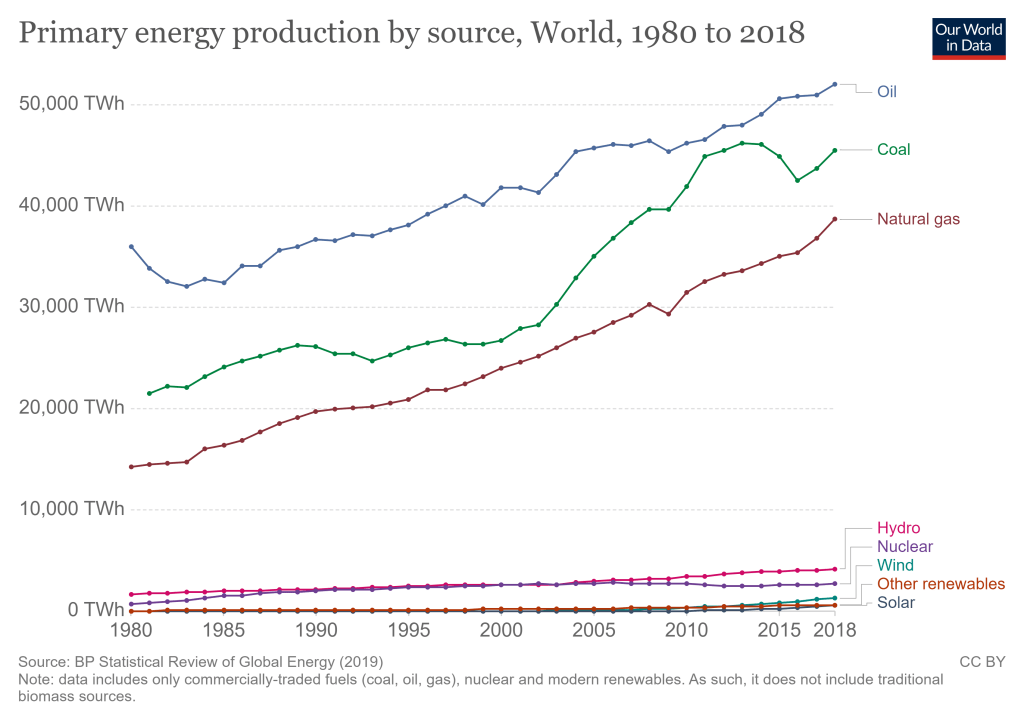
source: https://ourworldindata.org/grapher/primary-energy-prod-source?time=1980..2018

We have failed. We have had years of climate action, discussion between nations, and targets have been set, yet the actions taken have ignored the problem and made the situation worse. The idea that technologies are largely defense mechanisms or modes of prevarication, is graphically illustrated. If we keep the same social organisation, and the same development processes going, then we are committing suicide. Whatever the appearance our States are failed States, when it comes to dealing with this problem.

We cannot rely on the State or big business to save us, or even to try to save us. We have been doing that, and this faith has not been repaid. We may need to get to work outside the State and outside big business…

This is where ideas of degrowth and community energy democracy come in. Degrowth will almost certainly not be a popular response to politicians, but it does allow us to ask questions which are otherwise not being asked. These questions have the potential to open the unconscious of our social dynamic towards destruction.

What, for example, if we tried to reduce burning fossil fuels without replacing them? This would be world changing, it would also start debates about wealth distribution, and energy distribution. What do we really need the energy for? How do we need the energy production distributed, to make these cuts possible? How can we levelise consumption to give everyone what they need to survive comfortably and freely? Can communities build and manage their own energy supplies? Can any of this be achieved along with the maintenance of rivalrous military based nation states? Will those in power who love the maintenance of violence-based hierarchies fight with all they can muster to go to destruction before surrendering their power?

I doubt such questions will be asked, but they are essential, otherwise technology is likely to primarily remain either a prevarication or a defense mechanism, which maintains our self-destruction.

Directed Skepticism II

May 25, 2020

Previously I have suggested that there is a common form of skepticism, which is not a real skepticism as it is directed. It is only skeptical of particular positions, and because of this tends to be politically active, or result from politics. It is the kind of skepticism that is skeptical of the motives of climate scientists, but unskeptical of the motives of climate denialists. It appears to be motivated, although it is not always the user who is motivated; they main gain their motivation through the one sided skepticism of their exemplars. Sometimes the direction comes from what is socially accepted as common sense, and is thus not challenged, or from common defense against the possibilities of forthcoming pain. There is also a kind of cache in information society about being skeptical, even while you are apparently believing rubbish – directed skepticism is particularly useful in that situation.

In this piece I consider a skeptical argument, based on one proposed to me by a very smart guy, and attempt to show this skepticism is directed rather than general.

The post, also touches on interconnection and complexity; we can be skeptical of these views, but we should also be skeptical of views which do not take interconnection and complexity seriously. In a pandemic, everyone’s actions have the possibility of affecting many others, and many others through those others. An individual act has the potential to move outwards through society – a ‘humorous’ cough in someone’s face could spread the disease, even if the cougher does not feel sick.

1) I am skeptical that the current restrictions placed on the people of the world, which amount to a draconian dictatorship, are connected to the virus.

Response: I’m skeptical the restrictions amount to a draconian dictatorship, or that they have a specific aim other than lowering the disease.

Physical separation is the standard and historic mode of dealing with contagious diseases which are lethal. We try and keep healthy people away from sources of infection. We try and stop infected people passing on their infection. There is little that seems overtly odd about this. Diseases spread through social interconnection. We might be skeptical as to whether the proposed “social distancing” will work by itself, or that the consequences of this distancing are entirely predictable, but there seems little reason to think the rather diverse set of distancing regulations we observe are not primarily connected to a response to the virus. With the internet they certainly do not keep people socially isolated.

The death rate and the infection rate in Australia is way, way less than in the US, and the main difference is the speed and effectiveness with which the governments imposed distancing. So the better the isolation, it seems the better the result – at the moment.

As a rather trivial remark, I don’t know of people being executed for breaking restrictions which was the hallmark of Draco’s laws… And there is nothing I’ve seen to indicate the laws are coherent across the world. I’m skeptical that the relatively mild lock-downs in Europe, the US or Australia, are an indication of harsh dictatorship – certainly without considerably more evidence than is being offered. At the moment, these allegations seem over-emphasised.

It is true, that rather than making attempts to make distancing compulsory, it might be nice if we could persuade people to volunteer to cooperate in distancing, or for employers to decide everyone could work at home, out of the goodness of their heart, but I’m skeptical this would always happen. We appear to live in a society which does not always recognise a general good. However, there is always the factor of time. It appears that reaction to a pandemic must be reasonably quick to have effects.

However, the plausibility of distancing, does not mean we may not be able to find better solutions.

I am also skeptical that all those opposed to lock-down are necessarily proponents of freedom and liberty. Indeed, the organisations which seem devoted to diminishing human freedom and cultivating subservience to the corporate sector or State, such as US Republicans, British Tories, Australian Coalition, Putin, Modi, Bolsonaro, etc are generally trying to pretend there is no, to little, problem.

I’m skeptical of the idea that they do not anticipate benefit from encouraging skepticism about the disease and getting people to risk their lives on their behalf.

On the other hand, I don’t see who is benefiting politically from quarantine, other than ordinary people – if they get income support. The only underhand things that seem to be happening while the disease provides distraction, are the channeling of recovery money to wealthy people and established companies, and lessening restrictions on pollution and environmental destruction. That seems like business as usual, and apparently illustrates the idea that capitalist development requires ecological destruction.

2) Given that Governments are not dealing with severe problems, I’m skeptical that this is a serious problem.

Response: I’m skeptical of the idea that because governments do not deal with some major problems, they may never attempt to deal with major problems.

It does seem correct that governments are not dealing with severe problems such as climate change, ecological destruction, rising wealth inequality, or the growing dominance of the corporate sector etc. but it could be that the dominant classes think they can make money out of ecological destruction with no personal risk, while COVID-19 is potentially dangerous to them.

However the more COVID-19 effects the economy, and the more it does start to affect their wealth, then the more they appear to want to do nothing about it. They are also able to practice self-isolation to keep safe.

In this situation, I am skeptical that we will continue to deal with this problem. I suspect we will revert to the ways that we deal with other severe problems, by pretending they are not real or significant.

3) I am skeptical of anything in the mainstream media. The mainstream media is obviously fully behind the agenda of control. I place a question mark over everything I encounter in the media on both sides. I don’t trust any of the world’s government’s left or right.

Response: I’m skeptical of the idea the media speaks with one voice, or that what is reported by some media is always absolutely wrong.

If you don’t trust any of the world’s governments, then you should also be skeptical of the reasons given by those governments who oppose lock-down as well.

While saying “the media is arguing in favour of something” is always supposed to indicate that what those various sources are arguing for is suspect, it is possible they argue for things because they believe them to be true or strategically beneficial, even if they are not.

I am skeptical that because youtube channels, Q-Anon, or other mainstream news like Brietbart, may have ‘odd’ or different news, they are necessarily correct, or a voice of truth.

It also seems to be the case that not all media is fully behind lock-down, even if they were behind control. The Murdoch Empire for example, often argues in favor of whatever Trump’s position is at the moment, and generally of the disease being trivial. It is as mainstream and corporate as it gets.

I’m skeptical that people know about the world independently of media. Where else do they get their ideas about the wider world from? I am skeptical of the degrees of co-ordination required to fake a disease, across the world. I am skeptical of my own knowledge that would enable me to say the media is always wrong, even if it was uniform, which it isn’t.

There is lots of conflicting information but none of it, that I have seen, is able to imply that there is any logical ulterior motive in the way lock-down has been applied.

Lock-down may not be effective. That is a different question.

4) Even going by the highest statistics, the death rate is very small. I’m skeptical about this disease being harmful.

Response: I’m skeptical we know much about the disease as it is relatively new, and organisms and their interactions, and spread are complex. It may be deadly and destructive. It may not. It may be destructive enough. We will find out eventually.

Going on previous experience we can probably assume that humans will not have great defenses against a new disease, if this is a new disease.

My understanding is that the current medical understanding states that COVID-19 is more contagious than flu, and can be contagious before people exhibit notable symptoms. It is therefore likely to be fairly contagious. And, the closer together people are, the more likely contagion is. Which is not to say that we cannot do stuff to boost our immune systems, and cut down contagion, but we should be skeptical of claims this is enough.

At the moment the US CDC is estimating that in the 2018–2019 flu season there were 34,200 deaths from flu in the US . In 2017-18 there were 61,000 deaths, and in 2016-2017 there were 38,000 deaths

As of today, the current estimate of deaths in the US from COVID-19 is
98,004 and rising every day. There is little sign of a decline.

I admit these figures could be wrong, and COVID may turn out not to be as harmful as flu, but it seems unlikely at the moment

Contagion rates and death rates do not have to be related. A disease can be highly contagious with an extremely low death rate, and it can have a high death rate but be mildly contagious.

Testing is difficult and often inaccurate with a new disease as well. So we would expect false positives and negatives, we do not know if these will cancel each other out.

The death rate certainly does not seem to be as high as originally expected.

However, some figures I’ve seen suggest that in many places people are dying at a far greater rate than last year, even after covid deaths are removed. Surprisingly this does not seem to be the case in Australia

There have been stories of significant undercounting of deaths, [2], [3], mistakes and of people being asked to revise figures downwards so as to get people back to work, and in the US until April 14 COVID-19 deaths had to be confirmed in a laboratory test while testing was not generally available, so where almost certainly undercounted.

We also now know that the doctors who were dying of heart attacks and strokes (which I was hearing about quite early on) were in fact dying of complications from corona virus, and were not counted.

There are now reports that children are getting rare inflammatory diseases, and that some people are remaining sick for a long time after infection [2]. So incapacity has to be counted as well as death rate.

At the moment some people seem to get the illness more than once. WHO has stated:

“There is currently no evidence that people who have recovered from Covid-19 and have antibodies are protected from a second infection,”

This is not unusual with diseases probably because they mutate, but there may be other reasons. I’ve seen reports suggesting Covid mutates quickly and mutates slowly, which suggest large degrees of uncertainty.

What looks like small death rates can mount up. If 60% of Australians get the disease, and the death rate is 1% that is still in the region of 156,000 dead people, and if we add incapacity to that disease consequences could well be significantly disruptive in many ways. If the disease continues for years, then of course it will likely mutate and the healthy people will get it as well. So the total death rate is unpredictable in the extreme.

We will probably never know, the true death rates in countries in which isolation is more or less impossible for ordinary people, India, Indonesia etc., as they won’t be able to test the bodies.

Getting vaguely accurate figures will take a while. But if we don’t act when we don’t have certainty we could kill a lot more people.

5) In Sweden, where there has been little done about the virus, conflicting reports are being given about the infection rate there.

Response: Yes, it could appear that information about Sweden has been politicised, because they may have gone for ‘herd immunity’. That means we should not just be skeptical about reports saying it has a high death rate, we should also be skeptical of reports that its doing well.

However I find the Murdoch Empire reports… 21 May that “Sweden is suffering the highest COVID-19 death rate in Europe”

“Nearly 4,000 people have died from the virus in Sweden, a figure many times higher per capita than those of its Nordic neighbours Denmark, Norway, and Finland, which all imposed strict lockdown measures.”

Stefan Lofven the Prime Minister, has faith their system will work in the long run, and there will not be a second wave of illness. The strategy is also relying on the Swedish sense of self-discipline, and not suprisingly the government can say “We get figures now that people are actually increasing their adherence to our advice [about distancing], not decreasing.”

We could be skeptical about his faith. He is making a prediction in a complex system… it is not guarranteed to be correct, and it is not cautious or conservative.

Other reports suggest that it was not working that well. “Just 7.3% of Stockholm’s inhabitants had developed Covid-19 antibodies by the end of April.” This is well below what seems to be required, to make a population relatively safe. Annika Linde who was the Swedish state epidemiologist from 2005 to 2013, has also expressed doubts as to whether the strategy is working.

Sweden is an experiment, which is useful as it gives information, but which because of what Sweden is like as a nation, may not be replicable elsewhere. I am skeptical of sigificant real confusion in the reported death rates.

6) Hospitals in the US are being paid more to diagnose patients as having the virus. I saw an article on this which had been “fact-checked” by a snopes-type crowd and they had to reluctantly admit it was true. This might be justified in that they may need more money if it is the case, but it also opens the system up to the inevitable over-diagnosing for the cash-strapped institutions to gain more resources in general. So who knows what the real numbers are?

Response: Payments to US hospitals are complicated matters. For example I read

“There isn’t a Medicare diagnostic code specifically for COVID-19.” The Kaiser Family Foundation estimates that “the average Medicare payment [is] $13,297 for a less severe hospitalization and $40,218 for hospitalization in which a patient is treated with a ventilator for at least 96 hours.”

And

“A COVID patient on a ventilator will need more services and more complicated services, not just the ventilator,” said Joseph Antos, scholar in health care at the American Enterprise Institute. “It is reasonable that a patient who is on a ventilator would cost three times one who isn’t that sick.”

There also do appear to be special bonuses for COVID patients, which were instigated to protect US hospitals from loss of their normal business.

As suggested previously, there also seem to be pressures leading to undercounting – such as the initial dismissal of heart attacks and strokes, and people dying outside hospital or in old people’s homes, or people wanting other people to go to work.

As I have said previously, I am skeptical that we know the exact figures, and I am skeptical that there is any reason to think deaths are significantly overcounted as opposed to undercounted.

It is also probable that if hospitals are over-counting then insurance companies and government auditors will likely sort this out, at some cost to the hospital and its reputation.

7) I’m skeptical that what ‘they’ are doing is necessary. Some professional doctors are criticizing the the idea of wearing masks and social isolation.

Response: I’m skeptical of all doctors, including those who say isolation is pointless. However, wearing badly designed or useless masks badly is probably useless.

Isolation may not be necessary, but as remarked earlier we have less dead in Australia per head of population than in the US, where the regime is more uncertain. A lot depends on what you think human life is worth, under various circumstances, as with old people, poor people, black people etc. This is a value judgement. I’m skeptical we will have agreement on this issue.

Another problem we face is that medicine is an empirical science of complex systems. As a consequence, there will often be disagreement about best procedure and likely results.

Most medical pronouncements are based on deductions from theory. We cannot know if the pronouncements are correct until after the event. However, unlike neoliberalism, they will likely be modified by failure.

Physical isolation is generally thought to be the best way of preventing transmission. Ideally if the disease dies in a person, or adapts to being harmless, without being transmitted to another person, then the problem is ended

8) What about Madagascar and WHO?

I’m skeptical of the relevance of this.

I read that WHO commends Madagascar’s fight against COVID. I also read that they are prepared to test a local herbal remedy.

I would be skeptical of assumptions such medicines work, before proper testing. If there is a remedy which works and is traditional, then wonderful, and even better if it becomes a source of income for the locals.

WHO did apparently say, in this context, that use of untested medicines: “can put people in danger, giving a false sense of security and distracting them from hand washing and physical distancing which are cardinal in COVID-19 prevention.”

Yes WHO are skeptical, but why not?

There only seems to be a problem if the supposed remedy is proven, and then outlawed, or we cannot make enough of it, or corporations won’t distribute it without the patent or something. And that has not happened, yet. It is freely being consumed by those who can get it.

9) I’m skeptical Bill Gates would be involved if there was nothing in it for him. It is highly suspect that all of a sudden he has started giving WHO advice. I’m skeptical he is a philanthropist of any kind. His organization is motivated solely for profit.

Response: I’m skeptical Bill Gates is particularly evil or incompetent. I’m skeptical he is more evil or incompetent than those politicians who disagree with him.

Anyone can give WHO advice, the question is whether they listen. The wealthier and more prone to be involved in global medical projects the person is and the more funding they can provide, the more likely such an organisation is to listen to them. I don’t know whether WHO has changed any policies based on what he has said, and I personally know very little about Bill Gates and his motives at the moment.

He does not seem to be an issue in this part of the world, except to people who think he is trying to mind control them through 5G.

It is one thing to be skeptical that 5G is absolutely healthy, but another to hold that it transmits viruses. If the latter is true, then we have had a major set of scientific breakthroughs which no one seems to know anything about… I’m skeptical enough of these propositions to wonder who is encouraging them and why?

Gates has been trying to support vaccination, and he likes orthodox medical science, that seems to be enough to make him suspicious to many. Especially to the active financial class.

It could be that wealthy people who don’t obey the party line and who might show another way is possible, get attacked, and lied about, by those who support the current order of power and wealth.

I’d also ask what’s in it for Trump and Boris Johnson, Alex Jones and all the other right wing media players, claiming there is little to no problem… they actually have a direct stake in the power game.

Bill Gates does not have to play power games anymore, but it does seem he has been worried about pandemics for a while, like many other people, and has warned against them. I’m skeptical that this is evidence he actively wants a pandemic.

10) If it is an emergency then where are all the requisitioned football stadiums being turned into temp hospitals? The whole “crisis” is being handled by the existing infrastructure.

Response: I’m skeptical health emergencies always overwhelm the existing infrastructure.

As far as I can tell hospital wards were stretched in the US, and Trump was boasting about the military erecting temporary wards, but I am pleased that minimal activity has saved the US from a true crisis.

I have read that hospitals in Northern Italy were overwhelmed, and doctors were discussing who should receive treatment and who should be left….

There were crises of body disposal, and it was clear that systems were overwhelmed. President Trump seemed troubled by this at one stage.

I would however add, that I am skeptical that the crisis is over, or has necessarily reached its peak.

Because the pandemic is an issue involving complexity, we may be able to say things like “without isolation, or without successful vaccination it is likely the disease will continue to spread,” but we don’t know how badly countries will be affected for some while, or even after the event. We do not know all the variables, or even the properties of the virus, as yet. So prediction is messy.

To only be skeptical that the disease is serious, is not real skepticism, it seems to be directed, possibly at continuing current life and fantasising ‘all is well’, when this may not be the case.

Repost: Planet of the Humans: A better version

May 18, 2020

From May 11, 2020

I reviewed this film, but it’s not enough just to criticise it, we also need to think what a good film might have done. This is a sketch for such a film. It may make a film which is too long, but at least it puts forward a course of action, while recognising the problems. And, perhaps we only need a minute on some points: the original film skipped about to begin with.

Very Brief Intro

1) Climate change is primarily brought about by emissions of greenhouse gases, primarily through burning fossil fuels. While our civilisation has depended on fossil fuels, fossil fuels are now a problem. Fossil fuels are taking more energy to find, and more energy to get out and prepare – people do not invest in tar sands and fracking if better sources of energy are available. The fracking industry appears to be run on debt rather than profit, causing major companies severe problems, and bankruptcies are plentiful. Coal is ecologically destructive and poisonous. Gas leaks are more plentiful than is admitted, and can be seen from space [1]. The whole system is destructive and on the verge of failure.

However, lowering the pollution from burning fossil fuels is not the only challenge we face.

2) We are heading for ecological disaster through ecological destruction, pollution, deforestation, over-development and over-fishing, as well as climate change. The ice caps are melting. Sea waters will rise. Species are dying out etc… Our lives and economy depend upon a smoothly working ecology, and our ecology is moving into unpredictable turmoil. Our whole civilisation is likely to be heading to the trash can.

How do we solve this?

3) We may need to recognise our psychological response to climate change and eco-destruction: mourning, distress, disempowerment, hopelessness, loss of a way of life, loss of the world, and a sense of immovable obstacles. If we don’t face into these psychological processes we are lost, or likely to slip into scapegoating blame-games.

Is it possible to clean up fossil fuels?

4) No. There is no reliable evidence this is possible or desired by fossil fuel companies. Clean coal is a marketing term. Carbon Capture and storage is not working at the levels we need it to work, and we cannot guarantee its safety. Any working clean up would cost vast amounts of money, and is unlikely to occur.

5) The IEA and IPCC expect that we will remove CO2 and other greenhouse gases from the air to reach their targets. While this is necessary, it seems unlikely. It is difficult and there is little financial incentive. We would probably have to be pay for it out of tax.

Renewable Energy

6) We would discuss current information about renewable energy in terms of the apparent problems, as done in the film but with modern data:

  • a) Consumption of resources
  • b) Destruction/consumption of land
  • c) Breakdown, replacement and recycling
  • d) Intermittency and storage (battery, pumped hydro, weight etc)
  • e) Grid design and regulation
  • f) Electric vehicles are better than fossil fuel vehicles, but it’s hard to convert quickly (infrastucture issues) – especially against government opposition.
  • g) Why biofuel is not green. The history of seduction of green organisations by biofuel, and it’s importance in UK and Germany.
  • h) The need for research while we act, to check our acts for destructive unintended consequences
  • i) The tendency of capitalism to stuff everything, and lie, and the State to favour established business. Promotion of misinformation is a normal part of the market
  • j) The small amounts of renewable energy we actually have in action when compared to fossil fuels.
  • k) Why has the possible transformation not occurred? The corrupt and embedded politics of fossil fuels.

7) Renewable energy could, in many places, replace most of our use of fossil fuels in a fairly short time, if it did not face: a) political and regulatory opposition and b) fossil fuel subsidies. Renewable energy is getting cheaper all the time and, is in many places, now cheaper than fossil fuels. Examples of successful countries, if there are any, that are making it without biofuels.

8) Will RE save us, by itself? No. even if we overcame the opposition to it, it would probably not be enough, quickly enough. The problems we face have to be solved on multiple fronts

Other necessary practices

9) Changing philosophy and living in better harmony with the world. We live here. We are part of the eco-system and depend on the eco-system. We need to simplify, and place less stress on the world’s systems – we may need to relax and observe its beauty, rather than consume items.

10) Ceasing Pollution. If we continue to issue material which cannot be processed by the world system or our economic system, then we will poison the ecology and ourselves. Water is precious. Ultimately all the products of manufacturing should be re-processable by the ecology.

11) Degrowth. The need to abandon continual economic expansion on a finite planet. Difficulties of escape in to space.
How do we lift people out of poverty without growth?

12) Is is possible to have degrowth with capitalism? Are there dangers that capitalism will destroy any attempts at survival? Will the profit motive unhinge transformation?

13) Talk to experts on the necessary steps towards degrowth, and problems of degrowth.

14) Regenerative Agriculture. Building up rather than destroying soils.

15) Curtailing population expansion in the long term and curtailing expanding consumption. If everyone in the world consumes at the rate of the ‘average’ person in the US and Australia we are sunk. The best tools we have to solve this problem are easily available birth control and education of girls, both of which are likely to face religious opposition. Those of us in the more prosperous world, need to set an example by lowering our consumption, without this just affecting the poor and middle classes.

16) Expanding emergency services and health care for extreme weather events, pandemics and so on.

Such a movie would point out some of the problems we face, and some of the best ways that we have of dealing with them. It could conclude by arguing that this may not be enough, but that what has been suggested is certainly a start.

Directed Skepticism and COVID-19

May 15, 2020

There seems to be a form of skepticism that seems politically alligned rather than general. It effectively says:

“I am skeptical of claims ‘this group’ is doing particularly badly.”

or

“I am skeptical that there is, or was, a way of doing better, or thinking better about the problems, than ‘this group’ is doing.”

When this position is consistent, it seems directed and perhaps even partisan – ‘this group’ often becomes ‘my side’, or ‘the group I like’.

We can see it in discussions about climate change, with people making statements that seem to translate as follows:

“I am skeptical that climate change is real, I am skeptical of the data, and I am skeptical of the motivations of climate scientists.”

Which might be fair enough, but these statements often seem coupled with another ‘undoing’ skepticism, which translates as:

“I am skeptical that those denying climate change could be faking, or cherry picking, data, or that they could be funded by the fossil fuel industry, or that this funding could have any consequence whatsoever. I am skeptical of claims that nearly all climate scientists are not socialist conspirators…”

Or in other contexts, we can see statements like:

“I am skeptical of government intervention in the economy. And I am skeptical of claims that free markets do not always deliver the best results, and of claims that free markets do not work the ways they are claimed to, or of claims there is no consensus in economic theory that allows us to categorically state that free markets are ‘best’ for most people….”

We can also see this style of skepticism in claims about the covid pandemic. for example in this New York Times article:

It opens claiming:

“In our actual pandemic, most of the institutions that we associate with public health expertise and trusted medical authority have failed more catastrophically than Trump has.”

I think that, while this claim could be seen as skeptical, it is also open to skepticism. It seems more probable to me that if anyone actually looks at Trump Administration’s behaviour and statements they would find the levels of failure and the refusal to listen to medical advice, pretty exceptional. This administration even pretended the previous administration did not have a plan for early response to emerging infectious disease threats. But then preparation for government was not apparently high on their list of priorities.

It is also not the public health authorities who issue or apply policy and rules, that is the government.

But we can suspend initial disbelief, as it is possible that the article might present lots of evidence, or be uniformly skeptical in more than just bursts….

However, as evidence of the idea that medical authorities have failed more than Trump, we are told that the world health organisation “followed its own political imperatives”

Well yes, what do we expect here? The World Health Organisation is a political body. It is part of the UN. Unless there is a specific reason for distrusting a member government it is probably generally going to accept what it is told, until the situation is overtly desperate, or the government is clearly wrong, otherwise it risks alienating support – a problem apparently demonstrated by the behaviour of Trump administration in attacking the organisation and cutting off US funding.

We are told WHO’s behaviour is corrupt in passing (“Less corruptly but no less disastrously…”) without any apparent skepticism, which is odd because making a mistake, in a constantly shifting new situation, is not always corruption – indeed we are later told (correctly I think) that mistakes are unavoidable. We could, however, be reminded that a certain world leader is busy blaming WHO for his own insistence that there was no problem although he often insists he did not insist that there was no problem.

Casually suggesting WHO is “corrupt” effectively operates to support this leader’s allegations, without any skepticism. Let’s not be skeptical of that leader’s claims, or competence…. let’s take him as truthful….

After all, on the 2nd of February, two days after WHO declared a global emergency, President Trump said:

“We pretty much shut it down coming in from China, We have a tremendous relationship with China, which is a very positive thing. Getting along with China, getting along with Russia, getting along with these countries…… But we can’t have thousands of people coming in who may have this problem, the coronavirus. We’re going to see what happens, but we did shut it down, yes.” 

Fox News 3rd Feb ‘Coronavirus: President Trump said US authorities ‘shut it down.’ Here’s what that means’ and
https://factba.se/transcript/donald-trump-interview-sean-hannity-part-1-february-2-2020

On February 24th President Trump praises WHO, tweeting:

The Coronavirus is very much under control in the USA. We are in contact with everyone and all relevant countries. CDC & World Health have been working hard and very smart. Stock Market starting to look very good to me!

Twitter

On the 14th April, he says:

“Today I am instructing my administration to halt funding of the World Health Organization while a review is conducted to assess the World Health Organization’s role in severely mismanaging and covering up the spread of the coronavirus,”

Remarks by President Trump in Press Briefing 14 May

Sure we can suggest that President Trump made a mistake, but he seems to avoid promoting that position altogether. Likewise, in a perfect world WHO would have behaved better, but it hardly seems to have failed more catastrophically than Trump.

One relevant question is how does it appear that an organisation behaves after it is clear it has not done the best job? If it attempts to get on with doing a better job then probably that is good. If it wastes time seeking to portray itself as blameless by blaming others, or pretending it never made a mistake, then this is probably not so good. That latter kind of organisation may be engaged in the processes we can describe as defense mechanisms, which means it pays more attention to soothing itself than to events.

Anyway, the article proceeds:

“But there is no definite pattern of outsiders being wrong and dangerous and insiders being trustworthy and good”

This somewhat dogmatic position (how is the author determining ‘dangerous’ and ‘good’) is arrived at with only two examples (outside WHO), with no consideration of the number of times that governments ignored medical warnings about the virus, which does seem heavily documented.

This is odd, for a real skepticism…

We then get given the “both sides are equally bad” argument.

This nowadays seems to be a popular argument when the supporters of a side which has done spectacularly badly wishes to diminish the effects of their performance.

In climate change we can occasionally get it in allegations that “both sides have blocked climate change action”. This is news to most people who are in favour of action. It is more correct to say, neither side seems interested in the kind of action which seems necessary, but only one side seems to be actively blocking any action at all. We often get a similar format in Republican claims to Democrats that the Democrats are as neoliberal as the Republicans – a claim not repeated to Republicans. So we get the next statement.

If one Medium post foolishly lowballs the disease’s contagiousness, another will make a cogent case for masking long before the C.D.C. did. 

There is no mention that the CDC has been effectively muzzled, marginalised and defunded by the Government, and no mention of how the government’s leaders actively promote not wearing masks, or of how the mask reserves where run down and medical authorities were alarmed at the end of January, when this was realised….

This form of skepticism seems consistently directed rather than universal.

“all of the rules we’re implementing are just rough and ready guesstimates.”

Well I’m not sure some of these rules have not grown out of appearances and experiences – but the suggestion is that we should be more skeptical of all of them, than of those who would dismiss them….

Lets look at how this works again….

“Yes, you should trust Anthony Fauci more than Donald Trump when it comes to the potential benefits of hydroxychloroquine.”

but we negate this immediately…

“if you’re a doctor on the front lines trying to keep your patients from ending up on a ventilator, Dr. Fauci’s level of caution can’t be yours, and you shouldn’t be waiting for the double-blind control trial to experiment with off-label drugs that Spanish and Chinese doctors claim are helping patients.”

So people should really listen to the President before they listen to the medical stories and testings that the drug can harm people…? Let’s be skeptical of Fauci but, in an emergency, not skeptical of Trump.

The article continues:

“Every single reopening will be its own unique experiment, with confounding variables of climate, density, age and genetics that are nearly impossible to model, and the advice of epidemiologists will only go so far. Governors and mayors will have to act like scientists themselves, acting and re-acting, adapting and experimenting, with expert advisers at their shoulders but no sure answers till the experiment begins.”

This is correct – but we are not asked to be skeptical of those officials who say that we should open anyway, or that the disease is going away, when the numbers are increasing. We are not asked to be skeptical that openers will follow this procedure.. Again the skeptical proceedure is directed.

Again we have the issue about ‘opening the economy.’ This is not mentioned in the article, but the political struggle over the opening, and how many people dying is acceptable, is a significant part of the article’s background.

Let us look at Fauci’s responses to questions from the Senate (long sorry):

I get concerned if you have a situation where the dynamics of an outbreak in an area are such that you are not seeing that gradual over 14-day decrease that would allow you to go to phase one. Then if you pass the checkpoints of phase one, go to phase two and phase three. What I’ve expressed then, and again, is my concern that if some areas, city, states, or what have you, jump over those various checkpoints and prematurely open up without having the capability of being able to respond effectively and efficiently, my concern is that we will start to see little spikes that might turn into outbreaks…..

most of us feel that the number of deaths are likely higher than [the reported] number because given the situation, particularly in New York city, when they were really strapped with a very serious challenge to their healthcare system, that there may have been people who died at home who did have COVID, who were not counted as COVID because they never really got to the hospital….

My concern is that as states or cities or regions, their attempt, understandable, to get back to some form of normality, disregard, to a greater or lesser degree, the checkpoints that we put in our guidelines about when it is safe to proceed in pulling back on mitigation. Because I feel if that occurs, there is a real risk that you will trigger an outbreak that you might not be able to control. Which, in fact, paradoxically, will set you back, not only leading to some suffering and death that could be avoided, but could even set you back on the road to trying to get economic recovery….

I have never made myself out to be the end all and only voice in this. I’m a scientist, a physician, and a public health official. I give advice, according to the best scientific evidence. There are a number of other people who come into that and give advice that are more related to the things that you spoke about, about the need to get the country back open again, and economically. I don’t give advice about economic things. I don’t get advice about anything other than public health. So I wanted to respond to that….

we should be humble about what we don’t know. And I think that falls under the fact that we don’t know everything about this virus, and we really better be very careful, particularly when it comes to children. Because the more and more we learn, we’re seeing things about what this virus can do that we didn’t see from the studies in China, or in Europe….

I think we better be careful if we are not cavalier in thinking that children are completely immune to the deleterious effects….

If you think that we have it completely under control, we don’t. I mean, if you look at the dynamics of the outbreak, we are seeing a diminution of hospitalizations and infections in some places such as in New York City, which has plateaued and started to come down, New Orleans. But in other parts of the country, we are seeing spikes. So when you look at the dynamics of new cases, even though some are coming down, the curve looks flat with some slight coming down. So I think we’re going in the right direction, but the right direction does not mean we have, by any means, total control of this outbreak….

it would seem that if you want to keep things like packing plants open, that you really got to provide the optimum degree of protection for the workers involved, the ability to allow them to go to work safely, and if and when individuals get infected to immediately be able to get them out and give her the proper care. So I would think when you’re calling upon people to perform essential services, you really have almost a moral responsibility to make sure they’re well taken care of and well-protected. And again, that’s not an official proclamation. That’s just me speaking as a physician and as a human being.

Dr. Anthony Fauci & CDC Director Senate Testimony Transcript May 12

This was President Trump’s response

 Q   Dr. Fauci yesterday was a little cautious on reopening the economy too soon.  Do you share his concerns?

THE PRESIDENT:  About reopening what?

Q    Reopening the economy too soon, some states.

THE PRESIDENT:  Look, he wants to play all sides of the equation.  I think we’re going to have a tremendous fourth quarter, I think we’re going to have a transitional third quarter, and I think we’re going to have a phenomenal next year.  I feel that we are going to have a country that’s ready to absolutely have one of its best years……

Q    Sir, when you say Dr. Fauci is playing both sides, are you suggesting that the advice he’s giving to you is different?

THE PRESIDENT:  Well, I was surprised — I was surprised by his answer, actually, because, you know, it’s just — to me, it’s not an acceptable answer, especially when it comes to schools

May 13, 2020 Remarks by President Trump in a Meeting with Governor Polis of Colorado and Governor Burgum of North Dakota

And

And I just want to make something clear.  It’s very important: Vaccine or no vaccine, we’re back.  And we’re starting the process.  And in many cases, they don’t have vaccines, and a virus or a flu comes, and you fight through it.  We haven’t seen anything like this in 100-and-some-odd years — 1917. But you fight through it.  And people sometimes, I guess — we don’t know exactly yet, but it looks like they become immune, or at least for a short while, and maybe for life.  But you fight through it….

And if we don’t, we’re going to be like so many other cases, where you had a problem come in, it’ll go away — at some point, it’ll go away.  It may flare up, and it may not flare up.  We’ll have to see what happens.  But if it does flare up, we’re going to put out the fire, and we’ll put it out quickly and efficiently.  We’ve learned a lot….

But again, you know, it’s not solely vaccine-based.  Other things have never had a vaccine and they go away.  So I don’t want people to think that this is all dependent on vaccine, but a vaccine would be a tremendous thing.

May 15: Remarks by President Trump on Vaccine Development

So I ask you which of these positions sounds more dogmatic and less open to unexpected consequences and feedback from the world?

The article continues…

“So if you’re going to find your way out and up to health and safety, you have to be prepared to grope, to stumble, to make your own light, and sometimes to move by feel or instinct through the dark.”

This apparently is similar to the WHO pronouncement on 15 April:

“In the first weeks of January WHO was very, very clear; we alerted the world on January 5th. Systems around the world, including in the US, began to activate their emergency management systems on January 6th and through the next number of weeks we’ve produced multiple updates to countries including briefing multiple governments, multiple scientists around the world on the developing situation – and that is what it was; a developing situation.
The virus was identified on January 7th, the sequence was shared, I think on 12th with the world.”

WHO COVID-19 virtual press conference – 15 April, 2020

When we are in a new situation, or facing a new challenge, we cannot say we know the best path for sure. However it is going beyond evidence to assert that past experience and knowledge of similar challenges is as useful as, or less useful than, ignorance and apparent incompetence. Or that experts and non-experts are showing equal levels of catastrophic failure.

So we might also try to be skeptical of skepticism that is so consistently directed.

An Ignorant Summary of an idea by Martin Hagglund and its relation to ecology and climate action

May 12, 2020

Hagglund develops the idea that religious life is a mode of alienation, but this rather mundane idea has interesting consequences…

If we live life as if our real life was somewhere else after we are dead, we suffer from “a devaluation of our finite lives as a lower form of being.” We tend to assume that “finite life is not enough, that there has to be something beyond it.” Even the potential destruction of everything is trivial compared to eternal life. As St Paul says:

Set your minds on things that are above, not on things that are on earth, for you have died, and your life is hidden with Christ in God.

With this attitude, there is no way of relating to the world, to people, or to animals and plants as they really are. Hagglund claims that:

To be invulnerable to grief is not to be consummated; it is to be deprived of the capacity to care.

This is the way the Christian Religion (not alone) has tended to argue – our concentration should be on the eternal not the passing. This focus is magnified because the stakes are so high – either death and/or eternal pain, or eternal life free of misery. A case could be made that this is a Christian innovation, ‘Old Testament’ Judaism is not the same – there seems to be no inherent transcendent immortality project).

This spiritual tradition is probably why it has been so easy for the west to dismiss animals as if they were empty (soulless) machines, and the world as if it was dirt, while simultaneously trying to prevent change and freeze the ideal, when change is the way of natural processes. The world we live in is not a being (or beings) in its own right, with its own necessary imperatives, but something to be abandoned, or bent into the unchanging image of the eternal. Hence, to the religious, action to preserve the world in its fluxing imperfections can seem ridiculous – God will end the world sometime anyway, so what’s the point of trying to preserving the non-eternal.

We can have people assuring us, that the world cannot pass away without God requiring it to be so, when the question is whether a livable world can pass away, and what do we do to prevent this.

He says:

I’m trying to show that it’s not just that eternal life is unattainable. It’s actually undesirable, because if you remove the possibility of death you also remove life, if you remove the possibility of grief you also remove joy. These things go together.

Nietzsche, if I remember correctly, argued that in a religion of omnipotency there can be no tragedy, because everything has to end up as God wills, and that must be good, no matter how much suffering there is – we ultimately loose our ability to relate to others because suffering fits into that demanded good. If people die horribly then God has either taken them to heaven, or damned them to hell. In either case feeling upset, in itself, is an expression of disloyalty to God’s omnipotence and peace. And this is a point made repeatedly by theologians from Augustine to Luther and Lewis.

Hagglund suggests that, in practice, many religious people do care about daily life, and are distressed by the loss of those they love (even if they are supposedly eternal) and, to that extent, they are either non-religious or their religion is undermined by necessity of living and their humanity. Similarly ‘secular’ people undermine their secularity by attempting to deny or avoid finitude and death as is argued by Ernest Becker’s denial of death thesis.

Religious people often suggest that atheism is a religion; here Hagglund is returning the favour and arguing that religious people are really secular to the extent that they are human and not what we might call ‘spiritual cybermen’ – all human imperfections removed.

However, if our finite lives are all we have, then time is the basis of all experiential value – “and the best form of society is the one that maximises our freedom to use that time as we wish…,” “everything depends on what we do with our time together.” There is a sense in which ‘time is life’ as there is no known life without time, and without that life occurring through events. The search for a society which allows maximum free time availability and usage, is part of our way of relating to the world.

Whatever its strengths, Hagglund, argues that capitalism can never be a system which maximises free time and hence freedom, since the system will always tend to enforce the use of whatever time ‘surplus’ you can generate in its service. That is, in service of further growth, more consumption, and further job-work. We can add that your survival, both moral and practical, depends on working at the commands of a boss, or an organisation. Capitalism is a system which is anti-democratic at its heart, although you can be taught to believe freedom involves flitting from one boss to another, and buying products you don’t need.

When we sell our labour, or thoughts, or commitment, for a wage so as to survive in the only way allowed to those who are not independently wealthy, we are selling away our lives. “Capitalism, even if it rewards you with great wealth, will always want more of your life.”

We can notice that despite attempts in the socialist 20th century to reduce working hours and ensure that workers earned enough to feed and house their families and spend time each week off work, that since the triumph of neoliberalism from the 1980s onwards, work hours have increased, many people need to work in more than one job to survive, and in the US people may work and need food stamps to survive. All the “labour-saving devices” we own tend to just free us for more job-work – and this is despite consistent promises during the last 100 years that constructive leisure for ordinary people would increase through free markets and mechanisation.

Given the demands of capitalism, people in our everyday world tend never have any time and feel overwhelmed and empty, even while they are working away their lives in the hope of eventually having free time – which, for most of us, will never eventuate, or eventuate only briefly in our old age, when we probably cannot use it any more, or are saving for our increasingly time starved children.

To lead a free life, it’s not enough that we have formal rights to freedom. We must also have access to the material resources and the forms of education that allow us to own and engage the question of what we ought to do with our time together. What really is our own is not property or goods, it’s the time of our lives.

Capitalism, as an ideal and as a practice, may also be based a need to engage in ecological destruction of the ‘dirt world’ to make cheap goods, and these destructions will eventually end the possibility of free time. It has probably inherited this contempt for ‘material nature’ through our spiritual traditions.

My love remarked the other day that with the COVID quarantine, that as well as us having lower pollution and poisoning, it seemed that people were walking and engaging with their local world and even their children. With some control over their work, or lack of work, they were in some moments, relating to the real world again. She wondered if this might lead to a change of attitude, that could translate into a reluctance to meekly go along with eco-destruction.

I, being a pessimist, think it more likely that once they get submerged in the endless demands of job-work, that they will stop feeling the world, and feel harassed again. Indeed one function of a job, is to fill up your time, stop you from thinking and feeling, and help to allow the system to keep on grinding to destruction, and others to make a profit.

Perhaps people become so miserable in their jobs, that it helps global destruction. People come to want it all to end, as destruction is the only freedom they can see as ever arriving, and hence they ignore the signs, or welcome them….

Freedom in capitalism can also be constrained, because of the apparent ultimate need to make a monetary profit. We cannot engage in the discussion of what we value apart from this need for (powerful people to) profit. So we are inherently limited in our response and our values and driven by the need to cut what may be important away to decrease cost and increase profit.

We have to hold open our understanding of the deeper problems with how we measure value in our society in general… we ultimately need a revaluation of value rather than a mere redistribution of wealth

This is similar to Ruskin’s criticism of capitalism’s destruction of ethics, relationship and beauty. Capitalism cannot be the answer to a question it cannot ask.

Haaglund apparently concludes that democratic socialism is the answer, but this assumes that capitalism has only one “opposite” when there have been many different systems of governance and organisation, although not many geared to maximising free time since we retreated from hunting, gathering and casual cultivating.

The harm is not just in capitalism, it is, for example, clearly possible to have a military society in which your time is totally consumed by training and by war, and you never have time for life.

In any case, the building of possible new ways of life do not “exist independently of the way we are sustaining and devoting ourselves to them.” Which to me is another way of saying the means must be in harmony with the ends – wherever possible.

The ends are also finite ends – there is no theocratic paradise here or elsewhere. The fragility of what we aim for is intrinsic and valuable. Indeed value can depend on the fragility. If we aim at the eternal, there may be no value as it cannot be lost and reality is elsewhere. Perhaps only by knowing we could destroy the world can we come to not take it for granted.

Even if we achieve an emancipated society, we’re always going to have to sustain the forms of justice to which we are committed at the risk of failing to do that, and that’s part of what makes it a living project.

Whatever you think of all this, it seems to me me the question of how we work towards a society which enables us the maximum time to devote to lives that give us meaning, without deflecting the meaning to the transcendental and away from the earth, is perhaps one of the most important questions there is.

Quotations:

From this review:
https://www.theguardian.com/books/2019/oct/02/this-life-martin-hagglund-outgrowing-god-richard-dawkins-review

and this interview:

https://www.jacobinmag.com/2019/05/this-life-martin-hagglund-review-interview

Planet of the Humans: some comments

May 1, 2020

This is a movie which is probably worth seeing, but while it makes some important points it is also so obviously out of date, it can’t be recommended completely.

Another reason for not recommending it is that it is blithely depressing. The film gives no way forward, other than the useless fantasy of population reduction…

So onto the Bad Things.

All the data on real renewable energy is at least six years out of date, some of it is 10 or more years out of date. One of his main sources, Ozzie Zehner, published his book on the subject in 2012 and, going by his website, has not published anything else since 2014. Anthropologist Nina Jablonski is a physical anthropologist interested in the development of skin colours or pigmentation, not an energy expert or a student of technology.

No decent solar panels nowadays will be 8% efficient, or decay in 10 years. If you get panels like that now you have been defrauded. The Cedar Street Solar Array he instances for these figures and for being able to power 10 homes, was apparently built in 2008. Not the most recent farm and far smaller than more recent solar farms owned by the same organisation, which can supposedly power far more homes.

It is true that Renewable Energy (RE) technology does not last forever, but neither do coal or nuclear energy stations. Machines break down, wear out and in the case of nuclear become dangerous. The question is about life cycle emissions.

A study in Nature Energy in 2017 found that over the lifetime of the technology, the carbon footprints of solar, wind, and nuclear power are about one-twentieth of those of coal and natural gas, even if CCS worked. Another study from 2014 argued that:

a wind turbine with a working life of 20 years will offer a net benefit within five to eight months of being brought online…. It is likely that even in a worst case scenario, lifetime energy requirements for each turbine will be subsumed by the first year of active use. 

The US National Renewable Energy Laboratory concluded (in an ongoing study probably started in 2012?) from a study of many publications on emissions life cycles that “The central tendencies of all renewable technologies are between 400 and 1,000 g CO2eq/kWh lower than their fossil-fueled counterparts without carbon capture and sequestration (CCS).”

So, all this is not recent, obscure, or pathbreaking research, its been out there for some while. The obvious point is that there is plenty of reason to replace coal and gas with Renewable Energy (RE) – and gas emissions are usually underestimated because fugitive (escaped) emissions often seem much higher than recognised – largely because gas pipe systems, especially in cities, are old and complicated and hard to police.

While I personally am uncomfortable with the ways that the grid works, it is usually the case that companies who are claiming to be 100% renewable buy renewable energy, but do not have it connect directly to their places of work. They buy the power from renewable sources, which put it into the grid where it gets mixed up with other energy and the companies get their power from the grid. In other words, this is simply the way it works. It is not hypocritical to pay for renewable energy and take the energy from the grid, as long as the renewable supplier, and the system, is working.

The film does not interview any people about contemporary renewables, their costs or their consumption of materials. Its a bit like saying “with 64K memory, personal computers will never let you do anything like write a book,” and refusing to talk to anyone in computing to find things have moved on.

Not surprisingly the film’s discussion of electric vehicles seems to be set at the launch of the General Motors Chevy Volt in 2010. It is now no longer made. Not a Tesla, or anything else, in sight.

Generally people seem to agree that Electric cars, even if powered by electricity provided by coal, are now less polluting (particularly in terms of particulates) than petrol cars when being driven, and over the life cycle. [1], [2], [3], [4]. Even the US Department of Energy seems to agree. And it could be argued that you have to start somewhere to get better. However, as many have suggested, it would probably be better to work on a radical revision of the transport system to remove the need for millions of cars and the road systems that ruin cities.

Mining is not just a bad problem when it involves renewables. Coal mining, fracking, and oil and gas drilling are all deeply problematic and destructive of land, but this is not mentioned, perhaps just to make renewables look worse – with speeded up film no less. Another problem is that over the last 30 years the amount of coal and oil being burned has massively increased – partly this is because it has been encouraged and subsidised by Governments all over the planet. It takes a lot to replace that increase. Again there is no exploration of this, just an attack on renewables.

Despite the implied claims of the film, there is no evidence solar panels create deserts, or “solar dead zones”. Indeed there are suggestions that the shade of panels might be useful for farm animals and for growing plants, etc and the place were he made this point is now apparently generating electricity again.

Recent renewable developments tend to have storage, so they don’t need coal generators on all the time. Storage is being improved and researched. We may not need batteries; the New South Wales government suggests that by 2040, NSW could get 89% of its local power from solar and wind, backed by pumped hydro storage. Others suggest there are “22,000 potential pumped hydro energy storage (PHES) sites across all states and territories of Australia.” And, apparently surprisingly, back up coal, or gas, generators do not produce anywhere near the amounts of pollution produced by fully active generators – a point left unmade.

While it is absolutely correct that we are not replacing dirty energy with really clean energy at anything like the rates we need to survive, it now seems fully possible for Australia to get up to 75% renewable, or more, by 2025 if we wanted to, without huge amounts of trauma, and even cost savings to ordinary consumers. Even in 2017 some people (Andrew Blakers, Bin Lu and Matthew Stocks) from the ANU argued that it would be cheaper to replace Australia’s entire aging coal generation with renewable energy, than to build new coal.

Without massive government support, coal is largely collapsing. In Australia, coal stations are aging and uneconomic to run. It is only the Coalition parties who are interested in building coal energy stations, and no power company will do this without subsidy.

There is nothing obviously inherent in renewables which is stopping them from replacing gas or coal. That largely seems to a matter of established convention, politics, financial support from States, and regulations which expect the system to have the characteristics of coal supply. Consequently, we probably need a change in the economic system, and its power relations, to do this. We certainly need a change in government, and a willingness to stand up to well funded fossil fuel companies and their scare campaigns, and to films like this. However, it is not surprising that to build a new energy system, that initially we have to use the old one.

One of the problems that remains undiscussed by the film, is that the more renewables we have, the less economic fossil fuels become, and the more subsidy or price hiking they need to survive. And the more likely they are to try and kill off renewables.

The percentage of energy which is currently generated by real renewables across the world is tiny, but increasing in many countries with considerable apparent success. For example, in the third quarter of 2019, the UK’s renewables generated more electricity than their coal, oil and gas plants combined. Researchers at Stanford say they were:

surprised by how many countries we found had sufficient resources to power themselves with 100 percent wind, water, and solar power….

The entire renewable energy footprint [. . .] is on order of 1.15 to 1.2 percent of the world’s land. … In the United States, if you just look at oil and gas, there are 1.7 million active oil and gas wells and 2.3 million inactive wells. Collectively they take up somewhere between one to two percent of the U.S. land area. And that’s not counting the refineries, the pipelines, or coal and nuclear infrastructure.

Another study suggests that Europe’s untapped wind energy potential amounts to approximately 52.5 terawatts, or about 1 million watts for every 16 European citizens. 

We are learning from the forerunners in the transition. Again you have to start somewhere, and the first in line will be the clumsiest.

The film does not make any useful comparison of renewables with coal, just vague assertions that it is as bad as coal and oil for climate, which is frankly no longer true, if it ever was. The points could have been made that renewables will not save us by themselves, or that there is a lot of capital sunk into opposing energy transition. It also could have clearly stated that not doing renewables will not save us either; indeed staying with fossil fuels will speed the destruction.

Good points in the film

The film is absolutely right that bio-fuel, woodchip burning, or waste burning is not renewable or green. It is frequently counted as renewable as you might eventually regrow trees or whatever, but this is now clearly false. Most people advocating non-algal biofuels are not interested in solutions to the problems we have. Current biofuels are net greenhouse gas emitters, displace people from land, produce deforestation or lower agricultural production; they are a complete waste of time. Alligator fat is an obvious waste of money and research, which I guess is why it was mentioned….

Biofuels are a problem in Germany, and the UK has “become the largest importer of wood pellets in the world in just five years,” and it is using biofuels to claim growth in renewable energy. However, according to the US Energy Information Administration in 2019, biomass apparently provided about 1.4% of US electricity. This is just less than solar which provides 1.8% and wind which provides 7.3%. So there is too much biofuel in comparison. However, if you wanted to complain surely we should complain that gas still provides 38.4% and coal 23.5% of the electricity, and that no green energy challenges these fossil fuels which are leading the world to disaster?

Those green organisations which supported biofuel and woodchipping were mislead, or distracted. As the film shows, this was not a popular ‘solution’ with ordinary members, who rightly saw it as not green. The odd thing is that this section alone, implies that if the film is making the argument that the environmental movement has been bought out, then that argument is probably incorrect.

While Bill McKibben did once support biofuel, he has not supported it for quite a while – another example that the film is out of date. He was not interviewed for the film other than in passing, or asked to address the question properly or recently. This looks like character assassination.

The film obviously did not bother to investigate those green groups who do not think renewables are the complete answer. In the words of another review

They too wish to ignore the groundswell of radical resistance building all over the world against cancerous capitalism…. this failure played right into the hands of those who don’t give a damn about the planet.

They don’t even look at the Drawdown people. Why did they behave like this? This refusal leaves the film with nowhere constructive to go.

The film points out that businesses lie continually. Absolutely correct. You can make the best ideas in the world totally destructive and false if the profit motive and psychopathic billionaires run everything. They destroy places and then move on, as a matter of course.

As a consequence, this is not a film which gives much leeway for the righteous to self-praise, even if that is what they are trying to use the film to do. However, the critique of business and markets is so low key, and so unintegrated into the argument the right can ignore them completely, or just pretend that environmentalists are corrupt.

Elsewhere the film makers mention the contemporary extinction crisis, and make the obvious point that green tech will not bring them back. But they do not discuss this in the film. And the reason that the extinction crisis exists is not primarily because we are starting to use Renewables.

The main real point of the film is that it is impossible to continue as we are doing. This is undeniable.

The Film’s Proposed Solutions

Degrowth and shut down of economic expansion. The film does not present any way of achieving this, except to imply it requires some kind of change in our life and values. We probably need to try and reduce energy consumption. This is not easy, but it is well worth discussing, and an extra five minutes of the film on this could have been useful. These cutbacks will take planning and research, but even that is not advocated. As a footnote the much maligned Bill McKibben writes:

I’ve written books and given endless talks challenging the prevailing ideas about economic growth, and I’ve run campaigns designed entirely to cut consumption.

But they could not be bothered to discuss this. In reality, the film raises the issue in passing to quickly move on to the second fantasy option – and this is possibly how people manage to ignore the film’s main useful message: infinitely accelerating growth on a finite planet is just not possible.

The film moves into fantasy, and its fantasy solution is:

Lowering population. This gets more discussion than any other solution, which is not much. However, if population decrease is the answer, in the time we have left, who are you going to kill? Without such discussion the “solution” is just words that absolve us of action.

Given that people in Australia and the US consume more resources per head than most other countries, we should probably start culling there…. but I don’t see him volunteering. Neither will I.

Yes, if every Indian and Chinese person comes to consumes like the average Australian we are all dead. But we cannot expect them to stop heading that way, if we won’t stop. Why on earth should people outside our countries take all the burden?

So lets start learning to consume less and work less, to try and prevent culling from happening through climate and disease.

And remember that takes working at changing social relations as well…. We didn’t end up where we are because neoliberals were scared of social engineering, whatever they said to the contrary.

A film like this could have tried to help us deal with the crisis. But it doesn’t. Indeed it feeds apathy, retreat and a sense that the problem is all too much. This is why I think people are so upset by the film. We don’t expect this deadendness from Michael Moore.

So what do we need to do, when we face destruction? How do we act, if our best attempts so far are not working?

That’s probably a topic for another post.

However, a steadily increasing carbon price with the money raised distributed back to the population so they lose little income, is an obvious policy which would incentivise lower emissions and allow business planning. Carbon trading is not so good, as it subjects the price to the vagaries of the market and price fixing.

It is essential to stop:

  • Using fossil fuels
  • Emitting pollution of all kinds (gas, chemical, particulate etc)
  • Having unprocesseable wastes
  • Deforestation
  • Over fishing
  • Poisoning of water supplies
  • Denaturing land through bad agricultural practices
  • Destroying fertile land for housing

[Another venture in a helpful direction:

Zachary King: Unconventional Optimism: Lessons from Climate Change Scholars and Activists ]

Pandemic comparison 2

April 29, 2020

Previously I made a comparison between US and Australian figures for coronavirus. This is the second such comparison. The US is not improving.

This is perhaps a response to those who think that Australia should be more like the US economically and politically (ie Coalition politicians).

First case of coronavirus in the US announced 20th Jan.
First case in Australia 25th Jan. This is pretty comparable.

The US population is about 334,000,000 and the Australian population is about 26,000,000. So the population of the US is about 13 times greater than that of Australia.

Current confirmed cases in US: 1,008,571
Current confirmed cases in Aus: 6,725

The US has 150 times as many confirmed cases as Australia.

Current deaths in the US: 56,521
Current deaths in Australia: 84

The US has 673 times as many deaths as Australia.

Again, not all neoliberalisms or market fundamentalisms are equally destructive….

Solving the Black Elephant Part II

April 21, 2020

In the first of this series of posts we explored the idea of the Black Elephant, the offspring of the ‘Elephant in the Room’ and the ‘Black Swan’. That is a looming and serious problem, which people ignore, until it takes them by surprise.

If you read almost any account of the lead up to the financial crisis of 2008 and later, it seems pretty obvious that people were selling shonky and over-complicated financial products to each other. US banks and loan agencies were giving loans to people, and many of these loans seemed designed to enable the lenders to throw borrowers out of their homes, so the lenders could profit from selling those homes in an inflationary market. These sales flooded the market with houses, causing a price crash which led to everyone losing. Computer modelers were being asked to do impossible things in the way of prediction on the markets.

Eventually the system would have to crash – and this was, in hindsight, blindingly obvious. It should have been obvious at the time, but it was a Black Elephant. Nearly everyone in the financial world refused to acknowledge these problems; probably because they seemed to be making so much out of it, and so the system crashed.

Likewise, pandemics are an expected consequence of global trade and travel, and viral mutation, yet governments ran down their preparation and resilience capacities, and more people died than was necessary trying for “herd immunity”. In some cases politicians seemed to be saying “no one could have expected this”, when it was perfectly expectable; the only doubts being as to when it would occur and how frequently. The same issues will almost certainly happen with climate change and ecological destruction. The world is finite, we cannot destroy the place we live faster than it can repair itself, and survive. And we cannot all be bailed out from such destruction by the Government.

Black Elephants, large and small, are common and possibly deadly, and, when they finally become undeniable, are hard to manage.

In the second post we explored in more detail the kinds of organisational structures and processes which hide, or generate, Black Elephants. We also looked at the paradoxes around finding the Black Elephant. The first of which is that the dominant people in the organisation must want to find the Elephant, but if they were serious about this, then they would probably already know it and not have to go looking. In other words, avoiding Black Elephants provides the perfect excuse for not looking for them, and being taken by ‘surprise’ instead of being prepared. I also mentioned the propensity of the way an organisation orders the world to be the way they disorder and undermine themselves – often by disregarding Black Elephants and the unintended consequences of their actions.

Finally we looked at a few basic techniques for trying to uncover Black Elephants, such as appointing a tenured Black Elephant hunter, and attempting to remove organisational blocks to information flow, by understanding, and working against, what makes those blocks.

Now let us look at the problem of complexity, and then move to the final set of suggestions for dealing with Black Elephants, before leaving it to the reader, should they wish to carry this set of ideas further.

Complexity

Many people will already know something of complexity theory, but let us first look at the disconcerting aspects of it, which are frequently ignored through writers embracing the idea of “emergent order”. These chaotic features can be considered to be Black Elephants. They can lead to major problems which should be expected.

All social, ecological, organic, psychological, climatic etc. systems are complex – so there is no avoiding this.

Flux

Instability and dynamic change is the way of the world. Everything changes. Stability is rare and ‘unnatural’ and takes huge amounts of work. Eventually the work may take more energy and time than the organisation has available and change will reappear. Flux means that techniques which worked one day, may not work a week from now, or they may make things appear worse when applied today. Nothing is ever exactly the same. Standard actions may disrupt the intended order. This implies managers need to be constantly paying attention to all the relevant systems, and learning from results in them. Argument over how to proceed in any particular circumstance is more or less normal. However, its also worth using tried control mechanisms while they are still working. Change for its own sake may be disruptive in a bad way.

Unboundedness

Complex systems are everywhere, and not completely bounded. The borders between systems are permeable. They ‘spill’ into each other. Actions in one system can affect actions in another, often unexpected, system. The apparent boundaries may appear because of culture or language, rather than reality. For example, ‘societies’ are not really separate from ‘ecologies.’ Humans are not independent from other life forms. Individuals are not completely independent from other humans. Another way of expressing this, is to say everything is Context Dependent. Human operators can tend to strip away context and interaction with other systems from their perceptions to make things easier to understand (this is often useful, but not always). This unboundedness means that causality is not straight forwardly linear; lots of different factors interact to produce the results we observe.

Divergence

Any perception of overall harmony in a system or between systems, is probably false. The ‘advance’ of one part of the system will be resisted by other parts of the system. One creature feeds off another. Competition is as natural as co-operation. Humans have tended to emphasise either competition or co-operation, but both occur naturally. Apparent Harmony usually arises because one part of the system is forcibly sacrificed to another, or because the system has become rigid and, therefore, unprepared for unexpected shocks.

Unpredictability

Unpredictability is a feature of complex systems. We never entirely know what will happen as a result of our actions. The further we look into the future the less we know. Any assumption of certainty is likely to be wrong. This does not mean that we cannot posit in advance what are the most likely actions to produce acceptable results, or which actions are the most likely to produce harmful results. We may be able to predict trends, but not specific events. Even so, we may be wrong – so it is essential to be conscious of feedback, ‘positive,’ ‘negative’ and ‘ambiguous’.

Complication

Because there are so many systems operating simultaneously, it can be hard to tell what exactly what are the direct results of your action, what results from your action in interaction with other actions, or from apparently unconnected actions. Every action has a history of previous actions, consequently there are never any ‘initial conditions’ to make a safe analysis from. It also means that contextual issues possibly cannot be finalised.

Tipping points

At certain moments in time avalanches can happen. Previously stable systems suffer lots of minor changes which appear to have little affect. Then one or a few more changes and the whole system careens out of control. The turmoil does not stop until a new relatively steady state arises – but as flux is normal, this steady state may not be that steady. Tipping points can look like Black Swans: events which seem impossible beforehand, but which were merely highly improbable. More likely they are Black Elephants which were probable, but which the organisation wished to postpone into the distant future.

Emergent chaos

People talk a lot about emergent order, but the orders emerging may appear chaotic, or destructive, from within established viewpoints. These emergent orders may disrupt system functioning, or lead to system destruction. An emergent order, may not be the order you, or the organisation, wants or needs.

Limits of organisation

Any organisation works up to a point. Success can lead to rigidity or lessening of capacity to respond to the flux, and thus to failure. To paraphrase an earlier statement: eventually the work of maintaining stability, or preferred organisation, may take more energy and time than the organisation has available and change will occur – and this will frequently be perceived and felt as collapse.

Movement

As it is a cliche, it should not have to be remarked that sometimes dealing with problems also presents opportunities. Sometimes these opportunities can be destructive or can present problems in themselves.

For example this can happen when one already dominant part of the organisation uses the problem as an opportunity to increase its dominance, and increase the number of other parts of the organisation that should be its underlings. This tends to render organisations less flexible and less responsive. `

While finding opportunities can be good, it should not distract from finding the problems. Organisations have endless ways of avoiding problems, already.

Metaphor and Analogy

Human thinking tends to proceed by using metaphors and analogies. An organisation takes a model from an area they think they understand and applies it to an area they realise they do not understand that well. Over time, with experience, failure and learning, the metaphor may change, although it may be hard to discard. Thus scientists approached atomic structures with a Newtonian orbital model mixed with a bit of field theory, and eventually came up with quantum mechanics, which is very easy for amateurs to misunderstand, as the model is nothing like what passes for common sense. And as it is not like common sense, the model can sometimes be used to justify almost anything.

As a society, we have tended to deal with problems through a semi-Newtonian model of regularity, singular cause and singular effect, using the analogy of a mechanical device. However, you cannot completely deal with a complex system through a mechanical metaphor or model. It will eventually escape, react in unexpected ways, and produce Black Elephants. Models may mislead as much as they enlighten (second Black Elephant Paradox). This is one reason why the model of complexity being presented is presented as semi-disconnected points, which are hopefully comprehensible and useful.

The point is to develop a model which is not just command and control.

Problem solving/adapting again

Dealing with flux

Flux is to be expected. It is the leaves on a tree which primarily face changes in the environment. They are the parts that often ‘know’ the immediate problems that have to be adapted to. The trunk provides structure and possibly co-ordination, but the leaves are the knowers, problem facers and doers.

An organisations workers, especially those that directly deal with those the organisation serves or uses, may know more than the management. If there is a first rule it should be “Do not suppress their information – however painful”. Open communication channels are worth the pain. The problem is whether ‘those who know,’ fear ‘those who co-ordinate’. If the leaders don’t want to know, then they will only come to know through pain, and if they get bailed out, or easily move to another similar job, they may never learn and may continue to spread destruction from one organisation to another.

In the lead up to the financial crisis, many organisations apparently threw out their risk analysts, because the risk analysts told them their behaviour could be self-destructive, or that the risks of these financial products were unknown, or too high. Computer modelers who told them that what they were required to deliver was impossible were branded as negative and obstructive, and sacked or silenced. There also appeared to be few ways of holding the drivers of these behaviours responsible or accountable, because they formed a relatively tightly organised and supportive group, that permeated the barriers between organisations. This produced a destructive stability.

The question here is how does the organisation, adapt and learn – whatever learning is. This goes back to removing informational blocks, investigating the ignored, and relaxing the hierarchy. The following investigation sessions might well need to be considered as something like a “feast of fools,” a disruption of the normal, so that what happens in the sessions in terms of friction and perceived insult is to be left there. This is not really possible, and the impossibility should be recognised, but it can be encouraged – along with courtesy. It also means that looking for change, or for accumulating change, in the environment is important, and that leads to the next point.

Dealing with unboundedness and context

The organisation exists amidst other forms of organisation and context. It is not separated from them, even if it pretends to be. Ask people to consider problems in different contexts. This method approximately uses the Nora Bateson Warm Data approach much simplified. In a workshop people can experience the effects of looking at different situations, or workings, through different contexts. I think it is probably a good idea for each context to have a fixed observer who takes notes, but this is not part of the formal process. Relevant contexts might include:

Economics, politics, familial, technological, religious, environmental, resource, educational (how does the organisation educate its members), hierarchy, and so on.

The meaning of information changes with context, but quite often in contemporary society, the context is stripped away from information and rendered abstract. Often numbers, and effectively impenetrable computer models, are used to help remove that context and meaning, even when it is doubtful that everything being analysed can be turned into a meaningful number. Thinking about contexts can help put back some of this important meaning, and can help make perceptible the real complex dynamics and multiple interconnections around what is being discussed. It opens us to Black Elephants, among other things.

As said earlier, there can be no definitive, or happily transferable, list of contexts. Contexts may well change; it may be useful to change them. Perhaps the participants can be asked for contexts, once they have the idea?

If people look for problems in different contexts, one after the other, then they seem more likely to get some knowledge of how contexts interact, or how problems or questions spill over into different fields and are influenced by them.

In Bateson’s work individuals move from a group of chairs defined as a context to another group of chairs defined as another context as they choose, joining and leaving as they want. There is no reason not to go back to a context, but staying in the one context is not helpful.

This is a form of idea stimulation. In this stage, there are no right answers, just exploration.

This process breaks up standardised patterns of interaction. People from different groups, silos, hierarchies and places in those hierarchies, may interact in new ways and, hopefully, convey new information and ideas. However, the organiser has to have some idea how much the higher-ups will tolerate this, and work accordingly.

Contexts can be thought of, by analogy, as a collection of grounds with the organisation as a figure in that multiple ground. Like a painting with figures in a series of overlapping landscapes.

It may be of some use to rotate the image, making the figure the ground for a context or vice versa.

Does this change the relationship?

Which should be dominant, and when?

Douglas Rushkoff remarks:

people who see the figure may be oblivious to major changes in the background, and people who see the background may not even remember what kind of figures it surrounded.

Rushkoff Team Human – How Every Great Invention Turns Into Its Opposite

So at the least, this kind of exercise should help people be able to remember, and conceive, more of the whole picture. If we consider the possibility that Black Elephants are unremembered parts of the picture then perhaps these exercises will shake up the process of deletion.

Ruskoff makes two further remarks useful in this context. One gives an example of unintended reversal of figure and ground:

Corporations destroy the markets on which they depend or sell off their most productive divisions in order to increase the bottom line on their quarterly reports.

Rushkoff Team Human – How Every Great Invention Turns Into Its Opposite

The corporation should be the figure in the context of the market, but in this ‘reversal’ the corporation has become context for the market, as if it could survive without the market, rather than needing a market (or an ecology, or a functional political system, or an accurate information system etc) to survive itself. This seems a pretty general occurrence, and comes to seem natural – but it is often destructive.

Once the figure and ground have been reversed, technology only disguises the problem.

Rushkoff Team Human – Technologies Don’t Solve Problems

Technology provides a context for information. One question that might be asked, as implied earlier, is how does it hide as well as reveal? For example stock trading technology, may only focus on price movements, and in feedback with other trading tech, may completely hide the relationship of share price to economic reality, or investment to its function of opening real possibility for new, or worthwhile, ventures.

Further exercises

The point of these exercises is to free up people’s other creative faculties in an organisational context dealing with problems.

After exploring contexts, people can also expand their ability to represent the problems and opportunities through collective ‘art diagrams’. Individual art works can also be useful, but the collective route tends to diminish the inhibition that people have around, ‘I can’t draw’, ‘I’m not an artist’. People can be provided with figurines, and picture magazines, for pre-made illustrations. They can cut up the pictures however they like.

The diagrams can have active stories, which also convey information, occurring within them, as people move figurines around or add new lines, places, and pictures to the diagram. The diagram is a flux itself, and the stories bring in different, permeable and shifting, contexts. It is a usual piece of courtesy to have the rule that a person cannot move another person’s figurine, or picture without permission – although they can describe what they would like to do, and that often becomes a dialogue going places that neither person might have expected alone.

People might even imagine problems, and discuss how those problems would be dealt with. There are no right answers.

If you have two days, then ask everyone that night to try and recall and write down their dreams. Discuss the dreams the next day. Dreams can give insights. However, in this case the dreams are not to be taken as being about dreamer, but about the problems, or the events of the previous day. No personal analysis, by other people, is to be allowed for the fairly obvious reason, that this can become a put down.

Similar procedures can be used with the following issues

Dealing with Divergence

Ask yourself, or your group, where the conflicts, are in your organisation or context, or between organisations and contexts. How do these conflicts help the organisation keep going? What problems do they mask? What harmonies are imposed, and does divergence get suppressed? Ask the questions within different contexts. Explore inverting the figure/ground relationship in different contexts.

Dealing with Unpredictability

One obvious exercise is for people, or groups, to look at historical predictions about what will happen, and compare them to what actually happened. Often the best worst predictions are those made near the events that came to pass. What did people miss? Why did they miss it? If you can remember predictions the organisation, or yourself, got wrong, think about looking at them. Consider some of the sociology of ignorance points, and the complexity points, and relevant, or apparently random, contexts that were not considered. How would you advise the people involved to avoid similar mistakes in future?

Final Remarks

If any of this makes sense or appeals, then people should be able to work out their own processes for gaining awareness of the other Black Elephants that arise from other points of complexity.

This is, as I stated previously, a blog post. It is a series of suggestions only. Organisations are complex and very good at hiding their social unconscious – they may also be very good at enforcing that unconsciousness and punishing those who draw it to their attention. What you, or the organisation, do with these suggestions is up to you, and it is your responsibility – because of that complexity – no writer can know exactly what your situation is, or predict what will happen in detail.

No advice always works. That might be the final lesson of this series 🙂

Solving the Black Elephant? Part 1

April 19, 2020

In the previous article I explored “Black Elephants” which are what arises when the ‘Elephant in the Room’ is mated with a ‘Black Swan’, and a politics gets built around not acknowledging an oncoming problem as a problem.

When the Black Elephant, that people have been avoiding, arrives people will announce “no one could have expected this!” and it now may be too late to solve the problem anyway, so the consequences are worse than if it had been recognised earlier. This process of avoidance is tied into power dynamics and what is acceptable to the group. We could call this process ‘the social construction of ignorance’, as opposed to ‘the social construction of knowledge’.

Obvious examples of Black Elephants include most of the world’s ecological problems, which we hope are not going to be that big, and the possibility of pandemics, which we should have been prepared for. Similarly, that we going through one pandemic at the moment, does not mean we cannot have another at the same time, or that this one will not return.

Can we engage with Black Elephants?

The main problem is that a Black Elephant is not just an officially unrecognised problem, but a denied problem. Dominant people don’t want to talk about it. There is a tacit agreement not to talk about it. Its a bit of random chaos or not that important. There may even be penalties for trying to find out about it, or talking about it. You may get snubbed, or abused, by your groups if you mention it, and everyone will be relieved when the subject is dropped. No one has any acceptable model for dealing with it. Social organisation and its values could even be built around this denial, just as there are no servants in Jane Austen novels, although ‘everyone important’ depends upon them and their subservience. The Black Elephant maybe something most people know something about, but they probably do not know that much, as there is no incentive to find out about it. Some people may go out of their way to explain there is no Black Elephant, or it is not as bad as the evil idiots have made it out to be.

Given that it is a socially denied problem and there is social reinforcement of that denial, then openly recognising the problem is difficult, and so solving the problem is difficult. Any solution-process that does not recognise the fundamentally social nature of the problem, its denial and the difficulty of acknowledging the Black Elephant, is probably going to fail.

This means we have to study the rather undeveloped field of the sociology of ignorance (which is sometimes known as agnotology) .

Some pointers to the sociology of ignorance

Problems of hierarchy: such as:

  • Celine’s Law- (“good communication is only possible between equals”), in which people get punished for being bearers of bad news, or the high-ups cannot admit mistakes or vulnerability for fear of loss of face, status, power or wealth.
  • The Peter Principle in which people get promoted to their level of incompetence, and destroy competence around them and beneath them, partly because of
  • Dunning-Kruger effects, they don’t recognise competence when they see it, or do not want to be challenged.
  • Internal focus in which ‘managers’ get more status, power or wealth focusing on gathering internal rewards (office furniture, windows, golf games with important people, funding, more staff etc) than from focusing on external problems.
  • Deniability when the leaders are not be aware of the dirty, illegal or stupid tactics that underlings deploy, in order to carry out the leader’s instructions, or the underlings’ idea of the leader’s instructions.

Sometimes we can hear the argument that flatter hierarchies negate some of these problems, but that is not always the case.

The fewer the steps between the centre and the periphery, the more a hyper-dominant centre can overwhelm the periphery, and render it unable to adapt. The hyper-dominance may lessen ‘unofficial’ information flow still further – even if they can record every key stroke made the periphery. Flat organisations may only work in the long term, if the power differential, or inequality, between the levels is not that great.

Other Oganisational factors

  • Siloing in which different groups in the same organisation are walled off from each other, cannot talk to each other, replicate similar work, or are overridden as of minor importance when they are central.
  • Parkinson’s Law “work expands to fill the time available” or, as a corollary, managers make work for others to show that they are important and in control. This extra work then distracts the organisation’s members from dealing with problems of reality. They don’t have time.
  • Haga’s Law or organisation reduces anxiety and increases the ease of doing things, but there comes a point when the payoffs become less and the organising takes more and more energy for less and less results, which produces anxiety which leads to further organising, and less time for thinking or doing useful work, or recognising future problems.
  • Standardised Lack of Responsibility. Quite frequently organisations and high-ups have standardised ways of avoiding responsibility for their actions and policies. It may be a form of ‘distributed governance’, in which there is always someone else to blame, or channels of authority are not clear. Or it may be forms of attack – there are identifiable “bad people” who can be blamed for any events. Habitual ambiguity of instructions, or contradictory commands can be another form. This latter technique can also function to give those lower-down more freedom to act appropriately, and for the higher-up to take credit for whatever works, and condemn whatever doesn’t.
  • Information structures which hide information from various people.
  • Data is collected because it can be. The more data can be collected, the more time is wasted collecting it and analysing it in the hope it will be useful. If there is too much data, important events can get lost.
  • Disinformation society. In information society there is so much information that almost any argument can be justified in the short term. So without a real desire to explore the Black Elephant, the Elephant can be recognised and downplayed. For example, Bjorn Lomborg can always find some reputable organisation which says, or which produces figures which show, that climate change, while a problem, is not a serious or urgent problem. As a result, all the figures which show it is likely to be truly serious can be ignored. If people don’t want to find out that there is a problem. then they don’t ever have to look for those figures and see what Mr Lomborg is doing. Now he may be acting like this, because if he didn’t then there are groups of people who would not see climate change at all. And it is possibly better that they see it, and think about doing something useful, in other ways, than not to see it at all.
  • Knowledge and Status in ‘knowledge societies’, people are supposedly graded by knowledge and ability. Those higher up can be expected to know everything, and thus refuse to listen to those below, when those below may know things not known by those above. For higher-ups admitting they were wrong can be impossible as it appears to admit their position is not legitimate, yet everyone is wrong occasionally, and failure is one of the ways we learn.
  • Organisational roles, which make the Black Elephants someone else’s problem or indeed create particular Black Elephants by not having a recognised position to deal with those kinds of problems.

Problems of Language and Culture

Language

This is a complicated factor, and much has been written about it, but we can reasonably uncontroversially say that language draws attention to particular features of the world. Different languages may classify the world in different ways – they have different colour terms for example. Languages do not translate exactly because they have different world models. By directing attention to particular features of the world language directs attention away from other features. Thus the language you use may help create Black Elephants, through this direction or through its categories.

Organisations sometimes develop specialist languages and models for work, which again show parts of the world and hide or ignore others. An organisation, for example, might see things entirely in terms of good and evil, where good, means agrees with them, and evil means disagrees with them, and so they become unable to see the ‘evil’ (as classified by them) they do themselves. A language arises as a culture makes a world and deals with a world.

One of the problems with any example of language is that meaning depends on interpretation, and the context of the ‘sentences’, writing or utterance, helps influence their meaning for the interpreter, and this happens in many different ways. We can never guarantee that what we have written will be interpreted in the way we intended. This is why great poems or novels can never be exhausted, they are seen in different contexts by different interpreters. This is also why scientists tend to use mathematics, and frames of objectivity to limit context variability. Culture is one way of trying to give similar contexts, shared contexts with other people. But it is not the only way, and when used to interpret sentences from another culture, or subculture, can frequently be misleading. Violence can be deployed to reduce apparent misunderstanding. This just suppresses obvious variation.

If you write, or announce, a programme, expect that people will read what it differently, or sometimes with difficulty. Communication involves misunderstanding as much as understanding.

Culture

I’m only going to mention one factor here, common in the English speaking world, and that is the positive thinking ‘bundle’ (a collection of destructive reinforcing patterns).

Positive Thinking

Many contemporary people and organisations praise positive thinking. This can become a unofficial but compulsory positivity bundle. These positivity people may say that someone who finds problems is negative or unmotivated, or bad in some other way, and deserves to be silenced or let go. That events are sure to get better. We are marvelous and will deal with the Black Elephants easily when they become prominent enough to cause passing trouble. Problems are unreal and so on. Such an organisation is probably avoiding many Black Elephants. It is also probably good at spreading disinformation, because it only allows the information which suggests it is doing very well, and dismisses all criticism. People may again, be frightened of saying anything negative, or pointing out anything negative, as they think that will make the negative event happen, or that others will judge them as weak.

This positivity bundle is harmful. It is not the same as being able to recognise problems and not let them get you down; recognise that you can either solve them easily or with effort, take advantage of them, need to call in an expert to fix them, or need to evacuate now.

The Elephant Paradoxes

There are many other factors in the dynamics of ignorance, but we do seem to have a specific set of paradoxes about Black Elephants.

First Black Elephant Paradox. People who are doing the problem solving, particularly those people who are dominant or high status, have to want to explore and recognise the Black Elephants – and if we had that, we probably would not have the Black Elephants to begin with.

Second Black Elephant Paradox. The organisations tools of knowledge, like language, culture and technology, may direct attention away from the things the organisation needs to know about.

Third Black Elephant Paradox. Facing Black Elephants takes effort and risks disturbance. It may mean organisational change, which then occupies people’s attention so much, that they go back to ignoring the Black Elephants.

Fourth Black Elephant Paradox The problem space must be open, yet the more open the problem space is to recognising Black Elephants, the more unending the process, and the easier it is to avoid Black Elephants because of finding other more acceptable, easier to deal with, problems – especially such problems the organisation, or certain factions of the organisation, already acknowledge.

Fifth Black Elephant Paradox. To survive in one system, we may need to act in a certain way which threatens survival in another system. To see the threat to our survival in one system may create a threat to our survival in the other system. This paradox creates Black Elephants, as well as providing an incentive to ignore them.

Sixth Black Elephant Paradox.This is not really a paradox, but its close. The organisation may be so busy avoiding the big Black Elephant that they get eaten by termites. Avoiding a Black Elephant may lead to more immediate and recognisable threats being ignored as well. A Black Elephant can be sheltered by other Black Elephants.

With this in mind let us look at some potential ways of solving for Black Elephants. No guarantee is provided that these will work. This is a blog post.

Methods

One fundamental feature of dealing with Black Elephants is that there must be as much equity and open communication as possible, with no penalties for pointing to an unpopular problem. It must be possible to challenge the hierarchy. If this is not allowed then Black Elephants will not be faced.

Open communication is polite and non-threatening. People can say that communication which allows threatening-communication is real open communication, but the point of threats is shut people down. So this demonstrates another paradox: open communication involves restraints, but restraints can curtail communication.

Perhaps the inquiry can be conducted at a particular level in the organisation, in order to free the upper levels from potential inclusion. However the upper levels have to consider and take seriously the results of the inquiries, which is unusual. Every year some organisations find out that workers are unhappy with upper level management, and every year these results can be ignored, downplayed, or seen as purely political. Management has to be able to take criticism as important and meaningful feedback. This is difficult, even if open communication is promised. Criticism can also be political.

Seeking blocks

The first step is to find the blocks to Black Elephant recognition. We firstly have to assume there are Black Elephants. Without that assumption we probably will not find them.

This process involves a negative set of questions, such as: What the processes of ignorance and unconsciousness in our organisation? How can these processes be lessened, or undermined? What will be effective? We can look at some of the factors listed above to start with.

If a Black Elephant is suggested, what would it mean? If it means the organisation should not exist, this is a major block to its recognition. Very few people will destroy an organisation which gives them power, status, and income, to save the world from a Black Elephant. Some will, but that might not be enough.

If such an elephant appears then what can be done to keep recognition of the Elephant and transform the organisation without it expanding the elephant, or attempting to deny the elephant?

Is it possible to change the organisation but keep some of its focus and purpose? Say a fossil fuel company decides to become an energy company. How is this to be done? What relevant expertise and material capital do they already have? For instance an oil company might know how to build floating platforms which can be used for wind power. They may know how to transmit power, or oil, via undersea cables etc….

Blocks need to be made conscious, in order to progress.

Seeking destruction

Another fundamental question for exploration is – what kind of processes does our organisation engage in, which are destructive of its aims?

As a general heuristic, we could propose that: “Most forms of order, create disorder as unintended consequences of their modes of ordering.” If the blocks to perception and information are removed then we might be more able to see what these unintended consequences are and avoid them or deal with them.

If the organisation has a strong authoritarian hierarchy or a culture of fear (which leaders will probably not be able to recognise, or the culture of fear would not exist), it may be possible to ask people to put in anonymous submissions. It may also be useful to explain that destructive ordering is normal, and then appoint a group to explore what kinds of destructive ordering exist in the organisations relations to its ‘ecology’ (business, social, political, technological, religious, environmental, resources, educational etc). As we shall suggest in part two, exploring different contexts in which Black Elephants and self-undermining behaviour, can appear is vital to finding these problems.

An Official Elephant Hunter

Create a high-level semi-tenured position that looks for Black Elephants and informs the organisation as a whole. The only way of removing the person is if they don’t find any Elephants. They have a place in all high level deliberations. They have the ability to produce a ‘committee,’ ‘workshop’ or whatever, that considers the issue of the Elephant and how the organisation deals with it.

Problem. If the other high-ups still don’t want to see it, or do anything about it, they won’t. They can also try to undermine the Elephant hunter. But that is always the case. By being able to communicate with all levels of the organisation, it is possible independent ways of dealing with the problem will emerge anyway, or that the Black Elephant will slip into organisational conversation.

Consultants are supposed to be Black Elephant Hunters, but they are often aware that they have been brought in to recommend particular procedures for which those hiring them do not want to take full responsibility, or who want evidence to justify what they want to do. They are sensitive to the wishes of those who pay the bills. If they get a reputation as unsatisfactory with the dominant management of this organisation, then they may lose work elsewhere, as these managers have ties across organisations. This is why the Black Elephant hunter is semi-tenured.

Expand consciousness

This step is relatively innocuous and does not involve drugs. It simply means, once the blocks are uncovered, how do we expand organisational awareness? The Elephant Hunter is an overt method, but to some extent identification of, and removal of as many blocks as possible will help the identification of what the organisation does not recognise in general, what the organisation does not want to know, and what we personally benefit from (in the short term) by not knowing? (how do we help build the fictive world of the organisation?).

Let us describe a simple management technique which can be employed by any new manager, but is almost never applied. Walk the floor. Talk to the staff you are responsible for, but without being critical or surveilling them (Really!). Catch people doing what seem to be good things and complement them. When there is some level of trust, ask people what could be improved? What procedures do not work? What are the blocks to them doing their job? Take them seriously, check with others, do something about it. Talk with people. Remove the blocks to performance before you do massive change or restructuring. Things may almost be working now. Indeed they probably do work to some extent, or the organisation would have already collapsed completely. Then ask people what the major problems are, especially the problems the organisation does not deal with well. These may be harder to fix. They may be Black Elephants. Try not to get captured by a particular faction, because your underlings will recognise this and information will be tailored to this, or politicised.

The workers, the people on the ‘coal face’ or in the ‘interface’ between organisations or between organisations and those they serve, are much more likely to see some sets of problems than people in management, who are insulated from daily practice, but who attempt to structure that practise. This is both a form of consciousness expansion and Black Elephant detection.

This is long enough…. Part II later…

The Black Elephant

April 17, 2020

This is largely just a collection of quotes:

The Black Elephant is an unholy union of two boardroom clichés: the Elephant in the Room, the thing which everyone knows is important, but no one will talk about; and the Black Swan, the hard-to-predict event which is outside the realm of normal expectations, but has enormous impact. The Black Elephant is an event which was quite foreseeable, which was in fact an Elephant in the Room, but which after it happens, everyone will try to pass off as a Black Swan.

A: Dougald Hine | Black Elephants and Skull Jackets | A Conversation with Vinay Gupta

“There are a herd of environmental black elephants gathering out there” — global warming, deforestation, ocean acidification, mass extinction and massive fresh water pollution. “When they hit, we’ll claim they were black swans no one could have predicted, but, in fact, they are black elephants, very visible right now…. We’re just not dealing with them at the scale necessary. If they all stampede at once, watch out.”

B: NYT Herd of Stampeding Black Elephants

So to be clear: a black elephant is a known, or suspected, highly dangerous but not yet overtly current problem, which many people, especially powerful ones, do not want to see, or which they downplay hoping it is trivial, exaggerated, improbable or going to occur after it’s not their responsibility.

“In terms of sustainability, there are two questions. Sustain what? And then, can we sustain those things? Right now, more or less the whole of the debate focuses on whether we can sustain hyper-consumption – and the answer is no, of course not. Something is going to give: oil, climate,topsoil, some other factor we’re not even paying attention to. You can’t just burn the earth’s natural resources like a gasflare on an oil rig forever…. climate is just the first of a long list of things that can and eventually will go wrong.”

A:

These ecological, production and consumption problems make up a horde of black elephants, but powerful people appear to lose out if we do anything about them, and we are helped to be comfortable ourselves by ignoring them, or by pretending they are not looming. The powerful do not have to push us that hard to get us to pretend there is no problem or to act half-heartedly about all these problems.

“the power that financiers and corrupt politicians still hold in setting the limits on what we can and cannot destroy in nature — as opposed to the scientists and biologists — remains the bad news.”

B:

And again this is a black elephant. It is pretty obviously not sensible to have the world run by financiers or business, when what they finance destroys the land we are standing on.

Sometimes black elephants were possibly quite normal things or processes which have just grown up with us, and many people have not caught up to realise that the normal has become abnormal. Nearly everyone says, “oh Elephants are only 2 ft tall… and there is only one of them, and its really cute.”

Perhaps black elephants are created by human cognitive and social processes. One writer remarks that science is full of black elephants:

The scientific world is a sprawling and untidy place whose inhabitants practise their craft in myriad ways. Attempts are periodically made to bring order to this world by building model homes in it, so to speak, and declaring that what’s inside is what science is really like – all the activities outside being imperfect versions. That way, we can easily teach it and tell outsiders what it’s about.

Two such homes are particularly attention-grabbing. The first is orderly, its atmosphere logical, and its disputes calmly resolved by proposing theories and taking data. Experiments are good when they get the true result, wrong when they don’t. This house does not have normal people inside – the inhabitants are so exacting and rule-abiding that they live and act quite differently from the rest of us. Discoveries made inside this house are universal, reflecting truths about nature outside. This house was built by traditional philosophy of science.

Another house was erected in reaction to the first. Its inhabitants behave exactly as non-scientists do, motivated by the same social and psychological forces. Experiments are good when they get a result everyone accepts. What’s found in the room is not universal but local – arising from what’s happening in that room. Obtaining consensus about a result is a matter of swapping interests, like the work of diplomats. This home, built by “social constructivists”, has real people inside but no real nature.

The [models] differ in what they include and omit. The first, to oversimplify, gets rid of human beings, who disrupt the rationality inside the house. The second gets rid of nature, which would resist, define and frustrate the negotiations.

Physics World: Black Elephants

Either model diminishes ‘science’ by creating dangerous black elephants. The first by making science objective, inhuman, valueless or ‘unspiritual’ when we know it is human and made by humans and hence limited and slightly weird, and the second by disconnecting it from reality and making a matter of enforced consensus and desire, when we know the reactions of reality are vital to that consensus (or it cannot be called science) – and you will hear both positions taken by those attempting to discredit some science they don’t like….

Historically it has been quite difficult to speak of science as human and riddled with personal politics, and bias without appearing to discredit the ideals of science, its power, and relatively accurate truth. This inability now reinforces the arguments of those who would listen to nothing but their own short-term interests.

We also know that science is nearly always better when it is not played according to government or commercial policy. That is when people say “We would like this. Make it it so, for us.” Then you get a whole load of finance for projects like turning lead into gold, and pressure to push scientists to pronounce certainty when not enough research has been done, especially to get the product into consumption and make a profit.

This dynamic is another black elephant we hope our world can survive, when it comes to things like genetic modification, biotech and so on (which literally have a life and evolution of their own).

Science also sometimes generates black elephants in that there are non-solvable problems, weird occurrences, or theoretical incoherencies, which scientists ignore, in the hope that they are not significant problems, or that they will somehow turn out to be explicable by the current theory. And sometimes they realise things like an atom bomb could cause the world to ignite or that a hadron collider could produce black holes, but “hey let’s do it anyway!”

One writer points to the consequences of an obvious political Black Elephant that was pretty clearly present, but which it is probable hope got in the way of analysis…

Last year, many of us would have been astonished to learn that the Treasury in the United Kingdom had made no contingency plans for Brexit, despite the fact that the polls showed that the outcome of the referendum would be a close call. The British military – which I presume is like most armed forces and makes contingency plans at the drop of the hat – also reportedly did nothing. 

The black elephant challenge for governments
Peter Ho

That author points to another “obvious problem”

governments often ignore the complexity of their operating environment. They typically deal with complexity as if it is amenable to simple and deterministic, even linear, policy prescriptions. In a sense, the crux of public policy has been to apply – if not impose – orderly solutions to the myriad of complex problems that afflict our societies, our politics and our lived everyday experiences, in largely vain attempts to make what is complex merely complicated.

We see this in legal systems that are based on uniform punishments for complex and varied crimes, in public health enterprises that treat patients as largely homogenous, and education systems and pedagogies that assume that all children develop uniformly, or ought to.

We also see the same problem in business, for a similar reason: standardisation makes things appear simple, and allows the illusion of command and control. For some reason people rarely seem to want to admit this problem in business. Perhaps business is now where we put the search for perfection? Anyhow, the idea that business (big business in particular) does not face similar problems to government, is another Black Elephant, and possibly an extremely dangerous one, given how much of government we hand over to business.

The author goes on to ask:

What can governments do to improve the way they manage complexity, and at the same time mitigate the effects of the various cognitive biases that afflict them?

We can start by accepting that complexity creates uncertainty. Prediction is not possible.The right approach is an orientation towards thinking about the future in a systematic way.

We have to be careful here, because we can use unpredictability to hide black elephants from ourselves and others. “The climate change elephant may not come, we cannot be certain about it, it might go away, we might find a technology that can chain it up, if it was a problem people would be doing something about it before us – if we act first then we will be taken advantage of… We can’t be sure, let’s just ignore it.”

Ultimately this author recommends scenario planning, but does not say why this should overcome the social bias of avoiding the elephant.

Just in case you think the idea of the Black Elephant is simple:

Black Elephants capture the postnormal dynamic of the Extended Present, and they are decidedly contextual and ought to be situated and/or articulated from more than one perspective, if only to capture the contradictions inherent to their emergence. Finally, Black Elephants indicate that PNL is present, and perhaps dominant, within a particular system.

https://postnormaltim.es/black-elephant

I have no idea what PNL is either.

You may remember the famous and quite common-sensical lines from Donald Rusmfeld

Reports that say that something hasn’t happened are always interesting to me, because as we know, there are known knowns; there are things we know we know. We also know there are known unknowns; that is to say we know there are some things we do not know. But there are also unknown unknowns—the ones we don’t know we don’t know. And if one looks throughout the history of our country and other free countries, it is the latter category that tend to be the difficult ones.

Black elephants are those knowns and probables we don’t want to know, don’t want to acknowledge, don’t want to acknowledge as important, or don’t know we know, and which will effect us. Zizek has a nice essay on this going back to the Bush Jr. Admin and the treatment of prisoners at Abu Ghraib prison in which the army knew what was going on, and decided to ignore the reports. [I wonder if this elephant has almost been forgotten, nowadays?]

In the past several months, the International Committee of the Red Cross regularly bombarded the Pentagon with reports about the abuses [of Iraqis by US troops] in Iraqi military prisons, and the reports were systematically ignored….

To anyone acquainted with the reality of the American way of life, the photos brought to mind the obscene underside of U.S. popular culture – say, the initiatory rituals of torture and humiliation one has to undergo to be accepted into a closed community. Similar photos appear at regular intervals in the U.S. press after some scandal explodes at an Army base or high school campus, when such rituals went overboard….

In being submitted to the humiliating tortures, the Iraqi prisoners were effectively initiated into American culture: They got a taste of the culture’s obscene underside that forms the necessary supplement to the public values of personal dignity, democracy and freedom. No wonder, then, the ritualistic humiliation of Iraqi prisoners was not an isolated case but part of a widespread practice….

What [Rumsfeld] forgot to add was the crucial fourth term: the “unknown knowns,” the things we don’t know that we know – which is precisely, the Freudian unconscious, the “knowledge which doesn’t know itself,” as Lacan used to say.

If Rumsfeld thinks that the main dangers in the confrontation with Iraq were the “unknown unknowns,” that is, the threats from Saddam whose nature we cannot even suspect, then the Abu Ghraib scandal shows that the main dangers lie in the “unknown knowns” – the disavowed beliefs, suppositions and obscene practices we pretend not to know about, even though they form the background of our public values.

What we get when we see the photos of humiliated Iraqi prisoners is precisely a direct insight into “American values,” into the core of an obscene enjoyment that sustains the American way of life.

What Rumsfeld Doesn’t Know That He Knows About Abu Ghraib

In this context, we might also think of this comment:

Republican Rep. Trey Hollingsworth asserted that, while he appreciated the science behind the [corona]virus’ spread, “it is always the American government’s position to say, in the choice between the loss of our way of life as Americans and the loss of life, of American lives, we have to always choose the latter.”

“It is policymakers’ decision to put on our big boy and big girl pants and say it is the lesser of these two evils. It is not zero evil, but it is the lesser of these two evils and we intend to move forward that direction. That is our responsibility and to abdicate that is to insult the Americans that voted us into office.”

CNN 15 April: GOP congressman says letting more Americans die of coronavirus is lesser of two evils

In other words, he is making a rare acknowledgement that the American way of life, both requires and demands the early death of Americans.

Sartre had a point about this kind of unconsciousness, that we have to know what it is we don’t want to know, in order to ignore it – so we are writing of actively unknown knowns. Or things that are made ignorable matters of chaos when they are actually part of the order of everyday life and acknowledging them would somehow undermine that life, or its (moral) validity.

This is not ignorance but effort. The more upsetting the black elephant the more effort is put into ignoring it, and the less we will be prepared.

Perhaps all cognitive and social life requires us to create a social unconscious, which includes Black Elephants. Things that everyone knows are likely to become a problem, or generate problems, but which they believe would cause them problems were they to mention it. And besides the future is uncertain, perhaps the elephant will wander off, or prove to be a mouse in disguise. “Why should I upset my life for this? Nobody will thank me, and they might even hurt me.”

The other problem is that people tend to think that if it really was a problem then other people (especially people they respect) would be dealing with it. The fact that no one worthwhile is dealing with it, shows it is not a problem. And if everyone worthwhile thinks it is not a problem, then it probably isn’t – it’s certainly not my business. Again this formulation adds to the “Why should I upset my life by screaming about Black Elephants? Couldn’t I be deluded? And it looks tame now. Its not yet trampled anything important underfoot. Other people are not going to thank me, for going on about it”.

This is how a social unconscious is constructed, and it can become personal. Because if something is not acknowledged by people a person respects and desires to emulate, then they to have to suppress awareness of it, to emulate the admired ones. If you are lucky, you may never have your attention drawn to the black elephant, before it kills you. So you can relax – up until that moment.