Trump and ‘collusion’

June 13, 2018

President Trump denies there is any evidence of his personal collusion with Russia, and that collusion is not a crime anyway, and the investigation should be shut down… An interesting argument. He is innocent and if he is not innocent its not a crime, and no one should investigate any possible crime anyway.

This is a quick summary of some of the suggestive evidence…

1) We know Trump publicly asked Russia to release Clinton’s emails. This indicates that he was prepared to work with Russia for his benefit (this is totally in character, its not like its an aberration). We also know that if Clinton had asked the Russians to release Trump’s tax returns or whatever, that every part of the Republican media (and that includes more or less everything in the US with the possible exception of the LA Times and Mother Jones) would be nonstop calling her a traitor. His action could be excused as stupidity, but Trump supporters keep saying how everything he does is well thought out…

2) We know that people from the Trump campaign met with Russian intelligence at Trump tower, without Lawyers, and denied it. We know Trump wrote the denial. We know they wanted dirt on Clinton and they denied it. We know that at the meeting Russians talked about their governments support for Trump, and we know that the Trump people welcomed this. The meeting was for the purpose of collusion or conspiracy. We know that Trump jr rang a blocked phone number while arranging this meeting, and that the Republicans refused to allow tracing or investigation of that number.

3) We know that despite all the evidence that the Russians were attempting to manipulate the US campaign, the Trump team denied it and they keep denying it. This is what we would expect if they were colluding or conspiring. They even denied it during the campaign after being briefed by US intelligence that this was the case. In fact by these repeated denials they are helping the Russians manipulate US voting and are colluding for their own benefit (the Russians are not helping the Democrats). Again the Republican media would be screaming for Clinton’s head if she had done this. In any case they are leaving the US wide open for further attack in their favour. This is clearly, at best, opportunistic collusion

4) We now know that various wealthy Russians associated with Putin were trying to buy influence with and support US conservatives and the NRA. So the Russians were eager to conspire and other ‘conservatives’ were eager for their money to help Trump and Republicans.

5) We know that friends and associates of Trump and his campaign hunted out Russians to meet in secret during the campaign – by coincidence of course. Nothing to do with Trump, even if some of those people received money from the Trump campaign for unspecified reasons.

For example it appears Manafort was massively in debt to a Russian oligarch who was working with the Russian government to influence Trump and that Manafort hoped working with Trump would reduce his debts to the Russian. So he, as a member of the Trump campaign, saw his work as useful to Russians.

Likewise other people tried to get information on Clinton from the Russians for Trump, and lied about it, even when they were told that such actions amounted to collusion.

Roger Stone ‘predicted’ the hacking of Clinton’s emails before they were released, apparently showing he had knowledge of the hack presumably through contact with Russians – unless he is a successful psychic.

Trump junior also attended a meeting with a governor of Russia’s central bank, apparently to set up channels of communication – who knows what else? Whether this is connected with the Trump Tower meeting needs investigation.

6) There is no evidence that Trump and friends believe they are innocent. They try to obstruct and smear the inquiry at every moment. They also draw fake equivalencies, accusing Democrats of spying on them, when there is little to no evidence of this etc. They display no eagerness to get at the Truth at all, merely to prevent it emerging. In this they are unlike Jill Stein, and nobody seriously thinks she is involved, despite this being a Republican talking point to make the inquiry look political. We know Trump tried to stop or corrupt the investigation from the beginning and remove people he considered unfriendly (we might consider these as people who tried to be ethical and not intimidated by him). We have repeated evidence of witness tampering and attempts to obstruct justice by people associated with Trump. Amazing if there is nothing in it.

7) There are stories of Trump talking to people from Saudi Arabia about getting help.

8) We know Trump was involved with supporters who used Cambridge Analytica to help manipulate disinformation and that these people had contacts with Russians and lied about it – as usual.

9) We know that Wikileaks collaborated with Russian hackers, who were possibly connected with the Russian government to favour Trump and did nothing to favour Clinton or hinder Trump. We also know that that there was a lot of talk that Trump was planning to pardon Assange… We know there were two othe hacks into Democratic party email servers during 2016: One that stole Democratic National Committee emails and one that stole correspondence from John Podesta’s personal Gmail account, these hacks were also probably by Russian hackers. Trump and co were eager for scandalous content in these emails – ie they were hoping the Russians would collaborate with them. Almost nothing resulted from this, except that Republicans kept implying there was something shady about the Democrats…. and that stuff would soon be released. It was coincidentally released at times which benefitted the Trump campaign or distracted from his problems.

Coincidentally people from Cambridge Analytica also met with Assange…

10) Trump helped turn the Republican party and its masses away from the opinion that Russia was to be treated with suspicion to being a good guy who had never done anything nasty under Putin. He supported Putin’s role in Syria and Ukraine – both of which are (to put it mildly) dubious. In this he was helped by fake news from Russian accounts. He was working with Russian propaganda, whether this was conspiracy, payback or because he was a victim of the propaganda is difficult to tell at this moment.

11) By constantly repeating the narrative there is no direct evidence of collusion, Trump resembles a housebreaker stating ‘There was no embezzlement’, and making claims evidence of housebreaking is irrelevant. This is a story that seems persuasive to those who want to believe it. Trump was never going to be tried for collusion anyway, as it is doubtful that such a crime exists…. The question is about finding out what he, or his team, has done.

12) Mueller has so far obtained 17 criminal indictments and five guilty pleas, but this is presumably not relevant to the conduct of Trump and his crew, in any way whatsoever, and the inquiry is purely an unfounded witch hunt.
Modern Politics

June 8, 2018

For the last 40 years, in the English speaking world, we have been told that “free markets” and putting business first would bring us liberty, opportunity and prosperity.

It hasn’t done that, and can’t do that. All it does is bring liberty, opportunity and prosperity for the wealthy. Ordinary people’s prosperity is a cost and should be cut. Any attempt by people to get the State to help others in misfortune is a cost and to be opposed. Every virtue which does not generate a profit for the established powers, is a cost to be eliminated. Wealth buys politics, laws, regulations and so on. “Getting the government off people’s backs” has been used as an excuse to regulate ordinary people, give corporations more power and wreck the environment. There is no longer any hope. Wages (for ordinary people) do not increase like they used to. Social mobility is dead. Education is declining. and so on.

Given the failure of the so called free market neoliberal project, the only way that its benefactors can get people to vote for them, is through fake news, and stirring up nationalism and hatred. If you hate your opponents, then you can’t co-operate with them and you won’t learn from them, and you won’t team up against those oppressing you. You will vote for the people oppressing you because of your loyalty to something else, and you won’t get any real information….

There are some who think this is an aberration of the market or the state, but the problem is that a capitalist market nearly always seems to generate the same structures. The people who succeed and accumulate wealth and leave it to their offspring, eventually create a class society and succeed in buying the government – so the rich have a dominating say, and have (in a vaguely electoral political structure) to lie to people and deceive them to keep their support. In a free market there are no values other than profit, so its hard to object to this, or get your objections heard.

There was a time in the 60s and 70s (and still in some parts of Europe) when workers were organised and collaborative and there was a market which was regulated favourably for the people, and business sometimes had to compete against State owned companies and so found it hard to found unofficial cartels. The system was not perfect by any means, but most of us did not seem to have the problems we have now. There is also no doubt that if we had been aware of looming ecological catastrophe and climate change with the same kind of organisation, that attempts to deal with the problem would have proceeded much more rapidly than in an era of corporate dominance and belief in ‘free markets’. Everyone would have been better off. The truth is that humans are a cooperative and competitive species, they do not like hierarchies of the type capitalism generates, and they like organising together to carry out projects.

Conclusion: Some free market is good, lots of free market is bad and unfree. We need a balance. No one should be able to make vast profits destroying our future and that involves restraining ‘the market’.

The dominant political and economic forces in the Anglo-capitalist world generate destruction, and their political tactics involve distorting the truth to stop people from doing anything about it.

They aren’t the only destructive people on the planet of course, but they are the ones we can do something about.

Share

Bitcoin and its costs

June 7, 2018

Bit coin is usually put forward as a piece of criminal activity or as a triumph of libertarian economics.

It has two main problems, which reflect neither of these positions..

1) It is amazingly slow. The transaction rate is so slow that it constantly grinds to a halt with high demand. As far as I know, this problem cannot be solved without increasing the intensity of the second problem.

2) It has extraordinary energy consumption. I quote from an article appended below: “A fluctuating bitcoin price, along with increases in computer efficiency, has slowed the cryptocurrency’s energy footprint growth rate to ‘just’ 20 percent per month so far in this year. If that keeps up, bitcoin would consume all the world’s electricity by January 2021.”

Bitcoin is clearly destructive….

The energy usage is a cost of bit coin transactions which has to be paid for so it means that bitcoins should have a constant drain in value. This cost works like the signorage on medieval coins (the charge for turning gold or silver into coins), because bitcoin exchange is the only ‘value’ being produced. This drain on value is probably not a good deal, and probably can only be funded in an apparently non detrimental way as long as new bitcoin users appear, and bid for coins. This makes bitcoin a Ponzi scheme which will eventually collapse, given the limits on transactions, and the eventual limit on new participants compared to old participants.

The problem for non-users is the pollution from energy consumption, which is (if the article is correct) apparently huge. That pollution is a cost that appears to be being socialised or shuffled onto everyone, even if those being enriched hope that they can get rich enough to avoid the problems it generates. It is also possible that taxpayers will end up funding the energy costs, which is also probably not a good idea.

In the long term unless the energy consumption can be reduced (and the slow speed increased) bitcoin does cost too much to maintain.

https://grist.org/article/bitcoins-energy-use-got-studied-and-you-libertarian-nerds-look-even-worse-than-usual/amp/

Thinking on the spot: Algorithms and Environment

June 1, 2018

I may, or may not, be asked to participate in a radio show/podcast about algorithms and the environment….

This is my initial spur of the moment thinking…

I’d start by talking about the difficulties of getting algorithms for a complex system. The whole point of complex systems is that they are unpredictable in specific, while possibly being predictable in terms of trends. For example, we cannot predict the weather absolutely accurately for a specific place in 3 months, but we can predict that average temperatures will continue to rise. Initial conditions are important to outcomes in complex systems, but there are always prior conditions (ie there is a way in which initial conditions do not exist), and because so much is happening and linking to each other, there are always problems determining what is important to the model, and what the consequences of an action were. Another problem with complexity (as far as I understand it) is that it can only be modelled to a limited extent by any system which is not the system itself.

Then the model tends to be taken for reality, so we act as if we knew something and are working directly on that system, rather than working on a model which may increasingly diverge from reality with the passing of time….

Then there is the issue of power relations. We know that one simple way of proceeding with Climate change, is to phase out coal and other fossil fuels and increase the use of renewable energies. However, we can’t even do this transition at the speed we need to because of established power relations and habit (power is often the ability to trigger established pathways of behaviour) – and we cannot guarantee there will be no unexpected side effects even if we could. For example, we may not succeed in replicating something like our current social life with renewables or we construct them in such a way that it harms the environment.

We also seem to need to absorb greenhouse gases as well as cut back on emissions, but absorption can be used to delay reduction (again through power relations), and there is, as yet, no yet established way of dealing with the GHG that have been removed which is safe or long term. Algorithms cannot successfully model the effects of things we don’t know how to do…

On top of that there is the potential power consumption of the algorithms – while hopefully this will not be too bad there is some evidence that bitcoin (which is a complex algorithm of a kind) could end up being the most energy hungry thing on the planet…. In which case our efforts to save ourselves could intensify the crisis.

Now, to be clear, I’m not saying that computational algorithms are never of use, but that they tend to be used without testing because they depend on fictional stories which have a high level of conviction, and are treated as if they are the reality we are working with and not as models of that reality. If the model / algorithm tends to advantage some group more than others, and the appliers belong to people loyal to that group, then it will probably be harder to curb if incorrect, and be more likely to be taken for correct. The same is probably true if the model reinforces some precious group belief. The point of this is that models tend to become political, (consciously or unconsciously) because the axioms seem like common sense.

According to some theories humans tend to confuse the ‘map’ for the ‘terrain’ (to use the General Semantics slogan) almost all the time unless its visibly and hopelessly not serving them and there is an easy alternative. If so, that could be one reason why science is so difficult and so relatively rare, and so easy to ‘corrupt’ when it becomes corporate science.

If we are going to model what we do in the world then we absolutely need something like computer modelling, but we also need to emphasise that these models are unlikely to ever be totally accurate, always are going to require modification and change, will get caught in politics and could always be wrong.

If we don’t do this then the aids to helping us model what we are doing and need to do, could well make things worse.

One more time: Economics of Waste

May 31, 2018

(Based on a reply to a comment)
In the last post I argued pollution erupts everywhere there:

a) is no support for ecological thinking;
b) where the costs of pollution are not factored into the economic process; and
c) where there has been conquest.

I should have added a point

d) that pollution appears to be a strong part of developmentalism wherever it operates, whether in capitalist, socialist, communist, or nationalist systems.

Making products or energy by cheaply destroying the ecology is an easy way to make money, and generate the products associated with development. Again the ecology (and often the people who depend on it) are sacrificed to the gods of development, which are usually material prosperity (for some more than others), modern technology, industrialism and military power.

The more speedy the development the more pollution seems to occur, and if it takes force or law to overwhelm those who resist, then force or law will nearly always be used. This was first illustrated in 19th century England where people were poisoned and restrained by law, and the environment was polluted on a visible scale perhaps never seen before and rarely replicated since – although parts of the communist world which did similar development in an even shorter time were probably up there with it. Its hard to compare descriptions, and to measure the past.

Developing countries can see attempts to reduce their pollution as attempts to keep them undeveloped – particularly when countries like Australia refuse to diminish their own pollution.

It may be possible to make the argument that capitalism is now often justified by its ideologues in terms of it being a major force for development, which is why it is so bad for the environment. Both the demand for profit and the desire for development give each other support in their destructiveness.

If pollution was only marginal to capitalism we probably would not have had so much political action trying to justify pollution and make it sacred. How often do we hear something like: “If we stop polluting then the economy will crash. We can’t afford these restrictions?” Likewise, I have not seen that many companies protest against President Trump’s attempts to ‘free the market’ by making it easier to pollute and poison people, but I dare say there may be some – after all being capitalist does not mean a person is inherently evil.

The days in which ‘the people’ could use ‘their State’ to attempt to unambiguously reduce pollution, or enforce costs onto business use of pollution seem pretty dead, as the idea of the ‘free market’ fossilises corporate power, and any such anti-pollution movement is accused of wanting to bring about poverty and primitivism- that is they are said to be “anti-development.”

The ability of people as consumers to affect capitalism is probably limited – after all they still have to buy something to live… but if the consumer wants less pollution, they have to find correct information about pollution and who is making it (which companies may try to hide) and find a difference between companies with similar products. They must also be able to afford buying products with less pollution. There is no sense they should participate in the processes of the State to gain enough power to enforce less pollution, as that might diminish the liberty of the powerful to pollute on those less powerful.

We should also probably note that in capitalism the word ‘cost’ usually means ‘monetary cost’ alone. If the creatures and the land do not belong to anyone who both cares and is wealthy enough to go to law, or to make law, to protect them, then there is no recognisable cost; even if the destruction may be fatal to humans in the long term. If the person destroys their “own land” then everyone should be happy, as it is their ‘private property’ to destroy as they will, as if that property was separate from everything else in the world. Non-monetary cost, or cumulative dysfunction, seem difficult concepts to deal with once monetary profit becomes the only mark of virtue and success. If something is priceless, then it has no value.

In response to these kind of arguments, some people will appear to argue that there can be an ideal capitalist market in which problems dissolve, ie we just get rid of State regulations and protections for the environment and workers. This is bold, but the problem is that this ideal process never arises, and all the talk of free markets appears to do, is justify a more stringent plutocracy. So I assume that producing plutocracy is the function of that talk.

I may be wrong, but it does seem to be the case that the more pro-free markets the political party claims to be, the more they defend pollution and ecological destruction with vigour. They see themselves as vigorously defending capitalism and development, and demonstrate why we have to be careful with both of those institutions.

Economics of waste again

May 29, 2018

Why do humans pollute?

Firstly, because these particular people don’t think ecologically or systemically. They think that dumping their individual or organisation waste products into the environment will not harm anything that much. They may ask, ‘how much difference can one person/organisation make?’ The answer is, over years, and with other people thinking and acting similarly, a lot.

Secondly, pollution can be encouraged by society when the costs of polluting are not factored into the economic process. If it is cheaper to pollute, there is no penalty for polluting, and it does not seem to harm them directly then people will pollute. The more that profit becomes a god the more people are likely to cut costs by polluting. The freer the market, the more intense the pollution, as those who can buy the laws and ethics make the laws and ethics.

Thirdly, if one group has conquered another and they can direct their pollution at the weaker group then they will often do so. I suspect this comes from both the brutal joy in displaying power, the aim of further weakening the conquered, and a lack of consideration for others -especially ‘the weak’. It was traditional for the wealthy to live on the top of a hill and sewerage to flow down and accumulate, and the most polluting factories and mines tend not to be in wealthy areas.

A relatively equitable society, with friendly relations with its neighbours, that did not value money above all else would probably not have as many pollution problems. If people also thought ecologically, realised that individual actions were rarely individual or unique, did not emit more than the ecology could process and turn back into ‘goods’, realised that all such processes are uncertain, ‘complex’, unpredictable, often irreversible, and cumulative and that you need to factor in lots of ‘slack’ for systems to stay relatively stable, then it would almost certainly not be poisoning itself, and would make polluters take responsibility for their waste.

Can this happen without some kind of revolution in the capitalist west? I don’t know. Let’s hope so. Otherwise our lives will be driven not by constructive production, but the production of waste.

The difficulty of thinking Ecologically

May 17, 2018

Last night I attended a panel run by the International Panel on Social Progress, effectively launching their soon to be released three volume report called “Rethinking Society for the 21st Century” This report involves 269 different authors from all over the world and aims to change the game in thinking about society.

There were 6-7 authors launching it. Not one of them mentioned ecology. Not one.

When I made a query about this, they said the report was big, and well there may have been something about it somewhere. Someone said they had mentioned the sustainable development goals. (These have very little to do with ecology, and ecology is not sustainable – it changes, its called ‘evolution’).

The point is not that ‘environment’ should be tacked onto social and economic thought as an extra, which it can, it is fundamental to social existence, and thinking ecologically in terms of interrelationships, complexity, surprise, conflicting systems, and the importance of the planet, etc. is something which cannot be marginal to any future politics and social thinking. If it is marginal, then we simply reproduce the kinds of mess that we are in nowadays….

That this international multi-authored ‘report’ (and it was emphasised that authors had the capacity to make input everywhere, and had to sign off on the whole thing) seems to have ignored this completely, or made it marginal, shows the problems we face in generating constructive change…

Donut Economics

May 17, 2018

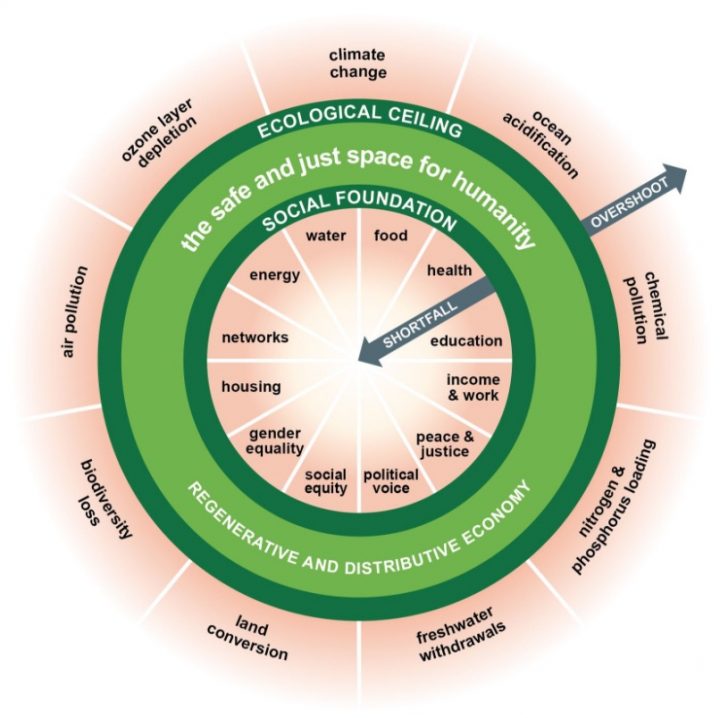
Kate Raworth’s ‘donut’ presents a relatively new way of looking at the economy, which has attained some fame. See the picture below.

the donut

As you approach the hole in the middle, you have an economy which does not satisfy people’s needs such as water, food, housing, relative equity, liberty, education and so on.

As you approach the edge of the image you begin to destroy the ecologies of the planet that the economy depends upon, producing events such as biodiversity loss, climate change, disruption of nitrogen and phosphorus cycles, destruction of fertile land, and so on.

Whereas without such a diagram, the capitalist economy is perceived as a matter of self-contained markets isolated from ecology, she argues that the aim of economics should be to satisfy people’s needs without destroying that planetary ecology.

Normal economic theory, can argue that inequality decreases as growth increases, and that growth cleans up economies, because the economic model looks at the world in isolated ways. Some economies appear to clean up ecologies, but they do so at the expense of other ecologies, and businesses are always happy to lower the costs of pollution and increase profit when offered an opportunity.

People may object that it is impossible to meet the needs of everyone – especially while respecting the planetary boundaries, but at least in this model it appears as something which can be discussed as a major concern. Just as we can ask “What is the economy for? What is it about?” and get a reasonably useful answer.

The old economics had an extremely confining view of human nature, it was humanity stripped of everything but the profit motive. This was a decision originally taken to distinguish economics from other fields such as history or philosophy, and to make things simpler, but it became the model of humanity. Under it we are *just* individual profit seekers. We only cooperate in order to make personal profit, we naturally destroy for profit, we have fixed preferences which we neutrally evaluate, and we have no purpose, happiness or virtue other than wealth seeking.

This view is simply not true, or adequate. Humans co-operate as naturally as they compete. We are social as much as individual, we do not naturally only value money and we do not destroy what we share. We are creatures with many purposes and many aims. Wealth is usually only important to the extent it brings about those other purposes and we are not made happy by consumption.
Raworth’s model, to me, is reasonably obvious and elegant and allows humans to be complex. It is not reductive.

It does have a few problems.

1) It does not explicitly recognise that the current economy is a mode of power, situated within frameworks of power relations, and that historical evidence appears to show that those who benefit from this mode of power will do almost anything to preserve it – including wreck the earth.

Nearly all forms of organisation are nowadays reduced to economic/capitalistic organisations. Media and information is controlled by capitalists, the law is controlled by capitalists, the State is controlled by capitalists, education is controlled by capitalists, and so on. Paying attention to the “bottom line” (measured in terms of money) is a mantra that both permeates society, and ignores reality.

It will be hard to move against inertia and the active power dedicated to preserving existing hierarchy. The model does not easily provide for the distortions that power puts into economics – any more than standard economics does. But as standard economics aims to preserve that power it is not a handicap for it, but a strength, as its users can pretend that inequality of outcome is always proportional to inequality of talent.

2) More importantly, the model does not provide a set of simple positive instructions for politicians. It does not give them an easy and painless set of action slogans and programs, whereas conventional economics does.

Conventional economics says: business is always good and always delivers, you must increase growth, nature is limitless or unimportant, commons don’t work so sell them off to business, government is inefficient so hand it over to business, rich people are talented so give them more support and protection (and pick up the rewards), reduce taxes, stop government services, increase charges, abandon poor people as they are without virtue, and individual wealth and its owners should be worshiped.

Donut economics, just says don’t destroy the world, and let everyone participate. Neither is easy under the current power relations, and these actions do not reward players in the State. The model grinds to a halt.

It needs simple and positive directives.

So time to think what those might be….

What can we do to protect the Environment?

April 30, 2018

This is a much asked question, and it is one that people often retreat from. It seems too big because the simplest answer is also the most difficult, and that is.

We must stop wrecking and polluting the environment as soon as possible; the environment is amazingly resilient, and it is likely to come back, if we give it a chance, and its better if we don’t interfere too much with what comes back, until its clear what comes back.

Stopping destruction is expensive, and will cut some people’s profit down, hence it is resisted politically. Furthermore, some people will put their temporary interests ahead of permanent ones, or they may freeload on other people’s attempts to put things right.

However, it will almost certainly be more expensive in all kinds of ways from simple prosperity to health and even personal survival, if we don’t take some preventative action NOW.

The ‘now’ is important. Which sets the first condition: “Do what you can, no matter how small.” It all helps.

The first step is to realize that Nature (the air, the water, the soils, the caves) cannot be used as dumping grounds for harmful waste products. Harmful in this case, means not just directly poisonous substances, but those substances like CO2 which are fine in small amounts, but become environmental stressors in large amounts.

Once you really realize this, then make your trash output as small as possible. Compost your food waste and use it in your garden. Most people buy too much food, cut back and eat what you have, that will save money too. If you are offered recycling use it, but also check the material actually is recycled – this may not be the case. In any case reduce your use of plastics. Ask local shops to stop wrapping everything in plastic – or unwrap it in the store (after you have paid:). Go to the street and pick up some plastic waste and at least stop it entering the drains.

If you can buy or install renewable energy then do so – again that reduces your waste over time, and this action is vital to stabilize the climate and wider ecology.

Protest against any attempts to promote deforestation in your region, or pollute rivers, or streams. Planned destruction rarely helps. Get to know the local wildlife and flora – even the creatures and plants you don’t like. Campaign for nature zones, and don’t be dismayed if you get the “wrong creatures” first off – nature is full of unintended consequences, while people have to learn how ecologies work in your area, and it may take a while for things to improve.

Support political parties which have a chance of gaining some power and influence, and which recognize the facts of ecological degradation and propose plausible solutions. Join them, and help! If you are a member of a political party which is doing nothing, think of leaving them or agitating for real action. Political participation is important and helps all kinds of people protect their own backyard against excessive development or useless highways, or whatever your local business/government people think is essential but wrecks things for others. And remember, many small business people like where they live and work and can help. The destructive organize, so help constructive people to organize as well. If you participate you cannot fail, you can (at worst) only learn about the obstacles to success, and move on.

If you have money and invest, then invest in green companies or, at least, protest at what is being done in the name of shareholders.

Do not be welded to solutions, but be prepared to learn what works and what doesn’t. Always remember unintended consequences are everywhere – because some plan sounds good does not mean it will always work, but do your best.

There are lots of books around to help with change, borrow them and read them. Buy them if they are good and helpful to support the authors.

Above all, do what you can. If you think you can’t do much, at least do that. It all helps, and builds consciousness, and that makes it easier to learn and do more.

Classical Liberalism

April 30, 2018

Liberalism was an ideology whereby the rising business classes fought against the land-owning aristocracy. It’s birth is usually assumed to occur in the 17th Century, with the alchemist, doctor and sponsored political writer, John Locke being its first significant philosopher.

While it has many virtues as a philosophy, classical liberalism (and modern libertarianism) also functions as a way of disguising the interests of capitalists and protecting the liberty of the capitalist and helping to ensure the wage-slavery of the workers. This is not accidental. Classical liberalism has been used to justify conquest, because of its insistence that unworked land is open for conquest, as people have not ‘improved it’ in a recognizable capitalist way – even if it was common land and occupied and used. Classical liberalism also either approved of slavery or the conquest of “lower races”, as part of capitalist expansion. It was a convenient philosophy. The work of Domenico Losurdo is good on this.

By emphasizing the individual alone, it also naturalizes people’s alienation from each other and from the creative process of co-operative labor and co-operative survival, this further acts as a way of preventing workers from organizing to form unions or political parties to participate in the political process, or to reject the organization of their lives by wage labor. Classical liberalism tends to be hostile to workers organizing, as it is a disruption of “free trade” and business power. Anything that disrupts business power becomes bad and unnatural in liberalism. In the long run everything becomes judged in terms of profit. Art is good if it makes money. Virtue is good if it makes money, and so on.

This is why the right spends so much time creating a false binary and arguing that socialism suppresses individuality and capitalism protects it, when (in reality, we are both social and individual. We exist in groups and require social being to truly exist – where else do we get language, ideas and culture from? Where else do our major satisfactions originate? Without society we cannot be individuals and vice versa. Any form which emphasizes one without the other is potentially tyrannous. Classical liberalism and modern individualisms all need modification by attention to their histories, unravelling the unintended consequences, and by the findings of social ‘science’.