Posts Tagged ‘Anthropocene’

Dictatorship or Evacuation?

April 5, 2025

Trump may want a dictatorship with himself at the top gaining deference from everyone. He has for example, not consulted with congress about a number of things he is supposed to consult about. He has said he will be able to seek a third term, possibly through succession. There are innumerable stories about how State level Republicans have been trying to get rid of potential non-Trump voters to fix elections for good eg [1], [2], [3], [4], [5], [6]. This is all part of Project 2025.

But if that is his aim, his attempts to implement project 2025 may not be generating the result he wants. Dictatorships are usually said to require a strong, well organised State.

By pulling the State apart, and massively confusing people as to his aims, he is generating a plutocracy, in which those who have enough riches will be able to do what they want, and those who do not have enough riches will get to do what they are told and to suffer. This represents a philosophy generally called “libertarianism” [7], [8]. Peter Thiel one of the billionaire founders of the movement leading to project 2025, stated clearly that “I no longer believe that freedom and democracy are compatible.” Democracy, in which people (including women) are consulted, is apparently incompatible with corporate liberty, or the liberty of the rich and special. Libertarianism, or oligarchy, is more likely to result from Project 2025.

Musk is a libertarian, who may well consider getting some people off earth more important than any aim of general welfare – after all if Earth is rendered unlivable before he gets a self-sufficient Mars base, then humanity may be doomed. If every human on Earth dies as a result of corporate and government actions, and the survivors on Mars found ‘Human space’ then all is well – humanity continues. This is virtue in the long term! As far as I know he has not declared government spending on his Space-X company to be a waste of money, and suitable for cutbacks (although he apparently has terminated expenditure into investigations into potentially illegal acts by his companies) [8]. He seems far keener to sink money into escape than into technology to prevent or lessen the effects of climate change – as after all climate science in the USA has been severely disrupted and repressed [9], [10], [11], [12].

Generally corporations like stability, so they can plan, so they can engage in profitable but low risk investment and so on. So most companies will not like the chaotic result of Project 2025 when they see the results, however much they have supported it until then.

However, they will fight to retain their power and positions, and the destruction of the US State will likely lead to the enshrinement of corporate power, wealth and struggle.

It could result in a feudal system in which ‘the Barons’ of industry fight over property, without the obligation the real Barons had to provide any ‘protection’ for the people. There will be nothing to constrain pollution or ecological destruction, or to counter act against the power of riches – except The Market – and the conveyance of elites to Mars -which will not be a pleasant life either.

However, a likely unexpected consequence of these policies, could be that the capitalist market falls apart, because ordinary people do not have the money to drive production… Can capitalism as we know it survive without a relatively well off working class, with the rich just serving each other? I don’t know. It will be a different type of organisation, perhaps again if it encourages mass die off, then it might survive going to Mars….

What happens after the elites hit Mars, is anyone’s guess.

Water loss

March 29, 2024

It is frequently reported that human society, capitalism, developmentalism, the polluter elite, etc are destroying the planets capacity to regenerate the resources we are taking from it. At the moment, it is estimated we have used up everything by August 2. The rest of the year involves plunder and destruction and lowers the date for the consumption of regenerable resources, next year and so on.

This is a problem when we come to basic survival supplies, like water….

Ground water loss

the amounts of fresh water and their rate of adequacy, is hard to estimate, rains etc vary, but the UN has just reported the following. And I quote directly.

(Groundwater depletion).

Groundwater is an essential freshwater resource stored in underground reservoirs called “aquifers”. These aquifers supply drinking water to over 2 billion people, and around 70 per cent of withdrawals are used for agriculture. However, more than half of the world’s major aquifers are being depleted faster than they can be naturally replenished. As groundwater accumulates over thousands of years, it is essentially a non-renewable resource. The tipping point in this case is reached when the water table falls below a level that existing wells can access. Once crossed, farmers will no longer have access to groundwater to irrigate their crops. This not only puts farmers at risk of losing their livelihoods, but can also lead to food insecurity and put entire food production systems at risk of failure.

emphasis added

This is likely to generate a ‘risk tipping point’ which increases the likelihood of cascading failure involving other dangers, see below.

Losses of ground water have already affected some countries

In the mid-1990s, Saudi Arabia was the world’s sixth- largest wheat exporter, based on the large-scale extraction of groundwater for irrigation. But once the wells ran dry, Saudi Arabian wheat production dropped and they had to rely on wheat imported from elsewhere. Other countries, like India, are not far from approaching this risk tipping point, too.

Another source of problems for ground water includes mining operations, especially fracking which cracks rocks and mixes substances from different layers. While this can be protected against for some years, if all the cracks are sealed off, there will come a time when the sealants break, and pollutants start permeating aquifers. So that water that remains in the aquifers may no longer be drinkable. Carbon Capture and Storage also risks contaminating water supplies.

Other Water Loss

Loss of fresh water supply is also threatened by the decline in Mountain glaciers through increased heat. These glaciers source most of the world’s great rivers, and water shortages are expected to trigger wars. This diminishment of water supply, so it will never be as great as it was, can be called ‘peak water’.

Peak water has already passed or is expected to occur within the next 10 years for many of the small glaciers in Central Europe, western Canada or South America. In the Andes, where peak water has already passed for many glaciers, communities are now grappling with the impacts of unreliable water sources for drinking water and irrigation.

There are also issues of water storage in dams because of increased evaporation levels due to the increased heat.

In Australia we have been watching our rivers die for years, as irrigation appears to strip so much water from them, they can no longer function. This could lead to the collapse of inland agriculture and, of course, country towns.

Tipping points

The idea of a risk tipping point is fairly simple.

There are different kinds of tipping points. For example, “climate tipping points” are tipping points after after which unstoppable changes occur which influence global climate and stop it reverting back to what has been historically normal. Examples of such tipping points include the melting of the Greenland Ice Sheet, the release of methane from unfreezing tundra, the shifting of ocean currents, the rise in water vapour in the air. Some of these tipping points may have even occured even without rising temperatures, such as the human clearing of the Amazon and other large rainforests which will likely change rainfall patterns, as well as producing species extinction. Overfishing the oceans which could leave them dying.

A risk tipping point occurs when a “given socioecological system is no longer able to buffer risks and provide its expected functions” or when we have killed resilience, slack and redundancy in the social system and harmed its ability to bounce back to normal equilibria. If this happens “the risk of catastrophic impacts to these systems increases substantially”.

In an interconnected world the impacts of risk tipping points such as this are felt globally, as they cause ripple effects through food systems, the economy and the environment. They affect the very structure of our society and the well-being of future generations, and they also affect our ability to manage future risks. Groundwater, for instance, is relied upon to mitigate half of the agricultural losses caused by drought, a scenario we can expect to occur more often at many places in the future, due to climate change. If the groundwater has been depleted, this is an option we will no longer have.

So starvation, death, rampant inflation of food prices, food riots and so on can be expected to result from loss of water.

Given the world’s largely neoliberal regimes and their belief in markets, we can expect that the rich, and corporations, will try to purchase the water they need and take it away from others.

Privatization can be a problem

People will have heard of the UKs water problems. Given the country’s fame for rain, this is almost unbelievable, but water cleanliness is being destroyed by privatisation and the urge for profit.

UK rivers are full of sewage. the number of people admitted to hospital with waterborne diseases has risen by 60% since 2010. Data suggests that raw sewage was discharged into rivers and hence into the Seas, for 3.6m hours in 2023, doubling over the previous year.

The government has given water companies until 2035 to reduce the amount of sewage flowing into bathing water and ecologically important areas, but other discharges could continue until until 2050.

Perhaps not surprisingly Water companies increased profits from this bad performance. In 2022-23, they made £1.7bn in pre-tax profits, up 82% since 2018-19, when they made £955m. They also plan to increase water bills by up to 40%, to pay for cleaning up and debt payments. Over the last 30 or so years Thames Water has paid £7.2bn in dividends, and taken out £14.7bn in debt – some of which is likely to have gone on dividends. Between 1990 and 2023, English water companies have paid out a total of £53bn in dividends, meaning that they have given almost the same amount to shareholders as they currently have in debt.

Guardian 28 Feb 2024

In the US testing by the Environmental Protection agency has found that about 70 million people are exposed to toxic “forever chemicals” in their drinking water. However, the testing only covers one-third of the USA’s public water systems, so the total figures could be much higher. Independent estimates put the total at around 200 million people having tainted water. Likewise, parts of the water supply in the USA are heavily contaminated with cattle waste from huge feedlots. According to the Minnesota pollution control agency, nearly 70% of the state’s water pollution comes from crop and livestock production, and the pollution also affects groundwater wells.

Both shortage of fresh water and unpolluted fresh water will increase the problems of population increase. To feed the extra 2 billion or so people being, we may need to double the water supplies for irrigation.

Conclusion

As many as 4 billion people are already exposed to water stress conditions for at least one month a year. The natural ecosystems that provide clean water and alleviate floods and other risks — such as forests, mangroves and wetlands — are degrading and disappearing at alarming rates. Demand for water is projected to increase by up to 30% by 2050, while water-related conflicts and political instability are on the rise. And climate change is worsening the problem, intensifying floods and droughts, shifting precipitation patterns and fueling sea level rise.

World Resources Institute Securing Freshwater for All

This essentially human-based weakening of survival systems, is the real mark of the Anthropocene.

The more parts of the global system become precarious the more likely a system cascade will eventuate, in which a failure of one system generates failures in other systems which then reinforce the original failure and so on.

Increased rain, in some places, may be captured rather than simply flood and destroy towns, but that would require vast engineering works. A large building program for filtration and desalination plants may be necessary, although it seems improbable nowadays.

We have to stop destroying natural systems, and possibly risk building new kludge systems to deal with the destruction we have generated.

UN Production Gap Report

December 17, 2023

One of the most important documents for a long time, was released just before the current COP. I’ve only just seen it. It:

finds that governments plan to produce around  110% more fossil fuels in 2030  than would be consistent with limiting warming to 1.5°C, and 69% more than would be consistent with 2°C.

ibid.

This means that:

Taken together, government plans and projections would lead to an increase in global coal production until 2030, and in global oil and gas production until at least 2050.

Summary of Key Findings emphasis added

In other words despite 151 national governments pledging to achieve net-zero emissions, by 2050, governments and fossil fuel companies are working together to produce more fossil fuels, and hence more emissions. OR they are simply ignoring the emissions problem, and hoping it will go away.

As is well known the International Energy Agency has argued that if we wish to stay under 1.5°C all there can be no development of new oil and gas fields after 2021.

Beyond projects already committed as of 2021, there are no new oil and gas fields approved for development in our pathway, and no new coal mines or mine extensions are required. 

IEA Net Zero by 2050

It appears from the UN report that not one country has committed to cutting coal, oil or gas production to be consistent with a 1.5C target, and with this level of production, we are locked into a more than 2°C temperature rise.

This is despite the latest forecasts that coal, oil, and gas demand will peak this decade.

Indeed this action can be seen as an attempt to undermine the prediction and keep countries addicted to using fossil fuels and increasing fossil fuel company profits.

Whatever anyone says, Carbon Capture and Storage cannot deal with this excess of emissions. It cannot deal with even a small fraction of what we already produce. So the chance of it succesfully dealing with this excess is microscopic.

Again, if we needed to know, this shows the dominant power in the world, and that it does not care what happens to people, as long as it makes its profits.

Even the excuse that coal is being phased out faster than oil and gas is useless, because:

“We find that many governments are promoting fossil gas as an essential ‘transition’ fuel but with no apparent plans to transition away from it later”

 Ploy Achakulwisut quoted in Governments plan to produce double the fossil fuels in 2030 than the 1.5°C warming limit allows

UN Secretary-General António Guterres says:

Governments are literally doubling down on fossil fuel production; that spells double trouble for people and planet… We cannot address climate catastrophe without tackling its root cause: fossil fuel dependence. COP28 must send a clear signal that the fossil fuel age is out of gas — that its end is inevitable. We need credible commitments to ramp up renewables, phase out fossil fuels, and boost energy efficiency, while ensuring a just, equitable transition

Governments plan to produce double the fossil fuels in 2030 than the 1.5°C warming limit allows

However, if Governments have previously promised to cut emissions but are really supporting fossil fuel companies in increasing emissions, why would anyone trust them to really change, as opposed to saying they will change, at the COP?

These are graphs of the problem, showing the differenc between planned production and needed reduction:

Just before the COP28 meeting in the UAE, it was revealed that Adnoc, the UAE’s state oil company was going to use the conference “to jointly evaluate international LNG [liquefied natural gas] opportunities” in Mozambique, Canada and Australia, and that it planned to discuss fossil fuel deals with 13 other nations including Columbia, Germany and Egypt. The documents suggest that Adnoc would argue that “there is no conflict between the sustainable development of any country’s natural resources and its commitment to climate change.”

The president of COP28, Dr Sultan al-Jaber, is the head of Adnoc. In 2022, under his leadership, Adnoc announced they would invest $US150 billion to “accelerate” the growth of oil and gas development. “Adnoc’s ‘overshoot’ of the IEA net zero scenario is…. 6.8 BBOE [billion barrels of oil equivalent], the third largest worldwide.” [The Link in the Guardian article to the accelerated growth announcement, no longer works, but see the ABC].

“The UAE team did not deny using COP28 meetings for business talks, and said ‘private meetings are private’.”

The UAE also prepared talking points on commercial opportunities for its state renewable energy company, Masdar, ahead of meetings with 20 countries, including the UK, United States, France, Germany, the Netherlands, Brazil, China, Saudi Arabia, Egypt and Kenya.

ibid

The UAE also failed to report its oil industry’s emissions of methane to the UN for almost a decade.

This can be seen as part of the fossil fuel company’s campaign to keep new fields opening and implies that it is rountine to put business before attempts to lower emissions.

While we are at it, the World Meterological Organisation released a preliminary finding that:

confirms that 2023 is set to be the warmest year on record. Data until the end of October shows that the year was about 1.40 degrees Celsius (with a margin of uncertainty of ±0.12°C )above the pre-industrial 1850-1900 baseline….. The past nine years, 2015 to 2023, were the warmest on record…. Greenhouse gas levels are record high. Global temperatures are record high. Sea level rise is record high. Antarctic sea ice is record low. 

2023 shatters climate records, with major impacts

My guess after seeing this result, is that we are going to sail over 1.5 degrees in a very short time, which means that cut backs in fossil fuel production, use and emissions have to start immediately. If we want a safeish planet. There is no later.

Bjorn Lomborg again

April 14, 2020

Revised 8 May 2020

I’ve been reading quite a bit of Bjorn Lomborg recently, for my research on climate technologies and their social consequences – and I’ve been reasonably critical of some of his writing and mode of argument (see [1], [2]). However, somewhat to my surprise I found it possible to extract an interesting, and relatively consistent position on climate and ecological problems from his work.

The main problem with Lomborg is that he almost always seizes on the most optimistic figures for the economic and other consequences of climate change, and never questions the consequences of current economic structures and drives. He is similarly cheery about the consequences of the current pandemic and the ways to deal with it. He always appears to try and diminish the problems. This ‘optimism complex’ (found in those supporters of renewables as well, who think transition is inevitable and easy) is a problem when the situation seems a lot worse than most people realise.

Another problem is that he appears to not ‘think ecologically’ ie in terms of complex systems. Thus he appears to argue that a few degrees cannot make that much difference – we can all survive 2 degrees no real problem. However, a minor change in one part of the systems can make massive amounts of difference as it courses through the systems, triggering other effects and compounding crises. For example, global warming will probably not just mean our highest temperatures are one or two degrees (the average) higher but much higher, and the high temperatures will not be separated out into single days which might not be too harmful, but over continuous days or even weeks. This significantly magnifies human and animal deaths, water and crop problems, so that they can become catastrophic. These failures then add to other stresses (say pandemic, flood, fire etc) on what should be manageable days. The more stressed the society, the more vulnerable it becomes, and the more catastrophic minor incidents become.

Finally he does not seem interested in any action which restricts air pollution, or emissions. It is probably right to be cynical about the bone fides of any position which claims to be about benefiting human life and which does not recognise air pollution as important harm.

However, this post is an attempt to summarise what I believe to be the strongest points of his underlying argument. The result may not be exactly what he would put forward himself, but seems worth considering. While I don’t agree with all aspects of this argument, and would be far more intense about the problems we face, it does seem to be a useful position, and I have put it as strongly as I can.

  1. At the moment, the whole world faces a set of interlinked problems that cannot be solved by a narrow focus on just one or two of these problems. We have to approach these problems from many directions, and be generalists.
  2. There is a climate crisis which needs to be fixed. It may not be immediate, and it may not be the primary problem we face today, but we do need to fix it. Now, I do think it is an immediate problem, but Lomborg tends to postpone it, as part of his optimism complex. However, let’s begin with it.
  3. The current systems of climate talks, agreements and targets are not working. The Paris targets are costly and nowhere near strong enough, and we are failing to achieve them anyway. There is little point continuing on in the same way and keep failing.
  4. We do not have anything like the amount of green energy we need. We may be increasing green energy enormously, but we have been increasing fossil fuels even faster, so the percentage of truly green energy remains tiny. According to the IEA, the OECD has 2.3% hydro and 2.6% of “geothermal, solar, wind, tide/wave/ocean, heat and other.” To this we can add 9.6% Nuclear and 6.1% of Biofuels and waste, if you really wish to classify these other sources as clean (IEA 2019 Key World Energy Statistics, p7.)
  5. Governments should immediately stop subsidising fossil fuels, at all stages of production. This is a complete waste of money and time. It helps make the situation worse. If companies go bust, then they go bust; that is the market in action. Established companies which depend on bailouts and subsidy should not be supported, as their weakness indicates either bad management, poor financial choices, unwanted products, or some combination of the three.
  6. Pollution and ecological destruction should not be free. At the very least, we need a mechanism to establish a carbon price to help fund research. Lomborg’s position is inconsistent and it’s easy to find counter examples, but I think his position moves towards this over time. I’d add that other ecological destructions should not go uncharged, and uncurtailed, either..
  7. Green energy should not be subsidised. This might result from good intentions, but it is distorting and, according to the IEA, governments are spending way too much for the observable results. Strangely, while Lomborg questions calculations for fossil fuel subsidies he does not seem to question the figures he objects to for renewable subsidies. For example, does the IEA count feed-in-tariffs as subsidies when these could be considered the price paid for electricity generation? We need to be sure what is a subsidy.
  8. Some of the processes receiving subsidy are not that green to begin with. For example, carbon capture and storage is a waste of money. It has no hope of solving the problem, and merely prolongs fossil fuels use.
  9. In the US and Europe, wood burning is classified as green or renewable. This is also deceptive. Burning wood emits more CO2 than coal, and destroys forests and wildlife. The forests may not be replanted, either and it is dubious planted forests have the bio-complexity and resilience of natural growth in any case. Biofuels take away land from agriculture, especially from poorer farmers, and they are largely energy inefficient with low EREI.
  10. Green energy’ should mean every energy source without GHG emissions after set up, including small scale nuclear.
  11. Currently, research into green energy does not receive anything like the money needed.
  12. Instead of subsidising renewables, governments should put at least half that money (or “an annual global commitment of some $100 billion”), into research into green energy [1], [2], [3]. This could be funded from abolished fossil fuel subsidies, so it is not an extra cost. Government led research is effective, and stripped of commercial bias. It can also lead to ‘public domain’ patents, available to all, thus increasing economic productivity.
  13. As we are on track for climate or ecological devastation in the long term, we also need to increase societal resilience.
  14. Poverty and disease are major causes of suffering and decrease societal resilience Removal of poverty also increases life-span and productivity.
  15. Most people who suffer badly from disasters [and climate change] are the poor. The better off people are the better able they can handle, or negotiate, disaster.
  16. Poor people tend to be less worried about climate than about day to day survival. Action on climate often may not seem to benefit, or engage, them but action on their immediate problems can be embraced enthusiastically. However, it can be added, that given that some problems are already coming from climate change, we should not ignore this either.
  17. One reason for massive fossil fuel use is that this easily available, well understood, and centralised form of energy is promoted as helping to lower poverty in the developing world. Without solving the poverty problem, we will not solve the pollution and ecological destruction problems.
  18. There is little point having green energy if it seems to be as harmful to people in poverty, as fossil fuel energy generation and mining can be. We should probably stop coal mining were it hurts, or displaces, poor locals.
  19. We need to keep the economy strong enough and organised enough to lift people out of poverty.
  20. It is notable that Lomborg does not ask whether the current structure of the global economy enables a general lifting out of poverty without harmful consequences. For example does the increase in living standards in the ‘third world’ or ‘the South’ come at the cost of increasing inequality of wealth and power in ‘the North’, along with the decline of the ‘first world’ working and middle classes? Do current methods of raising living standards destroy ‘community’ and mutual aid? Yet the general idea of raising living standards and prosperity, as a help towards problem solving, increasing political participation and resilience, is important and requires more investigation.
  21. These problems also stretch to his support for ‘Free Trade’. The problem is we don’t get really free trade. Neoliberal free trade, has tended to suppress government programmes aimed at providing the social amenities and common good which was not provided by ‘the market’ in the vague hope that they would be provided by the market. This amounts to a suppression of democracy in the corporate interest. Free trade negotiations also seem to have allowed the market to be regulated by the major players in the market to benefit, and protect, themselves. So care is needed here.
  22. Another cause of instability and suffering is disease. TB, for example, is debilitating, and could apparently be eliminated with enough spending. The same is true of Malaria.
  23. Governments also need to protect water and its flows. Improved sanitation and latrine technology help reduce disease, and no one can live without drinkable water. Convenient water also frees up time from collecting it. At the moment we seem to be damaging water at an increasing rate. In dry countries, like Australia, it seems obvious to me that projects which could harm, or restrict, the water supply, even in 200 years or more, should not be considered. It is easier to damage than to protect water supply, in particular underground water.
  24. Research is needed into improving agriculture and food supply in the long-term. It is obvious that short term improvements should not be at the expense of long term sustainability. Although Lomborg does not seem to mention it, this may require research into regenerative agriculture. At the least we need to lower the emissions from agriculture and stop leeching soils of nutrients, salt rising, topsoil loss, and deforestation to provide new fields because old fields are exhausted.
  25. Indoor air pollution from cooking, needs reducing. I would suggest solar cookers, where possible, as this allows wood to remain uncut and dung to fertilise the soil, but Lomborg goes for ventilation – this is also useful and cheap addition. Outside air pollution is also a problem. The World Health Organisation estimates 3.8 million people die per year from household pollution and 4.2 million people die from outdoor pollution. This requires reduction of burning, of coal, gas, oil and so on, but Lomborg seems largely uninterested in lowering this cause of death.
  26. Another source of instability and poverty is the lack of effective birth control, [1], together with the lack of educational and economic opportunities for women. Again it is relatively easy and cheap to fix this – although it will encounter a lot of religious opposition and the amounts being spent seem to be declining.
  27. By reducing the number of children, birth control helps provide better nutrition for existing children and this renders them more physically and mentally capable of education and resilience.
  28. Education needs improvement and more accessibility, especially pre-school – but this is difficult as some dominant groups don’t want people to be well informed, or able to think critically or creatively; they just want them accepting and obedient. A critical and creative population is dangerous for incompetent, or unjust rulers.
  29. It also needs to be added to this summary of Lomborg’s remarks, that any reform program that is actually going to deal with this whole series of problems which interact with each other and magnify each other, may involve a disruptive politics. Particularly when one of those serious problems, is the structure of power relations themselves, and those power relations will affect all attempts at reform.

These ideas seem to be worth considering, wherever they come from, as increasing disasters point to global systemic causes and effects, and they demand systemic strategies in response.

One final addenda. It seems common for people supporting Lomborg to say that:

Spending on green tech research,
Fighting poverty,
Doing our best to end TB, Malaria and other health issues,
Improving food and agriculture,
Improving access to drinkable water and protecting water supplies,
Lowering indoor pollution and
Boosting education, particularly for women,

is somehow incompatible with lowering emissions and pollution and reducing ecological destruction. They repeatedly imply it’s one or the other. However it is probably more accurate to say we cannot carry out Lomborg’s plans, unless we reduce pollution and ecological destruction. The poor end up with the harmful consequences of pollution and eco-destruction and usually live in the places which are most badly affected. We cannot, for example, reduce poverty when corporate or government interests are destroying local agriculture, and poisoning the water and air.

On Pandemics

March 25, 2020

This is just what I’ve put together from various sources, to make some things clear, which do not seem clear in much public discourse about the coronavirus so far… It also represents a change of view for me. This is a general consideration of disease. If its wrong, or seriously inadequate then please let me know, so I can change it…. I’m not an expert.

Probably not good to think about, if you are truly scared in the first place.

1) The problem with disease is not just the death rate. If for instance a virus has 100% death rate but kills one person, then it’s probably no big deal.

2) An important factor/problem is the contagion rate. If the disease is communicated to 80% of the population, as opposed to 10% of the population then its death rate, even if smaller, may be more serious than that of a disease which is hard to catch. If for example it infects 80% of 24 million people that is 19.2 million people. If the death rate is 1% then that is 190,000 people dead and a hell of a lot of overfull hospitals and overworked medical staff. If the virus spreads quickly which it probably will with a high contagion rate then all of these cases happen in a relatively short period of time, further overwhelming the health system (and probably most other social systems). Another virus may have a 10% death rate but be harder to catch and only be communicated to less than 1% of the population… 1% of 24 million people is 240,000 people, 10% of that is 24,000 dead. The first virus is probably more significant, even with a lower death rate – everything else being equal.

This is the big difference between coronavirus and SARS. SARS is far more lethal, but it is much harder to catch. Coronavirus seems very easy to catch, and so will spread further and probably kill more people.

3) The third problem is what I’ll call the incapacity rating of the disease (there is almost certainly a proper medical term for this, but i’m not a doctor – as should be obvious). This is when, perhaps, few people die, but lots of people are really seriously ill, need care, or would die without treatment. Theoretically a disease could exist which may not kill or injure people if they had decent hospitalisation. So the hospitals fill up with people who would probably recover. In this factor we can include diseases which do not kill people, but leave them severely disabled, or incapacitated – this stresses social and medical mechanisms, again – especially if patients all turn up in a short period. Diseases can have both high death rates and high incapacity rates, there is no reason to assume its one or the other.

Many people and politicians seem to be only interested in the death rate, and ignore the serious problems that arise from points 2 and 3. Even if the death rate is low, there can be a case for physical isolation.

4) The fourth problem I know of is the mutation rate. Viruses are particularly prone to mutation. This one has apparently (and the apparently means i don’t know for sure, its just something i read) mutated from an animal virus, to an animal to human virus, to a human to human virus, and now to a multi-variety virus. It is much harder to develop immunity and vaccines against such viruses. This is one reason why we can be affected by flu year after year.

There is a possible good thing about a quickly mutating virus, if it can propagate without killing people, and killing or injuring people stops its spread, then it may well evolve to be less harmful in the long run, but more easily catching. However, this cannot be guaranteed, and a lot of people might be severely incapacitated in the process.

5) Pandemics may need to be treated seriously, even if they do not seem so bad at first, until we work out all these different factors.

Spirit, soul, flesh and the climate crisis

March 24, 2020

The issue of spirituality again….

There seems to be a lot of people claiming that ‘materialism’ is the problem and ‘spirituality’ is the solution. It is not always clear what they mean by either of these terms, but these terms are binary, and define the other by what it is not. To the materialist the spirit is nothing, and to spiritualists matter is nothing. But both form a category based division of the world, which depends on each other for their meaning and sense of reality.

As I’ve discussed before binary and ‘mono-ary’ thinking are reductive. You seem to need at least three terms to start thinking non reductively, and even then it is difficult not to reduce one’s thought to the one or the two. You may always need a prime number of terms, to begin to avoid the reduction into binaries. A four term layout may easily reduce to two binaries and so on.

With the two terms, spirit and matter, we generate ‘opposites’ and ‘oppositions’, in which one term is valued more than the other, rather than complements, but you cannot have one without the other, even if they go as far as to deny or slancer the other to give themselves meaning.

James Hillman tries to broaden thinking and perceptions, by using the old Christian terms ‘soul’ (psyche), ‘spirit’ (pneuma) and ‘flesh’ (sarx or apparently sometimes soma although this latter could mark some further differentiation ). For a long time, it has seemed odd to me that this triadic distinction gets reduced to spirit and matter, especially if you hold that God is a Trinity, which was the official position….

In Western Culture, in a slightly modified use of Hillman’s terms, ‘spirit’ is the force of ascension – that which tries to leave the world and the flesh behind. It is that which is convinced its true habitation is elsewhere in spiritual clarity of pure mind and, at the extreme, sees the flesh as a prison, a tomb, or as unreal, by comparison with the freedom, might, power and reality of spirit. Often, with visions of the spirit, individuality, isolation, etc dies in the realisation of that spirit, in its “oneness”.

Soul, on the other hand, is that which seeks meaning in the dark, in the depths, of feeling, imagery and in recognition of our unconscious. It seeks the light of nature. It is the descent into and through the flesh into this world.

It could easily be suggested, that in these terms, pure spirituality is destructive of the flesh and the body. It is the parent of lack of care for the Earth, for the trope of abandoning the Earth or destroying the prison of the Earth. In its view ‘positivity’ overcomes everything, because the world and the flesh have no mind, no thought, no real being, they are at best obstacles for spirit which have to be overcome to reach our real home in immaterial spirit and God.
In other words, the problem with our world is not materialism, but the spirituality which generates materialism as an opposite, as part of its path of ascent away from matter. It, as a matter of course, generates ecological crisis, because it has no care for such things. Nature is irrelevant. We can gather in thousands to glorify the spirit in the midst of plague and no harm will befall us.

On the other hand, again in these terms, soul accepts the reality of the world and our literal attachment to the world. It accepts it is part of the flesh, and feels the flesh, and is the ‘salvation of the flesh’ perhaps through suffering. As love it is sensitive to the movements of matter and flesh, and the images that arise from matter and are transformed and recombined by the soul into its visions, and translate the unknown and unconscious into something it can intimate. The world has meaning through its synthesis with soul. The soul does not turn away from misery, but does its best to help, and its idea of help is not to increase their suffering so that they die into spirit, but for them to live with what is, and what can be improved and transformed as in alchemy. The soul sees the divine as here already, and not as about to leave. It may even produce the divine that is here. The soul sees the golden light and mind of matter. Soul tends ecologies because it expresses them and loves them as its basis.

If we wanted to, we could say that the approach of the soul does not create a barren materialism, like the approach of spirit, but a divine materialism in which the word is made flesh, and flesh becomes the word, and is alive.

Where we to go further, we could say that this triad is a model of continual circulation. That matter is ‘coarser’ spirit and spirit ‘refined ‘matter, but never separate, and the soul is a perspective on this dynamic procession.

We descend into the world and the flesh to find experience and to imagine, think, feel, pleasure and exist, and then move into the spirit bringing what we have learnt to learn again, and then return to the flesh, bringing what we have learnt to learn again. And this is not just ‘between lives’ for those who believe in reincarnation, but within the one life. The soul holds us together feeling and imagining all as we progress. But none of the three exist apart, and cannot exist apart without collapse. The procession is circular.

Separating the flesh and spirit, which the spirit does so easily is a form of death, recombining within soul is a form of enlivening, and thus the cycle continues and the earth is continually reborn, in reality and in our eyes.

Comment on Ted Nordhaus: ‘The Empty Radicalism of the Climate Apocalypse’

February 24, 2020

Mr Nordhaus’s article ‘The Empty Radicalism of the Climate Apocalypse‘ is challenging and interesting. Any summary of it will probably not do it justice, but hopefully I’m not distorting it too much.

Ted Nodhaus hails from the Breakthrough Institute (not to be confused with Breakthrough: National Centre for Climate Restoration), that is generally pro-corporate, anti-carbon price and pro-nuclear in its approach to climate change, so his argument that mainstream ‘left’ climate action proposals, are not really that left wing, or anti-capitalist, is interesting and worth engaging with. He is largely correct; environmental action has largely been adapted to not challenging capitalism. Neoliberalism is both all-pervasive, unable to take action itself, and inhibiting of any action by others.

Lets begin with his final point:

“we are all neoliberals now. Some of us just haven’t realized it.”

Neoliberalism is about protecting and promoting corporate dominance. A neoliberal is a person who talks about free-markets and small government, but is quite happy to have government intervene to crush workers’ rights or popular protest, to protect companies when they engage in pollution and harm, and to distort or regulate markets in favour of established corporate power.

In neoliberalism, anything established companies do is perceived as the ‘market in action’, and hence wonderful; anything which anyone does to curtail corporate dominance or to protect livelihood, or even existence, is acting against the market, and is evil and to be suppressed. Neoliberalism is both fundamentally anti-democratic and pro-corporate liberty. Corporations do not need democracy, or generate democracy. Profit and financial power are the only virtues neoliberalism recognises. If destroying ecologies makes profit, even if there are any laws left to protect ecologies (which neoliberals will attempt to remove), then ecologies will be destroyed.

Neoliberalism is inherently boring and real world problem avoiding. Neoliberals pretend that what they call free markets bring liberty rather than corporate dominance. Their only solution to every problem is even greater corporate dominance and less government acting on behalf of the people.

It is not surprising that after forty years of neoliberal ‘free market’ talk most people feel alienated from a politics which has become about corporate subsidy and corporate freedom, while considering most of the electorate expendable, or mindless, and to be manipulated rather than listened to.

Neoliberalism creates the conditions of its perpetuation by preventing any challenge emerging, by ensuring critical politicans generally get little funding, by funding fawning politicians, by owning the media and ensuring you get bombarded with neoliberal talking points, by enforcing the market, and dismissing whatever challenge becomes known as ‘anti-market’, and markets are inherently good. It also sabotages its conditions of existence by removing responsibility for the destruction of the ecologies it depends upon.

It is not a surprise that neoliberalism cannot deal with climate change, as recognising climate change demands changes in the behaviour of dominating corporations, a recognition of their responsibility for ecological destruction, and a reassertion of the rights of those ordinary people who are going to suffer severely from climate change. All of this, like any other democratic action is simply branded an interference in the market and unworkable as a result.

Most people (including neoliberals) deny they are neoliberals in this sense, but this is the way neoliberalism works. It forms the destructive background of our crisis

“Many conservatives have attacked the Green New Deal as socialism”

Neoliberals attack everything that does not give the corporate sector more power and wealth, as socialist or communist, suggesting it will lead to mass death. That is their main shtick. It also shows the poverty of their arguments – a slur is enough to satisfy them and prevent any further thinking.

But, as Mr Nordhaus says,:

“what is striking about the Green New Deal and similar proposals coming from climate hawks and left-leaning environmentalists is not their radicalism but their modesty.”

Yes. The left is now what would once have been called economically right wing. The solutions which are being proposed in our parliaments to the problem of climate change, are moderate capitalist, not socialist. They are not radical. The fact that they are attacked in this way, rather than discussed, shows the intensity of the neoliberal desire not to trouble the established and dominant corporate sector. The right is always attempting to push us further to the right.

“almost no one, in either electoral politics or nongovernmental organizations, seems willing to demand that governments take direct and obvious actions to slash emissions and replace fossil energy with clean.”

For the mainstream left, this is pretty accurate. From the 50s to early 70s direct government action would have seemed the sensible and obvious thing to do to almost everyone, as survival is more important than corporate power or markets. Markets have no necessarily beneficial teleology, other than seeking profit at this moment; their long term processes can easily lead to destruction, or the crash. Its not as if we don’t know that markets do crash, and bring many people down with them. Markets always require custom and regulation to work.

“the apocalyptic rhetoric, endless demands for binding global temperature targets, and radical-sounding condemnations of neoliberalism, consumption, and corporations only conceal how feeble the environmental climate agenda actually is”

He is right again. Neoliberal dominance or free market fundmentalism, crushes all innovation and potential innovation (unless it renders profit). Mainstream environmentalism yields, possibly to keep funding and avoid full-on media attacks.

The left’s agitation boils:

“down to some variant of either regulating corporations to stop them from doing things that produce carbon emissions or subsidizing them to use energy and other technologies that reduce carbon emissions”

As he is arguing, this is pretty minor stuff considering the potential scale of the disaster, yet it is vehemently opposed.

It is also true that as well as regulation and subsidy, some people suggest a carbon price as a solution. Not carbon trading, but a governmentally determined price with predictable increases, which gives the business world certainty (to the degree certainty is possible), and is given back to ordinary people to compensate for price increases. Again this is a mild impingement on markets, less of an impingement than sea level rises and so on. Its not hard to find this suggestion, as he recognises in his next paragraph. He continues:

“the primary frame through which climate change has been viewed over the past three decades is as a market failure.”

Yes. With the reservation that this is not really what is usually meant by ‘market failure.’ The term ‘market failure’ implies the possibility of ‘market success,’ yet the complete inability of neoliberal markets to deal with climate change is now reasonably obvious. It is not market failure. It is the nature of the neoliberal market itself that is the problem.

“Missing from this frame is the notion that abundant, cheap, clean energy and the low carbon infrastructure and technology necessary to provide it is a public good.”

Indeed because neoliberalism and its free market theory will not allow, or recognise, this. There is no such thing as ‘public good’ in neoliberalism, and talk of ‘public good’ is seen as a screen for ‘socialist dictatorship’ (lessening of corporate dominance). This again shows the poverty of neoliberal thought. Economics and exchange is a social activity, which depends on social order and a sense of public good. If it does not serve the good of the general public, what is the point? But, in neoliberalism, there is only the private good of the corporate class. No one else counts.

“Treating climate change as a public infrastructure challenge, not a private market failure, brings a range of advantages that pricing and regulation cannot provide.”

Yes again. This kind of action should recognise the inability of the market to work to save us, by itself. Dominant players in the market are currently profitting from the actions which lead to climate change, and they are not about to give those benefits up, without struggle.

“[Public action] enables long time horizons that private investors are unlikely to tolerate; planning and coordination across sectors of the economy to integrate technology, infrastructure, and institutions necessary to achieve deep decarbonization; and low-cost public finance that could make the price of the energy and climate transition far more manageable. And assuming a reasonably progressive tax system, it would arguably do so in a manner at least as straightforward and equitable as cap-and-trade or carbon taxes that aim at “correcting” market failures.”

Yes, but a carbon price may also be useful, as not everything would have to be done by government fiat alone. Perhaps a non-neoliberal market, in competition with central planning, might be useful. We have had mixed economies previously, and they worked quite well; certainly better than neoliberal markets.

“Green opposition to nuclear energy and hydroelectric dams has evolved into skepticism of centralized grids and infrastructure planning.”

I have not noticed this at all. This seems to be lazy thinking. It’s easy for the right to assume Greens are stupid (as they are not neoliberals) therefore they wouldn’t approve of grid planning.

However, as an example of reality, the Australian Greens argue they wish to:

  • Establish PowerNSW. A new, publicly owned electricity company to generate, distribute and retail renewable energy for the people of NSW fairly and affordably.”

and:

  • Upgrade the power grid. Build much-needed new public network infrastructure, connecting our abundant renewable energy resources to the National Electricity Market.”

So there is no skepticism about improving the grid. It should be fairly obvious that nuclear energy and Hydroelectricity present fundamental ecological challenges, and dangers, in ways that grids do not. Greens might prefer local people not to be restricted by neoliberal regulations designed to protect commercial grid operators at the expense of those local people, but if the grid became a national project, aimed at more than just private profit, then this might be much less of a problem.

“It was only the distortion of energy markets by policy-makers, at the behest of fossil and nuclear incumbents, [Amory] Lovins [chair of the Rocky Mountain Institute] has long insisted, that has stood in the way of the rapid adoption of renewable energy.”

Sadly this ‘distortion’ (which is not a distortion but part of the way the neoliberal market works) is inevitable in a society in which the official ideology only values profit. Massive inequalities in wealth allow massive inequalities in social power and in access to that power. The super-wealthy can, and will, buy and reward politicians for supporting them, and pay for think tanks to persuade those politicians that, in being bought, they are acting virtuously.

“the realities of renewable energy at scale look nothing like the distributed and decentralized utopia that Lovins and his environmental followers promised.”

Yes, again neoliberal ideology and action ‘distorts’ everything to perserve the powers of the corporate elite. Their aim is to prevent this elite having to change or respond to peoples’ needs or requests, and claim this is reputable because “the market knows best”. The environmental movement should not go along with any of these propositions, however dangerous this might appear.

“Most renewable energy today comes not from homes clad in solar panels but from enormous, industrial-scale wind, solar, and biomass facilities.”

This depends a little on where you live, but yes captured governments and renewable energy corporations, have tended to favour the enormous, and the centralised. They have favoured the structures which were good for coal energy companies and which removed local people from consideration or participation.

“The only remotely plausible path to the sorts of changes that many environmentalists now demand,… would require top-down, centralized, technocratic measures that most environmentalists are unwilling to seriously embrace.”

This is the fundamental paradox, but a centralised system which responded to, and involved, local communities could well have a different dynamic, if that was built into the planning. Again the problem is trying to adapt to neoliberalism.

“That is why the rhetoric of climate emergency in recent years has not been matched by explicit and specific proposals to do the sorts of things that a climate emergency would seem to demand.”

He should perhaps listen to some of the climate emergency declarations, and then realise the practical difficulty of acting against the endlessly wealthy elites…

This radicalism is

“fundamentally lacking any well-formed idea of what such a world would look like, in either its institutions, its actual social and economic organization, or most of its specifics—rationing, nationalization, or even just preempting local resistance to action… what most environmentalists, including radical greens, are basically demanding is capitalism with carbon regulations and lots of windmills.”

Yes true, and yet what visions there are, are still rabidly opposed by neoliberals, because it might set a precedent to challenge unfettered corporate power. There is no agreed on vision, because neoliberals refuse any negotiation, at all, even with this dilute environmentalism.

“there is little reason to believe at this point that we are capable of arriving at or sustaining the sort of political consensus that such an undertaking would require.”

This all suggests that the time for compromise with neoliberalism has passed. Neoliberals, as Nordhaus almost recognises, have obstructed climate action at every turn; no matter how mild the suggested action, they still claim it is too ‘socialist’. Over 40 years of neoliberal dominance there have been pretty much no neoliberal ‘free market’ suggestions for a solution to climate change that neoliberals have been willing to actually act upon. Perhaps because there cannot be.

Climate survival clashes with fundamental neoliberal principles.

The left may have to gain the kind of intolerance displayed by the neoliberals and not bother about further attempts at dialogue. Neoliberal markets do not work. Challenging neoliberals will be painful. Not challenging neoliberals will be death. Possibly this needs to be the fallback realisation of the environmental movement, left and right. Neoliberalism is not conservative at all.

Nordhaus ends with a kind of solution, which is probably yet another avoidance of the problem of neoliberal love of destruction.

“technological change will likely continue to prove more easily seeded and sustained than political change.”

Possibly, but again technological change and the way it is used, needs to be removed from neoliberal hands, or we will have more of the fracking disasters, and the leaking of methane in to the air. Fracking might “have significantly reduced the role of coal in the US electricity market” but it is doubtful it has reduced emissions, or preserved ecologies. It just reinforces the destructive system.

Technology has unintended consequences, but neoliberal technology will be designed and organised to benefit neoliberal power and wealth structures, before it will be designed and organised to improve quality of life or ecological stability.

Attempts to accommodate neoliberalsim and keep corporate support, may explain the incoherencies I have discussed in Australian climate policy, as neoliberalism is essentially hostile to ecological preservation and loss of any established corporate power. There is, and can be, no neoliberal effective climate policy. Consequently, neoliberalism must be defeated. We can begin by recognising that Neoliberalism in all its forms, is:

  • essentially anti-democratic
  • inherently destructive
  • unable to deal with ecological problems or climate change
  • reduces everything to maintaining profit
  • uninterested in most peoples’ survival, if that might lessen corporate wealth
  • controls the media, and hence what most people know
  • attempts to destroy information which is true, but might affect it
  • formidable as it is a form of plutocracy or rule by wealth
  • attempts to take over the state, through buying politicians, lobbying, privatisation, and positioning corporate people in government departments responsible for regulating their corporate activities.

Challenging neoliberalism will be difficult. Perhaps the only alternatives are revolution or death. I’d much rather they weren’t, but when established power seems bent on destruction and ignoring the problems, then perhaps that is the only option.

Fighting neoliberalism will be painful, but it is the only course of action that will get us anywhere.

Climate Emergency Summit 02: Action?

February 16, 2020

Part 1 of this discussion deals with the current state of the world and what the emergency looks like. We can now move on to what constitutes an adequate response.

The minimum actions seem to be something like the following. How they are organised is a political question which is vital, but open for discussion.

Firstly we need to stop all new fossil fuel mines and exploration. We almost certainly won’t do this, because of the power of fossil fuel companies and the (dis)information they disperse, and because some people cannot imagine life without fossil fuels, but it’s absolutely necessary. More fossil fuels will only make the situation worse.

This means no Adani mine, and no Clive Palmer mine. We apparently have plans for another 50-80 coal mines in Australia and even more new gas wells. This stops, Now. Personally I don’t think there should be any compensation for this. These companies were trying to profit from our destruction, so I have little pity for their loss, and we need all our resources to help the transition, but that is not my decision – that is part of the political process.

All existing fossil fuel mines need to be phased out over the next ten years. For the purposes of climate change, it is irrelevant whether these materials are burnt overseas or here. They have to be stopped.

We immediately start building, as public works, a grid that is capable of handling renewable energy and connecting new sources of energy to its markets. We also make it possible to directly transmit generated energy from a rooftop to another building without having to use the grid; this will make community energy developments much easier. The actual building of solar and wind farms can be left to companies or preferably communities, as there seems considerable will to build these.

We begin to reduce emissions in all fields (energy, transport, industry, building, agriculture etc) to zero by 2030. We start by phasing out fossil fuel subsidies, and by having a carbon price that rises every year in a predictable manner. We phase out ‘natural gas’ through renewably generated hydrogen and ammonia for transportation of the hydrogen. The hydrogen or ammonia can act as storage, along with weights, batteries etc. We mandate that all new buildings should have 7* energy efficiency by the end of this decade, exploring energy efficiency as best we can, and make sure regenerative agriculture becomes the norm. We may need to increase all taxes to raise money for action and research. At the minimum, no company should trade here and not pay tax on their local income.

People may say that being planned this is not going to deliver things as well as the market, but the market alone shows no signs of delivering what we need within the time frame in which we need it. The market is one of the factors which has generated the problem and it has failed to generate a solution. This does not mean we destroy the market, we just provide better parameters for it to function in. Parameters which are not determined by fossil fuel companies.

All the workers in these fields need to feel and perceive there is a progression to a new stable financially comparable and interesting employment. This will require more planning.

We need to engage in drawdown, not to offset burning fossil fuels, but to remove existing emissions from the air. Regenerative agriculture, biochar and massive tree replanting (that is not just planting the same tree over and over, but planting ecologically appropriate distributions of trees and bushes) might be useful here, as will be bans on land clearing and clear felling. We also need massive investment in research into carbon removal and reuse, as current tech is nowhere near adequate.

Drawdown, even to preindustrial levels, may not be sufficient. If the ice caps have melted enough then the world will be warmer and may not shift back into cooling fast enough. In which case we may need to do solar radiation management; that is cooling the earth by reflecting light back into space. This is dangerous with unintended consequences almost certain to arise. It requires worldwide co-ordination, and some plan to compensate those who end up worse off than previously. It is not to be contemplated before all other methods are found to fail and a time limit should be set for its use and slow withdrawal.

We almost certainly need to plan for migration inland resulting from sea level rises, and to protect coastal cities, towns and infrastructure where possible (nothing much is possible if we don’t prevent the 25 m rise). We almost certainly will need to have huge flexible and well equipped emergency services. And we will need to organise people to protect and tend changing eco-systems.

These requirements are truly massive in terms of preparation and expense (probably overwhelming) and we will not be able to protect everything. However the problem needs to be acknowledged, so we can do our best in advance, and it should create plenty of jobs.

The difficulties of such a project are enormous and possibly insurmountable. But the neoliberal elites from Keating onwards have derailed any attempts to solve these problems previously, and have politicised these problems in order to carry out their prime directive of making corporate power and hierarchy safe by destroying the power of ordinary people to affect their corporate overlords. In the long term, they have failed. In twenty to thirty years, without action of the kind discussed here, the whole economy will be falling apart and that includes the corporate sector, not to mention the billions who will suffer and die as a result of that refusal to act. If we had been able to start 30 years ago, we might not be needing this kind of ‘excessive’ action now.

This is not an exaggerated bid to gain action, it is a minimum bid for what is needed. Going still further would be better.

It is unlikely the State will go with these proposals, so we will have to work outside the State and build a new participatory democracy from the grass roots up. Some people will argue that the project violates their rights. But if we don’t have a working ecology, and a functional society, then no one will have rights. If we do nothing, we face dictatorship as the Corporate State tries to enforce its rule in a crumbling war torn world.

However if the best we are offered is 2050 targets (as, in Australia, with Zali Steggall’s Bill) then we should go with them, and press further. Anything serious is better than nothing. Even if it won’t work, it will get people thinking about what we need to do, and that might make the dangers clearer than if people keep running away from them in the hope that they personally will be special enough to escape the consequences.

This is a hard set of demands, which will not encourage unity. But it is extremely difficult to have unity with climate change deniers, after all they are seeking a unity in denial of the challenges and in flight from the challenges. However, as Zali Steggall said at the summit, as an athlete you live with failure: you have to be prepared to put it all on the line, and sometimes you will fail and sometimes it will be wonderful.

Part 3: The lack of political interest in the Emergency

Climate Emergency Summit 01: Position

February 16, 2020

The Summit in Melbourne demonstrated the way that mainstream politics on climate action is nearly delusional. Mainstream politics basically denies the seriousness of the situation.

Firstly, and this is my opinion obviously, the fires all over the world in the last two years have not only released heaps of excess Greenhouse gases (GHG) into the atmosphere, making our situation leap into the next bracket of bad, but we already have record temperatures all over the world, and more importantly, the melting of the permafrost. This melting will release stored methane, another GHG, and this release will further increase the warming and rate of warming. We are now going into a phase in which natural processes are accelerating human induced warming. The Amazon has apparently become so messed up it is turning from a carbon sink into a carbon source, and this transformation in damaged forest is not rare. Melting of the Antarctic and Greenland land ice, has already begun, and the melting once started, and accelerated by the extra GHG release, will be hard to stop and will increase ‘exponentially’; that is it will start off slow and rapidly accelerate. We can expect a sea level rise of 25 to 50 metres in a fairly small timeframe – probably within a human life time. For reference, 25 m is about a seven story building. Speeds of melting seem massively underestimated in the older literature – it was not supposed to have started yet.

I could expect, with the situation continuing to worsen, that we might even get a couple of metres of rise in the next 10 to 15 years. Most big cities are on the coast, and large populations are also coastal. Billions of people will be dispossessed all around the world. Few countries will be safe as the waters continue to rise. The stress of flooded cities and loss of fertile land, with the sea gradually getting higher, will destroy economies, destroy supply chains and destroy residencies. Even if the displaced people can get to refugee camps, then there will be no organisation, as countries and corporations will be using their resources elsewhere to hold themselves together. Even those people who live above 50 m above sea level will feel the cascading destructions.

Many places in the world will become uninhabitable with a three degree rise. Parts of Australia are already approaching uninhabitable, after a mere one degree, because of the tendency to have strings of really high temperature days with no breaks and no rain – this can kill even the most resilient plant life.

On top of this, we can expect the recurrence of hugely destructive storms and floods, as well as droughts, as the climate system struggles to find equilibrium. It cannot find equilibrium while we keep increasing the stress in the climate systems. This weather will clearly add to the stress on our social systems and our abiilty to be resilient, or make useful change. Insurance bills seem to be mounting, which marks increased destruction.

The current mass extinction is another problem. Collapsing biodiversity will affect all surviving living systems including those of agriculture. Given the change in climate as well, we can expect very different biosystems to begin to start existing around us. This will mean new diseases and new spreads of old diseases.

Tropical disease will move into the first world. Heat stroke is a major cause of death indirectly through heart attacks and so on. At the summit, representatives of the AMA announced they believe that global warming will be catastrophic for human health. On top of this the disorder will promote the collapse of the medical system; hospitals may be underwater, or without power and supplies. You, your children, your siblings, spouse and your parents are more likely to die of avoidable disease if climate change runs away.

The threat is huge. Climate change is no longer in the future but here now and going to get worse.

Given the situation we have described, targets which are to be achieved by 2050 are almost a waste of time. Indeed 2050 targets can be primarily seen as a way of doing nothing now. By 2050 we will be deep into a deadly disorganisation of enforced change. While the disruption will not be reaching its peak by then, it is still extremely likely to be society destroying.

The targets need to start being visibly implemented now, and we need to start carbon dioxide drawdown now. The GHGs we already have in the air are going to increase warming. There is a delay in the effects; how much is hard to predict, but even if we stopped all emissions tomorrow we are still not past the worst consequences of what we have already set in motion – Michael Mann thought it was likely that we are already locked into a 10 m sea level rise. If you try to stop a passenger liner just by turning the engines off, it will still keep going forward.

The next post describes how we probably need to act….

Earth Climate Dreams Book Launch

January 26, 2020

Bonnie Bright and Jonathan Paul Marshall (eds) Earth, Climate, Dreams: Dialogues with Depth Psychologists in the Age of the Anthropocene. Depth Insights Press.

0997955023 and 9780997955026
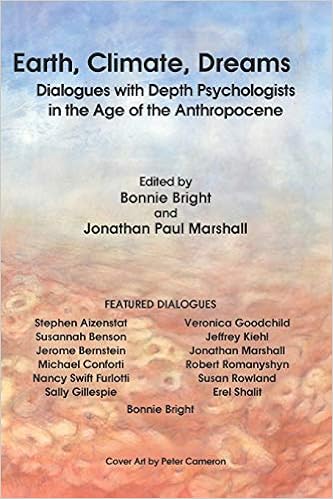
From: Amazon.auAmazon.com ; Amazon.co.uk

Bookdepository ; Wordery ; Barnes and Noble

The book, as should be obvious, reports on what 13 Depth Psychologists have to say in response to the Anthropocene. It is a collection of interviews with people like Stephen Aizenstat, Jerome Bernstein, Veronica Goodchild, Jeff Kiehl, Susan Rowland, Robert Romanyshyn, Erel Shalit, and other important people, and finishes with a multi-logue between seven of the participants.

[For descriptions of the interviews, and some critical responses, see an earlier blog post]

These people are all major contemporary figures in Depth Psychology, as some of you will know.

I’m going approach this launch in three ways. Firstly I will talk about the background question of the book, then one of my problems with the book and, thirdly, what is great about the book, and why you should buy it.

The fundamental issue

The background issue is that in the West, and most likely elsewhere, we are facing what can be called an existential crisis. That is, we are coming to recognise that our whole modes of being, living in the world and preparing for our future, is undermining our capacity to exist in the world. If we keep on living, acting and thinking as we do, we face destruction generated by those ways of living and thinking. The Anthropocene (the world-systems changing effect of humanity) marks a problem for our whole existence, and undermines our future.

The existential crisis presents a problem at all levels of our being: it is a psychological problem, it is a sociological problem, it is an economic problem, it is a technological problem, it is a cultural problem, a problem for all our relationships to everything. Once recognised, it is both hard to ignore and disorienting, to put it mildly – approaching trauma might be more accurate.

This crisis is the starting point for the book, and the necessary starting point for almost any relevant discussion about the future. The conversations are conducted with Depth Psychologists, because Depth Psychology attempts to deal with the total span of human existence, which includes all that I have just mentioned, from psychology to the world. Depth psychologists are uniquely in a position to approach these issues from a non-specialist position, and to offer tools to help people work with the problems, from their experience of group and individual therapy, from symbolic work with art, literature, and dreams, and from their sense of the intertwining of individual and collective.

My issue

Let me begin discussion of this book by talking about one of the things I find slightly problematic about it, and show why it turns out not to be that problematic, and how it generates insight, when approached with fewer assumptions.

My problem in reading this book was that, sometimes, I thought people found it much too easy to talk as if ‘spirituality’ (whatever that is) was a solution to our problems.

As I argue in the introduction, some types of spirituality might help constitute our problem, and this has to be faced. It cannot be suppressed, and I don’t think anyone in the book would want to suppress this issue.

As a culture, we in this room, have a religious or spiritual history, and in that history people have primarily been taught to see the world as a prison, a testing ground, a den of sin and iniquity. We have been taught to see our human destiny as leading us somewhere else, not this Earth. We are heading for heaven or hell or, at best, the new World after the Day of Judgement. We are not fundamentally creatures of Earth, born with the earth and tied to the Earth. In that sense, the Earth has to be fought against and dismissed for our salvation. If you actually love the world, you are being distracted from your love of God who is not ‘material’; you are loving something inferior and fallen.

This form of spirituality constitutes a problem, it could well be part of the reason it is Christendom that has led the charge into ecological destruction as an unintended consequence of its otherworldly spirituality. If so, then implying that a move from ‘materiality’ to ‘spirituality’ is a solution to the problems of the Anthropocene, is not a solution. Spirituality is part of the problem. Rather than just ‘spirituality’ itself, we need a new psychological and spiritual orientation to the world and to our actions within it.

However, if you actually listen to what people in the book are talking about, and remove the assumption that you know what they talking about, then you can begin to see what they actually mean, and the kind of psychological orientation they are pointing towards, and how this is not just a matter for our consciousness, will power, or decision.

In our society, because of our (spiritual and other) heritage, ‘natural processes’ are largely seen as disposable or replaceable or, to use Heidegger’s term ‘to hand,’ as resources for our own use and mastery of. In our dominant ideology, natural processes only exist for us to exploit. If they cannot be exploited and turned into profit, then they have no value. Natural processes are not something we should have a relationship with. You can see this attitude everywhere, with things like the Westconnex tollway, where we chop down every tree, undermine housing foundations, dispossess people, and fill the air with smog and noise, while providing a tax on travel in Sydney. Or with mining under water tables, rampant landclearing, mining in agricultural regions and so on. Natural processes are, officially, a lifeless backdrop to be pillaged for profit. They have no other value. The world is to be subdued to consciousness and will. The world is secondary to what we can make of it.

Yet this is not humanly true at any deep level. It does not resonate with real human being. Almost every human I have ever met has some kind of relationship to other natural processes, whether living forms, place, or to their own part in the system. They might only notice the connection when the creature or plant or animal has gone, but that is part of our disconnection from reality. This relationship may be to individual animals (their pets, or the dog down the street), to specific trees they feel connected to, to landscape that may seem to be part of us, and so on. Even those people busy despoiling other people’s environments and landscape, can have deep feelings for their own.

This is not really strange, because we think with, and in, this world. We use objects in the world to think with, to feel with, to learn with. We cannot live outside the world. It shapes us. We cannot escape from it. Nature and ecology is part of us, we are part of it; we are plural and connected by our existence, in a living network beyond our understanding.

When we realise this, then instead of treating nature, or other people, as resource objects, we can approach this world with reverence and awe; with a sense of mystery, recognising that we do not fully comprehend it, that it is a being that is both independent of us and impinging upon us. It is us and not us.

We can approach the world with our full ‘psyches’ and, in this, recognition of ‘complexity’ and interconnectedness, are themes which keep recurring in the interviews.

Why use the term ‘psyche?’ Because when we use other terms like ‘psychology’, ‘mind’, or ‘soul’, we already think we know what we are talking about. But we don’t. We don’t consciously know how our minds function, as they function. At least I don’t. I don’t know how my mindbody functions, how one thought gets linked to, or progresses into, another, how language works, how brain action generates mouth and arm action, how my skin heals, my stomach digests, my lungs process air, and so on. Much, probably most of the important things in life, operate outside of our limited awareness, and necessarily so.

“Psyche” plunges us back into the unknown, the entangled complex, interconnected, mess which is reality. We are inextricably if vaguely linked; my psyche does not exist without your psyche. I did not invent the language or all the ideas I use. Interaction with and talking to other people and to world culture has shaped me, and I have presumably shaped some others for better or worse.

We are both collective and individual at the same time. Even a sense of heroic individualism is collective at its base; something we share with others. Our psyches are already alive and part of natural processes. Our full psyches include the land, spill out into the land, into other people, into the processes that are everywhere.

And a realistic view of our selves needs to include all of this material, our culture has generally defined as extraneous, to help us to successfully resist the notion of natural process as a thing to turn into resources to make profit out of. In this new mode, with new practices and ways of perceiving, we can begin to move towards rejecting the system of thought that is destroying the world that we live in. This destructive system no longer makes sense. It seems psychotically limited and self-destructive. That awareness opens a psychological, cultural and activist position. The more we become aware of unconscious process, the less we seem driven by them, and the more free we become.

Let us return to an earlier point. As already implied, there are many unconscious processes. We are not aware of most of what is happening, although we may be more aware than we consciously know. That lack of conscious awareness of how our minds work, and how our physiology works, and how mind and physiology connect at this moment, implies unconscious processes. Some of these happenings I will have perceived, but not made conscious, perhaps because my thought or culture focuses my attention elsewhere, perhaps because there is so much to perceive that I cannot hold it all in my awareness. Even if I perceived it all, I can’t understand everything that is happening, and affecting us, even in this room. Most of life’s ongoing processes are essentially and inevitably outside my consciousness, and therefore unconscious to me.

However, I can become more aware of what is happening or more sensitive to it. I can attempt to perceive reality in different ways. I can turn attention to my neglected or repressed perceptions and drives. Recognising this possibility and being open to the strange and the unknown is what Depth psychology is about. It is fundamental to the process of discovery.

This is why Depth Psychologists pay attention to dreams, which are in some ways messages from the unconscious and the world; from our unconscious perceptions, pattern detections, and ways that we symbolise the unknown. Dreams often require work to understand. It is not always easy, but it can become more so the more we take these fleeting images and stories seriously and treat them as beings themselves. Paying attention to these, and other, neglected processes (fantasies, spontaneous images, scribbles, slips of the tongue, senses of unease, neglected feelings, suppressed thoughts) becomes a way of getting, or admitting, more understanding and data. It starts a new process of being in the world. If we repress our bodies and our dreams, we are likely to repress our awareness of the world. The more we attend to them, the more likely we are to be able to perceive messages in natural processes which are now hidden to us. Our tools for learning can expand outwards…

This new attention can represent a complete change in how we regard ourselves and experience our role in, and on, Earth. We can call this change spiritual if we want to. We can analyse and live our lives from that point of view. We might even be able to see this realisation as having much in common with reports we have classed as mystical.

This awareness involves experience of paradoxes, similar paradoxes to those around reported experiences of God, We are part of the world but separate from it. It is greater than us but still within us. The depths can lead to the heights. We are double sided: our goodness might be cruelty; our aspirations can be unreal or unsatisfying. Reality is ultimately unsayable, but it is pointable too through images and word, and it can be experienced, if we are open to it as it is. This is a new way of being, which can be called spiritual if you wish, or not if it makes you uncomfortable.

So even in the bits I personally have problems with, the book is still full of insights. Full of ways of proceeding. You may have problems too, but encountering this book may help you ponder them and open you. That is why this book is important.

The Good Bits

Let us now turn to the unproblematic virtues of the book. Its chapters are edited and concentrated conversations. They are generally excellent conversations. The primary interviewer Bonnie Bright is really good at her work. She participates in conversations. She contributes to the conversations as process. She draws people out. She listens carefully, and gets people to explain when needed. You could not have a much better interviewer for dealing with issues which could otherwise be quite difficult.

Reading these conversations, you will learn something about a family of understandings of how psyche works, through the dynamics of imagery, metaphor and feeling, and the effect of the unintended consequences of particular modes of consciousness which repress things you need to know about. As I have implied, if you take this seriously and start some of the practices, then you might gain a new view of the world. You might find a way out of the existential crisis, or a way to flourish in that crisis.

Depth psychology is important, because its mode of being, continually deals with problems that the conscious ego cannot understand. This is especially useful for facing the paradoxes, complexities and dilemmas of the Anthropocene.

Topics vary throughout the book, apart from the obvious topics of climate change and ecological destruction, subjects discussed range from discussions of pilgrimage, the aspirations of Dr. Frankenstein and what that tells us about modern life, the collapse of Mayan civilisation, colony collapse disorder in bees and its metaphorical connection to culture collapse in humans, the ways that politics and psyche interacts, the driving cultural complexes of capitalism, systems theory, unconscious forces, communication with the world, and the uses of dreams to gain insight into the world and relate to the world.

The book argues strongly, in various different ways that we need to engage with our full range of psychological processes, and perceptions, to deal constructively with the changes and problems we are facing. We need to understand how the systems we participate within, condition our minds when we suppress awareness of what is happening. If we stay in the psychology of mind we are conditioned to have, then psychological inertia, denial or other processes of repression or projection of problems and hostility onto others are likely to win out. Even if we manage a revolution we will probably replicate the problems we have, plus we will project our guilt onto others, and solve our problems through revenge.

This book explores possible tools to move beyond these psychological limitations and barriers.

Depth psychology can prove useful in this quest, because it tends to focus on neglected aspects of life and assumes that our individual psychology is at least partly collective, and it works through encouraging creativity, imagination, art and symbol production for their own sake, irrespective of judgement or profit..

As well as enlightening, this process of approaching reality is potentially fun and enjoyable; it can also be pretty horrible too, but everyone has the possibility of life changing realisations for themselves and for everyone else. As we are collectively facing similar problems, solutions to personal problems, or the symbols around those solutions, can turn out to be effective solutions for collective problems…. especially when we are working in and with groups. Anyone has the potential to contribute to our collective solutions. You go in and bring the solution back out. It is a cyclic process.

The book tries discuss ways of opening what may be a new way of perceiving the world, and approaching the world, and the role of human psyches within the world, and the way we all could develop.

This is, simply, vital work….. That is why I hope that this book will reach a large audience, even if they disagree with it, it could start discussions.