Posts Tagged ‘Anthropocene’

Civilisation extinction

January 2, 2019

Not original but worth reminding people….

There are a number of technological and lifestyle challenges we might assume were universal and culture destroying, that in our experience come right after each other.

1) Nuclear extermination.

2) Pollution and over-consumption lead to massive eco-system crisis.

3) Nanotech wars.

4) Biowar, or escaped engineered bio-constructs with harmful plague effects. Ease, and mass of travel, spreads deadly disease.

5) Putting decisions in the hands of AI or models and not noticing the problems that arise until too late. Independent AI warfare is a possibility. An AI could conclude human population was a major problem, and aim to eliminate that problem.

6) Climate engineering goes wrong, massive droughts, cyclones etc.

7) Physics experiment that could generate a small black hole, that grows.

8) Doctrinally fueled extermination.

9) Fake news epidemics so no one knows what is going on.

10) Ignore impending large asteroid collisions, because of politics, or role back of astronomical research. Maybe a space flight knocks an asteroid out of orbit.

I’m sure people can think of other things, and then there are the dangers we can’t even dream of yet

So one possible reason why we have not detected alien civilisations is that they all may hit a zone of possible self destruction and don’t go through it successfully. Will we be different…?

CO2 and non-linear systems

December 19, 2018

The amount of CO2 in the air has dramatic effects out of all proportion to the amount of the gas in the air or in proportion to the amount emitted by humans. It produces a non-linear effect.

Concentrations of CO2 have been much greater than they are now, in times when there were no humans around. Nobody is arguing that the world would end with much higher CO2 levels, just that relative climate stability would end, as the climate system shifts into new patterns, and human civilization would be extremely likely to suffer significant disruption and possibly destruction depending on how bad it gets.

As far as we can tell for the last half million years or so CO2 levels have remained between 180 and 300 parts per million (again, that’s pretty low compared to some other geological periods). In the last 100 years or so, this has risen to about to 410 parts per million (people were hoping the rise would stop at 350 parts per million, but it hasn’t).

There is no indication that this increase in CO2 concentration is slowing. That is a pretty rapid and significant change and most of it seems to have come from human emissions. The theory of greenhouse gases which has been around for well over 100 years would lead us to expect a rise in global average temperatures as a result, and this is happening – and it is happening pretty much as predicted (although a bit higher and more rapid than some official predictions).

Again it needs to be said that the average temperature rises are relatively small, but these small rises appear to be disrupting climate stability already. What seems small to us can have large effects on the system as a whole.

Now natural emissions of CO2 are huge – figures usually suggest around 800 giga tonnes per year. Natural ‘carbon sinks’ and conversion processes handle these emissions quite well. Human emissions are much, much, less than that, even now about 30 giga tonnes per year but increasing.

You might think its a matter of common sense that this little overshoot would not make that much of a difference, but we are not dealing with a simple linear system here. Small changes (in CO2 levels and temperature) can make large differences, due to the way feedback loops work and trigger, or disrupt, other systems.

For some while these emissions made little difference because natural carbon sinks could deal with the extra burdens – these sinks produced the well known pause in the rate of increase of average temperature (not a decrease in temperature or even a stabilizing of temperature, but a decrease in acceleration of temperature increase). These now seem to have been used up. The more we destroy the ecology and engage in deforestation etc. then the worse the accumulation gets and the higher the temperature increases. The rapidity of the change together with environmental destruction renders natural evolutionary or adaptational processes irrelevant – natural sinks do not appear to be able to handle the increase any more.

The more that the average temperature increases, the more that some natural sinks will start releasing CO2, methane and other greenhouse gases. For example the Russian Steppes might already be releasing previously frozen methane for more green house emissions.

This makes the situation even worse; it compounds the problems and shifts them into a whole other realm. We have to stop temperature increases now, if we don’t want extreme weather events to become more and more common, and remediation to become more difficult than it already is. Also as you probably know, land ice is melting and glaciers are disappearing and this will also likely lead to temperature increases and to rising sea levels. Neither of which is good for coastal cities or for human water supplies.

So if we continue with our current patterns of CO2 emissions we are heading for likely catastrophe – we are certainly not heading for good times.

This whole process is difficult to predict in its entirety, because of the way local conditions act with global conditions. For example, higher average temperatures could disrupt the patterns of the Gulf Stream which has kept the UK relatively warm. If the Gulf stream moves southward, then parts of Europe could heat up while the UK’s average temperature lowers. Whatever, happens the weather will change and probably change violently. If we do not stabilize CO2 emissions then the system fluctuations will get wilder, as it is subject to greater stress.

We need to stop CO2 emissions as quickly as possible, and start protecting the rest of the environment to allow its resilience to function. So we have to stop massive deforestation and other forms of pollution as well as stop CO2 emissions.

Human CO2 emissions largely come from burning fossil fuels, some forms of agriculture, and with some from building (concrete use). For some reason official figures for fossil fuel emissions often split the burning into electricity production, transport, industry, domestic and so on, but they all have the same cause.

We can pretty much end coal fired power for electricity now if we put money into it and impose regulations bringing coal burning to an end. We are helped in this as building new coal fired power stations is becoming more expensive than renewables, even with all the subsidies that fossil fuel mining and power receives. Ending coal burning won’t necessarily be pretty, but it can be done. Coal is poisonous during the mining and during the burning, and devastates fertile land during mining, so its a good thing on the whole. Petrol/oil burning may be a bit more difficult. We need an excess of renewable power and storage to allow transport to work like it does now. Possibly generating hydrogen from water is one way around that, but we need heaps of excess renewables to do that and that may then come up against material limits. Changing agriculture will be more difficult still, but people are claiming low emissions concrete is becoming available (I’m not sure).

However, there is a problem, even if we could stop tomorrow. The natural carbon sinks are over-stretched and unlikely to recover quickly. They will not remove the “excess” CO2 from the atmosphere quickly enough to prevent already dangerous average temperature increases. We may need to research Carbon dioxide removal techniques as well. These are being developed, but more money for research is needed, and we need to find some way to dispose of the extracted CO2, so it is not returned to the atmosphere in a couple of years. This is a massive technical problem, which is not really close to being solved (that is a matter of argument, but that is my opinion). Hopefully the problem can be solved.

We need to cut back emissions quickly. We will then almost certainly need to develop an extraction technology. If we can’t do either of these, then we face truly massive disruption: more extreme weather, flooding, city destruction, people movements, food shortages, and warfare.
Random remarks on climate and politics

November 4, 2018

There are at least two ways of looking at the planet: one as isolated being, and one as relational being in which the planet exists in the cosmos, in relation to the sun, the solar system, vast emptiness and so on.

With the first view you can imagine manipulating and dominating the planet, because that is all there is. With the second the planet is what keeps you alive in the vast emptiness of space; without it we cannot survive, it is something that needs tending and repairing as best we can. It is our vehicle of life. There is no practical alternative, we cannot all move to Mars.

You cannot do politics the way we normally do politics with the planet because it does not negotiate – it just acts. In particular it has no truck with authoritarian politics, where people tell others what will happen and there is no negotiation or little interest in the way things work, because an ideology is more important than checking if that ideology works. I suspect the less well the ideology works, the stronger this tendency can be when bonded to group loyalty.

One problem with Republicans is not that there are not Republicans who don’t admit climate change, but it seems far more necessary for them to abuse Democrats than to discuss practical solutions. This is probably because they need to demonstrate that they are really Republicans to other Republicans. If we were of a particular brand of irony, we would call this virtue signalling.

Being virtuous in the face of destruction is not particularly useful, especially when that virtue favours destruction, but at least you know you are not betraying your identity group.

However, while it may not be possible to tell the planet anything, we can try to listen to the planet, paying attention to what is happening, and attempting to perceive what the results of our actions are with the planet. This is almost the exact opposite of geoengineering… Listening to the planet and using basic logic, we cannot keep dumping waste which cannot be absorbed and reprocessed by the system – and this involves changing our economic and manufacturing processes to change the waste we produce.

Stratospheric Aerosol Injection

August 15, 2018

Stratospheric Aerosol Injection is a form of Geoengineering, which is being considered because the climate situation is getting desperate, with extremely high temperatures in the Antarctic, and massive bush fires around the world.

It involves injecting particles into the upper atmosphere. There are problems with using this technique to modify climate – some technical and some political and some both. This post describes some of them. It incorporates parts of an earlier post on this site.

1) We have to rely on models for our predictions and understanding of weather, climate and ecology, and models can be wrong.

2) The system we would be trying to modify is complex and not predictable in specific. So we do not know the exact results of putting the particles into the stratosphere – we would have to find out through doing.

3) The chances are high that some areas would suffer significant weather changes after the particles reached the stratosphere and these changes would not be uniform. The effects usually discussed are changes in rainfall. For example protecting Europe could lead to major drought in north Africa.

4) Geoengineering is based in social systems which are also complex systems, and GE could disrupt those systems and their balances.

5) For example, unintended bad weather effects could lead to massive people movements, which as we know can be considered potential ‘take overs’ and increase social stresses and tensions….

6) This together with unpredictability, might lead to accusations of weather warfare, whether it was or not, and this might then spill over into more orthodox forms of warfare.

7) GE is cheap in some sense, in that it might only cost billions a year to implement. While this suggests rogue corporations or states could begin GE, it also suggests that there could be fights over funding. Would those who contributed the most want the best results for their countries as opposed to others?

8) GE requires some form of international governance to avoid arguments, which has been shown to be hard to establish even with simpler objectives

9) I have not seen any viable self-supporting GE proposals. Nearly all of them require massive tax-payer subsidies, and some appear to need massive cross-national governance and regulation. We could give massive subsidies to private enterprise and hope they do they job without any oversight, but I doubt that will appeal even to the pro-corporate-power lobby. There is no apparent profit in Geoengineering, other than the potential to threaten people with bad weather. So it is unlikely that corporations would persist with it.

10) GE once begun must be continued, but warfare, or economic collapse could lead to rapid discontinuation, and hence extremely rapid climate change, which might further reduce biodiversity, as the change would be so rapid. Decline in biodiversity = decline in ecological stability.

11) It is extremely likely that once GE was implemented, people in power would breathe a sigh of relief and say “oh we don’t have to stop burning fossil fuels anymore”, so the situation gets worse, but they stay in power.

12) The rational solution to climate change is to lower emissions – we have known this since the 1980s at least. We have the technology to do this now, and it largely seems to work. That we don’t do this, shows we have a destructive set of social organisations and rivalries, and GE will be implemented within this destructive organisation and probably further destruction.

13) The assumption of GE is that it is easier to modify the complete climate and bio ecologies of the planet without serious unintended effects, than it is to lower emissions. This, in practice seems unlikely.

14) GE does not stop or ameliorate the results of high levels of CO2, thus ocean acidification and ocean death would continue – which would be calamitous.

15) The particles which people usually suggest we use are sulphites, these have the potential to further damage the ozone layer. There are plenty of other ecologically destructive actions GE does not ameliorate or stop.

16) People who support GE tend to be those who deny we should do anything about climate change, consequently the likelihood of point the points about continuing destruction, rather than lessening it, increases.

Short summary: Stratospheric Aerosol Injection is a largely uncontrollable, unpredictable process embedded in destructive social organisations, that will delay any chances of fixing climate change. Fixing climate change requires changing our social organisation and reducing emissions.

Skepticism and Evident climate change

July 30, 2018

I guess everyone interested in climate change will have encountered people who state three things. One; that climate change is not evident, Two; that climate change has happened in the past and is part of the natural cycles, and Three; that we cannot predict exactly what will happen…

Changes that happen slowly are rarely evident to bare human sensory apparatus. We acclimatize, and declare it has always been this way – despite the record of above average temperatures we have been registering (and of course averages are undermined by people’s experience of variations, and by their desires to keep seeing normality and experience tranquility) People who move from cold countries to hot countries may soon feel that temperatures which would have once been ‘hot’ feel ‘cold’. Unaided senses may not always be accurate enough to detect climate change, that does not mean it is not happening. When we can detect climate change with unaided senses it will probably be too late.

After saying that Climate change is not evident, then people may point to previous incidents of climate change and imply it is relatively harmless, or that we cannot do anything about it, and it has nothing to do with us. While I think the idea that climate change has happened in the past is probably correct, the rest may not be.

I particularly have no idea how the concept that “the planet has been going through heating and cooling waves for millions of years” can be considered ‘evident’ in itself – especially if contemporary climate change is not evident. The concept of previous climate change is based on a whole lot of theory, interpretation and data gathering.

Most of that theory is part of the web of theory which also suggests that the current climate change (even if natural) will be rapid (in geological terms) and devastating for ecologies and human civilization.

Current climate change is also compounded with widespread ecological devastation from human sources (deforestation, over-fishing, chemical pollution, depletion of phosphorus etc.), all of which are likely to make the change even more violent and which were not present in previous ‘natural’ periods of change.

The further assertions that because the planet has had changes of climate many times before we should not be worried about it this time, do not seem evident at all to me. Especially as rapid climate change in the past does seem to have been harmful for species.

The third point about uncertainty of what will happen is true; the future is always uncertain. However, because the future is uncertain does not give us the right to assume that the least unpleasant events are the most likely. That is actually a refusal to accept uncertainty.

So what is evident? To me it is evident that we depend on ecologies, and creatures depend on each other (I do not live alone in a vacuum) – this is also backed up by many studies, which give what I would call evidence. Other people may deny this for whatever reasons. But if you accept that some kind of mutual dependence is evident, then continually messing up, destroying and injecting waste into these ecologies is evidently harmful to us all, and likely to result in catastrophic change past a certain point. So its probably best to stop doing it, and try something else. Harm may also result from these remedial actions, but that harm is not evident – it is supposition.

Is it evident that a bullet through the chest will kill me? No, not until it happens – and if it is evident, then there will probably be no me for it to be evident to. There is a level at which it may be best to work with some supposition.

Can we reform capitalism

June 14, 2018

This is another website’s summary of the arguments of Yorrick Blumenfeld, slightly modified. URL below.

Summary: Capitalism cannot be reformed, because its nature is destructive.

Capitalism erodes and corrupts democracy: Capitalism is fundamentally antidemocratic. Money controls Parliaments and politicians, not the other way around. Corporate money tends to buy the ability to write and engineer favourable legislation, as parties need money to campaign, and corporate sponsored think tanks decide the environment of thought. The highest bidder – which is usually a group of corporations – buys the government.

Drive to the Bottom: Capitalism pits small countries, states, and counties against each other, seeking special tax breaks and subsidies in highly wasteful “corporate welfare” programs. Capitalism seeks the lowest level of conditions for the people: cheap labour, cheap resources, cheap dumping of waste and cheap regulations.

Capitalism drives off accountability: The political strucutre of corporations shields upper level managers from accountability, while shareholders are protected from personal liability for damage done by the corporation in making the profit they share. Multinationals are not responsible to any electorate, or to governments that respect them. Corporations can always be elsewhere, when they are challenged – just as they take their profits away from where they are earned.

Capitalism’s values are insufficient: Capitalism doesn’t foster many things we value such as: ethics; controlling child labour; strict health and safety standards; reducing hours of labour; providing security for workers; preserving nature; or guaranteeing holidays and weekly breaks from labour. The market economy has failed to focus on durability and ecologically sustainable products and services, and it cannot because these count as costs, not profits. The only spiritual values capitalism can recognise are those that see money as a sign of God’s favour, demand obedience from workers, or generate sales.

It fails to serve the poor: This model underserves over three billion people. Two hundred plus years of capitalism have not brought about global prosperity or environmental balance. It has brought massive prosperity for the very wealthy. Most of the world’s current wealth is controlled by an extremely small number of people – which gives them even more power to govern in their interests alone.

Capitalism has a stability and debt accumulation problem: The supply of money is dependent on people and firms relying on loans and perpetually increasing their debt. Issuing interest requires endless economic growth to pay back the debt, which is neither in the national nor in the global interest. This inflated speculative debt drives the never-ending economic crises and bubble bursts. Without debt current capitalism would collapse. Most of the world’s monetary transactions are purely speculative: wealth is being burnt.

Corporations are subsidized and unaccountable: Capitalist companies are often heavily subsidized (including subsidized by the global ecology by making pollution and destruction an ‘externality’). They also avoid giving back to the community. For instance, corporations avoid taxes that support infrastructure fundamental to their expansion. They use shell companies, tax havens, and modern electronic transfers to shuffle capital around and evade responsibility and to avoid contributing to the life conditions they need. They are parasitic on healthy societies, which they help run down

Globalized capitalism creates local vulnerability: Globalized export-oriented high-tech capitalism undercuts national and regional self-reliance in key commodities. Heavy dependence on global supply lines for items such as food and energy creates a fragile and dangerous situation. Countries may not be able to feed themselves in the near future. Just like workers cannot be self-sufficient without jobs in capitalist organisations. Capitalism creates low resilience to crisis.

Capitalism undercuts diversity and threatens groups: It favours cultural homogenization as well as the homogenization of goods and services to advance market control and to increase profit through uniformity of production. By pushing consumerism and materialism and crushing all other value and survival systems, some would argue that capitalism inspires terrorism. At the least, undermining local conditions creates nationalisms, and fundamentalisms in response.

Capitalism ignores and destroys nature’s life support systems: Capitalism denies that the biosphere has any limits. By failing to internalize the costs of environmental pollution, and purposefully misleading people about the effects of pollution to further their profit, corporations drive a process that radically reduces planetary carrying capacity. Endless expansion of growth and destruction of resources and ecologies is destined to cause overshoot and collapse. Fisheries are over fished, land is over grazed, chemicals are pumped into the environment with little restraint or knowledge of effects, other minerals are extracted from the environment destructively with little attempt at rehabilitation. More waste clogs the land air and sea. The ‘invisible hand’ of corporate power has been destructive. Capitalism will almost certainly drive global suicide.

http://www.fdnearth.org/essays/capitalism-cant-be-reformed-try-the-incentive-economy/

Other points

Capitalism destroys commons: Capitalism produces the tragedy of the commons, in which common property is consumed and destroyed by profit seeking, because the only property that can be recognised is alienable private property. Capitalism enforces the idea that people should not cooperate to restrain the business of others when it impacts on them. Common-land is simply land to be exploited, and to be destroyed or polluted in order to cheapen the cost of production, as is the air and water. All cheap or free things tend to be undervalued, unless they can be monopolised. Capitalist theorists say they can solve all our problems by turning everything, including you, into private property. Then somebody will care. But capitalist property rights also include the right to destroy ‘your’ own property. If someone owns the air, then they can pollute it without challenge. However, if no one owns the air then everyone, especially the powerful, can pollute without challenge as well. Common property is of no value, yet it is the basis of all value.

Capitalism owns the law: for the same reason it owns politics. It buys the lawmakers, and exemptions from the law, so that law favours it’s actions. Similarly because law itself is a process involving lawyers, it can buy the best lawyers and exploit the incoherencies of law, and stretch out cases for such a long time that ordinary people are rendered bankrupt, and cannot afford to challenge the wealthy – even if the wealthy do break the law. The more the law can be bought the more wealth dominates.

Capitalism treats workers as a cost and considers them disposable: The aim of any capitalist enterprise is to deliver a profit and high salaries to those who run the organisation. It may also aim to return profit to shareholders. Workers are a cost. They diminish profit. Hence the amounts spent on them must be cut, and the conditions of work should be as cheap as possible. Thus the natural tendency of untouched capitalism is to reduce wages, extract more work from workers, and lower conditions of work.

Thinking on the spot: Algorithms and Environment

June 1, 2018

I may, or may not, be asked to participate in a radio show/podcast about algorithms and the environment….

This is my initial spur of the moment thinking…

I’d start by talking about the difficulties of getting algorithms for a complex system. The whole point of complex systems is that they are unpredictable in specific, while possibly being predictable in terms of trends. For example, we cannot predict the weather absolutely accurately for a specific place in 3 months, but we can predict that average temperatures will continue to rise. Initial conditions are important to outcomes in complex systems, but there are always prior conditions (ie there is a way in which initial conditions do not exist), and because so much is happening and linking to each other, there are always problems determining what is important to the model, and what the consequences of an action were. Another problem with complexity (as far as I understand it) is that it can only be modelled to a limited extent by any system which is not the system itself.

Then the model tends to be taken for reality, so we act as if we knew something and are working directly on that system, rather than working on a model which may increasingly diverge from reality with the passing of time….

Then there is the issue of power relations. We know that one simple way of proceeding with Climate change, is to phase out coal and other fossil fuels and increase the use of renewable energies. However, we can’t even do this transition at the speed we need to because of established power relations and habit (power is often the ability to trigger established pathways of behaviour) – and we cannot guarantee there will be no unexpected side effects even if we could. For example, we may not succeed in replicating something like our current social life with renewables or we construct them in such a way that it harms the environment.

We also seem to need to absorb greenhouse gases as well as cut back on emissions, but absorption can be used to delay reduction (again through power relations), and there is, as yet, no yet established way of dealing with the GHG that have been removed which is safe or long term. Algorithms cannot successfully model the effects of things we don’t know how to do…

On top of that there is the potential power consumption of the algorithms – while hopefully this will not be too bad there is some evidence that bitcoin (which is a complex algorithm of a kind) could end up being the most energy hungry thing on the planet…. In which case our efforts to save ourselves could intensify the crisis.

Now, to be clear, I’m not saying that computational algorithms are never of use, but that they tend to be used without testing because they depend on fictional stories which have a high level of conviction, and are treated as if they are the reality we are working with and not as models of that reality. If the model / algorithm tends to advantage some group more than others, and the appliers belong to people loyal to that group, then it will probably be harder to curb if incorrect, and be more likely to be taken for correct. The same is probably true if the model reinforces some precious group belief. The point of this is that models tend to become political, (consciously or unconsciously) because the axioms seem like common sense.

According to some theories humans tend to confuse the ‘map’ for the ‘terrain’ (to use the General Semantics slogan) almost all the time unless its visibly and hopelessly not serving them and there is an easy alternative. If so, that could be one reason why science is so difficult and so relatively rare, and so easy to ‘corrupt’ when it becomes corporate science.

If we are going to model what we do in the world then we absolutely need something like computer modelling, but we also need to emphasise that these models are unlikely to ever be totally accurate, always are going to require modification and change, will get caught in politics and could always be wrong.

If we don’t do this then the aids to helping us model what we are doing and need to do, could well make things worse.

The difficulty of thinking Ecologically

May 17, 2018

Last night I attended a panel run by the International Panel on Social Progress, effectively launching their soon to be released three volume report called “Rethinking Society for the 21st Century” This report involves 269 different authors from all over the world and aims to change the game in thinking about society.

There were 6-7 authors launching it. Not one of them mentioned ecology. Not one.

When I made a query about this, they said the report was big, and well there may have been something about it somewhere. Someone said they had mentioned the sustainable development goals. (These have very little to do with ecology, and ecology is not sustainable – it changes, its called ‘evolution’).

The point is not that ‘environment’ should be tacked onto social and economic thought as an extra, which it can, it is fundamental to social existence, and thinking ecologically in terms of interrelationships, complexity, surprise, conflicting systems, and the importance of the planet, etc. is something which cannot be marginal to any future politics and social thinking. If it is marginal, then we simply reproduce the kinds of mess that we are in nowadays….

That this international multi-authored ‘report’ (and it was emphasised that authors had the capacity to make input everywhere, and had to sign off on the whole thing) seems to have ignored this completely, or made it marginal, shows the problems we face in generating constructive change…

Donut Economics

May 17, 2018

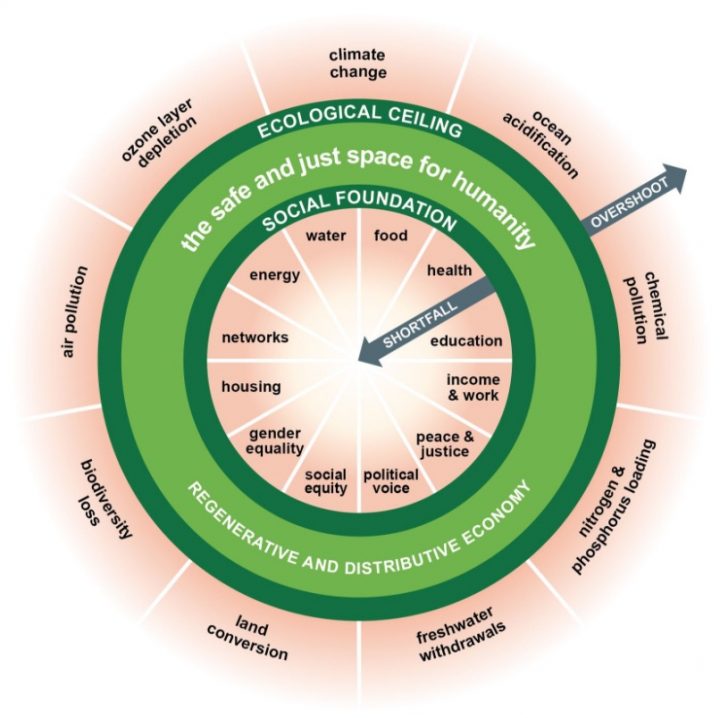
Kate Raworth’s ‘donut’ presents a relatively new way of looking at the economy, which has attained some fame. See the picture below.

the donut

As you approach the hole in the middle, you have an economy which does not satisfy people’s needs such as water, food, housing, relative equity, liberty, education and so on.

As you approach the edge of the image you begin to destroy the ecologies of the planet that the economy depends upon, producing events such as biodiversity loss, climate change, disruption of nitrogen and phosphorus cycles, destruction of fertile land, and so on.

Whereas without such a diagram, the capitalist economy is perceived as a matter of self-contained markets isolated from ecology, she argues that the aim of economics should be to satisfy people’s needs without destroying that planetary ecology.

Normal economic theory, can argue that inequality decreases as growth increases, and that growth cleans up economies, because the economic model looks at the world in isolated ways. Some economies appear to clean up ecologies, but they do so at the expense of other ecologies, and businesses are always happy to lower the costs of pollution and increase profit when offered an opportunity.

People may object that it is impossible to meet the needs of everyone – especially while respecting the planetary boundaries, but at least in this model it appears as something which can be discussed as a major concern. Just as we can ask “What is the economy for? What is it about?” and get a reasonably useful answer.

The old economics had an extremely confining view of human nature, it was humanity stripped of everything but the profit motive. This was a decision originally taken to distinguish economics from other fields such as history or philosophy, and to make things simpler, but it became the model of humanity. Under it we are *just* individual profit seekers. We only cooperate in order to make personal profit, we naturally destroy for profit, we have fixed preferences which we neutrally evaluate, and we have no purpose, happiness or virtue other than wealth seeking.

This view is simply not true, or adequate. Humans co-operate as naturally as they compete. We are social as much as individual, we do not naturally only value money and we do not destroy what we share. We are creatures with many purposes and many aims. Wealth is usually only important to the extent it brings about those other purposes and we are not made happy by consumption.
Raworth’s model, to me, is reasonably obvious and elegant and allows humans to be complex. It is not reductive.

It does have a few problems.

1) It does not explicitly recognise that the current economy is a mode of power, situated within frameworks of power relations, and that historical evidence appears to show that those who benefit from this mode of power will do almost anything to preserve it – including wreck the earth.

Nearly all forms of organisation are nowadays reduced to economic/capitalistic organisations. Media and information is controlled by capitalists, the law is controlled by capitalists, the State is controlled by capitalists, education is controlled by capitalists, and so on. Paying attention to the “bottom line” (measured in terms of money) is a mantra that both permeates society, and ignores reality.

It will be hard to move against inertia and the active power dedicated to preserving existing hierarchy. The model does not easily provide for the distortions that power puts into economics – any more than standard economics does. But as standard economics aims to preserve that power it is not a handicap for it, but a strength, as its users can pretend that inequality of outcome is always proportional to inequality of talent.

2) More importantly, the model does not provide a set of simple positive instructions for politicians. It does not give them an easy and painless set of action slogans and programs, whereas conventional economics does.

Conventional economics says: business is always good and always delivers, you must increase growth, nature is limitless or unimportant, commons don’t work so sell them off to business, government is inefficient so hand it over to business, rich people are talented so give them more support and protection (and pick up the rewards), reduce taxes, stop government services, increase charges, abandon poor people as they are without virtue, and individual wealth and its owners should be worshiped.

Donut economics, just says don’t destroy the world, and let everyone participate. Neither is easy under the current power relations, and these actions do not reward players in the State. The model grinds to a halt.

It needs simple and positive directives.

So time to think what those might be….

Minorities rule….

April 12, 2018

The interesting thing about Australian Coalition Government’s policy which has been revealed by the so called “Monash group” (which is pro-coal), is that policy appears to be dictated by the fear of not offending five non-cabinet MPs.

This means our climate and energy policies, in a lower house of 150 people, is being decided by less than 10% of the members (I’m adding extra people to their cause out of generosity). This is not remotely democracy in action – this is rule by the miniscule; the fleas controlling the dog.

How does it come about? Firstly because those 5 people have the support of the Murdoch Empire and the Minerals Council of Australia, which have helped make resistance to the idea of climate change, a hallmark and definer of conservative politics. Indeed they supress discussion of climate change to make everything about an ‘economics’ that is concerned with the profit of established corporations. Mass protests against climate change just don’t get reported, while tiny protests against the left do. Even those radical conservatives like One Nation who think international corporations are destroying local customs and culture, and need to be checked, support fossil fuel companies who are as international and destructive as they come. Any right winger who breaks on this issue will be misinterpreted, seen as a traitor, seen as losing nerve, and punished. Any right winger with principles, fears they will lose selection.

This is polarized information group dynamics in action, and stopping discussion. These groups can be created for this purpose, and are reinforcing it. The 5 people become exemplary examples of a right wing ‘us’ group – while possibly moderate people like the Prime Minister Malcolm Turnbull become outsiders, who have to continually demonstrate their group loyalty, by not steering too far away from the extreme, and by refusing to challenge that extreme. In this situation the so called ‘centre’ suffers – even when the official ‘left’ move further rightwards to capture its shifting point, and even if ‘the people’ show their commitment to renewables by plopping them on every available rooftop.

The dedication of the far right is reinforced because they stick with the Murdoch Empire and do not see contrary evidence, or have it explained away for them well enough. They are hung up on being just and fair (so if anyone is doing less to mitigate climate change than them, they can always argue it is just for them to support even less action) and they suffer the Dunning Kruger effect, were they do not realise their ignorance in the field and subsequently cannot recognize competence in the field – and they reinforce their ignorance out of group loyalty and the sense of persecution which comes from being wrong.

And so it goes. It could be combatted by strong leadership which stood up for principles and argued against them for the good of the country. But we are probably not going to get that. All we can hope for is that the people themselves get on with the business of lowering carbon emissions, reducing their pollution, getting their workplaces to reduce emissions, protesting against government sell outs to corporations and doing anything else they can no matter how small. While voting Labor and Green is useful, it will not be enough either, because they continually move to the right, to keep on side with the powers that be.

It is up to us to do we what we need to do to survive, and to take government back should we want.