Posts Tagged ‘carbon capture’

Drax and woodchip energy

November 8, 2022

This is basically a paraphrase of an article in the New Yorker with a few additions. The Millions of Tons of Carbon Emissions That Don’t Officially Exist: How a blind spot in the Kyoto Protocol helped create the biomass industry. By Sarah Miller December 8, 2021, because its really important and even by my standards is a bit long – although naturally this version grew as it went along. But please read the original.

Drax 1

The article is primarily about the wood chip powered energy production in the village of Drax, in Yorkshire, by the Drax Group. The huge Drax power station used to be a coal fired energy generator, but is, or has, now translated to “sustainably sourced biomass,” or wood pellets, so as to enable “a zero carbon, lower cost energy future (p.4).” It also:

can be at the heart of the green economic recovery in the North. Scaling up BECCS at Drax could support thousands of jobs during construction at its peak and contribute significantly to the local economy, according to a report from Vivid Economics, commissioned by Drax.

Drax: 3

BECCS is Bioenergy with carbon capture and storage. We also learn from the Drax Report that:

In the US, EU and in the UK, policy makers have continued to regulate biomass in the context of global and domestic efforts to meet net zero. In the EU, the European Commission’s Green New Deal proposed a new biodiversity strategy and re-opening key legislation such as the REDII and EU ETS. In the UK, the Government announced it would begin work on a new bioenergy strategy – to be published in 2022. In the US, the EPA has been actively considering the carbon credentials of biomass.

Drax

So Drax supposedly has all the benefits of low emissions, contributing to the economy and jobs, and being backed by officials.

Ok back to the article

In 2019 Drax “emitted more than fifteen million tons of CO2, which is roughly equivalent to the greenhouse-gas emissions produced by three million typical passenger vehicles in one year” (Miller). Of these emissions 12.8 million tons were “biologically sequestered carbon.” We might need to bear the ‘sequestered,’ or stored, in mind, as like the BECCS it may not be happening. Emissions increased the next year.

Draz receives heavy subsidies from the UK government….

The thinktank Ember calculates that, from 2012 until 2027, when Drax’s ROC subsidies end, it will have collected more than £11bn in government payouts.

Lawson Energy bills may rise if government gives Drax more support, say MPs. The Guardian 20 September 2022

It was possible during the energy crisis of 2022, that the British Government could get locked into another agreement, to keep power prices down, that would subsidise Drax for even longer.

Drax said in July that profit before tax had jumped to £200m in the first half of the year, up from £52m in the same period a year earlier, aided by high electricity prices. It upgraded annual profit forecasts, and has signed a deal with National Grid to keep its coal-fired operations open through the winter.

In the past 12 months, its stock has risen 63% to 709p, valuing the company at £2.84bn

Lawson…Emphasis added.

Some History of Biofuels – Origins in bad accounting?

The issue here has its beginnings quite a while back when the Kyoto Protocol was being negotiated in 1997. The conference did not quite know how to classify wood burning. Burning wood is renewable up to a point. If you burn it, it eventually, grows back. For some reason the IPCC decided that “if they counted emissions from harvesting trees in the land sector, it would be duplicative to count emissions from the burning of pellets in the energy sector” (Miller),

William Moomaw of Tufts University, says that negotiators thought of biomass as only a minor part of energy production. It was small-scale enough that forest regrowth could theoretically keep up with tree harvesting of . He said “At the time these guidelines were drawn up, the I.P.C.C. did not imagine a situation where millions of tons of wood would be shipped four thousand miles away to be burned in another country,” (Miller). Officially loss of biomass did not count. Beverly Law of Oregon State University told Miller, “The wood biomass energy claims of carbon neutrality are incorrect and misleading… It can worsen climate change even if wood displaces coal.”

In 2009 the EU passed the Renewable Energy Directive to enforce the guidelines set up in Kyoto, asking nations to reduce emissions by 20% or more by 2020. Many European States decided that the cheapest and easiest way to go was to switch coal plants to woodchip plants.

Scot Quaranda of Dogwood Alliance, and activist forest-protection group says “Countries had to meet their renewable-energy targets,… There was no way to do it without gaming the system and counting biomass as carbon neutral.” If so then an error in the mode of accounting has had considerable effect.

In 2017, the E.U. spent six and a half billion euros on subsidies for biomass plants. Last year, Drax got about $1.1 billion from the British government. “The governments can claim they are compliant, while former coal companies that would have been dead get rich on government subsidies and selling electricity—much of which, with proper planning, could have come from wind and solar,” Quaranda said. “The forests are destroyed, and the world burns.”

By 2019, biomass accounted for about fifty-nine per cent of all renewable-energy use in the E.U.

Miller

Another journalist writes:

Europe gets 60 percent of its renewable energy from biomass fuels, a process that uses wood scraps, organic waste and other crops to generate heat and electricity in specially designed power plants. U.N. rules allow the European Union to write off the emissions as carbon-neutral, so long as sustainable guidelines are met, even though burning the fuel can release more warming gases into the atmosphere than coal….

[As a result] Many countries are significantly underreporting their emissions to the United Nations, leading to a massive undercount of what is actually released into the atmosphere

Birnbaum E.U.’s big climate ambitions have the scent of wood smoke The Washington Post. 10 Nov 2021

At the Glasgow COP there was little conversation about the problems of biomass, and Frans Timmermans, the European Commission’s executive vice president for the European Green Deal said:

To be perfectly blunt with you, biomass will have to be part of our energy mix if we want to remove our dependency on fossil fuels….. I do admit that it’s quite complicated to get this right…. [Europe would] try to use the biomass that is not at odds with our environmental and climate objectives.

Birnbaum emphasis added

The Dogwood Alliance estimate that at least sixty thousand acres of trees—trees that would have otherwise sequestered carbon—are burned each year to supply the plants, and the amount is growing. Global demand for wood pellets is expected to double by 2027.

What is more, there is apparently no “binding governmental or industrial oversight for replanting trees at all”, which if true means that forests can be cleared for other purposes, the regrowth does not happen, and everything is ok by the regulations.

Problems with biofuel

When President Trump’s EPA administrator Scott Pruitt said that the E.P.A. would declare the burning of wood from managed forests for energy production to be “carbon neutral” several scientists wrote to him saying:

Mr. Pruitt’s declaration contradicts some basic facts. Burning wood from forests to generate electricity is not carbon neutral when the direct emissions from combustion, plus emissions from soil and logging <transport> and processing the wood, are considered. Scientific studies have shown that it will worsen the consequences of climate change for decades or through the end of this century. This was not a decision based in science, but in politics, a giveaway to the forest products industry. 

Pruitt Is Wrong on Burning Forests for Energy

They pointed to scientists in Europe who had written to the EU:

Even if forests are allowed to regrow,… using wood deliberately harvested for burning will increase carbon in the atmosphere and warming for decades to centuries…. even when wood replaces coal, oil or natural gas.

Pruitt is Wrong

And then resumed, pointing to the time and delay factor which usually seems to be ignored:

regrowth takes time, a century or more for native forests, assuming they don’t fall victim to wildfire or disease. And regrowth never occurs if the land is developed or converted to pasture or farmland.

Moreover, throughout the many decades before the replacement forests can grow enough to remove the extra carbon dioxide from the atmosphere, the previously added gas will thaw more permafrost and melt more ice, make ocean acidification worse, accelerate global warming, speed sea-level rise, increase the incidence of extreme weather, worsen drought and water stress, and hurt crop yields — effects that will persist for centuries or longer.

Pruitt is wrong

Biomass harvesting can have other ecological effects, such as increasing water run off, furthering floods and silting up rivers. They conclude that through the use of woodchips

British taxpayers there are paying electricity providers to make climate change worse.

Pruitt is wrong

Drax: Selling the project and CCS

Back to Drax. Miller gives an account of a tour of the establishment. The tour guides made a big deal of wood being natural, and the wood coming primarily from timber waste products (such as sawdust) in the USA and Canada. Given the quantities of wood involved (one mill requires fifty-seven thousand acres per year) this seems implausible, especially when many of the wood mills are owned by Drax. “Some of this activity is in primary-growth forests—forests that have never before been logged” (Miller). And photographic evidence suggests forests have been removed.

Apparently “under international definitions, if a government or private entity cuts down a forest but doesn’t develop the land, it has not officially engaged in deforestation” (Miller). The rules seem confusing and not particularly adapted to reducing emissions.

Ali Lewis, the head of media and public relations for Drax, disputed the idea of gaming the system. “How can we be ‘gaming the system’ when the carbon accounting for biomass is derived from the principles set by the world’s leading climate scientists at the U.N. I.P.C.C., and we follow those rules to the letter?”

Miller

Drax also tried to start a carbon capture and storage project it called White Rose, which does not seem to have eventuated. However, the tour guides apparently emphasised carbon storage as well.

“Before the carbon can even leave that big smokestack, Drax is intervening, and binding it with a solvent, and burying it in the ground… It’s a matter of balancing what’s being used with what’s being replaced. Wood is a sustainable material because they’re taking it away as they’re replacing it…. The solvent looks like really runny honey,”

Miller.

Miller asked them how much carbon they stored, the response was not clear at all, but:

Almuth Ernsting, the co-director of Biofuelwatch, an international anti-biomass-industry N.G.O., told me, “Drax has never actually stored a single pound of carbon.”

“With government support, the first beccs unit at Drax could be operational in 2027 with a second in 2030,” a Drax spokesperson told me.

Miller

As usual CCS projects deliver sometime in a possible future. It not only had troubles with activist organisations, but financial and political organisations.

The climate thinktank Ember has argued that Drax’s CCS plans could cost people paying energy bill £31.7bn over 25 years, amounting to £500 a household. “The cost of supporting its future bioenergy plans could climb to more than the cost of subsidising Hinkley Point C nuclear power plant.” Drax claimed that the cost of retrofitting an existing plant would be much cheaper.

Shortly after the British Minister energy minister secretly expressed reluctance about biofuels (see below), the government announced a new discussion on biofuels and particularly BECCS, with Rishi Sunak telling the Yorkshire Post:

I created the £1 billion Carbon Capture and Storage Infrastructure Fund as Chancellor… As a Yorkshire MP, I am excited about the opportunities and jobs that Bioenergy with Carbon Capture and Storage could bring to our region, as well as its potential for sustainable power generation. 

Bocott-Owen Bid to create thousands of jobs at Drax Power Station in Yorkshire to be greenlit by Government. Yorkshire Post 18th August 2022

The Yorkshire Post adds that ‘Whitehall Sources’ told them that:

Drax’s implementation of the new technology would be key to the UK’s future energy security.

“BECCS is the only sustainable way to continue biomass in the way it removes emissions from the atmosphere.

“[Drax] is by far the single largest renewable energy generator in Britain, it is critical to energy security and without it we’d have to import that electricity from abroad or burn more gas….

“It’s a no-brainer from the Government’s perspective. But of course it will take time, and no decisions have been made just yet.”

Bocott-Owen Bid to create thousands of jobs at Drax Power Station in Yorkshire to be greenlit by Government. Yorkshire Post 18th August 2022

Problems for Drax

Not all relevant organisations are positive about Drax.

Greenpeace discovered that Drax Biomass exceeded limits on chemical emissions at its wood chip plants close to residential communities in Louisiana. These included “volatile organic compounds (VOCs), a class of air pollutants linked to cancer, breathing difficulties and other health effects.” Drax agreed to two payments of $1.6m each with the Louisiana Department of Environmental Quality to settle claims against two of its wood pellet plants, without accepting liability. The previous year “Drax had been fined $2.5m for air pollution violations in the neighbouring state of Mississippi”

In October [2021], Drax lost its place on the S. & P. Global Clean Energy Index, as did Albioma, a biomass company in France, after analysts expressed skepticism about the true carbon neutrality of their operations. But Drax doesn’t appear to be at any risk of losing its government subsidies

Miller

Luke Sussams, a Jefferies equity analyst, had argued that:

bioenergy was unlikely to make a positive contribution to climate action because of “uncertainties and poor practices” in some parts of the timber industry regarding the sources of wood, forest management practices, supply chain emissions and high combustion emissions…..

“We argue that bioenergy production is not carbon neutral, in almost all instances. This casts doubt on whether bioenergy with carbon capture and storage (BECCS) is a net-negative emissions technology. The widespread deployment of BECCS looks challenging,”

Ambrose. Drax dropped from index of green energy firms amid biomass doubts. The Guardian 19 October 2021

A spokesperson for Drax defended the company arguing that:

“The world’s leading authority on climate science, the UN’s IPCC, is absolutely clear that sustainable biomass is crucial to achieving global climate targets, both as a provider of renewable power and through its potential to deliver negative emissions with BECCS.”

Ambrose

The Government hesitates

Kwasi Kwarteng, perhaps better known as Liz Truss’ Treasurer and supporter of unfunded tax cuts for the wealthy, was energy minister in August 2022. He had a recording of a private meeting leaked. In the meeting he apparently said:

I can well see a point where we just draw the line and say: This isn’t working, this doesn’t help carbon emission reduction, that’s it – we should end it. All I’m saying is that we haven’t quite reached that point yet… There’s no point getting [wood] from Louisiana – that isn’t sustainable … transporting these wood pellets halfway across the world – that doesn’t make any sense to me at all.” 

Carrington Burning imported wood in Drax power plant ‘doesn’t make sense’, says Kwarteng. The Guardian, 11 August 2022

Other MPs apparently agreed.

One MP at the meeting told Kwarteng: “It can take 100 years to grow a tree but 100 seconds to combust it. So, unless we actually have a measure of how much CO2 is being released in the same period of time as is being sequestered by new growth, it seems to me ludicrous to say that this is carbon neutral.” Another MP said: “It’s cutting down huge numbers of forests and it’s not defensible.”

Carrington Burning imported wood

In public Mr Kwarteng has stated: “The government is fully behind biomass energy to provide more power in Britain.”

The European Academies Science Advisory Council earlier had said that burning wood in power stations was “not effective in mitigating climate change and may even increase the risk of dangerous climate change”.

Drax is more than biofuel

Drax bought the gas power stations owned by Scottish Power, when the Scottish company went fully renewable.

Drax was also planning the “biggest gas power station in Europe [which] could account for 75% of the UK’s power sector emissions when fully operational”. The British Planning Inspectorate recommended in 2019 that the station not be allowed as it:

would undermine the government’s commitment, as set out in the Climate Change Act 2008, to cut greenhouse emissions [by having] significant adverse effects.

Carrington Legal bid to stop UK building Europe’s biggest gas power plant fails. The Guardian 22 January 2021

The minister refused the advice. And a court case to stop the project was lost. However, a Drax spokesperson stated “the gas plant project was not certain to go ahead because it depended on Drax’s investment decisions and on securing a capacity market contract from the government.”

A spokesperson for the Department of Business, Enterprise and Industrial Strategy said:

“As we transition to net zero emissions by 2050, our record levels of investment in renewables will meet a large part of the energy demand. However, natural gas will still provide a reliable source of energy while we develop and deploy low carbon alternatives.”

Carrington Legal bid.

Drax later scrapped plans for the Gas energy. However, according to the article the company may still build another four small-scale gas plants for use during times of peak electricity demand.

The Real Problem?

Miller concludes by pointing to the real problem; the economy. It needs to grow and make profit and provide jobs and consume massive amounts of energy.

Even as we watch economic growth literally killing us, it is what we talk about before we talk about anything else—we are told, over and over, that we must run to it for help. The truth is that if the economy is not entirely unmade, the debates over the folly of biomass, over what counts as renewable, over whether or not a tree can grow back faster than it burns—all of it will vanish into a great silence.
Imaginary Technology and Climate Change

May 27, 2020

This blog article is largely a summary and brief discussion of a short paper published in Nature Climate Change. “The co-evolution of technological promises, modelling, policies and climate change targets” by Duncan McLaren & Nils Markusson. I mesh some of the summary with a blog article written by McLaren, as this appears to give extra information and more clarity to the general argument. Unless specified, quotations come from the article.

The paper discusses “technologies of prevarication” which form part of an “an ongoing cycle that repeatedly avoids transformative social and economic change” (p.392).

The ‘gentle’ argument is that the international goals of avoiding climate change have been reinterpreted in the light of new technological and modelling methods, and the promises these new ‘devices’ have allowed. These technological promises, in general, allow the sidelining of social transformation, and the delay of any real cut back in emissions.

In the terms I’ve deployed elsewhere, these fantasies about technologies act as defense mechanisms against change and political challenge.

The article proposes five different stages in the global climate policy process. These stages overlap, but policy debates about targets in these stages “was noticeably framed primarily in [certain] terms while previous formulations retreated from the public eye” (p.392).

The stages they argue for are:
1) Stabilizsation c.Rio 1992
2) Percentage emissions reductions c.Kyoto 1997
3) Atmospheric concentrations c.Copenhagen 2009
4) Cumulative budgets c.Durban 2011, Doha 2012
5) Outcome temperatures c.Paris 2015

I should add that I don’t think these stages are proven and fully documented (the article is short), but they are plausible, and I’m sure the authors will document them more rigorously later.

Stage 1: at Rio, when the United Nations Framework Convention on Climate Change (UNFCCC) was negotiated,

the UN settled on a goal of ‘stabilizing atmospheric concentrations of GHGs [Green House Gases] at a level commensurate with avoiding dangerous anthropogenic climate change’…

p.392

This was associated with coupled ‘general circulation models‘ [1] and ‘integrated assessment models[2] which allowed the exploration of emissions reductions techniques and their economic costs. As the authors say in a blog post:

assessing specific policy interventions with these early models was difficult, and responses were often discussed in very broad-brush terms.

13 May 2020 Guest post: A brief history of climate targets

Policy responses included: energy efficiency, promotion of forest carbon sinks (the blog adds ocean iron fertilisation), and finally nuclear energy. Nuclear energy stalled largely because of costs and public concerns about risks, and voters not wanting to live near one.

Stage 2: The debate around Kyoto was largely over speed of emissions reductions, usually with percentage reductions of emissions by target dates.

Models enabled people to relate emmissions cuts to concentrations of GHGs, but not to outcome temperatures.

Policy and promises focused on emissions reductions from fossil fuels, through the technologies of Carbon Capture and Storage (CCS) (promising up to 90% reductions from fossil fuels) and fuel switching, and on energy efficiency. Trading schemes were proposed, [although were often so slackly developed, in order to reduce costs to business, that they had little result.] The IPCC issued a report on CCS. The blog mentions that in some parts of the world there was talk of building new “capture ready” coal power stations, with licenses being granted before the term was even defined. The blog states:

CCS was selected preferentially by the model algorithms because the simulated costs of continued expansion and use of fossil-fuel power – linked to retrofitting with CCS – were lower than those associated with phasing out electricity generation using coal and gas.

13 May 2020 Guest post: A brief history of climate targets

However,

practical development of CCS got little further than research facilities, while the promise of ‘CCS readiness’ even facilitated continued construction of new fossil power plants.

p.394

Fuel also switching did not live up to its promise.

Modelling

continued to become more sophisticated. It moved on to establish direct links between economic activity and the concentration of CO2 in the atmosphere. 

13 May 2020 Guest post: A brief history of climate targets

Stage 3: Atmospheric concentrations c.Copenhagen 2009

The blog asserts that in the lead up to the Copenhagen COP, there was intense debate over setting a goal for atmospheric CO2 concentrations. Initially 550 ppm was considered adequate but the debate saw that lowered to 450 ppm.

There had been little progress, in reducing emissions. Bioenergy came to the fore as a promise, especially Bioenergy with CCS (BECCS) which implied a lowering of GHG concentrations at a future date. At the time BECCS was more or less completely conceptual, but it merged two apparently known technologies so was considered practicable.

Like CCS before it, BECCS promised ways to cut the costs of meeting a particular target, slowing the transition even more by its promise to effectively reverse emissions at a future date.

p.394

The blog phrases this more strongly. BECCS “allow[ed] the justification of a slower transition by its promise to effectively reverse emissions at a future date.”

Computer modelling became more complicated, with many 450 ppm of CO2 scenarios using the postulate of imagined CCS. The fact that this target appeared, to some, nowhere near adequate to prevent destructive climate change led to 350.org being founded.

There was less talk of emissions cuts and more talk of concentrations, and some possible confusion over the connection to temperature outcomes, even if the Copenhagen was officially focused on keeping the increase in temperature at about 2 degrees.

Yet again, CCS, or BECCS, had failed to be deployed, or we might add, even researched, to any useful extent.

Stage 4: Cumulative budgets Durban 2011, Doha 2012

some negotiators argued… for the pursuit of ‘a clear limit on GHG concentrations, and consequently a scientifically calculated carbon budget’…

p.394

A Carbon Budget attempts to set a total limit on the CO2 that can be emitted by States, to keep global temperature rise below a certain level. According to the blog “the UK began setting periodic five-year carbon budgets under its Climate Change Act in 2008″.

At around the same time:

the development of a simple inversion tool in the MAGICC model enabled not only the development of RCPs [Representative Concentration Pathways], but also more sophisticated global carbon budgeting models.

p.394

The idea of limiting cumulative emissions seemed to be more robust than previous methods, but opened the idea of imagined ‘negative emissions technologies’, which again reinforced the fantasy of underdeveloped BECCS. Indeed these imagined technologies became the only way forward, even if they largely remained imaginary.

As the blog states:

In addition, [these negative emissions technologies] enabled promises of future carbon removal as a means to reverse any “overshoot” of the budget…. And there is a fine line between inadvertent and planned overshoot

13 May 2020 Guest post: A brief history of climate targets

Stage 5: Outcome Temperatures. The carbon budgets idea never really got put into play – possibly because they were too empirical and demanded emissions cutbacks, and the non-use of fossil fuel reserves. So the Paris COP shifted to a focus on temperature increase – officially 2 degrees, but possibly 1.5 – as the boundary around dangerous climate change. This further boosted talk of negative emissions technology.

Looking ahead, although [Negative Emissions Technologies] might retrospectively balance carbon budgets, delayed action would still make a temperature overshoot more likely.

p.395

This helps construct “a space for an imaginary technology that can act directly to reduce temperatures”, such as Geoengineering. This, in turn, makes the use of geoengineering, and attempts to control the ecology of the whole world, more likely to be factored into models.

However, it is extremely difficult to accurately model the ecological consequences of geoengineering (especially without large scale testing), so the likely undesired effects become a cost left out of the models.

The blog remarks:

Many national and business targets are now framed as “net-zero” carbon, explicitly – or implicitly – achieved through substantial future deployment of carbon removal. 

13 May 2020 Guest post: A brief history of climate targets

Conclusion

Policy change looks like to be a co-evolutionary process involving implicit policy, politics, models, and imagined technologies.

In this process, the ‘evolutionary fitness’ of each technological promise is less a product of its (potential) climate impact than a measure of how well it can be modelled, and how well it matches the extant framings of climate policy.

p.395

These imagined techs then become embedded in the models and in the policy projects even if they do not exist at sufficient scale, after years of opportunity. The blog argues that the problem is magnified because the “integrated assessment models” focus on:

cost optimisation with time discounting. This means they favour future promises of action over plausible, but potentially costly, near-term interventions.

13 May 2020 Guest post: A brief history of climate targets

The delays make the policies look cheaper to deliver, and cheapness is, in neoliberalism, a virtue; but over time little has been delivered – for example it appears that during the first decade of the twenty-first century, world coal production almost doubled, and it has not declined back to dangerous 1990s levels, yet.

Critically, in this process, each technological promise has enabled a continued politics of prevarication and inadequate action by raising expectations of more effective policy options becoming available in the future, in turn justifying existing limited and gradualist policy choices and thus diminishing the perceived urgency of deploying costly and unpopular, but better understood and tested, options for policy in the short term.

p.395

These technologies of prevarication have rarely delivered on their promises, or been as cheap as expected, and have rarely been embraced by governments or business in practice as opposed to imaginal rhetoric.

Often the problems, or unintended consequences, of the imagined technologies were not seen until people started to implement them. BECCS for example can result in deforestation, impingement on food production, require large amounts of energy input, and the extracted CO2 can be used to help push oil out of wells to be burnt to produce more CO2. At the best talk of CCS and carbon extraction merely slows down transition.

There is a possibility that:

each promise has, to some degree, fed systemic ‘moral corruption’ in which current elites are enabled to pursue self-serving pathways while passing off risk to vulnerable people in the future and in the Global South.

p.395

The technological promises, promise to save neoliberalism and market based developmentalism, and “promised future action, rather than immediate sacrifice.”

Carbon sinks may have perhaps gone backwards. Nuclear power has almost ceased being built, even though the promise remains to allow people to imagine future cuts in emissions. Efficiency gains have enabled growth in consumption and energy expectations have expanded. Often technologies etc have allowed additional energy capacity rather than reduced emissions. We can add that it appears that many countries (particularly China and the US) have encouraged poorer countries to lock-in to coal dependency to keep the exporters coal mines running, as emissions are counted on a per country basis. This increases the cost of conversion to renewables – all the money which could have been spent getting the countries self sufficient in renewables has been wasted in fossil fuels. While cheaper renewables make a change apparently more practicable, it is an extra expense and destruction of invested capital that poorer countries, and some wealthier ones, cannot afford easily – they have more immediate expenses, and few powerful people like to admit they have wasted money for nothing.

The whole process has downplayed urgency and helped defer deadlines for action.

We have played into the imagined technological fix, rather than the social change we need. There is no suggestion that the people who have invented and worked on this technology are to blame, the problem is the way their imaginings have been used to in policy and modelling to maintain small scale action. It has been more important for politicians to maintain neoliberalism, and development, than to act on climate.

[L]ayers of past unredeemed technological promises have become sedimented in climate pathway models. Contemporary imaginaries may prove just as unrealizable as the previous generations of promises,and there is no logical end to the set of possible technological promises that could be added to ‘resolve’ the models.

p.396

This ‘sedimentation’ of failed technological promises is now so standard that risks of technology disappointment and failure should be incorporated into models and policy discussions, and research.

Thirty years of failure, should show that we cannot continue our society working as it does, and expect to solve problems of climate change. We have to, as the blog states, “deliver behavioural, cultural and economic transformations.”

Comment

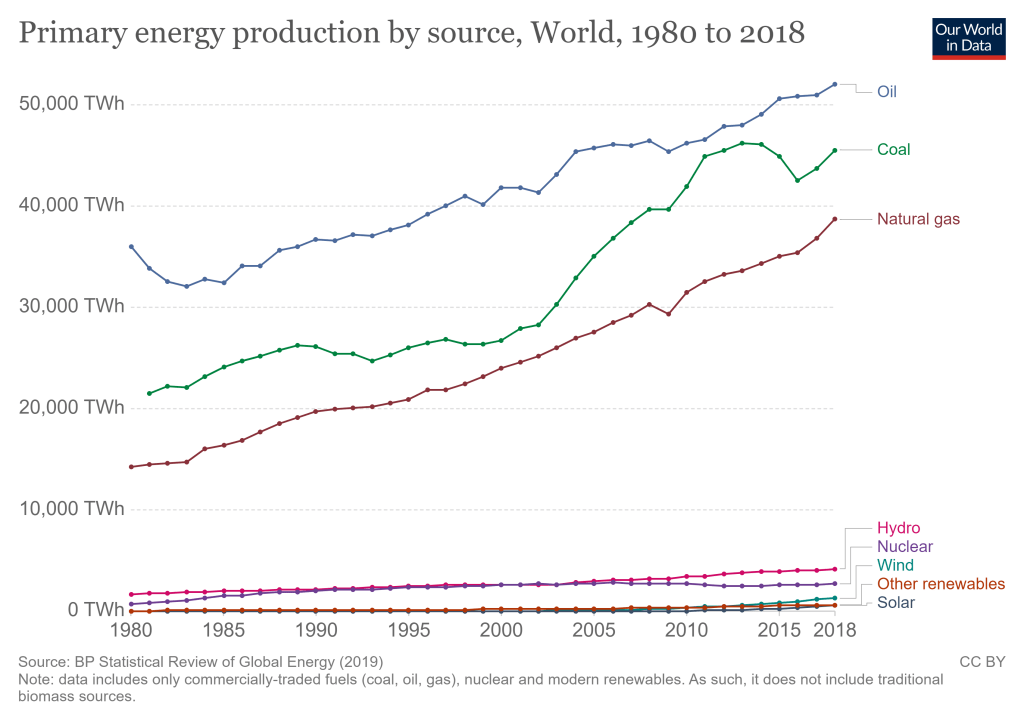
Assuming the figures used to make this graph are accurate, the image shows how well we have reduced energy production from fossil fuels, and how much we have increased renewable energy in the last 40 years.

source: https://ourworldindata.org/grapher/primary-energy-prod-source?time=1980..2018

We have failed. We have had years of climate action, discussion between nations, and targets have been set, yet the actions taken have ignored the problem and made the situation worse. The idea that technologies are largely defense mechanisms or modes of prevarication, is graphically illustrated. If we keep the same social organisation, and the same development processes going, then we are committing suicide. Whatever the appearance our States are failed States, when it comes to dealing with this problem.

We cannot rely on the State or big business to save us, or even to try to save us. We have been doing that, and this faith has not been repaid. We may need to get to work outside the State and outside big business…

This is where ideas of degrowth and community energy democracy come in. Degrowth will almost certainly not be a popular response to politicians, but it does allow us to ask questions which are otherwise not being asked. These questions have the potential to open the unconscious of our social dynamic towards destruction.

What, for example, if we tried to reduce burning fossil fuels without replacing them? This would be world changing, it would also start debates about wealth distribution, and energy distribution. What do we really need the energy for? How do we need the energy production distributed, to make these cuts possible? How can we levelise consumption to give everyone what they need to survive comfortably and freely? Can communities build and manage their own energy supplies? Can any of this be achieved along with the maintenance of rivalrous military based nation states? Will those in power who love the maintenance of violence-based hierarchies fight with all they can muster to go to destruction before surrendering their power?

I doubt such questions will be asked, but they are essential, otherwise technology is likely to primarily remain either a prevarication or a defense mechanism, which maintains our self-destruction.

Carbon Capture and Storage, Yet Again

March 10, 2020

A slightly abridged form of this blog was posted at John Menadue’s site.

Despite the jaded history of Carbon Capture and Storage (CCS) in Australia, the Government has announced it will fund it rather than Renewables. CCS is costly, and faces numerous unsolved problems, while renewable energy would not produce the emissions that CCS is supposed to diminish.

The Federal Government, through the Energy Minister Angus Taylor, has proposed that taxpayers’ money should be invested in Carbon Capture and Storage (CCS) research, rather than in aiding the supposedly now ‘developed’ renewables sector.

A Climate Council press release responded to Mr Taylor’s speech:

The Federal Government has signaled a move away from investing in the solutions we already have at our disposal – wind and solar – to technologies like carbon capture and storage (CCS)….

‘Carbon Capture and Storage is incredibly expensive. It is not a climate solution, but an attempt to prolong the role of fossil fuels in the energy system’.

The Government’s slogan is “technology, not taxes” as “humans have an extraordinary ability to innovate.” However, that ingenuity does not mean every conception is viable in time, either in terms of financial cost, technological development, effectiveness of results, or safety of operation.

CCS is not the Government’s only plan for investment in research; hydrogen, lithium, livestock feed supplements, and biological sequestration are also named. But CCS is amongst the most dubious of research areas.

The previous history of the research is valuable in judging its potential.

The first Australian geo-sequestration project, the Otway project in Victoria, was proposed in 1998. It appears to be still in development after at least a cost of $100m. The Howard Government promised “$21.8 million… for [a] new Co-operative Research Centre on CO2 that will build on work already carried out to place Australia at the leading edge of geo-sequestration technology.” The Minister David Kemp made it clear that CCS and other supported technologies would safeguard the use of Australia’s “vast reserves of low cost brown coal.” That Government’s clean energy white paper also mentioned a “low emission technology fund” which was to have $700m to spend on many ideas including CCS. It is hard to see how much was spent in that area.

The Rudd and Gillard Governments continued the approach with more CCS funding, launching the “Offshore Petroleum and Greenhouse Gas Storage Act” and the Global Carbon Capture and Storage Institute, promising $2b for CCS under the Clean Energy Initiative. All this money generated a truly remarkable lack of interest from the coal industry. On the whole, we can say the coal industry used the presence of funds and some low grade projects to promise clean coal in some fantasy future. They did almost no research at all. Therefore, there is little evidence to suggest that new funding will significantly reduce coal emissions.

Nevertheless, research into carbon extraction is needed. If we wish to keep temperature increases below 20, then as well as stopping emissions, we need to remove greenhouse gases (GHG) from the air. 88 out of the 90 scenarios in the IPCC’s report assume some level of net negative emissions. IPCC Special Report on 1.5 degrees says:

Different mitigation strategies can achieve the net emissions reductions that would be required to follow a pathway that limits global warming to 1.5°C with no or limited overshoot. All pathways use Carbon Dioxide Removal (CDR), but the amount varies across pathways, as do the relative contributions of Bioenergy with Carbon Capture and Storage (BECCS) and removals in the Agriculture, Forestry and Other Land Use (AFOLU) sector

And

In modelled 1.5°C pathways with limited or no overshoot, the use of CCS would allow the electricity generation share of gas to be approximately 8% (3–11% interquartile range) of global electricity in 2050, while the use of coal shows a steep reduction in all pathways and would be reduced to close to 0% (0–2% interquartile range) of electricity

The longer we emit GHG the more we need to remove. However, technological (as opposed to aided biological) carbon removal has three fundamental problems:

1) Carbon extraction requires quite of lot of energy generated of top of what we already use. Mark Z. Jacobson of Stanford University claims that his “research finds that [CCS] reduces only a small fraction of carbon emissions, and it usually increases air pollution” because of the energy needed to run it. As I understand it, the second law of thermodynamics implies that you cannot remove the carbon for less energy than was released in its burning. In nature CO2 is removed by the action of the sun on Chlorophyll in a biological context. If done artificially, we need to be aware of the amounts of energy required, and how much this adds to stress on the energy system. Furthermore, this energy must not add more GHG pollution to the atmosphere, or it is pointless.

2) What do you do with the carbon once you have removed it? Carbon is common, and generally not very valuable. Some people suggest it should be returned to the soil in bio-available forms, or used to make bricks, or converted into fuel, or used to extract the last drop of oil or gas from old wells, which is somewhat counter-productive. CCS proposes that the extracted material is useless and should be stored underground, usually in old gas or oil fields.

3) Carbon dioxide exists in pretty low atmospheric concentrations, so a large amount of air has to be processed for worthwhile levels of removal. According to one estimate, assuming 100% efficiency, “to get a ton of CO2, we’d need to filter it out of about 1.3 million cubic meters of air”. This adds to the energy consumption of the process. The usual solution is to carry out the removal where there are heavy emissions, such as at coal fired power stations. However, no known carbon removal process is 100% effective, so emissions will be released.

The IEA remarks that they would like:

a cumulative 107 gigatonnes of carbon dioxide (Gt CO2)… permanently stored in the period to 2060, requiring a significant scale-up of CO2 storage from today’s levels.

One of the world’s largest storage systems, the Chevron gas Gorgon facility in Western Australia, will, at best, store between 3.4 and 4.0 million tonnes of CO2 per annum. So far, this project is storing CO2 extracted from its gas production. So while it may have reduced emissions, it is hardly lessening overall emissions from burning gas, and is far less effective in reducing emissions than lowering the amount of gas being burnt.

Added to this, the storage option of CCS has to be ruled as unproven and difficult for the following reasons.

1) No examples exist of either carbon capture or storage working at anything near the volumes required. The research required is significant, and it will take a long time to apply in the real world. To be done quickly, there must be no problems of scale and the technology present now must be adequate to the job. We may develop better technologies, but we cannot assume that in advance.

2) There is the problem of leakage, and the difficulties monitoring those leaks, especially with offshore storage underwater. If the storage site is an old oil or gas field then exit points are often plentiful. Leaks are also possible in transport to the storage place. Leaks undo the whole process.

3) While there is dispute about this, CO2 storage may increase the possibility of earthquakes, increasing the possibility of leaks.

4) Sudden leaks may produce fatalities. Concentrations of CO2 over 10%, even in the presence of oxygen, can be fatal.

5) Leakage and underground flow may produce unpleasant tastes or introduce poisons to underground water supplies. This is particularly problematic given the importance of underground water to Australia.

6) As commentators on the article pointed out there is a lot of carbon emissions. The Centre for Global development, estimates that the Australian power sector emits 226,000,000 tons of CO2 per year. The Government’s Quarterly Update of Australia’s National Greenhouse Gas Inventory states that the emissions from electricity are 180 MT CO2-e (CO2 equivalents). Emissions from the total energy sector that are 380 MT CO2-e or 380,000,000 tonnes. By comparison in 2015-16 Australia exported 37 million tonnes of LNG per year. So we would be trying to store more CO2 in the ground, than we export liquid gas. That is a lot of storage and transport per day, and a lot of infrastructure with no profit attached. Not impossible, assuming no other problems, but costly.

As stated above, CCS requires extra energy, adds to operational costs, and possibly increases fossil fuel consumption.

7) Due to running costs and capital expenditure, CCS is likely to significantly increase energy prices, which is something the Government wishes to avoid. Without massive subsidies, competition may force CCS power stations out of the market.

8) Monitoring and responsibility for discovered leakage. Companies rarely remain solvent forever, and the GHG need to be stored for a long time. Companies are likely to find the costs of policing leaks annoying, and have incentives to be desultory. This leaves ultimate liability with the taxpayers, which gives further incentives for companies to delay reporting leaks.

9) Difficulties in retrofitting old coal power stations for CCS may lead to the building of new coal or gas power stations, locking in emissions.

10) It requires a massive spending on infrastructure. In 2006, Vaclav Smil estimated:

“Sequestering a mere 1/10 of today’s global CO2 emissions [at that time that was 3 Gt CO2] would thus call for putting in place an industry that would have to [transport and] force underground every year the volume of compressed gas larger than or (with higher compression) equal to the volume of crude oil extracted globally by petroleum industry.”

A build of such size is also likely to have significant emissions. So the process seems unviable at the levels we need.

In Australia, Carbon Capture and Storage will likely waste money for insignificant emissions reductions. However expenditure on improving the grid will lead to more investment opportunities for working low emissions technologies while removing the need for CCS to reduce current emissions.