Posts Tagged ‘climate change’

Biofuels: Will they work?

September 5, 2022

[Long but unfinished]

What are Modern Biofuels

The term ‘biofuel’ is usually used to refer to liquid or solid fuels manufactured from recently living organic material called ‘biomass’ (which can include plants, cooking oils, animals, microorganisms and so on), and made in relatively short human time frames. Fossil fuels also come from living material, but are made in geological time frames.

Biomass can be specially grown on farms, taken from forests (natural or cultivated) or from so called ‘marginal land’, collected from the waste from production of another crop (rather than being used as mulch, fertiliser or animal feed). Biomass can be made from organic garbage or manure, which is then usually (but not always) turned into methane (‘natural gas’) and purified. Biomass can also be made through the growth of algae in tanks or sometimes ponds. Sometimes the burning of mixed rubbish, or plastic pollution is also classified as a biofuel.

History and use

Biofuels such as collected wood, plant matter and dung have been used by humans for heating and cooking for a long time. Some of the earlier internal combustion engines were supposedly either designed or modified to run on biofuels – although I do not have documented evidence for this. Nicolaus August Otto who is usually said to have invented the first automobile engine in 1876, potentially fueled it with alcohol as well as coal gas. The diesel engine, could be run on fuel made out of peanut oil, and Ford’s model T could also run on bio-oils.

However it is usually agreed that the cheapness of petroleum products in the 1910s-20s, ended these experiments and engines were no longer built to work with bio products.

After the recognition of climate change, biofuels have sometimes been mandated by Governments to strengthen energy security, reduce GHG (through regrowth of crops), and because they can provide ways to subsidise some agriculture or other industries.

The EU issued its first biofuel directive in 2003 which recommended “tax exemption, financial assistance for the processing industry and the establishment of a compulsory rate of biofuels for oil companies”. This was so successful that by 2017 it was claimed that:

Biomass for energy (bioenergy) continues to be the main source of renewable energy in the EU, with a share of almost 60%. The heating and cooling sector is the largest end-user, using about 75% of all bioenergy (see section 1).  

European Commission’s Knowledge Centre for Bioeconomy. 2019. Brief on biomass for energy in the European Union. and

The UK was lowering coal consumption but replacing the coal with wood pellets imported from the southeast United States, and providing over $1 billion in annual subsidies to help pay the costs of production and transport, mainly at the Drax power station (“the British government paid Drax the equivalent of €2.4m (£2.1m) a day in 2019”).

Drax appear to claim that wood pelleting is good for the environment and that they buy from sources which encourage tree growth:

“Over the last 25 years, the US South has not only increased its total wood supply – the surplus annual growth (compared to removals) each year has quadrupled”

Managed forests often absorb more carbon than forests that are left untouched .

(Drax 2022c)

We might wonder how biodiverse the new forestry is, and how much GHG are emitted transporting the chips across the Atlantic. We can also suggest that biofuel fit in well with European conditions of burning fuels and subsidy of agriculture. It could also increase wood chopping

According to Eurostat:

Almost a quarter (23 %) of the EU’s roundwood production in 2020 was used as fuelwood, while the remainder was industrial roundwood used for sawnwood and veneers, or for pulp and paper production…. . This represents an increase of 6 percentage points compared to 2000, when fuelwood accounted for 17 % of the total roundwood production. In some Member States, specifically the Netherlands, Cyprus and Hungary, fuelwood represented the majority of roundwood production (more than 50 %) in 2020. 

Eurostat 2021 Wood products – production and trade

Roundwood comprises all quantities of wood removed from the forest and other wooded land, or other tree felling site during a defined period of time

Eurostat: 2018 Glossary: Roundwood production

A Guardian article claims that “Between 2008 and 2018, subsidies for biomass, of which wood is the main source, among 27 European nations increased by 143%.” So the subsidies could provide an extra energy to focus on activities which are already happening.

The IEA claims:

Modern bioenergy is the largest source of renewable energy globally, accounting for 55% of renewable energy and over 6% of global energy supply. The Net Zero Emissions by 2050 Scenario sees a rapid increase in the use of bioenergy to displace fossil fuels by 2030.

IEA Bioenergy 2021?

Clearly bioenergy is significant in the technologies which count as renewable. However, the reduction of emissions from burning biomass, might be largely theoretical. One source claims:

biomass burning power plants emit 150% the CO2 of coal, and 300 – 400% the CO2 of natural gas, per unit energy produced.

PFPI Carbon emissions from burning biomass for energy

The complexity and confusion over biofuel use, appears to be being used as a way of making EU renewable figures more respectable, and as such is enmeshed in politics rather than in ‘physical reality’. An Article in Environmental Policy and Governance stated:

We find that the commitment of EU decision-making bodies to internal guidelines on the use of expertise and the precautionary principle was questionable, despite the scientific uncertainty inherent in the biofuels debate. Imperatives located in the political space dominated scientific evidence and led to a process of ‘policy-based evidence gathering’ to justify the policy choice of a 10% renewable
energy/biofuels target.

Amelia Sharman & John Holmes 2010. Evidence-Based Policy or Policy-Based Evidence Gathering? Biofuels, the EU and the 10% Target. Environmental Policy and Governance 20: 309–321. and official site

So it can be suggested that biofuels can act as a fantasy evasion of challenges. Supposedly “responding to industry feedback”, the UK government increased its targets for biofuel, and justifies expanding airports by claiming that planes will use “sustainable” fuels, even though only a small number of planes can be provided with biofuels with current technologies. This means even more magic and fantasy, creeps into responses.

In 2005, the US Congress passed a “Renewable Fuel Standard,” which required transport fuel to include an increasing volume of biofuel. The law was expanded in 2007 and as a result, 2.8 million additional hectares of corn were grown between 2008 and 2016

“The Energy Policy Act of 2005 used a variety of economic incentives, including grants, income tax credits, subsidies and loans to promote biofuel research and development. It established a Renewable Fuel Standard mandating the blending of 7.5 billion gallons of  renewable fuels with gasoline annually by 2012. “The Energy Independence and Security Act of 2007 (EISA) included similar economic incentives. EISA expanded the Renewable Fuel Standard to increase biofuel production to 36 billion gallons by 2022.” (EPA 2022).

In late 2021, The Biden Administration released plans (Whitehouse 2021) for increased biofuel production for aviation. With the aim of enabling “aviation emissions to drop 20% by 2030 when compared to business as usual” and “New and ongoing funding opportunities to support sustainable aviation fuel projects and fuel producers totaling up to $4.3 billion.” Later reports suggested that the Build Back Better Bill would include $1 billion in extra funding for normal biofuels (Neeley 2021).

In 2022, with the Russian invasion of Ukraine and a worldwide increase in fossil fuel prices. The Administration said (Whitehouse 2022) they were “committed to doing everything [they] can to address the pain Americans are feeling at the pump as a result of Putin’s Price Hike” and this involved spurring US biofuel production (“homegrown” to make it wholesome). This involved authorising the production of E15 in the summer months, when it is normally illegal, partly because it evaporates easily and adds GHG and particulates to the atmosphere including nitric, and nitrogen, oxides, although this is disputed (refs# AFP 2022). He also claimed to have negotiated “a historic release from petroleum reserves around the world, putting 240 million barrels of oil on the market in the next six months” (Whitehouse 2022). This is clearly not an attempt to reduce petrol consumption but the price of petrol which is likely to increase consumption over what it would have been otherwise.

The US Energy Information administration states that in 2021 “17.5 billion gallons of biofuels were produced in the United States and about 16.8 billion gallons were consumed. The United States was a net exporter of about 0.8 billion gallons of biofuels” (EIA 2022).

Biofuels are a major taxpayer supported industry, which appears to help delay change in at least some fields such as transport (automobile fuel), and are supported by that industry.

Scientific Encouragement

Biofuels have long been part of official plans for the energy transition, as a replacement for petrol or gas. The IPCC said in 2018:

Bioenergy has a significant greenhouse gas (GHG) mitigation potential, provided that the resources are developed sustainably and that efficient bioenergy systems are used. Certain current systems and key future options including perennial cropping systems, use of biomass residues and wastes and advanced conversion systems are able to deliver 80 to 90% emission reductions compared to the fossil energy baseline….

From the expert review of available scientific literature, potential deployment levels of biomass for energy by 2050 could be in the range of 100 to 300 EJ…. The upper bound of the technical potential of biomass for energy may be as large as 500 EJ/yr by 2050….

Biomass provided about 10.2% (50.3 EJ/yr) of the annual global primary energy supply in 2008,

IPCC Chapter 2: Biofuels 215-16

Recognised Problems

Not enough biofuels

In 2011, the International Energy Agency forecast that biofuels could make up 27 percent of global transportation fuels by 2050. In 2021 the same organisation called for greater production of biofuels, but feared that (even i biofuels were less polluting and were low emissions) the necessary increase was not happening:

Transport biofuel production expanded 6% year-on-year in 2019, and 3% annual production growth is expected over the next five years. This falls short of the sustained 10% output growth per year needed until 2030 to align with the SDS.

IEA Transport Biofuels tracking report 1921 [Note IEA website addresses are often used more than once for the current report]

And:

While biofuel demand grew 5% per year on average between 2010 and 2019, the Net Zero Emissions by 2050 Scenario requires much higher average growth of 14% per year to 2030.

Despite a boost in biofuel production in Asia, Wood Mackenzie state

Our forecast shows that no Asian market can meet its biodiesel and ethanol blending targets this year. Indonesia for example, l requires 15 million hectares more palm oil plantations to reach its mandate target, and in China ethanol for biofuels started noticeably competing with food production (Wood Mackenzie (2021).

The IEA calls for more production incentive policies to make up this shortfall, but remarks:

These policies must ensure that biofuels are produced sustainably and avoid negative impacts on biodiversity, freshwater systems, food prices and food availability. Policies must also incentivise greenhouse gas reductions, not just biofuel demand

op cit.

Removal of emissions

To be useful, biofuels must replace other worse sources of emissions and pollution, rather than being used in addition to those sources of pollution. This is another case in which emissions density, the ratio of energy to emissions is an irrelevant measure, as biofuels could reduce emissions intensity, while still allowing emissions increase.

It is perhaps questionable whether sustainable production of biofuels is compatible with both reduction of fuel costs (ie they compete with fossil fuels as replacements), rapid growth of production and lowering of pollution, as pollution is often associated with making things cheap and plentiful.

Lockin

Biofuel, as an addition to petrol, may require us to keep petrol going for longer than is necessary, preserving fossil fuel company profits with only marginally lower emissions. Biofuels may also not be as efficient as fossil fuels and therefore increase overall consumption, and a Jevons effect might eventuate if the mixed fuel becomes cheaper to use, and more is consumed.

The Time Issue

It is generally much quicker to burn a plant or the fuel derived from a plant than it is to grow the volume of plants being burnt and turned into fuel. The more biofuel being burnt in a time period, the more biomass is needed to be being produced at the same time.

If it takes three days to regrow and process the amount of matter burnt in 1 day (which is excessively and unlikely quick replacement), then we need to grow and store enough biomass for days two and three and then grow it again. The greater the demand for biofuel the greater the demand for excess production. This will generally denature the soil, and make a problem for food production as it takes large quantities of land. Currently the world is expected to suffer food shortages because of the Russian invasion of Ukraine. It is probably not sensible to bet so much on crops for biomass given the instability of the current world through politics and through climate which may affect growth and fertility.

Systemic problems

a) Biofuels may take a lot of energy, land and manufactured fertiliser to produce, refine and transport to places of consumption, so their Energy Return on Energy Input (EREI) could be extremely low while the pollution through their production could be high.

b) Using organic waste, usually for the production of biogas, may remove natural fertilisers from the soil so that the ecological cycle of recovery is broken, and has to be repaired artificially. This may increase the energy ‘consumed or ‘wasted’ in making replacement chemical fertilisers. Again the IEA states:

biofuels are increasingly produced from feedstocks such as wastes and residues, which do not compete with food crops…. [while currently] only an estimated 7% of biofuels came from wastes and residues… Accounting for just 3% of transport fuel demand – biofuels are not on track to attain the Net Zero trajectory

###

Given that used cooking oil and waste animal fats provide the majority of non-food-crop feedstocks for biofuel production, and are limited “new technologies will need to be commercialised to expand non-food-crop biofuel production”. In other words imaginary, or possible, technologies will have to rescue us again.

c) Use of biofuels increases the so called ‘metabolic rift’ which comes with industrial agriculture. Materials and nutrients are taken from the soil and dispersed into the atmosphere, or become waste in another place – where they may decay into methane, another GHG.

d) Biofuels may lead to indirect land-use change. That is when food crops in one part of the world are directed to biofuels, and farmers elsewhere try to capitalise on the potential shortage of food crops by expanding into forests, or using agriculture that released soil stored GHG.

Through the interlinked systems, biofuels have the potential to make things worse.

Food

Farming, or extracting, these fuels, can: require fertile land and increase the price of food by taking land away from food production; dispossess small farmers, forest dwellers, and dependent labour from land (increasing food problems); bring about destruction of old growth forests (increasing CO2 emissions); decrease biodiversity lowering ecological resilience; and increase systemic vulnerability to plant disease through monocropping.

A suppressed or confidential World Bank report leaked to the Guardian in 2008 stated that “Biofuels have forced global food prices up by 75%”. Robert Bailey a policy adviser at Oxfam, remarked at the time:

Political leaders seem intent on suppressing and ignoring the strong evidence that biofuels are a major factor in recent food price rises… While politicians concentrate on keeping industry lobbies happy, people in poor countries cannot afford enough to eat.

Aditya Chakrabortty Secret report: biofuel caused food crisis. The Guardian 4 Jul 2008

Dr David King the UK Government’s Chief Scientific Advisor from 2000 to 2007 said:

It is clear that some biofuels have huge impacts on food prices… All we are doing by supporting these is subsidising higher food prices, while doing nothing to tackle climate change.”

Aditya Chakrabortty Secret report: biofuel caused food crisis. The Guardian 4 Jul 2008

In 2010 it was said that:

One-quarter of all the maize and other grain crops grown in the US now ends up as biofuel in cars rather than being used to feed people, according to new analysis which suggests that the biofuel revolution launched by former President George Bush in 2007 is impacting on world food supplies.”

John Vidal 2010 One quarter of US grain crops fed to cars – not people, new figures show. The Guardian 23 January

Lester Brown, the director of the Earth Policy Institute, was reported as saying:

The grain grown to produce fuel in the US [in 2009] was enough to feed 330 million people for one year at average world consumption levels… By subsidising the production of ethanol to the tune of some $6bn each year, US taxpayers are in effect subsidising rising food bills at home and around the world

John Vidal 2010 One quarter of US grain crops fed to cars – not people, new figures show. The Guardian 23 January

Other reports which suggest even more problems. Gro Intelligence, argues that the calories in biofuel production resulting from current and future policies could feed 1.9 billion people annually. The invasion of Ukraine, and the resultant shortage of foodstock sharpened the debate and it was alleged that close to 36% of US corn may be produced for biofuel and 40% of soy went into biodiesel. Another article suggests that a 50% reduction in grain for biofuels in the US and Europe would compensate for the loss of all of Ukraine’s grain exports

But of course there are different opinions. Rob Vierhout, the secretary-general of ePURE, the association of the European renewable ethanol and related industries attacks:

the allegation that millions of people were starving due to EU biofuel policies.  Not a single scientific paper over the past two years gave credence to that theory. The Commission’s own report earlier this year on the historical and future price impacts of EU biofuels policy suggested that the impacts had been negligible, an order of magnitude below what the NGO campaigners have claimed. Major contributions to the field this year include a World Bank paper concluding that oil is responsible for two thirds of price increases…

anti-biofuels campaigners have for the past six months focused on an allegation by IISD that biofuels cost EU taxpayers €10 billion annually…. We and our members have tried for a year to have meaningful and scientifically-relevant dialogue with IISD’s biofuel researchers, and we have pointed out dozens of factual and methodological errors in their work, as well as their constant failure to secure meaningful peer review…. They give the results that their clients order and then try to justify those results through manipulation of data and highly selective use of facts.

Rob Vierhout 2013. Take an honest look at ethanol! Euractiv 2 September

Vierhout adds:

Seventy thousand people owe their jobs to the EU renewable ethanol industry. European biofuels industry now contribute more than €20 billion annually to Europe’s GDP. They are a product made in and for Europe. Every litre of biofuel sold in Europe is a litre of reduced fossil fuel demand.

Rob Vierhout 2013. Take an honest look at ethanol! Euractiv 2 September

The number of jobs is irrelevant if the industry is harmful. Tom Buis, the chief executive of Growth Energy (Supporting American Ethanol) said:

Continued innovation in ethanol production and agricultural technology means that we don’t have to make a false choice between food and fuel. We can more than meet the demand for food and livestock feed while reducing our dependence on foreign oil through the production of homegrown renewable ethanol

John Vidal 2010 One quarter of US grain crops fed to cars – not people, new figures show. The Guardian 23 January

Water is also consumed at all stages of biofuel production: in agriculture in manufacture and in the fuel itself. It may be possible to conserve or recycle water, but it may not without adding more energy consumption to the process. Likewise if forests are felled to provide land for growing biofuels, then the local hydrological cycle may be disrupted, and water flow off the land, helping to produce floods, rather than being absorbed.

The problem here is that the systemic logic of the problem is fairly high. Biofuel crops require land and water to grow. There is limited land and water available. Consequently, this land and water either comes from existing agricultural (food producing) land, which lowers food production and thus puts the price of food up, occupies new land and produces lack of biodiversity, or produces food shortages (unless there is massive food over-production). If the land comes from areas which are cheap and supports local farmers, grazers in commoning, then those people may be dispossessed by mass cropping and forced into wage labour, or have to move elsewhere, and again the local price of food, and the amount of human suffering, is likely to increase along with declines in biodiversity and resilience. If the new land comes from forests, or previously unfarmed land then the loss of a carbon sink my eradicate any emissions lowering from using the fuels. If it comes from previously marginal land, then that may generate systemic problems, such as vulnerability to drought, soil loss and so on. The land was probably not being farmed for some reason or other. Yet there is a clear financial incentive for biofuels to continue.

For what it is worth Exxon remarks:

Many peer-reviewed papers in the scientific literature suggest that the direct life cycle GHG emissions are lower than fossil fuels but that indirect consequences of first generation biofuel development, including changes in forest and agricultural land use change, may result in higher total GHG emissions than petroleum-derived fuels

Exxon Newsroom 2018 Advanced biofuels and algae research: targeting the technical capability to produce 10,000 barrels per day by 2025. 17 September

EU response

The latest Climate negotiations from the EU, Fit for 55, seems to take note of some of these issues. The section on the transport sector does not seem to mention subsidised ethanol production for automobiles but plentiful charging stations and the deployment of a gaseous hydrogen refueling infrastructure. (The infographic refers to “liquified methane” which seems an odd choice for emissions reduction). It does refers to shipping and stimulating “demand for the most environmentally friendly sustainable fuels, particularly renewable fuels of non-biological origin” presumably hydrogen, although whether this is green hydrogen or not is unclear. The main section on biofuels is almost entirely about air transport, so we could perhaps expect that is where the subsidies will go. The discussion says they want to extend “the scope of eligible sustainable aviation fuels and synthetic aviation fuels. For biofuels, the scope is extended to other certified biofuels complying with the RED sustainability and emissions saving criteria, up to a maximum of 3%, and with the exception of biofuels from food and feed crops, which are excluded.”

It might also be useful to make sure transport emissions are low, and that energy efficiency is high so that transport needs less fuel.

Types of Biofuel

The US Energy Information Administration (EIA 2022 another web page which gets updated regularly), remarks that “The terminology for different types of biofuels used in government legislation and incentive programs and in industry branding and marketing efforts varies,” and that “definitions for these biofuels may also differ depending on the language in government legislation and programs that require or promote their use and among industry and other organizations.” This makes it hard to be definitive.

Ethanol

Biofuels are generally made from specially grown biomass, as implied above and burnt releasing GHG emissions which are hopefully absorbed over time by regrowth.  The currently most common biofuel involves ethanol Ethanol is a fermentation product made from plants such as corn, sugarcane, sugar beets etc. with a high sugar content. Fermentation to make ethanol also releases CO2, whether it is possible to lower this release is possibly likely, but still difficult to predict. It is added to petrol to dilute the amount of petrol being used, but as stated previously still produces emissions.

If fermentation is not used, as in ethanol production, then the plant material has to be broken down. One family of methods involves high temperatures, which of course takes energy. If this energy is provided by fossil fuels or further biofuels, then there will be added emissions.

  • Pyrolysis: biomass rapidly heated in an Oxygen free environment at 500-700 degrees Centigrade. The char then needs to be removed.
  • Gasification uses higher temperatures still >700 degrees. It produces ‘syngas’ a mixture of CO and hydrogen.
  • Hyrdothermal liquefaction for wet biomass like algae uses water at 200-350 degrees C and high pressure.

The resultant product needs purification and upgrading.

Ethanol is usually less efficient for petrol engines than petrol, it has less energy density, and in Australia the fuel is lower octane than usual petrol. Some research has suggested that cars use ethanol diluted fuel require more refuelling than those which do not, which may lead to extra fuel burning, and hence reduce the emissions reduction. As far as I can see more research is needed.

Cellulosic ethanol

This kind of ethanol is made from the cellulose and hemicelluloses which are found in plant cell walls, and the fuel tends to be made from agricultural waste, or non-edible remnants of crops. It is considerably harder to ferment the glucose in cellulose than to ferment the sugar rich seeds of corn etc. A story from 2016 states

no company is currently selling microorganisms capable of fermenting sugars contained in hemicellulose to corn ethanol refiners.  Therefore, such ‘cellulosic ethanol’ originates from the cellulose sugars in the fiber or [in] the starch which adheres to it.

Almuth Ernsting Cashing in on Cellulosic Ethanol: Subsidy Loophole Set to Rescue Corn Biofuel Profits

Cellulosic fuels are sometimes called second generation biofuels. This biomass should be able to come from more marginal land or from waste (EPA 2022). However, there is still a risk of soil depletion from the plant material not being returned to the soil, and it appears the energy consumption in making it is high.

Biodiesel [unclear]

Biodiesel tends to be made from vegetable oils, and animal fats, both new and used. Some diesel engines appear to be able to run on pure biodiesel, but in most cases the vegetable oils have too high a viscosity and the oils require heating before they can be used, so they are temperature vulnerable. The NSW department of primary industry claims: “the Australian diesel fuel standard allows up to 5% biodiesel in pump fuel. Higher concentrations of conventional biodiesel can cause issues with current infrastructure and engines.”

When I began writing this, the US Office of Energy Efficiency stated that “Currently one commercial scale facility (World Energy in Paramount, California) is producing renewable diesel from waste fats, oils, and greases.” Presumably more companies have appeared.

One of the possible techniques used is hydrocracking which uses hydrogen to break carbon to carbon bonds, but it is not clear to me what this technique is applied to, or what kind of energy and chemical processes are involved.

Biodiesel is often distinguished from Renewable diesel. The NSW government states:

Renewable diesel is produced from a wider variety of feedstocks than conventional biodiesel including non-food biomass and feedstock such as straw, cotton trash and urban waste streams. It can also use purpose-grown crops such as grass, woody biomass or algae. [Or sewage vegetable oils and animal fats] Renewable diesel is compatible with existing infrastructure and vehicles, but commercial scale production has yet to occur in Australia, though some pilot scale plants are in operation.

NSW Department of Primary Industries Biodiesel, renewable diesel and bioethanol 7 June 2022

Again we have the problem of the pollution through manufacturing and agricultural processes. It also appears that the NSW government at least is currently more interested in Hydrogen power than in biodiesel, but hydrogen production requires excess green energy to produce clear hydrogen, or working Carbon Capture and Storage to make from methane.

Wood

Wood has better have better energy density and higher EREI than most other plant materials but it is less energy dense and has higher moisture levels than fossil fuels and produces more particulate pollution. As said previously deforestation or monoculture trees tend not to be good for resilient ecologies.

Algae

Algae is essentially an experimental venture, even though it has been worked with since the oil crisis of the 1970s. Often called the third generation of biofuels. In theory algae should be wonderful. It is much quicker growing than other biomass (even when compared to burning time). It is rich in lipids and this, and growth rates, could possibly be boosted even further by genetic engineering. However, the record does not match the enthusiasm.

From 2005 to 2012, dozens of companies managed to extract hundreds of millions in cash from VCs in hopes of ultimately extracting fuel oil from algae [and failed]

 In 2015, EnAlgae, an EU-funded coalition of 19 research bodies, concluded (p2) that “it now looks highly unlikely that algae can contribute significantly to Europe’s need for sustainable energy,” although the research had helped algae be useful for “food, nutraceuticals, etc.” and help cut back fishing.

Similarly, in 2017, the International Energy Agency made the ambiguous comment that:

• The single biggest barrier to market deployment of algae remains the high cost of
cultivating and harvesting the algal biomass feedstocks, currently a factor of 10-20
too high for commodity fuel production…

• Algae-based production to produce bioenergy products like liquid or gaseous fuels
as primary products is not foreseen to be economically viable in the near to
intermediate term and the technical, cost and sustainability barriers are reviewed
• Macroalgae have significant potential as a biogas, chemicals and biofuels crop in
temperate oceanic climates in coastal areas. Their commercial exploitation also
remains limited by cost and scalability challenges

IEA 2017 State of Technology Review – Algae Bioenergy

By 2012, Shell had ended its algae biofuel research and development program, news had dried up of BP’s $10 million deal with bioscience firm Martek, and Chevron’s five-year partnership with the government-funded National Renewable Energy Laboratory had produced no significant breakthroughs. By early 2018, Chevron’s website had gone from promising that algae biofuel development was “still in the research stage” to openly admitting its work was unsuccessful.

Joseph Winters 2020 The Myth of Algae Biofuels. Harvard Political Review 26 January

Apparently Exxon are still interested in algal fuels and genetic modification as the solution.

Genetically engineered high reproduction rate algae is ecologically risky, as the chances are high, that some will escape, and if they can breed in the wild, which given the reproduction rates and lack of predators that often lead to algal blooms is likely, they could produce massive damage. Other problems include co-products, waste, nutrients, harvesting, drying and conversion technology.

In 2017 Exxon announced that:

Using advanced cell engineering technologies at Synthetic Genomics, the ExxonMobil-Synthetic Genomics research team modified an algae strain to enhance the algae’s oil content from 20 percent to more than 40 percent.

Exxon Newsroom 2017 ExxonMobil and Synthetic Genomics report breakthrough in algae biofuel research 19 June

Later they moved to outdoor testing of.

naturally occurring algae in several contained ponds in California…

ExxonMobil anticipates that 10,000 barrels of algae biofuel per day could be produced by 2025 based on research conducted to date and emerging technical capability.

Exxon Newsroom 2018 ExxonMobil and Synthetic Genomics algae biofuels program targets 10,000 barrels per day by 2025 6 March

Finally in late 2018 they declared:

algal biofuels will have about 50 percent lower life cycle greenhouse gas emissions than petroleum-derived fuel…

producing algae does not compete with sources of food, rendering the food-vs.-fuel quandary a moot point

Because algae can be produced in brackish water, including seawater, its production will not strain freshwater resources the way ethanol does.

Algae consume CO2, and on a life-cycle basis have a much lower emissions profile than corn ethanol given the energy used to make fertilizer, distill the ethanol, and to farm and transport the latter.

Algae can yield more biofuel per acre than plant-based biofuels

Exxon Newsroom 2018 Advanced biofuels and algae research: targeting the technical capability to produce 10,000 barrels per day by 2025. 17 September

There seems to be no record of progress since then. The US EPA simply remarks in 2022: “algae biofuels are not yet produced commercially”. However the U.S. Department of Energy’s (DOE’s) Office of Energy Efficiency and Renewable Energy Bioenergy Technologies Office (BETO) states it is “working to build the algae bioeconomy of the future, where fossil fuels could be replaced with a renewable, abundant, and flexible source of energy.” It is offering awards to students for advances in algal tech.

Biogas

The decay of much biomass produces methane, or ‘natural gas’. The idea is that it is possible to capture or generate methane from waste, and rather than release it to the atmosphere, burn it to produce energy and presumably some GHG. The point here is not that no GHG is released, but it is used as it is released.

China has more than 100,000 biogas plants, and a large number of household biogas units, followed by Germany with over 10,000 plants.

Methanol is another form of biogas made from biomass at extremely high temperatures and in the presence of a catalyst

Plastics

It is also possible that plastics could be converted to biofuels  – exchanging one form of pollution for another less noticeable form. Australian energy startup Licella was funded by Renewable Chemical Technologies Ltd (RCTL) and Armstrong Energy (£5m) to convert plastics to oil suitable to blend in with hydrocarbon fuels. It can work with broken and mixed plastics, and paper. However, the production of plastics locks away carbon, while conversion and burning releases it, so you get rid of the plastic from landfill or oceans but put it in the air, – along with any other pollutants. This is the case even if the production process is lower in emissions than usual. Given plastics are usually made from fossil fuels, fuel made from plastic should probably be classified as processed fossil fuels.

Waste

Waste or rubbish is one of the more confusing categories. It can include biogas but also high temperature burning of rubbish such as plastics and other materials which might be otherwise put into landfill. It may add to transport emissions if trucks carry the waste from the landfill area to the incinerator. The heat is usually used to produce steam and drive turbines to produce electricity. (A commercial description can be found here). It is dubious that burning mixed materials will have low emissions, or low particulate pollution, and the ash left behind is likely contaminated with heavy metals, salts, and persistent organic pollutants. Modern incinerators also have air pollution control equipment, which adds to the energy and cost of operation. The US EPA claims:

A typical waste to energy plant generates about 550 kilowatt hours (kWh) of energy per ton of waste. At an average price of four cents per kWh, revenues per ton of solid waste are often 20 to 30 dollars… [another] stream of revenue for the facilities comes from the sale of both ferrous (iron) and non-ferrous scrap metal collected from the post-combusted ash stream.

The United States combusted over 34 million tons of Municipal Solid Waste [MSW] with energy recovery in 2017…

 The ash that remains from the MSW combustion process is sent to landfills. 

EPA Energy Recovery from the Combustion of Municipal Solid Waste (MSW)

A medical survey of evidence concluded that:

A range of adverse health effects were identified, including significant associations with some neoplasia, congenital anomalies, infant deaths and miscarriage, but not for other diseases. Ingestion was the dominant exposure pathway for the public.

More recent incinerators have fewer reported ill effects, perhaps because of inadequate time for adverse effects to emerge. A precautionary approach is required.

Peter W Tait et al. 2020. The health impacts of waste incineration: a systematic review. Aust N Z J Public Health 44(1):40-48.

Another article on the same topic claimed:

We found a dearth of health studies related to the impacts of exposure to WtE emissions. The limited evidence suggests that well-designed and operated WtE facilities using sorted feedstock (RDF) are critical to reduce potential adverse health (cancer and non-cancer) impacts, due to lower hazardous combustion-related emissions, compared to landfill or unsorted incineration. Poorly fed WtE facilities may emit concentrated toxins with serious potential health risks, such as dioxins/furans and heavy metals; these toxins may remain problematic in bottom ash as a combustion by-product. 

Tom Cole-Hunter 2020 The health impacts of waste-to-energy emissions: a systematic review of the literature. Environmental Research Letters,15: 123006

Not unreasonably they call for further research before expanding the industry.

In the US, The Department of Energy announced:

$46 million for 22 projects that will create biofuel energy to help decarbonize the transportation and power generation sectors.

Turning waste and carbon pollution into clean energy at scale would be a double win—cleaning up waste streams that disproportionately burden low-income communities and turning it into essential energy,” said U.S. Secretary of Energy Jennifer M. Granholm.

Unusually, they try to sell the waste burning, as removing waste streams from low-income communities, and lowering pollution, both of which seem dubious.

In Australia, the government has also seen incineration ‘renewable energy’ and as creating revenue streams for industry, and then allowing industry to apply for grant programs, through people such as the renewable energy agency Arena and the Clean Energy Finance Corporation. Promotion of rubbish for energy also came about shortly after China refused to take more Australian rubbish exports, and this allows recycling centres to sell on otherwise unwanted recycling materials.

Burning rubbish would seem to be a way of not having to lower rubbish-pollution, increase recycling, or find new ways of recycling. In other words it allows freeloading polluters to continue to freeload and rubbish-collectors to make extra profits. It may even encourage more plastic manufacture. to provide feedstock.

Sustainable Aviation fuel

Aviation fuel is a major cause of GHG. By 2019, the total annual world-wide passenger count was 4.56 billion people.

passenger air travel was producing the highest and fastest growth of individual emissions before the pandemic, despite a significant improvement in efficiency of aircraft and flight operations over the last 60 years…

if global commercial aviation had been a country in the 2019 national GHG emissions standings, the industry would rank number six in the world between Japan and Germany.

Jeff Overton 2022 Issue Brief | The Growth in Greenhouse Gas Emissions from Commercial Aviation. Environmental and Energy Study Institute 9 June


In 2017 the aviation industry promised carbon neutral growth by 2020.  The “green jet fuel” plan, promised and increase use of biofuels to 5m tonnes a year by 2025, and 285m tonnes by 2050, which is about half the overall demand, assuming it remains stable, and stops growing. This is also about three times the amount of biofuels currently produced, and that suggests that the blowback would be considerable. Nearly 100 environmental groups protested against the proposal. Klaus Schenk of Rainforest Rescue said: “The vast use of palm oil for aviation biofuels would destroy the world’s rainforests” and Biofuel watch estimate it would take an amount of land more than three times the size of the UK.

British Airways abandoned a £340m scheme to make jet fuel from rubbish in January 2016, while Qantas managed a 15 hour flight from the US to Australia using a fuel with a 10% blend of a mustard seed fallow crop. The flight reportedly reduced the normal emissions of the flight by 7% which suggests a long way to go. At the time it was reported that Qantas aimed to set up an Australian biorefinery in the near future in partnership with Canadian company Agrisoma Biosciences. I do not know if this has happened, but they claimed that in Jan 2022 they became the first Australian airline to purchase Sustainable Aviation fuel out of Heathrow in London. It “will represent up to 15 per cent of our annual fuel purchased out of London…. and reduce carbon emissions by around 10 per cent on this route.” The fuel was said to be produced with certified bio feedstock from used cooking oil and/or other waste products. This is then blended with normal jet fuel. Qantas Group Chief Sustainability Officer Andrew Parker said “Aviation biofuels typically deliver around an 80 per cent reduction of greenhouse gas emissions on a lifecycle basis”. This seems unlikely while it is blended with jet fuel, and does not really compare with the 7 to 10 percent reduction they were previously claiming.

Reuters states that “Only around 33 million gallons of SAF were produced last year globally, or 0.5% of the jet fuel pool”. Stuff from the Biden bill
 

Climate change in 1965

September 4, 2022

The 1965 Report Restoring the quality of our environment presented to US President Johnson gives some ideas of knowledge and approach to climate change. They took it as likely and serious. Here are some paragraphs with a few comments in [ ]s:

President Johnson wrote:

the technology that has permitted our affluence spews out vast quantities of wastes and spent products that pollute our air, poison our waters, and even impair our ability to feed ourselves…. Pollution now is one of the most pervasive problems of our society.

Johnson points out that pollution is a general and serious problem resulting from the way societies have gained affluence. The Report, itself, opens with some history of the knowledge of CO2 Pollution, climate change, and its consequences:

The possibility of climatic change resulting from changes in the quantity of atmospheric carbon dioxide was proposed independently by the American geologist, T. C. Chamberlain (1899) and the Swedish chemist, S. Arrhenius (1903), at the beginning of this century.

They point to some existing evidence of climate change.

One might suppose that the increase in atmospheric CO2 over the past 100 years should have already brought about significant climatic changes, and indeed some scientists have suggested this is so. The English meteorologist, G. S. Callendar (1938, 1940, 1949), writing in the late 1930’s and the 1940’s on the basis of the crude data then available, believed that the increase in atmospheric CO2 from 1850 to 1940 was at least 10%. He thought this increase could account quantitatively for the observed warming of northern Europe and northern North America that began in the 1880’s….

As Mitchel (1961, 1963) has shown, atmospheric warming between 1885 and 1940 was a world-wide phenomenon.

The authors point to the difficulties of prediction of climate….

Even today, we cannot make a useful prediction concerning the magnitude or nature of the possible climatic effects.

Although clearly they recognise that climate change is a problem. They also recognise that sea level rise is a likely result.

It has sometimes been suggested that atmospheric warming due to an increase in the CO2 content of the atmosphere may result in a catastrophically rapid melting of the Antarctic ice cap, with an accompanying rise in sea level…. But such melting must occur relatively slowly on a human scale…. The melting of the Antarctic ice cap would raise sea level by 400 feet. If 1,000 years were required to melt the ice cap, the sea level would rise about 4 feet every 10 years [They add that this is not yet happening]

They think CO2 increase is induced by the actions of a particular social formation, and is therefore humanly induced.

Through his worldwide industrial civilization, Man is unwittingly conducting a vast geophysical experiment. Within a few generations he is burning the fossil fuels that slowly accumulated in the earth over the past 500 million years. The CO2 produced by this combustion is being injected into the atmosphere; about half of it remains there.

We can conclude with fair assurance that at the present time, fossil fuels are the only source of CO2 being added to the ocean-atmosphere-biosphere system.

By the year 2000 the increase in atmospheric CO2 will be close to 25%. [They were wrong, the increase was much bigger than they thought] This may be sufficient to produce measurable and perhaps marked changes in climate, and will almost certainly cause significant changes in the temperature and other properties of the stratosphere. At present it is impossible to predict these effects quantitatively…

Again, they suggest that humanly induced climate change could be bad for humanity

The climatic changes that may be produced by the increased CO2 content could be deleterious from the point of view of human beings. The possibilities of deliberately bringing about countervailing climatic changes therefore need to be thoroughly explored.

The solution they propose, appears to involve an early suggestion of geoengineering, rather than a cutback in fossil fuel consumption.

A change in the radiation balance in the opposite direction to that which might result from the increase of atmospheric CO2 could be produced by raising the albedo, or reflectivity, of the earth.

So, the Report could warn that global heating and climate change was likely to occur because of human burning of fossil fuels, but made no suggestion of cutting back consumption of those fossil fuels.

Sounds pretty contemporary.

State of the World?

July 19, 2022

We seem to be facing a climate crisis already. We don’t have to wait for the future. This description is obviously not complete, and only deals with 2022.

Australia

There are severe floods in Eastern Australia again. The Climate Council calls them “one of the most extreme disasters in Australian history… causing tragic loss of life and submerging tens of thousands of homes and businesses.” They point to speed, severity and “rain bombs”.  Yet this flooding occurred on the East Coast at the the same as Perth on the West Coast “smashed its previous record number of summer days at or over 40 C.” The Council recommends “Australia triple its efforts and aim to reduce its national emissions by 75% by 2030, and reach net zero by 2035.” The government is currently refusing to budge on its targets of 43% cuts by 2030 and net zero by 2050. This does not seem enough.

While the handling of the last floods may have been better than the previous floods, the country does not seem to be preparing for more events. Greg Mullins, former commissioner of Fire & Rescue NSW, Climate Council member, and founder of the Emergency Leaders for Climate Action states:

Australia lost a critical decade of preparation under a former federal government that repeatedly failed to heed the advice of scientists and experts… We are now in a position where we’re ill-equipped to get ahead of disasters and nowhere near where we should be to address the climate crisis.

Greg Mullins Australia is woefully unprepared for this climate reality of consecutive disasters. The Guardian 5 July 2022

Recently the NSW government scrapped orders to consider flood and fire risks before land zoning and building. The previous Federal Government delayed the release of a report into the condition of Australia’s environment until after the election. This has just been released. It appears to show a large number of newly threatened animals, with the country having one of the highest rates of species decline in the developed world, large scale forest clearance (not sure if this includes through the bushfires), a crisis in the Murray-Darling river system which is vital for agriculture and inland life, repeated bleachings of the Great Barrier Reef, increased ocean acidity, sea level rise affecting low-lying areas, such as the Kakadu wetlands, loss of soil carbon, and so on. The new Minister for the Environment stated that “The Australian Land Conservation Alliance estimates that we need to spend over $1 billion a year to restore and prevent further landscape degradation”.

The president of the Australian Academy of Science, Prof Chennupati Jagadish, said the report was sobering reading and the outlook for the environment was grim, with critical thresholds in many natural systems likely to be exceeded as global heating continued

Adam Morton and Graham Readfearn State of the environment: shocking report shows how Australia’s land and wildlife are being gradually destroyed The Guardian Tue 19 Jul 2022 03.30 AEST

The Australian Bureau of Meteorology states:

Australia has warmed on average by 1.44 ± 0.24 °C since national records began in 1910, with most warming occurring since 1950 and every decade since then being warmer than the ones before. Australia’s warmest year on record was 2019, and the seven years from 2013 to 2019 all rank in the nine warmest years.

State of the Climate 2020

It appears that Australia is already close to exceeding the 1.5C increase, that was an acceptable target.

Staying under 1.5C, or even setting a good example, is unlikely, as Australian emissions have recently increased in most areas of the economy, with the exception of electricity.

  • Increased transport emissions (up 4.0%; 3.5 Mt CO₂-e) reflecting a continuing recovery from the impacts of COVID restrictions on movement
  • Increased emissions from stationary energy (excluding electricity) (up 3.3%; 3.3 Mt CO₂-e) driven primarily by an increase in fuel combustion in the manufacturing sector
  • Increased emissions from agriculture (up 4.2%; 3.1 Mt CO₂-e) due to the continuing recovery from drought
  • Increased fugitive emissions (up 1.8%; 0.9 Mt CO₂-e), resulting from increased venting and flaring in oil and gas.

The latest list on the Department of Industry Science and Resources (p.8) Lists 69 new coal projects and 45 new gas and oil projects in various stages of approval. This could change with the new government, but it seems unlikely. Rupert Murdoch’s The Australian reports the new Prime Minister as saying new coal and gas projects could ­proceed if they stacked up financially and passed environmental approvals and “Policies that would just ­result in a replacement of Australian resources with resources that are less clean from other countries would lead to an ­increase in global emissions, not a decrease” [Albanese: coal ban won’t cut emissions, The Australian, 21 July 2022: 4.]. This was a conventional line repeated by the Minster for Environment: “Other countries that are burning Australian coal are responsible for reducing the pollution when they’re burning that Australian coal. That is how the global accounting for carbon pollution reduction works.” It also appears that Australian based Fossil Fuel companies have also been announcing massive profit increases. For example, Woodside announced a 44% increase in revenue. Santos an 85% increase despite only increasing production by 9%. Whitehaven Coal announced that it received a “record” average price for coal over the second quarter in 2022, over 5 times what it charged the previous year.

The weather conditions elsewhere are also ‘difficult’.

UK

There is the current heat wave in the UK, with record temperatures, melting runways, warnings for people not to commute, trains cancelled and so on. The UK Met Office issued its first-ever Level 4 “extreme heat” warning indicating that even the fit and healthy could fall ill or die, not just the high-risk and vulnerable groups. The hottest temperature ever recorded in the UK of 40.2C at Heathrow. This broke the previous record of 38.7C set in 2019.

Dr Eunice Lo, a climate scientist at the University of Bristol Cabot Institute for the Environment, said: “The climate has warmed since 1976 significantly. We have a record going back to 1884 and the top 10 hottest years have all occurred since 2002…. This hasn’t happened before; it is unprecedented…. By definition these are new extremes.”

Helena Horton UK is no longer a cold country and must adapt to heat, say climate scientists. The Guardian 18 July 2022

The UK Met said:

The chances of seeing 40°C days in the UK could be as much as 10 times more likely in the current climate than under a natural climate unaffected by human influence.

UK prepares for historic hot spell. Met Office News. 15 Jul 2022.

To add to the Strangeness. The normal source of the River Themes has dried up, and the river now starts 5 miles downstream from that point. There is a drought.

Apparently some UK climate scientists said that they had not expected these kinds of temperatures in the UK this early. Yet the simultaneous Conservative Party leadership ballot, has had candidates accused of ignoring climate change. The two finalists Rishi Sunak and Liz Truss have both expressed caution. Sunak said “If we go too hard and too fast” toward net zero “then we will lose people,” and Truss said she wanted to “find better ways to deliver net zero” that won’t “harm people and businesses” [1]. Truss has generally voted against climate measures.

EU

Fires are burning in France, Spain, Portugal, Croatia and Hungary. At least 12 thousand of people have been evacuated from the Gironde in south-western France. [Later reports suggest 37,000] According to the French weather channel La Chaîne Météo 108 absolute temperature records were set. Some Nuclear Reactors where turned down as the cooling water was too hot. In Spain temperatures reached 45C and 3,000 people were evacuated from the town of Mijas due to fires. The arrival of 30C temperatures in Spain has “advanced between 20 and 40 days on average in 71 years, according to a climatological study by” the State Meteorological Agency (Aemet) “the climate of Spain no longer It is as we knew it: it has become more extreme” the four seasons in Spain will end up being two: summer and almost summer (Via Google Translate). Fires have also broken out near Athens [more] fanned by gales and heat. A hospital and the National Observatory of Athens were evacuated, and homes were burnt down.

The French Prime Minister warned that France is facing its “most severe drought” on record. “The exceptional drought we are currently experiencing is depriving many municipalities of water and is a tragedy for our farmers, our ecosystems and biodiversity.” Apparently more than 100 municipalities were not able to provide drinking water to the tap and had to be supplied by truck. Portugal having recorded its highest July temperature is nearly completely in severe or extreme drought.  In Italy, the Po is 2 metres lower than normal, and increased salinity is threatening rice and shellfish production. Further reports suggest that the Rhine river is 7 cm off being unsuitable for river traffic and this will affect trade all through the continent, and add to the stress coming from the heat, the energy shortage, and the war in Ukraine.

Andrea Toreti of the European Commission’s Joint Research Centre [sais] “There were no other events in the past 500 [years] similar to the drought of 2018. But this year, I think, is worse.”

Henley, J. Europe’s rivers run dry as scientists warn drought could be worst in 500 years. The Guardian, 14 August 2022

Only 3% of homes in Germany and the UK have air-conditioning,  5% of residential homes in France, 7% in Italy. The heat waves suggest that there will also be a wave of power consumption as people start to install cooling in their homes. Radhika Khosla, associate professor at the Smith School at the University of Oxford, made the obvious point about needing air conditioning in a heated world:

“The global community must commit to sustainable cooling, or risk locking the world into a deadly feedback loop, where demand for cooling energy drives further greenhouse gas emissions and results in even more global warming.”

Fiona HarveyAshifa KassamNina Lakhani, and Amrit Dhillon Burning planet: why are the world’s heatwaves getting more intense? The Guardian 19 June 2022

There is also likely to be struggles over available energy in Europe over the winter. Frans Timmermans the vice-president of the European Commission has warned the EU could descend into serious strife if there wasn’t enough energy for heating in winter, and “If we were just to say no more coal right now, we wouldn’t be very convincing in some of our member states and we would contribute to tensions within our society getting even higher.” So “can we make further commitments on reducing our emissions given the situation?” The answer he was implying was ‘no’.

The heat and fires are likely to affect farming and food availability. Mustard for example is short in France because of excessive heat in Canada where much of their mustard seed is grown. An estimated 15 to 35% of the wheat crop in states close to Delhi such as Punjab, Haryana and Uttar Pradesh – what is known as India’s “wheat bowl” – has been damaged and the government banned wheat exports.

USA

In the US

Nearly 90 large fires and complexes have burned  3,100,941 acres in 12 states. Six new large fires were reported, two in Alaska and one in Alabama, Idaho, Montana and Oklahoma. More than 6,600 wildland firefighters and support personnel are assigned to incidents across the country

National Interagency Fire Center National Fire News 18 July 2022 [this link is likely to be lost due to updates]

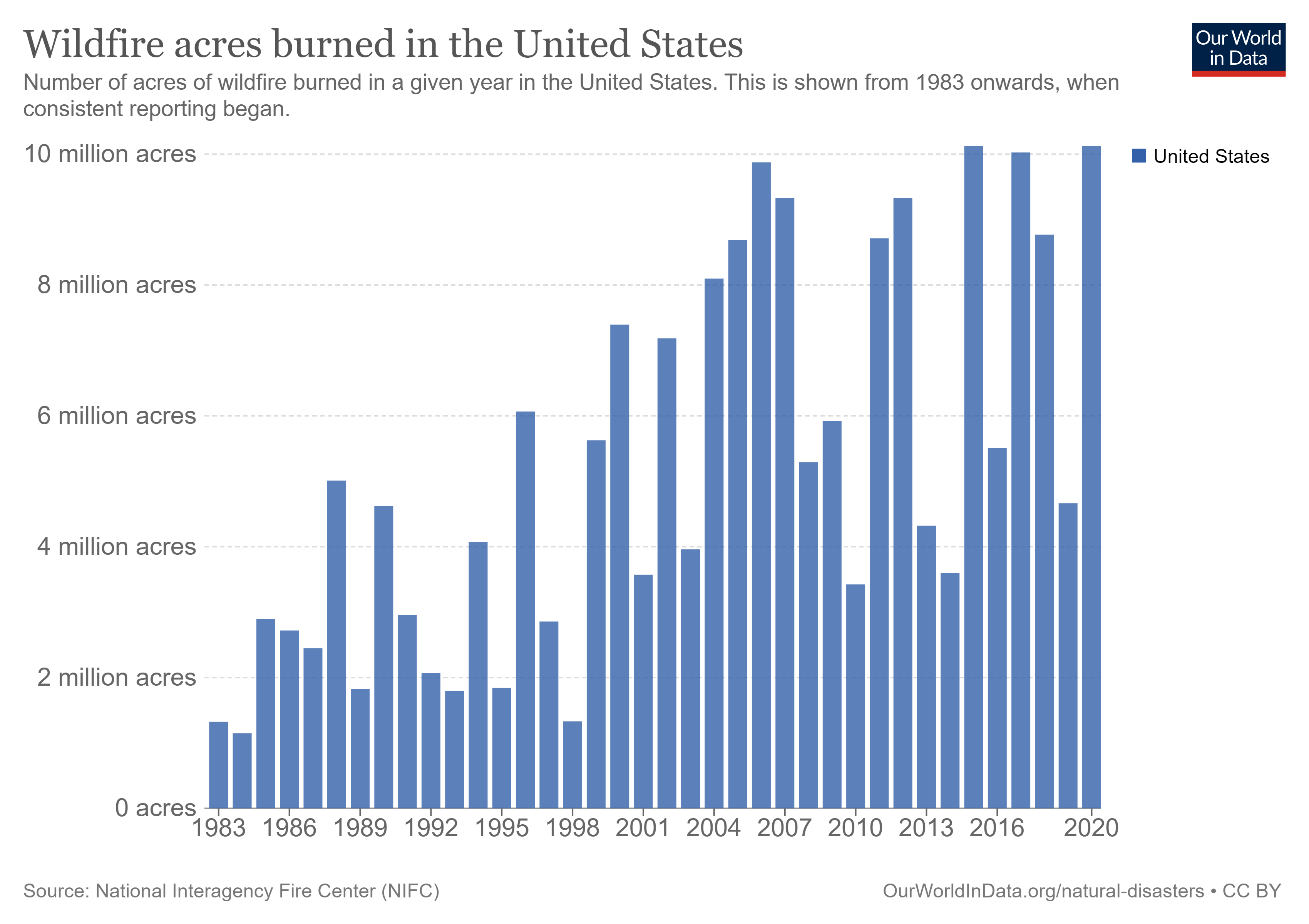
The amount of the USA being burnt seems to be increasing… By early July the Alaskan fires had burnt over 2 million acres, more than twice the size of a typical Alaska fire season.

the weather factors – the warm spring, low snowpack and unusual thunderstorm activity – combined with multidecade warming that has allowed vegetation to grow in Southwest Alaska, together fuel an active fire season…. [The fires] burn hotter and burn deeper into the ground, so rather than just scorching the trees and burning the undergrowth, they’re consuming everything, and you’re left with this moonscape of ash

Rick Thoman Alaska on fire: Thousands of lightning strikes and a warming climate put Alaska on pace for another historic fire season. The Conversation 5 July 2022

In California there are large fires almost every year nowadays. The ‘Oak fire’ in Mariposa county has led to 6000 people being evacuated.

On Saturday, the Oak fire sent up a pyrocumulus cloud so large it could be seen from space…. Kim Zagaris, an adviser for the Western Fire Chiefs association, told the LA Times: “When you get a pyrocumulus column, it can pick up a pretty good-sized branch and actually draw it aloft into the column and in some cases drop it a mile or two miles down the head of the fire, which starts additional spot fires.”….. Felix Castro, a meteorologist with the US National Weather Service, said the region had experienced 13 consecutive days of triple-digit heat with relative humidity of 8% or 9%. Vegetation had reached near-record dryness, he said, in what scientists estimate to be the most arid 22-year period in at least 1,200 years.

Gabrielle Canon Edward Helmore, California Oak fire remains uncontained as Al Gore warns ‘civilization at stake’. The Guardian 25 July 2022
https://ourworldindata.org/grapher/acres-burned-usa

There were unexpected heat waves in Texas and Arizona with daily temperature records, and record overnight temperatures. Some cities opened cooling centres for people without air conditioning. Texas warned people to cut electricity use or face blackouts. “Extreme heat is America’s leading weather-related killer, and Phoenix in Maricopa county [Arizona] is the country’s hottest and deadliest city.”

Water shortage’s are common in Western USA, due to a long term drought. In Mid August, the US Department of the Interior declared the first-ever tier 2 water shortage for the Colorado River, so Arizona, Nevada and Mexico have to reduce their water usage even more from 1 January next year. Not only is the ecology of the river basin threatened, but humans will face disrupted water supplies and diminished hydro electric capacity. This has already increased tensions between the different states.

The Democrats have not been particularly successful getting climate measures passed, and Biden has proposed new offshore oil drilling off Alaska and in the Mexican Gulf.

‘Sub-continent’: India, Pakistan, Bangladesh

Earlier in the year there were heat waves in Pakistan and India showing the highest temperatures on record. According to the Meteorological Department Delhi has recorded temperatures of 42C (and above) on 25 days since summer began. Temperatures of about 50C were seen in May, while India had 71% less rain than normal in March and there was 62% less rainfall in Pakistan. People from the World Meteorological Association wrote:

The 2022 heatwave is estimated to have led to at least 90 deaths across India and Pakistan, and to have triggered an extreme Glacial Lake Outburst Flood in northern Pakistan and forest fires in India. The heat reduced India’s wheat crop yields, causing the government to reverse an earlier plan to supplement the global wheat supply that has been impacted by the war in Ukraine. In India, a shortage of coal led to power outages that limited access to cooling, compounding health impacts and forcing millions of people to use coping mechanisms such as limiting activity to the early morning and evening… Because of climate change, the probability of an event such as that in 2022 has increased by a factor of about 30.

Zachariah et al Climate Change made devastating early heat in India and Pakistan 30 times more likely

Bangladesh has been having the worst floods in Sylhet in a century. Thousands of people are displaced, towns have been washed away. According to the UN, an estimated 7.2 million people across seven districts have been affected. Hospitals are inaccessible due to flooding. Over half of the regions medical clinics are underwater. “An estimated 60,000 women are pregnant in the affected region, with more than 6,500 births expected to take place in July”, and the lack of medical resources also means that waterborne diseases are likely to sweep through the population.

India has apparently used the heat wave and failing power sources to reduce environmental compliance rules for coal mines, such as holding public consultations before mines operate at greater capacity. The government plans to increase coal production to 1.2 billion tonnes, an increase of over 400m tonnes, over the next two years

Latin America

Conditions where not good in Latin America early this year

In mid-January, the southern tip of South America suffered its worst heat wave in years. In Argentina, temperatures in more than 50 cities rose above 40°C, more than 10°C warmer than the typical average temperature in cities such as Buenos Aires. The scorching heat sparked wildfires, worsened a drought, hurt agriculture, and temporarily collapsed Buenos Aires’s electrical power supply. 

Rodrigo Perez Ortega Extreme temperatures in major Latin American cities could be linked to nearly 1 million deaths. Science 28 June 2022

China

In China, at least 86 Chinese cities in eastern and southern parts of the country had issued heat alerts. in the city of Nanjing, officials opened air-raid shelters for locals to escape the heat. Reports from earlier in the year suggest that Premier Li Keqiang announced a goal of 300 million tons of new coal production in 2022, in addition to the 220 million tons added last year.

Africa

Ethiopia, Kenya and Somalia are facing lack of rainfall and a drought emergency [1], [2]

The Poles

Temperatures at Vostok station relatively near the South Pole were 15C hotter than the previous all-time record. At the North Pole temperatures were 3C higher than average. Science Daily reported research which showed that “the Arctic is heating up more than four times faster than the rate of global warming.” (See also here) The ice melts reveal more ‘dark sea’ which will absorb more heat and, in a positive feedback loop, lead to higher temperatures and more ice melts

State of the global climate

The World Meteorological Association State of the Global Climate 2021 report’s ley points include:

  • The global mean temperature in 2021 was around 1.11 ± 0.13 °C above the 1850–1900 pre-industrial average…. The most recent seven years, 2015 to 2021, were the seven warmest years on record.
  • Global mean sea level reached a new record high in 2021, rising an average of 4.5 mm per year over the period 2013–2021.
  • Greenland experienced an exceptional mid-August melt event and the first-ever recorded rainfall at Summit Station, the highest point on the Greenland ice sheet at an altitude of 3,216 m.
  • Exceptional heatwaves broke records across western North America and the Mediterranean. Death Valley, California reached 54.4 °C on 9 July, equalling a similar 2020 value as the highest recorded in the world since at least the 1930s, and Syracuse in Sicily reached 48.8 °C.
  • Hurricane Ida was the most significant of the North Atlantic season, making landfall in Louisiana on 29 August, equalling the strongest landfall on record for the state, with economic losses in the United States estimated at US$ 75 billion.
  • Deadly and costly flooding induced economic losses of US$ 17.7 billion in Henan province of China, and Western Europe experienced some of its most severe flooding on record in mid-July. This event was associated with economic losses in Germany exceeding US$ 20 billion.
  • Drought affected many parts of the world, including areas in Canada, United States, Islamic Republic of Iran, Afghanistan, Pakistan, Turkey and Turkmenistan. In Canada, severe drought led to forecast wheat and canola crop production levels being 35%–40% below 2020 levels, while in the United States, the level of Lake Mead on the Colorado River fell in July to 47 m below full supply level, the lowest level on record.
  • Hydro-meteorological hazards continued to contribute to internal displacement. The countries with the highest numbers of displacements recorded as of October 2021 were China (more than 1.4 million), Viet Nam (more than 664 000) and the Philippines (more than 600 000).

These weather patterns seem entirely consistent with the idea that climate change had arrived and that weather is getting more chaotic and disruptive.

Cost of Damage?

It is clearly not possible, as yet, to estimate the damage for 2022, but Munich RE, (a provider of reinsurance, primary insurance and insurance-related risk solutions) has estimated the costs for the ‘milder’ year of 2021:

  • In 2021, natural disasters caused overall losses of US$ 280bn, of which roughly US$ 120bn were insured
  • Alongside 2005 and 2011, the year 2021 proved to be the second-costliest ever for the insurance sector (record year 2017: US$ 146bn, inflation-adjusted) – overall losses from natural disasters were the fourth-highest to date (record year 2011: US$ 355bn)
  • Hurricane Ida was the year’s costliest natural disaster, with overall losses of US$ 65bn (insured losses of US$ 36bn)
  • In Europe, flash floods after extreme rainfall caused losses of US$ 54bn (€46bn) – the costliest natural disaster on record in Germany 
  • Many of the weather catastrophes fit in with the expected consequences of climate change, making greater loss preparedness and climate protection a matter of urgency….
  • The USA accounted for a very high share of natural disaster losses in 2021 (roughly US$ 145bn), of which some US$ 85bn were insured

Five Final Opinions

Carbon Brief, is an activist organisation, so you may want to ignore it….

We found more than 400 new mine proposals that could produce 2,277m tonnes per annum (Mtpa), of which 614Mtpa are already being developed. The plans are heavily concentrated in a few coal-rich regions across China, Australia, India and Russia.

If they all went ahead, the new mines could supply as much as 30% of existing global coal production – or the combined output of India, Australia, Indonesia and the US.

Yet last month, the International Energy Agency said no new coal mines – nor extensions of existing mines – were “required” in its pathway to 1.5C. A UNEP report last year said coal output should fall 11% each year to 2030, under the same target.

Plans to massively boost coal production are, therefore, incompatible with the 1.5C limit. Alternatively, if global climate goals are to be met, the estimated $91bn of investment in the proposed mines could be left stranded.

Guest post: Hundreds of planned coal mines ‘incompatible with 1.5C target’ Carbon Tracker 10 June 2021

The UN Secretary General to the G20:

The climate crisis is our number one emergency.

The battle to keep the 1.5-degree goal alive will be won or lost by 2030….

But current national climate pledges would result in an increase in emissions of 14 percent by 2030.

This is collective suicide.

We need a renewable energy revolution. Ending the global addiction to fossil fuels is priority number one.

No new coal plants.

No expansion in oil and gas exploration….

Emerging economies must have access to the resources and technology they need.   

Wealthier countries must finally make good on the $100 billion climate finance commitment to developing countries, starting this year. 

We also need a radical boost for adaptation and early warning systems.

Secretary-General’s video message to the G20 Foreign Ministers: “Strengthening Multilateralism” 8 July

Later he said:

Eight months ago we left COP26 with 1.5 on life support.

Since then, its pulse has weakened further.

Greenhouse gas concentrations, sea level rise and ocean heat have broken new records.

Half of humanity is in the danger zone from floods, droughts, extreme storms and wildfires.

No nation is immune.

Yet we continue to feed our fossil fuel addiction.

What troubles me most is that, in facing this global crisis, we are failing to work together as a multilateral community.

Nations continue to play the blame game instead of taking responsibility for our collective future.

Secretary-General’s video message to the Petersberg Dialogue 18 July 2022

The Chair of the IPCC, said at the launch of the Working Group II report.

The cumulative scientific evidence is unequivocal: climate change is a grave and mounting threat to human wellbeing and the health of the planet. Any further delay in concerted global action will miss a brief and rapidly closing window to secure a liveable future.

We are not on track to achieve a climate-resilient sustainable world.

This report is a dire warning about the consequences of inaction. 

Opening remarks by the IPCC Chair at the IPCC-SBSTA Special Event on the Working Group II contribution to the Sixth Assessment Report Monday, 6 June 2022

Katharine Hayhoe, chief scientist for the Nature Conservancy in the US and professor at Texas Tech University says:

We cannot adapt our way out of the climate crisis…. If we continue with business-as-usual greenhouse gas emissions, there is no adaptation that is possible. You just can’t…. Our infrastructure, worth trillions of dollars, built over decades, was built for a planet that no longer exists… Human civilisation is based on the assumption of a stable climate…. But we are moving far beyond the stable range. We will not have anything left that we value, if we do not address the climate crisis

Fiona Harvey We cannot adapt our way out of climate crisis, warns leading scientist. The Guardian 1 June 2022

Concluding comments

Let’s be clear this is only the beginnings of actual observable climate change. Not the end. These events are happening within what was considered the ‘safe range’ of a global average under 1.5C rise. We are continuing to make the situation worse, and there is always a delay….

The need to cut GHG gas emissions and transition to renewable energy quickly appears to begin the only way that present day large scale civilisations can survive. Hence you would think transition might be an urgent priority – although it still seems to be an urgent priority to have more coal and gas supplies.

However, we have several problems, the world is distracted by the ongoing mutating pandemic, the war in Ukraine (and there is no necessity that the war remains contained), is taking money away from climate mitigation and adaptation, and causing shortages of gas which is causing countries to open old coal plants, increase emissions, while also causing food shortages. Tackling inflation by putting up interest rates is likely to cause defaults not only on the housing market, but to countries and companies who are indebted and only just managing, which will likely cause an economic crisis, which will hinder ecological restoration and ambitious plans for energy transformation. The chaotic weather is also likely to disrupt travel and economic production and increase demand for electricity for air-conditioning and cooling, adding to the problems of energy, productive capacity and available money.

Dealing with complexity 1: Political Risk Analysis

July 3, 2022

I’ve been reading John C. Hulsman’s To Dare More Boldly: The audacious story of Political Risk (Princeton University Press 2018). I have no idea whether this is considered a good book or not but its interesting. He gives ten principles for political risk and, in so doing, points towards principles useful for dealing with complexity, as what could more complex than political behaviour between nations?

Today I’m going to consider the first principle, and show that while its good, he actually ignores it in favour of ‘received knowledge,’ ‘individualism,’ and apparently ‘meaningless words’….

“We are the risk”

The point here is that we tend to ignore our own possible failings, or the failings of the systems we like. We look elsewhere for the problems.

For example, the author attended a Council of Foreign Relations meeting, and he suggested that American “political sclerosis” (whatever that is) was one of the ten most significant political risks in the world today, he was told it was the rest of the world that was the problem, not the USA, which could be left out of the problem sphere (p.45).

This is pretty clearly not a useful form of analysis, as the USA interacts with everyone else (complexity) and therefore has an effect on the result – no matter how ‘healthy’ it might be.

Another way of looking at his point, is that civilisations which collapse under external attack first suffer an internal collapse that makes them vulnerable.

He suggests that 18th Century Historian Edward Gibbon makes this kind of analysis in his Decline and fall of the Roman Empire. Or as he summarises:

Rome fell not primarily because of outside pressures but rather owing to an internal and gradual loss of civic virtue amongst its citizens

(P.43)

Now as an anthropologist I’m going to state that a decline in civic virtue, is not an explanation of anything. It is a statement of what might have happened. We may also need to ask, what caused this decline? What made the decline seem reasonable to people? What are the structures and processes involved? What are the complex interactions that lead to collapse, or slow phase out. I doubt that many individual people woke up one morning and said to themselves: “that’s it for civic virtue” and then Rome fell, or as Hulsman puts it

society atrophied as a result of personal failings that accumulated over time

(p 48).

If its personal failings there is nothing we can do, except blame others. However, if its shared personal failings or social dynamics then we can look around to find common causes and remedy them. Pretty obviously Rome in the East continued on for quite a long time (falling in 1453) so its a bit foolish to just focus on Rome in the West (476, almost a thousand years earlier), and we need to know what civic virtue (or personal failings) even are, and how they changed – not just assume they are immediately obvious, and obviously important because we like the idea and maybe think we are virtuous and have them.

Gibbon may have thought that Roman civic virtue was a matter of militarism.

The victorious legions, who, in distant wars, acquired the vices of strangers and mercenaries, first oppressed the freedom of the republic, and afterwards violated the majesty of the purple. The emperors, anxious for their personal safety and the public peace, were reduced to the base expedient of corrupting the discipline which rendered them alike formidable to their sovereign and to the enemy; the vigour of the military government was relaxed, and finally dissolved, by the partial institutions of Constantine

Christians, while violent, did not support the military as such, and hence helped the downfall. However, Gibbon begins this passage by making an added point.

Prosperity ripened the principle of decay; the causes of destruction multiplied with the extent of conquest; and, as soon as time or accident had removed the artificial supports, the stupendous fabric yielded to the pressure of its own weight.

The Roman Empire became too big, and to clumsy to control, and to respond properly to challenges, as well as Romans becoming less interested in constant military ventures which consumed even more energy away from making it work. It is doubtful that even a modern empire with internet, jets and satellite can expand forever and hold its conquered land, as its context of supply chains, identity failure and local resistances grow more and more complicated.

However the point is clear, as Hulsman says, Rome may have eventually fallen because of a failure “to recognise and combat [the] home grown problems” of its Empire. This is a form of societal suicide which he calls ‘decadence’ (nothing like having a word that already tells you something is bad to help your judgements, and think you mean something) which he defines as “a society’s loss of ability to deal with its problem, coupled over time with a long-term abdication of responsibility for them” (p44).

My personal guess is that a lot of Romans probably tried to take responsibility for the problems, by blaming other people for them – despised classes like passive people, lazy workers, prostitutes, gays, people reveling in Luxury, nouveau riche, freed-slaves, Christians and later pagan philosophers etc. and they probably felt quite proud of facing up to the faults of others and berating them (Juvenal for example). Our vocabulary for condemning decadence (not being the same as we once were) very likely comes from Romans condemning each other.

Anyway, the point is that the Empire grew to such a size that it had to use barbarians to make its legions – which might have lengthened the decline – after all it gave the Barbarians something to fight for that wasn’t the fall of Rome, and made them invested in the Empire itself to an extent – they could become Roman citizens. They lived dangerous lives and got paid for it.

However, it is possible that ordinary citizens no longer saw the Empire as a particular advantage for them and lost interest…. It solved problems which did not seem that relevant to them, or it created problems for them – such as finding work, finding land, not having political representation, being unable to make social change and so on. Sport, public murder, and religious dispute, was all they might have had left to make a meaning for life

Hulsman further discusses the dangers of the Praetorian guard who were meant to defend the Emperor and family, but became a force in themselves from quite early on. They slaughtered emperors they did not like, appointed new people to the throne, and demanded higher and higher payments for loyalty – because they were necessary. Obviously not a mechanism for stable government, but it did not immediately cause the collapse of Rome, as the Emperor Constantine disbanded them and destroyed their barracks when he invaded Rome in AD 312.

So the main take away is the problems may issue from us, from the way we approach the problems, or the way we organise ourselves – but it is not simple.

The ‘Perfidious French’

Rather oddly, instead of moving to look at his own society from this point of view, he moves to condemn the modern day French. Let’s charitably assume that this is because he thinks Europe is part of the US, or he will talk about the US later on….

He discusses the events of August 2003 when Paris suffered a heat wave and large numbers of people died. To quote wiki:

In France, 14,802 heat-related deaths (mostly among the elderly) occurred during the heat wave, according to the French National Institute of Health.[6][7] France does not commonly have very hot summers, particularly in the northern areas,[8] but eight consecutive days with temperatures of more than 40 °C (104 °F) were recorded in Auxerre, Yonne in early August 2003.[9]

Wiki 2003 European heat wave.

Houses in France are not generally built for heat waves. Hulsman alleges that the French government, and doctors (?), did nothing. The relevant ministers were on holiday and reluctant to come back to the heat. Many people who died where healthy people living alone, and the government blamed French Families for not taking care or elderly relatives.

Hulsman blames:

  • The sanctity of French summer Holidays (Lazy selfish people)
  • Worship of an unsustainable mode of living (not ecologically unsustainable, but unsustainable in terms of capitalist economics.)
  • Europe “rotting from within” with decadence.
  • People avoiding responsibility for their kin.
  • Growing older populations
  • People wanting too much from work.

His solution, is pretty obvious for a North American. Capitalism.

Lets not bother to look at whether the Capitalist system still works or not. Let’s not bother to ask whether something we like, or participate within, is a problem or not. Capitalism may be great for getting development going, but after its reached a point in which a very few of the people own nearly everything, and have bought the political system and taken it away from the people, is it still the solver of all problems? Or is it a generator of at least some significant problems? Is economic growth a solution or a problem? Not asking these questions is like avoiding American “political sclerosis.” It is violating the principle that “We are the risk”.

Let us assume he is correct and that capitalist markets in Europe are not allocating most people enough money for what they want to do, and that it will all crash down. Then how are you going to sell a project which means – YOU (other people) work harder, take home less pay, get less benefits, retire later, pay increased personal taxes if middle class, have pensions privatised and subject to risk and rip off, in return for an uncertain promise that allowing other people to earn more in half an hour than you do all year round, might fix the problem or might not. This sounds like a standard neoliberal solution in which austerity is for the poor and the middle classes. Indeed Austerity seems to be both the solution and the result.

The wider questions around Are we the problem?

Capitalism as a problem?

He may be correct that Euro-capitalism is dying, but is the only solution US style capitalism, which could also be said to be dying? Or could it be something new?

Do we need to abandon capitalism? I’m not suggesting we always do (although there are obvious problems with neoliberal capitalism and its theories which I’ve discussed elsewhere), but it needs to be examined if the Anglo-sphere is not just to rest on its claimed laurels.

Are people uninvolved because neoliberalism encourages a “selfish” individual focus?

Are people uninvolved because capitalism encourages obedience to bosses, and irrational managerial restructures in which no one affected is ever listened to?

Are people uninvolved, because all spiritual and psychological questions become reduced to purchases?

Are people uninvolved because capitalism reduces tradition to obstruction?

Are people uninvolved because capitalism:

has left remaining no other nexus between man and man than naked self-interest, than callous “cash payment”. It has drowned the most heavenly ecstasies of religious fervour, of chivalrous enthusiasm, of philistine sentimentalism, in the icy water of egotistical calculation. It has resolved personal worth into exchange value, and in place of the numberless indefeasible chartered freedoms, has set up that single, unconscionable freedom – Free Trade. 

Marx and Engels Communist Manifesto

I don’t know, but they, and other questions, are questions worth asking.

We could also note that pro-corporate media is very keen on the idea that people who die of Covid, die with Covid, have existing conditions, or are old and useless and would die anyway. We repeatedly here how old people are a cost not a benefit, and so it is perhaps no wonder that people ignore the elderly and leave them to die. That they are solely a cost and burden, as they are retired, might even be an implicit message in his own arguments…

If people cannot labor, in relevant fields, or have no money to invest, do they have any value in capitalism?

That a form of capitalism worked well in the 60s to 70s in the Anglo-sphere to bring prosperity, social mobility, art, and education to all is not a guarantee that neoliberal capitalism will do the same, work now, or could not be modified with consultation. We could look at it as a potential cause of problems. Or do we have to protect capitalism from being considered even briefly a problem generator? There is plenty of degrowth economics around.

While it is cynical, we might find the answer to the question of why are these questions completely avoided in a chapter on not avoiding questions which implicate ourselves by reading the opening chapter and finding out that most political risk analysis is sold to corporations. Telling them capitalism might need to be changed is possibly limiting the market.

Climate

Lets look in a wider sphere, dragging in events or contexts he seems to be ignoring. Events only have meaning in context.

Can you publish a book on real political risk in 2018 without mentioning climate change and ecological decay. I don’t know yet, but I suspect you can. There is no entry for these problems in the index.

People did not normally die in late summer in Paris from heat. The contexts of events are changing. Climate change was already here in 2003. However at that time, probably no government or corporation on Earth recognised climate change as a current problem. There was little to no preparation for it. It was in the distant future, despite the warnings. So it is not surprising that few people were prepared. This was unusual. Nights in Paris are usually cool, but this time they were not. Houses did not cool over night.

Summer 2003 was the hottest in Europe since 1500, very likely due in part to anthropogenic climate change. The French experience confirms research establishing that heat waves are a major mortal risk, number one among so-called natural hazards in postindustrial societies. Yet France had no policy in place, as if dangerous climate were restricted to a distant or uncertain future of climate change, or to preindustrial countries. 

Marc Poumadère, Claire Mays, Sophie Le Mer, Russell Blong. The 2003 Heat Wave in France: Dangerous Climate Change Here and Now. Risk Analysis 25(6): 1327-1687

Let us remember the Australian Governments some 15 years later and their complete lack of interest in climate change, and complete lack of preparedness for the “black summer” bushfires and the huge floods a few years later. It is much harder to excuse these pro-market people for their failure, than the French; especially after all the warnings and the wild events around the world. However, people like Bjorn Lomborg are still trying to argue that heat is not as deadly as a cold people will be unlikely to suffer in France; indeed that heat saves lives [1], [2].

Capitalism, and pro-capitalist governments, have not been good at dealing with climate change, although they have been good at denying climate change and resisting social change to deal with it. Given this, it seems even more odd to argue that capitalism is a solution for either the problems of climate change in France, or the long-term problems of the French Economy.

Conclusions

It is worthwhile looking at the failures of our own system, or the systems we like, and not to protect them from questions, when we are considering the future. “We, and what we like, are (part of) the risk“.

It is also useful to look at the contexts of those system we live within, such as the global ecology and the global climate. These are changing and will challenge established systems which grew up within different systems and developed different expectations as a result.

Something which once worked ‘well-enough,’ may now no longer work, because it operates differently dues to internal changes, or the context it is working within is now different.

In terms of climate politics we might need to look at how our attempts to initiate lower emissions, renewable energy, ecological care and so on, are maladaptive, remembering again that: “We, and what we like, are part of the risk to our own success and to our own future.”

The Great Delay on Climate

June 22, 2022

We gave up on climate long ago. We have known since the 70s of last century what the result of burning fossil fuels would be, and…..

  • We have had decades of avoidance.
  • Decades of pretending it is not a problem.
  • We’ve had fossil fuel companies and corporate networks pushing against action.
  • Corporately owned and controlled media has pretended that there is a major divergence of opinion about climate change, and promoted the fossil fuel company line.
  • Various pro-corporate think tanks have spread false information, to delay action and keep the system going.
  • We’ve had governments trying to make sure its always someone else who acts first.
  • We’ve had pro-corporate political parties refusing to act at all.
  • We’ve had pro-corporate political parties claiming that climate change was politicized, as they went about politicizing it.
  • We’ve had governments sponsor and encourage fossil fuels with taxpayers’ money.
  • We’ve had confusion as in Germany where they increased emissions from lignite and locked in diesel while they almost went renewable.
  • We have had a reduction in emissions, accidentally due to Covid, but (in the last 30 years) we have never reduced the trend of increasing CO2 in the atmosphere.
  • We’ve had pro-corporate think tanks, media and parties shouting out that it will be the end of the world if we act to reduce pollution and environmental destruction.

As a result, the world will almost certainly will not act to achieve the Paris goals, and those goals will probably not have been steep enough to change the trajectory in any case.

We are gaining truly bizarre temperature levels in various places including the poles. We are getting almost global extreme flood and fire events. We are having collapses in animal and insect populations, that will disrupt the ecologies we depend upon for food.

It is logical to assume that as we reach tipping points, and the tundras release vast clouds of methane and we keep increasing the mining and burning of fossil fuels, that things will get much worse. This is only now the beginning.

And still we keep refusing to act.

It gets more difficult to act the more we wait, and the worse the conditions get.

However, we are learning the truth. Many corporations do not care whether your life and livelihood is threatened or whether their civilization is likely to collapse etc, as long as they can keep making an easy profit. Governments will rarely act against established corporate interests. We have also learnt that there are lots of people who will go along with them rather than face up to significant problems – and that they will think they are virtuous for acting that way.

The main problem hindering action on climate change remains politics and power relations, and there is little sign it is changing in the large scale. Governments and business will not do it for us. If we want action, we have to act ourselves and organize and act together.

More Information Mess: “This is generally bad, but this is an exception – and the exceptions do not add up…..”

May 27, 2022

The issue:

Just something obvious I’ve noticed recently – which suspect others will have noticed before me

People seem to be using a formulation of a rule which seems designed to discredit the rule it is supposed to be protecting. The formulation is of the form: “X is terrible and should be stopped. But any particular incidence of X can always be dismissed or excused.” These supposedly excusable cases are then claimed to not reinforce the problem of X.

The Heard Depp Dispute

I first noticed this as a regular thing, in a discussion about the Heard Depp trial. I’m not that interested in this trial, but I have noticed that it seems to be caught in a massive propaganda war, and that the ‘reporting’ I’ve seen seems to be overtly trying to influence my opinion on the subject and promote particular agendas and emotional reactions in its audience. Reporting seems to coagulate around two poles

  • a) women are hysterical liars who try to frame men by accusing them of rape and cruelty, when really the problem was the woman. Believe the man, castigate the woman. This is the position I have come across most often.

OR

  • b) Men are inherently violent and untrustworthy and women are constantly in danger all the time. Believe the woman, castigate the man.

I suspect that the divisions are likely to be based on gender and on Democrat and Republican political allegiance. It is also not surprising given the apparent aims of some of the reporting, that Heard claims she has received a torrent of abuse and death threats. The reporting would often seem to be aiming for that level of anger and interaction – perhaps apolitically, just to get eyeballs for advertising as the phrase goes.

To get back to the subject. In this charged atmosphere, I met someone who appeared to argue that he was opposed to Heard because she was ruining #Metoo for other women.

[I am not alleging anything about this particular person, this is a social phenomenon, not necessarily anything to do with individuals or their intentions.]

Anyway, in this case, the proposition mentioned above, appears to go:

“#Metoo is right for pointing out that women get beaten and raped by men regularly and that they then have their protests and charges casually and demeaningly dismissed as falsehoods, hysteria or malevolence.

“However in this particular case Heard is clearly hysterically and malevolently claiming to have suffered from threats and violence, and so her claims should be dismissed.

“This quick dismissal does not reinforce the difficulties that women face in coming forward.”

Given this dismissal, the death threats etc, she has likely received, can be ignored. It appears likely to me that after seeing what Heard has been through, even if she is proven to have lied, other women will feel inhibited about coming forward. Why, if they have been assaulted, should they suffer twice from the violence of the attack, and the violence of the manipulated (?) audience?

I have no idea of Heard or Depp’s real motives of course, or the real events that each interprets differently, or why it is obvious she (or he) is lying. I do know that a British judge thought that “the great majority of alleged assaults” on Heard by Depp had been “proved to the civil standard”. But this is largely ignored. The argument that the person is defending #Metoo does not seem to be neutral or encouraging women to stand up to violence and intimidation, but discouraging it.

This discouragement may be the argument’s intention, but it would seem to be its function.

In using the argument, the person can claim to be virtuous and recognising that violence against women is bad, at the same time as encouraging people to dismiss claims of violence by any particular woman, especially against men they like.

BLM

This argument strikes me as similar to many US based arguments I’ve heard over Black Lives Matter, in this case the formulation appears to be:

“Of course it is bad that so many people get shot by police (avoiding the race issue). We should protest against this and stop it. But in this particular case (whatever it is) when a black person was shot in a confrontation with police they were: a known criminal (even if they were not making threats or engaged in violence); they could have been on drugs; they are unsavory; the police thought they went for a weapon; they were not obeying the police; they were running away in terror; they shouted at the cops threatening them; they acted surprised and guilty when the police knocked down their door by mistake, and so on.”

Again while the person can concede that police shooting people is supposed to be bad, in practice they say this black person deserved it, or it was a sad mistake. The formulation suggests that there is nothing to worry about really. With each particular murder a person excuses, they can still claim to they are virtuous and opposing police violence. In reality, the formulation excuses the police violence it is supposed to be against.

Climate Change

This is a slight variant. The Australian government admits that climate change is bad, and that emissions are bad – but in any particular case of mining fossil fuels, the emissions or burning that result should be ignored, because one case cannot make any difference and is beneficial for someone (usually the mining company). No matter how much the ‘single cases’ add up to produce harm that is supposedly recognised by the arguer, any single case is fine, which eventually means no case should be stopped. Again the person can claim to be virtuous and recognise climate change is a problem, while still doing everything they can to make it worse.

Conclusion

The point of the formulation is that it is a way, the person seeks to establish their moral credibility on the issue (violence against women, police shooting unarmed or unresisting people, or avoiding climate change), while actually excusing the crime they are supposed to be condemning.

A constant use of special cases, undermines getting rid of the evil we are supposed to be condemning, and yet there may be occasions in which the exception is real: the woman is lying or the police responded appropriately. This is the deadly paradox, and its certainly possible and needs to be factored into trials.

However, in climate the special exception is probably more rarely justifiable, because the cumulative bad is inevitable, no matter the virtue of any particular mine or power station.

If the formulation is common, then we can be reasonably sure that people are using it to reassert the established ways of dismissing and denying the problem, while pretending to virtue. Becoming aware of this standard formulation, may help us become aware of it, so we can try and escape it, or argue against it – and remain more neutral during the trial whatever politics gathers around it.

If we were to identify something as “virtue signaling” then this would be a fine candidate. It signals virtue to the audience while allowing the condition to continue, and using the person’s signaled virtue to excuse the crime in this case, and possibly in every case. The exception functions to break the rule completely.

More on Climate Denial and Defence

April 24, 2022

This is to some extent a simplification, or recasting of this piece, reducing the main number of defenses to four.

1) Climate change is real but we only need to do one or two things to solve it

This is a standard position amongst the supposedly concerned.

  • We just need to put renewable energy in place.
  • We just need to curb population
  • We just need to follow the sustainable development goals

These points generally forget the massive, widespread and systemic, nature of the ecological decline we are facing, and the almost certain arrival of tipping points, such as methane release from those frozen ‘wastelands’ which are heating up and melting. The position minimises the problems and we may need to bother about all of these factors at once, and more. We cannot keep destroying ecologies through over-extraction, we cannot keep polluting and poisoning. We need to change the economic system which only flourishes through destruction and siphoning wealth up to a relatively small group of people – who probably think they can buy survival. Population will eventually become a problem if it does not plateau and decrease, but at the moment, the main problem is over-use of resources and destruction by the hyper-wealthy and powerful.

The crisis calls for almost a change of everything. Sure, this is difficult, and let us go one step at a time, as long as we take those steps. But just changing to renewables will not solve the problem. Culling population will not solve the problem (and how do we do this?). How do we attain the sustainable development goals, in the current system, without increasing use of energy and pollution?

2) Climate change is real but not that bad, we have no urgency to do anything. Everything is ok. We are already doing enough

This is the classic set of moves by those who don’t want to risk social change or disruption to the power and wealth arrangements. But ecological destruction and upheaval of the magnitude expected, will cause social change and social upheaval. The only way to preserve a destructive regime when the destruction bites back hard is through violence and enforced stability. This can only hold change back for a while until it becomes unavoidable for most people.

In this ‘relaxed’ set up, corporations who benefit from pollution simply lie about what they are doing to reassure people all is well. Carbon Capture and Storage is nowhere near being able to reduce emissions either significantly, or to zero, anywhere in the world. If they claim they are moving into renewables while actually increasing gas and coal production, they are not helping. If people are engaged in large amounts of destructive mining, deforestation or pollution, they are not helping, they are making the situation worse.

3) We can do nothing about Climate Change as it is natural. “The climate is always changing.”

The argument is that humans have done nothing to cause climate change and can do nothing to stop it. This is silly, humans have done lots to survive events they did not cause. They have not always given up immediately a ‘natural problem’ arises. Even if we did not know what human actions make climate change worse (pollution, greenhouse gases, ecological destruction) we could still start preparing for adaptation to the problem and surviving it, if this acknowledgment of Climate change was sincere. We could still ask: How are we going to deal with increased intense flooding, increased intense fires, increased intense storms, increased intense droughts, changes in weather generally, decrease of Ocean life, decrease in water supplies and dying rivers? etc… If we don’t act then many people will die and wars will be fought. The problem here is that the position surrenders to a fatalism which seems unnatural and overly defensive. The position is again from people who don’t want to do anything or recognise the problem.

4) Climate change is a complete falsehood

This is still relatively popular, with those embedded in the old system, who seem system change as fatal or massively uncertain. They are right. System change is fatal to the old system, and the results of conscious change are incredibly uncertain. However we are as certain as can be that ignoring the problem will not make it go away. It will just get worse and harder and more expensive and disruptive to deal with. We need to start acting now, even if we don’t completely know the effects of what we are doing.

Conclusion

The main obstacles to action are defensive political formations, not technology.

The system of destruction has grown up in a world of relative plenty, and we don’t know, for sure, how to get prosperity without it and this arouses fear.

The fact that society can grow around technology and particular forms of extraction and pollution, means the technology, extraction and pollution become ingrained into regulation and custom. Everything in the system tends to be geared to reinforce each other. Regulations assume centralised fossil fuel energy and need to be changed to support localised community energy, because they stop social change. This is not always visible until lots of people try to change and run into social, political and regulatory problems – which can discourage them if they don’t know what is happening.

Survival means:

  • Renewable energy
  • Electrification of most energy uses
  • Stopping new fossil fuel mines.
  • Reducing all pollution – even from renewable construction.
  • Reducing the damage of extraction in general.
  • New ways of large scale and small scale agriculture.
  • Conservation of fish stocks, and other natural bio-worlds.
  • Reducing the ecological footprint of populations.
  • Not exceeding the capacity of the planet to supply our lives.
  • Political change and experimental and exploratory policies.
  • Social and economic change, so destruction and pollution no longer look sensible.
  • Collapse of distant concern, so that pollution and destruction events which happen elsewhere, cannot be ignored.
  • Recognising, discovering and tending to planetary boundaries.

Non of this is impossible, and the main obstructions are political.

The ecological death spiral

March 26, 2022

Wealth and power inequality, seem to be increasing all the time. Inequality in wealth equals inequality of power. Due to the power inequalities, wealthy people continue to get tax breaks in times of crisis, they get legislation which suits them, they get special privileges and subsidies. So the inequality of wealth keeps growing without limit, when we all need to pull together. This is one of the aims of neoliberalism. The other is to protect corporations from democracy. We can summarise this by saying, neoliberalism supports the proposition, that only big business and big profit is good. Nothing else counts.

It appears that through right wing parties and media ownership, the wealth elites are setting up oligarchies through out the world, and carrying out disinformation campaigns, to support their power and distract people from the real causes of inequality and crises in living.

Inequalities of wealth, in capitalism, also equal inequalities of pollution. The wealthy are responsible for most of the world’s pollution through their earning, ownerships and lifestyles. They get to freeload pollution and ecological destruction onto poorer areas. They drive ecological breakdown and its side-effect of climate change. Wealthy companies continue to manage to get taxpayer subsidies for new fossil fuel fields, destroying agricultural areas, while dispossessing and poisoning local people. In Australia, they get all this and most pay more or less no tax.

It is likely that eco-system tipping points have started, such as release of methane from beneath permafrost, rapid temperature rises at the poles, and bleaching death of major coral reefs. Should the tipping points become established, then there is no going back. Systems out of equilibriium and heading for new equilibrium, or chaotic states, are hard, if not impossible, to return to normal.

Inequalities of wealth also distribute inequalities of resilience and capacity to avoid, or deal with floods, bushfires, droughts, pandemics and pollution. Poorer people suffer more substantially and for longer from ecological disasters, and appear to get less governmental help.

Inequalities of wealth and power, also mean that potential solutions to problems are corrupted. Corporations do Renewable Energy installations, ignore the needs of locals, and do not even power local communities. They fence off, perhaps destroy and privatise lands, and create inequalities when they pay royalties and rents to some, but not to others. This prevents any social transformation, lowers hope, and lowers the legitimacy of Renewables.

The Covid pandemic is not over. Where I live, in NSW, Australia, there have been 1485 deaths from Covid this year (March), according to my arithmetic. This is more deaths than for the whole of Australia last year. However, there is no longer any interest in reporting the trends – hence my arithmetic. There is no interest in reducing the deaths through simple public health measures, even less interest in preventing long Covid amongst working people, and there seem to be no fear about what could happen with new variants which defeat vaccines. In Australia we are no longer requiring people to have Covid tests to enter the country, so the new variants will spread. The trend seems to be that most wealthy people can work from home, and avoid some dangers, while poorer people (including hospital doctors) take the risks. Furthermore pandemics will not end with Covid. The possibility is high that worse pandemics will be transferred around the world by aeroplane, as we destroy more forests, and viruses which normally affect small mammals cross species and escape into the wider world.

Its as if we have decided that if we cannot suicide through ecological destruction and climate change, we should suicide through avoidable public health failures, and ignoring what is happening.

Warfare is another present danger which could escalate. Putin is threatening nuclear war. this means all other nuclear systems will now be on stand by, and ready to go. I suspect Putin is the kind of person that should he feel he is losing or under threat will be happy to take others with him.

Climate change plus the disruption of gas and oil supplies caused by the war, while possibly helping energy transition (although giving others excuses to boost fossil fuel production) has already put food prices up. Ukraine is one of the world’s great sources of food, and it will take years to put back together, and climate change and biofuel production seems to be affecting food anyway. Increasing food prices will render poorer people even less resilient and capable of surviving eco-destruction.

All of these interactions generate an existential crisis for most people. This is a crisis of meaning and meaning making. People’s worlds are falling apart, yet they have no idea what is going wrong, or what to do about it. They do their best and still fall behind. They work endlessly to survive and get completely exhausted This makes them more vulnerable to misinformation and distraction and unable to resist their losses, so the situation is likely to get worse.

There seem to be few working negative feedback loops which could encourage stability, or a return to equilibrium – and those which might exist are being destroyed.

This means every day is essential….

George Marshall talk and comments

March 22, 2022

George Marshall (author of Don’t Even Think About It: Why Our Brains Are Wired to Ignore Climate Change [1], [2]) gave a really interesting talk/discussion to the Climate Psychology Alliance last night, and this is a two part summary and comments.

He opened by pointing out two things

  1. That we have already started to slip into probably irreversible climate change (not only the recent massively high Australian floods, but even more importantly the recent temperatures in the polar regions)
  2. We need to understand our possible psychological responses to this ongoing disaster.

He began by saying that psychologically, we have been guided by our approach to problems by a myth of the hero.

Essentially in that story, the hero (often with unexpected aid) faces up to the challenge (the monster, the wizard, the king, the enemy army etc) and defeats the challenge and all is restored to its right place, or a new piece of culture, picked up in the adventure, is added to the cultural repertoire (fire, iron, a magic weapon, some new understanding, a new god, etc). Essentially all is solved.

However, he went on to suggest that climate change is not a monster which can be slain, or an enemy which can be defeated anymore. We have left it too late. Climate change is now more like a terminal disease, which will keep getting worse, or an attack in which the missiles and bombs never stop and will never stop. The effects are out of control; in term of a human life time, they probably without end or resolution. The hero myth is not useful to us, and may even sabotage our responses.

I’d like to suggest that there are other hero myths which might be more useful. In these the hero makes a tragic mistake, or their strengths, successes and overconfidence lead to failure and death, while the rest of the world often carries on. We can think of the end of King Arthur and the Round Table, a burst of ‘civilisation’ comes to an end through Arthur’s attempts to keep himself safe. Oedipus’s valour leads to famine and shame. Hercules’ bravery and agression leads to an intensely painful death.

What we face seems more easily generalised into something like Toynbee’s challenge and response idea. Sometimes a culture succeeds and changes (or changes and succeeds), but people often fail to deal with the challenge. A recurring theme is that this happens because those in power keep the old and previously successful ways of functioning going despite the fact those ways of success are now deadly and destructive. Just as fossil fuel burning is now deadly and destructive and needs to be phased out.

The effects of a continual storm, or impossible to deal with disaster, is socially common. Many indigenous societies have withered for a long time under colonialism, and a violence which was inconceivable to them. Some of these societies have also survived under hideous conditions, and many are being brought back. This will probably not be exactly the same as what was lost, but the movements help restore something and to regain the fight for people’s lives and ways of being. This is success.

It may sound hideous but we, whose societies participated in this cruelty and destruction, may now be able to learn from these rebirths when we face up to the climate change we have also created. This could also be seen as part of the way that indigenous societies are succeeding. And it is interesting how many people in the climate movement, seem to have been influenced by directly received (public) indigenous teachings or been influenced by books written by indigenous authors. This appears to be part of the growing eco-consciousness.

Toynbee implies that successful responses to new challenges often involve a new religion or cosmology. In this sense a religion or cosmology is a way of understanding the world and perceiving the world, which has a large symbolic component.

I suspect that a religious response is extremely likely to result during climate change, as climate change has to be represented symbolically: its too big to perceive directly; it is way too complex to enumerate all the possible factors involved; it’s unpredictable; its not controllable, etc. Given this kind of state a response will have to involve a completely new (to capitalism) world view or religion. It’s clear enough that our current views will not work, and are not working to deal with the problem. It is also probable that the variant which arises will not be consciously designed, but emerge from unconscious processes of pattern seeking and symbolisation. This process does not have to result in a beneficial conception, we could argue that Nazism was an unconscious symbolic response to the crises of the post WW1 era, and it was not beneficial at all.

The process is dangerous, but it will happen, and in processes like Q, and ‘Trumpism’ you can see the delusional versions occurring, in some forms of eco-consciousness you might see the constructive forms emerging. The point is to be aware it is happening, and that it has both good and bad sides.

The next article in this series will discuss Marshall’s list of psychological states.

Modes of Denial and Defense

January 30, 2022

People often indignantly say they do not deny climate change, but it sometimes seems they might as well.

There are a variety of ways of defending oneself and politics from the prospects of climate change.

  1. Climate change is unreal or is not happening.
  2. Climate change is unreal and it’s all just the result of a vast conspiracy of scientists from all over the world. This is somehow much more likely than that there is a conspiracy of fossil fuel companies, who would like us to continue fossil fuel burning. These two points are a little rarer than they used to be, and the people who used to take these positions now often take one of the following.
  3. Climate change is real, but its no big deal. People who think it might be a big deal, are to be dismissed as ‘alarmists’, ‘chicken littles’ etc.
  4. Climate change is real, but it’s not humanly generated and, as it’s not humanly generated, humans can do little about it. Clearly this denies the human cause of climate change, so it promotes continuing as normal, usually without even thinking about adaptation. Fossil Fuels Corporations and more fossil fuels are fine. This merges with…
  5. Climate change is real, but it happens all the time. While recognising the existence of climate change, the person defuses it, and implies that there is nothing special about this particular lot of Climate Change. This change is normal – even though it seems to be rapid and non-localised. Again the result is to protect the person and the social establishment from having to change, or even think about the problems. Climate change is something humans have faced locally before, but we haven’t experience as a planet for a long, long, while before recorded history.
  6. Climate change is real, but it is so economically costly to do anything about it, that we should not do anything about it. People need the forms of development we have developed over the last 120 years, and recognising the consequences of human action will keep people poor. Climate change is less threatening to our well being than the economy, which will destroy us if we change.
  7. Climate change is real, but the consequences of dealing with it are politically costly. Dealing with it might involve governments making requests of corporations, or imposing taxes on corporations, so we should do nothing, so as to avoid complete tyranny.
  8. Climate change could be real, or is real, but the models climatologists use are inherently implausible, so we will just use our common sense and abandon all these models and assert that everything will be ok. We will assert the world cannot change hugely, and ignorance is our great defense.
  9. Climate change is just one of many problems. So let’s do nothing about all of them.
  10. If climate change is real it will be fixed by the Free Market and magic. If people want to buy products that cause their death and the death of others, that is their fault, and they will evolve out.

I’m sure there are more, and I’ll add them when I remember them…

But real understandings of climate change make several points:

  1. Climate change is happening. It is happening quickly, and the speed of change seems to be increasing, as we go along. It gets more dangerous the longer we delay attempting to fix it.
  2. Climate change is caused by human industry producing greenhouse gases. Human production of greenhouse gasses usually comes from modes of energy consumption and production, agriculture, transport, building, mining for fossil fuels, leaks, deforestation and so on. We need to change the ways we do these things.
  3. Climate change already seems to be costly in terms of natural disasters, and the cost will likely increase.
  4. Climate change, along with other human activities, will increasingly disrupt the known patterns of the weather system, and disrupt necessary ecological processes for some while. This will almost certainly have detrimental effects on everyone’s lives and the international political process will likely become unstable.
  5. Surviving climate change involves curtailing greenhouse gas production, and adaptation to the changes in weather and ecology.
  6. How we decide to make, or not make, these changes will result in political struggles.