Posts Tagged ‘climate change’

Directed Skepticism Summarised

December 2, 2020

I want to return to a form of skepticism, which seems common in the contemporary world, which does not seem skeptical at all to me, and just summarise the other rather long articles on this blog [1], [2], [3], [4].

I’ve called it ‘directed skepticism’.

in its simplest form it appears as “I am a real skeptic. I am skeptical about everything, but I cannot speak to anyone who is skeptical of my positions, as those positions are true, and any skeptics of those positions are stupid and immoral.”

Another possible way of phrasing this view is:

“I do not like this information. It is unpleasant. It comes from someone I justifiably do not like or am suspicious of. I am very skeptical of it. I’m a real skeptic.”

The above statement then often seems to be followed by another implied statement of the form:

“This information I do like. It supports my side of politics. It is reassuring. It comes from someone I like. Therefore it is probably true. I’m still a skeptic, because if I can be convinced its false, then I never really believed it in the first place, even if I’m likely to believe it again if I hear it from another source I like. I’m always skeptical of its refutation, or of the good intentions of those who disagree. I am a real skeptic.”

In general, people might say they are skeptical because they use their senses but, in effect, often what they are saying cannot come ‘directly from their senses’ as the subject being discussed is too big for overall perception, and too slow for the changes to be perceptible, as with climate change, pandemics, the cause of wars etc..

In these cases, our perception is likely to be mediated by what we have heard from others, no matter how much we insist on our independent thinking. That is, what we think is opinion, not knowledge to use an old (and probably largely invalid) distinction. We only have hypothesis.

This might all sound like caricature, but lets look at a few situations….

Climate change.

It seems common for people to say that they are skeptical of climate change. They may even allege that it is obvious that climate change is not a problem, or that climate scientists are lying.

We could allege that the idea that one’s own ‘side’ is undermining one’s life and the life of our children is difficult. It is far more comfortable to believe climate change is not real, than that our imagined allies are killing us (deliberately or not). However, a skeptic might be skeptical about the idea that our side cannot be harmful to us….

I personally do not know how the fakery and harmlessness of climate change could be obvious. Climate change is a big phenomena. No one can observe directly everything relevant that is happening, so it seems odd for a skeptic not to accept even the possibility that climate scientists may be persuaded by the evidence, or the cumulation of evidence, even if they are still mistaken. Whether it is wise to assume they must be mistaken is another question.

However, those people skeptical of the information and motives presented by climate scientists often appear to have little skepticism about the information and motives of the people on youtube or in the ‘mainstream media’ or in their favoured political party who tell them there is ‘no problem’ or that it is ‘not that bad’, or that ‘we can solve it through [imaginary??] technology’.

The ‘skeptical’ person may argue that the consequences of climate change are bad for the economy, and we should therefore be skeptical of those actions and keep the economy going as we need it, and let the free market sort it all out. With this argument, there is no obvious skepticism directed at the idea that the free market will be able to solve all problems. This is not obvious. It would appear to be a dogma. IThe skeptic is showing no skepticism of the idea we need an economy which is destructive to us, or of the motives of those promoting this idea.

It may be that the people telling the ‘skeptics’ there is nothing to worry about are not climate scientists, and have no apparent long-term experience with the issue. These people may still be right, and climate scientists wrong, but it is not inherently likely that this is the case. It is possible, but are non-climate scientists the best people to trust? Can we be skeptical about deciding that people who are not climate scientists must know much more about climate than all those people who have spent years studying the subject? This is skepticism of non-climate scientists is generally not allowed by climate skeptics.

Acceptance of the ‘no case’ case also tends to demand acceptance of the idea that climate scientists are conspiring, or that science is now completely corrupt (when it conflicts with the skeptics dogma). Is it clearly the case that a world wide conspiracy of climate scientists and leftist politicians is more plausible than a conspiracy involving some fossil fuel companies (who directly benefit from ignoring climate change), and some rightwing media and politicians. If it is not clearly the case, then this could sound like choosing to believe what is comforting.

In my experience, directed skeptics may refer to scientific papers as evidence for their view, which they may not have read, as often the papers do not appear to say what they say they say, or perhaps they just wanted to hear something nice which confirms their skepticism.

The skepticism appears to be entirely directed at justifying a particular point of view. It is not applied evenly to the person’s own positions.

Covid

The same appears to be true of Covid. I, at least, met many people skeptical that Covid is real or dangerous. Diagnosing a new disease, and predicting its trajectory, is difficult. It is another process which seems beyond our direct sense perception – we cannot perceive every virus, and every infected person, all over the world as these develop. So there is every reason for being skeptical of the proposition that we know everything we should know, or need to know, about the disease. It could be something we can adapt to painlessly after a while.

However again, these directed skeptics seem largely unskeptical of people who say its a hoax, or a summer flu, or that the death figures for the US are made up, possibly by doctors to get money or to allow Joe Biden to form a dictatorship. Why should we not be equally skeptical of Trump’s claims that covid would just go away, and that it would disappear after the election, when there was no evidence of this at the time.?


Donald J. Trump@realDonaldTrump
·

ALL THE FAKE NEWS MEDIA WANTS TO TALK ABOUT IS COVID, COVID, COVID. ON NOVEMBER 4th, YOU WON’T BE HEARING SO MUCH ABOUT IT ANYMORE. WE ARE ROUNDING THE TURN!!!

Twitter

These people may quote doctors worried that long term lock-down will probably have some bad psychological and health effects for some people, as being evidence that Covid is not really a problem, or that dealing with Covid is worse than ignoring it. Another conclusion might be more like recognising that doctors may well be right that there are problems with lock-downs, and these problems should not be ignored.

Again the skepticism seems to be directed at a particular and reassuring result – we are safe all of our family is safe, and the people we support are not sacrificing us.

News

I often seem to be being told that I should not rely on ‘mainstream media’ for political news. This seems good advice as again I cannot observe everything that happens politically as it happens (and I would need to interpret what is happening anyway, direct perception is limited), and the mainstream media has similar limited perception and comprehension. It also probably displays political and other bias, most likely in favour of its corporate or billionaire owners and advertisers. However, it then seems these people assume that Fox or Breitbart or some youtube channel, that appear to have noticeable political slants, can be trusted most of the time and despite their size and influence are not mainstream, corporately controlled media. This is odd. Surely these news sources are at least equally worthy of skepticism?

Elections

We are currently being told at great volume that we should be skeptical of the US Presidential election results (not the House or Senate results, only the Presidential election results). This is also worthy of skepticism.

Election results are often not representative. Electorates can be gerrymandered. Attempts at fairness, or unfairness, can mean particular parts of the population get more representatives than other parts of the population, as when smaller population states get to elect more members per head than do large population states. Small margins in some electorates can change the result of a whole election, which might otherwise have gone another way. People can be turned away from polling booths, some sections of the population can be disenfranchised by what could look like reasonable political action, voting machines could be hacked. There may be attempts to stop mail in voting, or pre-poll voting. ‘The people’ may not be as binary as the major parties claim. Voters can be ‘conservative’ or ‘liberal’ or ‘socialist’ and not support all the policies of the party they vote for. There is even a social theorem which states that a fair and rational voting scheme is impossible.

The idea that political parties in government always represent the ‘general will’ (or something) and have a ‘mandate’ to do whatever they like, deserves skepticism as few people are likely voting for everything the party has proposed or might propose in the future.

However, in this current case, we are just being asked to be skeptical about the voting system being accurate, and policed, enough to award Donald Trump the victory.

We are furthermore being asked to be unskeptical of a person who argued that he could only loose if the other side cheated. We are to be unskeptical that this person has good evidence of cheating which they have so far refused to present in court, where it can be tested, and perjury can be penalised. We are asked to be unskeptical of claims that the majority result of the vote must be wrong by close to 8 million. We are being asked not to consider whether the known frauds were equally, or even majorly, Republican attempts at cheating. We also have recounts which have not changed the results, and the Attorney General, who appeared to have misrepresented the Mueller report in favour of the President, also states there is no evidence of fraud. But we still have to remain unskeptical of a person who does not have a reputation for peacefully going down, or telling the truth.

At the moment, given who is alleging the claims of truly massive cheating, it would seem ‘rational’ to be skeptical of those claims. Especially given that he appears to want to disenfranchise hundreds of thousands (to millions?) of voters by not counting their votes, in order to win.

Conclusion

These directed skeptics, do not appear to have a sense that skepticism which is only directed in one direction is not skepticism – it is a form of belief which refuses to test its own desired truths.

In this case, directed skepticism seems to be being used to further particular dogmas.
A Podcast

November 8, 2020

On climate change and psychology

The recognisable stages of capitalism

September 21, 2020

Capitalism is not the same everywhere, but in the English speaking world it has a number of stages, which might be described as: Theft and Conquest; Consolidation and Worker’s Rise; People’s Capitalism; Plutocracy and; Crisis and Fascism. All the stages can overlap, and they may not always appear in sequence.

People’s capitalism’ is probably one of the better forms of social life. Certainly it is better than militarism, theocracy, complete state control over everything. However, pro-corporate capitalist writers tend to move from this relative fact to insisting that capitalism is without significant flaws in every stage, and thus should be left alone.

If left alone, then capitalism will nearly always become rule of the rich, or plutocracy. The theory of this is easy to understand. In capitalism, wealthy people are seen as virtuous and have status. They are largely admired for their success. Wealthy people also have much larger amounts of disposable wealth than ‘ordinary people’. Wealthy people can easily team up and promote legislation which supports what they see as their interests, without much opposition. They can buy politicians. They can buy laws and lawyers. They can buy “think tanks”. They control information through owning and controlling the media, large and small. Smallness of media is no guarantee of accuracy, or liberty from the control of wealth.

In capitalism, there is no source of power which cannot be bought from violence to religion. Consequently, wealth is the source of nearly all power, and of all differences in power. Wealth is used to support the wealthy and hinder anyone else from challenging them. This is quite natural. This does not mean there are no factions amongst the wealthy; some, for example, may have more sense of obligation to those ‘beneath them’ than others, but because the wealthy control the sources of information, these differences may be hard to detect accurately.

It seems fairly obvious, that regulation favouring established wealth will not always work out well for everyone. It will have unintended and harmful consequences. It can stop the best part of capitalism, namely the ability of new success to tear down the old wealth and power establishment, and set up new businesses, new technologies and new business models.

In plutocratic capitalism, owners, high level executives and directors tend to know each other, and support each other, and engineer the distribution of wealth, so having contacts rather than talent is rewarded. Established companies tend to receive heaps of taxpayers’ money during a crisis to bail them out and keep them running. They can also receive more favourable regulations, or lessening of regulation. That appears to be what is happening in the Covid crisis – especially with fossil fuel companies. In the financial crisis of 2007-8 there was plenty of money to bail out financial corporations, but very little to bail out ordinary people who had taken fraudulent, or entrapping, loans. Wealthy capitalists were protected from the consequences of their actions – and some parties claimed those companies receiving bailouts should not have to pay any of the gifted taxpayers’ money back.

In this plutocratic stage, it often happens that new industries which challenge established ones are regulated out of existence by established wealth, or find it much harder to operate than they should. Sometimes, as with large stores, established business can effectively use their market power to stop small business from being economic. Hence the crisis in small business today.

If there is a real crisis which will not fix itself profitably (such as ecological exhaustion, serious pandemic, decline of an important resource, massive inflation, stagflation etc), and the State is supposedly democratic, then many of the established wealthy groups tend to abandon any restraint in attempting to preserve their power and wealth.

They may attempt to split ordinary people by encouraging hatreds amongst the population, scapegoating minorities, misdirecting people’s anger against the wealthy into support for the wealthy, encouraging police violence and so on. They may find a nice demagogue – that is, a highly persuasive and unprincipled person – who will say anything to take lead of the State – with the violence against dissent getting more and more intense as this leader solidifies their power.

This is the beginning of fascism. Fascist processes are encouraged as an attempt to provide stability for a form capitalism in crisis. While the fascists build on the power of wealth at the beginning of their moves, they slowly take it over, usually through violence from the party and its militias. Some of the established wealthy manage to accommodate to the fascists. However, along with the scapegoats, some of the established wealthy people get eliminated, or realise they have stuffed it badly for themselves. But most of the wealthy were never in favour of democracy anyway, as it disrupts their power and their freedom, and they prefer the apparent discipline of fascism, the suppression of unpleasant opposition and the appearance of a solution to their problems, which should not cost them anything.

So there is a tendency for capitalism to end in violence when it hits a crisis, especially a crisis that capitalism generates itself – such as the increasing ecological crisis.

Violence is no stranger to capitalism. Some people argue that capitalism always grows out of violence and theft. For example, European and American capitalism, grew out of violent conquest, slavery, murder, dispossession of people from their lands (not only in America, Australia, India and Africa, but in the UK as well), the destruction of land, stripping wealth and resources from countries, the imposition of drug addiction in China by gunboats, and so on. It was an easy form of accumulation which provided some people with capital which they could use to start up business.

This violent theft gets legitimated, and turned into property by the plunderer’s influence in the State which made laws justifying the theft, or because this wealth collection is part of a State project to begin with. Sometimes State armies are used against people who protest against any of this. This period was not pleasant for those people who suffered and died to make capitalism successful.

Capitalism only seems peaceful because, over generations, people forget the violence, and people are not reminded by the capitalist owned media about the violence in their history, or the violence that is going on now. You have to do that research for yourselves. The point is that the capitalist wealthy are already used to violence, or ignoring their violence, and the violence of fascism can seem necessary if it seems to be protecting them from risk.

If the wealthy go the fascist way, then eventually the fascist leader, they have promoted or supported, becomes dictator and leads the country to war to gain new resources, to build the people’s loyalty and because the fascist rulers enjoy violence. That usually results in collapse, as the country extends beyond its military capacity, and generates more and more opposition from other powers.

So the major cycle goes: capitalism is born in plunder and dispossession, leading to massive wealth inequalities, which leads to plutocracy which aims to preserve the power and wealth inequalities. Plutocracy plus crisis leads to fascism, which usually leads to war and suffering for most people.

This cycle, can in theory be interrupted, by ‘people’s capitalism’, or to be more dramatic ‘socialist capitalism’ as found in the Nordic States or in the UK after the Second World war. People’s capitalism seems relatively precarious. It arises through political action from ordinary people, not through economic necessity, and is vulnerable if the wealthy decide that they have nothing to fear from the people.

Historically, it began to arise towards the end of the 19th Century, when workers began to organise and demanded better wages and conditions. Capitalists feared communist revolution – the “spectre haunting Europe”. As a result, a kind of truce occurred in the capitalist west in which wealth was somewhat shared, people got educated, the State became mildly helpful to everyone and protected people (to some extent) from misfortune. Ordinary people began to prosper a little, and social mobility increased.

The more that people share the wealth being produced, and the more governments act to help people to get opportunity and advancement, hinder the powers of corporations to exploit or poison people, set up competition to capitalist activities, and break up capitalist monopolies (or duopolies), then the longer capitalism will work and the people flourish.

This movement heightened after World War II and between the 1950s to 1970s capitalism was pretty good for most people, and it seemed to be steadily improving.

However with the collapse of the threat of revolution with the collapse of the Soviet Union, and the wind down of worker organisation, plutocracy has been growing again. This plutocracy grew along with intense talk of free markets, attempts to destroy unions, and largely successful attempts to stop people from having much control over corporate activity as it interfered with the ‘free market’. Neoliberals successfully promoted the idea that the economy was the most important thing in life.

Given the many crises we face, the corporate world now seems to be heading for fascism again to preserve its wealth and power in the face of those crises. The choice is pretty clear. If, at this moment, a party supports action against the ecological crisis then it is probably not fascist. If it supports action which opposes ecological action or allows pollution to get worse, it probably is supporting the current set up at all cost, and will ultimately become fascist if it is not already.

It should not be a surprise that most pro-capitalist analyses of capitalism, such a neoclassical economics, or Austrian economics, tend to ‘forget’ the importance of accumulating differences in wealth and success, how this ends ‘free markets’, and the class politics involved in attempting to maintain, or lessen, that difference. Both of these factors are essential to understanding how the system works in the long term.

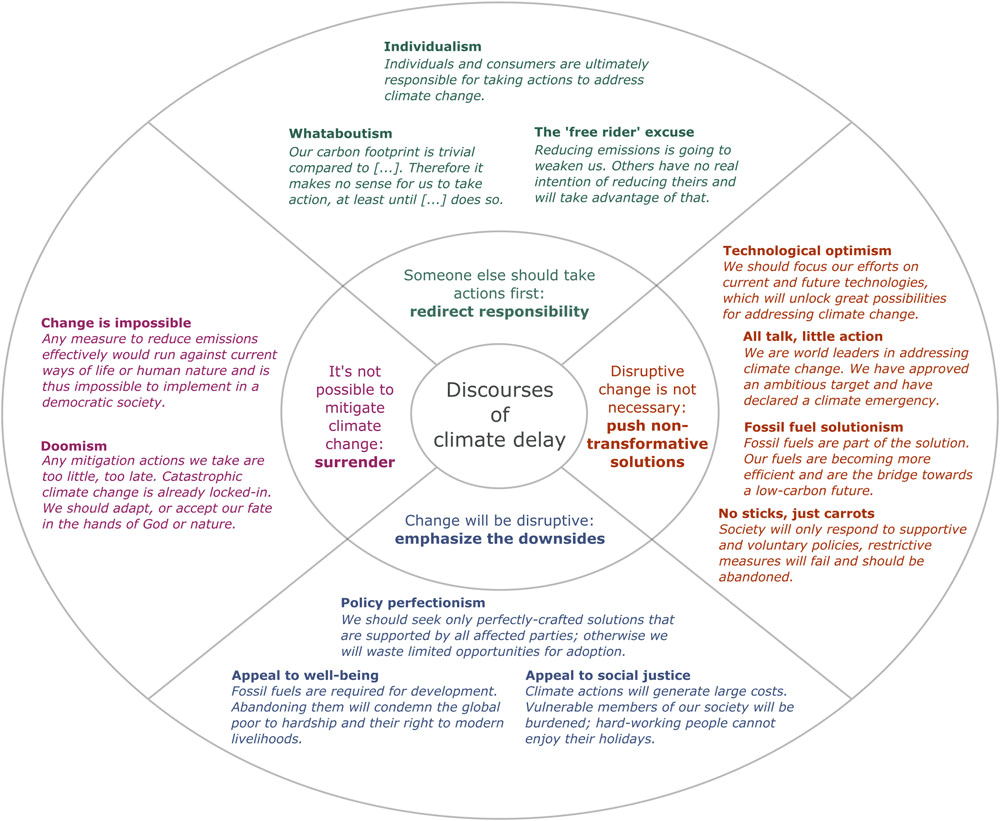
A denial diagram

July 8, 2020

I think this diagram is quite neat and useful… Hopefully I can say more about it tomorrow

From:

William F. Lamb, Giulio Mattioli, Sebastian Levi, J. Timmons Roberts 2020. “Discourses of climate delay”. Global Sustainability 3, e17, 1–5
DOI: https://doi.org/10.1017/sus.2020.13. Published online by Cambridge University Press: 01 July 2020.

The Diagram can help you avoid your own resistances, and forms of delay, by simply inverting it….

  • 1) Take responsibility now – do what you can, don’t pretend its some one else’s job to go first. Going early will make transitions easier and quicker. Be generous – don’t expect rewards or praise
  • 2) Human nature is pretty flexible. That something is hard does not mean it is impossible. If we act now we can at least stop it getting maximally bad, which is a really good thing.
  • 3) We don’t have to be perfect, just act as best we can. Accept what you are offered by the politics and take it further. Fossil fuels are poisons, lets get healthy. Burn as little as you can. Climate chaos will affect everyone, but poor people much worse, so help them out. Just stop doing things which harm the environment directly. By stopping, you support all our lives.
  • 4) While we support research, we need to solve the problem, as best we can, with the tools we have now. We can’t depend on fantasies that we will develop wonderful super-tech, or that everything will turn out ok, because Murdoch tells us so. We may need to penalise those who would destroy the lives of the rest of us, by continuing emissions. They might need warning, and gradually increasing penalties and costs, but that will help them change. Conversely we can reward those who do well.
  • 5) Doing the right thing is not always easy, but we do it anyway.

COVID and CO2

June 1, 2020

We have heard a lot about how you can see now see the Himalayas and air pollution has gone down markedly.

However a few stats from the Guardian’s “Green Mail”:

Weekly average CO2 readings

1) 1 March 2020: 413.84 ppm
Last year: 411.91 ppm

2) 29 March 2020: 415.74 ppm
Last year: 412.39 ppm

3) 18 April 2020: 416.27 ppm
Last year: 413.62 ppm

4) 25 April 2020: 415.88 ppm
Last year: 413.71 ppm

5) 16 May 2020: 416.79 ppm
Last year: 415.31 ppm

6) 23 May 2020: 416.97 ppm
Last year: 414.72 ppm

Despite the reduction in economic activity and visible pollution, CO2 readings are still up on last year.

Imaginary Technology and Climate Change

May 27, 2020

This blog article is largely a summary and brief discussion of a short paper published in Nature Climate Change. “The co-evolution of technological promises, modelling, policies and climate change targets” by Duncan McLaren & Nils Markusson. I mesh some of the summary with a blog article written by McLaren, as this appears to give extra information and more clarity to the general argument. Unless specified, quotations come from the article.

The paper discusses “technologies of prevarication” which form part of an “an ongoing cycle that repeatedly avoids transformative social and economic change” (p.392).

The ‘gentle’ argument is that the international goals of avoiding climate change have been reinterpreted in the light of new technological and modelling methods, and the promises these new ‘devices’ have allowed. These technological promises, in general, allow the sidelining of social transformation, and the delay of any real cut back in emissions.

In the terms I’ve deployed elsewhere, these fantasies about technologies act as defense mechanisms against change and political challenge.

The article proposes five different stages in the global climate policy process. These stages overlap, but policy debates about targets in these stages “was noticeably framed primarily in [certain] terms while previous formulations retreated from the public eye” (p.392).

The stages they argue for are:
1) Stabilizsation c.Rio 1992
2) Percentage emissions reductions c.Kyoto 1997
3) Atmospheric concentrations c.Copenhagen 2009
4) Cumulative budgets c.Durban 2011, Doha 2012
5) Outcome temperatures c.Paris 2015

I should add that I don’t think these stages are proven and fully documented (the article is short), but they are plausible, and I’m sure the authors will document them more rigorously later.

Stage 1: at Rio, when the United Nations Framework Convention on Climate Change (UNFCCC) was negotiated,

the UN settled on a goal of ‘stabilizing atmospheric concentrations of GHGs [Green House Gases] at a level commensurate with avoiding dangerous anthropogenic climate change’…

p.392

This was associated with coupled ‘general circulation models‘ [1] and ‘integrated assessment models[2] which allowed the exploration of emissions reductions techniques and their economic costs. As the authors say in a blog post:

assessing specific policy interventions with these early models was difficult, and responses were often discussed in very broad-brush terms.

13 May 2020 Guest post: A brief history of climate targets

Policy responses included: energy efficiency, promotion of forest carbon sinks (the blog adds ocean iron fertilisation), and finally nuclear energy. Nuclear energy stalled largely because of costs and public concerns about risks, and voters not wanting to live near one.

Stage 2: The debate around Kyoto was largely over speed of emissions reductions, usually with percentage reductions of emissions by target dates.

Models enabled people to relate emmissions cuts to concentrations of GHGs, but not to outcome temperatures.

Policy and promises focused on emissions reductions from fossil fuels, through the technologies of Carbon Capture and Storage (CCS) (promising up to 90% reductions from fossil fuels) and fuel switching, and on energy efficiency. Trading schemes were proposed, [although were often so slackly developed, in order to reduce costs to business, that they had little result.] The IPCC issued a report on CCS. The blog mentions that in some parts of the world there was talk of building new “capture ready” coal power stations, with licenses being granted before the term was even defined. The blog states:

CCS was selected preferentially by the model algorithms because the simulated costs of continued expansion and use of fossil-fuel power – linked to retrofitting with CCS – were lower than those associated with phasing out electricity generation using coal and gas.

13 May 2020 Guest post: A brief history of climate targets

However,

practical development of CCS got little further than research facilities, while the promise of ‘CCS readiness’ even facilitated continued construction of new fossil power plants.

p.394

Fuel also switching did not live up to its promise.

Modelling

continued to become more sophisticated. It moved on to establish direct links between economic activity and the concentration of CO2 in the atmosphere. 

13 May 2020 Guest post: A brief history of climate targets

Stage 3: Atmospheric concentrations c.Copenhagen 2009

The blog asserts that in the lead up to the Copenhagen COP, there was intense debate over setting a goal for atmospheric CO2 concentrations. Initially 550 ppm was considered adequate but the debate saw that lowered to 450 ppm.

There had been little progress, in reducing emissions. Bioenergy came to the fore as a promise, especially Bioenergy with CCS (BECCS) which implied a lowering of GHG concentrations at a future date. At the time BECCS was more or less completely conceptual, but it merged two apparently known technologies so was considered practicable.

Like CCS before it, BECCS promised ways to cut the costs of meeting a particular target, slowing the transition even more by its promise to effectively reverse emissions at a future date.

p.394

The blog phrases this more strongly. BECCS “allow[ed] the justification of a slower transition by its promise to effectively reverse emissions at a future date.”

Computer modelling became more complicated, with many 450 ppm of CO2 scenarios using the postulate of imagined CCS. The fact that this target appeared, to some, nowhere near adequate to prevent destructive climate change led to 350.org being founded.

There was less talk of emissions cuts and more talk of concentrations, and some possible confusion over the connection to temperature outcomes, even if the Copenhagen was officially focused on keeping the increase in temperature at about 2 degrees.

Yet again, CCS, or BECCS, had failed to be deployed, or we might add, even researched, to any useful extent.

Stage 4: Cumulative budgets Durban 2011, Doha 2012

some negotiators argued… for the pursuit of ‘a clear limit on GHG concentrations, and consequently a scientifically calculated carbon budget’…

p.394

A Carbon Budget attempts to set a total limit on the CO2 that can be emitted by States, to keep global temperature rise below a certain level. According to the blog “the UK began setting periodic five-year carbon budgets under its Climate Change Act in 2008″.

At around the same time:

the development of a simple inversion tool in the MAGICC model enabled not only the development of RCPs [Representative Concentration Pathways], but also more sophisticated global carbon budgeting models.

p.394

The idea of limiting cumulative emissions seemed to be more robust than previous methods, but opened the idea of imagined ‘negative emissions technologies’, which again reinforced the fantasy of underdeveloped BECCS. Indeed these imagined technologies became the only way forward, even if they largely remained imaginary.

As the blog states:

In addition, [these negative emissions technologies] enabled promises of future carbon removal as a means to reverse any “overshoot” of the budget…. And there is a fine line between inadvertent and planned overshoot

13 May 2020 Guest post: A brief history of climate targets

Stage 5: Outcome Temperatures. The carbon budgets idea never really got put into play – possibly because they were too empirical and demanded emissions cutbacks, and the non-use of fossil fuel reserves. So the Paris COP shifted to a focus on temperature increase – officially 2 degrees, but possibly 1.5 – as the boundary around dangerous climate change. This further boosted talk of negative emissions technology.

Looking ahead, although [Negative Emissions Technologies] might retrospectively balance carbon budgets, delayed action would still make a temperature overshoot more likely.

p.395

This helps construct “a space for an imaginary technology that can act directly to reduce temperatures”, such as Geoengineering. This, in turn, makes the use of geoengineering, and attempts to control the ecology of the whole world, more likely to be factored into models.

However, it is extremely difficult to accurately model the ecological consequences of geoengineering (especially without large scale testing), so the likely undesired effects become a cost left out of the models.

The blog remarks:

Many national and business targets are now framed as “net-zero” carbon, explicitly – or implicitly – achieved through substantial future deployment of carbon removal. 

13 May 2020 Guest post: A brief history of climate targets

Conclusion

Policy change looks like to be a co-evolutionary process involving implicit policy, politics, models, and imagined technologies.

In this process, the ‘evolutionary fitness’ of each technological promise is less a product of its (potential) climate impact than a measure of how well it can be modelled, and how well it matches the extant framings of climate policy.

p.395

These imagined techs then become embedded in the models and in the policy projects even if they do not exist at sufficient scale, after years of opportunity. The blog argues that the problem is magnified because the “integrated assessment models” focus on:

cost optimisation with time discounting. This means they favour future promises of action over plausible, but potentially costly, near-term interventions.

13 May 2020 Guest post: A brief history of climate targets

The delays make the policies look cheaper to deliver, and cheapness is, in neoliberalism, a virtue; but over time little has been delivered – for example it appears that during the first decade of the twenty-first century, world coal production almost doubled, and it has not declined back to dangerous 1990s levels, yet.

Critically, in this process, each technological promise has enabled a continued politics of prevarication and inadequate action by raising expectations of more effective policy options becoming available in the future, in turn justifying existing limited and gradualist policy choices and thus diminishing the perceived urgency of deploying costly and unpopular, but better understood and tested, options for policy in the short term.

p.395

These technologies of prevarication have rarely delivered on their promises, or been as cheap as expected, and have rarely been embraced by governments or business in practice as opposed to imaginal rhetoric.

Often the problems, or unintended consequences, of the imagined technologies were not seen until people started to implement them. BECCS for example can result in deforestation, impingement on food production, require large amounts of energy input, and the extracted CO2 can be used to help push oil out of wells to be burnt to produce more CO2. At the best talk of CCS and carbon extraction merely slows down transition.

There is a possibility that:

each promise has, to some degree, fed systemic ‘moral corruption’ in which current elites are enabled to pursue self-serving pathways while passing off risk to vulnerable people in the future and in the Global South.

p.395

The technological promises, promise to save neoliberalism and market based developmentalism, and “promised future action, rather than immediate sacrifice.”

Carbon sinks may have perhaps gone backwards. Nuclear power has almost ceased being built, even though the promise remains to allow people to imagine future cuts in emissions. Efficiency gains have enabled growth in consumption and energy expectations have expanded. Often technologies etc have allowed additional energy capacity rather than reduced emissions. We can add that it appears that many countries (particularly China and the US) have encouraged poorer countries to lock-in to coal dependency to keep the exporters coal mines running, as emissions are counted on a per country basis. This increases the cost of conversion to renewables – all the money which could have been spent getting the countries self sufficient in renewables has been wasted in fossil fuels. While cheaper renewables make a change apparently more practicable, it is an extra expense and destruction of invested capital that poorer countries, and some wealthier ones, cannot afford easily – they have more immediate expenses, and few powerful people like to admit they have wasted money for nothing.

The whole process has downplayed urgency and helped defer deadlines for action.

We have played into the imagined technological fix, rather than the social change we need. There is no suggestion that the people who have invented and worked on this technology are to blame, the problem is the way their imaginings have been used to in policy and modelling to maintain small scale action. It has been more important for politicians to maintain neoliberalism, and development, than to act on climate.

[L]ayers of past unredeemed technological promises have become sedimented in climate pathway models. Contemporary imaginaries may prove just as unrealizable as the previous generations of promises,and there is no logical end to the set of possible technological promises that could be added to ‘resolve’ the models.

p.396

This ‘sedimentation’ of failed technological promises is now so standard that risks of technology disappointment and failure should be incorporated into models and policy discussions, and research.

Thirty years of failure, should show that we cannot continue our society working as it does, and expect to solve problems of climate change. We have to, as the blog states, “deliver behavioural, cultural and economic transformations.”

Comment

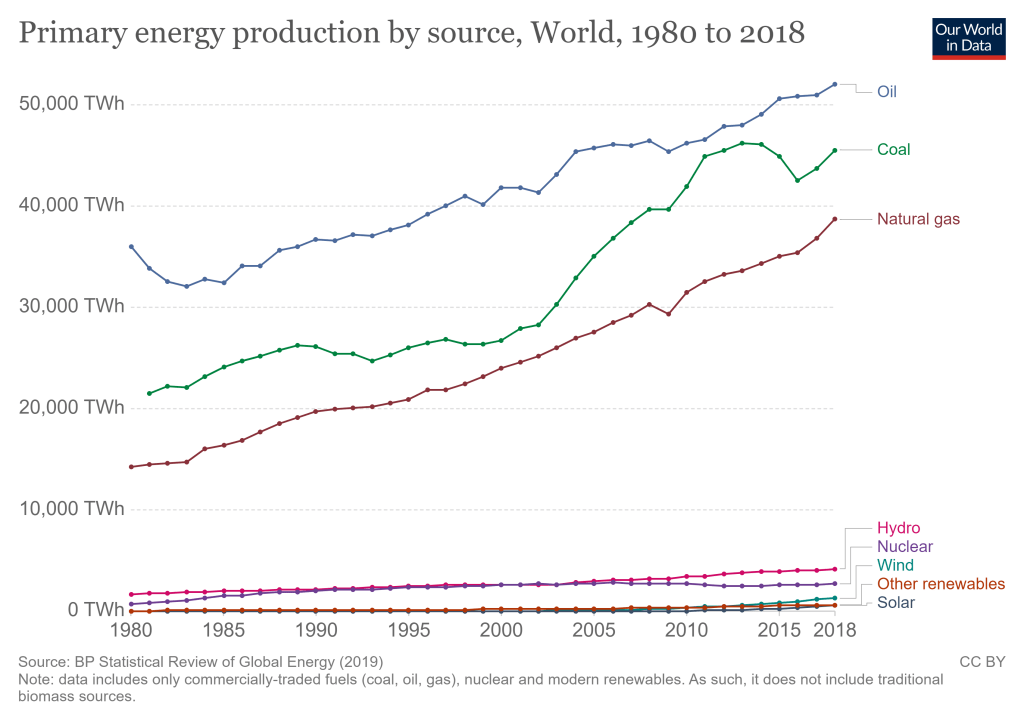
Assuming the figures used to make this graph are accurate, the image shows how well we have reduced energy production from fossil fuels, and how much we have increased renewable energy in the last 40 years.

source: https://ourworldindata.org/grapher/primary-energy-prod-source?time=1980..2018

We have failed. We have had years of climate action, discussion between nations, and targets have been set, yet the actions taken have ignored the problem and made the situation worse. The idea that technologies are largely defense mechanisms or modes of prevarication, is graphically illustrated. If we keep the same social organisation, and the same development processes going, then we are committing suicide. Whatever the appearance our States are failed States, when it comes to dealing with this problem.

We cannot rely on the State or big business to save us, or even to try to save us. We have been doing that, and this faith has not been repaid. We may need to get to work outside the State and outside big business…

This is where ideas of degrowth and community energy democracy come in. Degrowth will almost certainly not be a popular response to politicians, but it does allow us to ask questions which are otherwise not being asked. These questions have the potential to open the unconscious of our social dynamic towards destruction.

What, for example, if we tried to reduce burning fossil fuels without replacing them? This would be world changing, it would also start debates about wealth distribution, and energy distribution. What do we really need the energy for? How do we need the energy production distributed, to make these cuts possible? How can we levelise consumption to give everyone what they need to survive comfortably and freely? Can communities build and manage their own energy supplies? Can any of this be achieved along with the maintenance of rivalrous military based nation states? Will those in power who love the maintenance of violence-based hierarchies fight with all they can muster to go to destruction before surrendering their power?

I doubt such questions will be asked, but they are essential, otherwise technology is likely to primarily remain either a prevarication or a defense mechanism, which maintains our self-destruction.

Lomborg cannot be blamed for this

March 25, 2020

The article by Bjorn Lomborg I discussed recently was followed by an editorial in the same Newspaper which significantly distorts Lomborg’s position, twists it into total denial, and do-nothingness, and shows the dangers of that position once it becomes political and is used to argue much harder and far more incoherently than Lomborg himself.

The editorial asserted that the problem with the bushfires was simply their visibility through social media. There was no mention of the clouds of smoke dust and ash which hung around the city making the fires visible to everyone outside social media, of course. Presumably we are expected to have short memories.

The other problem was apparently the unscrupulous “climate evangelists” who were prepared to exploit this visibility through social media: “People have promoted misinformation to push a policy barrow.”

We might even be able to agree with this, but it may not only be the climate activists who have promoted misinformation, or even illogic, for political reasons.

Use of the word unprecedented has been instrumental; by politicians, activists and journalists. It has been deployed since November last year in an attempt to invoke climate change as the root cause of the fire disasters.
This has been contrived and dishonest.

The editorial argues that the reality is that the fires were a once in a generation experience, but we have them all the time (yes the argument was that coherent). They continue by suggesting that maybe the fires were unprecedented, but not all of the fires were unprecedented, so none of them were unprecedented. There have been lots of fire disasters in Australian history, so to say that this one was unprecedented, is dishonest.

Fires are not a new threat, and, even if they were, they cannot be neutered by climate policy, they will still exist.

This is proven by Bjorn Lomborg:

annual areas burned by bushfire across our continent are on a clear downward trend; and this year’s total, so far, is well below average.

Presumably what we are to conclude from all this, is that all fires are similar, and no Australian fire could ever be unprecedented in its intensity or spread, because there have been fires previously. Area of blaze is more significant than intensity of blaze. So nothing to worry about here…

Let me repeat Prof. Lomborg gives no evidence for his assertions about decline in fire areas, and does not explore alternative explanations for these figures. He merely asserts there is evidence. He may be right. He may have irrefutable evidence. But from that article we do not know.

The editorial does admit that the drought probably had something to do with the fires, but the drought is “not directly linked to climate change” – we have droughts don’t cha know? The fires could have been influenced by high temperatures and strong winds which also apparently have nothing to do with climate change. Fires were also caused by “Natural and human-induced ignition, and heavy fuel loads because of insufficient hazard reduction”. So the ‘natural’ apparently makes it ok or inevitable, and the human implies that it was all the fault of arsonists. No mention of the fact that the fire service could not find many wet or cool months to do the hazard reduction, with the addition that that had nothing to do with climate change either. Perhaps three denials of climate change in a row would look to be pushing it.

People also built houses in the bush and were not prepared. So there you are: its all the fault of the NSW State government for not finding the right times for burning, and if people had not built houses in the bush there wouldn’t have been any blaze. No they are not arguing that latter point, but they are probably trying to diminish the number of properties destroyed – by implying it was all the home owner’s fault for being stupid or unprepared. That is what I would call politicising the fires at the cost of the victims…. which is a recurrent theme of theirs used to berate people for talking about climate change.

The editorial remarks that in the good old days we would have all come together with “the all-too-familiar smell of bushfire smoke” but this time the evil greenies split us apart and those days of unity and uniform agreement with Mr Murdoch are gone forever.

Then we learn the crisis was magnified by the mainstream green left-oriented media (!!!) who are hell bent on getting revenge on the Coalition for winning an election. This ‘Love media’ includes channel 9 and “online Twitter feeders such as Guardian Australia.” (‘Love’ obviously has some unique The Australian meaning here.) And there were other jejune people on social media reporting what they experienced as “social media memes”.

“Displaying the corporate and professional memories of goldfish, they gave us a sickeningly revisionist perspective” in which climate change was relevant to the fire, when all sensible people know it was not, even if they didn’t at the time.

This green left media deliberately discourages tourism and politicises everything by disagreeing with us. They engage in abuse! People will eventually see this overreach of climate activists and come back to supporting the government – and we can live in natural harmony once more….

“Facts do matter.” Yes they do whatever the editorial writer asserts,

Whatever climate policies are adopted in Australia, they cannot change our climate because global emissions are still rising sharply.

Yes and they will continue to rise rapidly as long as we have editorials like this, prepared to sacrifice everyone and everything for the continuance of a failed and flailing order.

“Alarmism is the order of the day”. No, unfortunately this kind of editorial silliness is the order of the day: extremism posing as rationality; the victim blamers pretending to be the victim; politicisation pretending to be apolitical and dispassionate.

If “alarmism” was the order of the day, we would have policies to deal with climate change and its consequences. We would be phasing out coal mining, we would not be talking about new coal power stations, we would be limiting land-clearing and deforestation, we would be discussing how to protect our low lying areas from sea level rises, we would be building new energy grids, we would be clarifying energy regulations in consultation with industry and communities, we would enable rather than hinder community energy, we would discontinue subsidies for fossil fuel mining, we would be seriously investigating regenerative agriculture and so on. The fact that we are not doing any of these things suggests that denial, and fossil fuel companies reign supreme.

Apparently this editorial describes what many politicians might believe, or believe it is safe to believe…

To finish with a remark from Lomborg on the glaring inadequacies of the Paris agreement:

President Trump…. failed to acknowledge that global warming is real and wrongly claimed that China and India are the “world’s leading polluters.” (China and the U.S. are the largest emitters of carbon dioxide, and the U.S. is the biggest per capita.)… the White House now has no response to climate change….

The real misfortune for the planet isn’t that Mr. Trump withdrew the U.S. from the Paris treaty. Rather, it is that his administration has shown no interest in helping to launch the green-energy revolution that the world so urgently needs.

Wall Street Journal 17 June 2017

Just like the Murdoch Empire.

Spirit, soul, flesh and the climate crisis

March 24, 2020

The issue of spirituality again….

There seems to be a lot of people claiming that ‘materialism’ is the problem and ‘spirituality’ is the solution. It is not always clear what they mean by either of these terms, but these terms are binary, and define the other by what it is not. To the materialist the spirit is nothing, and to spiritualists matter is nothing. But both form a category based division of the world, which depends on each other for their meaning and sense of reality.

As I’ve discussed before binary and ‘mono-ary’ thinking are reductive. You seem to need at least three terms to start thinking non reductively, and even then it is difficult not to reduce one’s thought to the one or the two. You may always need a prime number of terms, to begin to avoid the reduction into binaries. A four term layout may easily reduce to two binaries and so on.

With the two terms, spirit and matter, we generate ‘opposites’ and ‘oppositions’, in which one term is valued more than the other, rather than complements, but you cannot have one without the other, even if they go as far as to deny or slancer the other to give themselves meaning.

James Hillman tries to broaden thinking and perceptions, by using the old Christian terms ‘soul’ (psyche), ‘spirit’ (pneuma) and ‘flesh’ (sarx or apparently sometimes soma although this latter could mark some further differentiation ). For a long time, it has seemed odd to me that this triadic distinction gets reduced to spirit and matter, especially if you hold that God is a Trinity, which was the official position….

In Western Culture, in a slightly modified use of Hillman’s terms, ‘spirit’ is the force of ascension – that which tries to leave the world and the flesh behind. It is that which is convinced its true habitation is elsewhere in spiritual clarity of pure mind and, at the extreme, sees the flesh as a prison, a tomb, or as unreal, by comparison with the freedom, might, power and reality of spirit. Often, with visions of the spirit, individuality, isolation, etc dies in the realisation of that spirit, in its “oneness”.

Soul, on the other hand, is that which seeks meaning in the dark, in the depths, of feeling, imagery and in recognition of our unconscious. It seeks the light of nature. It is the descent into and through the flesh into this world.

It could easily be suggested, that in these terms, pure spirituality is destructive of the flesh and the body. It is the parent of lack of care for the Earth, for the trope of abandoning the Earth or destroying the prison of the Earth. In its view ‘positivity’ overcomes everything, because the world and the flesh have no mind, no thought, no real being, they are at best obstacles for spirit which have to be overcome to reach our real home in immaterial spirit and God.
In other words, the problem with our world is not materialism, but the spirituality which generates materialism as an opposite, as part of its path of ascent away from matter. It, as a matter of course, generates ecological crisis, because it has no care for such things. Nature is irrelevant. We can gather in thousands to glorify the spirit in the midst of plague and no harm will befall us.

On the other hand, again in these terms, soul accepts the reality of the world and our literal attachment to the world. It accepts it is part of the flesh, and feels the flesh, and is the ‘salvation of the flesh’ perhaps through suffering. As love it is sensitive to the movements of matter and flesh, and the images that arise from matter and are transformed and recombined by the soul into its visions, and translate the unknown and unconscious into something it can intimate. The world has meaning through its synthesis with soul. The soul does not turn away from misery, but does its best to help, and its idea of help is not to increase their suffering so that they die into spirit, but for them to live with what is, and what can be improved and transformed as in alchemy. The soul sees the divine as here already, and not as about to leave. It may even produce the divine that is here. The soul sees the golden light and mind of matter. Soul tends ecologies because it expresses them and loves them as its basis.

If we wanted to, we could say that the approach of the soul does not create a barren materialism, like the approach of spirit, but a divine materialism in which the word is made flesh, and flesh becomes the word, and is alive.

Where we to go further, we could say that this triad is a model of continual circulation. That matter is ‘coarser’ spirit and spirit ‘refined ‘matter, but never separate, and the soul is a perspective on this dynamic procession.

We descend into the world and the flesh to find experience and to imagine, think, feel, pleasure and exist, and then move into the spirit bringing what we have learnt to learn again, and then return to the flesh, bringing what we have learnt to learn again. And this is not just ‘between lives’ for those who believe in reincarnation, but within the one life. The soul holds us together feeling and imagining all as we progress. But none of the three exist apart, and cannot exist apart without collapse. The procession is circular.

Separating the flesh and spirit, which the spirit does so easily is a form of death, recombining within soul is a form of enlivening, and thus the cycle continues and the earth is continually reborn, in reality and in our eyes.

The latest from Project Drawdown

March 17, 2020

From The latest report slightly rephrased.

1) We can reach Drawdown by mid-century if we use the climate solutions already in hand at a large enough scale. We can solve our problems even without technological innovation.

2) Climate solutions are interconnected as a system, and they should reinforce each other.

3) Climate solutions have other benefits for people as well, such as no longer being poisoned by pollution, or having their land destroyed.

4) Savings significantly outweigh costs.

5) We need to accelerate moves to reduce or replace the use of fossil fuels. We need to actively stop the use of coal, oil, and gas and replace them with other sources of energy – renewables, hydrogen etc.

6) We need to simultaneously start reducing emissions towards zero and support, or expand, nature’s carbon sinks

7) Some powerful climate solutions receive comparably little attention, reminding us to widen our lens.

  • Food waste reduction and plant-rich diets
  • Regenerating eco-systems
  • Restoration of temperate and tropical forests
  • Rehabilitating peat lands
  • Encouraging Ocean based Carbon sinks (which improve fisheries)
  • Preventing leaks and improving disposal of chemical refrigerants
  • New cements, which exist
  • Building recycling responsibility into products
  • Bio-plastics
  • Electric Transport and improved public transport running on zero-emissions energy.
  • Access to high-quality, voluntary reproductive healthcare and high-quality, inclusive education

8) Solutions do not scale themselves. We need means of removing barriers and accelerating their implementation and expansion. That is, we need political and cultural action.

9) The climate crisis requires systemic, structural change across our global society and economy. Footholds of agency exist at every level, for all individuals and institutions, to participate in advancing climate solutions.

10) Greta Thunberg: “You must take action. You must do the impossible. Because giving up can never ever be an option.”

We should probably add that we need to stop, as quickly as possible, all pollution – that is all waste which cannot be processed by the ecology in the amounts that are emitted. We also need to stop deforestation, and over-fishing.

We need to phase out all subsidies for fossil fuels, whether they are taxpayer handouts, tax breaks, tax evasions, royalty holidays or anything else. If needed the recovered money could be used to help renewable development.

All of these moves will cause lots of opposition, but they are necessary. It is not just a matter of what we do, but what we refrain from doing.

A sketch of the Dynamics of Climate Argument

March 13, 2020

There are several points which seem relevant to the question of the politics of ‘disbelief’ in climate change, and the popularity of refusal to act when it seems needed, even if surveys continually report the result that people say they want action.

General factors affecting information in “information society”

The dominance of neoliberalism with its long established belief in economic growth at all costs, the sanctity of corporate profit, hostility to environmentalism (especially when this affects the profit of established companies), active disempowering of political participation by ordinary people, and its tendencies to plutocracy, is vital to the promotion of climate change denial or do-nothingness. Wealth gives groups of people the power to promote information that suits them. However, I’m not going to consider that here, it remains a background. This post will be about the dynamics of information society and what I call ‘information groups’.

Most of the problems with climate inaction stem from the obvious fact that, in an ‘information society,’ even one with lots of good knowledge, nobody can accurately ‘know’ everything. People cannot accurately know even a fraction of what is relevant to them. Even if they specialise in a field they almost certainly do not know everything in that field either.

Most of us are stunningly ignorant about all kinds of things. The more ignorant a person is, the harder it is for them to recognise their own ignorance – they have little accurate knowledge with which to judge what is plausible or what are the likely consequences of their actions.

Furthermore:

1) Information and communication are only secondarily about accuracy. Information and communication primarily function to create group bonds and group memberships (what Malinowski called phatic communication), and to persuade others to do as the speaker prefers.

Given this, information and communication can be thought of almost entirely in terms of strategy and tactics, or the effect that the message has on others. Rather than keep talking of strategy and tactics, I will, from now on, use the term ‘politics’. If accuracy contributes to this politics then it can be important, but it tends to be secondary. We all know that in everyday life people lie to keep others on side, to avoid hurting them, or to keep bonds functional and relatively harmonious. This is normal in conversation. It is a daily experience at work, in encounters with management in particular.

Truth is not always necessary, and is often avoided to help social functioning, avoid conflict, and get on with those in power.

Although complete inaccuracy could eventually lead to breakdown, it may in the short term contribute to political success in terms of producing harmony and co-operation within the group, and asserting dominance over other groups.

2) Need for information filtering. In ‘information society; with massive amounts of information available, people need to filter information otherwise they cannot orient themselves in the world or act in the world. There are too many contrary positions for ease of functioning, and given that people know information is often false, expressions of ignorance, or deliberate lies for political purposes, they cannot accept (particularly uncomfortable or disruptive information) immediately.

This lack of accuracy and certainty in information, is so fundamental to modern life that it is more useful and accurate to talk of ‘disinformation society‘ than of ‘information society’. The society does not function entirely through accurate knowledge, but through using or dealing with an ‘information mess’. Information mess can be increased deliberately, as when Steven Bannon, who was an adviser to President Trump, recommended “flood[ing] the zone with shit.” This prevents consensus about accuracy or probability from forming, and it creates a disorientation, which might help people to be manipulated by dominant people within the group.

3) Information groups as filters. Because of the disorientation arising from too much contradictory information, people end up relying on other people (groups) for filtering information and belief. This involves the creation of strong group identification, and a level of trust and distrust of that group and other groups. These groups I call ‘information groups,’ they help people decide what is real. In disinformation society, many of the primary information groups seem to be politically oriented. Perhaps this is because politics is about action and orientation in the world, and this is what has become confused.

This kind of group identification involves personal identity as well, as it sets forth who one is to like, admire and emulate, and who one dislikes, avoids and tries to be different to. In that way, a person’s sense of who they are in disinformation society can come from those they identify with and the principles, or information, they identify with. The stronger the boundaries around the groups a person identifies with, the more strongly the group acts as a filter, and can reject unwelcome data in general.

Because of these processes of self-identification, the people in the group have a claim to be moral, while those outside the group (especially if classified as oppositional) rarely appear to have such a claim. Leftwingers are communist, satanist, effeminate whimps who cry a lot. Rightwingers are stupid, ill-educated, redneck, racists.

The prime point of these processes is that if an information source seems to be an exemplar of the group and its values, then its information will seem more trustworthy than if not. If the information appears to come from a source which is not exemplary, or is exemplary of the ‘opposition group’ then the information will seem untrustworthy, or ‘politically motivated’. If a source can make contrary information seem to come from an ‘opposition group’, while their own information matches the information groups’ values and beliefs, then they will often have achieved persuasion, without any mention of ‘facts’ or any real evidence.

Group alliance and identification becomes the primary (and unconscious) way of determining what is to be believed and what is to orient action.

There is also some research that suggests that having one’s opinions confirmed by others is pleasurable, and having others disagree is unpleasurable, so there is further incentive to seek out sources and others who agree with you and thus join information groups, even if without being aware of it.

4) Knowledge and Status. One way of claiming high status and functionality in information society, is to claim, and persuade others in your information group, that you are knowledgeable, well informed and certain, and that others are not. This probably decreases the chance of the person being well informed, because they ‘know’ the truth of their own certainty, and ignore counter arguments and data. However, the certainty (especially if the person is enunciating positions of group identity) can be attractive to other people in the group, and helps those people gain certainty in their own knowledge and orientation, and in the incorrectness, or immorality, of those who disagree. It also grants the original person more power, authority and influence; so it becomes a self-reinforcing loop.

To repeat: Solidarity, or lack of solidarity with the information group, acts as a filter for the information a person receives and accepts. Consequently, it is important for successful propagandists to manufacture a strong degree of solidarity and identity amongst those who support them, and to break the solidarity and identity of those who oppose them. The more confused the information mess, the more the zone is flooded with shit, the more that any hostility of ‘information outgroups’, to the group and its identities, will appear to make the solidarity of within the group reassuring. This also has the result that most conveyors of misinformation will be repeating what others have told them and not be deliberate propagandists.

Experience of repetition of information from multiple sources (even if they are from the same information group), makes that information more compelling, it gives it social backing and certainty – as well as implying people who disagree must be mistaken.

The other side of keeping the information groups’ truth going, involves, increasing the distrust of sources the person might disagree with (because of their group identification), and a degree of building trust for those sources they agree with.

In capitalist information society, distrust can be a general framework, not only because there is so much counter-information, and so much alienation from the ‘establishment’, but because distrust allows a person who finds their favoured sources have deceived them, to say that they never trusted them anyway, and to keep on following them and keep their group identification. It declares their wisdom and freedom – they are not being manipulated, they can tell themselves and others, they know how to evaluate news.

Practical consequences of the above.

Within this framework

1) Winning Rhetoric.

The modern right appear to want to win at all costs, they do not appear that interested in accuracy, truth or principle, which does not contribute to victory. Indeed they may well regard ‘the masses’ as needing to be led, and have no problem manipulating people and lying to them. The current left (such that it is), on the whole, tend to regard the people as equals and as needing to be informed, rather than manipulated. In disinformation society the left is vulnerable, and will generally lose.

2) The Process of Persuasion has several prongs:

a) Binarism. You need to make an opposed binary, ‘us and them’, and to convince people that they cannot trust the institutions and information of the other side.

b) Condemnation In pro-fossil fuel thought, this involves attacks on scientists as socialist conspirators, or as only being in it for the money. In climate action thought this involves condemning people on the other side as corporate tools, trolls, or ignorant ‘rednecks’. The abuse helps keep parties apart when they attempt to discuss the issue (“the other side is so abusive, they can’t think”). If this strategy works, people on our side no longer even have to listen to the other side.

c) Trust? This leads to the situation in which we are virtuous, and (on the whole) can be trusted, while those immoral people who support the other side cannot be trusted with anything.

d) Messy contradictory messages. For example, when Lomborg implies we don’t have to do anything, but research is necessary, nuclear is necessary, CCS is necessary and so on. This allows people to take a flexible position, with regard to winning an argument. “We need do nothing and we must do research into green technology, but not their green technology.”

It actually appears, in this case, that the idea seems to be that we don’t research or explore nuclear or the CCS, even while promoting them as solutions. That way you can confuse the issue, and attract both those who think something should be done but that renewables or social transformation is not the answer, and those who want to do nothing.

These strategies are so common, that people may not even think about them, but just deploy them.

3) Muddy the waters by:

a) Playing on the idea that ‘consensus’ means that scientists got together and agreed on something for their own purposes, rather than were persuaded by the evidence. Its a conspiracy!!

b) Providing other scientists or even non-scientists who can put forward the position there is no climate change, or its not humanly caused. This confuses the issue.

This is effective because in information society, most people are ignorant and confused, and cannot check the research themselves. They probably will not check whether the sources ‘refuting’ climate change are climate scientists or not, but if it turns out the source does not have experience in that field, then it does not matter as climate scientists are immoral and conspire.

c) Insist the media cover ‘both sides’ of the controversy equally. If they won’t then they are biased. Everyone on the right ‘knows’ the media is left wing, because it occasionally criticises the right, so this is easy to believe. This is despite the obvious fact that the media is owned and sponsored by the corporate sector, and hence is likely to support that sector and its established authority. Those people who insist that the media cover all sides of the climate ‘debate’, never insist that the media cover all sides of the economic debate, and that debate is actually a real debate. So this insistence seems purely political.

d) If you can persuade people on your side that only a few media organisations are truthful because they support “our side,” and those organisations run specific campaigns, then people will tend to believe those campaigns, because those media organisations are part of the information group.

e) Flooding the zone with shit, means that much real information will be ignored or become normal, as when the repetitive narratives of President Trump and his allies’ corruption, deceit and convictions become normal, and they pass away beneath new showers of shit, and are not repeated ad nauseam as were the allegations of Clinton corruption, which then appear true, even if they never resulted in anything.

4) Emphasise the costs and uncertainties of action.

Do not mention the costs and uncertainties of inaction. In a social situation where neoliberalism is based on the idea that cost to profit is bad, this will help emphasise the immorality of action.

5) Heroic individualism

The US has a guiding belief in heroic individualism, which grows out of, and feeds into contemporary neoliberalism. Not only does this individualism fit with the survival politics of neoliberalism and disguises the fact that we don’t come to know things by ourselves, it also sets up the idea that the person taking what is portrayed as a ‘minority’ position is heroically doing the research by themselves. They will not realise that most of their heroic research is being channeled by their own side (or propagandists for the establishment, or people appearing to be on their side) into work which supports their sides objectives – which may not be their own objectives of finding ‘truth’.

I have met many climate change deniers who seem to consider they have done research, when that research only involves reading what deniers say. If the group opposition is established strongly enough they don’t have to read that which they might disagree with, as it is clearly faked. They have little to no contact with real research, don’t know how to recognise it if they did, and frequently misuse it when they find it (apparently not even having read it, in many cases). Those people who tell them they are wrong, are clearly being persuaded by the group mind, the dominant faction, the uniformity of the media etc. Again they do not have to listen.

6) Claims of persecution

Another important tactic is to imply the information group is being persecuted for its knowledge by a dominant group. This reinforces the idea that counter-information is purely a matter of the other groups’ politics, and thus dismissable. However those in our information group are heroic individuals struggling to get the truth out against powerful opposition. This is so, even if the side one is on is actually the powerful one largely successful in stopping information from circulating. Thus rightwing governments often insist employees not discuss climate change, take down information from government websites, scrap research and so on, while claiming to be in a persecuted and censored position.

7) Role of Wealth

Information is spread by the use of wealth, which helps generate repetition. If information is considered only in strategic terms (as opposed to accuracy terms) then, if you are wealthy enough, information can be easily disseminated, through the use of people who are not officially connected with you, and who sound like they are members of particular groupings. We can instance the mud that has stuck on ‘Hilary Clinton-criminal’ despite continuing long term ‘witch hunts’ which have never resulted in enough evidence for her, or her associates, to be charged with anything. The repeated allegations are enough, and become reason to stay with the opposition to her.

8) Information hangs around

In information society, refuted information remains, and can always be found by those who don’t know of the refutation and be used again. In any case the refutation can usually be dismissed as biased.

Climate change

Climate change is particularly challenging for human groups, because climate change information generates what we might call an existential crisis in individuals and in society.

If climate change is true, then it changes everything. Almost all the actions we now think of as normal and which contribute to our security and orientation in the world, are harmful. The patterns of order and life-meaning that society has developed disrupt the orders and meanings of that society, and our way of life. There is no easy solution to such problems. We cannot safely simply continue to act in the ways that we have previously supported. Traditional socialism, traditional capitalism, and traditional developmentalism all seem to be dead ends. Historically, and at present, they produce more pollution than functional ecologies can process. Through that action these modes of life destroy their ability to establish and maintain themselves. We cannot return to Lenin with ecological success any more than we can return to Nehru, Menzies or Atlee. This means that our previous understandings and life patterns are useless. This is disorienting in itself.

Likewise, if a person decides to deny the importance or reality of climate change, they still face an existential threat, because they know that others wish to completely change their ways of life, and it is not clear what is to be done to stop them, except to deny the problem, or say it is out of human hands, and continue on as best they can.

In this kind of situation, optimism is both easy and deadly. It is relatively easy, in a situation in which there is no agreed upon solution, to convince people that the established modes of life, and/or theories of life, are both necessary and relatively harmless. People want to continue, and are encouraged to shelter in their established group identities and to enforce them, as the breaking of those identities is an apparently obvious form of disintegration. The strengthening of identity groups serves to reinforce the power of those established in those groups (particularly true in religion, eg. Islam and fundamentalist Christianity), which can lead to encouragement of those identities by dominant factions.

The crisis apparently strengthens the function of information groups, and the need for information groups and leads to political inaction and paralysis.

The only way out is to understand these dynamics and the mess they produce, and start using them properly or undermining them.