Posts Tagged ‘collapse’

Sri Lanka and Green Policy

July 15, 2022

There are a lot of media people (for example: [1], [2], [3]) claiming that one failed ‘experiment’ in Sri Lanka means that we should never change to organic agriculture or follow any Green policies. Sri Lanka is, they say, a dire warning to everyone about becoming Green.

However, that Sri Lanka failed to solve a problem, does not mean the problem is not real, or that chemical fertilisers, pesticides and weed killers are not having “adverse health and environmental impacts” as ex-president Rajapaska said to the UN. Industrialised agriculture does degrade the soil, pollute the waterways (poisoning fish and people), and is a major contributor to greenhouse gases – it releases 13% of the total GHG in Australia. On top of which “Global pesticide use has steadily increased from an estimated 2.3 million tonnes of active ingredient in 1990 to 4.1 million tonnes in 2016“. This could be why there is a world wide collapse in insect populations, and the populations of creatures and plants that depend on them. [See also]

In the UN speech quoted above, Rajapaska also talked about “a wider programme that includes enhancing market oriented inclusive food value chains to reduce rural poverty.” The commentators do not talk about this wider programme. It seems likely a whole collection of policies caused the problems but these particular commentators only focus on the organic farming policies.

it is important to acknowledge that the root cause of the current economic crisis is because of Sri Lanka’s decades long neoliberal programs. And that is what a majority of the Western media won’t cover.

Pitasanna Shanmugathas Sri Lanka Is A Neoliberal Failed State. Columbo Telegraph 22 July 2022

As that article attempts to document, Sri Lanka, went through cutbacks in social welfare and social expenditure, privatisation, expansion of military spending, dependence on exports and imports rather then ‘inefficient’ local trade, increase in wealth inequalities, and so on.

Sri Lanka could be a dire warning, but it could also be a ‘useful’ warning about bad policies and the consequences of external pressures.

The Obvious Mistakes

In terms of food production, Rajapaksa banned all imports of agricultural chemicals in April 2021, some claim without any warning at all.

Unless you have total faith in the market to make up shortfalls with acceptable chemical or ‘natural’ substitutes manufactured locally, this is obviously foolish, and going to lead to shortfalls of food. It is also likely to throw some importing companies out of work, making you enemies.

On top of this the Government did nothing to increase the production of substitutes, or make the money available for purchase of local substitutes, which could be expected to increase in price due to the shortage, perhaps because of its faith in the market to supply people. Others have suggested these moves were deliberate to break small farmers and leave their farms open for purchase by wealthy farmers, which is not an unusual market tactic. An organic farmer is quoted as saying

Prior to this policy, the government had unsuccessfully tried to commercialise farm land, which is the biggest commercial asset the country has. So many of us think this was another way to try and get farmers to leave their land, or to weaken the farmers’ position and enable a land grab

Ellis-Peterson ‘It will be hard to find a farmer left’: Sri Lanka reels from rash fertiliser ban. The Guardian 20 April 2022

Others allege it was an attempt to greenwash the country’s inability to afford fertiliser, because of the existing financial crisis.

Furthermore, the government did not put in place any educational programs to help farmers learn composting techniques, or give them time to build up soil quality after their intensive use of chemical fertilisers. Essentially it withdrew aid to small farmers. With diesel prices more than doubling, many farmers could also not use their farm equipment.

These actions were followed by (or caused) a collapse in rice yields by about 30%. Sri Lanka’s primary export, tea, declined by nearly 20%. This was predictable.

The government eventually yielded to farmers protests and relaxed the ban, but removed subsidies after the price of fertilisers had increased due to the war in Ukraine “because other countries have long-term contracts that have tied up supplies,” according to a retired Indian diplomat Neelam Deo. So the strain was not released.

The Financial Crisis

Rajapaksa also had made the classic neoliberal error of borrowing to fund infrastructure projects while cutting tax revenue. It is hard to evaluate infrastructure projects, but it is possible some were dubious, or ended up being controlled by the lender. By 2020 Sri Lankan debt had reached 101% of its GDP. One ratings organisation remarked: “the Sri Lankan government will have to allocate around 29 billion USD between now and 2026 to service debt repayments alone.”

The resulting debt, together with currency depreciation, led to overseas organisations removing money from the country, and further depleted the government’s coffers. This caused the financial crisis.

In April 2022 it was reported that:

The country barely has any foreign currency reserves left, leading to dangerous shortages of food, gas and medicines as it is unable to import foreign goods, while people are enduring power blackouts of up to eight hours a day.

Ellis-Peterson Sri Lanka facing imminent threat of starvation, senior politician warns. The Guardian 7 April 2022

The collapse in medical supplies means that many people will die or cease to be self supporting.

As well as the debt, Sri Lanka’s economy had been simultaneously affected by Covid and terrorism, with a decline in tourism. Then the war in Ukraine increased fuel prices (Russia and Ukraine are also apparently its best source of tourists) and then the government defaulted on 51b of debt before negotiating anything with the IMF.

Electricity

The previously mentioned collapse in electricity supply meant that many shops and local industries cannot function. This was primarily connected to fossil fuel energy supplies, not to any renewable development.

The Ceylon Electricity Board (CEB) lost 65 billion rupees ($185 million) in the first quarter and sought an 835 percent price hike for the heavily-subsided smallest power consumers, the Public Utilities Commission of Sri Lanka (PUCSL) said…. Domestic rates have yet to be decided, but prices will go up by 43 to 61 percent for commercial and industrial users

Sri Lanka electricity firm seeks 835% price rise. France 24 27 June 2022

Sri Lanka’s primary energy supply mainly comes from oil and coal. Almost 40% of Sri Lanka’s electricity came from hydropower in 2017 but coal’s shares in power generation has been increasing since 2010.

IEA Sri Lanka

Greenhouse gas emissions have increased by 517% since 1990, and it appears there are no large scale incursions by renewables – possibly because the grid is not adequate. So there is no resilience, or challenge, provided by local renewables, and Sri Lanka has little to no coal deposits and its oil company has been losing money, the problem is running out of supplies.
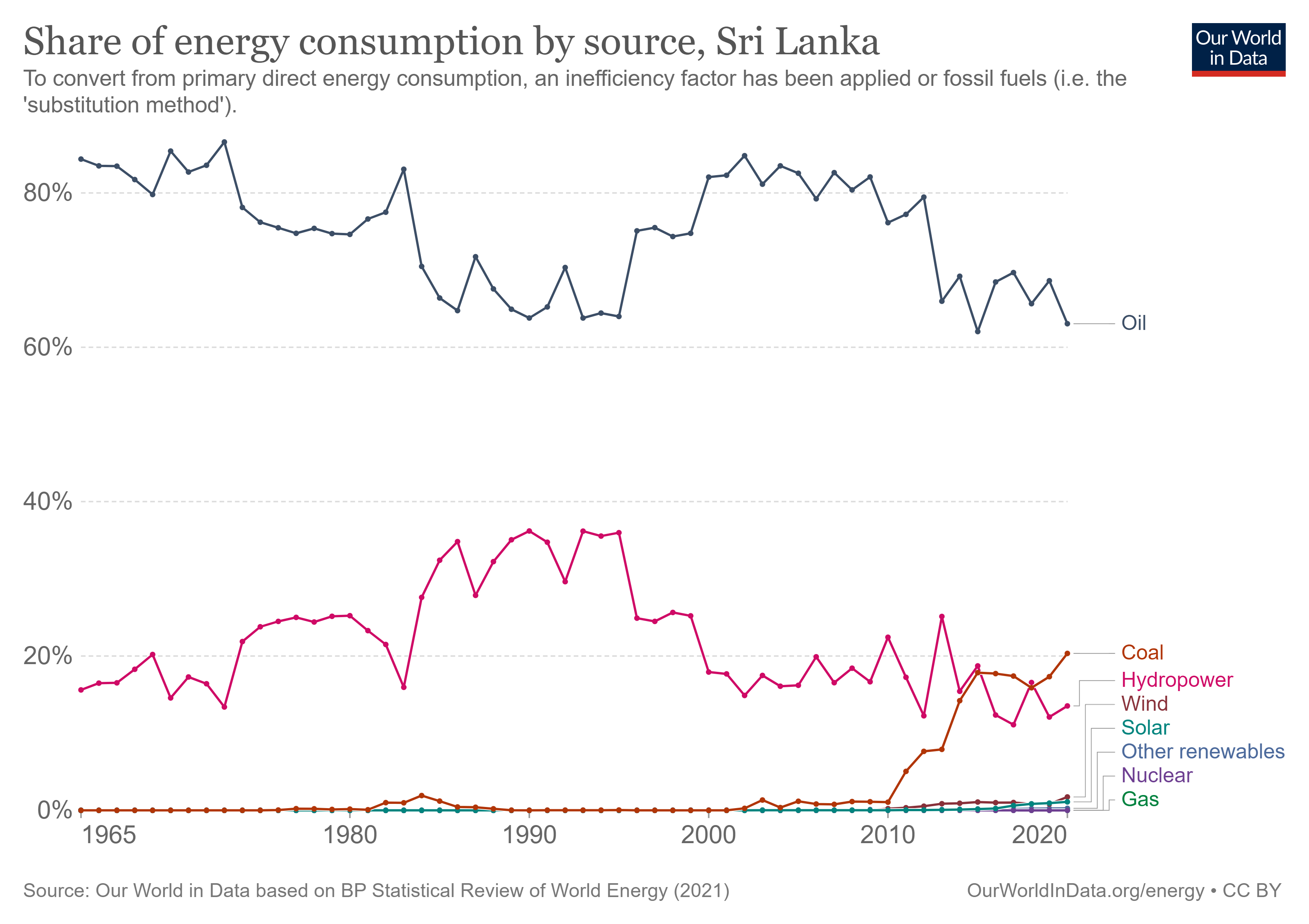
https://ourworldindata.org/energy/country/sri-lanka

At the end of June 2022, the government suspended all sales of fuel to anyone other than essential services, due to lack of fuel supplies. They also closed down schools, and reduced the government workforce to reduce commuting.

Widespread Protests

There were mass protests calling for Rajapaksa to resign and almost all the cabinet resigned, in protest over Rajapaksa’s behaviour.

There is some evidence the government was corrupt and disconnected from the people, such as the appointment of family members to important positions where they fought each other,

Since he was elected, Rajapaksa, who hails from Sri Lanka’s most powerful political dynasty, has worked to concentrate power in the hands of himself and his relatives. 

Ellis-Peterson Sri Lanka facing imminent threat of starvation, senior politician warns. The Guardian 7 April 2022

and the luxury of the homes revealed by the riots. The Government suppressed criticism of their policies in general. As defense minister, Rajapaska may have overseen the death of 40,000 Tamils, and others accuse him of having stolen billions from the country (I have no evidence).

World Crisis, not Local Crisis

Sri Lanka is not the only place in the world likely to suffer crisis. A UN Global Crisis Response Groups brief from 8th June 2022 warns that:

people globally are facing a cost-of-living crisis not seen in more than a generation, with escalating price shocks in the global food, energy and fertilizer markets – in a world already grappling with the COVID-19 pandemic and climate change….

An estimated 1.6 billion people in 94 countries are exposed to at least one dimension of the crisis, and about 1.2 billion of them live in ‘perfect-storm’ countries which are severely vulnerable to all three dimensions…

the war [in Ukraine with the resultant food shortages], together with the other crises, is threatening to unleash an unprecedented wave of hunger and destitution, leaving social and economic chaos in its wake,

Today, about 60 percent of the world’s workforce is estimated to have lower incomes than before the pandemic. More than half of the world’s poorest countries are in debt distress or at high risk of it.

War in Ukraine threatens to unleash “unprecedented wave” of global hunger and destitution, warns UN Chief. UN Press Release 8 June 2022.

The World Bank has said almost 60% of the lowest-income countries are in debt distress. The President of the World Bank stated:

I’m deeply concerned about developing countries… They are facing sudden price increases for energy, fertiliser, and food, and the likelihood of interest rate increases. Each one hits them hard…. People are facing reversals in development for education, health, and gender equality… They’re facing reduced commercial activity and trade. Also the debt crises and currency depreciations have a burden that falls heavily on the poor… Food crises are bad for everyone, but they are devastating for the poorest and most vulnerable.

The inequality gap has widened materially, with wealth and income concentrating in narrow segments of the global population. Rate hikes, interest rate hikes, if that’s the primary tool, will actually add to the inequality challenge that the world is facing.

Spring Meetings 2022 Media Roundtable Opening Remarks by World Bank Group President David Malpass. 18 April 2022

The chances are high that other countries will default or suffer considerable food distress. Sri Lanka just happened to be the first. It was not a problem of organic agriculture but of general economic failure and external pressures. Even this badly executed process of organic transition could possibly have been met with food imports or suspension of food exports, the monetary and external crises made it impossible

Predicted cuts in aid by Western powers, trying to glide over the crises they face, will likely make things even worse.

Initial source Time Magazine

More Diamonds: Diamond Points: 4-7

October 3, 2021

Continuing from: More on Diamond’s first three points

And I’m still not past the first chapter….

The Next points

Diamond point 4) Get Help from Others

I’ve already mentioned the probable need to team up with others, talk to others, get fresh perspectives, and support (preferably mutual). Other people or nations, can perhaps lend (or gift) you resources for a time. Humans are social animals, the more ties the better (in general – introverts may disagree, but it still helps). Your own view of yourself, may not be that accurate, you need those fresh perspectives, and you gain more power, competence and effect working with others – provided you don’t try and set up a hierarchy. Cooperation magnifies effects.

Possibly important here: “good communication is only possible between equals”.

However, choose your helpers wisely. If you choose the wrong people, you can end up losing power and competence. You can end up in a restricting and harmful cult, which appears safe. Getting help is a risk, like most other choices, but if you are already sliding downhill you may need to take that risk.

It is probably worth bearing in mind, that many possible solutions may produce new problems, lead to new hazards or new dead ends, yet staying where you are could also be lethal. Continual awareness, and openness to change, is needed….

Diamond point 5) Other People as Models

Other people and other countries may have faced similar problems. You can perhaps learn from them, and learn to emulate them, or at least gain some hope from them. So again you can talk to others, team-up with others, or read about others. Part of the point of Diamond’s book is to learn about countries which have faced problems, and learn from their successes and mistakes. Many people I know have found Jung’s Memories, Dreams, Reflections useful in their personal lives. It certainly opens up possibilities which are not normally perceptible in Western society.

The problem is that some of our current National problems may be unusual. We don’t have, as far as I know, many records of places which have survived ecological collapse or massive changes in climate. If you know of any, then please indicate them in the comments section, and I’ll lift them up here, with acknowledgements.

Another problem occurs when we choose a bad example to emulate. Lots of people embraced neoliberalism, because powerful nations did. It rarely helped them solve all their problems.

Diamond Point 6) Ego Strength/National Identity

This is a point I have problems with, because to me, ego derives from what you are aware of, as produced by the theories, culture, conditioning, habit and experience you have had. The ego is a form of directed consciousness, with accepted ‘truths’. This idea is supported, so some extent, by Diamond comparing ego-strength to national identity, which I guess can be thought of as, what a dominant portion of the nation thinks it is like and what that dominant portion of the nation thinks its members share. Ego is absolutely necessary, but it is also a restriction.

My guess is that ego-strength is very useful if the problems are not complex and do not require big changes, but this does not mean it is always useful, or always non-destructive. For example, national identity can be both delusional and a source of problems, and may need to change. For example, if Germany, Japan or Italy had kept their ‘fascist,’ or militaristic, identity (yes Japan was different, but there are enough similarities) then they could not have adapted to the post-war world at all – they would simply have gone on damaging themselves, or provoking others to damage them. If a nation has constructed an identity around ‘race’ and national kinship, it is probably going to have internal fights and commit crimes if its leaders want it to be ‘pure’. The nation is going to consume energy which could probably have been better spent adapting to its new world. Similarly, if a person has constructed an ego around the idea of them being useless, exploitative, or always correct, then they don’t want more strength behind those ideas; they may need ego opening, not ego strength. They probably need some flexibility or flow, not more ego strength.

“Self pride” in an identity may mean that you are unlikely to change, or adapt, or even see the problem. Pride implies staying the same, or even disparaging others and refusing to learn from them.

As another possible example. If national or personal ego is invested in ‘free markets’, or fossil fuel use, then it may be close to impossible to face climate change because, these factors are part of the probable causes of climate change. Facing climate change may mean impacting fossil fuel companies and fossil fuel use, ‘harmfully’. However, keeping the ego strong may mean not abandoning these positions ever, as abandoning a fundamental value seems weak, and on the other side, they may have no belief that anything can compensate for a lack of fossil fuels or free markets. Being open to fossil fuel use, and what people call ‘free markets,’ needing to be changed, requires the ego to be open to alteration, and that is more than just ego strength – even if it is a form of strength.

The ego that has grown to produce a problem, may not be the best place from which to overcome the problem.

However, while ego-strength may not always be worth while; it is certainly correct that giving up, apathy, or hopelessness (in everything) also seem harmful. So a person or a nation might need to have a capacity for resilience, for recognising something beyond mere identity, a capacity to keep on going, to keep learning, to keep focused, and to discard ideas which are harmful to themselves and others, or which are now useless. That is, they may need to change conscious, change ego, or change national identity. This means that fencing off what works, (Diamond point 3) is an ongoing process of alteration, not a one-off event.

At this moment, I can’t think of a good word for this persistence and willingness to change (tenacity, resolve, responsibility?), but ‘ego-strength’ is not it.

Diamond Pont 7) Self Appraisal

Diamond ties the ability to do honest self-appraisal to ego strength. Obviously, I’m not so sure. The ego, or the national identity, is a form of directed consciousness, and unless that consciousness is open to change, and strong enough to change or suspend its ‘truths’ for a moment, it is hard to give honest appraisal, or be open to new ‘visions’ and understandings.

With a strong commitment to the ego. It is much easier to give a dishonest and comforting self-appraisal. This again is where blame, shadow politics and condemnation is handy: we are not part of the problem, it is them, all evil them whoever they are. If we attack them harder, then all our problems will disappear. Sometimes that may be true in part, but if you are that good, then why are they the problem?

Ego strength can lead to the rejection of other’s help and advice, because accepting that advice implies you are not perfect or strong.

How do you tell the difference between honest self-appraisal, and mistaken comforting self appraisal which flatters your ego? This is not easy, as it is both you that is deciding, and you that have the problems. This may also require listening to others, and relaxing the hold of existing beliefs, which are harming you.

We need the strength to go beyond our ego, and to stick with the task of facing reality and heading into the unknown.

Concluding comments

Self motivated change is NOT easy. it is a struggle. It is easier to stay where you are, strengthen your ego beliefs, blame others and die. And we have more points to go.

Continued in: Diamond Points: 8-12

More on Diamond’s first three points

October 3, 2021

This is another conclusion to the last post, hopefully summarising it.

Please remember I have no particular credibility, so this is simply advice that may or may not be useful to you.

I also apologise for being a more hectoring than is probably necessary, so just ignore that if you can… and see whether anything is worthwhile.

It seems that in the crises we face, both business and state are implicated, so we have to work at the levels we can work at, and not hope that someone else will solve problems for us.

What to do in a crisis, personal or social

1 Recognise and accept the problems

  • This can be difficult. and may require patience. If you really accepted the problems then you might be dealing with them already.
  • You may have developed social and psychological defences against the problems, or be trying to persuade yourself the problems are not real.
  • You might recognise some problems and deny others. No one is perfect.
  • If lots of people identify a problem, there may be something in it.
  • You may be frightened of the problems. Accept the fear and the problem.
  • Blame, especially angry blame, is usually a defence, aimed at making you feel innocent and better.
  • It is probably the system that is at fault not individuals.
  • Problematic systems interact. Those interactions can be reinforcing of the problem, or possibly, opposing/balancing the problem.
  • In a complex system, there may be people at fault, and that may include you, but this means that you can possibly make a helpful change wherever you are.

2 Taking responsibility

  • Take responsibility for what you can do and for recognising the problems you, and others, face. That’s all.
  • That the problems are systemic does not mean you can do nothing.
  • Every small improvement counts
  • If you are the CEO of a heavily polluting company you have more responsibility for what that company does, and more capacity to act, than does a worker. This does not mean that you won’t face significant opposition. But you may have any easier option to make things a bit better.
  • Team up with others to make a greater difference, and to support each other.
  • Have some self compassion for failure. You probably will fail some of the time, perhaps most of the time.
  • Beware of acts which can diminish your responsibility, such as angry blame.
  • Don’t be afraid of experiment – but check its unlikely to harm others – look for what is happening as a result of the experiment.
  • You don’t know how much improvement a situation can tolerate until you try.

3 Keeping what works

  • Identify what what works ‘well enough’ in your life
  • Build on that.
  • When you team up with others, also recognise what is working in that team up, and for other people.
  • Learn from each other. Everyone has slightly different experiences and understandings.
  • However, sometimes what worked, can now form an obstacle to further progress. Does it need to be abandoned or modified?
  • It may be worth trying to take back the State, but this seems difficult in the extreme. It is probably best to work one seat at a time, in areas you can affect.

Final comments

It is up to us. In one sense, there is no one else available, although the crises need many of us. This means we have to look after ourselves, and not flog ourselves to death. Humans need rest. They need breaks. They need enjoyment, as well as dedication.

Final point. It is normal for plans not to work out, or for actions to have unexpected consequences. This is not a matter for blame but for learning. No matter how nice an idea sounds, it may not work in the real world, and we often learn by doing.

Jared Diamond and Crisis

October 1, 2021

I’ve only just started to read Jared Diamonds book Upheaval (Little & Brown/Allen Lane 2019), so what I say may prove incorrect and need to be modified later.

Diamond posits a similarity between the way individuals and nations face crisis – and he uses a template developed in the 1950s to help people adapt to crisis, to help show how nations can change and triumph over such crises.

A crisis occurs when the ways people have developed to live a life are obviously no longer working, and things are breaking down. In personal life this may be because you cannot solve problems at work, you are no longer invested in work, someone important to you dies, your partner leaves you or vice versa, you loose your money, you loose you job, your town is hit by a natural disaster, there is war, or you become very sick and so on. Clearly not everything is under our control. That is life. The same kind of events can happen to a nation. More difficultly, as I have said before, the techniques of life that the society promotes can often lead to destruction if circumstances change, then those techniques of life may need to change to deal with those changing circumstances and the changing problems they present.

Diamond makes a long series of points that a person and a nation will find helpful, to work through the problems.

Today I will look at the first three points, because they seem to be foundational. I’ll phrase them slightly differently to Diamond, because I think he looses a clarity in concision.

The points are:

  • Recognise the problems and be prepared to face them
  • Take responsibility for the problems. It is you reactions to those problems that determine what will happen. It is not other people’s fault, even if they are harming you.
  • Find what in your life is working and ‘fence’ it off from change, to give you a base to work from

Diamond point 1) Recognising and facing problems

This is part of the what I’ve called the Toynbee cycle. Civilisations or societies, if they are to succeed and survive, have to adapt to, or solve, problems, or challenges, in their environment and inadequacies in their actions. Many problems can be generated by social action, ideological unconsciousness, established hierarchies and power relations.

The major problem, sometimes at this stage, is the difficulty of facing, or admitting the problems.

At the moment, I don’t think there is much evidence the nations of the world as a whole are facing up to the problems before them, or recognising the seriousness of those problems. This is partly because they are difficult problems, and partly because they derive from patterns of action which have, in the past, brought success, wealth and power – especially for those currently dominating life, economics and politics. This latter point, brings about social resistance from powerful people, and from lack of apparent alternatives (as alternatives may have been crushed or removed by regulations that favour the previous system).

One obvious problem is that the currently dominant economic system is producing pollution which produces climate change (among other things), while the same economic system is destroying both ecologies and the remaining planetary resilience that would help us humans deal with these problems (or at least give us more time to act). It also seems to be a way to build prosperity and security, and there is no obvious replacement, if it needs replacing.

A second problem is that our political system, as a whole, is devoted to protecting the economic system and the systems of power and wealth it produces – and this helps the dominant groups to ignore, play down or dismiss the problems, and keep the system that apparently benefits them (but will ultimately disrupt them severely).

Climate

The latest version (September 2021) of the UN NDC Synthesis Report states:

[The IPCC estimates] that limiting global average temperature increases to 1.5C requires a reduction of CO2 emissions of 45% in 2030, or a 25% reduction by 2030 to limit warming to 2C…

The available NDCs of all 191 Parties taken together imply a sizable increase in global GHG emissions in 2030 [when] compared to 2010, of about 16%. 

The 16% increase is a huge cause of concern. It is in sharp contrast with the calls by science for rapid, sustained and large-scale emission reductions to prevent the most severe climate consequences and suffering, especially of the most vulnerable, throughout the world

UN Full NDC Synthesis Report: Some Progress, but Still a Big Concern 17 September 2021 Italics added.

On the other hand, Climate Action Tracker estimates that emissions levels will remain constant until 2030, rather than decline by the roughly half which is necessary to stay under a 1.5 degrees increase:

Australia, Brazil, Indonesia Mexico, New Zealand, Russia, Singapore, Switzerland and Viet Nam… have failed to lift ambition at all – they have submitted the same or even less ambitious 2030 targets than they had put forward in 2015.

CAT Global Update: Climate target updates slow as science demands action 15 September 2021

It seems nations are not facing the problems. Australia, which has no excuse as it is a prosperous country, is busy having a gas led recovery, and even those Australian states which have emissions targets are promoting new coal and gas fields. For example, the NSW Energy minister, Matt Kean, is reported as saying:

Our emissions reduction target assumes continued expansion of coal mining in NSW

Daily Telegraph NSW will halve its carbon emissions by 2030

and

the coal industry here in NSW won’t be affected by domestic policy makers, it is going to be affected by the decisions of borders overseas and governments overseas

Raper NSW government sets more ambitious 50pc emissions reduction target for 2030. 29 September 2021 and On why some of us know we need to get our green skates on and some of us are still coal gazing Fifth Estate
  • [For some bizarre reason the press conference transcript does not seem to have been issued.]

Even here where emissions targets are being set, the problem of coal export emissions is being left to others at best. The problem is being turned away from. Probably because coal mining companies are powerful, and because coal is supposedly good.

There are obvious other problems which are not being faced up to, such as Covid openings based solely on vaccination numbers, information distribution and corruption, distrust and so on…. but let’s leave it there.

There is no really evidenced ability to face up to problems fully.

Diamond point 2) Taking Responsibility

It is hard to take responsibility for problems you don’t recognise. Australia’s PM seems to refuse to take responsibility for much. Almost everything is someone else’s problem.

It is also easy to blame climate and other problems on other States you may not like, like China. But, so what if China is not delivering on emissions reduction? That does not absolve us from doing our best, even if it makes us feel good to scapegoat others and engage in shadow politics.

Rather than wondering what they can do themselves, many people seem keen to blame population for the problems. The problem is more to do with the amount of consumption and destruction per head than population itself. If you think consumption and destruction per head is a problem, then work to reduce the population of places like Australia, or the wealth elites. But people’s enthusiasm seems tied in with blaming foreigners and less powerful people.

‘We’ have responsibility for ‘our’ part of the problem, and for trying to intensify that problem by selling more coal and gas. We cannot stop China or other people from doing what they are doing, we can only stop ourselves.

Diamond point 3) Keeping what works

The problem here is severe. Especially if we consider the US. What in the US works?

I’m not going to document much here because I’m not really going beyond cliché.

The Economic system

is working if you think its purpose is to continue to transfer wealth upwards, otherwise it is not doing much except destroy the planet. Trump supporters, and others, know that things are not working for them economically as well as they used to – and few people seem to be listening to them.

Covid may have produced an increasing collapse of supply chains, and this is likely to have systemic economic effects [1], [2], [3], [4], [5].

The Political system

does not appear to be working after Trump. One party has gone along with the idea of destroying trust in the system (references to this would clog the page completely), in order to ‘fairly’ take actions to ensure they will win in future, no matter what. Again Trump supporters and others distrust the political system, as it does not deliver for them. It seems largely bought by a politically active corporate sector. It is doubtful the political sector could ever act against that corporate sector in the public interest, without extreme difficulty and with much cost to the actors. This is not just a US problem.

The Information system

is widely distrusted, and the most distorting parts of the system endeavor to destroy trust in other parts of the system, and many people seem to just accept what they want to hear. Education also seems to be failing, or being wound down in favour of home schooling or private schools. This does not help people to distinguish what is real from what is fantasy. Raising anger rather than discussion seems to be the main aim of participants, and they do that well. Polarisation is frequently remarked, this is exemplified in a situation where anything the outgroup proposes must be wrong, and all virtue resides in one’s own group (even if you don’t think they are particularly virtuous). The internet does not help. One of the problems about facing problems, is that people can always find some group telling them that a problem is not really a problem, and the real problem involves something easy, or some scapegoat.

The Health system

is not working. Life expectancy is declining in the US, and not just because of COVID-19, or the failure of the economy to have the resilience to provide for ordinary people. One journalistic account states:

the US houses among the most advanced medical and research centers in the world, but performs poorly in basic health metrics such as maternal mortality and infant mortality; accidental injury, death and disability; and chronic and infectious disease….

“So much of the whole issue of social determinants of health and the US ‘health disadvantage’ is rooted in a lack of trust and a lack of trustworthiness in many parts of our society,” said Laudan Y Aron, a senior fellow at the Urban Institute’s health policy center….

[A report] US Health in International Perspective: Shorter Lives, Poorer Health… describes how Americans spend more than double per person on healthcare compared with 17 peer nations, but rank near the bottom in health outcomes….

recent research show[ed] that American life expectancy has declined while peer nations saw continued gains.

Glenza How the US vaccine effort derailed and why we shouldn’t be surprised. The Guardian 27 September 2021

It is frequently said the US has an extremely expensive health system, which delivers bad results for the people. But if all you count is profit, then it’s doing remarkably well.

The Food system

may not be working well, either.  The health of soil is seriously compromised:

Iowa has lost about half the topsoil it had in 1850. Since they were first plowed, America’s farmland soils have lost about half of their organic matter – the dark, spongy decomposed plant and animal tissue that helps make them fertile.

The soil that produces [the] nation’s food supply is a weakened link slowly failing under ongoing strain. 

Otten & Collier It’s time to rethink the disrupted US food system from the ground up The Conversation 5 June 2020

On top of this there is the mass marketing of cheap, sugary and ’empty’ food which possibly affects people’s health, energy and capacity, the death of small farms and the growth of oligopolies which tend to be narrowly focused, water pollution etc etc.

Disaster Relief Systems

may or may not be working. I’m not having much luck working out whether Hurricane Ida was better survived than Hurricane Katrina, but the point is that the more the weather gets wild, the more disaster relief systems will be stretched, and less likely to work. Covid also means that the health systems needed to protect people after a disaster are already stretched, and it is likely that the disease will spread unless care is taken.

This depressive interactivity is true for all other systems. The closer some systems get to breakdown, the more stress on other systems.

As mentioned before, some times processes which used to work, and may still work for you, have become obstacles or even sites of destruction. This is something we may have to be aware of, especially if we have benefitted from those processes.

Declines in other ‘infrastructure’ such as roads, bridges, water, sewerage, power cables, etc. may also add to the problems [1], [2]

General

One of the problems the US might face, might precisely be that very little works, and that gives them little space to move from to recover from crisis. All the non-working systems compound the problems in each other.

So far Diamond’s analysis is not providing much hope, especially at the ‘fencing off what works’ stage.

However, we can still push governments, corporations and people to recognise the problems, and their responsibility for producing the problems and acting on the problems….. Hopefully people can build new systems as they go about facing those problems.

Indeed I expect that change will come from below as people realise they have to make the change from below.

Given that not much is working we either have to let experimental groups explore future modes of organisation, or take a ‘leap into the dark’ with experimental policies which can allow us to learn more about the situation and explore what works and discard what does not work. This would require a great deal of popular support to work as it will lead to mistakes, which render it open to sabotage by those protecting the establishment, and those who already ‘know’ what works. This is unlikely to happen in a polarised and distrustful society.

We must also be ready to defend ourselves from what seems to be fossil fuel fascism – as that is one solution we can expect will be pushed by the establishment to avoid any real change.