Posts Tagged ‘complexity’

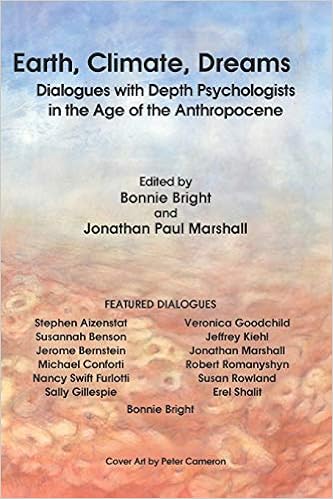
Earth Climate Dreams Book Launch

January 26, 2020

Bonnie Bright and Jonathan Paul Marshall (eds) Earth, Climate, Dreams: Dialogues with Depth Psychologists in the Age of the Anthropocene. Depth Insights Press.

0997955023 and 9780997955026

From: Amazon.auAmazon.com ; Amazon.co.uk

Bookdepository ; Wordery ; Barnes and Noble

The book, as should be obvious, reports on what 13 Depth Psychologists have to say in response to the Anthropocene. It is a collection of interviews with people like Stephen Aizenstat, Jerome Bernstein, Veronica Goodchild, Jeff Kiehl, Susan Rowland, Robert Romanyshyn, Erel Shalit, and other important people, and finishes with a multi-logue between seven of the participants.

[For descriptions of the interviews, and some critical responses, see an earlier blog post]

These people are all major contemporary figures in Depth Psychology, as some of you will know.

I’m going approach this launch in three ways. Firstly I will talk about the background question of the book, then one of my problems with the book and, thirdly, what is great about the book, and why you should buy it.

The fundamental issue

The background issue is that in the West, and most likely elsewhere, we are facing what can be called an existential crisis. That is, we are coming to recognise that our whole modes of being, living in the world and preparing for our future, is undermining our capacity to exist in the world. If we keep on living, acting and thinking as we do, we face destruction generated by those ways of living and thinking. The Anthropocene (the world-systems changing effect of humanity) marks a problem for our whole existence, and undermines our future.

The existential crisis presents a problem at all levels of our being: it is a psychological problem, it is a sociological problem, it is an economic problem, it is a technological problem, it is a cultural problem, a problem for all our relationships to everything. Once recognised, it is both hard to ignore and disorienting, to put it mildly – approaching trauma might be more accurate.

This crisis is the starting point for the book, and the necessary starting point for almost any relevant discussion about the future. The conversations are conducted with Depth Psychologists, because Depth Psychology attempts to deal with the total span of human existence, which includes all that I have just mentioned, from psychology to the world. Depth psychologists are uniquely in a position to approach these issues from a non-specialist position, and to offer tools to help people work with the problems, from their experience of group and individual therapy, from symbolic work with art, literature, and dreams, and from their sense of the intertwining of individual and collective.

My issue

Let me begin discussion of this book by talking about one of the things I find slightly problematic about it, and show why it turns out not to be that problematic, and how it generates insight, when approached with fewer assumptions.

My problem in reading this book was that, sometimes, I thought people found it much too easy to talk as if ‘spirituality’ (whatever that is) was a solution to our problems.

As I argue in the introduction, some types of spirituality might help constitute our problem, and this has to be faced. It cannot be suppressed, and I don’t think anyone in the book would want to suppress this issue.

As a culture, we in this room, have a religious or spiritual history, and in that history people have primarily been taught to see the world as a prison, a testing ground, a den of sin and iniquity. We have been taught to see our human destiny as leading us somewhere else, not this Earth. We are heading for heaven or hell or, at best, the new World after the Day of Judgement. We are not fundamentally creatures of Earth, born with the earth and tied to the Earth. In that sense, the Earth has to be fought against and dismissed for our salvation. If you actually love the world, you are being distracted from your love of God who is not ‘material’; you are loving something inferior and fallen.

This form of spirituality constitutes a problem, it could well be part of the reason it is Christendom that has led the charge into ecological destruction as an unintended consequence of its otherworldly spirituality. If so, then implying that a move from ‘materiality’ to ‘spirituality’ is a solution to the problems of the Anthropocene, is not a solution. Spirituality is part of the problem. Rather than just ‘spirituality’ itself, we need a new psychological and spiritual orientation to the world and to our actions within it.

However, if you actually listen to what people in the book are talking about, and remove the assumption that you know what they talking about, then you can begin to see what they actually mean, and the kind of psychological orientation they are pointing towards, and how this is not just a matter for our consciousness, will power, or decision.

In our society, because of our (spiritual and other) heritage, ‘natural processes’ are largely seen as disposable or replaceable or, to use Heidegger’s term ‘to hand,’ as resources for our own use and mastery of. In our dominant ideology, natural processes only exist for us to exploit. If they cannot be exploited and turned into profit, then they have no value. Natural processes are not something we should have a relationship with. You can see this attitude everywhere, with things like the Westconnex tollway, where we chop down every tree, undermine housing foundations, dispossess people, and fill the air with smog and noise, while providing a tax on travel in Sydney. Or with mining under water tables, rampant landclearing, mining in agricultural regions and so on. Natural processes are, officially, a lifeless backdrop to be pillaged for profit. They have no other value. The world is to be subdued to consciousness and will. The world is secondary to what we can make of it.

Yet this is not humanly true at any deep level. It does not resonate with real human being. Almost every human I have ever met has some kind of relationship to other natural processes, whether living forms, place, or to their own part in the system. They might only notice the connection when the creature or plant or animal has gone, but that is part of our disconnection from reality. This relationship may be to individual animals (their pets, or the dog down the street), to specific trees they feel connected to, to landscape that may seem to be part of us, and so on. Even those people busy despoiling other people’s environments and landscape, can have deep feelings for their own.

This is not really strange, because we think with, and in, this world. We use objects in the world to think with, to feel with, to learn with. We cannot live outside the world. It shapes us. We cannot escape from it. Nature and ecology is part of us, we are part of it; we are plural and connected by our existence, in a living network beyond our understanding.

When we realise this, then instead of treating nature, or other people, as resource objects, we can approach this world with reverence and awe; with a sense of mystery, recognising that we do not fully comprehend it, that it is a being that is both independent of us and impinging upon us. It is us and not us.

We can approach the world with our full ‘psyches’ and, in this, recognition of ‘complexity’ and interconnectedness, are themes which keep recurring in the interviews.

Why use the term ‘psyche?’ Because when we use other terms like ‘psychology’, ‘mind’, or ‘soul’, we already think we know what we are talking about. But we don’t. We don’t consciously know how our minds function, as they function. At least I don’t. I don’t know how my mindbody functions, how one thought gets linked to, or progresses into, another, how language works, how brain action generates mouth and arm action, how my skin heals, my stomach digests, my lungs process air, and so on. Much, probably most of the important things in life, operate outside of our limited awareness, and necessarily so.

“Psyche” plunges us back into the unknown, the entangled complex, interconnected, mess which is reality. We are inextricably if vaguely linked; my psyche does not exist without your psyche. I did not invent the language or all the ideas I use. Interaction with and talking to other people and to world culture has shaped me, and I have presumably shaped some others for better or worse.

We are both collective and individual at the same time. Even a sense of heroic individualism is collective at its base; something we share with others. Our psyches are already alive and part of natural processes. Our full psyches include the land, spill out into the land, into other people, into the processes that are everywhere.

And a realistic view of our selves needs to include all of this material, our culture has generally defined as extraneous, to help us to successfully resist the notion of natural process as a thing to turn into resources to make profit out of. In this new mode, with new practices and ways of perceiving, we can begin to move towards rejecting the system of thought that is destroying the world that we live in. This destructive system no longer makes sense. It seems psychotically limited and self-destructive. That awareness opens a psychological, cultural and activist position. The more we become aware of unconscious process, the less we seem driven by them, and the more free we become.

Let us return to an earlier point. As already implied, there are many unconscious processes. We are not aware of most of what is happening, although we may be more aware than we consciously know. That lack of conscious awareness of how our minds work, and how our physiology works, and how mind and physiology connect at this moment, implies unconscious processes. Some of these happenings I will have perceived, but not made conscious, perhaps because my thought or culture focuses my attention elsewhere, perhaps because there is so much to perceive that I cannot hold it all in my awareness. Even if I perceived it all, I can’t understand everything that is happening, and affecting us, even in this room. Most of life’s ongoing processes are essentially and inevitably outside my consciousness, and therefore unconscious to me.

However, I can become more aware of what is happening or more sensitive to it. I can attempt to perceive reality in different ways. I can turn attention to my neglected or repressed perceptions and drives. Recognising this possibility and being open to the strange and the unknown is what Depth psychology is about. It is fundamental to the process of discovery.

This is why Depth Psychologists pay attention to dreams, which are in some ways messages from the unconscious and the world; from our unconscious perceptions, pattern detections, and ways that we symbolise the unknown. Dreams often require work to understand. It is not always easy, but it can become more so the more we take these fleeting images and stories seriously and treat them as beings themselves. Paying attention to these, and other, neglected processes (fantasies, spontaneous images, scribbles, slips of the tongue, senses of unease, neglected feelings, suppressed thoughts) becomes a way of getting, or admitting, more understanding and data. It starts a new process of being in the world. If we repress our bodies and our dreams, we are likely to repress our awareness of the world. The more we attend to them, the more likely we are to be able to perceive messages in natural processes which are now hidden to us. Our tools for learning can expand outwards…

This new attention can represent a complete change in how we regard ourselves and experience our role in, and on, Earth. We can call this change spiritual if we want to. We can analyse and live our lives from that point of view. We might even be able to see this realisation as having much in common with reports we have classed as mystical.

This awareness involves experience of paradoxes, similar paradoxes to those around reported experiences of God, We are part of the world but separate from it. It is greater than us but still within us. The depths can lead to the heights. We are double sided: our goodness might be cruelty; our aspirations can be unreal or unsatisfying. Reality is ultimately unsayable, but it is pointable too through images and word, and it can be experienced, if we are open to it as it is. This is a new way of being, which can be called spiritual if you wish, or not if it makes you uncomfortable.

So even in the bits I personally have problems with, the book is still full of insights. Full of ways of proceeding. You may have problems too, but encountering this book may help you ponder them and open you. That is why this book is important.

The Good Bits

Let us now turn to the unproblematic virtues of the book. Its chapters are edited and concentrated conversations. They are generally excellent conversations. The primary interviewer Bonnie Bright is really good at her work. She participates in conversations. She contributes to the conversations as process. She draws people out. She listens carefully, and gets people to explain when needed. You could not have a much better interviewer for dealing with issues which could otherwise be quite difficult.

Reading these conversations, you will learn something about a family of understandings of how psyche works, through the dynamics of imagery, metaphor and feeling, and the effect of the unintended consequences of particular modes of consciousness which repress things you need to know about. As I have implied, if you take this seriously and start some of the practices, then you might gain a new view of the world. You might find a way out of the existential crisis, or a way to flourish in that crisis.

Depth psychology is important, because its mode of being, continually deals with problems that the conscious ego cannot understand. This is especially useful for facing the paradoxes, complexities and dilemmas of the Anthropocene.

Topics vary throughout the book, apart from the obvious topics of climate change and ecological destruction, subjects discussed range from discussions of pilgrimage, the aspirations of Dr. Frankenstein and what that tells us about modern life, the collapse of Mayan civilisation, colony collapse disorder in bees and its metaphorical connection to culture collapse in humans, the ways that politics and psyche interacts, the driving cultural complexes of capitalism, systems theory, unconscious forces, communication with the world, and the uses of dreams to gain insight into the world and relate to the world.

The book argues strongly, in various different ways that we need to engage with our full range of psychological processes, and perceptions, to deal constructively with the changes and problems we are facing. We need to understand how the systems we participate within, condition our minds when we suppress awareness of what is happening. If we stay in the psychology of mind we are conditioned to have, then psychological inertia, denial or other processes of repression or projection of problems and hostility onto others are likely to win out. Even if we manage a revolution we will probably replicate the problems we have, plus we will project our guilt onto others, and solve our problems through revenge.

This book explores possible tools to move beyond these psychological limitations and barriers.

Depth psychology can prove useful in this quest, because it tends to focus on neglected aspects of life and assumes that our individual psychology is at least partly collective, and it works through encouraging creativity, imagination, art and symbol production for their own sake, irrespective of judgement or profit..

As well as enlightening, this process of approaching reality is potentially fun and enjoyable; it can also be pretty horrible too, but everyone has the possibility of life changing realisations for themselves and for everyone else. As we are collectively facing similar problems, solutions to personal problems, or the symbols around those solutions, can turn out to be effective solutions for collective problems…. especially when we are working in and with groups. Anyone has the potential to contribute to our collective solutions. You go in and bring the solution back out. It is a cyclic process.

The book tries discuss ways of opening what may be a new way of perceiving the world, and approaching the world, and the role of human psyches within the world, and the way we all could develop.

This is, simply, vital work….. That is why I hope that this book will reach a large audience, even if they disagree with it, it could start discussions.

Paul Chefurka’s “Ladder of Awareness”

December 29, 2019

[Re-edit October 2020]

Paul Chefurka proposes a number of stages of awareness of climate problems, with psychological consequences, which might be useful in understanding what we can expect as we ‘progress into the depths’ of the problems and predicaments we face.

Stage 1: The Person sees that there are particular shortcomings in an organization, our morals, our economy or whatever. It’s a matter of changing the rules, or getting more of something that is already there. It’s pretty easy really, if only people saw sense. [In terms I use later in this blog, this is a partly a problem which arises because of the so-called ‘directed mind‘]

Stage 2: There is ONE Fundamental Problem which destroys everything else. Capitalism, Climate Change, government, overpopulation, Peak Oil, biodiversity loss, fossil fuels, inequality, patriarchy, sociopolitical injustice, stupid politicians, socialism, lack of spirituality, etc. If we can fix this problem, or control some other people, then we can fix everything. [This is a form of radical simplification – a refusal to acknowledge social and ecological complexity [1], [2]]

People become activists and keep bringing up this problem to explain everything, and point out how everything could be solved if we really solved this problem.

Stage 3: If we become aware that we cannot seem to solve the big problem, it is possible for awareness of their complexity to grow. Then it seems there are many problems, but the person still might still try to prioritise some problems or resist expanding the ‘problem field’, to keep things under control. They may fear that further new concerns will only dilute the effort which needs to be focused on solving the “highest priority” problems.

Stage 4: Then the person realises that the problems are interconnected and influence each other. It is hard to keep those problems bounded and separate. There is a multitude of problems. The person sees the importance of unintended consequences – a solution in one domain may worsen a problem in another. Prediction is difficult, planning seems impossible.

At this stage people may move into small like-minded groups. This can increase learning and insight as the whole set of issues is discussed, in ways in which they cannot be discussed elsewhere.

I would add these groups can also be a retreat from problems, if the people are not careful. The people involved can see themselves as an elite amongst the benighted, and just reinforce their earlier certainties, [or they can become pure and spiritual and risk separation from the world].

Stage 5: Through ongoing discussion, the set of problems can now be seen as a complex predicament, by which I think Chefurka means a condition of existence which may not be solvable at all. We become aware that the predicament encompasses all aspects of life. Chefurka keeps this realization as part of Stage 4, but I think that moving into recognition of the predicament is another stage which needs recognition – as that is a different place from the rest of Stage 4. With this realization:

The floodgates open, and no problem is exempt from consideration or acceptance. The very concept of a ‘Solution’ is seen through, and cast aside as a waste of effort.

[We can potentially open up the problem field, and see how problem areas we have kept separate are connected. As well, everything we think we know, may appear even more uncertain.]

Depression is likely at this moment – especially if we are facing the problem alone, and have not managed to form a sympathetic group. If the problems are insolvable, then what will happen to us all?

However, there are two paths which open – although they would seem to have always been open, and this realisation constitutes the stage beyond depression – I would call this Stage 6.

Again, I think it important to accept that stage 6 is also a social event. The groups and connections we have formed are not transcended. They are part of the process.

Path 1. Move into resilience, community-building and local sustainability initiatives. We recognize that the State will not solve the problem, and probably cannot solve the problem. [Big NGOs cannot solve the problem.] The Corporate Sector will not solve the problem either. But we have to help both others and ourselves survive the oncoming crash. Without community, without the ability to work together we are probably dead. At the least, without active community we are stuck, unable to move and helpless. Being alone or with our family, holding out against all comers is eventually barren, even though it could be temporarily useful. Humans, in general, do not live well without other humans. It seems we have to find what strengthens all of us to fight onward, and make a new life, using the insights of the previous stages.

What we have learned is: Life is complex. There is no one problem. We cannot solve, or survive, the mess of problems [and this is a deliberate term], especially not alone. Predicaments interact. Unintended consequences are normal. We cannot depend on old structures. We have to talk, as well as act. We have to change our psychology which was appropriate perhaps for the old consumer life.

Path 2: The Inner path. “Become the change you wish to see in the world,”  “In order to heal the world, first begin by healing yourself.”

This move is not a retreat into established religion and dogma, or to retreat from the world. That is simply pretending there is only one problem again, with one solution – sticking with the dogma and generally, imposing it on others. That is a denial of Spiritual and world complexity. The inner path is a process of attending to oneself as part of the world/creation, of one’s visions and dreams, of one’s feelings, and poetry. Other people help point out depth – our predicament is collective, and so, to some extent, is our inner world.

For me, both these paths are one. To make them separate, and bounded, is yet another denial of complexity.

Without attention to the ‘inner world’, we bring our complexes, resentments, unconsciousnesses, violence and so on to the effort to become resilient. We keep blaming others. We do not withdraw projections. We do not relate to others, and we need the others for satisfaction. We do not behave morally – and whether you want it to be the case or not, a new ethics needs to be born, out of what we find we need to do to survive the predicament.

Without attention to the ‘outerworld’ then we merely talk to ourselves, and get lost in the symbols, the fantasy, the bliss or horrors. We wander around not perceiving what is happening: we believe only what we want to believe, only what comforts us, and pass into delusion. In this solo state, we still require others for building our ‘spirit’, but we do not help them.

We test the inner by the outer and the outer by the inner. We learn the one from the other.

The ‘inner’ is only separated from the ‘outer’, when we are lost in theory. When they come together we get art as well as scientific practice amidst our daily life. And that could be good for all.

Myths of Climate 02: Eden and the Fall

December 24, 2019

Continues from Myths of Climate 01: Creation, order and disorder

The myths of Eden and the Fall, tell us there is something unspoiled, friendly and beautiful in the environment and elsewhere that we have lost. It appears to neglect the fact that living systems are complex systems, and that there never has been an unchanging ideal and primal world.

Eden

The myth of Eden suggests a return to a simpler age, with attempts to restore ravaged nature, or to preserve nature in some pure and pristine state beyond change. We can see this with natural parks and ‘wilderness’ movements. Eden is perhaps the foundational myth of wilderness, and often invoked when we are shown an area teeming with what we think of as ‘wild life’ but with no humans.

The aim of restoration and perfect preservation of the natural world is impossible as nature is a complex dynamic process and continually changing. The process we call evolution is constantly at work; creatures fail to reproduce, genes do not replicate perfectly all the time, new variants of species and new species are continually coming into being. Creatures move out of one ecology into another. ‘External events’ such as volcanic eruptions, meteorite strikes, climate change, storms, fires, and so on change ecologies and change how the system of life might work, opening it up to possible colonisation by new species, or recolonisation by old species. It is not normal or ‘natural’ for complex systems of life to remain the same, or to be without competition and co-operation, which affects some members deleteriously.

Attempts to keep nature pristine and unchanging have to rely on human force and thus violate any natural pristineity. As Cronon argues, Edens are essentially artificial. This does not mean that national parks and wilderness areas may not be necessary, especially to save environments from those extractive industries which would change them completely and forcibly, but that natural systems are complicated and changing – as all complex systems are.

If we were to wish to restore the world, as a whole, to an artificial purity in which we could easily survive, then we would have to kill a large portion of the world’s human population and a massive number of other ‘pests’ that have moved into new places. This might be morally difficult (certainly not ‘pure’), and we have no surety as to the percentage of people who would need to die to restore the lost Edenic world. However, there are people who seem to celebrate massive disasters with huge death tolls as ways of engineering the return to nature. Perhaps they neglect the destructive effect of those disasters on the non-human world as well?

The Fall

This myth also holds a counter-position, in which post-fall nature can be seen as harsh and hostile, as opposed to humanity, as ‘brute’, uncaring, violent or primarily cruel. The world may even be a place of punishment, a substitute for the way it was meant to be, or a reminder of loss.

This hostility, and departure from the intended reality, suggests that the brutal and savage fallen world, and humanity, requires both law and enforcement. Here we have both desire and fear together – the fear propelling us to control, to impose the lost order of God on the world. We are riven here, caught within unresolved opposites, which I think we generally solve by keeping them separate, so that the law becomes better than the world, while the rebellion of the world against the law or, more accurately, the failure of the law in the world, is taken as showing the supremacy of law and the evil of the world.

Many writers rely for their persuasiveness on the topos that nature is hostile without our ordering (as implied in myth 01). However, both positions of Eden and the Fall are projections, as the world just is what it is.

Humans seem to be not just fallen or bad, but competitive and co-operative, capable of being both violent and loving, cruel and kind, selfish and absurdly generous, and so on. Most evidence I am aware of suggests that most humans are not as violent as portrayed in our society; they have to be trained to be repeated killers, even when drafted to be soldiers, and they tend to suffer trauma and pain afterwards. Group violence and orders help sponsor individual violence; people tend to do what they need to survive against what other people show them is normal.

We may both expect humans to be too bad to change, or demand that they be so good they fail. Neither place might be helpful. The myth of the fall suggests we cannot progress even a little, and we must always expect the deliberate worse from humans and world, rather than that humans stumble and life is difficult.

In this myth we are riven, caught within unresolved opposites, which immobilise us. When we invoke one side of the mythic topos, say by arguing that we should preserve nature, some listeners will hear that we wish to preserve the brutality and precariousness of the fall. If we wish to discipline nature with law, we are destroying the natural Eden.

Whatever we do will invoke the contrary myth, leading to resistance and possibly paralysis.

Conclusion

Relating to the world as Eden or Fall, distorts our perceptions of the world and our actions in the world. We may need new ways of mythically relating to the world, and that may come again with sitting with the contradiction.

Myths of Climate 01: Creation, order and disorder

December 22, 2019

Continues from Climate change and ‘myth’

Introduction

Creation myths organise symbols and form templates for how we think the universe behaves, the nature of order, what is ‘natural’ itself, our place within the world, the process of development, how we can act, and what could be possible. Perhaps not all creation myths do all of this, after all that would be overly ordering, but the potential is there for them to say something about the fundamental nature of the cosmos and the world, and influence our thinking about that world.

The Western Creation myth and order

The most prominent of Western creation myths is in the Bible. It emphasises that the underlying act of creation is ordering, and that disorder is the natural and bad state of things. It sets up the opposition that order is good and disorder is bad. However, everything real and alive is disorderly to some extent, and this sets up a serious problem for Western understanding and action.

In Genesis, after the initial creation, the earth begins as chaos. It was “without form, and void; and darkness was upon the face of the deep”.

God makes the world through a process of ordering; through separating out Light from Darkness, Day from Night, “the waters which were under the firmament from the waters which were above the firmament”, the Land from the Sea and so on.

In this myth, without the ordering and sorting actions of God there would be no constructive dynamics and no life. God goes on to make sure that things reproduce after their kind (miyn – portion), in an orderly manner, and so on. 

This myth implies that the world must be ordered by someone to work, that any natural ‘rest’ state is disordered, and that virtue is putting things into order.

This idea that order has to be imposed is so strong that it even constitutes an argument for the existence of God in the standard argument by design which claims that the order we perceive cannot arise by itself so therefore there must be a God doing the ordering.  This whole argument depends on the myth that order requires an orderer, which may not be correct, and without the myth, may not even feel correct. Sometimes people compare the universe to clocks, and say that as clocks have builders so the universe has a builder. Again the same assumption is being made. In reality, we can guess a clock has a builder, because it is completely unlike anything found in nature without humans, so this is not a good argument about things which are found in nature. So if you have ever felt the pull of the argument by design then you feel the pull of this story.

You do not have to believe the myth, to be influenced by its assumptions and implications.

People influenced by this myth may think that without ongoing ordering, and recognised authority, the world will collapse into disorder and original chaos. The myth could also imply that disorder can result from the activity of people who disrupt God’s order. Christianity takes this point and insists that disorder and disobedience are regressions to chaos and evil, (so that disorder is punished eternally in hell) although in the Genesis story there is nothing to indicate the Serpent is evil as such, just disruptive of God’s apparent plan through encouraging thought and disobedience.

People influenced by the myth are likely to also hold that, as there is only one true God, there is only one true order, and are likely to claim they know what that true order is, so other forms of order are really chaos in disguise and must be suppressed. There is one truth, one plan. In this view life becomes a never ending struggle against disorder, and an attempt to suppress whatever seems like disorder. Every sign of disagreement has the potential to become a heresy which is to be suppressed.

For example, while business people and neoliberal politicians frequently claim to want business processes to work without regulation or interference, we nearly always find they have a desire to keep everyone busy and dependent on business, and to order and regulate the world heavily in their favour. We are not offered de-regulation, but a choice between a regulation which might benefit most people, or regulation which might only favour the wealthy and powerful for a short while.

Disorder and unpredictability, can become joined in the binary of good and evil. For example, ‘Conservative’ English author Paul Johnson, in an article discussing climate change demands complete predictability from climate science and Marxism, but seems unconcerned about his ability to predict the result of his favoured ‘good’ policies. For him, what he defines as ‘good’ must already be orderly, and what he defines as bad must be without order.

The Myth channels into the position that disorder arises either from: a) us not doing enough ordering or; b) from the work of those who are evil.

Life = Chaos = Evil

However, living things and living systems, are not completely orderly. Indeed the more alive something is, the less easy it becomes to predict what it will do, the harder it is to control, to keep it in what we have defined as its rightful place. Another way of putting this is that life, naturally, forms complex systems that are beyond our total control and ordering, and that attempts to order living systems (ecologies) will have unintended consequences.

The absence of total order as we expect it in the world, and the idea of the omnipotence of God, reinforces the idea that there is a power of disorder and chaos, which is evil. This force, often called the devil, or Satan, is evil because he epitomises disorder.

While this idea is common, it has been challenged by fiction. One of the intellectual breakthroughs of the Dungeons and Dragons game was to suggest that some demons can be ‘lawful evil’, and exhibit orderly evil – they keep contracts and their word is their bond, although they will look for loopholes. Disordians suggest chaos is part of world order. Michael Moorcock pointed out in his novels that extreme order, like extreme chaos, is equivalent to death. He suggested we need balance, but this idea is still precarious.

In conventional thought, insects and bacteria, however radically different, seem chaotic. They get everywhere. They are out of correct place. They eat things we would rather they didn’t and spread disease we see as disorder. They are vermin, plagues. The only way to solve this problem within our myth, is to kill them. And hence we try and kill them, and disrupt the ecologies that depend on them, creating more disorder…. We become Daleks, exterminating all that is not immediately useful to us, and driven by that extermination, to exterminate even more.

The problem

When our virtuous one true method of ordering starts obviously producing chaos, then there appears to be no way forward; any movement from the perfection of ordering appears to risk disorder. We may feel we have to strengthen our mode of ordering rather than relax it. We need more neoliberalism, applied even harder, rather than less. We need more development, more consumer goods, more growth, rather than less. We need more fossil fuels, rather than less. We may even need more pollution, to free up business creativity, rather than less.

It is likely that our ordering urges produce more disorder, which then promotes more of the failed ordering, which produces more disorder and so on. We cannot try something new, until the social order starts obviously collapsing (and even then we might delay), or new people rise up with new ideas and take control to impose their order.

This is the model of many of our approaches to climate change and, so far, it has spread through the world, bringing disaster with it.

Other styles of myth

This approach does not have to be the only way. Other creation myths might suggest that order will arise if we stop doing things, or may suggest that chaos has a constructive role in the universe, or is not removeable.

In Hesiod’s myth of creation, Khaos, the void, is one of the primal principles, along with Gaea and Eros, that reproduce with each other in order to make the Gods and other forces. In this view of the world, ‘being’ itself is productive, and ordering arises through ongoing interaction and development, which may or may not be harmonious.  Khaos is vital to this process, even if uncomfortable or dangerous.

Elsewhere Hesiod declares that there are two forms of Strife, “wholly different in nature”.  One form of strife fosters war and battle, and the other prods us towards action and culture. This second strife is enabling.  In this myth strife and disorder can be valued and there is no single source of order.  Good people can fail, there is no personal safety net in virtue. 

As a another example, Gregory Bateson reports an Iatumul myth from Papua New Guinea in which the great crocodile Kavwokmali was paddling hard, mixing up the mud and the water.  Then Kevembuangga came along and killed Kavwokmali with his spear and the mud settled and the dry land was formed.  In this myth, making ‘chaos’ takes work, and ‘sorting out’ occurs if that work is stopped.  People with this myth might aim to remove the sources of disturbance and allow order to settle out or emerge.   They may be more motivated to surrender their orderings in able to allow the ecological disturbances of climate change to settle down themselves once the work of disordering has been stopped.

While some Chinese Creation stories suggest that the myriad things were blended together and needed to find their way out of chaos, the stories are not uniform. Taoist philosophy has a different approach to order and disorder, which it is useful to elaborate. The West has little of the Taoist sense of working with nature to find its own level.

The most well known Chinese story about chaos (hun-tun) comes from the Chang tzu and is roughly as follows:

The Ruler of the Northern Ocean was Shu (Heedless) the Ruler of the Southern Ocean was Hu (Sudden), and the Ruler of the Center was Chaos (hun tun). Shu and Hu were continually meeting in the land of Chaos, who treated them very well. They consulted together how they might repay his kindness, and said, ‘Men all have seven orifices for the purpose of seeing, hearing, eating, and breathing, while this (poor) Ruler alone has not one. Let us try and make them for him’.  Accordingly they dug one orifice in him every day; and at the end of seven days Chaos died. [Chuang Tzu, Chapter Seven, Quoted from, The Texts of Taoism, trans. James Legge (New York: Dover, 1962), 1:266-267.]

Legge takes the standard Western here and writes: “But surely it was better that Chaos should give place to another state. ‘Heedless’ and ‘Sudden’ did not do a bad work” [ChuangTzu, p. 267]. 

But the fairly obvious point is that, trying to impose an order, which seems to be beneficial elsewhere, can bring something else to an end. Through their well-intentioned ordering Hun-Tun, Shu and Hu killed a being who had treated them kindly, and who provided a place for them to meet. Through rigid conceptualisation and putting fixed boundaries in place we loose touch with reality – we no longer flow with the tao.  The consequences were not necessarily good for Shu and Hu, not to mention Hun-Tun.

Legge’s translation of the names as ‘Heedless’ and ‘Sudden’ (although there are other possible translations), suggests the killers did not pay attention to unexpected consequences or adjust their actions according to those results, they just acted without thought or feeling according to their preconceptions.

Taoist philosophy, seems to posit that the natures of things are inherently un-understandable, and thus must be allowed to express themselves with their own dynamic. They have an intelligence or dynamic which cannot be completely expressed in language – the ‘tao which can be tao-ed is not the ongoing tao’.  Tao is process, it is not static and thus cannot be encapsulated by static or unchanging categories.  This notion has resonance with what we might mean by saying that the world is a complex system. Thus:

The actual world presumed by Taoism is anarchic since it is without archai or principii serving as determining sources of order distinct from the order which they determine. The units of existence comprising nature are thus self-determining in the most radical sense (Hall 1974: 274). [although we can be skeptical about the phrase ‘units of existence’ as there may be no unchanging atoms of any relevance, but this shows the difficult of exact expression.]

As everything is constantly in a state of transition from one state to another, the universe is flux rather than expressible in fixed reasoned categories (Hall 1974: 275-6). Similarly the interplay of the ‘principles’, reminds us that nothing is entirely bright, active and ordering (yang), and nothing is entirely dark, passive and ordered (yin).  An excess of yang produces yin and an excess of yin produces yang. 

Sufferings and harm arise from imposing willed action upon the flow of tao without sensitivity to its flow, its existence, its intelligence, or its ‘needs’, just as Shu and Hu, imposed regularity on Hun-tun.

My understanding of the Confucian text Doctrine of the Mean (which may be wrong) suggests that the best we can hope for is to produce temporary islands of order in the chaos and flow, and that (being all we can do) is enough. This is not a bad thing, this is the nature of things. Eternal Order does not arise from human action, therefore we watch for the conditions to make order, and let that order pass when the conditions change. We do the best we can, attentively, and that might be enough.

Conclusion

Western myths clearly distinguish order from disorder. Ordering is creative and good. Disorder is bad. The myths do not encourage a conceptualisation of disorder as arising from beneficial acts of ordering. The myths do not encourage us to consider the existence of what seems to be beneficial disorder, or to conceive disorder as a necessary part of the process of life. If bad things happen then: a) there is a disordering force working against us, or; b) the ordering is to be classed as evil, rather than: c) the beneficial order had unintended, or unexpected, consequences which have been ignored because of that order’s supposed benefits. This formulation is particularly problematic when we are faced with the likelihood that complex systems are not orderable, and that living systems are not orderable.

These mythic templates do not help us to realized that unintended consequences are almost inevitably going to arise from our actions, and so it is hard to change direction. It is difficult to attend to the unintended. We tend to stick with the harmful acts that have been successful so far, because they must be good or, on the other hand, perhaps we aim overthrow the whole corrupt existing order because it must be ineluctably bad.

Never-the-less, there are ways of relating to disorder (even if they are not immediately available to us), which inculcate different ways of behaving and understanding. Perhaps knowing these other stories and feeling their resonance might change something in the ways we can approach the problems we face, as when the order of fossil fuels, which produces the orders of our societies, also generates the disorders of climate change.

Perhaps we can learn to work with the flow of the cosmos, and with the unintended consequences we generate, rather than to persist in destruction.

Continues in Myths of Climate 02: Eden and the Fall.

Climate change and ‘myth’;

December 20, 2019

Introduction: Conceiving complex systems

In the next ten or so posts (!) I will try to describe what happens when humans attempt to conceive something like climate change, that is not comprehensible in detail, and how that affects our actions and abilities to cope with the problems it presents.

Climate Change is a global phenomena, beyond individual experience and beyond our abilities to manipulate easily (especially as individuals). It is what Timothy Morton calls a “hyper object” although I would prefer “hyper-process” – or simply “large scale complex system”.

Being a large scale complex system, Climate change is

  • not completely predictable
  • not completely modellable
  • not completely and easily comprehensible
  • hard to manipulate by individuals or small groups.
  • not completely separable out as a phenomena of its own. For example, climate change involves weather, vegetation, animal life, local ecologies, large scale ecologies, human social behaviour, human economic behaviour, human political behaviour and so on. Normally separate categories interact and blend.
  • prone to tipping point behavior in which things radically and quickly change from the current ‘state’ to a new one,
  • likely to appear disorderly and paradoxical. For example, some places might suffer more cold, and some more heat. Rainfall might become more intense, but occur in fewer days, and thus increase the extremes of flood and drought.
  • constituted so that actions have unintended consequences as a matter of course.

Not being completely comprehensible or predictable, when we try to conceive climate change, we tend to use what we might call the ‘symbolic register’. That is, we, as humans, tend to try and represent it by using existing symbols (or patterns of symbols), that are used to think about other hyper-processes, like life, being/existence, or even religious experience.

These symbols are not constituted as fully formed ‘scientific’ or ‘logical’ categories, but will have traces of magic or power (awe, mana), hanging around them. If you prefer, then you can think of climate change as being responded to as we might respond to “the sublime” or even to God.

This is not the same as saying that climate change is like God, in any other way than it is also bigger than us, beyond complete comprehension, and appears to be out of our control.

This is one reason why I am calling these patterns of conception, ‘myths’ and ‘symbols’; reflecting the kind of language or understanding used by theologian Paul Tillich, psychologist Carl Jung, and historian and political scientist Eric Voeglin; although I clearly am not using their systems in their full complexity, as they are not necessary for the points I’m trying to argue.

Myths defined

In this framework, myths are defined as strings of metaphors and templates for thought and experience that provide affective and narrative links between disparate things, events or processes (especially those that are overwhelming), thus producing an appearance of order. Myths, as the term is being used here, also act as rhetorical topoi, or as organisers of argument and perceptions of truth in situations of relative uncertainty, overwhelm and incomprehension.

Defined this way, myths and symbols are different from what we might call ‘signs’, where the words and the processes and objects they are applied to, are relatively easy to manipulate and understand, if we have the right technology etc. Signs and symbols form a continuum, rather than staying as fixed binary oppositions, and conceptions can slide around between the poles adding to the confusion…. but this is extra detail, not needed for the moment.

Particular uses of a mythic topos can also mark group allegiance. Using the wrong kind of mythic topoi in a discussion, might exclude a person from being listened to, or accepted by another group.

Other formulations of the problem of patterns of thinking: Marx and Foucault

The idea that our ideas are gathered around particular kinds of basic formulations is not new. Marx famously argued that ideas grow out of regular social practice, and that the ruling ideas of the time, the ideas which get most promotion and justification, are those ideas which justify and promote the rule of the ruling class, and their practice and experience. Neoliberalism, and its variants (what I will later call ‘religion of the market’), seem to be good examples of this.

If you are lucky in a Marxist world, then other classes might develop ideas which help them understand the world in terms of their practice, and act as counter-positions to, and critiques of, those ruling ideas, and allow actions against established power relations. If you are unlucky then you get the development of ideas which help the people reconcile themselves to their position, or even support their own domination – such as the sense that they are loosing out to minority groups, and their culture is being destroyed and undervalued by intellectuals, and they need more ‘free markets.’ Such positions may express the group’s practice to an extent, or they would have no appeal, but the positions may also ignore people’s more immediate problems, and propose solutions which only add further pain to their position.

Foucault, in his early work, suggested that ideas were patterned by an ‘episteme’ which linked things together in particular ways. For some reason or other (its not clear to me), the ‘episteme’ would change, and previous ideas would no longer make sense, or seem persuasive, and a new episteme would begin, which would have been incomprehensible to people working in the old episteme. For Foucault, Marxism is just another 19th Century mode of thinking that is no longer comprehensible in the current episteme, without a lot of work.

What I am suggesting is that these Marxist and Foucauldian positions are too systematic and, to some extent, ignore the force of previous developments on current popular forms of ideas.

Myths again

Myths are related to some previous patterns of ideas or tradition, and not any idea is likely to have mass appeal. There are many possible patterns of thought, not just a few, there is no extreme break between succeeding patterns, or necessary coherence between co-existing patterns.

The ‘myths’ I am discussing, are tied in with previous Western ways of understanding the world. They don’t have to mesh with each other perfectly. They can be wheeled into play when a group thinks them useful, or effective. Importantly, all these myths imply paradox or what I will call ‘counter-positions’. They imply a contradictory movement, as part of the myth’s governing dynamic. These paradoxes, when unrecognized may not help us deal with the situation we find ourselves in, they can split our energies and undermine our attempts at conceiving reality and our attempts to deal with that reality, but recognizing the paradox may open us up to new, more beneficial ways of conceiving the world.

Looking at the myths used to express Western relations to nature and disorder helps us to understand our ways of conceiving and persuading. People do not have to believe these myths, or take them as absolutely true, or nameable, for them to have effect; the myths are present in their collective history.

Here, I will discuss stories which I have classed as ‘Creation’, ‘Eden’, ‘Apocalypse-Millenium’, ‘Prometheus,’ ‘Justice’, ‘Reality is Elsewhere’, ‘The Problem’, the ‘Religion of the Market’ (see also Hulme 2009) and ‘Individualistic Rebellion’.

Although these myths are only nine amongst many, all are rife with immobilising paradox. The hope is that by realizing the source of our immobility, and being able to sit with the paradox, we may be able to move forward in a more creative way….

Next: Myths of Climate 01: Creation, order and disorder

Simple Thoughts on Politics

November 29, 2019

The world is complex. It is composed of heavily interactive systems that modify themselves in response to events within both themselves and within the ‘external’ world.

As the world is complex, responsive and interactive, it is always in flux. It is never completely stable.

Such complex systems are not completely understandable, or replicable, by humans.

Such complex systems are not completely predictable. The further into the future you imagine, the less accurate your predictions are likely to be.

As a result of these factors, political or other actions are extremely likely to have unintended consequences.

There are several common responses to these unintended consequences.

  • a) Refusal to accept the unintended consequences.
  • b) Accept that other people’s policies can have unintended consequences but not yours, because yours are true.
  • c) Accept the unintended consequences, but say they are irrelevant to what you are doing.
  • d) Suggest that the unintended consequences have unpleasant political consequences and are therefore unreal or a plot.
  • e) Argue that because the world is complex we cannot be sure these events have anything to do with our actions. We must continue.
  • f) Accept the unintended consequences, but blame evil forces.
  • g) Refuse to accept the unintended consequences and still blame evil forces.
  • h) Recognise the problems, but claim the bugs are features.
  • i) Start to eliminate, or silence, those who are telling you about the unintended consequences.
  • j) Start to eliminate those who you blame as evil forces, even if they cannot be proven to have anything to do with it, and even if you deny the consequences are real.
  • k) Intensify the actions we are performing, because clearly we are not applying them strongly enough. The theory is correct therefor we are not being thorough. We are being weak.

These common responses simply make the trap harder to escape.

Ways out.

Do not assume that because you are well intentioned, the policies you favour must work, and the theories you hold must be correct.

Policies and theories are tools, to be discarded when shown not to work in the ways they are expected to work.

As the world is complex, try innovations in small relatively enclosed areas, to see what happens. Realise problems can change with scale of implementation. For example, small amounts of fracking can be relatively harmless, but small amounts of fracking seem to be impossible.

If we are plagued with problems, especially problems we did not have before our innovations, then investigate those problems, and see if we can ameliorate, end them, or use them. Do not ignore them or blame others.

Problems are information, and must be listened to, to understand what we are doing, and do it better.

Change our actions, listen to the critics, see what they say is correct and what is wrong.

Be prepared to change as the world changes, because the world is always changing.

Recognise politics is always an experiment, and some times experiments will show you your theories are wrong.

Naturalising Politics

October 10, 2019

The Forbes article which attempts to flatter and dismiss Thunberg, and which I have discussed here and here, relies for its effect, on the asumption that politics has a bad reputation.

In my more paranoid moments, I suspect that some of this reputation is deliberately manufactured and aims to weaken people’s desire to participate in formal politics by persuading them that politics is only about power, enforcement, deception and dishonesty. Who would want to be political in that case?

Such a cultivated attitude reinforces the power of those who do participate, and particularly those who participate shamelessly.

However, such a vision of politics seems limited and inacurate.

For me, politics is what humans engage in when they attempt to decide upon, or achieve, an aim which involves or effects other people.

Politics necessarily happens all the time because we live with other people, and people acting together can be much more effective than individuals acting alone (most of the time). Indeed to live harmoniously with others, we have to learn how to negotiate and compromise and get them onside as best we can.

This is a view with considerable antiquity. As is well known Aristotle wrote that

“animals that live politically are those that have any kind of activity in common, which is not true of all gregarious animals,”

and

“humans are by nature political animals [or political life forms, Zoon politikon]. And he who by nature and not by mere accident is without a Polity, is either above humanity, or below it.”

Aristotle appears to argue, that people cannot perform their natural functions apart from the polity, since they are not self-sufficient. Thus, the Polity (my way of translating polis, usually translated as ‘state’ or ‘city state’ or even ‘social organisation’) comes into existence to enable human life. He takes a more or less anthropological position that:

The polity is prior in nature to the household and to each of us individually.

This is because we build our function, abilities and capacities through our relationships to others. Households and individuals do not exist by themselves.

For the whole must necessarily be prior to the part… [as] all things are defined by their function and capacity, so that when they are no longer able to perform their function [within the whole] they must not be said to be the same things

In other words, humans develop their capacities and virtues in relationship to other humans within already existing modes of organisation. We come into being amidst creative others (this is I think important to Aristotle’s idea of humanity, and is in any case always important to recognise). The polity is, therefore, the way humans can come to craft a good and human life the best way they can. The Polity is necessary to make a better polity.

We can also hope that those capacities and virtues crafted within the crafting of the Polity, can perhaps extend outwards to the land, and other life forms. Again, because environments change and relationships between different groups or different polities change, the work of making the good polity is never ending. It never reaches permanent stability or perfection. The polity is likely to face new challenges and new problems, which it has to face creatively.

Taking this idea of politics seriously, politics can be seen to involve idea generation, persuasion, co-operation, competition, decision making, allocating responsibility, allocating authority, overcoming entrenched and no longer useful authority, gaining ability, gaining virtue, rewarding virtue, rewarding beneficial aspiration, and so on.

Politics is essential for joint-human activity, but it need not mean “power over,” or constant dishonesty – an anarchist, communitarian, politics is possible, even if it is precarious. Indeed we might well define a politics which only requires power over and dishonesty as defining a bad polity, which is headed for disaster and requires reformation.

Despite the Forbes article, Thunberg, for example, is almost certainly not playing power and dominance games but is involved in trying reform the current polity, craft the best possible polity, and to continue survival. However, because of this, she is involved in politics, and being made part of power and dominance struggles, by those who are engaged in such struggles and attempting to preserve a disastrous polity. That is probably why she is being so roundly abused. This is supposed to make her less effective, but because of her response to the abuse, it only makes her more effective, and acts as an exemplar for how to behave (virtue) for those who support her.

Some of those engaged in this kind of established abuse politics, are pretending that they are not political, because, in their politics, doing nothing to challenge the processes of destruction is supposed to seem normal.

Please note that I’m not defining politics so that it has to be successful, or result in any firm control over the world (I’m not sure about Aristotles’ opinion on this). The best we can hope for is influence, or effect on the world – working with the world, perhaps – and then check events as they occur to see if we are getting the results we anticipated. This is the nature of the world.

However, uncertainty does not mean you can escape living with politics, or entirely escape having a diffuse effect on the world. Politics is part of human, and humane, life.

The Anthropocene and Geological Time

August 16, 2019

There is a common argument that the idea of the Anthropocene is a joke. That in terms of geological time the idea of the Anthropocene is meaningless; it is currently much shorter than the margin of error for declaring a geological epoch, and that the traces of humanity are unlikely to be marked because “If 100 million years can easily wear the Himalayas flat, what chance will San Francisco or New York have?”. Geological time stretches for billions of years, not millions, and especially not hundreds of years. Even radioactivity is irrelevant “If there were a nuclear holocaust in the Triassic, among warring prosauropods, we wouldn’t know about it.” Personally I like the idea that there were intelligent dinosaurs – there apparently were big brained dinosaurs who were co-operative pack animals with opposable thumbs, and it is interesting to think that no traces of their civilisation survives. However, that is a digression

Basically the argument is that humans are irrelevant in the grand scheme of things and that we have an inflated opinion of our ability to control events. Any human effect on the planet is transient and meaningless (just as was the effect of our imagined intelligent dinosaurs). We will probably be gone in a blink of God’s eye, in geological terms. The idea of the Anthropocene, according to this position, is stupid; nothing that humans can do matters.

I’d have to say this argument does not convince me.

The problem with geological time is precisely that humans, or other genus and families of creatures, don’t matter. It is true, we are probably not going to be here for 10s of millions of years, never mind 100s of millions of years, because if we survive we won’t be the same – evolution will change us. Taking a geological approach to human problems is probably why it seems that geologists are usually the scientists who don’t care about climate change or ecological destruction. In terms of geological time such destruction is totally trivial. The Earth goes on.

However, the problem comes when this position is used to imply that social action is not resulting in a series of ecological crises, that the sixth great extinction of life on Earth is not likely to be happening, that climate change is a mere blip, that we are not leaving forms of pollution all over the global eco-system, or disrupting that system to an extent which is dangerous for many species, and possibly for human survival. Such an implication is simply wrong, and when pushed, most geologists would probably deny they are making it.

The term ‘Anthropocene’ is useful because it recognises that contemporary human societies are having a marked effect on global ecological, climate and geological systems. We are potentially changing the ecology to such a degree that our current civilisations may not be able to survive, and possibly billions of humans will die off. These crises would probably not have arrived, or been the same, without human action.

In human terms, as opposed to geological terms, this recognition is relevant. Having a term that recognises those changes and our role in creating them is useful. Suppressing it, almost certainly makes it harder to think about it, which is probably why articles like this get published.

Now, I’m certainly not going to argue that we can reverse the crises and return to the world we have destroyed, or that people always achieve the results that they intend. The world involves interconnecting complex systems, and consequently unintended consequences are routine and reversibility is not generally on.

If human social action results in unintended, unplanned, consequences which involve ecological catastrophe and (as far as we can tell) the deliberate actions of bees (for example) don’t, then I think humans are more responsible than bees, dolphins, or koalas, for those consequences. Furthermore, I’m not convinced bees, or other creatures, can take responsibility or act differently, while we can.

Yes, the Earth goes on, but I would rather it went on with us, than it went on without us. This is irrespective of the billions of years of Earth history in which humans have not, and will not, exist. This may be selfish or self important, but if we are to think about humans and the creatures who share the Earth with us, then we cannot think primarily in geological time – that is an abrogation of responsibility, and of our own, and other species, survival in the immediate future – and, if we do cause a mass extinction, then we are affecting the future history of life on Earth – no amount of saying we don’t matter in geological time will change that.

Lack of total control of the world does not mean we cannot mitigate and lessen the crisis. Who says that we have to “defeat” an ecological crisis, rather than, say, refrain from causing one – given we know how we are causing it? We do not have to have complete control to take action. If we had to take control of the world before we did anything, we would never act.

Even stopping causing the problem as much as we can individually, or as groups, is an improvement on the actions of the Australian and US governments (to take two of many examples), who seem to be trying to encourage corporations to pollute more for higher profits and to make things worse for us.

Refraining from making the situation worse may not be enough, but it is better than nothing – and because we are living in complex systems with unintended consequences as normal, we cannot be sure a particular action won’t start something which eventually becomes enough.

Conventions, Knowledge and Politics

August 3, 2019

I want to discuss the connection of conventions and knowledge by consideration of a political speculation.

The speculation is Could US President Trump declare a third term, or even become president for life?

If you don’t like speculating that Trump is able to violate existing convention, then substitute the name of your favourite political villain, who has power, whenever you read the word ‘Trump’, or just delete the word Trump. Cut and paste if necessary.

To begin to answer this question we have to ask “What is a constitution?” “What kind of power does a constitution have, and how does it get it?” and “how do people know about the constitution?”

I will suggest that constitutions have power because of the way they are interpreted, and the web of institutions and conventions that grow up around that constitution. This web of conventions and interpretations, sets up people’s knowledge about the constitution. Most people will not know the constitution in detail, they will only know it by what they are told, or how they are told to read it. As the interpretations change and the web of institutions change, or the conventions around those institutions change or weaken, then the interpretations of the constitution, knowledge of the constitution, and the role of the constitution can change. No constitution has power in itself alone, outside of this dynamic and complex context.

Constitutions are, like most laws, to a large extent decided by argument and by what people find they can get away with.

To return to the initial question about President Trump. This is of course a difficult question to predict the answer to, because the answer precisely depends on the interactions in complex web of institutions, conventions and interpretations, which will inevitably be involved in political struggle. Victory in that struggle is hard, perhaps impossible, to predict.

The simple answer to the question about President Trump, is that ‘constitutionally’ “no, it can’t happen” because of constitutional amendment XXII.

The status of an amendment is, again, not set in stone, but in convention. That the term limit is set by an amendment, may suggest the Constitution could be amended again to remove that clause. There is also a debate as to whether the framers of the constitution would have supported such an amendment, or whether they may have intended the President to be an elected king. If so, people could argue that the amendment is unconstitutional in itself and should be revoked, subject to further debate, repealed, or de-ratified in some way. If the institutions, or some of them, could be persuaded, or commanded, to be considerate of this view then the struggle is partly over. Yes there will likely be dispute, but the result depends on the strength of conventional institutions, their interpretations and the ruthlessness of the politics supporting or challenging these conventions.

To repeat, constitutions are matters of struggle, interpretation and precedents which are not certain – the knowledge of the precedents and what the constitution means is tied up with the interpretation of the Constitution. Words are always ambiguous, and their meaning can alter as the context (political or otherwise) alters. Even knowledge of the past can be interpreted in different ways and become a different history, which then gives different meanings to the present, and can be used to justify the argument the presenter wishes to justify. So the supposed constitutional framework of politics, and knowledge of that framework, is affected by the politics that is conducted within it.

President Trump and his party have to be admired for the skill with which they have undermined convention, interpretation, precedent and knowledge, and have set up new modes of interpretation and knowledge which favour them. It is no longer apparently disapproved for the President and his family to profit financially from the presidency. It is no longer disapproved for the President to accept help from a foreign power to boost his electoral chances. The President can apparently seek to obstruct the course of justice and it is not a problem.

President Trump has been explicitly attacking standard conventions of the US constitution. He has claimed that Article II gives him powers which no one has previously realized. He says it means he can do whatever he likes. People who are experts in the Law, say this is not true, but he has made the point, and his followers are more likely to believe him, than the experts. He has not been condemned for making these claims about the lack of limits on his power, by many people on his side of politics.

He has also claimed on two separate occasions that he can easily overthrow the 14th Amendment which says:

All persons born or naturalized in the United States, and subject to the jurisdiction thereof, are citizens of the United States and of the State wherein they reside.

Initially he claimed he could change it by executive order, and later by somewhat vague method. However, it is being asserted that the Constitution is not immutable and that he can suspend it, and those who say he can’t are wrong. Importantly Republican members of Congress seem to be largely not protesting against these claims, which suggests tacit support for Constitutional fragility, as long as it benefits them.

If any of this is disturbing to supporters, they can also deny it is true quite easily because of the mess of information, and because any position can be supported in information society – including positions which support any presidential overthrow of term limits. Likewise, as I have argued elsewhere on this blog, the information groups we belong to limit our access to disapproved-of-information and tie the information we accept to those we identify with so that information received and accepted becomes a matter of identity. In this situation, people who support, or oppose the President are less likely to have the full arguments of the ‘other group’ presented to them, and most likely dismiss them without understanding them. This is part of the way we come to know things.

President Trump also intensifies the patterns employed by previous Presidents to bolster power-concentrating conventions and precedents. He is part of a trend which helps him. He has continued deepening ‘the swamp’ of corporate interest, and governing according to those financial interests. He openly encourages corporations to pollute and poison people in the name of economic prosperity. He breaks treaties, and threatens war, by himself without consultation with Congress. His followers do not appear to expect him to tell the truth to the people, to conduct a remotely civil debate, or to refrain from multiple adultery and sexual assault. And so on.

The conventions have changed, and the sources of information the President’s supporters are repeatedly exposed to, have changed as part of this change. The lack of civility which the President encourages, also encourages the sharp separation of information groups, and the unlikelihood of his supporters or opponents getting information presented to them neutrally.

Within this kind of context, can we assume that if Trump did declare martial law, or claim a third term (perhaps because a winning Democrat had accepted help from Russia, had a sex scandal, or committed massive financial fraud that disqualified them from office), can we guarantee that fellow Republicans, judges and officials would not support him and would not denounce those opposed to this move as traitors, communists, or even terrorists? Would they absolutely not talk about armed insurrection if they were losing, or using the army to suppress dissent if they were winning? Would they not have the support of large swathes of the generally pro-Republican media? Especially after a few well placed threats? Would they not claim that violent neo-fascists who might go around beating up opponents were innocent, patriots, or just people fed up with the ‘deep state’? Would the institutions which support the conventional meaning and knowledge of the constitution, stand up for those meanings and knowledges against the direct instruction of politically appointed directors? Could they organize themselves effectively, or would they collapse in confusion and multi-directional impulses or internal dispute, which have resulted from the political discourse that splits the country?

I’m not sure whether any of this is possible or not. It would be nice to think it is all rubbish, but events suggest the US would not have that much further to go before it became possible, and then possible and acceptable, almost no matter who was President, and that the country and its institutions are heading in that direction, slowly and almost imperceptibly to most US citizens.

People can acclimatize to anything, given enough time, and the argument that President Trump is stupid, misses the fact that ignorance is not stupidity, and he has years of successful self-promotion behind him. He may have a limited set of skills, but they may be exactly what is needed for him to gain a third term if it is possible. He also has incentive to go for a third term because it protects him from prosecution…

There are plenty of occasions in which people have said that something could not happen, or would not happen again, just before it happened. Historically dictators have ignored convention, re-interpreted laws, declared states of emergency, got support from other interested factions, conducted massive misinformation campaigns, suppressed dissent, changed the status of knowledge or whatever. It has happened.

It would not seem impossible that Trump could suspend a Constitutional amendment, and that he would received support, rather than face immediate and compelled dismissal. Especially if he and his supporters were prepared to use violence to support their position.

Overconfidence in procedure, convention or knowledge, remains a great way to remain unprepared.

Energy and Economy

May 16, 2019

Another attempt to theorise what seems to be both obvious and undertheorized…. This material is very basic and possibly wrong.

As I have argued elsewhere economies require the transformation of materials and energy, together with exchange from one person to another. The more energy that is available, through technologies of energy production, the more that can be done by those with access to that energy.

Energy production can mark military security, as it allows action at a distance, rapid manufacture of complicated weaponry and so on (assuming access to the materials etc). Most States take action to ensure they have excess energy and can defend themselves, or extend their range of attack, as well as extend the influence and power of their nation’s businesses.

All energy on Earth largely originates in two sources:
as ‘Interspatial energy‘,
or as ‘Planetary Energy

Interspatial Energy (IE) comes primarily from the Sun as electromagnetic energies, light and heat. There are also gravitational tides from the Moon, which affect planetary weather and water movements – this is energetically important. The consequences for the Planetary system of IE is huge, but the return effects of Planetary systems on IE is, so far, negligible.

Planetary Energy can come from weather, the water cycle, winds, tides and so on, which result from interaction between the Planetary system and Interspatial Energy. Other sources of Planetary energy, include Geothermal energy, fire, the interactive properties of materials, and potential nuclear energy. I want to summarise all this with the term ‘Planetary Energy and Materials’ (PEM). PEM largely depends on the existence of IE. This is an example of the laws of thermodynamics in action. Without continual energy input from an external source, the Earth system will run down. It would not have much available energy, and there is little likelihood of life evolving into anything particularly complex (not completely zero chance, we have hope for the moons of Saturn, but little chance).

The PEM leads to Planetary Ecological Cycles (PEC), which are complex living systems in which everything interacts with everything else, sometimes directly, sometimes indirectly.

Complex systems have numerous properties in general. Some of the important ones, are

  • that they are in flux and evolve
  • they can reach temporary equilibrium states
  • they are subject to accident, and rapid change at tipping points and
  • they are (humanly) unpredictable in specific (we might be able to predict trends and general events, but not specific events).
  • Eventually, the living system covers the planet, becoming planet wide, and we have something approximating the Gaia idea. PEC and PEM are linked. PEC depends on both PEM and IE, and can affect PEM on some occasions – as when early life changed the chemical composition of the atmosphere.

    PEC provides us with coal, natural gas and oil from the long time decay and death of plants and animals. These materials are all stores of ‘Carbon’ in various forms, as that is one of the major materials of Earthly life. When burnt, or released into the atmosphere, they release stored material which forms Greenhouse gases, and effects the functioning of the PEC.

    Eventually we end up with humans and human organisation. Human organisation involves technologies, relations of power, relations of kinship, relations of labour, relations of knowledge and so on (all of which we often lump together and call ‘culture‘), which make use of, and are influenced by, PEC and PEM. We will call this level the Social Economy (SE), it depends upon the workings of all ‘previous’ stages, and can influence the workings of those stages.

    In ‘simpler’ economies the main energy source is human labour, powered by available food and water, and perhaps fire which primarily makes more potential food edible and safe, drives away dangerous animals, allows deliberate or accidental changes in ecology and may allow some processing of minerals (copper, bronze, iron etc), which then have unexpected consequences for human lives. The use and harnessing of animals also boosts energy availability, which affects the possible scale of agriculture, population density, warfare and so on. The more organised the labour the more energy is available. However, slave (or indentured) labour appears to have been the energy basis of many large scale societies prior to widespread use fossil fuels. People also use technology to tap the power of geography and weather with river power (water wheels) and wind power (sails and windmills). This again adds to possible production, and people work to use the technology when the power is available.

    Then we get the use of fossil fuels and technology to generate steam power, mechanical motion and electricity. Finally we get nuclear energy and renewable power – all stages build on the complexities of earlier stages, and multiple paths are available, both taken and not taken – for example, many nations have not used nuclear energy. Each stage in this development comes with different forms of social and work organisation, and relationship to environment (including the capacity to damage it).

    The more available energy becomes, the more people can do, the wider and more integrated their organisations can become, the quicker, longer and more voluminous trade routes can become, the more separated in space the relationships that can be built, the faster armies can move and damage be delivered, and the greater the distinction in class that becomes possible: those that own or control vs those who labour, or are controlled. With plenty of cheap energy it is possible to develop mass consumption societies, with large numbers of goods.

    The State, where it exists, is part of the social economy, and often promotes and protects energy systems for the obvious reasons of building trade and production that is beneficial for it and its ruling factions, and to extend military security and aggression (often to increase easy access to raw materials and energy). The State also exists to protect unequal divisions of wealth internally. The State has tended to provide slaves, protect relations of slavery (along with other forms of property), promoted navies, wind power, river power, and subsidised coal and oil production and infrastructure, and also has often supported nuclear energy because of its costs and risks. Eventually, these subsidies and supports become familiar and invisible, and support for new energy sources (not managed or owned and controlled by the same people) can become a political issue. For example the IMF advises us that fossil fuel subsidies globally amount to US$5.2 trillion or 6.5% of global GDP. This is far more than given to renewable energy generations. The subsidies include estimations for the damage from pollution, which is both a silent subsidy, and an approval of the pollution as it is not penalized.

    As proposed, initially organisation of human labour and food (energy) availability, together with a set of relationship to the environment determined what could be done and what could be produced. This is the domain in which the labour theory of value is almost correct, given the addition of cultural and religious values. Relations of power are also important in influencing value, but I shall discuss all of these factors elsewhere.

    Labour is simply one form of energy generation. As economies get more complex, other forms of interconnection and energy generation are added, together with issues of supply, demand, control and power. Also it is quite clear that with easily available energy people may produce more of an item than there is a market for, and it does not really matter how much labour/energy goes into the item, it can still not bring a return on a cash/commodity market. So exchange value is not directly equivalent to labour or other energy expenditure.

    One important concept for consideration of energy in the economy is ‘Energy return on energy investment’ (EREI). I prefer the phrase ‘Energy return on energy input,’ (same initials) as it avoids using financial terms with very specific meanings. This idea refers to the ratio of the amount of energy you have to input into a technical system, when compared to the amount you get out. The higher the ratio, (or the more energy is emitted per unit of energy input), then the more easily available energy there is. If the energy input is continually higher than the energy output, the system is likely to eventually grind to a halt.

    EREI is also dependent on organisation, or the direction, of energy expenditure. Uncontrolled energy expenditure is not the same as energy availability, just as the directed energy expenditure in a nuclear reactor is different to the energy expended in nuclear bomb. Energy availability may also be directed towards particular social groups; aluminium factories amy get supported by higher prices for other people; those who can afford energy may get more of it, and so on. There is, inevitably, a social component, and restrictions, to energy availability.

    Fossil Fuels radically changed social EREIs. Fossil Fuels have been easy to extract, relatively easy to transport and process, and emit huge amounts of easily deployable energy in return. This availability has allowed transport of food from distant locations, world trade, world empires, world war, mass manufacturing, industrialisation, mass electrical technology and mass computing. It has allowed technology to become incredibly complicated and small. All of these procedures require, and use, cheap and easily obtainable energy – they also require a large and complicated back drop of production and skills – so technology is enmeshed in complex systems. Cheap easy energy has increased the possibilities of general prosperity, especially when coupled with organised labour.

    It might also be the case, that the more freely energy became available, the more extraction can shift into destructive modes, as it becomes relatively easy to destroy ecologies (especially distant ecologies), transport the extracted materials anywhere, and to protect oneself as destroyer (temporarily) through more technology and energy expenditure.

    Human energy and technology use can, fairly clearly, have consequences for the PEC, and thus affect human life.

    In some cases, of long residence, it can appear that human life styles are ecologically harmonious, or even determined by ecologies. In these cases, the interactive system as a whole generates an implicit knowledge of how to survive, which may not be explicitly known by anyone. Such local harmonious systems are hard to replicate or transport elsewhere. They may also only be harmonious until external forces disrupt the system, or the success of particular internal forces generates tipping points.

    Finally we get into the recognition of waste and pollution which we have discussed in other posts. Briefly, ‘waste‘ is defined as the by-products of production and consumption, which can (in relatively brief time) by reprocessed by the economy or the PEC. ‘Pollution‘ is defined as the by-products of production and consumption which cannot be processed by the economy or the PEC, and which has the capacity to disrupt or poison those processes. The more destructive the extraction processes, the less able ecologies are able to process waste and that waste becomes pollution. Pollution is often distributed according to relations of power, and dumped upon poorer or less powerful people, and poorer less visible places. Pollution eventually feeds back into the complexity of the PEM and PEC and affects a society’s ability to survive – at the least it generates changes in the Social Economy.

    The problem we face is that pollution is changing the PEC to such a degree that the civilisation we participate in could fall apart in many ways. This is not that unusual. Previous civilisations have destroyed their ecologies by determined accident. In our case one of the prime dangers is the pollution from fossil fuels.

    The same processes which give us a huge EREI and hence cheap, plentiful energy, will cause massively turbulent weather, storms, droughts, flooding, sea water rise and so on.

    These are severe problems for us. It will be hard to tackle these problems if the EREI goes down, which it seems to be, and the problems will also increase if we continue with fossil fuels to try and keep the EREI up.

    Oil and gas are no longer as easy to find and extract as they were, hence the use of tar sands and fracking. Their EREI is declining. Quite a lot of people, who claim to be experts, argue that rates of discovery of new oil and gas fields has declined since the early seventies. Some consider that no new massive oil fields are likely to be discovered in the future. Desperate attempts to keep going, may mean that oil companies are becoming overburdened with debt, which they will never be able to repay from profitable discoveries. Lack of oil will affect supply chains which largely depend on it for transport. Coal is now gained by open cut and other explosive techniques which are far more destructive of the environment and poisoning of nearby people. Any increased efficiency of use of fossil fuels is likely to require a fair amount of energy expenditure to implement, and may not be economic. Renewable technologies require far more energy input for their energy output than fossil fuel energy, at least at the beginning of their lives.

    So far, the amount of coal and gas fueled energy is increasing at similar rates as solar and wind, increasing emissions.

    There is a further economic theory which is of use here; the Jevons Paradox. This is disputed, and not everyone accepts it. Some of the rejection seems to stem from the recognition that, if correct, it has unpleasant consequences.

    The Jevons paradox is basically that “The more, available, efficient or cheaper the energy, the more it will be used.” This implies that energy efficiency can result in greater consumption of fuel, rather than less consumption, and hence greater emissions. It is also in the interests of corporations who sell energy, to boost sales of energy, rather than to have unused energy on hand, so there are a few social drivers operating here, few of which favour reduction of pollution.

    One consequence of the above, is that new renewable energy may not displace fossil fuel energy. Energy use may merely go up, as new renewable energy adds to energy availability, and is accompanied by even more Fossil Fuel burning – which seems to be what we are currently observing. India and China are building huge amounts of both renewable and fossil fuel power, and organisations may cut fossil fuel use at home and encourage it elsewhere in the world, where there are fewer controls. Renewable energy technology also requires energy input, for extraction, production and transport and this has been provided by fossil fuels. This increases Greenhouse gases. If fossil fuels remain stable, then building renewables at the rate required lowers energy available to run the rest of society. Any decline of the availability of fossil fuels, (due to shortage or phase out) may also mean that we cannot build renewables with the speed and financial return required to keep civilization going.

    If we succeed and the percentage of renewables relative to fossil fuel increases then the amounts of cheaply available energy will sink, and the world will head for ‘degrowth’ and disconnection, whether voluntary or involuntary.

    Involuntary degrowth could be disastrous. If emissions are to be reduced that will take legislation and regulation and a likely cut in living standards and the cut back of world trade, which may be culturally hard to accept. At the moment, working to satisfy consumption urges, drives the system. It is unlikely that this can be maintained, and that requires cultural work and change to make acceptable – and we are not good at doing this deliberately.