Posts Tagged ‘complexity’

Stratospheric Aerosol Injection

August 15, 2018

Stratospheric Aerosol Injection is a form of Geoengineering, which is being considered because the climate situation is getting desperate, with extremely high temperatures in the Antarctic, and massive bush fires around the world.

It involves injecting particles into the upper atmosphere. There are problems with using this technique to modify climate – some technical and some political and some both. This post describes some of them. It incorporates parts of an earlier post on this site.

1) We have to rely on models for our predictions and understanding of weather, climate and ecology, and models can be wrong.

2) The system we would be trying to modify is complex and not predictable in specific. So we do not know the exact results of putting the particles into the stratosphere – we would have to find out through doing.

3) The chances are high that some areas would suffer significant weather changes after the particles reached the stratosphere and these changes would not be uniform. The effects usually discussed are changes in rainfall. For example protecting Europe could lead to major drought in north Africa.

4) Geoengineering is based in social systems which are also complex systems, and GE could disrupt those systems and their balances.

5) For example, unintended bad weather effects could lead to massive people movements, which as we know can be considered potential ‘take overs’ and increase social stresses and tensions….

6) This together with unpredictability, might lead to accusations of weather warfare, whether it was or not, and this might then spill over into more orthodox forms of warfare.

7) GE is cheap in some sense, in that it might only cost billions a year to implement. While this suggests rogue corporations or states could begin GE, it also suggests that there could be fights over funding. Would those who contributed the most want the best results for their countries as opposed to others?

8) GE requires some form of international governance to avoid arguments, which has been shown to be hard to establish even with simpler objectives

9) I have not seen any viable self-supporting GE proposals. Nearly all of them require massive tax-payer subsidies, and some appear to need massive cross-national governance and regulation. We could give massive subsidies to private enterprise and hope they do they job without any oversight, but I doubt that will appeal even to the pro-corporate-power lobby. There is no apparent profit in Geoengineering, other than the potential to threaten people with bad weather. So it is unlikely that corporations would persist with it.

10) GE once begun must be continued, but warfare, or economic collapse could lead to rapid discontinuation, and hence extremely rapid climate change, which might further reduce biodiversity, as the change would be so rapid. Decline in biodiversity = decline in ecological stability.

11) It is extremely likely that once GE was implemented, people in power would breathe a sigh of relief and say “oh we don’t have to stop burning fossil fuels anymore”, so the situation gets worse, but they stay in power.

12) The rational solution to climate change is to lower emissions – we have known this since the 1980s at least. We have the technology to do this now, and it largely seems to work. That we don’t do this, shows we have a destructive set of social organisations and rivalries, and GE will be implemented within this destructive organisation and probably further destruction.

13) The assumption of GE is that it is easier to modify the complete climate and bio ecologies of the planet without serious unintended effects, than it is to lower emissions. This, in practice seems unlikely.

14) GE does not stop or ameliorate the results of high levels of CO2, thus ocean acidification and ocean death would continue – which would be calamitous.

15) The particles which people usually suggest we use are sulphites, these have the potential to further damage the ozone layer. There are plenty of other ecologically destructive actions GE does not ameliorate or stop.

16) People who support GE tend to be those who deny we should do anything about climate change, consequently the likelihood of point the points about continuing destruction, rather than lessening it, increases.

Short summary: Stratospheric Aerosol Injection is a largely uncontrollable, unpredictable process embedded in destructive social organisations, that will delay any chances of fixing climate change. Fixing climate change requires changing our social organisation and reducing emissions.

Skepticism and Evident climate change

July 30, 2018

I guess everyone interested in climate change will have encountered people who state three things. One; that climate change is not evident, Two; that climate change has happened in the past and is part of the natural cycles, and Three; that we cannot predict exactly what will happen…

Changes that happen slowly are rarely evident to bare human sensory apparatus. We acclimatize, and declare it has always been this way – despite the record of above average temperatures we have been registering (and of course averages are undermined by people’s experience of variations, and by their desires to keep seeing normality and experience tranquility) People who move from cold countries to hot countries may soon feel that temperatures which would have once been ‘hot’ feel ‘cold’. Unaided senses may not always be accurate enough to detect climate change, that does not mean it is not happening. When we can detect climate change with unaided senses it will probably be too late.

After saying that Climate change is not evident, then people may point to previous incidents of climate change and imply it is relatively harmless, or that we cannot do anything about it, and it has nothing to do with us. While I think the idea that climate change has happened in the past is probably correct, the rest may not be.

I particularly have no idea how the concept that “the planet has been going through heating and cooling waves for millions of years” can be considered ‘evident’ in itself – especially if contemporary climate change is not evident. The concept of previous climate change is based on a whole lot of theory, interpretation and data gathering.

Most of that theory is part of the web of theory which also suggests that the current climate change (even if natural) will be rapid (in geological terms) and devastating for ecologies and human civilization.

Current climate change is also compounded with widespread ecological devastation from human sources (deforestation, over-fishing, chemical pollution, depletion of phosphorus etc.), all of which are likely to make the change even more violent and which were not present in previous ‘natural’ periods of change.

The further assertions that because the planet has had changes of climate many times before we should not be worried about it this time, do not seem evident at all to me. Especially as rapid climate change in the past does seem to have been harmful for species.

The third point about uncertainty of what will happen is true; the future is always uncertain. However, because the future is uncertain does not give us the right to assume that the least unpleasant events are the most likely. That is actually a refusal to accept uncertainty.

So what is evident? To me it is evident that we depend on ecologies, and creatures depend on each other (I do not live alone in a vacuum) – this is also backed up by many studies, which give what I would call evidence. Other people may deny this for whatever reasons. But if you accept that some kind of mutual dependence is evident, then continually messing up, destroying and injecting waste into these ecologies is evidently harmful to us all, and likely to result in catastrophic change past a certain point. So its probably best to stop doing it, and try something else. Harm may also result from these remedial actions, but that harm is not evident – it is supposition.

Is it evident that a bullet through the chest will kill me? No, not until it happens – and if it is evident, then there will probably be no me for it to be evident to. There is a level at which it may be best to work with some supposition.

Max Weber and the unintended consequences of Protestantism

June 18, 2018

When writing about Max Weber’s Protestant Ethic and The Spirit of Capitalism two obvious things have to be born in mind (and I wouldn’t bother writing about them except a friend pointed to an article which completely ignored them). You need to understand what Weber understood by the ‘Protestant Ethic’, and explain how and why Weber connected it to ‘capitalism’. Weber did not write about the ‘Christian Ethic and the Spirit of Capitalism’, or the ‘Modernist Ethic and the Spirit of Capitalism’, but the ‘Protestant ethic and… ‘

The book is about the Ethic/ideology of Protestantism, and why this led to the formation of capitalism as an unintended consequence of the actions and dispositions protestant (really puritan) religion generated. It is a reply to those Marxists who insisted that economic behaviour and structures was the complete determinate of religious ideology. In counter argument Weber proposes we have a positive feedback loop (although he could not use those terms of course). In this argument Protestantism both was, and generated, a major break with the Christian past and previous economic formations processes. For Weber, Protestantism formed the generator and essence of capitalism or in other words its ‘spirit,’ or ‘internal rationality.’ It is also a mild criticism of that ‘spirit’ and of those people who think wealth is a sign of God’s blessing, and the consequences these views have built.

So the Protestant and particularly the puritan ethic had the following consequences (and this is a bit of elaboration of Weber, and taken from other places).

1) Salvation became purely individual. You could not work together for salvation, such as say prayers for those in purgatory. Hence the idea that everything depends on the individual – and there is no such thing as supportive community with anyone other than believers.

2) Everything that happened is and was predestined, including your salvation or damnation. Nothing you did in the way of good works could make a difference to your future, only your strong faith, and separation from sin.

3) Poverty was a result of sin and God’s will, so the poor were beyond help through charity, only through their personal/individual conversion and God’s will. It was even considered sinful to give ‘indiscriminate charity’. The Poor had no legitimate demand on the rich, or anyone else, for help. This helped to break the social relations which operated against capital accumulation. It also led to punishing the poor through workhouses, which may have formed the template for the factory.

4) As you did not know whether you were saved or damned and good works did nothing, you looked for signs of God’s favour in this life such as wealth.

5) Work and capital accumulation became the measure for true ‘vocation’ rather than mysticism, open charity, love or prayer for others.

6) Eventually work became everything, and everything that was not work was an indicator of potential damnation – the devil makes work for idle hands – the poor must work, human life is work/labour. Time is money and must not be ‘wasted’…. etc. The Workhouse was considered good for the poor as well as preventing them from committing sin.

7) Nature was purely a resource for work and conversion into wealth. Unless land was ‘productive’ for good puritans it was valueless, and needing ownership and improvement to make productive. Hence, first people’s did not treat land as ‘property’ or ‘properly’ and it should belong to protestants by right of God.

With the loss of joyful activity, all that was left was work, money and condemnation of the sinful.

None of these results were intended by the original protestants, and only a fairly small portion of the population were ever driven puritans, but the ideology and the habits it inculcated had a major effect on the formation of modern life.

While this opened a pathway to allow the formation of a prosperous and plentiful mercantile middle class, as opposed to peasants and aristocrats, priests and warriors, the problem is (and I think that the criticism is implied by Weber), is that this protestant ethic is not a particularly pleasant foundation for a society. It destroys human sociability, mutuality, joy, spontaneity and connection to the Earth, and reduces all value to money and self-righteousness…. It is a very bleak basis for life and permeates the modern world.

Bitcoin and its costs

June 7, 2018

Bit coin is usually put forward as a piece of criminal activity or as a triumph of libertarian economics.

It has two main problems, which reflect neither of these positions..

1) It is amazingly slow. The transaction rate is so slow that it constantly grinds to a halt with high demand. As far as I know, this problem cannot be solved without increasing the intensity of the second problem.

2) It has extraordinary energy consumption. I quote from an article appended below: “A fluctuating bitcoin price, along with increases in computer efficiency, has slowed the cryptocurrency’s energy footprint growth rate to ‘just’ 20 percent per month so far in this year. If that keeps up, bitcoin would consume all the world’s electricity by January 2021.”

Bitcoin is clearly destructive….

The energy usage is a cost of bit coin transactions which has to be paid for so it means that bitcoins should have a constant drain in value. This cost works like the signorage on medieval coins (the charge for turning gold or silver into coins), because bitcoin exchange is the only ‘value’ being produced. This drain on value is probably not a good deal, and probably can only be funded in an apparently non detrimental way as long as new bitcoin users appear, and bid for coins. This makes bitcoin a Ponzi scheme which will eventually collapse, given the limits on transactions, and the eventual limit on new participants compared to old participants.

The problem for non-users is the pollution from energy consumption, which is (if the article is correct) apparently huge. That pollution is a cost that appears to be being socialised or shuffled onto everyone, even if those being enriched hope that they can get rich enough to avoid the problems it generates. It is also possible that taxpayers will end up funding the energy costs, which is also probably not a good idea.

In the long term unless the energy consumption can be reduced (and the slow speed increased) bitcoin does cost too much to maintain.

https://grist.org/article/bitcoins-energy-use-got-studied-and-you-libertarian-nerds-look-even-worse-than-usual/amp/

Thinking on the spot: Algorithms and Environment

June 1, 2018

I may, or may not, be asked to participate in a radio show/podcast about algorithms and the environment….

This is my initial spur of the moment thinking…

I’d start by talking about the difficulties of getting algorithms for a complex system. The whole point of complex systems is that they are unpredictable in specific, while possibly being predictable in terms of trends. For example, we cannot predict the weather absolutely accurately for a specific place in 3 months, but we can predict that average temperatures will continue to rise. Initial conditions are important to outcomes in complex systems, but there are always prior conditions (ie there is a way in which initial conditions do not exist), and because so much is happening and linking to each other, there are always problems determining what is important to the model, and what the consequences of an action were. Another problem with complexity (as far as I understand it) is that it can only be modelled to a limited extent by any system which is not the system itself.

Then the model tends to be taken for reality, so we act as if we knew something and are working directly on that system, rather than working on a model which may increasingly diverge from reality with the passing of time….

Then there is the issue of power relations. We know that one simple way of proceeding with Climate change, is to phase out coal and other fossil fuels and increase the use of renewable energies. However, we can’t even do this transition at the speed we need to because of established power relations and habit (power is often the ability to trigger established pathways of behaviour) – and we cannot guarantee there will be no unexpected side effects even if we could. For example, we may not succeed in replicating something like our current social life with renewables or we construct them in such a way that it harms the environment.

We also seem to need to absorb greenhouse gases as well as cut back on emissions, but absorption can be used to delay reduction (again through power relations), and there is, as yet, no yet established way of dealing with the GHG that have been removed which is safe or long term. Algorithms cannot successfully model the effects of things we don’t know how to do…

On top of that there is the potential power consumption of the algorithms – while hopefully this will not be too bad there is some evidence that bitcoin (which is a complex algorithm of a kind) could end up being the most energy hungry thing on the planet…. In which case our efforts to save ourselves could intensify the crisis.

Now, to be clear, I’m not saying that computational algorithms are never of use, but that they tend to be used without testing because they depend on fictional stories which have a high level of conviction, and are treated as if they are the reality we are working with and not as models of that reality. If the model / algorithm tends to advantage some group more than others, and the appliers belong to people loyal to that group, then it will probably be harder to curb if incorrect, and be more likely to be taken for correct. The same is probably true if the model reinforces some precious group belief. The point of this is that models tend to become political, (consciously or unconsciously) because the axioms seem like common sense.

According to some theories humans tend to confuse the ‘map’ for the ‘terrain’ (to use the General Semantics slogan) almost all the time unless its visibly and hopelessly not serving them and there is an easy alternative. If so, that could be one reason why science is so difficult and so relatively rare, and so easy to ‘corrupt’ when it becomes corporate science.

If we are going to model what we do in the world then we absolutely need something like computer modelling, but we also need to emphasise that these models are unlikely to ever be totally accurate, always are going to require modification and change, will get caught in politics and could always be wrong.

If we don’t do this then the aids to helping us model what we are doing and need to do, could well make things worse.

Economics of waste again

May 29, 2018

Why do humans pollute?

Firstly, because these particular people don’t think ecologically or systemically. They think that dumping their individual or organisation waste products into the environment will not harm anything that much. They may ask, ‘how much difference can one person/organisation make?’ The answer is, over years, and with other people thinking and acting similarly, a lot.

Secondly, pollution can be encouraged by society when the costs of polluting are not factored into the economic process. If it is cheaper to pollute, there is no penalty for polluting, and it does not seem to harm them directly then people will pollute. The more that profit becomes a god the more people are likely to cut costs by polluting. The freer the market, the more intense the pollution, as those who can buy the laws and ethics make the laws and ethics.

Thirdly, if one group has conquered another and they can direct their pollution at the weaker group then they will often do so. I suspect this comes from both the brutal joy in displaying power, the aim of further weakening the conquered, and a lack of consideration for others -especially ‘the weak’. It was traditional for the wealthy to live on the top of a hill and sewerage to flow down and accumulate, and the most polluting factories and mines tend not to be in wealthy areas.

A relatively equitable society, with friendly relations with its neighbours, that did not value money above all else would probably not have as many pollution problems. If people also thought ecologically, realised that individual actions were rarely individual or unique, did not emit more than the ecology could process and turn back into ‘goods’, realised that all such processes are uncertain, ‘complex’, unpredictable, often irreversible, and cumulative and that you need to factor in lots of ‘slack’ for systems to stay relatively stable, then it would almost certainly not be poisoning itself, and would make polluters take responsibility for their waste.

Can this happen without some kind of revolution in the capitalist west? I don’t know. Let’s hope so. Otherwise our lives will be driven not by constructive production, but the production of waste.

Donut Economics

May 17, 2018

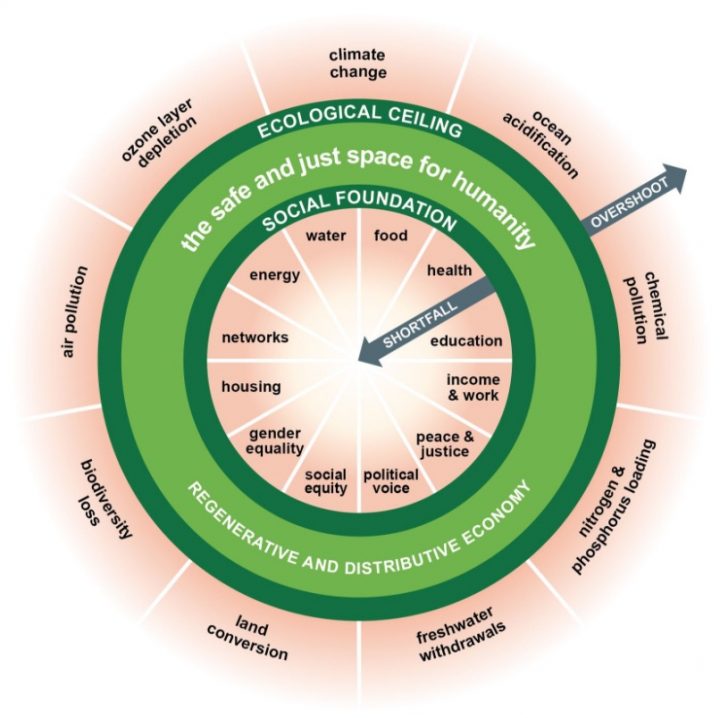
Kate Raworth’s ‘donut’ presents a relatively new way of looking at the economy, which has attained some fame. See the picture below.

the donut

As you approach the hole in the middle, you have an economy which does not satisfy people’s needs such as water, food, housing, relative equity, liberty, education and so on.

As you approach the edge of the image you begin to destroy the ecologies of the planet that the economy depends upon, producing events such as biodiversity loss, climate change, disruption of nitrogen and phosphorus cycles, destruction of fertile land, and so on.

Whereas without such a diagram, the capitalist economy is perceived as a matter of self-contained markets isolated from ecology, she argues that the aim of economics should be to satisfy people’s needs without destroying that planetary ecology.

Normal economic theory, can argue that inequality decreases as growth increases, and that growth cleans up economies, because the economic model looks at the world in isolated ways. Some economies appear to clean up ecologies, but they do so at the expense of other ecologies, and businesses are always happy to lower the costs of pollution and increase profit when offered an opportunity.

People may object that it is impossible to meet the needs of everyone – especially while respecting the planetary boundaries, but at least in this model it appears as something which can be discussed as a major concern. Just as we can ask “What is the economy for? What is it about?” and get a reasonably useful answer.

The old economics had an extremely confining view of human nature, it was humanity stripped of everything but the profit motive. This was a decision originally taken to distinguish economics from other fields such as history or philosophy, and to make things simpler, but it became the model of humanity. Under it we are *just* individual profit seekers. We only cooperate in order to make personal profit, we naturally destroy for profit, we have fixed preferences which we neutrally evaluate, and we have no purpose, happiness or virtue other than wealth seeking.

This view is simply not true, or adequate. Humans co-operate as naturally as they compete. We are social as much as individual, we do not naturally only value money and we do not destroy what we share. We are creatures with many purposes and many aims. Wealth is usually only important to the extent it brings about those other purposes and we are not made happy by consumption.
Raworth’s model, to me, is reasonably obvious and elegant and allows humans to be complex. It is not reductive.

It does have a few problems.

1) It does not explicitly recognise that the current economy is a mode of power, situated within frameworks of power relations, and that historical evidence appears to show that those who benefit from this mode of power will do almost anything to preserve it – including wreck the earth.

Nearly all forms of organisation are nowadays reduced to economic/capitalistic organisations. Media and information is controlled by capitalists, the law is controlled by capitalists, the State is controlled by capitalists, education is controlled by capitalists, and so on. Paying attention to the “bottom line” (measured in terms of money) is a mantra that both permeates society, and ignores reality.

It will be hard to move against inertia and the active power dedicated to preserving existing hierarchy. The model does not easily provide for the distortions that power puts into economics – any more than standard economics does. But as standard economics aims to preserve that power it is not a handicap for it, but a strength, as its users can pretend that inequality of outcome is always proportional to inequality of talent.

2) More importantly, the model does not provide a set of simple positive instructions for politicians. It does not give them an easy and painless set of action slogans and programs, whereas conventional economics does.

Conventional economics says: business is always good and always delivers, you must increase growth, nature is limitless or unimportant, commons don’t work so sell them off to business, government is inefficient so hand it over to business, rich people are talented so give them more support and protection (and pick up the rewards), reduce taxes, stop government services, increase charges, abandon poor people as they are without virtue, and individual wealth and its owners should be worshiped.

Donut economics, just says don’t destroy the world, and let everyone participate. Neither is easy under the current power relations, and these actions do not reward players in the State. The model grinds to a halt.

It needs simple and positive directives.

So time to think what those might be….

Ethics and Culture

April 23, 2018

Ethics is cultural, we are brought up to feel that certain things are wrong, and that we should behave in certain ways. It is also bound up with political relationships between groups – if a person is a member of our group, or someone we identify with then we are likely to treat them specially; usually (but not always) we will be more sympathetic, accept excuses, assume they are really right, be persuaded by their arguments, and so on. These seem to be matters of fact. But our responses to them are ethical.

Should ethics be cultural? Should ethics be political? This is instantly an ethical question, and thus irresolvable if my initial question as to whether any ethical propositions could exist that were not already ethical, although I suspect most people would not say ‘yes’ to either of these propositions…

it seems to me that agreement with local customs cannot be a basis for ethics. It seems to be a cop out. I would expect a an ethicist to challenge local customs. That they would be socratic in the sense of seeing whether those customs had any basis in reality or were coherent, or likely to produce the results that the holders’ intended. While arguing that ethics should produce the result it intends is another ethical statement, it seems to be one most people might agree with – although they don’t have to, its not compelling. My kind of ethicist would not be socratic in looking for a definition of the good or the just, because that leads to the unreal….

When I suggest that there is no basis for ethics which is not already ethical, I’m not suggesting that ethics is always coherent, although I may assume an ethical position that coherence is usually good. For example an ‘ethics of love’, may also generate violence, oppression and hatred (especially if it is applied via rules… but that is another argument for another time), and this may not seem compatible with its initial formulation. People with this ethics may be aware of these problems (as when Franciscans were brought into the inquisition), but these ethical people may attempt to suppress awareness of unintended consequences, in order to support their ethical systems, and produce even worse consequences and incoherencies….. And it seems ethicists might challenge that, although the challenge can always be denied.

Ethics and its basis – Again….

April 22, 2018

My recurring question is whether it is possible to find a basis for ethics which is not already ethical?

Thus some people argue that we should obey God’s commands (let us ignore the fact that almost nobody obeys the complete commands of any religious text) but the idea that obeying God is ethical is already an ethical proposition which can be challenged by other ethical propositions.

The Utilitarian idea of the greatest good for the greatest number, depends on the ethical idea that ethics should benefit the many rather than the few, this also could be challenged by another ethical proposition.

The idea that we should behave in a situation in the way that we would want all such situations to be treated (‘the categorical imperative’), contains an ethical assumption that generality should override specific context. It could be argued that ethics must attend to context. (‘should’ and ‘must’ are almost always terms implying an ethics is going on).

The idea that ethical behaviour resides in a mean (Aristotelian arête ethics), is a proposition which implies that extremes are unethical (and come in binaries!)

Anti-cultural relativism, often seems to assume similarity is ethical and unsimilarity is not.

And so on.

I think people can argue that I am cheating here because I have not given a definition of ethics. But while definitions are helpful I don’t think it solves problems.

I’m not a Platonist, so I don’t believe that giving a definition always provides understanding, or is always possible.

Sometimes people know what they mean well enough…. But let us assume that ethics has to something to do with terms like virtue, good behaviour, right behaviour, morality and things like that. I may not know what ethics is, you (as reader) may, but I all I kind of know is how people use the word.

One gentleman discussing this issue with me gave the following definition:

By “ethical”, I mean “anything that pertains or is related to some system of ethical values and duties”.

I would also stipulate that, according to my own preferred use of terms, a system of values and duties is to be called “ethical” if — at a minimum — it is designed with the (implicit or explicit) goal of protecting (and even of increasing) the well-being of some sentient entities (human or non-human).

This encapsulates part of my problem with ethics as a “set of propositions” and illustrates my question… “Is it possible to find a basis for ethics which is not already ethical [i.e., value-laden]?”

Lets look at the beginning of this definition: “By ‘ethical’, I mean ‘anything that pertains or is related to some system of ethical values and duties’.”

I don’t have to say this is circular, and I certainly couldn’t do any better myself. ‘Ethics is about ethics.’ Obviously he moves on to illustrate what he means by ethics…

“a system of values and duties is to be called “ethical” if — at a minimum — it is designed with the (implicit or explicit) goal of protecting (and even of increasing) the well-being of some sentient entities (human or non-human).”

So he makes what seems to me to be an ethical proposition, that ethics is about ‘protection’, and ‘well being’, of ‘sentient entities’.

There is no non ethical reason why this should be the case. It is already value laden. Thus a person with a different ethical position might argue that not everyone should be protected, only particular special people (this is common in ethical systems – foetuses cannot be killed by surgery, but enemy mothers and foetuses can be killed by bombs). They might object to “well-being” saying that was the decadent ethics of bourgeois society and ‘hardiness’ or ‘spiritual discipline’ should be the end of ethics as it was ethically superior, etc. Finally a non-humanist eco-philosopher could argue that that ethics has to be directed to the environment, as there are no singly existing sentient entities, everything exists together, or that sentience is not that important ethically speaking; it is an “unethical” form of exclusion, structurally comparable to racist ethics, and so on…

If so, and if this makes sense, yet again we have an illustration of it appearing not to be the case that we can have an ethical proposition/axiom which is not already ethical, or value laden…

Libertarianism, communism and freedom

April 17, 2018

“Liberal” is a weird word. To people in the European tradition it means someone for whom free markets are important, and personal liberty is tied up with wealth and the removal of barriers, and so a nowadays a “non-conservative” member of the right. At one time this kind of liberalism was radical, now it is simply a way of enforcing the power of money, hence it sits well with the establishment. In America this position is “libertarian” while the term liberal implies a person who thinks that we should all get on with each other, that government should be helpful, and that participation in government should not be restricted to the wealthiest.

“Communist” is equally a weird word, because communism as a aspiration is radically different from the communist powers which used to exist. There were as many varieties of communism as liberalism. Originally communism meant the withering away of the state, liberty and co-operative freedom. This kind of communism recognized that freedom and life required other people, and sometimes required help, not simply the removal of barriers. Too much poverty and violence does not grant freedom, or the capacity to act on what freedom is available. Later, official communism simply supported the power of the Communist State and its rulers. Official communism was not an egalitarian arrangement.

“Freedom” is also weird. Some people have asserted that freedom is recognition of necessity, which often seems to mean keep carrying on with oppression. Personally I think there is no liberty without enablement, and without some degree of equality. Sure there will always be some inequality as people don’t have equal abilities or good fortune, but massive inequality usually means that the society is being run for the benefit of those at the top (who may not have great ability and who have some protection from ill fortune). Consequently the liberty of those people has to be curtailed slightly for the benefit of others. It is, for example, often (but not always) agreed that a person’s freedom to use their ability to beat other people up, or kill them, should be limited, so it is with other freedoms. Freedoms can always contradict, that is why it is a struggle.

In complex systems attempts to impose either order and freedom can have unintended consequences. Imposing the freedom of the market can lead to freedom for the wealthy and non for everyone else. Imposing equality through the State can also lead to lack of freedom for some people. We perhaps need to carry awareness of these oppositions and contradictions in mind, and allow something new to arise, rather than simply assert what we believe to be true, but which has never worked, is the way to go.