Posts Tagged ‘degrowth’

Ruskin: Wealth, Illth and Degrowth

August 14, 2022

As you might guess none of this is original

https://commons.wikimedia.org/wiki/File:Ruskin_Self_Portrait_1875.jpg

Definitions

Let’s begin with some useful definitions from Ruskin:

Wealth” to Ruskin is what contributes to a good life and adds to people’s capacity to be constructive:

There is no wealth but life. Life, including all its powers of love, of joy, and of admiration. That country is the richest which nourishes the greatest numbers of noble and happy human beings; that man is richest, who, having perfected the functions of his own life to the utmost, has also the widest helpful influence, both personal, and by means of his possessions, over the lives of others.

Unto this Last.

To Ruskin wealth is therefore connected to the power of implementing virtue, ‘nobility’, and being helpful. This is not a definition likely approved by classical economics – partly because these powers cannot be counted or measured and evaluation can be fairly subjective. Wealth being life, also points to the health of the environmental ecology.

Riches” can be distinguished from wealth as it is collections of money and property which may not contribute to peoples lives. They may even involve cruelty, exploitation and exclusion.

If the king alone be rich, or if a few slave-masters are rich and the nation otherwise composed of slaves is it to be called a rich nation?… [paraphrase]
Since the inequality, which is the condition of riches, may be established in two opposite modes—namely, by increase of possession on the one side, and by decrease of it on the other—we have to inquire, with respect to any given state of riches, precisely in what manner the correlative poverty was produced.

Ruskin Munera Pulveris

Wealth tends to be communal, riches tend to be private and exclusive. I’m not aware of whether Ruskin writes on the virtues of commoning, but it is implied in these definitions. Wealth and prosperity is helpful to all, riches are not. This distinction is again unlikely to be favoured by classical economics, as such economics might even have the aim of confusing prosperity with riches for some.

Illth” is the harm produced by economic activity. Illth includes obvious(?) devastations produced by pollution, dumped nuclear waste, ecological destruction during extraction and so on, but illth also includes the, perhaps, unintended human consequences which can arise from building riches such as ugliness, ill-health, insensitivity, compulsive selfishness, bad community relationships, exploitation, increasing misery, people crippled or exhausted and insecure from the work they have to do, loss of the ability for the community or individual to support themselves, work injuries, consumerist addiction, people being fed lies and untruth, dispossession of people by market demands, people being sacrificed to the market, destruction of prosperous futures, destruction of virtue, and so on.

There may be conflict here. What one person counts as illth, can be defined by others as riches, or even wealth.

Problems of Measurement

Recognition of the complexity of wealth and the problems of Illth seem vital to living a good life and perhaps even surviving. As Herbert Daly points out, once we start hurting the planet and using up its capacity to regenerate its wealth, we are continually generating compounding illth – even if we apparently generate riches. This is a case in which our economics measures money, but does not measure prosperity or the risk of illth. Again, this is difficult to do, but should probably not be ignored.

The main supposed measure of prosperity is the GDP which measures economic activity or expenditure (riches), not Ruskinian wealth.

There are a number of approaches but basically they all use monetary measures:

  • GDP = C (Private Consumer spending) + G (government spending) + I (investments spent on capital equipment, inventories, and housing) + NX (country’s total exports less total imports)

or

  • GDP = Wages + Profits + small business profits + Taxes – Subsidies

These sums can be adjusted for inflation or not. I used Wikipedia as the source, despite finding many other definitions, on the grounds that informed people would probably alter Wikipedia if it was obviously wrong, but also see this which points to rents, earnings from interest, and depreciation as factors in the second version of GDP etc.

The problem with illth in this scheme, as Daly points out, is that it has little recognised monetary value and is not measured. While few people wish to buy illth, they will happily dump it on others to increase profits and the GDP, and people will buy products that may save them from illth, gas masks, air filters, vitamins, pollution clean ups and so on, also boosting GDP, so that illth not only can help destroy the future but generate economic activity which counts as riches and prosperity as measured by the GDP. Through the measurement process, illth can increase apparent riches more than if the harm had not happened. The actual damage to life that illth creates may not be so easy to calculate.

Likewise if a climate change driven storm flattens an area and leaves people homeless or months or years, then any effort at reconstruction also adds to GDP, when in many cases little wealth may be being added to people’s lives and much may have been taken away.

If a forest is destroyed that can count as good economic activity. If people destroy all the world’s trees that is still a boost to the current GDP, despite having destroyed current and future wealth. Destroying the capacity for life, is almost certainly definitional of illth.

Because humans have apparently already significantly affected the planet’s ability to support us, then we need to lower the mass of the monetary economy, especially the mass of the illth economy. To do this we may have to abandon the current version of the GPD as a measure, and damage will have to be counted as a negative in the same terms, which may not be possible. But it is almost certain that economies will have to shrink in reality until the illth (long and short term) is minimised.

Sometimes harms may be useful when they occur during a re-organisation of the economy into a more democratic form, for example, but that is not usual.

We might even wonder if illth can ever be separated from riches? It may be the case that the global economy (both capitalist and developmentalist) requires illth to ‘work’ or to know it is working.

If we then add growth of the GDP as a supposed necessary mark of success or even of economic “sustainability”, then this holds a demand that the economy will have to continue to increase resource extraction and consumption, which may require even more violent, and illth producing, forms of extraction, which incidentally add more to GDP because the cost is greater but which add very little wealth. Daly again remarks that a low destruction oil well that produces much oil without much labour or danger, would currently add less to the GDP than would a dangerous deep sea well, in a storm racked area, which produces heaps of pollution and a need for clean ups. The second well would probably only be countenanced when the easy wells are almost used up.

The difficulty is measuring illth purely in monetary terms. If illth is not completely repaired, which is possibly impossible, then there is no cost, and as we have seen currently the cost of repair hides the damage as riches. If illth is freeloaded upon to generate riches, then it cannot be costed other than by estimate, and if the illth of human misery is to be factored in, then it can always be denied by those with riches….

A more useful measure????

Nowadays, according to some claims, economic activity uses up a year of the Earth’s capacity to regenerate in just under 8 months. This is illth creation in action. Economic activity is creating riches but destroying our capacity to produce future prosperity. It indicates the seriousness of illth production. I presume this is a disputable measurement, which is why it is not in official use, but it does seem to be a useful measure. We simply cannot afford to be in a situation in which our use of the planet is greater than the planet can regenerate, for long periods of time.

Hence, again we go to the necessity of

  • degrowth
  • the recognition of the unintended harms coming from the production of riches, and
  • the need to produce real wealth in human life.
Climate and Categories

September 30, 2021

George Monbiot, writes in the Guardian today about the way that the categories we use to fight climate change may in fact hinder our capacity to do anything about it, because they break up the system into tidy, non intersecting boxes, and the issue with all ecological events/processes are that they are interconnected. I’ve added a few comments in italics, but most of this is a summary.

There is a box labelled “climate”, in which politicians discuss the climate crisis. There is a box named “biodiversity”, in which they discuss the biodiversity crisis. There are other boxes, such as pollution, deforestation, overfishing and soil loss, gathering dust in our planet’s lost property department. But they all contain aspects of one crisis that we have divided up to make it comprehensible.

Monbiot. ‘Green growth’ doesn’t exist – less of everything is the only way to avert catastrophe. The Guardian, 29 September 2021

In reality these divisions do not exist, and a crisis in one ‘box’ spills over into other boxes. They make compounding crises. We cannot deal with one of these crises, without considering how they interact and how the way we respond to one box effects the ‘other’ boxes – “each source of stress compounds the others.”

Some of the crises may be separated out altogether from the problem. Therefore economic crises and political crises may not be seen in terms of the ecological crises, even though it is political and economic decisions which are making the ecological crises, and politics and economics cannot be entirely separated from ecological events. If there is a drought, supplies can get disrupted, companies can go bust, food prices increase, governments be destabilised, and so on.

He looks at the right whale: “fewer than 95 females of breeding age remain.” This comes about because:

  • Warming waters push the whales into busy sea lanes – where they get tangled in nets or injured by ships.
  • Their food source (a small crustacean) is also moving north.
  • A fishing industry has recently developed to exploit the crustacean We don’t know the effects of this on its population levels.
  • Increased ocean acidification could also impact on the crustacean.
  • Increased gas and oil exploration may add to pollution and crustacean death.

Other problems include declining birth rate of the whales which could be caused by

  • Pollution. We know some mammals are affected by pollution in that way.
  • Disruption of communication via Ocean noise caused by the shipping.

you could call the decline of the North Atlantic right whale a shipping crisis, or a fishing crisis, or a climate crisis, or an acidification crisis, or a pollution crisis, or a noise crisis. But it is in fact all of these things: a general crisis caused by human activity.

ibid

He then points out that the effects of chemicals tend to be investigated individually is if they were isolated from other chemicals, whereas they are (in the wild) constantly interacting with thousands of other chemicals, as well as thousands of other purely ‘natural’ chemical and transformative processes (such as various kinds of digestion).

Studies of bees show that when pesticides are combined, their effects are synergistic: in other words, the damage they each cause isn’t added, but multiplied. When pesticides are combined with fungicides and herbicides, the effects are multiplied again.

ibid.

As well as encountering chemicals, insects may also find their reproductive cycles no longer match plant cycles because of climate change. Even changing street lights can have unintended consequences:

The switch from orange sodium streetlights to white LEDs saves energy, but their wider colour spectrum turns out to be disastrous for insects. 

ibid.

The problems with coral reefs is not just because of bleaching through increased heat (even though people will deny this), but because of bottom fishing (dragging weighted nets along the reef and pulling them down), explosive fishing (usually illegal but still happening), fertiliser run offs, coal dust pollution, ocean acidification, and increasingly strong storms and cyclones. With decreasing fish supplies the response will probably be to increase fishing and destructive fishing techniques, which will put further stress on reefs and their inhabitants.

What would we see if we broke down our conceptual barriers <boxes>? We would see a full-spectrum assault on the living world. Scarcely anywhere is now safe from this sustained assault. 

ibid.

If we are to try and solve the current crisis through massive building projects, such as renewable farms or carbon removal:

this would demand a massive new wave of mining and processing for the steel and concrete…. The mining of sand to make concrete is trashing hundreds of precious habitats. It’s especially devastating to rivers, whose sand is highly sought in construction. Rivers are already being hit by drought, the disappearance of mountain ice and snow, our extraction of water, and pollution from farming, sewage and industry. Sand dredging, on top of these assaults, could be a final, fatal blow….

mining and processing the minerals required for magnets and batteries is laying waste to habitats and causing new pollution crises

ibid

His conclusion seems unavoidable.

The problems largely stem from a political conviction that endless economic growth is possible, necessary and desirable. This conception of economic growth and increasing extraction of ‘goods’ and ‘resources’ cannot be isolated from the world it occurs within and which it is destroying – “there is no such thing as green growth. Growth is wiping the green from the Earth.”

Politics and economics are not separate from the crisis.

Somehow, we have to decrease consumption per head, and that responsibility primarily falls upon the polluter elite, or that part of the population who both fund pollution through investment and pollute massively to live their lives. While most people reading this blog, are not the elite of the elite, they still probably pollute more than most of the world’s population and, through pension funds, profit from pollution, and so (even if individually, the cuts a person can make are trivial) some cutting is within your power, and if enough people do it, that could travel through the system, and help build effects, to persuade the elite of the elite that there is some resistance happening.

Imaginary Technology and Climate Change

May 27, 2020

This blog article is largely a summary and brief discussion of a short paper published in Nature Climate Change. “The co-evolution of technological promises, modelling, policies and climate change targets” by Duncan McLaren & Nils Markusson. I mesh some of the summary with a blog article written by McLaren, as this appears to give extra information and more clarity to the general argument. Unless specified, quotations come from the article.

The paper discusses “technologies of prevarication” which form part of an “an ongoing cycle that repeatedly avoids transformative social and economic change” (p.392).

The ‘gentle’ argument is that the international goals of avoiding climate change have been reinterpreted in the light of new technological and modelling methods, and the promises these new ‘devices’ have allowed. These technological promises, in general, allow the sidelining of social transformation, and the delay of any real cut back in emissions.

In the terms I’ve deployed elsewhere, these fantasies about technologies act as defense mechanisms against change and political challenge.

The article proposes five different stages in the global climate policy process. These stages overlap, but policy debates about targets in these stages “was noticeably framed primarily in [certain] terms while previous formulations retreated from the public eye” (p.392).

The stages they argue for are:
1) Stabilizsation c.Rio 1992
2) Percentage emissions reductions c.Kyoto 1997
3) Atmospheric concentrations c.Copenhagen 2009
4) Cumulative budgets c.Durban 2011, Doha 2012
5) Outcome temperatures c.Paris 2015

I should add that I don’t think these stages are proven and fully documented (the article is short), but they are plausible, and I’m sure the authors will document them more rigorously later.

Stage 1: at Rio, when the United Nations Framework Convention on Climate Change (UNFCCC) was negotiated,

the UN settled on a goal of ‘stabilizing atmospheric concentrations of GHGs [Green House Gases] at a level commensurate with avoiding dangerous anthropogenic climate change’…

p.392

This was associated with coupled ‘general circulation models‘ [1] and ‘integrated assessment models[2] which allowed the exploration of emissions reductions techniques and their economic costs. As the authors say in a blog post:

assessing specific policy interventions with these early models was difficult, and responses were often discussed in very broad-brush terms.

13 May 2020 Guest post: A brief history of climate targets

Policy responses included: energy efficiency, promotion of forest carbon sinks (the blog adds ocean iron fertilisation), and finally nuclear energy. Nuclear energy stalled largely because of costs and public concerns about risks, and voters not wanting to live near one.

Stage 2: The debate around Kyoto was largely over speed of emissions reductions, usually with percentage reductions of emissions by target dates.

Models enabled people to relate emmissions cuts to concentrations of GHGs, but not to outcome temperatures.

Policy and promises focused on emissions reductions from fossil fuels, through the technologies of Carbon Capture and Storage (CCS) (promising up to 90% reductions from fossil fuels) and fuel switching, and on energy efficiency. Trading schemes were proposed, [although were often so slackly developed, in order to reduce costs to business, that they had little result.] The IPCC issued a report on CCS. The blog mentions that in some parts of the world there was talk of building new “capture ready” coal power stations, with licenses being granted before the term was even defined. The blog states:

CCS was selected preferentially by the model algorithms because the simulated costs of continued expansion and use of fossil-fuel power – linked to retrofitting with CCS – were lower than those associated with phasing out electricity generation using coal and gas.

13 May 2020 Guest post: A brief history of climate targets

However,

practical development of CCS got little further than research facilities, while the promise of ‘CCS readiness’ even facilitated continued construction of new fossil power plants.

p.394

Fuel also switching did not live up to its promise.

Modelling

continued to become more sophisticated. It moved on to establish direct links between economic activity and the concentration of CO2 in the atmosphere. 

13 May 2020 Guest post: A brief history of climate targets

Stage 3: Atmospheric concentrations c.Copenhagen 2009

The blog asserts that in the lead up to the Copenhagen COP, there was intense debate over setting a goal for atmospheric CO2 concentrations. Initially 550 ppm was considered adequate but the debate saw that lowered to 450 ppm.

There had been little progress, in reducing emissions. Bioenergy came to the fore as a promise, especially Bioenergy with CCS (BECCS) which implied a lowering of GHG concentrations at a future date. At the time BECCS was more or less completely conceptual, but it merged two apparently known technologies so was considered practicable.

Like CCS before it, BECCS promised ways to cut the costs of meeting a particular target, slowing the transition even more by its promise to effectively reverse emissions at a future date.

p.394

The blog phrases this more strongly. BECCS “allow[ed] the justification of a slower transition by its promise to effectively reverse emissions at a future date.”

Computer modelling became more complicated, with many 450 ppm of CO2 scenarios using the postulate of imagined CCS. The fact that this target appeared, to some, nowhere near adequate to prevent destructive climate change led to 350.org being founded.

There was less talk of emissions cuts and more talk of concentrations, and some possible confusion over the connection to temperature outcomes, even if the Copenhagen was officially focused on keeping the increase in temperature at about 2 degrees.

Yet again, CCS, or BECCS, had failed to be deployed, or we might add, even researched, to any useful extent.

Stage 4: Cumulative budgets Durban 2011, Doha 2012

some negotiators argued… for the pursuit of ‘a clear limit on GHG concentrations, and consequently a scientifically calculated carbon budget’…

p.394

A Carbon Budget attempts to set a total limit on the CO2 that can be emitted by States, to keep global temperature rise below a certain level. According to the blog “the UK began setting periodic five-year carbon budgets under its Climate Change Act in 2008″.

At around the same time:

the development of a simple inversion tool in the MAGICC model enabled not only the development of RCPs [Representative Concentration Pathways], but also more sophisticated global carbon budgeting models.

p.394

The idea of limiting cumulative emissions seemed to be more robust than previous methods, but opened the idea of imagined ‘negative emissions technologies’, which again reinforced the fantasy of underdeveloped BECCS. Indeed these imagined technologies became the only way forward, even if they largely remained imaginary.

As the blog states:

In addition, [these negative emissions technologies] enabled promises of future carbon removal as a means to reverse any “overshoot” of the budget…. And there is a fine line between inadvertent and planned overshoot

13 May 2020 Guest post: A brief history of climate targets

Stage 5: Outcome Temperatures. The carbon budgets idea never really got put into play – possibly because they were too empirical and demanded emissions cutbacks, and the non-use of fossil fuel reserves. So the Paris COP shifted to a focus on temperature increase – officially 2 degrees, but possibly 1.5 – as the boundary around dangerous climate change. This further boosted talk of negative emissions technology.

Looking ahead, although [Negative Emissions Technologies] might retrospectively balance carbon budgets, delayed action would still make a temperature overshoot more likely.

p.395

This helps construct “a space for an imaginary technology that can act directly to reduce temperatures”, such as Geoengineering. This, in turn, makes the use of geoengineering, and attempts to control the ecology of the whole world, more likely to be factored into models.

However, it is extremely difficult to accurately model the ecological consequences of geoengineering (especially without large scale testing), so the likely undesired effects become a cost left out of the models.

The blog remarks:

Many national and business targets are now framed as “net-zero” carbon, explicitly – or implicitly – achieved through substantial future deployment of carbon removal. 

13 May 2020 Guest post: A brief history of climate targets

Conclusion

Policy change looks like to be a co-evolutionary process involving implicit policy, politics, models, and imagined technologies.

In this process, the ‘evolutionary fitness’ of each technological promise is less a product of its (potential) climate impact than a measure of how well it can be modelled, and how well it matches the extant framings of climate policy.

p.395

These imagined techs then become embedded in the models and in the policy projects even if they do not exist at sufficient scale, after years of opportunity. The blog argues that the problem is magnified because the “integrated assessment models” focus on:

cost optimisation with time discounting. This means they favour future promises of action over plausible, but potentially costly, near-term interventions.

13 May 2020 Guest post: A brief history of climate targets

The delays make the policies look cheaper to deliver, and cheapness is, in neoliberalism, a virtue; but over time little has been delivered – for example it appears that during the first decade of the twenty-first century, world coal production almost doubled, and it has not declined back to dangerous 1990s levels, yet.

Critically, in this process, each technological promise has enabled a continued politics of prevarication and inadequate action by raising expectations of more effective policy options becoming available in the future, in turn justifying existing limited and gradualist policy choices and thus diminishing the perceived urgency of deploying costly and unpopular, but better understood and tested, options for policy in the short term.

p.395

These technologies of prevarication have rarely delivered on their promises, or been as cheap as expected, and have rarely been embraced by governments or business in practice as opposed to imaginal rhetoric.

Often the problems, or unintended consequences, of the imagined technologies were not seen until people started to implement them. BECCS for example can result in deforestation, impingement on food production, require large amounts of energy input, and the extracted CO2 can be used to help push oil out of wells to be burnt to produce more CO2. At the best talk of CCS and carbon extraction merely slows down transition.

There is a possibility that:

each promise has, to some degree, fed systemic ‘moral corruption’ in which current elites are enabled to pursue self-serving pathways while passing off risk to vulnerable people in the future and in the Global South.

p.395

The technological promises, promise to save neoliberalism and market based developmentalism, and “promised future action, rather than immediate sacrifice.”

Carbon sinks may have perhaps gone backwards. Nuclear power has almost ceased being built, even though the promise remains to allow people to imagine future cuts in emissions. Efficiency gains have enabled growth in consumption and energy expectations have expanded. Often technologies etc have allowed additional energy capacity rather than reduced emissions. We can add that it appears that many countries (particularly China and the US) have encouraged poorer countries to lock-in to coal dependency to keep the exporters coal mines running, as emissions are counted on a per country basis. This increases the cost of conversion to renewables – all the money which could have been spent getting the countries self sufficient in renewables has been wasted in fossil fuels. While cheaper renewables make a change apparently more practicable, it is an extra expense and destruction of invested capital that poorer countries, and some wealthier ones, cannot afford easily – they have more immediate expenses, and few powerful people like to admit they have wasted money for nothing.

The whole process has downplayed urgency and helped defer deadlines for action.

We have played into the imagined technological fix, rather than the social change we need. There is no suggestion that the people who have invented and worked on this technology are to blame, the problem is the way their imaginings have been used to in policy and modelling to maintain small scale action. It has been more important for politicians to maintain neoliberalism, and development, than to act on climate.

[L]ayers of past unredeemed technological promises have become sedimented in climate pathway models. Contemporary imaginaries may prove just as unrealizable as the previous generations of promises,and there is no logical end to the set of possible technological promises that could be added to ‘resolve’ the models.

p.396

This ‘sedimentation’ of failed technological promises is now so standard that risks of technology disappointment and failure should be incorporated into models and policy discussions, and research.

Thirty years of failure, should show that we cannot continue our society working as it does, and expect to solve problems of climate change. We have to, as the blog states, “deliver behavioural, cultural and economic transformations.”

Comment

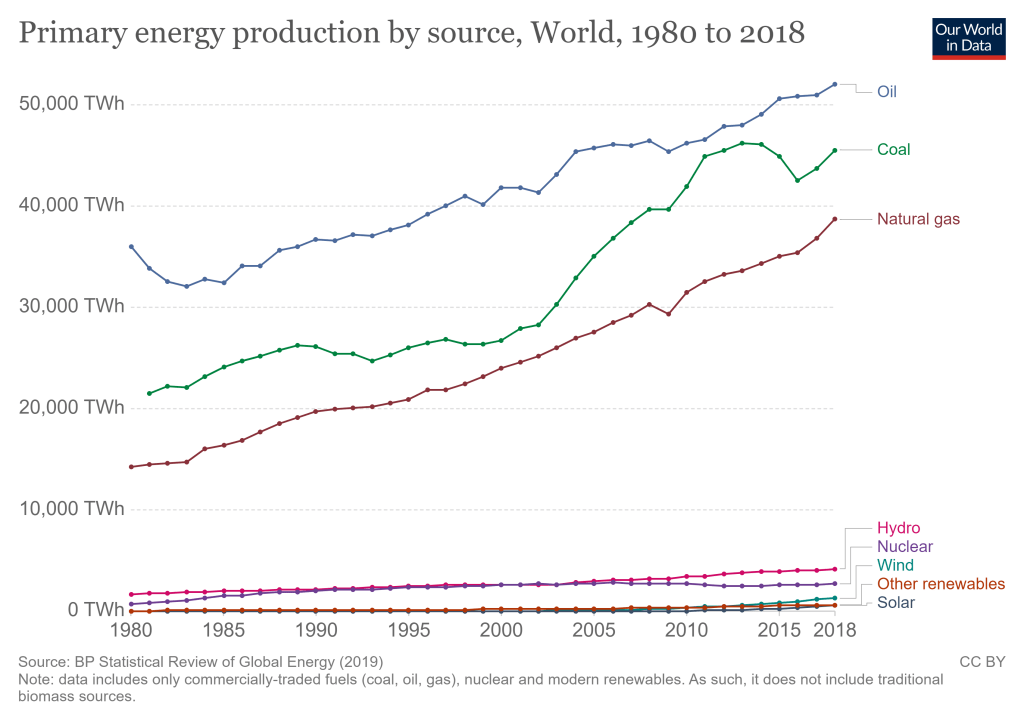
Assuming the figures used to make this graph are accurate, the image shows how well we have reduced energy production from fossil fuels, and how much we have increased renewable energy in the last 40 years.

source: https://ourworldindata.org/grapher/primary-energy-prod-source?time=1980..2018

We have failed. We have had years of climate action, discussion between nations, and targets have been set, yet the actions taken have ignored the problem and made the situation worse. The idea that technologies are largely defense mechanisms or modes of prevarication, is graphically illustrated. If we keep the same social organisation, and the same development processes going, then we are committing suicide. Whatever the appearance our States are failed States, when it comes to dealing with this problem.

We cannot rely on the State or big business to save us, or even to try to save us. We have been doing that, and this faith has not been repaid. We may need to get to work outside the State and outside big business…

This is where ideas of degrowth and community energy democracy come in. Degrowth will almost certainly not be a popular response to politicians, but it does allow us to ask questions which are otherwise not being asked. These questions have the potential to open the unconscious of our social dynamic towards destruction.

What, for example, if we tried to reduce burning fossil fuels without replacing them? This would be world changing, it would also start debates about wealth distribution, and energy distribution. What do we really need the energy for? How do we need the energy production distributed, to make these cuts possible? How can we levelise consumption to give everyone what they need to survive comfortably and freely? Can communities build and manage their own energy supplies? Can any of this be achieved along with the maintenance of rivalrous military based nation states? Will those in power who love the maintenance of violence-based hierarchies fight with all they can muster to go to destruction before surrendering their power?

I doubt such questions will be asked, but they are essential, otherwise technology is likely to primarily remain either a prevarication or a defense mechanism, which maintains our self-destruction.

Problems with Shale Oil in the US

February 9, 2020

This is a summary of a series of blog posts by another writer. He is trying to sell you ‘precious metals’ as a hedge against economic collapse, but his analysis of a coming crisis in US shale oil production seems highly plausible…

He suggests that activity in the world’s economy has been driven by cheap energy availability, and this has largely been provided by cheap US shale oil.

Nowadays, it appears that Peak Mainstream oil is already here. Each year the world needs to replace 3 million barrels per day of supply no longer provided from mature and declining oil fields at the same time as meeting growth in demand for oil. Any growth in contemporary world oil consumption was allowed by the US shale.

However, the decline in US shale oil production is even more dramatic than that for mature mainstream oil wells. The top 4 U.S. shale oil fields have suffered a 44% decline in their rate of production in less than a year, between Dec 2018 to Oct 2019.

It will take a massive amount of investment spending and thousands of new wells to offset these losses in production from shale oil, and keep the output stable. As the easily available shale oil has by now been taken (as businesses generally go for the easy targets first), it is probable that new shale oil will also require a lot more energy to retrieve. The ratio of Energy Return to Energy Input (EREI) will be much lower, so overall energy availability will be lower.

The spending and oil output is almost certainly ungeneratable, and unsustainable, in any kind of financial system. This situation is made worse as the author has argued elsewhere, because shale oil has largely survived on borrowed money, with investors hoping for long term stable production which has not eventuated. There will likely be large scale losses of this borrowed money, which could start a general financial collapse.

Lack of production also means that oil based energy collapse is extremely likely, and this will probably reinforce the financial collapse.

It is also likely to make the necessary transition into renewables harder, although it might ‘help’ through unplanned and catastrophic degrowth.

Mencius on property

January 21, 2020

When Mencius, was visiting King Hwuy of Lëang, the King went and stood with him by a pond.

Looking around on the wild geese and deer, large and small, the King said, “Do wise and good princes take pleasure in these things?”

Mencius replied, “Being wise and virtuous, they have pleasure in these things. If they are not wise and virtuous, although they have these things, they do not find pleasure in them.”

Mencius continued: “King Wan had a park like this, which was for himself and the people. He used the strength of the people to make his tower and pond, and the people rejoiced to do the work, calling the tower ‘the Marvellous Tower,’ and the pond ‘the Marvellous Pond,’ and were glad that he had his deer, his fishes and turtles.

“He had his tower, the pond, birds and animals, but how could he have pleasure alone? The ancients caused their people to have pleasure as well as themselves, and therefore they could enjoy what they had.