Posts Tagged ‘depth psychology’

Spirit, soul, flesh and the climate crisis

March 24, 2020

The issue of spirituality again….

There seems to be a lot of people claiming that ‘materialism’ is the problem and ‘spirituality’ is the solution. It is not always clear what they mean by either of these terms, but these terms are binary, and define the other by what it is not. To the materialist the spirit is nothing, and to spiritualists matter is nothing. But both form a category based division of the world, which depends on each other for their meaning and sense of reality.

As I’ve discussed before binary and ‘mono-ary’ thinking are reductive. You seem to need at least three terms to start thinking non reductively, and even then it is difficult not to reduce one’s thought to the one or the two. You may always need a prime number of terms, to begin to avoid the reduction into binaries. A four term layout may easily reduce to two binaries and so on.

With the two terms, spirit and matter, we generate ‘opposites’ and ‘oppositions’, in which one term is valued more than the other, rather than complements, but you cannot have one without the other, even if they go as far as to deny or slancer the other to give themselves meaning.

James Hillman tries to broaden thinking and perceptions, by using the old Christian terms ‘soul’ (psyche), ‘spirit’ (pneuma) and ‘flesh’ (sarx or apparently sometimes soma although this latter could mark some further differentiation ). For a long time, it has seemed odd to me that this triadic distinction gets reduced to spirit and matter, especially if you hold that God is a Trinity, which was the official position….

In Western Culture, in a slightly modified use of Hillman’s terms, ‘spirit’ is the force of ascension – that which tries to leave the world and the flesh behind. It is that which is convinced its true habitation is elsewhere in spiritual clarity of pure mind and, at the extreme, sees the flesh as a prison, a tomb, or as unreal, by comparison with the freedom, might, power and reality of spirit. Often, with visions of the spirit, individuality, isolation, etc dies in the realisation of that spirit, in its “oneness”.

Soul, on the other hand, is that which seeks meaning in the dark, in the depths, of feeling, imagery and in recognition of our unconscious. It seeks the light of nature. It is the descent into and through the flesh into this world.

It could easily be suggested, that in these terms, pure spirituality is destructive of the flesh and the body. It is the parent of lack of care for the Earth, for the trope of abandoning the Earth or destroying the prison of the Earth. In its view ‘positivity’ overcomes everything, because the world and the flesh have no mind, no thought, no real being, they are at best obstacles for spirit which have to be overcome to reach our real home in immaterial spirit and God.
In other words, the problem with our world is not materialism, but the spirituality which generates materialism as an opposite, as part of its path of ascent away from matter. It, as a matter of course, generates ecological crisis, because it has no care for such things. Nature is irrelevant. We can gather in thousands to glorify the spirit in the midst of plague and no harm will befall us.

On the other hand, again in these terms, soul accepts the reality of the world and our literal attachment to the world. It accepts it is part of the flesh, and feels the flesh, and is the ‘salvation of the flesh’ perhaps through suffering. As love it is sensitive to the movements of matter and flesh, and the images that arise from matter and are transformed and recombined by the soul into its visions, and translate the unknown and unconscious into something it can intimate. The world has meaning through its synthesis with soul. The soul does not turn away from misery, but does its best to help, and its idea of help is not to increase their suffering so that they die into spirit, but for them to live with what is, and what can be improved and transformed as in alchemy. The soul sees the divine as here already, and not as about to leave. It may even produce the divine that is here. The soul sees the golden light and mind of matter. Soul tends ecologies because it expresses them and loves them as its basis.

If we wanted to, we could say that the approach of the soul does not create a barren materialism, like the approach of spirit, but a divine materialism in which the word is made flesh, and flesh becomes the word, and is alive.

Where we to go further, we could say that this triad is a model of continual circulation. That matter is ‘coarser’ spirit and spirit ‘refined ‘matter, but never separate, and the soul is a perspective on this dynamic procession.

We descend into the world and the flesh to find experience and to imagine, think, feel, pleasure and exist, and then move into the spirit bringing what we have learnt to learn again, and then return to the flesh, bringing what we have learnt to learn again. And this is not just ‘between lives’ for those who believe in reincarnation, but within the one life. The soul holds us together feeling and imagining all as we progress. But none of the three exist apart, and cannot exist apart without collapse. The procession is circular.

Separating the flesh and spirit, which the spirit does so easily is a form of death, recombining within soul is a form of enlivening, and thus the cycle continues and the earth is continually reborn, in reality and in our eyes.

Climate Emergency Summit 04: Psychology and Feeling

February 18, 2020

Having briefly discussed the lack of political interest in the emergency, we can now look at general psychological issues, which hinder our response.

There are two strong features in the psychology of our responses to the climate emergency, which came out at the Summit.

Firstly recognition of the emergency presents us with an existential crisis. Acts that were praiseworthy and brought success, can now be perceived as harmful. Going along as we have been going along does not make sense. Indeed, most of what we do in our lives does not make sense. Consumerism is destructive, travel can be destructive, expanding growth can be destructive, seeking profit can be destructive, and so on. The expansion of self into the globe is potentially destructive, yet the alternative of narrow racist nationalism, lack of world wide commerce and interaction seems equally destructive. The forms of meaning within which our lives are embedded, seem fragile, and provide no guidance for life. This is psychologically disruptive and disorienting.

Secondly, our political rule of action is neoliberalism and ‘free market’ theory. Neoliberalism does not work in the way it is supposed to, as markets become subject to power-in-the-market through oligopoly (when a few corporations control a particular market) and plutocracy (rule by wealth in general). Markets are never free. Changing from this set of presecriptions for the world, is difficult because it is so entangled with our systems of power, order and suppression. It is inherently used to rejecting, or co-opting, challenges to its rule, rather than listening to information it regards as hostile.

One of the many problems of neoliberalism is that it reduces almost everything to numbers that refer to money and profit. This means that, as a directive, if an action brings established companies profit (especially if of low personal risk to highlevel managers), then it must be done, and also that whole realms of human experience become demoted and ignored, unless they can be manipulated to get people to attack those people who are suspicious of neoliberalism. This includes any recognition of a complex psychology, or even of feeling itself. Let alone our dependence on ecology.

These two factors means that our main social habits, patterns of life, patterns of power, ease of getting on with others, sense of meaning, ways of interpreting reality, and so on, lead us to deny the seriousness of the climatic situation and suppress awareness of our pain in relationship to the changes going on around us; the mass death, the burning, the strange weather, the threat of what is to come. Awareness brings pain and dislocation. We cannot be completely unaware of the crisis, nowadays, without a degree of effort, or without attempts to blame others for our pain. Humans are good at denial, and it can be useful up to a point. But in this case it is helping to perpetuate our own destruction, and suppress our selves as manifested in our feelings and understandings.

There is a possibility that we are encouraged in this response, precisely because the neoliberal life is so psychologically unsatisfying that we do not value ourselves, or that we actually might enjoy the release of the destruction of this narrow life. Destruction might satisfy our hatred of ourselves, the way we live, and our sense of confinement.

The crisis is frightening in itself, but when tied to these other factors can be overwhelming, so the desire to live peacefully, with equinamity, perhaps in the ‘spirit’ can also lead to suppression of information about the crisis, the feelings associated with it, and constructive discussion about it.

Indeed the media and the political Right have generally tried to stop recognition of climate crisis, and to turn climate change into a subject people are too frightened to talk about. People feel they will be attacked, humiliated, or inadequate. They may think the science is too complicated and they may get it wrong, or they would not know what is inncorrect in someone else’s assertion. Even the most open news sources may undermine their own articles on climate change by finishing with doubt. Or media may portray a heatwave with pictures of people at the beach, rather than people in ambulances. This lack of public conversation, and recognition of helps make climate emergency seem an intractable problem, and reinforces the idea that there is a real debate about whether climate change is happening, or whether it is humanly caused.

Even the climate movement seems generally ‘afraid’ of feelings, apparently thinking that fear or grief, for example, will lead people astray; but these feelings are a non-detachable part of human response to the crisis, and if ignored will undermine the work we do.

As Margaret Klein Salomon argued at the Summit, fear tells us to protect ourselves and those we value; it can move us into action. Fear is a warning and fear can be a fuel. If you are not frightened of climate change then you are not really alive – at the best you are probably suppressing your awareness of the situation we are in, and thus not reacting to it appropriately.

She went on to argue that grief also tends to be locked out, yet many of us grieve for the world we have lost, the animals, ecosystems and people who have been destroyed or severely injured. Grief is an expression of love and fellow feeling. We grieve because the loss matters, and because we feel the connection that has gone. By feeling the grief we feel, we are taking in the truth of the situation, and opening our way to something new. This world is dying, but with recogition of grief, we can start to build a new one.

Sally Gillespie suggests that discussing our feelings and understandings with like minded people, in places which are safe, furthers our ability to act, and overcomes the sense of isolation which is encouraged by the media and the Right. Simply listening to others and recognising these feelings can give people a sense of their own solidity and reality, and of the possibility of action. It makes the crisis real, and the possibility of response real.

The facts of climate change can be overwhelming, we can zone out when hearing them, and we need to acknowledge the feelings that arise so that we can process the information and its connection to our daily lives. Without these forms working together and acknowledging feelings and problems, we can enter a cycle of individual disconnection which reinforces established powers and destructive patterns. We are ecologies as much as we live in an ecology, and we need to acknowledge this reality.

Listening to reality and to others, implies the importance of listening to those things we are unconscious of, which we may find in fantasies and more particularly in dreams. Dreams themselves are modes of perception. Learning to live with these modes of awareness is vital to our response and to our psychological health, as we deal with the crisis which our society would rather did not exist.

Denying and suppressing feelings and distress takes energy, quite a lot of energy in muscle tension amongst other things. When we are able to acknowledge the feelings and share them with others so they seem normal and we can come to accept them and let them flow (rather than try to hold them in place), then we have a lot more energy with which to do things with, including protest and political (and other) action against climate change. We become alive again, and can honour life.

Earth Climate Dreams Book Launch

January 26, 2020

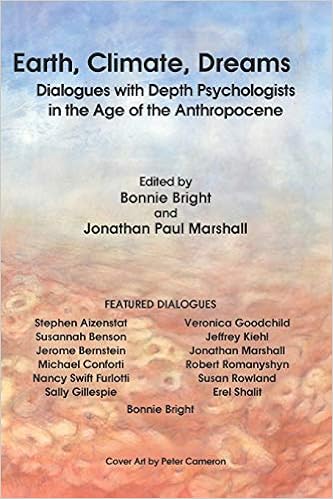
Bonnie Bright and Jonathan Paul Marshall (eds) Earth, Climate, Dreams: Dialogues with Depth Psychologists in the Age of the Anthropocene. Depth Insights Press.

0997955023 and 9780997955026

From: Amazon.auAmazon.com ; Amazon.co.uk

Bookdepository ; Wordery ; Barnes and Noble

The book, as should be obvious, reports on what 13 Depth Psychologists have to say in response to the Anthropocene. It is a collection of interviews with people like Stephen Aizenstat, Jerome Bernstein, Veronica Goodchild, Jeff Kiehl, Susan Rowland, Robert Romanyshyn, Erel Shalit, and other important people, and finishes with a multi-logue between seven of the participants.

[For descriptions of the interviews, and some critical responses, see an earlier blog post]

These people are all major contemporary figures in Depth Psychology, as some of you will know.

I’m going approach this launch in three ways. Firstly I will talk about the background question of the book, then one of my problems with the book and, thirdly, what is great about the book, and why you should buy it.

The fundamental issue

The background issue is that in the West, and most likely elsewhere, we are facing what can be called an existential crisis. That is, we are coming to recognise that our whole modes of being, living in the world and preparing for our future, is undermining our capacity to exist in the world. If we keep on living, acting and thinking as we do, we face destruction generated by those ways of living and thinking. The Anthropocene (the world-systems changing effect of humanity) marks a problem for our whole existence, and undermines our future.

The existential crisis presents a problem at all levels of our being: it is a psychological problem, it is a sociological problem, it is an economic problem, it is a technological problem, it is a cultural problem, a problem for all our relationships to everything. Once recognised, it is both hard to ignore and disorienting, to put it mildly – approaching trauma might be more accurate.

This crisis is the starting point for the book, and the necessary starting point for almost any relevant discussion about the future. The conversations are conducted with Depth Psychologists, because Depth Psychology attempts to deal with the total span of human existence, which includes all that I have just mentioned, from psychology to the world. Depth psychologists are uniquely in a position to approach these issues from a non-specialist position, and to offer tools to help people work with the problems, from their experience of group and individual therapy, from symbolic work with art, literature, and dreams, and from their sense of the intertwining of individual and collective.

My issue

Let me begin discussion of this book by talking about one of the things I find slightly problematic about it, and show why it turns out not to be that problematic, and how it generates insight, when approached with fewer assumptions.

My problem in reading this book was that, sometimes, I thought people found it much too easy to talk as if ‘spirituality’ (whatever that is) was a solution to our problems.

As I argue in the introduction, some types of spirituality might help constitute our problem, and this has to be faced. It cannot be suppressed, and I don’t think anyone in the book would want to suppress this issue.

As a culture, we in this room, have a religious or spiritual history, and in that history people have primarily been taught to see the world as a prison, a testing ground, a den of sin and iniquity. We have been taught to see our human destiny as leading us somewhere else, not this Earth. We are heading for heaven or hell or, at best, the new World after the Day of Judgement. We are not fundamentally creatures of Earth, born with the earth and tied to the Earth. In that sense, the Earth has to be fought against and dismissed for our salvation. If you actually love the world, you are being distracted from your love of God who is not ‘material’; you are loving something inferior and fallen.

This form of spirituality constitutes a problem, it could well be part of the reason it is Christendom that has led the charge into ecological destruction as an unintended consequence of its otherworldly spirituality. If so, then implying that a move from ‘materiality’ to ‘spirituality’ is a solution to the problems of the Anthropocene, is not a solution. Spirituality is part of the problem. Rather than just ‘spirituality’ itself, we need a new psychological and spiritual orientation to the world and to our actions within it.

However, if you actually listen to what people in the book are talking about, and remove the assumption that you know what they talking about, then you can begin to see what they actually mean, and the kind of psychological orientation they are pointing towards, and how this is not just a matter for our consciousness, will power, or decision.

In our society, because of our (spiritual and other) heritage, ‘natural processes’ are largely seen as disposable or replaceable or, to use Heidegger’s term ‘to hand,’ as resources for our own use and mastery of. In our dominant ideology, natural processes only exist for us to exploit. If they cannot be exploited and turned into profit, then they have no value. Natural processes are not something we should have a relationship with. You can see this attitude everywhere, with things like the Westconnex tollway, where we chop down every tree, undermine housing foundations, dispossess people, and fill the air with smog and noise, while providing a tax on travel in Sydney. Or with mining under water tables, rampant landclearing, mining in agricultural regions and so on. Natural processes are, officially, a lifeless backdrop to be pillaged for profit. They have no other value. The world is to be subdued to consciousness and will. The world is secondary to what we can make of it.

Yet this is not humanly true at any deep level. It does not resonate with real human being. Almost every human I have ever met has some kind of relationship to other natural processes, whether living forms, place, or to their own part in the system. They might only notice the connection when the creature or plant or animal has gone, but that is part of our disconnection from reality. This relationship may be to individual animals (their pets, or the dog down the street), to specific trees they feel connected to, to landscape that may seem to be part of us, and so on. Even those people busy despoiling other people’s environments and landscape, can have deep feelings for their own.

This is not really strange, because we think with, and in, this world. We use objects in the world to think with, to feel with, to learn with. We cannot live outside the world. It shapes us. We cannot escape from it. Nature and ecology is part of us, we are part of it; we are plural and connected by our existence, in a living network beyond our understanding.

When we realise this, then instead of treating nature, or other people, as resource objects, we can approach this world with reverence and awe; with a sense of mystery, recognising that we do not fully comprehend it, that it is a being that is both independent of us and impinging upon us. It is us and not us.

We can approach the world with our full ‘psyches’ and, in this, recognition of ‘complexity’ and interconnectedness, are themes which keep recurring in the interviews.

Why use the term ‘psyche?’ Because when we use other terms like ‘psychology’, ‘mind’, or ‘soul’, we already think we know what we are talking about. But we don’t. We don’t consciously know how our minds function, as they function. At least I don’t. I don’t know how my mindbody functions, how one thought gets linked to, or progresses into, another, how language works, how brain action generates mouth and arm action, how my skin heals, my stomach digests, my lungs process air, and so on. Much, probably most of the important things in life, operate outside of our limited awareness, and necessarily so.

“Psyche” plunges us back into the unknown, the entangled complex, interconnected, mess which is reality. We are inextricably if vaguely linked; my psyche does not exist without your psyche. I did not invent the language or all the ideas I use. Interaction with and talking to other people and to world culture has shaped me, and I have presumably shaped some others for better or worse.

We are both collective and individual at the same time. Even a sense of heroic individualism is collective at its base; something we share with others. Our psyches are already alive and part of natural processes. Our full psyches include the land, spill out into the land, into other people, into the processes that are everywhere.

And a realistic view of our selves needs to include all of this material, our culture has generally defined as extraneous, to help us to successfully resist the notion of natural process as a thing to turn into resources to make profit out of. In this new mode, with new practices and ways of perceiving, we can begin to move towards rejecting the system of thought that is destroying the world that we live in. This destructive system no longer makes sense. It seems psychotically limited and self-destructive. That awareness opens a psychological, cultural and activist position. The more we become aware of unconscious process, the less we seem driven by them, and the more free we become.

Let us return to an earlier point. As already implied, there are many unconscious processes. We are not aware of most of what is happening, although we may be more aware than we consciously know. That lack of conscious awareness of how our minds work, and how our physiology works, and how mind and physiology connect at this moment, implies unconscious processes. Some of these happenings I will have perceived, but not made conscious, perhaps because my thought or culture focuses my attention elsewhere, perhaps because there is so much to perceive that I cannot hold it all in my awareness. Even if I perceived it all, I can’t understand everything that is happening, and affecting us, even in this room. Most of life’s ongoing processes are essentially and inevitably outside my consciousness, and therefore unconscious to me.

However, I can become more aware of what is happening or more sensitive to it. I can attempt to perceive reality in different ways. I can turn attention to my neglected or repressed perceptions and drives. Recognising this possibility and being open to the strange and the unknown is what Depth psychology is about. It is fundamental to the process of discovery.

This is why Depth Psychologists pay attention to dreams, which are in some ways messages from the unconscious and the world; from our unconscious perceptions, pattern detections, and ways that we symbolise the unknown. Dreams often require work to understand. It is not always easy, but it can become more so the more we take these fleeting images and stories seriously and treat them as beings themselves. Paying attention to these, and other, neglected processes (fantasies, spontaneous images, scribbles, slips of the tongue, senses of unease, neglected feelings, suppressed thoughts) becomes a way of getting, or admitting, more understanding and data. It starts a new process of being in the world. If we repress our bodies and our dreams, we are likely to repress our awareness of the world. The more we attend to them, the more likely we are to be able to perceive messages in natural processes which are now hidden to us. Our tools for learning can expand outwards…

This new attention can represent a complete change in how we regard ourselves and experience our role in, and on, Earth. We can call this change spiritual if we want to. We can analyse and live our lives from that point of view. We might even be able to see this realisation as having much in common with reports we have classed as mystical.

This awareness involves experience of paradoxes, similar paradoxes to those around reported experiences of God, We are part of the world but separate from it. It is greater than us but still within us. The depths can lead to the heights. We are double sided: our goodness might be cruelty; our aspirations can be unreal or unsatisfying. Reality is ultimately unsayable, but it is pointable too through images and word, and it can be experienced, if we are open to it as it is. This is a new way of being, which can be called spiritual if you wish, or not if it makes you uncomfortable.

So even in the bits I personally have problems with, the book is still full of insights. Full of ways of proceeding. You may have problems too, but encountering this book may help you ponder them and open you. That is why this book is important.

The Good Bits

Let us now turn to the unproblematic virtues of the book. Its chapters are edited and concentrated conversations. They are generally excellent conversations. The primary interviewer Bonnie Bright is really good at her work. She participates in conversations. She contributes to the conversations as process. She draws people out. She listens carefully, and gets people to explain when needed. You could not have a much better interviewer for dealing with issues which could otherwise be quite difficult.

Reading these conversations, you will learn something about a family of understandings of how psyche works, through the dynamics of imagery, metaphor and feeling, and the effect of the unintended consequences of particular modes of consciousness which repress things you need to know about. As I have implied, if you take this seriously and start some of the practices, then you might gain a new view of the world. You might find a way out of the existential crisis, or a way to flourish in that crisis.

Depth psychology is important, because its mode of being, continually deals with problems that the conscious ego cannot understand. This is especially useful for facing the paradoxes, complexities and dilemmas of the Anthropocene.

Topics vary throughout the book, apart from the obvious topics of climate change and ecological destruction, subjects discussed range from discussions of pilgrimage, the aspirations of Dr. Frankenstein and what that tells us about modern life, the collapse of Mayan civilisation, colony collapse disorder in bees and its metaphorical connection to culture collapse in humans, the ways that politics and psyche interacts, the driving cultural complexes of capitalism, systems theory, unconscious forces, communication with the world, and the uses of dreams to gain insight into the world and relate to the world.

The book argues strongly, in various different ways that we need to engage with our full range of psychological processes, and perceptions, to deal constructively with the changes and problems we are facing. We need to understand how the systems we participate within, condition our minds when we suppress awareness of what is happening. If we stay in the psychology of mind we are conditioned to have, then psychological inertia, denial or other processes of repression or projection of problems and hostility onto others are likely to win out. Even if we manage a revolution we will probably replicate the problems we have, plus we will project our guilt onto others, and solve our problems through revenge.

This book explores possible tools to move beyond these psychological limitations and barriers.

Depth psychology can prove useful in this quest, because it tends to focus on neglected aspects of life and assumes that our individual psychology is at least partly collective, and it works through encouraging creativity, imagination, art and symbol production for their own sake, irrespective of judgement or profit..

As well as enlightening, this process of approaching reality is potentially fun and enjoyable; it can also be pretty horrible too, but everyone has the possibility of life changing realisations for themselves and for everyone else. As we are collectively facing similar problems, solutions to personal problems, or the symbols around those solutions, can turn out to be effective solutions for collective problems…. especially when we are working in and with groups. Anyone has the potential to contribute to our collective solutions. You go in and bring the solution back out. It is a cyclic process.

The book tries discuss ways of opening what may be a new way of perceiving the world, and approaching the world, and the role of human psyches within the world, and the way we all could develop.

This is, simply, vital work….. That is why I hope that this book will reach a large audience, even if they disagree with it, it could start discussions.

Climate paranoia, or the real reality?

January 17, 2020

I have just received an email, that tells me that

“Vatican Societas Iesu and Secular Illuminati controlled City of London, People’s Republic of China, United Nations and Obama led US Senior Executive Service Satanic Occultist SOCIALISTS have initiated WAR AGAINST the population and land of AUSTRALIA”

Yes this is through the bushfires and through generating climate change….

You will notice that everyone evil is a Socialist, a Catholic, a financier, Chinese, black, or Satanist. Goes without saying – but they are really Socialists. This perhaps means the Protestant Right now hates everyone. I wonder if the use of the City of London, is a deflection from Wall Street; so that the financial evil in the world is British, not American? or just an expression of all those US movies in which the villain has a British accent (if they don’t have a Russian or Arabic accent). Have these supposed truth seekers been BOUGHT OUT by US finance?

That the US has a Senior Executive Service Satanic Occultist explains a lot. That must be how Trump got in.

“Drought has been engineered through criminally unconstitutional ‘water harvesting’ privatisation of natural water resources.”

This is possibly correct, and privatisation of water has affected rivers severely. Always good to start with something plausible, but this is soon left behind.

“criminally irresponsible neglect of ‘controlled burn’ forestry management”

Ok that’s from Mr Murdoch and the Coalition, and about as wrong as it gets. the controlled burning did not have much effect, even though the rural fire service in NSW supposedly exceeded their targets. Of course things can always be done better. But 17m Hectares is a lot of burning.

If you want a conspiracy about lack of prevention then you could ask what has happened to Peter Dutton who is head of Emergency Management Australia. EMA is supposed to aim at building “a disaster resilient Australia that prevents, prepares, responds and recovers from disasters and emergencies.” It appears Dutton and his department were warned, after the election, of “more frequent and severe heatwaves, bushfires, floods, and cyclones. These will increasingly occur concurrently.” However, he did nothing, and has disappeared during the fires, leaving Scott Morrison to take the heat and the blame.

Anyway, apart from real politics, we have:

“Stratospheric aerosol injection of aluminum and barium fire accelerants.”

Ingenious.

“Amplified by Ionospheric Microwave Heater Array weaponry”

How good is that?

“The enormous fire disaster in Australia has nothing to do with anthropogenic carbon dioxide emissions ‘climate change’, let alone Australia’s anthropogenic carbon dioxide emissions” [This idea of climate change is promoted by] “celebrity prostitutes and Socialist activists delusionally insist in fervent mass murder”

There you are, trying to stop people destructively changing the earth systems is now to be classed as mass murder.

And this fire disaster represents a political take over by such people as:

“Extinction Rebellion, School Strike 4 Climate and the National Union of Students.”

Yay!!!! But these evil students want

“total conversion to SolarCity and SpaceX/StarLink/NeuroLink ‘Smart Grid’ Neural Implant Integrated ‘Internet of Things’ Electronic Enslavery & Eugenics Extermination 5G ACTIVE DENIAL Microwave Radiation Weapons of Mass Destruction.”

Whatever that is.

Insects are being exterminated via

“MASSIVE MICROWAVE OVEN WEAPON OF MASS EXTERMINATION VIA CARCINOGENIC CIRCUITS & CYBERNETICS”

I guess this is more obvious than insects are dying because of genetic modification of crops, massive use of insecticides or changing ecologies.

“5G Ghz Prelude to 6G Thz Plague
UN Agenda 2030 ‘666’ Terra Hurts ‘Lake of Fire'”

I like Terra Hurts…. and the 666 frequency. But again I understand many people are disturbed by 5G, so we might as well add that to the mix.

“Kevin Rudd & Julia Gillard’s massive donations to Clinton Foundation Pay-to-Play Child Sex & Cannibalism corruption, blackmail and extortion linked to Cardinal Pell”

In case you didn’t know, the first part of this is standard right wing noise. There is precious little evidence presented, but then the Clinton Foundation is not the Trump foundation, which seemed to indicate its charitable object in its name. Anyway, we all know Hillary is crooked, so this just adds to the weight of socialist, Satanist, English, Chinese, Vatican crooks. They all have something in common. We don’t like them.

China is bad, it is growing emissions… but

The rabid, deluded and democidal POLITICAL “climate change” drones refuse to ever direct their efforts against the PRC:

That could be because many of them don’t actually vote in the PRC, or speak Chinese, and they have no political influence there. But plenty of people do criticize China and India, although both countries are expanding their renewables at a considerable rate.

“ACHTUNG ! Stop breathing ! How dare you exhale CO2 ! I said stop breathing !”

This, I presume, is a parody of a person who believes in climate change. Clearly these people have swallowed the idea that CO2 is absolutely harmless under all circumstances, and we can have as much as we like. Here let me show you:

before the beginning of the Industrial Revolution, atmospheric carbon dioxide densities where at near starvation levels for planetary flora whereas the current atmospheric carbon dioxide density is still only 40% of the optimal level for planetary flora.

We need more CO2 its good for you, even if its poisonous. The people who wrote this must be the EXTERMINATING SLAVES of the fossil fuel companies!!!!

We should also probably stop chopping trees down, so they can benefit from all this beautiful CO2, but that is not part of the agenda either, maybe they are fossil fuel bought out loggers. Oh and wasn’t China bad for increasing its emissions? If emissions are good, surely they should be welcomed as saviours of the worlds plant life?

I ran a game once in which the criminal shape changing lizards who ran the world, were trying to terraform Earth to something more suitable to their biology….. Seems like reality has almost caught up….

Climate change is the kind of strange object which for many people seems to make a conspiracy of disparate powerful and non-powerful people, (Catholics, Satanists, socialists, politically diverse scientists, school children with hyper-weaponry), more believable than a conspiracy of neoliberals and established fossil fuel interests, who already have networks, paid for think tanks, paid for politicians and a documented reputation for deception and ruthlessness. Indeed the success of the latter can be shown by the fact that the former have not managed to get any thing done to delay climate change at all, and the latter have managed to do things which should make it worse.

Why is this displacement so?

Myths of Climate 04: Prometheus

December 30, 2019

Continues from: Myths of Climate 03: Apocalypse and Millennium

Prometheus brings humans fire which is needed for culture and development, and is chained to a rock by Zeus, with an eagle devouring his liver every day, until he is eventually rescued by Heracles.

The myth of Prometheus encapsulates both the idea that technology can save us, and the counter-position that technology leads to retribution or destruction.

While the two parts of this myth are usually kept separate, it may be useful to bear both in mind simultaneously.

God Like Technology

The ‘technology is always positive’ side of the duality reassures us that technology can save us. Influenced by this myth we tend to be carried away into technological fantasy, into thinking that we have solutions to problems, when we don’t know if those solutions work or not. It often promotes non-existent ‘fantasy’ technology (like clean coal, carbon sequestration, or mirrors in space, portable nuclear power stations, fusion power) as saving us from having to abandon coal fired power stations. Or it may claim potentials for existing technologies that have so far been largely unsuccessful at containing ecological destruction (biofuels, thorium reactors, new hydro power, etc).

Within the myth, we expect technology to arrive to save us, just as part of the natural order of things. Some people even argue that something like this is part of economic fundamentals; if there is enough need, then investment will occur and the technology will be invented and appear. However, this is never guaranteed, and it encourages us to forget the unexpected effects of technology, and to ignore complexity and assume we know all the interconnections in a natural system, which we cannot.

In this mode, human technological endeavour is heroic, even godlike. No radical change is needed and we can retain the status quo; we can continue as normal with a technological add on. Some writers can even move away from climate change acceptance and any tinkering with the corporatised market, by arguing that ecological degradation has nothing to do with climate change or forms of economics, and that it can be fixed by easily deployed technologies.

In the ‘technology is good’ side of the equation we also tend to think that technology is determinate, and indicates degree of advancement and proficiency – this is something of a contradiction to the technology as add on idea, but it is used in different arguments about technological superiority and usually kept separate. We often mark out history by supposedly technological periods which follow in succession, a kind of “technological ladder”: Stone Age (Paleolithic, Mesolithic, Neolithic), Bronze Age, Iron Age, Agricultural Age, Age of Print, Age of Sail, Age of Steam, Industrial Age, Atomic Age, Space Age, Computer or Information Age and so on. Each ‘Age’ is supposedly better than the last, rather than just partly the same and partly different.

This allows us to dismiss any wisdom or knowledge possessed by ‘earlier’ ages, and also makes it hard to see the complexities of reality, such as ‘Stone Age’ Australian Aboriginal people appear to have had complex systems of ‘agriculture’ which are completely different in their ways of working to European systems (see Bill Gammage and Bruce Pascoe) (Some references to the controversy over this).

Harmful Technology

The counterposition makes science the cause of all our problems. Not only does it suggest Prometheus’ punishment is more primary than his success, but it suggests the Tower of Babel with God striking down human technological presumption, or that our technology will escape and take over the world, destroying us, as we can see in many science fiction scenarios. It implies that technological presumption leads to disaster, perhaps even to the end of the world.

The dark side myth can be used to imply technologist and scientists are evil, as with the “climate change ideas only exist because of a world wide socialist conspiracy” trope. All experts can be ignored, if they don’t agree with positions we already hold.

This view can also be used to imply that people ‘down’ the ‘technological ladder’ had generally much greater wisdom and lives than we do today, which may not always be the case.

At best this side of the myth implies that technology alienates us from something essentially human, even though humans always seem to have used technology of some sort. We often hear people arguing that the internet destroys our capacity to think, or to have an inner life, when (if we were loosing our capacity to think etc) there might be many other reasons – like being fed false information for political purposes, or being so busy and nervous at work that we have no time for reflection.

One writer rebuffs the idea of using windmills to generate electricity as they are a medieval technology and make an infernal noise – reference to the sound of hell is not accidental, even if unconscious, and that implies the possibility of punishment from God. Yet I suspect the writer does not object to other noisier technologies like aircraft. But this does not seem clear to him. To be real, and of the future, technology has to look a certain way, a demand shaped by myth, or at least by films of a great future (do we have those any more?). Likewise President Trump seems somehow aware that building windmills can involve pollution, even if he seems unaware of the pollution from coal mining and burning, or he chooses not to emphasise this. Likewise with bird killing.

In this part of the myth new technology becomes seen as corrupting and inherently destructive of the social, or natural, order, and indeed it may well change those orders.

When technology becomes part of the social order, it does so as a complex system within other complex systems, and unintended consequences are routine. At a simple level it can open opportunities for some groups to consolidate or increase their social power and influence. Although this is usually only considered disruptive if people from lower groups get raised. If people from dominating groups increase their power, this may not be portrayed as a problem.

The Conflict/Paradox

What one side hears as the solution sounds to the other like a charter for further destruction. Technology is simultaneously, saviour and destroyer, potentially part of the solution but currently part of the problem. Which position we choose to argue from determines where we end up, and the alarms (intended or otherwise) we raise in other people.

However, both positions have equal possibility of being true. In this case, it is possible that putting the two halves of the myth together may help us deal with problems of transformation/transition.

Some technological breakthroughs could save us, or at least help us. And we may not have to wait for them, we already have renewable sources of energy. However, it is also true that renewables may not be able to save us, if we wish to keep using more energy, or bring everyone in the world to the energy use of the average Australian or US American. A change in lifestyle and life plans may also be required. Some people may loose wealth so as to stabilize the system, some people may gain wealth to stabilized the system. This could be disruptive and it would be easy to make people fear this change, because who knows where it will end up? We also appear to have the capacities to lower pollution and waste production, but it is difficult because it is not profitable, and profit is what counts in our economic and political system. In this case the technology is being disrupted by the maintenance of other systems.

It is also true that new technologies can be disruptive or harmful, and they may well need to be vetted, but this is not easy.

Ultimately a significant part of the problem with technology comes down, not just to the myth, but to our inability to think in terms of complex systems, and, of unintended consequences as being normal.

We have tended to deal with unintended consequences, just by arguing about them afterwards, or generally ignoring them, as with fossil fuels, with the possible exception of the London smogs. These were solved by government action, information work, and regulation. They could have continued to be ignored, there is no reason why the death of ordinary people should impinge on the souls of those seeking profit alone. Probably enough of them lived in London to accept the reforms, or feared the rise of the poisoned working and middle classes and gave in.

As the consequences of technology are often unintended and unexpected we cannot easily predict them, but part of the problem is that we do not try – we often do not seem to consider this at all.

Exploring the dynamics of unintended and unexpected consequences should be a major research project. All policy, corporate or governmental, should consider the likelihood of unintended consequences, and determine how these consequences will be looked for, and taken into account.

Technology does not escape myth.

See also: Problems of Transition 02: Technology as Fantasy

Paul Chefurka’s “Ladder of Awareness”

December 29, 2019

[Re-edit October 2020]

Paul Chefurka proposes a number of stages of awareness of climate problems, with psychological consequences, which might be useful in understanding what we can expect as we ‘progress into the depths’ of the problems and predicaments we face.

Stage 1: The Person sees that there are particular shortcomings in an organization, our morals, our economy or whatever. It’s a matter of changing the rules, or getting more of something that is already there. It’s pretty easy really, if only people saw sense. [In terms I use later in this blog, this is a partly a problem which arises because of the so-called ‘directed mind‘]

Stage 2: There is ONE Fundamental Problem which destroys everything else. Capitalism, Climate Change, government, overpopulation, Peak Oil, biodiversity loss, fossil fuels, inequality, patriarchy, sociopolitical injustice, stupid politicians, socialism, lack of spirituality, etc. If we can fix this problem, or control some other people, then we can fix everything. [This is a form of radical simplification – a refusal to acknowledge social and ecological complexity [1], [2]]

People become activists and keep bringing up this problem to explain everything, and point out how everything could be solved if we really solved this problem.

Stage 3: If we become aware that we cannot seem to solve the big problem, it is possible for awareness of their complexity to grow. Then it seems there are many problems, but the person still might still try to prioritise some problems or resist expanding the ‘problem field’, to keep things under control. They may fear that further new concerns will only dilute the effort which needs to be focused on solving the “highest priority” problems.

Stage 4: Then the person realises that the problems are interconnected and influence each other. It is hard to keep those problems bounded and separate. There is a multitude of problems. The person sees the importance of unintended consequences – a solution in one domain may worsen a problem in another. Prediction is difficult, planning seems impossible.

At this stage people may move into small like-minded groups. This can increase learning and insight as the whole set of issues is discussed, in ways in which they cannot be discussed elsewhere.

I would add these groups can also be a retreat from problems, if the people are not careful. The people involved can see themselves as an elite amongst the benighted, and just reinforce their earlier certainties, [or they can become pure and spiritual and risk separation from the world].

Stage 5: Through ongoing discussion, the set of problems can now be seen as a complex predicament, by which I think Chefurka means a condition of existence which may not be solvable at all. We become aware that the predicament encompasses all aspects of life. Chefurka keeps this realization as part of Stage 4, but I think that moving into recognition of the predicament is another stage which needs recognition – as that is a different place from the rest of Stage 4. With this realization:

The floodgates open, and no problem is exempt from consideration or acceptance. The very concept of a ‘Solution’ is seen through, and cast aside as a waste of effort.

[We can potentially open up the problem field, and see how problem areas we have kept separate are connected. As well, everything we think we know, may appear even more uncertain.]

Depression is likely at this moment – especially if we are facing the problem alone, and have not managed to form a sympathetic group. If the problems are insolvable, then what will happen to us all?

However, there are two paths which open – although they would seem to have always been open, and this realisation constitutes the stage beyond depression – I would call this Stage 6.

Again, I think it important to accept that stage 6 is also a social event. The groups and connections we have formed are not transcended. They are part of the process.

Path 1. Move into resilience, community-building and local sustainability initiatives. We recognize that the State will not solve the problem, and probably cannot solve the problem. [Big NGOs cannot solve the problem.] The Corporate Sector will not solve the problem either. But we have to help both others and ourselves survive the oncoming crash. Without community, without the ability to work together we are probably dead. At the least, without active community we are stuck, unable to move and helpless. Being alone or with our family, holding out against all comers is eventually barren, even though it could be temporarily useful. Humans, in general, do not live well without other humans. It seems we have to find what strengthens all of us to fight onward, and make a new life, using the insights of the previous stages.

What we have learned is: Life is complex. There is no one problem. We cannot solve, or survive, the mess of problems [and this is a deliberate term], especially not alone. Predicaments interact. Unintended consequences are normal. We cannot depend on old structures. We have to talk, as well as act. We have to change our psychology which was appropriate perhaps for the old consumer life.

Path 2: The Inner path. “Become the change you wish to see in the world,”  “In order to heal the world, first begin by healing yourself.”

This move is not a retreat into established religion and dogma, or to retreat from the world. That is simply pretending there is only one problem again, with one solution – sticking with the dogma and generally, imposing it on others. That is a denial of Spiritual and world complexity. The inner path is a process of attending to oneself as part of the world/creation, of one’s visions and dreams, of one’s feelings, and poetry. Other people help point out depth – our predicament is collective, and so, to some extent, is our inner world.

For me, both these paths are one. To make them separate, and bounded, is yet another denial of complexity.

Without attention to the ‘inner world’, we bring our complexes, resentments, unconsciousnesses, violence and so on to the effort to become resilient. We keep blaming others. We do not withdraw projections. We do not relate to others, and we need the others for satisfaction. We do not behave morally – and whether you want it to be the case or not, a new ethics needs to be born, out of what we find we need to do to survive the predicament.

Without attention to the ‘outerworld’ then we merely talk to ourselves, and get lost in the symbols, the fantasy, the bliss or horrors. We wander around not perceiving what is happening: we believe only what we want to believe, only what comforts us, and pass into delusion. In this solo state, we still require others for building our ‘spirit’, but we do not help them.

We test the inner by the outer and the outer by the inner. We learn the one from the other.

The ‘inner’ is only separated from the ‘outer’, when we are lost in theory. When they come together we get art as well as scientific practice amidst our daily life. And that could be good for all.

Myths of Climate 03: Apocalypse and Millennium

December 25, 2019

Continues from Myths of Climate 02: Eden and the Fall

In the myth of Apocalypse the end of the world is cataclysmic, and out of our hands. While there are warnings of its coming, it’s arrival is sudden and abrupt. It is the will of God, yet it is monstrous. However, in this myth, the good survive; they may even, in modern versions, be rescued intact in the Rapture, before much that is horrible occurs. There is a sense in that, as ‘we,’ or the, good survive and it is the end of historical disorder, Apocalypse can only be welcomed or encouraged. It represents a potential end of misery for those who make it. It is out of our control and we may not be good enough to pass into the new world (we may even end up in hell), so what can we do?

This myth, renders us largely helpless. It may prod us into action but it is a confused passive, and more or less individualistic action, as we can only be responsible for our own salvation at this moment. It promotes an acceptance of destruction as God’s will, or acts as a call for us to separate out from the sinful world, perhaps proposing the obliteration of others, or at least the acceptance of that obliteration, as we uneasily side with an apparent cosmic murderer to prove that we are among the good, and worthy of being saved.

If we are convinced of our own immortality and safety, then there is payback for our current suffering in the destruction of others, and it is not us being vicious; we can remain calmly moral. Apocalypse, further potentially reduces existential crisis by positing a specific end to the current disorder, and again we don’t have to do anything to solve the crisis and its problems; the need for action in the world is taken away.

There is a sense in which knowing the Apocalypse is coming can be soothing. The Apocalypse becomes both unstoppable destruction and relief. Given that it is sometimes not clear what we can do, the relief of just having to wait, could be even greater.

One problem is that the myth implies that while there are warnings of its coming, which are obscure to read, and possibly stages to its arrival, there is really one event. And yet the climate change is slow and gradual, a series of apparently disconnected events until perhaps tipping points are reached. It has been hard to tell climate change is happening, despite the record temperatures and the huge amounts of property damage from weather events. We can only say that it is likely these result from climate change, and the likelihood is increasing. There is no definite proof until after it has happened. Apocalypse is not a good model for thinking about climate change….

Despite the models inadequacy, much talk of climate slides into Apocalypse, especially when being “realistic”. For example, James Lovelock claims that:

The tropical and subtropical zones of the Earth will be too hot and dry to grow food or support human life. People will be forced to migrate towards the poles to places like Canada. There will be less than one billion people by the end of the century (Lovelock 2009).

That is more than 6 billion people will die – and probably die in warfare as migration, and resistance against migration, becomes violent. The UN World Health Organisation, far less dramatically, warns that even assuming:

continued economic growth and health progress… climate change is expected to cause approximately 250 000 additional deaths per year between 2030 and 2050

That is a ‘mere’ 5 million people, but we have no real idea what will happen when we go over 2 degrees. It is unlikely in the extreme that there will be continued progress in dealing with health problems, as so much is likely to start breaking down.

The process is unfortunately cumulative, not one-off, as the myth of Apocalypse suggests.

The problem again is that the numbers of potential deaths are overwhelming, especially when we factor in deaths from pollution, heat stroke and loss of water. This magnitude also can lead us to feel that our individual action is worthless, and to start conceiving in symbolic terms, which may make the myth of Apocalypse seem even more real, and reinforce our sense of helplessness and hope that we will get through anyway, without doing anything.

More problematically, Apocalypse is also such a common trope that it is easy to demote one form of Apocalypse for another, or even to argue that because we predict bad results are due, the prediction is worthless. For example, it can be suggested that we have not yet produced “grey-goo” through nanotech, or that as Y2K was not disastrous, this just ‘proves’ climate change is not so bad, when it has little in common with either.

People can even spend more time planning what to do in a Zombie Apocalypse than in planning to prevent, and adapt to, climate change.

Using this kind of move, Paul Johnson, implied that reports of climate change come from evil people and predicted an economic apocalypse if we tried to deal with climate change – presumably economic disorder is worse than climate disorder:

Those who buy in to global warming wish to drastically curb human economic and industrial activities, regardless of the consequences for people, especially the poor. If the theory’s conclusions are accepted and agreed upon, the destructive results will be felt most severely in those states that adhere to the rule of law and will observe restrictions most faithfully…. We shall all suffer… as progress falters and then ceases and living standards decline.

In other words, acting is intrinsically unfair, and leaves you open to exploitation. He imagines the rest of the world will take advantage of those who act fairly, not only ignoring a history of ‘unfair action’, but projecting shadow to make those who believe in climate change seem deluded or evil.

More recently Australia’s prime minister has warned about not taking a “wrecking ball to the economy” (which implies that acting on climate change could produce economic Apocalypse), and is supporting coal exports supposedly to support reduction of poverty overseas, and arguing that it is unfair to expect Australia to curtail its GHG pollution, and unrealistic to expect it could have any global effect if we did.

Again, it is suggested that it is attempting to deal with climate change that produces Apocalypse, rather than climate change itself. Morrison also uses the idea of Apocalypse to try and discredit protestors and justify prevention of protests, as protestors are “apocalyptically inclined” and hence irrational. He even says that protestors tell Australians what to think, and so it is apparently justified for him to tell people what they should think or be punished for.

While phrased in terms of justice for the poor (showing how easily ‘justice’ is co-opted to continuing the status quo), the implied logic of both positions is that as the consequences are discomforting, then climate change must be a negligible problem, or a problem for others.

Psychologically this also seems an attempt to make the world familiar again so that previous patterns of virtue, action and belief still work. The framework suggests that as action opposed to the current system is uncertain then we should do nothing; even if the results of action supporting the same system are likely to be as equally uncertain. Apocalypse is apparently either ‘on’ or ‘off’, consequently the myth does not describe real events very well, as they tend to form a continuum, even if that does involve sudden tipping points.

In Morrison’s case, because of his active religion, it is possible that the idea of a secular apocalypse without God, seems irrational to him. The Apocalypse will happen only by God’s fiat, and not beforehand; and if it is coming, not only will he be saved, but what can be done?

The myth is active whatever ‘side’ you are on.

Millennium

Apocalypse shades into the counterposition of the myth of Millennium. In this myth the world spontaneously changes into a paradise (perhaps after apocalypse), often by a mass change of consciousness and there are no further problems. This is often seen in new age thought, where mysterious breakthroughs in consciousness are supposed to be happening all over the globe. Even the internet can be seen as forming a global mind which ushers in a new age of prosperity and enlightenment, or produces a melding of human minds into a super-intelligence. Again this kind of fantasy could distract from the actual problems, or the effort of acting.

Millennium can also call for the deaths of millions, as a necessary sacrifice of those who could not transform. This mythical framework suggests both that change is to be feared and accelerated.

Apocalypse and Millennium both demand purity from evil. In a dialogue with George Monbiot, Paul Kingsnorth (2009) writes:

The challenge is not how to shore up a crumbling empire with wave machines and global summits, but to start thinking about how we are going to live through its fall, and what we can learn from its collapse

Elsewhere he claims:

We’re deniers every time we say “80 percent by 2050,” or even “80 percent by 2020”; every time we refer to tipping points in the future tense; every time we advocate substituting “clean” energy for “dirty” energy; every time we buy a squiggly light bulb or a hybrid vehicle; every time we advocate for cap-and-trade, or even a carbon tax; every time we countenance the mention of loopy geoengineering schemes; every time we invoke the future of our children and grandchildren and ignore the widespread suffering from global climate disruption today.

Every time we say these things and more, we’re promoting denial of dire climate reality…. We’re denying that our consumption and waste have far exceeded planetary capacity, possibly irreparably so.

Such purity can produce the despair or depression as reported in interviews with climate activists. What actions can be enough when the end really is nigh? When it is declared to be too late. Yet, by acting, as opposed to not acting, we can make the changes and crises we have to deal with lesser than otherwise. This may not be perfect, but stopping before we increase by 3 degrees is better than going to increases of 4 or 6 degrees.

And indeed Kingsnorth seems to celebrate this collapse and, as George Monbiot suggests, the death of billions of people, by associating it with a return to Eden (Kingsnorth and Monbiot 2009).

Apocalyptic optimism and despair generate hopelessness and refusal of action. For Kingsnorth, putting effort into clean energy is a pointless diversion on our way to the end. Here he (perhaps inadvertently) joins together with Paul Johnson, and other refusers, who suggests that as biofuels did not solve the problem and caused an increase in food prices, we should do nothing. That biofuels were not a solution does not mean there is no solution, but maintaining purity of categories in Apocalypse or Millennium demands that if something has failed then we should not bother trying something else. The myths join ‘believers’ with ‘deniers’ in helplessness or in false optimism of supposing miracles will necessarily occur.

Conclusion

It does not seem that these myths are terribly useful for dealing with climate change, and life after climate change, but we cannot ignore its pull, or its effects. It needs to be faced into with others, and new schematas found.

Continues in Myths of Climate 04: Prometheus

Psychology and climate?

December 23, 2019

The question of psychology, climate change, and our apparent inability to deal with the problems, is an extraordinarily complicated question, so please excuse the length of this attempted foray.

First off I’d argue that, in the case of climate change, we probably cannot isolate individual psychological inabilities to deal with the problems, from the social and political inabilities to deal with problems; they are almost certainly all related and interconnected.

We live in a society whose huge success has depended on ecological despoliation and the production of greenhouse gases (GHG). This is a reality. The ‘available energy’ we have had to innovate, to build the form of prosperity we have, and the levels of military expansion and protection we have had, depends almost entirely upon fossil fuels, concrete (with heavy GHG emissions) and steel production. The rest of the world, to a large extent (not completely), would like the same levels of prosperity for at least some people, and the same levels of military security, and those things currently appear to need expanded use of fossil fuels and steel production – although some people are trying to do it with renewable energy, but that is hard and a little uncertain.

So we live in such a society, and are psychologically adapted (to the extent we can be) to that society and to its consumerist drives. Many people find their main source of psychological satisfaction in buying products, and this keeps the economy, its production, and its energy usage going. Note I’m not arguing that buying products is necessary for human satisfaction or happiness, but simply that this is encouraged by our social arrangements – politicians and business people get worried if people are not buying things. Buying things often (not always) also encourages ecological destruction and pollution – this is the nature of our lives and social dynamics.

If people accept that climate change and ecological despoliation is occurring and occurring at a rate which is dangerous to their individual and social lives, then they are faced with what we might call an existential crisis. Their ways of living are apparently destroying those ways of living. Most of what they know about how to act is potentially disruptive of that ability to act. Much of what they do to protect their families, is potentially harmful to those families. What apparently produced stability in their worlds, now appears to produce instability, and so on. This realisation can be paralyzing.

This problem is extremely hard to deal with at an individual level. How do you find out what to do? How do you make and take effective actions, without keeping the destruction going? How can you, as an individual, stop the apparently suicidal course of world social order? How do you fight against your source of prosperity? What might result if you do? It may seem too complicated, too horrible.

Deciding what to do may be close to impossible in the circumstances. You may feel stunned, drained, anxious, depressed etc. Conception of the world proves difficult, disruptive and disturbing. There are no standard social guides to what to do. Advice from anyone, is really only conjecture – it cannot be anything else. We have not faced this problem before, on this scale. However, should you decide to act anyway, you then face another, and possibly even greater, social problem.

Faced with the same issues as yourselves, many currently more powerful people have decided to ignore the problem, or decided that it is too difficult or that it does not exist. To their minds solving the problem means potentially destroying their prosperity, potentially destroying their military security, potentially destroying stability, and potentially destroying the relations of power and wealth they apparently benefit from. If climate change is true, and its effects are potentially really bad, and we try and stop it, then it seems that some extremely powerful and large corporations can no longer make money out of selling and burning fossil fuels. Some other companies will have to stop destroying ecologies to get resources. Some companies will have to stop over-fishing, destructive agriculture and forest felling.

If all this is true, then the situation is certainly psychologically dislocating for powerful people, and the established interests of their organisations and paymasters.

Those powerful people will not act on their own. They will team up with each other, to defend their apparent interests. Hence they can spend a lot of money and a lot of effort, trying to convince you that nothing can be done, and nothing should be done. They can politicise climate change, claiming that if you are a real conservative, real Republican, or real pro-business person, you will understand that the science is a conspiracy, and that solutions to climate change are socialist and hence bad (or evil) and so on. They try to appeal to fundamental parts of your social and psychological identity, to make you ignore the problem, support existing modes of wealth and power, and to encourage you to attack those who disagree. Indeed the politicization of climate, makes it much harder for people to talk to each other about it, which reinforces psychological incapacity and silence. After all, to those who recognized climate change, it appears that ‘deniers’ are trying to kill them, through denial. This also does not help calm conversation and psychological health.

Surprisingly rather than attempting to produce solutions (which may have uncertain social consequences), these representatives of established ways tend to denounce all potential solutions – and they sometimes may have a point, not all proposed solutions will be good solutions. However, this behaviour is unusual. Normally they can put forward solutions to problems, even if it is the one solution to all problems, but not here. This problem and this inability paralyses them (and is, in turn, part of their paralysis), and it paralyses a whole body of politics, a whole part of society. They have nothing left other than denunciation, the hope that it won’t be so bad after all, that scientists are wrong, and things can continue, or perhaps the hope that Armageddon is here, and they can do nothing about that, other than walk to their doom/salvation. Again psychology is entangled with social and political life.

However, as things continue to get worse, as fire erupts in forests which have not burnt for thousands of years, as droughts become more prolonged and farms become unproductive, as heat waves last longer, as land glaciers and ice shelves melt, as floods affect living areas, as weird weather keeps hitting, people may become more and more uneasy. They still have little sense of where to go, they have new things to learn and no way of learning. The distress will likely continue to increase, and people become more and more debilitated.

Eventually the psychological social and political systems will have few options

1) They will break down under their own inertia and inability to solve problems.

or

2) The people in power will start thinking that if they don’t do something then everything really is threatened, so they had better act, even if they don’t know what they are doing, or even if preserving existing power relations is more important to them than productive change.

or

3) New people with new ideas will try and take over, and there will be a political war.

or

4) a miracle will occur….. for example a new cheap easy technology may replace fossil fuels – but if it does not replace the social organization that occurs around pollution and destructive extraction will it do more than delay the point of crisis?

In any case, it is likely that realising that both psychological incapacities and capacities have socially and politically active backgrounds may be useful to overcoming some of the incapacities, anxieties and depressions that we face.

The reality is that we are not facing these problems alone and, while we may be encouraged to face them alone by people who want us to do nothing, or by the fear of being denounced by others, there is a necessity of facing the problems together with others; especially if we are going to undo our psychological incapacities. Perhaps discussing the way we feel about climate change with others in small groups might help us to clear away some of the incapacities to act? Then we might find out how to act, or how to promote solutions. Maybe we might even come up with solutions and persuade others to act. When facing such a problem, we need to work together, but we may need to converse together first in a reasonably collaborative and non-condemning environment, so as to build trust. Working together is important as it expands our capacity to act, our capacity to think, and our capacity to effect change, and have an influence in the world.

Turning away from problems because they seem insurmountable, or trying to solve everything by ourselves, is rarely helpful either to our pyscho-social functioning or to our success in solving the problems which produce their distress. This is especially the case, when the problem arises from the social dynamics we live amidst.

Earth, Climate, Dreams: Dialogues with Depth Psychologists in the Age of the Anthropocene

October 28, 2019

Earth, Climate, Dreams is a new book being launched at Gleebooks in Sydney, by Analyst and author Judith Pickering on the 16th November 2019.

See http://www.gleebooks.com.au/BookingRetrieve.aspx?ID=318994

The book is a series of interviews with a range of experienced Depth Psychologists (primarily of Jungian heritage) and discusses psycho-symbolic and social responses to the Anthropocene.

Apart from the obvious topics of climate change and ecological destruction, subjects discussed range from discussions of Pilgrimage, to the aspirations of Dr. Frankenstein, to the collapse of Mayan civilisation, to colony collapse disorder in bees, to the cultural complexes of capitalism, to systems theory, unconscious forces, communication with the world, and the uses of dreams to gain insight into the world.

The book argues strongly that we need to engage with our psychological processes to deal constructively with the changes we are facing – otherwise psychological inertia, denial or other processes of repression and hostility are likely to win out. We are facing an existential crisis, with grave psychological consequences. This book explores possible ways to move beyond these psychological limitations and barriers.

Depth psychology proves useful in this quest, because it tends to focus on neglected aspects of life and assumes that individual psychology is at least partly collective, and works through creativity, imagination and symbol production. Our psyches are already alive and part of nature.

Depth psychology continually deals with problems that the conscious ego cannot understand, so this is especially useful for facing the paradoxes, complexities and dilemmas of the Anthropocene.

Readers who are already familiar with those being interviewed, will realise that this is quite a formidable and well published group of people. There is a lot of valuable experience here, made available in an approachable format. The main interviewer, Bonnie Bright, is a deep listener and contributor to comprehensibility of the conversations.

I’m only going to give very brief tastings of the interviews to give a feel of what people talk about, because you really need to read the book to get the full depth of thought here.

The book starts with a short introduction, trying to explain the basic terms and their dynamics: myth, consciousness, unconscious processes, image, symbol, dreams, the Self, complexes, separation and so on. It also suggests that the ways these forms are presented in our lives are conditioned by, and respond to, capitalism and developmentalism, but can lead to creative political, or other action.

The first interview is with Jeffrey Kiehl, a climate scientist who took up analytic training in response to the problems of communicating climate science. He argues against one-sided approaches to climate change (such as the purely rational), suggesting we need to use multiple ways of understanding and relating to the world. He emphasises the importance of acknowledging painful feelings about climate change, which can cause people to space out when faced with the data. He introduces the idea that dreams can contain awareness which speaks to problems in the world, and help us face them.

Susan Rowland is an academic literary critic who primarily looks at human relationships to nature and the gods. She discusses how the imagination can be part of addressing, and connecting to, ecological crises. She brings up the question of the imaginary relationship between gender and nature, and particularly the way that nature has been connected to the “feminine” and can be treated violently in our culture, and how it could be treated differently elsewhere. She explores this possible arc of creative difference through the myth of Dionysus and the experience of being broken into parts.

Stephen Aizenstat is the founding president of the Pacifica Graduate Institute and has worked with the UN. As well as talking with CEOs and government bodies, Aiszenstat is frequently asked into schools where he finds students have a strong sense of the fragility of the world, and become more fragile and grief struck, because of that connection. He discusses ways of dream tending as remedy, emphasising the importance of encountering the dream beings rather than interpreting them. This allows the dreams to become a source of strength and illumination. As he says: “At night, when our eyes are closed, something else comes awake.”

Susannah Benson, researcher and past President of the International Association for the Study of Dreams, discusses the importance of dreams and long-term dream groups. Taken over time, dreams provide a way of orienting ourselves in the world, somewhat like a GPS. She quotes a Buddhist text: “A dream is as much an immediate reality as is the waking state and it is even possible to see the world more clearly in our dreams than in our waking state.” Dream groups help provide different perspectives on the dreams and can deepen our modes of listening to the hidden parts of the self, because the group can help break through our habitual perceptions and interpretations, thus providing more creative responses to problems. 

Jerome Bernstein, analyst and author, started his path working with Native Americans, learning from them and gaining his first religious experience at a Hopi ceremony. This has given him a sense of what might be missing in a suicidally oriented technological society. He suggests that we have a co-evolutionary process with the world as a whole. This process could work with us, if we were prepared to listen and act in a reciprocal way with it, rather than try to dominate or fix it. Getting to this place, requires the cultivation of what he calls a “borderland psyche,” which appears to be appearing spontaneously, in some people, in response to the crisis.

Sally Gillespie a researcher engaged with climate action points to the emotional difficulties we have, as a culture, with conversations about climate change. Anxiety, dread, terror, hopelessness, guilt and so on, build up making it a loaded and complicated area – even without considering the complexities of the topic. However, it can be possible to have such conversations in groups, and acknowledge these feelings and the dreams around the conversations. Feelings can then develop and energy become available for connecting personal with collective knowledge and action.

Robert Romanyshyn, analyst and author, discusses the ideas which lead to his book on Victor Frankenstein, the Monster and the Shadows of Technology. He treats the story of Frankenstein as a cultural dream, which can be worked through in many ways. Looking at the story helps us to see what we have left behind and forgotten, and this provides a context for understanding where we are now. This context helps us see another truth of things, and may allow us to imagine the future in different ways, and make a new framework for understanding problems of technology and environment.

Erel Shalit, analyst and author, begins by talking about memory as the basis of civilisation and the problem of handing memory over to machines. He points out that we also want to forget, as when we are gripped by trauma and keep remembering the same unbearable thing.  But with the forgetting we lose history, and in an information rich world, we can choose the information which pleases us, and lose that which might keep us safe. He discusses the difficulty of maintaining a balance between machines which intensify human mastery and machines which become masters, or devices which distance us from trauma causing destructive acts of the kind regularly carried out in the Anthropocene.

Michael Conforti begins by discussing the reality of psyche and its processes, especially the move from primary to secondary narcissism. Secondary narcissism marks the beginning of a moral psyche, in which you gain pleasure by pleasing and helping others. Primary narcissism leads to environmental destruction, as everything pleasurable becomes addictive and unending, with no relationship to other beings. He suggests addiction is an attractor, as in chaos theory, in which everything comes to circle, including destruction of nature. The remedy involves more care about psyche and its unconscious awareness.

Jonathan Marshall a researcher and author, talks about complex systems theory and how psychological processes are related to ecological and political processes in the world, and spill over into them. Repression of the world equals repression of psyche. This similarity and connection can make it difficult to know whether a transformation will be successful or not. Acts and policies, tied into fantasies, can be good up to a point and, after that, quite harmful. Every restorative action in the world is experimental and, to be effective, may require revision and modification.

Veronica Goodchild, is an educator, analyst and author.  She talks about ways of relating to the earth through pilgrimage and spiritual practice through attending to our imaginal relationships to nature, through vision, image and dream. “Your own imagination is connecting, as I see it, to the imagination of nature.” Such practices have helped her deal with her grief about world destruction, and participate in the processes of regeneration, human and natural, and to help others through similar processes.

Nancy Swift Furlotti discusses the religious and mythic culture of the Maya, detailing the stories of the Popol Vuh and their psychological meanings. She shows how Mayan religious and cultural practices had the side effects of destroying their ecology and hence society, despite the presence of warnings in their myths. Their temples are the biggest in the entire world in terms of mass, and the intensification of processes of building them appears to have cut off water supplies. This clearly has relevance for our own times, as we build the biggest temples of commerce ever seen while ignoring the effects on ecologies.

Bonnie Bright, the founder of Depth Insights, and interviewer for the book, is then interviewed by co-editor, Jonathan Marshall. She talks about colony collapse disorder in bees and uses this as an analogy to discuss “cultural collapse disorder” in humans. Both phenomena are vitally important. Without bees, food cropping will fail, and there will be further pressure on natural regeneration. While, if humans fail to bring their deeper symbolic experiences and inspirations back to others, then their culture begins to die, as it cannot deal with new challenges and becomes unable to relate to the changing natural world.

The final chapter contains a wide-ranging discussion between a number of the interviewees about the cultural complex and crises of capitalism during the Anthropocene. This discussion suggests some ways of dealing with the overwhelming grief and disorientation produced by facing into the destruction of the world by our own ways of living.

Some Pre-release Comments

“Depth psychologist Bonnie Bright and her colleagues help us understand that climate change is not just an environmental, economic, social or security challenge – although it is all of these – but a deeply psychological crisis that demands “a new psychological position and understanding.” A must-read for anyone wanting to better understand why we’re in our current mess and how to get out of it!”

Linda Buzzell, Co-Editor, Ecotherapy: Healing with Nature in Mind

These interviews are, at one level, a fine tribute to Jung’s vision that the human psyche cannot be considered in isolation from the wider forces that govern life on Earth. But Bonnie Bright’s collection of dialogues also has a far more urgent relevance: the Anthropocene has now been unleashed and it remains an open question whether we can act in time to maintain a habitable planet. The answer will lie in a myriad of policy and behavioural decisions and underlying them all is the need for humankind to transform its notions of self-interest in the light of Earth consciousness. The interviews in this book are both signposts and beacons in that all-important journey.

—Adrian Tait, Co-Founder, Climate Psychology Alliance

Dreams open a portal to another way of seeing the world, offering access to the personal and collective unconscious. Dreams encourage the imagination to flourish. Sometimes, dreams can offer another way to approach seemingly insoluble problems. So this anthology arrives at the perfect moment, offering insights and inspiration in this time of climate chaos and global crisis, with contributions from leading thinkers in the field of depth psychology, science and education.

—Mary-Jayne Rust, Co-Editor, Vital Signs: Psychological Responses to Ecological Crisis

“This work provides a unique perspective on the issue of climate disruption. Science has provided us with all the evidence necessary for immediate action, yet too little is being done too slowly to address this global threat. As Jung noted, in such times of deep disarray, perhaps we should ask the unconscious what to do. The dialogues in this work do just that. Here we are given an opportunity to listen to psyche’s concerns about our planet.”

—Jeffrey T. Kiehl. Participant in the book, Climate Scientist, Jungian Analyst, Author of Facing Climate Change: An Integrated Path to the Future

Jordan Peterson and Foucault

August 26, 2019

Some one suggested that I explain what was wrong with a Jordan Peterson lecture on Foucault. The lecture is here. In a further article I will try and do a semi-Foucauldian twist and explain how Peterson uses authority, hierarchy and rhetoric to functionally silence Foucault and postmodernism.

First off let us remember that Peterson appears to be giving a university lecture. Such lectures should have much higher standards than blog posts. What we can possibly excuse here as a matter of not having enough time, should not be acceptable in a university. I should also state clearly that I am not an expert in Foucault or in Peterson, and that I am lazy enough to only refer to the lecture referenced above. If you want more detail, then please go elsewhere.

Although I have watched quite a number of his videos, I have yet to see any evidence that Jordan Peterson has read Foucault or, for that matter, any of the so called “postmodernists” he criticises. There is certainly no evidence that he has read these texts closely or carefully. I’ve yet to see, in any of his multiple lectures and talks, any quotations in context, page references, or any attempt to explain what the person being criticised is actually on about with proper documentation.

That does not mean such talks or papers do not exist, but that I have not seen them, and I would have expected to be recommended them. He largely seems to rely on his listeners not knowing anything other than rumor about the people he criticizes, and of them probably being predisposed to rejecting those thinkers in the first place because of the listener’s pre-existing political loyalties and the media they attend to.

[As a footnote, I’d point out that, although it is ambiguous, in the debate with Žižek, Peterson seems to be suggesting that he had just read the Communist Manifesto for the first time since he was 18. This is rather odd for a person who regularly dismisses and criticizes Marx. In that debate, Peterson provided no evidence that he had read any of Marx’s mature works at all, or any other Marxists whatsoever. Which is, again, odd for a person who presents as an intellectual authority on Marxism, but it does suggest a proneness to criticizing without familiarity.]

Please note that I am not saying that Peterson never says anything worthwhile – his first book for example Maps of Meaning is definitely worth a look, if you are interested in Jungian Psychology (which I am). It seems to be of a completely different level to his contemporary work.

So on to the lecture.

Peterson starts by stating a theme he will reiterate. Foucault is the most reprehensible individual you could imagine. You could not dream up anyone worse.

He gives no evidence for this accusation. We could suggest that Peterson appears to be making the charges simply to support his established ‘right wing’ bias and discredit the victim. There is no academic impartiality or quest for truth being shown here.

Later on he will argue that Foucault was a bitter and treacherous person, who aimed to undermine the presumably virtuous structure that would not accept him. One problem with this suggestion is that you could also criticize Foucault for being hyper-successful – which he was. For example, he had a professorship created for him at the College de France, which can be described as one of the most prestigious universities in France. He also wrote and had published an extremely large number of well-selling books. Peterson continues by saying that no structure could function with people as peculiar, bitter and resentful as Foucault. Presumably the College de France did. No evidence of Foucault’s mysterious sins are given, but it is possible that Peterson is referring to Foucault’s homosexuality and interest in sado-masochism. I presume Peterson’s idea is that, if he finds someone unpleasant, then their ideas must be incorrect or, perhaps, that if he does not like the ideas the person must be reprehensible.

The talk does not appear to be about uncovering the truth of Foucault or his ideas, but refusing him and his ideas because he is declared to be inferior, by the great judicial authority that is Jordan Peterson. In other words, by his example Peterson appears to be arguing that ethics is about power and slander. He would almost certainly deny this, of course. But let us set these ad hominem arguments to one side, and get on with the other arguments.

Peterson states Derrida and Foucault were avowed Marxists in the 60s and early 70s. As usual he gives no evidence for this. I don’t know if there is any particular evidence for this. They were influenced by Marx, and argued about Marx, but then again few thinkers of the period were not either influenced by Marx or attempting to argue against Marx. So it is not surprising they could have discussed Marx, even if they disagreed with him, and thought society could be improved. We might declare that Hayek was a Marxist by the same logic.

If Peterson could have been bothered to read the Wikipedia article on Foucault, instead of following his own knowledge entirely, he would have learnt that Foucault “left the Communist Party in 1953” being “appalled by the anti-semitism exhibited during the 1952-1953 ‘Doctors’ plot’ in the Soviet Union” and having experienced directly the bigotry of the party. The same article claims that Foucault refuted “core Marxist tenets such as class struggle” and later said “Marxism exists in nineteenth-century thought as a fish exists in water; that is, it ceases to breathe anywhere else.” In other words Marxism, for Foucault, was not a significant innovation, it was rooted in the 19th Century Western way of thinking and thus completely superseded in the present day.

Judging by what follows, the point of bringing in Marx is to reinforce the ad hominem argument, and to discredit Foucault and Derrida without having to argue against them, or exhibit much knowledge of their works.

Peterson states that even Sartre was not a Marxist by then. Well that is convincing. Unfortunately he appears not to know much about Sartre either. Sartre was writing against the Soviet Union from the 1950s from a Marxist point of view. He considered it important to protect Europe’s autonomy from the Soviet Union and from the US, and not be torn to pieces between either of them. Sartre later called himself an anarchist, and opposed the corporate take over of media, but he considered his Marxist oriented Critique of Dialectical Reason, to be one of his most important works.

The problem is that Peterson confuses Marxism with support for the Soviet Union or Maoist China. Marxism is a theory of social processes, it is not support for a particular State, indeed Marxism promises the State will wither away after the Revolution – obviously something that did not happen in any Marxist Revolution. And if Peterson had the slightest knowledge of Marxism he would have realized that Trotsky, who is usually considered to be a Marxist, was also against Stalinism. It is, however, not unreasonable to point out, that people who have proclaimed themselves Marxists have been murderous, just as have people who have described themselves as Christians or Muslims.

We could also say to Peterson, that by the late 60s no one with any moral integrity supported unconstrained capitalism – because everyone knew how it went; rampaging colonialism, exploitation of workers, destruction of environment, plutocracy etc. This does not mean that US capitalism is as bad as the Soviet Union, but it does not mean that it has to be essentially good. The US was, at that time, attempting a large scale undeclared war against ecology and life in Vietnam and Cambodia; the people of which were not remotely equally equipped or wealthy enough to defend themselves – which they did remarkably.

What postmodernists did, says Peterson, is that they transferred the conflict of rich vs poor into oppressed vs oppressor. The conflict in Marx is not between rich and poor, but between different classes with different imperatives. Is it not reasonable to assume that different groups do not always have the same aims, especially if one is supposed to dominate the other? Can we always assume harmony between groups?

Peterson seems to be trying to deny this. He seems to be trying to argue that those at the top of the hierarchy always have your interests at heart…. I may be wrong, but that may be why he needs to discredit Foucault and Marx.

He states, Foucault’s aim is:
a) to resurrect Marxism under a new guise
b) to justify that it was everyone else’s problem that he was an outsider.

Point ‘a’ is only true if you stretch categories so that whatever different ideas you select are the same, despite their differences. In other words, he seems incapable of recognizing difference and blends everything he does not like into a mess.

The second point seems to be another “I, Jordan Peterson, find Foucault, and what I understand of his ideas, unpleasant, so his ideas are not worth considering” argument.

Peterson classifies Foucault’s position as “The rise of the marginalised against the centre.” This is apparently, clearly bad.

He states Derrida’s thinking was the same… but adds another one of his slap down arguments that Derrida is even more treacherous, than Foucault. Yes the argument Derrida supposedly deploys must be really bad in that case. As you may expect he presents no evidence for this, or no account of their arguments; we have to take him on faith. At some moment he reveals that Foucault and Derrida did not like each other and disagreed with each other. He makes a joke. But apparently they are the same, even if they disagree. Does Peterson make an argument for this similarity? Not that I can see. Does he tell you what they argued over? Not that I can see. However, this just might be important for understanding what they are saying.

He asserts that the post-modern argument (it is not a Marxist argument, but they are blended anyway), is that there is a Political centre and then there are people outside those central categories.

Peterson admits this is true…. to categorise you have to include and exclude things from categories. So categories involve inclusion and exclusion. Rather dramatically he says that without this you just die. He gives no evidence for this over-dramatic position, and then says that schizophrenic people’s categories break down – but, assuming this is true, and again he gives no evidence for what is a reasonably contentious position, we all know that schizophrenic people exist – they don’t die immediately….

He appears to ignore the fairly obvious idea that categories can be more or less accurate, and perhaps more or less oppressive: we don’t have to exclude gay or female people from being able to discuss politics, simply because they are gay or female, or whatever. Making our categories fit their task better, could be considered one of the primary tasks of philosophy.

So I don’t understand his point here. But perhaps it is to suggest that people who don’t accept Jordan Peterson’s preferred categories, perhaps like Foucault or Derrida, are insane (or can be classed as schizophrenic). In which case we have another ad hominem argument, this time by a very tenuous association, and I’m starting to get tired with this style of thinking.

We are then told that this is an incredibly crooked part of their thinking, because category systems exclude, political systems exclude, any hierarchy of value excludes. So far, if he is correct about what they are arguing, he is agreeing with them. He then asserts they think that the reason those hierarchies of value are constructed is to maintain the hierarchy of power. While he does not explicitly argue that such a position, can never be true, it would seem to be implied; he is not exploring when it might be true and when it might not be true. But unfortunately for him, the position that hierarchies of value are sometimes about power is plausible.

The wealthy can construct a hierarchy of value which asserts that wealth is a mark of virtue, of hard work, of ‘talent,’ of God’s favour, etc. and that those who are not wealthy are not virtuous, not hardworking, not intelligent enough to become wealthy, or not favoured by God – they are implicitly inferior, and should be guided by the wealthy because the wealthy have demonstrated the right virtues. In reality, they might add, those few of the wealthy who argue for the rights of the poor are corrupt and don’t have the normal set of wealthy virtues.

I think I’ve seen hierarchies of value like that on all sides of politics.

As a side point, the French thinker most associated with this kind of position is Pierre Bourdieu, who is not Foucault, and not a post-modernist in any meaningful use of the term, but let us all keep blending everything together to make ideas less clear.

Peterson adds that this claim that hierarchies of value maintain hierarchies of power, is an incredibly crooked claim. He does not explain why, but he does assert there are hierarchies everywhere and perhaps continues to imply that they are all unproblematic. He does not argue that hierarchies may be both necessary and may distort, or act as tools of power.

His example is that in order to laud musical genius we have to exclude those musicians who are crap. He does not discuss the fact that people may disagree quite vehemently about this. I know people who don’t appreciate Bach, and others who can’t understand any techno. I personally don’t like much Beethoven other than the late string quartets. Wagner bores me. Some people prefer Eric Clapton to Jimi Hendrix. There is, as we say, “no accounting for taste”. Music is not really an area of social compulsion in our society, so opinions can be varied. However, liking the ‘right music’ could become a marker of status. We can easily imagine statements like “No one who dislikes Wagner could possibly be high class. We don’t have to listen to such a person.” Or “people who don’t like blah are just not up to date” or whatever, because most of us have experienced how hierarchies of value can be primarily about power, status and exclusion….

Peterson claims this is the postmodernists’ essential claim but makes no reference, yet again. He does not explore the issue. Maybe his aim is to condemn rather than explain? I don’t know for sure, but it is starting to look that way.

Peterson remarks that for Hobbes people in the state of nature fought – this is the chaos of individuals, so people had to be organized by force. So is he justifying violence in politics? Its not really clear, but it looks like it.

I agree with his remarks that people and social structures can be good and evil – and that we don’t like having this pointed out. So can we assume hierarchies (a social structure) can be good and evil at the same time? Apparently not.

He continues arguing that postmodernists added a collective element, in which groups of individuals struggle for power. Most political theorists talk about groups, classes, etc. not just postmodernists, so I don’t get the point again. To me, most people are individuals who exist in [categorizable] groups, and are shaped by the relations within and between those groups. Very few humans have survived without groups. This is another paradox, the individual may require groups to learn to be individual, and to be recognized as an individual. This is not Peterson’s position here. Later on he dismisses the idea that people can belong to identity groups and find it hard to discuss with each other across the borders. I’m not sure why. After all, postmodernists appear to find it difficult to talk with Petersonites and vice versa.

I’m not sure this stuff about identity groups is in Foucault, by the way, but I’ve already asserted I’m no expert, and the idea of ‘identity groups’ (other than right wing or suppressive identity groups), has become one of those slur terms used to discredit people’s politics when they suggest that some people might be excluded, as a group, from the wholesome righteous vision of society. (There is a series of posts on Identity Politics, on this blog).

Peterson asserts that in the postmodern Marxist universe there is nothing but power. Which, if true, implies that postmodernists are not Marxists, because Marxism is materialist. There is the world, its resources, what we call ecology. There is social organisation. there are ideas that grow out of actions in the world etc.

He then asserts that postmodernists don’t admit any standards, don’t believe in the real world, or science. He makes jokes about science denialists using mobile phones. He does not extend the joke to right wing climate change denialists who use mobile phones and dismiss climate science as ‘socialist’. Perhaps it is only relevant to criticize those identified as leftist. I don’t know enough about Peterson to wonder if he is one of those people who deny climate change because he does not like the politics of it, and is thus the subject of his own jokes? I guess you might have to do the research if you want to find that out.

He asserts that for Postmodernists there is no such thing as ethics or high order value.

I would say that Derrida and Foucault actually seem to be obsessed with ethics. Perhaps the problem is that they may think ethical problems are difficult, and cannot be resolved by an appeal to authority, even though that is routine and perhaps necessary? But I’m not claiming to be an expert.

Peterson appears to simply deny their ethical concerns and asserts that postmodernism is self defeating (apparently if an argument appears to have unpleasant consequences it cannot be true). He concludes by saying that postmodernism is obviously a mask for the continuance of Marxism because Marxism has an ethic and involves struggle even if its ungrateful… This is not remotely logical in my view; postmodernism does not have an ethic and does have an ethic. I cannot follow the argument. So I might be missing his point.

He suggests that postmodernists suggest that Western culture is pathological, and responds by apparently saying that as pathological as Western culture is, its less pathological than everything else. His only argument for this is that people are said to immigrate to the west in greater numbers than go in the opposite direction. Even if this is the case, it may mean that Western propaganda is good, not that Western culture is good, or accepting of migrants. I don’t know, the level of argumentation and documentation is not high.

He remarks that there is an argument that the only reason the West functions is because it has raped the rest of humanity and the planet. There is an awkward pause as he apparently cannot think of anything to rebut this position – and he concludes the less said about that the better. Which is, I suppose, another slam-dunk argument. Who could wonder about incoherence being an effective argument. This is perhaps very postmodern or zen or something.

He then says that postmodernists don’t believe in grand narratives. He could point out this was an argument made by Lyotard, not Foucault but, by now, we should be used to this merging of different thinkers, and different thought, into a mess. Again Peterson employs the argument by unpleasant consequences: If there are no grand narratives then there is no meaning. However, his argument does not mean grand narratives such as the ending of capitalism in workers revolution are true because they are grand narratives, no matter how nice it might be to think with that.

Peterson suggests we need an ethic. He again appears to ignore the ethics of postmodernists. He argues that postmodernists are demolishing the fictions that unite us as people, and that we cannot cooperate without these fictions. In other words, the unpleasant consequences of non-cooperation mean that their argument (whatever it is) can be dismissed.

Consequently, he appears to be suggesting that we should just accept these fictions and they should not be challenged. This is an ethical position, but it is not one we have to accept. Indeed the normal “Western position” might be that “noble lies” should be undone, and that our grand narratives should have some relationship to truth or accuracy. We should at least be able to discuss these narratives. If we accept this position, then surely postmodernists are carrying on this tradition, while Peterson is shifting it to one side – perhaps in the interests of established power? I don’t know.

He then asserts that it is unbelievably corrosive, to assert hierarchy is about power. He argues brutal people don’t establish stable hierarchies. Hopefully this is true, but we are not given many reasons to think this is correct, other than some discussion about chimps, who generally don’t organize armies very well, and how on earth does this mean that hierarchies are never about power?

He asserts that stable hierarchies are about relationship. This also may be correct. I would like to think so, but Foucault, if known for anything, is known for the assertion that power is in relationships, it is not something exerted by one person who has it, on another who does not – where there is dominance there is resistance. Foucault appears to assert that power is not just about brutality, it is necessary to exist humanly – it can be what is needed to uncover and cultivate one’s self. Relations of power can also hide their brutality. So while it appears that Peterson uses Foucault without acknowledgement, he does not use him in his complexity.

Peterson then talks about hierarchies of competence, which again is plausible, but has little to do with Foucault, that is, if you are not going to ask how ‘competence’ is socially decided.

One problem Peterson ignores, and it may not be relevant for him, is that hierarchies can tend to hide mistakes, and to hide the past, in order to justify their behavior in the present. That this might be disconcerting does not mean it is incorrect. Indeed anyone might learn this from Foucault.

For example, we often think we treat mad people better than they used to, but we might find out through study that in the early modern period they did not lock up, drug or punish mad people or abandon them to poverty in the streets. They may have thought of them as different rather than inferior or incompetent. The ‘moon struck’ might even have wisdom useful to others (the fool for example). In these societies, some poorer people could live outside of a total labor hierarchy (The History of Madness).

Foucault might also lead us to wonder if medical hierarchies have tended to dehumanize us, breaking us down into isolate parts rather than be considered as a whole people, or persons with emotions, fears and relationships. Indeed some doctors might have listened to some of this, and be attempting to improve practice (The Birth of the Clinic)

Different historical periods might have different patterns of thought, that strongly influence what can be argued successfully and taken as true. This suggests we might not be improving in knowledge, simply changing our patterns of thought, and if we want to understand the past, or other cultures, we have to be willing to accept the presence of other patterns of thinking (The Order of Things).

The contemporary prison system might support or reinforce the social hierarchy by isolating people and hiding the cruelty they experience away from sight of others, who might come to empathize. The prison might well have become the model of the factory, and hence the office, where the workers are under constant surveillance by their superiors, and have to exist for their superior jailers. Indeed the prison might become an ideal factory in which employees are under-paid, or not paid, supported by the tax payer, and without the power to resist. Control can exist without overt violence (Discipline and Punish).

We may well have medicalized sex, or have subjected it to a confessional process, both of which could be considered hierarchical submissions, rather than learnt how to cultivate the pleasure of it for ourselves and partners….(History of Sexuality Vol.1)

Peterson does not discuss any of these major writings of Foucault but after reading Foucault, it may be harder to just assume we are better than we used to be, or better than other societies, just because it is pleasant for us to think so…. This might be a good thing.

Peterson’s final argument seems to be that contemporary processes are incredibly complex so you want disciplined people who are super smart to make it work, and to rise to the top. Yes we do, but that does not mean we will always get them.

We often get incompetents who appear brutal and stupid – for god’s sake he was talking about Stalin ten minutes ago! The Peter Principle should be well known to him, and other people – it is about how hierarchies undermine themselves by promoting people who were competent to their levels of incompetence. Is it not, at least, conceivable that an undisciplined, not very clever, or coherent person, could become US President and take down all the competent machinery of government? Apparently not.

Peterson argues that competence must be everywhere. Yes, there must be a lot of it about or everything will fall down, but that need does not mean we will get it, or we are not falling down. It merely means it would be nice to get it, and we should perhaps guard against dangerous incompetence. The niceness of something does not mean it is inevitable. He then asserts that postmodernists were after both the destruction of competence, and the idea of the world. He refers to Derrida. There is some awkwardness here, because Peterson is aware that we interpret the world as Derrida states, but he asserts there is more than just that. Of course.

Then lecture ends…. Perhaps it gets better in the part we have not seen.

The point is that Peterson attacks Foucault, Derrida, post-modernism and Marx, without giving any references, without any quotations, without any attempt to give them a decent exposition. He does not even seem to have read Foucault for Dummies or whatever. He just attacks them and relies on the ignorance of his audience for the attacks to work. It also seems important for him to justify a particular kind of hierarchy, without saying why it should be justified. Could you justify any hierarchy and its violence in this kind of way?

As I said earlier, maybe Peterson does a better job elsewhere. I’ve not read it or seen it, but it could the the case. However, my point remains. If you are watching Jordan Peterson as a philosopher, please ask him for evidence and please don’t think you can learn about people he has declared to be his enemies from him alone.

If you want to understand someone, read them, don’t listen to Peterson or me. There are also many introductory books and articles to Foucault, or other postmodernist thinkers, which are far better documented than anything I’m going to bother to write for a blog, and which would give you a better idea of what Foucault, or other postmodernists are about than anything I would have time to write, or Jordon Peterson can be bothered to explain.

The second part of this blog tries to list and explain, the modes of silencing of discussion, that Jordan Peterson uses in this lecture

Other possibly relevant blogs: