Posts Tagged ‘economics’

Rich men north of Richmond

August 23, 2023

This is relevant to climate politics.

My experience with this song that it is good tune, well sung, well played, but fairly bland – that’s my taste no big deal, people are free to disagree.

The lyrical plus of the song is that it acknowledges some of the problems faced by working people in the US and elsewhere, in modern captialism

Working all day Overtime hours For bullshit pay

A real and serious problem. It locates the problem with

These rich men north of Richmond” who “Just wanna have total control

All true, and the Republican party elite is all about supporting those rich men and having total control, but this identification is not made, and the problem is said to be tax….. ???

Surely the problem is that ordinary people don’t get paid enough? And the rich don’t pay enough tax as a percentage of their income to fund government and its services for ordinary folks? This largely occurs because of Republican tax cuts for the wealthy, and the destruction of unions, which has transferred a lot of the tax burden to you, along with the bullshit pay. Bullshit pay is a political decision not to share the USA’s riches more equitably.

I wish politicians Would look out for miners”. Yes me too. Politicians look out for mining companies a lot, as mining and fossil fuel companies are wealthy and powerful, but mining companies think of the people who work on the mines as a cost center which needs to be cheapened, used and discarded when the mine is no longer ‘economic’, often with their health wrecked. That system needs change, but no suggestion of that

Lord, we got folks in the street Ain’t got nothin’ to eat” True, partly because there are no jobs as rich men have exported them elswhere and fought politically to decrease the share of wealth the workers get, and workers can’t fight back as they have no organisation or unions, and social security has been taken from them (as part of the defunding services for enable tax cuts for the wealthy) so its hard keep alive in this engineered misfortune.

And the obese milkin’ welfare” Ok so let’s attack fat people, and people who are injured and sick, or long term unemployed, because they are the problem. Not the rich men outside Richmond but people who depend on welfare. A good Republican move there, but not exactly useful to people in Richmond, especially those who are poor and without hope.

Young men are putting themselves Six feet in the ground’ Cause all this damn country does Is keep on kicking them down”. Yep, but not because of fat people, but because there are no jobs, no meaning, no future, in the form of capitalism we have nowadays. Some of that is because drugs are criminalised, and young people and their parents can’t afford help for addictions, even if there was any, and would prefer to avoid jail. Young men, and others, are abandoned by the Republican rich people outside Richmond, who don’t give a shit about the people of Richmond as long as they (the rich people) are making money.

Similar stuff happens with the politics of climate change. We have climate change because of the Rich Men using pollution and poisoning to make a profit, while inflicting heat and weather catastophies on those who are abandoned and working for bullshit pay, and they are encouraging ordinary people to attack gays, transpeople, fat people and people on welfare, instead of the cause of the problem

I’ve been selling my soul Working all day Overtime hours For bullshit pay” Yep that is what happened since Reagan boosted neoliberalism and corporate power. It is Republican policy, usually hidden under the name of free markets. Democrats are not uninvolved in this either. Ordinary people need to take their own power, not attack other ordinary people. and not support the party of business and rich elites.

The main reason this song seems to have been taken up by the right is, because the problem it states is real, but the solutions it proposes leave the rich safe, with more tax cuts for them, and less support for working people, plus it encourages attacks by some working people on others who are even less fortunate than themselves. Divide and Rule. The song seems to be saying, let’s partially blame the Rich Men north of Richmond but give them a tax cut, and ignore them, certainly not take the fight to them.

Technological innovation vs. regulation in climate policy

May 31, 2023

That technological innovation is preferable to government regulation seems a common idea.

However there are a number of problems with this idea:

Technology is not magic, it will not always eventuate because we need it or because it would be nice if it arose. It may not arrive at the right time, at the right price, be easy to use, be usable at the scale required, or not have dire climate side effects.

‘The Market’ is not magic either, whatever you are told by people who are powerful in The Market. There is no reason to assume that innovative tech will be taken up, or that the best tech will be taken up. What counts, and pretty nearly always what counts, is how the company makes extra profit from it.

Because people think of tech as the magic solution, unworkable tech can be used as an excuse to keep on emitting pollution, and destroying ecologies. Indeed the tech does not even have to be installed to have this affect, as with Carbon Capture and Storage.

If PR and empty hype about technology increase profit more effectively than the technology iteself, then PR and hype will be used more than the technology is. There is no reason to think that the technology will be used.

Without regulation, there is no reason for innovative tech, to stop people from doing damage, especially if the corporation is gaining more profit from continuing as it has done in the way it knows how to.

People in corporations like other people, prefer the world to be smooth and stable, and introducing disruptive technology, may disrupt profits without foreseable good consequences. Hence they will avoid it. Computers took off, because they were an obvious way of standardising behaviour, regulating workers and allowed some tasks to be done much quicker than previously. They, in theory, got more work out of workers, which is always a corporate drive. Climate tech on the whole, does not do any of that.

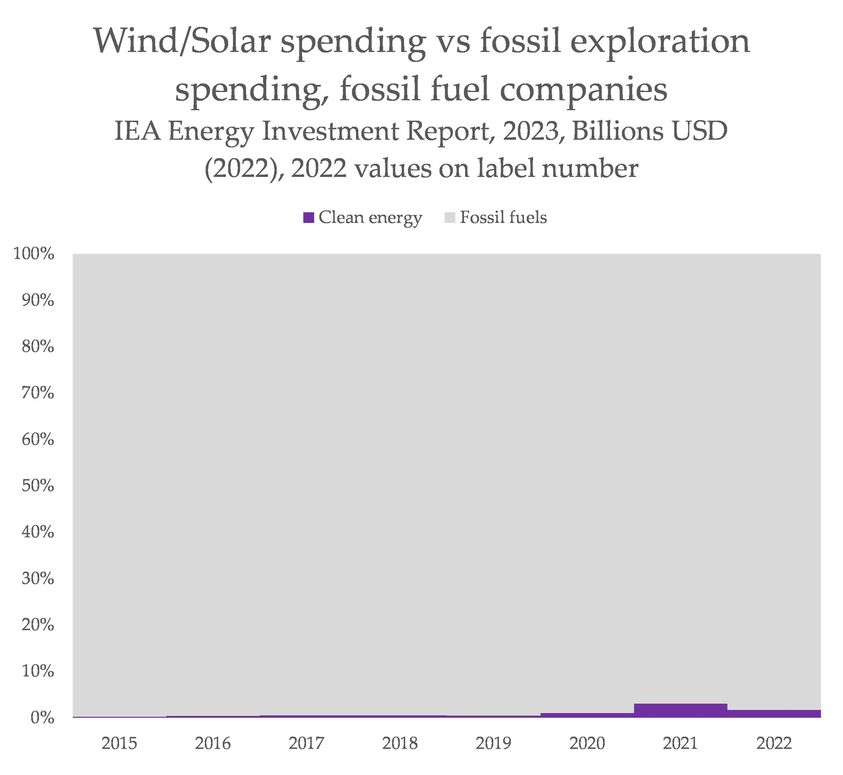
Climate tech, without regulation may do little. For example renewables can be used to increase the energy supply cheaply, without decreasing the amount of fossil fuels that are used. This seems to be standard in many places, and it is standard in fossil fuel company spending – in which spending on exploration and new fossil fuels is at least 15 to 20 times higher than their spending on renewable development, as shown in this graph, The grey area represents expenditure on exploration for fossil fuels.

There is nothing to guarrantee that a technology will only have the effects we want, and will not be commandeered by standard destructive practice.

All markets depend on regulation, and regulation that can be enforced by the State or through the courts. All markets have power imbalances, which affect the market and its regulation. Succesful and rich companies will team up and try and abuse their position of success to make regulations that favour them. This is normal, and makes useful, generally beneficial, regulation difficult.

Without regulation adding to the pressures, most companies will not actually (as opposed to in PR) change their pollution, dispersion or their destructive extraction and climate change will continue to get worse, irrespective of the tech we have, or the tech we might imagine is coming soon.

Technology is useful, but we should work with the tech we have now, rather than imaginary innovative tech that may happen sometime in the future, or may never come.

We should regulate to impose emissions and destruction reduction. Consequences for breaking regulations should be enforced and should affect profit. Hopefully this would give corporations more incentive to work on the problems.

We should also sponsor technological private and governmental research to get better tech rather than leave it to the corporate sector and the market. After all many tech innovations have come from public money, not private money, and are more easily made available if their are no restrictive patents or copyright issues to face.

On Capitalism

May 15, 2023

Capitalism

Capitalism is an organised system of domination, politics and economic power, not just a system of trade.

Capitalism tends towards producing vast inequalities of wealth, that depend upon a person’s place in the system, and not a person’s hard work or talent.

Riches are largely, although not always, decided by birth.

.Accumulation of riches tends to lead to oligopolies, in which small numbers of business control most of their specific markets, and deliberately wipe out competition.

If capitalist ‘free markets’ could exist they would destroy themselves.

In capitalism profit is the only virtue and only mode of evaluation

Capitalism is also a system in which profit is the main virtue and main goal.

If it helps make profit, then pollution, ecological destruction, low wages, industrial accidents, deception, low income misery, low income bad health, and political marginalisation of the populace will be encouraged.

Capitalism reduces all virtue and tradition to profit.

Religion becomes a way of justifying the extraction of riches from the world, or a promise that God favours the saved with riches, and hence that the rich are, as a class, the favoured of God.

This glorification of monetary profit, leads to a sociopathic system which has little care about the damage it produces. The system rewards, and selects for, those people who find it easy not to care for others or the world. Those people then select people who are like them. Consequently the system selects pathologically harmful people to lead it, which intensifies the problems with the system.

A fundamental drive of capitalist profit making is maximising cheapness of production (through low wages, cheap destruction, cheap pollution, cheap resources, cheap dispossession of poorer people etc.) and raising the price of sales.

Capitalism, government and the State

This accumulation of riches leads to plutocracy, where riches can buy any other form of power, and the rich dominate over everyone else and structure the market in their favour.

Capitalists will collaborate with each other and the State to achieve the aims described above, which benefit nearly all of them, because this is how business has to behave within the system.

Collaboration amongst capitalists makes what is called ‘crony capitalism’.

Crony capitalism is not an addition to, or blemish on, capitalism, but fundamental to its political workings and its domination over the State and over government.

As a system, capitalism cycles through boom, bust and bailout.

The rich arrange it so that ordinary citizens and tax payers protect their companies from their unrealistic, destructive or deceptive profit making practices, and the rich have bought the power and credibility to make this assumption fundamental to capitalist practice.

If poorer people suffer from the bust, that is just the price that has to be paid to keep the system going, so who cares?

Without the State to prop it up, capitalism would collapse, or decay into the rule of open violence.

To protect capitalism, the populace have to be misinformed (which is normal given corporate ownership and control over the media, advertising and PR), and people have to be convinced not to co-operate to constrain capitalism in any way.

The people are then led to find scapegoats for the troubles of the system – this can be people of other ‘races,’ other religions, other sexualities, other politics etc. It does not matter who the scapegoat is, as long as it is not the capitalist class in general. It can easily be a billionaire who makes it clear they do not worship capitalism.

Consequently, capitalism destroys social trust, constructive co-operation and compassion, as a matter of course.

Responses

If it seems impossible, or too dangerous, to overthrow capitalism, then for society and its individuals to survive, some other group must organise to restrain capitalism’s destructiveness.

The ‘easiest’ way is to take back the State, and liberate it from lobbyists, corporate bribery and the assumption that corporate elites are the only important part of society, know how to run things and know how to organise every possible process.

Taking back the State, can lead to laws which apply to all business, and encourage sharing of wealth with the workforce, making work places safe, halting environmental destruction and pollution, increasing worker representation in parliament or congress. lessen inequalities of wealth and protect people from busts and the inevitable misfortunes of life as much as possible. This all lowers the likelihood of plutocracy and increases quality of life for most people. This is a minimum.

This actually happened in the 50s, 60s and early 70s of the last century, so it is not impossible.

It should be pretty obvious that some people and parties who pretend to be taking back the State for the people, are deeply embedded in capitalist processes and have no intention of cutting back its normal excesses, even if they criticise some sectors of the economy.

Other systems of resistance, suggest that people should withdraw their support from capitalism, and become self-providing and self-governing communities that deliberately exclude big business (shopping malls, polluters, arms manufacturers, mining companies etc) from their areas, and try to constrain local riches from taking over. When a few such self controlled communities exist, they can start teaming up to become a political force, struggling against surrendering control to capitalism.

There is no reason these two constructive responses to capitalist destruction and domination cannot work together.

Summary

To repeat capitalism is a system of power relations build on top of crimes an dispossession. It needs checking if we are to survive both social and economic collapse, and the collapse of the world’s ecologies.

Inflation and interest rates

September 13, 2022

I probably do not understand economics that well, so feel free to inform me. But here we go:

The consumer price index goes up by x% mainly because of food and energy (drought, floods, sudden gas shortages, increasing energy company profits), but possibly also because of Covid lockdowns in China, or climate change in China, India and Pakistan which is knocking factories out.

The central bank claims people have too much money (there is a loose money supply), so that is why we are getting inflation. I have not seen much evidence that most people, have too much money, or that inflation is being driven by wages increasing faster than profits. Indeed quite the other way around….

Anyway, the central bank appears to assume that people in general must have too much money, therefore it increases interest rates to restrict the money supply.

As those with loans pay more for those loans, they have less money to spend… there is less demand and so prices are supposed to come down.

However, low to median wage people already have less money because its being eaten up by price rises in food and energy – which they might NEED.

Now after the interest rate rise they have even less money and may get thrown out of their homes because they also need to eat etc…. and can’t pay off the loan increases…. Some people live pretty close to the edge.

They can always starve the children I guess, but the situation is likely to get worse as small business with little capital reserve need to put up prices in general to pay off the increased interest on the loans they have taken….

So inflation increases as prices go up and therefore the central bank puts interest rates up again, to try and lower inflation, and drives more people out of their homes and, just maybe, some small businesses go out of business, because they cannot compete with those big businesses with capital reserves…. and the economy gets even more centralised, and people have even less chance of upwards social mobility.

And given small businesses are major employers, it possibly means that closing small business increases unemployment. The IMF apparently has argued that US unemployment should about double to about 7.5% (I can’t find this information, so it may not be correct.). You might wonder about a system whose solutions to problems, openly involve making ordinary people’s lives more precarious.

With less competition, big companies can put up prices, and they can easily coordinate putting up prices, and blame it on inflation. They don’t have to do this of course, but I’d be surprised if some near monopolies don’t – after all making profit for the least cost, is the point of the game. They can also argue that because of cost increases they can’t afford to put up wages – again making profit for the least cost. So the policy is likely to help the transfer of income from ordinary people to the corporate rich and shareholders.

With all the homes being sold, and high interest rates perhaps house prices fall, perhaps they don’t – they didn’t with huge interest rates some years back, where I live. I guess people with money just bought more property.

So this common anti-inflation technique, is bad for people and small business, but ok for big business and people with money to invest in property, and it protects the banks because they get more income, and more foreclosures?

Is that how it works?

Ruskin: Wealth, Illth and Degrowth

August 14, 2022

As you might guess none of this is original

https://commons.wikimedia.org/wiki/File:Ruskin_Self_Portrait_1875.jpg

Definitions

Let’s begin with some useful definitions from Ruskin:

Wealth” to Ruskin is what contributes to a good life and adds to people’s capacity to be constructive:

There is no wealth but life. Life, including all its powers of love, of joy, and of admiration. That country is the richest which nourishes the greatest numbers of noble and happy human beings; that man is richest, who, having perfected the functions of his own life to the utmost, has also the widest helpful influence, both personal, and by means of his possessions, over the lives of others.

Unto this Last.

To Ruskin wealth is therefore connected to the power of implementing virtue, ‘nobility’, and being helpful. This is not a definition likely approved by classical economics – partly because these powers cannot be counted or measured and evaluation can be fairly subjective. Wealth being life, also points to the health of the environmental ecology.

Riches” can be distinguished from wealth as it is collections of money and property which may not contribute to peoples lives. They may even involve cruelty, exploitation and exclusion.

If the king alone be rich, or if a few slave-masters are rich and the nation otherwise composed of slaves is it to be called a rich nation?… [paraphrase]
Since the inequality, which is the condition of riches, may be established in two opposite modes—namely, by increase of possession on the one side, and by decrease of it on the other—we have to inquire, with respect to any given state of riches, precisely in what manner the correlative poverty was produced.

Ruskin Munera Pulveris

Wealth tends to be communal, riches tend to be private and exclusive. I’m not aware of whether Ruskin writes on the virtues of commoning, but it is implied in these definitions. Wealth and prosperity is helpful to all, riches are not. This distinction is again unlikely to be favoured by classical economics, as such economics might even have the aim of confusing prosperity with riches for some.

Illth” is the harm produced by economic activity. Illth includes obvious(?) devastations produced by pollution, dumped nuclear waste, ecological destruction during extraction and so on, but illth also includes the, perhaps, unintended human consequences which can arise from building riches such as ugliness, ill-health, insensitivity, compulsive selfishness, bad community relationships, exploitation, increasing misery, people crippled or exhausted and insecure from the work they have to do, loss of the ability for the community or individual to support themselves, work injuries, consumerist addiction, people being fed lies and untruth, dispossession of people by market demands, people being sacrificed to the market, destruction of prosperous futures, destruction of virtue, and so on.

There may be conflict here. What one person counts as illth, can be defined by others as riches, or even wealth.

Problems of Measurement

Recognition of the complexity of wealth and the problems of Illth seem vital to living a good life and perhaps even surviving. As Herbert Daly points out, once we start hurting the planet and using up its capacity to regenerate its wealth, we are continually generating compounding illth – even if we apparently generate riches. This is a case in which our economics measures money, but does not measure prosperity or the risk of illth. Again, this is difficult to do, but should probably not be ignored.

The main supposed measure of prosperity is the GDP which measures economic activity or expenditure (riches), not Ruskinian wealth.

There are a number of approaches but basically they all use monetary measures:

  • GDP = C (Private Consumer spending) + G (government spending) + I (investments spent on capital equipment, inventories, and housing) + NX (country’s total exports less total imports)

or

  • GDP = Wages + Profits + small business profits + Taxes – Subsidies

These sums can be adjusted for inflation or not. I used Wikipedia as the source, despite finding many other definitions, on the grounds that informed people would probably alter Wikipedia if it was obviously wrong, but also see this which points to rents, earnings from interest, and depreciation as factors in the second version of GDP etc.

The problem with illth in this scheme, as Daly points out, is that it has little recognised monetary value and is not measured. While few people wish to buy illth, they will happily dump it on others to increase profits and the GDP, and people will buy products that may save them from illth, gas masks, air filters, vitamins, pollution clean ups and so on, also boosting GDP, so that illth not only can help destroy the future but generate economic activity which counts as riches and prosperity as measured by the GDP. Through the measurement process, illth can increase apparent riches more than if the harm had not happened. The actual damage to life that illth creates may not be so easy to calculate.

Likewise if a climate change driven storm flattens an area and leaves people homeless or months or years, then any effort at reconstruction also adds to GDP, when in many cases little wealth may be being added to people’s lives and much may have been taken away.

If a forest is destroyed that can count as good economic activity. If people destroy all the world’s trees that is still a boost to the current GDP, despite having destroyed current and future wealth. Destroying the capacity for life, is almost certainly definitional of illth.

Because humans have apparently already significantly affected the planet’s ability to support us, then we need to lower the mass of the monetary economy, especially the mass of the illth economy. To do this we may have to abandon the current version of the GPD as a measure, and damage will have to be counted as a negative in the same terms, which may not be possible. But it is almost certain that economies will have to shrink in reality until the illth (long and short term) is minimised.

Sometimes harms may be useful when they occur during a re-organisation of the economy into a more democratic form, for example, but that is not usual.

We might even wonder if illth can ever be separated from riches? It may be the case that the global economy (both capitalist and developmentalist) requires illth to ‘work’ or to know it is working.

If we then add growth of the GDP as a supposed necessary mark of success or even of economic “sustainability”, then this holds a demand that the economy will have to continue to increase resource extraction and consumption, which may require even more violent, and illth producing, forms of extraction, which incidentally add more to GDP because the cost is greater but which add very little wealth. Daly again remarks that a low destruction oil well that produces much oil without much labour or danger, would currently add less to the GDP than would a dangerous deep sea well, in a storm racked area, which produces heaps of pollution and a need for clean ups. The second well would probably only be countenanced when the easy wells are almost used up.

The difficulty is measuring illth purely in monetary terms. If illth is not completely repaired, which is possibly impossible, then there is no cost, and as we have seen currently the cost of repair hides the damage as riches. If illth is freeloaded upon to generate riches, then it cannot be costed other than by estimate, and if the illth of human misery is to be factored in, then it can always be denied by those with riches….

A more useful measure????

Nowadays, according to some claims, economic activity uses up a year of the Earth’s capacity to regenerate in just under 8 months. This is illth creation in action. Economic activity is creating riches but destroying our capacity to produce future prosperity. It indicates the seriousness of illth production. I presume this is a disputable measurement, which is why it is not in official use, but it does seem to be a useful measure. We simply cannot afford to be in a situation in which our use of the planet is greater than the planet can regenerate, for long periods of time.

Hence, again we go to the necessity of

  • degrowth
  • the recognition of the unintended harms coming from the production of riches, and
  • the need to produce real wealth in human life.

Summary of Praxeology post

July 7, 2022

This is trying to say much the same as the last post in a much less formal and much briefer manner

The point of praxeology is to make our axioms, suppositions, hypotheses, observations, and deductions obvious and open to criticism, so we can progress our understanding as we encounter new events and new understandings.

Capitalism is a set of social organisations of ‘forms’ or ‘systems’ of life

Human life occurs within interacting systems. The basic system on which all others depend are the planetary ecological systems. The capacity of human life depends on the functionality of these systems.

Propositions on Profit

Monetary profit seeking does not seem to be a sufficiently complex concept to drive a functional economic system. [People have many aims beyond profit.]

Monetary profit seeking appears to drive non-functional or even pathological systems, which delete human capacities, reduce most humans to machines for cheap labour, set up plutocratic forms of government and induce confusion and ignorance over vital information and understandings of problems.

Whatever pro-corporate economics says. there are no externalities to the planetary system, and any economics which considers pollution external to its own working, will cultivate non-functionality and death. It is useful to remember Ruskin’s idea of illth. Profit seeking will often produce externalised illth.

Continual enlargement of profit, company or economy is likely to be impossible, and should be treated with suspicion as generating non-functionality and destruction.

Freeloading

Freeloading seems inevitable in profit seeking and profit enlargement economies, and is harmful to social development, constructive co-operation and ecological functionality

Prices

Competition is imperfect and difficult because of the information system, and because of risk (companies are not providing exactly the same products).

Historical Digression: Trajectories of Capital accumulation

Differences in access to capital accumulation are not just the result of virtue, or productive talent as claimed by most pro-capitalist economic theory, but of a history of violence, theft and murder.

The advertised benefits of capitalism have largely been brought about by worker co-operation, threat of revolution and by becoming a market. The benefits have not been brought about by capitalists.

Proposition: Human Competition and Co-operation

Humans are both competitive and co-operative. Most pro-capitalists economics ignores co-operation between the wealth elites, against the working classes, but its important.

Propositions on power and economic action

Wealth is a basis for power.

Capitalism generates a situation of unequal wealth and hence unequal power – especially when the Wealth elites co-operate against the ‘lower classes’

Proposition: ‘Crony Capitalism’ and ‘State Capture’ are inevitable

Crony capitalism is normal and leads to State Capture or State Takeover – plutocracy. Capitalists use their wealth and power to shape the State to serve what they think are their best ends….

Wealth gives power, liberty and capacity; and inequality of wealth gives inequality of power liberty and capacity.

Siding with the elites

Some working people side with the capitalist class through taking managerial positions – however this may not lessen their vulnerability.

Power in the ‘Marketplace’

Power differentials affect market transactions and satisfactions.

Information system

Capitalism inherently confuses the information system by using it for advertising, PR, lies, etc., and by doing so, lowers that system’s capacity to provide useful and accurate information. This undermines the response of the wealth elites, and the polity as a whole, to real problems.

Information mess likely exists within most corporate bodies as well as in the more public sphere.

The information system is confused by normal action, so that various forms of market and social collapse are usually surprising.

Markets, Relationships and Trust (Morals?)

Human non-capitalist economies are as much about relationship and co-operation as monetary exchange. Exchange of money may defeat relationship.

Uncertainty and experimental politics

Uncertainty is normal in life and information incomplete even in the best circumstances. Hence policies should be regarded as experiments rather than as dogma. Attention should be paid to after-events in order to refine the actions and understandings.

Returning to systems

We live within systems. Individuals appear in systems of interactions.

The primary political need seems to be to recognise that we need functional ecologies in order to have functional economic systems, functional political systems and so on. Tending to ecologies is a fundamental political act that needs encouragement.

If we kill, or unrecoverably disrupt, our ecologies then the likelihood of us humans having much of a future severely diminishes….

Towards a real ‘praxeology’ of capitalism

July 6, 2022

Praxeology is the attempt to define the underlying logic of human action both individual and collective. It was a fundamental hallmark of Austrian ‘free market’ economics. It’s advantage is that, if conducted properly, it should make our axioms, suppositions, hypotheses, observations, and deductions obvious and open to criticism, so we can progress our understanding as we encounter new events and new perspectives. However, Austrian economics and its followers seem to have continually ignored empirical observations which suggest that capitalism would not work as they wanted it to behave. Rather than deal with the problems of their assumptions, or of capitalism, they have appeared to have wanted to blame others for capitalism’s failures (such as people with ‘good intentions’, socialists, state interference etc). Hence, their free market economics appears as if it is an attempt to protect capitalism from democratic influence or responsibility.

This is an attempt to describe human action without that particular bias.

This post will likely grow as I rethink it and rewrite it.

Capitalism is a set of social organisations of ‘forms’ or ‘systems’ of life:

Economic Life system: The organisation of exchange, trade, production, distribution of goods and wealth, property rights, ownership, credit, poverty, waste, pollution, extraction;
Political Life system: Relations of power and dominance, state organisation, taxes, active concerns, priorities, neglects, law, courts, regulation, policing, interaction with other groups, placing people in social categories to treat them ‘correctly’ (however ‘correctly’ is defined), warfare etc.
Informational Life system: Modes of gathering, producing, organisation, owning, distributing, suppressing or ignoring, information. Structures of communication. Modes of informational etiquette (such as abusing those who disagree) Modes of truth.
Energetic Life system: Labour, slavery, water, wind, solar, food, coal, wind, oil, nuclear etc.
Ecological Life system: Availability of resources, weather patterns, fertility, creatures, planetary boundaries etc…

  • [Capitalism also involves organisations of family, personal, educational and religious life (and so on), so that people can earn money, survive and find meaning within the overall system, but for the while we will ignore these factors, simply to make it relatively simple.]
  • [I have sometimes separated out the system of waste, pollution, dispersion, extraction and ecological destruction to emphasise its importance to current problems, and may do so again later. We can hypothesise that all economies depend on their systems of waste, pollution, dispersion and destruction.]

Despite coming last in this set of conditions, ecological systems are the fundamental basis of all life. Ecology is primary to all of economy, politics and energy use, although it is shaped by economy, politics and energy use. I’m not alone in asserting that politics and economics should be more focused on tending to the ecology, and keeping it healthy and functional, so as to help our survival. Functional, non-poisoned ecologies, in human terms, are vital.

All these forms or systems of life are bound together. You cannot separate them, and be realistic. Capitalism, politics, information, energy, ecology are all interacting complex systems. The imposition of one kind of order in one sphere, may generate unintended consequences or events, elsewhere, which are considered to be disorders.

Economic and political life are especially bound together. No capitalism has been observed without political life or without a State. Capitalism without States, may be possible, but so far it is a fantasy, and praxeology must deal with the real and observable, or be useless. Likewise no form of capitalism currently exists without an information system or without being within an ecology.

Proposition: All of these systems/forms of life have been impacted on over history, and this may affect their present condition and limit their probable futures.

The specific modes of organisation which define capitalism will become clearer as we progress, but the initial Primary guiding hypothesis is that the increase of monetary profit is the main drive and organising focus of capitalism – especially of neoliberal (current day) capitalism. Other forms and systems of social organisation, may not assume that monetary profit is the prime directive of all life. People may, for example, seek status (admiration from others) and power through displays of generosity or care.

A Secondary guiding hypothesis, which does not seem uniquely relevant to capitalism, is that the ruling elites (wealth or otherwise) will seek to maintain the conditions of their existence, and to increase their power (and profit). However, while they may have these intentions, there is no guarantee that they will succeed, or that they will not undermine themselves. The world is complex and escapes anyone’s total control.

Propositions on Profit

Definition: Profit is the extraction of money from the general economic process and its allocation to particular people in positions of business ownership, through legal means (ie political action), who then are said to make, and own, the profit. Profit arises within an underlying complex set of social processes or interdependencies (labour, provision of goods, provision of energy, regulation, interactions with other businesses, customers and so on). The law allows its separation out from this complex set of interdependencies. Recognised money makes profit ‘real’ and ‘storable’. As Ruskin suggests profit is not to be confused with wealth. Profit can also be a source of ‘illth.’

Question: Is there any form of what we call capitalism which does not require money?

Assertion based on the primary guiding hypothesis: Taking, and increasing, Profit is the fundamental underlying (and moral) principle of capitalism. The more intense the power of capitalists the more likely this is the case. Profit is needed for survival as a business.

Proposition 1: In capitalism, high profit (within the law) is considered good and less profit bad.

Proposition 2: The more costs of production can be lowered to increase profit the better.

Therefore: Workers are a drain on profit, and should be either eliminated or underpaid. The same may be true of suppliers. Likewise, pollution, poisoning, and unremediated ecological destruction are useful as they cut costs, and so are dismissed in capitalism as externalities. They are said to be external to the economic system, having no effect. Essentially externalities are the ways in which the capitalist class can freeload costs and suffering onto others to increase profit. One significant problem is that the planet and its ecologies are not external to survival and are finite. They have limits, and freeloading will eventually catch up with everyone. We have known this in theory since at least 1966, although the realisation seems to have been put to one side.

Question: Is capitalism more or less driven to destroy the ecology which supports it, through the drive to ‘externalise’ and ignore ecological damage, in order to increase profit?

The desire to continually increase profit, leads to growth (enlargement rather than development) being the mark of a successful business. Enlargement is not necessarily sustainable in all conditions for everyone – hence most businesses collapse, and only the most profitable (or ruthless) survive and eat everything else. To repeat, this increases the necessary power of profit, it keeps you in business, and that is more important than valuing ecology in this system.

Freeloading

Definition: Freeloading involves letting other people, or other companies, do the socially useful survival work (like not emitting pollution, feeding the workers), and avoiding the costs of that work and therefore increasing profits at the expense of those who don’t freeload.

Empirical generalisation: Corporate freeloading is often hidden by the information system, while worker freeloading is exposed.

Hypothesis: Freeloading is moral in capitalism, if it makes a profit and its done by the corporate class against the non-corporate class.

Question: Is there anything in capitalism, which prevents individualists from refusing to participate in the general costs of survival, by hiding their freeloading on those who do absorb those costs, then continuing with making the damage, making more profit and surviving when the other ‘responsible companies’ collapse?

If nothing opposes this, then all companies will be inclined towards freeloading for the sake of their survival.

Prices

It may be important to distinguish price from value, although they are often confused. Fresh air may be valuable but it may not yet be priced. Love may be valuable, but it may not always be priced. Price is the amount of money something can be charged for on the market.

It may be important not to assume that the value of anything is solely (and objectively) its price.

Proposition 1: In capitalism, high profit (within the law) is considered good and less profit bad.

Proposition 3: The higher the prices that can be charged to the customer, the greater the profit.

Therefore: Prices should continually increase until the products cannot be sold at a profit or potential customers move to products produced by other people with roughly the same function. This process is generally called competition.

Competition involves information. People have to know they can get the cheaper useful product for competition to work. Complete information is impossible, but fraud is possible. that is the cheaper product may not work.

Transactions with new businesses are risky. Companies are not providing exactly the same products. Cheaper may be cheaper, but they may not be good, the new company might break down, and leave you without a supplier, and so on.

Question: Do businesses generally regard competition as bad, and head towards monopoly, cooperation and/or suppression of information?

Empirical observation: Companies can, and do, create the illusion of competition by manufacturing different brands of ‘stuff’ at different prices.

Question: Is attempting to confuse the market (or the customer) a standard or vital tactic for business to help increase the price they can charge?

Historical Digression: Trajectories of Capital accumulation

Question: If there is no legal force which demands peace recognised, what crimes will be perpetuated in the name of profit?

Empirical observations: the East India Company. The Opium Wars. Tobacco companies.

Accumulation of capital, or the profit, to begin capitalism, has been historically brought about through violence.
Feudalism, conquest, colonialism, theft of treasure and resources (gold and silver from the Americas and India), ‘enclosures’ or dispossession of people from land, stripping people of their right to self sufficiency, slavery, cheap (but crippling or deadly) working conditions, downplaying the value of labour, reducing obligation and care to ‘money,’ together with repression of rebellion until this set up became taken as natural because people had never experienced anything else.

Capitalist colonialism has always attempted to eliminate non-capitalist ways of organising economic behaviour. Sometimes this destruction was deliberate (imposing wage labour, dispossessing people from land, or otherwise promoting the need for currency through taxes etc.) and sometimes it may have been accidental through the inability to understand that non-capitalist economic systems existed or had any virtues (ie through the capitalist shaping of the information system, and through the fact that not all these economies valued a constant increase in monetary profit at all costs). We might call this “The Natives are lazy” syndrome, found in Australia under Terra Nullius, which claimed that aboriginal people ignored the land and did not exist, which ‘therefore’ justifies taking the land, the destruction of non-capitalist people, ecologies and economies. Sometimes the destruction was by spread of disease, deliberate or otherwise.

Observation: The history of capitalist accumulation seems to be brought about by elites co-operating with each other and their ‘workers’, and doing far more damage than they could have done alone. There is no reason to assume that they should have become ‘individual’ operators after that success. (See ‘competition and co-operation’ below.)

Differences in capital accumulation are not just the result of virtue, or productive talent as claimed by most pro-capitalist economic theory, but of violence and theft.

Question: Does this situation continue today?

Empirical observation: We are still told the poor (‘Natives’) are lazy, untalented or cursed by God to be blamed for their own poverty, and that the ‘undeveloped world’ needs more capitalists, more enclosure of property, to buy more of our products (to make money for us), the help of international corporations and minerals being taken for very little in the way of payment. In America and Australia ‘our’ economic and state institutions still keep most of the land which was violently stolen.

The use of day to day violence was partially mitigated by the rise of worker organisation, the workers standing up to the violence, the rise of independence movements, the fear of revolution, and the general failure of fascism to stabilise capitalist power. Since the late 1980s this fear has diminished and workers’ organisation has declined. We may be heading into another round of ‘stabilising’ fascism.

Another factor in the lessening of repression was the realisation that workers with higher wages can form a viable market for products and hence higher wages can benefit all through increasing the scope of the market. However such a realisation was likely to fall, because of the temptation for individual capitalists to freeload on others, and to go back to undermining, deskilling and underpaying labour to increase their own profit and power in the market, at the cost of those who treated workers better to generate a good market.

Proposition: Human Competition and Co-operation

Empirical observation: People are both cooperative and competitive
a) They tend to cooperate within ingroups, or with people the person identifies with
b) They tend to compete with outgroups, or with people the person does not identify with

Empirical observation: People can do things through co-operation they could not do alone. They can often get more done through co-operation than by working alone.

Empirical observation: Competition often occurs through co-operation, as when group co-operates to ‘defeat’ another group or to increase their power and capacity.

Corporations are examples of human cooperation and competition (cooperation and competition both within and without).

Remark: Human beings don’t have to compete for money. Humans can compete for respect, acknowledgment, fame, power, obligation and so on – all of which can be beneficial to community life.

Many economic systems rely on ‘generosity’ of gifting, to build relationships and obligations. This can mix both competition and co-operation.

To ignore one of these factors in favour of the other, is to suppress awareness of human complexity.

Observation: Nothing that can be called an economy does not involve both competition and co-operation.

The limits of co-operation and competition are usually set by social convention and who is defined as ingroup and who is defined as outgroup.

Rejecting ideas of co-operation and non-monetary returns, means that people ignore vital parts of society, such as the building and design of the internet (free exchange in return for status and acknowledgement), long lasting commons and shared land, and even obvious fact, that most parents don’t kill, or seriously harm, their babies.

Propositions on power and economic action

Definition: Power is the capacity for both a) free action and b) control, or influence, over others’ actions.

Empirical observation (and axiom) 1: Unequal wealth = unequal power.

In a capitalist state, and perhaps in all States, wealth buys access to political processes, free action and control over others through organised violence or law. Wealth is a basis for power for free action and control over others.

Unequal wealth and power generates unequal liberty and unequal capacity for action.

Empirical observation (and axiom) 2: Capitalism generates massively unequal wealth (Usually justified by Praxeologists on the grounds of unequal talents.)

Therefore: capitalism generates massively unequal power, liberty and capacity to act.

Suggestion: Capitalist politics enforces this unequal liberty in order to preserve its system stability, to preserve the hierarchy of power and wealth of those who have it, and to engage in ‘capitalist pillage for capital accumulation’. See above and next section.

Hypothesis: The fundamental relationship in capitalism, is between Boss and worker. The worker must, in general, do as they are told so as to maximise profit. There is no necessary relationship between boss and worker apart from obedience and money. Capitalism is about obedience, and dependence on the employer, not about liberty.

Suggestion: Maximization of profit requires that groups who might want to share in the profit they helped produce, or who might increase costs through rendering pollution a non-external cost, have to be suppressed as best as possible, without leading to their revolt. This suppression may require the State, or co-operation between businesses.

Proposition: ‘Crony Capitalism’ and ‘State Capture’ are inevitable

The hyper wealthy will tend to identify with each other against ordinary people (see the proposition ‘Human Competition and Co-operation’, above). Hence they will co-operate against ordinary people and the ‘threat’ posed by ordinary people.

This is reinforced by the ‘need’ to diminish wages and working conditions and externalise costs onto others, so as to increase profit.

Statement: Employers, large corporations and wealth elites have more power than ordinary workers

Definition: Crony capitalism is co-operation between corporations or wealth elites so as to increase wealth, profit and power. This may make use of a political class, primarily a political class which identifies with the wealth elites, or is easily bought (because profit is the main social virtue).

Crony Capitalism is normal capitalism based in ‘human nature’ and ingroup outgroup behaviour. It’s easy and it is effective in increasing profit, and hence reinforced by the normal processes of profit seeking.

That corporate elites co-operate against outgroups, does not mean they will be unified with no internal competition, but that competition maybe suppressed in their cooperation against the “common enemy”.

Proposition 1: The corporate wealth elite has more power and capacity than the ‘lower classes’

Proposition 2: The elite will co-operate against the lower classes.

Proposition 3: The corporate wealth elite will pass this wealth and the advantage it brings to their children.

Therefore: workers are more limited in their response to opportunities. Competition between workers will always drive down wages unless there are workers with skills which are in short supply, and there is no equality or freedom of opportunity in capitalism for most people.

Comment: This competition between workers to earn enough to survive seems to be encouraged by pro-capitalist politicians to force down wages, and this perhaps unintentionally lowers the capacity of the mass market to purchase products and services.

What counts as belonging to who, is an act of negotiation and power. The more powerful the workers the more ‘belongs’ to them, the more powerful bosses and business, the more belongs to them.

Proposition: Collaboration between wealth elites will also occur in the wider political sphere.

Therefore: The hyper wealthy and the corporate sector will attempt to take over or capture the State, or set up a plutocratic state, to prevent the lower classes from acting against them. This State will regulate and structure the market in their favour in order to benefit their profit; it will allow more freeloading on others; it will attempt to prevent people demanding action which is socially beneficial but which could reduce profit, and it will police challenges to this order. This is personally beneficial for the politicians in capitalist ideology.

As a result, there is no possible capitalism in which the State does not interfere with the market, especially in an attempt to support the capitalist market. Hence the State is part of the market and cannot be blamed for the failure of the market alone – the behaviour of the State is part of the market in action.

Assertion: the form of State present in a capitalist society, will tend to support the wealth elites, support the location of profit with the wealth elites, while cutting back any support for workers, cutting back attempts to end freeloading by the wealth elites and demonising those who might agitate against the wealth elites in ways which could be effective.

Siding with the elites

Proposition 1: Living the worker life is insecure and low status.

Proposition 2: People tend to avoid positions of insecurity and low status if they can.

Therefore: People can hope to increase their wealth and apparent power, by siding with employers or corporations forming the managerial class which acts as a distractor and buffer between workers and wealth elites. However, low level managers (in particular) are still workers and discardable, whatever they might hope to the contrary.

Observation: Capitalism has to attract support to survive outside of perpetual warfare.

Power in the ‘Marketplace’

Following on from the earlier propositions.

Proposition 1: Wealthier players may have less of an immediate need for a transaction – they have the ‘capital’ to prolong survival, at a loss.

Proposition 2: Poorer players may have an immediate need for the transaction to survive and may have to agree to ensure that survival. They cannot survive the loss.

Therefore: All actors in the market do NOT have equal power in the market, and that transactions are not equitable, and are not equally satisfying.

Empirical observation: People who are not self supporting, and who need wages to survive may have to accept jobs at low wages, as low wages are better than non. Low wages may provide food, delay being thrown out of accommodation and so on. The employer does not have to care that much, as there will probably be someone else out of their luck and willing to accept the wages.

Employers can also co-operate to lower wages. cf Crony capitalism. They can also oppose livable minimum wages becoming law, because they are a recognised power block.

Likewise, in certain circumstances, a supplier can be desperate for a contract, and have to take a low offer because there is nothing else around, and the purchaser can hang in. In other circumstances the purchaser may be in the vulnerable position.

Mutual satisfaction in capitalist exchange is not guaranteed.

It is almost sanctified to rip off, or cheat, the other, unless it affects profit and repeat sales. Caveat emptor (buyer beware) is the principle.

Proposition 3: Small businesses can rarely undercut big businesses.

Proposition 4: Big business can often undercut the prices of small business for long enough to break the small business. They can then put up the prices.

Therefore: Big business can usually drive out small business, or non-established businesses, if the transactions are based solely on prices.

Therefore: An established oligopoly can generate conditions in which it is almost impossible for competitors to break into a market, even if the prices they charge are vastly inflated – especially given that the competitors usually have to consume capital to enter into the market in the first place, and are therefore likely to have higher costs to recover.

The risks of interacting with new players for old customers, is also a factor which supports the oligopoly.

Information system

All social systems have information systems.

The information a person has access too will influence the way that they perceive the world and its workings. Hence, control of the information system, or parts of the system is important politically, as it brings things to notice.

Proposition 1: In a capitalist society, the main media organisations and sources of information will be owned and controlled by the wealth elites.

Proposition 2: Nearly all contemporary people will gain information about the wider world, politics, ecology and economy, from media rather than from personal experience. The world is too big to know it all personally.

Therefore: the media will, in general, defend the wealth elites, their views, and their system of wealth to help preserve the system.

Note: this does not mean every player will automatically see the rightness of a particular defense, but defense and justification will be aimed at.

Proposition 3: As the media are corporate, the main purpose of the media is to make profit.

Proposition 4: the main source of media profit is corporate advertising.

Therefore: They will attempt to not alienate their advertisers or their audience. The primary aim of media is to attract audiences for advertisers’ advertisements, not to promote accurate statements.

Proposition 5: A secondary aim will be to discredit other media to stop the audience going elsewhere, and to keep advertising revenue high. This also does not contribute to accuracy.

Proposition 6: The function of advertising is to sell products, associate engaging fantasies with particular products, get people excited about new products or imagined products, attack existing competing products, hide cheaper competing products, increase profits, justify or naturalise capitalism, or protect a company from challenge, not to promote accuracy or accurate understanding. The Corporate Media is necessarily saturated in hype, falsehood and exaggeration from the beginning. And then there is the need to hide freeloading, or create ‘greenwash’, etc, to keep markets open against protest.

Reminder: It has already been suggested that false information about markets and confusion about prices of products can be useful to competitors on the market. If people do not know what they are buying, or how much they are paying, that can also be useful to competition. (Scot Adams: ‘Confusopoly’).

Proposition 6: People depend on the knowledge system, to learn about the world, to respond to the world and to situate themselves in the world.

Proposition 7: Confused people are more easily led to avoid problems and into further destruction by those who think they benefit from ignoring the problems.

Therefore: An information system which is completely messy will allow problems to accumulate or even encourage problems and destruction to continue, so as to preserve the power and wealth structures.

Empirical observation: the information system may distract people away from important information, in order to help the system pretend it is coping, and to prevent added challenges to the system. For example, controversy about the science of climate change is promoted beyond it statistical significance, while general agreement is not. Celebrity life is more important than climate change. This helps the system keep going (for a while). Likewise, non-capitalist economics is ignored, while the virtue of ‘free markets’ is promoted. Information necessary for survival may be hidden or attacked by the information system if it is seen as presenting an unacceptable challenge to capitalism.

Question: Are these kinds of information disruption systems present within the corporation itself?

Hypothesis: In general (but not always) people at the local level have a better knowledge of what is going on locally than people distant from them.

Therefore: Locals may tend to lie to the centre, or distant power, to allow them to act appropriately.

Remark: Pro-corporate analysts recognise that distant government officials can be out of touch, but generally do not recognise that corporate officials can also be out of touch for the same reasons.

Hypothesis: A punitive hierarchy will establish a system in which people below tell people above, what those below think those above want to hear, so as to protect themselves. The people above will only tell people below, what they think those below need to hear or know, and will lie to protect themselves, or to prevent resistance. Status depends on knowledge, so few people give knowledge away.

When you buy information from a supplier to try and obtain accuracy, the buyer still faces the problem that the supplier is likely to try and keep the purchasing relationship going by providing you with what you might want to hear, rather than what is accurate, and their sources might do likewise. Think tanks are often quite overt about providing their customers with what they want.

Suggestion: to this market based information disruption, we can add the effect of the political propaganda also spread through the information system, in which various forces attempt to make the corporate sector or political parties and politicians look good or bad and provide them with the information that will change their behaviour in desired ways.

The capitalist information system is riddled with rhetoric, hype, lies, distraction, fantasy and confusion, not as an add-on or an easily correctable mistake, but as part of its normal operation.

The normal processes of the market and of customer purchase appear to disrupt the intelligence and information needed to make decisions in the market.

Eventually the whole system will collapse when reality does not match with what the people come to believe should be the case, and with how they should act. This is suicidal. The information system becomes a non-functional ecology, in human terms.

Hypothesis: this cultivation of confusion and falsity to gain and keep market advantage is one reason why economic collapses, market breakdowns and the like, always take almost all players in the market by surprise.

It has been said that the market is the ultimate and only information processor about the world. If a business gets something wrong and does not learn, it goes bust. However, markets are a subset of ecological interactions. It is the ecology which has the final say. And if the ecology collapses, it does not matter how successfully the market has operated in its own terms, it will likely go down with the ecology.

Question: Despite all this information disruption, can wealth can buy better information and therefore buy advantage on the marketplace?

Non-profit ways???

Markets, Relationships and Trust (Morals?)

Anthropological observation: Most systems of exchange are about building relationships (systems of obligation, trust, gifting, connection and status) between people to further co-operation. Humans are relational animals before economic animals, and long before becoming ‘monetary transaction machines’.

Observation: Relationality still exists when price is not the only determinate of behaviour.

People can build relationships with small companies, with corner stores, with favourite stores, with their children etc. that are more than monetary exchanges.

Relationship building seems to be one reason why ingroup and outgroup bonds are so easy to form.

Companies have often tried to take advantage of relationality, and build up a relationship between customers and products, as if it were two way, when its primarily entrapping the customer..

By trying to make price and advantage the prime mode of exchange, in which the payment of money terminates the transaction, capitalist ideology breaks down human relationships to other humans and to ecology (natural world).

This is deeply anti-human, destructive of awareness and preventative of spontaneous beneficial non-capitalist co-operation from emerging.

Building connections and co-operation within and outside capitalism, and outside its self-generated problems, is likely a step towards building a survivable and less catastrophic world.

Commons

Emphasising co-operation without pretending people are never competitive or self-interested. Common land, common tools, common property exists throughout the world. I’ve argued that common energy may be the best way out of the energy crisis, as it puts responsibility for energy and pollution squarely on those that use it. It responds to local conditions, builds functional local democracy and participation, and has to guard against freeloaders or the project will fail.

It looks as though successful commons require locally agreed upon rules of use, and sanctions for violation of those rules.

Uncertainty and experimental politics

Assertion 1: Uncertainty is fundamental in complex systems. No matter how good the information system we will probably never have certainty. Few precise predictions can be guaranteed. The system is too complicated to map completely. No information system carries completely accurate statements.

Assertion 2: Uncertainty is not fixed by imposing the certainty that free markets deal with uncertainty and always produce the best possible result. Free markets are entangled in relations of power and deceit from the beginning. The ecology is the only real marker of correctness, and its response may be violent.

Assertion 3: Due to uncertainty, most policies, ethical positions and proposed solutions are experimental, and have to be treated as experimental. We don’t, and will not, know the full result of a set of actions until after we have acted, and we need to refine actions based on the result and the feedback it gives – and recognise this may change.

Assertion 4: We do now know, that current day neoliberal capitalism does not appear able to solve the problems it generates, and largely sweeps them under the table. It’s day needs to be over, but we may not know what to replace it with. This adds to uncertainty and the need for experiment.

Returning to systems

Observation: People live within systems. They do not live as isolated individuals. They live as interdependent people. This is fundamental. Without being able to be dependent on other humans all infants would die.

Observation: People live in the interaction of numerous systems of human and non human systems.

Observation: humans live in and create complex systems…. this has consequences. (I’ve dealt with this elsewhere, but uncertainty is primary).

Hypothesis: Attempting to impose any single system on all the others can easily lead to disaster.

Imposing ‘individualistic’ capitalism, or the ideology of individualistic capitalism on everything, is causing disaster.

It does not even produce an adequate model of what happens in real capitalism or real economies.

Methodological individualism is a distortion of reality, which serves an ideological purpose alone, to help maintain the power of capitalism and to prevent co-operative innovation and moves outside of the destructive economic system.

This set of reconceptualisations, which is not claiming to be original, is important because

  • humans act in situations/contexts
  • with particular understandings.
  • Understandings are part of the information system

Humans are hampered and encouraged by the contexts they live within.

If they have fundamentally incorrect understandings of the situation then the hampering to action from that situation will win out.

For example, it is easily possible to allege that most politics allowed to participate in capitalism are politics which help the reproduction of capitalism. There may be disagreements about how this is done, ranging from pure fascist theocratic authority, to pure libertarianism, to having working social services, but the main idea is to keep capitalism and its ‘class system’ going, even if we add another class to it to help that happen.

However we could imagine a politics in which the main concern was regenerating relatively harmonious human ecological relations, so that we did came to not deplete the earth, destroy other species, or poison the world. A politics which realised that without a working set of ecologies which include us, we cannot survive let alone survive well. This would be a politics and economics which would either displace or transform capitalist destruction, and make a new more human economics. It would at the least challenge the type of assumptions that we make about the world within capitalism.

The understandings proposed here can be trivial or wrong, but I assert they are better for dealing with our situations than the ones which have informational dominance and which seem to be helping towards continuing and worsening the multiple crises we face.

….

Attempt to summarise this on the next page.
Capitalism and Ideology

June 17, 2022

Its hard to say what capitalism is or is not, but relatively easy to point out when you are reading a book which is driven by ideology driven rather than by wanting to discover the truth about how capitalism works.

1) Funding

If the authors are, or were, funded by corporate sponsored think tanks or just plain sponsorship, then they are likely bought. They were chosen for their ability to please their corporate customers and their desires, and it becomes part of their job. Accuracy is almost certainly less important than maintaining their income. Hence by capitalist logic, we should be suspicious of these people. This covers a fair number of ‘Austrian’ and ‘free market’ writers.

2) Naturalisation

If the author presents capitalism as purely natural, and conflates capitalism with other forms of economic activity such as trade, exchange, production or so on, then its ideological. Communist societies engaged in trade and so on. We would expect communism and capitalism to be economically different. The term ‘Capitalism’ has to be limited to specific set of economic and political organisations or the term is meaningless.

3) Capitalist hierarchy is good

If the author presents the wealth hierarchy in capitalism as a matter of hard work, genius or customer satisfaction alone, then the work is ideological. Capitalism involves a form of political organisation which allows and reinforces the concentration of wealth amongst certain people, and hence the building of fixed hierarchy and power differences are essential parts of capitalism, which need to be part of our analysis, not counted as accidents or benefits.

4) Without a past

An ideological person may present capitalism as being without a history, to bury the violence, dispossession and theft (or colonialism) that has been a dynamic part of capitalist history, and can still be seen today. They are suppressing the roots and routes of capitalist development to make it look better. They may even argue that capitalism is always peaceful, ignoring the enclosure of the commons, the conditions of the working class in 19th Century England, the East India Company or the Opium Wars and many other acts of violence which have benefitted and helped originate capitalism – we could even argue World War I was entirely about defending and establishing colonial and capitalist empires.

Capitalism does not have a peaceful past, and that is part of the way it works.

5) Uniquely generates moral goods like ‘liberty’

If the person says that something valuable, like liberty, is a fundamental part of capitalism, then they are likely being driven by ideology. Capitalists like liberty for themselves, most dominating classes do. The question is ‘was liberty for the people something that had to be fought for, against capitalists or not’. The historical answer seems to be that it had to be fought for. Furthermore most pro-capitalist ideologies act to remove that liberty, by putting the liberty of corporations first, or attempting to restrict the power of organised labor. Pro-capitalists also tend to oppose social movements for the liberty of those still suffering from oppressive histories (calling them SJW etc). Liberty is not a natural result of capitalism, although, as said previously, capitalists like liberty for themselves, or for their liberty to be immune from considerations of public health, functioning ecologies, good working conditions, wealth sharing. etc.

Sometimes ideological authors engage in argument by punning saying that free markets lead to freedom, or that free markets are freedom. In practice the ‘free market’ devolves into whatever is best for the wealth elite, and gives them the freedoms they need and can obtain.

  • [This does not mean that there can be no liberty in any form of Capitalism. This had happened to some degree and needs investigation – what causes it?
  • A real ideologue will respond to the idea that capitalism is not about liberty, by creating a false dichotomy. Either you support whatever their version of capitalism is, or you supposedly support tyranny. No, you can support a kind of democratic capitalism, of the type that they have in Scandinavia, or had in the 50s, 60s and 70s in the US, UK and Australia. that is easy.]

Capitalism generates what is ‘profitable,’ or extractive, to the system, and this may, or may not be, what people think is morally good. It may not even be self-sustaining, but destructive in the long term.

6) Removes power inequalities

The fundamental social relationship in capitalism is between employer and employee, master and servant, boss and worker. This is rarely a relationship of liberty, and more usually a relationship of punitive obedience – to survive most people will ‘need’ a boss.

There is no necessary harmony between the working class and the capitalist class. Even capitalist theory should realise that, in general, workers want good wages, freedoms and good working conditions, and that capitalists want high profits and low costs. Labour is purely a cost to capitalists and the freer it is to disobey, or live independently of capitalism, the more costly it is. Capitalists also want cheap pollution, and cheap extraction, those affected by pollution and extraction do not.

7) Opposed to the State

Ideologues frequently claim that capitalism is opposed to the State. However, no form of capitalism has ever existed without a State, to protect wealth inequalities, labour inequalities, contract and obligation, the social forms required by capitalism, and to satisfy the wealth elites desire for power and control. Laws in capitalism are often about defending the rights of particular sections of the capitalist class. Even if this wasn’t the case with some laws, then there is nothing to prevent it from happening if enough capitalists desire it.

Some corporations are large enough and wealthy enough to count as mobile States in their own right

The idea that capitalism is opposed to the State functions as a method of explaining away the problems in capitalism – “it was the State what done it!” not the dynamics of capitalism. Where capitalism exists, then the State is largely controlled by the capitalist class, who buy politicians, regulations laws, and subsidies to help themselves survive. Where capitalism exists the State is the Capitalist State. Capitalism and the State are not separable, and hence the State is part of the system, not opposed to it.

The function of being opposed to the State, is to destroy, or ‘roll back’, any part of the State which might constrain capitalists, or benefit workers and other people, and to make the State purely plutocratic. Paradoxically those who opposed the State never seem to make it smaller, perhaps because that is not their aim. Controlling and punishing non-wealth-elites can take a lot of effort and State mechanics, as can subsidising businesses which supply the military.

8) People are simple

If an author states that people are primarily competitive, then they are driven by ideology. People are both competitive and co-operative. Indeed without co-operation you could not have most forms of competition like wars, or even like corporations. Usually the reason for ignoring co-operation is to pretend that the wealth elites will not co-operate together to take over the State or to found a State, for their group advantage. It also obscures the idea that crony capitalism, and state capture, are normal forms of capitalism.

Co-operation amongst the wealth elites leads to plutocracy, suppression of liberty for others, and the end of open markets.

9) Economic Man

Any book which reduces people to rational profit driven machines, is ideological. People are irrational and complicated. Any view which reduces people to competitive rational profit seeking machines is almost certainly going to destroy the conditions for human contentment or satisfying human life.

John Stuart Mill made this assumption to make economics simple for himself, without pretending that this was true, but it became taken as true, as it helps justify and naturalize capitalism

10) Markets are perfect information processors

Ideologists insist that markets are the best form of information processors. However, the information available in capitalism, tends towards information that encourages purchase, profit, extraction and more capitalist power. It is not geared towards capitalists recognising the signals that they are doing something pathological, before the destruction happens. Hence business cycles, corporate crashes, stock market crashes, market bubbles, ecological failures such as over-fishing and so on.

The market is, however, part of the ecology, and the ecology can be thought of as an information processor, but the way that information is processed is through disruption of ecological equilibrium, leading to disruption or destruction, as a new equilibrium is found. These new equilibriums do not have to be beneficial to previously existing life forms. The drive for immediate profit in the market may not signal this information in ways which can be recognised until too late.

That appears to be what is happening now with ecological destruction and climate change. Despite the dangers being reasonably obvious to many people (especially scientists), most capitalists keep on profiteering and making the dangers worse.

Taking the market ‘out’ of the bigger ecology, or making the market more important than the bigger ecology, or into the main information processor, makes the market a completely useless information processor, filled with falsity and avoidance, and headed towards destruction on a grand scale.

Conclusion

If a book only considers an ideal capitalism, or an imagined capitalism, it is ideological. Any true consideration of capitalism must consider real forms of capitalism, their history and mess. We cannot do economics, or any other social science, in the abstract.

The Positive effects of Neoliberalism?

April 15, 2022

If you want to discuss positive and negative effects of any movement, you usually have to ask “for whom?”

Definition

To some extent neoliberalism can be defined as the doctrine that the only part of society which is of any value is established business, and the bigger and more successful the business the better. A person who supports or benefits business is valuable, everyone else is not.

Positive effects

Neoliberalism has had a large positive effect on the earnings and wealth of already wealthy people.

The income of CEOs and high level executives has increased massively relative to the median income, while the income of ordinary people, factoring in inflation, has remained pretty stagnant, at least when compared to the increases in prosperity that ran through the 50s, 60s and early 70s of the last century.

The share of corporate profit in the GDP has increased, and that of wages has declined.

How has Neoliberalism achieved this?

It has allowed those hyper-wealthy people to buy political parties to help structure the market to transfer more wealth to them under the guise of ‘market liberty’ and the supposed efficiency of ‘free markets’.

It has shifted the tax burden onto the middle classes, by regularly diminishing the tax levels of the already wealthy.

It has diminished the possibility of democratic control of corporations through the same mechanisms of buying politics and tax legislation, so there is little restraint on corporate profiteering, corporate damage, or corporate extraction of wealth from workers.

Jobs have been transferred from wealthy countries to places where labour is cheaper, and this has helped prosperity elsewhere in the world, by accident, but it has significantly lowered the prosperity, work conditions, security and power for workers in the West.

It has diminished the number of large companies, as big corporations have taken over many different smaller companies. There is now little in the way of market competition, just illusory competition between parts of the same company. It has also consolidated centres of wealth and power.

Neoliberal Knowledge and Propaganda

In neoliberalism, you only listen to the market and to established profit. That is the only recognised source of wisdom and knowledge.

It trivialises the truth of information as what counts is: what sells; what promotes sales; or what promotes neoliberal power.

It has allowed the wealthy to buy “think tanks” and media, which promote neoliberal common sense, and rationality, and dismiss alternate views.

Science is to be dismissed if it suggests some forms of established profit making are destructive.

It has greatly hindered any attempts to mitigate or adapt to climate change – this will lead to problems for ordinary people who don’t have the money to move somewhere safe.

Neoliberal Virtue and liberty

It has reduced all virtue and values to profit, and thus furthered corruption.

In neoliberalism the established wealthy are virtuous, by virtue of their wealth, which proves virtue. Ordinary people are talentless fools or scum who corrupt the perfect market through laziness and envy.

The only liberty in neoliberalism, is the liberty provided by wealth and corporate hierarchy. Liberty comes down to what you can buy – liberty is to be enjoyed by the virtuous.

The Neoliberal State

Neoliberalism breaks up the ‘Welfare State’ that is potentially helpful to most people, and makes the State helpful to wealth and corporate power alone. Remember non-wealthy people are scum who need to be disciplined . Social service becomes persecutory.

This is what is meant by ‘small government’ – government defense of corporations, and a government that holds people down and gives no help unless they are wealthy and thus have virtue.

Any power used to contain the corporate sector, is an interference in the free market. Any power which supports corporate freedom to harm is the free market in action.

Some people think the only way that neoliberals can keep flourishing in a democracy is to support fascism (neoliberals love hierarchy), and to break up working class unity through culture wars. This seems to be happening.

Conclusion

Neoliberalism is great for the corporate sector although it may lead to problems if mass markets collapse through lack of money in circulation amongst not-so-wealthy people. It is not so good for ordinary people.

At best neoliberalism, is an idealism, proposed by people who know what is best for you.. It is a failed “vision of the anointed”. At worst it is a massive intensification of class war by the wealthy on everyone else.

Problems of Economics

January 10, 2022

Firstly, there are lots of economic theories and practices guided by those theories- there is not just one economic theory, although people tend not to realise this. Some theories may be better than others. However, evaluating different theories is not the point of this post.

Nearly all economics faces some incredible difficulties.

  1. Economics tends to be caught up in social values. After all, economic theory encourages behaviours, forms of organisation, government policies and aims for particular results. It is difficult to conduct social theory without importing values into it, and much harder to be objective about such issues, than it can be when studying physics for example. I suspect that values cannot be separated from what a person perceives to be reality, and what they ignore of reality. Values can prompt unreality, but we cannot not have values.
  2. Values also get caught up in the dynamics of politics and power. The economic theories and practices which tend to be well known and used in a society will nearly always be those which support the wealth and power of the dominant groups in that society. Who else gets to promote theories and their proposers easily? Even if the theories were ok, they will be distorted by this practice, and become ideological tools to hide important processes, or to justify inequalities of power and opportunity. We could ask if some action is avoided because of economic damage, what kind of economic damage counts, whom does it primarily effect, and what might be a way of avoiding that damage?
  3. As a result of these political processes, most current well known western economics, tends to assume that capitalism is an inherent given, rather than one mode of social organisation among many, even in capitalist societies. For example, people generally do not treat their children as only being cheap labor, or as a cost.
  4. Societies and economic systems seem to be what people call “complex systems”. That means they are composed of ‘events’ which are influencing each other. A theory may have been a good theory, but after a while the practices associated with that theory change the system, so that the theory no longer works – sometimes people say that the system is ‘self-reflexive’. Complexity means that all knowledge is a simplification at best, and that the only accurate model of the system is the system itself, and that reality includes people working with the theories. [This does not mean models of complex systems are useless, they are the best we can do, but they are not completely accurate in their predictions, and this should always be remembered]. ‘Items and events’ within complex systems do not exist apart from those systems, or without being influenced by those systems.
  5. Complex systems don’t have firm boundaries. Economics, in its current forms tends to forget that John Stuart Mill’s removal of social factors, culture, politics and psychology was only an attempt to simplify the system to make a start at analysing it. He did not, and economists should not, think that economics is independent of these factors. If you remove these factors then you are going to be erroneous.

These factors seem to be relevant for all kinds of social and political understanding. They are one reason it is difficult to engineer a ‘good society’, whether we try to do this by regulation or unregulated capitalism.

This does not mean it is impossible to get a better society, but we probably should remember:

  1. Our values can distort what we perceive and what we do.
  2. Models can have values and politics and self-benefit hidden within them.
  3. Capitalism is not natural, inevitable or inherently good.
  4. Complexity seems to be a fact of life. Uncertainty, degrees of ignorance, unintended conseuqences, and unpredictability are normal. Useful values and policies probably have to reflect this ‘fact’. Everything we do is experimental, not given as true in advance.
  5. Different fields overlap. You cannot have a healthy non-ecological politics, or an economics which disregards power, the power of wealth, or the existence of varied modes of exchange.