Posts Tagged ‘economics’

Summary of the opening of Capitalism in Crisis

October 28, 2021

Charles Hampden-Turner, Linda O’Riordan and Fons Trompenaars have recently released a two volume work Capitalism in Crisis. This deserves some attention as they are all established business writers, who want to recognise problems with capitalism, and fix them. This is not radical left stuff, it is also fairly simple.

Here I will simply summarise the opening salvo, because its not available online as far as I can see, and I think it deserves some publicity. If this felt to contravene copyright by either authors or publishers please contact me via the comments. I clearly do not make money from this action.

Shareholder dominance = Shareholder extraction

Firstly they point out that wealth is created by all the people in the production/distribution/sales process working together. They call these people ‘stakeholders’. I personally strongly dislike this term but, despite being business writers, they Do NOT limit the term to people within or invested in the business, as is usual, and include people such as:

employees, suppliers, customers the community, the government, the environment and the shareholders.

They emphasise that while shareholders are important, they should be the last to benefit.

they can only collect what the other stakeholders have created between them.

Without the work of others there is nothing for shareholders. However, the system has now been [politically] structured so that shareholders get priority, and they tend to increase their percentage of their wealth generated at the expense of other stakeholders, therefore reducing the percentages that go elsewhere. [This priority is often explicit in business talk: “we must look after our shareholders” “Our sole responsibility is to our shareholders” and so on. ]

The authors allege that this set-up decreases productivity and innovation, probably as there are fewer rewards within the business itself, and less constructive connection with communities outside.

As we have seen repeatedly, companies engage in share buy backs, pushing the share prices up, and allowing managers who have been rewarded with shares to sell back to the companies on a rising market. It helps actions which temporarily drive up the share price, but weaken the company in the long run – such as sacking experienced staff. Going by the share price, and for maximum leanness or profit now, does little for company robustness or resilience.

Another problem is that those companies who spend money on improving themselves and their staff, in researching problems, and improving products, don’t give as good shareholder returns, and the share price often becomes cheap (not a good investment) and raiders can buy them up, and strip the spending away, funneling it back to the shareholders which now includes themselves. [Or they can engage in asset stripping, as was big in the Reagan years, in which components of the firms are sold off for more than the company is valued on the share market. The killing is made, and the often productive company destroyed.]

Money

Is the purpose of industry to make money? Or is the purpose of money to make industry?

“Industry” by which the authors seem to mean collaborative building or making, is what generates wealth. It needs money, but once its purpose becomes to make money then it can be hampered, as people focus on the money rather than on problems or the building – [the easiest route to personal benefit becomes selected, rather than company benefit]. Innovation is hampered because little monetary reward is given to innovations which are not directed or anticipated by superiors. Money can support innovation but not create it out of nothing.

Money by itself is sterile. No two coins ever created a third coin or ever will.

Money gives a single focus on getting more of it, or more ‘goods’. Past financial results govern predications of what will happen, and the push towards future performance, rather than paying attention to what is happening in the world – and this includes exploitation and destruction of our environment. Yet:

the unit of survival includes our environment and we will sink together.

Finally people try to control finance, which is impossible [it is a complex system], and company efforts to rigorously control its finance or the finance of the world further disorganises the company and the world financial system. [Although it is not discussed here, this can generate the problem of “debt capitalism” [1], [2], [3], [4], [5], [6], [7], [8] (please note that many analysts reduce the total debt to GDP ratio by not including private debt which is important and nowadays seems to compare with government debt). Debt gives corporations ‘energy’ and financial stability, but eventually the debt grows to such an extent that it overwhelms the productive economy: growth comes from increasing debt rather than from production of useful items; property prices inflate and so on. Eventually, the system, or the currencies of the world, will probably have to collapse, and billions of middle class people will probably lose their savings and their homes.]

[This does not mean that companies should not look after their finances, but that over-control, or over-borrowing, can be disastrous. Finding the mean may not be easy]

The Wealth Cycle vs The Wealth-destruction cycle

In a wealth creating cycle, the focus is not just on profit to shareholders. Investors support the other stakeholders and then take a fair share of the wealth created between them all.

[Illth should also be minimalised, but this is hard in a primarily profit seeking environment, as harms are considered an externality or a bonus.]

In other words, wealth is encouraged by looking after the producers or increasing job satisfaction, rather than by treating producers as disposable servants or slaves. Good relationships are often important to human functioning, creativity and production.

In a wealth destruction cycle, relationships and good conditions are severed or destroyed by monetary concerns. The priority given to shareholders, means that they extract money from the other “stakeholders.” Wages are held down. Workers are threatened by redundancies. Workers are substituted for by machines, or by export of production overseas, and sacked. [A high unemployment rate, and low hyper-strictly monitored unemployment benefits, helps keep workers nervous and exhausted. Trainings become threatenings, consultation processes become enforcements.] R&D is cut as it often fails and is an expense. Supplier payments get delayed, and reliable, high-quality suppliers can be threatened if they do not cut prices. The tax payments which support the societies the companies use for earnings and production are minimised or avoided, often by complicated networks of ownership, overseas debt, transfer pricing and so on. Local environments, and living conditions, are destroyed, as few shareholders live in those environments, and its nearly always cheaper in the short-term to destroy.

The money is transferred away from workers upwards to shareholders, by the way the system is organised.

Shareholder focused management has conquered labour of all types, lowering wages (or increase in wages) for most people, and this means there is less money in circulation for basic products, which probably puts prices up to keep shareholders happy, which causes more poverty or precarity.

No wonder employees become disengaged, growth slows and world market-shares shrink. Wages in the US have flat-lined for a generation or more. There is growing resentment among people.

And the system that sets this problem up, then sets about blaming people [who have little power or responsibility, but who seem different]: migrants, refugees, [racial minorities, university professors, radical communists, feminists, scientists and so on, anything other than the managerial and shareholding elites.] This sets up a further hampering of the system, as real problems are not faced up to, especially if they cause corporate, or group based, unease.

Our means of controlling the anxiety generated by the system in which we live typically makes things worse – we become more alarmed by the scapegoats and suffer more from the real problems we ignore. This in turn leads to more escapism and less focus on real problems. For many the escapism comes through drugs, alcohol or consumption, which further hamper people’s ability to deal with reality and adds to their problems.

Mind-set, Re-set

The usual solution is to change world view, and indeed that is important. [We can see the effects of the change in which a billionaire becomes the hero of displaced Americans and then tries to steal an election. Whether this change in world view will generate any long term change or not, it has certainly altered things.]

So the ideology of the Industrial Age is giving way to an ideology for the Age of Nature, which is a possibility, [but it is being hard fought against, and on many fronts. Not only by corporations by by Religions, who insist that we are not part of the World, we are part of Spirit or Soul, or our residence is in heaven above. ] However, the Age of Nature implies that ‘we’:

must learn to sustain what sustains us.

rather than believing in The Market or a kind of deity that rewards prudence and punishes sloth.

[An ideology of the Age of Nature, involves what I have called thinking ecologically. That is thinking in terms of systems and interactions, and the ways systems change with changes elsewhere, they way that changes circle on themselves. To go back to the beginning point, shifting the economy so that it benefits shareholders and shareholder companies, changes the whole focus of the way the economy works. People near the bottom, are of little consequence, as they get little money, and are not deemed worthy of money. There is no sense, as there was in the 1950s, 60s and 70s that the economy was about improving life for all, or that if lower profits helped worker integration, power and enjoyment then that was worthwhile. see footnote below]

The economy is more like a tree or living system. Nature is circular, systemic, paradoxical and fractal…. the whole is inevitably more than its parts.

We cannot command other creatures without consequences. Process works in multiple loops: self-interest spurs our willingness to serve others and serving others is in our own self-interests.

The question is whether we can make that change to viewing things from an ecological perspective, rather than a “dominance of shareholder wealth perspective”? It will be difficult as so much benefit is geared to wealth. This is the ultimate problem of climate change,

The reason I quite like this approach is that it’s focus on how shareholders and some managers have levered the system to benefit themselves and destroy our ability to perceive the world reasonably accurately, reminds us that the solution to destructive capitalism can be political. Neoliberal ideology helped support the takeover of the old system of capitalism, which worked reasonably well, and helped support ordinary people. So a new political development may be able to restore a modified version of this older ‘state of the world.’ Otherwise we are faced with the unstable prospect of either crashing, or overthrowing capitalism and that leads to its own dangers…

*

Footnote

From the Parliamentary library. Australian Conservative hero and deceased Prime Minister, Robert Menzies on social justice. In other words it is not necessary to live as we do:

“The country has great and imperative obligations to the weak, the sick, the unfortunate.  It must give to them all the sustenance and support it can.  We look forward to social and unemployment insurances, to improved health services, to a wiser control of our economy to avert if possible all booms and slumps which tend to convert labour into a commodity, to a better distribution of wealth, to a keener sense of social justice and social responsibility.  We not only look forward to these things; we shall demand and obtain them.  To every good citizen the State owes not only a chance in life but a self-respecting life.”

Menzies saw social justice as an issue of rights rather than charity.

“The purpose of all measures of social security…. is not only to provide citizens with some reasonable protection against misfortune but also to reconcile that provision with their proud independence and dignity as democratic citizens.  The time has gone when social justice should even appear to take the form of social charity.”

Charity is a benevolence to be given or withheld to supplicants at will.  Social justice is a defined right of respected citizens to social security in times of need.

Menzies, who had seen the excesses of laissez faire and the effects of boom and depression, rejected the view of government as merely “ holding the ring, while private enterprise fought and won on the basis of the fight going to the strongest and the devil take the hindmost ”.

Liberalism was not to be the servant of private enterprise.  Again and again, using remarkably similar words, Menzies rejected this notion.

“We stand for the dynamic community force of private enterprise; we are its protectors and encouragers but we are not its servants.  We prefer the live hand of the private entrepreneur to the dead hand of socialism; but if the individual is to have social and industrial justice and to be guarded against what might become the tyranny of the strong, private enterprise must accept its duties or even its burdens.”

Another source

the community has a definite responsibility to provide adequate security for individuals against the results of economic disaster. None of us accept any philosophy which says that those who fall by the wayside are to be left to fend for themselves.

The first answer to this foul doctrine of the ‘class war’ is to do all we can in a positive way to show both employers and employees that they work in a common enterprise, in which neither can succeed without the other, in which each should share in prosperity, in which the employer’s greatest asset is a body of contented employees who feel that they are understood and fairly treated, and the employee’s greatest asset is a successful business which can guarantee to him steady employment and expanding opportunities. We say to the employers of Australia that they have a great responsibility on this matter. One of the tragedies of modern large-scale industry is that the relations between employers and employees tend first to become remote, and then estranged and then embittered. The wage-earner in an industry is a human being whose welfare should be the care of the industry in which he co-operates. Legal duties and legal wages are not all. We have fallen behind advanced industrialised nations in our realisation that the personal factor in industry requires constant attention and a warm and sympathetic understanding. The best employers know this; but there are still too many who have failed to appreciate that an automatic resistance to all claims, and a belief that the only obligation to employees is to be found in minimum wages and conditions, are just as much an encouragement to the ‘class war’ as the subversive activities of mischievous agitators.
Some fundamental questions: Illth

September 22, 2021

It seems to me, from what I’ve written in the last couple of posts, there are at least two fundamental questions for life on Earth.

1) Can capitalism as it is, produce prosperity without significant forms of ‘illth’, or harms, to society, personal psychology, liberty and ecology? The same can be asked of the developmental State.

2) Are pro-free market ideologies anything other than schemes to protect the dominance of the wealth elites and the illth they produce?

With these questions I’m much more interested in actually existing capitalism, than in an ideal or imaginary capitalism, in which The Market operates smoothly and only produces benefits in accordance with justice: i.e. the wealthy are virtuous and the poor are, at best, incompetent.

I have mentioned Ruskin’s concept of illth previously. It follows from Ruskin’s concept of wealth.

Definitions

Wealth, is defined by Ruskin as what makes life and health. That includes good food, pleasure, love, connection, concern, compassion, beauty, contemplation, psychological wholeness, religious experience, sharing, good work that builds a good ‘soul’ and ‘a good life’. Wealth is tied in with the cultivation of people and the provision of beauty, beneficial work and peace. Wealth involves the higher pleasures natural to humans; it is fundamentally life enhancing. We can add to this that wealth is sustainable, it exists with less destruction than can be absorbed, and transformed into wealth, by society and ecology. This is summarised in the slogan “There is no wealth but life,” adding “Life, including all its powers of love, of joy, and of admiration.”

That country is the richest which nourishes the greatest number of noble and happy human beings; that man is richest who, having perfected the functions of his own life to the utmost, has also the widest helpful influence, both personal, and by means of his possessions, over the lives of others.

Ruskin Works 17 “Unto this Last”: 105

‘Wealth’ needs to be distinguished from ‘Riches’ and ‘illth, or there is no real economics, only encouraged destruction and tyranny.

Riches, he defines as the appropriation from another. Riches can brought about through death, power and injustice, by impoverishing and harming workers. Riches tends to be found in lots of money or possessions, not so much in real wealth. Riches can simply undermine character and soul. Riches tend to usurp, overthrown or diminish, life.

Illth‘ is the contrary of wealth. While wealth brings ‘weal’ (health, well-being, prosperity, plenitude or improvement) illth brings physical or mental sickness, harm, destruction, impoverishment, lack, desperation and death. Illth is anti-life.

Ruskin suggests Riches and illth go together. This coupling can be seen in despoiled landscape, grotesque buildings, sensationalist art, filth, disease and in ruined bodies and souls. Any difference between the labouring and the rich classes comes about because of this illth and their different conditions of living and working.

It is not impossible that Riches could go together with wealth, but we should not disregard the illth that also comes with riches in our current economy. Traditionally, conservatives would denounce the pursuit of riches at all costs; the cheapening of culture; the degradations of soul resulting from mass literature or TV; or the lying slogans of populism and so on. But now they seem more concerned with protecting the riches of some, than cultivating real wealth or truth. Neoliberalism may well exist to sanctify selfishness, lack of co-operation and riches for some rather than wealth for all.

Illth as ‘Externalities’

In classical economics we might identify illth with what are called ‘externalities’. That is the parts of the economic system that you can ignore, or thrust upon less fortunate others, who do not have the power to retaliate. Pollution is often classed as an externality, because it rarely enters into the costs of production, distribution or sales, unless valued people start dropping down dead. This obviously benefits the Polluter Oligarchy/Elites. And forcing them to count the illth costs of pollution would count as interfering in The Market, or at best ‘green tape’.

Riches are important to continuous illth creation, because riches can command the power, and the information channels, to classify illth as irrelevance, minor, someone else’s problem or unreal. In classical terms if the cost of illth can be dispersed onto the ‘uncomplaining’ Earth or amongst the relatively powerless, then it is ‘free’, and contributes to Riches. We should not concern ourselves with it, as it results from The Market (not from any particular people seeking riches), and if it is a problem, will be fixed by The Market and others seeking Riches.

As umair haque suggests, capitalism promotes the central idea that:

left to their own devices, self-reliant individuals in markets will expand the common good, through aggressive, crushing, competitive self-interest…. It’s led to 80% of Americans living paycheck to paycheck, watching their kids be shot at school, their neighbours die and go bankrupt for a lack of basic medicine, never save enough to retire — all while the ultra-rich shoot themselves off to Mars.

umar haque The Missing Half of Economics

The other point is that it seems easier to create Riches by illth production than by wealth production. In making Riches without a concern for wealth, less energy has to be expended in exploring the harmful results, or unintended consequences, of making those Riches. With a focus on Riches, free pollution and ecological destruction is a ‘good’. This is less likely if people are focusing on wealth production. Consequently, producing Riches will tend to be more profitable than producing wealth, and hence is likely to drive wealth producers out of business.

A system which makes profit primary, will tend to ignore both illth and wealth, as it has no concern for them beyond profit, and hence produce more illth.

The battle for distinction

One of the task of people, in a functional society, may be to distinguish between wealth and illth. I would expect that this is a political battle, as those with riches will fund people to defend, ignore or deny the presence of illth, or to help confuse ‘soul-based’ illth with liberty.

I would, however, suggest that anything which, in the long term, is likely to damage land and ecology will produce illth, irrespective of any other virtues. The only excuse for it, is that it replaces some process which is even more destructive, in which case there should be ways of phasing its harms out.

Having the concept before us, it is more likely that people can see the importance of distinguishing wealth from illth, and participate in discussions. To quote haque again

Economics is there to study the question: what forms of social and political organization genuinely expand the common wealth, the human good, prosperity, possibility? If it can’t do that — it serves no purpose… at all, except as a kind of… ideological machine. 

umar haque The Missing Half of Economics

Conclusion

The distinction between wealth and illth is fundamental to the functioning of any society.

With the question of illth being put forward repeatedly, it is perhaps possible that capitalism can be altered to be less harmful. Without considering the question, then capitalism will probably be overwhelmed with its own destructiveness.

Addenda

The points about real wealth and illth, seems to me, to be as useful as when Ruskin made them over 150 years ago. I am puzzled why the idea of illth has been so thoroughly abandoned, when it seems vital to describing economic (and other) activity. I would imagine most people would want a high Ruskinian wealth and a low illth, to be part of their lives, rather than mere riches, or in general poverty (high illth, not lack of money). It is hard to talk of economic/productive/consumptive harms in general without such a term, and they occur nearly all the time.

I wonder if the idea of illth been so hard to accept because:

  • Western culture has a demand for order which causes it to ignore the disorder produced by everyday approved actions…. as I have argued on a number of occasions on this blog? Or because
  • Of the politics of capitalist domination and the politics of markets? It may be implied that riches drive the problem. Successful, well known and promoted economists will be those who tend to suggest capitalism always delivers the best possible results, and that what we observe are either a) those best possible results in action – give or take a minor tweak – or b) the fault of government.

If we talked about illth would we might have to look more closely at what drives the production of illth, and observe how that ties in with particular organisations of the economy, and work towards getting rid of them. However if we assert that markets always deliver the best results, that the wealthy are virtuous, while forgetting about illth, then we will not really criticise ‘The Market’ and its players and generators?

Polluter Oligarchies

September 19, 2021

Polluter Elite

Dario Kenner adds to the analysis of the Carbon Oligarchy with another exceptional book Carbon Inequality. He points out that our political and economic elites, the centres of power, are a ‘polluter elite’. Their power and wealth is also expressed as pollution.

This makes it crucial to understand the role of the richest in shaping environmental outcomes in the US and globally. In the US many of the largest fortunes were based on oil and automobiles from the 1890s onwards.

Kenner Carbon Inequality, p.5.

Wealth, power and freedom are tied up with an ability to pollute:

  • Through consumption and lifestyle. Massive air travel, private jets, private ocean going vessels, luxury imports. Energy wastage.
  • Emissions made through investments and return on investments – i.e. through investing in polluting and destructive industries.
  • Political influence and the ability to protect pollution through ‘State capture’.

We might summarise this as the polluter elites have the ‘right to pollute and poison others;’ the right to ignore harms to others produced by their own actions; the right to be unconscious of the damage they cause; the right to ignore the limits of the planet; and the right to expect the State to suppress protest against pollution with force.

These points are, if you will, the direct face of the carbon oligarchy and their violence.

Given the dominant political power of the oil & gas polluter elite the low-carbon transition will only happen on the large scale and at the rapid speed that is needed if they are weakened.

Kenner Carbon Inequality p10

Note this is not just because they are wealthy and powerful, but because as well as being dedicated to wealth and power, they are dedicated to destruction and harm in the protection of that wealth, power and liberty.

The term ‘polluter elite’ (I’d probably prefer ‘Polluter Oligarchy’) is also useful to remind us that Carbon Dioxide and Methane are only part of the pollution picture. Other forms of harmful pollution, in their origins, produced by relatively small numbers of people are also routine. Although Kenner rarely heads in that direction, it is implicit in the work.

This elite has the ability to shape the consumption choices of the general population to skew them towards lifestyles that are intertwined with fossil fuels, and other forms of pollution, so that the average citizen remains “addicted” those to fossil fuels and other forms of pollution, and they remain within an intersecting set of social systems which reinforce the pollution, and the wealth generated by pollution. Again, we need to realise that we are not just dealing with private companies, but with State owned companies, who use the State directly to support and ignore the pollution that they produce.

The Polluter/carbon Oligarchy has been in existence since at least the second quarter of the Nineteenth Century (Kenner 39), when industrialism started to render cities, atmospheres and rivers poisonous: what John Ruskin summarised in quasi-religious terms as the apocalyptic “Storm Cloud of the Nineteenth Century” although he did not directly tie it to industrialism, the tie is implicit as is the more obvious tie to his audience’s moral blindness and refusal to care for ecology and its beauty [12], probably because of intertwining of monetary wealth and pollution.

The Polluter/carbon Oligarchy stretches across the world. We have the polluting elites and the polluted lower classes, everywhere. It is not perhaps just a matter of the developed world vs the developing world, although it is part of that contest. The ultra rich everywhere protest against environmental protection [13], and in a plutocratic social environment their ‘vote’ counts for more than those being harmed.

A report by Lucas Chancel and Thomas Picketty from 2015 states:

Global CO2e emissions remain highly concentrated today: top 10% emitters contribute to 45% of global emissions, while bottom 50% contribute to 13% of global emissions. Top 10% emitters live on all continents, with one third of them from emerging countries…

Our estimations show that the top 1% richest Americans, Luxemburgers, Singaporeans, and Saudi Arabians are the highest individual emitters in the world, with annual per capita emissions above 200tCO2e. At the other end of the pyramid of emitters, lie the lowest income groups of Honduras, Mozambique, Rwanda and Malawi, with emissions two thousand times lower, at around 0.1tCO2e per person…

[The bottom 50% of emitters produced] 13% of world emissions

Chancel & Picketty Carbon and inequality: from Kyoto to Paris Summary.

Other research presents similar data and estimates. For example the Oxfam report, ‘Confronting Carbon Inequality,’ suggests that:

The richest one percent of the world’s population are responsible for more than twice as much carbon pollution as the 3.1 billion people who made up the poorest half of humanity during a critical 25-year period of unprecedented emissions growth.

Between 1990 and 2015… [t]he richest one percent were responsible for 15 percent of emissions… during this time – more than all the citizens of the EU and more than twice that of the poorest half of humanity (7 percent).

During this time, the richest 10 percent blew one third of our remaining global 1.5C carbon budget, compared to just 4 percent for the poorest half of the population.

Oxfam Carbon emissions of richest 1 percent more than double the emissions of the poorest half of humanity 21st September 2020

In more detail the report states that between 1990 and 2015:

The poorest 50% have made 7% of cumulative emissions and have remained steady since 1990.
The middle 40% have made 41% of cumulative emissions and are responsible for 49% of emissions growth since 1990.
The richest 10% have made 52% of cumulative emissions and are responsible for 46% of emissions growth. The top 5% alone are responsible for 37% of emissions growth. Oxfam p3-4

Wealth asymmetry is tied up with pollution amongst other problems. Wealth asymmetry also makes change difficult. As Kenner points out:

When previous civilizations collapsed one common driver has been that the elite were able to insulate themselves from the impact of their decisions. Often the elite were motivated to seek personal profit even if in doing so they harmed the rest of society…

Mackay argues that even when societies have possessed sufficient technology and cultural knowledge, they have not used these solutions because the oligarchy has blocked them. Instead, the oligarchy has captured decision-making to enrich themselves and strengthen their own power [see 14]

Kenner, p53.

This is symptomatic of what I have called the Toynbee Cycle.

As Kenner implies, in these circumstances, the polluter elite should not be seen entirely as wealth creators but also as wealth destroyers, “where wealth is understood as the necessary conditions for a habitable planet.” (Kenner 57) ‘Monetary’ or ‘material’ prosperity (‘riches’) is not just an unmitigated good, it is (necessarily?) accompanied by destruction and harm, or by what Ruskin called ‘illth’ [15], [16]. Again resistance to diminishing the harm occurs because capital investment is sunk into harmful procedures and infrastructures such as rigs, mines, pipelines, railroads, refineries, tankers, which cannot be stopped without loss to the oligarchy (Kenner, p. 67).

The oligarchy has access to the State, it appears to be part of what keeps the State functional, and hence has access to taxpayer’s money, and this is reinforced by the neoliberal ideology that that business and the market are the main important things in life.

between early 2017 and the end of 2018 the Trump administration had successfully eliminated 47 environmental rules mainly related to fossil fuel extraction and emissions, and was trying to eliminate another 31 rules. [Popovich] The elimination of these rules helped to reduce costs for fossil fuel producers. This made them more competitive abroad which is one factor in the rise in US coal exports. Trump approved the Dakota Access and Keystone XL pipelines. He removed regulation on leasing for oil and gas operations on federal lands. He gave the green light for drilling for oil in US coastal waters.

Fenner p.71

Noeliberalism has also led to massive tax cuts for the wealthy and wealthy organisations which has helped incapacitate the ability of those parts of the State which seek to avoid environmental disaster to act to prevent that disaster, while the dogma of growth reinforces the reluctance of the State to act against industries which have traditionally brought about employment, State revenue and cheap available energy – even if they are not currently bringing in that much revenue to the State.

Naomi Klein points out that it is often argued that fighting against climate change requires some people to engage in self-sacrifice, and this obstructs action. However, over the last 40 years most people in the West have been persuaded to engage in a self-sacrifice which has boosted the oligarchies – calls for austerity and sacrifice to support neoliberal dominance and economic stability have been successful.

we have not done the things that are necessary to lower emissions because those things fundamentally conflict with deregulated capitalism, the reigning ideology for the entire period we have been struggling to find a way out of this crisis…. [Sensible actions] are extremely threatening to an elite minority that has a stranglehold over our economy, our political process, and most of our major media outlets….

The three policy pillars of this new era are familiar to us all: privatisation of the public sphere, deregulation of the corporate sector, and lower corporate taxation, paid for with cuts to public spending.

Naomi Klein How will everything change under climate change? The Guardian 8 March 2015

They justify these lessening of people power by terms like “liberty,” “free markets” and “choice” which have, in practice, meant eliminating most restrictions on the ability of wealth elites and the Polluter Oligopoly to do as they please, and ignore the costs. We need to “shift the focus from the super-poor to the super-rich” if we are to overcome climate change

We have sacrificed for the Oligarchy, even if we sacrificed because we were deceived, now it may be time for many to sacrifice for the sake of our continuing place on Earth.

Conclusion

If we wish to survive and to limit ecological destruction and climate change, then we have to recognise the power and prevalence of the ‘Polluter & Carbon Oligarchy.’ They are not mere innocents making money and bringing prosperity, they are also stuck into bringing destruction, and issuing propaganda in favour of that destruction, or hiding that destruction. The wealth they have enables them to defend themselves and keep the destruction going. They are not just businesses, but are tied into the State, and tied into State, subsidy and protection, the more securely the more voters are convinced into abandoning the State and leaving the State to them.

At the least, we have to challenge tax and other subsidies given to the Oligarchy, challenge regulations that make it easier to pollute and destroy ecologies – such as offsets, carbon accounting and so on – and challenge imaginary technologies like carbon capture and storage, or geo-engineering, which appear to make it ok to keep pollution going on. We may need steadily increasing carbon and pollution taxes to levy revenue for the State and to compensate those among the community who face higher prices. We may also need subsidy, and plans, for communities to set up their own renewable power generation, to free them from dependence on the Oligarchy, and to make energy use, revenue and control, local and more democratic. We may need to make environmental regulation more secure, which sadly may be used to raise ill-will against the general transition.

Protests and legal challenges against expanding coal mines, gas field and oil fields – may fail, but they also keep bringing the issue into public view and they add to the costs of the Oligarchy’s operation. The more that new pollution can be delayed, the more likely that renewables will replace what was ‘needed’, and the fossil fuels become uncompetitive.

One positive sign is that in 2016-17, according to Fortune Magazine, 5 of the top six companies in terms of revenue were fossil fuel companies. Now in its August 2021 list only 2 of the top 6 are oil and gas companies, and only 6 of the top 25 are fossil fuel companies. This does not mean that fossil fuels, pollution and destruction are not important for the operation of the other companies, but that the balance is possibly changing.

But the Oligarchy is unlikely to give up without combat. This is a struggle which will not stop for a long time, but it is one we cannot afford to lose.

Wealth Asymmetry as Crisis

September 13, 2021

This is just a summary of the opening chapters of a book called Ten Years to Midnight (2020), by a team of people from Price Waterhouse Coopers, who figure we have ten years to solve major global problems before the situation becomes irreparable.

Given the organisation the authors come from we would not expect them to be left leaning, so hopefully other people can take what they say about the causes of the problems seriously.

What they say is that wealth asymmetry (when a relatively small group of people own most of the wealth) is one of the fundamental problems facing the planet. Wealth asymmetry has social consequences – especially if people feel they are heading downwards, or struggling to keep up with the prosperity they used to have. I would say that wealth asymmetry affects two of the other three problems they identify: Technology destroying jobs, and political polarisation and increasing distrust.

Less than 1% of the world’s population hold over 45% of the world’s wealth. The top 10% hold 80% of the world’s wealth (p.15-16).

Growth in shareholder income has been more than double the growth in wages between 1999 and 2015 (p.16).

Money is moving from publicly listed companies to private equity markets, which limit investment to the well off. The number of people investing in publicly listed companies is shrinking (p.17-18).

In the OECD the size of the middle class has consistently shrunk since 1988. In North America, the number of people who identify as belonging to the middle class has also fallen “from two thirds to one half of the population since 2008” (p.15).

Home ownership is shrinking (p.18).

“For the first time in recent history a large percentage of parents believe their children will be worse off than they are” (p.15).

Governments collect less tax from the wealthy (p.18), and try to make it up from the less wealthy.

Globalisation, and the technology which enabled it, exported worker’s wealth and jobs from the developed world, which may have been good for the places the jobs were exported to…. but the benefits overwhelmingly went to the upper echelons, even with the revitalising of the so-called ‘knowledge industries’. Most people in the developed world were left behind.

“Unchecked, this crisis will infect (indeed it is already infecting) our social, economic and political systems” (p27).

  • One thing missing from all this analysis, is the obvious point that the greater the wealth asymmetry, the greater the power of the wealthy to influence politicians and laws, and to influence what most people believe to be true, and how they act. The wealthy can buy media, media performers and think tanks (and sometimes universities). The greater the wealth asymmetry, the easier it is for the wealthy to make sure they get more of the wealth, and disempower most people even more, making the situation much worse. It also makes it relatively easy to divide and conquer the ‘lower classes’ and get them to hate each other rather than see the problems they have in common – thus increasing polarisation and distrust.

“When the general population is not prospering, societies are in deep trouble”.

  • More accurately, I think, societies are in trouble, when people have lost a sense of things improving, or see the world as in decline.

In that situation, people don’t dream, they don’t plan, they don’t purchase things, they don’t set up businesses. Creativity declines. People may get resentful. Community participation may decline, so life gets harder for all. People may fall into drugs and related violence as distractions from their misery. They can become insular. There may be less community involvement, but others are seen as hostile. In particular the dominant groups, can be seen to be the problem. And they might well be part of that problem. People may cling to an idea of a better past, while trampling on the institutions that have failed them; thus destroying that past (p.27).

  • I’d also suggest that community can in some circumstances build up during collapse, as people withdraw from dependence on elites and come to mutual dependence upon each other. This happens in many poorer areas in the world, where they create their own economies, politics and self help. But it seems rare in the developed world, perhaps because capitalism destroys such felt interconnection – everyone fights against everyone else… but I don’t know.

Even university graduates no longer have a path to prosperity before them, in the supposed knowledge economy. They probably will not get high paying jobs, they may be expected to intern for free in the hope of a job, they will pay a large portion of their income for accommodation or live with their parents (which may not help maturation) and they will have large education debts to pay off. In the UK the education debt has almost tripled in the last 5 years (p30-31).

Older people face pension cutbacks on inadequate pensions, and those who have pension funds face market risk. If the market truly tanks, then they will loose everything. In the US, pension fraud by employers seems common, and people again lose money (p.32-3).

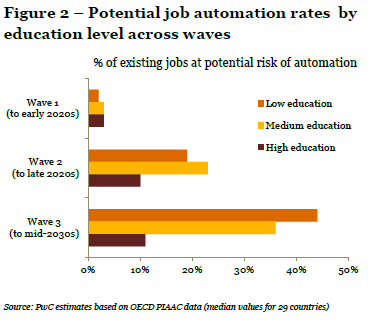
People in the middle of their career may have a mortgage, especially given the low interest rates we currently have. However, they may be supporting parents and children. Any rise in interest rates, or loss of job (due to automation, market crash, or managerial incompetence) would be catastrophic. They have little potential for resilience. If they fail, then their dependents fail. One estimate suggests that over 35% of existing jobs in the US are threatened by automation and artificial intelligence. So a large number of people’s survival is at risk.

From Will robots really steal our jobs? – PwC

Even if new jobs replace the ones being destroyed, then change is painful, and change does not promise success or new prosperity (p.36-39).

  • Technology is designed to render workers irrelevant to cut costs and increase employer power over the production process. This increases wealth asymmetry and occurs because of the separation between levels of wealth. Employers have little care for their workers. Eventually the current style of mass economy will collapse as fewer and fewer people have disposable income.
  • To add to this, few people are likely to think, comfortably, the world is currently stable. They likely know (even if unconsciously) jobs and homes (sunk capital) can be threatened, or destroyed, by ecological failure, storm, flood, fire and so on. This conglomeration of potential and painful disruption, makes up an existential crisis.
  • I would suspect such people would be prone to trying out fascisms that promise stability and returns to greatness. Without that they may end up with nothing. Fascisms lead to scapegoating, and internal warfare against people defined as the evil other, so they lead to increased intolerance, increased violence and increased precariousness, because you have to make sure you, personally, are never thought of as one of, or even in sympathy with, that evil other.
  • The evil other is usually promoted as a distraction from problems generated by the wealth elites. This again points to polarisation as a possible deliberate creation.

The authors of this book point (p.60-61) to the 2020 Edleman Trust Barometer which states

despite a strong global economy and near full employment, none of the four societal institutions that the study measures—government, business, NGOs and media—is trusted. The cause of this paradox can be found in people’s fears about the future and their role in it, which are a wake-up call for our institutions to embrace a new way of effectively building trust [and] balancing competence with ethical behavior….

A majority of respondents in every developed market do not believe they will be better off in five years’ time, and more than half of respondents globally believe that capitalism in its current form is now doing more harm than good in the world…

In a majority of markets, less than half of the mass population trust their institutions to do what is right.

2020 Eldelman Trust Barometer

The authors of the Trust Barometer are clear that “distrust is being driven by a growing sense of inequity and unfairness in the system.” They report that a massive:

83 percent of employees say they fear losing their job, attributing it to the gig economy, a looming recession, a lack of skills, cheaper foreign competitors, immigrants who will work for less, automation, or jobs being moved to other countries.

2020 Eldelman Trust Barometer

in capitalism, survival depends on jobs, and hence survival seems threatened – and this does not factor in the problems of climate change or pandemic.

These problems around wealth asymmetry are mutually reinforcing (p.39), and affect most people.

  • This is a crisis which seems to have no signs of getting better. And pretty much the only solution we are allowed to hear, is “leave it to the market. Don’t trust government. Don’t participate in your own government, or participate violently.” Beat people up or Give up.

Political Conclusion

The book does not recognise the politics of wealth asymmetry and its tendency to oligarchy, or the rule of the few. It does not appear to consider how the asymmetry and oligarchy has been established, and how that oligarchy makes maintaining its power more important than solving pronounced problems such as: wealth asymmetry; technological displacement of workers; or the ecological destruction which is used to generate wealth. This makes its remedies somewhat dubious.

There is one old point, usually said to have been made by US Supreme Court Justice, Louis Dembitz Brandeis (1856-1941)

We must make our choice. We may have democracy, or we may have wealth concentrated in the hands of a few, but we can’t have both.

Raymond Lonergan in Mr. Justice Brandeis, Great American (1941), p. 42.

Wealth Asymmetry is not a sign of social health, and that leads on to the next two posts about the Carbon or Polluter Oligarchy as the main factor in causing climate change, and in preventing us from dealing with it.

Capitalism, disorder, sociopathy

September 10, 2021

This is a response to a response, elsewhere online, to my definition of capitalism post.

Their argument is that the features I determined to be part of capitalism, are not part of capitalism, not found in any dictionary definition of capitalism and are found elsewhere. They argue that wealthy people are not sociopaths but quite nice, and this is backed by research…. They also say that with no profit, there is no sustainability.

I will suggest that:

  • My definition is useful and does not delete important features of capitalism as system.
  • While I am dubious that the capitalist elite are specially virtuous, I did not argue that wealthy people have to be sociopaths for them to be a problem, they just have to team up to support what they see as their own interests, and this teaming up seems obvious and ‘natural’.
  • It is useful to remember that sometimes capitalist organisations do commit crimes, and override the liberty of other people.
  • You cannot separate capitalism, capitalist government and capitalist economics. Economic action is political action and vice versa.

Defining capitalism

I agree that all the factors I have described as being part of capitalism are possibly found elsewhere. That is not the point. The point is that they are nearly all part of any actually existing capitalisms. I don’t think you can discuss the functioning of capitalism by ignoring those factors or pretending they are irrelevant. As far as I can see, no form of capitalism has ever existed without most of these factors. Certainly modern capitalism appears to hold them all, and the fact that it does hold to most of these features, means that it cannot support liberty (collective or individual), for anyone other than some of the wealth elites. Capitalism needs to be considered as a system of power as much as a system of trade. Capitalism requires a State and will take over that State, to expand its power and security.

This is why I cannot support a definition of capitalism that pretends capitalism is (for instance) just a form of private property and trade. Trade happens everywhere (even in communist States), and is no inherent sign of capitalism. There are many forms of trade which are not capitalist. Likewise, if we are going to talk about ‘private’ property as being central to capitalism (which it is), we have to talk about the different forms of property, the history of property, the history of property accumulation, the destruction of other forms of property by capitalism, and look at how private property gets selected out from general production. To understand capitalism you probably have to understand non-capitalist and stateless societies, otherwise capitalism might just seem ‘natural’ to people who have lived with it alone. It is not ‘natural’ in any sense other than it can exist.

These kinds of overly simple definitions are like saying communism occurs when the workers own and control the means of production in common and live happily ever after. It is true in ideology, but we have to ignore a lot of history, organisation, practice and failings to make it an accurate description of large scale Communism.

Capitalism is a set of variations on a form of social organisation that seems to require, and enforce, hierarchies, inequalities and destruction. Any form of analysis of, or support for, capitalism that decides these unpleasant factors are unimportant, or accidental, seems inaccurate, and is probably dangerous or ‘ideological’ because it is set on being unconscious, and is refusing to deal with the realities of actually existing capitalism.

The pretense of perfection is part of the problem

Nearly all hierarchies and tyrannical systems, I am aware of, pretend that their cruelties, obstructions, miseries, failures, inability to meet their ideals, and so on, are aberrations, or nothing to do with the ‘real’ system. The Islamic world would be in perfect peace and harmony if people were truly just obeying God’s obvious and wise laws and there were no infidels stirring up trouble – the system itself is not a problem. Communists would not require a State or a secret police if they had completely succeeded in the revolution, and these temporary necessities, will fade away when they have succeeded. They are not essential parts of communism – the system itself is not a problem. We would have a healthy, happy and peaceful Germany without the Jews, and other people who keep fighting against the true wisdom of the Führer, and who wish to hold us back – the system itself is not a problem… etc etc.

Same with capitalism, all this undesirable stuff is just an accident of history or the fault of government; it has nothing to do with ‘real’ capitalism – the system itself is not a problem. This move supports a fantasy of a capitalism which has never existed, and substitutes that fantasy for the more checkered reality.

I’m also not alleging that all monetary profit is bad (although there are other forms of profit, social, intellectual, spiritual, ecological etc, which are probably as important). I am alleging that making monetary profit the only value is quite probably harmful, as it appears to suppress other all the other values, and shuts down, or restricts, our perception of reality to what makes profit. It also makes wealth the major marker of virtue, and thus allows people to sell (or buy) anything, as their only principle is wealth accumulation, and wealth is the most all-encompassing power, as it can buy any other power. More importantly, the drive for perpetually increasing profit, is almost undoubtedly harmful and counters any sustainability criteria such as the survival of other people, or ‘nature’. It is an example of the case in which a drive might be useful at an individual level, but is harmful if everyone does it. It also becomes almost impossible to survive by not doing it, if everyone else does it – you are likely to get bought out, and either asset stripped, or converted into an increasing profit organisation.

Disorder Theory

If a system nearly always displays recurrent features or failings (no matter how unpleasant or apparently unrequired), then those features are part of the system. And if you want to describe or improve the system, you have to understand how the system really works in its total mess, recognising that everything effects everything else, and nothing in the system is isolated from the system. Accidents pass, but recurrent features are likely to be significant features.

I call this realisation ‘disorder theory’. The statement that social modes of ordering tend to produce the disordering and unintended consequences, that they consider threatening, is not popular. People will try and separate out the order which they declare ‘good’, from the disorder they ignore, declare ‘bad’ or irrelevant, or someone else’s fault – but they all occur together as part of the order.

The idea, pretty obviously, stems from depth psychology, in which it is asserted that we repress parts of our nature, inclinations and understandings (our psychological and biological systems) so as to fit in with our familial and social situation, and that this repression bites back in the forms of symptoms which disrupt our ability to fit in, or to live in any kind of satisfying sense. However, we are encouraged to pretend that these symptoms are unreal, or personal, rather than generated by the social system of order itself. No matter how common, they are said to not be essential parts of our faulty adaptation to social reality.

The Virtuous Billionaire

The connection between wealth, morals and social organisation seems complex. See these popular references with a mixture of arguments – some of which tells of the same research from different perspectives [1], [2], [3], [4], [5], [6], [7], [8], [9], [10], [11], [12], [13], [14], [15], [16], [17], [18], [19], [20], [21], [22], [23], [24]. There are a growing number of ethnographies of corporations and financial services organisations, which could add to our understandings of how customs and conventions can increase harmful behaviour.

However, it seems obvious that ‘dominating hierarchies’ will tend claim that their ruling elites are superior in some way, either because god has chosen them, because their rulership is natural, or perhaps because they are particularly virtuous or particularly talented. The dominant class nearly always claims to exemplify a special set of virtues.

In aristocracies, the dominant groups are said to be noble, learned, valiant, different beings to peasants, placed in power by God, and so forth.

In theocracies the dominant groups are said to be holy, knowledgeable of scripture, wise, keep to the laws rigorously, touched by god, in direct communication with god, etc.

In bureaucracies the elite have unquestionable loyalty to the state, are thorough, knowledgeable, honest, familiar with regulations, good hearted, neutral, refined etc.

In capitalism, the elites are rich, hard working, noble, trustworthy, uniquely talented, self-sacrificing for their vision and so on.

This claim can be true of some. I assume some high-up people in the Catholic Church are religious, and do live relatively holy lives. But it may not be correct about all of them. One Marcus Aurelius does not make up for loads of Commoduses, or people selected to the throne because the guard thought they could control them, or who were crazy enough to kill everyone else first. Same with capitalists. Not all billionaires have earned their wealth. Some inherited it. Some were massively lucky. Some likely destroyed or copied the work of others. Some appear massively incompetent, completely untrustworthy and are well known for ripping people off or vindictive revenge. Some might once have been reasonable people, but lost it as power and wealth corrupted them. Donald Trump should end the argument about the inherent virtue and good will of all billionaires, even if you think that Warren Buffett and George Soros may be good people. Trump’s corruption was well known to everyone who read the US business pages before his election, although this was largely ignored by the entrepreneur worshipping US corporately-owned media.

If the society is literate, there may be a whole literature teaching you how to cultivate the virtues the elite are supposed to have. This not only gives readers hope of social mobility, but it sanctifies the elite – who do this naturally, or perhaps after a sinful youth. There are hagiographic books telling you how smart, or holy, or whatever these people are; some of these get quickly forgotten when it becomes obvious their heroes were not smart or consistently good at what they do (Al Dunlap?). There are even books glorifying Donald Trump as the most talented man who ever lived and which claim to teach you the secret of rising from nothing like he supposedly did. Some books point out how he has been blessed by God, to bring righteousness to business and America. Such books should be recognised as what they are, propaganda tools, which is not to say they cannot ever be useful. Stoicism is as valid for Emperors as for the poor. And books of exposure, may attract law suits, or other forms of revenge, like Trump Nation did, so the elites are protected.

Why then do people co-operate with ‘bad’ but powerful and wealthy people? Sometimes, people may not read the business press and learn, for example, that working for Trump is only rarely a good deal. However, we can assume that more often people work for business people for the same reason they work for dictators (why did people not kill Stalin in advance?), because they hope the money and power will flow down, because the person only occasionally goes off the edge, because it seems safer to be an associate than an enemy, because you don’t recognise you are expendable, because you like being close to power and wealth, because you think you are smarter than them, because you think their selfishness will help you manipulate them, because you have seen what happens to businesses that challenge them, because they are good liars and promisers, because they are exciting, because you hope they will look kindly on you and leave you alone, and sometimes because they are well-intentioned and kind people, who kill thousands with the best intentions. Perhaps corrupt people work for corrupt people, so it becomes a self-reinforcing circle. Most people who work for them, do so because if they don’t work for them, or somebody like them, then they will starve.

In other words powerful capitalists get people to work with them or for them, just like other powerful elites get people to work for them. Politicians who lie, should lose trust, and people should abandon them, but Donald Trump again demonstrates that supporters won’t necessarily move away no matter what; they may deny obvious lies, declare the lies are unimportant, or decide the lies are true, they may argue that the person’s failures only occur because of a monstrous conspiracy. Indeed because politicians depend upon good moral standing, good interpersonal skills, being obsessively focused and productive, with an ability to deal with incredibly complex situations and balance all kinds of competing interests, that to pull political success off they must be honourable, or they will not succeed. People in the opposing parties (and their supporters) are already against them to begin with, some of their own party want to replace them with themselves, and some people are generally against successful people in any case. They have to be good. The logic is sound, but of course it is inadequate to describe reality, just as it is inadequate to describe the reality of corporate power. People get to occupy positions of power and wealth for all kinds of reasons, not least inheritance.

Sociopathy and Wealth

I’m not actually alledging anything about wealth and sociopathy, other than:

  1. Some people allege capitalist (and other) managerial structures could select for sociopathy or even create it by creating distance between people, and power over ‘less worthy people’… This is not inherently implausible.
  2. I can’t see any reason why sociopaths would not be attracted to making money, or why they would not be good at it, or again why making heaps of money would not encourage social separation, feelings of dominance, and hence what we can call ‘sociopathy’.

Now this does not mean that all the wealthy are sociopaths or psychopaths, or whatever label you want to use. I am not arguing that billionaires have to be ‘bad people,’ just that, like most humans, they will team up to bend policy and politics to favour what they perceive as their common interests. This should not surprise anyone. In a capitalist society, money talks loudly and persuasively.

To repeat, a person does not have to be a sociopath to team up with others to support what they consider to be their joint interests, dominance, security or place in ‘The Market’. It would be incredibly surprising if wealth elites did not act this way with the aim of pushing their interests in the State, and they have the money to do it successfully, especially if they team up. And this is pretty much what we observe in modern politics.

The fact that libertarians, Austrian economic theorists and so on, do not recognise this as an issue, while being fully capable of recognising that other people (workers, politicians) can team up to interfere with ‘The Market’, is interesting.

And it seems logical that people who could buy their way out of the penalties of law, or consider fines as costs, would not fear the consequences of illegal acts; consequences are for lesser people.

I just read that a family who profited from opiate addiction and death, have managed to escape prosecution through bankruptcy and largely keep their fortunes. They apparently show no remorse or feel there is any need to compensate families. Defending their wealth might come first? Sociopathy?

Likewise where I live people are being thrown out of their homes, doctors’ advice about pollution is being ignored, limits to liability are much smaller than the evidence suggests they should be, contracts being signed before Environmental inquiries held etc… all to make money for a toll road company. Let’s be clear. People will die because of this, houses have and will fall down, and there is nothing anyone could do to stop it. Protests and political campaigns were ignored. This is a bought State in action, defending profit maximisation at all costs. Sociopathy, or normality?

Most of the damage to the Earth’s ecology is owned by a very small percentage of the Earth’s population. But they get away with it, even when there is now no real excuse to pretend such damage is not a problem. Indeed we know that fossil fuel companies have been fighting against recognition of climate science for years, deliberately creating the conditions for mass loss of property and life, to keep making profits. Instead they had rather blame population growth. Sociopathy? Maybe. Capitalism, yes.

I should not need to mention:

  • Tobacco companies, and the trade in death they did quite well out of, and are still doing well out of, and still searching for new customers to kill.
  • Slave traders arguing they were civilising and rescuing savages while delivering them to kindly masters who had an interest in looking after them
  • Finance companies shifting costs on to those they ripped off, or the general behaviour of finance companies in the lead up to the crash of 2007-8, and its aftermath
  • Arms manufacturers who want to sell to terrorists
  • I’ve previously mentioned the East India Company’s plunder of India. But to add to it, they cut off the thumbs of hundreds of weavers in Bengal to maintain their profit on imported cloth, but this was more or less normal for companies
  • Other capitalists have had workers working in dangerous and unhealthy conditions, because workers may not have any alternatives. The mid to late 19th Century free market generated many quite unsettling stories and reports about this, and workers had to join together and fight hard for their safety.

Conclusion

To understand capitalism, you have to understand real, existing, forms of capitalism, not ideal forms which do not exist and have never existed, and which only exist as ideas to justify the actually existing forms of capitalism and pretend they are other than what they are.

To be able to prevent tyranny you have to be able to stop it from occurring, and that includes tyranny of the State, tyranny of wealth, tyranny of religion, tyranny of violence, tyranny of landholding, tyranny of control of communication and information, tyranny of control of energy, and tyranny of enforcing valued social categories.

If you want to stop the tyranny of the State, then you need to dismantle or inhibit the State. If you want to stop the tyranny of religion, then you have to diffuse the power of the Church, or the organisation of religions and introduce more religions…. If you want to stop the tyranny of wealth, you need to opposed the way the wealth is organised and passed on to the next generation. If you don’t then the tyranny will become established….

This sets up a paradox, that for some people to have liberty, the power of other people to deprive them of liberty must be curtailed. This can either be done by an independent power, which is likely to become arbitrary, or by attempting to set up a more participatory system of governance, by allowing such customs such as demand giving, or distribution of wealth and property at death, to non-family members, or simply destruction of that wealth.

If you cannot stop accumulation of power occurring then you have surrendered and there is no liberty. Libertarians do not acknowledge the power of wealth, or the power of organisation by the wealthy, or consider it an accident, and not part of the social functioning of wealth. They do not seem to promote limits to the authority of wealth.

Of course ‘liberty’ may not be the only social virtue to begin with.

Finally, we are in a situation in which the US political party of corporate domination, is:

1) Ignoring major problems with capitalism and ecology because it affects corporate sponsorship,
2) Pretending that the wealthy and the poor have the equal liberty to avoid a pandemic and get good treatment,
3) Preventing businesses from protecting their staff and customers from the pandemic,
4) Trying to prohibit teachers from talking about the history of race in America,
5) Lying about an election result with no evidence that will hold up in court,
6) Attempting to restrict votes that will go to their opponents, and
7) Attempting to restrict investigations into an apparent attempted coup.

Like the corporate and aristocratic backers of nazism, the right seem to be trying to hold capitalism and its hierarchy stable by cultivating an authoritarian, non-democratic State. This may be the standard capitalist response to crisis. It may not be the only such response. Again it needs thinking about.

Defining Capitalism

September 5, 2021

It is hard to define capitalism rigorously without excluding some of the obvious characteristics of capitalism, or making the definition so general that it perhaps reduces capitalism to exchange, or ‘private property’ (as if there was only one kind of private property). This is too general to be useful, other than to pretend capitalism is innate. There are also varieties of capitalism [2], [3], and cultures of capitalism. Capitalism in Norway, is not the same as capitalism in the 21st Century UK, or 19th Century UK, or in the USA, or Japan, or India, or China etc.

So this definition is a definition by listing. If some economic system is described by a large number of these points, then it is strongly capitalist, if it has non of them it is not capitalist. Other systems may share some of these points as well.

  • Capitalism is a form of State sanctioned, and enforced economic hierarchy.
  • In capitalism, the majority of people have to sell their labour (physical and mental) and the products of their labour to an employer. The property resulting from labour, is generally not owned by the labourers, but by the employer prganisation. In some cases even ideas that have nothing to do with their work are owned by the workers’ employer. This general ‘alienation’ of labour may rob people of satisfaction.
  • In general capitalism attempts to make all labour wage labour. It destroys self-sufficient social groups, by making them ‘uneconomic’, taking them over and merging them into a bigger company, or through violence.
  • Most ordinary wage labour is governed by downward pressure on wages. Automation of labour, that removes the skills of labour helps to diminish the cost of labour, and make workers interchangeable and largely indistinguishable. However, wage labour closer to the top of the hierarchy may become more expensive, or prosperous.
  • Capitalism ideally gives an employer the right to dismiss any worker in any circumstance. There are few official types of continued responsibility, obligation or relationship, between bosses and workers. Capitalism breaks social bonds around labour.
  • In capitalism the power of the boss should increase, while the power of the workers is diminished. Obedience to a boss, who has no obligation to you, is one of the fundamental social relations of capitalism. It does not promote liberty.
  • Capitalist property is marked by exclusion and exclusivity. In general, the owner of property has the right to destroy that property without regard to anyone else, and to exclude anyone else from using it. On privately owned land the owner can determine, as far as their intention prevails, what happens on that land. Libertarians, for example, frequently support the right of land owners to suppress protests on their land, even if that land has been appropriated from the community.
  • The one exception seems to be that mining companies can often do what they like on your land to get at materials they have contracted from the State. This varies from place to place. If this is the case their is a hierarchy of property ownership.
  • You can ideally sign away your rights to anything for payment. Some libertarians support ‘voluntary’ slavery.
  • Capital, and property, itself grew from the plunder of colonies (or plundering of the plunder of the colonizers as with British Privateers), theft or conquest of land, dispossession of people from land, and the forced labour of human bodies. Capitalism and its property/capital is based on the products of theft, reinvested in new production. This is usually justified by instancing other forms of input and ‘improvement’ usually done by forced or wage labour. If, however, a landlord’s property is improved by tenants, then this does not apply the other way, and legally justify taking the landlord’s property.
  • Capitalism usually involves the free movement of (previously appropriated) wealth (capital), and its investment in the production of more wealth. It is an ethical question, whether capitalism and its inequalities can be abstracted from history.
  • Capitalism usually allows cheap ecological destruction and pollution, so as to maximise profit.
  • Capitalism appears to demand constant growth and expansion. Companies also seem to demand that the rate of profit continues to grow. It is not obvious, that this can keep happening forever. If expansion cannot go on forever, then capitalism is self destructive.
  • Capitalist processes tend towards concentration of wealth. While the total wealth may increase, the percentage of total wealth going up the hierarchy also increases. So inequality of prospects, action and power is magnified. If this does not happen, then the system is probably not capitalist.
  • The State in capitalism, tends to be controlled by the wealth elites. The more the wealth difference between them and the rest of the populace increases, the greater the tendency.
  • The State eventually becomes a tool, whereby capitalism, its property, regulation and inequality is protected. However, different businesses may have different ideas of protection, hence the State can still be a site of limited dispute.
  • Capitalism’s main institution is the stock (shareholder) company – which is a form of collaboration between controllers, and owners, of wealth (capital).
  • As the wealth elites own shares in many companies, and may be on the board of directors of many companies, or own those directors, collaboration between members of the wealth elites increases, at the expense of everyone else, including those who actually make the products or services the companies sell.
  • ‘Crony capitalism’ is normal and approved, as is suppression of worker associations.

General points

Contemporary capitalism has an origin in the UK sometime between the 16th and 19th Centuries. It is not natural, eternal or innate. It spread through force (East India Company, and imperialism) and also because nations wanted the same level of military might that it generated to protect themselves and gain power. States have frequently promoted capitalism, to boost their power.

The idea of the ‘free market’, acts to reduce all social and governance questions to questions of profit maximisation, and wealth increase for the wealth elites. It also tends to act as an excuse for letting ‘The Market’ determine what should be done, no matter how destructive, as long as it benefits some of those wealth elites, and dispute amongst the wealth elites does not then lead to some form of regulation to benefit (or protect) some of that elite.

Worship of the Market does not lead to liberty, because the market is regulated and patterned to favour certain groups and their existence. Liberty might be found in escape from the market.

All markets have regulation. Market activity includes politics. If people pretend markets do not include politics, then the market is probably being regulated in favour of a dominant group. There is no such thing as a ‘free market.’

As capitalism is marked by conflict between ‘workers’ and owners and controllers of employment and capital because of:

  • Alienation of labour and the products of labour
  • Destruction of self-sufficiency
  • Forcing wages down, deskilling of labour, making workers interchangeable and impersonal (dehumanisation),
  • No ties between workers and employers, other than money
  • Demands for obedience from bosses
  • Concentration of wealth
  • Control of companies being reserved for the few
  • Capitalist control of the state and increasing exclusion of non-capitalist interests, unless they support capitalist interests…

then capitalism is marked by class struggle. However class struggle is not unique to capitalism, so is not part of its definition. Also, some of this struggle can be remedied by easily available, non-policed and livable unemployment payments. These allow workers to leave bad bosses, and bad working conditions, without suffering, and can help ‘nudge’ employers into providing better working conditions and sharing more of the profit with the producers. This kind of practice increases general liberty, and so is strongly opposed by capitalists.

Marx, class conflict and society

August 26, 2021

I’m not particularly trying to convince anyone of anything here, just to make Marx’s position relatively clear and simple.

Firstly Marx argues that what people have to do to survive in society is more important for understanding historical processes than ideas are. Popular ideas are frequently just ways of justifying the actions of the dominant classes, and the modes of hierarchy – people tend to do what they have to do.

This is why his theory of history is sometimes called ‘historical materialism’. It is primarily based on what people have to do, and the material basis of that action, rather than on what they think.

Capitalism and wage labour

Capitalism engineers a mode of life, or arises out of a life, in which the majority of people depend on wage labor for survival. In other words, capitalism destroys self-sufficiency amongst the majority of the people it encounters as soon as possible. It may dispossess people from their land, or insist upon taxes so that people have to earn money through labor.

This process means most people have work for somebody else, starve or live a very precarious life as a beggar. In employment, they have to do as they are told – the first rule of capitalism is not liberty, but obey your boss (or ‘master’ as they used to be called in Marx’s time). Workers produce goods and ideas that legally belong to their employer. They have little to no control over what they produce, or what happens to those goods. They generally have little control over the working day, or the times they work. Holidays (or control over the worker’s own time) are relatively rare. So called flexibility, usually means the worker has to be flexible to suit their employer.

This separation from involvement in, and control over, the products of their labor and their labor time Marx, in his earlier works, calls ‘alienation’ and it usually appears to produce dissatisfaction with life.

It is a hallmark of capitalism. For example, crafts people controlled their own time, designed and made their own wares, and sold them to merchants, or other locals etc. Feudal peasants may give part of their crop to the lord, or spend some time working on their lord’s fields but generally what they grow, how they grow it, how they dispose of it, and when they work is up to them and the demands of nature. As long as they fulfil their obligations, their time and produce is their own. So while the labor set up may not be great, it is different from that in capitalism, and small farmers may have even more self-sufficiency.

Another way of phrasing this is that the imperatives of capitalism subtract from human satisfaction in work. Capitalism attempts to fill this hole, through encouraging consumption, which is capitalist materialism in action, and probably will never work for long. However, pressures to keep wages low, mean that consumption runs against limits, or encourages destructive debt.

Transfer of wealth

Capitalist, employers vary from good to terrible, but the dynamic for any employer, to help survive in the capitalist market, is to get as much labor out of the worker as they can for as little cost as possible. They may also automate production, so that they are less dependent on employee skill and crafting ability, so work becomes even more alienated, and workers more interchangeable and more disposable should they make trouble, times are hard, or whatever.

Rather than being recognised as people, the capitalist dynamic tends to make workers into impersonal energy to be used at the Master’s whim. Some employers recognise that this is not the best way to get work out of people, but they are still generally constrained by the necessity to make labor as cheap as possible.

Marx also argues the employer essentially ‘steals’ value from the the employees’ labor. That is the employee has to be paid less than their labor actually contributes to the product or service, or there can be no profit.

While this latter point may ignore the risk to the employer, and the organisational work they contribute, in general capitalism skews the market so more return goes to the owner and controller of labor than goes to the actual makers of goods. The greater this differential, the more capitalists are in charge of politics and society.

As successful businesses get massive benefits in terms of scale of production, discount sales or purchases and so on, they usually drive smaller businesses out of business, and gain even more wealth and power. You can think about what happens when a chain like wal-mart, or another big supermarket, comes to town. Independent businesses often close down, and small employers get to lose their capital and become precarious wage laborers. The same happens as agribusiness moves into a farming area. Small farmers get squeezed out.

In other words capitalism destroys small business, as well as exploits workers.

There is some argument as to whether managers, nowadays, are workers or representatives and controllers of capital. I’d suggest many try to pretend that they are part of the dominant elites, but usually end up finding out they are disposable workers. At the pinnacle, however, even incompetent CEOs get severance packages that would support normal people for a life time. The elites support their own.

Power and class war

On top of this, wealthy capitalists get to own and control the State, because wealth in capitalism buys anything from information and ideologies, to politicians. Therefore the State tends to represent their interests in keeping labor cheap, disposable and bound to employment, than it tends to represent the interests of workers, who have much less money to buy power.

Because the two classes have competing and opposed interests within the system, what we can call class warfare arises, which, in general, the powerful classes win.

Marx thought that eventually the workers would experience unity in their work experience, classify themselves as a group, and co-operate to overthrow the ruling classes, who would be weakened by the inherent tendency of capitalism to destabilise and destroy itself (which might be another blog post).

So far he has been wrong about this.

For a while between the 50s and the 70s driven by the fear of revolution amongst the dominant classes, there was an attempt to declare peace in the class war, by providing easy unemployment benefits, which allowed people to change jobs freely. This freed them from being stuck in jobs that have bad wages and conditions, and encouraged employers to share the wealth. Most countries supplied some kind of free health care, to keep workers free and functional, and they used the Keynesian insight that more money going to the workers will drive the economy. Hence we seemed to have massive growth of prosperity, social mobility and creativity in that period. With the threat of revolution gone, these ‘advances’ have gradually been withdrawn and we seem to be getting back to pure class warfare, and the concentration of employer power.

Historically, since the ascendency of capital, this full on alienation, and disposability, leads to fascism and war. That seems to be coming, but we shall have to see.

Consensus in Economics

August 22, 2021

The impression given by the media and politicians, is that there is a large degree of consensus on economics, but there isn’t.

There are many different forms of economic theory, and if you ever find a cross section of economists arguing you will see they disagree significantly. They are also notoriously unable to predict crashes or other economic events. Large numbers of mainstream economists claimed that business and finance had solved the problem of crashes just before the last big crash. Few warned against it, or were taken notice of, if they did.

Given there is this level of disagreement and that economics frequently fails to be useful, why are non-economists given the impression that there is unity and truth in that unity?

The Orthodoxy

This is where the politics comes in. Probably, because of the power arrangements common throughout the world, in which wealth elites dominate and structure the economy in ways which they think benefit them, voters have to be persuaded that:

  • We have a free market economy, or things would be even better if we had a really free market in which governments, or people, had no control of the wealthy.
  • We don’t need to regulate, or interfere in business, because The Market, represents the invisible hand of God, and does everything close to perfectly.
  • Free markets work for everyone.
  • Free markets bring liberty.
  • People who rise to the top in a free market have special talents which others do not have, and which benefit all.
  • There is no need for a minimum wage people can live on, because if people deserve to live, and work hard, they will be ok.
  • If you are low paid or unemployed, it’s your own fault, and you just need to work harder, because The Market is good at distributing benefits.
  • We need to protect business, and listen to it, before anyone else, as business is the really important important part of society.
  • Wealthy people and corporations need more in tax cuts because that will lead to more business.
  • Business rarely does anything wrong collectively, and if the economy fails it is because of ‘the government’, even if the government is owned by business.
  • Booms, busts and bubbles are aberrations, or the consequence of avoidable human folly.
  • Crony capitalism is an aberration, easily rectified by less government intervention.
  • Everything is going as well as it possibly could, without imposing dreadful impingements on your liberty.

This persuasion is the main feature of mainstream neo-classical and popular economics. They may not say any of this directly but that is what mainstream economics comes down to.

This is generally what we might call “right wing economics” – or economics which supports existing relations of power and wealth.

Non-mainstream economics

Many other economists might disagree with all of these kinds of propositions, but you won’t hear that much from them, and what you do hear is probably distorted to help support mainstream economics. I’m not an economist, so there is much I am missing out here but some simple examples include the ideas that:

  • Economies cannot continue to grow, in a finite ecology, without running against the limits of the world and permanently damaging themselves and the Earth.
  • There are limits to possible pollution without producing disastrous change and we are hitting them.
  • Capitalism constantly destabilizes itself. Booms, bubbles and crashes are part of its normal workings.
  • Business is pretty obviously wrecking society and the natural world, as part of its normal activity. It brings goods and harms.
  • Capitalism is not just trade, but a form of class warfare.
  • Mainstream economics is a form of politics and about supporting power as much as it is about trade.
  • Capitalism tends to produce monopoly and diminish competition.
  • In capitalism, crony capitalism and plutocracy are the norm, and to be expected.
  • Capitalism always exists with a State, and uses the State to maintain its functioning.
  • Capitalism destroys the ability of most people to be self-supporting outside of waged labour. It rewards obedience to a boss and dependency.
  • When business controls the spread of information, information is geared towards markets (what appears to sell the news to people), propaganda (what appears to preserve the system or increase the power of some favoured players) and commercial hype (what produces more sales of ‘our’ commodities) rather than accuracy. Almost everyone in such a market has little idea about what is going on, and the markets will likely collapse.
  • Strong unions increase the relative power of workers and increases their share of profit.
  • If people live in capitalism they need protection from the cycles of the economy, and unemployment.
  • Distributing money to the poorer classes stimulates the economy, as they spend the money. Distributing money to the wealthy takes energy from the economy.
  • Human beings exist best and with the most freedom in a ‘gift economy’, rather than an ‘accumulation economy’.

These opinions tend to be less visible in the media, or distorted by the media and politicians.

Conclusions

I’m not trying to convince you of the truth of any proposition here. The main point is to know that there is a lot of variation of economic theory, and little consensus about the right thing to do, despite the confidence with which politicians and media people speak in favour of orthodoxy.

More simple thoughts on Energy and Economy

July 29, 2021

Basic Economic Facts: Destruction, Pollution and Balance

Extraction of food, minerals, fish, timber, ‘raw materials’ etc. always involves energy usage and destruction. Any economy will involve energy use and destruction of some sort. Very few people seem to want to recognise this.

Because an economy is a cycle we also have to deal with the effects of material that arises as a consequence of the economy’s action. For reasons of clarity I break this material up into ‘waste’ and ‘pollution,’ both of which are produced through energy use/dissipation.

  • Waste is material which can be be ‘used’ or processed by the economy or the ecology as raw materials for ‘repair’ in a ‘reasonable time’.
  • Pollution is matter which cannot be used or processed in such a reasonable time. It may also poison the ecology. So its another part of destruction.

The time frame (‘reasonable’ time) is arbitrary in the sense it may vary between systems, and not be specifiable in advance, but is important, and points to problems of accumulation of waste.

Waste can become pollution if there becomes too much of it. CO2 is a great example. Chlorine is another example, if its used in small amounts to keep water pure, it seems relatively harmless (so far!), but in concentration is deadly.

What people call the natural balance is when the waste and mutual feeding (destruction), plus sunlight (or other source of energy if in the deep sea) more or less balances everything out over time ie repairs things. The destruction feeds into reconstruction. This balance is in many cases delicately stable, and evolution involves the gradual change of the system as a whole.

It is worth emphasising that even balanced and ‘sustainable’ systems change, and modes of extraction which were once relatively harmless, can become destructive of the whole.

Sunlight and Entropy

Entropy is dissipated, non-deliberately usable, energy. Usually heat, which can be thought of as added movement of particles. Entropy always increases in a closed system.

In formal entropy terms, the earth is not a ‘closed system’, because of the mindbogglingly huge amount of sun energy we receive from “outside”.

Without the sun, most life forms would die off reasonably quickly, as the food supplies would rapidly decline and things would start to freeze over. If you had a store of fossil fuels you could probably survive for a while…. We depend on the Sun in a fundamental way. Fossil fuels are essentially fossilised sunlight through plant matter.

Human and other life gains energy from food, which ultimately depends on the sun. Digestion itself takes energy. But the energy released is more than taken to release it. Whether you consider this a transfer of energy or not depends on your perspective.

The process goes

  • Sunlight ->plant -> human (or cow or whatever), or
  • Sunlight ->plant -> cow or whatever-> human .

If you want to be more precise it’s something like

  • Sunlight->plant->[voluntary intermediary animal] -> human -> [possible human predators] -> [as body parts, or excreta] -> plants [and Sunlight].

Each stage involves energy use, and the energy content usually (but not always) declines. The Plant wastes lots of sun energy, and the human wastes lots of plant energy.

I’ve been reluctant to relate entropy to disorder, but, given that it takes energy to produce pollution, and it may sometimes be useful to think of pollution as concrete unusable, disordering or destructive energy – that is materials which cannot be used, transformed or re-cycled by the economy or the ecology at the rate they are produced.

I guess entropy always increases in a closed system… but is that always the case with pollution, or is that a matter of economy and design?

Nevertheless the energy expenditure and pollution should be part of economics.

Comparing Economy and Economia

In, say, an indigenous ‘economia’ (using this word to remind people all economies are not the same) the rate of destruction is equal, or less than equal, to the rate of natural repair (perhaps with a bit of help) or the people die out, or move out until the area has repaired itself, or changed. People do not need much more energy than is generated by their bodies through food consumption.

Indigenous economia has usually become part of the natural balance over time.

In a ‘modern’ developmental/capitalist economy the rate of destruction and pollution is much higher than the rate of natural repair, and much of the destruction cannot be repaired by the ecology itself. The evolutionary balance cycle does not work quickly enough to make repair.

The decision to behave in this destructive way is a political decision, which has brought many benefits, but is now more destructive than beneficial, because we are reaching the limits of what we can destroy.

Humans attempting to repair the damage consume energy. At best repair may involve something like manufactured or transported fertiliser to replace the nutrients extracted from the used soil. That is we are destroying the soil to grow things fast. Making the fertiliser takes materials and energy which is used in transport, in manufacture, in extracting the raw materials etc. So human based repair takes energy. The more repair, the more energy. And this repair also generally involves destruction somewhere else.

Once you have got into a rate of significant destruction (see Earth overshoot day), then you are probably in a bind – desperately searching for new energy to repair or avoid the consequences of destruction.

This economy also brings about and allows far more elaborate power and co-ordination factors, which paradoxically make it more resistant to change. People who can trigger the pathways of power, may not want to adapt to inevitable changes, as they only see threat and the unknown, in such a change. So they may try to avoid the consequences of their destruction and pollution for as long as possible. And until recently that was possible, so they have not had time to learn flexibility, and are likely to think they can fix problems with more energy.

Energy Return on Energy Input

The hunt for new energy runs into the problem of oil. Oil was a truly cheap and easy to use form of energy, even better than coal. The problem with oil is that we have reached the point were it seems new oil fields take significantly more energy to exploit per unit of energy recovered than they use to. Think of deep water drilling, tar sands, etc. Companies don’t do this, if they have easier sources. So the surplus of energy from oil is decreasing. To use a cliché: “The low hanging fruit has been plucked.” As well, burning the oil, and other fossil fuels, helped produce the climate crisis.

The summarising concept for this process of expending energy to get energy, I call Energy Return on Energy Input. It has many other names, but I think that one is reasonably clear. If your energy return on the energy you input to get the new energy, keeps declining you are getting less and less excess energy to do things with.

The situation is even worse if you are burning fuel and contributing to the instability which makes adaptation, production and extraction more difficult.

A Comment on Capitalist Economic Theory

In capitalist economic theory, the damage to the system from both extraction and pollution are counted as “externalities.” That is, a deliberate decision is made not to factor them into economic equations and descriptions, despite their obvious effects.

This is one reason why capitalist economists cannot see that ‘growth’ with its necessary increased destruction and pollution cannot be continued forever, or used as a tool for ‘recovery’ – they don’t factor in the relevant information.

They ignore the fundamental processes of the economy.

Wage Labour in Capitalism

June 27, 2021

The Capitalist view of wage labour

The ideology is simple. In an imaginary free market, both employer and employee only ever sign voluntary agreements. There is never any differential of power or need, and the market always values labour and skills at exactly the right value, or the contract would not be signed by either party, who are perfectly free to turn the contract down.

No contract, no matter how exploitative, can in this sense be defined as unfair or exploitative – because it is ‘voluntary’.

In neoliberalism, the same kind of argument is used to try and persuade people that everything they do in a free market is voluntary; from being homeless, having no access to education, not being able to afford medical treatment, to having to risk covid to earn an income.

In reality this is a largely motivated delusion. It suits employers and helps make them virtuous almost no matter what they do.

Objections to the Capitalist view

Self-sufficient Labour?

The capitalist argument about employment contracts might approach truth where the worker has a guaranteed source of food and shelter independent of their labour for an employer. But in capitalist societies this is exceedingly rare. Indeed capitalists have historically tried to stop that situation of freedom from arising, especially in colonial societies because they have repeatedly found that people will not submit to work for hire if they can avoid it. People’s apparent reluctance to hire out their labour and skills, if they don’t have to, is important to acknowledge.

Working for bosses, only possibly becomes voluntary where workers can survive without having to work for others. An aim of capitalism, particularly neoliberal capitalism, seems to be to make workers precarious, with as little support and independence as possible, so that they do have to work for bosses. This inability for most people to control their own labour is one of the primary causes of lack of responsibility, lack of self-reliance, lack of care, and what Marx called ‘alienation’.

Suppression of connections across hierarchy

This worker ‘precarity’ is reinforced if there is no other kind of relationship between worker and boss, other than the contractual relationship – no friendships, no obligations of wealth, no protections. That is, there is no mutual obligation on the bosses’ part to support workers in hard times. Conservatives like GK Chesterton were, as a result, often nostalgic for feudalism, where lords did have obligations towards their workers. This, fundamental human obligation to each other, is something which is usually suppressed in capitalism and reduced to contracts. When capitalists talk about mutual obligation, it nearly always means the obligation of the poorer person to the richer person (in return for an income, or even potential income, no matter how small). In Neoliberalism, any ties between non-related, non-elite, people are a potential impediment to the market.

This suppression of human ties and mutuality, is a break up of community responsibility and another cause of lack of responsibility, lack of self-reliance, lack of care, and what Marx called ‘alienation’. Max Weber seems to argue that Protestantism tended to make this breakage of connection much easier, because in extreme Protestantism you had no responsibility to others, and all that counted was your own salvation, which was won by faith not by charity.

Capitalist team-ups

Employers in a town (or country if they are big enough) can team-up to decide wage ranges. As Adam Smith wrote:

People of the same trade seldom meet together, even for merriment and diversion, but the conversation ends in a conspiracy against the publick, or in some contrivance to raise prices.

There is no reason to assume they will not keep this agreement between themselves unless, perhaps, there is a labour shortage and they get desperate for workers. If there is a labour shortage in an area, workers elsewhere then have to decide whether it is worth losing contact with their friends and support networks, and familiarity with the local system to get a job which may not last more than a week or two, or run the risk that enough workers have also moved and turned up to compete to run wages down again.

Most, perhaps not all but certainly most, employers have more capital than workers, enough to borrow money anyway. That is why they can employ people. So they have more power, and more ability to hold out. So they tend to win in negotiations, unless workers can organise. At the least workers who try and organise to get decent wages or conditions will be blamed, through the capitalist media, for any problems that arise. The bigger the corporation the more power it normally has. Smaller businesses are much more desperate, and find organised labour much harder to deal with.

Fundamental liberty?

All this appears to mean that the fundamental capitalist social relation is between boss and worker. It requires that the worker obeys and submits to the boss in exchange for survival. That is capitalist liberty, and some libertarians argue that people should be free to sign contracts of slavery, presumably if they are desperate enough to work for nothing but food and shelter. Remember, in capitalism, no wage work contract can be exploitative if the winner can say you did not have to sign it. In general, your only choice is between who to submit to, if you manage to change, or get, other work.

Socialists usually require that it be relatively easy to obtain unemployment benefits so people can survive unemployment, and get some power of choice over who they decide to sign up with – a basic provision for liberty. Capitalists usually oppose this, just as they oppose workers organising and striking, to get better wages and conditions, but don’t actively business people organising to suppress wages, or support their own power and influence. In practice, pro-capitalists usually do not object strongly to tax payer subsidies for business, even if not needed, even if the companies were corrupt and stupid, and even if it interferes with the market. This has been demonstrated over and over again; recently from the 2007-8 financial crisis to Covid.

Socialists also try to encourage workers (and everyone else in a low power position) to self organise, to balance out the power differences, but these workers’ organisations always run the risk of selling out to big business if the members are not actively involved and resistant to such sell outs, and media demands for such sell outs. On the other hand, capitalism rarely encourages democracy or self-governance for everyone. It pretends we are like it should be (individuals without ties beyond our families), just as it encourages deep hierarchies and inequalities to avoid the possibility of challenge to wealth and profit.

Connections

Because some employers are much, much, wealthier than workers, they tend to have better political and economic connections, so they have much more influence over regulations and the use of state violence. They buy the regulations which make it easier to protect their property and lifestyles from workers who get fed up with the system. They make it harder for workers to organise. They control the media so they largely control the workforce’s ideas about the world. They make the system of exploitation part of every day life, and enforced by the rules, the law and people’s understanding. It is hard for workers to challenge this ‘everydayness’, with their own experience and interests. There is, nowadays, little in the way of media which is not tied to capitalist forms of organisation, and which can give people non-capitalist ideas – especially not Fox, Breitbart or OANN etc.

Workers and working conditions

Workers are a cost on business, so the general (not everyone but general) business drive is to get as much out of them for as little as possible in expense, to get maximum profit. Hence the urge for cheap dangerous working conditions, hence workplace injuries, insecure work and so on. Capitalists usually try to deskill, or AI, work as much as possible so they can hire anyone for any job, which results in a race to the bottom for wages as well as higher profit. Conservative Adam Smith famously argued that repetitive, cheap labour destroys the moral, intellectual and other ‘human’ capacity of workers – but that, apparently, is a consequence of profit and so cannot be challenged. It may also render workers less capable of figuring out what the contracts they are signing actually mean for their lives, which further benefits employers.

As a result, capitalists generally support cutting back workplace inspections and health regulations as it is a supposedly unnecessary interference in business. Again this is capitalist liberty. Just as it is capitalist liberty for pollution to be dumped on poor areas of town without cost to them – it helps increase profit. Anything which restricts profit is an interference with the market.

Your contract to work in murderous, exhausting conditions, is still fair by capitalist definition, even if you did not know about those conditions in advance. Socialists tend to want more equity in working conditions, and ensure (as best as possible) that people are not incapacitated or poisoned by work.

Hierarchy and the value of labour

This downwards pressure on wages and conditions is not always the case. People higher up the capitalist hierarchy such as high level executives, usually have enough power to be able to transfer some of the savings brought about by cheapening most people’s labour to increase the value of their own labour, and give themselves class luxuries even when these luxuries are a cost on business. Conservative David Hume argued, the value given to labour is a function of the labourer’s power as much as, if not more than, the value of what they contribute.

If such high up people lose a position through company failure or their own incompetence, they are likely to have enough money to hold out for a while, rather than have to rush to the meat packing works for income, and they probably have good elite social networks that they can use to ensure they get another well paid job of roughly the same level. So they are much more immune than the average worker to precarious conditions.

Marxism – to some extent

The Marxist argument is that capitalism is inherently exploitative, as workers have to produce more value than they get paid for, otherwise business could not make a profit. In other words, capitalist business needs to steal some of the fundamental human resource of labour from workers to be viable. This is not because bosses are inherently malicious (even though capitalism may encourage selfish malice and promote sociopaths who feel no obligations to others), but because it is what the system demands from them. They cannot act in any other way. In capitalism, labour is essentially extracted by violence, and the property and capital which results from this theft or extortion is then protected by the State.

Capitalism requires a State. There has never been a form of capitalism which has existed without a State, and it is rare for the wealth elites not to be dominant in that State, making sure the legislation and arrangements help preserve their power from challenge

This Marxist argument, it strikes me, is not entirely fair. The employer risks capital and their own labour and that risk could require some kind of return to make it worthwhile. If the employer does not succeed in making profit then (assuming they were not wealthy to begin with, with the right connections), they risk having to sell their own labour and becoming a worker themselves and being subject to the exploitation that other workers face. With that risk it is no wonder that employers are prone to authoritarianism, to cheating and malice, whatever their intentions otherwise. Hence the permanent presence of class warfare, directed from employers downwards towards people who have to seek employment to survive….