Posts Tagged ‘economics’

More on the Politics of Technology and Markets for electricity

April 13, 2021

In the post A New Report on the possibility of Renewable Transition, I discussed the politics of the way the Australian National Energy Market was being designed (and restricted) to maintain reliability, stability and security, and whether fossil fuels were a necessary part of that design. One of the main players in the process was the Energy Security Board.

Another main player is the government. As the reader probably knows the government is in favour of massive investment in methane gas, which is probably not that economic, and will just lock us into high levels of methane emissions, but their plan for the electricity market seems to be centered on keeping gas going.

Methane, Methane and more Methane

Angus Taylor, the Minister for Energy and Emissions Reduction, has made the backing of methane, very clear. He said:

The Government backs the gas industry, backs Australians who use gas and it backs the 850,000 Australians who rely on gas for a job. The manufacturing sector alone relies on gas for over 40 per cent of its energy needs.

Gas is a critical enabler of Australia’s economy. It supports our manufacturing sector, is an essential input in the production of plastics for PPE and fertiliser for food production. 

In 2019, we overtook Qatar to be the largest LNG exporter in the world, with an export value of $49 billion.

Australia’s energy future 29 October 2020

No mention that Australia received less than $2 billion in royalties from these sales between 2016 and 2018 under the petroleum resource rent tax (PRRT), whereas Qatar is estimated to have received $26 billion in royalties. In 2019, tax credits for oil and gas companies, taking Australian fossil fuels rose to $324 billion – that is there is $324 billion in tax the companies owe but do not have to pay [1], [2], [3]. I guess the idea is that taxpayers have to subsidise mining, and they have to keep methane gas going.

Taylor continues:

This Government will secure a future gas market that is attractive for gas development and investment. This will allow us to remain one of the top LNG exporters.

We will ensure that long-term domestic gas contract prices are internationally competitive to support our manufacturing and industrial sector.

We will ensure that there is sufficient new gas generation to maintain a reliable grid.

We have proven through the Snowy project at Kurri Kurri that the Morrison Government doesn’t bluff.

Our National Gas Infrastructure Plan will identify the major priorities for investment. If we don’t see the investment that we need to keep our gas market strong then we will act.

Australia’s energy future 29 October 2020

It is terrible when fossil fuels shut down, and the government will threaten to build methane gas powered energy, if other people will not.

ANGUS TAYLOR: What’s very clear is in the last few years, there hasn’t been enough investment in dispatchable generation [this means fossil fuels, even though coal is not ‘dispatchable’ because it is slow to ramp up or down], at the same time as we’ve seen big closures like we saw at Hazelwood in Victoria a couple of years back. So it’s that dispatchable generation, making sure there’s enough of that in the system is where it’s gone awry. Now, you know, we’re now saying to the big energy companies, if you don’t invest in that dispatchable generation, we will do it ourselves. That’s exactly what we’ve said we’ll do in the Hunter Valley at Kurri Kurri [with methane gas]. But it is true, there hasn’t been enough of that investment. Now, there has been some and it is increasing. I opened a gas generator in South Australia, for instance, around a year ago, which was has made a real difference in the South Australian grid. Helped to drive down prices, increased reliability [presumably unlike the batteries?]. But we need to see more of that. And if the private sector doesn’t do it, we’ll step in. That’s exactly what we said we’ll do in the Hunter Valley.

Interview with Luke Grant, 2GB, 5 January 2021

Conflict and Cancelling

The government argues that the closure of the Liddell power station…

will leave NSW 1000 megawatts short of electricity. Others dispute this, including the agencies tasked with regulating and maintaining the energy system: the Australian Energy Market Operator and the Energy Security Board.

KERRY SCHOTT, CHAIR, ENERGY SECURITY BOARD: The operator AEMO who keeps a close watch on the availability and what they need in the system, has said that there’s a gap when Liddell goes in 2023 of about 200 megawatts or so.

Fired Up. 4 Corners, 12 Apr 2021

This is a fair difference, and this perhaps sets the ESB, the AEMO and the government on a collision course.

Last night the ABC program, 4 corners, reported that:

Four Corners understands the federal government became so frustrated with the Energy Security Board chief’s refusal to support their position on gas that the minister’s departmental secretary called Kerry Schott and urged her to resign.

KERRY SCHOTT, CHAIR, ENERGY SECURITY BOARD: It was a private discussion

MICHAEL BRISSENDEN, REPORTER: Right, so there was pressure on you though?   

KERRY SCHOTT, CHAIR, ENERGY SECURITY BOARD:  Oh, there’s always pressure on me.   

Fired Up. 4 Corners, 12 Apr 2021

So no confirmation or denial from Schott.

MICHAEL BRISSENDEN, REPORTER:  Why did your head of department call Kerry Schott and suggest she resign?

 ANGUS TAYLOR, FEDERAL ENERGY MINISTER:  Well, he didn’t. So I reject that, absolutely. But what I will say is that there was an independent review of the ESB that proposed and recommended the abolition of the ESB.  Obviously, there was discussion about how best to respond to that recommendation. We’ve ultimately made the decision we want to support the ESB to completing the 2025 market design work. This is a crucial piece of work about the future of our electricity grid. And we strongly supported Kerry to lead that work.

Fired Up. 4 Corners, 12 Apr 2021

There were other stories of pressure

MICHAEL BRISSENDEN, REPORTER: Four Corners has also been told that last year the minister personally intervened to try to pressure the head of the Australian Energy Market Operator to change its forecasts, which were unfavourable to gas.

AEMO boss Audrey Zibelman refused to do so.

MICHAEL BRISSENDEN, REPORTER: AEMO’s Integrated Systems Plan published in July last year also makes a clear case that if gas is going to compete with batteries in electricity generation, the price will need to be well below $4 gigajoule by 2030 and beyond. And that battery charging costs would need to stop falling. Now, why did you feel it necessary to try to pressure Audrey Zibelman to change those conclusions? 

ANGUS TAYLOR, FEDERAL ENERGY MINISTER: Well, look at the end of the day, there has to be a balance in the system and gas is part of that balance. Batteries can play a particular role over shorter durations, particularly in that period when you’ve got destabilization of the grid, we’ve seen batteries play an enormously important role, but the longer duration storage or the longer duration backup overnight or during periods when we’re getting less sunshine or wind, we actually need a source of energy … Can I just, is that me? Sorry, mate. I have no choice. 

MICHAEL BRISSENDEN, REPORTER: The bells signaled a parliamentary vote and cut our interview with the Minister short.

Fired Up. 4 Corners, 12 Apr 2021

Market design in practice

The ESB’s Market Design Options Paper has now been handed to Angus Taylor. RenewEconomy comments:

there is serious concern about the lack of transparency in this process and [for] the creation of a new [market] structure that leaves Taylor in apparent sole arbiter of the process, acting for a government which has been opposed to wind and solar and which has mocked new technologies such as big batteries.

Vorrath. Taylor reportedly put pressure on Schott and Zibelman over gas plans RenewEconomy 13 April 2021

It is possible the States will object:

MATT KEAN, NSW ENERGY MINISTER: Let’s get the facts on the table: using gas to create electricity is a really expensive way to do it. If you’re interested in driving down electricity prices, then you’d be mad to use gas….

The cheapest way to now deliver electricity or energy, is a combination of wind, solar, pumped hydro, and renewable technologies. So it’s not fossil fuels, it’s now cleaner energy. Those people defending old technologies are the equivalent of defending Blockbuster in a Netflix world.

Fired Up. 4 Corners, 12 Apr 2021

DAN VAN HOLST PELLEKAAN, SA ENERGY MINISTER: We’ll use less and less gas over the time. We have four grid-scale batteries operating at the moment in South Australia, we have two more already established to, started construction, and we’ll get more and more of those.

Fired Up. 4 Corners, 12 Apr 2021

And that methane gas might be replaced with hydrogen

DAN VAN HOLST PELLEKAAN We in South Australia actually have the largest hydrogen electrolyzer in the nation operating at the moment in Tonsley, in the Southern suburbs of Adelaide. It’s actually a relatively small one at 1.25 megawatts, but it’s the largest in Australia. We are right at the leading edge of that, and it’s all operating from renewable energy. So we are determined to deliver, well, we’re determined to produce, and to consume, and to export green hydrogen in South Australia.

Fired Up. 4 Corners, 12 Apr 2021

Another view on whether methane gas is useful for leading recovery

A Grattan Institute report argues that:

Far from fuelling the recovery from the COVID recession, natural gas will inevitably decline as an energy source for industry and homes in Australia…

The east coast has already burned most of its low-cost gas, and will not go back to the good old days of low prices…

Even if the Government could significantly reduce gas prices, the benefits to manufacturing are overstated. The companies that would benefit most contribute only about 0.1 per cent of gross domestic product, and employ only a little more than 10,000 people. And much of this gas-intensive industry is in Western Australia, which has low gas prices already.

Flame out: the future of natural gas. Grattan Institute 15 November 2020

They suggest that gas has a role as:

a ‘backstop’ for the power system – used for relatively short bursts to maintain reliability…, [but this] contrasts strongly with the idea of gas as a ‘transition fuel’…

This [backstop] role doesn’t need lots of gas or cheap gas, but it does require flexible gas. The Federal Government’s recently announced policies focus on supporting new gas production and pipelines…., but these require relatively constant gas demand to keep average costs as low as possible

https://grattan.edu.au/wp-content/uploads/2020/11/Flame-out-Grattan-report.pdf

A later report from the same organisation claims:

moving to a system with 70 per cent renewable energy – and closing about two-thirds of today’s coal-fired power plants – would not materially increase the cost of power but would dramatically reduce emissions….

The economic modelling suggests that moving to a system with 90 per cent renewable energy – and no coal – could also be reliable. But some additional costs – such as more generation, transmission, and storage – would be necessary to ensure supply…

Gas is likely to play the critical backup role, though not an expanded role. Australia will make a gas-supported transition to a net-zero emissions electricity system – but not a ‘gas-led recovery’ from the COVID recession.

Go for net zero: A practical plan for reliable, affordable, low-emissions electricity. Grattan Institute, 11 April 2021

Gas and modernising the grid

The determination to force more methane gas on to Australia, to counter predicted declines, is probably the reason that Angus Taylor has been so hostile to the idea that the electricity grid needs modernising and expanding, to deal with the energy transition and the kinds of ‘solar traffic jams‘ we have discussed before.

The Australian Energy Market Operator’s offered a 20-year blueprint, known as the ‘Integrated System Plan’ (ISP) and the Labor party pledged $20 billion to modernise the grid to support the the plan [2].

Taylor tweeted that:

The ISP had been recommended by the Finkel Review and endorsed by all governments at the Coag Energy Council which Taylor chairs.

AEMO has made it clear that these upgrades are essential to modernise the grid, and improve reliability and security, with the happy bonus that it will cut emissions and keep down prices. 

Parkinson. “Lines to nowhere:” Taylor mocks ISP and Labor’s $20bn grid plan. RenewEconomy, 8 October 2020

So it seems clear the government, at this moment, do not want the grid improved so that the transition can work better. This may be because they don’t want to do anything to help further the decrease of fossil fuels, because they don’t to risk public money on something constructive, or they just don’t believe there is a climate problem and we can keep on with fossil fuels endlessly.

Conclusion

The question then is whether politics can hamper and disrupt supposed ‘economic reality’. I’d argue it can. It has mainly been politics that has delayed response to climate change, and which makes it hard to expect that we can now solve the problem before facing major disruption, and that has continually involved weirding markets to favour the old ways.

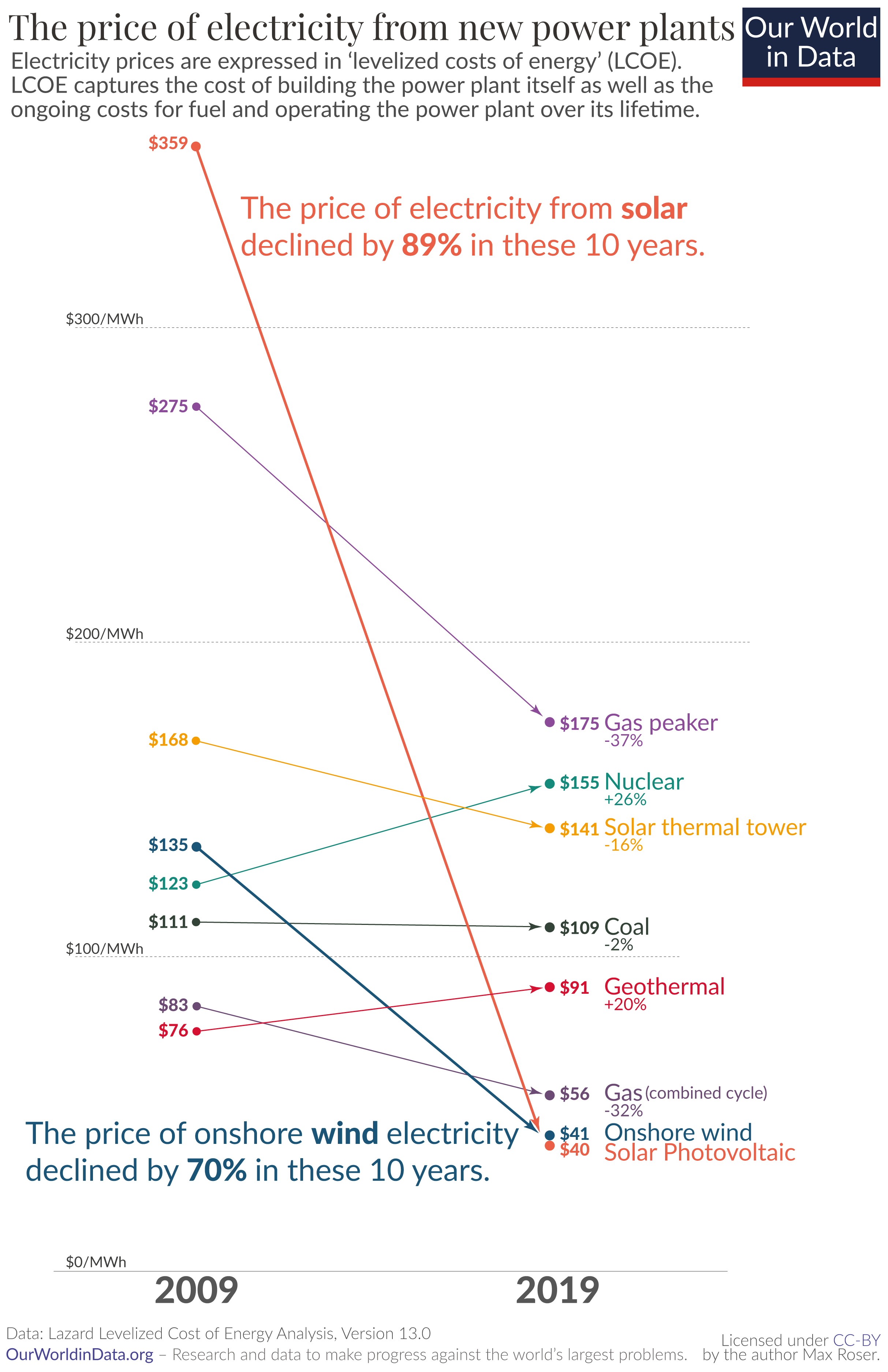
For once a cheery graph….

December 30, 2020

Electricity prices from renewables decline noticeably over the last 10 years

Price of electricity new renewables vs new fossil

see: https://ourworldindata.org/cheap-renewables-growth

Basic Complex Systems for eco-social analysis again

December 25, 2020

This is another go at formulating a list of basic systems which need to be considered for eco-social analysis. For earlier versions see here, here and here.

Introduction

As a guide to the factors involved in eco-social relations we can point to a number of different, but interacting systems. This list is not claiming to be complete, but it can be used as a set of reminders when we try to make analyses of our contemporary situation, and we may be able to make some general statements about how they interact. The order of relative importance of these systems is a matter for investigation, and the order of their presentation, in this blog post, is not a claim about their relative importance.

The seven main systems, discussed here, are

  • Political;
  • Economic (extraction);
  • Energy;
  • Waste, pollution and dispersal;
  • Information;
  • Technological;
  • Planetary Boundaries (geography) :

All these systems are complex systems, and it is generally impossible to predict their specific course. They are also prone to rapid change, gradual instability, and the ‘seeking’ of equilibrium.

Political System

The political system, includes:

  • the modes of struggle encouraged, discouraged, enabled or disabled,
  • the patterns and divisions (the ‘factioning’) within the State and wider society,
  • the differing effects of different bases of power: such as monetary power, communication power, power through violence or threat, hierarchical power, religious and cosmological power (the power to delimit the official views of the way that the cosmos works), organisational power, etc.,
  • who gets into positions of power and how, and so on,

Politics can affect all the other human systems. What activities (extraction, energy use, organisation etc.) are encouraged or discouraged, the kinds of regulation that apply, what counts as pollution or risk, what information is easily available, and who is to be trusted, and so on.

Political systems can forcibly ignore pollution or the consequences of energy production, economic extraction, the wage system, and so on, effectively rendering them part of a general unconscious, which eventually ‘bites back’.

Economic System

Most of the dominant economic systems currently in action can be described loosely as ‘capitalist’. The economic system involves modes of appropriation, extraction, property, commodification, exchange, circulation of ‘products’, technological systems, energy use, as well as accumulation of social power and wealth and so on. Most of which depend upon the State for their existence and reinforcement, although they may also challenge organisation and politics within the State. There is no inherent stability in current economic systems.

In many sociological theories the patterns of economic organisation and behaviour are known as the ‘infrastructure’ and are held to be determinate of most other social behaviours, primarily because the economic system seems the most obvious determinate of what people have to do in order to survive.

This organisation may have apparently unintended consequences, such as producing periodic crashes, or destroying the ecological base of the economy, and therefore threatening that organisation. They also may have quite expectable consequences, which are downplayed. In capitalism, political and economic patternings tend to be describable as ‘plutocratic’; as wealth allows the purchase of all other forms of power. However, different factions in the State can ally with different or competing factions in the economic system. For example, different government departments or political factions can support different types of energy: fossil fuels, renewables, or nuclear. The political system legitimates and enforces, allowable modes of extraction, property and pollution, and regulates economic behaviour among different social groups. Economics always involves political as well as economic struggle; politics is part of ‘the market’. ‘Crony Capitalism’ is normal capitalism.

Extraction

The Extraction system is part of the economic system, but it might be useful to separate it out from the economic system because extraction is one of the prime ways in which economies interact with ecologies and because different kinds of economies can use similar extraction systems. Extraction not only involves extraction of what gets defined as ‘resources’ (minerals, naturally occurring substances such as oil, coal or timber, and so on) but also the ways that human food gets extracted for consumption, via agriculture, gathering, hunting, industrial fishing, and so on. Ecologies are not passive, and they respond to human or other actions in ways which are often unpredictable in specific, but still disruptive. Ecologies seem to need attention, for survival to be possible in the long term.

Extraction in capitalist and developmentalist societies, often seems harmful to the functioning of ecologies, perhaps because of the need for continual growth, and thus a need for increasing extraction. Clearly, not all forms of extraction need to be destructive of the ecologies and geographies they depend upon. Extraction systems can allow the ecologies to repair after extraction, or attempt to rehabilitate the land. However, repair of ecologies can be considered an expense leading to reduction of profit, and hence is not attractive in a profit emphasising system.

As such, we can distinguish recoverable extraction, in which the ecologies and economies repair the damage from extraction, from irrecoverable extraction in which the ecologies and economies do not repair the damage from extraction within a useful time frame.

The Global Footprint network, suggests that:

Today humanity uses the equivalent of 1.6 Earths to provide the resources we use and absorb our waste. This means it now takes the Earth one year and eight months to regenerate what we use in a year. 

Global Footprint network. Ecological Footprint

If this is correct, then the current extraction and pollution systems are generally irrecoverable, and deleterious for human and planetary survival. Investigating the differences between harmful and less harmful modes of extraction may well produce useful insights.

Economies are not the only possible harmful extractive systems – cosmologies can also require irrecoverable extractive behaviour to build temples, or to show the ‘other-worldly’ specialness of humans, and so on.

Energy System

All life and its resulting ecologies involve transformation of energy. These transformations stretch from transformation of sunlight by plants, the digestion of plants, to thermal gradients in the deep sea, to atomic power. Eco-systems require a system of energy release, energy generation and energy transformation.

Transformation of energy, together with effective ecological functioning, is necessary for any human actions to occur. The human energy system powers all other human systems. Because food is necessary for human labour, cultivation of food can be considered to be part of the energy system. The energy system and its ‘infrastructure’, could seem to be as important as the economic infrastructure.

The human energy system is organised, at least in part, by the political and economic systems, and by the environmental systems available. The environmental system includes possible energy sources from plant material, animal strength and docility, fossil fuels, sunlight, wind and moving water. Human labour, and its organisation, is (and has been) part of the energy system, and while not yet, if ever, superseded completely, can be supplemented and possibly overpowered by technological sources of energy. Coal and oil power, for example, provide masses amounts more directed energy than can human labour, and this ability is important to understanding the patterning and possibilities of the economic and extraction system, and its relationship to colonial/imperial history. Modern military expansion and colonialism, largely depends on this ability to apply large amounts of energy to weaponry, movement and organisation.

Important parts of the energy system include the amounts of energy generally available for use, and the capacity for energy to be directed and applied. Non-directable energy is often wasted energy (entropy), and usually unavailable for constructive use.

Another vital point is that human production of, or using of, energy takes energy. No energy is entirely free.

The availability of energy is influenced by the Energy Return on Energy Input (EREI) or ‘Energy Return on Energy Investment’. The larger amount of units of energy applied to gain a unit of humanly directable energy output, the less excess energy is available.

Fossil fuels have historically had a very high EREI, but it is possible that this is declining otherwise nobody would be tempted by fracking, coal seam gas, tar sands, or deep sea drilling. All of which require large amounts of energy to begin with, have very high risks of extractive destruction, and fairly low profit margins when compared to the dangers.

Renewables and storage currently have a high energy cost to manufacture (and possibly a high extractive cost as well) but for most renewables, after they are installed, the EREI changes, as very little labour, or energy expenditure, is required to gain an energy output – it is more or less free – whereas fossil fuel energy generation requires continual energy use to find and process new fossil fuels and keep the power stations turning, and produce continual pollution from burning.

Social power and economics may affect the ways that energy is distributed, what uses are considered legitimate and so on. However, the energy system also influences what can be done in other systems, and in the costs (social, aesthetic, ecological or monetary) which influence choices about the constituents of energy systems The system’s pollution products, which may be significant factors in producing climate and ecological change, may eventually limit what can be done.

As the energy system determines what energy is available for use, it is not an unreasonable assumption that social power and organisation will be partly built around the energy system, and that changes in energy systems will change energy availability, what can be done or who can do it, and thus threaten established social orders. Threats to established orders will be resisted. If an energy transition does go ahead, it is likely that the established orders will try and preserve the patterns, of organisation, wealth and social power which have grown up under the old system.

One important question is ‘how do we transform the energy system without continuing a damaging extraction and pollution system?’

Waste, Pollution and Dispersal systems

Transformation of materials through energy use, or through energy production, produces ‘waste’. The simplest human society imaginable (and this is an overt simplification), turns edible material into energy and human excreta, which in this case can usually be processed by the ecology – although, even then, dumping excreta into rivers may not help those downstream.

Understanding the Waste, Pollution and Dispersal systems is also vital to understanding possible energy and economic transformations.

In this book we will define ‘Waste‘ as material which can be re-processed, or recycled, by the economy or eco-system, and ‘Pollution‘ as material which is not re-processable within an arbitrary useful time frame, say over hundreds of years or more. ‘Dispersal’ occurs when some essential material is dispersed into the system, and becomes largely unavailable for reuse without ‘uneconomic’ expenditures of finance or energy – as occurs with helium and phosphorus.

When too much waste for the systems to re-process is emitted, then waste becomes pollution. This is what has happened with CO2. CO2 is normally harmless, even required for the system to work, but too much CO2 changes the ways eco and climate systems work. CO2 has also been dispersed into the atmosphere which makes CO2 extraction, which is stated to be essential by the IPCC and IEA for climate stability, difficult and costly in terms of energy expenditure.

These concepts, along with ‘extraction’, directly import the ecosystem into the economy, while pointing out that what counts as allowable waste, pollution or dispersal can change, economically, politically, scientifically and ‘practically’.

Waste, pollution and dispersal from the energy system and from modes of extraction, enter into the political system because that system decides and regulates what can be emitted, and where, and who is too valuable to be poisoned by the pollution. The political makes the laws allowing, diminishing or preventing, pollution. Often localisable pollution is dumped in ‘wasted’ zones or on poorer, less noticeable and less powerful people.

Energy and extraction may not the only significant sources of pollution, and other sources of pollution need to be curtailed, or turned into sources of waste.

Information about pollution from the fossil fuel energy system and from the extraction systems, provide a major driver for energy transformation, partly because this issue seems ‘economically’ politically and energetically solvable, while other sources of pollution seem more difficult to deal with.

However, even facing the problem, provokes a likely politicisation of the information system. How would people, in general, become aware of pollution and who primarily suffers from its effects, especially when it threatens established systems of power?

Information System

What people become aware of, what can be understood or done depends on the Information System. This system determines what feedback is available to conscious humans, about what is happening in general. The information system, in theory, could allow humans to recognise eco-feedback in response to systems such as waste and pollution, or extraction. Information is vital to social functioning, and part of social functioning. Accurate information is even more useful.

Unfortunately, information about complex systems, such as societies or ecologies, is almost always limited and inadequate. Some information may tend to be symbolised rather than literal, because of the difficulties of representing the information in a literal form (these difficulties can be political as much as in terms of human capacity).

Information systems can also hide, or distort, ecological feedback, because of flaws in their design, or because powerful people do not want it to bring the problems to general attention. This adds to confusion, and to the possibilities, that the information system primarily reflects human psychological projection, fantasy and shadow politics.

The political and economic systems also directly impact on the information systems, as politics often centres on propagation of politically or economically favourable information and the inhibition of politically unfavourable or economically information. Economic power, ownership and control of sources of information can also influence what information is collected, processed and made widely available.

Information is not so much ‘received’ as interpreted, so Cosmologies and politics which provide a framework for interpretation, play a big part in how the information is interpreted and, then, what kind of information is transmitted.

Government, Religious, Economic, or military (etc) regulation can be a further important part of both the information and political systems, sometimes affecting what is likely to be transmitted. Information systems, in turn, indicate the availability or coherence of regulation and the understanding of problems and predicaments. Regulation is based on information selection as well as political allegiance, and regulations can be opaque, or hidden, as well as easily decodable. For example, until recently it seemed very difficult to find out what the NSW governments regulations for Renewable Energy Zones, meant in terms of business, building, or connection to the wider system.

The information system does not have to be coherent, thus we can be both informed and disinformed of the progress of climate change and energy transformation by the system. Certain groups are more likely to be informed than others, even though everyone tends to frame themselves as being well informed – especially in an ‘information society’ when being well informed is a matter of status. Information does not have to be accurate to have an effect, it is also part of socially constructed propaganda – as we can see with climate and covid denial, and this can influence political process, victories and inaction.

In summary, most information distortion comes from: economic functions such as business hype, secrecy and deception; from organisational functions such as hierarchy, silo-isation, lack of connection and channels; from politics where information is distorted for strategic advantage; and from the complexity of the systems that the information tries to describe and the inadequacy of the language or approach being used.

Technological Systems

Technological systems enable the kind of energy use, direction and availability, a society can have, the kinds of extraction it can engage in, the range at which political and economic systems can have an effect, the modes of transmission of information, and the types of waste pollution and dispersion which are likely to happen. Technologies also necessarily use properties of the environment and ecologies around them in order to work, and thus interact with those environments and again cause unintended consequences.

People use technology to extend their power over others, extend their capacity, escape regulation, or render previous technologies less dominant, and hence technologies tend to be caught in struggles between groups, thus provoking unintended social consequences.

We could hypothesise that technologies, as used under capitalism (and perhaps elsewhere), tend to extract people out of their environment, and break the intimacy between humans and ecology, or shift human perception onto the technology rather than the world, therefore making it easier to regularly engage in processes of destruction.

In the contemporary world, technologies become objects of fantasy, and metaphors by which we think about the cosmos in general. For example the clockwork universe is now almost replaced by the information processing universe.

Planetary systems and boundaries

Finally we have planetary boundaries. The planetary boundaries are ways of conceiving the limits and constitution of ecosystems, and are, as such, fairly abstract. These boundaries represent systems necessary for human and planetary functioning.

They do not necessarily form the one system, and can be separated out for purposes of analysis. They act as guidelines, and probable reactive limits which are essential for the consideration of ‘eco-social’ relations, and the likely long term success of those relations. Measuring the boundaries may have a wide margin of error, as due to the complexity of these systems and their interactions. We will not know for sure when they will collapse until they do, and once they start collapsing they will affect the resilience of other boundaries. So the known limits on the boundaries will change as we take more notice of them, and keep challenging them.

Exceeding the boundaries almost certainly leads to the rundown, or breakdown, of ecological functioning, and this breakdown then adds difficulties to maintaining other systems. If they are maintained ‘artificially’ then this requires extra energy expenditure, and may have further consequences. Kate Raworth’s ‘donut economics’ presents a quick and easy way of conceiving functional economies in terms of ecological boundaries and human betterment [1], [2], [3].

Any global system which does not preserve or reinforce planetary systems will probably give impetus to global ecological collapse.

The systems are usually listed as involving: climatic stability, biospheric integrity (distribution and interaction between lifeforms, balance between species, rates of extinction etc), water flows and cycles (availability of drinkable, non-poisonous water, and water for general ecological functioning), biochemical flows (phosphorus and nitrogen cycles, dispersal of valuable materials which literally form the ‘metabolic rift’, etc), ocean acidity or alkalinity (which affects the life of coral reefs, plankton and so on), levels of particulates or micro-particulates (which poison life forms), ozone levels, and the introduction of novel entities into the global ecology and their unknown systemic consequences (new chemicals, plastics, microplastics etc.). [4]

It is the functioning and disruption of these boundary systems which make processes of pollution and extraction problematic. Thus they impact directly on society, and appear to limit the kinds of economic growth, extraction, energy and technological systems that can be deployed safely.

Capitalism and developmentalism tend to recognise boundaries only to ignore them, and claim that ingenuity and willpower, will overcome those boundaries forever without limit.

Geographic Systems

Then we have Geographic systems as a subset of planetary boundaries. Geography affects the layout of energy systems, the potential reach of political and economic systems, the ‘natural’ flow of air and water, changes in temperature, the availability of sunlight, and the kinds of extractions which are ‘economic’ or economic in the short term, but deleterious in the long term. Geography is relational, giving layout in space between spaces and constructions. Geography shapes and is shaped by politics, social activity, economics, pollution and so on.

Mountain ranges, forests, plains etc may affect the layout of Renewable Energy, or the RE may affect the land, if trees are felled, fields converted etc. Wind may be severe, putting a limit on size of turbines, or the angles of solar panels. Winter darkness, or heavy seasonal rain can affect the possibilities of solar power.

Geography constitutes the human sense of home, and transformation of geography or relations of geography can produce a sense of ‘unhoming’, or dislocation in place and in the future of place.

Conclusion and Provisional Advice

Recognition of the interactions of these systems, with their differing but interacting imperatives, seems vital to getting a whole and accurate picture of the problems and opportunities presented by energy transition.

All the systems that have been discussed here, are complex systems. They are composed of ‘nodes’ which modify themselves or change their responses in response to changes in the ‘system as a whole.’ The systems are unpredictable in specific. The further into the future that we imagine, the less likely our predictions are to be specifically accurate. We can, for example, predict that weather will get more tumultuous in general as we keep destroying the ecology, but we cannot predict the exact weather at any distance. Complex systems produce surprise and actions often have unexpected consequences. If we seek to apply a policy, we cannot expect it to work exactly as we think it should. For example, the political move to make ‘markets,’ the most important institution, did not deliver either efficiency or liberty, as was expected, almost the opposite in fact. In all cases of actions within complex systems we should seek for unintended consequences. Sometimes the only realistic way to approach unintended consequences is to realise that our theory could not predict those events, and without looking we might never even have seen the events, or realised their connection to what we did. Working in complex systems, all politics becomes experimental.

While complex systems adapt or seek balance, they do not have to arrive at the best conditions for human beings. From a human point of view, they can be maladaptive. For example, a social system can be maladaptive and destructive of our means of living. The ecology could arrive at a balance within which many humans could not live.

People involved in promoting Energy Transformation have to deal with the various complex systems we have discussed above. The complexity does not mean we cannot make any predictions, although we need to treat them cautiously.

  • People engaged in transition have to consider the effects of the political systems involved, and be aware that politics influences what is likely to be possible. A transition may be delayed by political action, and political patterning, no matter how sensible or affordable the transition is.
  • The Economic system will be entangled in the political system, and those who dominate the economic system will have disproportionate input into the political system, and this can cause problems. This recognition reinstates the economic process as both a political and a business process.
  • A transition has to fit in with existing economic patterns, or its supporters may have to be prepared to change those patterns.
  • Patterns of extraction, pollution and dispersal have to be less harmful than previous patterns or the harm will be continued, even if in a different manner.
  • Changing the energy system is a political problem, and may require a change in the economic system as well as in power relations.
  • We need to have the available energy to build the transformed system. As we are supposedly aiming to replace the existing harmful system without lowering the energy availability, this may prove difficult. Where does the energy come from to build the new system if not from the old? And we need to demolish the old system, because of its dangers.
  • We need to avoid using renewables to simply add to energy availability, without reducing energy from fossil fuels.
  • The new system and the path of transformation, has to reduce pollution and extraction damage, or ecological and climate crises will continue, and planetary boundaries will be given no chance to recover. A transition plan which does not consider this problem is probably futile.
  • Considering these problems may lead to conclusions about the necessity of some kind of degrowth.
  • Transition plans should consider diminishing the dispersal of rare and valuable materials. More of what is currently pollution and dispersal has to be transformed to waste, in amounts the systems can process.
  • The current information system does not seem to be functioning in favour of the transition. It seems highly politicised and does not report ecological feedback accurately, either denying crisis, or delaying the supposed arrival of crisis.
  • Our current information system is largely owned and controlled by the neoliberal fossil fuel based establishment, which is defending its power, wealth and ways of living in the world. Without an independent information system, it will be impossible to win the political struggle. At the same time accurate information will be attacked and dismissed as political.
  • Likewise, many people will see accurate information as political, because it potentially disrupts their way of living, or because of interpretation and projection issues.
  • At the least, people engaged in energy transformation have to be aware of the nature of complex systems and the normal arising of unintended and unexpected consequences. We need an information system that allows us to perceive such consequences, without attacking the transformation as a whole.
  • Geography will affect the layout and possibilities of the transition. Renewables appear to require far more land than fossil fuels per unit of energy although fracking and coal seam gas seem to require similar amounts of land and do far more permanent damage to that land.
  • Renewables should probably never be installed through deforestation.
  • Renewables should not monopolise agricultural land. They should co-exist with previous land use, or help rehabilitate the land.
  • We should note the capacity of any new form of energy generation, or large scale technology, to ‘unhome’ people. Fossil fuels are especially bad at this, and often also poisonous, but the information systems tend to find this easier to ignore.
  • The energy transformation should aim to avoid disrupting the planetary boundary systems as much as possible. They should be installed with the longer term target of restoring those systems.
  • Pointing to the range of boundaries will possibly remind people that climate change is not the only problem we face, and it should be clear that no energy, or social, system is going to survive if it violates these boundaries in the long term.

Some questions about markets

December 15, 2020

This is a continuation of the previous post on ‘Praxeology’. But its self-sufficient, you don’t have to read the other post.

This post is just a series of questions about markets to those who believe in the possible existence of ‘free markets’ and the virtues of corporate ‘free markets’. The indented parts are usually comments on the questions.

Questions

Does wealth give power? Does this power increase with increasing inequalities of wealth?

  • If people have less wealth it could seem they have less power and less ability to influence others, or buy the services of others.
  • Great wealth is one of the things that gives States power.

Does capitalism magnify differences in wealth? Does it lead to accumulation of differences in wealth? [Perhaps due to inheritance laws?]

  • Are there systems which act to prevent accumulating differences in wealth?

Do wealthy people and businesses normally team up to get even more co-ordinated power and market control?

  • As far as I can see, the corporation has its origin in this capacity of people to team up to support individual and collective interests. If people were just ‘isolated individuals’ then we would not have corporations, or families, etc.
  • States could likewise originate in both team ups and fractures.

Do some corporations currently have assets and resources greater than some countries?

  • Are corporations are as big and powerful as some States?

Do corporations and wealthy people get priority access to politicians and government, to put their views on how governments should behave?

  • Is there a form of ‘government’ in which other people might get priority of access?

Does wealth buy lobbyists, whose job is to influence government policies?

  • and who sometimes end up running government departments?

Does wealth enable the wealthy to buy politicians through donations of money and labour to the campaigns of those politicians, or by promising well paid easy jobs to them after they retire from politics?

Does wealth allow people to fund the semblance of political activity, and give a false impression of what is popular?

  • Astro-turfing, push polling, bought trolling and votes etc.

Do Big business and government naturally ally? Who is likely to be dominant and under what circumstances?

Does wealth buy positive ‘information’ through the funding of think tanks, or university research centres, which primarily exist to justify ideology and research which supports the interests of wealth?

  • A think tank is never surprising. It is run on the market principle of giving the backers what they want, to continue to get being paid.

Do corporate lobbyists make use of this think tank information to influence the ways that people and politicians see and understand the world?

  • Hypothesis. Information whether true, false, or partial, influences the way people seek to act in the world. If you control the information a person accepts then you have some control over how they act, and what they will support. Rhetoric, or the art of persuasion, is not a minor consideration in social life. It is nearly always present in communication.
  • States also frequently try to control the means of information and the content of information.

Have corporations acted as major sponsors of ‘free market’ thinking since the 1930s, and can we hypothesise that one reason is because they find it useful to help maintain their power?

Do wealthy people and corporations own and control media (large and small), and hence control the information that the media circulates, does not circulate?

  • Does this create what passes for common sense and ethical behaviour?

Does wealth buy the law? Not just which laws that get passed by the government, but the actual legal process itself and the lawyers to execute it, making taking on a corporation way too expensive for most ordinary people?

  • It seems hard to challenge a corporation in law. It could be even harder to imagine how you would challenge a corporation without law and a State to enforce it.
  • Obviously States can also try to own and control the law for their own convenience.

Do corporations often have mobility which enables them to set up wherever the conditions are best for them, and thus have States bidding for their presence, by lowering demands or regulations on those corporations?

  • This seems well demonstrated to me.
  • States are rarely that motile. Most people who can leave a State’s area of land, will be left alone by that State, but not always.

Do small States, imply that people can probably make less resistance against corporate power, by attempting to take control of the State?

How do people control a corporation without being able to purchase heaps of shares? ie do wealthy people and organisations end up being the only ones who can have impactful input into a corporation?

Does wealth allow people to buy violence, organised or otherwise?

  • People can make money from being mercenaries. We can also think of the East India Company, the Opium war, and the dispossession of indigenous people by business, which seems to imply violence could become a normal part of trade, or of setting up points of trade.
  • States also usually try to gain the power of organised violence.

Do jobs (which are the mainstream way of surviving in capitalism) usually involve submission to the employer, and therefore not encourage liberty in daily life?

Who constrains your daily life more, your boss or your government?

Are jobs a cost, so that it is in the apparent interest of any particular corporation to lower that cost, or dispose of jobs, to increase profit?

Does death or sickness from pollution tend to be distributed to poorer areas of the country or the world?

Is this distribution of pollution affected by the corporate advocacy for laws, and buying of laws, which enable them to pollute or suffer no consequences from making pollution and poisoning people and environments?

Is not polluting and not destroying those environments subject to extraction a cost, so that it is logically in the interest of any particular corporation to lower that cost and increase pollution and destruction?

Does liberty for the wealthy ever impinge on the liberty of the less wealthy, because of inequalities of power and resources?

Given the inequalities of wealth, power and survival is it possible that all exchange in a capitalist market is inevitably voluntary and equally satisfying for all participants?

Do corporations and the wealthy try and engineer the existence of governments that will allow them to structure the market to help them survive and prosper?

Do corporations aim to get taxpayer subsidies, if they are doing badly for some reason?

Is all trade the same as corporate capitalism?

  • If not, in what ways do they differ?

Is corporate monopoly bad? If not why not?

  • Does free market theory end up supporting monopoly and more corporate power?

Is corporate planning bad?

  • If corporate planning is not bad, then why is government planning bad?

Do corporations not care about ordinary people, or the so called ‘90%’?

  • Should anything make them care?

Does capitalism need a State to enforce property rights, hierarchies, wealth inequalities, contract, law, favourable order, labour and so on?

  • If so, then corporate capitalism will never not have a State which exists to support it, help it, and be taken over by the wealthy.

Is it likely that hyper-wealthy people will team up to set up states, to protect their perceived interests?

Do corporations, themselves, involve government over participants, power differentials, formal organisation, planning, internal economic transactions and so on?

  • It seems that businesses can resemble States, without a necessary basis in a country.

Can you tell me any basis of Government power which is not also possessed by the corporate sector as a whole, or by a corporation?

  • It seems to me, that if you object to governments then you should object to corporations, or at least to corporations over a certain size.
  • Corporations may fail, but so may governments. It does not necessarily change the system, or bring liberty.

Conclusion

If people continue to support free markets, which is their right of course, I would just ask them to consider the high probability that free markets are not free, and are never going to remain free, while we have vast inequalities of wealth, and while we have corporate forms of organisation and planning.

It seems plausible, that when we have these forms of organisation being dominant, then we have the possibility of a growing tyranny of wealth or plutocracy. Under those circumstances, the demand for free markets seems to be largely a demand to get out of the way of corporate and wealth power and action, and to be subject to that power and action.

If anyone really wants free markets then we probably have to start from scratch, not only destroying the State, but destroying the power of the mini-State, which makes up the corporation, and the plutocracy which makes States. If we don’t do that then it seems probable that we will just get increasing power of the wealth elites, and their liberty will remove your own.

No neoliberal is ever going to suggest that corporations are as deadly to liberty as States, because the whole function of their argument is an attempt to increase corporate power and plutocracy.

Crony Capitalism and Neoliberalism

December 5, 2020

For what its worth I argue that what people call ‘Crony Capitalism” is the normal form of capitalism. It is not, in any way, aberrant, even if it supposedly ‘corrupts’ the market; that is what happens in capitalism. Neoliberalism is a particular form of crony capitalism which aims at total control over all forms of human life, and the sacrifice of human life to capitalism.

Crony Capitalism

Wealthy people (or people who succeed in the market, if you prefer) naturally team-up with each other to:

  • protect themselves
  • defeat their enemies,
  • defraud the public,
  • suppress rising competition whenever possible,
  • secure their wealth and property,
  • attain maximum profit at minimum risk (which is the origin of the modern corporation),
  • disperse the costs of business, or business expansion, onto the public,
  • get maximal labour for minimal costs,
  • plan for a favourable future for themselves,
  • propose what they consider to be sensible government,
  • reinforce, or set up, a State to govern on their behalf,
  • buy legislation and regulation that supports them,
  • support people in the State who give them good results,
  • support people who can intellectually and rhetorically justify their actions and dominance,
  • deceive the public to distract from what is really going on, and so on.

Some of these normal aims obviously overlap.

Friendly people who work in the State, and elsewhere, benefit from this association. They get:

  • supplemented incomes,
  • extra entertainment,
  • prestige,
  • power and back up,
  • association with people who might support them in times of need
  • high paying jobs, after they leave the State, with little real work.

It is a mutual association that works well. State workers tend to work with the powerful as it makes life easier, capitalists tend to want the State to defend them, or be useful to them, and business people want to work with other business people for mutual profit. This is just normal business in action.

Historical issue?

I am not aware of any historical form of capitalism or mercantilism that does not work this way. If crony capitalism is not dominant in any period of history, then it’s probably because the existence of at least one other organised (or ‘crony’) force that is equally, or more, powerful: an Aristocracy, Church, Military, Organised Labour etc. That does not mean that crony capitalism does not exist in those societies, merely that it has to struggle and does not win all the time.

Cronyism is normal

The simple point is that people who identify with each other as being similar, will often collaborate against others they identify against, even if they are often competitive with each other as well. Any formal group working for its own interests will always have people competing for positions, dominance and so on, within that group. This does not mean the group’s people are not also collaborative, and do not team up to:

  • protect each other,
  • gain power as a group, or
  • fight against those in groups they do not like.

The people who are considered similar might change depending on who the opposition is. In war, business people might see themselves as more similar to workers than they are to the enemy, and thus work with workers while the war is on, even if they still try and maintain ultimate dominance, or try to reassert the established hierarchy when the war is over.

This can be considered a common human dynamics (‘human nature’ if you like), and if it is left out of an economic theory then that theory is deficient. Almost always pro-corporate economics ignores the collaborative nature of the corporate system, or makes collaboration something that is acceptable within the firm, but condemns collaborations of workers (an outgroup) in general. These kind of economic statements could be seen as political statements, acting for the benefit of business, not statements aimed at discovering anything about real economic behaviour.

If humans were not prone to ‘cronyism’ then society would not work very well. If we did not compete and co-operate for personal and group advantage, we would not have firms, corporations, gangs, rock bands, political parties, discussion groups, organised religions, families and kin groups, and almost any other feature of social life you might care to mention.

That capitalists and business people engage in cronyism is to be expected. The more society is structured by wealth, then the more effective that cronyism will be, and that leads us to neoliberalism.

Neoliberalism

Neoliberalism seems to be an intensification of crony capitalism, or a tool of crony capitalism, that effectively acts as if to argue:

  • the State only exists to support the big-business (corporate) sector,
  • the State should not encourage or support any other sector at all,
  • the State should leave ‘planning’ to business,
  • the State must support the ecological destruction caused by business and allow pollution and poisoning by business, unless it threatens the activities of other big business,
  • everything must be organised for business,
  • every activity must be organised like a business as there must be no other organisational form with any public validity. Every organisation from Church to mother’s group to the army is really a business.
  • public monopoly is bad, private monopoly is good (one of the big differences between neoliberalism and classical economics),
  • ‘the people,’ or the State, must be stopped from interfering with business profits as that will lead to disaster and tyranny,
  • democracy is only good, if it protects business, and is disciplined by corporate (‘market’) needs,
  • free markets solve every problem as satisfactorily as that problem can be solved.

By promoting these positions, neoliberalism not only threatens human ways of life, but human life itself.

These positions seem marked in early neoliberal theorists such Hayek, Mises and the like, as well as in neoliberal politics.

Neoliberal politics came in to prominence when the possibility seemed strong that ‘the people’ might start working to stop business and State from causing ecological catastrophe, in the late sixties to early seventies. Neoliberals saw this as an unforgivable democratic attempt to interfere in business operations, liberties and profits, and neoliberalism seemed the way for crony capitalists and friends to go – especially after the only major challenge of Communism collapsed.

Corporately controlled markets were said to be the only way to bring liberty and prosperity. In Thatcher’s famous words: “There is no alternative.” Her words can also be seen as an attempt to stop the search for alternatives, which is one of the strategic aims of neoliberalism; it tries to present itself as inevitable when it is merely a hierarchical political and utopian movement.

A term central to neoliberal practice, is ‘free market.’ In practice, this term simply refers to whatever big business does. Interfering with nearly anything established business does is immediately said to be bad. Boosting free markets also means that the State should not help ordinary people, because that can free those people from the markets, and that might lead to a challenge to those markets. Business is the model for everything.

In practice neoliberal political parties are not ‘hands off’, and always seem eager to throw money at businesses they like; bail out failures (currently oil, gas and fracking companies) and to choose winners when they like them, or need to suppress some up and coming challenger. This is one reason why it is important to observe what neoliberals do, rather than what they say they do. The dogma of ‘free markets’ is an attempt to make this power grab seem aspirational; it easily passes from a position of putting the interests of established business first to claiming this gives everyone else liberty rather than servitude. In neoliberalism, the term ‘free market’ usually functions as a misdirection.

Preventing interference with whatever established corporations want to do can also involve:

  • Lowering taxes on business, as that interferes in profits.
  • Removing protective regulation such as minimum wages, good or safe working conditions, prevention of ecological destruction, lowering pollution etc., as they all interfere with business liberty and profit maximisation, and thus the ‘free market’.
  • Increasing regulation and penalties which inhibit protest against business, as this stops interference with business.
  • Arguing that taxpayers should not support ‘free education’ or ‘free’ healthcare for those who need it, as that impinges on ‘liberty’ (it probably is an added cost to business), presents a non-business form of organisation, and businesses could profit themselves from running these services.
  • Reducing any social security which allows people not to be forced to take very low wages or working conditions to avoid starving to death, as this interferes with the threats business people can use to discipline workers and increase profits. The more neoliberal the powers that be, the more they are happy to sacrifice people to disease to keep the economy, and profits, going.

In neoliberalism, the ‘free market’ never means a market that is not structured to support big business, and it always allows giving big business subsidies from taxpayers if needed – whatever neoliberals say to the contrary.

Neoliberalism is not about ideal, or really, free markets and never has been – partly because to get real free markets you would have to scrap some forms of accumulation (particularly destructive accumulation) and stop companies getting so large they influence the market or the State (or become “too big to fail”), so that people could compete relatively equally in the market. This would be interfering with business as it is, and hence interfering with what neoliberals call free markets.

You would have to break up existing crony capitalism to get free markets, but eventually the process of control would restart unless you had inhibitors, such as limited lifespan for corporations, wealth taxes, customs such as dispersion of assets on death, or you had other powerful groups which were organised to resist capitalist control.

Conclusion

Crony capitalism may be unavoidable, just as crony communism, crony conceptualisation, or crony Christianity, are unavoidable. Neoliberalism is avoidable and challengeable, provided we recognise what it is and what is aims for (deliberately or not): that is, total dominance by the corporate classes or plutocracy.

However, fighting neoliberalism calls for ‘cronyism’ amongst all those in the population who are victimised by it – which is another reason the term is condemned by neoliberals. If we are all neoliberal ‘individuals’, then how can we team up to defeat it? Co-operation by the people is necessary to struggle against co-operation amongst the wealth elites.

What is neoliberalism? Again…

October 22, 2020

This will obviously repeat what I have said before, in various places, but it comes out of a circling process and hopefully is more precise than previously. This repetition is also relevant to this blog as neoliberalism appears to form the main institutional block to climate action, energy transition, degrowth and repair of the world ecology. It may also be the main danger to democracy and liberty, as it protects corporate power at the cost of human life.

Introduction

First of all, like fascism, neoliberalism is not primarily a body of theories, although it does point to landmark theorists in neoclassical, monetary and ‘Austrian’ economics. It is primarily a set of techniques for increasing and entrenching the power of the corporate sector, which organises the economy so that most of the wealth goes to the already hyper-wealthy. It is quite happy to ignore its pet theorists, and official principles, if they are inconvenient for these aims.

Origins

Neoliberalism seems to have arisen in the context of a series of challenges to corporate power by governments acting to regulate corporations for the public good.

It seems to have begun in the 30s, with corporate sponsorship, during the great depression. It went to sleep during the second world war, when governmental organisation seemed necessary for corporate survival. It survived primarily as corporately sponsored anti-socialism after the second world war when socialism, or a mixed economy, was boosting the standards of living of the general populace to an extent never before seen. This was the era of the founding of the Mont Pelerin Society, home of Friedrich August von Hayek and Ludwig Heinrich Edler von Mises among other anti-socialists. However, they had relatively little influence as the elite also feared the possibility of worker revolution, which could be stopped by a little wealth and power sharing.

Neoliberalism returned, with the usual sponsorship, in the early 1970s as a response to the fear that democracy and activism (of all kinds, including environmental) was taking power away from the corporate elites to do what they wanted, and that confusion would result. It also proposed a simple ‘solution’ to the problems of stagflation, and the oil shock – which effectively increased levels of unemployment and reduced wages for most people. It came into its true ascendency after the collapse of the Soviet Union, when there seemed no longer to be any fear of a workers’ revolution, and we were faced with what some called the end of history, namely the triumph of capitalism and its then neoliberal ideas.

Neoliberalism was also helped by the Left arguing that the welfare state was a mode of control over the working class. This was partially correct, but the welfare state was clearly better than the previous alternatives. The solution would have been not to attack welfare but to improve it and liberate it.

The left had little defense against neoliberal ‘liberty’ but naïve anti-capitalism or accommodation. Accommodation won out, as it often does, and we got market based Labour parties in the UK and Australia, who followed the neoliberal lead and treated the corporately dominated ‘market’ as the most important social institution and thus the corporate sector as the most important and privileged part of society. The Democrats likewise largely followed the Republicans in the US, as with Bill Clinton’s slogan “Its the economy, stupid.” Socialism was dead.

Neoliberal “Free Markets”

The language that neoliberalism uses tends to resemble the language of libertarians, but it is not the same, even if libertarians can themselves be confused by it, and used by it.

To explain the confusion, we can return to the primary function of neoliberalism which is to extend the power of the corporate sector and prevent it from being “interfered with”, made to act responsibly, “civilised” or encouraged to share wealth, on behalf of the people. Neoliberalism tends towards corporate authoritarianism not libertarianism. Once we understand these are the aims, then many otherwise puzzling features of neoliberalism become clear.

Thus neoliberals talk a lot about the “free market” but they do not mean a market open to all without regulation within which people can live freely, they mean a market that is regulated in favour of the corporate class. This is a market which allows tax evasion, suppresses unions, lowers wages, transfers wealth upwards, hinders organisation against corporations, lowers corporate responsibility towards anyone other than their shareholders, makes it harder for corporations to be sued for harm, lowers environmental regulation or other forms of prevention of damage, and otherwise distorts markets to favour the wealthy and what they do to get wealthy.

By focusing on the market, they also tend to undermine any realisation than societies are more than markets, or more than obedience to markets and the corporate sector.

Neoliberals also try to “externalise” the costs of the markets. That is, in more normal English, put the costs of market operation upon the non-corporate sector. For neoliberals it is the people who ideally, should bear the costs of pollution, poisoning, ecological destruction and worker injury, and not the corporate sector. They make it harder to hold corporations legally responsible for damage, or for people to protest against that damage. Although they have not yet suppressed public opinion, they can suppress public information.

Likewise, in neoliberal thought, the corporate sector should own anything valuable, and the people should own everything that costs, or ‘anything which costs’ should be abandoned. This is what privatisation is about. The idea is to make the state, simply an arm of the corporate class, so it can exert maximal control over your lives.

Public or common property, like tax payers money, should be gifted to the corporate sector, or provided as a service at minimum charge. This, of course, encourages governmental corruption, as it becomes normal to sell public property off to the wealthy. It also becomes normal to have corporate lobbyists embedded in government.

In this framework, mining companies who take the public’s resources, should pay minimum cost for that privilege and the public should get as little as possible. If the mining destroys villages, towns and countryside and uses or poisons water supplies, that is a problem for the people not the company.

If gas pipes and drilling sites leak, helping to increase global warming, that is not the company’s problem, and so on. Again this is a major aim of neoliberal activism.

Neoliberalism can also support monopolies as an efficient and competitive form of trade, as long as they are private corporate monopolies. Partly this was to challenge anti-trust laws, partly to keep the new monopolies safe, and partly to justify privatisation of governmental monopolies. This, of course, violates the normal standards of an open and competitive market, but it does justify and protect corporate power. It is done by pretending that competition could enter the market if the monopoly was abusing its privilege. This idea ‘forgets’ that market occupiers have power and resilience, that consumers have to have a no-risk transfer of allegiance, that new competitors do not face a deficit of experience or have to sink lots of losable capital to get going in the market, that they cannot be undercut until they leave the market, or regulated out of the market by politicians indebted to the monopoly. The reality of actual capitalist economic behaviour is not the same as in the fantasy markets promoted by neoliberals.

One of the main neoliberal fantasies is that the wealthy and powerful will not team up to gain benefits for themselves, and that it is only the envious workers who will exert political force on markets. In a capitalist economy, everything is up for sale, virtue, integrity, and power, and it is much easier for team-ups of the wealthy to have an effect. This is rarely to never considered, or it is thought that these people will always be in competition and so never team up – this simply shows probably deliberate, selective ignorance of human nature, which just benefits the wealthy.

It is correct that, just occasionally, neoliberals do acknowledge this problem and call it ‘crony capitalism’ which aims to imply this is an aberration, which can be blamed on State action, and normal capitalism does not work this way normally, but this is unreal. This is how capitalism generates the State it can buy, and how neoliberalism itself manages to gain influence.

In practice “free markets” in neoliberalism can be defined not as voluntary trade or exchange, but as allowing powerful corporations to behave as they will with any deleterious consequences to the public being ignored, or being claimed to be good. Whatever corporations do, is the neoliberal ‘free market’ in action. The idea of the free market exists to prevent people exerting power over their corporate masters.

The State

Neoliberals need the State to protect: what they define as private property; the organisation of labour; military defense and expansion; contract; investment and; the power of the corporate sector.

While neoliberals make a great deal of fuss about shrinking the State, they wish the State to be shrunk, not to provide people with liberty or to encourage an active local politics, but to provide the powerful with more wealth and the liberty to stand over and exploit everyone else. What neoliberals mean to end forever, is the idea that the State might be useful to the general populace, as opposed to the wealthy. In this they have been extremely successful; people nowadays generally have little faith in the State, in political action or in the power of non-neoliberal political parties to change anything (“both sides are equally bad”).

Thus despite neoliberals having power since the 1980s, there has been no diminution of the State or decline in State regulation. What has declined is the ability of ordinary people to affect the State, or the ability of the State to help people. The State has made the welfare it provides interfering and dominating. The point of neoliberal welfare is to penalise people and encourage people to get off it, not to support them through difficulty as a humanitarian right, and certainly not to support them while they start a new venture.

However, despite this neoliberal hostility to the State possibly helping people and the amount of effort they put into discouraging small frauds by ordinary people, neoliberals think it quite acceptable for financial corporations to be bailed out at taxpayer expense, even if (particularly if?) the corporation has behaved stupidly and and dangerously, and the bailout money is used fund executive bonuses, or share buybacks, rather than to support the workers, or stop them being thrown out of their homes (even if workers loosing their homes is bad for the economy as a whole – maintaining power is more important). A non-neoliberal state might think that the best way to help everyone in a financial or loan crisis, is to subsidise ordinary people’s mortgage payments, so they can keep their homes, eat and keep spending so small local businesses survive. But that is not the aim of free market talk.

Again if a powerful corporate group is affected by neoliberal policies, for example agribusiness, then it can be said farmers are being helped out, when all the money goes to the wealthy parts of the sector, not to the more precarious smaller famers.

This strategy helps make the State more unpopular, and thus justifies rollback of the State’s democratic helpfulness, while keeping the State as the support for the elite. The State becomes more traditional, a thing which protects hierarchy, wealth and property alone.

Neoliberalism also encourages an unrealistic individualism which denies human sociability, interdependence and collaboration for ordinary people. This functions to discourage collaboration against the neoliberal state and corporate sector, while allowing people to seek individuality through supporting neoliberal propaganda.

Deliverables

Neoliberalism has delivered what you would expect, given its inclinations.

Inequality of wealth and power has increased. Vast amounts of wealth have been concentrated in fewer and fewer hands. Social mobility has lessened – it is now much harder for most people’s children to be wealthier than their parents were, or for a person to crawl out of the working class into the middle class, than it was in the 20-30 years after World War 2. Political alienation has increased. Corporations rule the Western world. The rise and success of neo-fascism seems probable. The World is on the brink, possibly over the brink, of ecological crisis. Nothing is likely to be done to prevent, or even accommodate to, this crisis, if it causes problems for the corporate establishment.

Positive psychology and ‘information mess’

As I have suggested elsewhere positive thinking is a hallmark of neoliberalism, and this leads to distortion and suppression of information.

The neoliberal “free market” is dogmatically thought to always deliver the best result possible. The only thing that can ever officially go wrong with the market is government intervention.

Unfortunately markets often go wrong and have unintended and sometimes harmful consequences – this is life – this is what happens in complex systems, and anyone who denies this is a property of all such systems is engaging in selective truth.

However, because the neoliberal State and neoliberal policy exists solely to protect the market and its big players, and it is impossible to separate the market from politics, or from attempts at control, it is always possible to say that something a government has done is the cause of the problem. Even when that action was a result of neoliberal protections for the corporate sector.

Neoliberals are positive the market delivers good things, and that paradise will emerge in the future (even when the market appears to be delivering global destruction), in order to defend corporate power and action.

To keep this positivity, neoliberals have to ignore all the counter evidence, or define that evidence as political bias, again because the purpose of neoliberalism is not to deliver a good economy, but to deliver an economy in which established power is preserved. Counter-evidence is defined as political as it shows the politics of neoliberalism does not deliver quality results for the majority of the population.

Neoliberalism can only flourish an environment of ‘positive’ or cheerful lies, that hide difficulties. Truth would demand the system be changed as it is not working.

Neoliberalism needs misinformation, just as President Trump does, because it is unlikely to be successful campaigning on its real aims of increasing corporate power and wealth, and decreasing the power, wealth and security of everyone else. This need for misinformation is magnified when society as a whole faces great challenges, which may not be able to be solved by maintaining the old ways of life and power.

Neoliberals act to impoverish information and education, to preserve ignorance, so as to increase support.

It is also standard for corporations to use misinformation to boost sales, halt competition, misdirect competition, claim they have working products when they don’t, shift away responsibility for disaster, promote false financial statements and so on. This is the normal behaviour demanded of business people. Support of corporate power without responsibility, is simply to support this already existing flood of misinformation. Misinformation is part of capitalist power, just as much as it is part of other non-democratic sources of power. Capitalist Advertising and PR are big businesses, and it is naïve to think they do not know how to manipulate people with fiction.

Corporations control almost all the media and promote neoliberalism, a good example being the Murdoch Empire. Corporations control and fund large numbers of think tanks, while neoliberal policy aims to make sure that universities are servants of the corporate sector and only do research useful to consolidate the profitability of that sector.

Some extremely neoliberal pro-corporate media has developed the strategy of arguing that other media is left wing and socialist. This is simply not true, as they are nearly all corporately owned, and dependent on corporate advertising for survival. However, it does help to smear any possible alternative to hardline neoliberal corporate domination, and keep its audience loyal and thinking they are being radical, rather than supporting their own submission.

As suggested elsewhere in this blog, neoliberals will embrace fascism to keep power in a crisis. They will attack socialism and communism, because however defective those movements are, they are intended to end the domination of people by corporate wealth, and that cannot be thought.

For neoliberals the lives of ordinary citizens are unimportant when compared to retaining corporate profit – hence they have no difficulty pretending there are no problems with climate change or pandemics.

Neoliberal Conspiracy

In the series of posts on this blog called “Neoliberal Conspiracy” I have suggested that because Neoliberals cannot campaign easily on the grounds of their real policies, they conspire together to try and manipulate people into thinking that hardline neoliberal politicians have another, more populist and libertarian, agenda. In practice, by liberty they mean the equal liberty of all to crush those weaker or less wealthy than themselves. The Murdoch Empire has been an important part of this propaganda war for a long while.

The main aim of the conspiracy is to maintain corporate dominance amidst ecological and other forms of collapse.

However it is important to remember, that due to this conspiracy, most people who end up supporting neoliberal politicians are not neoliberals themselves.

Neoliberalism as capitalism?

I would argue that while neoliberalism is a ‘happy’ form of capitalist ideology, it is not an inevitable part of capitalism itself. It is common, because capitalism is not just about trade, but about forms of power, organisation, and exclusion of others from property. Neoliberalism is simply a tool used to protect and intensify those forms.

I personally feel that 1960s capitalism was much more realistic. It would probably have been less suicidal and able to deal with the pressures of climate change, even without the alternate energy sources we have now. There would have been big research projects, massive amounts of investment and so on. People would have accepted rules to lower emissions, just as they accepted the rules to lower deaths from smog, even if it cost profit.

There is, of course, no evidence for this because they did not face the same problems with the same intensity. Perhaps if they had, then they would have locked down into protecting wealth and ending democracy so as to preserve the inequalities of the system as a whole, but they may not. We cannot know what would have happened, but we can expect that neoliberalism will continue to prefer to kill us, before it does anything to solve the problems.

However, it might be possible to change the forms and ideology of Anglo-capitalism, and help people to become aware that neoliberalism is a useless, deceiving and harmful, ideology.

Basic Systems for eco-social analysis

September 2, 2020

This is another go at formulating a list of basic systems which need to be considered for eco-social analysis. For earlier versions see here and here.

As a guide to the factors involved in the socio-ecological dialectic we can point to a number of different, but interacting systems. We can use this list as a set of reminders for analysis and we can make general statements about how they interact. The order of importance of these systems is a matter for investigation.

The main systems are as follows:

Political System

The political system, includes the modes of struggle encouraged, enabled or disabled, the structure and divisions (factioning) of the State, the differing effects of different bases of power (monetary, communication, violence, hierarchy, religion etc), who gets into positions of power and how, and so on.

Economic System

The economic system can presently be described as ‘capitalist’. The economic system involves modes of appropriation, extraction, property, commodification, exchange, circulation of ‘products’, and accumulation of social power and wealth and so on.

In capitalism, political patternings tend to be describable as ‘plutocratic’, although different factions in the State can ally with different or competing factions in the economic system. For example, different government departments or political factions can support fossil fuels, renewables, or nuclear. The political system legitimates and enforces, allowable modes of extraction, property, pollution and regulates economic behaviour among different social groups. Economics always involves political as well as economic struggle.

The Extraction system is part of the economic system, but it might be useful to separate it out from the economic system because extraction is one of the prime ways in which economies interact with ecologies and because different kinds of economies can use similar extraction systems. Extraction not only involves extraction of what gets defined as ‘resources’ (minerals, naturally occurring substances such as oil or coal, and so on) but also the ways that human food gets extracted for consumption, via agriculture, gathering, hunting and so on. Clearly not all forms of extraction need to be destructive of the ecologies and geographies they depend upon, and investigating the differences may well produce useful insights.

Energy System

The energy system powers the economic system and is organised, at least in part, by the political and economic systems. Human labour is part of the energy system, and while not yet, if ever, superseded completely, can be supplemented and possibly dominated by technological sources of energy. Coal and oil power provides masses amounts more of directed energy than human labour, and this is important to understanding the patterning and possibilities of the economic and extraction system, and its relationship to colonial/imperial history.

Important parts of the energy system include the amounts of energy available for use, and the capacity for energy to be directed. Non-directable energy is wasted energy (entropy), and usually unavailable for constructive use.

The availability of energy is influenced by the energy return on energy input. The greater the amounts of energy applied to gain a humanly directable energy output, the less energy is available. Because food is necessary for human labour, cultivation of food can be considered to be part of the energy system.

Social power and economics may affect the ways that energy is distributed, what uses are considered legitimate and so on. However, the energy system also influences what can be done in both other systems, and the costs (social, aesthetic, ecological or monetary) which influence choices about the constituents of energy systems The system’s pollution products which are significant factors in producing climate and ecological change, will also limit what can be done.

As the energy system determines what energy is available for use, it is not an unreasonable assumption that social power and organisation will be partly built around the energy system and that changes in energy systems will change what can be done, and thus threaten established social orders and be resisted. If an energy transition goes ahead, it is likely that the established orders will try and preserve the patterns, of organisation, wealth and social power which have grown up under the old system.

Waste, Pollution and Dispersal systems

Understanding the Waste, Pollution and Dispersal systems is vital to understanding current energy transformations. We can define waste as “material which is re-processable by the economy or eco-system”, and pollution as not being so re-processable. ‘Dispersal’ is where some essential material is dispersed into the system, and becomes largely unavailable for reuse without ‘uneconomic’ expenditures of finance or energy – as occurs with helium and phosphorus. These concepts directly import the ecosystem into the economy, while pointing out that what counts as allowable waste, pollution or dispersal can change, economically, politically and ‘practically’.

When too much waste for the systems to re-process is issued, then waste becomes pollution. This is what has happened with CO2. CO2 is also dispersed in the atmosphere which makes CO2 extraction, as recommended as essential by the IPCC and IEA, difficult and costly in terms of energy.

Waste, pollution and dispersal from the energy system and from modes of extraction, enter into the political system because that system decides and regulates what can be emitted, and where, and who is too valuable to be poisoned by the pollution. The political makes the laws allowing, diminishing or preventing, pollution.

However, energy is not the only significant source of pollution, and if we are to discuss transition this has to be remembered.

Information about pollution from the energy system and the extraction system, provides a major driver for energy transformation, partly because this issue seems ‘economically’ politically and energetically solvable, while other sources of pollution seem less easy to deal with. This involves a likely politicisation of the information system. How would people, in general, become aware of pollution and who it is that primarily suffers from its effects?

Information System

What people become aware of, what can be understood or done depends on the Information System. This determines what feedback is available about what is happening in general, but also the information which allows people to act politically, economically, in response to the actions and reactions of the ecological system to other systems such as waste and pollution, or extraction.

Regulation is an important part of both the information and political systems. Information systems indicate the availability or coherence of regulation of energy and extraction, and the understanding of problems and predicaments. Regulation is based on information selection as well as political allegiance, and regulations can be opaque as well as easily decodable.

The political and economic systems also directly impact on the information systems, as politics often centres on propagation of politically favourable information and the inhibition of politically unfavourable information. Economic ownership and control of sources of information also impacts upon the information available. Economic power may also influence what information is collected and processed.

The information system does not have to be coherent, thus we can be both informed and disinformed of the progress of climate change by the system. Certain groups being more likely to be informed than others, even though everyone tends to frame themselves as being well informed. Information does not have to be accurate to have an effect, it is also part of socially constructed propaganda – as we can see with climate and covid denial, and this can influence political process, victories and inaction.

Geographic Systems

Then we have Geographic systems. Geography affects the layout of energy systems, the potential reach of political and economic systems, the ‘natural’ flow of air and water, changes in temperature, the availability of sunlight, and the kinds of extractions which are ‘economic’ or economic in the short term, but deleterious in the long term. Geography is relational, giving layout in space between spaces and constructions. Geography shapes and is shaped by politics, social activity, economics, pollution and so on. Geography constitutes the human sense of home, and transformation of geography or relations of geography can produce a sense of ‘unhoming’, or dislocation in place and in the future of place.

Planetary systems and boundaries

Finally we have planetary boundaries. The planetary boundaries are ways of conceiving the limits and constitution of ecosystems, and are, as such, fairly abstract. These boundaries represent systems necessary for human and planetary functioning.

They do not necessarily form the one system, and could be separated out for purposes of analysis. They act as guidelines, and probable reactive limits which are essential for the consideration of ‘eco-social’ relations, and the likely long term success of those relations.

These planetary boundaries appear to be either under significant pressure, or breaking down. Any global system which does not preserve or reinforce planetary systems will probably give impetus to global ecological collapse.

The systems are usually listed as involving: climatic stability, biospheric integrity (balance between species, rates of extinction etc), water cycles (availability of drinkable, non-poisonous water), biochemical flows (phosphorus and nitrogen cycles, dispersal of valuable materials, which literally form the metabolic rift, etc), ocean acidity or alkalinity, levels of particulates or micro-particulates, ozone levels, and the introduction of novel entities into the global ecology and their unknown systemic consequences (new chemicals, microplastics etc.). It is the functioning and disruption of these systems which make processes of pollution and extraction problematic. Thus the impact directly on society.

Conclusion and Advice

Recognition of the interactions of these systems, with their differing but interacting imperatives, seems vital to getting a whole and accurate picture of the problems and opportunities presented by energy transition.

All the systems that have been discussed here, are complex systems. They are composed of ‘nodes’ which modify themselves or change their responses in response to changes in the ‘system as a whole.’ The systems are unpredictable in specific. The further into the future that we imagine, the less likely our predictions are to be specifically accurate. We can, for example, predict that weather will get more tumultuous in general as we keep destroying the ecology, but we cannot predict the exact weather at any distance. Complex systems produce surprise and actions often have unexpected consequences. If we seek to apply a policy, we cannot expect it to work exactly as we think it should. For example, the political move to make ‘markets,’ the most important institution, did not deliver either efficiency or liberty, as was expected. In all cases of actions within complex systems we should seek for unintended consequences. Sometimes the only realistic way to approach unintended consequences is to realise that our theory could not predict those events, and without looking we might never even have seen the events, or realised their connection to what we did. Working in such systems, all politics becomes experimental.

Complex systems do not have to be seek the best conditions for human beings. From a human point of view, they can be maladaptive. For example, our social system can be maladative and destructive of our means of living.

People involved in promoting Energy Transformation have to deal with the various complex systems we have discussed above. The complexity does not mean we cannot make any predictions, although we need to treat them cautiously.

  • People engaged in transition have to consider the effects of the political systems involved, and be aware that politics influences what is likely to be possible. A transition may be delayed by political action, and political patterning, no matter how sensible or affordable the transition is.
  • A transition has to fit in with economic patterns or its supporters have to be prepared to change those patterns. It may help or hinder the process if patterns of extraction, property and control are not changed. This reinstates the economic process as both a political and business process. Patterns of extraction also have to be less harmful than previous patterns or the harm will be continued, even if in a different manner.
  • We have to have the available energy to build the transformed system. As we are supposedly aiming to replace the existing harmful system without lowering the energy availability, this may prove difficult. Where does the energy to build the new system come from if not from the old? We also need to avoid using renewables to simply add to energy availability, without reducing energy from fossil fuels. Considering these problems may lead to conclusions about the necessity of degrowth, in the same way as slowing down the damage from extraction may do. Changing the energy system is a political problem, and may require a change in the economic system as well as in power relations.
  • The new system and the path of transformation, has to reduce pollution and extraction damage, or ecological and climate crises will continue, and planetary boundaries will be given no chance to recover. A transition plan which does not consider this problem is probably futile. Likewise a transition plan should consider diminishing the dispersal of rare and valuable materials. More of what is currently pollution and dispersal has to be transformed to waste, in amounts the systems can process.
  • The current information system does not seem to be functioning in favour of the transition. It seems highly politicised and does not report ecological feedback accurately, either denying crisis, or delaying the supposed arrival of crisis. Our current information system is largely owned and controlled by the neoliberal fossil fuel based establishment, which is defending its power, wealth and ways of living in the world. Without an independent information system, it will be impossible to win the political struggle. At the same time accurate information will be attacked and dismissed as political. At the least, people engaged in energy transformation have to be aware of the nature of complex systems and the normal arising of unintended and unexpected consequences. We need an information system that allows us to perceive such consequences, without attacking the transformation as a whole.
  • Geography will affect the layout and possibilities of the transition. Renewables appear to require far more land than fossil fuels per unit of energy although fracking and coal seam gas seem to require similar amounts of land and do far more permanent damage to that land. The capacity of renewables to take up agricultural land has to be factored in, as does the capacity of any new form of energy generation to ‘unhome’ people – especially fossil fuels which are also poisonous.
  • Finally, the transformation should aim to avoid disrupting the planetary boundary systems as much as possible, with the longer term targets of restoring those systems. Pointing to the range of boundaries will possibly remind people that climate change is not the only problem we face, and it should be clear that no energy, or social, system is going to survive if it violates these boundaries in the long term.

More considerations on decarbonisation

August 3, 2020

What I’m trying to do, however badly, in the previous comments is to figure out what are some of the more important eco-social systems in play in decarbonisation, and the ways they interact. It is impossible to specify all such factors in advance, so these are limited, and could be discarded. The main point is to avoid reduction of reality to the two blocks of ‘society’ and ‘ecology’ although I’m limited in my ability to do this because of lack of ecological knowledge.

When I use the term ‘eco-social systems’ I’m deliberately placing ecologies first. Humans do not exist without ecologies, while ecologies can and have existed without humans.

The eco-social systems selected out here, are:

  • Energy,
  • Waste/pollution
  • Extraction
  • Information
  • Planetary boundaries, and the limits of ecological functioning or resilience.

Energy system

This is obviously based in eco-physical functioning. The ecosystem itself can be considered to be a system of energy release/generation and transformation.

I’m suggesting Labour is part of the directed energy system, but no longer should count as the major and only significant part of that system, as in Marxism or classical economics for example, due to the bulk of directed energy coming from other than human sources.

It is useful to explore the dynamics of the limits and stresses of the energy system, and its transformation. For example, we have the possibility that renewables could simply become an addition to the continued use of fossil fuels, unless we have a specific programme to cut greenhouse gas emissions.

The Waste/pollution system

I think it is useful to specify a conceptual difference between ‘waste’ and ‘pollution’ (waste is re-processable by the economy or eco-system, and pollution is not), because the ecological feedbacks, and eco-social consequences are different. It suggests how eco-social activity can overpower ecological resilience even through such apparently harmless action as the production of CO2 – the CO2 waste becomes pollution after it passes certain levels, and the more the ecology is destroyed the more waste becomes pollution.

I also hope naming this system reminds people that the manufacture and distribution of renewables may produce pollution. We need to cut this pollution down, but it seems that renewables are relatively non polluting after installation (before decommission), unlike fossil fuel energy, which only functions through continuing pollution. However, waste and pollution are not removed from the system.

If renewable energy, after the initial costs, is almost free, until the installation reaches the ‘waste/pollution’ stage, that has a large disruptive capacity in itself.

The Extraction System

The eco-social extraction system can damage itself, through ecological ‘revenge’ effects and feedback. There is obviously nothing unusual about asserting this, although it does not seem to be recognised in orthodox pro-capitalist economics.

The damage does not have to be gradual or linear. It can be abrupt and excessive as systems breakdown.

Extraction systems do not have to be harmful – they can pay attention to ecological information, and moderate themselves as needed. However, largely, unconstrained extraction/destruction, pollution, and expansion (or what is usually called ‘growth’) have historically been part of both capitalism and developmentalism, and are the main factors which seem to produce the current eco-crisis. Capitalism and Developmentalism also tend to suppress, downplay, or ignore information about ecology. We can also note that pro-corporate neoliberals tend to remove limits on extraction, pollution and expansion, as soon as they can.

Given this, we can raise the question of ‘how we can transform the energy system without continuing a damaging extraction system?’

If economic growth is linked to increasing extractive destruction, then either growth has to go, or we need to find new ways of extraction. This may cause ‘climate justice’ issues if growth remains our main solution for poverty.

The Information system

This is how humans generally recognise eco-feedback. However, the information system can be distorted by organisational, economic and political processes.

It seems useful to have some idea of how this distortion occurs, and where it is dangerous, and maybe how to diminish it .

Planetary Boundaries and the limits of eco-social resilience.

This is pretty crude but, that is because of a lack of ecological knowledge. However, it does place constraints within the model.

Firstly we need to consider the physical layout, geography, climate, and spatial configuration of a place. This can effect the possibilities of the renewable energy being used, and the way it is deployed. Changing the environment can produce the experience of people being ‘unhomed’. Land not only shapes human activities but is shaped by them. Possible uses of land depend on political struggle and sometimes violent displacement of those originally occupying the land.

As well as this the world’s systems are effected by what people call planetary boundaries, which are themselves systems. The formal planetary boundaries and the eco-social systems which encapsulate them are:

  • Climate stability,
  • Biospheric integrity (balance between species, rates of extinction etc),
  • Water cycles,
  • Biochemical flows (phosphorus and nitrogen cycles etc),
  • Ocean ph (acidity or alkalinity),
  • Particulate levels,
  • Ozone depletion, and
  • Novel entities (new chemicals, microplastics etc.).

We can think of these as essential planetary geo-bio cycles – they are necessary to human functioning, and to the functioning of the planet. They can be broken, and appear to be being broken at this moment. Adjustment will eventually happen, but there is no reason to think that this adjustment will automatically be friendly to current human societies, or even to humans themselves.

It seems that capitalism and developmentalism, both seek to avoid limits, and claim they can transcend those limits, usually though innovation and new technology. But this is likely to be a fantasy. Going by the evidence so far, it is a fantasy – however consoling it might be.

Even if we have massive unexpected technical innovation in the next twenty years (say, fusion power), then it still may be too late, and we still have to stop pollution and ecological damage from other sources.

It almost certainly will not hurt more to stop breaking the geo-bio cycles, than it will hurt to continue breaking them.

Further comments

All of the above systems are obviously interconnected, but specifying them out, might help us factor them all in to our analysis, all the time.

I didn’t particularly bother about the class system and its political dynamics (plutocracy) at this time, because I figure I’m unlikely to forget that, but it affects all of the above. Likewise the political system and its patterns affect all of the above.

Politics can affect the energy system. People can encourage and hinder certain forms of energy. They can forcibly ignore the consequences of energy production and so on.

Politics can affect the waste/pollution system such as the kinds of pollutions accepted or banned. Who is allowed to pollute. Where the pollution is dumped. What kind of penalties apply, and so on.

Politics affects extraction. Who can do the extraction. What kind of royalties are paid. What kind of property is made. What kind of limits to extraction exist. What local benefits arise.

Politics affects what kinds information are promulgated. The kinds of truth standards to are applied. The modes of distribution of information. The suppression of information and so on. What kinds of people who are ‘trusted’ with respect to information. The kind of information is accepted by different groups?

In later blogs I’m planning to try and incorporate the property/accumulation system, and the class/plutocracy/group-categorisation systems into the analysis.

Decarbonisation

Decarbonisation seems obviously affected by all of these factors:

How do we generate the energy to decarbonise, without disrupting ecologies, through waste/pollution and extraction processes? How do we decarbonise without harmful growth?

How do the information systems work to recognise, or not recognise, what is happening? how do they play out through the political and economic processes? Is it possible to improve them?

How do ecological limits affect decarbonisation pathways when they are not in good shape. We face doing decarbonisation in an era of compounding eco-social crises, which increases energy expenditure as people attempt to control them. This adds to the difficulties of decarbonisation.

To reiterate: we cannot successfully decarbonise, without generating enough energy to decarbonise. It also seems we must generate this energy at the same time as cutting pollution, ending extractive destruction, ending growth, refining information, and protecting ecological resilience, etc.

Conclusion

If there are any points that I would really like people to take from any of this it is that:

  • It takes energy to ‘release’ energy – and usually leads to waste or pollution somewhere in the cycle. Pollution must be minimised to keep geo-bio cycles functional.
  • In this sense, no energy is completely free.
  • If it takes more energy for humans to make energy than energy is released then, over the long term, the human system will collapse.
  • Human action is limited by available energy. It is also limited by the amount of destruction, and damage to the geo-bio cycles produced by the energy system.
  • The Information System and its confusions, is not an addenda to the other systems, it is vital to any analysis.
  • Human energy, extraction, waste/pollution, information and other systems, interact with planetary geo-bio-cycles or planetary boundaries, and if the human systems disrupt those geo-bio cycles, they will be limited and disrupted in turn – probably violently.

Considerations on decarbonisation processes

August 2, 2020

Basics

Social life only exists because of ecological processes, and is shaped by those processes.

All economies (modes of production, distribution and consumption) involve systems of energy, waste, extraction, information and ecological limits. [They almost certainly involve systems of accumulation/property, class/plutocracy and regulation/politics, but I’ll leave those out for another blog]

  • These other systems are not necessarily subsumed or determined by economies.
  • If an economic theory ignores the interactions between energy, ecology, waste, information, social organisation and conflict, it is more or less pointless.

It can be helpful to think of eco-social relations in terms of flow or flux, of patterns rather than structures, or of disruption rather than stability, or as guidable but not controllable .

Ecologies and eco-social relations are inevitably what we call ‘complex systems’. Their trajectory cannot be predicted with complete accuracy. If we are working with them, we should be on the look out for unintended consequences and surprise – as these are sources of information.

Every being in the system is interdependent with others, and responding to others. It has the characteristics it has, because of those interactions and their histories.

Energy

All ecologies and economies involve transformation of energy, from the transformation of sunlight by plants, to atomic power.

Transformation of energy, plus effective ecological functioning, is necessary for any human actions to happen. The less effective, or functional, the energy or the ecology, the more restrictions and difficulties.

Labour power is just one form of humanly applied and directed energy. Labour, itself requires energy from the organic transformation, and breakdown, of food into waste.

  • Humans have appropriated animal labour, the flow of water, wind and tides, the burning of biological material, the burning of fossil fuels, the energies inside atoms, and so on. These processes magnify, and transcend, human labour.
  • Once you develop large scale directed energy generation and application, then labour, and the organisation of labour, becomes secondary to the organisation of energy production and transmission in general. This is why energy is so fundamentally important to social capacity and organisation – and why changes of modes of energy generation are so threatening and unsettling to that established order.

Human producing, or using, of energy takes energy. Understanding this is vital.

The more energy is produced by the energy used to produce it, the greater the energy availability and the greater the activity possible. This is what we can call the “Energy Return on Energy Input” or EREI.

  • Fossil fuels have had a very high EREI. It look as though the EREI of renewable energy is much less. However, for most renewables after they are installed, the EREI changes, as very little labour, or energy expenditure, is required to gain an energy output – it is more or less free – whereas fossil fuel energy generation requires continual energy use to find and process new fossil fuels, and continual pollution from burning.
  • It looks as though the EREI of fossil fuels is decaying. Gas and oil sources are diminishing, requiring uneconomic and ecologically dangerous practices like fracking, or they are having to be found in places with increasingly difficult extraction practices – such as being under deep and stormy waters. Extraction of fossil fuels seems to be doing more ecological damage and requiring more energy to obtain. The ‘low hanging fruit’ has been taken and it cannot grow back, as once used it is consumed forever.
    • Coal could be an exception to the decline in EREI, but this may be because contemporary open cut coal extraction processes are much more ecologically destructive than previously, and the energy costs of transport are being ignored.
  • The decline in the EREI of fossil fuels, with the possible exception of coal, means that the energy expense of finding new fossil fuels to provide the energy for fossil fuel power stations is probably increasing in general.
  • It also means that there is less available energy around.

Waste/Pollution

Transformation of materials through energy, or in energy production, produces ‘waste’. The simplest human society imaginable, turns edible material into energy and human excreta (this is an overt simplification).

  • ‘Waste’ is here defined as excess, or unwanted matter which can be used, or ‘recycled’ by the economic or ecological system within an arbitrary, but functional, ‘reasonable’ time.
  • ‘Pollution’ is defined as waste which cannot be so processed in a ‘reasonable’ time.
  • Perfectly harmless waste can become pollution if there is so much of it that the economic or ecological systems cannot process it, and it accumulates and disrupts, or poisons, functioning ecologies.
  • Contemporary Greenhouse gas emissions are wastes which have become pollution because of the volume in which they are emitted.

The more that pollution damages the system, the less waste can be processed by it.

Extraction and ecology

Economies can also extract materials, and life forms, from the ecology in ways that destroy the ability of the ecology to regenerate and, as a consequence, produce eco-social change, minor or large depending on industry wide levels of destruction.

  • Ecologies are not passive, and respond to human or other actions in ways which are often unpredictable in specific.
  • It is possible to imagine an economy in which destruction of ecologies was not standard practice.
  • Indeed the impact of humans on ecologies was, until relatively recently, mostly fairly gentle. Although some human systems appear to have been unintentionally destructive of their ecologies, before the large scale use of fossil fuels, and carried out the destruction fairly quickly.
  • Increasing economic growth, which seems essential in capitalism and developmentalism, nearly always seems to involve increases of ecological damage. Such growth has often come out of destruction.

For decarbonisation, the fundamental question is “how we can transform the energy system without continuing a damaging extraction system?”

It can be postulated that the economic system is not the only cause of ecological destruction. Religious systems can demand the cutting down of trees, the use of plaster which blocks water supplies, as apparently the case for the Maya, and so on. That is another reason why we talk of eco-social relations, and indicates the importance of worldview and information.

Information

Economies require information distribution and restriction. At the minimum, people need to know what to extract, how to transform it, how to consume it, and how to keep the system going. This knowledge may be restricted so that only some people know how to do some tasks properly (through gender, age, class, education, etc.), and the information may be limited, incorrect, or influenced by its role in politics.

The information system is how humans generally recognise eco-feedback.

Any information about complex systems, such as societies or ecologies, is almost always limited and inadequate, because it is inherently impossible to map all the relevant links and exchanges in real time. Any representation, however useful, is a distortion.

  • Not all information is literal, some can be ‘symbolic.’ There is the possibility that symbolic information may be useful in dealing with systems that ‘resist’ ordinary language.

Information distortion is not just a product of the limits of human conception. The information system can be distorted by organisational, economic and political processes.

  • For example, information distortion can result as a normal function of capitalist accumulation. There is the production of opaqueness of pricing to hinder customers finding out the best price (competition through obscurity), the use of rhetorical, or overly hopeful, information as part of market strategy to capture markets and discourage competition, and the use of information to capture, or influence, states.
  • The information needed to know that aspects of the economy, are destroying the ecologies they depend upon, can be ignored or suppressed as part of the functioning (and protection) of that economy.
  • Politics also damages accurate information, through using information as a mode of persuasion, through concealment of information, and through the inability to co-ordinate coherent information in a zone of information excess, such as an information society, when information justifying almost anything can be found.
  • Organisational forms, such as punitive hierarchy, can also distort information transmission. In such a circumstance, people try to give those higher up in the hierarchy than them the information they think those above them require, and hide mistakes to avoid punishment or gain reward. Likewise, those above have incentives not to reveal exactly what is going on to those below them, or to ever admit ignorance, as that implies vulnerability. This situation can be reinforced if the organisation is justified by adherence to a correct dogma which has to be kept safe from challenge.
  • Information has value, and its value to a group may depend on how restricted or how available it can be made, in different situations.

Ecological systems 1: Human Geographies

Before considering planetary boundaries as features of eco-systems, lets first briefly consider geography, climate and landscape.

Obviously, mountain ranges, forests, plains etc may affect the layout of Renewable Energy, or the RE may affect the land, if trees are felled, fields converted etc. Wind may be more geographically more prevalent than sunlight, or vice versa. Wind may be severe, putting a limit on size of turbines, or the angles of solar panels. Winter darkness, or heavy seasonal rain can affect the possibilities of solar power. Weather features such as presence of wind and sunlight, and the presence of water for hydro-electric generation, can be affected by climate change. Distances between centres of population and the areas in which renewables can be deployed, are all important, although cities may need to become renewable centres (there are plenty of wind canyons, and high roofs ). All this means that simple geography, spatial layout and its effects, cannot be ignored.

Landscape and vegetation is also something that people related to, and end up in relationship with. Disruption, or change, of landscape can disrupt and unsettle people and their activities, and often their livelihood, to the extent of them feeling ‘unhomed’.

Unhoming is a common feature of development, which is usually ignored by the established powers and thrust upon people living in that landscape. For some reason it is far more significant when the unhoming comes from renewables.

Ecological Systems 2: Planetary boundaries

All planetary eco-social systems are currently bounded. Exceeding the boundaries leads to the rundown, or breakdown, of ecological functioning, and this breakdown then adds difficulties to maintaining other systems in their previous flourishing.

  • As ecological systems breakdown, they cease performing all of their ‘essential services’ at previous levels.
  • If these levels are to be maintained ‘artificially’ then this requires extra energy expenditure, in addition to normal energy expenditure.
  • It appears that growth, in the contemporary world, is likely to eventually lead to the breaking of planetary boundaries

Capitalism and developmentalism tend to recognise boundaries only to ignore them, and claim that ingenuity and willpower, will overcome those boundaries forever without limit. However, just because a technology is needed and would be profitable, does not mean it will be developed in time to save the system.

Capitalism downplays any limit to growth, and any fundamental role to the world ecology. This is one reason it is currently so destructive.

The main planetary eco-social systems which form these boundaries are:

  • Climate stability,
  • Biospheric integrity (distribution and interaction of organic life forms),
  • Land layout (geography),
  • Water flows and cycles,
  • Biochemical flows (phosphorus and nitrogen cycles. The possibility of ‘Metabolic Rift’),
  • Ocean acidity or alkalinity,
  • Particulates,
  • Ozone levels,
  • Novel entities such as new chemicals, plastics and microplastics.

All of these factors should at least be glanced at.

To emphasise again: humanly propelled destructive extraction and pollution are the main current disruptors of these boundary systems.

Capitalism and developmentalism

Capitalism and developmentalism have been incredibly successful at increasing standards of material life for many people. This success means that changes to their processes are likely to be resisted, at many different points in society.

So far, this success has involved refusals to live within ecological (or planetary) boundaries and processes. The eco-social relations of these systems seem doomed.

Capitalism and developmentalism, run a several pronged attack on ecologies. They a) emit pollution, b) destroy ecologies through over-extraction, and c) attempt to grow themselves to increase their ‘benefits’ (such as profits, development, spread, production, consumption and extraction). They attack planetary limits, and produce compounding destruction.

  • Dumping pollution and poisoning without cost is defined by these systems, as an ‘externality’, and helps to increase business profit. This means that pollution escapes being ‘accounted’ for (or noticed) by members of the emitting organisation.

There are no ‘externalities’ once we accept society and ecology always intermesh, and that there are boundaries to the planet and its functionality.

  • To reiterate: organisational structure can limit the observation, and conscious processing, of feedback and useful information. It is involved in creating patterns of ignorance or unaccountability. It is likely these patterns of ignorance also hide other information vital to the general survival of the organisation.

Capitalism leads to the classic tragedy of the commons, in which individuals and organisations acting independently, in their apparent self-interest, over-exploit and over-pollute a resource destroying the common good.

By diminishing ecological functioning as part of their own functioning, capitalism and developmentalism, suffer from what Engels called the ‘revenge effects of nature’.

Climate Change

One of these ‘revenge effects’ is climate change. Climate change is a subset of the consequences of the ecological damage produced by capitalism and developmentalism, as should be clear through looking at the list of planetary boundary systems. We probably should not ignore the other ecological problems we are facing at the same time.

All the systems I have been discussing, are bound into a shared set of eco-social processes, and as they are all active (although not coherently or harmoniously), any change in the relationships, or interactions, produces further changes in eco-social relations.

  • Ecological damage probably always portends some change in eco-social relations. The greater the damage the more likely the greater the change.
  • This is summarised in the concept of the Anthropocene, in which it is recognised that human activity can influence planetary activity, and vice versa.

Climate change disrupts the possibility of a smooth continuance of the established eco-social relations. This means change, whether voluntary and planned, or otherwise. There is no necessity the change should be beneficial.

Accelerating social breakdown produced by climate change may render all forms of transition more difficult.

Energy Systems and Transformations

Through the introduction of new energy systems and a simultaneous ongoing reduction of pollutions and destructions, the global greenhouse effect could be diminished and climate disruption ameliorated.

  • It needs to be emphasised that an increase in renewables without a cut back in pollution (especially from burning fossil fuels) and a slowdown in destructive extraction (which will probably need to be connected to a slowdown in growth etc.), will not generate stability and the eco-climate crisis will continue.

If establishing a new relatively stable set of eco-social-energic relations is successful, then social relations will have changed – and probably unpredictably.

As energy systems influence the capacity of a society’s ability to act (to produce, consume, struggle, invent, extend itself, produce information, or promote dominance of various groups and nations,), a change of energy system will cause political eruptions, and unpredictable change, which potentially threatens losses for powerful sections of society, not just fossil fuel companies.

  • For example:
    • cheaper energy might threaten the capital accumulation of energy companies of all kinds; it may even threaten capital accumulation itself.
    • Cheaper energy might increase eco-destruction, as more damage can be done at low cost.
    • More jobs may threaten economic platforms which depend on maintaining a “reserve army” of unemployed labour.
    • With localised energy production, nations may be able to break up with greater ease.
  • Our solutions to poverty have so far depended on increasing energy supply, emitting cheap pollution, destroying ecologies and economic growth. If we stop these practices to save the world, do we know how to reduce poverty in the short term? I suspect not. If those in favour of transformation are in favour of what is loosely called ‘climate justice’, then this is a problem they have to face.
  • Unintended consequences are possible everywhere and should be expected.

Any energy transformation depends on the production of energy to power and build that transformation.

It may not be possible to provide all this energy immediately from other renewables, or non-greenhouse-gas emitting sources. Without care, the organisation of transformation could lead to a catastrophic increase in the use of fossil fuels to ‘temporarily’ provide the energy for the transformation, which would then appear to ‘lock-in’ the use of those fossil fuels for some time.

  • As stated earlier, the EREI of fossil fuels seems to be declining, which could mean there is both less energy available from them and the harm of using them increases.

A program of transformation may also generate heavy pollution from the manufacturing, and installation, of the new energy system.

If the old forms of social organisation remain, then renewables may be used to allow increasing energy supply on top of fossil fuels, rather than replacing energy supply from fossil fuels.

  • This would be a so called ‘Jevons effect’ in action.

The energy costs of transformation, when added to the power of established fossil fuel industries, may lead to state and business encouragement for locking in fossil fuels.

  • Potential conflict between the state and capitalist accumulation, may lead to the state abdicating its role in the transformation, to the extent that its governors depend on corporate subsidy for their campaigns or for other forms of income.
  • The energy transition is largely occurring because of recognition of climate change, not through normal socio-political reasons such as increase of profit for already powerful people, or increase of state power, or the dangerous increase in the EREI of fossil fuels. Fossil fuel energy production is still relatively cheap, efficient (for certain values of efficiency) and is an established and understood technology. Transformation can be seen as an unnecessary cost, with little benefit for the already successful.
  • Accepted behaviour that previously generated wealth and power, now generates (disputable) harm – in the sense that any information can be disputed. Recognition of this problem, could produce an existential crisis, which may well lead to people lowering their anxiety by enforcing familiar ways of problem solving.

Cost, lack of co-ordination among, and between, capitalists and states, and presence of competition between business and states, is likely to increase problems of freeloading and non-cooperation.

  • It may seem beneficial for an organisation to allow other organisations to bear the cost of transformation, or catch up later assuming that costs will have decreased.

Every country has possible excuses for why it should be exempted from action and allow other countries to have the primary expense of conversion.

  • In Australia it tends to be argued that we are an exporting nation, contribute relatively little in terms of greenhouse gas emissions, or that we are large country which needs to burn fuel for transport etc.
  • It also tends to be argued that we should only change after others have done so, so we do not lose out through: a) the higher competitiveness of nations which retain or boost fossil fuels; b) loss of coal sales; or c) through the greater cost of early transformation.
  • We also tend not to be informed of the steps to transformation that are happening elsewhere. Even the success of Conservative British Governments in reducing greenhouse gases tends not to be reported here, or skated over. That India has a carbon price is almost completely unknown.
  • Information is hidden or lost, probably by ‘interested parties’ to reinforce inertia.
    • Australians also have to deal with an extremely confusing, and hidden set of energy regulations, which vary from state to state. There is no apparent co-ordination of energy legislation or regulation.

“How do we overcome organisational inertia and freeloading within a state and capitalist framework that puts local profit first?”

Renewable Energy

Renewable energies can be presented as:

  1. a simple technical fix,
  2. a retro-fit of the existing system,
  3. an ‘energy transition’,
  4. a wide-scale ‘energy transformation’
  5. a wide-scale social and energy transformation, which makes either radical break with the present or for continuing change,
  6. the inevitable process of societal decarbonisation under climate change,
  7. a co-ordinated socialist plot to increase government control over daily lives,
  8. a false hope – too little too late. Or even,
  9. the end of civilisation and a reversion to barbarism with a return to “living in caves”.

The information presented about renewable energy is not always entirely positive, and analysts should not pretend otherwise, or claim that a transformation will inevitably occur. Transformation to renewable energy involves social struggle, partly because we do not know the consequences of the transformation, and imaginations of the transformation involve, and produce, politicised information geared at social persuasion.

Transformation also involves technical and organisational difficulties.

  • According to some estimates, the amount of fossil fuel energy we need to replace is truly massive. Real renewables (not biofuel, not hydro) currently compose less than 3% of the world’s total energy requirements, according to the IEA. Other estimate seem more optimistic, but we are still, once biofuels are removed, talking about 5-7% of the world’s total energy usage.

To make incursions on the non-electrical energy system we have to electrify these other uses of energy (diesel in Australia). This requires even more energy use to build.

The technical difficulties of achieving this replacement, without producing further ecological destruction or pollution, is huge, especially given that energy needs to be highly available to make the transition. It is a problem which has to be faced.

Transition to renewables also faces powerful political opposition. This renders the imposition of renewables upon people through standardised neoliberal non-consultative planning processes, which do not benefit local populations, even more harmful than usual. Renewables may face difficulties not faced by more established industries.

We also appear to have significant time constraints. If we keep delaying the transformation, climate change and eco-social destruction will become more severe and make the transformations far more difficult.

  • As the ecological crises get worse, we may well require more energy use to keep eco-social relations stable, or repaired, after more frequent, and compounding, disasters
    • (such as covid and intense storms, which spread the virus because people cannot keep clear of each other, which lessens the energy available to deal with the problem).
  • The crises may possibly take energy away from transition, or require still more energy generation.
  • Organisational breakdown resulting from climate turmoil will also impede the transitions and add to the energy expenditure.

Conclusion

We cannot successfully decarbonise, without generating enough energy to decarbonise. It also seems we must generate this energy at the same time as cutting pollution, ending extractive destruction, ending growth, refining information, protecting ecological resilience, dealing with compounding problems, and fighting political wars etc.

Energy transformation is not easy, and is being rendered more difficult, by the current forms and dynamics of eco-social relations, and our ways of problem solving.

An Ignorant Sketch of Offsetting

July 30, 2020

I am about to do some work on this, but do not know at the moment other than through anecdotes. So I may change my mind on this, and appreciate comments or refutations.

The theory of offsets, in general, is obvious. If you produce, say, a tonne or so of greenhouse gas then some people estimate buying the planting of 4 or so trees will absorb about 1 tonne of CO2 for a period of 100 years depending on the trees. This clears you of the guilt of greenhouse gas production and supposedly balances it all out.

However, at best, there is always a lag.  A business emits a tonne of CO2 probably in couple of hours or years depending on what they are doing, and it takes over 20 years or so (wild guess, but it is not instantaneous) for the trees to pull it down. So the gas stays in the air for quite a while – all else being equal. As implied above, the trees could die and release the CO2, if it is not done properly.  People could also harvest them, or burn them, if the offsetting was done really badly (I believe this has happened overtly in Brazil, but again I may be wrong).

Sometimes people spend offset money supporting forests in Indonesia, or somewhere. What often happens is that local forest people get chucked off their land, and get forced to move out of the area, so they stop being a secure, largely self supporting ‘community’ and have to engage in wage labour without support or connections. This dispossession can also provoke ecological problems as the people may have lived in the forest for thousands of years, looking after the forest and protecting it, or changing it in some way. When they go, diseases can spread with greater ease, pests get out of control, fire becomes more deadly as there is less clearance of fallen timber or undergrowth (for firewood or grazing) and so on. So the process may not only destroy ways of life, but make the forest vulnerable.

I’ve also heard of people being allowed to preserve land somewhere else to offset the destruction produced by the mine. Of course the land elsewhere is not the same as the land being mined, and frequently does not have the creatures who were endangered by the mine – and sometimes people claim the preserved terrain is not of the same rarity, or even with similar properties to that being destroyed etc.. In any case this is simply not destroying more land/ecosystem for the moment, rather than ‘making’ new replacement land or ecosystems. If such a process continues, then new land keeps being destroyed until we run out of mining land. This is not quite the same idea as the drawdown offset, but its often lumped together.

Farmers in Narrabri told me, and the people I was with, that one of the mining companies in the local area did offsets by planting trees (not sure what this was about), however they planted trees in areas in which any farmer could have told them the trees would not grow. Indeed the farmers showed us dying and stunted trees planted in rows, with absolutely no effort made to replicate the local scrub. And they told us the company just left them after planting, making no efforts to water or protect them – this, of course, may be mistaken. But there was little chance of mistaking the parlous condition of the young trees or the nature of the drought which had been going on for years.

I have also seen tree planting in the Hunter Valley, but this seemed pretty clearly to have the function of screening the dead mines from roadside observation. I don’t know if they got offsets from this.

There are people who argue offsetting is all marketing. It allows people to claim they are carbon neutral or pretend to themselves they are not contributing to climate change when they are. It also takes money and motivation away from investments in better technology. Plans for moving into low emissions technologies can get shelved because of the offsets.

Having said that, I think the evidence is that we need to stop emissions, and we need to drawdown CO2 or methane. There is some suggestion we can do this through technology. However, reducing emissions is the priority.

Planting trees, or seaweed, is not a bad idea as drawdown, but it is probably not a great idea if used as offsets, and it may only defer the problems as eventually organic life dies and releases gases – sometimes fewer gases if the forest is a real functioning forest, because insects and other creatures consume the dead trees and effectively bury them… But that does not seem to count for much when people are discussing offsets.

I tend to agree with the cynics. It is a method of trying to put a voluntary price on destruction, when it is better to stop the destruction itself.

Addenda September 2021

The Australian Conservation Foundation has reported that avoided deforestation projects, funded from the government’s emissions reduction fund, has taken about 20 per cent of the total Australian Carbon Credit Units (ACCUs) that have been issued under the Australian Government’s Emissions Reduction Fund.

These offsets are often not a carbon abatement as it “is likely to be resulting in projects being issued ACCUs for not clearing forests that were never going to be cleared” (ibid: p.3).

So it may not represent additional abatement.

Annica Schoo said:

“Our findings demonstrate that the avoided deforestation method – which makes up one in five of all Australian carbon credits – is deeply flawed”

Morton One in five carbon credits under Australia’s main climate policy are ‘junk’ cuts, research finds. The Guardian 22 September 2021

Investigations show environmental offsets promised by several NSW coal mines have been delayed for years because governments allow companies to push back deadlines to secure permanent protection of habitat….

the embrace of biodiversity offsetting in NSW and other Australian jurisdictions has not been accompanied by sufficient critical scrutiny of the effectiveness and integrity of these schemes…

At best offsets are ineffective at protecting biodiversity, at worst they facilitate the destruction of irreplaceable habitat…. [A]n inherent problem is… that demand for environmental offsets is driven by environmental destruction

ACF Offset schemes facilitating environmental destruction. 9 September 2021

Richie Merzian, from the Australia Institute, said landholders were being issued with credits to retain forests that they could not have cleared had they wanted to.

I’m not sure that is entirely a bad thing as it still puts a value on forests, even if it does not lead to actual carbon reduction or offset.