Posts Tagged ‘economics’

An approach to the politics and economics of coal

August 19, 2019

1) Coal usage and burning is the problem, not coal itself.
People often write as if coal has imperatives in itself. If this was so, then everywhere with coal would have the same trajectory as happened in the UK. This did not happen independently, but as a matter of emulation and conflict. Taking coal as having imperatives, may move us into technological determinism, and coal useage is political at many levels.

2) If a post-coal future is to arrive, it will arrive through political struggle
Politics, to a large extent, is about people in struggle using narratives and scripts, where scripts are semi-automatic formulations and associations of ideas and actions.

Politics involves persuasion – whether this is through words and ideas, through force, or the imposition of risk for dissent.
Various groups argue about the meaning and value of coal. In other words the value of coal is tied to the meaning of coal, which is tied to a family of scripts or narratives which are being used to change, or reinforce, that meaning.
Without reinforcement of established meaning and action, there would be no struggle.

3) In considering the politics of coal, we are exploring how the meaning and value of coal can be challenged and change.
This ongoing political struggle is why commodities are not “stable entities.” For example, ivory, slaves, uranium. Commodities are unstable in capitalism anyway; very few people buy typewriters nowadays – and if they do, they do so because the typewriters are ‘collectable’ not high-tech.

Coal is not inherently valuable, useful or whatever. For example, it can be classified as dirty, poisonous, dangerous, and old-fashioned.

An item only becomes a commodity in a particular type of pattern of social action.

4) Coal is burnt because of:

  • a) Its association with scripts and narratives of ‘development’ largely based on the history of ‘development’ of ‘the West’, ‘First World’, or ‘North’.
  • The established economic and other power or influence of various fossil fuel companies in the State (which has come about largely through previous acceptance of scripts of development).
  • c) Existing scripts about “needs” for (increasing) profit in capitalism.
  • 5) This recognition implies that: Economic relations are fundamentally political and about meaning.

  • a) Markets involve struggles (often about the shape of the markets, and who should succeed in them). Not all markets are capitalist.
  • b) The State supports particular scripts about markets, and attempts to give those scripts legitimacy, and force in law – this includes capitalist markets which depend on the State to guarantee private property, contracts and the subservience of workers
  • c) Legitimacy comes about by violence, AND through reinforcing these scripts and other scripts and narratives. De-legitimacy comes from people actively weakening established scripts and reinforcing new ones.
  • 6) The State is not monolithic.

    There is struggle in the State, as elsewhere, which is why scripts, policies, and markets, can change. The state is a site of legitimate conflict. It gains its power like everything else gains power, through a combination of violence, wealth, persuasion, organization, communication etc.

    7) Developmentalism can be a tricky term. Not all developmentalisms are the same. However, the type of developmentalism we are describing, means aiming for material prosperity, economic growth, emulation of Western nation-states in terms of power and prosperity, ‘modernity’ and military power/security.

    Those forms of life which are classed as traditional which impede this ‘progress’ are classified as obstacles to be sacrificed for the greater good.
    Cheap and plentiful energy is at the heart of development, as is steel production. Hence importing, production and burning of coal has been a key developmentalist operator.

    8) Relationships between developmentalist states spur developmentalism.

  • a) From a desire for military security and defense against the capacities of other developed states.
  • b) From importing, building or exporting developmentalist products like coal, steel etc. to, or from, other states. Or from accepting investment projects and monies from developed states which use developmental scripts (which usually do not have the interests of local people at heart, who are sacrificed).
  • c) Competitions for status and influence and role in the world.
  • 9) The expansion of thermal coal production and burning occurs in response to these scripts, and relationships, of development.
    Reducing thermal coal apparently could leave people in life-threatening poverty, unhinge the eternal increase of development, and weaken the State with respect to other States.

    10) The main conflict or struggle is between:

  • a) Groups that demand coal burning for development (which often involves industrialization, military security, and competition with other countries) and/or profit.
  • b) Groups trying to defend local modes of life, land use, and to resist dispossession. And
  • c) Groups against climate change, and for transition to a new economy of some sort.
  • There can be alliances between b and c, but not necessarily.
    Groups in c, can lift local struggles into the national and even international field.
    Alliance between b and c, is potentially useful, unless people in b feel it alienates them from the holders of State power, or attracts State hostility or State support of the mining companies.

    11) The force in ideas arises because people use them, or because they reinforce, or challenge, a way of life or way of dominance.
    People often write about things like the contradiction between ideas of coal use and climate policy, as if the ideas have force.
    But the force in ideas comes from struggle between people with different ideas. These ideas were developed or utilised in that struggle, or in the politics before the struggle.
    For example, arguments do not become ‘anachronistic’ (this is an evaluation which assumes that the change is happening), they become challenged by other people.

    When making an analysis, reported statements should be anchored in the groups making them. Statements do not exist without context or makers.

    12) That climate change is happening could be irrelevant to coal use, without the idea of climate change being used by politically active groups opposed to coal use.

    In other words coal supporters do not have to necessarily worry about pollution or climate change; they can just keep burning and denying, or not recognizing, the problems. Just as renewable energy people do not have to see the problems that come with particular organizations of renewable energy.

    People who are opposed to coal “in their backyards”, do not have to care about climate change. So people who do care about climate change, need to be careful not to make everything about climate change, and alienate these people. Both groups are opposed to more coal mining and/or burning.

    13) Climate change often seems used as a mode of ‘Framing’ arguments and attempting to change meanings.
    While climate change is real, it is also part of the mode of scripting used by some of those opposed to coal.

    ‘Pro-capitalist or neoliberal economics’ and ‘Development’ are also ways of framing the argument. These framings are used to favour coal use, the profit of particular groups of companies, and reinforce the established meanings of coal as commodity and useful resource.
    People who use these economic or developmental framings tend to suppress awareness of the destructive parts of actual developmental and economic processes as part of their politics and framing.

    Hence it is useful for opponents to emphasise those necessarily destructive parts: ‘sacrifice of the less powerful for the general good’, or more theoretically, ‘accumulation by dispossession’ ‘capitalisation of nature,’ Luxemburg’s vision of capitalist ‘primitive accumulation’ as ongoing, etc.

    14) There is no apparent consensus on climate change and policy.
    This is despite the science and political necessities of survival appearing clear.
    That is why there is struggle going on.
    If there was consensus, there may well be no need for struggle.

    I think it is clear the Australian government does not worry about climate science as a reality, only as an argument it needs to dismiss, and as pointing to people it would like to suppress.
    Likewise I’m not sure that the Australian government recognises transition as a necessity or is arguing that transition should happen later on, when we are ready. it may well prefer to stop transition. Likewise, in Australia Labor seems to be moving to a ‘do little’ and support coal mines position.

    While some coal mines have been stopped, not all mining has been stopped. The Adani mine is being speedily approved. New coal mines are opening in NSW and QLD for example, despite water problems, and the Australian Resources Minister Matthew Canavan is aiming to promote the sale of an additional 37 million tonnes of coal. He said:

    That is the equivalent of three or four new Adani Carmichael–sized coal mines. If this investment occurred in the Galilee Basin, it would open up a new, sustainably-sized coal basin in Queensland.

    Villages seem to be continuing to be destroyed in Germany to make way for coal.

    Trump is actively encouraging pollution, ostensibly for economic/developmental purposes. He does not accept any climate consensus, unless the consensus is “burn away and be damned”

    China is actively encouraging coal power in the rest of the developing world.

    Coal, itself, has probably not been ‘discredited’ in India by the corrupted privatisation process. Some people may have utilised this position in political struggles. Others used it to redistribute coal licenses to other companies – and the second process seems to have been more effective.
    Forests are still being cleared for coal, and villagers thrust into heavy pollution or complete loss of land.
    India would, at best, seem to be ambiguous. Sure they have a good renewables programme, they also have an increase coal programme.

    It is pretty clear by now, that IEA recommendations for a decline in coal consumption by 2020 will not happen in most of the world.

    We cannot ignore this if we want to understand what is going on, and the stakes involved. Yet many people opposed to climate change talk as if there was a real and universal consensus. This is not correct.

    15) The fight is not won.
    It is not inconceivable that the appeal of known scripts of development and profit will win out over the appeal of survival until it is way too late.

    16) The politics of waiting works both ways.
    While the strategy of delay has been used by coal protestors, in the hope that the mine will become uneconomical, as the problems of climate change become clearer, the politics of waiting work both ways. Companies can wait until protest becomes unfocused, or people assume that no one can be crazy enough to open a mine, and then move in and open up those mines or whatever. We have been waiting for climate action for decades. Waiting is not just an anti-coal strategy.

    17) Solar and wind power use is small throughout the world
    When people are discussing transition to renewables they need to be careful, as biofuels are often classed as renewables, although they are not as clearly beneficial, and this hides the low level of progression towards transition to solar and wind.

    For example in the Key World Energy Statistics for 2017 the IEA points out that only 1.5% of World total primary energy supply by fuel is “geothermal, solar, wind, tide/wave/ocean, heat,” 2.5% is hydro and 9.7% is biofuel.

    If you look at ‘Electricity generation by source’, in the same publication, then, 7.1% of Electricity is generated by “non-hydro renewables” – this includes biofuels – it is not just solar and wind.

    Elsewhere they say: “Modern bioenergy (excluding the traditional use of biomass) was responsible for half of all renewable energy consumed in 2017 – it provided four times the contribution of solar photovoltaic (PV) and wind combined.”

    So the percentage of low GHG renewables is tiny. It could appear that currently there is no significant move to solar or wind throughout the world, only in certain places.

    This makes the struggle even more important, but it does not make it easy.
    Mining in Australia II

    July 10, 2019

    There has been a recent report which suggests that fossil fuel mining in Australia accounts for 5% of global greenhouse emissions, as well as being one of the highest per capita producers or greenhouse emissions. It is possible that with the new coal and gas mines Australia could be responsible for something like 17% of Global emissions by 2030.

    see RenewEconomy and The Guardian

    Obviously the country hits well above its weight, and the argument that we shouldn’t do anything because our contribution to the problem is trivial, is completely wrong.

    One potential response is to suggest that we are just not going to stop because its so economically important, but as previously suggested its doubtful we make that much from this type of mining, due to export of profits overseas, low royalty rates, massive tax concessions and decreasing employment in the industry.

    But, if we recognised that fossil fuel mining and burning is a problem, then another possible response is “someone has to stop fossil fuel mining first, if we are going to survive in our society, and so it might as well be us.”

    However, I suspect that the real question, may well be “should we go about increasing the amount of fossil fuel mining we are doing, so that we become the one of the world’s biggest exporter of emissions, and one of the biggest causes of ecological destruction on the planet, or should we begin to phase fossil fuel mining out?”

    If people agree that is a real question, then we can begin to stop opening new mines, especially mines that threaten water supplies and agriculture as do the Adani mines, and the mines in the Sydney catchment areas, and when that is done we could stop expanding existing mines into agricultural regions, and then start phasing them out altogether.

    If we are about to increase exports to provide 17% of global energy emissions, then it might well appear that the rest of the world is cutting back by comparison. Certainly some countries plan to phase out coal mining. So why not us as well?

    This may not happen because the parties are bought by miners…. but we probably should not let corruption stop us from doing the sensible or moral thing. Behaving morally is not always easy, and won’t always make you as much money as behaving immorally.

    Mining in Australia

    July 8, 2019

    9th July 2019 version

    People frequently say something like we should not stop fossil fuel mining and export in Australia, because we would go ‘bankrupt’ without income from mining.

    This is a response which will be updated as I do more research.

    Australia does not earn much in royalties or income from mining, as we tend to give away minerals (when compared to other countries), profits are transferred overseas to tax havens and so on….

    Wikipedia states: “At the height of the mining boom in 2009–10, the *total* value-added of the [entire] mining industry was 8.4% of GDP.” That is not the same as useful income to the country….

    Adani predicted in court that the full coal mine would produce less than 1500 direct and indirect *job years* (not jobs) over the life of the mine, which is basically nothing (given a life of 25 years that is an average total employment of 60 jobs per year).

    The Labor market information portal states that mining employs less than 2% of the total workforce. And that is from all the mines (iron, copper, lithium, uranium etc), not simply the fossil fuel mines. According to a parliamentary website mining employs much less than any of ‘Retail Trade’, “Wholesale trade’, ‘Professional, Scientific and Technical Services’, ‘Construction’, ‘Manufacturing’, ‘Accommodation and Food Services’, ‘Agriculture, Forestry and Fishing’, ‘Transport, Postal and Warehousing’, ‘Financial and Insurance Services’ and so on.

    Some old surveys suggest that Australians think that mining employs about 8-9 times more people than it does. Increasing, automation, means employment in mining is decreasing all the time.

    I have no idea how many mining workers are here on temporary visas, ready to take their wages back home either. The mining industry is always complaining there are not enough locals with the skills – which is odd given that there used to be, and less people are working in mining. However, overseas based workers are probably not unionized so they can earn less.

    If climate change goes ahead uncontrollably, then there will be massive job losses in tourism (no barrier reef) agriculture (Adani taking all the water and poisoning the artesian basin). People will loose their homes, and so on – but that will be a boost to building.

    So while Australia may go bankrupt (or at least face financial stress in the future), it will probably not be from stopping fossil fuel mines or refusing to help the world be destabilised.

    On business confidence

    July 7, 2019

    Scott Morrison is following the Trump pattern attacking worker’s rights and wages, and removing environmental ‘red tape’.

    Odd how business confidence nowadays seems to depend on scrapping worker’s protections and environmental care.

    Is capitalism that desperate that it can no longer function without the ability to destroy everything?

    Trip to the Hunter Valley

    June 9, 2019

    I spent several days last week in the Hunter Valley, visiting various community groups, with colleagues.

    I saw that the Hunter is covered with huge coal mines, most of which are hidden from the road by scenic barriers; mounds of earth with trees growing on them, or by metal panels stuck on stilts. It is almost as if the mining companies were not proud of what they were doing, and did not want people to observe it.

    I also learnt that open cut coal mines tend to have two, or even three parts. There is the mine pit, which destroys the land it occupies and much of the land around it, and there are the waste mountains which are composed of the rocks and soil covering the coal and separating the coal seams. That also destroys the land it is piled on and around it. The third place is where the finished coal is dumped for transport.

    Several of these processes require heavy water use. The coal dust is apparently damped down to keep it from flying around, although excavation through explosives cannot be damped. The coal at the “holding for transport place” is supposed to be damped down, again to stop it from flying about, although we watched for quite a while at one mine without any evidence of this damping happening. The air was heavy with clouds of coal dust. The truly massive trucks involved use lots of diesel which is also polluting, and poisonous to breathe, but they get the tax removed on diesel usage, so its all good.

    People who live near mines tell us that coal dust covers everything, and the general suspicion seems to be that coal is not damped down at night. So everyone is breathing coal dust. The mine waste also produces dust. Its dumped from the big trucks and clouds of dust rise up. The ground and trees around the dumps are covered in white/grey powder. The growth is not healthy looking.

    Mining companies are supposed to do rehabilitation of the mines. This apparently means filling the pits with water, which then leaches poisons from the coal and sinks into the land taking the poisons with it. The process not only poisons rivers and bore wells but deprives the areas of water flow, on top of the water the mines get to appropriate for their own purposes. I’m not sure why the pits are filled with water, but the obvious suggestion is that it is cheap for the companies. There is some evidence of seedling planting but this mainly on the mounds that are shielding the mines from tourists, or on the sides of the dumps facing the roads. Apparently areas away from vision are largely untouched, although clearly I cannot confirm that. Most of the growth you see covering the sides of the rubble areas looks random, or natural, and very sparse. It is probably at least as unhealthy as the areas covered in the white or grey powder from the dumps.

    We did not see many people working the mines or the dumps. The huge trucks, conveyor belts and mining by blowing ground up and using huge digging implements to scoop up the rocks, means few workers are needed. We were also told that most of the workforce is now contracted out, so the workers earn much less than they used to and have no sick or holiday pay or pension funds other than what they put aside out of their diminished pay. The aim of business is nearly always to decrease wages where possible.

    People of course fight new mines and mine expansion, because it endangers their health, their communities and the countryside they live in. Mining companies buy up property, but this always comes with a non-disclosure agreement, so people cannot find out what the prices being paid are, and so don’t know what to hold out for; this amounts to suppression of the market for profit. People who protest might find that their houses are not bought while the rest of the village is destroyed. Sometimes companies were told to destroy the houses because the areas was too dangerous or too uninhabitable, but they would rent out the houses instead, further poisoning their workers who rented them.

    People who protest can suffer from death threats in the streets from pro-mine people, which the police take seriously, and they can similarly be threatened by government agents although, so far, not with death. Under new laws they can be imprisoned for up to seven years, and if they protest about these laws can be told they are for their safety, as protesting on mines can be dangerous. If the court rejects a mine because of its destruction, then the laws can be changed retrospectively to get that mine through. It also seems to matter who you are in terms of successful protests. So far more mines seem to have been stopped to protect horse studs than farms or villages. As one person said “Horses are more important than people”.

    It can sometimes seem like the main reason for the mines going ahead is the pleasure of destruction. In one place where a mine was stopped, the fertile ground, attractive hills and Aboriginal sacred sites were clear. It would have been a loss for very little long term gain.

    People have argued that agriculture could make more for the local economy and the State (mining companies pay very little in royalties for our minerals, and generally avoid tax), and that farming would continue a lot longer that mining with fewer health side effects, but even that is not enough to persuade the State not to support miners. One group was told by a government official that “wherever there are resources we will harvest them” – clearly fertile land is not a resource which can be harvested.

    We were taken to one site were a well known company had spent considerable amounts of money building gas storage facilities, only to find that the company prospecting for that company had neglected to inform them that the plain flooded regularly, and that the ground was so honeycombed that any gas bored out would leak into the air. The Government office relied entirely on documents provided by the company to do the approval and did not know about either point. They did no further research.

    Some people alleged the government and its committees had been stacked with people from the fossil fuel industry or chosen by that industry, so there was no possible objections to the conduct of the industry or what it could destroy. This appears standard throughout most of the capitalist world.

    Quite a number of people suggested that the process was so biased towards the mining industry that there was no point engaging with the State, actions had to be taken outside it to have any effect. However, there is no doubt the courts can be useful, if the situation is aligned, and pro-mining evidence can be shown to be wrong. Ultimately gains are precarious, but it seems necessary to participate.

    One group was trying to get people to think about the future of the Hunter beyond coal. They were told by a representative of the industry that diversification was suicide. The stupidity of this statement, if reported correctly, is unbelievable. Focusing on one industry is a recipe for disaster. All eco-systems including economies, benefit from diversity.

    There was only a little talk about renewable energy. Although some people suggested that the coal heaps could be covered in solar, as they were not fit for anything else.

    All the people we met were inspirations. We need to join with them to preserve the earth from destruction for profit and from joy of destruction.

    Another way Capitalism ‘works’

    June 9, 2019

    One of the ways Capitalism works:

    Step 1: Destroy or poison something, because it helps make a profit.

    Step 2: Sell people what they used to have before it was destroyed, and make a profit.

    Step 3: Say “how great is this?”

    Capitalism could love climate change, because there is now so much to repair and replace. You can sell people air pollution filters, oxygen tanks, reforestation, bottled water, water filters and desalination plants, rehabilitation of destroyed reefs and artificial fish stocks, flood walls, geo-engineering projects to lower temperature rises, and machines to remove CO2 from the air. You might invent things that remove plastics from food. You boost production of medical treatment due to anti-biotic resistant bacteria generated by farming practices and so on.

    The GDP should go up like anything.

    Neoliberalism, the State and economic crashes

    June 9, 2019

    The Question

    Can repeated economic crashes and collapse disprove Neoliberal positions for neoliberals?

    What are neoliberals?

    ‘Neoliberal’ is the name given by their opponents to a collection of people and economists (Mises, Hayek, Friedman are the traditional core) who support domination by corporate capitalists, through talk of free markets and through imposition of an unrestrained capitalist state (paradoxically often by supporting the idea of a small State or a demolished State). Neoliberalism seems primarily about re-regulating markets to preserve and increase corporate domination. Some neoliberals may propose a more humanistic corporate domination, while others may propose a more total form of that domination.

    ‘Neoliberal’ is not a neat category, it is defined by function rather than by ideology. Democrats and Republicans, Coalition and Labor[1] can be called neoliberal, depending on their level of support for capitalist plutocracy. That few people call themselves ‘neoliberal’ does not mean the term describes nothing. The term sums up the political dynamics of corporate dominance and the ideology of its supporters.

    An answer

    Repeated economic crashes and collapses cannot prove neoliberalism wrong, because the official pro-free market position is that capitalism can never be harmful, never produce unintended consequences, and never fail. Failure must, as a consequence, always be explained by something supposedly outside capitalism, or outside the “free market”, such as the State, or by any attempts by workers to soften the effects of capitalism, or diminish capitalist exploitation.

    Some followers of ‘Austrian economics’ (Mises, Rothbard etc.), have argued to me that the superiority of free market capitalism can be deduced from obviously real/true axioms, and that no empirical check is ever necessary as the superiority and naturalness of capitalism becomes intrinsically obvious and only denied by the willfully stupid. This position also helps people to ignore failures or to explain them as being caused by the political obstruction of perfect free markets.

    However, a theory which tells you some process of organisation is always the best, cannot fail and is only disrupted by ‘others’ is pretty clearly ideological. When Communists say communism does not display its full democratic glory only because of the actions of paid capitalist subversives, this ideological factor becomes clear to most people.

    Capitalism as the State

    Perfect capitalist non-State based free markets, as promoted by neoliberals, have never existed, because the State is part of the capitalist system. There is no known species of capitalism which does not have a State to protect capitalist forms of private property, capitalist types of market, extreme inequalities of wealth, and capitalist power. States have, largely through violence, also helped the establishment of capitalism through dispossessing people from their land and helping to stop people from being self-supporting so they have to become wage labourers and dependent on wage-payers.

    In Capitalism, wealth not only becomes the primary token of virtue but it allows its possessors, as a class, to buy politicians, buy the State, buy the laws, buy the violence, buy the religions, buy the education, buy the media and buy public information generally (nearly all media is owned by corporations, and the media that is not corporately owned is constantly threatened). Through information control, PR, media and advertising, pro-capitalism becomes a form of “common-sense”.

    Consequently, wherever there are successful capitalists, they attempt to take over the State (even if it was previously non-capitalist), or establish a State, to help protect themselves and regulate markets to benefit the corporate elites and discipline workers. Unrestrained capitalists always produce a capitalist State. The big contribution of Neoliberalism to this takeover has been to try and obscure the connection between business and the State, so as to shift blame away from capitalism.

    In the neoliberal capitalist State, the idea of “free markets” is used to argue that the corporate sector must not be inhibited in any way, or by anything such as worker’s rights, as these disrupt the workings and perfection of a (non-existent) free market. Observation will show you that supposed libertarians will almost always vocally and hostilely oppose anything that could benefit workers, or give them some liberty from business control, and largely ignore regulations or subsidies that support the corporate sector. Neoliberal ‘liberty’ is always about the liberty of those with resources, although neoliberals usually do not say this as they would lose popular support.

    Unrestrained capitalism always produces plutocracy. Hence it tends to be heavily promoted and supported by the rich. Capitalism almost always ends up undermining the liberty that it claims to promote.

    The conditions we observe today of corporate domination, curtailed liberty, incoherent policy, an unresponsive State that people feel separated from, stagnant or declining wages and conditions, and massive environmental destruction, are probably what we could expect from the pro “free market” talk that we have been bombarded with over the last 40 years. Capitalism without regulation is, in reality, a contradiction in terms; an impossibility, or a joke.

    [There are occasions in which other classes, or wild parties, can gain partial control over the State, but they generally end up protecting some corporations; we don’t have to assume the wealthy are always unified, although they will probably tend to support their class in general.]

    The State and economic failure

    Because there is no capitalism without a State, and neoliberal capitalism pretends it is different from the State it controls, neoliberals can always blame the State, and its unsuccessful attempts to prop up industries and finance, for any economic collapse or the hardship that anyone suffers to lower the costs of business (like mutilation and injury at work, wages too low to live on, no health care, heavy pollution, etc.).

    Capitalists can also point to the failure of Communist States to prove capitalism is the best system going. This is hardly logical, as the failure of Communist States could equally be evidence of the wonderful success of Byzantine forms of State organisation. Neoliberal apologists then appear to confuse post-world-war II mixed economies and Nordic Socialism with communism, rather than seeing them as States where people had some participatory role in controlling their lives. This becomes part of the capitalist common sense, promoted by capitalist media.

    These ideological non-falsifiable positions make it harder to restrain economic collapse, or even to observe how businesses generate collapse through the ways they pursue profit, organize themselves, pursue internal and external corruption, distort information for economic purposes, or use the State to keep themselves going.

    The Neoliberal ‘Small State’

    Neoliberals claim that because the State is always to blame, rather than business no matter how corrupt or stupid, it must be diminished. However, their ways of making the State small, always end up (possibly unintentionally) being about diminishing the power of ordinary people to oppose corporate domination. This is one reason why the State constantly expands while being controlled by people who talk about making the State small. They cut back social insurance, medical assistance, pensions, anti-pollution controls, working conditions, health regulations at work, etc., while massively expanding the military (subsidies to arms manufacturers etc.), using expensive private contracting, subsidizing already wealthy private schools, boosting tax concessions for wealthy people, extensively policing the workers or poor people heavily while giving liberty to the rich to rip people off, and so on. Again this is because actions by the working or middle classes that might curtail, or seriously challenge, corporate power are said to interfere with the completely fictitious and beneficial “free market”. [2]

    Neoliberalism opposes any efforts to constrain the generation of climate change and its growing effects on the middle and lower classes, because that would interfere with the free market and the power of some corporations and wealthy individuals. If people die from bad health care or corporately generated disaster, that is their fault for not being wealthy enough to avoid it.

    With neoliberal small State policies, the State usually becomes much more oppressive and useless for most people, and many can be persuaded to support making the State even ‘smaller’ and less useful to them.

    Concluding Remarks

    Neoliberals can be distinguished from anarchists, because anarchists recognise that corporate capitalism involves concentrated power, and they challenge that power.[3] Neoliberals can also be distinguished from real conservatives who recognize that capitalism often destroys tradition and virtue for profit.

    Neoliberalism is an ideology of transcendent value imposed by money, experts and capitalist hangers-on with no regard for empirical reality, or attention to the ways capitalism is dysfunctional. It is, at best, a set of good intentions which produces harsh consequences for most people. It is designed to help its followers avoid noticing the ill effects of capitalism, and so cannot be disproved by those ill-effects.

    NOTES

    [1] The supposedly left wing Labor Party introduced neoliberal policies to Australia by floating the currency, privatising State-owned institutions, removing tariffs and so on, with many ‘humanistic’ qualities such as working public health, good social services, and a wages accord between unions and business. It has proven very easy to dissolve this humanistic framework in favour of corporate dominance. Support for ordinary people seems incompatible with neoliberalism; such support must be attacked. It has been argued that the neoliberal military coup in Chile demonstrates that neoliberalism is, however, completely compatible with dictatorship, violence and terror.

    [2] Given that ideas about the free market function entirely to justify corporate dominance, then if the dominance of particular factions is better served by imposing tariffs, controlling prices, inhibiting competition, or providing taxpayer subsidies then this can be done. Sometimes this is done at the same time as praising free markets.

    [3] It should be noted that plenty of trade and exchange has occurred without a State, but these systems are not capitalist. If you want learn how to establish a ‘market’ without a State, then you need to read some anthropology.

    HT Odum on Energy, Ecology and Economics

    June 3, 2019

    Howard T. Odum was one of the earliest people to tie economics together with energy and ecology, so it is worthwhile giving a brief outline of some of his thought. As Odum develops his thought, the ideas seem to get a little overcomplicated, so this is only a basic account which seems enough to be useful for understanding our current situation and highlighting its problems. More detail may follow later.

    Ramage & Shipp (Systems Thinkers) describe his underlying theme as follows:

    The central method for Odum in understanding the behaviour of an ecosystem at any scale was to follow its energy flows: the way in which energy was transferred and transformed from one part of the system to another.

    Odum also wanted to develop principles which applied to any ‘ecosystem’ from the ‘individual’ to the world.

    I’m not sure what Odum’s definition of energy is, as I cannot find one at this moment, but let us assume energy is the ability to do work, move particles (produce heat) or to build organisation, structure or what is sometimes called ‘negative entropy’. We can use the Jancovici definition of energy as produced by, or allowing changes in, the world/system, or as being the engine of transformation. A constant stream of fresh available energy is needed to maintain any system’s functioning.

    Paying attention to the ‘laws’ of thermodynamics, Odum notes that there is always a loss (or more accurately ‘dispersal’, or ‘degrading’) of energy; this is known as ‘entropy.’ There is always a difference between usable, or available, energy and the total energy expended to produce, transport and concentrate that available energy. The usable energy is generally less than the total energy expended, through the system.

    For example, the energy used by motor transport is not just the energy used by the automobiles to move around, but the energy used in manufacturing the cars; building the roads and bridges and petrol infrastructure; transporting petrol; maintaining roads and cars etc. Energy is constantly dispersed, or lost as heat, in these processes, and the energy required to maintain the whole traffic system is much greater than just the sum of petrol burnt to power cars.

    The amount of available, or net, energy to a society, organism or ecological system, determines the limits of what may be done. For Humans, real wealth, or prosperity, is ultimately limited by geophysical, ecological and energetic processes.

    Odum argued as far back as 1974 that humans were using more and more of our available fossil fuel energy to generate new fossil fuels or other energy sources, thus lowering socially available energy as a percentage of energy use. This was presumably overcome through using up energy sources more rapidly.

    Most business predictions about future available energy are based on the gross (total) energy of the source and not the available energy. This relationship between energy consumed to make energy available (what other people call Energy Return on Energy Input) can be excessive and Odum argued that shale oil, for instance, would never yield more energy than was used to extract it. This does not mean that people cannot structure the market to make profit from shale oil in the short term, but it is ultimately a non-constructive use of energy and will cause collapse somewhere in the system.

    Odum suggests that social systems will succeed and dominate, the more they can “maximize their useful total power from all sources and flexibly distribute this power toward needs affecting survival”. When it is possible to expand inflow of available energy into a society, then survival can be helped by rapid growth or expansion allowing that society or organism to take over a domain, even if there is a large amount of energy (and other) wastage.

    This spread or domination often involves using energy before others can use it; or ‘stealing’ energy from others and the future. The expanding system is heavily competitive (perhaps internally as well as externally). The more energy a system steals from others, the more likely its expansive phase will be short, as it is probably destroying its ecological base.

    In general, if a society, or organism, consumes all of the resources it requires for survival, then it must change, diminish or die out.

    Furthermore, if the energy expended by a society (especially one with decreasing available energy) does not help support energy collection and concentration, or social replication and general equilibrium processes, then the system is also likely to become vulnerable to collapse.

    When energy inflows are limited or declining then successful systems (or parts of systems) are more likely to use the available energy to build relatively co-operative, stable, long-lasting, high diversity, equilibrium states. These societies are more oriented towards maintaining energy inputs without increasing energy expenditure to do so. In this case, previously marginal lifeforms or societies, using energy sources that are neglected by the dominant form, may continue after the dominant form has burnt itself out.

    Odum seems primarily interested in the dominant systems using maximum power and then changing, rather than in evolution on the margins. He also seems to assume steady states (equilibriums) are what ‘nature’ seeks, rather than that all systems change and risk disequilibrium. His thesis was largely developed before Chaos and complexity theory, and assumes that all systems develop maximal use of energy: “systems organize and structure themselves naturally to maximize power [energy use]”. However he notes that “energies which are converted too rapidly into heat are not made available to the systems own use because they are not fed back through storages into useful pumping, but instead do random stirring of the environment.” This could be destabilising.

    He suggests that modern economics developed during an extremely high expansion era, and economists are generally not even aware of the possibility of relatively steady, low growth, societies. Most of our other institutions and understandings are also based upon, and demand, expansion. These institutions and ideas will be challenged and stressed by lower energy availability and may actively sabotage attempts at change.

    However, most of human existence has occurred in relatively low expansion societies, so such societies are not impossible.

    Furthermore, as most economists take expansion as natural (living in societies of high energy availability), they assume expansion of energy is also natural or easy. They tend to oppose ideas which suggest contraction or conservation are healthy phases, and tend not to notice how new post-fossil-fuel, energy sources (e.g. nuclear and solar) often depend on a kind of subsidy through fossil fuel use. These new energy sources become less useful, less easy to build and less profitable when that energy subsidy is removed.

    [M]ost technological innovations are really diversions of cheap energy into hidden subsidies in the form of fancy, energy-expensive structures.

    It is even possible that the successes in expanding agriculture in the last 100 years does not primarily come from improvements in agricultural knowledge and practice, but from burning lots of fossil fuels, so that we invest far more energy into food than we get out of it. People now eat “potatoes partly made of oil.” The expansion of fish catch has come from massively increased tonnage of ships, massive increase in the energy expended in the building of them and powering them. With the decline of fish populations, even more energy may be required to carry on getting a profitable fish catch, until the fish are gone, and the fishing system collapses.

    Changing social energy sources to renewables takes massive energy expenditure (and probable ecological destruction) to make the factories, gather resources, build the equipment, fuel the transport etc. That does not mean it is completely impossible to slowly organise the manufacture of renewables entirely through renewable energy, but that it won’t occur without considerable planning and enforcement, and it may not happen in time to prevent disastrous climate change.

    It may be the case that there there are no new sources of low energy input, and low polluting, energy becoming available. For example, fusion is still a fantasy.

    The energy available to contemporary society, and hence the amount of work/organisation and effective activity that can be done, may well be running down. Consequently economic expansion is slowing. Quite a number of people argue that the period of real growth in the West ended in the 1970s or even earlier.

    It could be that current appearances of expansion are largely being funded by the attempt to use easy currency availability as energy, through low interest debt and through syphoning wealth up the hierarchy. But this ‘simulation’ of available energy cannot continue forever, without new sources of energy availability. Some of the global expansion may be happening because developing countries are using energy to generate growth, from a low basis, as happened earlier in the west.

    The question arises that if we are now beginning an era of declining global energy availability, how should we best spend the energy remaining? Sixty years ago we possibly could have used the energy to build a renewable system, that may now be more difficult, because of the decline in availability.

    Societies also receive an energy subsidy which comes from the natural workings of ecologies such as the flows of sun, wind, waters, waves, etc. Another method of achieving apparent growth could arise through accelerated destruction of the world ecology (consuming it without replacement) which will have fierce consequences as life supports are destroyed, and need to be repaired (requiring large amounts of energy if possible).

    An economy, to compete and survive, must maximize its use of these [ecological] energies, [while] not destroying their enormous free subsidies. The necessity of environmental inputs is often not realized until they are displaced.

    Our current societies are tending to destroy these subsidies, or remove vital parts of the system (such as water) and replace the ecosystem workings (if replaced at all) by high energy expenditure technologies, which become vulnerable to energy decline. A society which is aiming for relative equilibrium may need to make sure it helps its natural ecology to increase its own replication and equilibrium capacity.

    After this discussion it should seem obvious that the energy used to give us energy availability includes the works of the sun, ecologies, humans and technologies. A lot of this energy availability comes without human work, and the more human activity destroys this ‘free energy’ the more expensive energy production becomes.

    High availability of energy allows the building of complicated structures, greater resilience against natural fluctuations and threats, and allows greater concentrations of people and built organisation. Cities, for example, depend on cheap energy for building concentrated structures and for bringing in food. With fossil fuels, cities have increased in size as food can be brought in from far away and local lands do not have to support the population. Loss of energy availability, may mean cities collapse.

    High energy availability also gives greater capacity for expansion. High energy availability human societies are usually military threats to lower energy availability societies – hence the pressure for everyone to increase energy availability for defense. Attempts to maintain growth seem to be a matter of maintaining, or obtaining, dominance at the expense of a functioning eco-system. In times of energy scarcity, militarily active societies may burn themselves out, putting energy into expansion rather than conservation, or they may put increasing amounts of energy into maintaining the power and lifestyles of the already wealthy and powerful. This may postpone apparent system breakdown, but it will only increase the problems and collapse will more likely be hard to control.

    In the contemporary world, those countries which have only recently embarked upon the growth/expansion process, may be starting it at a time when it would be better to support or improve their former economic and energy flow patterns, if they wish to survive.

    Countries which save energy now are more likely to survive, and they will have functioning energy resources in the future. Countries which attempt to solve their energy problems through warfare at a distance will probably expend more energy than they can recover.

    With the decline in available energy human labour will become more important. Without some degree of social change in attitudes to labour, this seems likely to involve the creation of an under class or even slavery (although Odum does not argue this). Information storage, processing and availability may well decline, as that consumes a lot of energy. Information (because of the second law) tends to disperse, depreciate, and develop error, and it requires ongoing energy usage to preserve unchanged or develop, although it may require less energy to replicate than to generate anew.

    The contemporary world is caught in the paradox of needing energy to continue with its patterns of development and expansions, but the only energy and economic processes which can power this, are destructive of the ecosystem at large and of the capacity of these societies to continue. The only way non-catastrophic way forward is to find some way in which general economic expansion can be curtailed, ecologies supported, and energy usage reduced.

    Conservatives and the Left vs the Right

    May 26, 2019

    This post makes use of the political triad (Right, Conservative, Left) proposed in a previous post.

    What seems clear is, that over the last 40 years of the Pro-Corporate Right (and its talk of ‘markets’) being dominant, ‘ordinary people’ have been marginalised from political and economic processes. Median wages have stagnated, share of wealth has declined, housing has become largely unaffordable, social services have become persecutory, developers can over-ride locals with impunity, people’s objections are largely ignored, and so on. Yet we are all are surrounded by displays of great wealth and squander. Over these last 40 years, the Right has engineered massive change to benefit the wealthy, to break any ties of obligation the wealthy have to any other portion of society, and to break any checks and balances the system had developed. They have succeeded in that aim, to a greater degree than they probably thought possible, yet they appear to want to continue that path until the end of the world.

    Both Conservatives and the Left are unhappy with this result. However, rather than blame their own attempts at allying with the power of the Right, they both blame the other.

    Conservatives wonder why minorities are supposed to get priority when white workers are loosing out, and the Left saying “white privilege”, while true, is not an answer; everyone should feel they are advancing together. They will never feel that under the Right, because, to the Right, wages are a cost and ordinary people are a potential obstruction; both should be eliminated no matter what hardships that brings. Today, hard working people can hold two jobs and still only just support their families. The current system is failing everyone.

    Conservatives are suspicious about climate change as, so far, all the big changes put forward by the Right have not benefitted any ordinary people. It is reasonable to suspect that if climate change is dealt with in the normal way, it will hurt people yet again – that is how things work nowadays. If the left makes dealing with climate, a matter of capitalism as usual, then this is probably going to be true. If they make it a matter of challenging capitalism, then they also face problems of gaining support as it is unclear how change will be carried out.

    Conservatives generally fear that if they break with their support of the Right, then they will completely loose influence, or they try and convince themselves that they will eventually win over the Right, but all that happens is that they become corrupt and throw conservation aside. They may need to remember that there is no compromise between God and Mammon. Wealth is not ‘the good’.

    The Left tends to blame the supposed stupidity, racism and small mindedness of Conservatives for their failure. The apparent inability of Labor to analyse its failings in the last election, and the number of Labor supporters apparently blaming the Greens is extraordinary. The Greens did not lose Labor’s election, Labor did.

    But again, this ‘stupid’ attack on Conservatives misses the reality, that ordinary people are resentful of their decline in power, income and position, and are suspicious of grand plans and experts who have harmed them (remember all those experts who said free markets would benefit everyone?). That the Left also attempted to ally with the Right, does not help here. As is the case with conservatives, the alliance only ends in corruption, and support for plutocracy not democracy. The whole point of Left existence is lost.

    I’m not denying that Conservatives and the Left have real disagreements, what I am suggesting is that those disagreements are not more severe than the disagreements they both have with the Right. The Right is good at lying, making false promises, and running the other two sides against each other, so distrust is easily stirred. However, if either Conservatives or the Left wish to survive, then they have to ally with each other. There is no future for either of them if they don’t – at best we will get more of the same. However, 40 years of Right dominance, show that it is much more likely that things will get far worse for the rest of us if we allow things to continue as they are. There is no chance anything will spontaneously recover.

    Three forms of contemporary politics?

    May 26, 2019

    The Triad

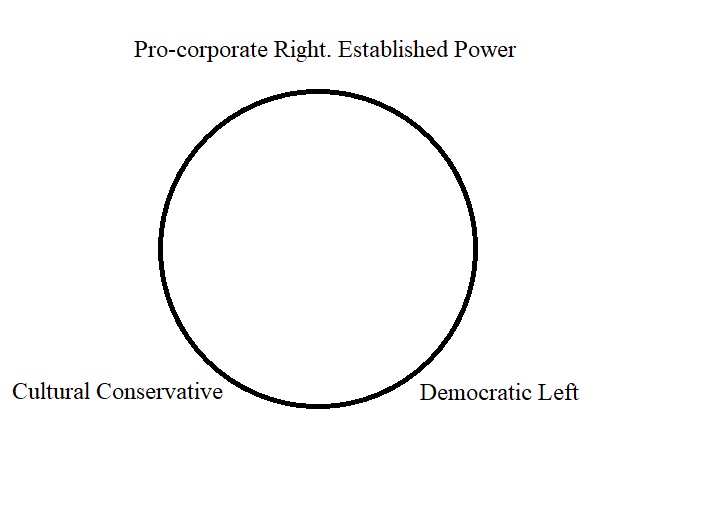
    It could be useful to think of contemporary Australian, and probably US, politics in terms of a triad:

    (Currently Pro-corporate) Right
    Cultural Conservative
    Democratic Left.

    Using a triad rather than a set of binaries helps us to avoid seeing these factions as opposites. They all share things with each other, can move from one position to another, and ally with one another.

    political circle 02

    In brief:

    The (pro-corporate) Right support established wealth and power. They consider that the powerful are virtuous, and justified in that power, by virtue of that power and wealth. Given that the main contemporary power resides in the corporate sector they tend to support that sector and its justification within so-called ‘free markets.

    Cultural conservatives support what they see as traditional culture, and traditional power relations.

    The Democratic left supports ‘the people’, against entrenched power and entrenched ‘irrational’ culture. They tend to see themselves as the supreme judges of what is entrenched.

    In more detail:

    The Right tends to attack the rights, incomes and conditions of ordinary people in order to support established power and hierarchy.

    Power must be maintained, and society geared towards providing the best conditions for the powerful to do their stuff (whatever that is; make money, use violence, own land, spout theology etc.), as that is supposedly best for everyone. They are anti-democratic at heart.

    They oppose any kind of benefits for the poor, which are not a form of charity which requires genuflection towards the rich, or other elite, and hence reinforces the power system. To them mutual obligation means the obligation of the poor not to accept help that costs the elite anything, or for the poor not to challenge the elites.

    They also oppose to any traditional culture or set of values, which acts to restrain the power they support which, as stated above, in our society is the corporate sector.

    They encourage culture wars to maintain separation between conservatives and the left, and use conservative respect for established power to persuade conservatives that they are both on the same side.

    If contemporary rightists have a religion it tends to assume that wealth is God’s reward for virtue and faith, and that a person’s prime responsibility is for their own salvation and then, perhaps, their family’s.

    The main problem the right face is that they know they are right. They think all information is PR and you make it correct by PR, will and effort, or sleight of hand. They are extremely good at sales and marketing in an economic system in which false advertising and hype is normal. They tend to think any counter evidence is evidence of bias, and must also be made up. The problem for them is that eventually reality cannot be denied, and bites everyone, including them.

    Conservatives tend to be suspicious of innovation.

    Nowadays, living in corporate capitalism, innovation occurs all the time, destroying traditional culture and place, so life is difficult for them.

    Capitalism also tends to reduce all value and virtue to money. This often seems fundamentally wrong to conservatives.

    While tending to support single authorities, conservatives can also like a balance of social powers to act as restraints. Thus they can support professional organisations, teaching organisation, religious organisations, business organisations, military organisations and conservation organisations having input into government. Whoever is the ‘King’ should have loyal and fearless advisers.

    They also tend to think that power involves responsibility towards both the established rules and laws of government and to the ruled. The rulers should cultivate noblisse oblige, protection for the ruled, charity, justice and so on. Ideally while everyone should know their place, there should be mutual respect. Mutual obligation is not one sided.

    Religion is often considered vitally important in cultivating virtue, generosity, judgement, content with one’s place and is supposed to act as a restraint on human selfishness.

    Cultural conservatives tend to like traditional boundaries for gender, profession, task and so on, especially when tied into religion.

    They often consider that traditional culture carries a wisdom, which cannot be easily summarised intellectually, and that breaking traditional culture and its mores carries unsuspected dangers. This can lead them to support functional ignorance, as new knowledge might be dangerously mistaken.

    They are strongly suspicious of people for being different, and can team up to put down any difference, thus limiting a culture’s range of potentially constructive responses. This is a weakness.

    Another weakness is thinking that by allying with established corporate power, primarily against the left, they are defending cultural wisdom against difference, and that this gives them real power. In other words they often think that established power must inherently be virtuous and conservative. What they eventually discover is that if they get in the way of money making, or whatever the right’s hype of the moment is, then they will be over-ridden completely.

    More on conservative philosophy here

    The Democratic Left tends to be suspicious of everything that oppresses, or could oppress, people and which only has backing in tradition or raw power. They tend to think that what seems like arbitrary power and culture should be destroyed.

    For them ordinary people are as wise as anyone else and should be supported in their efforts to better themselves. People should not be ignored or suffer simply because they are poor or outcast – this is unjust.

    The problem for the left is that revolutionary leftists, if the revolution succeeds, become the new rightists. They support the new forms of established power and run roughshod over those who oppose them.

    On the other hand, moderate leftists tend to accommodate to the power of the right, and thus end up cautiously supporting oppression to receive funding. They may also accept established power relations in return for what appears to be the ability to moderate that power. This position can achieve something, but without them encouraging another set of power bases, they cannot hold the achievement. This is clear from Hawke and Keating in Australia, Blair in the UK and Obama in the US.

    Leftists are often conservative; they don’t want to reduce every virtue and value to money, they tend to like balance of powers, and they often support the achievements of the past which have now been swept away by the Right: for example the Menzies idea that social insurance was a right, and that people should not be humiliated or harassed for accepting it, or the idea that workers form a valuable community rather than a disposable resource. They also tend to support environmental conservation and oppose destruction of land and place.

    Their main problem is the tendency to want to overthrow traditional culture rather than improve it. This is one reason, that ‘modern art’ holds so little popular appeal; much of it only rebels. Conservatives are probably correct that culture holds some evolutionary adaptive organisations, but that it may well need to change as circumstances change.

    Leftists are easily persuaded that conservatives support harm for the marginalised, are racist, sexist, superstitious and stupid – which helps drive the culture wars, started by the Right, and which tends to throw them on the mercies of the right.

    Consequences

    The point of all this is to suggest that there is perhaps as much commonality between left and conservatives as there is between conservatives and the right, or the right and the left. There is room to be flexible. However allying with the right is likely to prove disastrous for the other two sides, partly because the right has no respect for reality, only wealth. Both the left and conservatives have weaknesses which sabotage them, but which have a chance of being corrected by the other.

    Historically it could be argued that the successful 19th and early 20th century reform movements, that lead to public education and protection against misfortune for the working class, arose through an alliance through the democratic left and the conservatives both recognizing that unconstrained capitalism was destroying traditional life, interconnections and responsibilities. That this economic system was demeaning the working men and women of the country, and that it was Christian to try and help people live lives which were not full of abject misery and poverty.

    This alliance was largely successful, despite obvious frictions. It is not impossible that a similar movement against the corruption of public life through money and the destruction of land, water and air could motivate another successful alliance.

    The only thing that seems guaranteed, is that if the Right remains dominating, then everything will end badly.

    More reflections here…