What would happen if we pretended that we could play the game of life without without having to destroy our environment by playing?
After all most of us care about some of the people we live with, and around, and would not go out of our way to harm them. Perhaps we could live without going out of our way to harm other beings? Without pollution, or pretending that we don’t pollute?
It could be an interesting venture to try, not that we would get much support. I guess it would look like cranky individualism.
But is hard to play anything without an ‘environment; play in…
Faced with the apparent visions of the future as involving ‘Collapse’ or ‘Authoritarian continuance and rising dystopia’. A group I belong to, associated with the Anthropocene Transitions Network, aimed for a an alternate vision of ‘Regenerative Cultural Values’.
This is some basic thinking on what is involved, obviously it is not just my own thinking (see ‘ecology of mind’ below), but I don’t want to scapegoat anyone else, for its deficiencies.
The Problem?
Apart from disliking the targets of ‘Collapse’ and ‘Authoritarianism’, there are lots of consultative processes in modern society, which essentially seem to be set up so people can drain themselves in effort, to be ignored by the powers that be. This is a common neoliberal consultative practice. The aim of the consultation seems to be to support whatever action is being taken by the authorities, and pretend it has support. Perhaps we can add this “Neoliberal Consultative Process” to the targets of Collapse and Authoritarianism as it can be part of either.
Is there some other way?
What are Regenerative cultural values?
Regenerative cultural values aim to revitalise values and relationships and make them as functional, participatory and resilient as possible, so as to produce constructive ‘democratic’ change.
Regeneration appears to have to involve systems thinking as its base, and preferably complex systems theory. Complex systems thinking could also be called ‘ecological thinking,’ as seeing oneself and others as a system and acting in the midst of systems is part of the process of the new vision. It also involves the recognition that ecologies change, evolve and regenerate. They are not stable forever without force.
The term ‘ecology’ does not have to refer to ‘natural environments’, but can also refer to communities, and economies etc. All of these involve interaction with other participants and other systems, mutual influence, symbiosis, conflict and co-operation, and so on. ‘We’ spill out into the social culture, borrow other people’s ideas or language, are shaped by (and shape) traditions, use tools and objects to think with. As Gregory Bateson argued, our minds are not alone, but exist in an ecology of mind which extends way beyond our skins, with feedback and originality. In an ecology nothing dominates completely according to its will. The most dominant feature in most ecologies is the Sun. It does not control anything, but without it most ecologies would die.
Boundaries between different systems and different people tend to be fuzzy and vague, this ‘spill out’ is not unique.
Being outsiders within
However, we live in a hierarchical social system, and higher levels do try and control lower levels, rather than let those lower levels freely adapt to local conditions. Consequently, regenerative cultural values may need to separate from, or hide from, the hierarchies until they get established. That is, they may have to form what Geels has called ‘niches’ – areas of creativity which both avoid being: noticed until ready; pushed into the service of the hierarchies worldview or; crushed. They form ‘subcultures,’ ‘temporary Autonomous Zones’ or even act as hidden ‘parasites’ using the hierarchies without submitting to them.
Community
‘Community’ is a vague concept that carries a lot of baggage, but it is important.
What we can observe is that humans, if unobstructed, nearly always build something we can call ‘community’. In villages, suburbs, online groups, sports clubs, children’s sports, mother’s support, child minding groups, even in prisons, and so on. The trend is that people support each other to the degree possible, take note of each other, identify with each other, and build friendships and rivalries, and so on. Ideally they come to form a mutual ecology; community is not an on/off process but develops. ‘Community’ can also be a political term which indicates people are seeking recognition for their groups, and participation in wider spheres. All ‘healthy’ human systems probably involve some forms of community and relationships, not just with other local humans but with animals, surrounding environments and so on. Community does not have to be anthropocentric.
Community can arise out of ‘projects’, or people working on something for the common good, such as building a local arts/sports centre, developing community energy, helping people in floods or fires, protecting the local village from over-development or being overwhelmed with current strangers, preserving the local wildlife and their ecologies, recognising common responsibilities or ownership of rivers or woods or community gardens, and so on. Projects also involve mutual learning, and cohabitation with others.
If so, then one way of generating community is to help people to get working or projects relevant to them, without expecting the project to be accepted by the ‘powers that be.’ If possible perhaps the project should also be outside the influence of the powers that be (in a ‘niche’), so that these powers do not interfere, and processes get finished. This community might then extend into other fields not as remote from the hierarchy – say agitating the local council, people with similar views, or the police office, for support, and getting forest protection etc.
This kind of action can also build a political base to challenge the way things are done, or to support those local powers who might challenge the system that produces local and national misery.
Resilience
Resilience seems tied into an apparent paradox: allowing diversity and conflict can build unity on some occasions.
Deviance, diversity and conflict are necessary for resilient communities. A community of ‘perfect harmony’, probably has a limited number of roles, responses and modes of control, and probably is not capeable of surviving disharmony. It could find it difficult to try processes out to see if they work, because people and processes, have to follow the established and harmonious patterns. Diversity allows diversity of responses without planning, and evaluation of the responses, and hence more chance of adapting.
I suspect that a community only appears perfectly harmonious if there is ongoing threat of violence and suppression.
The challenge is that the community has to be able to survive the internal conflict which can be generated by diversity, and levels of diversity may have to be experimented with. People still have to manage to think of themselves as ‘together’ with each other and their various ecologies even in diversity. I suspect that it is social tradition, rather than human nature which makes this difficult, but I could be wrong. This is especially so where the general political ecology acts to force people into opposing ‘sides’, but if people are aware of the engineered polarisation they can try to reject it, and be open to one another.
Openess – the Thou
I have written elsewhere of Martin Buber’s idea of ‘it’ and ‘thou.’ [1], [2], [3] This is an easy, and apparently trivial distinction, but it seems important.
When we make something or someone, an ‘it’, then we consider that person or thing to be without complexity, without valuable being. They are something to be used and manipulated, perhaps discarded with complacency. Culturally, ‘we’ seem to regard most ‘things’ in the world as ‘its’ – we pollute air and rivers, move rocks without care, chop down trees to stop the mess of dropped leaves and so on. There is no real care needed for an ‘it’.
However, when we regard something, someone or some process as a ‘thou,’ we approach it as a being that is open, that must be learned about, lived with, cared for and so on. It is a bit unclear in Buber, but it would seem to be possible not only to treat those we regard as deviant as worthwhile thous, but all the ecologies we live with. People can treat their cars, their pets, their toys, trees, beaches, special rock platforms etc, as thous if they care about them. The idea of caring for the non-human as if they were beings of worth, is not foreign to us. Thouness and caring seem to be related.
This caring does seem foreign to the idea that monetary profit is the only value, because with profit, some things have to become its, to be sold, destroyed or polluted, and things which cannot be profited from are valueless by definition.
It seems part of the basis of regenerative cultural values to rediscover the ‘thouness’ of life and being, perhaps within a community project of some kind.
Summary
Regenerative cultural values, begin locally. [Added from Ken McLeod: where “local” can reference both spatial and cultural proximity].
They begin in the making of community, collaboration, conflict and recognition.
Regenerative values are open to the thouness of people and ‘nature’.
Regenerative values accept that diversity is useful for survival and adaption, despite the unease it may generate.
Community may be generated through projects of general value to the the local people.
These projects may need to be hidden, or to engage only briefly with established hierarchies, until they are robust or finished.
Once the projects have results, then it may be useful to venture out into the world, gain support and give support.
Right wing intellectual, Ben Shapiro, appears to try and avoid the challenges of social chaos and complexity by implicitly arguing that morals require the uniformity and imposition brought by religion.
[This style of text is Shapiro, as I understand him]
[This style of text is a comment]
Shapiro’s argument seems to go:
Atheists accuse religious people of being immoral and argue that if religion inculcated goodness then religious people would be good. They argue “if religion is good, why are religious believers often so bad?”
That is a common argument made by atheists. They say that religious belief does not guarantee morality in believers. Therefore there is nothing particularly wonderful about religious morals, or religion in inculcating morals. If we are discussing morals, this is a point to be considered.
However, Shapiro responds to this point by writing, “Of course, one could ask this about any philosophy – most people are in fact sinful and wicked, and have the capacity for good.”
So he appears to dismiss the question of whether religion is a good source of morals, by saying nothing is. He will forget this as he goes on, but let’s agree and make the proposition: ‘There may be no philosophy, the holding of which will guarantee that the holders will be good.’ If this is true then it applies to religion (as Shapiro is doing here) as well as to non-religion. It does not justify religion as a sources of morals, it excuses it.
He continues by arguing that atheism cannot establish a moral framework, and hence that atheism cannot guarantee people will be good.
We have already agreed with him that no philosophy will guarantee those who hold it will be good. It is as true of atheists as of religious people.
However, I have never heard an atheist claim, in the way that religious people can make claims, that only atheists can be good or that religious people are all morally dead, or that all religious people should be killed. It is not a general part of atheist philosophy. So his argument is completely irrelevant to the initial point that religion does not guarantee morality, and does not display any indications that there is anything supernaturally beneficial about religious morals.
His argument does not claim that religious people are generally more moral than atheists, or that religions give an infallible basis for morals, or even that religions provide a moral moral framework which is good, and which works. He does not try to. Indeed he asks:
“how we are supposed to judge whether the religion is promoting something morally good or bad without another frame of moral reference.”
This is another extremely important question, which he ignores, and he asserts:
“atheism itself can make no self-sustaining moral claims on human beings.“
I agree again to an extent. But that is not the point of atheism. Atheism is not about establishing moral claims. His argument also ignores atheist philosophers who have made coherent moral systems with claims on people. David Hume for example.
Even if it is correct that atheism makes no self-sustaining moral claims on human beings, that does not mean that all, or even any, religion is promoting something necessarily good. That some set of ideas cannot do something well, does not mean that another set of ideas it attacks, will necessarily do that something well. We can return to the principle that ‘There may be no philosophy, the holding of which will guarantee that the holders will be good.’
However, atheists do make an implicit argument that ‘if you do not embrace truth and reality, you cannot be moral’. I think this is a valid argument about morals, and not to be ignored as Shapiro does.
The atheist position implies that if you accept the absolute morality of beings who torture people forever, commit genocide, or demand people’s deaths for eating shellfish or being gay, or whatever, then you will have a dangerously warped moral sense. And indeed we can see this throughout history. People driven by their religious beliefs can do things, which I, and often other religious people, judge to be immoral and not to be praised, but which are covered up or celebrated by the religion. Rape of children by godly men, is the obvious example, and appears to occur in most organised large scale religions.
Atheists may also argue that different religious systems have different moral systems and promote different laws. Hence there is nothing obvious about religious morals, other than the authority being claimed for them and the punishments threatened for disobeying them. How do we know those particular morals are moral? This is another important question when we consider the morals of religion. To requote Shapiro: “”how we are supposed to judge whether the religion is promoting something morally good or bad without another frame of moral reference?”
He then appears to avoid these issues about morality, by claiming that atheism is bad because atheist governments have been murderous: they “have been far more murderous and tyrannical than any religious theocracy in history.”
I’m not sure Nazism was atheist. Hitler definitely talks about his guidance by metaphysical concepts. Jewish people had been condemned and murdered by Christians for a long time so the Holocaust may exist because of religion, and the Nazis approved ‘Aryan Christianity’. Mussolini generally had a good relationship with the Catholic Church. However, religious governments are also murderous: inquisitions, pogroms, brutal punishments for sinners, and religious wars do happen. All European wars and conquests have been backed and justified by churches. So far the religious haven’t had the technology of mass murder down to the art it reached in the 20th Century under Nazism, but if they ever get into total power again, it is not unreasonable to expect that the full technology of death and suffering will be used to purge the world of sin and disagreement.
He asserts: “Atheism promotes a vision of mankind entirely at odds with the building of a productive society: it suggests materialism, which means lack of free will; it undermines the unique value of human beings, which undermines liberty and rights; it dismisses the value of tradition in favor of a reason it cannot defend on its own terms.” In another place he argues:
“a Godless world is a soulless world…. Transcending biology and our environment requires a higher power — a spark of the supernatural” (2).
It is amazing that he is apparently unaware of the idea that God being all-powerful and all-knowing has determined or determines everything that happens or will happen. This also gives a lack of effective freewill.
Materialism does not have to back determinism, any more than religion does. Materialism nowadays should embody complexity, and challenge the fuzzy boundaries between mind and matter. Materialism is not necessarily in opposition to consciousness. While materialism may undermine traditions based on religion, so does capitalism, and he is not attacking that for some reason.
He presents no evidence for the idea that we can only make moral choices because of ideas like soul, or that morality involves transcending biology – perhaps the ability to learn a morality is part of out biology, like the ability to learn language, or the need to socialise and form social groups.
This is an undemonstrable assertion not an absolute truth, and quite possibly asserts that non monotheisms, and that religions which don’t promise an afterlife are immoral as well.
His major implied point here seems to be that many major religions demand behaviour they call ‘morals’. They tell us what to do, and threaten punishments for those who don’t do it, and therefore form a good basis for the State (or at least an authoritarian state).
It seems to me (but I won’t insist on it) that Shapiro is implying that if the population is ‘brainwashed’ by a religion, then they will all have the same morals and think the same way, and this will bring about social harmony and agreement. In this way religion builds order out of chaos and protects against chaos. This may be correct (although I suspect it leads to a lot of murder of deviant thinkers and a lot of blowback), but if so, it might seem he is in favor of authoritarianism, and of people who are violent arbiters of morals. This may not require religion, as he has argued above with respect to atheist governments, it just requires a passionate and thorough intolerance of dissent or questioning – which may equally lead to social breakdown, social distrust and fracture as people struggle to assert their innocence, and show how good they are by accusing others.
He also implies that as atheism does not tell us what to do, (apart from asking us not to believe in falsity, undemonstrable propositions, or in incoherent gods, theologies and religious morals) it, perhaps, asks us to think and question, and is BAD. “As a system of thought, atheism cannot be the basis for any functional state” (2).
Even if atheism could never be a basis for a functional state, that does not prove that religious morals can deal with the complexity of modern life, do not have unintended consequences, are a real basis for a functional state, or are moral.
It apparently does not matter if the morals taught by a religion are ethical, coherent, beneficial, cruel or even if they do always provide the basis for a ‘productive society’, as long as we are all told what to do, and can stop thinking or questioning those morals, and we agree on what is moral on fear of death or God’s displeasure. That is all.
Religion just functions to declare morals and produce order by enforcing those morals. It makes things simple and generally agreed. This makes it good. Whether this order and uniformity allows us to deal with complexity, or not make mistakes, or be moral is irrelevant.
To make this argument, he needs to ignore the questions of ‘what is morality,’ ‘do religions all have good morals’ ‘how do we decide whether a system of morals is good’. He raises these issues to ignore them immediately. He implies that it is enforced order which is good and justifies morals being enforced.
This implicit praise of any order as long as it can be called ‘religious,’ seems, to me, to be an immoral basis for morals.
It could be suggested that he is not really a friend to religion and that his position is morally bankrupt.
There is no morality, or rights anywhere written into the universe.
As humans we don’t like this, for fairly obvious reasons. The obvious point is what is to stop someone from killing us, if there is no morality or agreed on rights?
However, the only arguments in favour of human rights and morality, come out of ‘human nature’ and pragmaticism. There are no universal axioms of morality.
‘Human Nature’: Empathy
Basically ‘human nature’ involves competition and co-operation. We appear to have a natural longing for relative equality of treatment, or fairness, as well as a longing to do the best for ourselves (whatever that is – it is not written into the universe either). Most people quickly discover as children, that the opposition between co-operation and competition is not a real opposition. A functional human being normally does better for themselves, and enjoys themselves better, through co-operation. We can compete with others through co-operation with a ‘team’ or ingroup.
This and ‘empathy’ leads to morality. We feel others’ pain, and unfairness to others, and usually do things about it, to fix things up (the more, the better we know the person and like them…) Perhaps we don’t feel others’ pain as strongly as we feel our own pain, but most children feel for others. There are few societies in the world in which what is considered in-group injustice is not condemned, even if secretly because it is too dangerous to do otherwise, and people support their own ingroups’ morality pretty fiercely.
The point is that empathy can be extended or limited by conventions around social categories. Out-groups can be separated from normal morality, as is clearly happening politically in the US where people in the ‘other’ political category receive little in the way of empathy, and much in hostility. Empathy can also be extended or limited by experience of someone’s behaviour and this can also feed into social category separation, as again is happening in the US and elsewhere.
These dynamics of separation and connection are not stable, and change moralities.
Pragmaticism
Humans have morality for pragmatic reasons; in that societies work better with some kind of morality. Everyone knows what to do. People can co-operate with reasonable security that they will not always be completely ripped off. Hence things appear to function better than they would without it. Societies survive, the more agreement there is that the morality, expresses human nature and has good results.
However, no system of morality can always guarantee that only ‘good’ will result from ‘good’ actions. We live amidst a complexity which can undermine our intentions, so we have to pay attention to results, and sometimes adjust our behaviour.
Conclusion
Human rights etc don’t exist, but they arise from normal human processes and their pragmatic benefits.
This does not mean that all moralities are necessarily ok…. but its hard to have a moral argument which does not rely on either a view of human nature or of the consequences of not having the morality.
Morals change – partly because morals are inherently uncertain.
Morals change when the situation changes. People behave differently in war and peace for example. Defining such changes in advance can be difficult and uncertain.
Technologies introduce possibilities of action which were previously unthinkable. So people have to change or develop morals to deal with those courses of action, or stop the tech which is also a moral decision. What changes will be introduced is uncertain. It is often uncertain as to whether preventing a technology will be harmful as it may curtail good.
Morals change with Culture. Different cultures have different moral sets and emphases. We no longer behave as the ancient Romans behave – and this would often seem a good thing. However, there is no real reason given the difference in cultures that Romans would accept present day Western morals. Moral improvement involves moral judgements.
Morals change with social order. The moral rules of a feudal society are not appropriate for the smooth running of a democratic society, or a capitalist society, or any stateless society. Again, and for similar reasons, it is uncertain that moral arguments could resolve these issues.
Morals usually support the behaviour of the power elites, to show that they are dominant because they are moral. For example, in capitalist societies wealth is often taken as an indicator of virtue. Not attempting to control corporations is taken as a virtue, money making is a virtue. People are said to be poor because they are judged to be lacking in a whole range of virtues, such as hard work, fortitude, persistence, talent etc
Morals, and moral exceptions, change with ‘side’ and allegiance. We can have no doubt that had Clinton or any Democrat done what Trump has done, Republicans would be calling for prosecution. This is common. ‘Respectable people’ usually suffer less for their crimes than disreputable people and so on. Morality is uncertain in its application.
When any people rise up from a position of oppression, then the morals enforcing that oppression may increasingly seem to be less good, and more arbitrary. Indeed part of the struggle will be to disqualify the old morals that keep them down.
Morals usually involve some kind of socially enforced penalty. The penalty expected can sometimes overwhelm the moral position as the punishment can come to seem immoral in itself, again involving uncertainty, should the person be found not guilty, or the punishment changed.
Morals can change when people try to be consistent. I would suggest that the decline of Christianity since the 18th Century had much to do with people realising the moral standards of Christianity were incoherent. It seemed increasingly unlikely to people that a supposedly loving God could have commanded genocide, rape, murder and eternal torture for anyone. Yet this is uncertain as after all God is supposedly infinitely powerful and wise.
Morals can change when supposed moral exemplars are discovered to have behaved badly. The defense of pedophiles and rapists by various churches is an example of this, and it also explains why Churches defended them – because they feared losing moral influence. Perhaps the moral position was still valid even if proves impossible, or is used to shelter ‘evil’?
Morals nearly always involve dispute because of social and situational change, alliance, and levels of consistency. Almost any legal case, political case, or so on will involve moral argument, and arguments about punishment and retribution. The argument may increase the apparent arbitrary nature of the morality, and point to its inevitable uncertainty, and lead to people trying to advance to another stage, or to them trying to fix the problems with violence and compulsions – which others may say is immoral. Ambiguity and uncertainty is present again.
Whether morals should change is a moral question. All I’m saying is they will change. However, I suspect that if your morals will not change, then you are not open to the complexities of life, and you will make immoral decisions as a result.
This blog note is an unfinished attempt to say something about the basis of ethics, legitimation, delegitimation and the struggles around them in the NSW country town of Narrabri, and the surrounding Narrabri Shire. While this is all highly provisional, it can be stated that the main struggle appears to occur within the context of ‘resources curse’.
Public Domain map of NSW from Ian.Macky.net [Unintended distortion by the blog software?]
Introducing Narrabri
The Narrabri region, as referred to here, is an area in the Northwest of NSW, often (but not always) called ‘the Northwest’, not just Narrabri town, or shire. It is cursed with plenty and lack of resources, both of which are issues because of climate change. Most of the time I will call the area the Northwest.
The Northwest has plentiful supplies of coal and gas, and a marked lack of water, through prolonged drought and possibly declining water tables. The Northwest used to be primarily a farming area, but farms are now hard pressed, and threated by recent mining, with coal dust and threatened damage to the water table through gas mining. There are also large cotton farms which may provoke more water shortages for smaller farms.
As shall be covered in more detail later on both the Federal and State governments seem keen to have more fossil fuel mines and have supported the mining companies in this area. These kind of events may foreshadow the outcome of the 2021 COP – we can also think of a massive expansion of Chinese coal mining [1], [2], and a UN report which apparently claims the world is going to increase fossil fuel emissions until at least 2040, almost three times higher than what’s needed to keep global warming under 1.5 degrees Celsius.
We may be seeing the Green Paradox ramp up [3], [4] – the idea that as it becomes likely coal, and even gas, will be phased out, there is an commercial and ethical imperative to sell or use as much as possible. This is a position encouraged by a massive price increase for coal, going from $US60.00 per ton October last year to $US230.00 per ton this month.
If we are going to try and specify groups, we can specify: farmers, business people in town, mining workers, residents close to mines (usually farmers), residents distant from mines (townsfolk) and Gomoroi people.
Legitimacy struggles
The situation in the Northwest involves an ethical struggle over the legitimacy of fossil fuel mining. Because there is no agreed on basis for ethics, it is hard to resolve this situation totally through the application of ethics alone; it seems probable there are large irresolvable differences between the positions of various social groups/categories. As suggested earlier, ethics is a matter of relative social power between different social group or categories, group identities, relative ‘structural’ positions between groups, changing or maintaining cosmologies, changing or maintaining customs and habits and changing contexts or framings, and arguments over those contexts and framings. It can in the final case depend on threat, violence and exclusion.
It seems to me that the legitimacy argument in the Northwest has several interactive strands, based on the factors just discussed. As also previously suggested legitimacy is not distributed equally between all sections of the population and involves struggle just like ethics. Legitimacy may also be risked any time it is asserted.
Maintaining and changing customs and habits
Fossil fuels are established and familiar, they involve established customs and habits, and modes of organisation. The way forward is relatively clear. This lends legitimacy and ethical potency. Renewable Energy may require new customs, new habits and new modes of organisation, as well as generate new forms of instability while becoming established, and so looks precarious and illegitimate.
There is a sense that the company itself claims to support local customs and improve them for example:
The Santos Festival of Rugby was a momentous success for Narrabri Shire and Santos, bringing the community together after prolonged drought and the COVID-19 pandemic for three days of rugby action in February…. The exciting pre-season game saw the Waratahs claim victory over the Reds, taking home a $25,000 reward and the prestigious Santos Cup.
In preparation for the festival, Santos upgraded Dangar Park with broadcast quality stadium lighting and installed wi-fi connectivity into the clubrooms, which will potentially attract more large-scale events in the future. The economic benefits to the community have been warmly welcomed. The event injected approximately $700,000 into the community through Santos’ direct spend with local suppliers, as well as indirect spend on hospitality and accommodation from visitors.
Other stories in the ‘Community News’, point out the company is going to be net-zero emissions by 2040, which seems improbable, that it is “supporting local business,” “part of the community” and so on. Trying to establish it is one of ‘us’, and generous.
Other people are also mining fossil fuels and selling them, why shouldn’t we?
Cosmology: Prosperity and development
This might be called a society wide pragmatic frame, but it also involves cosmology – in the sense that accepted wisdom implies this is the way the world works, and is the way the world works for the best – the assumption is that abandoning this frame is the first step to chaos.
Fossil fuels have brought what is defined as prosperity and development, where development is defined as the process of increasing material prosperity, increasing technical sophistication and boosting military security. Prosperity and development are defined as good, and as a purpose of life which should be spread throughout the planet – the undeveloped world tends to be seen by the developed world as ‘backward’: poverty ridden and intellectually inadequate whether this is true or not. Fossil fuels are the basis of modernity and benefit many people who use electricity and automobiles, as well as those who profit from them. Prosperity and Modernity are cosmologies which provide contexts and frames for fossil fuel production and use. Maintaining those fossil fuels is therefore the basis of that good, and a potential way of spreading that good. Without fossil fuels life will decline. It is certainly true that fossil fuels have provided plentiful energy (although it is getting harder to obtain), and it is doubtful that renewables can supply similar amounts of energy in the short term.
Many folk in the town (it seems especially influential business people) also support mining because they see the mines as a potential source of prosperity and jobs in the town, which will save the town. There is also a reasonably sized body of activists who see the mining as purely destructive – some of whom are trying to encourage renewable development. Mostly the mining’s obvious deleterious affects occur in the country, and affect farmers, but the ties between farmers and town seems weaker than it once was. There are larger corporate farms rather than family owned farms. Not having the same money farmers are said to not spend as much in town, and they don’t hire as much labour from the town – possibly because of technical ‘advancement’ and the increase in scale.
[Once it was] plausible to support a large family on 250 acres with crops, … [however] today a farmer would need 2000 acres and capital to invest in machinery and equipment.
Brooks et al. 2001. Narrabri: A Century Remembered 1901-2001: p.15
Given the apparent lessened ability to depend on farming, the Mayor of Narrabri at the time, Cathy Redding, argued that the mines should go ahead because:
Population retention would be one advantage for Narrabri, in that jobs would be created, new manufacturing businesses would develop and the multiplier effects of these developments would ensure regional growt
In reality, local prosperity is a matter of how the mining is organised, where the profits go, where the ongoing operational payments go and so on. It is a legitimising frame, which may have little local truth. Indeed the argument that gas mine workers come from outside, that profits are largely transferred elsewhere, while costs remain (such has increased rental housing prices, damage to ecology and water) seems to be one of the most common arguments against the mining. In general the response is largely to assert that prosperity will result, and that Narrabri Shire will avoid the costs. A number of local businesses do stand to benefit from the mines, from increased economic traffic in town and from contracting work with the mines, which legitimates the mine through prosperity contexts. However, results from the 2016 census imply that mining has a relatively low effect; it currently provides 5.4% of jobs, comparing with 11.6% in health and social assistance, 10.5% in retail, 7.7% in Education and 7% in Agriculture forestry and fishing.
Sustainability of the local area, becomes sustainability by new jobs in one field. This acts to promote the gas and distract from environmental damage. There are people who are enthusiastic about this form of sustainability, people who reject it, and people who accept it will happen. It is not really clear from the figures that the Narrabri region is in radical population decline, but we need to wait for the current census results.
I’d suggest that the people who accept it will happen and those who are enthusiastic are that way, because there is almost nothing else officially on offer to generate prosperity, although a brief survey our students did of people in the street, suggested that the idea of Narrabri as a tourist food town was very popular. Many people were clearly fed up of being questioned, which suggests they accept it will happen, rather than working towards rejection.
Renewables are personally popular, but seem to have little social consequence. There was at least some acceptance of the delegitimating arguments against renewables by lack of consistency, and lack of intensity – which is primarily about habit and custom – see below (#). There is little struggle against renewables, probably because renewables are not a threat. They can be almost ignored – which offers a degree of freedom.
Prosperity framings are reinforced by corporate and State practice, and by the widespread neoliberal ideology which acts to put business first, suggests local prosperity flows from encouraging or subsidising corporate prosperity, and attacks any kind of inhibition on business liberty – an ideology which is so persuasive that it is adopted by all the major parties. The supposed farmers party (the Nationals) always seems to put corporate interests ahead of farming interests, as when they protect mines instead of farms, or continue to agitate for lack of climate action, when farmers are pressured by climate change and water problems. Matt Canavan of the National Party has remarked:
About five per cent of our voters are farmers, it’s about two per cent of the overall population. So 95 per cent of our voters don’t farm, aren’t farmers or don’t own farmland.
Furthermore, with the gradual erosion of the welfare state and attacks on unemployed people, like robodebt, there is little other way for ‘ordinary people’ to survive unless it be hanging on to corporate ‘prosperity’.
Changes in Cosmology?
However, the context of this cosmology may be shifting, as argued in a previous blog, the Business Council of Australia, after a long period of complete climate-action denial, has moved into issuing plans for emissions targets and reductions in emissions. The plan is a little ambiguous about coal and gas exports, and it seems significantly motivated by fear of others acting on climate and lessening trade with Australia as a result, but it could change the context significantly and suggest that fossil fuels are not the only, or necessary, way to go.
Protestors can also use the ‘economic reality’ argument:
“Financial institutions around the world are increasingly unwilling to back polluting fossil fuel projects like what Santos proposes at Narrabri.”
Coal seam gas drilling has bought a harsh boom bust cycle to other towns, especially in Queensland, leaving the towns with little but damage and rusting well sites. This surprisingly, has little effect on the prosperity framing for many. It appears local business knows the risks, thinks it is smart enough not to be caught out by the damage that has happened in other towns, and that this intelligence helps support the legitimacy of the operation. They want it to succeed, or need it to succeed, without cost, so it must. To some extent this is doing what other people have done with the hope it has different consequences. However, the realisation of damage elsewhere is a challenge to cosmologies of prosperity.
Another challenge to prosperity through fossil fuels is the idea of prosperity through renewables. An ISF report suggested as one option the rather unlikely figures of “2,840 [local] ongoing maintenance and operation jobs by 2030” if Narrabri started going (corporate) renewable, whereas Santos only promises “up to 200 ongoing positions” [5], [6]. The problem seems to be that the ISF figures seem exceptionally high for solar, and so unpersuasive. People have another experience with solar farms in NSW – they require very little maintenance – mainly cleaning (with the expectation of water use).
Finally while the Gas mining has been justified by NSW need for local gas, a report conducted for the Climate Council suggests that NSW is likely to:
reduce its annual gas demand by the same amount that the Narrabri Gas Project is forecast to produce, as soon as 2030.
This report effectively renders the Narrabri Gas Project redundant. We already know that this project will drive up greenhouse gas emissions, worsen climate change and do nothing to reduce power prices. Now we also know the project is completely unnecessary when it comes to meeting the state’s energy needs,
Power relations – Fossil fuel companies and the State
In corporate capitalism, in general, corporations have more bases for power than community groups. The have wealth, contacts, prestige, ability to put out information, buy politicians and think tanks, even gain violence from police or from outsiders (there is no suggestion that companies in the region have done this, but it is certainly possible in general) etc. The power relations are not equal, and many people may think siding with the corporations could grant them benefits, while opposing them could make their situation worse.
Fossil fuels and fossil fuel companies, have State support which can override any local objection that does not command the allegiance of a vast majority of local people, and this potential for power when allied with at least some at the local level, not only gives fossil fuels support or indifference, but makes them easier and cheaper to mine. For example it has been alleged that the State government neglected to implement most of its Chief Scientists recommendations to make gas drilling safe [7], [8] [9].
One person in Narrabri insisted that
the government had not implemented 14 of 16 recommendations to limit the risk of coal seam gas made nearly six years ago by the then NSW chief scientist, now Independent Planning Commission chair, Mary O’Kane. “Our government has betrayed us,” Murray said.
The Federal minister apparently approved the gas wells before the company explained which parts of the Pilliga forest would be cleared, it finished investigating effects on local groundwater, or developed a biodiversity plan, important given local koala habitats and declines in koala populations not to mention other endangered animals. Later on the project was boosted by the Federal Government’s ‘gas-led recovery‘ (“Cheaper, more abundant gas is the second pillar of our energy plan for COVID recovery. We’ve got to get the gas.” “this [Narrabri project] is 1,300 jobs, $12 billion worth of investment and it is absolutely critical“) and that government’s agreement with the NSW state Government to fund gas [10], [11], [12], [13]. One comment was:
The state government has committed to injecting an additional 70 petajoules (PJ) of gas per annum into the east coast market in return for $3 billion from the Commonwealth government.
NSW Premier Gladys Berejiklian flagged two possibilities to supply the gas; import it or source it from the yet-to-be-approved Santos Narrabri Gas Project, which will create 70 PJ a year….
[The local MP said:] “They have absolutely corroded the independent process,…
“Regardless of the good intentions and the upstanding integrity of the Independent Planning Commission, if the project is approved, the perception will always be they dangled $3 billion in front of them to get the approval.”
It seems that in July 2020 the NSW Government was worried that Federal support for the Narrabri project was too overt and that:
any impression that the outcome of the IPC [the NSW Independent Planning Commission] process is pre-determined could undermine public trust in the process.
They apparently realised that enforcing the case could undermine legitimacy. However, the project was listed as one of 15 major projects to gain a reduction in their “assessment and decision timeframes.” This received remarkably little publicity at the time. There are frequent references to a PM’s announcement, but the announcements I’ve found did not include all the projects, or mention the Narrabri project.
Fighting against large fossil fuel companies is also a difficult process in Australia, as if you win, it seems possible the State will change (or appeal) the law so you lose, or the Company will try again in a marginally different manner, or that they will successfully claim a new mine is an expansion of an old mine. For example, after the Rocky Hill coal mine was refused on the grounds of the emissions production overseas when the coal was burnt, the NSW government legislated to to prevent “the regulation of overseas, or scope-three, greenhouse gas emissions” in mining approvals to give certainty to miners [14] [15].
Fighting against fossil fuels is fighting against both the State and Fossil Fuel companies and unlikely to succeed in terms of power relations and money.
The State is not supporting development of any LOCAL processes in the Narrabri region (that have been mentioned to me) which could provide prosperity or increase survival opportunities, which do not depend on fossil fuels. This makes it harder to challenge fossil fuel legitimacy. However, the NSW state government, has recently managed to gain emissions targets for 2030, and it does support corporate renewables elsewhere, through Renewable Energy Zones, which seem to be geared to supplying the big city and industrial areas on the Coast. But it is not clear that the state or federal governments do much to support local energy supplies via renewables or community renewables, or will oppose fossil fuels directly. Both Parties in Australia have made it clear they are in favour of mining fossil fuels, establishing new fossil fuel mines, and selling the products overseas.
Opposition resources spokeswoman Madeleine King has said Labor will not stand in the way of new mines and believes Australia will export coal beyond 2050…
For so long as international markets want to buy Australian coal, which is high quality, then they will be able to.” Ms King said Labor was “absolutely not supportive one bit” of a push by Malcolm Turnbull for a moratorium on new coalmines
One framing which allows them to claim this is compatible with climate action is the convention that emissions only occur in record of the country burning the fuel, and likewise should not apply to the company profiting from the emissions (as they are outside its control). If the measures were changed this claim of legitimacy might fall.
In a somewhat contradictory policy regime the NSW Government made declared the only active petroleum/gas exploration licences to remain in action were to be those supporting Santos’s Narrabri coal seam gas project, due to concerns from other regional communities [20].
So again we have the power differential and the assumption that fossil fuel profits are good, but changing the law like this also draws attention to the way the law is a political tool used to benefit particular groups.
Context/Framing: Regulation
Current regulation which is based on previous habits, limits connecting energy sources, and energy sources with users, without using the grid, especially if they cross property boundaries. These regulations are largely a matter of custom, and do not reflect the new situation, but there is inertia, because the new situation is easy to ignore, if we keep established power relations going.
Connecting these household sources might provide some kind of new paradigm or framing once it is established, or perhaps during the establishing.
Recent proposals for a feed in tariff suggests that household players could end up paying for export, further discouraging action.
These regulations shape the economy to favour existing players, deliberately or not.
Enforcement?
Apparently, in 2016 the State government increased penalty terms for protesting on land and disrupting mining equipment [21], [22], [23]
There is little sign that the Australian State will change its pro-fossil fuel status, so while it may be useful to try and take back the State, it is also useful to move outside the State, perhaps through local level activity, to try and overwhelm the legitimacy of fossil fuels in general – but the question is whether working outside the State removes legitimacy.
Local Power relations and desires
Local action rarely has state backing when in opposition to mining.
Surveys and polls
There is repeated self selecting survey and other evidence to suggest that most to a large percentage of people in the region do not support the gas fields. For example 64 per cent of the local submissions to the Environmental Impact Statement Inquiry in 2018, were opposed – non local submissions were even greater in their opposition. A Lock the Gate survey of 840 people found 97% of people were in favour of renewables to provide long-term jobs, 52%, of people surveyed were opposed to the gasfield, 28% of people said they were in favour of the gas, and and 20% were unsure. “55% of the people surveyed said they were very or somewhat concerned about the gasfield and only 24% said they were not concerned”. Never the less, the implication is that a reasonable number of people could accept both gas and renewables. A Gas Industry Social and Environmental Research Alliance (a collaborative research institute with members such as Australia Pacific LNG, QGC, Santos, Origin Energy and CSIRO) survey found that that 30.5% of residents ‘reject’ the gas, 41.7% of residents would ‘tolerate’ (27%) or be ‘ok with it’ (15%) (which suggests at least some of these would be accepting or indifferent), while 27.8% of residents would ‘approve’ (13%) or ‘embrace’ (15%) CSG development (pp.5, 22). It again seems clear that lack of enthusiasm, overwhelms support – but suggests that perhaps it would be difficult to organise opposition against corporation, state and law.
As implied earlier was the case, it appears to the GISERA survey that “Residents who lived out of town held significantly more negative views towards CSG development than those who lived in town”, and that:
Potential impacts on water quality and quantity were the top two concerns (M = 3.75 and M = 3.74 respectively), followed by community division over CSG development (M = 3.63) and the disposal of salts and brine (M = 3.63)
(ibid: 24)
An Informal survey conducted by UTS students in the streets of Narrabri town, presents some further clues as to what might be happening. Out of “four priorities” for the town 59% selected ‘more employment’ again showing possible survival anxiety dominates, 29 per cent selected ‘improved government services’, 9 per cent ‘stronger community life’, and only 7 per cent selected ‘more sustainable environment’ as their highest priority. Asked to identify the biggest threat to the Region out of five choices, 31% chose drought and climate change, 29% chose loss of local businesses, 20% chose drift of population to larger towns or cities. Asked to choose multiple options for the future, 69% chose local farming and food culture, 43% chose community-owned renewable energy, 31% chose large scale renewable energy, and 29% chose large scale coal and gas. Again the suggestion from this multiple factored informal survey is that mining has fairly low committed support, on par with community renewables, and possibly flows from anxiety about survival.
A click through survey on the Land website, when checked on 23/10/21, gave the results to the question ‘Do you want CSG production at Narrabri?’ as 76% No and 24% yes, but I see no mechanism to stop people voting more than once.
Lack of State support for alternative development in the area, reinforces the apparent ‘need’ for gas and the prosperity/survival it promises but may not deliver locally. This can be seen as part of the connection between State and Fossil fuels. However, local contracting and other businesses which can possibly benefit from mining, take these power relations into the local area, not only through individual businesses, but sometimes through the Local Council (which has to look after local business as it is a major source of local income for people) and through the Chamber of Commerce.
Local Power relations and fragmentation
In the debate about the gas, hostility has been marked, and become pretty polarised. Anecdotes of painful events were common, such as stories of break up of long standing friendships and groups over the gas issue, stories about public rudeness, public ridicule, unfair division of time or access to Council, and so on. People seemed extremely wary of anything that might start an argument.
Both sides, to some extent, blame external forces for the fraction. Many of those we spoke to who were in favour of gas, claimed that people from Lock the Gate were not locals, but city folk – trying to imply the protestors were not from the area, and thus delegitimate them through social categorisation.
These lot just rock into town and tell us what we should be doing with our land. I mean we’ve been here our whole lives.
Interestingly no mention that the mining companies are also from out of town, which indicates the effectiveness of the “we are one of you” categorisation game played by the mining company. However, the objection to protestors goes through conservative politics and there are still ongoing attempts by pro-fossil fuel groups to strip LTG of its charitable status, and reduce its funding.
This indicates a legitimacy struggle over fossil fuels, but it also shows the local cost in a relatively small community.
Framings and power
These framings interact and appear to magnify each other in terms of granting legitimacy (support and acceptance) for fossil fuel mining. Social order, customs and habits is largely built on fossil fuels, and survival is reduced to what is good for business, which is reinforced by alliances between miners and the State, and regulations which are based on the needs of established industry and which inhibit competition. Laws reinforce the survival threats against protestors, which have the probable intention of making delegitimation reluctance or rejection visible. Even the divisions in town seem to be based on external forces, and the hopes or despair begin cultivated, and it implies that there is some way in which people are being treated as extreme or the differences cannot be ignored. It could easily be alleged that local resistance is overwhelmed by outside input, and local fears about survival.
These are largely external contexts which are provided to the region and which shape possible action in the region. The main sign of what is happening locally is the social fragmentation, which seems to be encouraged by these external factors as much as by internal factors.
However, there are some signs that these contexts could be changing (the NSW targets, the BCA, the visibility of ‘cheating’ in the courts), and there is the possibility that changes in complex systems can accelerate quickly. Further signs shall be discussed below.
Delegitimating Fossil Fuels
Reframing 1: fossil fuel damage
The proposal for the gas suggests there will be around 850 gas wells over 425 well-pad sites, so the project will have significant impacts on local appearance. People are assured that no serious ecological damage, or damage to the town economy, will arise from fossil fuel mining, which is perhaps contradicted by this number of wells. This reassurance is impossible to guarantee, but neoliberalism seems happy to ignore damage that helps profits of large companies. However, this complacency is a possible breaker of legitimacy, as admitting that a process could damage the ecology, town and farming seriously, could reframe that process. Not admitting the possibility of damage (when it is reasonably well documented elsewhere) also adds to the perception that those who won’t admit the possibility are lying – the new frame is in play. So we have prosperity and damage framings being brought in.
The possibility of water damage has to be defended against, or else they cannot proceed. The company denies possible serious damage to the water table (the famous Great Artesian basin), which is above the gas tables. The gas comes through the water. Even if they seal the drill holes well enough to not have produce damage immediately, they probably cannot guarantee these seals will not fail in hundreds of years, and when you are dealing with ecology you are dealing in thousands of years at least… There is also water in the gas tables, and that is toxic, and there are signs that leakage has already occurred.
Bringing in the question of environmental damage, and possible poisoning of basic necessities such as air and water, challenges the prosperity frame’s coherence.
There have been protests against gas mining in the region, since it was first proposed, with national community activist organisations such as Lock the Gateand People for the Plains, having a large presence in the area. For example on its current website Lock the Gate attempt to reframe gas in terms of damage, ecological and economic.
When every fracked gas well needs 30 million litres of fresh water and 18 tonnes of chemicals, and when gas already contributes 19% to our greenhouse emissions, it’s actually a recipe for disaster…
For every 10 jobs created in coal seam gas (CSG), 18 jobs are lost in agriculture Over 120 farm water bores in Queensland have already run dry because of coal seam gas Direct loss of farmland for CSG results in farmers losing up to 10% in economic returns More than $2 billion in public funds have been allocated to the gas industry in the last financial year
The threat of environmental damage is now so ‘obvious,’ that it can be used to draw the ire of neighbouring farmers, as when Lock the Gate suggested it was likely that the Gas Company would extend its mining operations into neighbouring areas of the Northwest such as Namoi Valley and Liverpool Plains, as such creeping expansion has happened elsewhere and the State Government’s moratorium on further gas exploration did not cover that area. The local MP stated:
I think it is highly hypocritical to suggest that one electorate in regional NSW should have these things and another shouldn’t…
I would like to see all of these PELs [Petrol Exploration Licences – which include gas] totally extinguished because most coal seam gas (CSG) and gas reserves that are based in the coal bed interact with water aquifers and to get to the seams you have to punch holes through the aquifers.
We have just been through the worst drought in living memory which showed us just how important groundwater is and our regional communities know how important groundwater is.
“It doesn’t matter if you’re in the Tamworth, Barwon or Northern Tablelands electorates, it’s important in each and every one of them.”
Emily Simpson, NSW Farmers Association Policy Advisor had previously also pointed out that while farmers did not oppose gas in principle,
the location of the Narrabri Gas Project creates an unacceptable risk to the precious water resources of northern NSW.
The many conditions attached to the project are designed to minimise this risk, however do not recognise a simple reality: water sources that are damaged cannot be replenished or replaced. The possible harm to water resources has been confirmed by the NSW Government’s own Independent Water Expert Panel.
Bringing climate change in as a frame, suggests that while fossil fuels can bring prosperity and order they are gradually bringing in chaos and disorder which may be so great as to undermine the existence of the shire itself. It is not clear how effective this framing is in Narrabri itself yet, although it is clear from reading the Federal court judgement in the duty of care case, referred to above, that evidence about climate change was extremely significant to the judge – and people did talk about drought and climate change.
The International Energy Agency has argued that there can be no new gas, coal or oil projects if people wish to avoid catastrophic climate change. The IPCC agrees in its latest report. Thus support of new coal could be seen as completely destructive, a position perhaps harder to take as climate change becomes more obvious…
The gas company makes a few half hearted suggestions that it is green. After taking over another gas company, the managing director said:
the combined group would be better-equipped to seize opportunities to expand into clean-energy technologies such as carbon capture and storage (CCS) and zero-emissions hydrogen. “Size and scale have never been more important as we look to fund the energy transition to net-zero emissions,”
This implies that rather than cease emissions they hope to remove them, which is not a successful technology at the scale required.
As a number of my colleagues have suggested, there is some evidence to suggest that knowledge of climate change, has made external organisations more interested in offering support to local people opposed to the mines, perhaps providing support, or perhaps increasing the local friction.
Climate change itself is also starting to increase destabilisers of legitimacy, through increased droughts, fires and storms. Through observing the consequences, farmers are starting to ally with environmentalists, and possibly indigenous people, to protect their land from ill effects of ‘development.’ Recently in Australia the National Farmers Federation has cautiously announced support for an emissions target in discussions with the National Party who reject the idea:
Far from creating uncertainty, a target actually creates certainty in an industry where much is uncertain…. the one thing that is certain is that if we set targets we can work towards those targets
This again is a small change but it fits in with other changes, in moving the legitimacy of emissions.
Reframing 3: Cheap energy with local benefits
Renewable energy, especially solar is cheap and modular. It can be built up, part at a time, in small clusters. It does not require the large amounts of capital that fossil fuel energy requires to generate community level low polluting power. It may not be as profitable as fossil fuels but while that is important for corporations, that may not always matter that much for community groups. But it sets up possibilities.
Over 60% of dwellings in the 2390 postcode which includes Narrabri have rooftop solar, so solar is popular, but rooftop is not communal – its about individual virtue, concern or money saving. It is possible to have solar panels and still support fossil fuels.
There is a relatively new organisation called Geni Energy which is exploring the possibility of community renewables being used to generate cheap energy for activities which could lead to prosperity in the region (‘the Northwest’) beyond coal and gas. The idea is to bring plentiful energy into the region, which keeps money in the region, as opposed to the profit centres being outside the region (as with the coal and gas). As previously explained regulations make this project difficult, but not impossible. However, the issue is how quickly the community projects can get up, and how much support they can gain in terms of the framings contexts of customs and becoming habitual, prosperity, external power relations, regulation, and enforcement. That requires several breakthroughs, their ability to build community and extra-community networks – which they are trying to do – and their ability to shift people into enthusiastic support and acceptance.
Reframing 4: Corporate Solar
The company currently establishing a commercial solar farm [24], [25] does not seem well connected to the community, does not seem to provide many continuing jobs, and the connections to take power out of the region are not particularly good, and there is no sign the State government, or anyone else, will improve this. Commercial renewables will be unlikely to supplant fossil fuels, or bring similar prosperity to the Region, (few jobs after construction and money leaves the town) and if they do, that does not remove the link between fossil fuels and prosperity in made in Narrabri.
There are some other corporate solar farms in the air, but some people have said these are ambit claims primarily to lock others out. In any case they have no significant involvement in the region, or apparent connection with people. They are all pretty vague.
Corporate solar is not necessarily helpful in raising support for renewables or delegitimating fossil fuels.
Other Tools
Court cases and appeals against Environmental approvals have been the most effective. While they have not stopped the mining, they have delayed its onset, which (if the State could be persuaded to take export and other emissions seriously) would possibly eventually stop the permissions give to mine.
Conclusion
The contexts and framings for legitimating renewables and the delegitimating fossil fuels do not appear (at this moment) to provide the level of mutual reinforcement that the pro-fossil fuel contexts provide.
The prosperity / devlopment /growth format more or less engenders the State fossil fuel company alliance, and the commonsense that life requires fossil fuels. Habits and customs mean that people in the developed world use (actively or passively) for transport, food transport, computing, delivery, exports, imports, plastics and other components all the time. Without fossil fuels these habits would have to change, and that produces a degree of fear. New habits, and other cosmologies have not yet developed, although they are developing.
Professing support for fossil fuels does not have to involve an active campaign against renewables, they can rely on habit, regulation, power that is external to site, and hardening social categories to get the support to get them through. While the State government is changing, it does not seem to be wanting to stop fossil fuels, or lower them that much. The gas company is in the position where it is likely it has a time limit and would like to get the gas out as soon as possible.
There is no reason to assume that maps of legitimacy for fossil fuels and renewables would overlap in terms of the positions of various groups on the grid – while I can make good guesses as to where groups might appear, there is as yet no hard data which would allow the plotting.
However groups in Narrabri seem to be fractured and histories of past pain possibly leads to low levels of discussion and difficulties in developing cross group policies or actions. The history benefits those who would stay with gas and coal mining. There is also no way to enforce renewables, but the law enforces fossil fuels and restricts protests.
However, it seems possible that the legitimacy of fossil fuels is largely supported by indifference, acceptance, or the sense of there being no alternative. This could change, if there was an alternative, or there was more reach out by activists (which may be hard given an audience avoiding pain).
The main hope is that the context framing of the legitimacy systems for fossil fuels are starting to show cracks, becoming precarious and coming to their end, and that like the electoral legitimacy of the US government, they will collapse rapidly, and in this case in time for action to have some mitigating effect.
There is the possibility of trying to avoid the state and function outside it, circumventing regulation rather than following regulation. This requires the formation of a local movement, perhaps in community energy, through social enterprises like Geni. In Western Australia there seems to be a formal movement to do something like this with proposals to help towns get off the grid, and be put in charge of their own energy through disconnected microgrids.
That solar energy, is cheap and modular, means that community groups can build their own energy supplies over time, buying (or gifting) panels as they can afford to, and if the regulations change, connecting them up.. They don’t have to have huge building projects, projects can be manageable and use local labour.
Courts seem incapable of enforcing strictures against Fossil Fuels, but they make the artificial and political nature of the current set-up clearer. If the laws are changed or ignored, then the laws supporting the fossil fuel system seem more arbitrary and less legitimate – it also engenders delay which, if the context, changed, might make a significant difference.
Complexity suggests that small regular changes can make large differences to the whole system; the question becomes what are those changes?
So there is hope, amidst the difficulties, but it will not be easy.
All I can do is suggest that legitimacy is complicated and that the data indicate that is so. Part of what research can sometimes indicate is the inadequacy of data, and stimulate new questions.
This is part of the Change in Legitimacy in Australia argument, but got a bit too long for that. It at pretty low level of analysis. But the point appears to be that the context of legitimacy struggles in Narrabri, and Australia generally, are changing for business. The Business Council of Australia, after a long period of climate action refusal, has issued two booklets on business climate action Achieving a Net Zero Economy and Sunshot: Australia’s opportunity to create 395,000 clean export jobs. The first is described as:
a blueprint to achieve net-zero emissions and position Australia to reap an economic dividend of $890 billion and 195,000 jobs over the next 50 years….
“We believe Australia can achieve a more ambitious 2030 emissions reduction target of between 46 to 50 per cent below 2005 levels.
This is a major change, and challenges the Federal Government’s (and the Opposition’s) lack of 2030 targets. However, in the official blueprint they point out how important fossil fuels are for exports, and still have about 20% of total energy production coming from fossil fuels by 2070 [1] p.33. So to achieve net zero, the plan needs a lot of new and working offsets or working CCS which seems improbable. It would appear they are ignoring carbon budgets, or hoping accounting can balance real emissions. The Business Council has also announced support for the NSW Government targets and their:
detailed, investment driven plan that accelerates the deployment of proven, commercial technologies to reach this ambitious goal…
Regional NSW is set to be a net beneficiary from the more ambitious target as the plan delivers renewable energy zones and hydrogen hubs to boost green manufacturing in regional centres
Narrabri is not in a Renewable Energy Zone, but that might be an opportunity, as it is not constrained or as open to corporate takeover. The Business Council is, not surprisingly, not a promotor of community energy or cooperative energy. Finally, in the second booklet, they argue that:
Australia could create 395,000 new jobs and generate $89 billion in new trade by 2040 through investment in clean energy exports….
[Australia needs] a new energy transition authority with representatives from government, industry and unions to manage the disruption to regional economies and workers dependent on carbon-intensive industries
This is also pretty surprising, as the Business Council is not normally in favour of unions anywhere, and it is talking about ‘transition’. As the Australian Financial Review remarked:
As absolutely no one has failed to notice, this shift in economic analysis comes three years after it labelled a slightly more modest proposal from the Labor Party as “economy-wrecking”.
On Sky News Jennifer Westacott, chief executive Business Council of Australia explained the change:
The facts have changed…. three years ago energy prices were going through the roof and now they’ve stabilised..
Secondly, the markets have moved, over 50 per cent of the ASX is committed to net zero targets. Businesses are moving dramatically. You’ve got giant companies like BP and Shell committing to net zero. You’ve got companies like Fortescue Metals, you’ve got Rio Tinto, BHP, BlueScope – all reducing their emissions at a really rapid pace.
[Thirdly] three years ago, the US had pulled out of Paris, and now they back in but they’re back in with a higher target. Japan has got a higher target. Canada has got a higher target. And we have always said you’ve got to calibrate with what the rest of the world is doing.
We’ve now got a technology roadmap [cf here; comment here] we didn’t have one of those before.
[The BCA supports] the safeguard mechanism… it’s a clever mechanism, it puts a cap on emissions. And we’re saying, we agree with the government, you’ve got to do this through technology.
our plan is basically saying; use the government’s existing mechanism to drive those new technologies, to bring forward the early action. The safeguard mechanism which has been well-used by business now, well-respected mechanism. That’s the government’s mechanism. And the point is, if we want to get this done through technology and we don’t send some kind of signal or take too long, if we take too long we add a lot of risk later on.
I’m not sure if Westacott is implying that if the US retreats from targets or COP fails then they will also retreat from targets, basically the justification seems to be everyone is doing it, we emulate these people, and acting is pragmatic. Behind this, probably lurks the fear of importing countries penalising Australia for inadequate targets or policies through rules such as carbon tariffs [2] [3], [4], [5], [6].
Clearly one rhetorical technique is to praise the government here, and align the Council’s apparently radically different policy with “business as usual”. The “safeguard mechanism,” also known as the Emissions Reduction Fund mentioned above, seems to be a voluntary mechanism for large operators, to pledge to reduce emissions from a “baseline”, and receive a taxpayer funded subsidy to do so. If they go the wrong way and exceed the baseline, they can apply for more time, a change in the baseline, or an exemption. Even an official government website says:
This significant level of flexibility which allows baselines (or GHG emissions limits) to be readily adjusted has led some critics to question the effectiveness of the safeguard mechanism and whether it will achieve its aim of ensuring that emissions reductions purchased through the ERF are not displaced by rising emissions elsewhere. The same critics claim that the safeguard mechanism ‘gives the green light’ to increase greenhouse emissions to some enterprises.
It still indicates context is changing – whether the change is reinforced or not by the actions of others, is another question.
More
A few days later the ‘Climate Leaders Coalition‘ a board linking 32 major Australian companies including BHP, Coles, CBA, Citibank, Deloitte, Fortesque Metals, Microsoft, Qantas, Rio Tinto, and Santos, claiming a total revenue of $305 billion released a document entitled Roadmap to 2030: Shifting to a Low Carbon Future. This also indicates significant change. However, again they fall into the problem of methane fuels, and allowing gas companies to pretend that storing CO2 at the point of production somehow will act as an offset and reduce emissions from gas burning – which of course it will not (cf p.43). Any gas being burnt without the CO2 from the burning being caught and stored or used, is contributing greenhouse gas emissions, especially if coal is not being shut down. This seems to be in conflict with earlier principles they elaborate.
Legitimacy is an awkward subject, because it does not exist by itself, it exists in a series of potentially shifting cosmologies, customs, relationships, contexts and struggles. Legitimacy exists within complex systems, with all of the problems involved in analysing those systems.
Legitimacy is not really a noun or a thing in itself (that usage leads to significant problems), it is a descriptor – some thing, practice, process, institution, custom, series of events or group of people (henceforth abridged as ‘thing/process’), has gained some kind of ‘legitimacy’ somehow or other, and that legitimacy probably varies throughout society, throughout different groups, and probably has to be maintained in someway.
Early studies on legitimacy tended to focus on powerful organisations such as the State. In this case legitimacy essentially meant the ‘right’, or ‘rightness’ of dominant people to be accepted in their dominance. This implies that legitimacy is a moral or political question, inherently associated with ethics – in the west of rights, or of God’s will. The democratic move of the early 17th Century was based on the idea that at least some of the ‘ordinary people’ being governed should have to consent to the governing for it to be legitimate. David Hume, went as far as to imply the fact that the governing existed meant there was some consent, even if there was only the consent of fear and imagination, otherwise no one would follow the instructions, and the thing/process would fall apart. The consent of imagining implies some precarity in the legitimacy of any institution, thing/process etc.
A thing/process’s legitimacy may not always have an on/off switch, and may only rarely be agreed to by 100% of the affected population; as such it always carries the possibility of contestation. We may need to recognise that what we call a thing/processes’ legitimacy can always be partial. Perhaps this can be indicated by using some more complicated term like ‘degrees of legitimacy’, or ‘ratios of legitimacy,’ even if these degrees may be impossible to measure.
More recently, a thing/processes’ legitimacy has been perceived as form of ethical/political struggle in which a process, thing, or series of events, is made ‘legitimate’ in the sense it has (enough) significant support, or lack of hostility, which allows it to function. The support, lack of significant hostility, or acceptance, seems important.
It is possible that a group’s legitimacy to rule, may not be agreed to, by the vast majority of the population, but the group claiming legitimacy holds effective violence or is ‘supported by’ social inertia – people can’t be bothered to get rid of them, or the authority is perceived as irrelevant in most cases. The authority of the dominant group does not necessarily rely on a positive belief about that group, or even that something is so, for most people. The claim of legitimacy may be a claim that tries to make a belief in legitimacy, but is ignored. Legitimacy may only matter when it is challenged.
People can adapt to events (reluctantly), rather than overtly resist them, so these events may again have little ‘legitimacy’ (in the sense the term is usually used) for many people. The thing/process is an expected order rather than an accepted or supported order. Legitimacy might then appear to be habits, or simply ‘imagined order,’ even if the promised order is yet to arrive, as with communist or capitalist utopias.
That could mean the process has tacit acceptance to a degree. Analysists might try to remove tacit acceptance from questions of legitimacy, but that is reducing the complexities, and factors around the struggle. I’m suggesting that we recognise those variations, and avoid the idea that the legitimacy of something is a positive belief about that something, but more a lack of effective challenge at the moment, or a relative confidence the thing/process cannot be challenged usefully. Defining legitimacy as a belief that something is legitimate is not very helpful, (I’m not even sure legitimacy is a concept widely used outside of sociology and politics) but it might be possible to say more if we think of it as depending on many factors some of which may be beliefs and some of which are not. Another way of expressing this might be to state an organisation has a high degree of legitimacy if there is no obvious or effective deligitimation.
Finally, institutions and processes etc. can become sites of power struggles and conflict themselves; they do not have to be uniform, or simply an abject tool of one class alone. Culture, information and ‘legitimacy’ does not have to be uniform within organisation, and this lack of uniformity can imply gaps of comprehension within that organisation, the generation of fantasies to explain the gaps and recognises some of the dynamics of change, not only because of internal conflict, but because of the possibility that external actors can insert themselves into the struggle.
While it may be useful to separate out legitimation and delegitimation practices into ‘discursive’ (spoken and written), institutional, and behavioural as do Bäckstrand & Söderbaum 2018, the reality is that these cannot be separated. Discourse practices are behavioural, and institutional; institutional practices are discusive and behavioural and so on. Behaviour is also a huge term, including regular customs and habits, violence, emulation, acting relationships etc….
Legitimacy, Ethics, Delegitimation
Legitimating of a thing/process, like ethics, involves a struggle to appear persuasive, right, virtuous, inevitable, effective and so on. Like ethics it affects, and is affected by: cosmology (whether it fits with the supposed working of the universe); is a familiar or established custom (that fits in with the cosmos or not); copying valued others; whether it allows whatever is considered ‘normal politics,’ and the supposedly ‘real’ relationships between groups to function – the strongest dictatorship is not without internal politics. Likewise the context of the debate is important to give it meaning, or limit the range of possibilities. Legitimacy can also be enforced by power relations, by law as a symbol of power relations, and sometimes by violence or threat; To establish legitimacy, powerful people may try to render other plausible actions illegitimate, they will certainly exclude some people from real power. Although, if an organisation’s legitimacy appears to depend only on violence, it may also, in some circumstances, appear illegitimate. Like many other processes, what is used to attain it, can also undermine it. However, domination can appear legitimate, if it survives long enough. Yet again, if a group is growing in power, the systems that ignored it or held it down, may look increasingly illegitimate to that group and others, or the groups can be deceived and pull things down in a way that further disempowers them. Like ethics a change in context can change a thing/process’s legitimacy for some people.
To repeat, the existence of ethical positions in a society, does not imply uniform norms throughout society and so we cannot appeal to these overarching norms as explanations for legitimating activity or degrees of legitimacy. Likewise ethics do not assume everyone has the same beliefs. That some thing/process is present and accepted, may create any widespread norms, rather than be justified by them.
The recognition of, or achievement of, the appearance of degrees of legitimacy by a thing/process, implies the possibility that it’s legitimacy may be challenged. Further, some of those degrees of legitimacy are risked every time it is pushed, stretched or fails, or it could be open to destabilisation, from either (random?) ‘internal’ or ‘external’ events. Motion is not an addition to a ‘normal’ stasis or equilibrium. Processes are always in flux, and always have the potential to be self-undermining.
Legitimating activity may depend on ‘something’ else being declared illegitimate or unfavourable. There may be no binary, or dialectic here, with processes simply being either legitimate or illegitimate; they may have both characteristics in different degrees for different parts of society – making appeals to different groups. We may need to think of (de)legitimisation processes as intertwined and shape each other (Bäckstrand & Söderbaum 2018, Uhlin 2019), while recognising what it is that appears legitimating for one group may appear delegitimating for another.
The possibility of ‘de-legitimation’ comes with legitimation itself, just as the possibility of ‘mis’, or ‘dis’ information comes with ‘information.’ Legitimising and delegitimising agency may be anywhere in society, although clearly the greater the power, wealth and control of information, the more likely the agency will have effect up to a point – that is that the powerful people making the legitmation case, are themselves considered legitimate, or they do not understand that the arguments they think are persuasive actually delegitimate themselves in the eyes of their audience. Legitimation and de-legitimation struggles seem likely to shape each other, as legitimacy of a thing/process implies something else is not as legitimate.
Social Category theory
Social Category theory suggest that the social groups associated with thing/processes can be categorised in ways which help legitimation and delegitimation practices. These groups are classified in relationship to other groups people identify with or against. This schema is based on Bar-Tal 2004, with a few other practices added. The point is that legitimacy and illegitimacy can be generated by separating people into opposed categories.
Legitimaton (identification with)
***
Delegitmation (identification against)
The people tied in with this thing/process are just like us in many ways. They are individuals and people.
The people tied in are inhuman or subhuman, they are completely unlike us. They are all the same. They are not really people.
What we consider positive traits are attributed to the group, if possible as essential parts of their being
What we consider negative traits are attributed to the group, as essential features of their being
The people tied in with this thing/process support our group’s norms and customs
They violate our group’s norms and customs
We class them with other groups we feel positively towards. We are roughly equal partners.
We class them with groups we feel negatively towards. We have little in common.
We have shared history and shared struggles, supporting each other
We have a bad, or conflictual, history.
They support us, or work with us, or for us. We defend each other against others.
They are persecutors. They use violence or deceit against us.
We rightfully exclude similar people who oppose us
They wrongfully exclude us.
Raise ‘positive emotions’, warm feelings
Raise ‘negative emotions’ anger, digust etc.
They fit in with our cosmology
They attack or disrupt our cosmology
Golden politics most of the time – things are going in the right direction, everything will be well
It is easy to use Shadow Politics against them
Once this process of separation and opposition, gets going, it maintains and intensifies a context of lack of discussion and mutual attack, which magnifies the ill feelings the groups have towards each other – this can then be magnified by media – which gives people a shared experience of attack and name calling.
Institutions
Institutions are social groupings, composed of social groups, with specific kinds of tasks. Institutions often, but not always, help group people together while excluding others. They support particular behavioural practices – not necessarily for everyone equally. As such they provide some ground for the behaviour which needs justification and thus produce ethical ‘systems’ (systems here does not imply the ethics has to be systematic. Institutions also provide targets, if people can be persuaded that their ethical/behavioural system is not ethical, or they do non-acceptable things, and they are too weak to respond, or they over-respond, then they have degrees of illegitimacy. I’ve already suggested institutions do not have to be places of harmony, they can be places of struggle in themselves – this can make make them legitimate as people can see their interests represented, but it can also make them appear vulnerable, or incoherent. To the extent that institutions issue guidelines, they can also dismantle guidelines. Institutions which focus too much on internal conflicts or the acquisition of internal benefits can be very bad at adapting to changes in the ‘external world’ and thus delegitimate themselves through failure to win people over, or through practices which have become destructive.
Example: Delegitimising US Government
Legitimacy of a process (etc.) can be precarious and subject to quite rapid change. It was probably inconceivable, 2 years ago, that US election results would be widely disbelieved in the US, with the concurrent assumption that not only was the election illegitimate, but the Presidential results, and hence the Presidency, are also illegitimate. This suggests relatively high degree of legitimacy can be broken by political struggle. How broken it is, we cannot know in advance, and still do not know, but it is not looking good.
Increasing the degree of legitimacy of Trump’s claims requires the delegitimating of Biden, his party and the electoral system, while delegitimating Trump only require delegitimating him and his party, so the shock of delegitimation is even greater. But the struggle involves a lot of delegitimating of both ‘sides’, which adds to the legitimacy problems of the system, and hence reinforces the Republican position.
Supporters of the ex-president, assert both a) the moral superiority of Donald Trump over the ethical integrity, or legitimacy, of the whole electoral system, and b) their victimhood to the established system which therefore has to be challenged. To those on ‘any other side’ such an assertion seems ridiculous, but it clearly appears likely to be accepted by a significantly large number of voters in the US and elsewhere, and almost certainly cannot be ignored with impunity.
In my experience, social categories worked pretty much as we me might expect. Democrats and Republicans rendered each other subhuman with attributes like: stupid, can’t think for themselves, easily deceived by their media, hypocritical, oppressive, selfish, sneaky, anti-American, all the same, riotous, oppressive, destructive and criminal. On top of that Republicans classed Democrats as communists and fascists, and Democrats classified Republicans as fascist. Discrediting all the people involved discredited anything the others did, and the system involved – the electoral system was seen by many Republicans as part of the Democrat machine, with the characteristics they associated with that machine. In this view, nothing was independent. You were either for them or against them.
Mutual participation does not mean both sides are equally to blame for the situation, but it does mean they are participating in the system of collapse, and helping to intensify the separation.
The events also shows that evidence, and argument do not have to be coherent, or detailed, (especially when the category moves are in play) for them to have an effect in some circumstances. The overwhelming, and growing, affective truth of the feeling that ordinary people in the US have little input into their government (are victims of the system), threatens the legitimacy of governance processes – the fact that Trump is called out as illegitimate, may only add to the effectiveness of his claims, as he is being pronounced illegitimate by a system which is losing legitimacy – and is felt to be oppressive which, in turn, delegitimises that governance in terms of US cosmology.
The context of the power struggles over government in the US has also changed over the last 20 years.
Corporations have become more dominant (because of wealth appropriation, and legal rulings magnifying corporate rights and political purchase) and ‘ordinary people’ have become more excluded through that extension of dominance producing a kind of ‘distant dominance‘.
Governments have repeatedly failed to solve the growing problems of life, or include people in the governing process.
One party has consistently argued that governments cannot do anything useful and everything should be left to business and The Market, reinforcing the above two points, increasing corporate power and decreasing governmental competence or ability to reach out to the people.
The information ecology has changed radically, meaning it is harder to create community unanimity. It is also easier to manipulate people, create antagonistic information groups fueled by anger against ‘the others’, to keep revitalising positions with little real validity, and to add unspecified power to allegations the internet was involved in the fraud.
The economy, life and ecology have also become more precarious, partly because of corporate dominance and the pursuit of destructive methods of producing order and power.
All these changes in context, threaten established habits, customs ways of life, and the sustainability of the dominance which has created these conditions. This change possibly renders even extremely mild challenges to corporate power, like Joe Biden and the Democrats, something that has to be de-legitimized to keep that power going. So powerful people throw their weight behind it, sure of their ability to ride the waves, something which they probably would not have been risked even 20 years ago…
Not only is the power struggle different, but the implied rules around what is permissible in power struggles have changed, and the context of struggles have changed. Results granting Presidency to one party have become delegitimised, and perhaps the whole system will come to share that fate.
This is a risky game for the Republicans, as their own legitimacy is challenged in the process but, from my position, it seems plausible to assert that when they win, which they almost certainly will through stacked elections, vote prevention and threats to those who proclaim results they don’t want, they will attempt to enforce legitimacy through violence, threat and law (engaging in shadow politics), while proclaiming this violence is supporting liberty for their followers. This will probably render the system even more doomed, as it will suppress responses to real challenges, or even the recognition of real challenges.
Legitimation/Delegitimation Struggles and the Fossil fuel Industry
A similar dynamics could apply to fossil fuels. Their legitimacy is not only dependent upon a perceived need for cheap customary energy and exports, but upon the dominance of parts of the corporate sector, and a degree of ‘invisible violence’ – ignoring court decisions when appropriate, changing the law to allow continuance, changing regulation to make alternatives difficult, poisoning locals, disrupting or destroying ecologies, increased penalties for protest etc.. This legitimacy could theoretically slide as quickly as that of US elections, although established dominance is probably largely on the side of fossil fuels and profit at any cost. However, the gorwing explicitness of this siding may undermine the appearance of legitimacy, and other corporations may wonder about their survival and change sides on this issue, as with the Business Council of Australia recently going for emissions targets that 2 years ago it said would destroy the economy. Whether the announced change of the Murdoch Empire’s position in Australia is real, a smokescreen, or an attempt to minimise action, will be seen with time, as was their last supposed change.
One of my colleagues, pointed out that delegitimation is part of the process of change, not just when climate change, pollution or health issues, are used to delegitimate coal and gas in Australia, but in India. sometimes people will come in to villages to attempt, actively, to de-legitimise old modes of life, as when Indian villagers are told not to use cowpats as fuel. Unintended consequences may be generated (what happens with the cowpats, now?), which then become part of the process, and disrupt it.
To reiterate, legitimate/illegitimate does not have to be an exclusive binary. Coal can appear to be part of the expected order and to disrupt that order, and it is this ‘paradox’ that allows questioning to be generated. Going off coal will likely disrupt the expected order and legitimate order for some people. Saying, to those people, we have to change our lives and get off coal, merely proves this disruption to those people.
Legitimacy can also cause people to ignore vital factors. For example, renewable energy is absolutely necessary for transition away from a destructive system, but where do we get the energy to produce all the renewables we need on top of the energy we need to continue life as it is?
We can only survive, should that be an ethical goal, if we reduce energy usage considerably and quickly.
The Next part of this series discusses legitimation issues for Fossil Fuels in Narrabri, a country town in NSW.
I shall argue that ethical questions are vital but fundamentally irresolvable and so the questions become:
How do people build and reinforce an ethical system?
How does, or to what extent does, that system affect human life?
How can we change social ethics?
Social importance of ethics
Let me posit that humans like to be regarded by themselves and others, if possible, as ‘good people’ no matter how ‘good’ is socially defined. A Viking’s idea of what makes a good person, might be radically different to that of Mother Teresa’s, and ideas of goodness might differ in a society with a person’s gender, social role, age and so on. There may be no coherent set of ethical positions across different groups in a society. However, being recognised as socially ‘good’ by some others, often builds status, privilege, trust, influence and sometimes power. Being recognised as ‘not-good’ may increase distrust, fear, the threat of exile and so on.
Sometimes what is socially good, is built up in opposition to a supposed mainstream – thus a ‘good’ criminal (as defined by others), might see themselves as tough, competent and clever, despite the mainstream seeing them as bad. Perhaps they claim to see the reality of human life, while other people are hypocrites.
Arguments about politics, decisions about courses to choose in life, seem frequently underlined by claims that the decisions and positions involve ethics. Even if people can be accused of hypocrisy, they are still making some kind of ethical decision, deciding that the decision they make is the best one, that it is a decision they should be able to live with. So we can still suggest they are being ethical, simply that they perhaps do not expect others to approve.
Ethics is complicated, and hard to demarcate, and understanding ethics seems complexified by several factors such as its lack of a non ethical basis, its connections to cosmology, its connections to group identity and politics, its connection to custom and habit, and finally (but permeating everything) its connection to context.
Lack of basis for ethics
Firstly, it seems there is no basis for ethics which is not an ethical statement which foreshadows the ethical argument that will proceed from it. In general ethical arguments do not have appeal across different forms of ethical arguments, and there seems no way to avoid this problem, despite the apparent importance of ethics for human identity.
For example, if we say it is good to behave in the same way in all situations (the so called “categorical imperative”), that itself is an ethical statement, which can be denied by other ethical arguments such as the assertion that it is our duty to behave with respect to the situation in its particulars, and not suppress those particulars in the general (what is sometimes called “situational ethics”). I would suggest we almost always categorise human events as situations similar to others, because of our intentions. We may want to classify an event as ‘bad’ or ‘excusable’ because of circumstances and context for example – is a killing murder, self defense, occurring in war, ‘crime of passion’, provoked, accidental etc…
Even something as apparently straightforward as acting to preserve the survival of as many people as possible, is already an ethical decision. Other ethical systems could suggest that humans do not necessarily deserve to survive, or that the population (usually of other people) should be culled, or that only elites, or true believers, like us (whoever we are) deserve to survive, that survival should be determined by contest, or that or that material survival (as opposed to gaining spiritual wisdom) is unimportant, and so on.
There is no necessary agreed on basis from which to argue ethics, so ethical questions are always irresolvable, although groups who share similar ethical orientations may agree on the general principles.
If groups do not share some symbolic ethical orientation, then there appears no obvious basis on which different ethical positions can be resolved, other than by different groups resolving to live together irrespective of this difference, different groups splitting or hiding, or uniformity being imposed perhaps by total control of information or through violence. And these resolution positions may also be said to be ethical positions.
We might suggest that ethics is itself revealed in argument over what should be done, and what has been done.
I will argue that to study ethics in action and the way it is built, reinforced and changed, we have to look at the following kinds of factors, all of which help resolve or limit the undecidability of ethics:
Cosmologies (the way people and reality works),
Established customs or habits – what people do regularly and publicly is supposed to be good. on the other hand changes in custom or habit may make new habits become ethically good
Group identities and relations to other groups. A good member of a group appears to express group values.
The way group boundaries are constructed and the group is positioned in relationship to other groups.
Contest and power relations – the other group is always bad, what we do is good, or at least acceptable in the context.
Dominance can become a custom which justifies the nature of the dominance. If wealthy people dominate then wealth marks virtue. If religious people dominate that piety marks virtue. If warriors dominate then boldness in combat marks virtue, and so on.
Context, the surrounding events may well alter ethical judgement and decision making. Cosmologies, etc can be considered to be contexts
Ethics and cosmology
Ethics always states something about a person’s cosmology. By ‘cosmology’, I refer to the ways that a person or group, thinks (theorises) that people and the world or cosmos actually work, or the ways that people have to live to survive. Good behaviour should generate ‘good’ results (however they are defined), because that is how things are – even if the good results may manifest after we die. Thus if you think that obeying the written instructions of a God is the basis of ethics, that says something about your cosmology and the way you expect behaviours to be rewarded. If you think that behaving ethically will bring happiness, you may aim to increase happiness, in the way you think that works. If you think the world is a place of endless struggle, then you will probably participate in, and train for, that struggle.
There is, for example, some evidence that believing in neoclassical capitalist economics is correlated with more selfish behaviour. Which way the causality flows is uncertain (believing in classical economics generates selfish behaviour, and selfish behaviour reinforces a belief in those forms of economic theory), but it may form a positive feedback loop. The behaviour and cosmology reinforce each other.
Sometimes behaviour and cosmology may not appear to reinforce each other, but they still set off a particular ethical dynamic. For example may believe that God is both love and an eternal torturer, this may set off a dynamic of using torture and violence to express your love and concern – which may drive guilt which drives more torture and less love, and so on. Perhaps people eventually came to think that this message was inconsistent and this helped drive the decline in Christian dominance?
Custom and habit
Anthropologists who studied traditional people often expressed surprise, when they asked the people “why do you do this?” and received the answer “because we have always done it,” or “our ancestors did this.”
The point is that if some process is familiar it can seem that that is the way of the universe, or the way things work, or are. You may not like it (individually), but most people will go along with it, because that is how the world is, and perhaps little thinking seems required. Custom and habit suggest ethical acceptance, or else they might change. They reinforce cosmologies. If it is the custom to sacrifice your first born to the gods, then while you might have personal doubts, most other people in your group will support the action, and will probably try to make you perform it – perhaps to avoid the anger of the god. If it is necessary to find a job to survive, then getting a job will seem moral. If it is customary for the Aristocracy, or the wealthy, to rule, and they seem relatively good at ruling, then it will seem good that they rule. If people get married as a mark of maturity, people may seek to get married. If a society and its habits had depended on fossil fuels for a long while, it could seem immoral to try and change, and to risk those habits that have grown up around that technology – new habits might seem impractical, unpragmatic or just wrong.
A change in habit can produce challenges to cosmologies…
Ethics politics and difference
Ethics is always political and revealed in conflict, disagreement and argument. Politics usually involves some kind of ethical appeal, even if the appeal appears pragmatic, because in some views ethics is primarily pragmatic, but what is pragmatic is also an ethical decision. Whether it is ethical to run a country either by increasing corporate profit, benefitting the people materially, or keep the ecology functional, is a matter of ethics. People often justify what they want to do by an appeal to ethics, cosmology or politics.
As political, ethics can be perceived to be part of the social relations of differences between groups and their social categories and identities. This is a context in which ethics works, and social identities are constructed. Identities often come with ethical positions, in which it is implied that exemplary members of the category will behave in particular ways, and exhibit particular virtues. One obvious basis for ethics, is that everyone we respect in our group is doing it, so we had better do it. This seems to work because of the lack of a basis for ethics
People’s ethical judgment of the behaviour of people on ‘their side’ is often more lenient, and trustful, than it is towards people on a socially defined other side. A person who seems to be a good exemplar of the groups you identify with, will probably seem to be virtuous. A person who seems to exemplify, to you, the groups you oppose, will probably seem non-virtuous, or more prone to corruption and evil. Likewise, people can justify their group’s narrow political interests while claiming it is for the greater good, or the good of all. People seem to more easily see the bad in another group than in their own, or even invent that bad in the others through some kind of shadow projection. Social categories are important for ethics. Mistreating, or ‘mastering,’ some people of certain social categories may be a requirement of virtue
The way the boundaries between groups and social categories is constructed is also important, because empathy and concern is also strong between people who are defined as similar, and who can be put into a wider category. This is similar to the ways that Benedict Anderson suggested that Nations where constructed out of popular media; the media grouped people together as worthy of concern, as sharing the same stories and the same identity, so that distance was relatively unimportant. In this case, different people were constructed as different, but still belonging to the wider notion of the nature, and for some people of humanity. However, categories can be constructed as opposed, in which case the connecting empathy may be significantly weakened, or even broken all together. We can see something like this happening in the US. Once not that long ago, people who identified as Republican or Democrat could see each other as different, but also as fellow Americans who worked together for their country and who could co-operate for the greater good. That stage now seems over. Republicans see Democrats as evil hypocrites, and Democrats see Republicans as conniving and stupid people who deny reality. There has been almost no co-operation between the parties, except for a co-operation in name calling, hostility and building polarities, for the last 12 or so years.
As a result, the US is probably in danger of falling apart, or falling into decay. There is no common story and identity group cosmologies are growing apart. The split is driven by ethics, ethical identity and group relations, and seems to be becoming a custom or habit, and hence part of practical cosmology.
Context and Framings
We can define ‘context’ as the events around (or ‘framing’) a specific event, or which the event is embedded within. Changes in context changes the meaning of an event, just as a different context can change the meaning of a text, or anything else. Framings can be conscious or unconscious. Using the term ‘framing’ is meant to suggest that the context of an event, does not have to be ‘real’ – people can bring their own framings to an event, and different groups may have different framings, so they perceive and interpret what is happening quite differently. Cosmologies can provide context. Wide scale, or local, politics can provide context. Ecologies can provide context.
If the context involves charged relationships between particular groups such as a challenge to authority, then the condemnation of a person in the opposed group might intensify and the defense of a person in a supported group might also intensify. In a war, the side committing war crimes will probably ignore them, or defend them as honorable, or aberrations. If a custom is breaking down, then those who offend against it may be excuses or more severely condemned, depending on other parts of the context. If a cosmology changes enough then it may provide a context in which the old ethics does not appear to work or make sense. In the case I will eventually get around to studying, one important context is the relationship of Governments to fossil fuel companies – this governs a lot of what is easy to happen, and what is difficult to happen
It appears to me that the somewhat precarious role of coal at the present, because of climate change (a change in context and cosmology), has not yet rendered fossil fuels completely bad, but it does seem to render other people’s coal bad, and our coal ok – it is cleaner or something.
This is one reason why it seems important to fossil fuel companies to deny climate change, deny human responsibility for climate change, find a model of the world in which burning fossil fuels is not harmful, or fantasise about technologies which would fix the problem, but don’t exist yet.
The problems of socially defining and enforcing Justice (which is an ethical position), particularly across culture and rivalrous nations, may make climate justice arguments ineffective in promoting climate action.
Conclusion
This suggests that ethics arises in making (or justifying) decisions, in conflict over those decisions, in supporting or criticising established behaviours, and within power relations. So ethics enters into human life and politics almost immediately. A wide view of ethics could easily suggest it is central to human life and to human identity.
All of the arguments above means that ethical argument may not be persuasive to others, unless you use their form of ethics and are a member of their social group, and perhaps not even then. In general there seems little to resolve ethical struggle, between people with different ethics and different ethical identities, other than violence, threat of violence, exclusion of people from discussion, or apathy.
However, ethics, in practice, seems more social, contextual and political than absolute. It may be that pointing out the incoherence, or changing the contexts, customs and cosmologies of ethics, or perhaps pointing to exemplary people in the group being targeted who are slightly closer to the desired position, is more significant than attacking the basis of the ethics.
This is an argument that derives from my reading of Bregman. He proposes a binary distinction between empathy and compassion and argues that empathy is harmful.
I think there is a possibility of getting distracted here by arguments over definitions, so let us propose two ideal types.
‘C’ is when you feel love or care towards the pain of another, are sympathetic, but don’t identify with the other’s suffering
‘E’ is when you take on the pain of another, and feel it in yourself, the sympathy can be overwhelming or painful.
I would suggest that you are not going to do E if you have no C, as why suffer for nothing? Without C you may not respond.
I’d also suggest that you cannot do C, without some E, or you would have no idea what is happening with the other person, and thus not respond either.
This suggests there is what I will call a ‘sympathy continuum’ between E and C, which seems more realistic to me.
The problem with being close to the E end is that the E feeler may suffer uselessly, feel too drained to act, or privilege the person they are Eing towards (say putting them ahead of other people in similar predicaments, and thus ‘punishing’ others), or they may seek people to blame for the E’d person’s condition more than they might seek to help the other person. The problem with the C end, is that the C feeler can just feel good and soothed, and do nothing to help those in pain, because there is no impetus.
One argument I’m generally keen on, and is now modified, is that Ethics are generally based in, or originate from, the E/C continuum. Without feeling for others, concern for others, and understanding of what others are going through, we might not be that motivated beyond contractual, or exchange, ethics. That is “I do the bare minimum to let people know I’m ok”, or “if I do something for you, what’s in it for me?” Much ethics might be like this, but we certainly recognise that much ethics does go beyond this.
What the continuum idea suggests is that while we may start with pure E or C we need to seek an appropriate place in the C-E continuum, depending on what is happening. So we start off with feeling but decide what to do with it, and where to end up, and that is the first step towards action – even if that action is to do nothing.
Ethics as usual becomes a decision, but the first decision is how one reacts to the other person on the sympathy continuum.
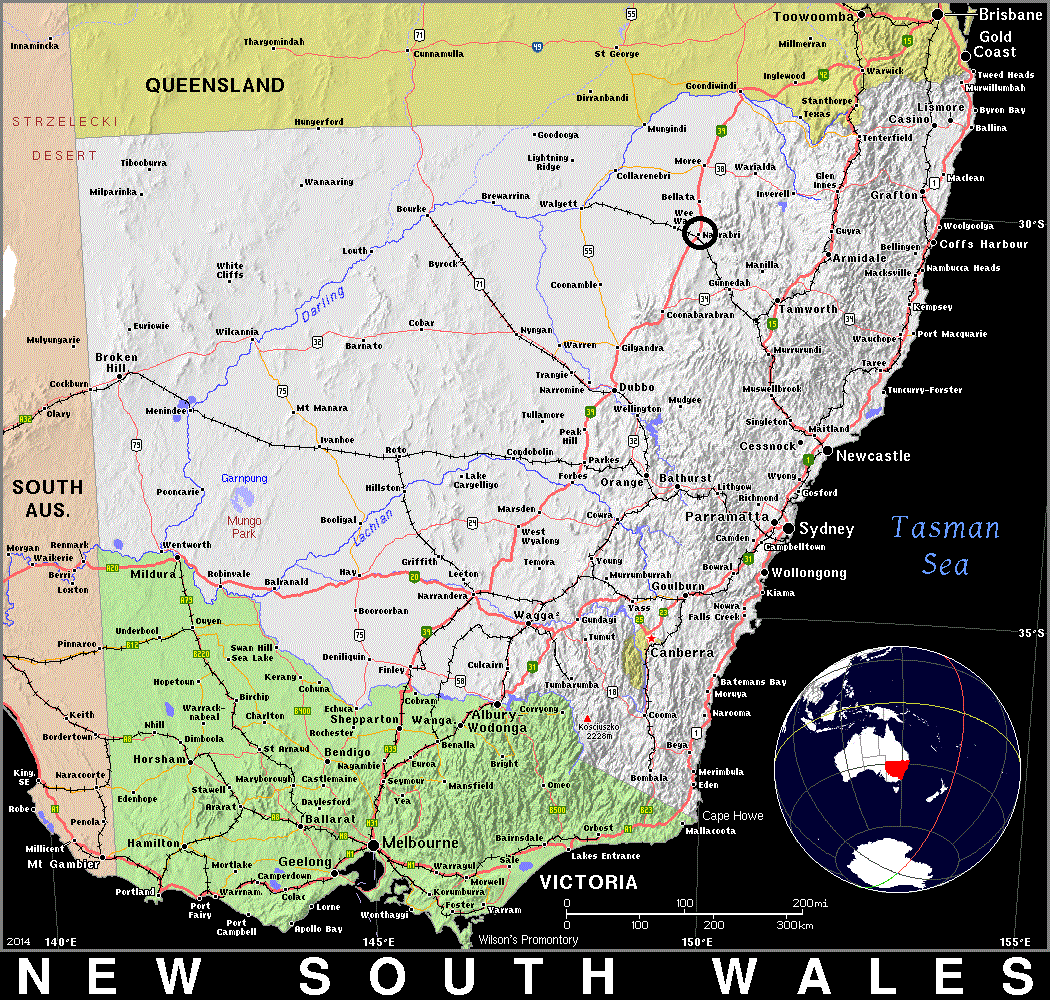
 Climate, technology and chaos Blog