Posts Tagged ‘knowledge’

Cthulhuocene

August 29, 2019

HP Lovecraft’s story, The Call of Cthulhu, opens with some of the most famous lines of horror literature:

The most merciful thing in the world, I think, is the inability of the human mind to correlate all its contents. We live on a placid island of ignorance in the midst of black seas of infinity, and it was not meant that we should voyage far. The sciences, each straining in its own direction, have hitherto harmed us little; but some day the piecing together of dissociated knowledge will open up such terrifying vistas of reality, and of our frightful position therein, that we shall either go mad from the revelation or flee from the deadly light into the peace and safety of a new dark age.

Lovecraft reverses the then standard idea that we more or less know everything and can know everything relevant, and proclaims this lack merciful rather than horrifying. We are forced to remain in blissful ignorance of the nature of the universe and “our frightful position therein”. The story then proceeds to undo this opening statement, and make it clear what at least part of that frightful position is, and how vulnerable we are to destruction from things we don’t, and cannot, understand.

In a way, this almost exactly suggests how we approach the Anthropocene. The customary position is to refuse to “correlate all our contents,” to argue that the world cannot end from trivial and everyday human actions, to reinforce our ignorance and lack of understanding of an object which is beyond our understanding, and certainly beyond our ability to predict. However, the sciences continue to piece together dissociated knowledge, and open up the terrifying vistas of a climate and ecology, so disrupted and out of control, that we either go mad, or flee into a new dark age in which science and knowledge is subservient to fear and politics.

Both stories are almost detective stories, “flashed out from an accidental piecing together of separated things.” Lovecraft’s tale is a detective story which links events from all over the world. A professor dies, from unknown causes, after being jostled by a “negro”; racism and horror of the unknown is never far separated in Lovecraft. His heir goes through the professor’s boxes and discovers strange things. These scattered objects and texts, like the fragments that most of us live with in the Anthropocene, strange weather, disappearance of insects, drying rivers, weird snowfalls, scientific gibberish, conflicting accounts, jumbled correlations from over the world, bad dreams, disease, disturbed artists, and mental illness out of nowhere, hint at a story which will destroy the hero and reader’s peace of mind forever.

Images recur, of a hybrid being – “simultaneous pictures of an octopus, a dragon, and a human caricature” – but “it was the general outline of the whole which made it most shockingly frightful.” Again it is the outline, the suggestion which is beyond easy resolution, like the Anthropocene. No one knows, or can know, what the Anthropocene means, what its outline really is. It can look like sea level rise, drought, storm, or any number of ‘ordinary’ things, but putting them together all at once, in varied combinations, is impossibly disturbing. All we can tell is the natural order is not what we thought. Its image can suggest “a fearsome and unnatural malignancy”.

Both tales bring into mind the vast ancientness of the planet, which has lived without us for billions of years, and will live without us for billions of years. This creature, beyond conception, harbours no special affection for humans, no hostility either, just complete lack of concern. Whether we worship it or not, counts for nothing, although worshippers might convince themselves otherwise. This massive creature, on whom we live and which we are part of, has been sleeping. The Holocene has been relatively free from upheavals, and indeed might have remained free from such upheavals for thousands of years, but we have prodded it, not perhaps, awake, but to roll over it its sleep, to scratch off its fleas, perhaps for some fragment of it to arise out of the oceans and throw civilisation aside without even noticing. Let us be clear, although the Anthropocene may mark a geological epoch, in terms of world existence it is nothing, a mere blip. In a billion years, a relatively small time in planetary life, nothing of the Anthropocene and human life will probably remain to be detected. The earth does not see us, we are no more special than any other species which has vanished in the past, trilobites, brontosaurs, giant dragonflies, all have been and gone

In the story Cthulhu rises from the depths of the Pacific as the earth moves, and science, so far beyond us as to be indistinguishable from magic shatters our reality, opening the strange and disparate affects we might ignore. However, rather anti-climatically, the being is driven back under the waves, more or less by accident. There was only good fortune that a ship was in the vicinity, otherwise the end would have come incomprehensibly to all, and it may yet come at any moment. Whatever safety we had was random.

Come or not, all those who hear of it, and understand however badly, can never be the same. The image haunts them as does the dread. “A time will come-but I must not and cannot think!” Others carry on, the world remaining veiled. Let us hope their dreams, and ours, do not further the world-beast turning once again.

Jordan Peterson and Foucault

August 26, 2019

Some one suggested that I explain what was wrong with a Jordan Peterson lecture on Foucault. The lecture is here. In a further article I will try and do a semi-Foucauldian twist and explain how Peterson uses authority, hierarchy and rhetoric to functionally silence Foucault and postmodernism.

First off let us remember that Peterson appears to be giving a university lecture. Such lectures should have much higher standards than blog posts. What we can possibly excuse here as a matter of not having enough time, should not be acceptable in a university. I should also state clearly that I am not an expert in Foucault or in Peterson, and that I am lazy enough to only refer to the lecture referenced above. If you want more detail, then please go elsewhere.

Although I have watched quite a number of his videos, I have yet to see any evidence that Jordan Peterson has read Foucault or, for that matter, any of the so called “postmodernists” he criticises. There is certainly no evidence that he has read these texts closely or carefully. I’ve yet to see, in any of his multiple lectures and talks, any quotations in context, page references, or any attempt to explain what the person being criticised is actually on about with proper documentation.

That does not mean such talks or papers do not exist, but that I have not seen them, and I would have expected to be recommended them. He largely seems to rely on his listeners not knowing anything other than rumor about the people he criticizes, and of them probably being predisposed to rejecting those thinkers in the first place because of the listener’s pre-existing political loyalties and the media they attend to.

[As a footnote, I’d point out that, although it is ambiguous, in the debate with Žižek, Peterson seems to be suggesting that he had just read the Communist Manifesto for the first time since he was 18. This is rather odd for a person who regularly dismisses and criticizes Marx. In that debate, Peterson provided no evidence that he had read any of Marx’s mature works at all, or any other Marxists whatsoever. Which is, again, odd for a person who presents as an intellectual authority on Marxism, but it does suggest a proneness to criticizing without familiarity.]

Please note that I am not saying that Peterson never says anything worthwhile – his first book for example Maps of Meaning is definitely worth a look, if you are interested in Jungian Psychology (which I am). It seems to be of a completely different level to his contemporary work.

So on to the lecture.

Peterson starts by stating a theme he will reiterate. Foucault is the most reprehensible individual you could imagine. You could not dream up anyone worse.

He gives no evidence for this accusation. We could suggest that Peterson appears to be making the charges simply to support his established ‘right wing’ bias and discredit the victim. There is no academic impartiality or quest for truth being shown here.

Later on he will argue that Foucault was a bitter and treacherous person, who aimed to undermine the presumably virtuous structure that would not accept him. One problem with this suggestion is that you could also criticize Foucault for being hyper-successful – which he was. For example, he had a professorship created for him at the College de France, which can be described as one of the most prestigious universities in France. He also wrote and had published an extremely large number of well-selling books. Peterson continues by saying that no structure could function with people as peculiar, bitter and resentful as Foucault. Presumably the College de France did. No evidence of Foucault’s mysterious sins are given, but it is possible that Peterson is referring to Foucault’s homosexuality and interest in sado-masochism. I presume Peterson’s idea is that, if he finds someone unpleasant, then their ideas must be incorrect or, perhaps, that if he does not like the ideas the person must be reprehensible.

The talk does not appear to be about uncovering the truth of Foucault or his ideas, but refusing him and his ideas because he is declared to be inferior, by the great judicial authority that is Jordan Peterson. In other words, by his example Peterson appears to be arguing that ethics is about power and slander. He would almost certainly deny this, of course. But let us set these ad hominem arguments to one side, and get on with the other arguments.

Peterson states Derrida and Foucault were avowed Marxists in the 60s and early 70s. As usual he gives no evidence for this. I don’t know if there is any particular evidence for this. They were influenced by Marx, and argued about Marx, but then again few thinkers of the period were not either influenced by Marx or attempting to argue against Marx. So it is not surprising they could have discussed Marx, even if they disagreed with him, and thought society could be improved. We might declare that Hayek was a Marxist by the same logic.

If Peterson could have been bothered to read the Wikipedia article on Foucault, instead of following his own knowledge entirely, he would have learnt that Foucault “left the Communist Party in 1953” being “appalled by the anti-semitism exhibited during the 1952-1953 ‘Doctors’ plot’ in the Soviet Union” and having experienced directly the bigotry of the party. The same article claims that Foucault refuted “core Marxist tenets such as class struggle” and later said “Marxism exists in nineteenth-century thought as a fish exists in water; that is, it ceases to breathe anywhere else.” In other words Marxism, for Foucault, was not a significant innovation, it was rooted in the 19th Century Western way of thinking and thus completely superseded in the present day.

Judging by what follows, the point of bringing in Marx is to reinforce the ad hominem argument, and to discredit Foucault and Derrida without having to argue against them, or exhibit much knowledge of their works.

Peterson states that even Sartre was not a Marxist by then. Well that is convincing. Unfortunately he appears not to know much about Sartre either. Sartre was writing against the Soviet Union from the 1950s from a Marxist point of view. He considered it important to protect Europe’s autonomy from the Soviet Union and from the US, and not be torn to pieces between either of them. Sartre later called himself an anarchist, and opposed the corporate take over of media, but he considered his Marxist oriented Critique of Dialectical Reason, to be one of his most important works.

The problem is that Peterson confuses Marxism with support for the Soviet Union or Maoist China. Marxism is a theory of social processes, it is not support for a particular State, indeed Marxism promises the State will wither away after the Revolution – obviously something that did not happen in any Marxist Revolution. And if Peterson had the slightest knowledge of Marxism he would have realized that Trotsky, who is usually considered to be a Marxist, was also against Stalinism. It is, however, not unreasonable to point out, that people who have proclaimed themselves Marxists have been murderous, just as have people who have described themselves as Christians or Muslims.

We could also say to Peterson, that by the late 60s no one with any moral integrity supported unconstrained capitalism – because everyone knew how it went; rampaging colonialism, exploitation of workers, destruction of environment, plutocracy etc. This does not mean that US capitalism is as bad as the Soviet Union, but it does not mean that it has to be essentially good. The US was, at that time, attempting a large scale undeclared war against ecology and life in Vietnam and Cambodia; the people of which were not remotely equally equipped or wealthy enough to defend themselves – which they did remarkably.

What postmodernists did, says Peterson, is that they transferred the conflict of rich vs poor into oppressed vs oppressor. The conflict in Marx is not between rich and poor, but between different classes with different imperatives. Is it not reasonable to assume that different groups do not always have the same aims, especially if one is supposed to dominate the other? Can we always assume harmony between groups?

Peterson seems to be trying to deny this. He seems to be trying to argue that those at the top of the hierarchy always have your interests at heart…. I may be wrong, but that may be why he needs to discredit Foucault and Marx.

He states, Foucault’s aim is:
a) to resurrect Marxism under a new guise
b) to justify that it was everyone else’s problem that he was an outsider.

Point ‘a’ is only true if you stretch categories so that whatever different ideas you select are the same, despite their differences. In other words, he seems incapable of recognizing difference and blends everything he does not like into a mess.

The second point seems to be another “I, Jordan Peterson, find Foucault, and what I understand of his ideas, unpleasant, so his ideas are not worth considering” argument.

Peterson classifies Foucault’s position as “The rise of the marginalised against the centre.” This is apparently, clearly bad.

He states Derrida’s thinking was the same… but adds another one of his slap down arguments that Derrida is even more treacherous, than Foucault. Yes the argument Derrida supposedly deploys must be really bad in that case. As you may expect he presents no evidence for this, or no account of their arguments; we have to take him on faith. At some moment he reveals that Foucault and Derrida did not like each other and disagreed with each other. He makes a joke. But apparently they are the same, even if they disagree. Does Peterson make an argument for this similarity? Not that I can see. Does he tell you what they argued over? Not that I can see. However, this just might be important for understanding what they are saying.

He asserts that the post-modern argument (it is not a Marxist argument, but they are blended anyway), is that there is a Political centre and then there are people outside those central categories.

Peterson admits this is true…. to categorise you have to include and exclude things from categories. So categories involve inclusion and exclusion. Rather dramatically he says that without this you just die. He gives no evidence for this over-dramatic position, and then says that schizophrenic people’s categories break down – but, assuming this is true, and again he gives no evidence for what is a reasonably contentious position, we all know that schizophrenic people exist – they don’t die immediately….

He appears to ignore the fairly obvious idea that categories can be more or less accurate, and perhaps more or less oppressive: we don’t have to exclude gay or female people from being able to discuss politics, simply because they are gay or female, or whatever. Making our categories fit their task better, could be considered one of the primary tasks of philosophy.

So I don’t understand his point here. But perhaps it is to suggest that people who don’t accept Jordan Peterson’s preferred categories, perhaps like Foucault or Derrida, are insane (or can be classed as schizophrenic). In which case we have another ad hominem argument, this time by a very tenuous association, and I’m starting to get tired with this style of thinking.

We are then told that this is an incredibly crooked part of their thinking, because category systems exclude, political systems exclude, any hierarchy of value excludes. So far, if he is correct about what they are arguing, he is agreeing with them. He then asserts they think that the reason those hierarchies of value are constructed is to maintain the hierarchy of power. While he does not explicitly argue that such a position, can never be true, it would seem to be implied; he is not exploring when it might be true and when it might not be true. But unfortunately for him, the position that hierarchies of value are sometimes about power is plausible.

The wealthy can construct a hierarchy of value which asserts that wealth is a mark of virtue, of hard work, of ‘talent,’ of God’s favour, etc. and that those who are not wealthy are not virtuous, not hardworking, not intelligent enough to become wealthy, or not favoured by God – they are implicitly inferior, and should be guided by the wealthy because the wealthy have demonstrated the right virtues. In reality, they might add, those few of the wealthy who argue for the rights of the poor are corrupt and don’t have the normal set of wealthy virtues.

I think I’ve seen hierarchies of value like that on all sides of politics.

As a side point, the French thinker most associated with this kind of position is Pierre Bourdieu, who is not Foucault, and not a post-modernist in any meaningful use of the term, but let us all keep blending everything together to make ideas less clear.

Peterson adds that this claim that hierarchies of value maintain hierarchies of power, is an incredibly crooked claim. He does not explain why, but he does assert there are hierarchies everywhere and perhaps continues to imply that they are all unproblematic. He does not argue that hierarchies may be both necessary and may distort, or act as tools of power.

His example is that in order to laud musical genius we have to exclude those musicians who are crap. He does not discuss the fact that people may disagree quite vehemently about this. I know people who don’t appreciate Bach, and others who can’t understand any techno. I personally don’t like much Beethoven other than the late string quartets. Wagner bores me. Some people prefer Eric Clapton to Jimi Hendrix. There is, as we say, “no accounting for taste”. Music is not really an area of social compulsion in our society, so opinions can be varied. However, liking the ‘right music’ could become a marker of status. We can easily imagine statements like “No one who dislikes Wagner could possibly be high class. We don’t have to listen to such a person.” Or “people who don’t like blah are just not up to date” or whatever, because most of us have experienced how hierarchies of value can be primarily about power, status and exclusion….

Peterson claims this is the postmodernists’ essential claim but makes no reference, yet again. He does not explore the issue. Maybe his aim is to condemn rather than explain? I don’t know for sure, but it is starting to look that way.

Peterson remarks that for Hobbes people in the state of nature fought – this is the chaos of individuals, so people had to be organized by force. So is he justifying violence in politics? Its not really clear, but it looks like it.

I agree with his remarks that people and social structures can be good and evil – and that we don’t like having this pointed out. So can we assume hierarchies (a social structure) can be good and evil at the same time? Apparently not.

He continues arguing that postmodernists added a collective element, in which groups of individuals struggle for power. Most political theorists talk about groups, classes, etc. not just postmodernists, so I don’t get the point again. To me, most people are individuals who exist in [categorizable] groups, and are shaped by the relations within and between those groups. Very few humans have survived without groups. This is another paradox, the individual may require groups to learn to be individual, and to be recognized as an individual. This is not Peterson’s position here. Later on he dismisses the idea that people can belong to identity groups and find it hard to discuss with each other across the borders. I’m not sure why. After all, postmodernists appear to find it difficult to talk with Petersonites and vice versa.

I’m not sure this stuff about identity groups is in Foucault, by the way, but I’ve already asserted I’m no expert, and the idea of ‘identity groups’ (other than right wing or suppressive identity groups), has become one of those slur terms used to discredit people’s politics when they suggest that some people might be excluded, as a group, from the wholesome righteous vision of society. (There is a series of posts on Identity Politics, on this blog).

Peterson asserts that in the postmodern Marxist universe there is nothing but power. Which, if true, implies that postmodernists are not Marxists, because Marxism is materialist. There is the world, its resources, what we call ecology. There is social organisation. there are ideas that grow out of actions in the world etc.

He then asserts that postmodernists don’t admit any standards, don’t believe in the real world, or science. He makes jokes about science denialists using mobile phones. He does not extend the joke to right wing climate change denialists who use mobile phones and dismiss climate science as ‘socialist’. Perhaps it is only relevant to criticize those identified as leftist. I don’t know enough about Peterson to wonder if he is one of those people who deny climate change because he does not like the politics of it, and is thus the subject of his own jokes? I guess you might have to do the research if you want to find that out.

He asserts that for Postmodernists there is no such thing as ethics or high order value.

I would say that Derrida and Foucault actually seem to be obsessed with ethics. Perhaps the problem is that they may think ethical problems are difficult, and cannot be resolved by an appeal to authority, even though that is routine and perhaps necessary? But I’m not claiming to be an expert.

Peterson appears to simply deny their ethical concerns and asserts that postmodernism is self defeating (apparently if an argument appears to have unpleasant consequences it cannot be true). He concludes by saying that postmodernism is obviously a mask for the continuance of Marxism because Marxism has an ethic and involves struggle even if its ungrateful… This is not remotely logical in my view; postmodernism does not have an ethic and does have an ethic. I cannot follow the argument. So I might be missing his point.

He suggests that postmodernists suggest that Western culture is pathological, and responds by apparently saying that as pathological as Western culture is, its less pathological than everything else. His only argument for this is that people are said to immigrate to the west in greater numbers than go in the opposite direction. Even if this is the case, it may mean that Western propaganda is good, not that Western culture is good, or accepting of migrants. I don’t know, the level of argumentation and documentation is not high.

He remarks that there is an argument that the only reason the West functions is because it has raped the rest of humanity and the planet. There is an awkward pause as he apparently cannot think of anything to rebut this position – and he concludes the less said about that the better. Which is, I suppose, another slam-dunk argument. Who could wonder about incoherence being an effective argument. This is perhaps very postmodern or zen or something.

He then says that postmodernists don’t believe in grand narratives. He could point out this was an argument made by Lyotard, not Foucault but, by now, we should be used to this merging of different thinkers, and different thought, into a mess. Again Peterson employs the argument by unpleasant consequences: If there are no grand narratives then there is no meaning. However, his argument does not mean grand narratives such as the ending of capitalism in workers revolution are true because they are grand narratives, no matter how nice it might be to think with that.

Peterson suggests we need an ethic. He again appears to ignore the ethics of postmodernists. He argues that postmodernists are demolishing the fictions that unite us as people, and that we cannot cooperate without these fictions. In other words, the unpleasant consequences of non-cooperation mean that their argument (whatever it is) can be dismissed.

Consequently, he appears to be suggesting that we should just accept these fictions and they should not be challenged. This is an ethical position, but it is not one we have to accept. Indeed the normal “Western position” might be that “noble lies” should be undone, and that our grand narratives should have some relationship to truth or accuracy. We should at least be able to discuss these narratives. If we accept this position, then surely postmodernists are carrying on this tradition, while Peterson is shifting it to one side – perhaps in the interests of established power? I don’t know.

He then asserts that it is unbelievably corrosive, to assert hierarchy is about power. He argues brutal people don’t establish stable hierarchies. Hopefully this is true, but we are not given many reasons to think this is correct, other than some discussion about chimps, who generally don’t organize armies very well, and how on earth does this mean that hierarchies are never about power?

He asserts that stable hierarchies are about relationship. This also may be correct. I would like to think so, but Foucault, if known for anything, is known for the assertion that power is in relationships, it is not something exerted by one person who has it, on another who does not – where there is dominance there is resistance. Foucault appears to assert that power is not just about brutality, it is necessary to exist humanly – it can be what is needed to uncover and cultivate one’s self. Relations of power can also hide their brutality. So while it appears that Peterson uses Foucault without acknowledgement, he does not use him in his complexity.

Peterson then talks about hierarchies of competence, which again is plausible, but has little to do with Foucault, that is, if you are not going to ask how ‘competence’ is socially decided.

One problem Peterson ignores, and it may not be relevant for him, is that hierarchies can tend to hide mistakes, and to hide the past, in order to justify their behavior in the present. That this might be disconcerting does not mean it is incorrect. Indeed anyone might learn this from Foucault.

For example, we often think we treat mad people better than they used to, but we might find out through study that in the early modern period they did not lock up, drug or punish mad people or abandon them to poverty in the streets. They may have thought of them as different rather than inferior or incompetent. The ‘moon struck’ might even have wisdom useful to others (the fool for example). In these societies, some poorer people could live outside of a total labor hierarchy (The History of Madness).

Foucault might also lead us to wonder if medical hierarchies have tended to dehumanize us, breaking us down into isolate parts rather than be considered as a whole people, or persons with emotions, fears and relationships. Indeed some doctors might have listened to some of this, and be attempting to improve practice (The Birth of the Clinic)

Different historical periods might have different patterns of thought, that strongly influence what can be argued successfully and taken as true. This suggests we might not be improving in knowledge, simply changing our patterns of thought, and if we want to understand the past, or other cultures, we have to be willing to accept the presence of other patterns of thinking (The Order of Things).

The contemporary prison system might support or reinforce the social hierarchy by isolating people and hiding the cruelty they experience away from sight of others, who might come to empathize. The prison might well have become the model of the factory, and hence the office, where the workers are under constant surveillance by their superiors, and have to exist for their superior jailers. Indeed the prison might become an ideal factory in which employees are under-paid, or not paid, supported by the tax payer, and without the power to resist. Control can exist without overt violence (Discipline and Punish).

We may well have medicalized sex, or have subjected it to a confessional process, both of which could be considered hierarchical submissions, rather than learnt how to cultivate the pleasure of it for ourselves and partners….(History of Sexuality Vol.1)

Peterson does not discuss any of these major writings of Foucault but after reading Foucault, it may be harder to just assume we are better than we used to be, or better than other societies, just because it is pleasant for us to think so…. This might be a good thing.

Peterson’s final argument seems to be that contemporary processes are incredibly complex so you want disciplined people who are super smart to make it work, and to rise to the top. Yes we do, but that does not mean we will always get them.

We often get incompetents who appear brutal and stupid – for god’s sake he was talking about Stalin ten minutes ago! The Peter Principle should be well known to him, and other people – it is about how hierarchies undermine themselves by promoting people who were competent to their levels of incompetence. Is it not, at least, conceivable that an undisciplined, not very clever, or coherent person, could become US President and take down all the competent machinery of government? Apparently not.

Peterson argues that competence must be everywhere. Yes, there must be a lot of it about or everything will fall down, but that need does not mean we will get it, or we are not falling down. It merely means it would be nice to get it, and we should perhaps guard against dangerous incompetence. The niceness of something does not mean it is inevitable. He then asserts that postmodernists were after both the destruction of competence, and the idea of the world. He refers to Derrida. There is some awkwardness here, because Peterson is aware that we interpret the world as Derrida states, but he asserts there is more than just that. Of course.

Then lecture ends…. Perhaps it gets better in the part we have not seen.

The point is that Peterson attacks Foucault, Derrida, post-modernism and Marx, without giving any references, without any quotations, without any attempt to give them a decent exposition. He does not even seem to have read Foucault for Dummies or whatever. He just attacks them and relies on the ignorance of his audience for the attacks to work. It also seems important for him to justify a particular kind of hierarchy, without saying why it should be justified. Could you justify any hierarchy and its violence in this kind of way?

As I said earlier, maybe Peterson does a better job elsewhere. I’ve not read it or seen it, but it could the the case. However, my point remains. If you are watching Jordan Peterson as a philosopher, please ask him for evidence and please don’t think you can learn about people he has declared to be his enemies from him alone.

If you want to understand someone, read them, don’t listen to Peterson or me. There are also many introductory books and articles to Foucault, or other postmodernist thinkers, which are far better documented than anything I’m going to bother to write for a blog, and which would give you a better idea of what Foucault, or other postmodernists are about than anything I would have time to write, or Jordon Peterson can be bothered to explain.

The second part of this blog tries to list and explain, the modes of silencing of discussion, that Jordan Peterson uses in this lecture

Other possibly relevant blogs:
Three sentence Marxism

August 21, 2019

Material forces are important in history

People organise themselves to live in (or adapt to) a material world, and this organisation affects the rest of our social life, our conceptions of the world, and the course of history.

History is the story of class conflict

Forms of social organisation tend to set up modes of domination, oppression and exploitation and this sets up forms of resistance and conflict between social groups or ‘classes’.

The dominant ideas of an era tend to support the dominant classes of that era

Ideas tend to come out of their producers’ experience, which comes out of their way of life and modes of social organisation. The people who make the dominant ideas tend to be supported and funded by the dominant classes. The dominant ideas are distributed by people who support the dominant classes, and these ideas tend to justify or naturalise the dominant classes’ mode of oppression and action.

Conventions, Knowledge and Politics

August 3, 2019

I want to discuss the connection of conventions and knowledge by consideration of a political speculation.

The speculation is Could US President Trump declare a third term, or even become president for life?

If you don’t like speculating that Trump is able to violate existing convention, then substitute the name of your favourite political villain, who has power, whenever you read the word ‘Trump’, or just delete the word Trump. Cut and paste if necessary.

To begin to answer this question we have to ask “What is a constitution?” “What kind of power does a constitution have, and how does it get it?” and “how do people know about the constitution?”

I will suggest that constitutions have power because of the way they are interpreted, and the web of institutions and conventions that grow up around that constitution. This web of conventions and interpretations, sets up people’s knowledge about the constitution. Most people will not know the constitution in detail, they will only know it by what they are told, or how they are told to read it. As the interpretations change and the web of institutions change, or the conventions around those institutions change or weaken, then the interpretations of the constitution, knowledge of the constitution, and the role of the constitution can change. No constitution has power in itself alone, outside of this dynamic and complex context.

Constitutions are, like most laws, to a large extent decided by argument and by what people find they can get away with.

To return to the initial question about President Trump. This is of course a difficult question to predict the answer to, because the answer precisely depends on the interactions in complex web of institutions, conventions and interpretations, which will inevitably be involved in political struggle. Victory in that struggle is hard, perhaps impossible, to predict.

The simple answer to the question about President Trump, is that ‘constitutionally’ “no, it can’t happen” because of constitutional amendment XXII.

The status of an amendment is, again, not set in stone, but in convention. That the term limit is set by an amendment, may suggest the Constitution could be amended again to remove that clause. There is also a debate as to whether the framers of the constitution would have supported such an amendment, or whether they may have intended the President to be an elected king. If so, people could argue that the amendment is unconstitutional in itself and should be revoked, subject to further debate, repealed, or de-ratified in some way. If the institutions, or some of them, could be persuaded, or commanded, to be considerate of this view then the struggle is partly over. Yes there will likely be dispute, but the result depends on the strength of conventional institutions, their interpretations and the ruthlessness of the politics supporting or challenging these conventions.

To repeat, constitutions are matters of struggle, interpretation and precedents which are not certain – the knowledge of the precedents and what the constitution means is tied up with the interpretation of the Constitution. Words are always ambiguous, and their meaning can alter as the context (political or otherwise) alters. Even knowledge of the past can be interpreted in different ways and become a different history, which then gives different meanings to the present, and can be used to justify the argument the presenter wishes to justify. So the supposed constitutional framework of politics, and knowledge of that framework, is affected by the politics that is conducted within it.

President Trump and his party have to be admired for the skill with which they have undermined convention, interpretation, precedent and knowledge, and have set up new modes of interpretation and knowledge which favour them. It is no longer apparently disapproved for the President and his family to profit financially from the presidency. It is no longer disapproved for the President to accept help from a foreign power to boost his electoral chances. The President can apparently seek to obstruct the course of justice and it is not a problem.

President Trump has been explicitly attacking standard conventions of the US constitution. He has claimed that Article II gives him powers which no one has previously realized. He says it means he can do whatever he likes. People who are experts in the Law, say this is not true, but he has made the point, and his followers are more likely to believe him, than the experts. He has not been condemned for making these claims about the lack of limits on his power, by many people on his side of politics.

He has also claimed on two separate occasions that he can easily overthrow the 14th Amendment which says:

All persons born or naturalized in the United States, and subject to the jurisdiction thereof, are citizens of the United States and of the State wherein they reside.

Initially he claimed he could change it by executive order, and later by somewhat vague method. However, it is being asserted that the Constitution is not immutable and that he can suspend it, and those who say he can’t are wrong. Importantly Republican members of Congress seem to be largely not protesting against these claims, which suggests tacit support for Constitutional fragility, as long as it benefits them.

If any of this is disturbing to supporters, they can also deny it is true quite easily because of the mess of information, and because any position can be supported in information society – including positions which support any presidential overthrow of term limits. Likewise, as I have argued elsewhere on this blog, the information groups we belong to limit our access to disapproved-of-information and tie the information we accept to those we identify with so that information received and accepted becomes a matter of identity. In this situation, people who support, or oppose the President are less likely to have the full arguments of the ‘other group’ presented to them, and most likely dismiss them without understanding them. This is part of the way we come to know things.

President Trump also intensifies the patterns employed by previous Presidents to bolster power-concentrating conventions and precedents. He is part of a trend which helps him. He has continued deepening ‘the swamp’ of corporate interest, and governing according to those financial interests. He openly encourages corporations to pollute and poison people in the name of economic prosperity. He breaks treaties, and threatens war, by himself without consultation with Congress. His followers do not appear to expect him to tell the truth to the people, to conduct a remotely civil debate, or to refrain from multiple adultery and sexual assault. And so on.

The conventions have changed, and the sources of information the President’s supporters are repeatedly exposed to, have changed as part of this change. The lack of civility which the President encourages, also encourages the sharp separation of information groups, and the unlikelihood of his supporters or opponents getting information presented to them neutrally.

Within this kind of context, can we assume that if Trump did declare martial law, or claim a third term (perhaps because a winning Democrat had accepted help from Russia, had a sex scandal, or committed massive financial fraud that disqualified them from office), can we guarantee that fellow Republicans, judges and officials would not support him and would not denounce those opposed to this move as traitors, communists, or even terrorists? Would they absolutely not talk about armed insurrection if they were losing, or using the army to suppress dissent if they were winning? Would they not have the support of large swathes of the generally pro-Republican media? Especially after a few well placed threats? Would they not claim that violent neo-fascists who might go around beating up opponents were innocent, patriots, or just people fed up with the ‘deep state’? Would the institutions which support the conventional meaning and knowledge of the constitution, stand up for those meanings and knowledges against the direct instruction of politically appointed directors? Could they organize themselves effectively, or would they collapse in confusion and multi-directional impulses or internal dispute, which have resulted from the political discourse that splits the country?

I’m not sure whether any of this is possible or not. It would be nice to think it is all rubbish, but events suggest the US would not have that much further to go before it became possible, and then possible and acceptable, almost no matter who was President, and that the country and its institutions are heading in that direction, slowly and almost imperceptibly to most US citizens.

People can acclimatize to anything, given enough time, and the argument that President Trump is stupid, misses the fact that ignorance is not stupidity, and he has years of successful self-promotion behind him. He may have a limited set of skills, but they may be exactly what is needed for him to gain a third term if it is possible. He also has incentive to go for a third term because it protects him from prosecution…

There are plenty of occasions in which people have said that something could not happen, or would not happen again, just before it happened. Historically dictators have ignored convention, re-interpreted laws, declared states of emergency, got support from other interested factions, conducted massive misinformation campaigns, suppressed dissent, changed the status of knowledge or whatever. It has happened.

It would not seem impossible that Trump could suspend a Constitutional amendment, and that he would received support, rather than face immediate and compelled dismissal. Especially if he and his supporters were prepared to use violence to support their position.

Overconfidence in procedure, convention or knowledge, remains a great way to remain unprepared.

Denying consensus

May 27, 2019

There was comment on the Guardian site recently which shows at least some of the problems with the Left.

It ran something like:

Three really good reasons to deny the science of climate change:

  • 1. Ignorance
  • 2. Stupidity
  • 3. Insanity
  • This formulation tells us nothing. It offers no strategy for persuasion or action. Perhaps, it makes the writer feel better, and heavens we all need to feel better, but it succeeds in making the likelihood of communication and problem solving even less, by name-calling and making barriers and reactions. It puts people who disagree with the speaker(and even some others who might be friendly to those speakers) into dismissible social categories and prevents people from hearing each other.

    It creates problems, it does not diminish them.

    Let’s look at some other reasons people might have for not being active, which are slightly less closed.

  • Fear. People don’t want to think about climate change, because there are no obvious things they can do. It threatens their children and grandchildren, and that is not easy to face. If correct it could be terrifying. Yet we have lived with the threat of nuclear war, population increases and so on, and so far everything is all ok. I spent my youth terrified and nothing happened. Maybe this will be ok, as well?
  • Lack of fear. Everything is in the hands of God. The world is too big to hurt. How is this tiny amount of a perfectly normal gas I breathe out every day going to massively disrupt the whole Earth? It doesn’t make sense. Humans are insignificant in the scheme of things. I cannot change what will be.
  • Sense of probable loss. Loss is painful, and over the last 40 years we have lost out over and over. The promises we were given have not eventuated. You guys trying to stop climate change could take even more away from me and my family. This is another loss. Let’s hope it is as unreal as the promises we were given.
  • Uncertainty as to whether remedies will work. Do we have any guarantees these remedies will work? No? In reality we don’t. It may even now be too late, and plenty of people assure us the costs are way to great to take action without certainty. What are you asking that we should give up again? Why is it always us that are giving up our prospects?
  • Uncertainty about change. Futures are not predictable any more. Who could have guessed this would be happening? Who would guess contemporary technology? Polls are always wrong. Guesses at the future are just guesses, and you are probably using your guesses to gain power over me, and persuade me to act against my interests, like everyone else. Why should I trust you?
  • Experts are often wrong. This is obvious. All of you promised that “free markets” would deliver liberty and prosperity but they haven’t. Even vaguely. They said war in the Middle East would be easy and successful, but its been a total mess, hurt lots of people, and made things worse. Even doctors change their minds every five minutes about what is good or bad for us. They promise cures that never come. These experts are just con-artists without common sense. Everyone makes mistakes you know.
  • Life is overwhelming. I have to make too many decisions. I have pressures from work all the time. My wages and conditions are being cut. I never get any holidays. My boss is a total dickhead. My company is corrupt. I’m not feeling well. My spouse is unhappy. I’m one or two pay days away from family disaster. My kids are acting weird, and I don’t know what to do to help. I’ve too much on my mind. Go away… I don’t need this climate bullshit.
  • Immediate pressures. [Pointed out by Alice Suttie] I have to provide for people around me today. I have to deal with real problems now, not decades, or even just years, in the future. My mother is really sick, I have debt collectors at the door, the electricity may be going to be cut off. I’m busy. I don’t have time to worry about irrelevancies. If you can’t help me now, or propose policies that help me now, then trouble someone else will you?
  • You people are just rude. You obviously don’t understand me. You are obviously not going to listen to me. Why should I listen to you? You are up yourselves, you f+@in alarmist morons
  • There is almost certainly more that could be said here. The advantage of some of these formulations is that the speakers are seen as relatively rational (as people are). We are not dealing with stupidity or insanity which cannot be altered. The statements are largely based on real remarks I have read from people. They are specific, not catastrophizing, not foreclosing of all solutions, like ‘madness’ is. They suggest that some of the problems might be generated by the activist approach, so the approach may need to change. They also suggest that there are specific questions and dialogues which need to be opened and pursued, and that people might be persuadable.

    Now these dialogues may not be easy. They may involved being abused. But the possibility of dialogue and failure also suggests the possibility of learning something new together.

    And that might get somewhere. At least further than thinking the opposition is ignorant, stupid or mad.

    Three forms of contemporary politics?

    May 26, 2019

    The Triad

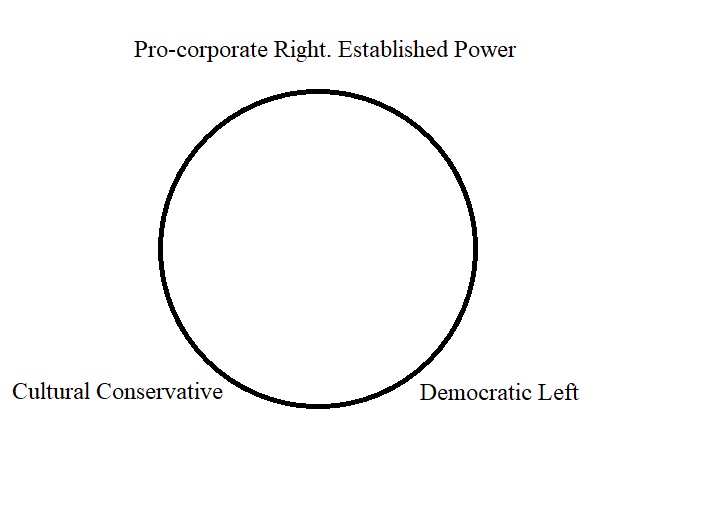
    It could be useful to think of contemporary Australian, and probably US, politics in terms of a triad:

    (Currently Pro-corporate) Right
    Cultural Conservative
    Democratic Left.

    Using a triad rather than a set of binaries helps us to avoid seeing these factions as opposites. They all share things with each other, can move from one position to another, and ally with one another.

    political circle 02

    In brief:

    The (pro-corporate) Right support established wealth and power. They consider that the powerful are virtuous, and justified in that power, by virtue of that power and wealth. Given that the main contemporary power resides in the corporate sector they tend to support that sector and its justification within so-called ‘free markets.

    Cultural conservatives support what they see as traditional culture, and traditional power relations.

    The Democratic left supports ‘the people’, against entrenched power and entrenched ‘irrational’ culture. They tend to see themselves as the supreme judges of what is entrenched.

    In more detail:

    The Right tends to attack the rights, incomes and conditions of ordinary people in order to support established power and hierarchy.

    Power must be maintained, and society geared towards providing the best conditions for the powerful to do their stuff (whatever that is; make money, use violence, own land, spout theology etc.), as that is supposedly best for everyone. They are anti-democratic at heart.

    They oppose any kind of benefits for the poor, which are not a form of charity which requires genuflection towards the rich, or other elite, and hence reinforces the power system. To them mutual obligation means the obligation of the poor not to accept help that costs the elite anything, or for the poor not to challenge the elites.

    They also oppose to any traditional culture or set of values, which acts to restrain the power they support which, as stated above, in our society is the corporate sector.

    They encourage culture wars to maintain separation between conservatives and the left, and use conservative respect for established power to persuade conservatives that they are both on the same side.

    If contemporary rightists have a religion it tends to assume that wealth is God’s reward for virtue and faith, and that a person’s prime responsibility is for their own salvation and then, perhaps, their family’s.

    The main problem the right face is that they know they are right. They think all information is PR and you make it correct by PR, will and effort, or sleight of hand. They are extremely good at sales and marketing in an economic system in which false advertising and hype is normal. They tend to think any counter evidence is evidence of bias, and must also be made up. The problem for them is that eventually reality cannot be denied, and bites everyone, including them.

    Conservatives tend to be suspicious of innovation.

    Nowadays, living in corporate capitalism, innovation occurs all the time, destroying traditional culture and place, so life is difficult for them.

    Capitalism also tends to reduce all value and virtue to money. This often seems fundamentally wrong to conservatives.

    While tending to support single authorities, conservatives can also like a balance of social powers to act as restraints. Thus they can support professional organisations, teaching organisation, religious organisations, business organisations, military organisations and conservation organisations having input into government. Whoever is the ‘King’ should have loyal and fearless advisers.

    They also tend to think that power involves responsibility towards both the established rules and laws of government and to the ruled. The rulers should cultivate noblisse oblige, protection for the ruled, charity, justice and so on. Ideally while everyone should know their place, there should be mutual respect. Mutual obligation is not one sided.

    Religion is often considered vitally important in cultivating virtue, generosity, judgement, content with one’s place and is supposed to act as a restraint on human selfishness.

    Cultural conservatives tend to like traditional boundaries for gender, profession, task and so on, especially when tied into religion.

    They often consider that traditional culture carries a wisdom, which cannot be easily summarised intellectually, and that breaking traditional culture and its mores carries unsuspected dangers. This can lead them to support functional ignorance, as new knowledge might be dangerously mistaken.

    They are strongly suspicious of people for being different, and can team up to put down any difference, thus limiting a culture’s range of potentially constructive responses. This is a weakness.

    Another weakness is thinking that by allying with established corporate power, primarily against the left, they are defending cultural wisdom against difference, and that this gives them real power. In other words they often think that established power must inherently be virtuous and conservative. What they eventually discover is that if they get in the way of money making, or whatever the right’s hype of the moment is, then they will be over-ridden completely.

    More on conservative philosophy here

    The Democratic Left tends to be suspicious of everything that oppresses, or could oppress, people and which only has backing in tradition or raw power. They tend to think that what seems like arbitrary power and culture should be destroyed.

    For them ordinary people are as wise as anyone else and should be supported in their efforts to better themselves. People should not be ignored or suffer simply because they are poor or outcast – this is unjust.

    The problem for the left is that revolutionary leftists, if the revolution succeeds, become the new rightists. They support the new forms of established power and run roughshod over those who oppose them.

    On the other hand, moderate leftists tend to accommodate to the power of the right, and thus end up cautiously supporting oppression to receive funding. They may also accept established power relations in return for what appears to be the ability to moderate that power. This position can achieve something, but without them encouraging another set of power bases, they cannot hold the achievement. This is clear from Hawke and Keating in Australia, Blair in the UK and Obama in the US.

    Leftists are often conservative; they don’t want to reduce every virtue and value to money, they tend to like balance of powers, and they often support the achievements of the past which have now been swept away by the Right: for example the Menzies idea that social insurance was a right, and that people should not be humiliated or harassed for accepting it, or the idea that workers form a valuable community rather than a disposable resource. They also tend to support environmental conservation and oppose destruction of land and place.

    Their main problem is the tendency to want to overthrow traditional culture rather than improve it. This is one reason, that ‘modern art’ holds so little popular appeal; much of it only rebels. Conservatives are probably correct that culture holds some evolutionary adaptive organisations, but that it may well need to change as circumstances change.

    Leftists are easily persuaded that conservatives support harm for the marginalised, are racist, sexist, superstitious and stupid – which helps drive the culture wars, started by the Right, and which tends to throw them on the mercies of the right.

    Consequences

    The point of all this is to suggest that there is perhaps as much commonality between left and conservatives as there is between conservatives and the right, or the right and the left. There is room to be flexible. However allying with the right is likely to prove disastrous for the other two sides, partly because the right has no respect for reality, only wealth. Both the left and conservatives have weaknesses which sabotage them, but which have a chance of being corrected by the other.

    Historically it could be argued that the successful 19th and early 20th century reform movements, that lead to public education and protection against misfortune for the working class, arose through an alliance through the democratic left and the conservatives both recognizing that unconstrained capitalism was destroying traditional life, interconnections and responsibilities. That this economic system was demeaning the working men and women of the country, and that it was Christian to try and help people live lives which were not full of abject misery and poverty.

    This alliance was largely successful, despite obvious frictions. It is not impossible that a similar movement against the corruption of public life through money and the destruction of land, water and air could motivate another successful alliance.

    The only thing that seems guaranteed, is that if the Right remains dominating, then everything will end badly.

    More reflections here…

    Climate and conversation

    May 22, 2019

    These are a few suggestions based on reading and occasional interaction…
    This is not a research article.

    Lets begin with the don’ts.

    Don’t talk about climate change.
    If people do not “believe” in climate change, you are not going to persuade them otherwise.
    Groups are already polarised on this issue, and it brings up lots of reasons not to talk to each other, suspicions and so on. It becomes a matter of identity and allegiance. You need to go beyond this.

    Don’t go on about the evidence.
    They have rejected the evidence, and you personally are probably not a climate researcher.
    Both of you are taking the evidence to a large extent based on authority.
    They believe a different authority, or think they are “independent thinkers”.

    Some psycho-social research shows that counter-evidence to what people already believe, is rarely compelling and sets up resistance especially when its tied in with identity politics (which seems to be the case on both sides).

    Another obvious point: Talking about people or telling people they are ignorant, stupid or easily conned is harmful to communication. That they already call you similar things does not excuse this. Only do it, if you want to waste your time.

    If you are a politician speaking to a wide audience, then its different. You have to clearly say what you will do and why its not harmful.
    You need to lower fear and scare. And climate change is scary (even if you deny it, the you are probably scared of what those other people might do to stop it).

    For example Bill Shorten, Australian Labor Party leader, could have said, and as far as I can tell did not say:

    “The Adani mine will not bring jobs. In court, talking about the big mine, Adani promised less then 1,500 job *years* of work for people in the mine or as a result of the mine. This is not very many, especially given the project is supposed to last 25 to 30 years. There are 750 two year jobs for example. We will actively compensate for and exceed these few jobs in Central Queensland, with useful projects (names a few).
    “The Adani mine, being open cut, is likely to pollute the Great Artesian Basin and that could damage water supplies and agriculture down large parts of east coast Australia. We cannot risk that loss of jobs, food security and prosperity. If water safety cannot be guaranteed, or we find the CSIRO were pressured to give a particular result, the mine will not go ahead. We will also not support Adani being given unlimited rights to water, this is suicidal given current climatic conditions
    “We want to encourage electric cars, not force people to buy them. As usual the Government is lying.”

    This still will not get your message through the Murdoch Empire. They will lie about you whatever you do, but keep on trying – people don’t have to depend on them.

    What can you do?

    First off.

    Talk and building connection is more important than persuasion.

    You might even learn something if you are not trying to persuade people. They may still try and score points off you, but just keep talking, making some kind of connection. They may even say things you can agree with, and that can build bonds.

    You don’t have to agree with people on everything to like them, or talk to them. This idea is quite radical in itself in our society 🙂 It is also a lot easier to say, than to do. Our society does not encourage discussion, it encourages telling people each other where they are wrong (This is a “think about doing what i say, not what i do” post 🙂

    Face to face is probably better.
    You can talk in groups, many people find it easier, but it can also open old fractures, so get ready to damp that down. That people turned up, means they are interested in talking.

    Sense of Place Nearly everyone has some kind of tie to a place they love, means a lot to them, or is their home. What is it about that place? What do they do there? Is it the same as it was? If not, how has it changed. How could it be protected?

    Again, the point is to explore relation to place. It is not about cause or blame, unless the others introduce that.

    People who may deny climate change can talk about lengthening drought, changes in wildlife, the decline in bird species, the difficulties with water, the greater amounts of fertiliser they have to use, the increase in dirt (particulate pollution?). What other changes affect their lives? Are you both gardeners? – that can lead to ecological connection, although it does not have to. All these are important, but they won’t talk if they feel you are trying to manipulate them or sell them something. So don’t. People’s experience of place and change is interesting in itself – its actually vital.

    There is no ecological thinking without an awareness of the environment – and awareness of environment leads to new questions and thinking.

    Talk about your own experiences apolitically – give back. What might you share?
    If you live in a country area, you probably know the place they are talking about, and can probably relate to them.

    What remedies might they have tried? If nothing, then fine, but it is likely they have tried something; like cleanups, changing the water flows, rotating crops, tree planting, opening a wind farm, having an Airbnb to raise cash, moving to a different place etc. How did it work? How do they find the bank, or government (or other) services? What have they heard about, but is really not practical?

    There is lots of stuff to talk about. Perhaps they are as depressed/distressed as you, but about other things.

    In ecology everything is connected. Surprising things happen. Maybe they got in a rainmaker and it worked. Maybe turtles appeared out of nowhere. It’s good to relate to a special place and notice changes.

    The point is this is a long process requiring patience. Its about building relationships, building communities, that have been (I suspect) deliberately broken, largely by pro-fossil fuel organisations and political opportunism. Be prepared for things to go wrong. In some cases people have a lot invested in preventing conversations. You just start again, maybe with different people.

    It is not about winning. We either get through this together or not at all, and we can all learn.

    The Australian Election

    May 20, 2019

    I was uncertain for the whole last week that Labor would win. Partly because the movement of the polls was in the wrong direction, partly because of the relentless misinformation, and partly because Bill Shorten’s speeches were not precise, and did not say what Labor would not do – which was vital. Labor should also have broken with the misinformation that coal mines bring jobs…. but for whatever reason that seemed impossible.

    However the main reason for my despair was reading right wing internet groups. Some of this reading was deliberate and some of this was because I was getting quite a lot of promotional material on Facebook without asking for it. Please note, any remarks here are impressionistic and not a mark of extended research…

    The appearance of these groups is of seething hatred and dedication, together with apparent loathing of general uncertainty and uncertain boundaries in particular.

    Groups tend to argue by abuse and by flat statement as a way of reinforcing boundaries (if you can’t take it then you are not one of ‘us’), but expressions of disgust and certainty are not uncommon online. The point is that ‘we’ are the righteous, and need to expel the different to keep the boundaries going.

    According to participants, nearly everything bad that happens to normal people happens as a result of some left wing policy. Low wages and unemployment, because of restrictions on the economy, migrants, refugees, positive discrimination, green tape and so on. Corporate power is a problem, because the left is all on board and wealthy (a point Tony Abbott made in his retirement speech – it is wealthy electorates who are concerned about climate change, while real people understand the Coalition and know the Coalition is best). Cultural crisis occurs because of cultural marxists, radical homosexuals and transsexuals destroying ‘our culture,’ and weakening its self-preserving boundaries by insisting that foreign Islam, other races and gender constructions are acceptable. It is also felt that Leftists are snobs, hate ‘us’ and make no attempt to understand ‘us’ (or that such attempts are aimed at undermining ‘us’) – and indeed the common left lament that the people have failed has more than a hint of this. Green policies are further attempts to sacrifice working people to rich people’s needs, radical lies and snobbery. Taxation is theft, and its always the working people who get taxed by high taxing parties, which is pretty true; only its the Coalition that does this.

    It is common to see people in these groups blame corruption in the Church, the police or politics on leftist values, or the sixties. There is a single handy explanation for everything, despite 40 years of largely right wing dominance.

    This blaming merges with scapegoating of particular groups, as a form of avoidance of responsibility. And indeed, one of the problems of the modern world is that we are all responsible. Some more than others perhaps, but not ourselves ever – and we all often fight to avoid recognising that part-responsibility.

    The Israel Folau issue (the sacking of a very expensive footballer for claiming gays would go to hell) was surprisingly important because it clearly ‘showed’ oppression of religion, or at the least suppression of authenticity, while demonstrating that the left had joined with the corporate sector in attacking working people who expressed righteous anger with people who attacked gender roles, boundaries and certainties. Again the scare campaign that Labor was going to force our kids to be gender fluid only makes sense in this kind of environment, of existential boundary fear. However, it is a mistake to think that traditional gender roles have much support either, even if people claim they do. Its more complex and flexible than that.

    In a few academic articles I have got into trouble with reviewers for arguing that trust in authority has little to do with belief. While these groups fiercely distrust the left they don’t trust the political right either. If their own side is irrefutably shown to have lied or schemed against them, the response is not to consider the possibility of being wrong, but to state “all media lie,” “all politicians lie,” “both sides are the same” or something similar. This allows people to keep their opinion while dismissing evidence that it may be false. This is what contemporary skepticism (or ‘independent thinking’) means, being skeptical of counter-evidence to your own, or group’s, position.

    People seek to defeat the uncertainty of a complex crumbling society by being stable, righteous, and avoiding responsibilty by finding scapegoats, who, if removed would solve all the problems people face. For the left it might be capitalists or neoliberals, for the right it is leftists, feminists, gays, transsexuals and sometimes abortioneers. Obviously I think the first position is more likely to be correct

    The Coalition campaign made fertile use of these trends – they are much better than Labor at it, perhaps because it avoids criticising real power. More and more, Labor depends on the powers that undermine them, for funding, publicity and respectability.

    The basic assumptions of these groups were supported by the Murdoch press and other media promoting the general social fantasies they depend on such as ideas that the coalition manage the economy better, the economy is primary, virtue involves identifying or punishing out-groups. The Labor party ignored this part of life, or perhaps they did not see it or dismissed it as the work of a few fanatics, rather than of a relatively large group of people, who would support anyone who promised to get rid of what they perceived as the leftist challenge to their existence.

    Due to communication having to involve interpretation rather than transmission of meaning, it is more or less impossible for such groups to actually hear what people on the other side are saying. Once identified as from that other side, then the boundaries are to be reinforced: that person’s comments are to be attacked, and the person ideally driven away if they cannot be converted. This then leads to a shouting war which tends to reinforce the separation and the further rejection of ‘good communication’.

    What to do? The first thing is to admit these groups exist, and that they are powerful and real expressions of ordinary people’s lives. Even intellectuals can often be quick to blame the left for problems or for hostile fanaticisms… Rather than convert them intellectually, they need to be listened to and understood, and then argued with, with some understanding rather than just a condemnation which reinforces their boundaries and life worlds. This requires patience.

    It is another example of the paradox that if we are to do anything democratically it will be slow (perhaps too slow), but if we don’t do it democratically and bring people along, then we will fail.

    A good idea is not enough….

    April 9, 2019

    Thinking about the way that things could go wrong is useful when we start thinking ecologically in terms of systems and complexity; unsuspected connections and feedbacks, interaction of supposedly separate systems, and so on.

    Linear thinking, with understood and simple causal connections, is helpful but its not always enough. In recognizing complexity, we can recognize that ‘things’ frequently get out of control.

    So let us suppose we have a solution to a problem. This is a list to point us to what may happen, if we don’t think about it. The list is almost certainly incomplete.

    “that something is a good idea is not enough…”

  • It can be feasible, but we don’t put enough energy into it to do it in time needed or avaiable.
  • It can be feasible but it’s much harder than we think.
  • It may be feasible and succeeds, but it does not do enough.
  • It may be feasible and succeeds, but disrupts other systems we think are not connected to it
  • It can be feasible but powerful people and institutions attempt to undermine its possibility, so we have a political problem as well as an ‘engineering’ problem.
  • It can be feasible but normally non-powerful people unite against it as it disturbs them, or they have not been consulted, or they face problems you are ignoring.
  • It may be feasible, but fighting for it distracts our attention from significant problems, either to do with it, or to do with the rest of the world. (As when fighting against climate change distracts us from other ecological challenges.)
  • It could be feasible if we knew about, or involved, other factors that we currently either don’t know or think are irrelevant.
  • It could be feasible but the way we are organising it’s implementation is not helpful or destructive to its aims.
  • It can be infeasible to begin with.
  • It may not be compatible with our expectations of what it will do.
  • It can have unintended effects which make the situation worse, but we don’t know about them until its deployed.
  • It can be successful at first and then fail.
  • It can succeed.
  • IPCC, complexity and climate

    February 8, 2019

    There seems to be a meme going around that the IPCC disproved climate change in one sentence and removed that sentence from reports. The sentence is:

    “The climate system is a coupled non-linear chaotic system, and therefore the long-term prediction of future exact climate states is not possible.”

    The sentence is found in the “Climate Change 2001: Synthesis Report” edited by Robert T. Watson and the ‘Core Writing Team’, Published by Cambridge University Press, and recently available on the IPCC website.
    here https://www.ipcc.ch/site/assets/uploads/2018/05/SYR_TAR_full_report.pdf

    (The IPCC website is being reorganized and hence stuff can be difficult to find – google does not appear to have caught up yet)

    It is in the Technical Summary Section, p.58. or page 215 of the full report
    According to Archive.org the text version of this was available between at least August 4 2009 until at least November 4 2018.

    There is no particular evidence that they hid this sentence.

    The sentence is included on a section entitled “Advancing Understanding” and is about further research into uncertainties. It is prefixed by the requirement that we need to “Explore more fully the probabilistic character of future climate states by developing multiple ensembles of model calculations.” I’d add that, it seems nowadays more generally realized that we cannot understand ecological, climate and social systems without an understanding of complexity theory.

    By my understandings of complex systems, this apparently unsuppressed sentence is entirely true: we cannot predict exact weather, or climate states, within any accuracy in the relatively distant future for a particular date or year. That is the nature of complex systems. However that does not mean we cannot predict trends, or that any result at all is possible.

    The sentence is not embarrassing, or disproving of climate science, it is, however, easily misunderstood.

    People do not understand the limits on chaos and complexity. Because we cannot predict exactly what will happen does not mean that anything can happen, or that any predictable event has equal probability, which is what ‘deniers’ seem to argue.

    It is, for example, if you will pardon the political implications, possible, but exceedingly improbable that President Trump will stop making things up, and everyone will agree that he is constantly telling the truth – at least I cannot predict the exact circumstances under which this would happen, and when it will happen. It is not an impossible event, but it is highly improbable based on the trends. Similarly, because I do not know where an ant will be on a moated table top in exactly quarter of an hour (assuming I have not placed some kind of sticky substance on the table on one spot etc.), does not mean it will start flying, or that it will talk to me. It is, likewise, extremely improbable that despite lack of certainty, and assuming weather stays stable, that it will snow in Sydney Australia in January or February.

    The point is that the inability to predict an exact climate or weather state, does not mean we cannot make informed predictions based on the trends, provided we correct for further information as it arises.

    The trends so far suggest, and seem confirmed by observation, that sea ice and land ice is thinning near the poles. Likewise glaciers seem to have been getting smaller over the last 30 years. There is no indication that these trends are reversing, and some that they are speeding up. The rate of disappearance appeared to slow down for a while, but it continued and never reversed. This in all probability means that sea levels will increase – it may mean water shortages in some places that depend on glaciation for water supply.

    It is possible that as the gulf stream shuts down, some parts of Northern Europe (especially the UK) will freeze up and ice will accumulate there. But this probably will not help that much, and is no evidence that climate change is not happening or not going to have disruptive effects.

    Similarly, if the average temperature keeps increasing elsewhere then weather patterns will be disrupted. Disruptions of the standard patterns of complex systems are nearly always fierce as the system ‘seeks’ a new equilibrium. This is especially so, if the pressures towards change continue or increase (ie if we keep emitting greenhouse gasses). It is a good prediction that we can expect more extreme weather (which is what we seem to be observing). We cannot pinpoint exactly when and where that weather will happen, but it would be foolish to pretend that this pattern is extremely unlikely to happen anywhere, or that it will discontinue in the near future. We can also expect it to become increasingly difficult to get insurance, or to find the money to rebuild cities wrecked by these storms.

    Likewise increased heat in places which are already difficult for agriculture or prolonged human labour, will probably mean that these areas become increasingly uninhabitable and production will be lowered. If people try to air condition fields with fossil fuel power (or something), that will in the long term increase pressures. This trend probably means population movements as people try to move somewhere more habitable with better food supplies. That probably means national boundary defense issues will increase. Again there is nothing, at present, to suggest that these currently existing trends will not continue.

    To encapsulate: While we cannot predict exact events, the trends are clear. If we keep emitting greenhouse gasses then the global average temperature will continue to rise. What we consider normal climate/weather will end. Sea levels will rise. Extreme weather events will become more frequent as the climate system destabilizes – the cost of repairing devastated cities may become prohibitive because there are so many crises happening simultaneously. Agricultural systems are highly likely to break down. People movement will intensify as people can no longer live in the areas they have lived recently. This may mean increased armed conflict, which is one reason why the Pentagon would be interested in climate change.

    This does not mean that people should not struggle to change the trends and therefore change the likely course of climate disruption, but those actions are likely to have unintended consequences (which are almost inevitable in complex systems), and we need to be aware of this.

    However there is almost no sign of such action happening, as people would rather pretend the unlikely is equally probable to the disastrous.