Posts Tagged ‘mentalities’

Free speech and the information mess

August 15, 2019

I read yet another article decrying the loss of free speech, by which they seem to mean that right wingers may have to think about abusing people, or damning them to hell, before they go ahead and do it anyway… but the article misses the point.

Yes we really do need to worry about loss of free speech, but the losses being complained about are trivial and avoid reality.

In Australia
We have the Federal Government harassing media organisations for reporting things they don’t like about themselves or right wing allies. And then suggesting that media are used by foreign spies, so as to make such critical media traitorous, and open to more harassment.

The government perpetually harasses and cuts back the public ABC news service because they don’t appear to like any news being critical or exposing them; if they can shut it off, they will, with screams of bias.

The government is actively hostile to animal rights activists exposing bad conditions on farms, making such activity criminal, while of course excusing those agri-businesses who cut back on decent conditions because it might lower profit.

I believe they have forbidden people in the CSIRO for speaking publicly about climate change – following the US example of shutting down talk about a really important problem they don’t want to face.

Public servants have been forbidden from even anonymously liking facebook posts critical of the government – even if these likes have nothing to do with the sacked person’s work. If you are a public servant you cannot talk.
We don’t know if this regulation will be extended to public universities or used to club people in the ABC even more.

The federal government routinely appears to revoke or delay visas for left wing activists, but this is rarely reported in the media unless they are semi-celebrities like Chelsea Manning.

The Coalition government’s (Federal and State) record on freedom of information is terrible.

Neoliberal ‘commercial in confidence’ regulations, means that much information relevant to taxpayer’s evaluation of services which have been contracted out is unavailable, and it can be a felony to release it. This helps support the corporatization of social services, and protects the unaccountable handing out of taxpayer’s money to the private sector.

The NSW government has, over the years, increased prison sentences for people protesting against mines.

We have no, or very few, protections for whistle blowers.
For example the people who revealed the Australian government security services spied on Timor in order to benefit the Woodside Corporation (which is surely a criminal act), and lower royalties paid to Timor for oil, face criminal charges and jail.
People who reveal massive corporate corruption may never get another job.

We have students being suspended for protesting against right wing speakers, as if such people deserve to be heard unopposed.

The Prime Minister has just announced that he will seek regulation of ‘Get-up’, a group funded by voters, which generally opposes his policies. No such regulation is sought of those groups who support his policies.

This is not just an Australian problem.

In the US Republicans are suggesting that protesting against fascism constitutes terrorist activities. They don’t appear to have any problems with death threats coming from fascists

The FBI is active against climate activists.

We cannot say that President Trump is welcoming of criticism and indeed seems to threaten those who criticise him regularly. Indeed free speech is not speech which criticizes him, because that is lying by definition. See an official speech

The President ignores the murder of an progressive (in Saudi Arabian terms) American based Journalist by Saudi Arabian friends, and then denies his own intelligence agencies reports which suggests his friend was responsible for organizing the murder. After all its a matter of priorities:

I only say they spend $400 to $450 billion over a period of time, all money, all jobs, buying equipment… I’m not like a fool that says, “We don’t want to do business with them.” And by the way, if they don’t do business with us, you know what they do? They’ll do business with the Russians or with the Chinese.

Snowden and Assange etc.

All of this comes about because rightwing governments want you, and everyone else, to be ignorant, and to support corporate profit taking from any challenge. Ignorance makes it easier for them to persuade you to keep supporting them.

However free speech is not simple. There are lots of situations in which free speech is not allowed: libel, defamation, national secrets, commercial in confidence etc.

We can say that with free speech there comes responsibility. If lying becomes a normal example of free speech, then maybe such speech has no meaning? And yet it is hard to tell lies from mistakes. The issue is complicated, and yet some examples, like those above, are clear…..

It is easy to favour free speech that favours the establishment, or attacks those opposed to the establishment, and attacks on established order can seem like vandalism deserving of punishment.

If you want to talk about this, then get real on the real sources of anti-free speech.
Australian fantasy

June 30, 2019

Just struck me that Australia is suffering a similar but even more silly fantasy than Brexit. Brexit is the idea that Europe is of no importance to the UK’s prosperity or coherent politics….

In Australia we think we can do “Eco-exit”. We can cheerfully exit a functioning ecology and water supply, and make heaps of money out of it, and that money will keep us alive and prosperous….

Three forms of contemporary politics?

May 26, 2019

The Triad

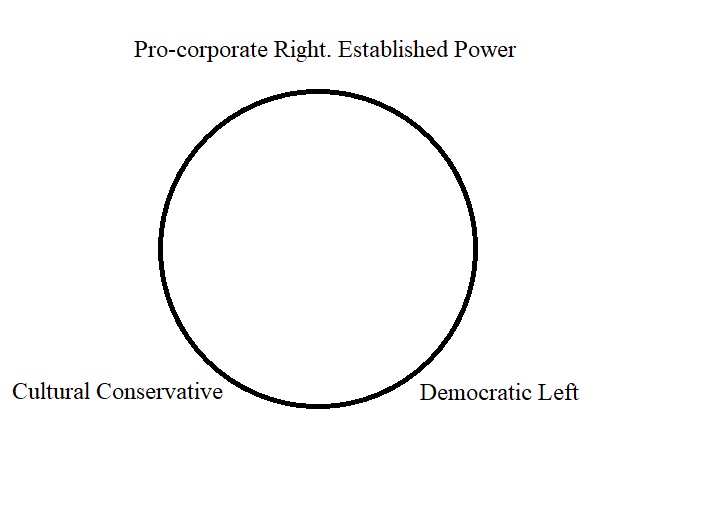
It could be useful to think of contemporary Australian, and probably US, politics in terms of a triad:

(Currently Pro-corporate) Right
Cultural Conservative
Democratic Left.

Using a triad rather than a set of binaries helps us to avoid seeing these factions as opposites. They all share things with each other, can move from one position to another, and ally with one another.

political circle 02

In brief:

The (pro-corporate) Right support established wealth and power. They consider that the powerful are virtuous, and justified in that power, by virtue of that power and wealth. Given that the main contemporary power resides in the corporate sector they tend to support that sector and its justification within so-called ‘free markets.

Cultural conservatives support what they see as traditional culture, and traditional power relations.

The Democratic left supports ‘the people’, against entrenched power and entrenched ‘irrational’ culture. They tend to see themselves as the supreme judges of what is entrenched.

In more detail:

The Right tends to attack the rights, incomes and conditions of ordinary people in order to support established power and hierarchy.

Power must be maintained, and society geared towards providing the best conditions for the powerful to do their stuff (whatever that is; make money, use violence, own land, spout theology etc.), as that is supposedly best for everyone. They are anti-democratic at heart.

They oppose any kind of benefits for the poor, which are not a form of charity which requires genuflection towards the rich, or other elite, and hence reinforces the power system. To them mutual obligation means the obligation of the poor not to accept help that costs the elite anything, or for the poor not to challenge the elites.

They also oppose to any traditional culture or set of values, which acts to restrain the power they support which, as stated above, in our society is the corporate sector.

They encourage culture wars to maintain separation between conservatives and the left, and use conservative respect for established power to persuade conservatives that they are both on the same side.

If contemporary rightists have a religion it tends to assume that wealth is God’s reward for virtue and faith, and that a person’s prime responsibility is for their own salvation and then, perhaps, their family’s.

The main problem the right face is that they know they are right. They think all information is PR and you make it correct by PR, will and effort, or sleight of hand. They are extremely good at sales and marketing in an economic system in which false advertising and hype is normal. They tend to think any counter evidence is evidence of bias, and must also be made up. The problem for them is that eventually reality cannot be denied, and bites everyone, including them.

Conservatives tend to be suspicious of innovation.

Nowadays, living in corporate capitalism, innovation occurs all the time, destroying traditional culture and place, so life is difficult for them.

Capitalism also tends to reduce all value and virtue to money. This often seems fundamentally wrong to conservatives.

While tending to support single authorities, conservatives can also like a balance of social powers to act as restraints. Thus they can support professional organisations, teaching organisation, religious organisations, business organisations, military organisations and conservation organisations having input into government. Whoever is the ‘King’ should have loyal and fearless advisers.

They also tend to think that power involves responsibility towards both the established rules and laws of government and to the ruled. The rulers should cultivate noblisse oblige, protection for the ruled, charity, justice and so on. Ideally while everyone should know their place, there should be mutual respect. Mutual obligation is not one sided.

Religion is often considered vitally important in cultivating virtue, generosity, judgement, content with one’s place and is supposed to act as a restraint on human selfishness.

Cultural conservatives tend to like traditional boundaries for gender, profession, task and so on, especially when tied into religion.

They often consider that traditional culture carries a wisdom, which cannot be easily summarised intellectually, and that breaking traditional culture and its mores carries unsuspected dangers. This can lead them to support functional ignorance, as new knowledge might be dangerously mistaken.

They are strongly suspicious of people for being different, and can team up to put down any difference, thus limiting a culture’s range of potentially constructive responses. This is a weakness.

Another weakness is thinking that by allying with established corporate power, primarily against the left, they are defending cultural wisdom against difference, and that this gives them real power. In other words they often think that established power must inherently be virtuous and conservative. What they eventually discover is that if they get in the way of money making, or whatever the right’s hype of the moment is, then they will be over-ridden completely.

More on conservative philosophy here

The Democratic Left tends to be suspicious of everything that oppresses, or could oppress, people and which only has backing in tradition or raw power. They tend to think that what seems like arbitrary power and culture should be destroyed.

For them ordinary people are as wise as anyone else and should be supported in their efforts to better themselves. People should not be ignored or suffer simply because they are poor or outcast – this is unjust.

The problem for the left is that revolutionary leftists, if the revolution succeeds, become the new rightists. They support the new forms of established power and run roughshod over those who oppose them.

On the other hand, moderate leftists tend to accommodate to the power of the right, and thus end up cautiously supporting oppression to receive funding. They may also accept established power relations in return for what appears to be the ability to moderate that power. This position can achieve something, but without them encouraging another set of power bases, they cannot hold the achievement. This is clear from Hawke and Keating in Australia, Blair in the UK and Obama in the US.

Leftists are often conservative; they don’t want to reduce every virtue and value to money, they tend to like balance of powers, and they often support the achievements of the past which have now been swept away by the Right: for example the Menzies idea that social insurance was a right, and that people should not be humiliated or harassed for accepting it, or the idea that workers form a valuable community rather than a disposable resource. They also tend to support environmental conservation and oppose destruction of land and place.

Their main problem is the tendency to want to overthrow traditional culture rather than improve it. This is one reason, that ‘modern art’ holds so little popular appeal; much of it only rebels. Conservatives are probably correct that culture holds some evolutionary adaptive organisations, but that it may well need to change as circumstances change.

Leftists are easily persuaded that conservatives support harm for the marginalised, are racist, sexist, superstitious and stupid – which helps drive the culture wars, started by the Right, and which tends to throw them on the mercies of the right.

Consequences

The point of all this is to suggest that there is perhaps as much commonality between left and conservatives as there is between conservatives and the right, or the right and the left. There is room to be flexible. However allying with the right is likely to prove disastrous for the other two sides, partly because the right has no respect for reality, only wealth. Both the left and conservatives have weaknesses which sabotage them, but which have a chance of being corrected by the other.

Historically it could be argued that the successful 19th and early 20th century reform movements, that lead to public education and protection against misfortune for the working class, arose through an alliance through the democratic left and the conservatives both recognizing that unconstrained capitalism was destroying traditional life, interconnections and responsibilities. That this economic system was demeaning the working men and women of the country, and that it was Christian to try and help people live lives which were not full of abject misery and poverty.

This alliance was largely successful, despite obvious frictions. It is not impossible that a similar movement against the corruption of public life through money and the destruction of land, water and air could motivate another successful alliance.

The only thing that seems guaranteed, is that if the Right remains dominating, then everything will end badly.

More reflections here…

Climate and conversation

May 22, 2019

These are a few suggestions based on reading and occasional interaction…
This is not a research article.

Lets begin with the don’ts.

Don’t talk about climate change.
If people do not “believe” in climate change, you are not going to persuade them otherwise.
Groups are already polarised on this issue, and it brings up lots of reasons not to talk to each other, suspicions and so on. It becomes a matter of identity and allegiance. You need to go beyond this.

Don’t go on about the evidence.
They have rejected the evidence, and you personally are probably not a climate researcher.
Both of you are taking the evidence to a large extent based on authority.
They believe a different authority, or think they are “independent thinkers”.

Some psycho-social research shows that counter-evidence to what people already believe, is rarely compelling and sets up resistance especially when its tied in with identity politics (which seems to be the case on both sides).

Another obvious point: Talking about people or telling people they are ignorant, stupid or easily conned is harmful to communication. That they already call you similar things does not excuse this. Only do it, if you want to waste your time.

If you are a politician speaking to a wide audience, then its different. You have to clearly say what you will do and why its not harmful.
You need to lower fear and scare. And climate change is scary (even if you deny it, the you are probably scared of what those other people might do to stop it).

For example Bill Shorten, Australian Labor Party leader, could have said, and as far as I can tell did not say:

“The Adani mine will not bring jobs. In court, talking about the big mine, Adani promised less then 1,500 job *years* of work for people in the mine or as a result of the mine. This is not very many, especially given the project is supposed to last 25 to 30 years. There are 750 two year jobs for example. We will actively compensate for and exceed these few jobs in Central Queensland, with useful projects (names a few).
“The Adani mine, being open cut, is likely to pollute the Great Artesian Basin and that could damage water supplies and agriculture down large parts of east coast Australia. We cannot risk that loss of jobs, food security and prosperity. If water safety cannot be guaranteed, or we find the CSIRO were pressured to give a particular result, the mine will not go ahead. We will also not support Adani being given unlimited rights to water, this is suicidal given current climatic conditions
“We want to encourage electric cars, not force people to buy them. As usual the Government is lying.”

This still will not get your message through the Murdoch Empire. They will lie about you whatever you do, but keep on trying – people don’t have to depend on them.

What can you do?

First off.

Talk and building connection is more important than persuasion.

You might even learn something if you are not trying to persuade people. They may still try and score points off you, but just keep talking, making some kind of connection. They may even say things you can agree with, and that can build bonds.

You don’t have to agree with people on everything to like them, or talk to them. This idea is quite radical in itself in our society 🙂 It is also a lot easier to say, than to do. Our society does not encourage discussion, it encourages telling people each other where they are wrong (This is a “think about doing what i say, not what i do” post 🙂

Face to face is probably better.
You can talk in groups, many people find it easier, but it can also open old fractures, so get ready to damp that down. That people turned up, means they are interested in talking.

Sense of Place Nearly everyone has some kind of tie to a place they love, means a lot to them, or is their home. What is it about that place? What do they do there? Is it the same as it was? If not, how has it changed. How could it be protected?

Again, the point is to explore relation to place. It is not about cause or blame, unless the others introduce that.

People who may deny climate change can talk about lengthening drought, changes in wildlife, the decline in bird species, the difficulties with water, the greater amounts of fertiliser they have to use, the increase in dirt (particulate pollution?). What other changes affect their lives? Are you both gardeners? – that can lead to ecological connection, although it does not have to. All these are important, but they won’t talk if they feel you are trying to manipulate them or sell them something. So don’t. People’s experience of place and change is interesting in itself – its actually vital.

There is no ecological thinking without an awareness of the environment – and awareness of environment leads to new questions and thinking.

Talk about your own experiences apolitically – give back. What might you share?
If you live in a country area, you probably know the place they are talking about, and can probably relate to them.

What remedies might they have tried? If nothing, then fine, but it is likely they have tried something; like cleanups, changing the water flows, rotating crops, tree planting, opening a wind farm, having an Airbnb to raise cash, moving to a different place etc. How did it work? How do they find the bank, or government (or other) services? What have they heard about, but is really not practical?

There is lots of stuff to talk about. Perhaps they are as depressed/distressed as you, but about other things.

In ecology everything is connected. Surprising things happen. Maybe they got in a rainmaker and it worked. Maybe turtles appeared out of nowhere. It’s good to relate to a special place and notice changes.

The point is this is a long process requiring patience. Its about building relationships, building communities, that have been (I suspect) deliberately broken, largely by pro-fossil fuel organisations and political opportunism. Be prepared for things to go wrong. In some cases people have a lot invested in preventing conversations. You just start again, maybe with different people.

It is not about winning. We either get through this together or not at all, and we can all learn.

Outline for the first chapter of an unwritten book on approaches to disorder

May 9, 2019

Classical Chinese thought tended to treat the world as process rather than as fixed thing. Taosim, for example, constantly suggests that there are at least two orders: the flow of tao, and the order that humans create through effort. The second order can always be disrupted by the first, and by the unintended consequences of human effort.

Humans are themselves part of this flow of the world, and human conception which feeds into action is, in many ways, a distortion of the world, as the flow is not easily broken into discrete categories, or ‘things’. Therefore, taoists suggest that right action, either ecological or political, involves learning to live and work with the flow of tao moving with constant correction, towards an ‘acceptable’ or ‘close to desired’ result. The main technique is encapsulated in the idea of wu wei, often translated as ‘action without doing’ or ‘action without exertion’. It points to a gentle action, which allows the flow of reality to manifest itself without being blocked. It is sensitive to, and accepting of, what might appear to be disorder.

Taoist action does not have to be peaceable. Sun tzu in his Bīngfǎ (Art of War) suggests many ways of increasing disorder in the enemy, allowing their deliberations and actions to disrupt their own tao, while taking advantage of this process of disruption. Again the principle is to be guided by actions without exertion, deceive the enemy, and to take advantage of the situation as it arises.

While Confucius seems devoted to creating a rigorous order, the book usually given the title Doctrine of the Mean strongly implies that the best the sage can do is, by constant attention, create islands of order in the flow, through attention to ritual and the right behaviour and right speech for that situation. While Confucian thought, does not completely oppose violent imposition of order, the wise leader should primarily lead by example. The leader will be emulated, and if the leader is virtuous then the populace will tend that way. Imposition of general order is not the first step, but the last.

While it seems clear that Taoism is not suggesting the world is without order, Taoists imply that this is not a static order; it has patterns but they change, human’s cannot conceive correct order and human action easily disrupts the most powerful and stable flow. Classical Chinese thought suggests that working gently with the flow of reality with attention to the unintended consequences of our actions should be normal. It suggests that if disorder appears we are not working with the real flow of things, or we have mistaken ambitions. It implies real knowledge is tacit, rather than explicit, and comes from careful and attentive interaction with the world.

However, this rather obvious practice and understanding is not common in the contemporary world.

On “Political Correctness”

March 5, 2019

“Political correctness” is the all round term of denunciation for any proposition which would like rightwingers to think, not be impolite, or not sanctify the suppression of someone, as in:

“Perhaps we should stop destroying our environment?”
“Oh stop being politically correct.”

“Maybe [racism, sexism, corporate power etc] needs to be recognized as a problem?”
“Shut up and stop being politically correct”

“The evidence suggests that the cardinal raped children, and suported other rapists.”
“Political correctness is everywhere. He’s the real victim.”

Gaining political support can often depend on people not thinking and not discussing things with other groups, so slur terms can spread and multiply, once you have decided on that approach.

Calling something “political correctness” is part of a general strategy in which Republicans and Republican media have done their best to shut down discussion over the years – from at least the Gingrich congress onwards.

We can see it in those rightwingers who:

  • continually scream their righteous abuse at those who disagree with them;
  • go after people because they made a remark they construed as “socialist” ie against corporate supremacy;
  • make a big show to each other of their righteous virtue while dismissing other people for “virtue signaling”;
  • dismissing someone as a “sjw” if they object to some blatant injustice;
  • dismissing another line of thought they don’t like and cannot be bothered to try and read as “Cultural Marxism”;
  • stomping around angrily calling the corporately owned media “biased” and “left wing”, if it slightly varies from the party line;
  • giving death threats to climate scientists for not supporting the pro-fossil fuel, pro-pollution, position;
  • invent terms like “libtard” to help stop discussion;
  • sneer at people who realise that capitalism can sometimes be destructive, or that the ecology is in crisis, or that racism and sexism exist, as “woke”, again so the don’t have to think about these things and can condemn those who do as stupid or following the crowd – unlike them who are following the corporate elites;
  • scream about how unamerican it was to object to the last Iraq war, while pretending their opponents are warmongers;
  • support a president who slams any coverage which is not 100% behind him, as being made by enemies of the people.

We know through these right whingers that they (with all their corporate backing) are the real victims, and that only women can be sexist, and only black people racist. Anyone who might offer sympathy to people who they think are being affected by racism, or sexism is a deluded busybody. Similarly, it’s a “witch hunt”, when a guilty, or probably guilty, right winger is questioned instead of being let-off to continue with their crimes.

Through rightwingers we also know that all fact checkers, scientists and people who study society have a liberal bias, as presumably the way you get to be right wing is through total ignorance of reality.

But then again we can be told by rightwingers that discussion, or finding the truth, is not what discussion is about; victory is the only thing that counts, with total annihilation of the other side the aim. What is the point of discussion other than to reinforce your own biases and scream a lot?

The republican media, starting with Rush Limbaugh and Fox taught these techniques, partly as a way of marketing – get the audience angry and upset so they can’t think properly, and tell them that any other source (that might disagree with that anger or think it is misplaced) is biased and out to get them. You get your audience to stick with you whatever rubbish you spout, and that brings more sponsorship and more wealth for you.

Partly this technique was developed because the policies the right sells (what is called ‘neoliberalism’ or ‘privileging the rich while kicking the poor and middle classes’), may not be that popular if they had been upfront about the known consequences of those policies.

To avoid people understanding this policy reality, they began to construct the idea that discussion involved the endless headkicking of difference and invention of scandal. They build the “culture wars”. They constantly accuse their opponents of positions they do not hold, so as to make them seem more evil to their ingroup and reinforce their own groupthink. The technique helps build conformity, and fear of attack, in their own group, because people see what happens to those who think for themselves, and they have the options of staying loyal or facing the consequences of having their friends forsake them….

The Right has been so free of facts and so full of denunciation they helped build the political polarisation of the US (and similar techniques were employed in the UK and Australia) and made way for a President who openly denies climate change, and denounces opponents, to protect corporate polluters and the extremely wealthy.

After a while they created the sense that right wing discourse was creation of an atmosphere of threat, and it became invisible to them; it was water to a fish. Eventually, after being abused and threatened for years, without any Republicans calling their side out for these techniques, the ‘liberal left’ began to respond in kind, and lo! Republicans suddenly became concerned about rudeness in discussion, after their years of silence on the issue. The separation of the debate into two sides who abuse each other was part of the aim of all this. Then you don’t have to worry so much about explaining what your policies achieve, as no one cares about anything other than point scoring.

These techniques have made the US vulnerable to Russian interference. People in the US don’t need Russia to divide them, because that was the Right’s aim and it has been achieved, but the Russians can, and have, increased those manufactured divisions for their own purposes. And yes we now have Trump, who the US’s enemies know is incapable of making anything great.

Is rectification of words possible?

February 4, 2019

Is it possible to clear up misunderstandings between right and left in the English speaking world and restore courteous discussion?

This seems like a nice question, but the problem is that many, but not all, right wingers, seem to consider that abuse, name calling, obfuscation, and lying are essential to argument when used by their side. They have been following this pattern in the media, in politics and internet discussion for at least 25-30 years. However, they tend to get upset if abused themselves, when someone they don’t identify with, beaks after years of continual abuse.

Quite a few times over the years, rightists have explained to me that they see the point of discussion as total elimination of the opposition, and that anything they do is fair in pursuit of that target. These people do not appear to have a sense of discussion as a tool to increase understanding, learn things or reach a workable compromise. This is obvious when you look at righteous media commentators and politicians, especially the President, and how they act.

So no, they will largely not be interested in such ideas. Words have very different meanings to both sides and this causes problems and confusion, and furthers the vitriol they desire.

What follows is caricature. I offer a commentary in the spirit of Right wing ‘argument’, so it is a little bitter. Many people (especially real conservatives) may say they don’t believe this, but look at what the politicians on their side actually do as opposed to what they say they will do.

For instance:

Justice:
On the left, justice may mean something like reparation, restoring things back to where they were before the crime. The system should do everything to help people who have been victimised by crime. Similarly, convicted criminals should be given every opportunity to reform rather than be punished for ever, or in advance. However, some people cannot, or will not, reform, that’s sad but reality. Justice can also mean something like preserving relative equality before the law, so that powerful people do not stomp over everybody or automatically get lower sentences for their crimes, on the rare occasion they get convicted. Hence the idea of avoiding profiling as much as possible.

For the righteous, justice should be defined by the highest bidder. Libertarians, in particular, love the idea of justice for sale with private police and private judges. Again, people on their side in power can lie, obfuscate intimidate and so on and this is ok, because power and kicking the less powerful is what life is all about. Hence it is completely ‘just’ that wealthy white men run nearly everything in the English speaking world, and try to keep it that way. The laws have been largely written by the wealthy in the first place, but this is a good thing as it keeps other people in their place. Being kept in your place is just as God decrees this. People who challenge wealth and dominance are really criminal. People who look different are probably criminal as well, especially if they are not wealthy. Supreme court judges can lie openly if they are righteous, because God is on their side. Justice is about preserving the power of the righteous elites.

Truth:
For progressives finding truth is complicated and takes work. It takes research, discussion, experiment, testing and so on. Most progressives think that science is the best method we have of determining truth, even though it can be sometimes be mistaken. They think it is useful to be aware of the best knowledge we have at this moment and to be cautious if there is doubt.

For the righteous, truth is often whatever the victors (ie themselves) want it to be. It is whatever is convenient to argue against progressives. It’s usually on Fox news. Science is wrong and biased whenever it contradicts fundamental rightist ideology, or the making of profit. A righteous person can easily refute a philosophy or knowledge that they know nothing about, and be cheered on by the others. Some of the righteous seem to believe that truth can only be found in some books – such as the Bible, or those written by Ayn Rand or Ludwig Mises. They suppress scientific information on government websites, because they think it is simply a matter of opinion and they know better.

Hurt:
Some progressive may worry too much about people’s feelings being hurt.

The righteous know hurt is important. Hence they support hurting the feelings of those they consider weaker than themselves, and protect the feelings of those in power through libel and slander laws, and the self-censorship of reputable publishers. They love their President’s continual abuse of others, but are alarmed when people dislike their President and express it.

Government:
For progressives, government means encouraging everyone to participate in the governance of the country and making the laws that apply to them. Liberty is important, but unfortunately no one should have unrestrained liberty to hurt, injure or repress other people, otherwise there is no liberty. One of government’s main functions is to do useful things to help people fulfil their lives and to balance (to an extent) bad luck and disaster as much as possible. Government ultimately has to respond to reality, so it needs an educated population and good knowledge.

Righteous people define good government as rule by the powerful and wealthy, with exclusion of the unpowerful other than as tools and shock troops. They link this government to a refusal to look at the way reality works, as that might get in the way. It means preserving established wealthy power elites even if it means we all get destroyed because we cannot adapt to reality. Righteous people support bad education for the ‘masses’, because it helps relieve ordinary people from the burden of thinking about self-governance, and they are more easily lied to. You should only get the quality of education you can pay for. When the righteous talk about small government, they have no objections to massive regulation of ordinary people and government that works to support and fund corporate power and wealth; indeed they encourage it. This appears to be because they think that wealthy people are specially virtuous and have the right to continue to be wealthy, and keep others poor. This position is not always popular, even on their own side, so they try and win support by distraction: stirring up irrelevant culture wars and implying that those who side with them have the right to kick everyone who disagrees. Righteous people also believe that if you suffer misfortune, the misfortune should be compounded, or you should submit to charity. In this set up, liberty is about preserving or intensifying property, wealth and power distributions. The more unequal the country the better, as wealthy people should never be hindered by their underlings. Rightists perpetually ‘confuse’ corporate liberty with liberty for all.

Identity:
Progressives say people have many different identities. Celebrate this and learn. Respect identities which are not your own, especially ones that the righteous like stomping over.

The Righteous claim we should all defer to the one primary identity. Women should realise their purpose in life is reproduction and obedience to men. All us white men together are what made this country great, and we are now under threat. No one should make us listen to those other people. Talk of respecting others shows weakness. People on the right perpetually pretend to have the most victimised identities of them all. Thus racism only affects white people, sexism only affects men and so on. Racism and sexism are primarily displayed when someone on their side is criticised for being racist or sexist.

Conservatism/Conservation:
Progressives want to maintain the checks and balances that have developed over the years to protect people from the potential rapacity of capitalists and bosses, and which help people to survive standard human misfortune. They also like the idea of keeping the environment in such a state that it allows us to continue our civilisation.

For the Righteous, conservation means protecting neoliberal economics and supporting corporations in almost whatever they do (unless they seem progressive). This largely involves stripping away everything that gave ordinary people a decent life; lowering wages, conditions and liberties in the name of efficiency. It also means destroying the environment to support the profit of the already wealthy, as wealthy people have the right to hurt the non-wealthy. The righteous keen for the wealthy to poison ordinary people through pollution and maim them at work. Ordinary people are inherently inferior (otherwise they would be wealthy), and corporate profit as the only important thing. Sometimes they support authoritarian Christians who want to rule over and suppress sinners (ie those who don’t accept their authority)

The righteous elites are filled the idealism that the wealthy will provide good government, and need to have an even bigger share of the wealth so that the money might trickle down to ordinary people. In order to further the power and wealth of corporations they want to allow those businesses to pollute and poison more effectively. In other words they want you dead. They cavalierly destroy anything that gets in the way of this, and do not think to check whether their theories deliver what they promise. They may aim at other results than the ones they promise, so they may not be stupid here.

This is pretty terrifying.

Trump and Mueller

December 23, 2018

It is odd but nowadays even inquiries into possible crimes give evidence of the wide reach of the mess of information in (dis)information society.

The Mueller investigation is not specifically a “witch hunt” into Donald Trump as should be clear by its terms of reference.

The Mueller investigation was appointed to:
“investigate Russian interference with the 2016 Presidential Election, and related matters”

This does include “any links and/or coordination between the Russian government and individuals associated with the campaign of President Donald Trump” (because evidence suggests that the Russians aided the Trump campaign).

The Special Counsel is also “authorized to prosecute federal crimes arising from the investigation of these matters”

You will note that there is no special mention of Donald Trump, or ‘collusion’, as a subject of interest – despite Trump’s assertions to the contrary, and despite Trump’s evident attempts to stop the investigation and slur the investigators.

The investigation is primarily into “Russian interference,” which seems absolutely real. Consequently, it is of no concern if Trump and his campaign is not implicated at all. In fact it is perfectly acceptable, as long as Mueller finds something out about Russian techniques of interference and helps the US protect itself from such interference.

So we can only speculate as to why Trump has made it about him and about ‘collusion’ (he could easily distance himself from the investigation). Possible answers include:

  • a) To Trump everything is always about him…
  • b) He knows he specifically is guilty of the suggested links and coordination.
  • c) He has been involved in so much corruption, that he is not sure whether his behavior in this case is corrupt or not, but he knows there is a problem.
  • d) He was set up by the Russians and he knows it.
  • We know people in his campaign were involved in soliciting information and aid from Russia and they lied about it. There is no doubt of this – the Trump tower meeting for one. We also know the Russians interfered with the campaign. While many Republicans take the view that this interference is unimportant, it still needs to be investigated, and they would probably favour investigation if there was evidence that Russians aided Democrats.

    Trump’s behavior is evidence suggesting the corruption reaches to the top… or it suggests a deliberate ploy to make it about him, so as to help his followers see Mueller as hostile to their own interests. In this case portraying Mueller’s job as attacking Trump, shifts us into social category rhetoric. Mueller becomes an exemplar of an outgroup, attacking the exemplar of an ingroup, and is therefore less persuasive to ingroup members, who can dismiss anything he finds immediately without listening to it….

    https://en.wikipedia.org/wiki/File:Appointment_of_Special_Counsel_to_Investigate_Russian_Interference_with_the_2016_Presidential_Election_and_Related_Matters.pdf

    Identity politics 2

    September 15, 2018

    We are having a lot of announcements from our government that religious freedoms must be protected. There is no doubt that there are areas of the world where religious freedoms are under threat. It is increasingly difficult to be Christian in many Islamic countries, and Muslims in many Christian countries can face daily abuse – in particular women in hijab. Fundamentalist Hindus in India seem to be attacking everyone else. Buddhists in Myanmar are behaving with apparent brutality to Muslims who have lived in the country for centuries. While this level of religious intolerance and violence should not be accepted, there is no evidence I have seen that suggests that Christians in Australia face anything remotely resembling this level of attack or that they are remotely likely to face this level of attack in the future.

    The evidence presented does not seem that persuasive either.

    The prime minister has mentioned that kids have been stopped doing Christmas plays. He does not present evidence for his statement. He says that Christians have been prevented from discussing the real meaning of Easter. No evidence is presented again. We are told that boards of directors may stop people from being members because of incompatibilities of belief. No evidence is presented, and the PM even seems to think the lack of evidence for it happening now, is evidence for it happening in the future.

    If indeed Church groups have been prevented from preaching to their members, or prevented from putting on Christmas plays in the Church, then we do have real problems. But nobody seems to be claiming this. Likewise Christians and others have discussed the meaning of Easter in public with me, with no apparent hinderance. The local newspapers usually have meaning of Easter articles, and editorials, and summarise the various Easter messages from the main churches. There is no one screaming in the papers that Christians should not be allowed to talk about Easter – nothing like the screaming against various right or left wing speakers that seems a regular feature of contemporary debate. Sure people commenting on articles with a Christian slant may be abusive or more likely dismissive, but facing abuse online is a regular event for everybody, and there is often abuse from Christians in return, suggesting atheists are subhuman or deserve to burn in Hell for eternity and often expressing joy at this hypothesis.

    We also have continuing tax exemption for religious organisations, even if they seem run for profit or for the income of the leaders. Taxpayer subsidy of religious schools, public money spent on Chaplains to council school children who don’t need any qualifications in counselling, and a total lack of funding for qualified counsellors who are not approved by the local denominations. We still effectively have compulsory religious instruction in public schools – as the NSW government does not allow schools to reveal if they have the substitute ethics courses available. We allow religious schools to sack people if they find them incompatible with their beliefs (ie they are gay, feminist, or the wrong form of Christianity) – oddly this is one area that people say is not strong enough for religious liberty! We have politicians and right wing commentators who have defended the clergy from accusations of child abuse. We have politicians claiming their religion as a matter of course. No one has persecuted them in any effective manner. There is not any movement to curb much of this.

    I am absolutely open to counter evidence for impingement on Christian liberty.

    All of this, along with the lack of concern for the religious freedoms of Muslims or Buddhists, suggests that there is a level of fantasy in these allegations and they are really about identity politics of a specific group that seeks privilege over others.

    Now it is true that the secular state has stopped human sacrifice, religious torture and persecution of other religions. It has tried to stop child abuse by churches, it has recognised rape in marriage, it has allowed women to claim equal rights, and not be beaten in marriage as a matter of religion. It does not allow people to sell their children into slavery, or have them wedded by the age of 12. It has failed to stop male genital mutilation, but that failure is an example of religious power. I would suspect that most Christians and other religious people, can live quite happily with these restrictions.

    However it was notable during the debate on whether the State’s category of marriage could be extended to homosexual relationships. No religion was being forced to carry out marriages, just recognise them, as they do other marriages not held in their churches. Many religious people seemed to consider that the attempt to stop them discriminating against others was a threat to their freedom. They naturally did the suggesting that homosexual people were subhuman immoral and deserved to burn in hell line, and seemed surprised that other people responded strongly to these suggestions. Is it that only they should be allowed to abuse others, or that they don’t they see these comments as abuse? Later in the debate when the ‘burn in hell’ lines did not seem to work amongst the general population who don’t think gay people are any worse than other people, they decided to attack heterosexual and Christian marriages as illegitimate if there was no chance of producing children. Naturally they did not put it that way, but that was the logical consequence of arguing that marriage was solely for the production of children. They also kept imagining gay couples will deliberately go to Christian bakers for wedding cakes to upset them. Such are the stands Christians have to take nowadays.

    The suggestion of all this, seems to be that Christians should not have to live under the same conditions as everyone else. They demand protection from debate, from having to justify their positions, and from any opposition, even opposition that they have provoked. This campaign, does not seem to be about freedom, but about privilege, and fits the general pattern that right wing identity politics differs from left as it is not about recognising more people’s rights to participate in public life with their full personal identity, but about saying “we are special, and better than others”. It represents an attempt to shut others down. Given Christian history, Christians from minority sects, those who try to live with love rather than condemnation, people from other religions, agnostics etc, should all be worried by this movement.

    What would Satan do?

    September 8, 2018

    Let us imagine that there is an incredibly powerful evil being who has influence over the earth, and was free for some time to do as he could, for whatever reason.

    Well, what would he do?

    Well one obvious answer is that he (and let’s be traditional and say he is male) would not try and tempt people one by one. That is a terrible expense of time and effort, for very little result, and he would probably think most humans are contemptible, so why spend time with them? My guess, as to the answer, is that he would try and confuse and corrupt whole civilizations, because its easier – humans reinforce each other’s behavior.

    For this purpose he might try to set himself up as the one true God. He could tell his followers that if they obeyed him they would be virtuous and successful, and only they would be virtuous, as everyone else was following false gods. Followers should support each other, and would be rewarded with material prosperity as well. Sounds good, and it reinforces group boundary lines and group loyalties. Then he might ask them to go and kill some people he didn’t like (perhaps they had rejected his claims) and take their land. His followers might object, so he might say he would punish them, so they then decide to go ahead with it, and occupy the land and slaughter the original inhabitants. They would probably not think, “Satan claims to be omnipotent – why can’t he just provide us with unoccupied land, or change some piece of desert into a land of milk and honey for us. Why did we have to slaughter people?” After all obeying Satan is good, by definition, and those who don’t obey him must be evil, so slaughtering these people is permissible.

    Satan tells them what they are doing is just. Genocide becomes virtue. Maybe he tells them to kill the men and rape the women. That’s good too, by definition. So Satan gets a war machine. His chosen people, or true believers, can murder, steal and rape with impunity, as long as they keep it under control with each other. He tells them they are surrounded by evil, and they must not associate with non-believers (unless to convert them to be his followers). They should not share food with them, as this is a good way of maintaining boundaries. Non-believers are corrupt and frightening – anything can be said about them, and it is probably true. This further reinforces both group boundaries and the assumption that other people are evil, and deserve persecution.

    Some time later he gives up the rewarding followers thing, because well he is evil and its boring, and he tells people he will generally reward them after death. No one will ever find out and bring the real news back. But people now know if the rewards don’t come immediately, with Satan testing their faith, rewards will come in the afterlife, and you should not struggle against Satan’s will, or you might not get the rewards.

    However, when things go wrong, he can tell them he is punishing them, perhaps not for their disobedience but for the disobedience of some other people nearby. As the rules are contradictory, or difficult, it is not too hard to find someone (or yourself) to hate and sacrifice to appease Satan’s wrath. That’s good as it produces more terror, although most believers don’t object to terror being the aim, because terror is the beginning of wisdom, or so Satan says.

    He then tells people he is a loving and compassionate being. This can confuse people, and as they emulate him, it also shows murder and so on must be compassionate, as long as it is not against fellow true believers. if they worry about that, well Satan is a mystery beyond human understanding. Eventually a few people do think this is incoherent as well. So he responds by telling people he is loving and compassionate and has people who disagree with him tortured for eternity. That can be really confusing. But you had better believe or else you face a dire fate, and you might decide you need to please Satan, and send people to hell to prove you are on his side. If the people you kill are really virtuous, then you can be sure Satan will make it up to them after they are dead. So no worries. If you think hell and compassion don’t go together that well, you must be allied with the forces of real evil, because if you were good, you would have no problems with this teaching, because Satan is good and truly compassionate. He tells us so.

    Because they know that by following Satan they are as good as it gets, believers know they are better than non-believers and should rule over them. If they don’t rule over heathen infidels, then they are being oppressed and should strike back. Likewise, men are better than women and should rule over them. Older people should rule over their children. This creates more bad temper, friction and murder. There are few families which are not rent inside, spurring on those evil, vicious and cruel acts, which are (not that) secretly pleasing to Satan.

    Perhaps some people come to think that people can be moral without obeying Satan, and that he does not show a very good example anyway. Those people are told that there is no basis for morality other than Satan’s word, and so they are without morality, and should not be listened to, or should be persecuted until they know better. Whatever Satan says is right, and the basis for a good virtuous life. If believers are not allowed to follow Satan’s word exactly, then they are oppressed. Believers also know that rebels against Satan always fail, and are always cursed, because he is the source of everything – so he says. And Satan says he cannot lie, or be mistaken. So that is the end of that. Unbelievers demonstrably have bad morals, as you can see by looking at any society run by non-believers, and they will not be saved – they are not righteously human.

    Followers really try to please Satan and even end up fighting other Satan worshipers, over massively important factors of doctrine or history (which look pretty trivial to ignorant non-believers), to preserve the real purity of belief and teaching which is necessary for rewards, and Satan is pleased.

    He sits back in his mighty throne and smiles…. It all worked well.