Posts Tagged ‘narrative’

Cthulhuocene

August 29, 2019

HP Lovecraft’s story, The Call of Cthulhu, opens with some of the most famous lines of horror literature:

The most merciful thing in the world, I think, is the inability of the human mind to correlate all its contents. We live on a placid island of ignorance in the midst of black seas of infinity, and it was not meant that we should voyage far. The sciences, each straining in its own direction, have hitherto harmed us little; but some day the piecing together of dissociated knowledge will open up such terrifying vistas of reality, and of our frightful position therein, that we shall either go mad from the revelation or flee from the deadly light into the peace and safety of a new dark age.

Lovecraft reverses the then standard idea that we more or less know everything and can know everything relevant, and proclaims this lack merciful rather than horrifying. We are forced to remain in blissful ignorance of the nature of the universe and “our frightful position therein”. The story then proceeds to undo this opening statement, and make it clear what at least part of that frightful position is, and how vulnerable we are to destruction from things we don’t, and cannot, understand.

In a way, this almost exactly suggests how we approach the Anthropocene. The customary position is to refuse to “correlate all our contents,” to argue that the world cannot end from trivial and everyday human actions, to reinforce our ignorance and lack of understanding of an object which is beyond our understanding, and certainly beyond our ability to predict. However, the sciences continue to piece together dissociated knowledge, and open up the terrifying vistas of a climate and ecology, so disrupted and out of control, that we either go mad, or flee into a new dark age in which science and knowledge is subservient to fear and politics.

Both stories are almost detective stories, “flashed out from an accidental piecing together of separated things.” Lovecraft’s tale is a detective story which links events from all over the world. A professor dies, from unknown causes, after being jostled by a “negro”; racism and horror of the unknown is never far separated in Lovecraft. His heir goes through the professor’s boxes and discovers strange things. These scattered objects and texts, like the fragments that most of us live with in the Anthropocene, strange weather, disappearance of insects, drying rivers, weird snowfalls, scientific gibberish, conflicting accounts, jumbled correlations from over the world, bad dreams, disease, disturbed artists, and mental illness out of nowhere, hint at a story which will destroy the hero and reader’s peace of mind forever.

Images recur, of a hybrid being – “simultaneous pictures of an octopus, a dragon, and a human caricature” – but “it was the general outline of the whole which made it most shockingly frightful.” Again it is the outline, the suggestion which is beyond easy resolution, like the Anthropocene. No one knows, or can know, what the Anthropocene means, what its outline really is. It can look like sea level rise, drought, storm, or any number of ‘ordinary’ things, but putting them together all at once, in varied combinations, is impossibly disturbing. All we can tell is the natural order is not what we thought. Its image can suggest “a fearsome and unnatural malignancy”.

Both tales bring into mind the vast ancientness of the planet, which has lived without us for billions of years, and will live without us for billions of years. This creature, beyond conception, harbours no special affection for humans, no hostility either, just complete lack of concern. Whether we worship it or not, counts for nothing, although worshippers might convince themselves otherwise. This massive creature, on whom we live and which we are part of, has been sleeping. The Holocene has been relatively free from upheavals, and indeed might have remained free from such upheavals for thousands of years, but we have prodded it, not perhaps, awake, but to roll over it its sleep, to scratch off its fleas, perhaps for some fragment of it to arise out of the oceans and throw civilisation aside without even noticing. Let us be clear, although the Anthropocene may mark a geological epoch, in terms of world existence it is nothing, a mere blip. In a billion years, a relatively small time in planetary life, nothing of the Anthropocene and human life will probably remain to be detected. The earth does not see us, we are no more special than any other species which has vanished in the past, trilobites, brontosaurs, giant dragonflies, all have been and gone

In the story Cthulhu rises from the depths of the Pacific as the earth moves, and science, so far beyond us as to be indistinguishable from magic shatters our reality, opening the strange and disparate affects we might ignore. However, rather anti-climatically, the being is driven back under the waves, more or less by accident. There was only good fortune that a ship was in the vicinity, otherwise the end would have come incomprehensibly to all, and it may yet come at any moment. Whatever safety we had was random.

Come or not, all those who hear of it, and understand however badly, can never be the same. The image haunts them as does the dread. “A time will come-but I must not and cannot think!” Others carry on, the world remaining veiled. Let us hope their dreams, and ours, do not further the world-beast turning once again.
Jordan Peterson’s ‘modes of silencing’

August 28, 2019

Having briefly discussed a lecture by Jordan Peterson on Foucault, we can now look at the way that the talk functions as an attempt to silence, or annihilate Foucault or anyone who might mention Foucault. Whether or not this lecture is absolutely representative of Peterson’s techniques is irrelevant. The techniques are present and apparently used effectively.

I suspect the reason these techniques are not immediately visible is that similar techniques are used across right wing discourse to suppress thinking, and people are so used to them that they become invisible. The main aim of the technique is to create a boundary between the in-group (us people who follow Jordan Peterson or the right in politics) and an outgroup of post-modernists and leftists. The in-group are good, and the out-group are bad. You need only listen to the in-group and despise the out-group. The out-group have nothing whatever worth listening to. President Trump is a master of this technique as well, although I’m not claiming his methods to achieve this are exactly the same as Peterson’s.

Technique 1: Accusations of moral turpitude and evil in the out-group. These accusations are unspecified, but severe. Perhaps the vagueness about the accusations inflates the possible evil, as it is absolutely unclear what it is, in the way the best monsters first appear as vague shadows, troubling hints or violent movements in the dark – things we had best not know. In this case, the aim of the lecture seems to be to keep the ingroup from curiosity, familiarity or discussion. Let’s keep ‘the others’ vague and messy. The more uninformed the audience is, and the more unformed the opposition are allowed to be, the more scary ‘the others’ are.

Technique 2: Accusations of incompetence and impracticality. Foucault is held to be an example of a person whose mendacity and stupidity would bring any structured organisation to its knees. This is, perhaps, why we have to be told later on that competence is vital to modern society. Something which might otherwise appear obvious. If we learn about these people in the out-group, or become contaminated by them, we too might destroy the hierarchy we belong to and are accepted by; we will certainly be rejected by our current in-group as incompetent or impractical or something…..

Technique 3: Guilt by association. Foucault is a Marxist (whether he was or wasn’t), he is thus responsible for mass-death, or for ignoring mass death. This man is clearly, at best, a hypocrite, but most likely evil. We don’t even really need to bother to find out what he, or Marx, thought, as people who claim to be Marxists. or who are claimed to be Marxists, are evil. Clearly Foucault is no better. You don’t really need to understand this person or the out-group in general, and everyone who says you do is simply a fellow traveler. By the same argument, clearly, every Christian is Torquemada.

Technique 4: Suppression of the out-groups ethical concerns. Peterson suppresses any audience awareness of the moral concerns of Foucault and other post-modernists, again to make it seem the out-group is composed of evil people. As they have no morals, again they can be dismissed.

Technique 5: Refutation by name-calling Peterson refutes by abuse, and establishes his ethics and authority by slander – which is disappointing as he has interesting remarks on ethics elsewhere, but here post-modernism becomes deployed as a category of abuse. “You postmodernist, you”. There are things people cannot discuss or defend without a high probability of reflexive abuse from those influenced by the authority of Peterson. He acts as an authoritative exemplar, for others to follow, of argument by abuse. Those put in the outgroup are only worthy of abuse. This helps separate the groups, generate mutual fury, and helps to prevent any real discussion occurring.

Technique 6: confusing the differences and making a mess. Peterson messes different thinkers together, saying different idea-sets are the same. This act turns his audience’s awareness of “post-modernism,” as a category, into an incoherent mush, which does not make any sense. This reinforces the idea that anything he can classify as ‘post-modern’ is not worth investigating, engaging with, or discussing. The techniques means what he is discussing does not make sense. Any people categorized as belonging to the post-modern out-group must be equally incoherent.

Technique 7: Lack of references and isolation. Peterson gives no references to texts by Foucault or anyone he is criticising. This helps to keep people away from the texts, by making it hard to find them or read them, and keeps the audience within his framework. People are much less likely to go and even look at something sympathetic to Foucault, or which tries to explain his ideas. They won’t come out of the lecture with a curiosity which might lead to questioning. They will, most likely, stay within the hierarchy and hear the teacher, obeying his authority by default and by lack of knowledge, and of not knowing where to go to check the teacher’s teaching.

All these steps hide and justify Jordan Peterson’s essential step which is not to expound or criticise Foucault in any detail. Foucault is clearly so messy, evil and incompetent, that making an effort to engage with his ideas would be a waste of time. It might even be corrupting in itself. Its dirty and filthy, lets avoid it like we might bypass a dead and decaying rat on the street. It is lazy, at best for someone who claims to be an academic.

Technique 8: Ignore any common faults or failings; blame them on one side alone . Peterson might make reference to a common fault like “science denial” but he only references the denial on the one “side” to condemn that side alone. He also does not explain the differences, between the two forms of “denial”. Some post-modernists could assert that there is always a social and historical aspect to scientific practice which influences what can be tested, theorised or accepted as true. Others might show how science has been embedded in social power structures and relations and been influenced by that embedding. To me, such ideas seem almost truisms. How would we be able to make knowledge outside of social processes and with total objectivity? This does not happen, or is difficult to ensure, but we might be able to become more or less involved in those processes. We can become aware of some of these ‘unconscious’ processes which guide our thought and possibly weaken some of them. Possibly that idea is threatening to his deliberate, or accidental, construction of in-groups and out-groups, and embedding his audience in them.

Technique 9: Relentless negativity. There is apparently nothing interesting or good in Foucault or any thinker who can be classified as post-modernist at all. This is almost certainly improbable for any group of thinkers. Even under Stalin and Hitler, with terrifying punishments for thinking ‘wrong thoughts’ there were still some interesting thinkers. For example Vygotsky, Bakhtin, & Bukharin under Stalin and Junger, Heidegger & Schmitt under Hitler. However, the technique helps silence Foucault and other post-modernists; they are simply made not worth listening to.

Technique 10: Refutation by unpleasant consequences. Part of the relentless negativity, is the repeated use of the argument that if some set of propositions (which apparently never need to be given precisely), appear to have unpleasant consequences, or disrupt our common sense, then they must be wrong. However, if thinking reveals possible unpleasant consequences, then perhaps we should think about, ot deal with, those consequences?

Technique 11: Avoidance of unpleasant consequences. This follows on from the previous technique. There is no sense that we might have to face up to the unpleasant consequences, we just avoid them by denying their possibility. This reinforces many kinds of right wing denial – not only of climate change or ecological destruction, but of the finitude of humanity on this planet, the effects of coal burning and pollution, the possibility that great tech will not arrive in time, the growth of plutocracy and the failure of ‘free markets’ to deliver liberty, good government, and unbounded good results for all. Through this technique, we can all live by asserting good things will happen if we don’t question the real hierarchies we belong to and the beliefs they encourage.

Technique 12: Always imply our hierarchies are good and necessary. Defending existing Western capitalist hierarchies seems to be important to Peterson. Hence, while many things can be good and bad, there is no sense in which the in-group’s hierarchies can be both good and bad. The implication is that because hierarchy might be necessary for the in-group’s functioning, the hierarchy is good and only questioned by evil and incoherent people in the bad out-group.

Technique 13: Our Good, is unchallengeable, because its Good. Finally, he implies that the outgroup can attack what the ingroup holds to be true and good, and thus should be ignored as this proves they are evil. For example, the out-group may attack Western Civilisation, or capitalism. But there is no attempt to understand why they might think like that. He can just be stunned by these propositions, as they are so obviously stupid. This is yet another example of the idiocy of these thinkers and another implicit explanation of why we should not even bother to find out what they say. We should just stay with our common sense and allow our teacher to tell us what we know to be truth.

Technique 14: Bold assertion. Peterson expresses no humility, or even doubt that he understands what he is talking about absolutely perfectly, even if he does not expound the thought he is supposed to be criticising. I presume if he were to mention that Foucault and Derrida can be difficult thinkers, this would be considered a fault in them, and further evidence they had nothing to say, presumably like Kant and other difficult thinkers have nothing to say. He cannot admit difficulty, because he aims at intellectual authority and, perhaps, admitting difficulty might suggest he is not superior. Personally, I prefer clear thinkers, but that does not mean I understand all difficult thinkers easily or completely. As I said, I’m not sure I always follow Peterson’s thinking, and I know he is more complex than is coming over in this lecture, but we are dealing with this lecture (which appears to be an excerpt from a longer lecture), and whether or not it is typical we can still learn from it.

Conclusion
His main message to his audience seems to be that “you guys already know Foucault is rubbish, I’m just about to confirm that for you.” He appears to perform a process of letting his audience think they are thinking, rather than encourage them to engage in actual thinking or discussion with other people who might disagree with them. Indeed, he appears to be saying, “such discussion is absolutely fruitless; stay here with me in our superiority and you will understand.” He creates the conditions of self-satisfaction and refusal to engage with others, other than through name-calling and dismissal. This is a form of silencing those put into the out-group category.

I suspect that the out-group is unbounded, there are no limits as to what can be placed there and messed together, while the in-group is pretty demarcated and cut off from the real world. One problem with this, is that all groups have interactions and permeations with their outgroups, and even with processes and things that are not recognized as in or out group. As a result, attempts to limit the cross-over, and make firm categories, are basically destructive of our ability to perceive reality. This is not a good habit to acquire.

If this analysis is correct, then Peterson appears to mesh well with the normal processes and techniques of right wing media and debate.

Greens and windmills

August 25, 2019

One-time Australian Greens leader, Bob Brown, has recently protested against a windfarm in Tasmania saying:

the Tasmanian public, including the people of the North-West of the island, has not been properly informed of the private deals, or public impacts or cost-benefit analyses (economic, social, cultural and environmental) of this, one of the biggest wind farm projects on Earth.

and

The transmission lines are planned to cut through wild and scenic Tasmania, including the northeast Tarkine forests and (until local outrage led to a sudden change) the Leven Canyon, en route to Sheffield and then the new export cable beneath Bass Strait. Why not use the more direct, much less environmentally destructive route aligning the Bass Highway?

He has been accused of hypocrisy and puzzlement that the ABC and so on did not report this

Bob Brown is human so he should be allowed to be inconsistent. That happens

However, it has never been Greens’ policy, as far as I am aware, that wind farms should be imposed on people. I think those claiming hypocrisy are thinking of the kinds of policies espoused by the right, in which people should joyfully embrace the coal mines, gas fields, highways and so on, which are imposed on top of them or expanded into them – and that farmland and water supplies should be permanently destroyed for temporary private profit, no matter what local people think.

However, Brown’s actions were not unreasonable, it was not about an impact on him in particular; he was responding to worried calls from people who contacted him, which shows he can listen to the public. This is unusual, but not hypocritical.

Again, who has said there should be no controls on Renewable Energy? Why should protected forest be destroyed for windfarms? Why should there be no debate or community consultation? Why should we assume that all renewables are without problem? Again, as this is not a coal mine, a motorway, or a casino in which everything has been agreed beforehand, we can attempt to make this process hospitable to locals….

Renewable energy has to fit in with the community, its views and values, if we value a free society. This may be too slow a way to proceed, but it is an ethical way.

Bob Brown is simply supporting democracy ahead of a development he might approve of in general, and this is so unusual that it looks weird and some people do not know how to respond.

On ‘Cultural Marxism’?

July 2, 2019

Some people, usually on the Left, deny the existence of ‘cultural marxism’, while some critics claim it exists, and some of them claim it exists as a movement.

Looking at what the critics actually discuss when they refer to cultural marxism, then it seems they are pointing towards people who criticise contemporary Western culture and capitalism. Such people definitely exist and always have. There are some major conservative political thinkers who also criticise their contemporary Western culture and capitalism: Coleridge, Burke, Ruskin, and innumerable religious thinkers etc. So there is nothing necessarily Marxist about such criticism, although Marx does criticise aspects of Western culture and obviously criticises and analyses capitalism.

Gathering from what I have read those criticising cultural Marxism tend to object to objections to:

  • fixed gender roles and male authority
  • the authority of wealthy people and corporations
  • the authority of religion
  • patriotic violence
  • the authority and superiority of ‘white culture’
  • compulsory heterosexuality
  • being polite to people who are different to yourself

and so on.

To simplify the critics of ‘Cultural Marxism’ object to challenges to forms of authority and customs they approve of. They themselves challenge forms of authority and customs they don’t like, but they don’t call themselves “cultural fascists” or even “cultural capitalists”. So the name would appear to have the rhetorical function of trying to get people to dismiss what is being challenged before any argument is made, rather than any form of clarification. It may rely on an expected automatic negative reaction to the name of Marx, by people in their in-group.

One slightly weird thing, if we were to take the critique seriously, is that many of these critics do not deal with specific thinkers they identify as cultural Marxists. For example after listening and reading quite a lot of Jordan Peterson, it seems to me that he frequently makes sweeping statements, but I have never heard him give any evidence that he has read the people he might name (like Foucault) in any depth, or even have read a book like ‘Foucault for Beginners’. He does not seem to think any real engagement is necessary – and this in university lectures. Ok people may not have the space to do this in blog posts, but in university lectures they should. While I cannot guarantee that he does not have a serious discussion about particular ‘cultural marxists’ somewhere or other, it is not obviously apparent, and suggests that his criticism is not based upon much thought, understanding or work. The critique seems to be politically motivated by a need to defend certain types of authority – for Peterson this seems to be primarily male authority, and occasionally religious authority, although his relation to religion seems complicated or inconsistent.

However, rather than something dreadful I would continue say that the criticism of Western culture, capitalism and other forms of authority has been a long standing and continuing part of the Western tradition involving both Protestantism and enlightenment. We could easily push it back to Heraclitus or Plato, if we wanted to.

Protestantism almost begins with the assertion that the worshipper should not accept the authority of the Catholic Church to tell worshippers the details of the Christian religion. Protestants claimed individuals should have to power and ability to challenge the teachings of the Church based upon their reading of the bible, their direct experience of God and the power of their own mind. The declarations of the pope and the Doctors of the Church were largely irrelevant. Sometimes this went as far as the free spirit antinomians who may have argued that being saved by faith you can commit no sin, and all is permissible.

Protestants in many cases then came to accept the authority of their own Churches and leaders, but they had challenged authority, and they constantly broke apart from each other over differences of doctrine. They often also challenged the authority of aristocracy, and the sins of culture (art theatre etc) especially if they were merchants. They also often broke the socially sanctioned ties between rich and poor, deciding that charity had to involve discipline of those who received charity, or that people who needed charity were sinners and thus should not receive charity. This breaking of demands may have helped the acquisition of capital, and other people attacked that. Whether intended or not, this created a tradition of ‘free thinking’, which allowed attacks on Protestantism itself.

In the enlightenment supposedly irrational forms of authority were also attacked, again primarily focusing on the Church, but also on wealth. The idea took root that people should be able to govern themselves to the extent that was possible. Authority should be acceptable, rational and ideally non-repressive. This is expressed in the American Revolution, the abolition of slavery, further challenge to the aristocracy, the formation of worker’s unions, the growth of science as a middle class activity, the promotion of religious freedom, the acceptance of less orthodox religious people into politics and so on.

The enlightenment both promoted and attacked capitalism. Adam Smith is a good example. He points to the benefits of capitalism, how merchants conspire to defraud the public, how the organisation of labour corrupts people, and how military activity defends merchants interests at the cost of the general taxpayer. John Stuart Mill likewise has a complicated attitude towards capitalism, being heavily aware of how it can further oppress those who have to labour.

Karl Marx uses the labour theory of value to argue that capitalist’s profit is stolen from the workers, that capitalism is incoherent and inevitably self destructive, and that capitalist culture and ideology is all about supporting the ruling class and crushing opposition to that rule. According to Marx, the culture that gets spread is that which the ruling groups promote and help spread and which fits in with social organisation and experience. Famously Marx declares religion to be equivalent to opium, at best a distracting fantasy – not something all Marxists believe – see ‘Liberation Theology’ and the people around the young Paul Tillich….

Later on, Marxists will allege that the workers are not that passive with respect to ruling class culture, they can transform it and use it for their own purposes. People can discard the distortions of reality produced by ruling culture and come to see the truth of their oppression and work towards liberty through revolutionary action. Ultimately, the Marxist position, is that all culture comes out of ‘material’ action or ‘praxis’.

Currently some people recognise further oppressions other than that of the capitalist dominant class, that stem from the irrational oppressions of the past. They ask, why should women be considered as secondary citizens, badly represented in areas of official power, subjugated by male violence, mocked for being female, considered to have less of the right intelligence, and so on. They ask why should homosexual people be threatened or attacked because of their sexual/romantic preferences, condemned to hell, unable to marry and so on. Why should poor people be treated like dirt and ruled by those who can make money or have inherited money. Why are the monied considered to be better human beings and more entitled to rule, when clearly there are things they do not know about most people’s lives. Why should we have to cheer or face exile when our country goes to war with another that has not attacked us, or is so much less powerful than us that we shall be responsible for massive death, and undesired abortions? Why should we not try for something better? Why should capitalists have the force to poison workers or destroy the environment and people’s futures?

All these kinds of questions are part of the Western tradition, and to me much of what is labelled as ‘cultural Marxism’ seems to be part of the search for liberty. Both the liberty from interference and restriction, and the potential liberty to act. Of course, for those who support restriction of the liberty of others, it can seem that their liberty to restrict is being removed, and that therefore they are not being respected as much as they should, or that they are being constrained.

Perhaps we could think that the Cultural Marxists are the defenders of that tradition while their attackers are those who ally with authority and attempt to fossilize that authority, or increase that authority as when they promote the extension of capitalist power, through winding back the checks and balances which have evolved to balance out that power.

At the least, they appear to want to shut discussion down by lumping the critical western tradition along with something they think should be despised.

Conservatives and the Left vs the Right

May 26, 2019

This post makes use of the political triad (Right, Conservative, Left) proposed in a previous post.

What seems clear is, that over the last 40 years of the Pro-Corporate Right (and its talk of ‘markets’) being dominant, ‘ordinary people’ have been marginalised from political and economic processes. Median wages have stagnated, share of wealth has declined, housing has become largely unaffordable, social services have become persecutory, developers can over-ride locals with impunity, people’s objections are largely ignored, and so on. Yet we are all are surrounded by displays of great wealth and squander. Over these last 40 years, the Right has engineered massive change to benefit the wealthy, to break any ties of obligation the wealthy have to any other portion of society, and to break any checks and balances the system had developed. They have succeeded in that aim, to a greater degree than they probably thought possible, yet they appear to want to continue that path until the end of the world.

Both Conservatives and the Left are unhappy with this result. However, rather than blame their own attempts at allying with the power of the Right, they both blame the other.

Conservatives wonder why minorities are supposed to get priority when white workers are loosing out, and the Left saying “white privilege”, while true, is not an answer; everyone should feel they are advancing together. They will never feel that under the Right, because, to the Right, wages are a cost and ordinary people are a potential obstruction; both should be eliminated no matter what hardships that brings. Today, hard working people can hold two jobs and still only just support their families. The current system is failing everyone.

Conservatives are suspicious about climate change as, so far, all the big changes put forward by the Right have not benefitted any ordinary people. It is reasonable to suspect that if climate change is dealt with in the normal way, it will hurt people yet again – that is how things work nowadays. If the left makes dealing with climate, a matter of capitalism as usual, then this is probably going to be true. If they make it a matter of challenging capitalism, then they also face problems of gaining support as it is unclear how change will be carried out.

Conservatives generally fear that if they break with their support of the Right, then they will completely loose influence, or they try and convince themselves that they will eventually win over the Right, but all that happens is that they become corrupt and throw conservation aside. They may need to remember that there is no compromise between God and Mammon. Wealth is not ‘the good’.

The Left tends to blame the supposed stupidity, racism and small mindedness of Conservatives for their failure. The apparent inability of Labor to analyse its failings in the last election, and the number of Labor supporters apparently blaming the Greens is extraordinary. The Greens did not lose Labor’s election, Labor did.

But again, this ‘stupid’ attack on Conservatives misses the reality, that ordinary people are resentful of their decline in power, income and position, and are suspicious of grand plans and experts who have harmed them (remember all those experts who said free markets would benefit everyone?). That the Left also attempted to ally with the Right, does not help here. As is the case with conservatives, the alliance only ends in corruption, and support for plutocracy not democracy. The whole point of Left existence is lost.

I’m not denying that Conservatives and the Left have real disagreements, what I am suggesting is that those disagreements are not more severe than the disagreements they both have with the Right. The Right is good at lying, making false promises, and running the other two sides against each other, so distrust is easily stirred. However, if either Conservatives or the Left wish to survive, then they have to ally with each other. There is no future for either of them if they don’t – at best we will get more of the same. However, 40 years of Right dominance, show that it is much more likely that things will get far worse for the rest of us if we allow things to continue as they are. There is no chance anything will spontaneously recover.

Three forms of contemporary politics?

May 26, 2019

The Triad

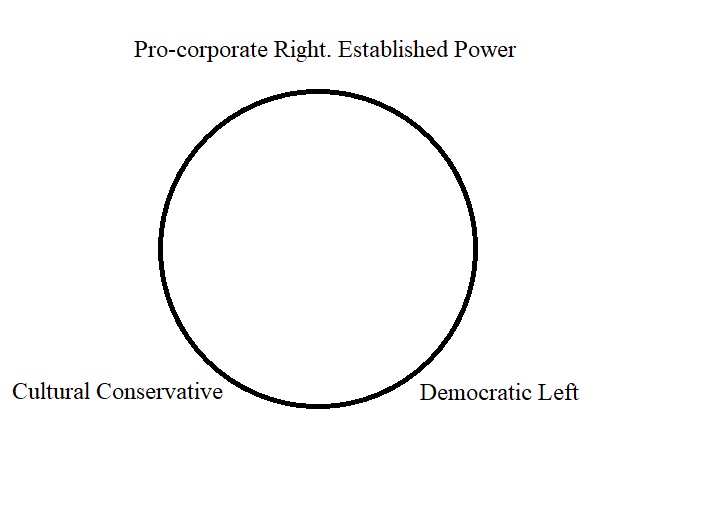
It could be useful to think of contemporary Australian, and probably US, politics in terms of a triad:

(Currently Pro-corporate) Right
Cultural Conservative
Democratic Left.

Using a triad rather than a set of binaries helps us to avoid seeing these factions as opposites. They all share things with each other, can move from one position to another, and ally with one another.

political circle 02

In brief:

The (pro-corporate) Right support established wealth and power. They consider that the powerful are virtuous, and justified in that power, by virtue of that power and wealth. Given that the main contemporary power resides in the corporate sector they tend to support that sector and its justification within so-called ‘free markets.

Cultural conservatives support what they see as traditional culture, and traditional power relations.

The Democratic left supports ‘the people’, against entrenched power and entrenched ‘irrational’ culture. They tend to see themselves as the supreme judges of what is entrenched.

In more detail:

The Right tends to attack the rights, incomes and conditions of ordinary people in order to support established power and hierarchy.

Power must be maintained, and society geared towards providing the best conditions for the powerful to do their stuff (whatever that is; make money, use violence, own land, spout theology etc.), as that is supposedly best for everyone. They are anti-democratic at heart.

They oppose any kind of benefits for the poor, which are not a form of charity which requires genuflection towards the rich, or other elite, and hence reinforces the power system. To them mutual obligation means the obligation of the poor not to accept help that costs the elite anything, or for the poor not to challenge the elites.

They also oppose to any traditional culture or set of values, which acts to restrain the power they support which, as stated above, in our society is the corporate sector.

They encourage culture wars to maintain separation between conservatives and the left, and use conservative respect for established power to persuade conservatives that they are both on the same side.

If contemporary rightists have a religion it tends to assume that wealth is God’s reward for virtue and faith, and that a person’s prime responsibility is for their own salvation and then, perhaps, their family’s.

The main problem the right face is that they know they are right. They think all information is PR and you make it correct by PR, will and effort, or sleight of hand. They are extremely good at sales and marketing in an economic system in which false advertising and hype is normal. They tend to think any counter evidence is evidence of bias, and must also be made up. The problem for them is that eventually reality cannot be denied, and bites everyone, including them.

Conservatives tend to be suspicious of innovation.

Nowadays, living in corporate capitalism, innovation occurs all the time, destroying traditional culture and place, so life is difficult for them.

Capitalism also tends to reduce all value and virtue to money. This often seems fundamentally wrong to conservatives.

While tending to support single authorities, conservatives can also like a balance of social powers to act as restraints. Thus they can support professional organisations, teaching organisation, religious organisations, business organisations, military organisations and conservation organisations having input into government. Whoever is the ‘King’ should have loyal and fearless advisers.

They also tend to think that power involves responsibility towards both the established rules and laws of government and to the ruled. The rulers should cultivate noblisse oblige, protection for the ruled, charity, justice and so on. Ideally while everyone should know their place, there should be mutual respect. Mutual obligation is not one sided.

Religion is often considered vitally important in cultivating virtue, generosity, judgement, content with one’s place and is supposed to act as a restraint on human selfishness.

Cultural conservatives tend to like traditional boundaries for gender, profession, task and so on, especially when tied into religion.

They often consider that traditional culture carries a wisdom, which cannot be easily summarised intellectually, and that breaking traditional culture and its mores carries unsuspected dangers. This can lead them to support functional ignorance, as new knowledge might be dangerously mistaken.

They are strongly suspicious of people for being different, and can team up to put down any difference, thus limiting a culture’s range of potentially constructive responses. This is a weakness.

Another weakness is thinking that by allying with established corporate power, primarily against the left, they are defending cultural wisdom against difference, and that this gives them real power. In other words they often think that established power must inherently be virtuous and conservative. What they eventually discover is that if they get in the way of money making, or whatever the right’s hype of the moment is, then they will be over-ridden completely.

More on conservative philosophy here

The Democratic Left tends to be suspicious of everything that oppresses, or could oppress, people and which only has backing in tradition or raw power. They tend to think that what seems like arbitrary power and culture should be destroyed.

For them ordinary people are as wise as anyone else and should be supported in their efforts to better themselves. People should not be ignored or suffer simply because they are poor or outcast – this is unjust.

The problem for the left is that revolutionary leftists, if the revolution succeeds, become the new rightists. They support the new forms of established power and run roughshod over those who oppose them.

On the other hand, moderate leftists tend to accommodate to the power of the right, and thus end up cautiously supporting oppression to receive funding. They may also accept established power relations in return for what appears to be the ability to moderate that power. This position can achieve something, but without them encouraging another set of power bases, they cannot hold the achievement. This is clear from Hawke and Keating in Australia, Blair in the UK and Obama in the US.

Leftists are often conservative; they don’t want to reduce every virtue and value to money, they tend to like balance of powers, and they often support the achievements of the past which have now been swept away by the Right: for example the Menzies idea that social insurance was a right, and that people should not be humiliated or harassed for accepting it, or the idea that workers form a valuable community rather than a disposable resource. They also tend to support environmental conservation and oppose destruction of land and place.

Their main problem is the tendency to want to overthrow traditional culture rather than improve it. This is one reason, that ‘modern art’ holds so little popular appeal; much of it only rebels. Conservatives are probably correct that culture holds some evolutionary adaptive organisations, but that it may well need to change as circumstances change.

Leftists are easily persuaded that conservatives support harm for the marginalised, are racist, sexist, superstitious and stupid – which helps drive the culture wars, started by the Right, and which tends to throw them on the mercies of the right.

Consequences

The point of all this is to suggest that there is perhaps as much commonality between left and conservatives as there is between conservatives and the right, or the right and the left. There is room to be flexible. However allying with the right is likely to prove disastrous for the other two sides, partly because the right has no respect for reality, only wealth. Both the left and conservatives have weaknesses which sabotage them, but which have a chance of being corrected by the other.

Historically it could be argued that the successful 19th and early 20th century reform movements, that lead to public education and protection against misfortune for the working class, arose through an alliance through the democratic left and the conservatives both recognizing that unconstrained capitalism was destroying traditional life, interconnections and responsibilities. That this economic system was demeaning the working men and women of the country, and that it was Christian to try and help people live lives which were not full of abject misery and poverty.

This alliance was largely successful, despite obvious frictions. It is not impossible that a similar movement against the corruption of public life through money and the destruction of land, water and air could motivate another successful alliance.

The only thing that seems guaranteed, is that if the Right remains dominating, then everything will end badly.

More reflections here…

President Trump on Energy

March 29, 2019

This is a commentary on Donald Trump speaking about Energy Policy from a speech to raise funds for Republicans in New York August 13, 2018.

While this speech is not about Energy Policy, it contains points he repeats elsewhere and is as complete a presentation of his views as I have seen.

You know, uh considering the fact that we have the highest taxes in the nation in New York, and we should have no taxes if Andrew Cuomo, if he took over and if he — think of it — if they would have allowed a little bit of fracking and taken some of the richness out of the land, which by the way is being sucked away by other states. You know, they don’t have state lines underground. You know what that means? That means it just goes down, down, down.

Gas does not always flow everywhere in fracking fields. This is why you have so many short lived drilling points.

However by fracking and blowing up the geological barriers you can get gas leaking into the water table and making water poisonous. You can also get gas leaking into the air. With Gas you also get large leaks through ancient pipes, particularly in big cities. Gas is heavily polluting, breathing methane is not pleasant and it adds to global warming.

We don’t get it. You look at what’s happened in Pennsylvania with the money they’ve taken in, you look at what happened in Ohio with the money they’ve taken in. They’re fracking, they’re drilling a little bit, they’re creating jobs, and this place, it’s just so sad to see it.

Would fracking in New York really create a significant number of jobs in New York, given New York’s population? I’d doubt it. But he never gives any figures, so who knows.

You look at what’s happened in Pennsylvania with the money they’ve taken in, you look at what happened in Ohio with the money they’ve taken in….. Because stuff flows — do you understand that? It flows, and they probably have those little turns, you know, they make the turns at the border. It goes like this, right? And all of a sudden someday you’re not going to have that underground maybe so much

If gas under New York Flowed to Pennsylvania and Ohio, then taking the gas out in New York would diminish the benefits and jobs produced by the gas in Pennsylvania and Ohio. So he is effectively suggesting that New York get rich at their expense.

This could have been Boom Town USA.

Ok New York has no business, and never booms? An odd view perhaps.

We got ANWR, one of the largest fields in the history in anywhere in the world. One of the great, one of the great energy fields anywhere in the world. That’s in Alaska. They’ve been trying to get that long before Ronald Reagan.
Nobody could get it approved. We got it approved. That’s going to be one of the great energy [Inaudible].

Yes you do have access to the Artic National Wildlife Refuge – largely because of climate change (which is good for you), but with oil drilling, spills and flares, construction and transport, you will not keep it as a wildlife refuge. This may not be a problem to neoliberals. So lets not push it. Trump has been trying to overturn National Monument protection to allowing mining and drilling. This is more of the same. Profit not wildlife.

We approved the Keystone and the Dakota-access pipelines in just about Week 1. They were dead. They were dead. I had dinner the other night with one of the gentleman involved in the Dakota access. He said, “Sir, we were dead.” — I never met him — “We were dead. It was not going to happen.”

Now it’s open. Tremendous numbers of jobs were produced in building it and everything else. We got it started. Likewise Keystone. I think it’s gonna be a total of 48, 000 jobs during construction and also environmentally better than the alternatives.

Stages 1-3 of the pipeline were completed before Trump became President. Stage 4 (the Keystone), which he gave the go-ahead to, is not yet completed or open. Yes people were protesting against the pipes, because they risked despoliation of water supplies and land, and they are now going ahead. Profit before people and land. The job figures appear to be fantasy, but I’m open to correction. And what is better about oil covered land?

We have clean coal — exports have increased, 60% last year — clean coal, which is one of our big assets that we weren’t allowed to use for our miners. You remember Hillary with the coal, right, sitting with the miners at the table? Remember? That wasn’t so good for her. So the people of West Virginia and all over, you look at Wyoming, you look at so many different places where they just, Pennsylvania, where they loved what we did, and it’s clean coal and we have the most modern procedures.

We don’t have clean coal. Clean coal is largely an expensive fantasy. Burning coal can be more, or less, polluting but it is not clean. Let’s be clear; coal is poisonous. Mining it damages water tables and can give people lung diseases. Burning it produces greenhouse gases and poisons. The ash which remains holds heavy metals and is poisonous; Trump’s EPA now allows the ash to be dumped in streams.

Four months after this statement, Trump’s EPA would abolish or modify Obama’s requirement for low emissions and Carbon Capture, so his point about coal being clean is largely irrelevant due to his own policies.

But it’s a tremendous form of energy in the sense that in a military way — think of it — coal is indestructible.

You can blow up a pipeline, you can blow up the windmills. You know, the windmills, [mimics windmill noise, mimes shooting gun] Bing! That’s the end of that one.

Coal actually works as an energy source because it is easily destructible. Burning coal destroys that coal. Sun and Wind are not destroyed by using them for energy – this is what is usually meant by “renewable”.

However, even if Trump really means coal infrastructure is more resistant than wind to attack or disaster, you still have a problem. Coal mines and power stations can be bombed or set alight. It is hard to put out fires in coal mines. Cables and grids can be cut or hacked. Coal power can collapse with high temperatures as we learn in Australia regularly. Because wind and solar are more widely distributed, and less concentrated in a small place, they are probably more resistant to attack.

If the birds don’t kill it [the wind farm] first. The birds could kill it first.

It is nice to see the President concerned about birds, but does anyone know of him ever expressing any concern about wildlife in any other situation? See the point about the Artic National Wildlife Refuge above. As far as I know, birds have never taken down a modern windmill.

And you know, don’t worry about wind, when the wind doesn’t blow, I said, “What happens when the wind doesn’t blow?” Well, then we have a problem. OK good. They were putting them in areas where they didn’t have much wind, too.

Strangely energy companies seemed not to be too worried about this problem. But if people were putting windmills in areas without much wind, it was probably because of a bad subsidy – say one that rewarded them for numbers installed rather than power generated.

And it’s a subsidiary [sic] — you need subsidy for windmills. You need subsidy. Who wants to have energy where you need subsidy? So, uh, the coal is doing great.

There are indeed subsidies for Wind power. However Trump is forcing people to buy coal power to keep coal power running, because of supposed security concerns. This is effectively a subsidy reflected in higher prices for consumers. Coal usually receives tax concessions, and exemption from its pollution costs, so coal is subsidised already.

American oil production recently reached an all-time high in our history and it’s going higher. We’re now the No. 1 in the world in that category. We’re No. 1 and there are, nobody ever thought they’d see that, but we opened it up in a very environmentally friendly way.

People who live in fracking fields may dispute how environmentally friendly this gas is: that is, if they did not have to sign confidentiality agreements.

Withdrew the United States from the job-killing Paris climate accord. That was another beauty. That was a beauty.

Exiting the Paris accord is probably not beautiful. Along with his removal of waste and pollution controls on corporations, it is going to harm the American people and the world. It also indicates to anyone that Trump cannot be relied upon to keep promises and treaties entered into by the USA, thus lowering US presence in the world, and boosting that of China.

Trump may be seduced by corporate profit as a good thing. But he also seems to be seduced by a narrative which states that coal is a source of power, progress and stability. But Coal is no longer any of these things, as explained above and elsewhere. New coal power is also extremely expensive to build, which is why pro-coal and pro-free market governments are talking about subsidies and compulsions to buy coal power. Nobody wants to build it without such subsidies. Left to itself and the market, coal is dead. But it won’t be left to itself.

On “Political Correctness”

March 5, 2019

“Political correctness” is the all round term of denunciation for any proposition which would like rightwingers to think, not be impolite, or not sanctify the suppression of someone, as in:

“Perhaps we should stop destroying our environment?”
“Oh stop being politically correct.”

“Maybe [racism, sexism, corporate power etc] needs to be recognized as a problem?”
“Shut up and stop being politically correct”

“The evidence suggests that the cardinal raped children, and suported other rapists.”
“Political correctness is everywhere. He’s the real victim.”

Gaining political support can often depend on people not thinking and not discussing things with other groups, so slur terms can spread and multiply, once you have decided on that approach.

Calling something “political correctness” is part of a general strategy in which Republicans and Republican media have done their best to shut down discussion over the years – from at least the Gingrich congress onwards.

We can see it in those rightwingers who:

  • continually scream their righteous abuse at those who disagree with them;
  • go after people because they made a remark they construed as “socialist” ie against corporate supremacy;
  • make a big show to each other of their righteous virtue while dismissing other people for “virtue signaling”;
  • dismissing someone as a “sjw” if they object to some blatant injustice;
  • dismissing another line of thought they don’t like and cannot be bothered to try and read as “Cultural Marxism”;
  • stomping around angrily calling the corporately owned media “biased” and “left wing”, if it slightly varies from the party line;
  • giving death threats to climate scientists for not supporting the pro-fossil fuel, pro-pollution, position;
  • invent terms like “libtard” to help stop discussion;
  • sneer at people who realise that capitalism can sometimes be destructive, or that the ecology is in crisis, or that racism and sexism exist, as “woke”, again so the don’t have to think about these things and can condemn those who do as stupid or following the crowd – unlike them who are following the corporate elites;
  • scream about how unamerican it was to object to the last Iraq war, while pretending their opponents are warmongers;
  • support a president who slams any coverage which is not 100% behind him, as being made by enemies of the people.

We know through these right whingers that they (with all their corporate backing) are the real victims, and that only women can be sexist, and only black people racist. Anyone who might offer sympathy to people who they think are being affected by racism, or sexism is a deluded busybody. Similarly, it’s a “witch hunt”, when a guilty, or probably guilty, right winger is questioned instead of being let-off to continue with their crimes.

Through rightwingers we also know that all fact checkers, scientists and people who study society have a liberal bias, as presumably the way you get to be right wing is through total ignorance of reality.

But then again we can be told by rightwingers that discussion, or finding the truth, is not what discussion is about; victory is the only thing that counts, with total annihilation of the other side the aim. What is the point of discussion other than to reinforce your own biases and scream a lot?

The republican media, starting with Rush Limbaugh and Fox taught these techniques, partly as a way of marketing – get the audience angry and upset so they can’t think properly, and tell them that any other source (that might disagree with that anger or think it is misplaced) is biased and out to get them. You get your audience to stick with you whatever rubbish you spout, and that brings more sponsorship and more wealth for you.

Partly this technique was developed because the policies the right sells (what is called ‘neoliberalism’ or ‘privileging the rich while kicking the poor and middle classes’), may not be that popular if they had been upfront about the known consequences of those policies.

To avoid people understanding this policy reality, they began to construct the idea that discussion involved the endless headkicking of difference and invention of scandal. They build the “culture wars”. They constantly accuse their opponents of positions they do not hold, so as to make them seem more evil to their ingroup and reinforce their own groupthink. The technique helps build conformity, and fear of attack, in their own group, because people see what happens to those who think for themselves, and they have the options of staying loyal or facing the consequences of having their friends forsake them….

The Right has been so free of facts and so full of denunciation they helped build the political polarisation of the US (and similar techniques were employed in the UK and Australia) and made way for a President who openly denies climate change, and denounces opponents, to protect corporate polluters and the extremely wealthy.

After a while they created the sense that right wing discourse was creation of an atmosphere of threat, and it became invisible to them; it was water to a fish. Eventually, after being abused and threatened for years, without any Republicans calling their side out for these techniques, the ‘liberal left’ began to respond in kind, and lo! Republicans suddenly became concerned about rudeness in discussion, after their years of silence on the issue. The separation of the debate into two sides who abuse each other was part of the aim of all this. Then you don’t have to worry so much about explaining what your policies achieve, as no one cares about anything other than point scoring.

These techniques have made the US vulnerable to Russian interference. People in the US don’t need Russia to divide them, because that was the Right’s aim and it has been achieved, but the Russians can, and have, increased those manufactured divisions for their own purposes. And yes we now have Trump, who the US’s enemies know is incapable of making anything great.

The difficulties of being climate aware: Social and Psychological

March 4, 2019

Official climate action is way too slow. Despite Rightist allegations that governments are pro-climate change because they could use it to increase their power and suppress dissent, on the whole governments seem extremely reluctant to do anything about climate change or ecological destruction. We can see them threaten scientists or others who talk out, remove useful information from official websites, appoint industry figures to investigate climate change or to lead departments of environment, attempt to destroy data, support coal mining and construction of coal power, change regulations constantly so as to make renewable ventures more difficult, make it easier to do more land clearing and emit more pollution and so on. There are few governments in the world who don’t exhibit at least some of these policies.

Why does this happen? For two main reasons.

  • 1) Dealing with climate change is difficult both practically and psychologically, and
  • 2) [a related factor] Dealing with climate change disadvantages quite a number of established powerful people who would have to stop making money from actions which lead to climate change. Change is threatening, as other people might displace them, or they might lose out on their current positions. Imagining change is psychologically disorienting for many people.
  • Those people who are interested in doing something about climate change, may need to remember that an extremely powerful and wealthy group of elites oppose them. Activists are the underdog, and this can be a hard position to accept.

    Corporations and Governments have (for about the last 100 years or so) been tied in with a model of profit and development which depends on fossil fuel consumption, the massive dumping of pollution on less powerful people (where possible) together with the destruction of natural resources, through mining, deforestation, housing development, industrial farming, modes of warfare, and so on.

    It should be hardly necessary to add that while this process has helped lift millions of people out of poverty, it has also forcibly dispossessed millions of people from relative self-sufficiency into wage labour and dependece, and stopped people from living a roughly sustainable life style. It has also produced truly massive inequalities of wealth. And massive inequalities of wealth lead to massive inequalities of power, confidence and apparent ability to act.

    Those wealthy people and organisations who get wealthy from producing climate change and ecological destruction as side-effects of their wealth generation, can buy governments all over the world. They are marked as wise and successful people by their wealth, they have access to governments, they can provide well-paying jobs for people who help them and so on.

    In most countries they own and control the media, and hence they either attack ideas of climate change, threaten climate scientists, provide money for ‘skeptical’ research, or at the best pretend that the science is undecided and hire opinion writers to scare people about climate science, the economic consequences of change, or the abuse and exile you will suffer if you oppose them. This occurs irrespectively of whether the media is supposed to be ‘left’ or ‘righteous’, as it is still largely owned by corporate people. This wealthy group also supports think-tanks which make money by providing arguments in favour of their aims.

    Government people often give more credence to endlessly repeated ‘information’ they read and hear, than they do to real research, and if governments were to act then they might lose media and donor support, so they could lose government. Governments (particularly in ‘developing countries’) also fear that if they did not maintain ecological destruction then it would be difficult to increase living standards for their people, and thus they would be replaced by governments who might be even worse. Investors might go on strike and take their money elsewhere. There is no obvious way forward – renewables may not work as well as fossil fuels.

    So you will find power and bought-information working against any progress towards not destroying our current ecology and eventually our civilisation.

    It almost goes without saying that realizing the world you depend upon is being destroyed, and that powerful people support that destruction or, at best turn away from it, is deeply depressing. It is also isolating as most people follow the lead established and find it difficult to talk about climate change, or will dismiss it as a ‘downer’; and it does hit people by reminding them of ends and mortality. Global ecological destruction is too upsetting for many people to face.

    Acting requires people to change their lives, and to admit that their children and grandchildren are endangered by ordinary life; you too are partially responsible for climate change, through how you live, what you buy, and what you consume. It is hard to keep psychologically functional and live with the realization that you face almost overwhelming power and overwhelming routine. Changing one’s life is threatening for both powerful and ordinary people. Climate change and its consequences may even satisfy any unconscious desires you have for self destruction.

    To some extent, continuing with climate change depends on you giving up, and accepting some other group’s superior power over your life and fate, and that too is hard to face.

    But, despite the overwhelming odds and difficulties, you have to continue to fight anyway, in whatever way you can. It is helpful to remember that many local communities are working together, sometimes rather anarchically, outside the system, or breaking the regulations, in order to do something. There are likely to be people in your local area interested in practical action, who are not blinded by the wealthy and powerful, and who just get on with things. They may be prepared to talk and express their feelings and recognize the difficulties even while they act. They act even if all seems dark, just as people have done when facing invasion or tyranny – and acting is a tonic providing you recognize the darkness within and do not suppress it or let yourself be taken over by it.

    See if you can find such groups and join in. If you don’t like a particular group, there will probably be some other groups you can link together with. It may be useful to engage in therapy, providing the therapist does not encourage you to isolate yourself from action, or the problem. It may be useful to learn how to work with your dreams as they reveal information, symbolically, that you may otherwise be unaware of. There is no reason why action cannot lead to a happier more contented self, once you realise the traps. The current state of affairs leads to a despondent, or suppressive, self. Moving to oppose, or get out of the system, may help you in every way possible.

    A left wing newspaper covers the Right

    August 27, 2018

    For those who don’t know, the Right wing government has had a change of Prime Minister. It was agitated for by the extreme right, and he kept yielding to them, until they rewarded him by challenging him for leadership. They succeeded in the overthrow, but not in putting one of their absolute own in place. We still have a neoliberal leader.

    Where I live We are always being told by the Right, that the local non-Murdoch newspaper, the Sydney Morning Herald is a left wing newspaper. I thought I’d test this hypothesis by looking at relevant article headlines for the first three days after the Morrison coup. See what you think.

    For any confused Americans, ‘Liberal’ in the rest of the world means something like “in favour of capitalism” it does not mean “progressive”.

    The lines reaching the margin are the headlines, the indent a vague summary of the article. Remarks in {}s are mine.

    Saturday
    Morrison snatches top job.

  • [New PM vows to unite party, nation]
  • Podium finish for Morrison after day of Drama.

  • [PM embarks on Campain to heal divisions]
  • PM vows action on Power prices.

  • [no mention of climate change or emissions. No criticism of his focus]
  • Headaches ahead on the policy front.

  • [he will push control of the policy priorities back to the centre right]
  • He promised so much but sadly delivered little.

  • [Peter Fitzsimmons laments Malcolm Turnbull’s failings]
  • Real Malcolm did stand up, too late.

  • [Another peice on Turnbull’s failings. Both legitimate the challenge]
  • The Rise and rise of a ruthless pragmatist always in a hurry.

  • [Morrison’s career as a moderate pragmatist… His connections with Peter Costello a Liberal stalwart and John Howard. Loyal to Turnbull. Likes football. A bastion of middle Australia. Competent Treasurer. Hailed by business. General moderate good guy.]
  • Down to earth, a good man, a winner, a clown.

  • [8 positive comments on Morrison from voters in his electorate one negative and one indifferent for balance.]
  • No Honeymoon for PM.

  • [Shock jocks still want Abbott/Dutton as PM]
  • The inside story of Scott Morrison’s ascendancy.

  • [Morrison had more application than Dutton. The mess is all the fault of those more conservative than Morrison. He was loyal to the end]
  • The breaking of politics in Australia.

  • [Left wing identity politics, and right wing insurgency is the problem. Steady democracy is on the way out – so the coalitions’ behaviour in the last week is the new normal]
  • Editorial: Liberals choose the sensible centre-right.

  • [No comment needed]
  • Letters: Turnbull can only blame himself. Narrow victory for the progressives
    Stephanie Dowrick: Rise up and resist the leaders with no vision.

  • [mildly critical, but the ALP are as bad.]
  • Tom Switzer: Popular ideas can help Morrison unite a split party.

  • [Malcolm Turnbull was never one of us. Morrison must fight the culture wars, political correctness and left identity politics. {presumably the government’s actual policies are not popular or desired by most people.}]
  • Peter Hartcher: Vengeance but no end to madness.

  • [Over a quarter of the peice gives Abbott’s attack on Turnbull without comment. The implication is that the Liberals have gone away from their conservative base and lost trust.]
  • Sunday
    Morrison to end school Funding War.

  • [{We will eventually find out that this means giving still more money to over-wealthy high fee private schools}]
  • Dutton backers tell PM to show he’s listening on immigration.
    Normal bloke next door is what Australia needs.

  • [The new Prime Minster is one of us]
  • Treasurer turns to Costello for tips.
    Everyone loves the real friendly new first lady.
    No clash of dynasties in Wentworth.

  • [all is peaceful in the ex-PM’s electorate. No one cares he has been displaced.]
  • The Roof of the Broad Church may be falling in

  • [Critical of Coalition or Turnbull Government, but implies that the republicans in the US are a populist working class party -NO]
  • Wanted firm political leadership.

  • [critical of both sides]
  • Editorial: If Morrison can be his own man then there’s hope.

    Monday
    Morrison treads softly in reshuffle.
    Voters warm to PM but turn on Coalition.

  • [Sounds critical but the “coalition has kept core support near the 44.6 per cent it gained at the last election” so they are hopeful of winning. {No mention of other polls which show Coalition support collapsing}]
  • PM Rewards Allies and restores key rivals to power.
    Morrison did everything for a truce. But one move was too far.

  • [Pragmatic cabinet reshuffle that did not reward Tony Abbott.]
  • Accolades flow for top Foreign minister.

  • [Be nice to Julie Bishop day. Don’t talk about sexism. Bishop was widely regarded as a leadership contender who worked hard for people on her side. She was roundly rejected by her party.]
  • Amanda Vanstone: No wonder the public is annoyed.

  • [Criticises nameless bad people in the Parliament so its all generalities]
  • Cancer eating the heart of democracy.

  • [Kevin Rudd attacks Rupert Murdoch and Tony Abbott.]