Posts Tagged ‘‘nature’’

Conceiving Politics

February 21, 2021

This is a redoing of some earlier posts on this blog about the question of how do we define and specify ‘politics’. The aim is to replace the idea that politics is something done by others in Parliament, or in the State, and reclaim the idea that politics involves everyone who lives in society.

Defining politics in general

Politics involves the attempts by individuals or groups of people to decide upon, or achieve, an aim which involves (or affects) themselves and/or other people. Politics includes the ways people go about organising themselves and persuading others to go along with them. Politics can manifest between groups, and between individuals within groups.

Politics necessarily happens all the time because we live with other people, and people acting together can often be much more effective in achieving aims than can individuals acting alone. People also tend to get satisfaction from being in groups acting and being together. Politics (persuasion of others, building co-operation, fostering attacks, etc.) is usually involved whenever we try to solve problems, and social life frequently involves attempts towards solving problems.

Everyone engages in politics, in the family, in the village, in the city, in the company, in the University, in the State, and in World wide organisations. From children deciding what games to play, or who should be on what team, to ministers trying to persuade other countries to surrender, humans are constantly trying to work with others, organise work and celebration with others, organise conflict with others, trying to get the better of others, trying to persuade others, trying to threaten others, trying to flatter others, trying to help others, trying to discover the truth of a situation, trying to hide the truth, trying to frame the truth in a way which suits us, or trying to make the good life with others.

To live harmoniously with others, we have to learn how to negotiate, compromise and get those others onside as best we can. However, as well as being relatively peaceable, politics can be ruthless, involving the capacity for threat and violence, or of defering threat and violence. It involves exerting power and resisting power, negotiating consensus and allocating dissensus, asserting hierarchy and equalities. Certain people can be excluded from the political field, and can assert, and possibly force their inclusion in that field. Politics can be about meaning and understanding: about the struggle over the ‘correct’ meanings and consequences of words and concepts, because undersanding words in particular ways can guide behaviour.

The social field is political

The social field is inherently political and involves struggle. Ethical and moral struggles also tend to be political, and we tend to evaluate people on ‘our side,’ or in our social categories, differently from other people – usually (but not always) being more likely to excuse their failings.

While the politics of the State may look different, have different modes of enforcement, have different effects from the politics of the home or the workplace, all politics involve similar kinds of processes.

The same kind of skills are deployed in the family as are needed to be employed in the village, in the township and so on, to make decisions, to organise people, to work and celebrate or whatever. Political processes in daily life and political processes in the State are similar, even if the range of their effect is quite different.

Politics can be seen to involve idea generation, persuasion, co-operation, competition, decision making, allocating responsibility, allocating authority, overcoming entrenched and no longer useful authority, gaining ability, gaining virtue, rewarding virtue, rewarding beneficial aspiration, and so on. It does not necessarily involve harmony, and can spiral out into civil (or other) war.

Politics sets up a complex system as it inevitably involves people reacting to other people and to circumstances as they arise.

Aristotle and politics

That social life is inherently political and that people are rarely completely outside some form of politics, is a view with considerable antiquity. As is well known Aristotle wrote that

animals that live politically are those that have any kind of activity in common, which is not true of all gregarious animals,

Politics involves the building of activity in common, not just living together.

humans are by nature political animals [or ‘political life forms’, Zoon politikon]. And he who by nature and not by mere accident is without a Polity, is either above humanity, or below it.

The suggestion is that normal humans are political creatures, and Aristotle appears to argue, this arises because people cannot perform their natural functions apart from the polity, since they cannot be completely self-sufficient throughout their entire lives. Thus, the Polity (my way of translating polis, usually translated as ‘state’ or ‘city state’ or even ‘social organisation’) comes into existence to enable human life. He takes a more or less anthropological position that:

The polity is prior in nature to the household and to each of us individually.

We are born into a polity, or society. This is because we build our function, abilities and capacities through our relationships to others. Households and individuals do not exist by themselves.

For the whole must necessarily be prior to the part… [as] all things are defined by their function and capacity, so that when they are no longer able to perform their function [within the whole] they must not be said to be the same things.

In other words, humans develop their capacities and virtues in relationship to other humans within already existing modes of organisation. We come into being amidst creative others (this is I think important to Aristotle’s idea of humanity as implied in the Rhetoric, the Poetics and On the Soul, and is in any case always important to recognise). To use terms which will be important later we live in systems (some of which are non-human) with histories or trajectories. The polity is, according to Aristotle, the way humans can come to craft a good and human life the best way they can. The Polity is necessary to make a better polity. The polity does not have to be a State, but usually a large scale polity has state-like structures.

We can fault Aristotle because he does not take his definition of politics seriously enough. He does not seem to object to the idea that political systems can work to exclude people (such as women, slaves and inevitably people below some arbitrary age). This can come to seem natural, but it is political.

Politics, complexity and uncertainty

Complexity means we cannot define politics so that it has to be successful, or result in any firm control over the world. The best we can hope for is to influence, or effect on the world – working with the world, perhaps – and then check events as they occur to see if we are getting the results we anticipated. This is the nature of the world. Life is further made complicated because people can agree over what they don’t want, but split over what they do want.

Many human activities do not achieve what people hope to gain. Most art will be forgotten or thrown out. Doctors do not heal everyone, and in some cases damage people even more. Many families will be unhappy despite the best efforts of those involved. Failure and unintended consequences are a normal part of engaging in life.

Success is never a measure of something occuring, and of course we live with moral uncertainty, and all other kinds of uncertainty, that still does not mean we don’t engage in politics with each other whether we object to those politics or not. Indeed, I would suggest that certainty of action and solution, is probably the hallmark of a politics which will fail to produce beneficial results for most people. The more certain or self-destructive the culture, the more deletarious unintended consequences are likely to arise. Climate change is a great example of what seems to be an unintended consequences of particular modes of social organisation and their politics.

However, politics nearly always attempts to create an order which it attempts to establish or defend.

Policing

There is also a form of politics which, following Jacques Ranciere, we can call policing. This is about continuing and defending established behaviours and categories. Ranciere sees this form of politics purely as a policing of established order. It does not involve much in the way of negotiation, or recognition of others as more than obedient, needing to move on from failure, or needing punishment.

Ranciere reduces politics to the politics between potential recognised equals or politics which is about gaining such equality, and the politics which is policing. However, as Davis points out, even succesful egalitarian politics may still involve policing, as people try to stop the system being commandeered by those who would destroy it, or prevent some recognition of some part of the polity. As is well known, this attempt is at best paradoxical, as stopping people from preventing others participating, may involve ceasing to recognise the ‘stoppers’ as being legitimate participants. That this is paradoxical does not mean it is not real part of politics, or that it can be eliminated.

Neoliberal policing

Neoliberalism aims to make ‘the market’ (or really corporate power) the dominant and non challengable power in human life and politics. The market is supposedly better than other parts of human life, because it is described as ‘non-political’. As a result, every human action and production becomes reduced to trade, and mutual decision making becomes an impingement on individual liberty, especially when it interferes with trade. For neoliberals, the ideal forms of evil organisation are the State or the Trade Union (and people must be encouraged to have no hope in the State or unions), and the truly good form is the company – where you get told what to do, unless you own and control the organisation. Apparently ordinary people are all individuals, and should never act together, and organisation should be reserved for the powerful and their economic/political activity. The State only exists to defend the exclusive rights of business people. Libertarians rarely seem to have the same strength of objection to the wealthy or business people acting together – perhaps because they realise this would affect the political effectiveness of these people, and the force of capitalism.

Because neoliberals only give importance to established business interests, they have no regard for ecology. Things which cannot be restricted in ownership and priced have no value. There is no common good, only private good and private profit.

Politics as protest

Neoliberals want to keep us ignorant, of the scale and success of peaceful popular movements against corporate power. For example, 20 million Americans joined protests for the first Earth Day. Who knows that nowadays? Who nowadays is allowed to think anything other than that environmentalism is a minor, non-mainstream, interest? So we cannot ask how it was that people in the US fought against flaming, poisonous rivers, and deadly work conditions, and temporarily succeeded?

This may have happened because in that pre-neoliberal period people knew that politics was part of daily life. “The personal is political.” Any ethical decision making that involves others, involves politics. It is now pretty much orthodoxy to leave the State to the wealthy, and assume nothing can be done to make things better.

While politics is essential for joint-human activity, it need not mean “power over others,” or constant dishonesty. Politics does not have to be ruthless. It is possible that the more ruthless the politics (especially official politics), the less ‘ordinary people’ may feel inclined to participate, if they morally disapprove of ruthlessness or are frightened of the consequences of participation. Indeed presenting politics as ruthless or corrupt, may be one way to foster lesser participation by people in general (other than as providing a backdrop of support). Ruthless politics may well be less about ideas and ethics, than about victory.

An anarchist, communitarian, politics is possible, even if it is precarious. Indeed we might well define a politics which only requires power over and dishonesty as defining a bad polity, which is headed for disaster and requires reformation.

Activists (such as Greta Thunberg) may not be playing power and dominance games but trying to reform the current polity, craft the best possible polity, and to continue survival for everyone. However, because of this, she is involved in politics, and being made part of power and dominance struggles, by those who are attempting to preserve a disastrous polity, or their place within it. This currently involves lots of abuse. Some of those engaged in this kind of abuse politics, are pretending that they are not political, because, in their politics, doing nothing to challenge the processes of destruction is supposed to seem normal. Challenging the establishment may always seem more political than leaving it alone. The established have more capacity for distributing abuse than their challengers. This is one way of promoting exclusion and limiting the political field. The end result is probably totalitarianism.

Polity with Nature

Just as we can hope for a politics which allows maximal human participation, we can hope that those capacities and virtues crafted within the crafting of the Polity (especially a healthy polity), can extend outwards to the land, and to other life forms. We have to live with our land, other life forms and within the boundaries of the planet. Destroying land, other life forms and planetary boundaries, forms a highway to disaster. Having a politics with beings that cannot use language is difficult, but I would suggest not impossible. Partly it involves recognition and formal incorporation, just as we can recognise children, and domesticated animals, and place their treatment within the concerns of the polity. It is a request that we extend our empathy found within our own identity categories, to the world as a whole. Even if the process is ultimately impossible, and people have to speak for other beings, then we still have to do it, if we wish to survive.

I suggest that one way of getting there is through practices of listening – or Dadirri. Many indigenous peoples have traditions of incorporating land and other creatures into their decision making processes. People who live in States could possibly attempt to learn from them.

Because ecologies change and relationships between different groups or different polities change, the work of making the good polity is never ending. It never reaches permanent stability or perfection. The polity is likely to face new challenges and new problems, which it has to face creatively.

Summary

People organise themselves together with others as part of normal social life, because they can achieve more as organised groups, and get enjoyment from that, if it is self-motivated. People also have to live together, and interact with each other, and solve the problems that all or some of them face. This all involves politics. We can call call this activity a polity. Polities can exist within polities, and include polities. Politics can be creative, maintaining, or repressive.

Politics can also involve force and exclusion, both at the local level and the level of the State. Social life and political life are rarely separable. We are born into a polity, and political relationships and interactions, exist before we can participate, even if our participation changes them.

Politics generates a complex system, and takes place within complex systems. It is inherently uncertain. Ideas we campaign for, may not be accurate. A healthy politics should probably remember this, so that it can change, and create new ideas which are more accurate and helpful for the polity.

In the English speaking world, the dominant form of politics for the last 40 years has been neoliberal politics. This centralises the importance of business, minimalises the importance of any other form of human activity, supports other activities to the extent they support business, and suppresses recognition of corporate power and decisions, through the idea of the impersonal market which, magically, always generates the best result. In this framework, attacks on business dominance, are attacks on the market and therefore bad.

Because neoliberalism centralises established business dominance, it also defends the right of business to destroy ecology, pollute, disperse materials and poison people, as if ‘the market’ demands this destruction for profit, then this is the best that can occur.

It is however possible to conceive the idea of expanding politics, so that it involves the land, other beings and planetary boundaries, and we need to start on the road towards that kind of politics, and put aside the politics that says only business, the market and the State really count.
Climate Emergency Summit 01: Position

February 16, 2020

The Summit in Melbourne demonstrated the way that mainstream politics on climate action is nearly delusional. Mainstream politics basically denies the seriousness of the situation.

Firstly, and this is my opinion obviously, the fires all over the world in the last two years have not only released heaps of excess Greenhouse gases (GHG) into the atmosphere, making our situation leap into the next bracket of bad, but we already have record temperatures all over the world, and more importantly, the melting of the permafrost. This melting will release stored methane, another GHG, and this release will further increase the warming and rate of warming. We are now going into a phase in which natural processes are accelerating human induced warming. The Amazon has apparently become so messed up it is turning from a carbon sink into a carbon source, and this transformation in damaged forest is not rare. Melting of the Antarctic and Greenland land ice, has already begun, and the melting once started, and accelerated by the extra GHG release, will be hard to stop and will increase ‘exponentially’; that is it will start off slow and rapidly accelerate. We can expect a sea level rise of 25 to 50 metres in a fairly small timeframe – probably within a human life time. For reference, 25 m is about a seven story building. Speeds of melting seem massively underestimated in the older literature – it was not supposed to have started yet.

I could expect, with the situation continuing to worsen, that we might even get a couple of metres of rise in the next 10 to 15 years. Most big cities are on the coast, and large populations are also coastal. Billions of people will be dispossessed all around the world. Few countries will be safe as the waters continue to rise. The stress of flooded cities and loss of fertile land, with the sea gradually getting higher, will destroy economies, destroy supply chains and destroy residencies. Even if the displaced people can get to refugee camps, then there will be no organisation, as countries and corporations will be using their resources elsewhere to hold themselves together. Even those people who live above 50 m above sea level will feel the cascading destructions.

Many places in the world will become uninhabitable with a three degree rise. Parts of Australia are already approaching uninhabitable, after a mere one degree, because of the tendency to have strings of really high temperature days with no breaks and no rain – this can kill even the most resilient plant life.

On top of this, we can expect the recurrence of hugely destructive storms and floods, as well as droughts, as the climate system struggles to find equilibrium. It cannot find equilibrium while we keep increasing the stress in the climate systems. This weather will clearly add to the stress on our social systems and our abiilty to be resilient, or make useful change. Insurance bills seem to be mounting, which marks increased destruction.

The current mass extinction is another problem. Collapsing biodiversity will affect all surviving living systems including those of agriculture. Given the change in climate as well, we can expect very different biosystems to begin to start existing around us. This will mean new diseases and new spreads of old diseases.

Tropical disease will move into the first world. Heat stroke is a major cause of death indirectly through heart attacks and so on. At the summit, representatives of the AMA announced they believe that global warming will be catastrophic for human health. On top of this the disorder will promote the collapse of the medical system; hospitals may be underwater, or without power and supplies. You, your children, your siblings, spouse and your parents are more likely to die of avoidable disease if climate change runs away.

The threat is huge. Climate change is no longer in the future but here now and going to get worse.

Given the situation we have described, targets which are to be achieved by 2050 are almost a waste of time. Indeed 2050 targets can be primarily seen as a way of doing nothing now. By 2050 we will be deep into a deadly disorganisation of enforced change. While the disruption will not be reaching its peak by then, it is still extremely likely to be society destroying.

The targets need to start being visibly implemented now, and we need to start carbon dioxide drawdown now. The GHGs we already have in the air are going to increase warming. There is a delay in the effects; how much is hard to predict, but even if we stopped all emissions tomorrow we are still not past the worst consequences of what we have already set in motion – Michael Mann thought it was likely that we are already locked into a 10 m sea level rise. If you try to stop a passenger liner just by turning the engines off, it will still keep going forward.

The next post describes how we probably need to act….

Earth Climate Dreams Book Launch

January 26, 2020

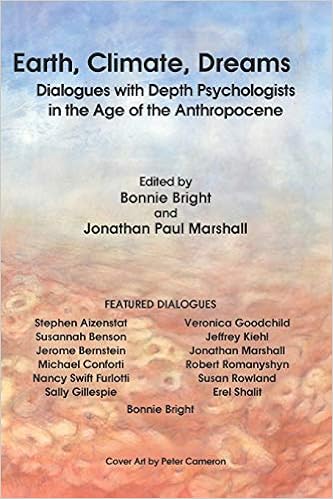
Bonnie Bright and Jonathan Paul Marshall (eds) Earth, Climate, Dreams: Dialogues with Depth Psychologists in the Age of the Anthropocene. Depth Insights Press.

0997955023 and 9780997955026

From: Amazon.auAmazon.com ; Amazon.co.uk

Bookdepository ; Wordery ; Barnes and Noble

The book, as should be obvious, reports on what 13 Depth Psychologists have to say in response to the Anthropocene. It is a collection of interviews with people like Stephen Aizenstat, Jerome Bernstein, Veronica Goodchild, Jeff Kiehl, Susan Rowland, Robert Romanyshyn, Erel Shalit, and other important people, and finishes with a multi-logue between seven of the participants.

[For descriptions of the interviews, and some critical responses, see an earlier blog post]

These people are all major contemporary figures in Depth Psychology, as some of you will know.

I’m going approach this launch in three ways. Firstly I will talk about the background question of the book, then one of my problems with the book and, thirdly, what is great about the book, and why you should buy it.

The fundamental issue

The background issue is that in the West, and most likely elsewhere, we are facing what can be called an existential crisis. That is, we are coming to recognise that our whole modes of being, living in the world and preparing for our future, is undermining our capacity to exist in the world. If we keep on living, acting and thinking as we do, we face destruction generated by those ways of living and thinking. The Anthropocene (the world-systems changing effect of humanity) marks a problem for our whole existence, and undermines our future.

The existential crisis presents a problem at all levels of our being: it is a psychological problem, it is a sociological problem, it is an economic problem, it is a technological problem, it is a cultural problem, a problem for all our relationships to everything. Once recognised, it is both hard to ignore and disorienting, to put it mildly – approaching trauma might be more accurate.

This crisis is the starting point for the book, and the necessary starting point for almost any relevant discussion about the future. The conversations are conducted with Depth Psychologists, because Depth Psychology attempts to deal with the total span of human existence, which includes all that I have just mentioned, from psychology to the world. Depth psychologists are uniquely in a position to approach these issues from a non-specialist position, and to offer tools to help people work with the problems, from their experience of group and individual therapy, from symbolic work with art, literature, and dreams, and from their sense of the intertwining of individual and collective.

My issue

Let me begin discussion of this book by talking about one of the things I find slightly problematic about it, and show why it turns out not to be that problematic, and how it generates insight, when approached with fewer assumptions.

My problem in reading this book was that, sometimes, I thought people found it much too easy to talk as if ‘spirituality’ (whatever that is) was a solution to our problems.

As I argue in the introduction, some types of spirituality might help constitute our problem, and this has to be faced. It cannot be suppressed, and I don’t think anyone in the book would want to suppress this issue.

As a culture, we in this room, have a religious or spiritual history, and in that history people have primarily been taught to see the world as a prison, a testing ground, a den of sin and iniquity. We have been taught to see our human destiny as leading us somewhere else, not this Earth. We are heading for heaven or hell or, at best, the new World after the Day of Judgement. We are not fundamentally creatures of Earth, born with the earth and tied to the Earth. In that sense, the Earth has to be fought against and dismissed for our salvation. If you actually love the world, you are being distracted from your love of God who is not ‘material’; you are loving something inferior and fallen.

This form of spirituality constitutes a problem, it could well be part of the reason it is Christendom that has led the charge into ecological destruction as an unintended consequence of its otherworldly spirituality. If so, then implying that a move from ‘materiality’ to ‘spirituality’ is a solution to the problems of the Anthropocene, is not a solution. Spirituality is part of the problem. Rather than just ‘spirituality’ itself, we need a new psychological and spiritual orientation to the world and to our actions within it.

However, if you actually listen to what people in the book are talking about, and remove the assumption that you know what they talking about, then you can begin to see what they actually mean, and the kind of psychological orientation they are pointing towards, and how this is not just a matter for our consciousness, will power, or decision.

In our society, because of our (spiritual and other) heritage, ‘natural processes’ are largely seen as disposable or replaceable or, to use Heidegger’s term ‘to hand,’ as resources for our own use and mastery of. In our dominant ideology, natural processes only exist for us to exploit. If they cannot be exploited and turned into profit, then they have no value. Natural processes are not something we should have a relationship with. You can see this attitude everywhere, with things like the Westconnex tollway, where we chop down every tree, undermine housing foundations, dispossess people, and fill the air with smog and noise, while providing a tax on travel in Sydney. Or with mining under water tables, rampant landclearing, mining in agricultural regions and so on. Natural processes are, officially, a lifeless backdrop to be pillaged for profit. They have no other value. The world is to be subdued to consciousness and will. The world is secondary to what we can make of it.

Yet this is not humanly true at any deep level. It does not resonate with real human being. Almost every human I have ever met has some kind of relationship to other natural processes, whether living forms, place, or to their own part in the system. They might only notice the connection when the creature or plant or animal has gone, but that is part of our disconnection from reality. This relationship may be to individual animals (their pets, or the dog down the street), to specific trees they feel connected to, to landscape that may seem to be part of us, and so on. Even those people busy despoiling other people’s environments and landscape, can have deep feelings for their own.

This is not really strange, because we think with, and in, this world. We use objects in the world to think with, to feel with, to learn with. We cannot live outside the world. It shapes us. We cannot escape from it. Nature and ecology is part of us, we are part of it; we are plural and connected by our existence, in a living network beyond our understanding.

When we realise this, then instead of treating nature, or other people, as resource objects, we can approach this world with reverence and awe; with a sense of mystery, recognising that we do not fully comprehend it, that it is a being that is both independent of us and impinging upon us. It is us and not us.

We can approach the world with our full ‘psyches’ and, in this, recognition of ‘complexity’ and interconnectedness, are themes which keep recurring in the interviews.

Why use the term ‘psyche?’ Because when we use other terms like ‘psychology’, ‘mind’, or ‘soul’, we already think we know what we are talking about. But we don’t. We don’t consciously know how our minds function, as they function. At least I don’t. I don’t know how my mindbody functions, how one thought gets linked to, or progresses into, another, how language works, how brain action generates mouth and arm action, how my skin heals, my stomach digests, my lungs process air, and so on. Much, probably most of the important things in life, operate outside of our limited awareness, and necessarily so.

“Psyche” plunges us back into the unknown, the entangled complex, interconnected, mess which is reality. We are inextricably if vaguely linked; my psyche does not exist without your psyche. I did not invent the language or all the ideas I use. Interaction with and talking to other people and to world culture has shaped me, and I have presumably shaped some others for better or worse.

We are both collective and individual at the same time. Even a sense of heroic individualism is collective at its base; something we share with others. Our psyches are already alive and part of natural processes. Our full psyches include the land, spill out into the land, into other people, into the processes that are everywhere.

And a realistic view of our selves needs to include all of this material, our culture has generally defined as extraneous, to help us to successfully resist the notion of natural process as a thing to turn into resources to make profit out of. In this new mode, with new practices and ways of perceiving, we can begin to move towards rejecting the system of thought that is destroying the world that we live in. This destructive system no longer makes sense. It seems psychotically limited and self-destructive. That awareness opens a psychological, cultural and activist position. The more we become aware of unconscious process, the less we seem driven by them, and the more free we become.

Let us return to an earlier point. As already implied, there are many unconscious processes. We are not aware of most of what is happening, although we may be more aware than we consciously know. That lack of conscious awareness of how our minds work, and how our physiology works, and how mind and physiology connect at this moment, implies unconscious processes. Some of these happenings I will have perceived, but not made conscious, perhaps because my thought or culture focuses my attention elsewhere, perhaps because there is so much to perceive that I cannot hold it all in my awareness. Even if I perceived it all, I can’t understand everything that is happening, and affecting us, even in this room. Most of life’s ongoing processes are essentially and inevitably outside my consciousness, and therefore unconscious to me.

However, I can become more aware of what is happening or more sensitive to it. I can attempt to perceive reality in different ways. I can turn attention to my neglected or repressed perceptions and drives. Recognising this possibility and being open to the strange and the unknown is what Depth psychology is about. It is fundamental to the process of discovery.

This is why Depth Psychologists pay attention to dreams, which are in some ways messages from the unconscious and the world; from our unconscious perceptions, pattern detections, and ways that we symbolise the unknown. Dreams often require work to understand. It is not always easy, but it can become more so the more we take these fleeting images and stories seriously and treat them as beings themselves. Paying attention to these, and other, neglected processes (fantasies, spontaneous images, scribbles, slips of the tongue, senses of unease, neglected feelings, suppressed thoughts) becomes a way of getting, or admitting, more understanding and data. It starts a new process of being in the world. If we repress our bodies and our dreams, we are likely to repress our awareness of the world. The more we attend to them, the more likely we are to be able to perceive messages in natural processes which are now hidden to us. Our tools for learning can expand outwards…

This new attention can represent a complete change in how we regard ourselves and experience our role in, and on, Earth. We can call this change spiritual if we want to. We can analyse and live our lives from that point of view. We might even be able to see this realisation as having much in common with reports we have classed as mystical.

This awareness involves experience of paradoxes, similar paradoxes to those around reported experiences of God, We are part of the world but separate from it. It is greater than us but still within us. The depths can lead to the heights. We are double sided: our goodness might be cruelty; our aspirations can be unreal or unsatisfying. Reality is ultimately unsayable, but it is pointable too through images and word, and it can be experienced, if we are open to it as it is. This is a new way of being, which can be called spiritual if you wish, or not if it makes you uncomfortable.

So even in the bits I personally have problems with, the book is still full of insights. Full of ways of proceeding. You may have problems too, but encountering this book may help you ponder them and open you. That is why this book is important.

The Good Bits

Let us now turn to the unproblematic virtues of the book. Its chapters are edited and concentrated conversations. They are generally excellent conversations. The primary interviewer Bonnie Bright is really good at her work. She participates in conversations. She contributes to the conversations as process. She draws people out. She listens carefully, and gets people to explain when needed. You could not have a much better interviewer for dealing with issues which could otherwise be quite difficult.

Reading these conversations, you will learn something about a family of understandings of how psyche works, through the dynamics of imagery, metaphor and feeling, and the effect of the unintended consequences of particular modes of consciousness which repress things you need to know about. As I have implied, if you take this seriously and start some of the practices, then you might gain a new view of the world. You might find a way out of the existential crisis, or a way to flourish in that crisis.

Depth psychology is important, because its mode of being, continually deals with problems that the conscious ego cannot understand. This is especially useful for facing the paradoxes, complexities and dilemmas of the Anthropocene.

Topics vary throughout the book, apart from the obvious topics of climate change and ecological destruction, subjects discussed range from discussions of pilgrimage, the aspirations of Dr. Frankenstein and what that tells us about modern life, the collapse of Mayan civilisation, colony collapse disorder in bees and its metaphorical connection to culture collapse in humans, the ways that politics and psyche interacts, the driving cultural complexes of capitalism, systems theory, unconscious forces, communication with the world, and the uses of dreams to gain insight into the world and relate to the world.

The book argues strongly, in various different ways that we need to engage with our full range of psychological processes, and perceptions, to deal constructively with the changes and problems we are facing. We need to understand how the systems we participate within, condition our minds when we suppress awareness of what is happening. If we stay in the psychology of mind we are conditioned to have, then psychological inertia, denial or other processes of repression or projection of problems and hostility onto others are likely to win out. Even if we manage a revolution we will probably replicate the problems we have, plus we will project our guilt onto others, and solve our problems through revenge.

This book explores possible tools to move beyond these psychological limitations and barriers.

Depth psychology can prove useful in this quest, because it tends to focus on neglected aspects of life and assumes that our individual psychology is at least partly collective, and it works through encouraging creativity, imagination, art and symbol production for their own sake, irrespective of judgement or profit..

As well as enlightening, this process of approaching reality is potentially fun and enjoyable; it can also be pretty horrible too, but everyone has the possibility of life changing realisations for themselves and for everyone else. As we are collectively facing similar problems, solutions to personal problems, or the symbols around those solutions, can turn out to be effective solutions for collective problems…. especially when we are working in and with groups. Anyone has the potential to contribute to our collective solutions. You go in and bring the solution back out. It is a cyclic process.

The book tries discuss ways of opening what may be a new way of perceiving the world, and approaching the world, and the role of human psyches within the world, and the way we all could develop.

This is, simply, vital work….. That is why I hope that this book will reach a large audience, even if they disagree with it, it could start discussions.

Myths of Climate 02: Eden and the Fall

December 24, 2019

Continues from Myths of Climate 01: Creation, order and disorder

The myths of Eden and the Fall, tell us there is something unspoiled, friendly and beautiful in the environment and elsewhere that we have lost. It appears to neglect the fact that living systems are complex systems, and that there never has been an unchanging ideal and primal world.

Eden

The myth of Eden suggests a return to a simpler age, with attempts to restore ravaged nature, or to preserve nature in some pure and pristine state beyond change. We can see this with natural parks and ‘wilderness’ movements. Eden is perhaps the foundational myth of wilderness, and often invoked when we are shown an area teeming with what we think of as ‘wild life’ but with no humans.

The aim of restoration and perfect preservation of the natural world is impossible as nature is a complex dynamic process and continually changing. The process we call evolution is constantly at work; creatures fail to reproduce, genes do not replicate perfectly all the time, new variants of species and new species are continually coming into being. Creatures move out of one ecology into another. ‘External events’ such as volcanic eruptions, meteorite strikes, climate change, storms, fires, and so on change ecologies and change how the system of life might work, opening it up to possible colonisation by new species, or recolonisation by old species. It is not normal or ‘natural’ for complex systems of life to remain the same, or to be without competition and co-operation, which affects some members deleteriously.

Attempts to keep nature pristine and unchanging have to rely on human force and thus violate any natural pristineity. As Cronon argues, Edens are essentially artificial. This does not mean that national parks and wilderness areas may not be necessary, especially to save environments from those extractive industries which would change them completely and forcibly, but that natural systems are complicated and changing – as all complex systems are.

If we were to wish to restore the world, as a whole, to an artificial purity in which we could easily survive, then we would have to kill a large portion of the world’s human population and a massive number of other ‘pests’ that have moved into new places. This might be morally difficult (certainly not ‘pure’), and we have no surety as to the percentage of people who would need to die to restore the lost Edenic world. However, there are people who seem to celebrate massive disasters with huge death tolls as ways of engineering the return to nature. Perhaps they neglect the destructive effect of those disasters on the non-human world as well?

The Fall

This myth also holds a counter-position, in which post-fall nature can be seen as harsh and hostile, as opposed to humanity, as ‘brute’, uncaring, violent or primarily cruel. The world may even be a place of punishment, a substitute for the way it was meant to be, or a reminder of loss.

This hostility, and departure from the intended reality, suggests that the brutal and savage fallen world, and humanity, requires both law and enforcement. Here we have both desire and fear together – the fear propelling us to control, to impose the lost order of God on the world. We are riven here, caught within unresolved opposites, which I think we generally solve by keeping them separate, so that the law becomes better than the world, while the rebellion of the world against the law or, more accurately, the failure of the law in the world, is taken as showing the supremacy of law and the evil of the world.

Many writers rely for their persuasiveness on the topos that nature is hostile without our ordering (as implied in myth 01). However, both positions of Eden and the Fall are projections, as the world just is what it is.

Humans seem to be not just fallen or bad, but competitive and co-operative, capable of being both violent and loving, cruel and kind, selfish and absurdly generous, and so on. Most evidence I am aware of suggests that most humans are not as violent as portrayed in our society; they have to be trained to be repeated killers, even when drafted to be soldiers, and they tend to suffer trauma and pain afterwards. Group violence and orders help sponsor individual violence; people tend to do what they need to survive against what other people show them is normal.

We may both expect humans to be too bad to change, or demand that they be so good they fail. Neither place might be helpful. The myth of the fall suggests we cannot progress even a little, and we must always expect the deliberate worse from humans and world, rather than that humans stumble and life is difficult.

In this myth we are riven, caught within unresolved opposites, which immobilise us. When we invoke one side of the mythic topos, say by arguing that we should preserve nature, some listeners will hear that we wish to preserve the brutality and precariousness of the fall. If we wish to discipline nature with law, we are destroying the natural Eden.

Whatever we do will invoke the contrary myth, leading to resistance and possibly paralysis.

Conclusion

Relating to the world as Eden or Fall, distorts our perceptions of the world and our actions in the world. We may need new ways of mythically relating to the world, and that may come again with sitting with the contradiction.

Cthulhuocene

August 29, 2019

HP Lovecraft’s story, The Call of Cthulhu, opens with some of the most famous lines of horror literature:

The most merciful thing in the world, I think, is the inability of the human mind to correlate all its contents. We live on a placid island of ignorance in the midst of black seas of infinity, and it was not meant that we should voyage far. The sciences, each straining in its own direction, have hitherto harmed us little; but some day the piecing together of dissociated knowledge will open up such terrifying vistas of reality, and of our frightful position therein, that we shall either go mad from the revelation or flee from the deadly light into the peace and safety of a new dark age.

Lovecraft reverses the then standard idea that we more or less know everything and can know everything relevant, and proclaims this lack merciful rather than horrifying. We are forced to remain in blissful ignorance of the nature of the universe and “our frightful position therein”. The story then proceeds to undo this opening statement, and make it clear what at least part of that frightful position is, and how vulnerable we are to destruction from things we don’t, and cannot, understand.

In a way, this almost exactly suggests how we approach the Anthropocene. The customary position is to refuse to “correlate all our contents,” to argue that the world cannot end from trivial and everyday human actions, to reinforce our ignorance and lack of understanding of an object which is beyond our understanding, and certainly beyond our ability to predict. However, the sciences continue to piece together dissociated knowledge, and open up the terrifying vistas of a climate and ecology, so disrupted and out of control, that we either go mad, or flee into a new dark age in which science and knowledge is subservient to fear and politics.

Both stories are almost detective stories, “flashed out from an accidental piecing together of separated things.” Lovecraft’s tale is a detective story which links events from all over the world. A professor dies, from unknown causes, after being jostled by a “negro”; racism and horror of the unknown is never far separated in Lovecraft. His heir goes through the professor’s boxes and discovers strange things. These scattered objects and texts, like the fragments that most of us live with in the Anthropocene, strange weather, disappearance of insects, drying rivers, weird snowfalls, scientific gibberish, conflicting accounts, jumbled correlations from over the world, bad dreams, disease, disturbed artists, and mental illness out of nowhere, hint at a story which will destroy the hero and reader’s peace of mind forever.

Images recur, of a hybrid being – “simultaneous pictures of an octopus, a dragon, and a human caricature” – but “it was the general outline of the whole which made it most shockingly frightful.” Again it is the outline, the suggestion which is beyond easy resolution, like the Anthropocene. No one knows, or can know, what the Anthropocene means, what its outline really is. It can look like sea level rise, drought, storm, or any number of ‘ordinary’ things, but putting them together all at once, in varied combinations, is impossibly disturbing. All we can tell is the natural order is not what we thought. Its image can suggest “a fearsome and unnatural malignancy”.

Both tales bring into mind the vast ancientness of the planet, which has lived without us for billions of years, and will live without us for billions of years. This creature, beyond conception, harbours no special affection for humans, no hostility either, just complete lack of concern. Whether we worship it or not, counts for nothing, although worshippers might convince themselves otherwise. This massive creature, on whom we live and which we are part of, has been sleeping. The Holocene has been relatively free from upheavals, and indeed might have remained free from such upheavals for thousands of years, but we have prodded it, not perhaps, awake, but to roll over it its sleep, to scratch off its fleas, perhaps for some fragment of it to arise out of the oceans and throw civilisation aside without even noticing. Let us be clear, although the Anthropocene may mark a geological epoch, in terms of world existence it is nothing, a mere blip. In a billion years, a relatively small time in planetary life, nothing of the Anthropocene and human life will probably remain to be detected. The earth does not see us, we are no more special than any other species which has vanished in the past, trilobites, brontosaurs, giant dragonflies, all have been and gone

In the story Cthulhu rises from the depths of the Pacific as the earth moves, and science, so far beyond us as to be indistinguishable from magic shatters our reality, opening the strange and disparate affects we might ignore. However, rather anti-climatically, the being is driven back under the waves, more or less by accident. There was only good fortune that a ship was in the vicinity, otherwise the end would have come incomprehensibly to all, and it may yet come at any moment. Whatever safety we had was random.

Come or not, all those who hear of it, and understand however badly, can never be the same. The image haunts them as does the dread. “A time will come-but I must not and cannot think!” Others carry on, the world remaining veiled. Let us hope their dreams, and ours, do not further the world-beast turning once again.

Australian fantasy

June 30, 2019

Just struck me that Australia is suffering a similar but even more silly fantasy than Brexit. Brexit is the idea that Europe is of no importance to the UK’s prosperity or coherent politics….

In Australia we think we can do “Eco-exit”. We can cheerfully exit a functioning ecology and water supply, and make heaps of money out of it, and that money will keep us alive and prosperous….

Climate and conversation

May 22, 2019

These are a few suggestions based on reading and occasional interaction…
This is not a research article.

Lets begin with the don’ts.

Don’t talk about climate change.
If people do not “believe” in climate change, you are not going to persuade them otherwise.
Groups are already polarised on this issue, and it brings up lots of reasons not to talk to each other, suspicions and so on. It becomes a matter of identity and allegiance. You need to go beyond this.

Don’t go on about the evidence.
They have rejected the evidence, and you personally are probably not a climate researcher.
Both of you are taking the evidence to a large extent based on authority.
They believe a different authority, or think they are “independent thinkers”.

Some psycho-social research shows that counter-evidence to what people already believe, is rarely compelling and sets up resistance especially when its tied in with identity politics (which seems to be the case on both sides).

Another obvious point: Talking about people or telling people they are ignorant, stupid or easily conned is harmful to communication. That they already call you similar things does not excuse this. Only do it, if you want to waste your time.

If you are a politician speaking to a wide audience, then its different. You have to clearly say what you will do and why its not harmful.
You need to lower fear and scare. And climate change is scary (even if you deny it, the you are probably scared of what those other people might do to stop it).

For example Bill Shorten, Australian Labor Party leader, could have said, and as far as I can tell did not say:

“The Adani mine will not bring jobs. In court, talking about the big mine, Adani promised less then 1,500 job *years* of work for people in the mine or as a result of the mine. This is not very many, especially given the project is supposed to last 25 to 30 years. There are 750 two year jobs for example. We will actively compensate for and exceed these few jobs in Central Queensland, with useful projects (names a few).
“The Adani mine, being open cut, is likely to pollute the Great Artesian Basin and that could damage water supplies and agriculture down large parts of east coast Australia. We cannot risk that loss of jobs, food security and prosperity. If water safety cannot be guaranteed, or we find the CSIRO were pressured to give a particular result, the mine will not go ahead. We will also not support Adani being given unlimited rights to water, this is suicidal given current climatic conditions
“We want to encourage electric cars, not force people to buy them. As usual the Government is lying.”

This still will not get your message through the Murdoch Empire. They will lie about you whatever you do, but keep on trying – people don’t have to depend on them.

What can you do?

First off.

Talk and building connection is more important than persuasion.

You might even learn something if you are not trying to persuade people. They may still try and score points off you, but just keep talking, making some kind of connection. They may even say things you can agree with, and that can build bonds.

You don’t have to agree with people on everything to like them, or talk to them. This idea is quite radical in itself in our society 🙂 It is also a lot easier to say, than to do. Our society does not encourage discussion, it encourages telling people each other where they are wrong (This is a “think about doing what i say, not what i do” post 🙂

Face to face is probably better.
You can talk in groups, many people find it easier, but it can also open old fractures, so get ready to damp that down. That people turned up, means they are interested in talking.

Sense of Place Nearly everyone has some kind of tie to a place they love, means a lot to them, or is their home. What is it about that place? What do they do there? Is it the same as it was? If not, how has it changed. How could it be protected?

Again, the point is to explore relation to place. It is not about cause or blame, unless the others introduce that.

People who may deny climate change can talk about lengthening drought, changes in wildlife, the decline in bird species, the difficulties with water, the greater amounts of fertiliser they have to use, the increase in dirt (particulate pollution?). What other changes affect their lives? Are you both gardeners? – that can lead to ecological connection, although it does not have to. All these are important, but they won’t talk if they feel you are trying to manipulate them or sell them something. So don’t. People’s experience of place and change is interesting in itself – its actually vital.

There is no ecological thinking without an awareness of the environment – and awareness of environment leads to new questions and thinking.

Talk about your own experiences apolitically – give back. What might you share?
If you live in a country area, you probably know the place they are talking about, and can probably relate to them.

What remedies might they have tried? If nothing, then fine, but it is likely they have tried something; like cleanups, changing the water flows, rotating crops, tree planting, opening a wind farm, having an Airbnb to raise cash, moving to a different place etc. How did it work? How do they find the bank, or government (or other) services? What have they heard about, but is really not practical?

There is lots of stuff to talk about. Perhaps they are as depressed/distressed as you, but about other things.

In ecology everything is connected. Surprising things happen. Maybe they got in a rainmaker and it worked. Maybe turtles appeared out of nowhere. It’s good to relate to a special place and notice changes.

The point is this is a long process requiring patience. Its about building relationships, building communities, that have been (I suspect) deliberately broken, largely by pro-fossil fuel organisations and political opportunism. Be prepared for things to go wrong. In some cases people have a lot invested in preventing conversations. You just start again, maybe with different people.

It is not about winning. We either get through this together or not at all, and we can all learn.

A good idea is not enough….

April 9, 2019

Thinking about the way that things could go wrong is useful when we start thinking ecologically in terms of systems and complexity; unsuspected connections and feedbacks, interaction of supposedly separate systems, and so on.

Linear thinking, with understood and simple causal connections, is helpful but its not always enough. In recognizing complexity, we can recognize that ‘things’ frequently get out of control.

So let us suppose we have a solution to a problem. This is a list to point us to what may happen, if we don’t think about it. The list is almost certainly incomplete.

“that something is a good idea is not enough…”

  • It can be feasible, but we don’t put enough energy into it to do it in time needed or avaiable.
  • It can be feasible but it’s much harder than we think.
  • It may be feasible and succeeds, but it does not do enough.
  • It may be feasible and succeeds, but disrupts other systems we think are not connected to it
  • It can be feasible but powerful people and institutions attempt to undermine its possibility, so we have a political problem as well as an ‘engineering’ problem.
  • It can be feasible but normally non-powerful people unite against it as it disturbs them, or they have not been consulted, or they face problems you are ignoring.
  • It may be feasible, but fighting for it distracts our attention from significant problems, either to do with it, or to do with the rest of the world. (As when fighting against climate change distracts us from other ecological challenges.)
  • It could be feasible if we knew about, or involved, other factors that we currently either don’t know or think are irrelevant.
  • It could be feasible but the way we are organising it’s implementation is not helpful or destructive to its aims.
  • It can be infeasible to begin with.
  • It may not be compatible with our expectations of what it will do.
  • It can have unintended effects which make the situation worse, but we don’t know about them until its deployed.
  • It can be successful at first and then fail.
  • It can succeed.
  • The world will end in 12 years???

    April 9, 2019

    Another meme that seems to circulate around the net is that climate scientists are saying the world will end in 12 years. This would appear to be ridiculous, and therefore is intended to discredit the whole idea of climate change.

    I personally don’t know of, nor have I read of, any scientists who warn that the world will end in 12 years due to climate change. As usual, I’m welcome to correction, but I doubt this will happen.

    However, what plenty of people have warned is that we have about 12 years left in which to seriously diminish the causes of climate change. If we don’t, the weather conditions are likely to move into greater degrees of instability and tumultuousness, and sea level rises will be significant.

    With only a warming of one degree, it appears that areas of the USA seem to be on the edge of failing to cope with the stresses of fires, floods and storms, and areas like Puerto Rico seem to have largely been abandoned by the current US government. The same is becoming true in Australia; areas are getting too hot for habitation, and water supplies seem to be diminishing (sometimes because of mining as well as climate change).

    As chaotic weather gets worse, it will cost billions in destroyed property, and distract from other economic activity. It will probably also mean massive people movements, food shortages and so on.

    I quote here from the LA times

    By the end of the century, the manifold consequences of unchecked climate change will cost the U.S. hundreds of billions of dollars per year, according to a new study by scientists at the Environmental Protection Agency. (emphasis added)

    Cynically, this is probably a reason why EPA research is being cut back; it gives results some people might not want to hear, and might not want other people to hear.

    However, while climate change could well begin the end of the civilizations we know and live in, and lead to lots of people dying, it won’t end the world. The world will carry on and some humans, those who have learnt to co-operate and have farming or hunting and gathering skills, will probably survive. With some luck, relatively large scale societies in more fortunate parts of the world may well survive. The scale and prosperity of social life we have now in the developed world and are aiming at elsewhere, will probably end.

    Strangely, attempting to prevent this collapse seems relatively easy. People can disagree about what action is needed to diminish climate change, but it usually comes down to phasing out fossil fuels as quickly as possible, lowering other forms of pollution and poisoning coming from productive processes, and not taking more fish and trees than can be grown back.

    If we would like long term survival, this would seem sensible anyhow.

    Questions about ‘nature’ and geological time

    April 6, 2019

    A friend responded to the last post on nature. I understood them to be essentially making three points:

    Point one: The division between human and nature is similar to the division between body and soul, essentially ficticious.

    Point two: As Humans are natural phenomena, everything they have done is natural. So nature is damaging itself.

    Point three: Any act has unforeseen consequences and the world exists in geological time, consequently we have no hope of a political solution to climate change or ecological degradation.

    This is my attempt to deal with these issues.

    Point 1: The idea of ‘nature’ is a human construct. Like Bateson and others I prefer to think of ecologies and systems. These ideas do challenge ideas of separation, but I’d also like to suggest that the conceptual differences between ‘mind and body’ and ‘human and nature’ are different. The degrees of separation and independence are not the same.

    Firstly, there is a non-human world which has, in many senses, little to do with me. I am not it, and it is not me. It has gone on for billions of years without me. It will go on, hopefully for more billions of years, without me. Currently, humans cannot survive without the non-human, and they have emerged out of it – yet once emerged, humans are no longer just a non-reflective part of the rest of the ecology. They are never the whole of the system, and could even be thought of as having a potential to differ from the rest of the system.

    However, my body and me do not exist separately in this sense. I can only learn and act with this body. If one dies the other dies. My body is not non-human. It is what makes me human. There is no sense of independence of one side from the other, unless you believe in immortal souls – and that is probably the basis of the idea of separation. There is nothing obvious in the idea of the two being potentially separate or independent.

    This takes us to point 2.

    Point 2: This potential to be different may not be unique to humans, but there are human constructions which would not exist without humans. Just as there are destructions of ecological systems which would not happen without humans.

    It seems to me, there is a problem with dismissing the term ‘nature’ and then keeping the word ‘natural’ to apply to everything which happens on earth and take a position in which human acts and decision become irrelevant, or perfectly in keeping with the rest of the eco-systems. Without this somewhat indiscriminate application of the idea of ‘natural’, there is a sense that humans are ‘extra’ to nature, despite emerging from nature.

    Paving a forest is not ‘natural’, as in the world without humans, or human equivalents, this could not occur. Again it emerges out of an ecology, but is destructive of the ecology in a way that the ecology could not achieve without humans. Humans are special, but they are not so special they are above nature. This seems hard for people in the west to grasp. People seem to want humans to be either above nature, or just another bacteria of no real consequence.

    To restate: while humans emerge from an ecology of ecologies, the consequences of their acts and decisions can be destructive to the rest of the ecology, and they can be aware of this. In that sense they can be contra-‘natural’ or contra-ecological. This is not a purely human phenomena, other organisms have changed the world’s ecology, but those organisms do not appear to have decided to do this, and have done it slowly enough for other life forms to evolve to deal with, and take advantage of, the transformation. The change has been ecological. Again this is not saying humans will destroy the world, eventually new life will arise, but possibly human life will not survive the rapid changes we are inducing in our ecology, and I personally would find that sad.

    Point 3: While it is true that many other creatures seem intelligent or self-aware, it also seems that humans are both intelligent and self-aware to an extent which is unusual. This does not mean that humans are intelligent or self-aware without limits, but it does mean that we have a greater degree of responsibility for our actions. If a bacteria developed which ate everything in its path, then we would probably try and defeat it, but we would not hold it morally culpable. If humans destroy everything in their path then, most humans in their path would say the destroyers should, and perhaps could, have made a different decision. Indeed it appears to be the case that humans, and many creatures, can make decisions.

    Finding the right time scale on which to live and make decisions, is likely to be vitally important for life in general. Some decisions or reactions have to be made immediately if you are to survive. Some decisions reflective creatures have more time to make, and for some decisions the creatures may need to think about the time frame for the effects of that decision, whether it is hours, days, months, years, centuries and so on. Thinking either in too long time frames or too short time frames can be deleterious to effectiveness.

    Looking at making political or ethical decisions within a time frame of geological time is a good way to achieve demotivation. This is probably why many of the people who embrace climate do-nothingness, or those few non worried scientists, appear to prefer thinking in geological time frames. In terms of geological time, human lives do not matter, creatural lives do not matter, even species survival does not matter. The rocks go on. Life goes on, and it is way outside our sphere of activity.

    Nothing matters so we don’t have to make decisions, we don’t have to struggle, we don’t have to worry, we do not have to take any responsibility for any of our own actions in geological times. We can, inadvertently, just let powerful people get on with destroying life chances for everyone, for their temporary benefit – because you can be sure the rulers of the world are not thinking in geological terms. Indeed it seems a common complaint that business does not think beyond the next quarter, which is probably too short a time frame for long term social survival, and increases the risks of any climate change….

    One thing that seems to happen regularly when people discover complexity theory, is the assertion that because you cannot control everything in fine detail, you cannot influence anything, or make any decision that is wiser or better than any other. As a consequence, some people argue that complexity theory is wrong, while others argue that politics is wrong. In both cases people seem to be saying that because we cannot do everything perfectly, we can do nothing. This seems silly, and we make decisions and act in our lives all the time despite the fact that these decisions don’t always have the expected consequences. Indeed, most of us might be bored if they did.

    It then seems strange to argue that human oppression of other humans is nothing new, and that some humans suffer disastrously because of this. This again seems an abdication, a demand for perfection of complete non-oppression, or a refusal to deal with difficulty. We may not remove hierarchies completely, but that does not mean that some hierarchies are not better than others, and we should not strive for better hierarchies. It also seems odd to tie this in with geological time, as in geological time, these kinds of destructive human hierarchies are extremely new. They are probably at most 10,000 years old, which is nothing.

    As a side note, it seems to me, that the so-called hierarchies found in ecological systems are not the same as hierarchies in human systems, it is just a metaphor being taken for reality; ecological hierarchies don’t deliberately oppress in an attempt to generate their own benefit.

    Humans are capable of living without mass destruction of global ecological systems, if they learn to adapt to systems or discover how change those systems in beneficial ways, that continue in human time frames. We know this. Some complex civilisations have lasted for considerable periods of time. This means that it is possible to live with ecologies. Difficult, but possible. It is partly a matter of choosing the right frameworks.

    Making all human behavior ‘natural’ and thinking in geological time frames are probably not the right frameworks.