Posts Tagged ‘‘nature’’

Stratospheric Aerosol Injection

August 15, 2018

Stratospheric Aerosol Injection is a form of Geoengineering, which is being considered because the climate situation is getting desperate, with extremely high temperatures in the Antarctic, and massive bush fires around the world.

It involves injecting particles into the upper atmosphere. There are problems with using this technique to modify climate – some technical and some political and some both. This post describes some of them. It incorporates parts of an earlier post on this site.

1) We have to rely on models for our predictions and understanding of weather, climate and ecology, and models can be wrong.

2) The system we would be trying to modify is complex and not predictable in specific. So we do not know the exact results of putting the particles into the stratosphere – we would have to find out through doing.

3) The chances are high that some areas would suffer significant weather changes after the particles reached the stratosphere and these changes would not be uniform. The effects usually discussed are changes in rainfall. For example protecting Europe could lead to major drought in north Africa.

4) Geoengineering is based in social systems which are also complex systems, and GE could disrupt those systems and their balances.

5) For example, unintended bad weather effects could lead to massive people movements, which as we know can be considered potential ‘take overs’ and increase social stresses and tensions….

6) This together with unpredictability, might lead to accusations of weather warfare, whether it was or not, and this might then spill over into more orthodox forms of warfare.

7) GE is cheap in some sense, in that it might only cost billions a year to implement. While this suggests rogue corporations or states could begin GE, it also suggests that there could be fights over funding. Would those who contributed the most want the best results for their countries as opposed to others?

8) GE requires some form of international governance to avoid arguments, which has been shown to be hard to establish even with simpler objectives

9) I have not seen any viable self-supporting GE proposals. Nearly all of them require massive tax-payer subsidies, and some appear to need massive cross-national governance and regulation. We could give massive subsidies to private enterprise and hope they do they job without any oversight, but I doubt that will appeal even to the pro-corporate-power lobby. There is no apparent profit in Geoengineering, other than the potential to threaten people with bad weather. So it is unlikely that corporations would persist with it.

10) GE once begun must be continued, but warfare, or economic collapse could lead to rapid discontinuation, and hence extremely rapid climate change, which might further reduce biodiversity, as the change would be so rapid. Decline in biodiversity = decline in ecological stability.

11) It is extremely likely that once GE was implemented, people in power would breathe a sigh of relief and say “oh we don’t have to stop burning fossil fuels anymore”, so the situation gets worse, but they stay in power.

12) The rational solution to climate change is to lower emissions – we have known this since the 1980s at least. We have the technology to do this now, and it largely seems to work. That we don’t do this, shows we have a destructive set of social organisations and rivalries, and GE will be implemented within this destructive organisation and probably further destruction.

13) The assumption of GE is that it is easier to modify the complete climate and bio ecologies of the planet without serious unintended effects, than it is to lower emissions. This, in practice seems unlikely.

14) GE does not stop or ameliorate the results of high levels of CO2, thus ocean acidification and ocean death would continue – which would be calamitous.

15) The particles which people usually suggest we use are sulphites, these have the potential to further damage the ozone layer. There are plenty of other ecologically destructive actions GE does not ameliorate or stop.

16) People who support GE tend to be those who deny we should do anything about climate change, consequently the likelihood of point the points about continuing destruction, rather than lessening it, increases.

Short summary: Stratospheric Aerosol Injection is a largely uncontrollable, unpredictable process embedded in destructive social organisations, that will delay any chances of fixing climate change. Fixing climate change requires changing our social organisation and reducing emissions.
Skepticism and Evident climate change

July 30, 2018

I guess everyone interested in climate change will have encountered people who state three things. One; that climate change is not evident, Two; that climate change has happened in the past and is part of the natural cycles, and Three; that we cannot predict exactly what will happen…

Changes that happen slowly are rarely evident to bare human sensory apparatus. We acclimatize, and declare it has always been this way – despite the record of above average temperatures we have been registering (and of course averages are undermined by people’s experience of variations, and by their desires to keep seeing normality and experience tranquility) People who move from cold countries to hot countries may soon feel that temperatures which would have once been ‘hot’ feel ‘cold’. Unaided senses may not always be accurate enough to detect climate change, that does not mean it is not happening. When we can detect climate change with unaided senses it will probably be too late.

After saying that Climate change is not evident, then people may point to previous incidents of climate change and imply it is relatively harmless, or that we cannot do anything about it, and it has nothing to do with us. While I think the idea that climate change has happened in the past is probably correct, the rest may not be.

I particularly have no idea how the concept that “the planet has been going through heating and cooling waves for millions of years” can be considered ‘evident’ in itself – especially if contemporary climate change is not evident. The concept of previous climate change is based on a whole lot of theory, interpretation and data gathering.

Most of that theory is part of the web of theory which also suggests that the current climate change (even if natural) will be rapid (in geological terms) and devastating for ecologies and human civilization.

Current climate change is also compounded with widespread ecological devastation from human sources (deforestation, over-fishing, chemical pollution, depletion of phosphorus etc.), all of which are likely to make the change even more violent and which were not present in previous ‘natural’ periods of change.

The further assertions that because the planet has had changes of climate many times before we should not be worried about it this time, do not seem evident at all to me. Especially as rapid climate change in the past does seem to have been harmful for species.

The third point about uncertainty of what will happen is true; the future is always uncertain. However, because the future is uncertain does not give us the right to assume that the least unpleasant events are the most likely. That is actually a refusal to accept uncertainty.

So what is evident? To me it is evident that we depend on ecologies, and creatures depend on each other (I do not live alone in a vacuum) – this is also backed up by many studies, which give what I would call evidence. Other people may deny this for whatever reasons. But if you accept that some kind of mutual dependence is evident, then continually messing up, destroying and injecting waste into these ecologies is evidently harmful to us all, and likely to result in catastrophic change past a certain point. So its probably best to stop doing it, and try something else. Harm may also result from these remedial actions, but that harm is not evident – it is supposition.

Is it evident that a bullet through the chest will kill me? No, not until it happens – and if it is evident, then there will probably be no me for it to be evident to. There is a level at which it may be best to work with some supposition.

One more time: Economics of Waste

May 31, 2018

(Based on a reply to a comment)
In the last post I argued pollution erupts everywhere there:

a) is no support for ecological thinking;
b) where the costs of pollution are not factored into the economic process; and
c) where there has been conquest.

I should have added a point

d) that pollution appears to be a strong part of developmentalism wherever it operates, whether in capitalist, socialist, communist, or nationalist systems.

Making products or energy by cheaply destroying the ecology is an easy way to make money, and generate the products associated with development. Again the ecology (and often the people who depend on it) are sacrificed to the gods of development, which are usually material prosperity (for some more than others), modern technology, industrialism and military power.

The more speedy the development the more pollution seems to occur, and if it takes force or law to overwhelm those who resist, then force or law will nearly always be used. This was first illustrated in 19th century England where people were poisoned and restrained by law, and the environment was polluted on a visible scale perhaps never seen before and rarely replicated since – although parts of the communist world which did similar development in an even shorter time were probably up there with it. Its hard to compare descriptions, and to measure the past.

Developing countries can see attempts to reduce their pollution as attempts to keep them undeveloped – particularly when countries like Australia refuse to diminish their own pollution.

It may be possible to make the argument that capitalism is now often justified by its ideologues in terms of it being a major force for development, which is why it is so bad for the environment. Both the demand for profit and the desire for development give each other support in their destructiveness.

If pollution was only marginal to capitalism we probably would not have had so much political action trying to justify pollution and make it sacred. How often do we hear something like: “If we stop polluting then the economy will crash. We can’t afford these restrictions?” Likewise, I have not seen that many companies protest against President Trump’s attempts to ‘free the market’ by making it easier to pollute and poison people, but I dare say there may be some – after all being capitalist does not mean a person is inherently evil.

The days in which ‘the people’ could use ‘their State’ to attempt to unambiguously reduce pollution, or enforce costs onto business use of pollution seem pretty dead, as the idea of the ‘free market’ fossilises corporate power, and any such anti-pollution movement is accused of wanting to bring about poverty and primitivism- that is they are said to be “anti-development.”

The ability of people as consumers to affect capitalism is probably limited – after all they still have to buy something to live… but if the consumer wants less pollution, they have to find correct information about pollution and who is making it (which companies may try to hide) and find a difference between companies with similar products. They must also be able to afford buying products with less pollution. There is no sense they should participate in the processes of the State to gain enough power to enforce less pollution, as that might diminish the liberty of the powerful to pollute on those less powerful.

We should also probably note that in capitalism the word ‘cost’ usually means ‘monetary cost’ alone. If the creatures and the land do not belong to anyone who both cares and is wealthy enough to go to law, or to make law, to protect them, then there is no recognisable cost; even if the destruction may be fatal to humans in the long term. If the person destroys their “own land” then everyone should be happy, as it is their ‘private property’ to destroy as they will, as if that property was separate from everything else in the world. Non-monetary cost, or cumulative dysfunction, seem difficult concepts to deal with once monetary profit becomes the only mark of virtue and success. If something is priceless, then it has no value.

In response to these kind of arguments, some people will appear to argue that there can be an ideal capitalist market in which problems dissolve, ie we just get rid of State regulations and protections for the environment and workers. This is bold, but the problem is that this ideal process never arises, and all the talk of free markets appears to do, is justify a more stringent plutocracy. So I assume that producing plutocracy is the function of that talk.

I may be wrong, but it does seem to be the case that the more pro-free markets the political party claims to be, the more they defend pollution and ecological destruction with vigour. They see themselves as vigorously defending capitalism and development, and demonstrate why we have to be careful with both of those institutions.

Donut Economics

May 17, 2018

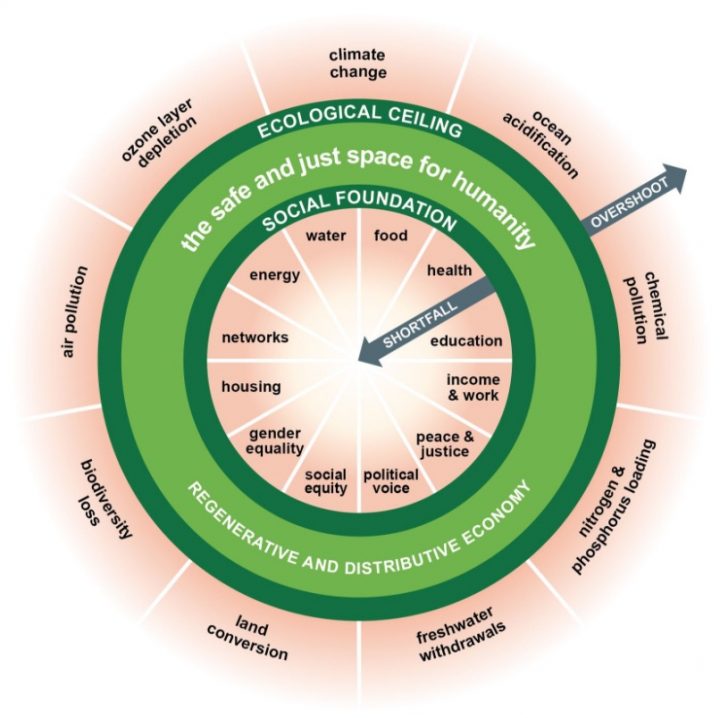
Kate Raworth’s ‘donut’ presents a relatively new way of looking at the economy, which has attained some fame. See the picture below.

the donut

As you approach the hole in the middle, you have an economy which does not satisfy people’s needs such as water, food, housing, relative equity, liberty, education and so on.

As you approach the edge of the image you begin to destroy the ecologies of the planet that the economy depends upon, producing events such as biodiversity loss, climate change, disruption of nitrogen and phosphorus cycles, destruction of fertile land, and so on.

Whereas without such a diagram, the capitalist economy is perceived as a matter of self-contained markets isolated from ecology, she argues that the aim of economics should be to satisfy people’s needs without destroying that planetary ecology.

Normal economic theory, can argue that inequality decreases as growth increases, and that growth cleans up economies, because the economic model looks at the world in isolated ways. Some economies appear to clean up ecologies, but they do so at the expense of other ecologies, and businesses are always happy to lower the costs of pollution and increase profit when offered an opportunity.

People may object that it is impossible to meet the needs of everyone – especially while respecting the planetary boundaries, but at least in this model it appears as something which can be discussed as a major concern. Just as we can ask “What is the economy for? What is it about?” and get a reasonably useful answer.

The old economics had an extremely confining view of human nature, it was humanity stripped of everything but the profit motive. This was a decision originally taken to distinguish economics from other fields such as history or philosophy, and to make things simpler, but it became the model of humanity. Under it we are *just* individual profit seekers. We only cooperate in order to make personal profit, we naturally destroy for profit, we have fixed preferences which we neutrally evaluate, and we have no purpose, happiness or virtue other than wealth seeking.

This view is simply not true, or adequate. Humans co-operate as naturally as they compete. We are social as much as individual, we do not naturally only value money and we do not destroy what we share. We are creatures with many purposes and many aims. Wealth is usually only important to the extent it brings about those other purposes and we are not made happy by consumption.
Raworth’s model, to me, is reasonably obvious and elegant and allows humans to be complex. It is not reductive.

It does have a few problems.

1) It does not explicitly recognise that the current economy is a mode of power, situated within frameworks of power relations, and that historical evidence appears to show that those who benefit from this mode of power will do almost anything to preserve it – including wreck the earth.

Nearly all forms of organisation are nowadays reduced to economic/capitalistic organisations. Media and information is controlled by capitalists, the law is controlled by capitalists, the State is controlled by capitalists, education is controlled by capitalists, and so on. Paying attention to the “bottom line” (measured in terms of money) is a mantra that both permeates society, and ignores reality.

It will be hard to move against inertia and the active power dedicated to preserving existing hierarchy. The model does not easily provide for the distortions that power puts into economics – any more than standard economics does. But as standard economics aims to preserve that power it is not a handicap for it, but a strength, as its users can pretend that inequality of outcome is always proportional to inequality of talent.

2) More importantly, the model does not provide a set of simple positive instructions for politicians. It does not give them an easy and painless set of action slogans and programs, whereas conventional economics does.

Conventional economics says: business is always good and always delivers, you must increase growth, nature is limitless or unimportant, commons don’t work so sell them off to business, government is inefficient so hand it over to business, rich people are talented so give them more support and protection (and pick up the rewards), reduce taxes, stop government services, increase charges, abandon poor people as they are without virtue, and individual wealth and its owners should be worshiped.

Donut economics, just says don’t destroy the world, and let everyone participate. Neither is easy under the current power relations, and these actions do not reward players in the State. The model grinds to a halt.

It needs simple and positive directives.

So time to think what those might be….

What can we do to protect the Environment?

April 30, 2018

This is a much asked question, and it is one that people often retreat from. It seems too big because the simplest answer is also the most difficult, and that is.

We must stop wrecking and polluting the environment as soon as possible; the environment is amazingly resilient, and it is likely to come back, if we give it a chance, and its better if we don’t interfere too much with what comes back, until its clear what comes back.

Stopping destruction is expensive, and will cut some people’s profit down, hence it is resisted politically. Furthermore, some people will put their temporary interests ahead of permanent ones, or they may freeload on other people’s attempts to put things right.

However, it will almost certainly be more expensive in all kinds of ways from simple prosperity to health and even personal survival, if we don’t take some preventative action NOW.

The ‘now’ is important. Which sets the first condition: “Do what you can, no matter how small.” It all helps.

The first step is to realize that Nature (the air, the water, the soils, the caves) cannot be used as dumping grounds for harmful waste products. Harmful in this case, means not just directly poisonous substances, but those substances like CO2 which are fine in small amounts, but become environmental stressors in large amounts.

Once you really realize this, then make your trash output as small as possible. Compost your food waste and use it in your garden. Most people buy too much food, cut back and eat what you have, that will save money too. If you are offered recycling use it, but also check the material actually is recycled – this may not be the case. In any case reduce your use of plastics. Ask local shops to stop wrapping everything in plastic – or unwrap it in the store (after you have paid:). Go to the street and pick up some plastic waste and at least stop it entering the drains.

If you can buy or install renewable energy then do so – again that reduces your waste over time, and this action is vital to stabilize the climate and wider ecology.

Protest against any attempts to promote deforestation in your region, or pollute rivers, or streams. Planned destruction rarely helps. Get to know the local wildlife and flora – even the creatures and plants you don’t like. Campaign for nature zones, and don’t be dismayed if you get the “wrong creatures” first off – nature is full of unintended consequences, while people have to learn how ecologies work in your area, and it may take a while for things to improve.

Support political parties which have a chance of gaining some power and influence, and which recognize the facts of ecological degradation and propose plausible solutions. Join them, and help! If you are a member of a political party which is doing nothing, think of leaving them or agitating for real action. Political participation is important and helps all kinds of people protect their own backyard against excessive development or useless highways, or whatever your local business/government people think is essential but wrecks things for others. And remember, many small business people like where they live and work and can help. The destructive organize, so help constructive people to organize as well. If you participate you cannot fail, you can (at worst) only learn about the obstacles to success, and move on.

If you have money and invest, then invest in green companies or, at least, protest at what is being done in the name of shareholders.

Do not be welded to solutions, but be prepared to learn what works and what doesn’t. Always remember unintended consequences are everywhere – because some plan sounds good does not mean it will always work, but do your best.

There are lots of books around to help with change, borrow them and read them. Buy them if they are good and helpful to support the authors.

Above all, do what you can. If you think you can’t do much, at least do that. It all helps, and builds consciousness, and that makes it easier to learn and do more.

Why is there Pollution?

March 27, 2018

Economic production demands the production of waste, as things are transformed into other things and they are transported around. An important question is whether this waste is processable by the ecology in general. If the ecology the waste is dumped in cannot process it, or the waste is poisonous to humans or other creatures and plants then it can be called pollution.

Pollution often occurs when:

  • people do not have to take responsibility for their own waste (ie they can dump it on someone else who is less powerful),
  • dealing with waste would interfere with profit (when profit is considered particularly important or sacred),
  • dominant people have technology which produces waste but don’t have technology that can process that waste into something useful or harmless,
  • dominant people think of the world as infinite and able to take any amount of waste (or when they think their personal waste is trivial),
  • the groups doing the polluting don’t have to take political notice of those people or ecologies harmed by the waste.

It is probable that contemporary forms of civilisation have developed because of the historical cheapness of producing pollution. People who produced the waste largely did not worry about those who suffered from the waste. Now there is so much pollution being produced that everyone is starting to be affected by it, there is more recognition that it is a problem. The Global Ecology cannot process the waste our economies emit.

It seems likely that because of our historical experience, many people in power cannot imagine a civilisation without pollution, or imagine their own power and wealth continuing without pollution. Therefore they insist it is someone else’s problem, and that nothing should be done.

In the long term, pollution only exists because anti-pollution politics is not strong enough or is too compromised with alliance with those who produce waste.

The Political Right and the ‘Bottom Line’

March 8, 2018

Do the right look after the budget bottom line in government?

Probably not anymore. Not if it interferes with giving taxpayer’s money and possessions to the corporate sector.

In the US, we have corporate tax cuts, massively increased military spending and license for corporations to pollute and poison people – none of this will apparently cost the public anything – while even the smallest increase to the dole or the basic wage is cause for catastrophe.

In Australia, the Right wing Coalition has blown out the debt since taking over, and plans to blow it out even more, with more military spending, more spending on supporting the Adani corporation dig up and burn enough coal to wipe out climate stability, tax cuts for corporations who don’t pay any tax and so on.

Then there is the Coalition in NSW. They apparently have plenty of money to throw at developers, while selling off public goods, making life easy for coal miners to pollute, and destroy our water table, and harder for ordinary people to protest. They constantly make massive commercial in confidence deals with public money. They sign contracts with private enterprise before business cases and Environmental Impact Statements are finished. They support the idea of public money being spent on private enterprise sports stadiums, when the sports organisations are tax exempt because they are supposed to provide their own facilities. They make totally stupid decisions with public transport – new trains without toilets on long routes, new trains that can’t fit in the tunnels, new tunnels that can’t fit normal stock. They dig up rail access into the centre of Newcastle so that developers can build on the ex-tracklines. They think that a major new tax on transport in Sydney (through the Westconnex set of motorways) is a great idea as long as the tax is a toll going to private enterprise, and it won’t end up funding public hospitals, schools or renewable energy research – and the public funds the building of the new roads. Cost, of course, blows out massively as it is remuneration for private business, and people get thrown out of their homes and undercompensated. This is either a pure waste of money and incompetence, or a deliberate policy about giving money to those who already have it, at the cost of everything else. The other way of seeing this is as normal crony-capitalism in action. The corporations control the parties who control the State, and the State exists to benefit the ruling corporations.

The last two Federal Coalition leaders, have both failed to deal with any of the problems we face at all – in fact they have run away from them, tried to put the cost on the less wealthy, or have simply made the problems worse.

It is always easy to pretend to live prosperously if you sell off your assets and overspend – eventually it hits, and that could be the grand idea, bankrupt the government and throw ordinary people to the wolves. Sometimes, as Walter Steensby says, it looks as though the neoliberal philosophy thinks that people and nature are just costs and an obstruction to its own development, and they need to be disposed of.

The Right often only seems to worry about the bottom line when there is a chance that money might be going to people who actually need it to survive.

Some remarks on the Communist Manifesto

March 3, 2018

If you read the Communist Manifesto, you will find that Marx and Engels briefly describe the dynamics and results of capitalism, and they claim it is pretty much to produce a situation similar to that we find we are in now….

  • Globalisation of a particular culture;
  • Destruction of national industries;
  • Inflation of the size of particular cities;
  • Increasing inequality (particularly in wealth distribution);
  • Increasing monopolization (ie more and more companies and owned by a small number of other companies);
  • Making labour an appendage to the machine;
  • Freeing capital from local regulation;
  • Turning the State into a managing agent for the benefit of upper corporate class;
  • Increasing the spread of directives and the control of land and people;
  • Turning all values into property or monetary exchange.
  • I don’t know of any other 19th Century figures who score so many accurate predictions. Yes they seem to have been wrong on the inevitability of revolution, but that is one missed prophecy and that was optimism in play.

    Nowadays we would probably add to these predictions, the idea that capitalism will destroy its civilization by destroying the ecology in an orgy of mass death and destruction; but we would have to say we have no idea what kind of organisations will follow on from its self destruction.

    Flux and Transformation

    February 18, 2018

    This is a comment inspired by a video whose URL is at the end of the post, about interconnectivity, and how the human body replaces itself, by absorption and excretion.

    There are a lot of processes which demonstrate interconnectivity, however, far more importantly this argument really demonstrates the possible basis of reality is flux, change and transformation.

    This is difficult to get, because the whole trend of western metaphysics is towards the idea that reality is eternal and unchanging, whether this is expressed in notions of the unchanging God, or the unchanging archetypes, or the unchanging nature of elementary particles such as atoms. All of these ideas can support interconnectivity, but it is the interconnectivity between things which do not change – at best it is about ‘flow’ of unchanging things.

    This view of reality as fixed, seems to lead towards pathological behaviour, as action becomes setting up the perfect structures, the perfect reality and clinging to it. Spirituality is about clutching to peace, or growing in a particular way. Psychology can insist that we should always be happy or self-actualising or something. Politics is about holding to the structures you have pronounced to be the best – at the moment our politics seems devoted to maintaining the power of established corporations and their plutocracy rather than the survival, or gentle transformation, of the world they depend upon.

    However, if reality is flux and transformation, then everything changes all the time. Furthermore, given complex systems theory, it seems that everything changes unpredictably in specific; we might be able to predict trends, but we cannot predict specific results. One of the properties specified by what we call ‘reflexivity’ is that if people think they understand the ‘systems’ they are in, then their behaviour changes and the system changes the way it works. This change may not be for the better.

    In his book known as ‘metaphysics’, Aristotle points out that Plato accepted the world is flux, but insisted that real reality is fixed, because otherwise it is impossible to speak truth. If everything is constantly changing then you cannot say anything true about them, as they will have changed. Aristotle seems correct in his interpretation of Plato to me, and this is a classic example of a philosopher encountering an uncomfortable position (ie everything is flux) and deciding that because it is uncomfortable it is untrue.

    There are other ways around this problem. Firstly it may not be possible to speak absolute truth, but that does not mean we cannot speak and think as accurately as we can (and that means accepting flux, misunderstanding and degrees of uncertainty). We can also speak in terms of flux, talking say of ‘patterns’ rather than structures, and temporary stasis rather than permanent equilibrium, we can give up expectations that we should know how things will turn out, and be prepared to learn from events as they happen. At the moment, if our actions produce bad results we are prone to deny this, and apply our actions more stringently and rigorously.

    To reiterate, we are caught in and part of a series of largely unpredictable fluxations. However, if we think that things should be eternal and unchanging, or we think that good things should be unchanging, we attempt to imprison that flux. This generally adds to suffering and increases apparent destruction and disorder. A current example, is the refusal to deal with climate change, and the tendency in Australian and US politics of trying to accelerate and maintain fossil fuels, old styles of concrete, environmental clearing and de-naturing. This is an attempt to cling onto an old order which nowadays produces destruction, and will produce more and more suffering the longer it is clung to.

    These points should be obvious to Jungians, as expectation of flux comes out of alchemy, and alchemy is the art and science of transformation. It tells us that the world is constantly transmuting, and that transmutation processes can look messy and chaotic, and that attempts to avoid the realisations of painful stages can be disastrous. It also provides symbolic guides for working with events rather than against events, or providing direction without compulsion. As such alchemy is still the radical way, and difficult for us to really approach, but it may be necessary.

    Some remarks on Geo-Engineering

    January 22, 2018

    Geoengineering (GE) involves the attempt to solve the problems of climate change by altering the Earth’s ecology.

    It largely comes in two forms:
    Solar Radiation Management (SRM) in which we try and lower the amount of the Sun’s energy/heat reaching the earth’s surface. This can involve: mirrors in space, reflective gasses in the upper atmosphere, or painting mountains white.

    Carbon Dioxide Removal (CDR) in which you try and suck CO2 from power stations or from the atmosphere. One recognized problem with this technique is the question of what we do with the CO2 once it is extracted.

    The idea of GE is that we can continue on with polluting, and try and lower the effects of that pollution.

    A common argument from pro-GE people, is that there is no evidence that the world can halt CO2 production and the resultant climate change, through political or economic processes at this moment, so GE may give us a longer period in which we can change, or transition to a new set of energy generators.

    Both the IPCC and IEA seem to expect that we can establish CDR and gain negative emissions, but at the moment the technology is largely a fantasy technology which largely exists as a rhetorical way of saying new coal energy should be acceptable. CDR does not exist at anything like the scale we need, and there is no really useful, safe and permanent way of disposing of the collected CO2.

    The primary question for both SRM and CDR is a simple one. GE, like everything else that depends on humans, is unlikely to be immune to its social bases. If the dynamics of contemporary societies are inherently destructive of ecologies, then GE is unlikely to prevent that destruction, nor to give a breathing space for new developments. It is likely to help make things worse, or continue the destructive dynamics of that system.

    Clearly if we use SRM, the system has to be continually maintained, and that will cost billions. There will be ongoing arguments over who should pay, and how much they should pay. If there is a financial collapse or large scale war, then that maintenance is unlikely to be without problems. In which case climate change would have the brakes taken off, and would accelerate rapidly, causing even worse climate turmoil.

    The governing idea of SRM seems that it is easier to change the whole ecological system than to change a political arrangement of economic power and profit. This I’m not sure about. The risk of unintended consequences when fiddling with a system as complex as that of climate is very high. We may already be living in a complex maladaptive system, which is bent on its own destruction and SRM simply magnifies this.

    GE could be the equivalent of encouraging smoking to preserve corporate profits, while trying to do research in the hope of some day being able to postpone the inevitable and increasing cancer toll. It might be simpler to discourage people from smoking and to make cigarettes less profitable.

    Basically, it can be suggested that if GE becomes the main way of dealing with problems of Climate change, then we live in a society in which ‘instrumental reason’ does not function very well as there are cheaper and possibly better options available, but those options require us to challenge established corporate power, and we are unlikely to do that successfully. I think the last 20 to 30 years of politics in the English Speaking world demonstrates that this failure is very likely to be the case.

    Amazingly it is true that among people who both support corporate dominance and deny climate change, GE is quite popular. At the moment I can hypothesise this is precisely because GE does not challenge corporate power, and provides an opportunity for leeching money away from the taxpayers, but I don’t know. It certainly strikes me that if you really wanted less State intervention in life, then you would not want geoengineering.

    I have not seen any viable self-supporting GE proposals. Nearly all of them require massive tax-payer subsidies, and some require appear to need massive cross-national governance and regulation. Of course we could give the massive subsidies to private enterprise and hope they do they job without any oversight, but I doubt that will appeal even to the pro-corporate power lobby. With CDR when that involves storage of CO2 underground, we know that ultimate and infinite responsibility of checking for leaks and collapse of storage, will reside with governments and taxpayers, as corporations do not last that long and will not take on those responsibilities. At the least, it seems probable that people will be concerned about other countries freeloading on their efforts, and there will be massive governmental jaunts to try and sort this out. The likelihood of small government and GE seems miniscule.