It is worthwhile starting this description by repeating the slogan, that if an energy transition does not reduce emissions, then it is not worth doing. Even if its cheap and innovative.
In a previous blog, I have tried to demonstrate that Peter Dutton has made a major mistake by saying that “energy is the economy”, and ignoring all the other factors that make the economy.
Dutton also seems to point to a major weakness in his own nuclear argument saying:
The Coalition’s energy policy is the only plan for cheaper, cleaner and consistent energy.
This is an odd argument to make when many people have pointed out the problems with this:
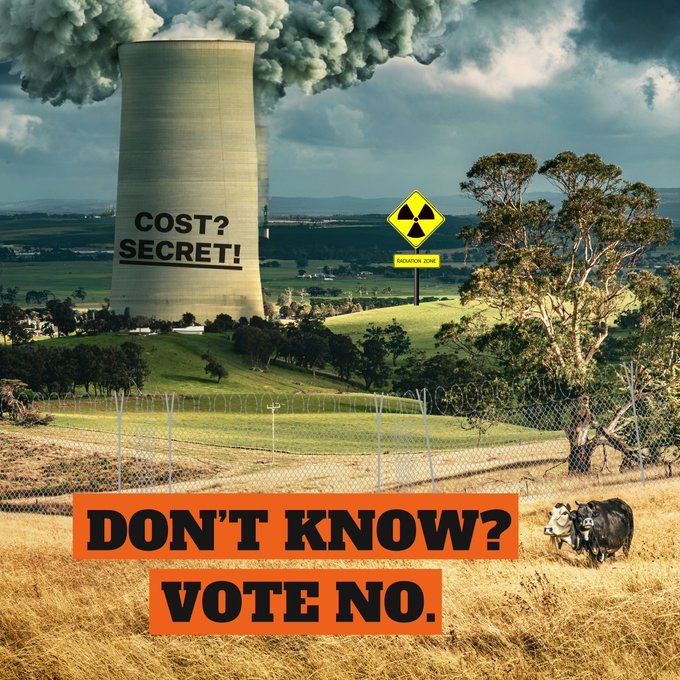
There is no costing of nuclear energy being given by Dutton and his party at all. This implies they do not know for sure it is cheaper.
They merely assert it must be less costly than renewables.
However, we have costings for Renewables from reputable sources that insist they are cheaper than nukes [1], [2], [3, 4] and costs of Renewables has been decreasing.
In the last 20 or so years the costs of nuclear have regularly turned out to be much greater than the builders estimated. Some projects have been discontinued because of this unexpected extra cost, and there can be no guarantee that the next set of projections will not be under-estimates as well.
This greater than expected cost requires an increased the price of electricity to pay the extra cost back.
Claims of cheapness are merely optimism about nuclear and pessimism about everything else.
There are people and companies wanting to build renewables, but Dutton claims that nuclear will have to be paid for by the taxpayers. Any mistakes or bad planning will be costs to taxpayers and there is no competition.
There is no evidence that any private enterprise is even vaguely interested in taking on the costs and dangers of building.
Then, we are trying to build at least 7-14 reactors at the same time. Just as large amounts of normal building cause price increases due to materials and labour shortages, so we can expect such increases from building reactors simultaneously. The only countries with experience of building large numbers of reactors together, at the moment, are China and Russia, and it is probably unlikely that Australians wish to entangle their energy future with either of those countries.
Nuclear also has ongoing costs, not just of keeping complicated systems functional and avoiding fat tail accidents, but of mining, fuel provision, transport and waste disposal.
More importantly, Dutton ignores the time factor:
He makes a big deal of energy costs now (which is high all over the world for many reasons) but nuclear energy would not arrive for at least 15 years (at the very best) and time of construction blow outs seem normal, given other people’s experience, so its likely to be later still.
Therefore, even in the unlikely event nuclear reactors will provide cheap energy, this cheapness is hardly going to relieve price issues now.
We don’t know how long any particular nuclear reactor can exist before the probability of danger overwhelms the probability of benefit. He is estimating 80 years. That is not 80 years of continual action as they need servicing, and at the end of life the cost of decommissioning is usually very expensive and takes a long time. These costs should be factored into the upfront costs rather than being ignored.
Without increasing immediate emissions-reducing power, like renewables, then nuclear will not help reduce emissions, because fossil fuels will have to be used to make up the decline in energy supply as coal phases out. If we don’t start reducing emissions now, then they will accumulate and make climate change worse.
Dutton also ignores the systemic nature of energy.
Even 16 nuclear energy sources will make up a small part of the system, especially by the time they are built, unless we reduce energy usage significantly.
Because they are a small part of the system, even if they were incredibly cheap, it is probably unlikely they will reduce energy prices.
If Australia expands its energy consumption, which is pretty likely, then it almost certainly will need more cabling, even if the nuclear stations use the old coal wires. So one of his arguments for cheapness is likely to be wrong, and the idea that no new cables will be needed shows the inability of the Coalition to look at the system as a whole.
So given this nuclear program is unlikely to reduce emissions, or produce cheaper electricity for a long time, if ever, the main plan for justification is to attack renewables and contemporary prices.
Prices only slowly rose under the Coalition and are massively expensive under Labor. This could be true, but its easy to keep electricity prices even, if you are not doing anything at all to reduce emissions, and think that increasing emissions is actually ok because you deny climate change. He adds to alarm.
The Albanese Government has us on a path towards the hollowing-out of industry and business in our country….. And it’s all because a weak Prime Minister is making decisions aimed at stopping Labor voters defecting to the Greens.,… Labor’s energy policy train wreck is only making it more vital that we include nuclear.
I don’t think anyone with any political awareness, could seriously think Labor is trying to take over Green’s policies. But it does seem from this, that Dutton’s arguments depend on exaggerated rhetoric
Nowhere in the world has a renewables-only policy worked.
This may be true, although people disagree, South Australia will likely shortly become mainly renewables with some gas firming, but no one, certainly not the Labor party is aiming for a Renewables only policy. The question is whether nuclear is the best form of emissions reduction.
He argues:
Germany too has invested heavily in renewables.
Wind and solar account for more than 30 per cent of its mix. But when Russia invaded Ukraine and cut off gas supplies to Europe, Germany was left in a precarious position. It ramped-up its coal-fired power generation.
This shows what many people have said previously, that Germany’s energiewende depended way too heavily on coal, lignite and gas (partly because it did phase out nuclear and energy corporations went for the cheaper and more profitable option of heavily polluting lignite), and Germany should never have made the decision to depend on overseas supplied gas, especially from Russia. However, since then Germany has attempted to boost its Renewable Capacity. It is certainly not going back to nuclear.
As we said earlier the point of the energy transition is not cheapness, although renewables seem cheaper than nuclear, it is emissions reduction. This is almost the only thing that counts. But of course the Coalition use the well known drug dealers defense – ‘We sell good drugs’ – as
[products] will be produced in other countries with weaker environmental standards than Australia.
One interesting part of this speech is that Dutton is almost claiming that nuclear can work with renewables,
The Coalition… sees renewables and nuclear as companions – not competitors, as Labor does.
rather than repeating his earlier position that large-scale renewables will be suppressed and fossil fuels increased to make up for the suppression. How far we can trust this really is a change of anything other than camouflage is uncertain.
The other argument he makes is that renewables are unpopular.
From Bunbury on the west coast to Port Stephens on the east coast, furious residents are protesting offshore wind farms due to their impacts on fishing, tourism and livelihoods….In February and September, farmers flocked to Canberra to rally against the roll-out of industrial scale renewables and transmission lines on their prime agricultural land.
It is correct that there is resistance to wind (in particular), although much of it seems to be about neoliberal implementation practices and lack of consultation or explanation. However there is a political force and encouragement over these protests from the Coalition and from oil company think tanks, and the Coalition, perhaps unsurprisingly, is not interested in encouraging dissent against offshore or onshore mining, that could destroy bore water supplies harm fishing, tourism and so on. Dutton has previously made clear that no protest will be acceptable over nuclear because of “national interest”.
The question arises could Australia use nuclear energy? The answer is clearly yes, but it has to be done along with increasing renewable energy. OR emissions will not decrease, and money is being thrown away for nothing.
By itself nuclear is just expensive and slow to get up. It will need subsidies, if power is to remain cheap and available, whatever the Coalition argue.
There is no point in building 7 nukes, that will almost certainly not produce enough energy to make a difference.
Nuclear is also experimental in the sense that we do not know what will happen when a country with no nuclear power plants tries to build 14 or so at the same time.
More importantly than providing baseload, we need to deal with the problem that large scale solar will produce massive amounts of excess energy which has to be stored. Storage is the number one problem for emissions reduction. If we get enough storage then we might not need ‘baseload.’ However it is also correct we do not know if this is possible at the moment, it just looks probable.
Any kind of transition which actually lowers emissions will be costly, that includes nuclear. To pretend otherwise is dishonest. This possible dishonesty is especially marked when the Coalition have not produced any costings and have simply denied everyone else’s costings with no evidence. Saying that they:
will release our costings in due course – at a time of our choosing. Not at Chris Bowen’s or Anthony Albanese’s choosing – but our choosing
simply implies their costings have been difficult at best, or they want to make sure these costings are not open to long, careful criticism.
Dutton concludes:
Let me conclude on this point; we can’t switch nuclear power on tomorrow – even if the ban is lifted.
Like other countries, we need to ramp-up domestic gas production in the more immediate term to get power prices down and restore stability to our grid.
I think that statement renders the position clear, For the Coalition, nuclear functions to increase emissions now and, likely, forever. Presumably we don’t challenge petrol for cars either. There is no talk of the electrification of everything, or of reducing emissions from other sources. The aim seems to be to keep fossil fuels burning and emissions up.
If there is, as he claims, something visionary about this plan, it is spending lots of money, not changing and everything being ok, probably because climate change is unreal and fossil fuel company profits must be maintained.
The Leader of the Australian Coalition and opposition party made a recent speech I will be returning to. In this post I simply want to discuss a basic error that he opens with, which I think is dangerous.
He starts
Energy isn’t part of the economy.
Energy is the economy.
He attributes the remark to conservative journalist Chris Ullman and the statement could originate with Vaclav Smil, so this is a borrowed and considered statement, not a brain fart.
However, it is pretty obviously not true. Drop a nuclear bomb on Sydney, will any of that energy make an economy, improve Sydney’s economy or make Sydney’s people (as a whole) prosperous? No. It is more likely to immediately destroy processes than to immediately improve them.
Energy is not the economy, energy is vital to and limiting of economies.
It would seem vital to understand that economies and energy come along with:
Social organisation, labour, relations of power and relations of access to energy. These influence the way social wealth is distributed and inhibited. Control over resources such as energy and riches, gives people and organisations power to influence and pattern markets and other parts of society.
Available and directable energy. Unavailable and chaotic energy is rarely beneficial unless ordered and processed. As we have learnt recently, energy can be made unavailable to increase profits and lock in production.
Time constraints. Food has to be eaten before decay. Building something might take too long for it to be useful, when compared to the speed of the threat arising. How quickly can two different processes adjust to change?
Entropy, waste, pollution, increasing disorganisation, or illth. Economies always produce waste and usually produce ‘harms’. Economies can cause levels of destruction which overwhelm their ability to function. The more energy they have, the more destruction and alteration they are capable of.
Transport of goods (requires energy), so they can be traded.
Ecologies, land, food (which is energy), water, resources, and climate. It is best when the ecologies are working in a relatively harmonious systemic way, with humans and each other. A decaying ecology leads to a decaying economy. Ecologies are probably never completely balanced, but hugely unstable ecologies (often as disrupted by humans) are hard, and costly, to live within.
The ways we socially think about and imagine energy, and the way it is used to benefit human life. We may tend to think some apparently unreal energies are real, and that some energy sources are more powerful than they are.
in summary, The Economy is not just energy, but involves a system of systems, which depends on other systems. We have to keep all those systems working reasonably well for survival
These multiple interactions are vital points for understanding an economy, but people generally seem to want to ignore them. The question is why is Mr. Dutton enthusiastic about ignoring them?
I think he tends to answer this in his next passage, which in summary states.
If energy is cheap then all is well. If it is expensive then:
Our manufacturers pay more to produce and package goods.
Our builders pay more to construct homes.
High power prices have inflationary impacts across the economy.
Higher costs are passed on to Australians.
You end up paying more for every product, good and service.
Cheap and consistent energy is critical for more affordable lives and a more prosperous economy.
This is only true if we reduce the complexity of the economy, and refuse to ask what are the consequences of this cheap energy production? What are the power relations in the economy – who gets cheap energy? How destructive is the energy production – what does its pollution do? How available and directable is most of the energy? lots can be wasted. What effects does it have on the rest of the energy system? Does it interfere with other needed energy? What effects, long and short term, does it have on ecologies? How do we think about that energy?
These points make the economy more complex but also more real.
Peter Dutton then asserts that nuclear power is cheap, available and low illth.
He does this by:
Ignoring any costings whatsoever, or any need to pay back huge public expenditure through increasing the cost of electricity or something else.
Ignoring the time taken for construction and development, and what the state of the electricity system will be by the time nuclear is constructed.
Ignoring the issues and costs of waste, breakdown, servicing, decommissioning etc
Ignoring the magical socio-psychological appeals of nuclear. Can 7 to 14 nukes really save Australia from energy problems? Will they both replace coal that is going out of business and provided the extra energy we will need by 2050? (No, they are not even enough to replace the lost coal, it is only because nuclear seems magically powerful that this question can be avoided).
Dutton is still talking about SMRs which do not exist commercially and which are less powerful than standard nukes. This would imply these imaginings have a magical hold on him.
Ignoring any other effects nuclear may have on the economy, ecology, or energy supply, and
Discouraging low-cost low-GHG sources of energy, This discouragement will increase the use of gas and hence the production of GHG emissions.
Even assuming that his “hidden data” does make energy cheap. then a change in energy systems which does not reduce GHGs is not worth the money. So we need to know whether nuclear increases pollution and destruction and so on.
We expect a right wing politician to say the economy is society or that it is the important part of society because it makes business the essential part of society, but saying that we don’t need to think about the effects of different types of energies, involves ignoring everything important to human life and not being prepared for the potentially harmful interaction between systems.
The Coalitions “Nuclear Fantasy” is not generated by concerns about:
Energy supply, as the seven nukes will not even replace the coal power generated electricity that is being shut down, never mind grant the increase in energy we will need by 2040.
Small Modular Reactors do not exist commercially, so after a lot of blather, they are only going to use two of them, in the hope they will eventually exist. The experimental SMRs also seem to produce less electricity than do normal reactors, so they are not a substitute for normal reactors. We will probably need three times the number of nukes.
The Smart Energy Council calculates that the seven reactors will only provide 3.7% of Australia’s electricity demand by 2050. This is pretty trivial, and may not be worth the cost or the risk.
Emissions reduction or reducing climate damage, because they also want to cut back large scale renewable projects, and they are abandoning emissions reduction targets. They will have to increase emissions, to get the energy needed, probably from gas burning.
Nuclear is not very flexible, it is required to generate a baseload, that means that as with coal, it gets disrupted by high levels of solar generation. This implies that to make it work, cheaper renewable energy has to be turned off. This also implies that the Coalition will need to prevent the regular export of electricity from your rooftop into the grid, so solar will become more expensive to operate.
Delay or the electricity generation gap. Given the illegality of nuclear energy in Australia, even assuming best building practice in a country that has never built such a thing, it will take at least 15 years to complete, and many of those years will be without coal power or adequate renewables. So electricity prices will climb, and we will have shortages.
Lowering costs of electricity as they seem to be ignoring the costs of building, insuring and decommissioning nukes, and making renewables harder to use. In the UK for example electricity prices from the new nukes are so high (because of the cost of building), that they will massively increase the price of electricity generally.
The long delay means that nuclear will do nothing to lower energy prices in the near future, although they are trying to imply it will.
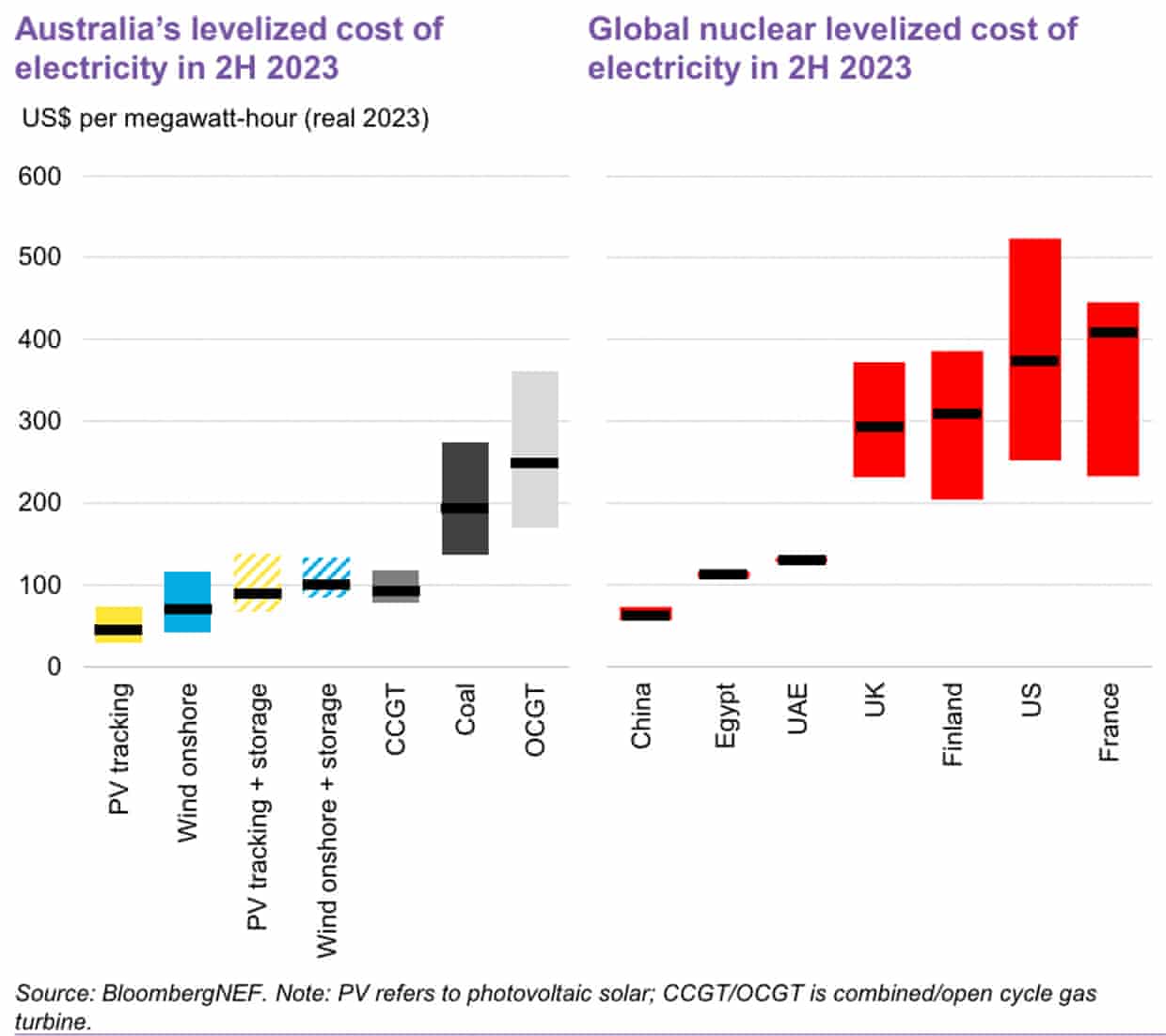
The CSIRO GenCost report, finds conventional nuclear power stations will cost about 2.5 times as much as onshore wind and 5 times more than large-scale solar. If so, the electricity price has to be higher to recover the capital cost.
Not surprisingly Nuclear reactors cost more to run than wind or solar. They have large numbers of moving parts, materials are dangerous, and a lot of care and precision is required.
Communities. They are happy to support opposition to, and veto over, renewable projects (because they oppose renewab;es), but no community will get a veto over nuclear because its in the “national interest”.
Coalition policy continues to ignore that the best thing for rural towns is community owned renewable energy, it keeps the money in the town, gives them control over their development and means everyone gets buy in.
Issues of taxpayer subsidies which will be required for the build, as there is no evidence that corporations want to build any nuclear energy for themselves, unlike renewables.
Costs of insurance and decommissioning. In general, even though nuclear is usually safe, because of the possibility of severe accidents insurance companies are reluctant to cover them, and taxpayers usually end up taking the risk and taxpayers usually pay the billions or more to demolish the reactors safely.
Money. As the project will probably be built by foreign companies, most of the money will leave Australia.
Nuclear waste. that appears to be something we worry about in the future.
Given the policy is not about anything sensible, it would seem to be about
Continuing their war on renewables
Supporting fossil fuel companies, and their emissions, for at least another 15 to 20 years
and
wasting lots of money, on something which could produce huge problems for Australia.
It appears this is the usual swamp politics of subsidising and protecting the fossil fuel corporate sector from change, at the taxpayers’ expense.
Nuclear might have been a great idea 10 to 20 years ago, but is not now a whole answer, or even a partial answer especially if emissions are being increased and alternatives suppressed.
In other words don’t think that building a few nuclear power stations stops the need for other action.
BNEF has just released a paper called “Australia’s nuclear-powered distraction threatens net zero” I will link to it as soon as I can find a link. This is based upon articles about the article
Summary
The issue is not really whether a case could be made for nuclear in Australia, but whether the Coalition policies will deliver:
More emissions, and
More expensive electricity.
That would seem to be the case from the mess of their policy, and their repeated requirement that we trust them to give details after the election.
The plan, even if completely successful will certainly not add that much to Australia’s energy supply, and there is no point going with small amounts of nuclear if we are going to increase emissions through rolling back on renewables.
Political Obstructions?
Despite nuclear energy technology having been banned in Australia since 1998, under Coalition PM, John Howard, with three of the high population states also banning it, the federal Coalition opposition has proposed seven sites for nuclear plants which they claim could be operational as soon as 2035, which is improbable. As Bloomberg states, it will be “a slow and challenging” effort to overturn existing bans, and to force people to accept nukes on the sites selected without consultation.
Nuclear is expensive
Nuclear could reduce emissions, but it is usually a very expensive technology in markets with limited experience, unsupportive politics and uncertain regulation — such as Australia. We have already mentioned that cost overruns are normal even with experienced builders. Another problem is that people cannot be held to contract prices as we do not want cheaply built and unsafe reactors, so we have to assume they are not deliberately underquoting.
Renewables are cheaper and easier
The usual estimates are that renewables are cheaper than Nuclear. Bloomberg said that going by existing nuclear industries in western nations, the cost would be “at least four times greater than the average” for Australian wind and solar plants with storage today.
Furthermore, Australia has plenty of wind and solar resources with large areas of semi-vacant land, and lots of people vying to build wind or solar power. There appears, as yet, to be no one volunteering to build nuclear in Australia, certainly not seven power stations worth by 2035.
To repeat, SMRs do not exist commercially so we have no idea what they would cost, or how much energy they would produce. So it is pointless budgeting for them.
Australia’s coal fired power stations will largely be phased out by 2035. So, to avoid power supply shortfalls and high electricity bills between the gradual shutting down of coal energy and the beginning of nuclear, we have to increase renewables and energy storage. If we do not do this, then electricity prices will increase massively or emissions from Gas will increase.
Nuclear will also add significantly to the costs of energy. To pay off the huge capital investment, which it seems will be carried by taxpayers, prices will have to rise.
Conclusion
if the debate serves as a distraction from scaling-up policy support for renewable energy investment, it will sound the death knell for decarbonisation ambitions – the only reason for Australia to consider going nuclear in the first place.
Plus a few other references. If this summary contravenes copyright, please let me know….
Age
Ted O’Brien, the shadow energy minister, has said the nuclear plants built here will last for between 80 and 100 years.
This is clearly likely to be guesswork as there are no 100 year old plants anywhere in the world…. Nuclear power plants did not exist in 1924.
The mean age of the 416 active nuclear reactors is about 32 years. The average age of the 29 reactors that have shut over the past five years, is less than 43.
16 reactors have been operating for 51 or more years. Mycle Schneider, an independent analyst who coordinates the annual world nuclear industry status report says “There is zero experience of a 60-year-old operating reactor, zero. It never happened. Leave alone 80 years or beyond” (The world’s oldest, Switzerland’s Beznau, has clocked up 55 years with periods of outages.)
CSIRO’s report looked at a 30 to 40 year life for a large nuclear plant as there was “little evidence presented that private financing would be comfortable” with the risk for any longer.
As plants age, maintenance costs are likely to increase (physical entropy or wear), as they have in France. Apparently the US has avoided this problem, although with declining investment over the last decade the average reactor age has increased from 32 to 42 years. So we need to find out how that was done.
What is the state of the global nuclear industry?
Five nuclear reactors opened last year and five were shut down
Over the last 20 years 102 reactors opened and 104 shut down
China has added 49 during that period and closed none. Nuclear energy provides about 5% of China’s electricity, which seems to be slightly more than the Coalition is going for in Australia
Last year, China added 1GW of nuclear energy but more than 200GW of solar.
In the world, solar passed nuclear for total energy production in 2022 while wind overtook it a decade ago.
Schneider says “In industrial terms, nuclear power is irrelevant in the overall global market for electricity generating technology.”
Bill Gates’ company has been trying to build commercial SMR’s for 18 years and not succeeded yet.
The CSIRO Gencost report noted that the Utah Associated Municipal Power Systems SMR, was cancelled last November. In 2020 its estimated cost of of $18,200/kiloWatt, was more than double that of large-scale plants at $8,655/kW (in 2023 dollars). But by “late 2022 UAMPS updated their capital cost to $28,580/kW” the CSIRO said. “The UAMPS estimate implies nuclear SMR has been hit by a 57% cost increase which is much larger than the average 20% observed in other technologies.”
Nuscale, the only company to have received design approval from US regulators for an SMR, were building SMRs for US Department of Energy’s Idaho National Laboratory. NuScale announced at the start of 2023 that the target cost of power for this project had increased by 53% since 2021 to US$89/ MWh. they had, in one account failed to attract customers at these prices.
Big Economies and Nuclear
The Coalition says that Australia is the only one of the top 20 economies that doesn’t have or isn’t getting nuclear energy. However, Germany has abandoned nukes as is well known, and Germany is also using less coal power than it has in decades. Italy shut down reactors after 1990. Saudi Arabia has been considering developing nuclear for about 15 years but, still has not embarked on it, and has set a goal of 50% of electricity coming from solar by 2030.
The 35 construction starts since 2019 were either in China, or were Russian-built in various nations. It is unlikely the Coalition will go to China or Russia for builders.
France?
Nuclear provides almost two-thirds (62%) of France’s electricity. However, the French company EDF has €54.5bn debt and hasn’t finished a plant since 2007.
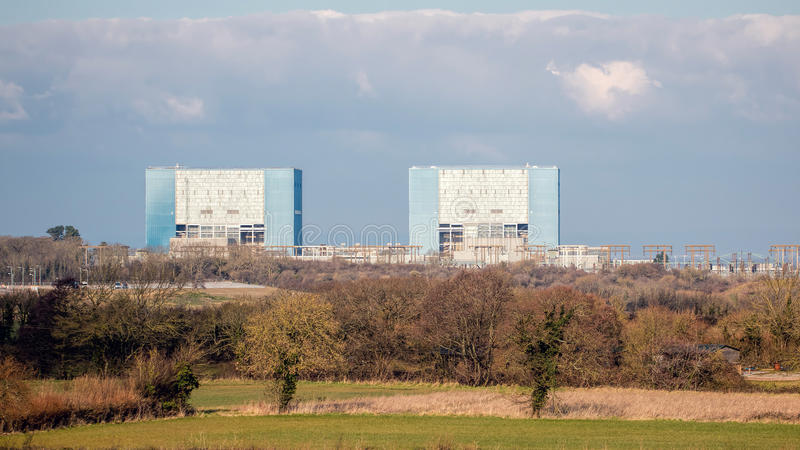
EDF is building Hinkley Point C in the UK, which has suffered from cost blowouts and delays. The current estimate is that it may not start until 2031 and may cost $90bn to complete. High electricity prices have been promised to keep it solvent.
In 2014, the Government aimed to reduce nuclear’s share of electricity generation to 50% by 2025. This target was delayed in 2019 to 2035, before being abandoned in 2023. Apparently 1 reactor is currently under construction. The amount of energy produced in 2022-3 declined due to necessary repairs [1] and in 2016 all the reactors were offline due to a long-term coverup of manufacturing faults. By the end of April 2022 it was reported that 28 of France’s 56 nuclear reactors were offline
US?
The 4.5GW Vogtle plant reached full capacity in April, making it the US’s largest nuclear power station. Its first two units exceeded $US35bn, with the state of Georgia’s Public Service Commission saying cost increases and delays have “completely eliminated any benefit on a lifecycle costs basis”.
The Korean company Kepco built the 5.6GW Barakah plant in the United Arab Emirates. As Schneider’s report notes, the UAE “did not agree” to the disclosure of cost, delays or impairment losses. so we have no knowledge of the problems, cost overruns etc…..
1) There is no costing at all, except for claiming it is cheaper than Labor’s renewable plan. The CSIRO’s costing are just officially denied. We have no idea of the cost and are not promised a costing.
2) The costs and time frames of nuclear energy production, are notoriously under-estimated even by experienced builders. Australia has never built a nuclear power station, and we are now to build 7 of them (simultaneously?), so we can assume any estimate is an under-estimate.
3) Given that no Australian company will be able to build them, then most of the money for building and supplies will go overseas.
4) The plans seems completely inadequate. The energy generated by seven nukes will not replace the energy from the coal fired power stations that are closing down. On top of that, they clearly cannot supply the extra energy the country may require.
5) Commercially available SMRs are currently hopeful fictions. They may produce about a third of the energy of standard nuclear energy stations. We have no idea what they will cost to build.
6) Dutton apparently thinks a drawing of a building is the same as a ‘concept design’, so his pronouncements that SMRs are viable are hopeful fantasies.
7) The Dutton plan does not care about emissions reduction, and the only reason for altering the energy system is because of the need to reduce emissions. If a plan does not reduce emissions significantly it is a waste of money.
8) There are no plans to reduce emissions from transport or farming.
9) The Dutton plan also seems to involve the suppression of large scale renewables.
10) This suppression plus the inadequacy of the number of reactors, pretty much guarantees that methane burning, and its emissions, will increase to provide the necessary energy.
11) Dutton will scrap the 2030 emissions reduction targets, breaking his own government’s previous agreements at the Paris COP. This, again, illustrates the plan’s lack of concern about emissions reduction. Supposedly net zero will occur after the reactors are built, even though the reactors do not provide significant reduction, gas burning will increase emissions, and other sources of reduction are not being mentioned.
12) Hence it seems plausible to assume that the idea has nothing to do with emissions reduction, other than to distract from it. Therefore it is a complete waste of money, no matter how cheap it is.
13) The Dutton plan for people’s resistance to nuclear is simply to ignore it and suppress it by force or bribery of particular people. However, the Coalition encourages opposition to renewables.
14) There is no comprehensive plan for waste disposal. We can worry about that later.
15) There is no evidence that the proposed sites have enough water for cooling, or that the local environment can handle the heating from taking waste heat.
16) Taxpayers will be responsible for the entire life-time costs of the reactors. It is not clear whether tax payers will get all the profits. Renewable energy is largely financed by the private sector.
17) The economic benefits are asserted rather than proven and would apply to renewables all over the country as well.
18) The Nuclear plan is unlikely to reduce the cost of electricity at all. It will most likely it will boost the price, by stopping the expansion of cheaper low emissions sources, and being inadequate to what is required.
19) Again the nuclear plan will not set Australia on course for net-zero by 2050, or even reduce emissions in any real sense.
It is a complete waste of money and effort, for no obvious benefit.
See the two previous posts on the Australian Coalition’s nuclear energy policy for documentation
The quick summary is that the Coalition’s nuclear plan will not significantly add to energy availability or emissions reduction in Australia. It will, however, cost a lot.
Peter Dutton, the leader of the Australian Opposition, has declared that he has released the policy which will make Australia Nuclear if the Coalition get into government.
The first thing to note is that his policy release is completely uncosted, despite the main scientific organisation in Australia, saying that nuclear would be at least 50% more expensive than solar and wind and would not be available any sooner than 2040, and previous attacks on CSIRO estimates by the Coalition, with the CSIRO denying those attacks had any validity. Oddly perhaps if Labor released uncosted policies that simply ignored the costings by the CSIRO, then the Coalition and Murdoch media would be jumping up and down in dismay, shouting about irresponsibility. But not now.
Some costs for the newest design large scale reactors:
Construction cost experience with generation 3 nuclear projects in US and Europe
AGL Energy’s CEO Damien Nicks said “There is no viable schedule for the regulation or development of nuclear energy in Australia, and the cost, build time and public opinion are all prohibitive…. Policy certainty is important for companies like AGL and ongoing debate on the matter runs the risk of unnecessarily complicating the long-term investment decisions necessary for the energy transition.””
Andrew Forrest, says “I simply want to see fossil fuels removed from Australia’s energy mix as soon as possible, but as an industrialist, I’ve looked at nuclear and it does not stack up,”
Kyle Mangini, of IMF investments, said it was “virtually impossible” for the private sector to take on the financial risk of building nuclear reactors without taxpayer subsidies. “If you look at where the nuclear facilities are being built globally, they’re almost in all cases being built by governments,” adding “”In Australia, there’s never been a nuclear facility built, so there’s no skilled labour force.”
As we proceed it will become reasonable to suspect that the main aim of the plan is to stop renewables, and keep the fossil fuels burning. The leader of the National party David Littleproud.. [said]
“We want to send the investment signals that there is a cap on where [the Coalition] will go with renewables and where we will put them…. Earlier on Monday [he] told ABC radio the Coalition’s energy policy will show investors Australia doesn’t need “large-scale industrial windfarms, whether they be offshore or onshore”.
As well the Coalition will drop all 2030 targets, and so encourage the build up of emissions, even if they make the 2050 target. The whole point of the change in energy is to reduce GHG emissions. It is doubtful whether this proposed change will do much if anything to reduce those emissions, and emissions reduction is urgent. Over the last year, much to many scientists surprise the average temperature has crossed 1.5 degrees C, reaching 1.63 degrees C. It is likely to cross 2 degrees relatively soon, and then spiral out of control. Innes Willox, chief executive of national employer association Ai Group summarises the policy, by saying:
“With no delivery projected until the middle of the next decade, the proposal does not immediately help with short-term emissions reduction or the cost and reliability of energy in the short term.”
While it maybe true that the reactors are cheaper than Labor’s Plan…. are they a useful source of power and emissions reduction? If they are not, then it is money and time wasted.
The Press Release and after
The Priority is not climate change
The official press release of the policy opens by making it clear the priority is not dealing with climate change
Every Australian deserves and should expect access to cheaper, cleaner and consistent electricity…
Right now, in households and businesses around the country, Labor’s expensive renewables-only approach is failing.
In a classic move, the reason for changing energy systems has been ignored. However, they do recognise one problem with the energy system
90 per cent of baseload electricity, predominantly coal fired power stations, is coming to the end of life over the next decade…
a future Federal Coalition Government will introduce zero-emissions nuclear energy in Australia, which has proven to get electricity prices and emissions down all over the world
Nuclear certainly has not reduced electricity prices everywhere in the world. The unfinished Hinkley Point being an obvious example. However, the propaganda aim seems to be to associate cost of living increases with the current government, imagined cutbacks in fossil fuels, and the rollout of renewables, which is a tactic borrowed from either Trump or his corporate think-tanks. There is no consideration of the inflationary effects of fossil fuel company profiteering, Russia’s invasion of Ukraine and hence more competition for gas, or even the local break down of old coal mines and power stations.
Locations
The proposed locations are:
Liddell Power Station, New South Wales
Mount Piper Power Station, New South Wales
Loy Yang Power Stations, Victoria
Tarong Power Station, Queensland
Callide Power Station, Queensland
Northern Power Station, South Australia (SMR only)
Muja Power Station, Western Australia (SMR only)
SMRs do not exist commercially yet.
It appears likely these sites were chosen because they have cabling infrastructure (grid) already in place. Others state:
Some of the sites, particularly Loy Yang in the Latrobe Valley, are very close to earthquake fault lines. Several have no obvious water source, which is essential. They appear to have been chosen for political saleability, not science.
A later comment from Ted O’Brien implies that the Coalition have not even decided the number of reactors involved
Ted O’Brien, who designed the plan, told the ABC’s Insiders the amount of energy generated would depend on the type and number of reactors built at each site, and that neither of those things could be known until a Coalition government could establish a nuclear expert agency to undertake studies.
Rather optimistically Dutton claims the sites “will start producing electricity by 2035 (with small modular reactors) or 2037 (if modern larger plants are found to be the best option).” Again this is with currently non commercially available SMRs, plus clearing all the political and economic barriers which are discussed below. Loy yang one of the sites is not closing until 2034 at the moment, so building could not start until after then. Again the CSIRO estimated the earliest anything could be running would be 2040 given a 12-15 year build.
The latest AEMO integrated system plan “forecasts the retirement of 90% of Australia’s remaining 21 gigawatts of coal generation by 2034-35, with the entire fleet retired by 2038.” To overcome that issue requires plenty of gas backup, or lots of renewables and storage. The Coalition is not saying how much energy they hope their nukes will generate or how they plan to make up the gap, but given the announced hostility to renewables, the plan most likely depends on gas as a major source and not a backup. Ted O’Brien said the obvious solution to the collapse of Coal was to “pour more gas into the market” but also said he would “welcome all renewables”. So their plan is to increase emissions, and it seems obvious that parts of the Coalition do not want more renewables, and more renewables is not part of the plan
AEMO is worried that renewables are not being rolled out fast enough to fill in the gaps in 2024-5, and nuclear cannot be ready in that time. It will be interesting to see what happens there. The climate council says:
Seven standard nuclear reactors would deliver approximately nine gigawatts of energy capacity [possibly more than that depending on design and what you are counting]. While [AEMO claims] Australia will need at least 300 gigawatts by 2050
We apparently use 22 GW of coal at present, so the planned nukes are unlikely to even replace coal use now, never mind the energy from other sources.
O’Brien strangely argued that “Australia already is a nuclear nation. We know that nuclear technology saves lives, we know that because we have a nuclear reactor operating here in Sydney. It’s been operating for decades, saving lives, especially diagnosing and treating cancers.” However, there is a massive difference between the size and complexity of Lucas Heights and that of a nuclear power station
“It must be recognised that this is a ‘zero-power’ pool reactor where the complexities of high pressure, high power, high radiation environments do not exist.”
People who moved into the reactor’s area, already knowing it was there, have objected to its presence for a long time. Even a small reactor is not accepted by everyone.
The big question, however, is what level of energy will these 7 reactors provide? And the answer appears to be “completely inadequate.”
Ownership, Funding and Control?
In a later interview/speech Dutton said:
The assets will be owned by the Commonwealth – a very important point – and we’ll work with experts to deliver these programmes…… [and] The Australian Government will own these assets, but form partnerships with experienced nuclear companies to build and operate them.
So taxpayers will be funding the building, and probably covering decommissioning and insurance. This will be expensive, and how will it be paid for? By increasing taxes, increasing the deficit, decreasing Medibank or social security, or getting huge loans? Hopefully the reactors will not be given to the private sector after the taxpayers have funded them, although the second statement implies they may be run privately, but we have no idea who will be involved. The main builders currently in operation are Russian and Chinese, who we might assume would not be acceptable.
On the other hand Renewables are under private, community or household funding and control, which is usually said to be a good thing.
We also need to remember that nuclear is potentially dangerous and we need heaps of trained and experienced people, and good regulation for Australian circumstances, to keep it safe and to cover fuel handling at all stages.
Supposed Economic Benefits
The sales pitch is that:
Not only will local communities benefit from high paying, multi-generational jobs but communities will be empowered to maximise the benefits from hosting an asset of national importance by way of:
A multi-billion dollar facility guaranteeing high-paying jobs for generations to come;
An integrated economic development zone to attract manufacturing, value-add and high-tech industry; and
A regional deal unlocking investment in modern infrastructure, services and community priorities. Press release
The leader of the Nationals promoted the idea that this plan would be beneficial for rural economies. Apparently locally owned and controlled renewables are not. Susan Ley again emphasised the economic side saying “So, our vision is to make sure that we underpin our economic success with jobs for decades to come in industries where Australia has that competitive advantage.” She did not say what the advantage would be. Ted O’Brien said “Labor is turning the lights out. Prices will soar, jobs will be shed and industries will collapse. Australians will be left poorer and our nation weaker.” LEADER OF THE OPPOSITION – TRANSCRIPT – JOINT PRESS CONFERENCE WITH THE HON DAVID LITTLEPROUD MP, THE HON SUSSAN LEY MP, THE HON ANGUS TAYLOR MP AND MR TED O’BRIEN MP, SYDNEY
However:
A 2023 PricewaterhouseCoopers report into offshore wind found the energy source was expected to add $40bn to GDP between 2027 and 2040, supporting 19,000 jobs in the peak of construction and 7000 to 14,000 operational roles in regional areas. According to International Energy Agency estimates, 17.5 gigawatts of offshore wind will be added to global capacity in 2024 compared with around 8.5GW of gross nuclear capacity
Coalition at odds on energy strategy. The Australian 19 June 2024: 4
Part of the promotion is that renewables are a “wrecking ball through the Australian economy” and that families “know it because it’s harder in their own budgets”, Again the plan is to associate the current multi-causal world wide inflation with Labor’s renewables’ policy. However,
Dr Dylan McConnell, an energy systems analyst at the University of New South Wales, says only about $100 of a household’s annual electricity bill is made up of charges related to environmental programs, such as feed-in-tariffs for rooftop solar or financial incentives for large-scale renewables projects.
[and] In the last quarter, the biggest price rises were in rents, secondary education, tertiary education and medical and hospital services… insurance premiums have gone up 16.4% in the last year… ABS data also shows electricity prices are a small part of Australian household expenditure, at just 2.36% of overall costs.
And the Coalition’s programme not only seems to include 7 expensive reactors, but to need back up in terms of more coal or gas because those reactors will not replace lost coal generation and will not make up for lost renewables. All of this will put more financial strain on taxpayers and customers as they cost more than renewables as will be discussed in the next section. The price is usually set in Australia by the most costly source, so relying more on gas than on renewables, will boost electricity prices. At the best, the prosed nuclear sites will do nothing to reduce the current increase in prices as they won’t exist for some while. So the Coalition’s implied end of rising electricity prices is false.
Problems
An ex-Prime Minister writes:
A nuclear power plant would face the same economic challenges that coal-fired generators do now – for much of the day it would be unable to compete with solar and wind. During those times of excess supply the nuclear plant would add to the excess. That surplus electricity would be taken up by batteries and pumped hydro which would then compete with the nuclear plant during the night.
So the only way the economics of a nuclear plant could be assured in our market would be for the rollout of solar and wind to be constrained. That seems to be Dutton’s intention
So unless renewables are destroyed nuclear may not be profitable.
The Coalition’s lack of costing is obvious, except to insist seven nuclear stations are cheaper than near 100% renewables. However, in one interview the leader of the Nationals was asked how much the plan will cost and whether it was around the CSIRO’s $8.5 billion to $17 billion estimate. He replied “Yeah, look, we’re not disputing that,” (Nationals leader pressed on how much nuclear will cost Aussies).
The lack of costing also does not include the cost of climate disruptions, fires, floods, droughts, heat deaths etc. They also say that “the investment that we’re making, it’s over an 80 year period” which might imply that they are going to build these 7 reactors very slowly. We don’t know as there is no timeline for the building. We have no estimation of the cost of electricity produced by nuclear power despite the CSIRO estimating it would be over 50% more than renewable energy. We don’t know what reactor types are involved, including the experimental SMRs, we don’t know about waste disposal (waste will be kept on site until it isn’t), we have no plans for emissions reduction in the rest of the economy (so talking of 2050 net zero is fantasy). We don’t know who are the likely builders and it is foolish to expect that nuclear energy can be built by Australian companies so campaigning for nuclear energy is campaigning to export billions of Australian money overseas. And, as argued above, nuclear as proposed by the Coalition will only partially replace current coal power. It will not supply the new energy Australia needs. There is a massive gap which we can presume will require more fossil fuels to fill.
in March 2023 Dutton said:
I don’t support the establishment of big nuclear facilities here at all, I’m opposed to it, but for the small modular reactors, we can have them essentially replacing brownfield sites now, so you can turn coal off and put the small modular reactors in and it’s essentially a plug and play. You can use the existing distribution networks
But that was a year ago…. and he may have realised that SMRs are largely fiction and not high energy sources able to replace coal power. An SMR is expected to produce 300 Megawatt electric (MWe) producing 7.2 million kWh per day, less than a third of a large scale reactor at 1,000 MWe producing 24 million kWh per day. So if we don’t go with 5 normal reactors we would have to have over 15 SMRs to replace them. In any case the 5 large scale rectors and 2 SMRs would, according to Simon Holmes a Court, “be expected to generate 50 TWh a year – less than 15% of the new generation needed”.
I have encountered arguments which suggest that submarines have SMR’s. However we have had nuclear submarines since 1958, so we have had them for at least 60 years. No one, not even the military, has appeared to successfully use them on land, and this is despite various militaries having had no problem using long term poisons and mutagens, even when their own troops could not be protected. Whatever, the reason it has not discouraged large scale nuclear building, so there is no reason to think the conversion would be easy or even plausible.
While the Coalition encourages local communities to oppose renewable energy, it appears they may not tolerate opposition to gas, oil or nuclear. The Deputy leader of the Nationals stated “if a community is absolutely adamant then we will not proceed but we will not be looking beyond these seven sites,” to which David Littleproud (the leader) said:
“No, she is not correct,… We made this very clear. Peter Dutton and David Littleproud as part of a Coalition government is prepared to make the tough decisions in the national interest.
To be confusing he also talked about “proper consultation.” In 2019 Ted Obrien in an official Coalition Government media release said:
“Australia should say a definite ‘No’ to old nuclear technologies but a conditional ‘Yes’ to new and emerging technologies such as small modular reactors.
“And most importantly,” said Mr O’Brien “the Australian people should be at the centre of any approval process”
I presume they are intending a neoliberal consultation in which people are told what is happening and ignored, and local businesses bribed. They would also have to deal with the issue that property values would likely decline near the site, although that can be dealt with by telling people that it is their problem.
Importantly there is Federal legislation forbidding nuclear power. Its not clear how changes to that legislation would pass through the Senate. Various states also have legislation (nuclear power is banned in Victoria, New South Wales and Queensland), and even the Coalition at state level is not welcoming the project. According to The Australian, Queensland LNP leader David Crisafulli has ruled out lifting the state’s nuclear ban if he wins the Queensland election in October (Coalition at odds on energy strategy. 19 June 2024: 4). The main plan to overcome the problem seems to be bribery (“Somebody famously said ‘I would not stand between the premier and a bucket of money’,”). However Dutton has implied several times that consultation could just involve the Commonwealth overruling the States, again an authoritarian neoliberal consultation process.
However, it is perhaps not surprising that the Minerals Council of Australia (the mining company Union) is in favour of nuclear but wants the ‘free market’ to sort it out, which effectively opposes the idea of government ownership (Tania Constable, End the ban on nuclear energy, and let the marketplace sort it out. The Australian 19 June 2024: 20). So they don’t have complete support from the plan there.
Apparently:
The United Arab Emirates is often put forward of an example Australia could follow. It took just 13 years to connect its first nuclear power plant, and is the only country in the world that has managed to successfully build nuclear from scratch in the last 30 years.
It is obviously not easy to do and that is 13 years after clearing all the political hurdles in Australia, If the Coalition gets in in 2025, and we assume 1 year to get the politics, money, ‘consultation,’ site acquisition, choosing builders and training workers out of the way, and start building, then it would be absolute best practice to have it running by 2039 – somewhat more in keeping the the CSIRO’s predictions that the Dutton predictions. However, Ted O’Brien and David Littleproud are now flagging that there might be two and a half years of local community consultation before the site details were finalised, although communities could not veto the sites. So that adds another year to year and a half to readiness times, making the best practice date 2040, not 2035-37 as promised.
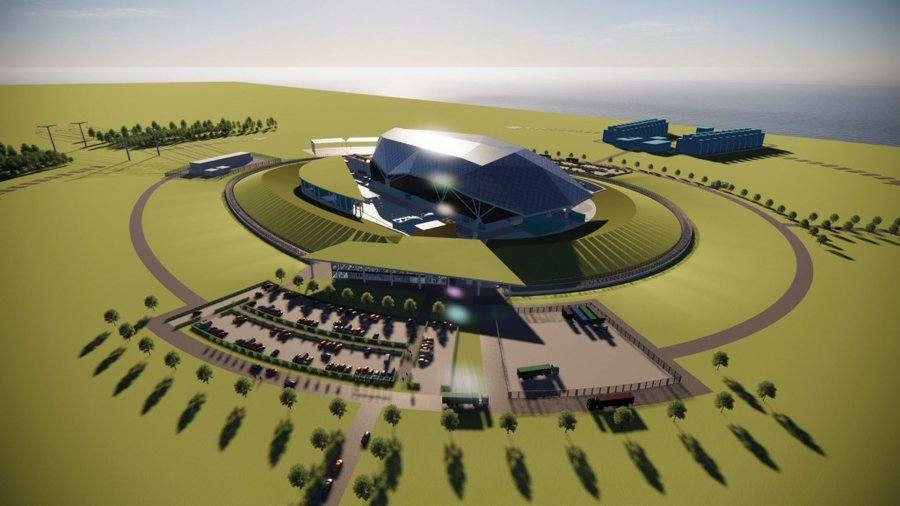
The level of Coalition competence on design is also not impressive. Peter Dutton tweeted that:
“This [image] is the concept design of a zero emissions small modular reactor [SMR].”
This seems frighteningly naïve when it comes to any complex and potentially deadly technology.
That picture is not a concept design for an SMR, it is just a design for a building and setting, which might hold an SMR, a library, a country restaurant, or a cheese display.
A concept design would tell us something about how the SMR is supposed to work, what the materials it will be constructed out of are, what the cooling system is, what the safety system is, where the uranium and waste is stored etc…. You may note that this ‘concept design’ does not even have a fence, it is that insecure and open to terrorist attacks…. this is an empty fantasy drawing, not a design of any practical value.
Foreign Policy
It may now happen that our neighbours think we are going to acquire nuclear weaponry, a normal product of nuclear power, and make moves to defend themselves. This is not fiction. When the Coalition decided to buy nuclear submarines from the US
the US made it plain to senior members of the Morrison government that if there was any suggestion the submarine deal could precipitate any broader policy change in Australia – anything at all that could generate speculation about acquiring nuclear weapons, no matter how fanciful – the deal was off. It must not, under any circumstances, give rise to any extraneous suggestion that the US was bending non-proliferation rules.
That included any talk of establishing a civil nuclear industry.
So they broke their agreement and are now using the argument that nuclear powered submarines are safe, to imply nuclear energy is always safe.
Nuclear vs Renewables.
Apart from over-optimism, and abandonment of emissions reduction, the problems for nuclear and renewables come down to:
Which technology reduces emissions with most speed
How much energy do we need? Can either supply that amounts
Which is most cost effective
Can an economy run on renewables
Which produces less long term environmental problems
What kind of social organisation is required for either of them
Going backwards
6) Renewables will be obstructed by fossil fuel companies for several reasons; the first is the obvious that renewables almost immediately start reducing emissions and the need to make emissions, and potentially cause loss of profit for fossil fuel companies and leave investments in fossil fuels stranded, as they replace fossil fuels. In this policy, it seems that Nuclear as planned does not reduce emissions; it may increase them as gas is used for backup with inadequate power generation. Renewables also allow the slow and modular building of Community controlled energy supplies, local level energy, resilience if they can function when the grid is down, and give the community political power and local finance, as money does not leave the local area. Renewables can be used to encourage independence, local political engagement and choice. Nuclear does not, it remains under outside control. Given the Coalition’s apparent hostility to renewables, the aim seems to be to keep centralised control, fossil fuel company profits and corporate power rather than to solve the emissions problem. In fact there is no real sense from the nuclear position that pollution and emissions are a problem. So it may be that neoliberal corporate dominance is one of many systems incompatible with solving the challenge of climate change, and hence needs to be curtailed.
5) Both nuclear and renewables disrupt environments. Renewables can be built so that farming can continue. Wind farms can also be built offshore and are likely to acts as artificial reefs and attract marine life to boost fishing and tourism. With proper design renewables should create little non-recyclable waste, but that does require the right designs. Nuclear requires ongoing costs of fuel and damage from mining, transport of radioactive supplies and waste, often through residential areas. Waste needs safe storage, and nuclear involves very expensive decommissioning at the end of its life because of high risk to those cleaning up and the local environment. Nuclear portends continued threats to environments.
4) It is possible that a modern corporate economy cannot run on renewables, but then a modern corporate economy cannot run on only 7 nukes. A modern corporate economy cannot run with climate change worsening either. Renewables are expandable, so they might be able to deal with the energy requirements. We might just have to change the economy and lower energy requirements, but that will involve a lot of struggle.
3) The CSIRO is clear on cost. Renewables are far more cost effective than nuclear. Nuclear cost blowouts are apparently worse than cost blowouts for the Olympics. Renewables are cheaper to install even including storage and cables. If well designed they should allow farming. I would rather trust the CSIRO’s estimates than those of a politician who is not itemizing the costs, and may never itemize them. As a further statement, Tim Buckley, director of thinktank Climate Energy Finance says:
“The international experience shows that the western nuclear industry is plagued with massive delays and cost blowouts,”… noting the Vogtle nuclear power plant expansion in the US blew out to cost $35bn, while Britain’s Hinkley Point C plant has been delayed to 2031 and is on track to cost £33bn pounds ($63bn).
2) The question of the energy we need is hard to answer, because this changes all the time. If we have to change the economy, then we change the energy we need. Earlier I mentioned that coal is fading out, and we may need 300GW in the 2030s. This energy cannot be delivered by 7 nukes. It might be that the ideal solution is to develop both nuclear and renewables, but it seems clear that the Coalition does not want to do this, they want to restrict renewables and support gas as with their technology neutral gas led recovery from Covid. Again we may need to change the economy to survive.
1) Either technology could reduce emissions, if the policy and the technology is well designed and implemented. Again the problem seems to be that with only 7 nukes the Coalition’s policy is not designed to reduce emissions. It seems to be designed to generate more gas use at great expense to taxpayers. So the chance of using nuclear and renewables together has been abandoned.
The Conspiracy?
The Dutton nuclear plan
bear a striking resemblance to a policy Trevor St Baker and SMR Nuclear Technology have been advocating for several years, in evidence and submissions to federal and state parliamentary committees, in think tanks and in energy forums.
[St Baker is a patron of the extremely wealthy] Coalition for Conservation, One of its aims is to reach out to environmentalists, renewable energy experts and climate scientists to garner support for Coalition members
I’m not absolutely against nuclear energy, it could be really useful, but I am against nuclear energy when its being used as:
a) a distraction from reducing emissions;
b) in support of continued fossil fuel burning and;
c) to disrupt the replacement of fossil fuels by renewables.
All of these factors seem to be features of Dutton’s policy. The policy will not produce enough energy to make a difference to emissions. It will at best, and probably not at all, generate enough energy to replace some of the phased out coal. We probably need to build at least 40 full scale nukes with continuing expansion of renewables to make a difference; with no sign of that level of build out and the suppression of large scale renewables, the only way to give Australia the energy it wants is through more gas burning. There seems to be no guarantee that the plans can get through the various governmental oppositions. There is no evidence to suggest that it is really intended to. Chucking out the 2030 targets because they are too difficult, suggests that the 2050 targets will become too difficult too, which is great for fossil fuel companies. If the Coalition wanted nuclear to be successful they should have started about 20 years ago.
However, while some people say the deception is easily seen through, Dutton’s choice is not a death wish. He will get funding from mining and fossil fuel companies, he will get corporate and pro-Trump think tanks churning out material to justify him and clog social media. He will get support from Murdoch and probably most of the rest of the media. He will get unity in his Party, and he may even get some Russian and Chinese support through social media.
But then, taking a cue from the Anti-Voice campaign, which is much more appropriate for this policy at the moment….. Peter Dutton wrote:
“In refusing to provide basic information and answer reasonable questions on the Voice, you are treating the Australian people like mugs… your approach will ensure a dangerous and divisive debate grounded in hearsay and misinformation.”
It is often alleged that people on the left are completely responsible for the decline of nuclear energy. However, people on all sides of politics can be cautious about nuclear energy.
Cost overruns are common.
They are expensive when treated commercially. The UK Hinckley reactor has to be supported by a large electricity price, which of course distorts markets and supports other expensive, and polluting, sources of energy.
Reactors tend to take a long time to build, usually longer than estimated. So people figure, perhaps incorrectly, that they will not cut enough emissions in the time we have left to keep the temperature increase within bounds. We have about 10 years carbon budget left (and after that nothing), if we want to stay under 1.5 degrees.
see Georgia Power’s Vogtle project: the cost has increased by 140% since construction began in 2011, and is more than six years behind schedule.
Reactors face problems with heat. They need water for cooling and, in France recently, had to be shut down because the rivers were too low and the water too hot. This is clearly a problem as global temperatures continue to rise.
The small reactors (SMRs) we have been promised for a long time seem uncertain. The Australian CSIRO recently tried to find reliable data on their energy production and cost, and failed completely. I’ve recently read an article which said that they were being used in China, and were wonderful but it had no evidence or references for its position. A report written for the Australian Conservation Foundation states.
The small reactors that do exist are in Russia and China, but these projects have been subject to serious delays and cost blowouts. While there are hopes and dreams of ramping up SMR production, the mass manufacturing facilities needed to produce the technology are found nowhere in the world.
I have been told Japan has a working SMR, which uses ceramic coated fuel pellets, and is very safe. However, I have failed to find anything about this. One pro-nuclear site wrote:
Japan’s problem is that it does not have a viable SMR design that is ready to come off the drawing boards. This raises the previously unthinkable prospect of importing an SMR via licensing from a country that has one ready to go.
Japan is behind the technology eight ball in terms of developing its own SMRs. The Nuclear Regulatory Authority has no policy framework for dealing with them. In addition to being notoriously sluggish in reviewing reactor restarts, so far in its history has not reviewed and approved a single application for a new reactors of any kind or size.
Thorium Reactors failed when people initially tried to build them, and don’t seem to be much better nowadays.
The Institute for Energy Economics & Financial Analysis has reported on an as yet unbuilt set of SMRs in Utah (to be completed in 2030) being built by UAMPS (Utah Associated Municipal Power Systems) and NuScale Power Corporation. It states that the original energy price was to be US$55 per MWh, but recent presentations have suggested it would be between $90-$100 per MWh, despite “an anticipated $1.4 billion subsidy from the U.S. Department of Energy and a new subsidy from the Inflation Reduction Act (IRA) on the order of $30 per MWh”.
In the IEA’s global pathway to reach Net Zero Emissions by 2050, nuclear power doubles between 2020 and 2050, with construction of new plants needed in all countries that are open to the technology. Even so, by mid-century, nuclear only accounts for 8% of the global power mix, which is dominated by renewables.
Ordinary energy generation reactors lead to the capacity to build nuclear weapons, and we probably do not need more distribution of them – the world is already unstable enough.
As far as I can tell, there is still a problem with the waste, although some people say that problem has been solved, but until these imagined solutions are in standard operation we cannot tell for sure.
While they are mathematically safe and low risk, the problems when reactors do go wrong can be major and long term. The more reactors we have, the more likely we will get a major problem.
Commercial building of reactors, can lead to shortcuts and dangers, to meet deadlines and keep profit.
People generally do not want a energy producing reactor near them, so they have to be built away from residences, and that adds to costs and energy loss. They also seem to have to have water for cooling, so this also restricts where they can be built.
Where I live the Right seems to have become strongly in favor of nukes only after leaving government. This is probably because, while in opposition, they don’t risk having to say where the reactors will be established and alienating voters. While in government they did hold some inquiries which concluded that nuclear was not practicable, but they are clearly free to ignore that when they don’t have power. My guess is that, for them, it is a way of trying to inhibit renewable electricity and keep coal and gas going.
Furthermore it is probable, although I don’t know for sure, that fossil fuel companies agitated against nuclear and slowed down research and improvements, in order to keep their monopoly on energy – this would be another reason why parties heavily dependent on fossil fuel money and sponsorship, did not promote nuclear as much as they might have done.
According to reports of a 350.org and Lock the Gate report:
at least $1.3bn and up to $1.9bn in direct funding for the gas industry was promised between September 2020 and the election. They found another $63m was pledged in indirect funding for federal agencies to support the expansion.
The International Energy Agency made it clear in May 2021:
from today, [there should be] no investment in new fossil fuel supply projects, and no further final investment decisions for new unabated coal plants. By 2035, there are no sales of new internal combustion engine passenger cars, and by 2040, the global electricity sector has already reached net-zero emissions.
Exxon Mobil made $18bn in profits in the past three months. Shell and Chevron each made nearly $12bn. Those are all record numbers.
A recent study showed that for the past 50 years, the oil industry has made profits of more than $1tn a year, close to $3bn a day. These profits are driven not by some fantasy of free enterprise and perfect competition, but by the exact opposite – cartels, mega-corporations and the regulatory capture of governments..,
However, more recently, the leader of the opposition said:
It is high time that Australia had an honest and informed debate on the benefits and costs of nuclear energy….
The current energy crisis has shown the importance of getting more dispatchable power into the grid. The average wholesale electricity price in the second quarter this year was three times higher than the same time a year ago – a situation described by the Australian Energy Market Operator as ‘unprecedented’….
Australia is already a nuclear nation. The Australian Nuclear Science and Technology Organisation has operated a nuclear research reactor at Lucas Heights for over 60 years. A national conversation about potential of nuclear energy is the logical next step.
We have already had multiple inquiries that suggest nuclear power is too expensive without a carbon price which the Coalition will not accept, and few people want to live next door to one.
In their mind it appears to ‘excuse’ opposing climate targets, and suggests they might have a plan.
They will probably hope to distract from their failure to agree to actually cut emissions by arguing that people disinterested in nuclear energy, such as most people in Labor, Green and Teals, are not really prepared to tackle climate change, and are only interested in crippling the Australian economy, while the Coalition has a practical solution to the problem with zero social cost.
However, they have no ability, or probably intention, to get nuclear up before 2030 and thus help phase out greenhouse gas emissions. It’s just empty virtue signaling.
If you want to see the difficulties of modern nuclear then have a look at the Hinkley Point project.
The CSIRO was recently unable to get any pricing from the people claiming to have developed Small and Medium Reactors, and CSIRO Chief Executive Dr Larry Marshall pointed out that:
The latest report shows renewables are holding steady as the lowest cost source of new-build electricity.. With the world’s largest penetration of rooftop solar, unique critical energy metals, a world class research sector and a highly skilled workforce, Australia can turn our challenges into the immense opportunity of being a global leader in renewable energy
The status of nuclear SMR has not changed. Following extensive consultation with the Australian electricity industry, report findings do not see any prospect of domestic projects this decade, given the technology’s commercial immaturity and high cost. Future cost reductions are possible but depend on its successful commercial deployment overseas.
We have had a range of feedback into the assumed current costs for nuclear SMR over several years reflecting the difficulty of finding good evidence for costs in circumstances where a technology is not currently being deployed. This year only one submission was received but it continues the theme established in previous years that current costs of nuclear SMR should be lower. Vendors seeking to encourage the uptake of a new technology have proposed theoretical cost estimates, but these cannot be verified until proven through a deployed project.
So the chances of getting affordable nuclear in time, seems small. However the cost of renewables is decreasing and they are much easier to build than reactors.
It seems likely that a conversation on nuclear, at the same time as ignoring all the other fossil fuel problems we have, and all the solutions we have, is likely to be an attempted shield for doing nothing.
Warning this is largely an excerpt from articles credited below. I hope to do some research to fill it out.
1) Increasing the number of nuclear power plants (currently around 450 globally) increases the risk of a catastrophic accident caused by an extreme weather event (bushfire, typhoon, floods, tsunami) and becomes more likely with increasing and wilder climate change.
2) Nuclear plants consume vast amounts of water, a diminishing resource in a warming world, and uranium mining pollutes groundwater.
Half of the world’s uranium mines use a process called in-situ leaching. This involves fracking ore deposits then pumping down a cocktail of acids mixed with groundwater to dissolve the uranium for easier extraction. This contaminates aquifers with radioactive elements. There are no examples of successful groundwater restoration.
Butler
3) Nuclear plants take at least 7-10 years to build – we need solutions that can be operational now so that fossil fuels can be turned down now.
4) A 2017 report by WISE International estimates, that over its life cycle, nuclear power produces 88-146 grams of CO2 per kilowatt hour of electricity. Wind power emits 5-12 grams.
7) Nuclear power is a precursor to nuclear weapons. More countries with nuclear power means more countries with the potential to produce nuclear weapons. The second Iraq war, plus the leaving-alone of North Korea, have that nations need weapons of mass destruction to deter bigger States such as the US.
8) Nuclear waste remains radioactive for millions of years and there’s still no safe way to store all of it, or to maintain responsibility for that period of time.
In the 1970s, the US army built a concrete cap to seal away 3.1 million cubic feet of radioactive waste on Runit Island, which is part of the Marshall Islands. Today, rising sea levels threaten to bring down the entire structure, releasing the radioactive waste into the lagoon. The US government has refused to help, saying it’s the Marshall Islanders’ problem now.
Butler
9) Uranium mining is unsafe for the environment and workers.
10) In 2009 the European Commission found that about 70% of uranium used in nuclear reactors comes from Indigenous lands. Mining means even more dispossession and destruction for them.
11) Nuclear power is a centralised power source that requires lots of up-front capital and a large distribution grid, and massive taxpayer subsidy. Wind and solar provide opportunities for local councils and local communities to build facilities that are tailored to local needs, possibly independent from the grid and community controlled.
 Climate, technology and chaos Blog