Posts Tagged ‘politics’

More considerations on decarbonisation

August 3, 2020

What I’m trying to do, however badly, in the previous comments is to figure out what are some of the more important eco-social systems in play in decarbonisation, and the ways they interact. It is impossible to specify all such factors in advance, so these are limited, and could be discarded. The main point is to avoid reduction of reality to the two blocks of ‘society’ and ‘ecology’ although I’m limited in my ability to do this because of lack of ecological knowledge.

When I use the term ‘eco-social systems’ I’m deliberately placing ecologies first. Humans do not exist without ecologies, while ecologies can and have existed without humans.

The eco-social systems selected out here, are:

  • Energy,
  • Waste/pollution
  • Extraction
  • Information
  • Planetary boundaries, and the limits of ecological functioning or resilience.

Energy system

This is obviously based in eco-physical functioning. The ecosystem itself can be considered to be a system of energy release/generation and transformation.

I’m suggesting Labour is part of the directed energy system, but no longer should count as the major and only significant part of that system, as in Marxism or classical economics for example, due to the bulk of directed energy coming from other than human sources.

It is useful to explore the dynamics of the limits and stresses of the energy system, and its transformation. For example, we have the possibility that renewables could simply become an addition to the continued use of fossil fuels, unless we have a specific programme to cut greenhouse gas emissions.

The Waste/pollution system

I think it is useful to specify a conceptual difference between ‘waste’ and ‘pollution’ (waste is re-processable by the economy or eco-system, and pollution is not), because the ecological feedbacks, and eco-social consequences are different. It suggests how eco-social activity can overpower ecological resilience even through such apparently harmless action as the production of CO2 – the CO2 waste becomes pollution after it passes certain levels, and the more the ecology is destroyed the more waste becomes pollution.

I also hope naming this system reminds people that the manufacture and distribution of renewables may produce pollution. We need to cut this pollution down, but it seems that renewables are relatively non polluting after installation (before decommission), unlike fossil fuel energy, which only functions through continuing pollution. However, waste and pollution are not removed from the system.

If renewable energy, after the initial costs, is almost free, until the installation reaches the ‘waste/pollution’ stage, that has a large disruptive capacity in itself.

The Extraction System

The eco-social extraction system can damage itself, through ecological ‘revenge’ effects and feedback. There is obviously nothing unusual about asserting this, although it does not seem to be recognised in orthodox pro-capitalist economics.

The damage does not have to be gradual or linear. It can be abrupt and excessive as systems breakdown.

Extraction systems do not have to be harmful – they can pay attention to ecological information, and moderate themselves as needed. However, largely, unconstrained extraction/destruction, pollution, and expansion (or what is usually called ‘growth’) have historically been part of both capitalism and developmentalism, and are the main factors which seem to produce the current eco-crisis. Capitalism and Developmentalism also tend to suppress, downplay, or ignore information about ecology. We can also note that pro-corporate neoliberals tend to remove limits on extraction, pollution and expansion, as soon as they can.

Given this, we can raise the question of ‘how we can transform the energy system without continuing a damaging extraction system?’

If economic growth is linked to increasing extractive destruction, then either growth has to go, or we need to find new ways of extraction. This may cause ‘climate justice’ issues if growth remains our main solution for poverty.

The Information system

This is how humans generally recognise eco-feedback. However, the information system can be distorted by organisational, economic and political processes.

It seems useful to have some idea of how this distortion occurs, and where it is dangerous, and maybe how to diminish it .

Planetary Boundaries and the limits of eco-social resilience.

This is pretty crude but, that is because of a lack of ecological knowledge. However, it does place constraints within the model.

Firstly we need to consider the physical layout, geography, climate, and spatial configuration of a place. This can effect the possibilities of the renewable energy being used, and the way it is deployed. Changing the environment can produce the experience of people being ‘unhomed’. Land not only shapes human activities but is shaped by them. Possible uses of land depend on political struggle and sometimes violent displacement of those originally occupying the land.

As well as this the world’s systems are effected by what people call planetary boundaries, which are themselves systems. The formal planetary boundaries and the eco-social systems which encapsulate them are:

  • Climate stability,
  • Biospheric integrity (balance between species, rates of extinction etc),
  • Water cycles,
  • Biochemical flows (phosphorus and nitrogen cycles etc),
  • Ocean ph (acidity or alkalinity),
  • Particulate levels,
  • Ozone depletion, and
  • Novel entities (new chemicals, microplastics etc.).

We can think of these as essential planetary geo-bio cycles – they are necessary to human functioning, and to the functioning of the planet. They can be broken, and appear to be being broken at this moment. Adjustment will eventually happen, but there is no reason to think that this adjustment will automatically be friendly to current human societies, or even to humans themselves.

It seems that capitalism and developmentalism, both seek to avoid limits, and claim they can transcend those limits, usually though innovation and new technology. But this is likely to be a fantasy. Going by the evidence so far, it is a fantasy – however consoling it might be.

Even if we have massive unexpected technical innovation in the next twenty years (say, fusion power), then it still may be too late, and we still have to stop pollution and ecological damage from other sources.

It almost certainly will not hurt more to stop breaking the geo-bio cycles, than it will hurt to continue breaking them.

Further comments

All of the above systems are obviously interconnected, but specifying them out, might help us factor them all in to our analysis, all the time.

I didn’t particularly bother about the class system and its political dynamics (plutocracy) at this time, because I figure I’m unlikely to forget that, but it affects all of the above. Likewise the political system and its patterns affect all of the above.

Politics can affect the energy system. People can encourage and hinder certain forms of energy. They can forcibly ignore the consequences of energy production and so on.

Politics can affect the waste/pollution system such as the kinds of pollutions accepted or banned. Who is allowed to pollute. Where the pollution is dumped. What kind of penalties apply, and so on.

Politics affects extraction. Who can do the extraction. What kind of royalties are paid. What kind of property is made. What kind of limits to extraction exist. What local benefits arise.

Politics affects what kinds information are promulgated. The kinds of truth standards to are applied. The modes of distribution of information. The suppression of information and so on. What kinds of people who are ‘trusted’ with respect to information. The kind of information is accepted by different groups?

In later blogs I’m planning to try and incorporate the property/accumulation system, and the class/plutocracy/group-categorisation systems into the analysis.

Decarbonisation

Decarbonisation seems obviously affected by all of these factors:

How do we generate the energy to decarbonise, without disrupting ecologies, through waste/pollution and extraction processes? How do we decarbonise without harmful growth?

How do the information systems work to recognise, or not recognise, what is happening? how do they play out through the political and economic processes? Is it possible to improve them?

How do ecological limits affect decarbonisation pathways when they are not in good shape. We face doing decarbonisation in an era of compounding eco-social crises, which increases energy expenditure as people attempt to control them. This adds to the difficulties of decarbonisation.

To reiterate: we cannot successfully decarbonise, without generating enough energy to decarbonise. It also seems we must generate this energy at the same time as cutting pollution, ending extractive destruction, ending growth, refining information, and protecting ecological resilience, etc.

Conclusion

If there are any points that I would really like people to take from any of this it is that:

  • It takes energy to ‘release’ energy – and usually leads to waste or pollution somewhere in the cycle. Pollution must be minimised to keep geo-bio cycles functional.
  • In this sense, no energy is completely free.
  • If it takes more energy for humans to make energy than energy is released then, over the long term, the human system will collapse.
  • Human action is limited by available energy. It is also limited by the amount of destruction, and damage to the geo-bio cycles produced by the energy system.
  • The Information System and its confusions, is not an addenda to the other systems, it is vital to any analysis.
  • Human energy, extraction, waste/pollution, information and other systems, interact with planetary geo-bio-cycles or planetary boundaries, and if the human systems disrupt those geo-bio cycles, they will be limited and disrupted in turn – probably violently.

Considerations on decarbonisation processes

August 2, 2020

Basics

Social life only exists because of ecological processes, and is shaped by those processes.

All economies (modes of production, distribution and consumption) involve systems of energy, waste, extraction, information and ecological limits. [They almost certainly involve systems of accumulation/property, class/plutocracy and regulation/politics, but I’ll leave those out for another blog]

  • These other systems are not necessarily subsumed or determined by economies.
  • If an economic theory ignores the interactions between energy, ecology, waste, information, social organisation and conflict, it is more or less pointless.

It can be helpful to think of eco-social relations in terms of flow or flux, of patterns rather than structures, or of disruption rather than stability, or as guidable but not controllable .

Ecologies and eco-social relations are inevitably what we call ‘complex systems’. Their trajectory cannot be predicted with complete accuracy. If we are working with them, we should be on the look out for unintended consequences and surprise – as these are sources of information.

Every being in the system is interdependent with others, and responding to others. It has the characteristics it has, because of those interactions and their histories.

Energy

All ecologies and economies involve transformation of energy, from the transformation of sunlight by plants, to atomic power.

Transformation of energy, plus effective ecological functioning, is necessary for any human actions to happen. The less effective, or functional, the energy or the ecology, the more restrictions and difficulties.

Labour power is just one form of humanly applied and directed energy. Labour, itself requires energy from the organic transformation, and breakdown, of food into waste.

  • Humans have appropriated animal labour, the flow of water, wind and tides, the burning of biological material, the burning of fossil fuels, the energies inside atoms, and so on. These processes magnify, and transcend, human labour.
  • Once you develop large scale directed energy generation and application, then labour, and the organisation of labour, becomes secondary to the organisation of energy production and transmission in general. This is why energy is so fundamentally important to social capacity and organisation – and why changes of modes of energy generation are so threatening and unsettling to that established order.

Human producing, or using, of energy takes energy. Understanding this is vital.

The more energy is produced by the energy used to produce it, the greater the energy availability and the greater the activity possible. This is what we can call the “Energy Return on Energy Input” or EREI.

  • Fossil fuels have had a very high EREI. It look as though the EREI of renewable energy is much less. However, for most renewables after they are installed, the EREI changes, as very little labour, or energy expenditure, is required to gain an energy output – it is more or less free – whereas fossil fuel energy generation requires continual energy use to find and process new fossil fuels, and continual pollution from burning.
  • It looks as though the EREI of fossil fuels is decaying. Gas and oil sources are diminishing, requiring uneconomic and ecologically dangerous practices like fracking, or they are having to be found in places with increasingly difficult extraction practices – such as being under deep and stormy waters. Extraction of fossil fuels seems to be doing more ecological damage and requiring more energy to obtain. The ‘low hanging fruit’ has been taken and it cannot grow back, as once used it is consumed forever.
    • Coal could be an exception to the decline in EREI, but this may be because contemporary open cut coal extraction processes are much more ecologically destructive than previously, and the energy costs of transport are being ignored.
  • The decline in the EREI of fossil fuels, with the possible exception of coal, means that the energy expense of finding new fossil fuels to provide the energy for fossil fuel power stations is probably increasing in general.
  • It also means that there is less available energy around.

Waste/Pollution

Transformation of materials through energy, or in energy production, produces ‘waste’. The simplest human society imaginable, turns edible material into energy and human excreta (this is an overt simplification).

  • ‘Waste’ is here defined as excess, or unwanted matter which can be used, or ‘recycled’ by the economic or ecological system within an arbitrary, but functional, ‘reasonable’ time.
  • ‘Pollution’ is defined as waste which cannot be so processed in a ‘reasonable’ time.
  • Perfectly harmless waste can become pollution if there is so much of it that the economic or ecological systems cannot process it, and it accumulates and disrupts, or poisons, functioning ecologies.
  • Contemporary Greenhouse gas emissions are wastes which have become pollution because of the volume in which they are emitted.

The more that pollution damages the system, the less waste can be processed by it.

Extraction and ecology

Economies can also extract materials, and life forms, from the ecology in ways that destroy the ability of the ecology to regenerate and, as a consequence, produce eco-social change, minor or large depending on industry wide levels of destruction.

  • Ecologies are not passive, and respond to human or other actions in ways which are often unpredictable in specific.
  • It is possible to imagine an economy in which destruction of ecologies was not standard practice.
  • Indeed the impact of humans on ecologies was, until relatively recently, mostly fairly gentle. Although some human systems appear to have been unintentionally destructive of their ecologies, before the large scale use of fossil fuels, and carried out the destruction fairly quickly.
  • Increasing economic growth, which seems essential in capitalism and developmentalism, nearly always seems to involve increases of ecological damage. Such growth has often come out of destruction.

For decarbonisation, the fundamental question is “how we can transform the energy system without continuing a damaging extraction system?”

It can be postulated that the economic system is not the only cause of ecological destruction. Religious systems can demand the cutting down of trees, the use of plaster which blocks water supplies, as apparently the case for the Maya, and so on. That is another reason why we talk of eco-social relations, and indicates the importance of worldview and information.

Information

Economies require information distribution and restriction. At the minimum, people need to know what to extract, how to transform it, how to consume it, and how to keep the system going. This knowledge may be restricted so that only some people know how to do some tasks properly (through gender, age, class, education, etc.), and the information may be limited, incorrect, or influenced by its role in politics.

The information system is how humans generally recognise eco-feedback.

Any information about complex systems, such as societies or ecologies, is almost always limited and inadequate, because it is inherently impossible to map all the relevant links and exchanges in real time. Any representation, however useful, is a distortion.

  • Not all information is literal, some can be ‘symbolic.’ There is the possibility that symbolic information may be useful in dealing with systems that ‘resist’ ordinary language.

Information distortion is not just a product of the limits of human conception. The information system can be distorted by organisational, economic and political processes.

  • For example, information distortion can result as a normal function of capitalist accumulation. There is the production of opaqueness of pricing to hinder customers finding out the best price (competition through obscurity), the use of rhetorical, or overly hopeful, information as part of market strategy to capture markets and discourage competition, and the use of information to capture, or influence, states.
  • The information needed to know that aspects of the economy, are destroying the ecologies they depend upon, can be ignored or suppressed as part of the functioning (and protection) of that economy.
  • Politics also damages accurate information, through using information as a mode of persuasion, through concealment of information, and through the inability to co-ordinate coherent information in a zone of information excess, such as an information society, when information justifying almost anything can be found.
  • Organisational forms, such as punitive hierarchy, can also distort information transmission. In such a circumstance, people try to give those higher up in the hierarchy than them the information they think those above them require, and hide mistakes to avoid punishment or gain reward. Likewise, those above have incentives not to reveal exactly what is going on to those below them, or to ever admit ignorance, as that implies vulnerability. This situation can be reinforced if the organisation is justified by adherence to a correct dogma which has to be kept safe from challenge.
  • Information has value, and its value to a group may depend on how restricted or how available it can be made, in different situations.

Ecological systems 1: Human Geographies

Before considering planetary boundaries as features of eco-systems, lets first briefly consider geography, climate and landscape.

Obviously, mountain ranges, forests, plains etc may affect the layout of Renewable Energy, or the RE may affect the land, if trees are felled, fields converted etc. Wind may be more geographically more prevalent than sunlight, or vice versa. Wind may be severe, putting a limit on size of turbines, or the angles of solar panels. Winter darkness, or heavy seasonal rain can affect the possibilities of solar power. Weather features such as presence of wind and sunlight, and the presence of water for hydro-electric generation, can be affected by climate change. Distances between centres of population and the areas in which renewables can be deployed, are all important, although cities may need to become renewable centres (there are plenty of wind canyons, and high roofs ). All this means that simple geography, spatial layout and its effects, cannot be ignored.

Landscape and vegetation is also something that people related to, and end up in relationship with. Disruption, or change, of landscape can disrupt and unsettle people and their activities, and often their livelihood, to the extent of them feeling ‘unhomed’.

Unhoming is a common feature of development, which is usually ignored by the established powers and thrust upon people living in that landscape. For some reason it is far more significant when the unhoming comes from renewables.

Ecological Systems 2: Planetary boundaries

All planetary eco-social systems are currently bounded. Exceeding the boundaries leads to the rundown, or breakdown, of ecological functioning, and this breakdown then adds difficulties to maintaining other systems in their previous flourishing.

  • As ecological systems breakdown, they cease performing all of their ‘essential services’ at previous levels.
  • If these levels are to be maintained ‘artificially’ then this requires extra energy expenditure, in addition to normal energy expenditure.
  • It appears that growth, in the contemporary world, is likely to eventually lead to the breaking of planetary boundaries

Capitalism and developmentalism tend to recognise boundaries only to ignore them, and claim that ingenuity and willpower, will overcome those boundaries forever without limit. However, just because a technology is needed and would be profitable, does not mean it will be developed in time to save the system.

Capitalism downplays any limit to growth, and any fundamental role to the world ecology. This is one reason it is currently so destructive.

The main planetary eco-social systems which form these boundaries are:

  • Climate stability,
  • Biospheric integrity (distribution and interaction of organic life forms),
  • Land layout (geography),
  • Water flows and cycles,
  • Biochemical flows (phosphorus and nitrogen cycles. The possibility of ‘Metabolic Rift’),
  • Ocean acidity or alkalinity,
  • Particulates,
  • Ozone levels,
  • Novel entities such as new chemicals, plastics and microplastics.

All of these factors should at least be glanced at.

To emphasise again: humanly propelled destructive extraction and pollution are the main current disruptors of these boundary systems.

Capitalism and developmentalism

Capitalism and developmentalism have been incredibly successful at increasing standards of material life for many people. This success means that changes to their processes are likely to be resisted, at many different points in society.

So far, this success has involved refusals to live within ecological (or planetary) boundaries and processes. The eco-social relations of these systems seem doomed.

Capitalism and developmentalism, run a several pronged attack on ecologies. They a) emit pollution, b) destroy ecologies through over-extraction, and c) attempt to grow themselves to increase their ‘benefits’ (such as profits, development, spread, production, consumption and extraction). They attack planetary limits, and produce compounding destruction.

  • Dumping pollution and poisoning without cost is defined by these systems, as an ‘externality’, and helps to increase business profit. This means that pollution escapes being ‘accounted’ for (or noticed) by members of the emitting organisation.

There are no ‘externalities’ once we accept society and ecology always intermesh, and that there are boundaries to the planet and its functionality.

  • To reiterate: organisational structure can limit the observation, and conscious processing, of feedback and useful information. It is involved in creating patterns of ignorance or unaccountability. It is likely these patterns of ignorance also hide other information vital to the general survival of the organisation.

Capitalism leads to the classic tragedy of the commons, in which individuals and organisations acting independently, in their apparent self-interest, over-exploit and over-pollute a resource destroying the common good.

By diminishing ecological functioning as part of their own functioning, capitalism and developmentalism, suffer from what Engels called the ‘revenge effects of nature’.

Climate Change

One of these ‘revenge effects’ is climate change. Climate change is a subset of the consequences of the ecological damage produced by capitalism and developmentalism, as should be clear through looking at the list of planetary boundary systems. We probably should not ignore the other ecological problems we are facing at the same time.

All the systems I have been discussing, are bound into a shared set of eco-social processes, and as they are all active (although not coherently or harmoniously), any change in the relationships, or interactions, produces further changes in eco-social relations.

  • Ecological damage probably always portends some change in eco-social relations. The greater the damage the more likely the greater the change.
  • This is summarised in the concept of the Anthropocene, in which it is recognised that human activity can influence planetary activity, and vice versa.

Climate change disrupts the possibility of a smooth continuance of the established eco-social relations. This means change, whether voluntary and planned, or otherwise. There is no necessity the change should be beneficial.

Accelerating social breakdown produced by climate change may render all forms of transition more difficult.

Energy Systems and Transformations

Through the introduction of new energy systems and a simultaneous ongoing reduction of pollutions and destructions, the global greenhouse effect could be diminished and climate disruption ameliorated.

  • It needs to be emphasised that an increase in renewables without a cut back in pollution (especially from burning fossil fuels) and a slowdown in destructive extraction (which will probably need to be connected to a slowdown in growth etc.), will not generate stability and the eco-climate crisis will continue.

If establishing a new relatively stable set of eco-social-energic relations is successful, then social relations will have changed – and probably unpredictably.

As energy systems influence the capacity of a society’s ability to act (to produce, consume, struggle, invent, extend itself, produce information, or promote dominance of various groups and nations,), a change of energy system will cause political eruptions, and unpredictable change, which potentially threatens losses for powerful sections of society, not just fossil fuel companies.

  • For example:
    • cheaper energy might threaten the capital accumulation of energy companies of all kinds; it may even threaten capital accumulation itself.
    • Cheaper energy might increase eco-destruction, as more damage can be done at low cost.
    • More jobs may threaten economic platforms which depend on maintaining a “reserve army” of unemployed labour.
    • With localised energy production, nations may be able to break up with greater ease.
  • Our solutions to poverty have so far depended on increasing energy supply, emitting cheap pollution, destroying ecologies and economic growth. If we stop these practices to save the world, do we know how to reduce poverty in the short term? I suspect not. If those in favour of transformation are in favour of what is loosely called ‘climate justice’, then this is a problem they have to face.
  • Unintended consequences are possible everywhere and should be expected.

Any energy transformation depends on the production of energy to power and build that transformation.

It may not be possible to provide all this energy immediately from other renewables, or non-greenhouse-gas emitting sources. Without care, the organisation of transformation could lead to a catastrophic increase in the use of fossil fuels to ‘temporarily’ provide the energy for the transformation, which would then appear to ‘lock-in’ the use of those fossil fuels for some time.

  • As stated earlier, the EREI of fossil fuels seems to be declining, which could mean there is both less energy available from them and the harm of using them increases.

A program of transformation may also generate heavy pollution from the manufacturing, and installation, of the new energy system.

If the old forms of social organisation remain, then renewables may be used to allow increasing energy supply on top of fossil fuels, rather than replacing energy supply from fossil fuels.

  • This would be a so called ‘Jevons effect’ in action.

The energy costs of transformation, when added to the power of established fossil fuel industries, may lead to state and business encouragement for locking in fossil fuels.

  • Potential conflict between the state and capitalist accumulation, may lead to the state abdicating its role in the transformation, to the extent that its governors depend on corporate subsidy for their campaigns or for other forms of income.
  • The energy transition is largely occurring because of recognition of climate change, not through normal socio-political reasons such as increase of profit for already powerful people, or increase of state power, or the dangerous increase in the EREI of fossil fuels. Fossil fuel energy production is still relatively cheap, efficient (for certain values of efficiency) and is an established and understood technology. Transformation can be seen as an unnecessary cost, with little benefit for the already successful.
  • Accepted behaviour that previously generated wealth and power, now generates (disputable) harm – in the sense that any information can be disputed. Recognition of this problem, could produce an existential crisis, which may well lead to people lowering their anxiety by enforcing familiar ways of problem solving.

Cost, lack of co-ordination among, and between, capitalists and states, and presence of competition between business and states, is likely to increase problems of freeloading and non-cooperation.

  • It may seem beneficial for an organisation to allow other organisations to bear the cost of transformation, or catch up later assuming that costs will have decreased.

Every country has possible excuses for why it should be exempted from action and allow other countries to have the primary expense of conversion.

  • In Australia it tends to be argued that we are an exporting nation, contribute relatively little in terms of greenhouse gas emissions, or that we are large country which needs to burn fuel for transport etc.
  • It also tends to be argued that we should only change after others have done so, so we do not lose out through: a) the higher competitiveness of nations which retain or boost fossil fuels; b) loss of coal sales; or c) through the greater cost of early transformation.
  • We also tend not to be informed of the steps to transformation that are happening elsewhere. Even the success of Conservative British Governments in reducing greenhouse gases tends not to be reported here, or skated over. That India has a carbon price is almost completely unknown.
  • Information is hidden or lost, probably by ‘interested parties’ to reinforce inertia.
    • Australians also have to deal with an extremely confusing, and hidden set of energy regulations, which vary from state to state. There is no apparent co-ordination of energy legislation or regulation.

“How do we overcome organisational inertia and freeloading within a state and capitalist framework that puts local profit first?”

Renewable Energy

Renewable energies can be presented as:

  1. a simple technical fix,
  2. a retro-fit of the existing system,
  3. an ‘energy transition’,
  4. a wide-scale ‘energy transformation’
  5. a wide-scale social and energy transformation, which makes either radical break with the present or for continuing change,
  6. the inevitable process of societal decarbonisation under climate change,
  7. a co-ordinated socialist plot to increase government control over daily lives,
  8. a false hope – too little too late. Or even,
  9. the end of civilisation and a reversion to barbarism with a return to “living in caves”.

The information presented about renewable energy is not always entirely positive, and analysts should not pretend otherwise, or claim that a transformation will inevitably occur. Transformation to renewable energy involves social struggle, partly because we do not know the consequences of the transformation, and imaginations of the transformation involve, and produce, politicised information geared at social persuasion.

Transformation also involves technical and organisational difficulties.

  • According to some estimates, the amount of fossil fuel energy we need to replace is truly massive. Real renewables (not biofuel, not hydro) currently compose less than 3% of the world’s total energy requirements, according to the IEA. Other estimate seem more optimistic, but we are still, once biofuels are removed, talking about 5-7% of the world’s total energy usage.

To make incursions on the non-electrical energy system we have to electrify these other uses of energy (diesel in Australia). This requires even more energy use to build.

The technical difficulties of achieving this replacement, without producing further ecological destruction or pollution, is huge, especially given that energy needs to be highly available to make the transition. It is a problem which has to be faced.

Transition to renewables also faces powerful political opposition. This renders the imposition of renewables upon people through standardised neoliberal non-consultative planning processes, which do not benefit local populations, even more harmful than usual. Renewables may face difficulties not faced by more established industries.

We also appear to have significant time constraints. If we keep delaying the transformation, climate change and eco-social destruction will become more severe and make the transformations far more difficult.

  • As the ecological crises get worse, we may well require more energy use to keep eco-social relations stable, or repaired, after more frequent, and compounding, disasters
    • (such as covid and intense storms, which spread the virus because people cannot keep clear of each other, which lessens the energy available to deal with the problem).
  • The crises may possibly take energy away from transition, or require still more energy generation.
  • Organisational breakdown resulting from climate turmoil will also impede the transitions and add to the energy expenditure.

Conclusion

We cannot successfully decarbonise, without generating enough energy to decarbonise. It also seems we must generate this energy at the same time as cutting pollution, ending extractive destruction, ending growth, refining information, protecting ecological resilience, dealing with compounding problems, and fighting political wars etc.

Energy transformation is not easy, and is being rendered more difficult, by the current forms and dynamics of eco-social relations, and our ways of problem solving.
Trump supporters are partially right

July 29, 2020

I’ve read a lot of pro-Trump material, and it seems to me that Trump officially recognises and publicises one main true message. Whether he does anything to make it better is another question. This message is:

  • Most of the American people have had their incomes lowered, their sense of security diminish, and their sense of participation in US political and social life scratched. They feel powerless. They feel that they have no chance of social progress. Even worse they feel ignored, and set upon. They feel mocked and scorned by the elites, and not listened to by politicians and the State. They feel most media does not ‘get’ them. They feel outsiders in their own country. Some of them also feel that they get to participate in irrelevant and pointless wars which leave ordinary people, like them, scarred, injured or dead.

These positions are pretty correct for many people, and they are angry that this is happening.

Trump is seen by most people as successful businessman – ironically largely because of promotion in the mainstream media, certainly not through most people’s encounters with him or his companies. He is seen as a person who has little to do with the elites, and who is also scorned by those elites. Unlike many politicians, he says what he thinks, irrespective of whether it’s nice or not. He speaks ‘ordinary American.’ He appears down to earth. He is not a politician and not compromised by political action. He does not listen to politicians, he listens to his own sense of the situation. Every time someone, who his supporters see as being elite, criticises Trump for being redneck, for stupidity, for lying, for adultery, for corruption, or for not understanding foreign policy, or economics or whatever, they see his outsider status confirmed. By the attacks on him he is confirmed as one of them, fighting for them. This is one reason why the President continually emphasises he is a victim, and it does not misfire with his supporters, even when he starts the fight.

Trump supporters see Trump as speaking directly, and without polish, to them via Twitter because he can’t get fair coverage elsewhere. The fact that he sometimes says silly things shows how unvarnished and genuine the comments are. His typos also show his messages are real and not vetted. If people criticise the typos, that’s just snobbish elites in action and shows how distant those elites are from real Americans. No President has previously had such an intimate and constant contact with his supporters. They tend to feel that he works to keep in touch and tries to tell them what is really going on. This appears unusual in US politics and, again, means he can be trusted – at least more than anyone else in Washington.

They see Trump as a person who keeps his promises – because that is what they are told by the President himself, and his media. It gets a bit harder when it comes down to listing what he has actually done with accuracy. But they see any failures as resulting from obstruction. Obstruction by people who are, by definition, against ordinary people. These failures through obstruction, again justify the President and his fight. But if you are confident the President’s successes would not be reported by the elite media, then the lack of reporting of those successes could be further confirmation of his struggle.

While the complaints about contemporary US life are accurate, I would suggest the diagnosis is not entirely accurate.

To be clear: Yes people are more precarious than they were, yes people no longer feel taken notice of, or being counted as part of the country. Yes people are angry about this. Some of this anger may express nostalgia for a time that never was, but some of it points to times (the 1950s and 60s) in which many people did have valid hopes of social mobility, greater prosperity, greater support, and a sense of political relevance.

However, most of this disappointment could well have been generated by what we might call the “five points of Republican policy” since Reagan turned away from Carter’s warnings of hard times to come over 40 years ago. These policies have been largely supported by the mainstream media, politicians and corporations. Most Democrat politicians have also gone along with these policies, or policies with similar consequences, but with a little more restraint. Resentment against Democrats is not undeserved, but they are not the primary culprits.

The main policies.

  1. Supporting the transfer of wealth, power, liberty and support to the corporate class, under the disguise of ‘free markets’ and ‘liberty’. This is pretty close to socialism for the wealth elites alone.
  2. Promoting the removal of wealth, power, liberty and support from the middle and working classes, also under the disguise of ‘free markets’ and ‘liberty’.
  3. Encouraging destruction of environments and the emission of pollution to help reduce corporate costs and increase corporate profit, largely under the disguise of ‘free markets’ and ‘liberty’. This also makes life for ordinary people, particularly farmers, more precarious.
  4. Encouraging culture wars to disguise the three main policies.
  5. Conduct the culture wars with marked violence and rudeness, so as to encourage the left to respond likewise, so it becomes impossible for people on either side to discuss anything across the divide, or even realise the others have a point. The aim here is to make strong social categories, which only minimally overlap, and which do not trust each other.

Such policies will generate not only precisely what Trump voters feel and live, but attempt to make sure they do not blame the parties who are mostly responsible.

The culture wars help persuade voters that “the real elite” are intellectuals, journalists, Democrat politicians, socialists etc, rather than Corporate bosses, billionaires, members of corporate think tanks, or Republican politicians etc. This works so that people generally do not blame the real elites, or look at how Republican policies largely benefit those elites alone. With the social categories established by the culture wars, the victims of the main policies may even identify as Republicans campaigning in favour of liberty and traditional morality.

This may be one reason why the Republicans have worked against public health measures, because they can claim to represent the freedom that ordinary people don’t have. Campaigning for the freedom not to wear masks is great, as it will hardly effect any of those who are wealthy enough to self isolate. It will mainly kill or injure ordinary folk. It also does not risk an attack on established wealth elites or corporate power.

If the culture wars can persuade people they are part of something great like America, which is under attack by the (fake) elites, and that the President aims to ‘Make America Great Again’, which they interpret to mean ‘to restore their lost possibilities’, then this seems to contrast with those who would exclude them from belonging to anything of value altogether (because they are ‘rednecks’ or ‘Christians’ or whatever convenient abuse can be found…).

If the Culture Wars can further convince people that some of their problems are generated by people who are, in general, equally or even less powerful than they are, or with only small amounts of privilege, such as migrant workers, feminists and black people, then you have a handy set of scapegoats. It gives the disempowered and ignored groups someone to blame who is unlikely to be able to retaliate, or whose retaliation can be crushed without sympathy.

The aim of the culture wars, and the Republican elites is to produce unity amongst supporters and passionate divisions between the supporters and everyone else. Trump is really good at intensifying this process, hence he seems the natural result of the strategy. But even if he gets voted out, and if he goes without encouraging violence and civil war, then someone else will eventually take advantage of the same system, and the situation will get worse.

Improving conditions for voters might even cause the Republicans to lose their political leverage, so it is unlikely to happen with their support for a while yet…

Privilege

July 18, 2020

A few people I know, say they have no particular privilege because they are ‘white’, so they don’t know what black people are complaining about. But I seem to have a huge number of Priviliges, that come from the social category I’ve been assigned and its historical fortunes….

Being white does seem to give privilege in some parts of the world, just as being Han Chinese gives privilege in other parts of the world. Obviously, living in Australia, I live in a part of the world, ruled and owned by ‘white’ men, with a history of violent dispossession, and action against the indigenous inhabitants. Power and fortune may be getting a bit more distributed, but it still seems primarily aimed at white males.

If you think that is entirely accidental, or a matter of talent, you are probably being naive. Power groups always claim that their power is natural, and comes from God or their essential abilities.

This ruling subsection of the population is built around established businesses, so its a bit more restricted still. However, it probably governs in the interests of white male business people, or at least governs with their perspectives. So that may well benefit me, in ways that is not overtly apparent to me, but is present.

However, far more overtly, I am privileged in many other ways, many of which people don’t seem to recognised.

I am privileged to be born, and live, in countries which overseas forces have not tried to invade or conquer through violence in the last seventy years. Even while we have tried to invade other other countries, for no apparent reason.

I’m privileged that I, and my recent ancestors, were not part of a violently conquered, enslaved or displaced group of people.

I was privileged not to be taken from my parents as a child, or have other members of my family living with trauma, because of the history of the social category to which we we were assigned.

I was privileged my parents were not crushed, violent, alcoholic or drug addled, which is relatively common especially in people in suppressed social categories, and that they supported me as best they could through my dependent years.

My parents had a sense of possibility and caution, which they passed on to me.

I was privileged because I was the right age group to avoid the Vietnam war and the war my parents lived through; in their case, in the navy and through bombing raids.

I have never lived surrounded by weapons.

I’ve never had to kill people to stay alive, and an armed person has only threatened to kill me once, and that is a privilege.

I was fortunate to be born without accidental or genetic impairment, or signs that would separate me from other people and allow me to be defined as inferior or difficult. I have not gained any such markings in my life so far.

I was privileged to be born with good mental functioning, that was recognised as such, and not hidden, or rendered ‘socially inappropriate’ or unbelievable, by my assigned social category.

I was born a race and gender which made many things easier for me because of the expectations around those categories, and I never faced much overt suppression because of my class, sexuality, or appearance.

I was not marked by my accent as inferior.

I never grew up to fear the police, the establishment, or being raped by friends, family and strangers.

The police have never attacked or chased me, or picked me up because they were looking for a suspected ‘white criminal’. The police have never knelt on my neck, or beaten me for ‘looking at the them the wrong way’.

I never had to live in a crime plagued slum, or even an ordinary, largely cooperative slum. I was never marked as a slum dweller with the scars assigned to that.

I was never that poor.

I was privileged in that the STDs I picked up in careless youth, did not kill or warp me.

I was privileged to live in a society in which men and women could apparently be friends on occasions.

I was privileged to have a good, largely free, education; in primary, high school and university. I was privileged not to be ostracised, or patronised, or beaten, in high school for my sexuality, race or ways in which I felt or thought – sure I sometimes had to be careful, but it was controllable. I was much more fortunate than some other people I knew at school.

My parents were both forced to leave school early, by social conditions and events. I was not.

I never had to live under a totalitarian religion or party who tried to restrict my reading, or knowledge through violence and removal of books, although I don’t know how long that will last. I guess you never do. [I do remember the unbanning of the Decameron, Fanny Hill , Portnoy’s Complaint, the Kama Sutra, Story of O, and so on in the early 70s.]

I was privileged to live in a society which generations of working and middle class people had fought to make one in which opportunities, reasonable wealth for most people and social mobility was possible.

I was privileged to live in a healthy economy. I never faced the poverty my parents had to live with, and everyone I knew could afford food and shelter. Most of the world’s population has never been that privileged. I don’t know how long this can continue.

Neither I, nor members of my family, or friend group, was ever indentured, enslaved, or forced into labour.

I did not have to fear the State taking me away, persecuting me, or campaigning against my existence, or blaming me for something going wrong – although the right has been trying to do this for some time (you know: alarmist, libtard, cultural marxist, socialist, cultural elite, university professor [I’m not] etc.).

My work did not endanger or kill me.

There were opportunites for business and employment which did not depend on assigned class. The economy was generally expanding and stable.

Social mobility was high during the entire first half of my life. This benefited my parents and hence me.

When I was ill for over 10 years I was privileged to have employers at Abbey’s Bookshop who designed work for me which kept me functional.

I was privileged that we had a working socialised health system which persisted in trying to find what the problem was, and did not make minor health issues major because I could not afford treatment.

On the occasions when I was unemployed, we had a working employment and relief system, with staff who were not over-regulated. They never pursued me, over occasional work, with robodebt.

I was priviliged in that I could work part time and still rent a unit in Glebe.

I was privileged that I and others could work, in the rest of our time away from part time work in a professional standard theatre company without pay.

I was privileged when I turned up again in the Sydney University Anthropology Department, and Professor Michael Allen did not flinch too much when I said I wanted to write about alchemy and Jungian theory.

I was privileged that after the alchemy thesis was finished Prof Allen fought for me to get a PhD scholarship and succeeded. This was particularly fortunate as I was then getting too bound by pain for an employer directed job. Without Michael my life might have been much more fraught.

I was privileged in that when my parents died I was left with some money rather than debt.

While it will be difficult to face old age with the ecological turmoil and social disintegration we can expect, so far I’ve been privileged and that will probably help.

Sure it is true that I worked for what I have. I could have given up, or suicided on many occasions. But other people have worked a lot harder than me for far less success.

And the fact that I worked for what I have does not prove that there is no class, racial, sexual, gender or other discrimination in our society. It proves I was lucky, and some of that luck involves who I was fortunate to be born to, where I was born, the time in which I was born, where I grew up, the social category I was assigned to, and who I had the fortune to know. This is privilege. Privilege is partly the ability to make social connections.

My success, such as it is, comes from society and me, not either one separately. But if society had been against me, then everything would have been much harder, and it probably would have been much easier for me to be really self-destructive, or to give up.

That I’ve worked enough to have had enough success to lead a decent life, and this was sometimes hard, does not mean that other people have not had it more difficult than me because of their assigned social categories and their experience of society.

It would be nice if everyone was privileged enough to make their own way, without the experience that they have been hindered in a systematic way because of who others thought they were because of their social category and the way it is treated.

Welcome to the Paranoid world – A new US civil war?

July 12, 2020

Part of the Republican, or righteous movement, seem to be getting ready for civil war. They are declaring Democrats evil, and suggesting that Biden will not only attempt to deprive them of weaponry, but try and kill them….

Generating Civil War

Some evidence from an ‘independent’ Trump supporter.

https://twitter.com/ScottAdamsSays/status/1278316325044056064
https://twitter.com/ScottAdamsSays/status/1278316391603466241
https://twitter.com/ScottAdamsSays/status/1278419099131887616

No mention of republicans driving cars into peaceful protesters, or waving automatic weapons at protesters while screaming at them, or threatening to douse them in petrol and set it alight, no mention of Trump encouraging police to be more violent, or egging his audiences to beat up people who come to his rallies and disagree, and then vowing to pay their legal defences for assault… and this is completely ignoring the way people on the right regularly make death threats against people like the parents of children who died at the Sandy Hook Elementary school shooting, or climate scientists or…. I guess this could have nothing to do with their leaders and media telling them some realities are just unreal plots to hurt the USA.

Guess he must live in a news silo.

Lets shift to a more formal source. Tucker Carlson, who reportedly earns 6 million a year for a show on Fox News, (he is one of the media elite, if anyone is), says of Black Lives Matter protesters:

These are definitely not protesters. They’re not even rioters. They’re the armed militia of the Democratic Party. They’re working to overthrow our system of government. They’re trying to put themselves in power.

That’s all obvious now. It’s genuinely sinister. We’re worried about it. We’ve said that. We mean it.

Tucker Carlson: The angry children toppling statues nationwide are not protesters – and are utterly stupid. Fox News June 25 2020.

Obviously people wanting the power to change the circumstances of their lives is bad. Carlson goes on to explain that as they are not genuine protests (by his own proclamation), they are obviously something much worse.

This is not about George Floyd. It’s not about ‘systemic racism,’ whatever that is. America is not a racist country. You are not a bad person for living here.

Who said anyone was bad for living in the US? Although this statement serves to imply those who object to BLM, or who are nervous about it, are the real Americans. Likewise, if there is no racism in the US (other than from black people), then clearly these protests are not about anything straightforward like people being killed by cops because of their race, it has to be much, much worse. It is, we are told, Democrats engaged in armed rebellion against American order, even if the protesters do not seem to be armed – after all this was not a pro-Republican protest.

Fox News itself reported on Carlson, clarifying the issues:

Democratic politicians don’t fear the mob… Why? Because they don’t need to. They control the mob. The mob operates with their permission. These are their foot soldiers. This is their militia. In unguarded moments, Democrats make it very clear that they know this….

Career bureaucrats in the federal agencies support the Democratic Party. That means they support the mob as well. It’s their militia too

What you’re watching in the streets is an attempt to crush the holdouts,.. Ask yourself who is being targeted for destruction right now? Anyone who’s not on board with their program…

We’ve known for 50 years that much of the poison in our society emanates from the universities. But we’ve done nothing whatsoever to fix that. We’ve continued to fund them…

There has been no meaningful reform of the CIA or the FBI or any of the other terrifyingly powerful agencies that operate independently from our democracy and on the side of the Democratic Party.

Victor Garcia. Tucker Carlson: ‘The mob’ is controlled by Democrats, and ‘this is their militia’, Fox News June 23, 2020

Yes of course, that is why the FBI released the information that they were investigating Clinton’s emails yet again, just before the end of the election campaign. They must have helped Trump through a totally unforeseeable accident. I may be wrong, but I understand him to imply that meaningful reform, means that US institutions must be forced to not, in any way, seem to offend any Republicans.

Carlson is a strong defender of neoliberalism, and of Donald Trump. His programs aim at making his audiences angry. He does not seem interested in people living together, but in people being loyal to the Republicans and their neoliberal policies, and being furious with everyone else.

Opposing Black Lives Matter is part of these tactics. It is reasonable to suppose he does not want people to be curious about what the movement is about, or to develop any sympathies with protesters. The aim is to divide and conquer ordinary people and keep the ruling wealth elites in power. He aims to set up conflicts over relatively unimportant things, while Trump continues his path of eco-destruction and poisoning for corporate profit – and to increase the chance of armed protest, if the ploy fails and the Democrats win an election.

Then there are hashtags like #taketheoath, in which people take the oath of alligence and say God bless our President and lets defend him because we are under attack, etc… Sounds innocent, but the ideas seem to be to pledge loyalty to this particular President as representing the USA, and to imply that people who disagree with him, are not real, loyal, Americans.

Preparation for Civil War is the boosted by the President joining in and saying that the US is under attack by the radical left and the Democrats.

This is from a speech on the 4th July, which is a special day for all people in the USA – a day of unity and pride in the USA.

The PRESIDENT (07:48)… as we meet here tonight, there is a growing danger that threatens every blessing our ancestors fought so hard for, struggled, they bled to secure. Our nation is witnessing a merciless campaign to wipe out our history, defame our heroes, erase our values, and indoctrinate our children.

Angry mobs are trying to tear down statues of our founders, deface our most sacred memorials, and unleash a wave of violent crime in our cities. Many of these people have no idea why they’re doing this, but some know what they are doing. They think the American people are weak and soft and submissive, but no, the American people are strong and proud and they will not allow our country and all of its values, history, and culture to be taken from them.

AUDIENCE:  USA!  USA!  USA!…. [added from the official Whitehouse transcription]

PRESIDENT: (10:24) … In our schools, our newsrooms, even our corporate boardrooms, there is a new far-left fascism that demands absolute allegiance.  If you do not speak its language, perform its rituals, recite its mantras, and follow its commandments, then you will be censored, banished, blacklisted, persecuted, and punished.  It’s not going to happen to us. 

Make no mistake. This left-wing cultural revolution is designed to overthrow the American Revolution. In so doing they would destroy the very civilization that rescued billions from poverty, disease, violence, and hunger, and that lifted humanity to new heights of achievement, discovery, and progress. To make this possible, they are determined to tear down every statue, symbol, and memory of our national heritage….

AUDIENCE: (12:28) Four more years!  Four more years!  Four more years!

THE PRESIDENT: (12:51) I am pleased to report that yesterday, federal agents arrested the suspected ringleader of the attack on the statue of Andrew Jackson in Washington, D.C. — (applause) — and, in addition, hundreds more have been arrested.  (Applause.)

Under the executive order I signed last week — pertaining to the Veterans’ Memorial Preservation and Recognition Act and other laws — people who damage or deface federal statues or monuments will get a minimum of 10 years in prison.  (Applause.)  And obviously, that includes our beautiful Mount Rushmore.  (Applause.)

 (13:54) The violent mayhem we have seen in the streets and cities that are run by liberal Democrats in every case is the predictable result of years of extreme indoctrination and bias in education, journalism, and other cultural institutions. Against every law of society and nature, our children are taught in school to hate their own country and to believe that the men and women who built it were not heroes but that were villains. The radical view of American history is a web of lies, all perspective is removed, every virtue is obscured, every motive is twisted, every fact is distorted and every flaw is magnified until the history is purged and the record is disfigured beyond all recognition. This movement is openly attacking the legacies of every person on Mount Rushmore. They defiled the memory of Washington, Jefferson, Lincoln and Roosevelt. ….

(25:39) No movement that seeks to dismantle these treasured American legacies can possibly have a love of America at its heart. Can’t happen. No person who remains quiet at the destruction of this resplendent heritage can possibly lead us to a better future. The radical ideology attacking our country advances under the banner of social justice, but in truth, it would demolish both justice and society. It would transform justice into an instrument of division and vengeance and it would turn our free and inclusive society into a place of a repression, domination, and exclusion. They want to silence us, but we will not be silenced.

Crowd: (26:43): USA! USA! USA! USA!….

Crowd: (26:43)
We love you!

Crowd: (26:43)
We love you President Trump.

Donald Trump: (27:11)
Thank you. Thank you very much. Thank you very much…..

The PRESIDENT: They would tear down the beliefs, culture and identity, that have made America the most vibrant and tolerant society in the history of the earth. My fellow Americans, it is time to speak up loudly and strongly and powerfully and defend the integrity of our country.

Crowd: (33:36): USA! USA! USA! USA! USA! USA! USA! USA! USA! USA! USA! USA! USA! USA! USA!….

The PRESIDENT: we will not be tyrannized, we will not be demeaned, and we will not be intimidated by bad, evil people. It will not happen.

Crowd: (35:12): USA! USA! USA! USA! USA! USA! USA! USA! USA!

https://www.rev.com/blog/transcripts/donald-trump-speech-transcript-at-mount-rushmore-4th-of-july-event

To me this sounds like the President is engaged in a campaign speech, not a national day speech, and is trying to portray people who disagree with him as being enemies of the USA, enemies who are evil – not just opposed to him, but evil. It seems he is setting up a basis for conflict and suppression. It also sounds like he has a dedicated group in the audiences attempting to whip up support and a sense of enthusiasm for his position.

We know Trump had peaceful protesters cleared with tear gas for a photo opportunity outside a Church. Trump’s first defence secretary, retired United States Marine Corps General James Mattis, described these actions as an “abuse of executive authority” and suggested that Trump should be held to account for making “a mockery of our constitution”.

When I joined the military, some 50 years ago, I swore an oath to support and defend the Constitution. Never did I dream that troops taking that same oath would be ordered under any circumstance to violate the Constitutional rights of their fellow citizens — much less to provide a bizarre photo op for the elected commander-in-chief, with military leadership standing alongside…

We must reject any thinking of our cities as a “battlespace” that our uniformed military is called upon to “dominate.” 

“The Full Statement from Jim Mattis”, NPR, June 4 2020

Current Defence secretary, Mark Esper, angered Trump by opposing the use of the 1807 Insurrection Act to deploy troops on US streets to stop the Black Lives Matter protests.

With the riots, we can also see videos of cops attacking peaceful people, cops arresting and beating journalists, or selecting black journalists to arrest, videos of cops pulling people out of cars, who could not have been in the protests and beating them, presumably because they were black. We can see the pictures of cops pushing an old guy over, and walking past him despite blood pouring out of his ears, and we can hear the President slander the man as an extreme radical.

We can see all of this, but in the right wing media, and the President’s speech, we merely hear that the USA is under attack by leftists, and that people who bravely oppose the mob are being sacked (not good if true). No reflection at all on the problems people are trying to point to, no reflections on the violence of the State, or the suppression of protest. Just the evil of these protesters. And yes, that does not mean that some protesters might not have got out of hand, but the point is that the official Right line is not to recognise any validity at all to the protests. These protesters are bad and not-Americans, unlike those armed protesters who burst into some Democratic State legislatures.

BLM people are being demonised by the Right, for political purposes. Indeed, that is what we should expect, as it helps build up the anger of their base, and build polarisation. But the polarisation already exists because Black Live don’t appear to matter.

The point of all generating all this hysteria about an evil left, is that if you are Republican and the life of Republicans is threatened, then you can do anything in retaliation. You can suppress votes. You can lie. You can probably encourage some preemptive strikes to help intensify the tension, and lead to some actual violence against people. If a group was wanting a civil war then giving the people who want violence the sense that they are a persecuted minority, is a good way to go.

Background

For some while now Republicans and their media have been cultivating the idea that they and their supporters are the only real Americans, that they are people who should rule, and that people who oppose them are traitors, degenerate and deserve to be defeated in any way possible.

Trump’s whole strategy of life is to rip off others, smear others, abuse others and create conflict. His main drive is to find people to blame and abuse, and to praise himself. I’ve never seen any sign whatsoever of him trying to reach out to all Americans, and bring the nation to work together in peace. He always tries to splinter people. Civil war is the end point of what he wants, and how he behaves.

As ex-marine general Mattis says:

Donald Trump is the first president in my lifetime who does not try to unite the American people — does not even pretend to try. Instead he tries to divide us. We are witnessing the consequences of three years of this deliberate effort. 

“The Full Statement from Jim Mattis”, NPR, June 4 2020

While people may want President Trump to be a competent innocent, or a person fighting bravely against the Deep State, there is no evidence of it anywhere.

What we see from him is the neoliberal war for power in its final stages. The ultimate sacrifice of people to the gods of money. Trump is the Right’s perfect demagogue and apparently without any principle other than gaining victory. He delivers almost exactly what this Dark Right want. He is one of the real wealth elite that rules the US for its own interests.

Conclusion

There is every indication that Trump was prepared to help the Republicans claim the last election was stolen if he lost, and he seems to be doing the same again. This inability to take loss fundamentally means civil war, and the memes and speeches, we began with, are preparations for it.

If it was just Trump trying to ramp up civil war if he looses, I would worry, but the subjective evidence suggests that the Party as well as the usual neoliberal forces are also in favour of civil war in response to loss – and that is very worrying. However, they may change their minds. I guess part of their problem is that Trump has been so incompetent that he has almost given media respectability to the left again, and to mild attempts to reign in corporate supremacy in the Green New Deal.

From an environmentalists point of view the Green New Deal is not enough action and too late, but from the neoliberal wealth elite’s point of view it could foreshadow a beginning of the end for ecological destruction, and provoke some kind of more equitable distribution of wealth and power. It could restart what they saw, in the 1970s, as the Crisis of Democracy; that is the participation of ordinary people in government.

If it takes civil war to stop that, they may well feel war is justified.

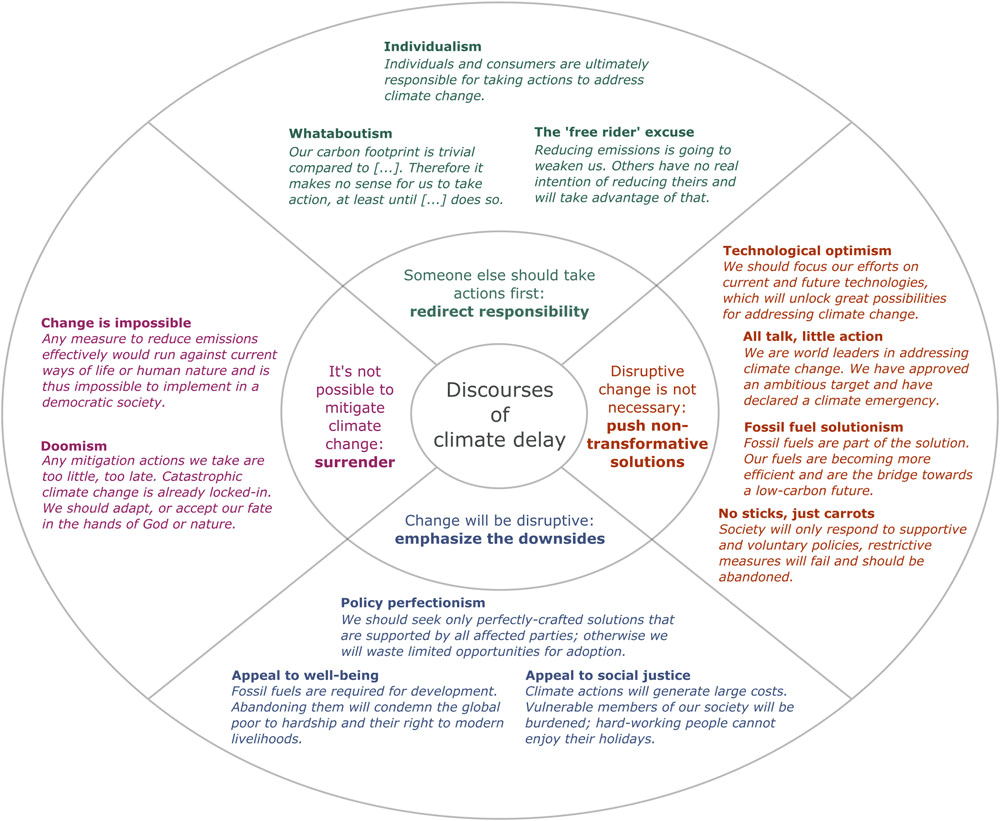
A denial diagram

July 8, 2020

I think this diagram is quite neat and useful… Hopefully I can say more about it tomorrow

From:

William F. Lamb, Giulio Mattioli, Sebastian Levi, J. Timmons Roberts 2020. “Discourses of climate delay”. Global Sustainability 3, e17, 1–5
DOI: https://doi.org/10.1017/sus.2020.13. Published online by Cambridge University Press: 01 July 2020.

The Diagram can help you avoid your own resistances, and forms of delay, by simply inverting it….

  • 1) Take responsibility now – do what you can, don’t pretend its some one else’s job to go first. Going early will make transitions easier and quicker. Be generous – don’t expect rewards or praise
  • 2) Human nature is pretty flexible. That something is hard does not mean it is impossible. If we act now we can at least stop it getting maximally bad, which is a really good thing.
  • 3) We don’t have to be perfect, just act as best we can. Accept what you are offered by the politics and take it further. Fossil fuels are poisons, lets get healthy. Burn as little as you can. Climate chaos will affect everyone, but poor people much worse, so help them out. Just stop doing things which harm the environment directly. By stopping, you support all our lives.
  • 4) While we support research, we need to solve the problem, as best we can, with the tools we have now. We can’t depend on fantasies that we will develop wonderful super-tech, or that everything will turn out ok, because Murdoch tells us so. We may need to penalise those who would destroy the lives of the rest of us, by continuing emissions. They might need warning, and gradually increasing penalties and costs, but that will help them change. Conversely we can reward those who do well.
  • 5) Doing the right thing is not always easy, but we do it anyway.

Jane Jacobs and the Dark Age Ahead.

July 7, 2020

In her book Dark Age Ahead, Jane Jacobs explores the likelihood of a coming dark age. Not all collapses lead to ‘dark ages’, Sometimes empires collapse and something new is born. This blog post is just about Dark Ages.

Jacobs starts off by pointing out that cultural dark ages are not rare.
Historically we tend to think of The Dark Age between as occurring between the fall of Rome and the Renaissance. As she says:

So much had been forgotten in the forgetful centuries: the Romans’ use of legumes in crop rotation to restore the soil; how to mine and smelt iron and make and transport picks for miners, and hammers and anvils for smiths; how to harvest honey from hollow-tile hives doubling as garden fences. In districts where even slaves had been well clothed, most people wore filthy rags.

Many historians have pointed out there were islands of civilisation and some technological advancement during this period, it was not all cultural loss, and quite possibly humans did not realise there was much decline while they were living through it. Nevertheless this was a time of wandering in ruins, loss of skills, loss of life span, plague and famine.

Similar events have occured all over the world, all through history. Many cultures have disappeared in the face of conquest, genocide and slavery, and enforced destruction of culture – we can easily think of indigenous cultures which have disappeared, or have had to be recreated and reborn. A dark age for one culture, does not have to be a dark age for another, even if the victors are barbarous to the losers. However, there are plenty of pre-historic civilisations which just appear to have more or less vanished over a short period of time: the cave painters of Lascaux, Norte Chico, Çatalhöyük, Easter Island, the Maya, and so on.

Mass amnesia, striking as it is and seemingly weird, is the least mysterious of Dark Age phenomena. We all understand the harsh principle Use it or lose it…. People living in vigorous cultures typically treasure those cultures and resist any threat to them. How and why can a people so totally discard a formerly vital culture that it becomes literally lost?

Discovering the causes of loss of ability to transmit culture is an important research topic, and we may be on the verge of facing this loss as a problem. As with the Library of Alexandria the problem may not just be fatal blows, but an ongoing decay which removes resilience and value. The causes of such decay have to be uncovered so that we may possibly avoid them.

She points out that people may be blase about this happening in our current world because information is everywhere. But there are problems.

The first is that information is irrelevant if people do not try to find it, do not value it, do not know how to use it, have too much information to detect what information is the best, get confused by conflicting information, destroy knowledge of the information through social loyalties, or have a dominant group which opposes looking after the knowledge.

The second is that use of culture depends precisely on active use and emulation. As she says

[C]ultures live through word of mouth and example. That is why we have cooking classes and cooking demonstrations, as well as cookbooks. That is why we have apprenticeships, internships, student tours, and on-the-job training as well as manuals and textbooks.

Culture also works through exemplars, and through imitation of exemplars and through ‘mentoring’. If our cultural exemplars feel no need for our cultural riches then neither will those who imitate them, or classify themselves as belonging together with them. Information, awareness, and even wisdom will decline.

Thirdly culture comes through experience. If you don’t experience the culture then you will not understand it. If you haven’t been through the initiation rituals you loose experience. If you have not had an experience of the divine in the right circumstances, then social religion will probably not make sense.

Fourthly, culture depends on context, or on other aspects of culture, and behaviour. Not having the right cultural background, will make reading Aquinas, Shakespeare, Plato, Hume, Burke, Newton, Einstein, Freud, Confucius, Lao Tzu, the Vedas, or even basic textbooks, too difficult. There will not be enough connection to other knowledges for the information to be decodeable, or even interesting. Imagine trying to read an engineering textbook with no knowledge of construction in the world, or attempting to learn computer programming without a computer.

If we do not have a society in which people habitually interact, and reinforce a togetherness which builds on the past, then we lose access to information in books.

Jacobs suggests that in the US, cars and roads build disconnection, as in many places it is impossible, or difficult, to walk and build ties or recognition with people in your neighbourhood. You are all, more or less, strangers, and strangers tend to be wary of each other.

Fifthly, culture always changes. In some situations it is possible to build a new culture which is destructive of connections with the past, or with elite knowledge, with exploration, or with ‘civility’. People may try and reconstruct past cultures but, as Jacobs argue, reconstruction is never the same as the original. Sometimes the divergence can be useful, sometimes not.

One point to be distinguished here is the forgetfulness of acute trauma, which tends to be gradually overcome as people move back into normal life, and the chronic forgetfulness, or loss, which gradually becomes permanent. The gradualness possibly leads to a sense that ‘greatness’ is still here, when it is being lost. We are not aware of what we are forgetting, or don’t care. Perhaps we feel we have more urgent concerns, like survival. Perhaps we are violently displaced, without connection to our past or to people with similar backgrounds.

We know that without the depths of culture and connection to the past and others, people can sink into meaninglessness. They ‘disappear’, they can sink into despair and hopelessness – the world makes no sense, their fragments of understanding make no sense. Life seems fragmented and pointless. People can try to move on and embrace another culture which does not accept them, and does not gel with their past. People don’t, or become unable to, support each other – perhaps they don’t know those who they are with?

In this kind of situation conservers of tradition, or makers of innovation get lost. The culture radically simplifies, gets stripped back, and all previously valued technical skills start to decline.

Authorities may try to fix this problem by decrees, by force, by taking administration away from the locals, compelling forms of behaviour – saying that the people are barbarous or uneducated, but all this makes the situation worse. The ‘natural’ culturally evolved controls and interactions of their previous functional society, get weakened further, the control, or education, is remote from their life. It is rare for top down organisation to work, unless it aims at eradication (it is much easier to destroy than to build), or the leaders have a direct connection with people’s lives, or the reform removes some true obstacle from people’s lives like crippling disease.

The historical stories people tell may devolve to them being losers, or sinners, or somehow deficient. Resentment or lack of care may become the governing culture, leading to more fragmentation.

Encounters with more militarily succesful cultures is not the only cause of decay. As Toynbee recognised years ago, all cultures face new challenges as the world changes, and the societies themselves change. Sometimes the societies fail these challenges internally. The dominant groups are unable to respond, or they are so ingrained in their response they cannot do something new as that could threaten their culture, their world view, or the power they exert, or the habits they have gained.

People can have the most favourable conditions for life and destroy them. Jacobs examples the ‘fertile crescent’ which was the fount of world civilisation, yet lost it’s lead completely, and is now no longer fertile. They appear to have cut down their forests faster than they could regenerate, domesticated goats which ate new growth, and soil was lost, salt accumulated, water flowed through too quickly, drought got worse. The problems compounded and the ecology changed for good. This has happened to many cultures. Not being in a relatively harmonious relationship with their ecology, is probably a primary cause of collapse.

Leaders of cultures can retreat from the world, to try and preserve themselves from challenge, rather than face the challenge, this only leads to deadening. China had vast fleets exploring the world, but gave it all up and destroyed or diminished the knowledge they had of the non-Chinese world, as they had the supreme culture. The culture retreated and ossified, and was forcibly incapable of dealing with problems, such as the Europeans, when they arrived. They deliberately knew little about what they were facing.

Losers are confronted with such radical jolts in circumstances that their institutions cannot adapt adequately, become irrelevant and are dropped.

This is what is happening today. We can see it throughout the world. Climate change and ecological destruction are ignored, or denied (maintaining the economy and corporate power is more important), or enmeshed in fantasy solutions. The serious problems are not faced, or are to be faced at some time in a relatively distant future. The Coronavirus is dismissed, people deny it is serious, people assert the economy is more important, and that all will be ok, quite magically. In the US, people on either side of politics cannot discuss things, they just abuse each other and fear each other. A growing Republican meme asserts that if Joe Biden wins he will kill them all. This meme is possibly reinforced by attempts to ignore the pandemic.

Education is often divorced from life and tradition, people cannot see the importance of the past or, if they do, refuse to accept that anything modern and critical of that past, can be of value. Education is nowadays about providing credentials for jobs and being ‘job relevant’, not about wisdom or meaning. Even at university people are pressured into teaching for work, not for discovery or life proficiency. Indeed, this is what many students seem to want. They have no time for ‘high culture.’ Culture and the learning of the past is jettisoned to continue corporate profit and wage labour. Sometimes this arises because the past of science and technology is seen as irrelevant to the current day. As one conservative blog, which is kind of reviewing Jacobs, remarks:

Many middle-class or wealthy people don’t consider themselves barbarians at all. But if they see the passing on of wisdom and knowledge of higher culture not as the heart of education, but rather as a useless appendage, then they are barbarians, no matter how nice their lawn looks.

American Conservative

Commercialisation of culture may also be a problem. This may encourage cultural production, but it also can lead to a loss of the past, because it is not referenced, or it is not successfully profit generating. Much of this new art is to be consumed and thrown away, rather than act as places of reflection. Or it may select the lives of the wealthy, the vulgar, or sports people, as being the lives to emulate – the supposedly ‘self made.’

We can also see organised politicisation of knowledge. ‘Science’ is identified with a particular politics and then dismissed, irrespective of the evidence. People can come to see knowledgeable people as part of their oppression, part of what holds them back from success, and thus to be overthrown – and sometimes they can be correct, as with neoliberal economics, but it is in the interests of the leaders to only encourage certain ‘ directed skepticisms‘ [1] which correspond with retreat from disruptive problems, and thus lowers the chance of solving them. Once a ruling elite gets separated from the people, say by massive divergence of wealth, they will have no hesitation in going for the ‘noble lie’ and attempting to dismiss and suppress the most knowledgeable people around. They may well declare them enemies of the state or enemies of the people. This way knowledge gets lost in fantasy, or in people attempting to avoid being denounced.

Politics itself is now an elite occupation with people largely not drawn from those who experience people’s daily lives. They seem largely committed to maintaining the destruction of their culture. Taxes tend to be used to subsidise the wealthy, or stripped away from productive areas. Infrastructure, important for daily life (such as roads, bridges, rail, sewage), is allowed to decay, increasing the expense of operating and leading to technical failures. Supervision of the powerful is stripped back, or allowed to decline, so they get away with fraud and deceit, and social trust decays. People may come to think there is nothing professionals can teach that is worth learning, or moral to learn. Neoliberal politicians tend to argue that wealth is the primary virtue and that if something cannot make a profit, it should die, unless it is a wealthy influential business which should be bailed out by taxpayers. Neoliberalism easily becomes rapacious and ready to sacrifice everything to money.

In the US, President Trump seems committed not just to maintaining the destruction, but to increasing it, putting tools of the dominant elites in all important positions, increasing elite power and wealth, increasing ecological destruction and poisoning, stacking or ignoring courts, decreasing supervision of the corporate sector, and increasing the fractures between his supporters and everyone else, even to the point of civil war, or furthering distrust of the whole US system. Trump is a personified vector of collapse.

There is possibly a sense that Trump could only be defended by people who fundamentally had lost touch with their guiding culture, or a sense of responsibility. In this world, interference with justice, suppression of evidence, corruption, pandering to enemies, and so on, are simply said to be something everyone does. Consequently, there are only immoral exemplars or extremely good liars.

There is often an easy optimism that the pendulum will swing the other way, but that only happens in a functional culture. In a dysfunctional culture this rebalance may not occur. This seems especially so, when the dominant groups seem to see their solutions in terms of preventing a rebalance, or engage in pretending that the pendulum is actually swinging the other way from which it is, so as to keep it swinging in their direction.

[P]owerful persons or groups… have many ways of thwarting self-organising stabilisers – through deliberately contrived subsidies and monopolies for example. Or circumstances may have allowed cultural destruction to drift to the point where the jolts of correction, seem more menacing than the downwards drift.

Different factions attempting to secure their own sense of wellbeing may sabotage the well being of others, or even themselves. They can prevent the ending of ecological destruction for example. In the Fertile Crescent, there would have been those who opposed tree conservation because of needs for fuel, others could have opposed limits on the use of goats. China quickly lost the knowledge of ship building, the ways of financing the fleet, and ceased to allow the expression of curiosity about the rest of the world.

So dark ages come about, in part, because:

  • The ruling groups fail the challenges the culture is faced with.
  • Powerful interest groups demand that destructive behaviour continues.
  • Rulers withdraw from interacting with the world into self-obsession, obsession with religious, or cultural, purity, or military expansion against their neighbours.
  • The culture and people are displaced by massively superior and indifferent force.
  • Continuing environmental destruction, no matter how good the reason
  • Change happens too quickly to adapt to in meaningful ways.
  • Local community interaction and integration declines, so there is no community resilience, bounceback or mutual support. People do not know their neighbours.
  • Education moves away from life, moving away from the contemporary to the past, or focuses too intently on a particular domain of life, excluding all others, including tradition.
  • Government’s cease to spend on the people, or protect the people, and only work for the power elites. Taxes are not spent on public goods, or keeping roads, bridges, sewers, cables, knowledge, etc functioning, but on protecting those dominant elites who are the supposed source of general wealth.
  • People who are models for emulation appear overtly corrupt, immoral or deceitful.
  • Acceptable knowledge becomes dependent on profit, or on sticking to the religious or party line.
  • People, previously of the same culture, are separated into mutually non-communicating, and likely warring, factions
  • Loss of knowledge and culture, and loss of the supports of knowledge and culture.
  • Increasing gaps between the elites and the people. In power, wealth, military proficiency, education etc. which in turn increases the power, wealth etc of a smaller and smaller number of people.

Contemporary Politics and the role of disinformation

July 5, 2020

1) The first point is to really identify the power elites, and not to be diverted into attacking scapegoats.

2) In corporate neoliberalism, the power elites and the wealth elites (and those dependent on them), are pretty much the same.

3) Neoliberal media, politicians and ideologues usually pretend the elites are not the power elites, but that they are relatively powerless people, such as ‘intellectuals’ or ‘cultural marxists’. For example, in this view, Trump’s family is not an elite, neither are the owners of major corporations, nor the intellectuals who support ‘free market’ neoliberalism, or occupy roles in corporate sponsored think tanks, and help justify the real power elites… A moment’s reflection will show this is misdirection. How many people pay attention to cultural marxists or even know whether they really exist, and what power do such intellectuals have other than persuasion?; they do not command armed police for example, they cannot buy legislation or regulation.

4) For the last forty years, in the US, the Republicans have been dedicated to furthering the success of the wealth and power elites. The part of the party which is not dedicated to completely supporting the power elites is devoted to furthering the power of pro-corporate and authoritarian Christians. In either case, deliberate democracy is not high on the list of priorities, neither is improving general prosperity, other than via ‘trickle down’, which is nearly always the favoured policy of the wealthy elites (aristocratic or corporate).

5) The Republican elites, or supporters of the wealth elites, are no longer conservatives; they are dangerous radicals who wish to strip away all traditional checks, balances and restraints on the corporate sector’s wealth and power. They appear to act as if they wish society to become a monoculture of rulers and ruled.

6) The same is generally true of the Conservative party in the UK and the Coalition in Australia. With the possible exception that the Conservative party still has some conservatives in it.

7) While the Republican elites are 90% pro-corporate, the Democrat/Labor elites are about 60% pro-corporate, but generally agree that most people should not be sacrificed for corporate power. They also tend to think that people should not be suppressed because of their race, gender, sexuality or religion. They are more humanistic pro-corporates. This is not great, but it’s all we have to work with.

8) As nearly all media is owned and controlled by the corporate sector or by billionaire families, it tends to support the corporate establishment. There is no left-wing media in the US, just media that is denounced by the hard line pro-corporate authoritarian media as ‘left’. If some media do not like Trump that does not mean he is upsetting all of the ruling elites, just some of them.

9) There are factions in the corporate elite. There are for example those who are happy that Trump is delivering tax cuts to them, removing regulations that give the people any control over the corporate section, allowing them to poison people, allowing them to despoil the environment, spending heaps of money on the military, destroying public health and so on. There are others who think an impoverished population is dangerous, or who realise that climate change and ecological destruction could be a problem. Neither factor is to be thought of as enough of a problem to challenge corporate power and economics, but they can be recognised as problems. They may also fear war with US trading partners, as if you are not in the arms business then you are likely to lose out. There are also occasional genuine believers in free markets, who notice that Trump is destroying such markets, and they think this will lead to disaster.

10) The main aim of elite propaganda is to get people to either support corporate power, or to ignore corporate power.

11) The best way to achieve this, is to intensify already existing hatreds and discriminations. Thus its good to blame baby boomers for being selfish, black people for being racist and not knowing their place, women for suppressing men and so on. This helps people who’s power has been stripped away, feel that they are better because they are young, white, male or whatever. It gives them an enemy to hate which they can despise, and which is not more powerful than they are. They can pretend Trump is not one of the elite, and is trying to help ordinary people, even though it is clear he is supporting the corporate elite, and stirring hatred, or practicing ‘divide and conquer’. Encouraging these hatreds also tends to separate people from more humanistic, mildly anti-corporate politics. The media can also try to pretend that any anti-corporate movement is treacherous, violent, or authoritarian, even as the movement calls for people to be liberated. They can easily misrepresent the claims of movements and slip them into their preferred patterns of support for the corporate elites, or ignore corporate elites. They can pretend Joe Biden is as bad as Trump, when he might be just a little better. They can pretend recognising climate change and the ill effects of eco-destruction stems from socialist conspiracy. They can even pretend that thinking that humans are not part of the earth, or cannot disrupt ecologies, is radical thinking, when it is another pre-copernican set of of ideas….. However, their main step is simply to ignore ‘left wing’ protests for as long as possible, unless they can be reported as violent, while highlighting right wing protests even if they attract tiny numbers in support. Given that the media is right wing, this is to be expected.

12) That something is a media channel on youtube, does not mean it is not pro-corporate, or corporately sponsored, even if it pretends otherwise. It can claim to be leftish, while spending most of its time ignoring the actions of the right elites or the President, and focus on criticising those challenging that power, or attempting to moderate that power. This is one way of helping to destroy the opposition to corporate power.

13) As many people have argued before, thinking, and information acceptance is social. It is not, completely, about understanding the world, but about gaining an orientation to that world, and the world includes social and group processes, and belonging. Information acceptance can be based in issues of identity – of what other people we identify with, and identify against, both in terms of conflict and culture. If people we value, also value some information we like, or seems essential to our identity, we are more likely to count that information as true. If people we don’t value, value information that we (or our groups) don’t like, the easier it is to dismiss that information as false. In other words, knowledge can function primarily as a marker of identity, and as a way of fitting in to a group. So one way of reinforcing acceptance of information is to intensify social differences, or social contempt, or social fear. This is what the right elites have been trying to do for forty years, it is why their ‘news’ tends to be so angry, rude and dismissive of opposition. It is why they insist that they, and their supporters, are the real folk of the nation. They want to create a situation in which opposed groups just abuse each other, or fear each other, rather than talk. This process now seems entrenched, as the left is now almost as rude and intolerant as the right. The process may no longer be able to be challenged.

14) The main aim is to confuse and fragment ‘the people’ so that they are more easily persuaded that the real problem is somewhere else, or that they are busy fighting someone else, and the corporate elites can keep on with their power grab.

US, Australia and pandemics again

April 11, 2020

The last post showed the figures for coronavirus in Australia and the US. It is clear that Australia is doing better than the US. They are both neoliberal governments, but the neoliberal government in the US is Donald Trump who appears incompetent. This demonstrates that there are different types of neoliberalisms and it is not accurate to say all neoliberalisms are the same. Some are actively harmful.

President Trump did close flights from China (announced 31st Jan, in place 2nd Feb), as he boasts, but originally this closure only referred to foreign nationals, and had so many exceptions that another 40,000 people entered the country from China after it was in place. Yes, that does not make sense at all. Two weeks after the flight ban he was saying the pandemic will be over by April. On the 27th Feb he was saying:

we have done an incredible job.  We’re going to continue.  It’s going to disappear.  One day — it’s like a miracle — it will disappear.  And from our shores, we — you know, it could get worse before it gets better.  It could maybe go away.  We’ll see what happens.  Nobody really knows

Remarks by President Trump in Meeting with African American Leaders

and there appears to have been more or less no federal preparation before March. There are reports that hospital workers are still (April 11) massively under-equipped in the US, and still at risk, which will compound problems as medical support is removed by the virus.

For example, a week ago, the New York Governor was expressing gratitude for ventilators donated by the Chinese Government as New York was running out and there was no sign of availability from the US.

Louisiana, which has also been hit hard by the virus, has requested or ordered 14,000 ventilators from the federal government and the private sector. Louisiana Gov. John Bel Edwards told NPR on Friday that the state had only received 553 so far.

Time Magazine 6 April Gov. Cuomo Says Chinese Government Delivering 1,000 Ventilators to New York

We now know that Trump’s medical advisers were asking him to issue physical distancing guidelines in the 3rd week of February, but apart from acting as a bad example, he delayed action until the 16th March.

By comparison, in Australia, on 21 Jan, Australia’s chief medical officer, Brendan Murphy, stated that “additional proportionate border measures” are in place. The same day health Minister Greg Hunt declared coronavirus a “disease of pandemic potential.”  Biosecurity and border security staff were meeting passengers from Wuhan to Sydney. The next day flights from Wuhan stopped. On the 29th Jan, the Queensland government requested quarantine of everyone coming from China, and the federal government released its stockpile of facemasks so hospitals would be equipped in advance. 31st Jan the World Health Organization declared a public health emergency. On the 1st of Feb Australia’s air ‘borders’ with China were effectively closed. Peter Dutton suggested Australians about to leave for any overseas holiday should reconsider their travel. Australians evacuated from Wuhan were quarantined on Christmas Island. There were immediate efforts at quarantining all people travelling in from overseas, even if it was largely voluntary. On the 18th Feb the government released its Emergency Response Plan. On the 27th February, the Prime Minister announced that:

based on the expert medical advice we’ve received, there is every indication that the world will soon enter a pandemic phase of the coronavirus and as a result, we have agreed today and initiated the implementation of the Coronavirus Emergency Response Plan…

So while the WHO is yet to declare the nature of the coronavirus and it’s moved towards a pandemic phase, we believe that the risk of a global pandemic is very much upon us and as a result, as a government, we need to take the steps necessary to prepare for such a pandemic….

we need an even greater abundance of caution to ensure that should the coronavirus move to a very extreme level or there is any particular risk that is associated with children, particularly those attending school, that we have the preparedness and the arrangements in place with states and territories. And I want to thank all of the state and territories for their engagement, whether it’s on this issue on schools or the many other issues, the health issues, that are associated… 

we’re effectively operating now on the basis that there is… a pandemic. 

27th Feb: Press Conference – Australian Parliament House

The Australian government’s approach was nowhere near perfect, by any means, there are many criticisms which could be made. For example, after advising a ban on large crowd events on the 13th March, the Prime Minister announced he would be attending a football match on the day before the ban came in. However, they had a somewhat different and more constructive approach to Trump, which has continued. For example while Trump has been trying to suggest a back to normal date is soon, Morrison has been saying:

We have seen what’s happened in Singapore most recently, we’ve seen what happened in Sweden and other countries. If you take your eyes off of this thing, and it gets away from you, it writes its own rules, so we do need to understand what the prerequisites are, the things that we have to achieve before we can start to ease some of those restrictions…

I do want to caution Australians that we’re not in that phase yet we’re many weeks away I think from being in a phase like that.

Interview on Sunrise 14th April 2020

Right wingers often say, no doubt inspired by Trump, that there were howls of ‘racism’ from the left, about his blocking of flights from China. I did not hear those howls personally, and some reports seem exaggerated by those being criticised. I did hear people saying that banning flights was not enough, which is true, and perhaps Trump should have done more than think he could wall off trouble? People, such as the Australasian College for Emergency Medicine and others did make requests for politicians to stop encouraging people to avoid or scream at Chinese Australians, or not go to Chinese Restaurants. That kind of internal disunity and pointless conflict is not helpful in containing a pandemic, although it does allow deflection of blame, which is why Trump loves it. People have also criticised his use of the term ‘Chinese virus’ when the virus has a proper name, and is not the only virus originating in China, but again I guess using the term serves to imply that Trump’s bad performance can be blamed on the Chinese, and that the threat is insidious and cunning – and it also feeds into the laregely right wing narrative that the virus is a Chinese bioweapon, that they decided to test in their own country rather than just release in the US (imagine how much worse the US response would have been if they had no warning there was a problem).

Closing borders as much as possible is a standard response to pandemics, and, apart from when bringing people home from foreign shores, is exactly what you would expect. Queensland has tried to close its borders to the rest of Australia as has Western Australia. That is difficult but not unreasonable. It is normal. It is routine, but it needs other backing as well.

There have also been attempts to say that virus is so bad in the US, because ‘the left’ has sabotaged Trump’s attempts to make firm borders. However, Trump had two years with a friendly congress to do whatever he wanted like make stronger borders or fix Obamacare etc. If he didn’t do it then, he either was not capable, uninterested, or there were good reasons for not doing it, which he is ignoring to now try and build political capital by blaming other people (as usual) for his inabilities. I could suggest that the demand for cheap labor by US business was one reason the borders were not closed. Anyway, the virus seems to have come into Mexico from the US, rather than the other way around. So the issue is irrelevant, and nobody has attempted to prevent him from preparing for a pandemic.

Trump continually says no one could have expected this situation. This is clearly not true. The world has been preparing for a pandemic for years. The possibility is glaringly obvious, and many of us were fearing a much worse event than the current one. Mass globalised air traffic, is an invitation for pandemics and, if you don’t know that, then you should not be in politics.

I quote a comedian – because we are in that realm in which comedians have better political knowledge than presidents. I guess the fools have always known more than would be kings:

“First, Obama officials walk Trump aides through a global pandemic exercise in 2017. Then, in 2017 and 2018, threat assessment intelligence analysts even mentioned a close cousin of coronavirus by name, saying it had pandemic potential. Then in 2018, the director for medical and biodefense preparedness at the national security council told a symposium that the threat of pandemic flu is our number one health security concern. Then, top administration officials said last year that the threat of a pandemic kept them up at night. Then, White House economists warned in 2019 a pandemic could devastate America. Then, intelligence reports warned of a coronavirus crisis as early as November. And then, US intelligence reports from January and February warned about a likely pandemic.”

The Guardian 10 April Colbert interviews Sanders

Then:

The Johns Hopkins Center for Health Security in partnership with the World Economic Forum and the Bill and Melinda Gates Foundation hosted Event 201, a high-level pandemic exercise on October 18, 2019, in New York….

Experts agree that it is only a matter of time before one of these epidemics becomes global—a pandemic with potentially catastrophic consequences. A severe pandemic, which becomes “Event 201,” would require reliable cooperation among several industries, national governments, and key international institutions.

http://www.centerforhealthsecurity.org/event201/

Furthermore, on the 29th January Trump’s trade adviser Peter Navarro, circulated a memo warning the administration that a coronavirus pandemic that could wipe out hundreds of thousands of jobs, erase trillions of dollars in economic activity. “The lack of immune protection or an existing cure or vaccine would leave Americans defenseless in the case of a full-blown coronavirus outbreak on U.S. soil,.. This lack of protection elevates the risk of the coronavirus evolving into a full-blown pandemic, imperiling the lives of millions of Americans.” He also argued that “the clear dominant strategy is an immediate travel ban on China.”

Truly no one could possibly be prepared if they didn’t want to listen.

I have heard right wingers say that Event 201 is suspicious, and shows some deep state planning to run a pandemic to undermine Trump. But that just shows you that they can escape any reality. This was a public event, warning of the possibility of pandemics. If Trump had listened he might have been better prepared, no matter how Machiavellian the organisers were. But he did not listen, and it does help the US to be unprepared if you cut CDC funding by 80%, disband the National Security Council’s global pandemic team, opt to discontinue the “Predict” program which monitored the threat of animal-born diseases crossing over to humans, which is the probable origin point of the current coronavirus, or allow stockpiles of respirators to break down because you cut maintenance contracts. That’s life.

Donald Trump has not had good relations with many States in the US, so coordinating responses has not been wonderful. He has gone so far as to argue the Federal government should not take responsibility for action, and largely left it to the States to do it by themselves.

we had to go into the federal stockpile, but we’re not an ordering clerk. They have to have for themselves. 

Rev: Donald Trump Coronavirus Briefing Transcript April 3

He also decided to end federal support for coronavirus testing sites, leaving the States with the responsibility for testing – although that move may be being reconsidered. He has also blamed the States for failures. So presumably his primary strategy is to end his responsibility and shift it, and the blame, elsewhere. He has helped create a toxic political environment, by this refusal to take responsibility, ‘forgetting’ what he said the day before, saying that he would not have contact with governors who were critical of him, and blaming everyone else for his own mistakes.

The context for Trump’s relationships with the US states is provided by the resentment of aid to Puerto Rico, and his blaming of California for its fires and his twitter threat to order Federal Emergency Management Agency (FEMA) to cease helping victims of those fires, despite the fires starting on Federal land. During the pandemic, on 27 March Trump declared when asked about his responses to the Governors,

I think we’ve done a great job for the State of Washington and I think the governor, who is a failed presidential candidate as you know, he leveled out at zero in the polls, he’s constantly chirping, and I guess complaining would be a nice way of saying it. We’re building hospitals. We’ve done a great job for the State of Washington. Michigan, she has no idea what’s going on. And all she does is say, “Oh, it’s the federal government’s fault.” And we’ve taken such great care of Michigan…..

All I want them to do, very simple, I want them to be appreciative. I don’t want them to say things that aren’t true. I want them to be appreciative. We’ve done a great job…

You know what I say? If they don’t treat you right, I don’t call. 

Rev: Donald Trump Coronavirus Task Force Briefing Transcript March 27

According to some reports the friendly governor of Florida received 100% of its requested medical supplies  including 430,000 surgical masks and 180,000 N95 respirators while Massachusetts, which is not so flattering, received a mere 17% of what it requested.

It appears that the only way, that Trump could see the toxic environment ending is if everyone keeps telling him that he is the best president ever.

Other accusations seem more serious:

the White House seizes goods from public officials and hospitals across the country while doling them out as favors to political allies and favorites, often to great fanfare to boost the popularity of those allies. The Denver Post today editorialized about one of the most egregious examples. Last week, as we reported, a shipment of 500 ventilators to the state of Colorado was intercepted and rerouted by the federal government. Gov. Jared Polis (D) sent a letter pleading for the return of the equipment. Then yesterday President Trump went on Twitter to announce that he was awarding 100 ventilators to Colorado at the behest of Republican Senator Cory Gardner, one of the most endangered Republicans on the ballot this year. As the Post put it, “President Donald Trump is treating life-saving medical equipment as emoluments he can dole out as favors to loyalists. It’s the worst imaginable form of corruption — playing political games with lives.”

Talking points: PPE and Ventilators Becomes Patronage in Trump’s Hands

See also: https://www.latimes.com/politics/story/2020-04-07/hospitals-washington-seize-coronavirus-supplies

Australia’s Prime Minister has been much better, despite similar political views, and despite the support of the Murdoch Empire. The Australian PM may have tried to model himself on Trump but he appears never to have been in that league and, he seems to have improved since the bushfire debacle, which is a good sign he can learn to be better.

Our main source of infection in Australia seems to have been people from the Ruby Princess cruise ship. There are questions as to why they were allowed to dock, including allegations that it could dock because it had Hillsong Church friends of the Prime Minister’s on board, and because home affairs intervened to let them dock. Whatever the results of the current police investigation, it should never have been allowed to dock once, never mind twice. But anyone can make a mistake. So it could be a mistake. A severe one, but a mistake.

We now know that unfortunately, many Qantas flights into the country had infected crews, because apparently crew have not had to quarantine if it turns out there were infected passengers on board. Another mistake, but its not sure whether that is the regulator or the business’ fault. Again another mistake.

Border force, or whoever is responsible, should also have been doing the kind of temperature checks in Australia that you get at overseas airports by distance, or forehead, thermometers. I’ve no idea what has been happening in the US. These thermometers have been available for years. The government has now finally started to take temperatures (I know people who came into the country two weeks ago, and they were checked everywhere other than at Sydney). Apparently the new temperature checks are being done manually – which does risk transmission without extraordinary care, and anecdotally this care is not happening. IF this is the case, and has been for more than a day or so, then it is monumentally stupid as well.

It also would have been good for the Government not to encourage queues of people at Centrelink offices, as that was not helpful, but again that was a mistake anyone could have made – initially. It helps you to make that mistake if you think Centrelink’s prime purpose is to punish people on welfare, but this could be changed. How long the mistake lasted or whether it is still happening, seems to be a subject of dispute and its not like the Republicans in Wisconsin forcing people to queue to vote, despite any rational person knowing at this stage this would be a problem and increase the seriousness of the epidemic. But then Republicans apparently ‘know‘ that mailing the votes in, which allows better checking for voter fraud, would mean no Republicans would be elected. I personally think that some Republicans would be elected, but the fear and the preference to sacrifice voters to power is extraordinary. Let us hope this event was just massive incompetence, instead.

It is probably a good idea to argue for random temp checks of the populace, as well as as much coronavirus testing as possible, although to excuse the PM we have not yet built up supplies of reliable checks (it’s not easy, and you need a decent sample size, and duration of testing to find if a test is working properly). Certainly this action is better than the current chorus of righteous demands for old people to die so the economy can get going. People over 60 have lived their lives don’t you know – but even Trump seems to realise that is probably not a vote winner – especially if older people are his main voters, and they all die off.

The Australian prime minister has been incredibly fortunate. If it had been a Labor person acting as he has done, we would be hearing nothing but screaming about how the party was sacrificing Australia’s economy and prosperity and how it was all financially irresponsible, a suppression of liberty, and an encouragement of dole bludging. But he isn’t, so thankfully he can be largely be left to get on with what is necessary. He has also been lucky that Peter Dutton has been sick with coronavirus and Tony Abbott is outside parliament and that Abbott has only been trying to take credit for it all, which is pretty mild for him.

I’d personally would have preferred it if Morrison had not tried to shut parliament so that there was no supervision or questioning of the government. There are many ways around the contagion problem, as nearly every office based workspace has discovered, and we could still function as some kind of participatory democracy.

So the US and Australia are different, and we are left with the proposition that all neoliberalisms are not equally deadly in every situation.

Biased Political Announcement

April 6, 2020

Right wing plan:

1: Make money for, or give money to, your mates.

2: Read Murdoch Empire.

3: Believe Murdoch’s ranters rather than science.

4: Call the ranters “quiet Australians” or “silent majority.”

5: Kick a few powerless people if any are available.

6: Claim to be a victim.

7: Claim anyone who disagrees with you, is:

  • a) politicising the subject,
  • b) drinks white coffee or Chardonnay,
  • c) a traitor,
  • d) a communist seeking tyranny,
  • e) just upset, and of no consequence.

8: Find some one else to blame, who had no power to change anything.

9: Give special treatment to some righteous fundamentalist Christians.

10: Destroy the ecology some more.

11: Ignore feedback from reality.

12: Repeat.