Posts Tagged ‘politics’

Peter Dutton does Nuclear

June 21, 2024

See also Peter Dutton and Action on Climate Change written before the formal announcement

The quick summary is that the Coalition’s nuclear plan will not significantly add to energy availability or emissions reduction in Australia. It will, however, cost a lot.

Peter Dutton, the leader of the Australian Opposition, has declared that he has released the policy which will make Australia Nuclear if the Coalition get into government.

The first thing to note is that his policy release is completely uncosted, despite the main scientific organisation in Australia, saying that nuclear would be at least 50% more expensive than solar and wind and would not be available any sooner than 2040, and previous attacks on CSIRO estimates by the Coalition, with the CSIRO denying those attacks had any validity. Oddly perhaps if Labor released uncosted policies that simply ignored the costings by the CSIRO, then the Coalition and Murdoch media would be jumping up and down in dismay, shouting about irresponsibility. But not now.

Some costs for the newest design large scale reactors:

Construction cost experience with generation 3 nuclear projects in US and Europe

CountryProjectOriginal budget (billions)Latest cost estimate (billions)Capacity megawatts$/MW (millions)
United StatesVogtle – units 3 & 4$21$452200$20.5
United StatesVirgil C. Summer units 2 & 3 – project abandoned$14.7$37.52200$17.0
FinlandOlkiluoto 3$4.8$17.71600$11.1
FranceFlamanville 3$5.3$21.31650$12.9
United KingdomHinkley C$30.6$87.93200$27.5
T. Edis Peter Dutton’s nuclear plan is an economic disaster that would leave Australians paying more for electricity

The Vogtle site features Dutton’s exampled Westinghouse AP1000 technology

There was also a lot of criticism of the proposed policy in advance.

Former Coalition treasurer of NSW, Matt Kean, said nuclear as “hugely expensive” and a ‘Trojan horse’ for the coal industry.

AGL Energy’s CEO Damien Nicks said “There is no viable schedule for the regulation or development of nuclear energy in Australia, and the cost, build time and public opinion are all prohibitive…. Policy certainty is important for companies like AGL and ongoing debate on the matter runs the risk of unnecessarily complicating the long-term investment decisions necessary for the energy transition.””

Alinta Energy’s CEO Jeff Dimery compared the Coaltion plans to replace coal plants with nuclear power to “looking for unicorns in the garden”.

Andrew Forrest, says “I simply want to see fossil fuels removed from Australia’s energy mix as soon as possible, but as an industrialist, I’ve looked at nuclear and it does not stack up,”

Kyle Mangini, of IMF investments, said it was “virtually impossible” for the private sector to take on the financial risk of building nuclear reactors without taxpayer subsidies. “If you look at where the nuclear facilities are being built globally, they’re almost in all cases being built by governments,” adding “”In Australia, there’s never been a nuclear facility built, so there’s no skilled labour force.”

See: https://www.abc.net.au/news/2024-06-17/nuclear-investment-case-coalition-reactors-viable/103978266

As we proceed it will become reasonable to suspect that the main aim of the plan is to stop renewables, and keep the fossil fuels burning. The leader of the National party David Littleproud.. [said]

“We want to send the investment signals that there is a cap on where [the Coalition] will go with renewables and where we will put them…. Earlier on Monday [he] told ABC radio the Coalition’s energy policy will show investors Australia doesn’t need “large-scale industrial windfarms, whether they be offshore or onshore”.

Coalition to impose ‘cap’ on renewable energy investment, Nationals leader says

Mr Littleproud again on Sunday morning said the explicit intention of the nuclear policy was less renewables.

T Corwley Coalition won’t say how much nuclear power its plan will generate until after an election

As well the Coalition will drop all 2030 targets, and so encourage the build up of emissions, even if they make the 2050 target. The whole point of the change in energy is to reduce GHG emissions. It is doubtful whether this proposed change will do much if anything to reduce those emissions, and emissions reduction is urgent. Over the last year, much to many scientists surprise the average temperature has crossed 1.5 degrees C, reaching 1.63 degrees C. It is likely to cross 2 degrees relatively soon, and then spiral out of control. Innes Willox, chief executive of national employer association Ai Group summarises the policy, by saying:

“With no delivery projected until the middle of the next decade, the proposal does not immediately help with short-term emissions reduction or the cost and reliability of energy in the short term.”

Peter Hannam ‘Raises red flags’: Coalition nuclear power plan met with widespread scepticism from business groups

While it maybe true that the reactors are cheaper than Labor’s Plan…. are they a useful source of power and emissions reduction? If they are not, then it is money and time wasted.

The Press Release and after

The Priority is not climate change

The official press release of the policy opens by making it clear the priority is not dealing with climate change

Every Australian deserves and should expect access to cheaper, cleaner and consistent electricity…

Right now, in households and businesses around the country, Labor’s expensive renewables-only approach is failing.

In a classic move, the reason for changing energy systems has been ignored. However, they do recognise one problem with the energy system

90 per cent of baseload electricity, predominantly coal fired power stations, is coming to the end of life over the next decade…

a future Federal Coalition Government will introduce zero-emissions nuclear energy in Australia, which has proven to get electricity prices and emissions down all over the world

Nuclear certainly has not reduced electricity prices everywhere in the world. The unfinished Hinkley Point being an obvious example. However, the propaganda aim seems to be to associate cost of living increases with the current government, imagined cutbacks in fossil fuels, and the rollout of renewables, which is a tactic borrowed from either Trump or his corporate think-tanks. There is no consideration of the inflationary effects of fossil fuel company profiteering, Russia’s invasion of Ukraine and hence more competition for gas, or even the local break down of old coal mines and power stations.

Locations

The proposed locations are:

  • Liddell Power Station, New South Wales
  • Mount Piper Power Station, New South Wales
  • Loy Yang Power Stations, Victoria
  • Tarong Power Station, Queensland
  • Callide Power Station, Queensland
  • Northern Power Station, South Australia (SMR only)
  • Muja Power Station, Western Australia (SMR only)

SMRs do not exist commercially yet.

It appears likely these sites were chosen because they have cabling infrastructure (grid) already in place. Others state:

Some of the sites, particularly Loy Yang in the Latrobe Valley, are very close to earthquake fault lines. Several have no obvious water source, which is essential. They appear to have been chosen for political saleability, not science.

Peter Dutton’s nuclear proposal disrupts investment in cheaper renewables. Is that the point?

A later comment from Ted O’Brien implies that the Coalition have not even decided the number of reactors involved

Ted O’Brien, who designed the plan, told the ABC’s Insiders the amount of energy generated would depend on the type and number of reactors built at each site, and that neither of those things could be known until a Coalition government could establish a nuclear expert agency to undertake studies.

Coalition won’t say how much nuclear power its plan will generate until after an election

The Production Gap

Rather optimistically Dutton claims the sites “will start producing electricity by 2035 (with small modular reactors) or 2037 (if modern larger plants are found to be the best option).” Again this is with currently non commercially available SMRs, plus clearing all the political and economic barriers which are discussed below. Loy yang one of the sites is not closing until 2034 at the moment, so building could not start until after then. Again the CSIRO estimated the earliest anything could be running would be 2040 given a 12-15 year build.

The latest AEMO integrated system plan “forecasts the retirement of 90% of Australia’s remaining 21 gigawatts of coal generation by 2034-35, with the entire fleet retired by 2038.” To overcome that issue requires plenty of gas backup, or lots of renewables and storage. The Coalition is not saying how much energy they hope their nukes will generate or how they plan to make up the gap, but given the announced hostility to renewables, the plan most likely depends on gas as a major source and not a backup. Ted O’Brien said the obvious solution to the collapse of Coal was to “pour more gas into the market” but also said he would “welcome all renewables”. So their plan is to increase emissions, and it seems obvious that parts of the Coalition do not want more renewables, and more renewables is not part of the plan

AEMO is worried that renewables are not being rolled out fast enough to fill in the gaps in 2024-5, and nuclear cannot be ready in that time. It will be interesting to see what happens there. The climate council says:

Seven standard nuclear reactors would deliver approximately nine gigawatts of energy capacity [possibly more than that depending on design and what you are counting]. While [AEMO claims] Australia will need at least 300 gigawatts by 2050

DUTTON’S CLIMATE POLICY: LET IT BURN 

We apparently use 22 GW of coal at present, so the planned nukes are unlikely to even replace coal use now, never mind the energy from other sources.

O’Brien strangely argued that “Australia already is a nuclear nation. We know that nuclear technology saves lives, we know that because we have a nuclear reactor operating here in Sydney. It’s been operating for decades, saving lives, especially diagnosing and treating cancers.” However, there is a massive difference between the size and complexity of Lucas Heights and that of a nuclear power station

“It must be recognised that this is a ‘zero-power’ pool reactor where the complexities of high pressure, high power, high radiation environments do not exist.”

Clennell ‘Will be starting from scratch’: Report paints grim picture of Australia’s long road to nuclear power

People who moved into the reactor’s area, already knowing it was there, have objected to its presence for a long time. Even a small reactor is not accepted by everyone.

The big question, however, is what level of energy will these 7 reactors provide? And the answer appears to be “completely inadequate.”

Ownership, Funding and Control?

In a later interview/speech Dutton said:

The assets will be owned by the Commonwealth – a very important point – and we’ll work with experts to deliver these programmes…… [and] The Australian Government will own these assets, but form partnerships with experienced nuclear companies to build and operate them.

LEADER OF THE OPPOSITION – TRANSCRIPT – JOINT PRESS CONFERENCE WITH THE HON DAVID LITTLEPROUD MP, THE HON SUSSAN LEY MP, THE HON ANGUS TAYLOR MP AND MR TED O’BRIEN MP, SYDNEY

So taxpayers will be funding the building, and probably covering decommissioning and insurance. This will be expensive, and how will it be paid for? By increasing taxes, increasing the deficit, decreasing Medibank or social security, or getting huge loans? Hopefully the reactors will not be given to the private sector after the taxpayers have funded them, although the second statement implies they may be run privately, but we have no idea who will be involved. The main builders currently in operation are Russian and Chinese, who we might assume would not be acceptable.

On the other hand Renewables are under private, community or household funding and control, which is usually said to be a good thing.

We also need to remember that nuclear is potentially dangerous and we need heaps of trained and experienced people, and good regulation for Australian circumstances, to keep it safe and to cover fuel handling at all stages.

Supposed Economic Benefits

The sales pitch is that:

Not only will local communities benefit from high paying, multi-generational jobs but communities will be empowered to maximise the benefits from hosting an asset of national importance by way of:

  • A multi-billion dollar facility guaranteeing high-paying jobs for generations to come;
  • An integrated economic development zone to attract manufacturing, value-add and high-tech industry; and
  • A regional deal unlocking investment in modern infrastructure, services and community priorities. Press release

The leader of the Nationals promoted the idea that this plan would be beneficial for rural economies. Apparently locally owned and controlled renewables are not. Susan Ley again emphasised the economic side saying “So, our vision is to make sure that we underpin our economic success with jobs for decades to come in industries where Australia has that competitive advantage.” She did not say what the advantage would be. Ted O’Brien said “Labor is turning the lights out. Prices will soar, jobs will be shed and industries will collapse. Australians will be left poorer and our nation weaker.” LEADER OF THE OPPOSITION – TRANSCRIPT – JOINT PRESS CONFERENCE WITH THE HON DAVID LITTLEPROUD MP, THE HON SUSSAN LEY MP, THE HON ANGUS TAYLOR MP AND MR TED O’BRIEN MP, SYDNEY

However:

A 2023 PricewaterhouseCoopers report into offshore wind found the energy source was expected to add $40bn to GDP between 2027 and 2040, supporting 19,000 jobs in the peak of construction and 7000 to 14,000 operational roles in regional areas. According to International Energy Agency estimates, 17.5 gigawatts of offshore wind will be added to global capacity in 2024 compared with around 8.5GW of gross nuclear capacity

Coalition at odds on energy strategy. The Australian 19 June 2024: 4

Part of the promotion is that renewables are a “wrecking ball through the Australian economy” and that families “know it because it’s harder in their own budgets”, Again the plan is to associate the current multi-causal world wide inflation with Labor’s renewables’ policy. However,

Dr Dylan McConnell, an energy systems analyst at the University of New South Wales, says only about $100 of a household’s annual electricity bill is made up of charges related to environmental programs, such as feed-in-tariffs for rooftop solar or financial incentives for large-scale renewables projects.

[and] In the last quarter, the biggest price rises were in rents, secondary education, tertiary education and medical and hospital services… insurance premiums have gone up 16.4% in the last year…  ABS data also shows electricity prices are a small part of Australian household expenditure, at just 2.36% of overall costs.

Readfearn There’s a yawning Coalition credibility gap on the cost of renewables and nuclear

And the Coalition’s programme not only seems to include 7 expensive reactors, but to need back up in terms of more coal or gas because those reactors will not replace lost coal generation and will not make up for lost renewables. All of this will put more financial strain on taxpayers and customers as they cost more than renewables as will be discussed in the next section. The price is usually set in Australia by the most costly source, so relying more on gas than on renewables, will boost electricity prices. At the best, the prosed nuclear sites will do nothing to reduce the current increase in prices as they won’t exist for some while. So the Coalition’s implied end of rising electricity prices is false.

Problems

An ex-Prime Minister writes:

A nuclear power plant would face the same economic challenges that coal-fired generators do now – for much of the day it would be unable to compete with solar and wind. During those times of excess supply the nuclear plant would add to the excess. That surplus electricity would be taken up by batteries and pumped hydro which would then compete with the nuclear plant during the night.

So the only way the economics of a nuclear plant could be assured in our market would be for the rollout of solar and wind to be constrained. That seems to be Dutton’s intention

Turnbull, M The Coalition’s nuclear power plan offers the worst of all energy worlds: higher emissions and higher electricity costs

So unless renewables are destroyed nuclear may not be profitable.

The Coalition’s lack of costing is obvious, except to insist seven nuclear stations are cheaper than near 100% renewables. However, in one interview the leader of the Nationals was asked how much the plan will cost and whether it was around the CSIRO’s $8.5 billion to $17 billion estimate. He replied “Yeah, look, we’re not disputing that,” (Nationals leader pressed on how much nuclear will cost Aussies).

The lack of costing also does not include the cost of climate disruptions, fires, floods, droughts, heat deaths etc. They also say that “the investment that we’re making, it’s over an 80 year period” which might imply that they are going to build these 7 reactors very slowly. We don’t know as there is no timeline for the building. We have no estimation of the cost of electricity produced by nuclear power despite the CSIRO estimating it would be over 50% more than renewable energy. We don’t know what reactor types are involved, including the experimental SMRs, we don’t know about waste disposal (waste will be kept on site until it isn’t), we have no plans for emissions reduction in the rest of the economy (so talking of 2050 net zero is fantasy). We don’t know who are the likely builders and it is foolish to expect that nuclear energy can be built by Australian companies so campaigning for nuclear energy is campaigning to export billions of Australian money overseas. And, as argued above, nuclear as proposed by the Coalition will only partially replace current coal power. It will not supply the new energy Australia needs. There is a massive gap which we can presume will require more fossil fuels to fill.

in March 2023 Dutton said:

I don’t support the establishment of big nuclear facilities here at all, I’m opposed to it, but for the small modular reactors, we can have them essentially replacing brownfield sites now, so you can turn coal off and put the small modular reactors in and it’s essentially a plug and play. You can use the existing distribution networks

LEADER OF THE OPPOSITION – TRANSCRIPT – INTERVIEW WITH TOM CROWLEY THE DAILY AUS

But that was a year ago…. and he may have realised that SMRs are largely fiction and not high energy sources able to replace coal power. An SMR is expected to produce 300 Megawatt electric (MWe) producing 7.2 million kWh per day, less than a third of a large scale reactor at 1,000 MWe producing 24 million kWh per day. So if we don’t go with 5 normal reactors we would have to have over 15 SMRs to replace them. In any case the 5 large scale rectors and 2 SMRs would, according to Simon Holmes a Court, “be expected to generate 50 TWh a year – less than 15% of the new generation needed”.

I have encountered arguments which suggest that submarines have SMR’s. However we have had nuclear submarines since 1958, so we have had them for at least 60 years. No one, not even the military, has appeared to successfully use them on land, and this is despite various militaries having had no problem using long term poisons and mutagens, even when their own troops could not be protected. Whatever, the reason it has not discouraged large scale nuclear building, so there is no reason to think the conversion would be easy or even plausible.

While the Coalition encourages local communities to oppose renewable energy, it appears they may not tolerate opposition to gas, oil or nuclear. The Deputy leader of the Nationals stated “if a community is absolutely adamant then we will not proceed but we will not be looking beyond these seven sites,” to which David Littleproud (the leader) said:

“No, she is not correct,… We made this very clear. Peter Dutton and David Littleproud as part of a Coalition government is prepared to make the tough decisions in the national interest.

‘No, she’s not correct’: Littleproud at odds with deputy over plan

To be confusing he also talked about “proper consultation.” In 2019 Ted Obrien in an official Coalition Government media release said:

“Australia should say a definite ‘No’ to old nuclear technologies but a conditional ‘Yes’ to new and emerging technologies such as small modular reactors.

“And most importantly,” said Mr O’Brien “the Australian people should be at the centre of any approval process”

Nuclear Energy – Not without your approval. 13 December 2019

I presume they are intending a neoliberal consultation in which people are told what is happening and ignored, and local businesses bribed. They would also have to deal with the issue that property values would likely decline near the site, although that can be dealt with by telling people that it is their problem.

Importantly there is Federal legislation forbidding nuclear power. Its not clear how changes to that legislation would pass through the Senate. Various states also have legislation (nuclear power is banned in Victoria, New South Wales and Queensland), and even the Coalition at state level is not welcoming the project. According to The Australian, Queensland LNP leader David Crisafulli has ruled out lifting the state’s nuclear ban if he wins the Queensland election in October (Coalition at odds on energy strategy. 19 June 2024: 4). The main plan to overcome the problem seems to be bribery (“Somebody famously said ‘I would not stand between the premier and a bucket of money’,”). However Dutton has implied several times that consultation could just involve the Commonwealth overruling the States, again an authoritarian neoliberal consultation process.

However, it is perhaps not surprising that the Minerals Council of Australia (the mining company Union) is in favour of nuclear but wants the ‘free market’ to sort it out, which effectively opposes the idea of government ownership (Tania Constable, End the ban on nuclear energy, and let the marketplace sort it out. The Australian 19 June 2024: 20). So they don’t have complete support from the plan there.

Apparently:

The United Arab Emirates is often put forward of an example Australia could follow. It took just 13 years to connect its first nuclear power plant, and is the only country in the world that has managed to successfully build nuclear from scratch in the last 30 years.

The Coalition’s nuclear power plan misses one key component: the cost

It is obviously not easy to do and that is 13 years after clearing all the political hurdles in Australia, If the Coalition gets in in 2025, and we assume 1 year to get the politics, money, ‘consultation,’ site acquisition, choosing builders and training workers out of the way, and start building, then it would be absolute best practice to have it running by 2039 – somewhat more in keeping the the CSIRO’s predictions that the Dutton predictions. However, Ted O’Brien and David Littleproud are now flagging that there might be two and a half years of local community consultation before the site details were finalised, although communities could not veto the sites. So that adds another year to year and a half to readiness times, making the best practice date 2040, not 2035-37 as promised.

The level of Coalition competence on design is also not impressive. Peter Dutton tweeted that:

“This [image] is the concept design of a zero emissions small modular reactor [SMR].”
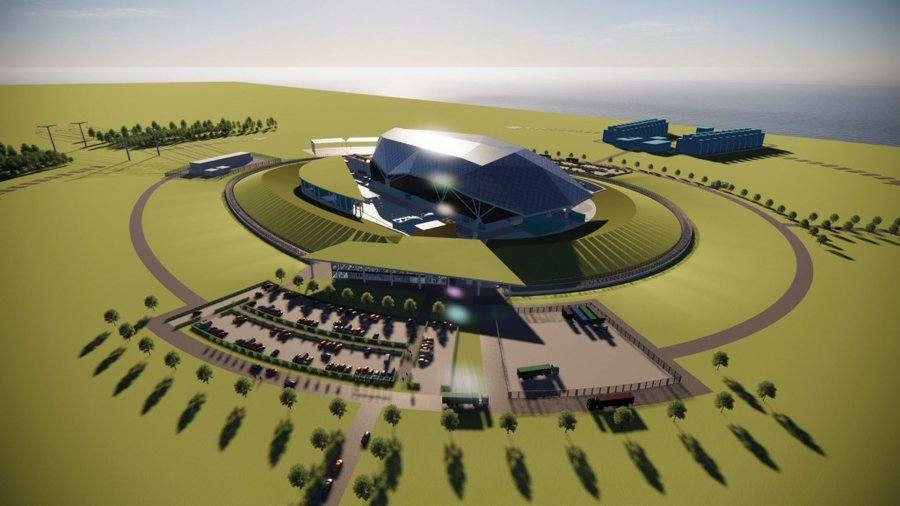
This seems frighteningly naïve when it comes to any complex and potentially deadly technology.

That picture is not a concept design for an SMR, it is just a design for a building and setting, which might hold an SMR, a library, a country restaurant, or a cheese display.

A concept design would tell us something about how the SMR is supposed to work, what the materials it will be constructed out of are, what the cooling system is, what the safety system is, where the uranium and waste is stored etc…. You may note that this ‘concept design’ does not even have a fence, it is that insecure and open to terrorist attacks…. this is an empty fantasy drawing, not a design of any practical value.

Foreign Policy

It may now happen that our neighbours think we are going to acquire nuclear weaponry, a normal product of nuclear power, and make moves to defend themselves. This is not fiction. When the Coalition decided to buy nuclear submarines from the US

the US made it plain to senior members of the Morrison government that if there was any suggestion the submarine deal could precipitate any broader policy change in Australia – anything at all that could generate speculation about acquiring nuclear weapons, no matter how fanciful – the deal was off. It must not, under any circumstances, give rise to any extraneous suggestion that the US was bending non-proliferation rules.

That included any talk of establishing a civil nuclear industry.

Middleton, There is no shortage of Coalition U-turns on nuclear. But this Aukus example might be the most remarkable

So they broke their agreement and are now using the argument that nuclear powered submarines are safe, to imply nuclear energy is always safe.

Nuclear vs Renewables.

Apart from over-optimism, and abandonment of emissions reduction, the problems for nuclear and renewables come down to:

  1. Which technology reduces emissions with most speed
  2. How much energy do we need? Can either supply that amounts
  3. Which is most cost effective
  4. Can an economy run on renewables
  5. Which produces less long term environmental problems
  6. What kind of social organisation is required for either of them

Going backwards

6) Renewables will be obstructed by fossil fuel companies for several reasons; the first is the obvious that renewables almost immediately start reducing emissions and the need to make emissions, and potentially cause loss of profit for fossil fuel companies and leave investments in fossil fuels stranded, as they replace fossil fuels. In this policy, it seems that Nuclear as planned does not reduce emissions; it may increase them as gas is used for backup with inadequate power generation. Renewables also allow the slow and modular building of Community controlled energy supplies, local level energy, resilience if they can function when the grid is down, and give the community political power and local finance, as money does not leave the local area. Renewables can be used to encourage independence, local political engagement and choice. Nuclear does not, it remains under outside control. Given the Coalition’s apparent hostility to renewables, the aim seems to be to keep centralised control, fossil fuel company profits and corporate power rather than to solve the emissions problem. In fact there is no real sense from the nuclear position that pollution and emissions are a problem. So it may be that neoliberal corporate dominance is one of many systems incompatible with solving the challenge of climate change, and hence needs to be curtailed.

5) Both nuclear and renewables disrupt environments. Renewables can be built so that farming can continue. Wind farms can also be built offshore and are likely to acts as artificial reefs and attract marine life to boost fishing and tourism. With proper design renewables should create little non-recyclable waste, but that does require the right designs. Nuclear requires ongoing costs of fuel and damage from mining, transport of radioactive supplies and waste, often through residential areas. Waste needs safe storage, and nuclear involves very expensive decommissioning at the end of its life because of high risk to those cleaning up and the local environment. Nuclear portends continued threats to environments.

4) It is possible that a modern corporate economy cannot run on renewables, but then a modern corporate economy cannot run on only 7 nukes. A modern corporate economy cannot run with climate change worsening either. Renewables are expandable, so they might be able to deal with the energy requirements. We might just have to change the economy and lower energy requirements, but that will involve a lot of struggle.

3) The CSIRO is clear on cost. Renewables are far more cost effective than nuclear. Nuclear cost blowouts are apparently worse than cost blowouts for the Olympics. Renewables are cheaper to install even including storage and cables. If well designed they should allow farming. I would rather trust the CSIRO’s estimates than those of a politician who is not itemizing the costs, and may never itemize them. As a further statement, Tim Buckley, director of thinktank Climate Energy Finance says:

“The international experience shows that the western nuclear industry is plagued with massive delays and cost blowouts,”… noting the Vogtle nuclear power plant expansion in the US blew out to cost $35bn, while Britain’s Hinkley Point C plant has been delayed to 2031 and is on track to cost £33bn pounds ($63bn).

Peter Hannam ‘Raises red flags’: Coalition nuclear power plan met with widespread scepticism from business groups

2) The question of the energy we need is hard to answer, because this changes all the time. If we have to change the economy, then we change the energy we need. Earlier I mentioned that coal is fading out, and we may need 300GW in the 2030s. This energy cannot be delivered by 7 nukes. It might be that the ideal solution is to develop both nuclear and renewables, but it seems clear that the Coalition does not want to do this, they want to restrict renewables and support gas as with their technology neutral gas led recovery from Covid. Again we may need to change the economy to survive.

1) Either technology could reduce emissions, if the policy and the technology is well designed and implemented. Again the problem seems to be that with only 7 nukes the Coalition’s policy is not designed to reduce emissions. It seems to be designed to generate more gas use at great expense to taxpayers. So the chance of using nuclear and renewables together has been abandoned.

The Conspiracy?

The Dutton nuclear plan

 bear a striking resemblance to a policy Trevor St Baker and SMR Nuclear Technology have been advocating for several years, in evidence and submissions to federal and state parliamentary committees, in think tanks and in energy forums.

[St Baker is a patron of the extremely wealthy] Coalition for Conservation, One of its aims is to reach out to environmentalists, renewable energy experts and climate scientists to garner support for Coalition members 

Dutton’s nuclear power plants

Conclusion

I’m not absolutely against nuclear energy, it could be really useful, but I am against nuclear energy when its being used as:

  • a) a distraction from reducing emissions;
  • b) in support of continued fossil fuel burning and;
  • c) to disrupt the replacement of fossil fuels by renewables.

All of these factors seem to be features of Dutton’s policy. The policy will not produce enough energy to make a difference to emissions. It will at best, and probably not at all, generate enough energy to replace some of the phased out coal. We probably need to build at least 40 full scale nukes with continuing expansion of renewables to make a difference; with no sign of that level of build out and the suppression of large scale renewables, the only way to give Australia the energy it wants is through more gas burning. There seems to be no guarantee that the plans can get through the various governmental oppositions. There is no evidence to suggest that it is really intended to. Chucking out the 2030 targets because they are too difficult, suggests that the 2050 targets will become too difficult too, which is great for fossil fuel companies. If the Coalition wanted nuclear to be successful they should have started about 20 years ago.

However, while some people say the deception is easily seen through, Dutton’s choice is not a death wish. He will get funding from mining and fossil fuel companies, he will get corporate and pro-Trump think tanks churning out material to justify him and clog social media. He will get support from Murdoch and probably most of the rest of the media. He will get unity in his Party, and he may even get some Russian and Chinese support through social media.

But then, taking a cue from the Anti-Voice campaign, which is much more appropriate for this policy at the moment….. Peter Dutton wrote:

“In refusing to provide basic information and answer reasonable questions on the Voice, you are treating the Australian people like mugs… your approach will ensure a dangerous and divisive debate grounded in hearsay and misinformation.”

Thompson ‘Treating people like mugs’: Dutton calls for Voice model before referendum

SO:…..
Peter Dutton and Action on Climate Change

June 13, 2024

For non-Australians, Peter Dutton is the leader of the opposition right wing party.

Whether you think Dutton is a bad thing is of course a matter of opinion.

Some people apparently think protecting fossil fuel company sales and profits is good, because they are the people who built the modern world and we should continue down that path.

Some people think climate change does not matter because a socialist conspiracy of scientists all over the world is far more probable than a conspiracy of right wing politicians, and corporations who are profiting, to deny climate change.

Some people think that not acting is a really bad choice that will kill Australians and lead to more floods, fires and droughts.

Some people think it is a really bad choice that will kill Australians and lead to more floods, fires and droughts, so we need the money from gas and coal exports….

Peter Dutton does not want fossil fuel energy to be replaced with renewable energy. As a result he has has claimed the 2030 Labor Party emissions targets are difficult and so are unobtainable, and they are bad for the economy, so he won’t bother to have any emissions reduction targets, or at least won’t bother to announce them before the next election. This protects fossil fuel emissions, and so he seems to be serious about protecting fossil fuel company profits.

In the old days would ‘Conservatives’ have shrunk from a problem because it was difficult?

His respect for the corporate economy seems much greater than his respect for human lives and the property of ordinary people. He seems to expect that it will be possible to attain the cutbacks by 2050, but of course with enough delay from not having any targets now those later targets probably won’t happen because they have also become way too difficult.

That is why he is proposing nuclear energy, which the CSIRO has said will be far more expensive than renewables plus all their oncosts of storage, cabling etc. At the best nuclear won’t be ready to run in Australia until 2040, which means at least another 16 years of fossil fuel profits. He almost certainly knows nuclear energy will not really get going, so as to replace all fossil fuels, for another 20 years after that, even if he wanted to. The problems of building the necessary 20 to 50 nuclear power stations at the same time in the one country nowadays are severe or possibly insurmountable, so it won’t happen. [We now know that they have no intention of replacing all fossil fuel generate energy with nuclear] Nuclear power also has huge costs for decommissioning, and for insurance (if you can get any). Taxpayers should not have to pay this or the billions in costs to build.

Nuclear energy also involves water for cooling so, in Australia, this probably means seaside plants only, as the rivers are already drying up. Nukes in France were shut down a year or so ago because of lack of water.

From a reducing climate turmoil point of view, Labor’s targets are inadequate as well, but far less inadequate than Dutton’s.

Dutton is also running around the country campaigning against windfarms at sea (10 or more Km away from habited zones), supposedly for both ecological and consulting with community reasons. Likewise National Party leader David Littleproud spent a day meeting with fishing and anti-wind farm groups opposed to plans for up to 200 floating turbines offshore between Wombarra and Kiama and said the Coalition was committed to overturning the two offshore wind zones now declared for the Illawarra and Port Stephens in the NSW Hunter. 

“We should have a slow transition from some of our coal-fired power stations to nuclear power plants that are zero emissions and firm that up with gas and carbon capture storage, which is zero emissions as well,”

National Party leader David Littleproud promises to scrap NSW offshore wind zones in Labor heartland

However the Coalition have never opposed offshore drilling despite it producing continual noise at depth, and being notably damaging to marine life. I’m also prepared to bet that he won’t go on endlessly about community consultation for nuke installation, if he is serious about it [again this does seem to be correct]. People will just have cop it, especially in Labor electorates, or it will not go ahead and fossil fuel company profits are guaranteed for even longer. which in his eyes seems good.

The latest move the US elites through the Atlas network, corporate bought think-tanks and Murdoch media, in their fight to preserve oil company profits, is not to focus entirely on denial of climate change or scientific conspiracy, as they are perhaps getting a little unpersuasive, but to try and get people worked up about industrial size renewables and their possible local ecological destructiveness. They do not seem to promote objection to industrial coal, gas or even diesel energy and mines, despite their documented detrimental ecological and health effects, especially when at sea, and so it seems less well organised.

There is some evidence to suggest that money is also following this trail from the USA to Australia, along with faked academic papers [2], and other fake news [3], [4], and ‘community resistance’ which has in some places been purchasing support. These activists also make sure not to ever mention the possibility of community led renewable energy – because it is (by definition) not corporate, and they do not bother to compare known effects of climate change with less likely effects of offshore wind warms.

Peter Dutton may well be following his American sponsors. He is probably also betting that Trump will win the next US Presidential election (which seems likely), and that result will be unrestrained action for oil companies and polluters (Drill, baby, drill.”). Dutton, wants to support his American allies, because he wants to be on the winning side.

Whatever his policies are, Dutton’s choice is not a death wish as some have alleged. He will get funding from mining and fossil fuel companies, he will get corporate and pro-Trump think tanks churning out material to justify him, pay his supporters, and clog social media. He will get support from Murdoch and most of the rest of the media. He will get unity in his Party (who seem to be largely climate deniers), and the whole fossil fuel and corporate ‘Deep State’ will be behind him. He is obviously courting Gina Rinehart [5], [6], [7], [8], [9], [10]. He may even get some Russian support through social media, as Putin is keen to continue to sell fossil fuels, and may logically think climate change will make Russia more habitable and gain northern ports.

In terms of gaining victory Dutton is not making a foolish choice, in terms of looking after Australia, its people, wildlife and future, he is.

Even the inadequate Labor Party actions will not be allowed to continue if he wins.

Agenda 47: Lets make more climate change and eco destruction

June 8, 2024

As a neoliberal, Trump gets really upset about climate change being used ‘politically’ to encourage energy transition, cut back the burning of fossil fuels, helping electric cars or promoting corporate responsibility. The only responsibility that Corporations have is to make money, and that can never destroy their ability to survive.

To Recap: Agenda 47 gives Trump’s official policies, many of which are also present in the corporate manifesto Project 2025. They seem to be heavily oriented towards crushing dissent.

This section considers his ecological and climate attitudes.

Against Corporate Responsibility and Shareholder action

He makes it clear by his non-political support of free speech that it should be forbidden for shareholders to ask companies not to destroy the environment. The sole moral responsibility of companies is to make profit. That’s all; not to be safe for workers, not protect the communities they operate in, not consider the effects of their actions on others, or whatever, just make profit.

When President Trump returns to the White House, he will immediately ban ESG [Environmental, social, and governance] investments through executive order and work with Congress to enact a permanent ban.

“When I’m back in the White House, I will sign an executive order and, with Congress’ support, a law to keep politics away from America’s retirement accounts forever.”

The entire ESG scheme is designed to funnel your retirement money to the maniacs on the radical left.

But pensions and retirement accounts with his radicalism and incompetence, they’re going down and they’re going down big and nobody’s seen anything like it.

I will demand that funds invest your money to help you, not them, but to help you. Not to help the radical left communists, because that’s exactly what they are. I will once again protect our seniors, just like I did before, from the woke left and the woke left is bad news. They destroy countries.

Agenda47: President Trump Continues to Lead on Protecting Americans from Radical Leftist ESG Investments
February 25, 2023

ESG simply means asking companies not to destroy the environment that people (including old people) live in, to pay fair wages, not defraud people, adhere to labour laws, factor in the risks of their actions and be transparent and responsible. However, this will be prevented.

Under Trumps laws, no one, including shareholders will be able to ask companies to stop destroying things or poisoning people, apparently because not destroying things and not exploiting workers, is a radical leftism which destroys countries. It should also be remembered that shareholders are company owners, and that if they cannot influence what their companies do, other than support them going for more profit, then that is a fairly odd definition of capitalist property rights.

It seems that, for Trump, it is disloyal to America to challenge corporate power, while siding with corporate power is completely non-political. All those who disagree are “radical left communists, because that’s exactly what they are.” Asking companies to disclose climate risks is also criminal.

Against Recognising Corporate Climate Risk

In May 2021, Biden issued an Executive Order that required federal agencies to define “climate-related financial risk to the financial stability of the… U.S. financial system” which led the Securities and Exchange Commission (SEC) to require private companies to publicly disclose climate-related risks.

This ruling will force companies to share with investors their estimated impact on the environment, which will allow climate crusaders in investment firms to punish companies that do not conform to their radical environmental agenda.

Agenda47: America Must Have the #1 Lowest Cost Energy and Electricity on Earth
September 07, 2023

Apparently looking at climate related risk is too big a risk for corporate liberty to pollute and harm people, to be requested.

More Fossil Fuels

Given Trump being against people acting within the normal rules of capitalism, and effectively putting an end to shareholder motions requesting responsibility, it is not surprising that his energy policy is more fossil fuels, despite the warnings about what this will produce.

He states:

“Joe Biden’s war on American energy is one of the key drivers of the worst inflation in 58 years, and it’s hitting every single American family very, very hard… Biden reversed every action I took that achieved energy independence and soon we were going to be energy dominant all over the world.”

Agenda47: President Trump on Making America Energy Independent Again February 09, 2023

Let us ignore that Biden has pushed for the greatest expansion of American fossil fuel production ever, and presided over huge increases in profits for oil companies [1], [2], [3], [4], [5]: that is not enough for Trump.

Nobody has more liquid gold under their feet than the United States of America. And we will use it and profit by it and live with it. And we will be rich again and we will be happy again. And we will be proud again. Thank you very much.

So lets burn more oil and make things harder for non-rich people by encouraging climate change.

On Day One, President Trump will rescind every one of Joe Biden’s industry-killing, jobs-killing, pro-China and anti-American electricity regulations.

China is being made into an enemy, and trying to go against Republican fossil fuel ideology is traitorous.

President Trump will DRILL, BABY, DRILL.

President Trump will remove all red tape that is leaving oil and natural gas projects stranded, including speeding up approval of natural gas pipelines into the Marcellus Shale in Pennsylvania, West Virginia, and New York.

Yes we don’t have to worry about whether going after shale oil and gas will damage people, water or whatever, we just have to support fossil fuels and the profits they generate. People who might think this is not automatically good, or who protest, will presumably be told they are not real Americans but woke Marxists, and removed.

Stopping Legal Protest

President Trump will stop the wave of frivolous litigation from environmental extremists that hold up critical energy development projects for years, increase project costs, and discourage future development.

Agenda47: America Must Have the #1 Lowest Cost Energy and Electricity on Earth
September 07, 2023

It should not be a surprise to find out that people’s legal ability to protest and disagree with the demands of corporations is denounced as illegitimate and to be prevented. People should obey and curb their speech before their masters. They know nothing, and should have no power to disagree.

Against Climate Agreements and China

Biden is bad because:

he reentered the horrendous Paris Climate Accord, so unfair to the United States, good for other countries, so bad for us. He put up huge roadblocks to new oil, gas and coal production and much, much more…. The country that now benefits most from Joe Biden’s radical left Green New Deal is China.

President Trump will once again exit the horrendously unfair Paris Climate Accords and oppose all of the radical left’s Green New Deal policies that are designed to shut down the development of America’s abundant energy resources, which exceed any country’s in the world, including Russia and Saudi Arabia.

Agenda47: America Must Have the #1 Lowest Cost Energy and Electricity on Earth
September 07, 2023

We know by now that we should not expect evidence, but the point seems to be that the current COP agreement involves possible cuts to fossil fuel production, and thus should be repudiated, no matter what the consequences. Corporate profit is the fundamentally important thing. Oddly he uses a justice argument to excuse this, the agreement is unfair…. Fairness presumably means powerful people and countries should do what they like. I guess that by attacking the ‘green new deal’ he is objecting to providing jobs by helping the energy transition. Fossil fuels have to remain the main source of US energy.

As you know, China paid hundreds of billions of dollars to the United States when I was president.

I presume this means the tariffs on Chinese goods, which Americans paid, not the Chinese. It is possible that China lost some deals, but they did not directly pay any money to the US because of the tariffs. We might hope a President would realise this, so I suspect the idea he is referring to tariffs is wrong.

Against EVs

Trump is opposed to electric cars, and people making a choice.

Because EVs cost an average of TWICE as much as gas-powered vehicles, take longer to fully charge, and have shorter ranges, almost two-thirds of Americans prefer their next car purchase to be a gas-powered vehicle, nearly half of all car dealerships would never sell an EV, and about half of current EV owners plan to switch back to a gas-powered car.

This is probably one reason why Elon Musk is attempting to cozy up to Trump. He realises that if Biden wins, he will be no worse off, but if Trump wins, EVs might be banned or taxed or put out of action, to protect fossil fuels.

Carbon Capture and Storage

Trump does make a few sensible statements.

According to two 2022 studies, the vast majority of CCS projects have underperformed or failed to date and hydrogen blending is plagued with safety and effectiveness concerns

This is true, but in context, it means that even symbolic attempts to reduce emissions should not be allowed.

So in summary:

Basically most of Trump’s Agenda 47 policies take the attitude that anyone who disagrees with him should be dismissed, punished, or prevented from acting.

This does imply that, whether he claims to be or not, he will act as a dictator and attempt to purge the USA of the liberty of dissent, and prolong ecological destruction and climate change.

Agenda 47 makes clear:

  • Trump is fighting non-existent ‘communists’, and those he calls ‘woke.’ Both terms seem to mean people he does not like or who disagree with him.
  • He is enthusiastic about protecting America from free speech he does not like.
  • People who disagree or inconvenience him are not real Americans.
  • The DoJ should support him, and the Party, alone, and go after people he does not like.
  • Education should only reinforce Republican doctrine as anything else is political.
  • Attempts to recognise that the USA has a history of racism, are racist.
  • Corporations should have free rip, particularly oil companies, and people (even shareholders) should not be free to object to corporate behavior, or attempt to alter it it.
  • He opposes any ideas that people should protect America (or the world) from environmental destruction, as such protection is Marxist.
  • Fossil fuels must be the only energy source to be protected.
  • He wants to stack the government with pro-Trumpists so he will never hear anything he does not like..

This, seems a complete recipe for destruction. Under Trump the USA will not face its real problems, although it may try to crush people who recognize those problems as only Marxists and Woke people would notice them and want to solve them.

Part 1: (Back) Justice

Part 2 (Back) Education

Agenda 47: Education as propaganda

June 8, 2024

Education goes the same way. It will become “non-political”. And it becomes non-political by banning everything that the Republican Party Machine might disapprove of. In a plan for an online educational institute for Adults or teens, which sounds like a good idea, he says

It will be strictly non-political, and there will be no wokeness or jihadism allowed—none of that’s going to be allowed.

Agenda47: The American Academy

This might seem an odd use of the term ‘non-political,’ but it does try and pretend that his political views are not political, but the common sense of all Americans. He will make sure that only the right material is taught in schools, and lie about what is taught in schools now. It is perhaps too much to expect him to describe what he means by wokeness, but it usually seems to mean any realisation that not all is perfect, and recognition that some people suffer from inequalities and social bias. He is also very upset about the possibility of tolerating non-traditional gender behaviour in schools.

In another display of non-politicisation of education he says:

President Trump will get Critical Race Theory, transgender ideology, and left-wing indoctrination OUT of our schools—and he will get reading, writing, and arithmetic back IN, so that America’s young people have the knowledge, skills, and training they need to get a great job and lead a successful career.

President Trump will cut federal funding for any school pushing Critical Race Theory, transgender insanity, and other inappropriate racial, sexual, or political content on our children—and he will pursue civil rights investigations into any school that engages in race-based discrimination.

Agenda47: President Trump’s Ten Principles For Great Schools Leading To Great Jobs

“Race based discrimination” seems to be telling people that white folk have not always been perfect, but it is a bit vague. However, Critical Race Theory, tends to be a term used by the Right, to mean teaching anyone about the history of American Race Relations. The aim seems to be that people should just ignore race relations and problems will go away, or we should learn that slavery was good, and taught ignorant Africans about agriculture.

The time has come to reclaim our once great educational institutions from the radical Left, and we will do that

When I return to the White House, I will fire the radical Left accreditors that have allowed our colleges to become dominated by Marxist Maniacs and lunatics.

Agenda47: Protecting Students from the Radical Left and Marxist Maniacs Infecting Educational Institutions, July 17, 2023

We can assume that, as usual, ‘Marxist’ is a non-political term, which means person who disagrees with the Republican view of America, or who wants to teach history reasonably accurately, as it is highly unlikely that any followers of Karl Marx dominate education, given the smallness of the movement in the USA. It is so small that most people do not seem to know what Marxism is about.

He continues in his non-political manner by saying that education should

protect… free speech by removing all Marxist diversity, equity, and inclusion bureaucrats,… [and] schools that persist in explicit unlawful discrimination under the guise of equity will not only have their endowment taxed, but through budget reconciliation, I will advance a measure to have them fined up to the entire amount of their endowment.

Presumably the aim is to halt any criticism, diversity, equity or inclusion, and that any attempts to compensate for, or recognise, inequalities etc, will result in huge fines. My guess this that the last sentence is directed at endowed universities… because stripping away property from those who dare to differ from Republican ideas does not violate Republican ideals. Another way of interpreting his statement is that he seems to want to use education to continue the class system and inequality.

However the idea that education is only about making children into workers is perfectly standard practice.

His non-political positive vision is that:

President Trump will fight for patriotic education in America’s schools…. [because] decades of poor scholarship have vilified our Founders and the principles that they championed and have taught many of our young people to hate their own country…. we will teach students to love their country, not to hate their country like they’re taught right now.

No evidence is presented, of course, as this is not about evidence. Who when talking about education would want evidence? But the point is that students have to think America has always been good, and that other views cannot be allowed.

Non-political education is also about religion:

we will support bringing back prayer to our schools.

Agenda47: President Trump’s Ten Principles For Great Schools Leading To Great Jobs

President Trump will once again fiercely protect the First Amendment right to pray in public schools—and he will ensure that every American’s fundamental right to the Free Exercise of Religion does NOT end when you walk into a classroom.

In reality, no one is prevented praying in American public schools, however they are prevented from forcing others to pray to their particular God. We can guess what might happen if an Islamic teacher insisted their students prayed to Allah before engaging in football.

We can also guess that his defense of the right of parents to fire teachers is to get rid of teachers who might teach forbidden topics like evolution or climate science, so religion can be another non-political tool used to stop education and support Trump.

The key slur terms like ‘wokeness,’ ‘Marxist’ and ‘vilification’ are left undefined, precisely to get teachers to worry about whether some Republican will apply these words to them, to get them persecuted or dismissed.

The point, of this non-political free speech in education policy, seems to be to suppress free speech, real education and thinking about problems and issues, and teaching only safe Republican ideology.

Part 1 (back) Justice

Part 3 Climate and energy

Agenda 47: the future of law, education and climate denial

June 8, 2024

If, or as now seems likely, when, Donald Trump wins the next election he has for once made it clear what he will do.

There are three core promises, which translate into:

  1. the Department of Justice will become a weapon [this page]
  2. Education will become propaganda enforcing Republican understanding
  3. Climate change will be encouraged.

Justice is a weapon

There are indications that Mr. Trump will attempt to end the existence of the Department of Justice as an officially neutral organistion, and make it a tool for the President’s use.

This policy seems easy to deny because his official position seems highly ambiguous. Some quotations from him imply he would do it, some quotations imply he might do it, and some quotations imply he should do it but that he won’t [1]. [2]. However it does seem compatible with his proposal to terminate rules in the constitution [3], [4] because he did not like the election results, his defense of rioters involved in the attack on the Capitol, and suggestions he might pardon them, and his convictions for financial crimes being denounced as Democrat driven witch-hunts, even when a whole jury found him guilty despite knowing they and their families would be threatened by his supporters if none of them doubted his guilt.

However, in Agenda 47, which is his official public policy document, he is much clearer as to his intentions. He writes:

There is no more dire threat to the American Way of Life than the corruption and weaponization of our Justice System—and it’s happening all around us. If we cannot restore the fair and impartial rule of law, we will not be a free country.

As President, it will be my personal mission to restore the scales of justice in America. We will have fairness and equality under the law.

To that end, I will appoint U.S. Attorneys who will be the polar opposite of the Soros District Attorneys and others that are being appointed throughout the United States. Very unfair to our population. Very unfair to our country.

They will be the 100 most ferocious legal warriors against crime and Communist corruption that this country has ever seen.

Agenda47: Firing the Radical Marxist Prosecutors Destroying America
April 13, 2023

It does not take much imagination to see this as a threat to have the law ignore Republican, and allies, crimes, as this is unfair, and to appoint people who will go after his perceived enemies without any restraint at all. It is standard for authoritarian parties to hold that the law should not apply to them.

That he is trying to slur people by calling the current DoJ officers ‘Soros Attorneys’ may be taken as indicating that he plans a direct attack on the freedoms of those he disagrees with and he will purge them from the office. That he also claims the main problem is “Communist corruption” shows how fake this pretense of reforming the DoJ is. The number of communists in the USA is tiny. The number of communists in positions of power (especially in the DoJ) will be likely be non-existent. However the amount of business and corporate corruption of the kind Trump engages in seems to be very high. This is basically saying the DoJ should not go after corporate corruption, as that would be unfair and communist. By the way, Soros is not remotely a communist, he is a person that thinks corporate domination is not good, that neoliberalism leads to corporate domination and that societies should be open in their discussions of politics. In other words he disagrees with the Republican Party Machine and with Putin.

From these comments we can expect a politicised DoJ. The idea of crushing opponents seems confirmed by other promises in Agenda 47 to protect free speech in universities by getting rid of people who teach things he does not like, and protecting students from learning anything that is not Republican Propaganda. He has also promised to stop investors asking companies not to destroy the environment.

In other words ‘impartial’ means “pro-Trump”. Agree with him or else the reformed DoJ will come after you.

Part 2: Education

Part 3: Climate and energy

Modern fascism and the hatred cycle

April 20, 2024

Summary:

Fascism involves self hatred, directed at outgroup others under the guidance of a leader seeking total power and total support. The leader generates hatred of the outgroup, in order to build cohesion in the ingroup, and stop members of the ingroup talking with members of the outgroup, and getting different perspectives. This hatred may further help to reduce anxiety by distracting people from the real challenges their society faces and which the established elites don’t want to face either.

The Fascist leader

The fascist leader is always important. The leader tends to claim that he is insightful and clever, and able to benefit the nation through mysterious means; maybe God, fate, or The sacred Market is on their side? However, beyond raising hatred their actual policies and means of implementation of those policies are usually not very clear, or involve vague feel good statements: “We will build the economy to be strong again,” “we will restore true liberty,” “We will bring unity and might back to the country,” “We will avenge our fallen,” “We will stop [outgroup X] from destroying the country” etc.

The people who support the leader become special by supporting the leader’s heroic work and imagining they belong to that leader’s ingroup. Through this bonding and sense of shared labour, they become essential to the recovery of the pure Nation. They have purpose and meaning in their lives.

One certain thing is that although the Leader may attack the elites who he claims are persecuting and holding the populace down, the Leader will always seek the support of a large part of the establishment by rewarding them, and showing people what will happen to people who don’t support him. The wealth and power elites will be fine, as long as they don’t inspire his hatred, by challenging him or mocking him. They will also support him financially as it’s a worthwhile investment, if they judge he has any hope of winning.

Background to Hatred

The important thing is hatred. The Leader identifies those who are to be hated, and justifies that hatred along with the followers, who support the hatred. This builds the ingroup and its loyalties through dismissing other people.

There is always a background to the hate. Hatred does arise out of nowhere. The people have to be desperate, or motivated to embrace hatred against fellow citizens.

However, as well as vague hatred towards the elites who have failed in their job of helping the people, there may well be widespread and painful self-hatred.

In the contemporary USA, for example, the promise is that everyone can get rich. That promise is no longer true, if it has ever been true. However, at one time upwards mobility was possible for a lot of the population so it is part of the story and of people’s experience or their parents experience. Nowadays many of the middle classes may perceive their status as precarious and that they are facing a downward trajectory, or their children will be going down, due to education debts, increasing housing prices, costs of medical procedures, costs of energy, lack of wage increases above inflation, etc.

The only common explanation allowed by mainstream capitalist politics for this perceived decline in possibilities of prosperity, is personal failure or lack of hard work, not economic structures, not the real power and wealth elites, not ecological collapse, not business failure, not ‘free markets’ leading to plutocracy, or whatever. So they main option to explain things is self-hatred for that failure. They have failed their families and in their lives, by not doing what is expected or demanded for survival. If they are religious, then they may have to hate themselves for sinning, of for not getting God to bless them with money, as well. Personal failure often generates self-hatred, which acts to reinforce this resolution, and it is likely to be common in this kind of situation. Self-hatred is a powerful, discomforting and unacceptable force.

Formerly reasonably well off people may also see, or think that they see, that minorities are receiving help and gaining a status that they feel they were never offered. Employers may say, “you did not get the job because you are white”, rather than you did not get the job because we wanted to give it to the boss’s nephew, or because you did not have any experience. This ‘pleasant’ excuse builds added resentment against outgroup members. Or people may see that those who would not have received work, such as women, can now get better work than they do. The formerly well off have gone downhill, and hatred is easily shifted from self to others if people are given an excuse, or if the hatred against others is shared and reinforced by the ingroup.

The Force of Hatred

The fascist leader relieves people by saying the problem is not the result of personal failure but because of outsiders: communists, gay people, transgender people, feminists, Jews, immigrants, Muslims, atheists, Black People, Chinese people, etc. These people as groups, realistically have almost no influence on what happens in society, they are minorities. However, the leader tells their followers that the presence of these foul people explains why their prosperity has declined, their survival is threatened, and why they feel displaced from their own culture. The leader may also attack some people who might be real obstacles to the leader such as opposition parties, the media that is not 100% behind them and so on. These people can also be threatened and used in order to create the sense of a vast noxious conspiracy from which the leader will save ‘us’ good Americans (or whatever).

Self-hatred transformed

Under the Leader’s direction self-hatred can be suppressed, transformed and projected onto the scum he has identified, while the faithful validate themselves by working to reclaim the country’s glorious past. The point of projection, and why it works as a defense mechanism, is that it allows people to stop feeling self-hatred through feeling hatred for others.

As the leader keeps harping on how the outsiders are corrupting, destructive and evil, and need to be removed, no one need feel guilty about their hatred or about attacking the scum themselves. Attacking these people is perhaps distasteful as people might rather not engage with the vile creatures at all, but it is heroic. People who fight against the outgroups are glorious self-sacrificing martyrs to the great cause. If supporters are arrested and convicted it is because the minorities have corrupted the legal system, into a system of witch hunts, or they are really hostages to the corrupt order, held captive until the leader can free them, and welcome them back into the fold. Judges who convict well-intentioned fellow fascists are among the real enemies of the Country, and will have their comeuppance under the new regime of the Leader.

The Fascist leader promises to break the destructive power of these minorities, to restore the image of the perfect citizen, male, straight and of the right race and religion.

Women

Women who are affiliated with the brave and honorable men who attack corrupting scum are acceptable, as long as they recognise the prime function of women is motherhood and caring for the family. They too must show their purity by supporting their men, hating the minorities, oppositions and women who support minorities, or who want other things than motherhood and family and who are not chaste.

Hatred serves the movement and blocks communication

The hatred not only builds a more relaxed psychology for the haters (they are now justified and hating others not themselves), and they have been given a promising (if vague) imagined future, but it forges ties between the faithful and gives them a simple unity of purpose to get rid of (or break the power) of those the Leader has identified as evil. This purpose fills the previous self-hating aimlessness of their lives. As said previously, the hatred they share for these outsiders bonds them to the leader, to the ingroup, and to the vision of the future they choose.

This hatred further blocks communication as the fascists know that the outgroups have nothing worth listening to, and that anything people in the outgroups might say would, at best, be corrupting, and therefore to be rejected automatically. Likewise, people in the outgroups refrain from trying to communicate with fascists, because they think fascists are vicious and stupid. Fascists name call the opposition and the opposition responds similarly.

The abuse may trigger existing self-hatred, but this time the fascists know they are in the right, and can strike back transferring their hatred onto the abusers. This kind of action reinforces the lack of communication and the lack of mutual respect or mutual empathy. It keeps groups apart.

Calling fascists names serves the fascists, and helps them to build and rigidify the ingroup and outgroups and helps justify their cause – people will not listen to their real grievances. When outsiders call the Leader names, this also shows that the Leader is one of ‘us’ suffering the same condemnation and persecution as ‘we’ do. This abuse shows the greatness of the cause, and its necessity, and justifies action against other citizens.

The cycle of hatred becomes a positive feedback cycle, which then helps reinforce and justify the hatred, which is one of the bases of the Leader’s power.

Political Hatred as Defense Mechanism

The mutual hatred may also distract people from real and overwhelming challenges the society faces, such as climate change, predatory capitalism, growing differentials in wealth, alienation from the state etc. allowing the situation to get worse, and allowing the elites to avoid doing anything to solve the problems that people face. The elites may encourage the fascism, precisely because it allows this avoidance, and the Leader does not appear to face up to the real problems either. This also helps reduce the stress of fascist followers. They can relax, knowing that their are no problems the leader cannot solve, by getting rid of the evil outgroups that arouse anxiety.

Australian National Climate Risk Assessment.

April 9, 2024

The first draft of the Australian National Climate Risk Assessment, seemed to bypass the media.

It identified identified 56 nationally significant climate risks within 7 out of the 8 systems it looked at. 11 of these risks were identified as being of severe impact.

The priority risks cover

  • environmental stress;
  • agriculture and food;
  • outback living;
  • health and social support;
  • infrastructure;
  • defence and national security;
  • communities and settlement;
  • water security;
  • supply chains;
  • economy, trade and finance; and
  • governance.

the Government is asking for responses…..

https://www.dcceew.gov.au/climate-change/publications/ncra-first-pass-risk-assessment

May be an image of ‎map and ‎text that says '‎Figure 1 Overview of observed and projected trends in Australia's climate hazards More severe fire weather days Fewer but more intense tropical cyclones More frequent heatwaves and hot days over 35°C ゼ 歌な Increase in heavy rainfall and flood risk More time spent in drought m M Sea level rise and increase in coastal flooding Likely increase in hailstorm days اب ኦ قطلي Fewer extratropical storms but with heavier rainfall More coastal erosion and changes to shorelines Increase in ocean temperatures and acidity OM 入‎'‎‎

Externalities vs Illth

April 1, 2024

I’m currently trying to write something on economics and what are called ‘externalities’. I’m not an economist, so am writing this in the hope of feedback telling me how I’m wrong, because it seems obvious I must be wrong.

Initial phrasing of the problem

‘Externalities’ seem to be usually thought of as those parts of an economic transaction which have harms, costs or benefits which affect people who external to that transaction. Externalities are usually described as positive (when someone can benefit without paying) for example clean air away from cities, or a neighbour’s bees fertilising one’s plants. A negative externality should (but often does not) include all forms of social and individual illth produced by economic activity (although illth production could come from the State, or other institutions). One immediate problem of this approach is that externalities as seen as coming from individual transactions rather than being systemic, so it localises and individualises the problem. For me, the major flaw of externality theory, is that it does not seem to be interested in preventing illth, it just wants to make some of the costs internal to the system, or even worse try to pretend illth is already costed and hence acceptable to the people who suffer from it.

In summary, my objections to the way the concept of externalities works, are:

  • Definitions and treatment of externalities appear to aim at removing illth from consideration and confining it by making it local, and fixable through monetary payment (compensation or tax). They rarely seem to see illth production as a norm inherent to a system which ‘needs’ cheapness of operation for the highest possible profit, and so generally do not look for solutions at the system level. They also generally do not see the system as potentially self-damaging. Hence I will define a negative externality as a socially generated source of illth, whether intended or otherwise, expected or not. People, or groups, should be held responsible for the illth that they inflict on others, and we should not pretend the illth problem is solved when people and companies have to pay something for it.
    • Research in the early 2000s by Nicholas Z. Muller, Robert Mendelsohn, and William Nordhaus showed that in some businesses (notably solid waste combustion, petroleum-fired electric power generation, sewage treatment, coal-fired electric power generation, stone mining and quarrying, marinas, and petroleum and coal products), the costs of externalities exceeded any value those businesses, added to the economy.
    • Kapp argues modern business enterprise operates on the basis of shifting costs onto others as normal practice to make profits. [Kapp, Karl William (1971) Social costs, neo-classical economics and environmental planning. The Social Costs of Business Enterprise, 3rd edition. K. W. Kapp. Nottingham, Spokesman: 305–18 ]
  • The standard model uses involves only three people, seller, purchaser and person suffering the illth. It effectively localizes illth (‘spillovers’, ‘neighbourhood effects’) rather than sees it as possibly affecting the functionality of whole systems. In other words writing on externalities generally ignores complexity, system and relationships – other than the price system.
  • Much ‘free market’ economics seems to think that illth can always be reduced to monetary compensation and agreement. Economists don’t have to look at the type of illth involved. Consequently, if people are monetarily compensated, then illth is not a problem and, for practical purposes, has disappeared as it is treated as having no other effects on people or the system.
  • Problems with government charges for illth are discussed below under Pigou, many of these difficulties apply to private negotiations as well.
  • It is not clear how you can always put a monetary cost on illth and suffering, or come to a valid agreement on those ‘costs’; especially if the illth is allowed to continue.
  • Illth is often produced by powerful people, and economics ignores the power and riches relations generally present, and the ways those relations could affect, or distort, any agreements likely to be reached on the monetary cost of illth.
  • Economics often seems to presume that ‘the invisible hand’ with its claimed beneficial emergent order will get rid of the problem, or make everything else so much better it no longer matters. This is simply optimism not a basis for governance or for disregarding harm.
  • Often it seems the theory is attempting to protect companies from any responsibility.
  • The energy and attention costs of cleaning up long term illth is ignored. Apparently it will just go away, as it it were ‘waste.’
  • Free market arguments tend to propose that penalties and regulation always, without exception, make everything worse, but that the market always works out fine for everyone, irrespective of their position in the power relations. This almost certainly fantasy.

There also seems to be a large amount of dispute about what the main hero economists thought on this issue.

History: Pigou, Hayek and Coase

Pigou and his objectors

Historically the idea begins with Pigou, although he does not appear to use the term ‘externality’. Pigou’s basic economic principle was:

the economic welfare of a community of given size is likely to be greater (1) the larger is the volume of the national dividend, and (2) the larger is the absolute share of that dividend that accrues to the poor.

Pigou Economics of Welfare 4th edition p 5-6

Not a currently fashionable position

In a chapter on the divergence between marginal social net product and marginal private net product (Chapter IX), he writes:

It thus becomes important to inquire in what conditions the values of the social net product and the private net product of any given (rth) increment of investment in an industry are liable to diverge from one another in either direction.

174

This is a problem not only when private riches overwhelm social wealth, but when the effects or costs of private investment comes “as a positive or negative item, to other people.” He examples Irish farmers who pay for improvements to farms owned by others.

He suggests that a problem arises because the costs of illth are not borne by those producing it, so they are not discouraged from its production. He argues that an appropriate tax, or price, on illth, equivalent to the harm inflicted on others, would lower the profitability of illth production. For example, makers of alcohol should be “debited with the extra costs in policemen and prisons which it indirectly makes necessary” (p 186).

This charge, assumes the harm can be priced, the damage can be fixed, or that cost discourages illth production, which would probably depend upon the profits being made. This would seem to be best as a matter of experiment, not of dogma.

As we might expect, neoliberal [1] [2] [3] economists think taxing illth production, is government interference in the market and hence bad.

  • It is alleged the government cannot know what the best price is, and hence it will be wrong and produce terrible disasters. The EU Carbon trading scheme can be used as an example of a system which did not work very well at the beginning – largely because it was too generous to business to avoid trouble for the EU, however, some levels of air pollution have now decreased (https://wordpress.com/post/cmandchaos.wordpress.com/11300 and https://www.theguardian.com/environment/2024/mar/13/air-pollution-levels-have-improved-in-europe-over-20-years-say-researchers). However, this criticism of tax solutions ignores the possibility of experiment, or of gradually increasing charge for the illth with no exemptions.
  • Instabilities, and changes in government, may destroy any such prices, tax or trading schemes, especially (although this seems rarely mentioned) due to the influence of powerful and wealthy industries who want to continue illth production. This problem has been experienced in Australia with the carbon price being repealed by pro-corporate government..
  • Lack of a global carbon price or tax, might incentivize companies to go where pollution is cheapest, which is a particular problem if the pollution diffuses, as with CO2.
  • It is difficult to estimate the cost of damage done by illth. It is difficult to measure emissions from individual factories and across an industry.
  • Another argument suggests that If people want non-polluting energy then, if non-polluting energy is cheaper people will purchase it. This ignores established powers in the market, and their ability to corrupt the information in the price system, or to corrupt people’s response to that information.
  • Pollution can be said to be an engineering problem, not an economic problem, while at the same time suggesting engineering is driven by economics. Spontaneous new technology is the solution.
  • One writer states that a tax/charge is unfair because it only punishes the polluter, and ignores the impact of the polluted, who are causing the polluter damage “by being there and causing a tax to be imposed on the other business.” [cf 3]. Possibly this rather odd idea may come from Coase, who assumes that externalities are reciprocal [check], and that there must be two specific parties interacting for an externality to exist. Hopefully the term ‘reciprocal’ was not meant to indicate the parties are equally responsible (deleting power relations) or that there can only ever be two parties at a time, or that a party cannot harm itself.

[Barnett, A. H.; Yandle, Bruce (24 June 2009). “The end of the externality revolution”. Social Philosophy and Policy. 26 (2): 130–50. doi:10.1017/S0265052509090190. S2CID 154357550.]

In all, the problem with the idea of tax or charge for illth appears to be that economists popular with governments and companies tend to see any governmental planning as the road to serfdom, because it suggests that the market may not always find the best way forward by itself. However, we may wonder how much better private transactions will be in estimating monetary substitutions for the harm of illth, all the time. Again, an expected increase in the charge may help provide incentive to reduce the illth.

Hayek

Hayek by his support for dictatorships in Chile, Argentina and Portugal and his response to criticism on this issue, appears to have thought that governments who murdered, tortured and’ disappeared’ their citizens, as long as they dictatorships did not, or might not, interfere with the market or with business profits, were far less tyrannous than governments who tried to plan for the betterment of everyone. Following this lead many Hayekians propose that free markets may have nothing to do with welfare. In which case, of course we can ask what is their point? Power? Unequal riches? Lack of general welfare? etc. and is that the kind of market they want. It is not clear what Hayek would have thought about climate change, but his apparent concern for protecting companies rather than people’s ‘rights’ (which he always dismissed) and safety, suggest he would leave it to the corporate market, and its power relations.

I follow Shahar here. Some people use Hayek, to argue that politically based responses to externalities are guaranteed to fail. for example::

  • [Carden, Art. 2013. “Economic Calculation in the Environmentalist Commonwealth.” Quarterly Journal of Austrian Economics 16: 3-16.;
  • Cordato, Roy E. 1997. “Market-Based Environmentalism and the Free Market: They’re Not the Same.” Independent Review 1: 371-86.;
  • McGee, Robert W., and Walter E. Block. 1994. “Pollution Trading Permits as a Form of Market Socialism and the Search for a Real Market Solution to Environmental Pollution.” Fordham Environmental Law Journal 6: 51-77.]

While other Hayekians argue that Hayek would have supported aggressive environmental protections on the same grounds that he defended liberty, property, and markets in economic arenas:

  • [DiZerega, Gus. 1992. “Social Ecology, Deep Ecology, and Liberalism.” Critical Review 6: 305-70.,  
    • 1996a. “Towards an Ecocentric Political Economy.” Trumpeter 13.
    • 1996b. “Deep Ecology and Liberalism: The Greener Implications of Evolutionary Liberal Theory.” Review of Politics 58: 699-734;
  • Gamble, Andrew. 2006. “Hayek on Knowledge, Economics, and Society.” In The Cambridge Companion to Hayek, edited by Edward Feser, 111-31. New York: Cambridge University Press;
  • O’Neill, John. 2012. “Austrian Economics and the Limits of Markets.” Cambridge Journal of Economics 36: 1073-90.]

In treated useable resources Hayek was blatantly optimistic. He noticed that “fertility of the soil, can only be expected to endure permanently if we take care to preserve them.” (2008, Pure theory of Capital: 72). This preservation is said to be part of the problem of maintaining and reproducing capital so as to permanently elevate prosperity (??102). As Shahar shows, for Hayek, this does not really mean conservation, but replacing “each resource that is being used up with a new one that will make at least an equal contribution to future income.” There is no need to keep the “total stock of natural resources… intact,” as used up land can be abandoned and this is not reprehensible or wasteful, because it is in the nature of monetary capital to be used (Constitution of liberty 1960: 323 [collected works 496]). However, while land can function as capital, it is not just capital or money and using it up does not always have no effects. Hayek states:

most consumption of irreplaceable resources rests on an act of faith. We are generally confident that, by the time the resource is exhausted, something new will have been discovered which will either satisfy the same need or at least compensate us for what we no longer have, so that we are, on the whole, as well off as before. We are constantly using up resources on the basis of the mere probability that our knowledge of available resources will increase indefinitely.

(constitution 1960, 319)

We might say that the pathology of capitalism is based on sentiments like this. However, as some resources have been replaced in the past with different ones, this does not mean we can assume that all resources can always be so replaced. Judging by the awkward phrasing Hayek realises there is a potential problem, but wants to embrace a magic pudding economy.

As well as potentially encouraging harm, Hayek also warns about protections against harm:

Industrial development would have been greatly retarded if sixty or eighty years ago the warning of the conservationists about the threatening exhaustion of the supply of coal had been heeded; and the internal combustion engine would never have revolutionized transport if its use had been limited to the then known supplies of oil (during the first few decades of the era of the automobile and the airplane the known resources of oil at the current rate of use would have been exhausted in ten years). Though it is important that on all these matters the opinion of the experts about the physical facts should be heard, the result in most instances would have been very detrimental if they had had the power to enforce their views on policy

(constitution 320)

Experts get in the way of capitalist know-how? Hayek also threatens us with the tragedy of the commons:

no individual exploiter will have an interest in conserving [commons], since what he does not take will be taken by others (1960, 319).

But, for once, he relies on the well managed commons principle. Commons may work out, if people “agree to be compelled, provided this compulsion is also applied to others” (Law, Legislation, and Liberty, vol. III: The Political Order of a Free People. Chicago: University of Chicago Press. 1981: 44)

Hayek also argues that while people should have regulations that force them to use the market (probably as the price system is the only information system he trusts, and failure and misery should be allowed to occur, if you are not rich), the market should not be told what to do, as actors would have:

“no chance to use their own knowledge or follow their own predilections. The action performed according to such commands serves exclusively the purposes of him who has issued it” (1960, 132)

having direction or paying charges is not the obstruction of use of knowledge. This is just hyperbole to stop capitalists being constrained, to demonstrate faith in markets.

A free market approach is said by some to mean that people would see the dangers, rebuild cities on higher land, use fish farms, invent profitable heat tolerant crops and so on. This assumes there are not unintended consequences of fish farms, that there is land inland which is not already being used, and that heat tolerant crops do not prove vulnerable in some other unexpected way. However, the main objection to the proposal is that nothing like this is happening in market societies, and that cannot just be blamed on governments. And if we need ideal free markets, then we might as well give up, as they will never happen, due to plutocrats buying governments to support their advantages.

Free marketeers are relying on top down planning from corporations who only are concerned about profit and appearance. We may need to rely more on local movements.

  • Steve Rayner, “How to Eat an Elephant: A Bottom-Up Approach to Climate Policy,” Climate Policy 10, no. 6 (2010): 615–21, https://doi.org/10.3763/cpol.2010.0138.
  • Steve Rayner, “Uncomfortable Knowledge: The Social Construction of Ignorance in Science and Environmental Policy Discourses,” Economy and Society 41, no. 1 (2012): 107–125.

Coase

Ronald Coase [“The Problem of Social Cost Journal of Law and Economics, Vol. 3, No. 1, pp. 1–44], objected to Pigouvian taxes, by alleging that all externality costs, could be resolved by strong property rights and market bargaining, and hence made ‘internalities’ in the market.

  • The first obvious objection to this kind of procedure is that the atmosphere, rivers, oceans and migratory animals are not generally private property, and can range across countries. It would also be unpleasant to be charged for breathing. Hence it is hard to negotiate over the main forms of climate illth due to its dispersion.
  • If the polluter owns what is being polluted or the owner does not care, then it becomes impossible to reduce pollution.
  • Property and borders are also rendered complicated by the fact that multiple organisations all over the world are polluting, and those companies who can avoid Coasian bargaining can benefit from pollution. Examples of this occur in Carbon Accounting whereby the burning of, say, Australian originating fossil fuels, does not count against Australia’s emissions totals – even if it profited from that transaction.
  • Another objection is that the more powerful the illth maker may be with respect to the harmed, the more they will be able to refuse participating in a genuine transaction. This happens commonly when people have been poisoned by work, and it takes what is usually a massively unequally funded court case to get anywhere, and people may be dead before they are compensated, as with Australian asbestos cases.
  • Or someone may be able to come up and say. “I’m founding a polluting business, down the street that will possibly drive away your customers. It would be sad if your business got broken, you know what I mean, I want [blah] a month to stop.” The transaction is essentially a bribe, or protection.
  • It may also be impossible for me to pay the cost of not polluting to the polluting company if they do stop polluting.
  • There is no guarantee market participants will know the value of not-polluting either. That does not make whatever agreement we come to the best possible agreement.
  • In some cases the full costs of the pollution may be paid by unknown people, or people who have not been born yet, for example those people born into our future, a world of completely out of control climate change.
  • In most cases we might think that the purpose of taxes and charges, is to stop the pollution, rather than to have people to decide on what compensation they want for the pollution, or how much money or cost a polluter wants to stop polluting.
  • There is no reason to assume that a monetary cost can always be imposed upon the illth, or the trouble of bargaining, agreed to.
  • If the illth is diffuse then, the actual short term cost might be so small that no one can be bothered to sue the company for restoration. Hence the illth continues to grow.

Some have argued that Coase is arguing that after transaction costs are taken into account, then there is no problem, even if the illth has not gone away. Dahlman adds, in “The Problem of Externality” (1979), that once we recognise levels of uncertainty then we cannot easily claim the Externality wasn’t internalized by somebody or other. Note this says nothing about the illth, even though it attempts to make it vanish, it just says that no one is financially responsible, ever.

A writer for the ‘free market’ Cato Institute writes without any apparent irony after giving an example of Coasian trading in action: “well‐​defined and tradable property rights abolish externalities, even if the pollution remains.” We will apparently get the least monetarily costly arrangement, even if it leaves the illth alone. It appears for these economists that there is no real world other than the price system. James Buchanan apparently adopts the position, that if the polluted don’t notice the pollution, then its not harming them. The obvious consequence from that position is not to lower the pollution but the amount of information about its harms.

  • Externality,” by James M. Buchanan and Wm. Craig Stubblebine. Economica 29(116): 371–384 (1962).

Buchanan also argues that comparison of the current word with a world in which illth of the type under discussion is not present is a fantasy.

To argue that an existing order is ‘imperfect’ in comparison with an alternative order of affairs that turns out, upon careful inspection, to be unattainable may not be different from arguing that the existing order is ‘perfect… [There is] nothing in the collective choice process that will tend to produce the ‘ideal’ solution, as determined by the welfare economist.”

Politics, Policy, and the Pigovian Margins,” by James M. Buchanan. Economica 29(113): 17–28 (1962).

Yes but it is also a fantasy to assume that illth can always be ignored.

Saying that the market cannot solve, or has not, solved these problems can be dismissed as thinking the government could do better – which is presumably obviously untrue [Externality: Origins and Classifications,” by Donald J. Boudreaux and Roger Meiners. Natural Resources Journal 59(1): 1–33 (2019)]. It can hardly do much worse.

Another Free market writer states:

What is called “pollution” is the use of a non-owned resource without compensation. In some situations, there are no private owners, as with the air. If there were, they could demand compensation for permission to use the resources, as with ordinary purchases. The consequences would be “internalized” on the responsible person, and pollution might be avoided or reduced

This argument functions as a way of protecting companies who destroy commons, or ‘public goods,’

In a similar mode, Candela writes that when ‘externalities’ occur “[i]t simply implies the failure of the conditions of the market process to exist, not the existence of market failure” (see Candela and Geloso 2020). But this is happening in a market, and no market is perfect, so its just a way of saying that when markets fail, there are no real markets, which is a sleight of hand to excuse harmful business activity in real existing markets.

Expectations

Some say that externalities must be unexpected, because people will always (if sensible) factor expected costs or harms into their lives.

“Externalities exist only when another party’s actions create unexpected spillover effects,” “Insofar as no one’s legitimate expectations are upset,.. no externality occurs.” The bargains have been made and the receivers of negative externalities indirectly compensated. “The problem, if one asserts there is a problem, is the structure of property rights” [Externality: Origins and Classifications,” by Donald J. Boudreaux and Roger Meiners. Natural Resources Journal 59(1): 1–33 (2019)]

If you move near a motorway then you have no right to demand compensation for the pollution you suffer, as that pollution (possibly) gave you a cheaper house price, or you figured that other benefits of the area compensated you for the financial ‘cost’ of breathing polluted air. There is therefore no need to reduce illth produced by the motorway’s use. In this system it appears that no one should be able to claim that climate change is unexpected so companies should bear no cost for the climate change that they have generated. If I am reading this correctly, then this theory seems to be another way of protecting polluters from their responsibilities.

Another fundamental part of the issue, is there can be uncertainty or incomplete information about who is responsible for damages or contract restrictions. Coase apparently implies that complete information must exist for his solution to work, along with rationality. However, uncertainty and incompleteness are normal in complex systems, so to imply that perfect and complete information is needed for something to work, is one indirect way of saying it will not work.

Technologies of corporatism

One question that might be worth asking is: “Is it market failure, or market success that increases illth?” Increasing illth increases profitability in the short term.

Is the presence of corporations as a technology which structures a group so that investors only have a limited liability for the harms they are profiting from, part of the cause of illth?

Liability and the Known Unknown”. Duke Law Journal. 68: 275–332. doi:10.2139/ssrn.3121519. ISSN 1556-5068. S2CID 44186028 – via SSRN. Hansmann, Henry; Kraakman, Reinier (May 1991). “Toward Unlimited Shareholder Liability for Corporate Torts”. The Yale Law Journal. 100 (7): 1879. doi:10.2307/796812. ISSN 0044-0094. JSTOR 796812.]

If fossil fuels do not get more expensive to produce, the fossil fuel companies do not issue propaganda, or buy or threaten governments, and renewables do not get more profitable, then the illth of GHG will continue if left to the market.

The theory of externalities seems largely designed to avoid the problem of illth production or to avoid reducing it.

The failure of market economics to apparently get the problem, means that the only plausible remedies seem legal and governmental ones.

  1. A government charge for illth production, that gradually and regularly increases, until the illth production is no longer profitable. The monies raised from the charge to be used for illth remediation.
  2. Defining economically produced illth as illegal, with a period to allow adjustment to this proclamation. Followed by other sources of illth, with people having the right to bring government subsidized cases against illth production and to fund remediation.

Marxist Fantasy

March 23, 2024

Probably everyone is familiar with a few points of Marxist imagining of the Revolution.

Marx says

after the enslaving subordination of the individual to the division of labor, and therewith also the antithesis between mental and physical labor, has vanished; after labor has become not only a means of life but life’s prime want; after the productive forces have also increased with the all-around development of the individual, and all the springs of co-operative wealth flow more abundantly – only then can the narrow horizon of bourgeois right be crossed in its entirety and society inscribe on its banners: From each according to his ability, to each according to his needs!

Marx Critique of the Gotha Programme section 1

And Engels

As soon as there is no longer any social class to be held in subjection; as soon as class rule, and the individual struggle for existence based upon our present anarchy in production, with the collisions and excesses arising from these, are removed, nothing more remains to be repressed, and a special repressive force, a state, is no longer necessary. The first act by virtue of which the state really constitutes itself the representative of the whole of society — the taking possession of the means of production in the name of society — this is, at the same time, its last independent act as a state. State interference in social relations becomes, in one domain after another, superfluous, and then dies out of itself; the government of persons is replaced by the administration of things, and by the conduct of processes of production. The state is not “abolished”. It dies out.

Anti-Duhring

The society which organizes production anew on the basis of free and equal association of the producers will put the whole state machinery where it will then belong–into the museum of antiquities, next to the spinning wheel and the bronze axe.

Origins of the Family

Will labour stop after the Revolution, or people become parasites? This seems to be a standard capitalist response – stop workers collaborating for fear they might end up supporting others as they do now….

To be a bit simplistic, Marx believed that all value and human life itself depended on human labor, so people would always have to work. The issue was that they would not have to work and have the value of their labor taken away from them. They would work freely without compulsion, for the pleasure of it.

In capitalism a person works for a capitalist or a boss, who pays them less than their labor is worth in order to profit. On the whole capitalists conspire to make this gap as big as possible, and they also try to make sure that people cannot be self-supporting (even in small business if possible) – so most people have to have a job and compete with others for that job to keep wages down.

In feudalism, the Lord take a conventional and usually religiously sanctioned percentage of what you grow on the land, so you labor for him some of your days. Technically, the Lord cannot stop you from supporting your family, or throw you off the land, without you having committed a crime.

In a slave society, slaves work under the threat of death and violence – this can be considered to be true in capitalism, hence the idea of ‘wage slavery’: most people have to work in a job or starve.

In ‘primitive societies’ you labor for yourself, your ‘extended family’ and other people and gift what you have in excess to others, or do whatever else you like – as nobody is taking anything away from you that threatens your ability to survive, and it is recognized that ‘economics’ and profit are not the only good things in life..

Part of the reason the State exists, according to Marx, is to separate you from your labor, so that it goes to your boss your lord, or your owner, and to protect the property and power of the dominant group from popular uprising. Adam Smith and David Hume said something similar. Capitalists will always want a State to protect them.

Without the State and enforced inequality, then Marx thought that people would again labor as they did in primitive societies; “each according to his ability, to each according to his needs.” In more modern terms we would say that this would probably be a status economy. If you produced for others you would gain status and respect, but it would not be an accumulative economy in which inheritance preserves inequality and status, so that the untalented children of the talented would be able to rule, but those ‘useless children’ would not starve, any more than anyone else. Everyone has to actively prevent class and power groups from arising.

It would be a real free enterprise economy that would not oppress others, destroy the earth and continually undermine its own functioning in other ways.

Marx chose to let the societies to come, find their own way forward as he had no idea what post-capitalist societies would be like, or what conditions they would face.

Yep rather than spend your days laboring for someone else and having no time for your self or your family, after the Revolution and the withering away of the State, it would be up to you. You could also work to improve things that others valued.

Personally I doubt this is possible, but it serves to remind people there are better ways of living than we have now.

Comments on Polanyi’s assertions about the failure of the 19th Century economy

March 17, 2024

Quotes from The Great Transformation

The economist and political theorist Karl Polanyi argued that 19th century society failed because of “the measures which [it] adopted in order not to be… annihilated by the action of the self-regulating market.” This ‘free market’ conflicted with “the elementary requirements of an organized social life” and produced the “strains and stresses which ultimately destroyed that society” (257). Capitalist markets are destructive of life and freedom even if they are constructive in other ways.

The problem arose from organising the economy on the principles of self-interest. As Polanyi points out “Such an organization of economic life is entirely unnatural, in the strictly empirical sense of exceptional.” It tried to naturalise its oddness, by claiming that all contrary behavior was “the result of outside interference” (257).

However, while self-interest exists, it is not the only principle of human action. There are also factors going beyond the calculating little self, like co-operation, compassion, charity, generosity and so on, all of which are needed for a satisfying life. Perhaps reduction to this simplicity comes from a market which expects it and destroys satisfaction in order to persuade people to consume what is unneeded.

More to the point, these so called “free markets” are also engineered by force:

Economic history reveals that the emergence of national markets was in no way the result of the gradual and spontaneous emancipation of the economic sphere from governmental control. On the contrary, the market has been the outcome of a conscious and often violent intervention on the part of government [or business] which imposed the market organization on society for noneconomic ends. (258)

Moreover, the supposed separation of politics and economic, which has never happened, served political purposes, to produce freedom foe some “at the cost of justice and security” and liberty for most other people who were condemned by riches, and kept in powerlessness. It was not a political decision to keep them dependent on ‘their betters’ for survival and to pay them low wages, it was what the impersonal economy demanded. Yet it may be worth preserving the ideas of “moral freedom and independence of mind” for all, not just the dominant class. It is that freedom, when used from the point of view of those suppressed by the economy, that suggests the economy does not deliver what it promises. As we see today, markets do not always deliver liberty and prosperity for all, they may even deliver authoritarianism (as discussed in the next part of this blog).

The shifting of industrial civilization onto a new nonmarketing basis seems to many a task too desperate to contemplate. “They fear an institutional vacuum or, even worse, the loss of freedom. Need these perils prevail?” (258).

As Polanyi points out, this current market is already permeated by loss of freedom for most people, employment with unlivable wages, economic crashes, profiteering, inability to act because of lack of money or leisure etc. The market was curtailed for a while after WWII, but came back in the 1970s to 80s. Now we have the additions of climate change, ecological destruction and plutocracy. Not doing something may be a greater danger.

The removal of corporately controlled ‘free markets’ will not be the end of markets, trade and exchange flourished long before capitalism and wage labour, but it could be the end of treating people and land as commodities controlled by the market, able to be dismissed cheaply or destroyed for profit.

With a new economy, freedom might not be as constrained by market forces.

The current corporate free market market not only seems unnatural and suppressive of humanity, but is kept going by force. It is becoming less easy to keep going by force the more that ecologies ‘fight back’ against their destruction and produce conditions under which those markets, and market societies, likely cannot exist in a vaguely satisfactory way.

However, the danger is that people may attempt to resolve (not solve) these challenges by a resurgence of authoritarianism, which suppresses people and awareness of the real issues, while favouring the Party and the rich elites. In short, we are threatened by a fascism which will make the situation worse.