Posts Tagged ‘religion’

George Marshall talk and comments

March 22, 2022

George Marshall (author of Don’t Even Think About It: Why Our Brains Are Wired to Ignore Climate Change [1], [2]) gave a really interesting talk/discussion to the Climate Psychology Alliance last night, and this is a two part summary and comments.

He opened by pointing out two things

  1. That we have already started to slip into probably irreversible climate change (not only the recent massively high Australian floods, but even more importantly the recent temperatures in the polar regions)
  2. We need to understand our possible psychological responses to this ongoing disaster.

He began by saying that psychologically, we have been guided by our approach to problems by a myth of the hero.

Essentially in that story, the hero (often with unexpected aid) faces up to the challenge (the monster, the wizard, the king, the enemy army etc) and defeats the challenge and all is restored to its right place, or a new piece of culture, picked up in the adventure, is added to the cultural repertoire (fire, iron, a magic weapon, some new understanding, a new god, etc). Essentially all is solved.

However, he went on to suggest that climate change is not a monster which can be slain, or an enemy which can be defeated anymore. We have left it too late. Climate change is now more like a terminal disease, which will keep getting worse, or an attack in which the missiles and bombs never stop and will never stop. The effects are out of control; in term of a human life time, they probably without end or resolution. The hero myth is not useful to us, and may even sabotage our responses.

I’d like to suggest that there are other hero myths which might be more useful. In these the hero makes a tragic mistake, or their strengths, successes and overconfidence lead to failure and death, while the rest of the world often carries on. We can think of the end of King Arthur and the Round Table, a burst of ‘civilisation’ comes to an end through Arthur’s attempts to keep himself safe. Oedipus’s valour leads to famine and shame. Hercules’ bravery and agression leads to an intensely painful death.

What we face seems more easily generalised into something like Toynbee’s challenge and response idea. Sometimes a culture succeeds and changes (or changes and succeeds), but people often fail to deal with the challenge. A recurring theme is that this happens because those in power keep the old and previously successful ways of functioning going despite the fact those ways of success are now deadly and destructive. Just as fossil fuel burning is now deadly and destructive and needs to be phased out.

The effects of a continual storm, or impossible to deal with disaster, is socially common. Many indigenous societies have withered for a long time under colonialism, and a violence which was inconceivable to them. Some of these societies have also survived under hideous conditions, and many are being brought back. This will probably not be exactly the same as what was lost, but the movements help restore something and to regain the fight for people’s lives and ways of being. This is success.

It may sound hideous but we, whose societies participated in this cruelty and destruction, may now be able to learn from these rebirths when we face up to the climate change we have also created. This could also be seen as part of the way that indigenous societies are succeeding. And it is interesting how many people in the climate movement, seem to have been influenced by directly received (public) indigenous teachings or been influenced by books written by indigenous authors. This appears to be part of the growing eco-consciousness.

Toynbee implies that successful responses to new challenges often involve a new religion or cosmology. In this sense a religion or cosmology is a way of understanding the world and perceiving the world, which has a large symbolic component.

I suspect that a religious response is extremely likely to result during climate change, as climate change has to be represented symbolically: its too big to perceive directly; it is way too complex to enumerate all the possible factors involved; it’s unpredictable; its not controllable, etc. Given this kind of state a response will have to involve a completely new (to capitalism) world view or religion. It’s clear enough that our current views will not work, and are not working to deal with the problem. It is also probable that the variant which arises will not be consciously designed, but emerge from unconscious processes of pattern seeking and symbolisation. This process does not have to result in a beneficial conception, we could argue that Nazism was an unconscious symbolic response to the crises of the post WW1 era, and it was not beneficial at all.

The process is dangerous, but it will happen, and in processes like Q, and ‘Trumpism’ you can see the delusional versions occurring, in some forms of eco-consciousness you might see the constructive forms emerging. The point is to be aware it is happening, and that it has both good and bad sides.

The next article in this series will discuss Marshall’s list of psychological states.
Buber and Binaries

May 8, 2021

First let me be clear I am no Buber expert, so everything I say may be wrong, but this is really a more general point.

I have in previous blogs said that I find the idea of binaries, over-common, and intellectually dangerous for several reasons.

1) Binaries tend to be conceived as opposites or negations,

However very few processes negate each other. Let us take a common binary: men and women. These categories are often conceived as opposites. Men are rational/women are emotional, men are aggressive/women are passive, men are tall/women are short. Whatever the level of plausibility here, there is lots of overlap, and the binary misses it, or even conceals it. For example while the ‘average man’ is taller than the ‘average woman’, it is not that difficult to find women taller than the average man, and men shorter than the average women. These short men or tall women are not, not-men, or not-women. The variation is not categorical but statistical. The same is almost certainly true of rational and emotive, or aggressive and passive.

Likewise the category of ‘not-woman’ contains a lot more creatures than just men: sharks, elephants, cows, bacteria, gum trees and so on. Men do not exhaust the entire category of not-women. So the category is not even logically sufficient or illuminating. Men are not the negation of women, or the opposite of women, or vice versa. The binary conceals a much more complex and shifting reality.

2) Binaries tend to have one pole made significant or dominant

This point was made by de Beauvoir although many people will attribute it to Derrida.

Using the man/woman binary again as an example, it has been standard practice to take the male as exemplary of the human, saying ‘Man’, ‘Mankind’, using the pronoun ‘he’ to include everyone, or using the term ‘the opposite sex’ to mean ‘female’, because male is supposedly the natural default sex. And of course, the male is supposed to dominate the female naturally. So the binary tends to inculcate, and indicate, dominance and passivity, or significance and lesser-significance. It lessens the chance of a mutual I-thou relationship.

Surprise?

The continual reduction to binaries, might be considered surprising when the dominant religion in the West supposedly believes that God is a trinity, and that its sacred text talks about the human triad of flesh, spirit (pneuma) and soul (psyche). Spirit and soul have been made the same, so we can have the binary of mind and body, spirit and body, mind/matter etc, with the mind/spirit dominant over, and more important than, the body, which can be dismissed and transcended.

This kind of binary might help people think their real life is in the spiritual world or ‘heaven’, and to dismiss the planet that they live on, as being inferior, and of little concern.

The solution?

Look for the third….. This is not the Hegelian or Marxist third which can be reduced to the synthesis of the original two, or a mediation between the two, but another factor altogether which co-exists with the original binary. Let’s be clear we are not limited to three, but the four tends to be reduced to binary oppositions again, so if we recognise a four, let us aim for a five…..

The Buber binary

The Buber binary is the two relations I-thou and I-it, of which the I-thou is primary.

The It-Authority relationship

I would suggest that there is at least one other possible relationship which adds to our understanding of human life. That is the It-Authority relationship. In which the ‘I’ becomes an ‘it’ in the face of authority, and there is no thou.

Before authority we are to quail, obey, stop thinking and side with the authority, or else we are to be crushed without remorse. We become instruments of the authority, without comment, or with only minor comment. The authority is not a subject and neither are we, there is no interaction other than authority’s instruction and our pleading or acquiescence.

Of course we can rebel, but we often rebel within the format of the It, just being resistant, not taking back our, or others’ ‘thouness’.

I would suggest that many people’s relationship to God is of the form It-Authority, were God is the authority, the rules, the punishments and blandishments, applied with no input from the human. This is the God who needs an eternal hell. I suspect that this is not a healthy relationship, or even a relationship at all – even if people pretend it is, so as to placate their God and hope to get on its good side, for fear of the alternative.

The It-Authority relationship seems common in sites of neoliberal employment, in which employees are an inconvenient cost centre, to be controlled, restructured and dismissed as ‘it’s, with little to no real valued input into the process….

I also suggest that the political response to ecological crisis is often conditioned by an It-Authority relationship to ‘the market’. This is the religion of the market, in which the market is neither recognised as being both made by humans, and made politically, but gets taken as a force in itself; an Authority, superior to the ecology in which it is actually immersed. The market is taken as an authority with which there is no appeal, and which will not be placated – unless it is to help out those who are already sanctified by the market, such as fossil fuel companies. This market reduces people and the world to ‘it’s, and treats them accordingly.

It makes the crisis even harder to deal with.

God and ecological ethics

February 26, 2021

Religious people often assume we could solve the eco-crisis with ‘more God’, or by everyone recognising God as King, Jesus as Saviour, or Mohammed as God’s prime prophet. But these people rarely explore the issue of why it is that more recognition of God would necessarily guarantee sustainable behaviour, or whether it has in the past.

I’ve previously argued that God, or rather ‘holy books’, do not solve the problem of ethics. Indeed we may use our ethics to judge the behaviour attributed to God and wonder if such a God is ethically worthy, of being ‘the’ God. If the God is not judged worthy, then it is probable that belief declines, or the stories become symbols and allegories interpreted to save God from lack of ethics, rather than taken as events demonstrating the power and justice of God. While it is obvious that a desire to please God, or a love of God, can inspire people to do marvelous acts, it also seems correct that people often use God to justify unpleasant, or cruel, things they wish to do to others.

Some features attributed to God, may even (perhaps unintentionally) hinder an ethical relationship to the world:

  • We might assume that God’s creation is eternal and we need do little to preserve it, as it will continue whatever we do.
  • We might assume God put humans on this world to subdue it, or master it, rather than care for it.
  • We might assume the world is something to be left behind (as trash?) as believers ascend to Heaven after death or after the last judgement.
  • We might assume that we are saved by faith, or by performing the rituals, and our other actions are almost irrelevant, or that the ecology comes way down the list of important things we need to care about – such as purging non-believers, punishing sexual minorities, subduing women, making the law harmonious with the holy books and the interpretation of our favoured scholars, or whatever.
  • We might assume that eco-destruction is part of God’s plan for the final judgement, and that working to stop this from happening, is working against God or evidence of the failing of pride or presumption.
  • We might think that God models tyranny, and that leaders should be likewise and discipline everything that exists (including the natural world) without regard to the people or the ecology’s needs.
  • A person might think that Humans are special in their connection to God, and non-human creation does not matter – certainly it may matter even less than caring for the present lives and comfort of heretics or infidels.

All of these views might derail attempts at preserving ecological functionality and sustainability. They might have that effect, even if people talk about how God commands us to keep balance, look after the land, or plant trees.

Another problem for me, is that I presume that people are currently influenced by their ethics and religion, and this has not prevented us from generating ecological problems. For example Evangelical Protestants and rightwing Catholics have supported Trump and thus have supported Trump’s lessening of environmental protections and pollution control rules; Islamic states have not curtailed the sale of their oil and the destruction that results from its use, or even supported the use of renewables until relatively recently, and they do not seem to take responsibility for the results of the use of that oil, any more than other non-religious oil companies do. Many Catholics seem to oppose Pope Francis because he does not continually praise capitalism and environmental destruction, even if they previously argued that obedience to the Holy Father was fundamental to Catholicism. Few major religious, or ethical, organisations are having great success challenging the crisis – although many are making the effort.

To effectively argue that we need more God to solve the problem, we would need to show that devout and religious countries have treated their environment better, and made it better and more sustainable, than countries that do not have a strong code of belief in God. If you then argue that the US, Italy, Brazil, Saudi Arabi, Iran, Afghanistan and so on, are not really devout enough, then you are probably going beyond human capacity into fantasy, or planning to use more violence to force people into devoutness, which probably means you will use more force on ecologies as well.

If there are God believing countries that have protected their ecology, and have not contributed to ecological destruction or climate change elsewhere in the world, then we need to explore what they have done, and how it ties in with their religion, and what is different in their practice to the practices of those with a similar religion.

Another step in the argument would be to ask what religions are most likely to encourage ecological relationship. We might suggest that some forms of Buddhism (with explicit compassion towards all beings) or non-ritual Taoism (with its efforts towards living in harmony with the flow and non-domination of the world) are promising. Unfortunately, the tendency of some kinds of Buddhism to leave relationship behind, and aim for non-suffering in ’emptiness’ or ‘nothingness’ may sabotage this possibility, and non-ritual Taoism is not really an official religion by its nature. Probably, the most effective religions of relationships and care are indigenous, in which natural beings are relatively equal and have to be respected, honoured, observed, talked to and cared for, and in which relationship with country is fundamental. But these people may not worship God as such, or they may be marginal to God religions, so they are not probably those being recognised by those who want more God.

Perhaps the call (unintendedly) suggests we need a new religion, one that hallows relationships with the natural world, one that situates humans in nature, one that does not promote violence against non-believers because they clearly sin against the true religion and hence deny God, one that does not have a God that lives entirely somewhere else or implies that good humans will leave the world behind, one that does not encourage consumption and wealth accumulation, one that encourages relationship and sympathy with all beings.

It could be logically possible to construct such a religion, but artificial religions rarely take hold. However, acknowledging the apparent failure of existing religions and knowing we could need such a religion, might set creativity, inspiration and discussion going. The New Age, whatever its obvious faults of positive thinking, prosperity by accumulation, or promotion of the idea that there is no reality beyond a person’s thoughts, may be a start in that direction – who can tell at this stage? It is even possible there could be a new reformation in Christianity, or a new understanding of Islam, which does not promote violence against nature and against non-believers.

The final problem is that I’m not even sure that people make decisions based on ethics, or moral instruction. There is the problem that people also seem to choose their ethics to justify what they, or people they identify with, have done or want to do. Although it is now a cliché, religious organisations might not have been expected to protect people in their organisations who were rapists while condemning their victims, if they were ethically concerned at all, but this process seems to have been quite normal and (presumably) ethically justified. We are even learning that despite the scandal, the same attitudes seem to be being taught at elite religious private schools.

While religion may promote morality, it does not guarantee universally valid morals.

Spirit, soul, flesh and the climate crisis

March 24, 2020

The issue of spirituality again….

There seems to be a lot of people claiming that ‘materialism’ is the problem and ‘spirituality’ is the solution. It is not always clear what they mean by either of these terms, but these terms are binary, and define the other by what it is not. To the materialist the spirit is nothing, and to spiritualists matter is nothing. But both form a category based division of the world, which depends on each other for their meaning and sense of reality.

As I’ve discussed before binary and ‘mono-ary’ thinking are reductive. You seem to need at least three terms to start thinking non reductively, and even then it is difficult not to reduce one’s thought to the one or the two. You may always need a prime number of terms, to begin to avoid the reduction into binaries. A four term layout may easily reduce to two binaries and so on.

With the two terms, spirit and matter, we generate ‘opposites’ and ‘oppositions’, in which one term is valued more than the other, rather than complements, but you cannot have one without the other, even if they go as far as to deny or slancer the other to give themselves meaning.

James Hillman tries to broaden thinking and perceptions, by using the old Christian terms ‘soul’ (psyche), ‘spirit’ (pneuma) and ‘flesh’ (sarx or apparently sometimes soma although this latter could mark some further differentiation ). For a long time, it has seemed odd to me that this triadic distinction gets reduced to spirit and matter, especially if you hold that God is a Trinity, which was the official position….

In Western Culture, in a slightly modified use of Hillman’s terms, ‘spirit’ is the force of ascension – that which tries to leave the world and the flesh behind. It is that which is convinced its true habitation is elsewhere in spiritual clarity of pure mind and, at the extreme, sees the flesh as a prison, a tomb, or as unreal, by comparison with the freedom, might, power and reality of spirit. Often, with visions of the spirit, individuality, isolation, etc dies in the realisation of that spirit, in its “oneness”.

Soul, on the other hand, is that which seeks meaning in the dark, in the depths, of feeling, imagery and in recognition of our unconscious. It seeks the light of nature. It is the descent into and through the flesh into this world.

It could easily be suggested, that in these terms, pure spirituality is destructive of the flesh and the body. It is the parent of lack of care for the Earth, for the trope of abandoning the Earth or destroying the prison of the Earth. In its view ‘positivity’ overcomes everything, because the world and the flesh have no mind, no thought, no real being, they are at best obstacles for spirit which have to be overcome to reach our real home in immaterial spirit and God.
In other words, the problem with our world is not materialism, but the spirituality which generates materialism as an opposite, as part of its path of ascent away from matter. It, as a matter of course, generates ecological crisis, because it has no care for such things. Nature is irrelevant. We can gather in thousands to glorify the spirit in the midst of plague and no harm will befall us.

On the other hand, again in these terms, soul accepts the reality of the world and our literal attachment to the world. It accepts it is part of the flesh, and feels the flesh, and is the ‘salvation of the flesh’ perhaps through suffering. As love it is sensitive to the movements of matter and flesh, and the images that arise from matter and are transformed and recombined by the soul into its visions, and translate the unknown and unconscious into something it can intimate. The world has meaning through its synthesis with soul. The soul does not turn away from misery, but does its best to help, and its idea of help is not to increase their suffering so that they die into spirit, but for them to live with what is, and what can be improved and transformed as in alchemy. The soul sees the divine as here already, and not as about to leave. It may even produce the divine that is here. The soul sees the golden light and mind of matter. Soul tends ecologies because it expresses them and loves them as its basis.

If we wanted to, we could say that the approach of the soul does not create a barren materialism, like the approach of spirit, but a divine materialism in which the word is made flesh, and flesh becomes the word, and is alive.

Where we to go further, we could say that this triad is a model of continual circulation. That matter is ‘coarser’ spirit and spirit ‘refined ‘matter, but never separate, and the soul is a perspective on this dynamic procession.

We descend into the world and the flesh to find experience and to imagine, think, feel, pleasure and exist, and then move into the spirit bringing what we have learnt to learn again, and then return to the flesh, bringing what we have learnt to learn again. And this is not just ‘between lives’ for those who believe in reincarnation, but within the one life. The soul holds us together feeling and imagining all as we progress. But none of the three exist apart, and cannot exist apart without collapse. The procession is circular.

Separating the flesh and spirit, which the spirit does so easily is a form of death, recombining within soul is a form of enlivening, and thus the cycle continues and the earth is continually reborn, in reality and in our eyes.

What he did at Christmas

December 26, 2019

Short and complete message from Barnaby Joyce, ex-right wing, deputy PM of Australia….. on twitter

“Well, you probably wonder what politicians do on Christmas Eve. Well, when it’s drought, feed cattle. [shot of drought affected land].

“Now, you don’t have to convince me that the climate’s not changing; it is changing. My problem’s always been whether you believe a new tax is going to change it back?

“Look, I just don’t want the government any more in my life, I’m sick of the government being in my life.

“Now, the other thing we’ve got to acknowledge is, you know, there’s a higher authority that’s beyond our comprehension, and right up there in the sky [camera shot of sky]. Unless we understand that’s got to be respected, then we’re just fools. We’re going to get nailed.”

Obvious Commentary:

People have been saying the drought is bad for some years now, and that it is being prolonged and made worse by Climate Change. During that time Barnaby has been running with the “I love a Sunburnt Country” line, with a rare, but disbelieving, ‘maybee something is happening’ comment…. So it is a boost to hear him say, on camera, climate change might be real.

Even if he almost uses the “climate always changes” line.

Then he asks us if a new tax change it back. No. It won’t.

Because of people like him, a Carbon tax and some mild government action could no longer prevent the current drought – after all the drought is happening, we can no longer prevent it. What could have happened if he and others had not prevented action, never mind concerted action, is a whole different world – completely unpredictable. It would most likely be a better world, with a much better future, but we won’t ever know for sure.

His remark does manage to show the massive lack of creativity on the Right. He can only think of a tax as a solution. Nothing else. This is particularly bad, given that the Carbon price was not thought up by him or by his side of politics, in the first place. They really do seem to have nothing to offer,

To be fair one action was probably never going to change a problem of a complex system. We have needed multiple actions, for some time.

Even now, we could try to stop making the situation worse. We could stop new coal mines and gas drilling, and phase out old coal and gas. We could help workers find new well paid work. We could support international action rather than oppose it. We could support renewables rather than try to make the market so complicated its hard to invest. We could invest in new transmission cables to allow new power sources to come on line. We could invest in storage to help smooth out supply. We could support regenerative agriculture and save the farm sector. We could investigate and fund GHG drawdown. We could de-financialise water to stop wealthy people accumulating most of it and letting towns die. We could stop mining in water tables and in catchment areas.

There is a lot of things we could do. I’m sure people can think of more possibilities. A carbon tax is only one prospect not all of them.

He says he wants the government out of his life. Cool. He could resign. Start up a business. Refuse Federal and State assistance for his farm and business. He could reject his government pension…. Its easy. No? Odd. He could want all the gifts and non of the responsibilities.

If the statement means that he thinks that he can solve climate change by himself without any government involvement, then he should get on with it, and stop complaining that he can’t think of anything to do. Personally, I think he needs to persuade his party to get involved and take on the Liberals now that he has seen the problem. He could be helpful. He could be a maverick.

I suspect that God is not going to be particularly joyful that Barnaby Joyce recognised the great problem of our time, the great moral issue of our time, the challenge of whether to help to keep the creation going or abandoning it to greed, and then walked away saying it was God’s problem?

If people don’t respect God and God’s Creation, then we will be ‘nailed’. Things will get worse. That is one message he could take away from this. There is no longer any excuse to try nothing.

Religious Freedom again

September 2, 2019

There was yet another article in the SMH today about protecting religious freedom. We still have not seen any evidence that religious people are being persecuted in Australia beyond occasionally facing questioning, and having their assumptions of moral superiority challenged, but the debate goes on – and its about the “information mess”, that I often write about, so here we are again.

And at the moment these comments, and presumably others, seem to have been suppressed at the SMH.

The “pro-freedom” author asserts:

“Religious freedom…, is not about a group of entitled, God-bothering zealots insisting on their civic privilege”.

The problem is that nothing in his article contradicts this imagined position.

Lets begin by accepting the reality that religion is important to many people, and that religion will always be important to many people. Following a particular religion, or not, may be one of the most important decisions in a person’s life; it may be the most frightening depending on their society or if their God is one of the threatening ones.

So let us be clear, Religion is important and should be protected – just like discussion and difference.

The author lists all the things the legislation would protect: such as a person’s right to remain employed, to have accommodation, education, or engage in sport. Doctors would not be personally forced to perform abortions, or commit euthanasia, etc. This is fine, good even.

However, the author objects to the proposed Bill because the bill only makes religious belief a “protected attribute” of individuals “akin to age, sex or sexual orientation,” and does not recognise religion as a “positive good” for everyone.

While religion may be a positive good for me, I’m not sure absolutely everything which can be classified as religion is a positive good for everyone. Mass human sacrifice? Religious terror? Religious war? Religious discrimination? Fear of eternal torture? These acts and ideas can be important to religious people, but why should they be protected?

Then the author slides into demands for the freedom of religious people to discriminate against others on the grounds of sexuality, gender, or marriage and what looks like a request to be able to offend, humiliate, intimidate, insult or ridicule other people on religious grounds. Offense might be fine, but these things can slowly shift into violence.

He wants Religious people to be able to *ensure* a person dies with huge suffering if religious people have any control over the sufferer’s body. He wants freedom for organisations to sack people if they marry someone of the same gender. Religious businesses should be able to break the law about discriminating against religion, by being able to sack people on grounds of their religion, and to refuse to serve customers because of their religion or other grounds. He presumably wants religious schools to be able to dismiss children on religious grounds as that keeps coming up from other religious people.

It is hard not to see all this as primarily about entitled religious people wanting privilege, and refusing to act with the general community. He gives no grounds for making exceptions to this position. If someone declares that truly religious people should be able to kill or assault people because they are of the wrong religion or gender, where does he stand and why? If people insist that their religion requires them to genitally, or otherwise, mutilate their children or other people’s children, where does he stand and why? If religions want to excommunicate or burn up businesses that deal with gay, black, people, or women, where does he stand and why? No limits are even suggested.

The lack of limits apparently stems from the idea that

Christianity and other religious traditions aspire through public outreach to strengthen communities. They need protection to conduct their public work in an authentic manner. To ignore the communitarian dimension of religious faith – as this bill does – strikes at the heart of the personal identity of believers.

But, the bill clearly does not stop people doing good works in the community, but if those good works involve discrimination, assertions of superiority, or attacks on the community, then perhaps they are not good works?

Perhaps the Author should read Matthew 6

“1: Be careful not to perform your righteous acts before men to be seen by them. If you do, you will have no reward from your Father in heaven. 2 So when you give to the needy, do not sound a trumpet before you, as the hypocrites do in the synagogues and on the streets, to be praised by men. Truly I tell you, they already have their reward.”

Jesus does not seem to expect that Christians should seek out flattery and recognition for Good Works – they should just do them.

The bill also does not recognise the social benefits of atheism, in atheists’ attempts to prohibit burning of heretics, enslavement of non-believers, wife beating, and so on. More sadly, the bill does not recognise the rights of atheists to exist. This is a problem – after all its easily possible to imagine that religious people will discriminate and persecute atheists as well as people from other religions or sects. We can repeatedly see how religious people accuse atheists of not having morals… even when the atheist is clearly holding a moral position such as “gay people should not be persecuted simply because they are gay”. But then if the mainstream Christian demand is that they should have the right to discriminate against Christians from other denominations, we can assume that atheists will get less protection than Cthulhu worshippers.

The bill is certainly not perfect, but it appears that some religious people will demand the privilege to harm others, and will not be satisfied until they can do this with impunity, simply because they say their religion (whatever it is) requires this, or justifies this.

On ‘Cultural Marxism’?

July 2, 2019

Some people, usually on the Left, deny the existence of ‘cultural marxism’, while some critics claim it exists, and some of them claim it exists as a movement.

Looking at what the critics actually discuss when they refer to cultural marxism, then it seems they are pointing towards people who criticise contemporary Western culture and capitalism. Such people definitely exist and always have. There are some major conservative political thinkers who also criticise their contemporary Western culture and capitalism: Coleridge, Burke, Ruskin, and innumerable religious thinkers etc. So there is nothing necessarily Marxist about such criticism, although Marx does criticise aspects of Western culture and obviously criticises and analyses capitalism.

Gathering from what I have read those criticising cultural Marxism tend to object to objections to:

  • fixed gender roles and male authority
  • the authority of wealthy people and corporations
  • the authority of religion
  • patriotic violence
  • the authority and superiority of ‘white culture’
  • compulsory heterosexuality
  • being polite to people who are different to yourself

and so on.

To simplify the critics of ‘Cultural Marxism’ object to challenges to forms of authority and customs they approve of. They themselves challenge forms of authority and customs they don’t like, but they don’t call themselves “cultural fascists” or even “cultural capitalists”. So the name would appear to have the rhetorical function of trying to get people to dismiss what is being challenged before any argument is made, rather than any form of clarification. It may rely on an expected automatic negative reaction to the name of Marx, by people in their in-group.

One slightly weird thing, if we were to take the critique seriously, is that many of these critics do not deal with specific thinkers they identify as cultural Marxists. For example after listening and reading quite a lot of Jordan Peterson, it seems to me that he frequently makes sweeping statements, but I have never heard him give any evidence that he has read the people he might name (like Foucault) in any depth, or even have read a book like ‘Foucault for Beginners’. He does not seem to think any real engagement is necessary – and this in university lectures. Ok people may not have the space to do this in blog posts, but in university lectures they should. While I cannot guarantee that he does not have a serious discussion about particular ‘cultural marxists’ somewhere or other, it is not obviously apparent, and suggests that his criticism is not based upon much thought, understanding or work. The critique seems to be politically motivated by a need to defend certain types of authority – for Peterson this seems to be primarily male authority, and occasionally religious authority, although his relation to religion seems complicated or inconsistent.

However, rather than something dreadful I would continue say that the criticism of Western culture, capitalism and other forms of authority has been a long standing and continuing part of the Western tradition involving both Protestantism and enlightenment. We could easily push it back to Heraclitus or Plato, if we wanted to.

Protestantism almost begins with the assertion that the worshipper should not accept the authority of the Catholic Church to tell worshippers the details of the Christian religion. Protestants claimed individuals should have to power and ability to challenge the teachings of the Church based upon their reading of the bible, their direct experience of God and the power of their own mind. The declarations of the pope and the Doctors of the Church were largely irrelevant. Sometimes this went as far as the free spirit antinomians who may have argued that being saved by faith you can commit no sin, and all is permissible.

Protestants in many cases then came to accept the authority of their own Churches and leaders, but they had challenged authority, and they constantly broke apart from each other over differences of doctrine. They often also challenged the authority of aristocracy, and the sins of culture (art theatre etc) especially if they were merchants. They also often broke the socially sanctioned ties between rich and poor, deciding that charity had to involve discipline of those who received charity, or that people who needed charity were sinners and thus should not receive charity. This breaking of demands may have helped the acquisition of capital, and other people attacked that. Whether intended or not, this created a tradition of ‘free thinking’, which allowed attacks on Protestantism itself.

In the enlightenment supposedly irrational forms of authority were also attacked, again primarily focusing on the Church, but also on wealth. The idea took root that people should be able to govern themselves to the extent that was possible. Authority should be acceptable, rational and ideally non-repressive. This is expressed in the American Revolution, the abolition of slavery, further challenge to the aristocracy, the formation of worker’s unions, the growth of science as a middle class activity, the promotion of religious freedom, the acceptance of less orthodox religious people into politics and so on.

The enlightenment both promoted and attacked capitalism. Adam Smith is a good example. He points to the benefits of capitalism, how merchants conspire to defraud the public, how the organisation of labour corrupts people, and how military activity defends merchants interests at the cost of the general taxpayer. John Stuart Mill likewise has a complicated attitude towards capitalism, being heavily aware of how it can further oppress those who have to labour.

Karl Marx uses the labour theory of value to argue that capitalist’s profit is stolen from the workers, that capitalism is incoherent and inevitably self destructive, and that capitalist culture and ideology is all about supporting the ruling class and crushing opposition to that rule. According to Marx, the culture that gets spread is that which the ruling groups promote and help spread and which fits in with social organisation and experience. Famously Marx declares religion to be equivalent to opium, at best a distracting fantasy – not something all Marxists believe – see ‘Liberation Theology’ and the people around the young Paul Tillich….

Later on, Marxists will allege that the workers are not that passive with respect to ruling class culture, they can transform it and use it for their own purposes. People can discard the distortions of reality produced by ruling culture and come to see the truth of their oppression and work towards liberty through revolutionary action. Ultimately, the Marxist position, is that all culture comes out of ‘material’ action or ‘praxis’.

Currently some people recognise further oppressions other than that of the capitalist dominant class, that stem from the irrational oppressions of the past. They ask, why should women be considered as secondary citizens, badly represented in areas of official power, subjugated by male violence, mocked for being female, considered to have less of the right intelligence, and so on. They ask why should homosexual people be threatened or attacked because of their sexual/romantic preferences, condemned to hell, unable to marry and so on. Why should poor people be treated like dirt and ruled by those who can make money or have inherited money. Why are the monied considered to be better human beings and more entitled to rule, when clearly there are things they do not know about most people’s lives. Why should we have to cheer or face exile when our country goes to war with another that has not attacked us, or is so much less powerful than us that we shall be responsible for massive death, and undesired abortions? Why should we not try for something better? Why should capitalists have the force to poison workers or destroy the environment and people’s futures?

All these kinds of questions are part of the Western tradition, and to me much of what is labelled as ‘cultural Marxism’ seems to be part of the search for liberty. Both the liberty from interference and restriction, and the potential liberty to act. Of course, for those who support restriction of the liberty of others, it can seem that their liberty to restrict is being removed, and that therefore they are not being respected as much as they should, or that they are being constrained.

Perhaps we could think that the Cultural Marxists are the defenders of that tradition while their attackers are those who ally with authority and attempt to fossilize that authority, or increase that authority as when they promote the extension of capitalist power, through winding back the checks and balances which have evolved to balance out that power.

At the least, they appear to want to shut discussion down by lumping the critical western tradition along with something they think should be despised.

Three forms of contemporary politics?

May 26, 2019

The Triad

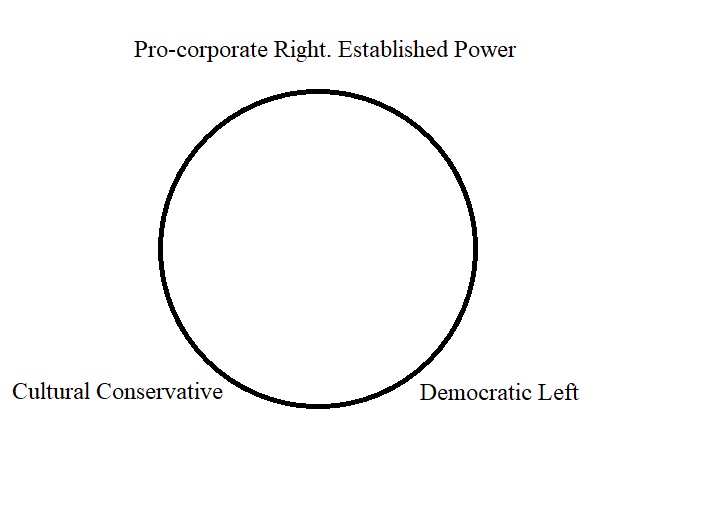
It could be useful to think of contemporary Australian, and probably US, politics in terms of a triad:

(Currently Pro-corporate) Right
Cultural Conservative
Democratic Left.

Using a triad rather than a set of binaries helps us to avoid seeing these factions as opposites. They all share things with each other, can move from one position to another, and ally with one another.

political circle 02

In brief:

The (pro-corporate) Right support established wealth and power. They consider that the powerful are virtuous, and justified in that power, by virtue of that power and wealth. Given that the main contemporary power resides in the corporate sector they tend to support that sector and its justification within so-called ‘free markets.

Cultural conservatives support what they see as traditional culture, and traditional power relations.

The Democratic left supports ‘the people’, against entrenched power and entrenched ‘irrational’ culture. They tend to see themselves as the supreme judges of what is entrenched.

In more detail:

The Right tends to attack the rights, incomes and conditions of ordinary people in order to support established power and hierarchy.

Power must be maintained, and society geared towards providing the best conditions for the powerful to do their stuff (whatever that is; make money, use violence, own land, spout theology etc.), as that is supposedly best for everyone. They are anti-democratic at heart.

They oppose any kind of benefits for the poor, which are not a form of charity which requires genuflection towards the rich, or other elite, and hence reinforces the power system. To them mutual obligation means the obligation of the poor not to accept help that costs the elite anything, or for the poor not to challenge the elites.

They also oppose to any traditional culture or set of values, which acts to restrain the power they support which, as stated above, in our society is the corporate sector.

They encourage culture wars to maintain separation between conservatives and the left, and use conservative respect for established power to persuade conservatives that they are both on the same side.

If contemporary rightists have a religion it tends to assume that wealth is God’s reward for virtue and faith, and that a person’s prime responsibility is for their own salvation and then, perhaps, their family’s.

The main problem the right face is that they know they are right. They think all information is PR and you make it correct by PR, will and effort, or sleight of hand. They are extremely good at sales and marketing in an economic system in which false advertising and hype is normal. They tend to think any counter evidence is evidence of bias, and must also be made up. The problem for them is that eventually reality cannot be denied, and bites everyone, including them.

Conservatives tend to be suspicious of innovation.

Nowadays, living in corporate capitalism, innovation occurs all the time, destroying traditional culture and place, so life is difficult for them.

Capitalism also tends to reduce all value and virtue to money. This often seems fundamentally wrong to conservatives.

While tending to support single authorities, conservatives can also like a balance of social powers to act as restraints. Thus they can support professional organisations, teaching organisation, religious organisations, business organisations, military organisations and conservation organisations having input into government. Whoever is the ‘King’ should have loyal and fearless advisers.

They also tend to think that power involves responsibility towards both the established rules and laws of government and to the ruled. The rulers should cultivate noblisse oblige, protection for the ruled, charity, justice and so on. Ideally while everyone should know their place, there should be mutual respect. Mutual obligation is not one sided.

Religion is often considered vitally important in cultivating virtue, generosity, judgement, content with one’s place and is supposed to act as a restraint on human selfishness.

Cultural conservatives tend to like traditional boundaries for gender, profession, task and so on, especially when tied into religion.

They often consider that traditional culture carries a wisdom, which cannot be easily summarised intellectually, and that breaking traditional culture and its mores carries unsuspected dangers. This can lead them to support functional ignorance, as new knowledge might be dangerously mistaken.

They are strongly suspicious of people for being different, and can team up to put down any difference, thus limiting a culture’s range of potentially constructive responses. This is a weakness.

Another weakness is thinking that by allying with established corporate power, primarily against the left, they are defending cultural wisdom against difference, and that this gives them real power. In other words they often think that established power must inherently be virtuous and conservative. What they eventually discover is that if they get in the way of money making, or whatever the right’s hype of the moment is, then they will be over-ridden completely.

More on conservative philosophy here

The Democratic Left tends to be suspicious of everything that oppresses, or could oppress, people and which only has backing in tradition or raw power. They tend to think that what seems like arbitrary power and culture should be destroyed.

For them ordinary people are as wise as anyone else and should be supported in their efforts to better themselves. People should not be ignored or suffer simply because they are poor or outcast – this is unjust.

The problem for the left is that revolutionary leftists, if the revolution succeeds, become the new rightists. They support the new forms of established power and run roughshod over those who oppose them.

On the other hand, moderate leftists tend to accommodate to the power of the right, and thus end up cautiously supporting oppression to receive funding. They may also accept established power relations in return for what appears to be the ability to moderate that power. This position can achieve something, but without them encouraging another set of power bases, they cannot hold the achievement. This is clear from Hawke and Keating in Australia, Blair in the UK and Obama in the US.

Leftists are often conservative; they don’t want to reduce every virtue and value to money, they tend to like balance of powers, and they often support the achievements of the past which have now been swept away by the Right: for example the Menzies idea that social insurance was a right, and that people should not be humiliated or harassed for accepting it, or the idea that workers form a valuable community rather than a disposable resource. They also tend to support environmental conservation and oppose destruction of land and place.

Their main problem is the tendency to want to overthrow traditional culture rather than improve it. This is one reason, that ‘modern art’ holds so little popular appeal; much of it only rebels. Conservatives are probably correct that culture holds some evolutionary adaptive organisations, but that it may well need to change as circumstances change.

Leftists are easily persuaded that conservatives support harm for the marginalised, are racist, sexist, superstitious and stupid – which helps drive the culture wars, started by the Right, and which tends to throw them on the mercies of the right.

Consequences

The point of all this is to suggest that there is perhaps as much commonality between left and conservatives as there is between conservatives and the right, or the right and the left. There is room to be flexible. However allying with the right is likely to prove disastrous for the other two sides, partly because the right has no respect for reality, only wealth. Both the left and conservatives have weaknesses which sabotage them, but which have a chance of being corrected by the other.

Historically it could be argued that the successful 19th and early 20th century reform movements, that lead to public education and protection against misfortune for the working class, arose through an alliance through the democratic left and the conservatives both recognizing that unconstrained capitalism was destroying traditional life, interconnections and responsibilities. That this economic system was demeaning the working men and women of the country, and that it was Christian to try and help people live lives which were not full of abject misery and poverty.

This alliance was largely successful, despite obvious frictions. It is not impossible that a similar movement against the corruption of public life through money and the destruction of land, water and air could motivate another successful alliance.

The only thing that seems guaranteed, is that if the Right remains dominating, then everything will end badly.

More reflections here…

The Australian Election

May 20, 2019

I was uncertain for the whole last week that Labor would win. Partly because the movement of the polls was in the wrong direction, partly because of the relentless misinformation, and partly because Bill Shorten’s speeches were not precise, and did not say what Labor would not do – which was vital. Labor should also have broken with the misinformation that coal mines bring jobs…. but for whatever reason that seemed impossible.

However the main reason for my despair was reading right wing internet groups. Some of this reading was deliberate and some of this was because I was getting quite a lot of promotional material on Facebook without asking for it. Please note, any remarks here are impressionistic and not a mark of extended research…

The appearance of these groups is of seething hatred and dedication, together with apparent loathing of general uncertainty and uncertain boundaries in particular.

Groups tend to argue by abuse and by flat statement as a way of reinforcing boundaries (if you can’t take it then you are not one of ‘us’), but expressions of disgust and certainty are not uncommon online. The point is that ‘we’ are the righteous, and need to expel the different to keep the boundaries going.

According to participants, nearly everything bad that happens to normal people happens as a result of some left wing policy. Low wages and unemployment, because of restrictions on the economy, migrants, refugees, positive discrimination, green tape and so on. Corporate power is a problem, because the left is all on board and wealthy (a point Tony Abbott made in his retirement speech – it is wealthy electorates who are concerned about climate change, while real people understand the Coalition and know the Coalition is best). Cultural crisis occurs because of cultural marxists, radical homosexuals and transsexuals destroying ‘our culture,’ and weakening its self-preserving boundaries by insisting that foreign Islam, other races and gender constructions are acceptable. It is also felt that Leftists are snobs, hate ‘us’ and make no attempt to understand ‘us’ (or that such attempts are aimed at undermining ‘us’) – and indeed the common left lament that the people have failed has more than a hint of this. Green policies are further attempts to sacrifice working people to rich people’s needs, radical lies and snobbery. Taxation is theft, and its always the working people who get taxed by high taxing parties, which is pretty true; only its the Coalition that does this.

It is common to see people in these groups blame corruption in the Church, the police or politics on leftist values, or the sixties. There is a single handy explanation for everything, despite 40 years of largely right wing dominance.

This blaming merges with scapegoating of particular groups, as a form of avoidance of responsibility. And indeed, one of the problems of the modern world is that we are all responsible. Some more than others perhaps, but not ourselves ever – and we all often fight to avoid recognising that part-responsibility.

The Israel Folau issue (the sacking of a very expensive footballer for claiming gays would go to hell) was surprisingly important because it clearly ‘showed’ oppression of religion, or at the least suppression of authenticity, while demonstrating that the left had joined with the corporate sector in attacking working people who expressed righteous anger with people who attacked gender roles, boundaries and certainties. Again the scare campaign that Labor was going to force our kids to be gender fluid only makes sense in this kind of environment, of existential boundary fear. However, it is a mistake to think that traditional gender roles have much support either, even if people claim they do. Its more complex and flexible than that.

In a few academic articles I have got into trouble with reviewers for arguing that trust in authority has little to do with belief. While these groups fiercely distrust the left they don’t trust the political right either. If their own side is irrefutably shown to have lied or schemed against them, the response is not to consider the possibility of being wrong, but to state “all media lie,” “all politicians lie,” “both sides are the same” or something similar. This allows people to keep their opinion while dismissing evidence that it may be false. This is what contemporary skepticism (or ‘independent thinking’) means, being skeptical of counter-evidence to your own, or group’s, position.

People seek to defeat the uncertainty of a complex crumbling society by being stable, righteous, and avoiding responsibilty by finding scapegoats, who, if removed would solve all the problems people face. For the left it might be capitalists or neoliberals, for the right it is leftists, feminists, gays, transsexuals and sometimes abortioneers. Obviously I think the first position is more likely to be correct

The Coalition campaign made fertile use of these trends – they are much better than Labor at it, perhaps because it avoids criticising real power. More and more, Labor depends on the powers that undermine them, for funding, publicity and respectability.

The basic assumptions of these groups were supported by the Murdoch press and other media promoting the general social fantasies they depend on such as ideas that the coalition manage the economy better, the economy is primary, virtue involves identifying or punishing out-groups. The Labor party ignored this part of life, or perhaps they did not see it or dismissed it as the work of a few fanatics, rather than of a relatively large group of people, who would support anyone who promised to get rid of what they perceived as the leftist challenge to their existence.

Due to communication having to involve interpretation rather than transmission of meaning, it is more or less impossible for such groups to actually hear what people on the other side are saying. Once identified as from that other side, then the boundaries are to be reinforced: that person’s comments are to be attacked, and the person ideally driven away if they cannot be converted. This then leads to a shouting war which tends to reinforce the separation and the further rejection of ‘good communication’.

What to do? The first thing is to admit these groups exist, and that they are powerful and real expressions of ordinary people’s lives. Even intellectuals can often be quick to blame the left for problems or for hostile fanaticisms… Rather than convert them intellectually, they need to be listened to and understood, and then argued with, with some understanding rather than just a condemnation which reinforces their boundaries and life worlds. This requires patience.

It is another example of the paradox that if we are to do anything democratically it will be slow (perhaps too slow), but if we don’t do it democratically and bring people along, then we will fail.

Cardinals and Crimes

February 28, 2019

An Australian Cardinal has just been convicted of child abuse/rape. It is possible he may be acquitted on appeal but this is not a comment on the Cardinal, but a comment on some of his supporters. Please note it is not a call to stop Christians from offering him forgiveness if he is not acquitted, but there is something which needs comment.

He has been roundly defended by members of Australia’s Righteous establishment. They have argued things like he was convicted by an atheist or left-wing conspiracy, the case was bad (despite the well-known difficulties of getting unanimous convictions in such cases, and their ignorance of the testimony or the records of testimony) and so on. They almost universally refer to his character as making the charges unlikely. One ex-prime minister called his character ‘exemplary’.

I do not know the man and have never met him. However, he is on record as having led the Church’s denial response to priestly rape. He has defended rapist priests, been unaware of rapist priests (even when he lived with them), attempted to silence victims, successfully argued that the Catholic Church was not a legal body which could be sued, limited compensation to $50,000 dollars, and smeared people who challenged him or presented evidence of abuse. He has fought fiercely to protect the Church from the appearance of scandal, while allowing the scandalous acts to continue for years. This implies that for the Righteous, institutions exist solely:

  • to promote the authority of those who hold office in them;
  • to defend the reputation of the institution and its office holders;
  • to treat those with less authority in the institution, or those who complain from outside, as sub-human;
  • to crush, isolate and silence those who are hurt by the institution, so it may continue to pretend there are no problems and allow its members to carry on the abuse;
  • to minimize any expenditure on reparation for those hurt;
  • to deny any responsibility for harm;
  • To issue reassuring lies that allow the institution to carry on, and keep its authority secure; and
  • to crush any form of dissent, even if the dissent is simply an attempt to get the institutions’ office holders to recognize there is a problem.
  • That this is considered ‘exemplary,’ I think, tells you a lot about Right wing politics and morality. It is about maintaining their authority, supporting the powerful when they fall, and headkicking those hurt by the system. There is little else to it, whatsoever.