“The main conclusion of the vast majority of 100% renewable energy systems studies, is that such systems can power all energy in all regions of the world at low cost”
Pessimism
However we can also read that is appears that tax payers all over the world, are still subsidising their own destruction.
An analysis of 51 countries responsible for 86% of electricity coonsumption, showed that global public subsidies for fossil fuels almost doubled to $700bn in 2021 largely through government subsidies of electricity prices.
Fatih Birol Director of the International Energy Agency remarked “Fossil fuel subsidies are a roadblock to a more sustainable future, but the difficulty that governments face in removing them is underscored at times of high and volatile fuel prices,”
And Mathias Cormann, the OECD secretary general (!!!well known for collaborating with climate/ecological damage denial governments in Australia) said “Significant increases in fossil fuel subsidies encourage wasteful consumption, while not necessarily reaching low-income households… We need to adopt measures which protect consumers [and] help keep us on track to carbon neutrality, as well as energy security and affordability”
Estimates including implicit subsidies, ie the cost of the climate and air pollution damage caused by fossil fuels, are far higher. These amounted to $5.9tn in 2020, according to the International Monetary Fund, or $11m a minute
There is a long standing argument, going back at least to the early 19th Century, that complicated technologies intrinsically distance, or alienate, people from the natural world. Rather than interacting with the world face to face, as it were, complicated tech separates us from reality. It does most of the thinking and interaction and transformative work. It is like the difference between swords and missiles. They are both designed to kill. One gives you responsibility and the presence of death and what it means, while the other distances you from the mass death you are causing.
To some extent I think this argument might be correct. For example, the idea of overlaying reality with virtual images, could be the absolute instance of separation from the real world and its dynamics. We could, in theory, choose only to see days without pollution, destruction, misery or poverty, and thus cease to recognise that these problems exist. We could choose to make the world more interesting in fantastic ways, to also distract us from the accumulation of real problems which might require political action, rather than heroic questing for virtual items.
However, there is another argument that the problem is not so much technologies themselves, or the development of new technologies, but that technologies can be used and designed for oppressive or alienating purposes. For instance, industrial technology, throughout the 20th Century and now was generally not used to boost the craft, creativity or involvement of the workers in production and work, but to deskill them, control them second by second, and render them as replaceable as possible so as to increase the profit and power of another class of people who owned the tech.
Similarly with the media. We have the capacity for a ‘democratic’ and mass participatory media, but we do not have this – we have billionaire owned and controlled huge media corporations which are primarily devoted towards gaining an audience for advertising and to promote the media owner’s power and influence. We have online ghettoization into conflicting ‘information groups’ which reinforce bias and unreality (of other people of course!), which is encouraged by the algorithms set up by facebook and twitter etc. Youtube shows just tend to reuse the mainstream politicised material and exaggerate the views of the audience they want to attract – also for subscriptions and advertising purposes.
This is quite natural. Systems of social power and organisation generally aim at perpetuating those systems of power and organisaton, or increasing the rigour and effectiveness of that power, so as to benefit the dominant groups, and technology can be designed to be one of the tools in that process.
However sometimes technology can have unintended effects which may undermine dominance, produce destruction or which can be exploited by those who have to use it. This may undermine power and organisation. Thus fossil fuel use while responsible for many societies success, is likely to produce the conditions for their failure. Computers and internet, allowed the boom of new companies and new business models which have disrupted the corporate sector, and allowed new groups to participate, but the technologies have become reintegrated into that sector, transforming it in some ways and extending its power in others.
In all of these senses, technology is often a site of political struggle between dominant and exploited or oppressed groups, to use the tech as either a mode of control or a mode of ‘humanisation’.
It is for example, possible to see a struggle in energy transition. To simplify. There are those who struggle to retain: the established modes of energy production; the value of the capital invested in that technology; and the social dominance, and market influence, control over that technology gives them. There are those who seek to replace the established powers with massive wind or solar farms which retain the centralised energy and power structures of the old system, and those who seek to use renewable energy to boost the social power, independence, resilience and control of local communities who share and distribute the energy generated.
At the moment, it is not clear who will win the energy technology struggle, but governments tend to side with the first two positions. This should change. People into community energy usually now realise that they don’t just face technical problems, but the political and organisational problems of possibly deliberate resistance.
Hence the importance of the recognition that the problem may not always be the technology but the way it is used, and the power relations embedded in it.
This blog note is an unfinished attempt to say something about the basis of ethics, legitimation, delegitimation and the struggles around them in the NSW country town of Narrabri, and the surrounding Narrabri Shire. While this is all highly provisional, it can be stated that the main struggle appears to occur within the context of ‘resources curse’.
Public Domain map of NSW from Ian.Macky.net [Unintended distortion by the blog software?]
Introducing Narrabri
The Narrabri region, as referred to here, is an area in the Northwest of NSW, often (but not always) called ‘the Northwest’, not just Narrabri town, or shire. It is cursed with plenty and lack of resources, both of which are issues because of climate change. Most of the time I will call the area the Northwest.
The Northwest has plentiful supplies of coal and gas, and a marked lack of water, through prolonged drought and possibly declining water tables. The Northwest used to be primarily a farming area, but farms are now hard pressed, and threated by recent mining, with coal dust and threatened damage to the water table through gas mining. There are also large cotton farms which may provoke more water shortages for smaller farms.
As shall be covered in more detail later on both the Federal and State governments seem keen to have more fossil fuel mines and have supported the mining companies in this area. These kind of events may foreshadow the outcome of the 2021 COP – we can also think of a massive expansion of Chinese coal mining [1], [2], and a UN report which apparently claims the world is going to increase fossil fuel emissions until at least 2040, almost three times higher than what’s needed to keep global warming under 1.5 degrees Celsius.
We may be seeing the Green Paradox ramp up [3], [4] – the idea that as it becomes likely coal, and even gas, will be phased out, there is an commercial and ethical imperative to sell or use as much as possible. This is a position encouraged by a massive price increase for coal, going from $US60.00 per ton October last year to $US230.00 per ton this month.
If we are going to try and specify groups, we can specify: farmers, business people in town, mining workers, residents close to mines (usually farmers), residents distant from mines (townsfolk) and Gomoroi people.
Legitimacy struggles
The situation in the Northwest involves an ethical struggle over the legitimacy of fossil fuel mining. Because there is no agreed on basis for ethics, it is hard to resolve this situation totally through the application of ethics alone; it seems probable there are large irresolvable differences between the positions of various social groups/categories. As suggested earlier, ethics is a matter of relative social power between different social group or categories, group identities, relative ‘structural’ positions between groups, changing or maintaining cosmologies, changing or maintaining customs and habits and changing contexts or framings, and arguments over those contexts and framings. It can in the final case depend on threat, violence and exclusion.
It seems to me that the legitimacy argument in the Northwest has several interactive strands, based on the factors just discussed. As also previously suggested legitimacy is not distributed equally between all sections of the population and involves struggle just like ethics. Legitimacy may also be risked any time it is asserted.
Maintaining and changing customs and habits
Fossil fuels are established and familiar, they involve established customs and habits, and modes of organisation. The way forward is relatively clear. This lends legitimacy and ethical potency. Renewable Energy may require new customs, new habits and new modes of organisation, as well as generate new forms of instability while becoming established, and so looks precarious and illegitimate.
There is a sense that the company itself claims to support local customs and improve them for example:
The Santos Festival of Rugby was a momentous success for Narrabri Shire and Santos, bringing the community together after prolonged drought and the COVID-19 pandemic for three days of rugby action in February…. The exciting pre-season game saw the Waratahs claim victory over the Reds, taking home a $25,000 reward and the prestigious Santos Cup.
In preparation for the festival, Santos upgraded Dangar Park with broadcast quality stadium lighting and installed wi-fi connectivity into the clubrooms, which will potentially attract more large-scale events in the future. The economic benefits to the community have been warmly welcomed. The event injected approximately $700,000 into the community through Santos’ direct spend with local suppliers, as well as indirect spend on hospitality and accommodation from visitors.
Other stories in the ‘Community News’, point out the company is going to be net-zero emissions by 2040, which seems improbable, that it is “supporting local business,” “part of the community” and so on. Trying to establish it is one of ‘us’, and generous.
Other people are also mining fossil fuels and selling them, why shouldn’t we?
Cosmology: Prosperity and development
This might be called a society wide pragmatic frame, but it also involves cosmology – in the sense that accepted wisdom implies this is the way the world works, and is the way the world works for the best – the assumption is that abandoning this frame is the first step to chaos.
Fossil fuels have brought what is defined as prosperity and development, where development is defined as the process of increasing material prosperity, increasing technical sophistication and boosting military security. Prosperity and development are defined as good, and as a purpose of life which should be spread throughout the planet – the undeveloped world tends to be seen by the developed world as ‘backward’: poverty ridden and intellectually inadequate whether this is true or not. Fossil fuels are the basis of modernity and benefit many people who use electricity and automobiles, as well as those who profit from them. Prosperity and Modernity are cosmologies which provide contexts and frames for fossil fuel production and use. Maintaining those fossil fuels is therefore the basis of that good, and a potential way of spreading that good. Without fossil fuels life will decline. It is certainly true that fossil fuels have provided plentiful energy (although it is getting harder to obtain), and it is doubtful that renewables can supply similar amounts of energy in the short term.
Many folk in the town (it seems especially influential business people) also support mining because they see the mines as a potential source of prosperity and jobs in the town, which will save the town. There is also a reasonably sized body of activists who see the mining as purely destructive – some of whom are trying to encourage renewable development. Mostly the mining’s obvious deleterious affects occur in the country, and affect farmers, but the ties between farmers and town seems weaker than it once was. There are larger corporate farms rather than family owned farms. Not having the same money farmers are said to not spend as much in town, and they don’t hire as much labour from the town – possibly because of technical ‘advancement’ and the increase in scale.
[Once it was] plausible to support a large family on 250 acres with crops, … [however] today a farmer would need 2000 acres and capital to invest in machinery and equipment.
Brooks et al. 2001. Narrabri: A Century Remembered 1901-2001: p.15
Given the apparent lessened ability to depend on farming, the Mayor of Narrabri at the time, Cathy Redding, argued that the mines should go ahead because:
Population retention would be one advantage for Narrabri, in that jobs would be created, new manufacturing businesses would develop and the multiplier effects of these developments would ensure regional growt
In reality, local prosperity is a matter of how the mining is organised, where the profits go, where the ongoing operational payments go and so on. It is a legitimising frame, which may have little local truth. Indeed the argument that gas mine workers come from outside, that profits are largely transferred elsewhere, while costs remain (such has increased rental housing prices, damage to ecology and water) seems to be one of the most common arguments against the mining. In general the response is largely to assert that prosperity will result, and that Narrabri Shire will avoid the costs. A number of local businesses do stand to benefit from the mines, from increased economic traffic in town and from contracting work with the mines, which legitimates the mine through prosperity contexts. However, results from the 2016 census imply that mining has a relatively low effect; it currently provides 5.4% of jobs, comparing with 11.6% in health and social assistance, 10.5% in retail, 7.7% in Education and 7% in Agriculture forestry and fishing.
Sustainability of the local area, becomes sustainability by new jobs in one field. This acts to promote the gas and distract from environmental damage. There are people who are enthusiastic about this form of sustainability, people who reject it, and people who accept it will happen. It is not really clear from the figures that the Narrabri region is in radical population decline, but we need to wait for the current census results.
I’d suggest that the people who accept it will happen and those who are enthusiastic are that way, because there is almost nothing else officially on offer to generate prosperity, although a brief survey our students did of people in the street, suggested that the idea of Narrabri as a tourist food town was very popular. Many people were clearly fed up of being questioned, which suggests they accept it will happen, rather than working towards rejection.
Renewables are personally popular, but seem to have little social consequence. There was at least some acceptance of the delegitimating arguments against renewables by lack of consistency, and lack of intensity – which is primarily about habit and custom – see below (#). There is little struggle against renewables, probably because renewables are not a threat. They can be almost ignored – which offers a degree of freedom.
Prosperity framings are reinforced by corporate and State practice, and by the widespread neoliberal ideology which acts to put business first, suggests local prosperity flows from encouraging or subsidising corporate prosperity, and attacks any kind of inhibition on business liberty – an ideology which is so persuasive that it is adopted by all the major parties. The supposed farmers party (the Nationals) always seems to put corporate interests ahead of farming interests, as when they protect mines instead of farms, or continue to agitate for lack of climate action, when farmers are pressured by climate change and water problems. Matt Canavan of the National Party has remarked:
About five per cent of our voters are farmers, it’s about two per cent of the overall population. So 95 per cent of our voters don’t farm, aren’t farmers or don’t own farmland.
Furthermore, with the gradual erosion of the welfare state and attacks on unemployed people, like robodebt, there is little other way for ‘ordinary people’ to survive unless it be hanging on to corporate ‘prosperity’.
Changes in Cosmology?
However, the context of this cosmology may be shifting, as argued in a previous blog, the Business Council of Australia, after a long period of complete climate-action denial, has moved into issuing plans for emissions targets and reductions in emissions. The plan is a little ambiguous about coal and gas exports, and it seems significantly motivated by fear of others acting on climate and lessening trade with Australia as a result, but it could change the context significantly and suggest that fossil fuels are not the only, or necessary, way to go.
Protestors can also use the ‘economic reality’ argument:
“Financial institutions around the world are increasingly unwilling to back polluting fossil fuel projects like what Santos proposes at Narrabri.”
Coal seam gas drilling has bought a harsh boom bust cycle to other towns, especially in Queensland, leaving the towns with little but damage and rusting well sites. This surprisingly, has little effect on the prosperity framing for many. It appears local business knows the risks, thinks it is smart enough not to be caught out by the damage that has happened in other towns, and that this intelligence helps support the legitimacy of the operation. They want it to succeed, or need it to succeed, without cost, so it must. To some extent this is doing what other people have done with the hope it has different consequences. However, the realisation of damage elsewhere is a challenge to cosmologies of prosperity.
Another challenge to prosperity through fossil fuels is the idea of prosperity through renewables. An ISF report suggested as one option the rather unlikely figures of “2,840 [local] ongoing maintenance and operation jobs by 2030” if Narrabri started going (corporate) renewable, whereas Santos only promises “up to 200 ongoing positions” [5], [6]. The problem seems to be that the ISF figures seem exceptionally high for solar, and so unpersuasive. People have another experience with solar farms in NSW – they require very little maintenance – mainly cleaning (with the expectation of water use).
Finally while the Gas mining has been justified by NSW need for local gas, a report conducted for the Climate Council suggests that NSW is likely to:
reduce its annual gas demand by the same amount that the Narrabri Gas Project is forecast to produce, as soon as 2030.
This report effectively renders the Narrabri Gas Project redundant. We already know that this project will drive up greenhouse gas emissions, worsen climate change and do nothing to reduce power prices. Now we also know the project is completely unnecessary when it comes to meeting the state’s energy needs,
Power relations – Fossil fuel companies and the State
In corporate capitalism, in general, corporations have more bases for power than community groups. The have wealth, contacts, prestige, ability to put out information, buy politicians and think tanks, even gain violence from police or from outsiders (there is no suggestion that companies in the region have done this, but it is certainly possible in general) etc. The power relations are not equal, and many people may think siding with the corporations could grant them benefits, while opposing them could make their situation worse.
Fossil fuels and fossil fuel companies, have State support which can override any local objection that does not command the allegiance of a vast majority of local people, and this potential for power when allied with at least some at the local level, not only gives fossil fuels support or indifference, but makes them easier and cheaper to mine. For example it has been alleged that the State government neglected to implement most of its Chief Scientists recommendations to make gas drilling safe [7], [8] [9].
One person in Narrabri insisted that
the government had not implemented 14 of 16 recommendations to limit the risk of coal seam gas made nearly six years ago by the then NSW chief scientist, now Independent Planning Commission chair, Mary O’Kane. “Our government has betrayed us,” Murray said.
The Federal minister apparently approved the gas wells before the company explained which parts of the Pilliga forest would be cleared, it finished investigating effects on local groundwater, or developed a biodiversity plan, important given local koala habitats and declines in koala populations not to mention other endangered animals. Later on the project was boosted by the Federal Government’s ‘gas-led recovery‘ (“Cheaper, more abundant gas is the second pillar of our energy plan for COVID recovery. We’ve got to get the gas.” “this [Narrabri project] is 1,300 jobs, $12 billion worth of investment and it is absolutely critical“) and that government’s agreement with the NSW state Government to fund gas [10], [11], [12], [13]. One comment was:
The state government has committed to injecting an additional 70 petajoules (PJ) of gas per annum into the east coast market in return for $3 billion from the Commonwealth government.
NSW Premier Gladys Berejiklian flagged two possibilities to supply the gas; import it or source it from the yet-to-be-approved Santos Narrabri Gas Project, which will create 70 PJ a year….
[The local MP said:] “They have absolutely corroded the independent process,…
“Regardless of the good intentions and the upstanding integrity of the Independent Planning Commission, if the project is approved, the perception will always be they dangled $3 billion in front of them to get the approval.”
It seems that in July 2020 the NSW Government was worried that Federal support for the Narrabri project was too overt and that:
any impression that the outcome of the IPC [the NSW Independent Planning Commission] process is pre-determined could undermine public trust in the process.
They apparently realised that enforcing the case could undermine legitimacy. However, the project was listed as one of 15 major projects to gain a reduction in their “assessment and decision timeframes.” This received remarkably little publicity at the time. There are frequent references to a PM’s announcement, but the announcements I’ve found did not include all the projects, or mention the Narrabri project.
Fighting against large fossil fuel companies is also a difficult process in Australia, as if you win, it seems possible the State will change (or appeal) the law so you lose, or the Company will try again in a marginally different manner, or that they will successfully claim a new mine is an expansion of an old mine. For example, after the Rocky Hill coal mine was refused on the grounds of the emissions production overseas when the coal was burnt, the NSW government legislated to to prevent “the regulation of overseas, or scope-three, greenhouse gas emissions” in mining approvals to give certainty to miners [14] [15].
Fighting against fossil fuels is fighting against both the State and Fossil Fuel companies and unlikely to succeed in terms of power relations and money.
The State is not supporting development of any LOCAL processes in the Narrabri region (that have been mentioned to me) which could provide prosperity or increase survival opportunities, which do not depend on fossil fuels. This makes it harder to challenge fossil fuel legitimacy. However, the NSW state government, has recently managed to gain emissions targets for 2030, and it does support corporate renewables elsewhere, through Renewable Energy Zones, which seem to be geared to supplying the big city and industrial areas on the Coast. But it is not clear that the state or federal governments do much to support local energy supplies via renewables or community renewables, or will oppose fossil fuels directly. Both Parties in Australia have made it clear they are in favour of mining fossil fuels, establishing new fossil fuel mines, and selling the products overseas.
Opposition resources spokeswoman Madeleine King has said Labor will not stand in the way of new mines and believes Australia will export coal beyond 2050…
For so long as international markets want to buy Australian coal, which is high quality, then they will be able to.” Ms King said Labor was “absolutely not supportive one bit” of a push by Malcolm Turnbull for a moratorium on new coalmines
One framing which allows them to claim this is compatible with climate action is the convention that emissions only occur in record of the country burning the fuel, and likewise should not apply to the company profiting from the emissions (as they are outside its control). If the measures were changed this claim of legitimacy might fall.
In a somewhat contradictory policy regime the NSW Government made declared the only active petroleum/gas exploration licences to remain in action were to be those supporting Santos’s Narrabri coal seam gas project, due to concerns from other regional communities [20].
So again we have the power differential and the assumption that fossil fuel profits are good, but changing the law like this also draws attention to the way the law is a political tool used to benefit particular groups.
Context/Framing: Regulation
Current regulation which is based on previous habits, limits connecting energy sources, and energy sources with users, without using the grid, especially if they cross property boundaries. These regulations are largely a matter of custom, and do not reflect the new situation, but there is inertia, because the new situation is easy to ignore, if we keep established power relations going.
Connecting these household sources might provide some kind of new paradigm or framing once it is established, or perhaps during the establishing.
Recent proposals for a feed in tariff suggests that household players could end up paying for export, further discouraging action.
These regulations shape the economy to favour existing players, deliberately or not.
Enforcement?
Apparently, in 2016 the State government increased penalty terms for protesting on land and disrupting mining equipment [21], [22], [23]
There is little sign that the Australian State will change its pro-fossil fuel status, so while it may be useful to try and take back the State, it is also useful to move outside the State, perhaps through local level activity, to try and overwhelm the legitimacy of fossil fuels in general – but the question is whether working outside the State removes legitimacy.
Local Power relations and desires
Local action rarely has state backing when in opposition to mining.
Surveys and polls
There is repeated self selecting survey and other evidence to suggest that most to a large percentage of people in the region do not support the gas fields. For example 64 per cent of the local submissions to the Environmental Impact Statement Inquiry in 2018, were opposed – non local submissions were even greater in their opposition. A Lock the Gate survey of 840 people found 97% of people were in favour of renewables to provide long-term jobs, 52%, of people surveyed were opposed to the gasfield, 28% of people said they were in favour of the gas, and and 20% were unsure. “55% of the people surveyed said they were very or somewhat concerned about the gasfield and only 24% said they were not concerned”. Never the less, the implication is that a reasonable number of people could accept both gas and renewables. A Gas Industry Social and Environmental Research Alliance (a collaborative research institute with members such as Australia Pacific LNG, QGC, Santos, Origin Energy and CSIRO) survey found that that 30.5% of residents ‘reject’ the gas, 41.7% of residents would ‘tolerate’ (27%) or be ‘ok with it’ (15%) (which suggests at least some of these would be accepting or indifferent), while 27.8% of residents would ‘approve’ (13%) or ‘embrace’ (15%) CSG development (pp.5, 22). It again seems clear that lack of enthusiasm, overwhelms support – but suggests that perhaps it would be difficult to organise opposition against corporation, state and law.
As implied earlier was the case, it appears to the GISERA survey that “Residents who lived out of town held significantly more negative views towards CSG development than those who lived in town”, and that:
Potential impacts on water quality and quantity were the top two concerns (M = 3.75 and M = 3.74 respectively), followed by community division over CSG development (M = 3.63) and the disposal of salts and brine (M = 3.63)
(ibid: 24)
An Informal survey conducted by UTS students in the streets of Narrabri town, presents some further clues as to what might be happening. Out of “four priorities” for the town 59% selected ‘more employment’ again showing possible survival anxiety dominates, 29 per cent selected ‘improved government services’, 9 per cent ‘stronger community life’, and only 7 per cent selected ‘more sustainable environment’ as their highest priority. Asked to identify the biggest threat to the Region out of five choices, 31% chose drought and climate change, 29% chose loss of local businesses, 20% chose drift of population to larger towns or cities. Asked to choose multiple options for the future, 69% chose local farming and food culture, 43% chose community-owned renewable energy, 31% chose large scale renewable energy, and 29% chose large scale coal and gas. Again the suggestion from this multiple factored informal survey is that mining has fairly low committed support, on par with community renewables, and possibly flows from anxiety about survival.
A click through survey on the Land website, when checked on 23/10/21, gave the results to the question ‘Do you want CSG production at Narrabri?’ as 76% No and 24% yes, but I see no mechanism to stop people voting more than once.
Lack of State support for alternative development in the area, reinforces the apparent ‘need’ for gas and the prosperity/survival it promises but may not deliver locally. This can be seen as part of the connection between State and Fossil fuels. However, local contracting and other businesses which can possibly benefit from mining, take these power relations into the local area, not only through individual businesses, but sometimes through the Local Council (which has to look after local business as it is a major source of local income for people) and through the Chamber of Commerce.
Local Power relations and fragmentation
In the debate about the gas, hostility has been marked, and become pretty polarised. Anecdotes of painful events were common, such as stories of break up of long standing friendships and groups over the gas issue, stories about public rudeness, public ridicule, unfair division of time or access to Council, and so on. People seemed extremely wary of anything that might start an argument.
Both sides, to some extent, blame external forces for the fraction. Many of those we spoke to who were in favour of gas, claimed that people from Lock the Gate were not locals, but city folk – trying to imply the protestors were not from the area, and thus delegitimate them through social categorisation.
These lot just rock into town and tell us what we should be doing with our land. I mean we’ve been here our whole lives.
Interestingly no mention that the mining companies are also from out of town, which indicates the effectiveness of the “we are one of you” categorisation game played by the mining company. However, the objection to protestors goes through conservative politics and there are still ongoing attempts by pro-fossil fuel groups to strip LTG of its charitable status, and reduce its funding.
This indicates a legitimacy struggle over fossil fuels, but it also shows the local cost in a relatively small community.
Framings and power
These framings interact and appear to magnify each other in terms of granting legitimacy (support and acceptance) for fossil fuel mining. Social order, customs and habits is largely built on fossil fuels, and survival is reduced to what is good for business, which is reinforced by alliances between miners and the State, and regulations which are based on the needs of established industry and which inhibit competition. Laws reinforce the survival threats against protestors, which have the probable intention of making delegitimation reluctance or rejection visible. Even the divisions in town seem to be based on external forces, and the hopes or despair begin cultivated, and it implies that there is some way in which people are being treated as extreme or the differences cannot be ignored. It could easily be alleged that local resistance is overwhelmed by outside input, and local fears about survival.
These are largely external contexts which are provided to the region and which shape possible action in the region. The main sign of what is happening locally is the social fragmentation, which seems to be encouraged by these external factors as much as by internal factors.
However, there are some signs that these contexts could be changing (the NSW targets, the BCA, the visibility of ‘cheating’ in the courts), and there is the possibility that changes in complex systems can accelerate quickly. Further signs shall be discussed below.
Delegitimating Fossil Fuels
Reframing 1: fossil fuel damage
The proposal for the gas suggests there will be around 850 gas wells over 425 well-pad sites, so the project will have significant impacts on local appearance. People are assured that no serious ecological damage, or damage to the town economy, will arise from fossil fuel mining, which is perhaps contradicted by this number of wells. This reassurance is impossible to guarantee, but neoliberalism seems happy to ignore damage that helps profits of large companies. However, this complacency is a possible breaker of legitimacy, as admitting that a process could damage the ecology, town and farming seriously, could reframe that process. Not admitting the possibility of damage (when it is reasonably well documented elsewhere) also adds to the perception that those who won’t admit the possibility are lying – the new frame is in play. So we have prosperity and damage framings being brought in.
The possibility of water damage has to be defended against, or else they cannot proceed. The company denies possible serious damage to the water table (the famous Great Artesian basin), which is above the gas tables. The gas comes through the water. Even if they seal the drill holes well enough to not have produce damage immediately, they probably cannot guarantee these seals will not fail in hundreds of years, and when you are dealing with ecology you are dealing in thousands of years at least… There is also water in the gas tables, and that is toxic, and there are signs that leakage has already occurred.
Bringing in the question of environmental damage, and possible poisoning of basic necessities such as air and water, challenges the prosperity frame’s coherence.
There have been protests against gas mining in the region, since it was first proposed, with national community activist organisations such as Lock the Gateand People for the Plains, having a large presence in the area. For example on its current website Lock the Gate attempt to reframe gas in terms of damage, ecological and economic.
When every fracked gas well needs 30 million litres of fresh water and 18 tonnes of chemicals, and when gas already contributes 19% to our greenhouse emissions, it’s actually a recipe for disaster…
For every 10 jobs created in coal seam gas (CSG), 18 jobs are lost in agriculture Over 120 farm water bores in Queensland have already run dry because of coal seam gas Direct loss of farmland for CSG results in farmers losing up to 10% in economic returns More than $2 billion in public funds have been allocated to the gas industry in the last financial year
The threat of environmental damage is now so ‘obvious,’ that it can be used to draw the ire of neighbouring farmers, as when Lock the Gate suggested it was likely that the Gas Company would extend its mining operations into neighbouring areas of the Northwest such as Namoi Valley and Liverpool Plains, as such creeping expansion has happened elsewhere and the State Government’s moratorium on further gas exploration did not cover that area. The local MP stated:
I think it is highly hypocritical to suggest that one electorate in regional NSW should have these things and another shouldn’t…
I would like to see all of these PELs [Petrol Exploration Licences – which include gas] totally extinguished because most coal seam gas (CSG) and gas reserves that are based in the coal bed interact with water aquifers and to get to the seams you have to punch holes through the aquifers.
We have just been through the worst drought in living memory which showed us just how important groundwater is and our regional communities know how important groundwater is.
“It doesn’t matter if you’re in the Tamworth, Barwon or Northern Tablelands electorates, it’s important in each and every one of them.”
Emily Simpson, NSW Farmers Association Policy Advisor had previously also pointed out that while farmers did not oppose gas in principle,
the location of the Narrabri Gas Project creates an unacceptable risk to the precious water resources of northern NSW.
The many conditions attached to the project are designed to minimise this risk, however do not recognise a simple reality: water sources that are damaged cannot be replenished or replaced. The possible harm to water resources has been confirmed by the NSW Government’s own Independent Water Expert Panel.
Bringing climate change in as a frame, suggests that while fossil fuels can bring prosperity and order they are gradually bringing in chaos and disorder which may be so great as to undermine the existence of the shire itself. It is not clear how effective this framing is in Narrabri itself yet, although it is clear from reading the Federal court judgement in the duty of care case, referred to above, that evidence about climate change was extremely significant to the judge – and people did talk about drought and climate change.
The International Energy Agency has argued that there can be no new gas, coal or oil projects if people wish to avoid catastrophic climate change. The IPCC agrees in its latest report. Thus support of new coal could be seen as completely destructive, a position perhaps harder to take as climate change becomes more obvious…
The gas company makes a few half hearted suggestions that it is green. After taking over another gas company, the managing director said:
the combined group would be better-equipped to seize opportunities to expand into clean-energy technologies such as carbon capture and storage (CCS) and zero-emissions hydrogen. “Size and scale have never been more important as we look to fund the energy transition to net-zero emissions,”
This implies that rather than cease emissions they hope to remove them, which is not a successful technology at the scale required.
As a number of my colleagues have suggested, there is some evidence to suggest that knowledge of climate change, has made external organisations more interested in offering support to local people opposed to the mines, perhaps providing support, or perhaps increasing the local friction.
Climate change itself is also starting to increase destabilisers of legitimacy, through increased droughts, fires and storms. Through observing the consequences, farmers are starting to ally with environmentalists, and possibly indigenous people, to protect their land from ill effects of ‘development.’ Recently in Australia the National Farmers Federation has cautiously announced support for an emissions target in discussions with the National Party who reject the idea:
Far from creating uncertainty, a target actually creates certainty in an industry where much is uncertain…. the one thing that is certain is that if we set targets we can work towards those targets
This again is a small change but it fits in with other changes, in moving the legitimacy of emissions.
Reframing 3: Cheap energy with local benefits
Renewable energy, especially solar is cheap and modular. It can be built up, part at a time, in small clusters. It does not require the large amounts of capital that fossil fuel energy requires to generate community level low polluting power. It may not be as profitable as fossil fuels but while that is important for corporations, that may not always matter that much for community groups. But it sets up possibilities.
Over 60% of dwellings in the 2390 postcode which includes Narrabri have rooftop solar, so solar is popular, but rooftop is not communal – its about individual virtue, concern or money saving. It is possible to have solar panels and still support fossil fuels.
There is a relatively new organisation called Geni Energy which is exploring the possibility of community renewables being used to generate cheap energy for activities which could lead to prosperity in the region (‘the Northwest’) beyond coal and gas. The idea is to bring plentiful energy into the region, which keeps money in the region, as opposed to the profit centres being outside the region (as with the coal and gas). As previously explained regulations make this project difficult, but not impossible. However, the issue is how quickly the community projects can get up, and how much support they can gain in terms of the framings contexts of customs and becoming habitual, prosperity, external power relations, regulation, and enforcement. That requires several breakthroughs, their ability to build community and extra-community networks – which they are trying to do – and their ability to shift people into enthusiastic support and acceptance.
Reframing 4: Corporate Solar
The company currently establishing a commercial solar farm [24], [25] does not seem well connected to the community, does not seem to provide many continuing jobs, and the connections to take power out of the region are not particularly good, and there is no sign the State government, or anyone else, will improve this. Commercial renewables will be unlikely to supplant fossil fuels, or bring similar prosperity to the Region, (few jobs after construction and money leaves the town) and if they do, that does not remove the link between fossil fuels and prosperity in made in Narrabri.
There are some other corporate solar farms in the air, but some people have said these are ambit claims primarily to lock others out. In any case they have no significant involvement in the region, or apparent connection with people. They are all pretty vague.
Corporate solar is not necessarily helpful in raising support for renewables or delegitimating fossil fuels.
Other Tools
Court cases and appeals against Environmental approvals have been the most effective. While they have not stopped the mining, they have delayed its onset, which (if the State could be persuaded to take export and other emissions seriously) would possibly eventually stop the permissions give to mine.
Conclusion
The contexts and framings for legitimating renewables and the delegitimating fossil fuels do not appear (at this moment) to provide the level of mutual reinforcement that the pro-fossil fuel contexts provide.
The prosperity / devlopment /growth format more or less engenders the State fossil fuel company alliance, and the commonsense that life requires fossil fuels. Habits and customs mean that people in the developed world use (actively or passively) for transport, food transport, computing, delivery, exports, imports, plastics and other components all the time. Without fossil fuels these habits would have to change, and that produces a degree of fear. New habits, and other cosmologies have not yet developed, although they are developing.
Professing support for fossil fuels does not have to involve an active campaign against renewables, they can rely on habit, regulation, power that is external to site, and hardening social categories to get the support to get them through. While the State government is changing, it does not seem to be wanting to stop fossil fuels, or lower them that much. The gas company is in the position where it is likely it has a time limit and would like to get the gas out as soon as possible.
There is no reason to assume that maps of legitimacy for fossil fuels and renewables would overlap in terms of the positions of various groups on the grid – while I can make good guesses as to where groups might appear, there is as yet no hard data which would allow the plotting.
However groups in Narrabri seem to be fractured and histories of past pain possibly leads to low levels of discussion and difficulties in developing cross group policies or actions. The history benefits those who would stay with gas and coal mining. There is also no way to enforce renewables, but the law enforces fossil fuels and restricts protests.
However, it seems possible that the legitimacy of fossil fuels is largely supported by indifference, acceptance, or the sense of there being no alternative. This could change, if there was an alternative, or there was more reach out by activists (which may be hard given an audience avoiding pain).
The main hope is that the context framing of the legitimacy systems for fossil fuels are starting to show cracks, becoming precarious and coming to their end, and that like the electoral legitimacy of the US government, they will collapse rapidly, and in this case in time for action to have some mitigating effect.
There is the possibility of trying to avoid the state and function outside it, circumventing regulation rather than following regulation. This requires the formation of a local movement, perhaps in community energy, through social enterprises like Geni. In Western Australia there seems to be a formal movement to do something like this with proposals to help towns get off the grid, and be put in charge of their own energy through disconnected microgrids.
That solar energy, is cheap and modular, means that community groups can build their own energy supplies over time, buying (or gifting) panels as they can afford to, and if the regulations change, connecting them up.. They don’t have to have huge building projects, projects can be manageable and use local labour.
Courts seem incapable of enforcing strictures against Fossil Fuels, but they make the artificial and political nature of the current set-up clearer. If the laws are changed or ignored, then the laws supporting the fossil fuel system seem more arbitrary and less legitimate – it also engenders delay which, if the context, changed, might make a significant difference.
Complexity suggests that small regular changes can make large differences to the whole system; the question becomes what are those changes?
So there is hope, amidst the difficulties, but it will not be easy.
All I can do is suggest that legitimacy is complicated and that the data indicate that is so. Part of what research can sometimes indicate is the inadequacy of data, and stimulate new questions.
As part of the general neoliberal thrust, resources companies, especially oil companies, were worried that that governments might ‘interfere’ in the market and cost them profits. In particular, former colonies might nationalise resources, weaken the companies’ control over these resources, increase royalty demands, or otherwise hurt corporate business models. Decolonization was a risk. The idea was to team up with banks, who would presumably have their income streams threatened if the companies were unable to pay off loans, and construct a international legal regime to protect their interests. Western governments also supported this movement, which helped come into being, but they ‘forgot’ (?) that it could apply to them as well. The eventual solution became known as ‘investor-state dispute settlements’, or ISDS. [1]
Energy Charter Treaty
The Energy Charter Treaty (ECT) is one such ISDS treaty. It is:
an international agreement from the mid-1990s. Investor rights apply to 53 countries stretching from Western Europe through Central Asia to Japan, plus the EU and the European Atomic Energy Community. It grants corporations in the energy sector enormous power to sue states at international investment tribunals for billions of dollars, for example, if a government decides to stop new oil or gas pipelines or to phase out coal.
The ECT gives sweeping powers to foreign investors in the energy sector, including the peculiar privilege to directly sue states in international tribunals consisting of three private lawyers, the arbitrators. In these tribunals companies can claim dizzying sums in compensation for government actions that have allegedly damaged their investments, either directly through expropriation or indirectly through regulations of virtually any kind….
This investor-state dispute settlement system – also known under the acronym ISDS – can be used to dispute any action by a nation state that could affect an investment: laws and regulations from parliaments, measures by governments and their agencies, and even court decisions, no matter whether they are taken at the local, regional, or national level. ‘Investment’ is interpreted so broadly that mere shareholders can sue and corporations can claim not just for the money invested, but for future anticipated earnings as well.
The treaty is sometimes defended as it means that States have to continue to support any renewable energy provisions they made to attract investors, but it would also apply to any rules that had encouraged or allowed dangerous or ecologically destructive fossil fuel developments and investments, and this is more likely to be an issue as fossil fuel exploitation has gone on much longer (One Treaty to Rule Them All. p.77).
As Secretary General of the ECT Urban Rusnák has said: “The ECT is technologically neutral…. We have to use the entire variety of energy sources available and the ECT is friendly to all of them.”
This treaty sets up “Investor-state dispute settlement” (ISDS) mechanisms which are common in most ‘free trade’ treaties. Chris Hamby on Buzzfeed (not the most respectable news source) writes of ISDS in general.
An 18-month BuzzFeed News investigation into ISDS for the first time casts a bright light on the use of these threats. Based on reporting from Asia, Africa, Central America, and the US; interviews with more than 200 people; and inspection of tens of thousands of pages of documents, many of which have never before been made public, the series has already exposed how executives accused or convicted of crimes have turned to ISDS to help them get off the hook…. Today’s story reveals how corporations have turned the threat of ISDS legal action into a fearsome weapon, one that all but forces some of the countries where these corporations operate to give in to their demands….
Only companies can bring suit. A country can only defend itself; it cannot sue a company. Arbitrators who decide the cases are often drawn from the ranks of the same highly paid corporate lawyers who argue ISDS cases. These arbitrators have broad authority to interpret the rules however they want, without regard to precedent and with almost no public oversight. Their decisions carry extraordinary power. Often, countries are obligated to obey ISDS judgments as if they came from their own highest courts. And there is no meaningful appeal.
ISDS is so tilted and unpredictable, and the fines the arbitrators can impose are so catastrophically large, that bowing to a company’s demands, however extreme they may be, can look like the prudent choice. Especially for nations struggling to emerge from corrupt dictatorships or to lift their people from decades of poverty, the mere threat of an ISDS claim triggers alarm. A single decision by a panel of three unaccountable, private lawyers, meeting in a conference room on some other continent, could gut national budgets and shake economies to the core.
Any action which might cause a foreign company to lose money is a target of the ISDS.
Executives convicted of crimes in a country can use ISDS mechanisms to intimidate that country.
Companies can sue countries, but countries cannot sue companies.
The justice of the cases is decided by a tribunal of lawyers who use the system to make money by suing countries under ISDS.
These lawyers apparently have the power to decide how the agreements work, and so are likely to oblige fellow lawyers who might be sitting on a case they are participating in, later on.
The fines are punitive, often making it a good strategy to yield when such a case is brought..
The buzzfeed article goes on to detail several cases, which are relevant to mining.
Australian response
The Australian Government remarks that such an agreement does not prevent the Government from:
changing its policies;
regulating in the public interest;
regulating in the interests of the environment;
regulating in the interests of the Pharmaceutical Benefits Scheme or health system.
ISDS does not freeze existing policy settings. ISDS claims must be based on breach of an investment obligation. It is not enough that an investor does not agree with a new policy or that a policy affects its profits.
there has been just one ISDS tribunal hearing against Australia. The dispute was brought by Philip Morris Asia challenging Australia’s tobacco plain packaging legislation. On 18 December 2015, the tribunal issued a unanimous decision agreeing with Australia’s position that the tribunal had no jurisdiction to hear Philip Morris Asia’s claim. More information on this case is available at Tobacco plain packaging – investor-state arbitration.
Perhaps the ECT is one reason why most Australian political parties seem to shy away from any restrictions on gas and coal, and they do not wish to admit there lack of sovereignty, which is usually such a big trigger for them.
A Boon to Fossil Fuel Companies
Paul de Clerck, the economic justice coordinator at Friends of the Earth claimed that:
the treaty was outdated and “a boon to dirty fossil fuel companies”…. “As soon as people hear about this obscure pact undermining the public interest and the fight against climate change, they will be outraged. Either the EU and member states fundamentally revise it, or pull out,”…
Friends of the Earth Europe is one of 260 civil society organisations and trade unions that have warned the ECT is incompatible with climate action because it contains measures to protect energy investments even where they contradict climate goals.
Activists tell us that the treaty has already been used to extract compensation for government action:
The risk is illustrated by Vattenfall’s €4.3 billion lawsuit against Germany over the shut down of two nuclear power plants. The ECT can also be used to put significant pressure on governments to allow new projects which would accelerate climate change and further lock-in fossil fuel dependence. This is illustrated by Rockhopper’s ECT challenge to Italy’s ban on new off-shore oil drilling projects….. as well as ECT litigation threats against laws to put an end to fossil fuel extraction (in France), and to ban the use of coal for electricity production (in the Netherlands)…. Also, When in 2019 the opposition British Labour Party planned to take the energy industry back under public control, arbitration lawyers predicted a “flood of claims” under the ECT and other investment deals. [for the Labour Party see also [1], [2]]
Another telling example comes from the North American Free Trade Agreement (NAFTA) between the US, Canada, and Mexico, which includes investor rights similar to the ECT’s. In 2013 oil and gas company Lone Pine sued Canada under NAFTA for US$118.9 million due to a moratorium on hydraulic fracturing…
TransCanada sued the US for a stunning US$15 billion in damages over the Obama administration’s rejection of the Keystone XL oil pipeline, which would have increased CO2 emissions by up to 110 million tons per year. While the company withdrew the lawsuit when the Trump administration approved the project, it is worth noting legal experts thought that TransCanada had a good chance of winning
foreign investors can bring ISDS cases against states without exhausting local remedies – a privilege exclusive to foreign investors. Further, international arbitrators protect foreign investors’ expectations, but not the expectations of states or local communities. This legal regime also allows oil companies to strike back after local courts find them responsible for environmental degradation, like Chevron did in the Lago Agrio (Ecuador) case. A few weeks ago, Shell did the same thing. It launched an ISDS case against Nigeria after a domestic court ordered the multinational giant to compensate the Ejama-Ebubu community.
Today no other trade and investment agreement has triggered more investor-state lawsuits than the ECT. By October 2020 a total of 134 ECT investor lawsuits were listed on the website of the ECT Secretariat. Both the number of cases and the amount of money at stake for public budgets and taxpayers is on the rise.
Another cause for concern is that the possibility of such action against States, not just from the Energy Charter Treaty but other trade agreements, is now considered a potential corporate asset
The sums awarded in damages are so vast that investment funds have taken notice: corporations’ claims against states are now seen as assets that can be invested in or used as leverage to secure multimillion-dollar loans. Increasingly, companies are using the threat of a lawsuit at the ICSID to exert pressure on governments not to challenge investors’ actions…..
There is no appeals process – only an annulment option that can be used on very limited grounds. If states do not pay up after the decision, their assets are subject to seizure in almost every country in the world (the company can apply to local courts for an enforcement order). While a tribunal cannot force a country to change its laws, or give a company a permit, the risk of massive damages may in some cases be enough to persuade a government to reconsider its actions.
These laws, aimed at protecting companies and investments, help to discourage energy transitions, and recompense the fossil fuel companies for no longer being able to destroy the world.
Looking at the Treaty itself UNFINISHED
The Section of the Treaty most relevant to our consideration is “Article 19: Environmental Aspects”.
each Contracting Party shall strive to minimise in an economically efficient manner harmful Environmental Impacts occurring either within or outside its Area from all operations within the Energy Cycle in its Area, taking proper account of safety.
In doing so each Contracting Party shall act in a Cost-Effective manner.
In its policies and actions each Contracting Party shall strive to take precautionary measures to prevent or minimise environmental degradation.
The Contracting Parties agree that the polluter in the Areas of Contracting Parties, should, in principle, bear the cost of pollution
Biofuels have been a major part of the supposed energy transition. They have been the subject of much investment, governmental legislation and subsidy, to make them attractive and sometimes to force consumption.
The fundamental problem is that as biofuels work through burning, they produce greenhouse gas emissions now, and do not lower greenhouse gas emissions (even in theory) until the emissions released in their production are recovered through regrowth, and it is generally much quicker to burn material than to grow it back again. They may never reduce emissions if they do not replace other worse sources of emissions and pollution, rather than being used in addition to fossil fuels, or producing no incentive to lower fossil fuel consumption.
That biofuels fulfil either of these conditions is dubious, but they can also produce systemic problems:
Biofuels may take a lot of energy and land to produce and transport repeatedly to places of consumption, so their EREI could be extremely low while pollution could be high.
Farming, or extracting, these fuels, can: require fertile land and dispossess small holders, forest dwellers, and dependent labour from land (increasing food problems); bring about destruction of old growth forests (increasing CO2 emissions); decrease biodiversity; increase systemic vulnerability to plant disease; and increase price of food by taking land away from food production.
Using genetically modified algae for biofuels could risk ecological damage, if the algae escape.
Using organic waste, usually for the production of biogas, may remove natural fertilisers from the soil, and increase the energy consumed in making replacement chemical fertilisers. It may also lead to the deliberate production of ‘waste’ to fuel the biofuel plant – as with wood chipping.
Using plastics as sources of biofuels, is simply using fossil fuels in a rather complex way.
Harmful, or dubious biofuels may be used to boost the illusion of a progressing renewable energy transition, and take attention away from more beneficial technology.
All of these factors make the ecological and social situation worse.
To solve the ‘burning problem’ people and organisations have proposed using biofuels with Carbon Capture (BECCS), but this assumes carbon capture is feasible and works, and that we can store or use the extracted gas without risk of releasing it. This seems to be largely an argument from fantasy.
This does not mean that all biofuels are useless in all circumstances. There are small scale exceptions when locally made biofuels can be used locally to add power to villages which are not connected to reliable electricity, or who suffer from a lack of traditional fuels, but even then replanting trees, and regenerative agriculture may be necessary as well.
Recently former Coalition Australian Prime Minister Malcolm Turnbull was briefly appointed by the NSW Cabinet to being the Chair of the NSW Net Zero Emissions and Clean Economy Board.
It was not a long lasting appointment, and the politics are illuminating
For those who are not local. Malcolm Turnbull is a member of the supposedly conservative Coalition of Liberal and National parties. He was deposed from Prime Ministership because he took a few vague steps towards climate action and had an energy policy of sorts. The current PM does not take action or have an energy policy in favour of transition, but says he does. The other main figure in the story is NSW Energy Minister, Matt Kean who also appears to believe in climate change and is working to produce an energy transision policy for NSW. The policy has been exceedingly vague, but is slowly taking shape.
The Announcement
Matt Kean, organised the position for Turnbull on the Net Zero Emissions and Clean Economy Board and said the Board would provide strategic and expert advice on program design and funding proposals under the State’s inaugural $1 billion Net Zero Plan Stage 1: 2020-2030.
The Board will help us to drive a clean industrial revolution for NSW – providing advice on opportunities to grow the economy, create jobs of the future, support industry to develop low emissions technologies and modernise industrial processes,… The Board is also going to be key in delivering low-carbon jobs in the Hunter and Illawarra [where there are coal mines and old industries], to help those economies diversify.
“In reality, we are going to move away from burning, and the world is going to move away from coal,” he told the Herald and The Age. “I’m very concerned we do that in a way that preserves and increases economic opportunities for everybody”.
The previous month, Mr Turnbull was appointed chairman of the Australian arm of Fortescue Future Industries, the new venture set up by Andrew “Twiggy” Forrest to invest in renewable energy and so-called green hydrogen – which would later be used to indicate a conflict of interest. It should be noted that the Coalition do not, in general. seem to think that membership on government advice bodies and on boards of fossil fuel organisations seem to be conflicts of interest at all.
Turnbull had previously clashed with members of the Coalition at Federal and State level. However NSW Deputy Premier John Barilaro, who is also important to this story, said that when approached by Matt Kean:
many weeks ago… I said then, as I say now, that Malcolm Turnbull is very much qualified for such a role…. I’m not opposed, and believe this appointment is based on Mr Turnbull’s merits.
However a clash started almost immediately. On the 31st March a government member who had allegedly raped a sex worker, and had offered another(?) sex worker money to have sex in Parliament resigned, due to the scandal – probably the scandal was made more prominent by the series of rape and sexual abuse scandals coming from the Federal Coalition, and their propensity to ignore the problem.
A by-election was called for the Upper Hunter. If the NSW government lost, then they would become a minority, so this is an important by-election.
The Hunter Valley can be described a coal mining area or an agricultural area being rapidly turned into a coal slag heap, depending on one’s politics and aesthetics. The problem for NSW is intensified as while some of the Coalition seem in favour of a low emissions economy, otherwise Kean would not be in his position, many do not seem to be in favour of a low emissions economy which does not include coal burning or coal sales. Coal is supposedly popular with people, and the Upper Hunter has the highest proportion of coal mining jobs of any seat in the state, but is also the fifth-highest for agricultural jobs.
A Report from the Australia Institute found that proposals for new projects in the Upper Hunter amounted to 98 million tonnes of extra coal production a year, or 10 times the size of currently approved for the Adani mine in Queensland. In NSW, 23 mines or mine expansions where being requested for a total production of 155 million tonnes of coal. Coal production in NSW doubled between 2000 and 2014, from 130m tonnes to 260m tonnes a year.
The Australia Institutes’ Richard Denniss said:
At the moment there are more mines seeking approval than could ever be handled by the rail networks and the Port of Newcastle, let alone the world’s coal customers.
The morning of the day the MP resigned, and before the resignation occurred, Turnbull called on the NSW government to pause the approval of new coal mines in NSW, saying the industry is already in decline as the world makes changes to address the climate crisis.
“I think [approvals for new mines are] out of control”, Mr Turnbull told the Herald and The Age, emphasising he was speaking in a private capacity as a landholder in the Upper Hunter region. “It’s like a lunar landscape… There is massive devastation that’s going [on].” [emphasis added, for reasons which will be seen later.]
He accused coal mining companies of “trying to get in before the party ends”, and that approvals are being made without any regard for the cumulative effects.
“The rehabilitation challenge is gigantic and it’s far from clear where those resources are coming from,… It would be good to have a public inquiry into the whole rehabilitation program. The state government is going to end up picking up the tab”
“We have no reason to believe that the companies concerned will have the financial capability to remediate the land, or whether in fact remediation is really possible. And there is no transparency about the level of the bonds or the adequacy of the bonds that have been lodged to support the level of remediation.”
Turnbull said the government should encourage industries with a long-term future such as clean energy, agriculture, tourism, thoroughbred racing and wine-making. He supported the Australia Institute’s call for a regional plan and coal approval moratorium. “If we want to look after the future of the people in the Hunter as opposed to a few coalminers – coalmining companies – we’ve got to carefully plan it” [1]
He also noted that he had written a submission opposing the proposed expansion of the Mount Pleasant mine [2]
Other reports suggest that the Upper Hunter postcode 2333 area has the worst air quality of any postcode in the state, almost certainly from the existing coal mines, so expansion of coal would be dangerous for resident’s health [3]. This is apparently unimportant, and is rarely mentioned by politicians except to be denied [4].
Condemnation
John Barilaro slammed Mr Turnbull’s comments, saying the government remained “firmly committed to the coal industry in NSW” and there would be no pause on coal mining approvals anywhere in the state.
“Malcolm Turnbull has been appointed to chair the NSW Net-Zero Emissions and Clean Economy Board but this is not a mandate for him to speak on behalf of the NSW government when it comes to coal,” Mr Barilaro said.
“I was willing to give Mr Turnbull the benefit of the doubt but by day two of his appointment he has misjudged his role by calling for a moratorium on mining.”
“He needs to set aside his war on the Coalition, because of his damaged ego after being rejected as leader and prime minister, like I’ve set aside my own past grievances on this issue,…
“Under the NSW government there will be no moratorium on coal in the Upper Hunter or anywhere else in the state”
I don’t know if his past grievances show that much sign of being put aside – they were pretty easily triggered. Later on Barilaro said that he supported plans for an expanded coal mining industry in New South Wales, and that this was the wider position of the NSW government.
“For someone to be appointed in a government role, and not to understand the passion and the policy position of the government, that in itself shows that they are thick-headed and and they aren’t interested in what is right and good for the economy.”
The Minerals Council of Australia joined in the condemnation. They are probably the most powerful lobby group in the country, and already claim the demise of one Prime Minister.
““The NSW government has a Coal Strategy and, given the importance of the sector to the NSW economy, Malcolm should read it because 12,000 Hunter coal miners don’t need another rich guy from Sydney telling them what’s good for them,”
I suppose its worth noting the pseudo climate justice justification for coal, for poisoning locals and making money.
And the Federal Minister for emissions reduction said:
“I was a bit surprised that Malcolm took on this role, a former prime minister, we’ll work with the NSW government to do the work we really need to get more gas into the market…. What I’ll be doing is working with the NSW government to make sure they keep their commitments on gas, on keeping enough energy in the system to put downward pressure on prices.”
The Federal Coalition is keen on supporting fossil fuels, and considers more gas is vital to economic recovery and growth. Emissions reduction is apparently not something one can plan.
Murdoch Empire
The Murdoch Daily Telegraph reported that Matt Kean had asked Turnbull to stop attacking coal and that the appointment had “sparked an inundation of angry calls from the party’s rank and file, with multiple Liberals now ‘ropeable’ about the former PM’s role.” One MP, Lea Evans, said the job should have gone to “anybody else but Malcolm”. Multiple MPs also told the Telegraph that the rank and file Liberals are furious at the appointment.[O’Doherty Libs hit a minefield as Mal-content fires up. Daily Telegraph 2 April 2021, p2. Paywalled]
Attacks extended to Matt Kean
Mr Kean has been allowed to run, unchecked by the Premier, with energy policies more suited to Labor or even the Greens. Now those misguided policies are coming home to roost.”
Terrible time to hire Turnbull. Daily Telegraph, 2 April 2021. p.28
Another Murdoch vehicle SkyNews was also against the appointment. Immediately on 29 March, Commentator Alan Jones said:
a “rejection” of NSW Liberal MP Matt Kean’s nomination of former prime minister Malcolm Turnbull to head the NSW Climate Policy board, is “precisely” what the state government “ought to do”. Mr Jones said Mr Kean… “ought to declare an interest; does any of Malcolm Turnbull’s family have a financial interest, yes or no, in renewable energy,” he said. “I think this is beyond extraordinary and if Matt Kean thinks it’s going to win votes for the Liberal Party, he’s kidding.”
the Liberal Party needs to “wake up to itself and cut ties” with their “miserable old ghost” Malcolm Turnbull.
The former prime minister is set to head up the New South Wales Government’s climate advisory board after being nominated by state Energy Minister Matt Kean.
“How they consider this loser even a valid member of a conservative party, defies everything that comes out of his mouth – especially since he was given the boot,” Mr Smith said. “Everyone who knows anything about politics knows what Turnbull is trying to do – trying every way possible to bring down the government that turned on him…”
Mr Turnbull is “already planning some kind of scorched earth policy” even before they’ve “designed the letterhead for this new agency”.
“On his favourite media again yesterday – the ABC, he called for a moratorium on all new coal mines in New South Wales…. Turnbull might have some kind of renewable dream, but he has no technology or existing system to replace coal.”
Within hours of this ludicrous appointment Turnbull was doing what he does best, sabotaging his federal colleagues at the same time as selling the coal miners of the Hunter down the river… But the biggest fool of them all is Gladys Berejiklian by allowing this lunatic Matt Kean to destroy the future prosperity of Australia’s premier state. We will all be paying for this folly for decades.
On the 6th April. The daily Telegraph had the headline Malcolm’s Coal War:
EXCLUSIVE Ex-PM’s NIMBY activism against mine
MALCOLM Turnbull wrote to the NSW government objecting to the expansion of a coal mine citing his family’s nearby 2700 acre grazing property among reasons for his concern.
Caldwell. Malcolm’s Coal War. Daily Telegraph, 6 April 2021, p1. [Unavailable online]
Turnbull protest letter exposes the former PM as ‘anti-coal activist’
MALCOLM Turnbull wrote directly to the NSW government objecting to the expansion of a key coal mine in the Upper Hunter citing his family’s nearby 2700 acre grazing property among reasons for his concern.
This was the letter that Turnbull mentioned at the beginning of his remarks. It is hardly a triumph of investigative reporting to have ‘uncovered’ it. However the Telegraph recognises that:
The letter was sent before Mr Turnbull’s appointment as the chief of the government’s Net Zero board was publicly announced
So even if you protest against coal in your private life and make clear that you have protested against coal in your personal capacity as a landholder, you don’t escape the cancel… The Board had no influence on planning approvals so it was not a conflict of interest.
The Telegraph then appears to accuse Turnbull of hypocrisy for previously supporting coal.
On February 1, 2017, while he was still prime minister, Mr Turnbull told the National Press Club that old high-emissions coal power plants “cannot simply be replaced by gas, because it’s too expensive, or by wind or solar because they are intermittent”.
As prime minister, Mr Turnbull was also a keen supporter of coal exports to India and backed Australian miners to help power South Asian.
Enough to turn a fossil fan green. Daily Telegraph, 6 April 2021, p.5 [paywalled?]
So he can’t win, whether he supports or does not support coal, or changes his mind based on evidence. Changing your mind, from Murdoch orthodoxy, is not allowed.
On the 6th April Turnbull’s appointment was terminated…
John Barilaro was the first to announce the sacking on radio 2GB, saying:
We are not proceeding with the appointment of Malcolm Turnbull as chair… You need someone who brings people together and not divides and unfortunately Malcolm has done the opposite… He pulled my pants down within 48 hours of his appointment on an area that I take seriously.
Under no circumstances did this appointment provide [Turnbull] with a mandate to criticise the mining industry and, as a result of his comments, the NSW government has decided not to proceed with the appointment,
The purpose of the Net Zero Emissions and Clean Economy Board is to create jobs in low carbon industries and see the State reduce its emissions in ways that grow the economy… It is important that the focus is on achieving these outcomes, based on facts, technology, science, and economics.
The focus should not be on personality.
…no person’s role on the Board should distract from achieving results for the NSW people or from the government’s work in delivering jobs and opportunities for the people of NSW,
I realised that I’d lost the support of my colleagues in keeping Malcolm as the appointed head of the net zero emissions board, and in order to keep the team together, I had to make a very tough decision about someone that I think the world of and I respect greatly.
in order to move forward, in order to keep reducing our emissions in the way we have in New South Wales, I need to bring the whole community along this journey,
his [position] was a part-time role which I was asked to do. I didn’t seek it. I agreed because we need to move as quickly as possible to a net zero emissions economy… Unfortunately there are vocal forces in our country, particularly the fossil fuel lobby and the Murdoch media, who are absolutely opposed to that.
On the other side of politics, Labor politician and coal miner supporter Joel Fitzgibbon said on Facebook:
Malcolm Turnbull now formally speaks for the NSW Liberal & National Parties and wants to make the Upper Hunter a coal mine free zone. Every voter in the area should listen to Wednesday’s @RNBreakfast interview. Jodi McKay [the leader of the NSW opposition] should play it over and over again through loud speakers!
Adam Searle, Labor’s spokesman for climate change and energy said:
This appointment, made without consultation with the Opposition, looks like the government is playing politics and risks creating political divisions in this crucial area.”
Mr Turnbull’s dumping vindicates Labor’s opposition to his appointment.
It was a divisive appointment – not only on a partisan basis but within his own side of politics. It’s just humiliating for Minister Kean, the Premier and the government to dump him.
Labor is calling on the Berejiklian Government to learn from its mistake here and pick a respected independent person for this very important role.
That Labor has never won the Upper Hunter, implies that coal miners are unimportant, have never been pro-Labor, or that the area is full of agricultural workers who vote for the supposed farmer’s party [Nationals], although it is pretty much a miner’s party nowadays.
McKay was reasonably quite on the Turnbull affair but wrote on Twitter:
How on earth did it even come to this? John Barilaro backed Turnbull’s appointment in Cabinet.
This should never have been a political appointment and was always going to divisive.
A monumental failure of judgment by John Barilaro.
Which seems to be missing the point. Who actually is disrespecting coal miners? The problem is that coal mining is dangerous for the world, not just the miners. Miners deserve a transition into decent jobs.
However, it does seem that few people in the Labor Party, perhaps no one, thought it worthwhile to defend either Turnbull’s right to have private opinions, or his proposition that the Hunter did not need more coal mines. No one seems to have thought it worthwhile to ask what was the point of an attempt to deal with climate change, while promoting more coal exports.
As a sidelight on the Election campaign, the Nationals registered websites under the names of their opponents. These seem to be currently not working, so I have no idea what was on them. John Barilaro, the deputy premier said:
They don’t like it when it’s the rough and tumble in reverse, we aren’t a charity, this is a political party and we are in the political game and we’ll use everything to our advantage… <He does not seem to bother describing what rough and tumble he is supposedly responding to>
They were slow off the mark, I’m sorry but it’s not illegal. They were slow off the mark and if you can’t even get your campaign right, the question is are you going to be good enough to run government?…
It’s not the first time, it’s happened to us. It’s a bit of fun, we’ll go through a process to see how we will resolve it but at the end of the day when you say negative campaign, you jump on those websites, it’s the truth…
If they did it to us, we’d be upset, we got them this time, we pulled their pants down,
Apparently he has an obsession with pants being pulled down.
Economics of Coal?
Australia is one of the biggest coal exporters on the planet. It is the largest exporter of metallurgical coal, and the second largest exporter of thermal coal (Department of Industry, Science, Energy and Resources, Resources and Energy Quarterly December 2020: 42, 56). Exporting more will, unless other coal sellers collapse, more than likely completely blow any chances of containing climate change.
Last year during Covid the price of coal crashed from nearly $100 a tonne to $60-$70 a tonne. The Wambo mine closed for 8 weeks in June, and when the miners returned to work, the owners announced that half the jobs, at least 75 workers, would have to go.
Glencore announced a collection of temporary site and equipment shutdowns across its Hunter Valley mines due to the market. BHP confirmed it intended to offload its Mount Arthur open cut mine, near Muswellbrook.
It seems unlikely that without a major turn around in the coal price, that more coal mines would actually remedy this problem [1].
Later news suggests that Glencore might shut down three of its Hunter Valley mines by 2023 [2]
The Port of Newcastle in the Hunter, also fears the limited future of coal. It is one of the largest coal export ports in the World.
Recognising the terminal decline of coal use to be a long-term threat to the Port [of Newcastle] and the entire Hunter Valley region of NSW, the Port, which exported 158 million tonnes of thermal coal in 2020 (99% of its export volume), has outlined an urgent need to diversify into non-fossil fuel sectors, including green hydrogen/ammonia/aluminium….
The Port suggests demand for its coal exports are expected to peak by around 2027, however this timeframe is likely to have considerably shortened as its major export markets, China, Japan and South Korea have all pledged to become carbon neutral.
Demand for export coal is declining,… That’s clear. The statistics are very clear there and the reasons are obvious. It’s that people in other countries are burning less coal.
We have a number of existing mines in the Hunter [that] are operating below capacity already. There is already enough capacity in the Hunter to meet export demand, you know, for a decade and more. Well into the future.
If you have an unconstrained expansion of existing mines like the expansion at Mt Pleasant or the opening of new mines, all that you are going to do is cannibalise the demand from the existing mines and put workers out of work today.
Richard Denniss of the Australia Institute remarked:
No-one would suggest building new hotels in Cairns to help that city’s struggling tourism industry. But among modern Liberals it’s patently heresy to ask how rushing to green light 11 proposed coal mines in the Hunter Valley helps the struggling coal industry.
Denniss also makes the obvious point, that coal mine expansions impede and lessen investment in agriculture and tourism. Coal Mining also has the capacity to damage agriculture, and cause farmers to sell up and move out.
New coal is supported by “independent experts” paid for by the coal companies.
It’s amazing [how] companies like Ernst & Young that talk about ‘the need to embrace the climate emergency’ are also prepared to knowingly inflate the economic case for new coal mines.
Ernst & Young’s economists use methods for coal mines that result in valuations hundreds of millions higher than even other coal industry consultants. These methods have been described as ‘inflated’, ‘contrary to economic theory’ and ‘plainly wrong’ by the NSW Land and Environment Court, but EY is happy to keep using them.
Deloitte also goes in to bat for new coal mines while saying climate change is the ‘biggest shared challenge facing humanity’”.
This is yet another example of the information mess. The problem is not the experts but neoliberalism and depending on commercial information sources and consultation companies which are paid to deliver results for those who pay. They won’t get repeat consultation by delivering the results which are not wanted, even if correct. If they do deliver the required results, then they’ll get recommendations from the firm that hired them to other businesses that also require results, so the money keeps coming, and the information keeps getting worse.
Its probably best to have ‘experts’ funded by the public who are free to give advice as neutrally as possible. Science tends to get corrupted when employed by business – as the demands of business are for profit, not for truth.
Some employment stats:
The Upper Hunter Council, which is part of the electorate, claims that it supports “14,180 people, [with] 5,260 jobs and has an annual economic output of $1.668 billion.”
1,344 of those jobs are in the Agricultural sector and 26!! are mining.
On the other hand Musswellbrook which is also part of the upper Hunter claims it supports “16,377 people, [with] 10,017 jobs and has an annual economic output of $7.290 billion.”
It has 3,120 jobs in mining and 541 in Agriculture, forestry and fishing. see remplan
The 2016 census reports that 14.2% of people, in employment in the Upper Hunter electorate, worked in Coal Mining, while only 0.4% of the Australian population works in that field. Coal mining jobs will have a spill over effect, as does any source of income which reaches the general population, but it is always hard to estimate what other jobs and industry it supports.
A poll
This is added a week or so later…
The Australia Institute, which has featured reasonably prominently in this story, carried out a poll in the Upper Hunter electorate using a sample of 686 residents, on the nights of the 7th and 8th of April 2021. Such a small poll is probably not that accurate, but they found:
The majority of voters (57.4%) in the NSW state seat of Upper Hunter support former PM Malcolm Turnbull’s call for a moratorium on new coal mine approvals and a remediation plan for existing mines for the Hunter Valley.
About a third of those who support the moratorium ‘strongly support’ the moratorium, while of those who oppose the moratorium only 16% ‘strongly oppose’. Support for the moratorium on new coal mines was present in most voting groups:
Nationals voters 54.1% support,
Labor voters 69.8% support,
Greens voters 91.3% support,
Shooters Fishers & Farmers Party 56.7% support.
The only party offering a moratorium is the Greens, and they will be extremely unlikely to win the by-election as the poll shows they have 9.3% support, so the idea is not being put to the people, only expansion is being allowed. This is one way politics suppresses peoples’ views.
Conclusion
If NSW is to reach real zero emissions, it cannot do this by locking in more coal mines, whether the coal is burnt here or overseas, and so some discussion needs to be had about what will happen in coal intensive areas. What kind of industries can be encouraged?
It is sensible to have that discussion in the Upper Hunter because of the agricultural remnants of the area and the high level of agricultural jobs which exist. Coal expansion will destroy the possibility of those jobs existing in the future. A massive over-production of coal, such as that which seems to be proposed at the moment, would depress the price of coal massively.
The point seems to be, that the NSW government cannot allow such discussion, by anyone associated with the Party, or else they might look disunified. I guess the idea is to encourage lock-in to coal power to keep the industry going and help destroy the Upper Hunter and the climate.
Turnbull was right to bring up the question though unfortunate in his timing – which allowed the fundamentalist coal people to stomp all over him, to get rid of him, and continue settling old scores. It also looks as if any targets, or exploration of green jobs, for NSW are precarious, and likely to be folded away as soon as possible.
Coal and emissions reduction are not compatible, and it appears that, in NSW and the Coalition, emissions reduction must come second to the promotion of coal, and not in any way conflict with the promotion of coal – even if there is apparently no market for the new coal being promoted, the coal poisons local people, and threatens agriculture.
The organisation Global Energy Monitor (About which I know nothing, there are too many sources of information nowadays) working with the Sierra Club, has just released a somewhat depressing report (Boom and Bust 2021) on the world’s coal energy generation. It opens:
A steep increase in coal plant development in China offset a retreat from coal in the rest of the world in 2020, resulting in the first increase in global coal capacity development since 2015. A record-tying 37.8 gigawatts (GW) of coal plants were retired in 2020, led by the U.S. with 11.3 GW and EU27 with 10.1 GW, but these retirements were eclipsed by China’s 38.4 GW of new coal plants. China commissioned 76% of the world’s new coal plants in 2020, up from 64% in 2019, driving a 12.5 GW increase in the global coal fleet in 2020….
Outside China, 11.9 GW [of coal] was commissioned
Boom and Bust: 3, 4.
The Chinese boom began as provinces began using coal plant building to stimulate local economies during Covid.
the boom was enabled by loosened restrictions on new coal plant permits and increased lending for coal mega-projects by the central government.
Boom and Bust: 10
Whether this will continue or not is unclear as China’s Central Environment Inspection Group issued a reprimand to the National Energy Administration for not enforcing the countries official limits on coal development…
They said:
the NEA lowered environmental specifications when revising a coal law and did not focus enough on promoting clean energy and a low-carbon transition.
“New coal power capacity at key areas for air pollution was not strictly controlled, leading to what should be built was not built and what shouldn’t was built….
“The failure to put environmental protection at its due height… is a major reason for long-term extensive development in China’s energy industry,”
However, it is not clear what the supposed reprimand means, or whether it has the support of high-ups in the party, and:
China’s 14th Five-Year Plan targets non-fossil energy to grow from 16 to 20% of all energy consumption, a rate of increase that is unlikely to cover the growth in power demand, meaning an expansion of coal power is likely through 2025.
Boom and Bust: 5
There is a level of confusion in Chinese policy. People in the West tend to see China as a ruthless and coherent dictatorship, but it may probably better to see it as a continuous struggle and balancing act. The Central government issues instructions and the local provinces work their ways around them, if they chose. The central government knows that it risks power when it tries to impose its will on insiders (far less problems with ‘outsiders’), and that it could start an uprising, or at least the results could be unpleasant and destabilising, so many things proceed rather haphazardly. Vague instructions, hints, reprimands, protests, screening, misdirection, agreeing the central government is wise but ignoring them as much as possible to satisfy local powers and business, jockeying around factions, doing what you can, occasional overt brutality, and so on.
As another example take this official speech I was referred to as an example of Chinese determination to reduce emissions. It’s translated by google translate, which does not help, but if anything can be said to be vague and woolly it would be this speechifying. No mention of procedures or coal for example, but lots of vague exhortation.
Xi Jinping, General Secretary of the Central Committee of the Communist Party of China, President of the State, Chairman of the Central Military Commission, and Director of the Central Finance and Economics Commission hosted the ninth meeting of the Central Finance and Economics Commission on the afternoon of March 15 to study and promote the healthy development of the platform economy and the realization of carbon
Xi Jinping delivered an important speech at the meeting and emphasized that the development of my country’s platform economy is at a critical period. It is necessary to focus on the long-term, take into account the current situation, make up for shortcomings, strengthen weaknesses, create an innovative environment, solve outstanding contradictions and problems, and promote the healthy and sustainable platform economy. Development; the achievement of carbon peaking and carbon neutrality is a broad and profound economic and social systemic change.
[After Xi’s speech] The meeting emphasized that… It is necessary to build a clean, low-carbon, safe and efficient energy system, control the total amount of fossil energy, focus on improving utilization efficiency, implement renewable energy substitution actions, deepen the reform of the power system, and build a new power system with new energy as the mainstay.
We must implement pollution reduction and carbon reduction actions in key industries, promote green manufacturing in the industrial sector, raise energy-saving standards in the construction sector, and accelerate the formation of green and low-carbon transportation in the transportation sector.
It is necessary to promote major breakthroughs in green and low-carbon technologies, accelerate the deployment of low-carbon cutting-edge technology research, accelerate the promotion and application of pollution reduction and carbon reduction technologies, and establish and improve green and low-carbon technology evaluation and trading systems and technological innovation service platforms.
It is necessary to improve the green and low-carbon policy and market system, improve the energy “dual control” system, improve fiscal and taxation, price, finance, land, government procurement and other policies that are conducive to green and low-carbon development, accelerate the promotion of carbon emission rights trading, and actively develop green finance .
We must advocate green and low-carbon life, oppose luxury and waste, encourage green travel, and create a new fashion for green and low-carbon life.
It is necessary to enhance the capacity of ecological carbon sinks, strengthen land and space planning and use management and control, effectively play the role of carbon sequestration in forests, grasslands, wetlands, oceans, soils, and frozen soils, and increase the increase in ecosystem carbon sinks.
It is necessary to strengthen international cooperation in tackling climate change, promote the formulation of international rules and standards, and build a green silk road.
This increase in coal, despite official public policy, is particularly bemusing as coal in the US collapsed during the Trump years.
retirements rising to 52.4 GW during Trump’s four years compared to 48.9 GW during Obama’s second term. Despite the record pace of retirements President Biden’s pledge to decarbonize the U.S. power sector by 2035 will depend on retiring existing plants even faster, as only one third of the U.S. coal fleet is scheduled to retire by 2035.
Boom and Bust: 4
In the EU:
retirements rose to a record 10.1 GW in 2020 from 6.1 GW in 2019. EU27 retirements were led by Spain, which retired half of its coal fleet (4.8 GW of 9.6 GW).”
Boom and Bust: 4
In most of Asia
South and southeast Asia may be seeing their last new coal plant projects, as government officials in Bangladesh, the Philippines, Vietnam, and Indonesia have announced plans to cut up to 62.0 GW of planned coal power. GEM estimates the policies will leave 25.2 GW of coal power capacity remaining in pre-construction planning in the four countries—an 80% decline from the 125.5 GW planned there just five years ago, in 2015.
Boom and Bust: 5
After China, India has the most plants in pre-construction development with 29.2 GW and they commissioned 2 GW of new plants in 2020. Between 2010 to 2017, India increased its coal fleet by an average of 17.3 GW per year.
This is almost the total of the report’s comments on Australia:
Despite the existence of proposals for two new plants totaling 3.0 GW, Australia has not commissioned a new plant since Bluewaters power station in 2009, and that plant was recently declared worthless by one of its part-owners, Sumitomo, which wrote off its US$250 million investment due to the difficulty of obtaining refinancing loans for coal projects.
A proposed 2.0 GW Kurri Kurri coal plant is on shaky ground as the builder China Energy Engineering Group (CEEC) is under sanctions from the World Bank for committing fraud in a power project in Zambia. The proposal has also been made moot by a plan to build a gas-fired plant in Kurri Kurri to replace the Liddel power station, which will be retired in 2023.
Shine Energy’s proposed 1.0 GW Collinsville power station received an A$3.6 million grant for a feasibility study despite the fact that Shine has never developed a power plant.
Boom and Bust: 19 Paragraphing introduced.
The progress is such that:
“no region is close to meeting the required reductions for the 1.5 degree pathway…. [and] the world as a whole is no closer to the 1.5 pathway than it was two and a half years ago.
Globally, the projected coal-fired capacity in 2030, if all proposed projects are realized and retirements are not accelerated further, is almost 2,400 GW, while the amount of capacity consistent with the IPCC 1.5 degree pathways would be 1,100 GW.
The Powering Past Coal Alliance claims that they have 36 countries and 36 subnational governments (some of which are within the countries they are counting) who have coal phase out measures.
We are in the midst of several crises of ecological and social destruction, , mainly brought about by our processes of extraction and pollution. Focusing only on the climate crisis can be a distraction from, or a defense against, realising how deeply we are caught in these multiple crises.
The Eco-crises include:
Deforestation
Destruction of agricultural land, through mining, house building, over-use, erosion etc
Poisoning through pollution
Over-fishing
Ocean Acidification
Disruption of the Nitrogen and Phosphorus cycles
Pollution, and loss, of water supplies
Introduction of new chemicals and materials
Changes in weather patterns
There are also social crises:
of information,
of social and political fracture,
of wealth and power disparities, including poverty
of political corruption,
of insecurity of work and income for most people (what is often called ‘precarity’),
of psychological contentment (existential crises)
and so on.
All these various crises interact in complex ways. Loss of agricultural land, for example, will probably spur the fractures of wealth and power, increase poverty and increase insecurity.
Part of the aims of this blog is to identify the problems, the underlying causes of the problems, and the ways we might come to change our minds and actions so as to deal with those problems.
Which don’t have a standard precedent, or standard formula for action; or the precedents and formulas appear to dig us deeper into the problem.
With no universal formulation; every wicked problem appears to be unique.
The people involved are in conflict, with different opinions and different aims, and there does not seem to be a possible mutually pleasing or agreeable solution. So solutions are likely to be undermined by those participating in the process, or prove unstable in the long run.
There are many linked problems, factors, drivers and consequences. The problem branches out into the systems.
Knowledge of the situation is obviously, and perhaps dangerously, incomplete. Some important people may dispute we have any knowledge.
There is little certainty a solution can be found in the time available for solving.
The problems are likely to change over time.
Solutions can also change the nature of the problem, and create further problems.
However, I’d say it is very difficult to fix the system rather than impossible. But the longer we leave it to stop what we are doing to disrupt the system, then the harder it will get to ‘fix’ it – or to keep it livable for the kind of society we might like.
It is easy to forget that we have always lived in complex systems and, in general, humans survive quite well – it’s not as if ‘wickedness’ or complexity are new phenomena, just something we often don’t recognise in contemporary societies.
If we remember we live in complex systems with a degree of unpredictability and uncertainty, and need to modify actions as we go along (and observe what happens), rather than assume we know in advance, then this realisation can change the ways we act, and process the results of our acts.
Complexity implies learning as we go along, trial and error, and so on.
We are currently not organised to solve complex problems of great magnitude, but this does not mean it is impossible.
People may note that many large scale societies seem disrupted by ‘tribalism’ I don’t like the term ‘tribalism’ because not all forms of organisation we call tribal, have the features people use the word ‘tribal’ to indicate, However, the UK was at one time incredibly split and diverse, with big breaks between people. Papua Niugini was likewise one of the most diverse and splintered countries ever, with more completely different languages than any other country in the world. Both those places are now reasonably together, PNG in a remarkably short time – even if there are still obviously problems. We can, and have reduced the problems of ‘tribalism’ in the past.
Consequently, I don’t think there is any inevitability in the idea that people cannot unify or recognise difference and be able to live with it.
We may need to look at more closely, is what kinds of patterns of social organisation promote ‘gentler competition,’ more cross-social empathy and a sense of unity and, on the other hand, what patterns promote faction. That has become a recurrent theme on this blog – observing the ways that contemporary political communication patterns depend on the creation of enemies and outgroups, to bond the ingroup together behind the rulers.
My suggestion is that the patterns of behaviour over the last 40 years have increased the factionalisation of the US, for example. Things can get better or worse. But if we think the world is hostile, and prominent people encourage this thinking, then we tend to retreat from being-together, into being against each other. If we think that different humans can get on pretty well in general, and there are fewer forces promoting separation, then we are more disposed to try and get on.
We have also had times in human history in which the difference between the top and the bottom of the wealth hierarchy was not that great in terms of poverty, we have had times in which living conditions improved for a lot of people, and we have had times of better social mobility than others. These kinds of conditions need to be investigated without dogma, and without trying to prove that our dominant groups are really the best ever, or that hierarchy is essential – hierarchy is common, but hierarchies can vary in depth and separation between levels.
I have this vague suspicion that if we had encountered eco-problems we face now, in the 50s or 60s of last century, we would have found it easy to do a better job of handling it. We had a better sense that we all were all in things together, that sometimes money was not the only thing – and we had a growing sense that the world was fragile, which was useful, if threatening to some people.
Conceptual steps
It is now not uncommon to recognise the issues around complex systems, once people become aware of them. It is not hard to gain an awareness of the dangers of ecological destruction. It is easy to gain some sense of the political confusion, and learn that this confusion is not necessary, if you are not afraid to take on established destructive powers and habits. There are lots of people working on these issues; they even get some coverage in some media. There is a lot of effort put into discrediting science, on behalf of profit, but we can still learn if we want to.
As implied above the first step is to recognise that we do live in a set of complex systems, and that we need an experimental politics that looks for unintended consequences, and is prepared to modify policies depending on results.
We then need to be able to live with some levels of uncertainty and skepticism towards our own understandings – which plenty of people do already. In this skepticism, it is useful to be aware of the difference between real skepticism and directed skepticism, in which you are only skeptical of the out-group’s ideas, and use this apparent skepticism to reinforce your own dogmas.
We need to be able to recognise the ecological crises are problems, and that we probably cannot survive without working ecologies, and that societies previously have seemed to collapse because of ecological crisis. Dealing with the problems cannot be postponed indefinitely.
We need to understand that everything operates in contexts, and that changing the context can change the whole system, or even the meaning that some events have for us.
We probably need to be able to perceive some things in terms of continua, or statistical difference, rather than as binary opposites – because it is more realistic, and allows greater communication.
We need to be able to recognise that people are hurting because of the social and eco-crises, and that we cannot afford to have that pain be commandeered by fascist-like movements who try and impose more dogmatic order on the world.
Talking to each other with as much respect and kindness as we can, is often a good start.
Practical steps
While we cannot solve the problems entirely by ourselves, and they can seem overwhelming, it is useful to make whatever start you can, by yourself if necessary.
I’ve seen books which have long lists of things people can do:
learn as much as you can,
cut your electricity usage and bills as much as you can,
turn the heating down, and wear warmer clothes if possible, when its cold.
buy food from local producers,
buy organic food when you can afford it,
eat a bit less meat,
sit with local plants, get to know your local environment,
be careful what weed killers, insecticides and fertilisers you might use,
don’t use bottled water unless you have to,
avoid buying plastic,
engage in recycling even if it does not work,
don’t use a car for short distance travel if you can walk,
contact your local representatives about ecological and climate problems,
sign online petitions (if you don’t sign them, they won’t count),
engage in, or help organise, street marches or blockades. Start with the easiest first,
talk to friends about the issues, but not aggressively,
write about heavily polluting local industries to the owners, managers and local politicians,
buy ecologically principled renewables if you can afford them, or get together to explore organising a community buy in, if you can’t,
if you have superannuation, try and make sure it is not invested in fossil fuels or other ecologically damaging industries,
if you do buy shares, buy them in beneficial businesses,
let politicians and business people know that climate change and preserving the environment are important to you.
I’m sure people can think of other things which could make a difference in their area – even showing your support for other people who are doing the work is good.
If you are retired or young, you get extra opportunities to practice these kinds of things, and to work out what to do.
All these actions may sound trivial, but they will help a little. The greater numbers of people who act, then the greater the effect, the more it becomes part of their habits and common sense, the more it becomes part of social common sense, and the more it carries political weight, and the further sensible action will go. Find the things you can do and do them. Even better if you can join do them with others, as that helps support your actions and widens them, but the main thing is to do them.
We are helped in this process of change because of two factors:
1) small events, especially small accumulating events, can have large effects in complex systems, and
2) people tend to emulate others; so if you set as good example as you can without forcing it on others, then people may pick up the ideas and actions themselves and these actions may spread – and that builds a movement, even if it is not organised.
If you identify as part of the ‘political right’ and you think climate change is a danger, then it could be even more important for you to set an example, as people are more likely to learn from those they identify with, or classify themselves with.
There will be opposition to your protests, but that is life….
Old regulation
One of the main things that obstructs renewables in Australia is regulation, and I’d guess that would be a factor in most places. Markets tend to be regulated to favour those who have historically won in those markets, and those regulations often make assumptions which are no longer accurate. When something new starts, it has to fight against the established regulations. There are few markets without regulation. If there are no regulations then there might be ingrained corruption.
Anyway, finding out the regulations, finding out where they stop change, and agitating to change them, or draw attention to how they work, can also be useful. Politicians, or people in the market, may not even be aware of the regulatory problems
Climate Generosity
I’m interested in the idea of climate generosity as opposed to climate justice [1], [2]. It seems to me that people living in the justice or fairness framework, often behave as if they should begin to act when it’s fair, and that other people should act first to show them it’s fair. People are always saying things like “why should we destroy our economy while they are still polluting?” and so on. Leaving aside whether action on climate change necessarily involves economic destruction, we can’t really afford to wait. So we may need to just be generous and act before others act. We might be being exploited by those others, but who cares if it encourages more people to act and we survive?
This is another reason to act, even if it seems pointless.
Generosity is quite normal human behaviour. We might give gifts to gain status, or gain advantage, but that is fine. It often feels good to be generous and helpful. How we act is up to us: we might try and gift solar panels to a community building, even better if we work with others. We might try to get our politicians to use our taxpayer funds to help gift solar panels to a village, rather than force a coal mine on them, we could try and raise money for this ourselves.
Again we might talk to people and find out what they want rather than we think they should want, and see if it’s possible to help them get it with minimal ecological damage. Gifting is fraught, but you can increase the beneficial nature of the gift, by finding out in advance whether people would like it, and whether they will accept it, and understand that no return is expected, except for them to use it and acknowledge it. There are all kinds of ways to proceed, and involve others. Most people can at least make a present of some of their time.
Generosity reputedly helps people to feel good, build relationships, creates meaning and allows action. It helps solve the existential crisis.
Environmental relating
Sitting with, and observing, your environment can be fundamental to relating to the world, and getting a sense of how it works and changes, how important it is to you, and how much a part of it you are. Almost everywhere that people live there is some sense of environment, some form of nature.
One of the problems with renewables at the moment, seems to be that the people installing them think primarily in terms of business and money, rather than in how renewables can be installed with relative harmony, help people relate to their environment, and be socially fair and appropriate. This is partly because of the success of neoliberal ideologies in shaping people’s common sense and sense of how the world works.
The number one bad?
One of the most dangerous things that has happened in the last 40 to 50 years is the triumph of ‘neoliberalism’. Hence I write about it a lot on this blog [1], [2], [3], [4], [5] and so on.
Neoliberalism is the idea that only important social function is business. The only responsibility of business is to make profit. People are taught that business can do anything, and that what it wants to do, must be good, that wealthy people are inherently virtuous, and that the job of government is to support established business and protect them from any challenge at all. This is usually justified by a kind of naïve Marxist idea that the economy determines everything else, so a ‘free market’ must mean freedom. But the idea is nearly always used to structure the economy to support the established wealthy, who can buy policies, buy regulation, buy politicians and so on.
A standard neoliberal process is to strip away regulation of the corporate sector, particularly ecological regulation, and try and regulate ordinary people so they cannot stop corporate action. Common tools of neoliberal economic policy include taxpayer subsidies of corporations when they face trouble, selling off public goods and profit to the private sector, tax cuts for corporations and wealthy people, and cut backs in the helpfulness of social services and making social services punitive. The main idea is that the wealthy deserve even more privilege, and the poor deserve less.
As such, neoliberalism has helped lessen the sense of possibility, and collaboration, that I referred to above. I suspect that neoliberalism, and the power relations that go with it, have done more to slow our response to the problems we face than anything else. This is not to say that free markets are not useful tools, but they are not the only tools or always the best tools, and neoliberals tend to want to structure the world so that it helps markets, rather than structure the market to serve and preserve the world. Indeed many people will argue that the idea of structuring the market to serve the world and its ecologies is tyrannical. But the basis of all economies is ecology. If we don’t make sure the ecological system can regenerate all that we take from it in a reasonable time (even, or especially, in a bad year), then we are on a dangerous path. Neoliberalism seems inherently opposed to action to stop ecological destruction [1], [2].
One reason neoliberalism is harmful, is that its supporters cannot win elections if they tell people that their primary interest is transferring wealth upwards, increasing the power of corporations, rendering ordinary people powerless, and making ecologies expendable, so they have to lie, stir up culture wars, and build strong ingroups to have any chance of victory [1], [2]. Now, in the US, they appear to be trying to stop people from voting. Sadly, the end point will probably be something like fascism [3], [4], [5], [6].
Neoliberalism suggests that ordinary people have no ability to cooperate (and should not cooperate outside of their jobs), are largely competitive and selfish, poverty is a moral failing, and that money is the measure of all virtue.
Any conservative should be able to tell you:
a) that people are cooperative and competitive, and that for good social life we want a competition which builds cooperation amongst the population rather than destroys it,
b) people are selfish, but they are not only selfish, and
c) virtue has little to do with money.
So we have to move on from the idea that it should be forbidden to criticise markets in politics – or perhaps more precisely, the players in those markets and the way they play. Tax cuts for wealthy people are not the only economic policies which exist.
The problem of virtue – the prime dangers of renewables comes from companies not from renewables
We should never assume that because a project appears to be virtuous, and we support its virtue, it will not have harmful effects. Furthermore, our ideas about the project, and how it works, may be completely wrong.
This applies to everything. Recognising that a virtuous, useful project that we completely support can have harmful and unintended consequences is fundamental to an experimental politics, and to navigating complexity.
So far the main problem we have had with renewable energy, is that we are often (although not always) carrying out the transition through the normal ways that we have carried out business and development in the past. These ways of proceeding have traditionally harmed people, and harmed ecologies, partly I suspect because they have always put development, business and profit ahead of those people or ecologies. So we have to be careful.
For example, production of solar panels can involve ecological destruction through mining or pollution. The factories can have harmful working conditions – workers can be poisoned. Disposing of old, or broken, panels can create pollution. We face the usual consequences we might expect from attempts to increase profit, without any ecological or social concern.
Biofuels have in many places resulted in small farmers being pushed off their land, loss of casual farm work for people without land, breakdown of village relationships, deforestation (which goes against the point of the fuels), replacement of food crops with fuel crops pushing up the price of food and leaving people short of food. Biofuels have resulted in greater use of fertilisers which may harm the soils and rivers, they may consume vast quantities of water which can threaten local livelihoods, if rain is rare.
It’s pretty obvious that cultivating vast areas of monocrops takes fuel burning, and making and transporting the resulting fuels can take fuel burning. As well, it usually takes much longer to grow biofuels than to burn them, so it is not immediately obvious that, unless fossil fuel consumption is significantly curtailed by these processes, that it is actually helping at all.
Likewise, wind and solar farms can involve companies fraudulently stealing land from small farmers (people I research with have observed this in action), can involve secret agreements which split townships, unclear distribution of royalties, disruption of people’s sense of the land, agreements that do not involve local people or only involve some local people, fake community consultations, use of water which is in short supply to clean panels, destruction of jobs without replacement and so on. Sometimes it can even involve organised crime, or militia’s, intimidating opposition, forcing people to sell land, or provide ‘services’ for the non-local labour that has come in to install the renewables.
Even events like attempting to conserve forests can lead to traditional people who have lived pretty well with the forests for thousands of years, being thrown out of the forests and becoming homeless.
It should be clear to anyone, that an energy transition does not have to proceed like this, but this is how normal developments proceed at the moment. Mining is often surrounded by local protest and horrendous treatment of local residents, and even poisoning. Having a large chain supermarket arrive in your town, can destroy local business, and create unemployment amongst previous business owners. However, for some reason or other, many of the people who lead country wide protests against wind farms, do not see a problem with mining, even when destroying agricultural land completely, perhaps because they think mining is virtuous. However, it is not just renewables that cause problems, it is the system. So the system needs change, at whatever levels we can manage.
The point is we need to have more care about how we proceed, and more awareness of the problems in virtuous projects without feeling we have to abandon them. If people get dispossessed by renewable companies, behaving as companies often do, we need to stop this, as they may tend to react with hostility towards the transition in general, when the problem is company behaviour not transition.
This blog aims to explore some of these effects, and suggest possible remedies. We cannot afford for business to behave like this, so renewables companies must be regulated to engage with communities.
Perhaps this means that community based renewables are a better way to go? People working as a community are more likely to listen to each other, and to relate to the place they are working in – which does not automatically mean harmony of course. If this is true, then it again demonstrates the importance of working at a local level – even in cities.
The downside is that careful processes take longer and slow progress down, but we want a liveable world at the end of it.
Problems of Fantasy Tech
Finally, some imagined technologies like ‘clean coal,’ ‘carbon capture and storage,’ or geoengineering [1], [2], [3] often act as ways to reassure us we can continue on as we are doing, and suggest we can fix everything up with a future technological add on to the process. These technologies currently do not exist safely, or are not working at the rates we need. It is generally not sensible to imagine that a working technology must appear because we need it, or in the right amount of time to solve our problems. That is just fantasy. While we should research new technologies, we also have to act with the technologies we have now, as well as we can. Further delay, because of technological fantasy, just makes the situation worse.
This continues the rather heavy policy, figures posts I’ve been making recently, to try and make sense of what is happening with the confusions in Australia over energy transition.
I sometimes wonder why people report on electricity supply alone when its total energy use and total greenhouse gas emissions that count for climate change. Focusing on electricity supply may give a false optimism, as it ignores other massive sources of emissions, such as petrol burning for transport, concrete manufacture, bad agriculture and so on. We have a lot more emissions problems to solve than electricity supply – and that is before we get to the ecological destruction produced by deforestation, mining, over-fishing and so on.….
However, while Australia is doing fairly well in this account, it is not on track to do as well as it needs to; and when we factor in the other sources of Greenhouse gases, the likelihood is high we will not lower emissions by anything like what we need – especially given the vague and conflicting policies.
Australian Figures
Let’s look at the figures.
Firstly,
Australia’s electricity demand per capita (9.9 MWh, in 2020)… is still three times the world average (3.3 MWh, in 2020) and well ahead of many other G20 countries, such as China (5.3 MWh), Germany (6.6 MWh), and the United Kingdom (4.8 MWh).
(EGER-A: 9)
So Australia has a culture of high electricity usage, which may well make it hard to phase out emissions.
Despite these high levels of consumption, wind and solar have increased from 7% of total electricity supply in 2015 (33TWh) to 17% of total supply in 2020 (63 TWh) (EGER-A: 1, 3).
Renewables were at 2% in 2010 (EGER-A: 5), which makes the growth appear even higher, but it needs to continue at the same rate to be useful.
Coal’s market share has declined by 10%. It is now 54% (135TWh) of total E generation. For the world as a whole, coal now makes up 34% of E generation (EGER-A: 1, 3), so Australia is particularly coal intensive. In the G20 Australia is ranked 5th in terms of its dependence on fossil fuel electricity.
Gas and oil burning accounts for about 20% of Australian electricity generation. This has been more or less steady over the last 5 years (EGER-A: 1).
Renewables make up 25% of total generation in Australia (this figure may include hydro), while renewables and nuclear add up to 39% for the world (EGER-A: 1). Again Australia is high on GHG emitting electricity – Australia has no nuclear power, and is unlikely to get any, any time soon.
This usage points to problems for emissions levels:
Coal generation needs to be completely phased out in Australia by around 2030, in order to put the world on track for 1.5 degrees, according to Climate Analytics.
This is much ahead of the announced coal retirement schedule, which will still leave over 15 GW of coal capacity in the generation-mix by 2030, representing more than 70% of the current capacity.
EGER-A: 3
The Australian department of Industry, Science, Energy and Resources estimates coal will remain “the single largest source of electricity by 2030, responsible for over 30% of electricity generation” (EGER-A: 7). These figures are somewhat confusing, but let’s assume coal will generate 30% of electricity as opposed to 54% as now. So while ghg emissions will decline, they will still be significant, by 2030.
[T]here still remains significant uncertainty about whether [State and Territory] targets can incentivise wind and solar uptake to the extent considered essential for putting the world on track for 1.5 degrees.
EGER-A: 5.
Again we face the problem that people either through their own expenditure, Council expenditure, or corporate expenditure, are doing a reasonable job in lowering the emissions of Australia’s electricity generation, but government policy is possibly not helping enough, and is hindering progress by enforcing fossil fuel use, and by subsidising fossil fuel exports through low royalty and low tax regimes.
World Figures
The same Source states that across the world
Wind and solar generation rose by 15% (+314 TWh) to produce a tenth of global electricity. So Australia is slightly ahead of average
Coal fell by a record 4% (-346 TWh)
The only place coal generation increased was in China, rising by 2% in 2020, and falling elsewhere.
Coal generation has only fallen 0.8% since 2015, while methane burning (gas) rose 11%.
World GHG emissions rose -despite Covid. I’m not sure if this is emissions from electricity or in general, or both.
Dave Jones, the Global Programme Lead of Ember, states:
Progress is nowhere near fast enough. Despite coal’s record drop during the pandemic, it still fell short of what is needed. Coal power needs to collapse by 80% by 2030 to avoid dangerous levels of warming above 1.5 degrees. We need to build enough clean electricity to simultaneously replace coal and electrify the global economy. World leaders have yet to wake up to the enormity of the challenge.
It may, of course, be the case that global leaders do know of the enormity of the challenge, and don’t want to face it, or don’t want to face the possible political fallout, from those who oppose action.
Concluding Remarks
To go back to the original point: electricity supply is just the first step to reducing emissions and repairing ecologies. If we are going to electrify cars for example, we need to generate even more electricity, and that requires even more renewables in a short space of time, if we are going to reduce emissions. The sector needs political help to meet real targets, and that requires action from ordinary citizens…
If you think this is a problem, please do not just trust to business to do it right, but think about telling your local representatives they are not doing enough, and join in protests, or support protestors, whenever possible.
the world added more than 260 gigawatts (GW) of renewable energy capacity last year [2020], exceeding expansion in 2019 by close to 50 per cent….
More than 80 per cent of all new electricity capacity added last year was renewable, with solar and wind accounting for 91 per cent of new renewables.
This means that 20% of new electricity capacity was not renewable, I need to check whether that was a significant decline, although it does not seem that much of a decline:
Total fossil fuel additions fell to 60 GW in 2020 from 64 GW the previous year.
Most renewables are still hydro, which is vulnerable to changing rainfall, or ice formation…
At the end of 2020, global renewable generation capacity amounted to 2,799 GW with hydropower still accounting for the largest share (1,211 GW) although solar and wind are catching up fast.
The two variable sources of renewables dominated capacity expansion in 2020 with 127 GW and 111 GW of new installations for solar and wind, respectively….
Wind expansion almost doubled in 2020 compared to 2019 (111 GW compared to 58 GW last year). China added 72 GW of new capacity, followed by the United States (14 GW). Ten other countries increased wind capacity by more than 1 GW in 2020. Offshore wind increased to reach around 5% of total wind capacity in 2020….
Total solar capacity has now reached about the same level as wind capacity thanks largely to expansion in Asia (78 GW) in 2020. Major capacity increases in China (49 GW) and Viet Nam (11 GW). Japan also added over 5 GW and India and Republic of Korea both expanded solar capacity by more than 4 GW. The United States added 15 GW
One of the recurrent themes of this blog is that climate policies all over the world, seem spur of the moment, confused contradictory, and hard to trace. I’ve argued that this partly derives from the existential crisis posed by climate change. Climate change is psychologically and sociologically disorienting at the same time.
Anyway, whether the theory is correct or not, this is the story of the confusions around the Australian Labor Party’s community battery ‘policy’ and whether it exists or not.
There are numerous stories indicating that Labor supports community batteries which have appeared in the last six days. For example:
Should it win the election, Labor says it will spend over $200m to install 400 community batteries across the country to service 100,000 households. Labor says this will help encourage households to invest in solar panels.
Federal Labor has unveiled some of its first new policies designed to slash greenhouse gas emissions, promising to slash federal taxes for electric vehicles and committing to build hundreds of community batteries.
A proposed $200 million ‘Power to the People’ initiative would see a federal Labor government fund the installation of up to 400 medium-scale batteries distributed across the grid, allowing households to enjoy the benefits of battery storage through a community shared battery.
Labor estimates that around 100,000 households could benefit from the deployment of community batteries.
Anthony Albanese will promise a Labor government would deliver a discount to cut the cost of electric cars and install community batteries, in modest initiatives costing $400 million over several years….
The announcement, to be made Wednesday, comes as Labor debates its platform at a “virtual” national conference involving some 400 participants.
The opposition is also vowing to spend an additional $200 million on 400 medium-sized batteries in suburbs and towns.
The so-called “community batteries”, which are about the size of a large car, are aimed at cutting power prices for up to 100,000 homes and taking better advantage of household solar.
About 20 per cent of households have rooftop solar panels – a figure that’s world leading.
But far fewer homes, closer to one in 60, have battery storage, which means during peak periods in the evening, or when the sun doesn’t shine, they are reliant on the grid.
The “community batteries” would connect somewhere between a few dozen and a few hundred households.
They would charge during the day and be drawn down during the night, saving households the costs of battery installation and maintenance.
So we can see that some of this is a reporting of the announcement that an announcement would be made. At the moment, I am not sure if a formal announcement of the policy was made, although there is some hint it might be. It is, for example, not in the National Platform released after the recent conference, which was after the announcement of the announcement. Although that Platform does say:
Community and publicly-owned energy systems will play a critical role in the modernisation of Australia’s energy system, including in regional and remote communities. Labor will support the ongoing development and deployment of community and publicly-owned energy systems, ensuring all Australians can access the economic and environmental benefits of renewable energy.
This paragraph is just previous to the announcement that:
Labor recognises and supports the critical role that gas plays in the Australian economy. Labor recognises that gas has an important role to play in achieving Labor’s target of net zero emissions by 2050.
Anyway, google advanced search reveals no mention of “community batteries” or “community battery” and very little on batteries or battery on the ALP website. The conference blog does not mention this policy. However, an account of the closing speech by Anthony Albanese, the parliamentary leader of the ALP does say:
If you want a world-leading plan to build community batteries for households and reduce electricity costs for families, Labor is on your side.
I then looked at Anthony Albanese’s website. Over the last year Mr. Alabanese was remarkably quiet about batteries other than about manufacture. However, a press conference does have these comments which is the best evidence the reports quoted above are not entirely fantasy.
Albanese: Today, also, we’re announcing our Power to the People Plan. This is a plan for community batteries. We know that Australia has the highest take-up in the world of putting solar panels on roofs. Australians are literally voting with their own roofs when it comes to taking action, which reduces the costs of energy for families, but also is, of course, good for our environment. But we know also that a constraint is being able to afford to put a battery on individual homes. We know also that batteries will make an enormous difference in terms of dealing with the issues that the take-up of renewables have had for reliability of the grid. By having community batteries, that will be a big step to overcoming that and to improving the functionality of the grid, as well as making it affordable for people to participate and to ensure that, at the time that they’re getting their energy through the solar panels, that it’s stored and used when it’s needed. So this is a practical plan. A practical plan for both community batteries and a practical plan for electric vehicles. It’s just our first step when it comes to these strategies. And I’d ask Chris Bowen to make some further comments before Ed Husic and then we’ll hear from someone from the EV sector….
Chris Bowen:…. But one in 60 has a battery because they’re very expensive. Now, that’s bad for the families because they have to draw on the grid at night in particular or when the sun’s not shining, and pay electricity bills for that. And it’s also providing a lot of pressure on the grid as solar feeds in during the day, really pumping the system of electricity, but we need those power stations at night. So those who care about grid reliability know that we have to get many more batteries. Now, there’s a role for batteries of the household, there’s a role for grid-wide batteries like the one in South Australia. But more and more, there’s a role for community batteries. Neighbourhoods coming together to share their power, feeding in from their solar panels to the battery during the day and drawing off it at night. So we will fund 400 batteries around the country where communities can come together, pay a very small fee of a few dollars a week to participate in that community battery, which will lower their energy costs and also reduce their emissions. And importantly, it will also be possible for people who can’t have solar panels for whatever reason. They might be renters and the landlord hasn’t put solar panels on, they might live in apartments and not be able to put solar panels on, they’ll also be able to participate in the scheme. And while they won’t feed in during the day, they’ll be able to draw out at night, providing the opportunity of renewable energy to more Australians. So these are the practical measures that we’re announcing today.
Ed Husic:… And particularly focused at the beginning on battery manufacturing as well, because a lot of people here have been dedicating themselves to that issue about how do we actually bring all of that together, manufacture the batteries and build from that moving forward? So it’s really big in that respect.
I suspect most of the journalism is based on this, press conference. At the moment I cannot find any details for this Power to the People plan, and it is surprising that it is not mentioned in the Party Platform. A last minute promise?
In any case without knowing the size of the batteries, the number of houses that would be connected to each battery, and where the stored energy would come from, we know very little about how effective the plan would be.
Previous to the last election, Albanese remarked:
People in the Inner West know that we need a Labor Government to get our nation’s climate change and energy policies back on track.
Through Labor’s plan residents in Grayndler will have assistance to slash their power bills and help in the national effort to reduce emissions, by installing household batteries in their homes.
Our Household Battery Program will provide a $2,000 rebate for 100,000 households on incomes of less than $180,000 per year to purchase and install battery systems, as well as low-cost loans for households.
Our target of 1 million new batteries to be installed by 2025 would triple the number of battery systems in Australian households compared to today.
Nothing about Climate or Energy, although to be fair the nation building infrastructure says:
Labor will invest in our energy grid, bringing the power of renewables to consumers and industry. Rewiring the Nation will enable us to power our manufacturing sector with cleaner energy.
There is nothing about this in the Platform either. Not of grids nor of “Rewiring the Nation”.
This is information mess in action. Perhaps the real announcement and details have yet to come and this was just a warm up? Or perhaps they got the headlines without making any formal promises…. Perhaps things shift from day to day, and these are aspirations not policies?
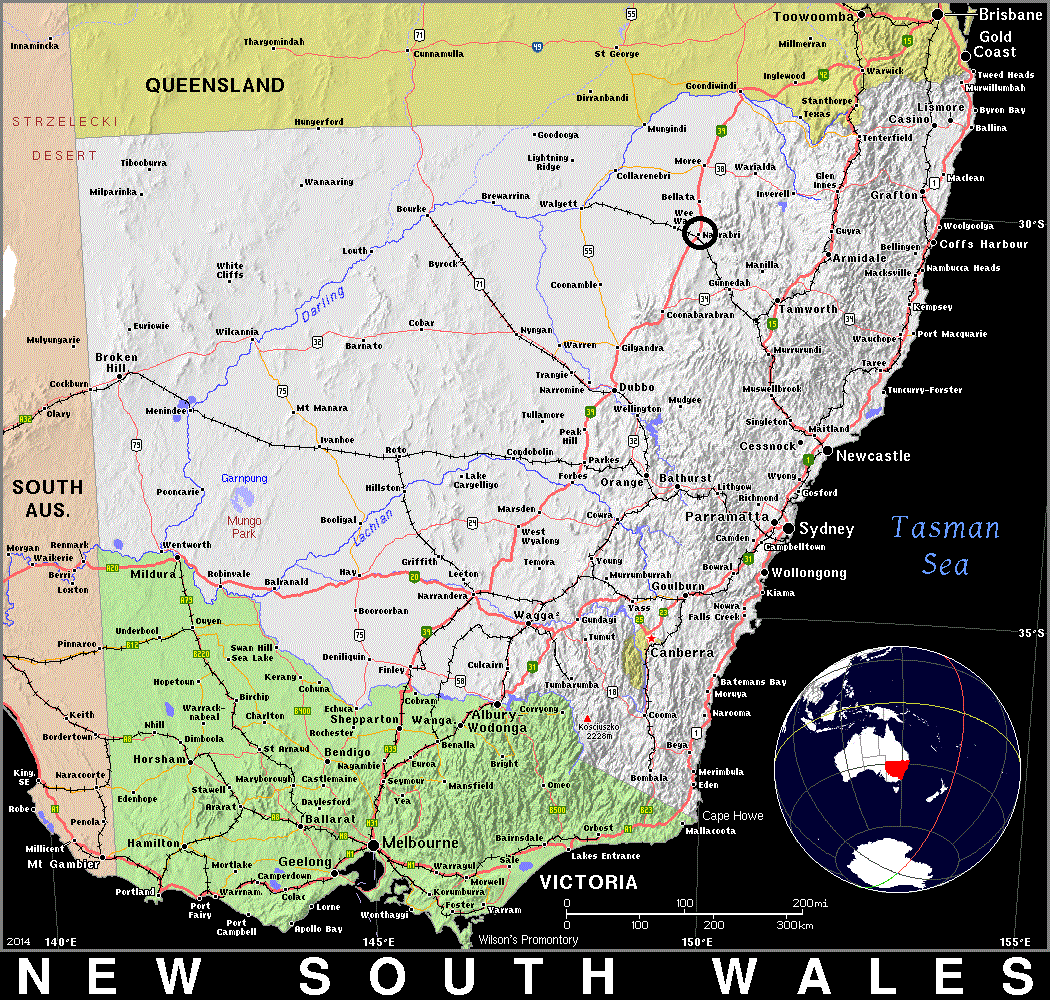
 Climate, technology and chaos Blog