Posts Tagged ‘ruskin’

Ruskin on perfection and alienation

October 2, 2022

Imperfection and disorder are necessary for satisfaction
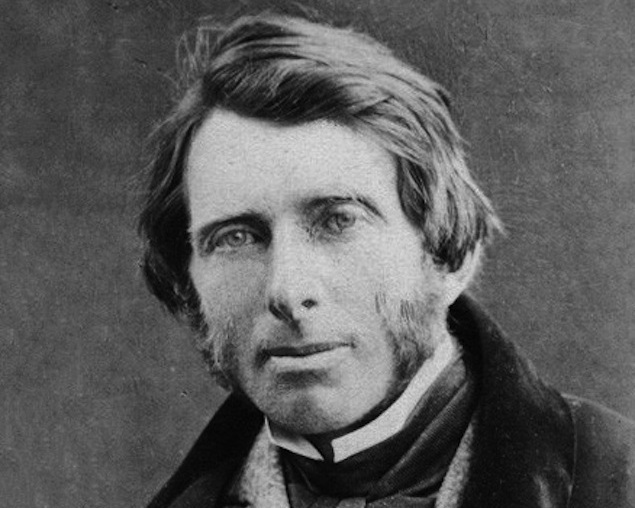
I have made the point previously, that for Ruskin the economic creation of illth (opposite to wealth) is not just a matter of environmental damage, pollution and so forth, it is also and importantly the destruction of human social capacity, of ‘soul,’ virtue, helpfulness, creativity and vitality.

Here, in an early analysis Ruskin takes illth in labour as stemming from demands for perfection, and the demands of machinery, which restricts human error, and hence creativity. I ask people to note, but ignore the sexism of the language, this obviously is intended to apply to women and men equally. I also apologise for the length of the quotations, but sometimes it is easier to read the originals.

Hitherto I have used the words imperfect and perfect merely to distinguish between work grossly unskilful, and work executed with average precision and science; and I have been pleading that any degree of unskilfulness should be admitted, so only that the labourer’s mind had room for expression. But, accurately speaking, no good work whatever can be perfect, and the demand for perfection is always a sign of a misunderstanding of the ends of art

Ruskin Stones of Venice: works vols 9-11. 202/845.

In this particular passage ‘art ‘refers to labour of builders and sculptors.

This for two reasons, both based on everlasting laws. The first, that no great man ever stops working till he has reached his point of failure: that is to say, his mind is always far in advance of his powers of execution, and the latter will now and then give way in trying to follow it; besides that he will always give to the inferior portions of his work only such inferior attention as they require; and according to his greatness he becomes so accustomed to the feeling of dissatisfaction with the best he can do, that in moments of lassitude or anger with himself he will not care though the beholder be dissatisfied also.

I believe there has only been one man who would not acknowledge this necessity, and strove always to reach perfection, Leonardo; the end of his vain effort being merely that he would take ten years to a picture and leave it unfinished. And therefore, if we are to have great men working at all, or less men doing their best, the work will be imperfect, however beautiful. Of human work none but what is bad can be perfect, in its own bad way.

Perfection is impossible and dissatisfaction is an inevitable part of the creative process.

The second reason is, that imperfection is in some sort essential to all that we know of life. It is the sign of life in a mortal body, that is to say, of a state of progress and change. Nothing that lives is, or can be, rigidly perfect; part of it is decaying, part nascent. The foxglove blossom,—a third part bud, a third part past, a third part in full bloom,—is a type of the life of this world. And in all things that live there are certain irregularities and deficiencies which are not only signs of life, but sources of beauty. No human face is exactly the same in its lines on each side, no leaf perfect in its lobes, no branch in its symmetry. All admit irregularity as they imply change; and to banish imperfection is to destroy expression, to check exertion, to paralyze vitality. All things are literally better, lovelier, and more beloved for the imperfections which have been divinely appointed, that the law of human life may be Effort, and the law of human judgment, Mercy.
Accept this then for a universal law, that neither architecture nor any other noble work of man can be good unless it be imperfect; and let us be prepared for the otherwise strange fact, which we shall discern clearly as we approach the period of the Renaissance, that the first cause of the fall of the arts of Europe was a relentless requirement of perfection, incapable alike either of being silenced by veneration for greatness, or softened into forgiveness of simplicity.

Disorder is inherent to life and to vitality. Requirements for perfection are harmful to human nature and we should allow people to fail.

I have already enforced the allowing independent operation to the inferior workman, simply as a duty to him, and as ennobling the architecture by rendering it more Christian.

We invite in failure to build art. It is necessary, and helps incorporate people’s variations, capacities and freedom into the work.

Wherever the workman is utterly enslaved, the parts of the building must of course be absolutely like each other; for the perfection of his execution can only be reached by exercising him in doing one thing, and giving him nothing else to do. The degree in which the workman is degraded may be thus known at a glance, by observing whether the several parts of the building are similar or not; and if, as in Greek work, all the capitals are alike, and all the mouldings unvaried, then the degradation is complete; if, as in Egyptian or Ninevite work,

Ruskin’s point is so important that he condemns Classical Greek work which was often thought the epitome of style and to be aimed for.

How much the beholder gains from the liberty of the labourer may perhaps be questioned in England, where one of the strongest instincts in nearly every mind is that Love of Order which makes us desire that our house windows should pair like our carriage horses, and allows us to yield our faith unhesitatingly to architectural theories which fix a form for everything, and forbid variation from it. I

Ruskin goes on to make sure that his audience do not take him to be advocating for complete chaos, even going so far as to praise “our commerce” which shows this is an early work.

Work and Creative Labour needs some chaos

Earlier in the book he remarks of a stone mason, and points to the chaos of creativity

you find his work perfect of its kind: but if you ask him to think about any of those forms, to consider if he cannot find any better in his own head, he stops; his execution becomes hesitating; he thinks, and ten to one he thinks wrong; ten to one he makes a mistake in the first touch he gives to his work as a thinking being. But you have made a man of him for all that. He was only a machine before, an animated tool.

Ruskin Stones of Venice: works vols 9-11. 192/835.

Recognising this creativity in imperfection, the necessity of space for thought and feeling, and the necessity of the risk of failure is to free people. The opposite is to destroy people.

And observe, you are put to stern choice in this matter. You must either make a tool of the creature, or a man of him. You cannot make both. Men were not intended to work with the accuracy of tools, to be precise and perfect in all their actions. If you will have that precision out of them, and make their fingers measure degrees like cog-wheels, and their arms strike curves like compasses, you must unhumanize them. All the energy of their spirits must be given to make cogs and compasses of themselves. All their attention and strength must go to the accomplishment of the mean act. The eye of the soul must be bent upon the finger-point, and the soul’s force must fill all the invisible nerves that guide it, ten hours a day, that it may not err from its steely precision, and so soul and sight be worn away, and the whole human being be lost at last—a heap of sawdust, so far as its intellectual work in this world is concerned: saved only by its Heart, which cannot go into the form of cogs and compasses, but expands, after the ten hours are over, into fireside humanity. On the other hand, if you will make a man of the working creature, you cannot make a tool. Let him but begin to imagine, to think, to try to do anything worth doing; and the engine-turned precision is lost at once. Out come all his roughness, all his dulness, all his incapability; shame upon shame, failure upon failure, pause after pause: but out comes the whole majesty of him also; and we know the height of it only when we see the clouds settling upon him. And, whether the clouds be bright or dark, there will be transfiguration behind and within them

Emphasis added

This applies obviously to disciplined factory work of the type common in the modern world. Again, we might have to scrape by the rhetoric on other forms of slavery; they also involve soul destruction, perhaps in different ways, perhaps in similar ways. The point is that there is no care for humanity in these processes.

And now, reader, look round this English room of yours, about which you have been proud so often, because the work of it was so good and strong, and the ornaments of it so finished. Examine again all those accurate mouldings, and perfect polishings, and unerring adjustments of the seasoned wood and tempered steel. Many a time you have exulted over them, and thought how great England was, because her slightest work was done so thoroughly. Alas! if read rightly, these perfectnesses are signs of a slavery in our England a thousand times more bitter and more degrading than that of the scourged African, or helot Greek. Men may be beaten, chained, tormented, yoked like cattle, slaughtered like summer flies, and yet remain in one sense, and the best sense, free. But to smother their souls with them, to blight and hew into rotting pollards the suckling branches of their human intelligence, to make the flesh and skin which, after the worm’s work on it, is to see God, into leathern thongs to yoke machinery with,—this is to be slave-masters indeed; and there might be more freedom in England, though her feudal lords’ lightest words were worth men’s lives, and though the blood of the vexed husbandman dropped in the furrows of her fields, than there is while the animation of her multitudes is sent like fuel to feed the factory smoke, and the strength of them is given daily to be wasted into the fineness of a web, or racked into the exactness of a line.

Ruskin tends to make a point repeatedly, but repetition can be good.

Let me not be thought to speak wildly or extravagantly. It is verily this degradation of the operative into a machine, which, more than any other evil of the times, is leading the mass of the nations everywhere into vain, incoherent, destructive struggling for a freedom of which they cannot explain the nature to themselves. Their universal outcry against [riches], and against nobility, is not forced from them either by the pressure of famine, or the sting of mortified pride. These do much, and have done much in all ages; but the foundations of society were never yet shaken as they are at this day. It is not that men are ill fed, but that they have no pleasure in the work by which they make their bread, and therefore look to [riches] as the only means of pleasure. It is not that men are pained by the scorn of the upper classes, but they cannot endure their own; for they feel that the kind of labour to which they are condemned is verily a degrading one, and makes them less than men. Never had the upper classes so much sympathy with the lower, or charity for them, as they have at this day, and yet never were they so much hated by them for, of old, the separation between the noble and the poor was merely a wall built by law; now it is a veritable difference in level of standing, a precipice between upper and lower grounds in the field of humanity, and there is pestilential air at the bottom of it.

Ruskin goes on to make a point which will not be popular today, but he argues that obedience is not an oppression if it involves responsibility, admiration, and relationship. This reverence can be humanising, but it is not found in the modern workplace.

to feel their souls withering within them, unthanked, to find their whole being sunk into an unrecognized abyss, to be counted off into a heap of mechanism numbered with its wheels, and weighed with its hammer strokes—this, nature bade not,—this, God blesses not,—this, humanity for no long time is able to endure.

One final quotation relevant to sociology, and probably a reference to Adam Smith’s remarks on the production of pins. Ruskin emphasises the more profit, less soul and satisfaction aspects of production, which Smith also notes, but is less often quoted on.

We have much studied and much perfected, of late, the great civilized invention of the division of labour; only we give it a false name. It is not, truly speaking, the labour that is divided; but the men:—Divided into mere segments of men—broken into small fragments and crumbs of life; so that all the little piece of intelligence that is left in a man is not enough to make a pin, or a nail, but exhausts itself in making the point of a pin or the head of a nail. Now it is a good and desirable thing, truly, to make many pins in a day; but if we could only see with what crystal sand their points were polished,—sand of human soul, much to be magnified before it can be discerned for what it is—we should think there might be some loss in it also. And the great cry that rises from all our manufacturing cities, louder than their furnace blast, is all in very deed for this,—that we manufacture everything there except men; we blanch cotton, and strengthen steel, and refine sugar, and shape pottery; but to brighten, to strengthen, to refine, or to form a single living spirit, never enters into our estimate of advantages. And all the evil to which that cry is urging our myriads can be met only in one way: not by teaching nor preaching, for to teach them is but to show them their misery, and to preach to them, if we do nothing more than preach, is to mock at it. It can be met only by a right understanding, on the part of all classes, of what kinds of labour are good for men, raising them, and making them happy; by a determined sacrifice of such convenience, or beauty, or cheapness as is to be got only by the degradation of the workman; and by equally determined demand for the products and results of healthy and ennobling labour.

Overcoming the problems?

Ruskin goes on to emphasise this chaos and failure, as part of his solution to the problem of destructive work. Firstly:

Never encourage the manufacture of anything not necessary, in the production of which invention has no share.

If something is not absolutely necessary now, then the worker should have time and place for creativity.

He illustrates with the glass trade:

Glass beads are utterly unnecessary, and there is no design or thought employed in their manufacture. They are formed by first drawing out the glass into rods; these rods are chopped up into fragments of the size of beads by the human hand, and the fragments are then rounded in the furnace. The men who chop up the rods sit at their work all day, their hands vibrating with a perpetual and exquisitely timed palsy, and the beads dropping beneath their vibration like hail.

Neither they, nor the men who draw out the rods or fuse the fragments, have the smallest occasion for the use of any single human faculty; and every young lady, therefore, who buys glass beads is engaged in the slave-trade…
But glass cups and vessels may become the subjects of exquisite invention; and if in buying these we pay for the invention, that is to say, for the beautiful form, or colour, or engraving, and not for mere finish of execution, we are doing good to humanity.

The contrast is obvious.

Secondly we have to accept a degree of roughness.

never… demand an exact finish, when it does not lead to a noble end.

This is to protect and help the worker improve….

If you are to have the thought of a rough and untaught man, you must have it in a rough and untaught way; but from an educated man, who can without effort express his thoughts in an educated way, take the graceful expression, and be thankful. Only get the thought, and do not silence the peasant because he cannot speak good grammar, or until you have taught him his grammar….

Always look for invention first, and after that, for such execution as will help the invention, and as the inventor is capable of without painful effort, and no more. Above all, demand no refinement of execution where there is no thought, for that is slaves’ work, unredeemed….

on a [small] scale, and in a design which cannot be mathematically defined, one man’s thoughts can never be expressed by another: and the difference between the spirit of touch of the man who is inventing, and of the man who is obeying directions, is often all the difference between a great and a common work of art.

I suspect this request is a bit naïve as owning perfection will come to be associated with riches and status, if we have not changed society, as mechanical perfection is more easily evaluated than imperfect invention, and thus it will be demanded. However Ruskin continues with his glassware example, to make the point.

The old Venice glass was muddy, inaccurate in all its forms, and clumsily cut, if at all. And the old Venetian was justly proud of it. For there is this difference between the English and Venetian workman, that the former thinks only of accurately matching his patterns, and getting his curves perfectly true and his edges perfectly sharp, and becomes a mere machine for rounding curves and sharpening edges; while the old Venetian cared not a with whether his edges were sharp or not, but he invented a new design for every glass that he made, and never moulded a handle or a lip without a new fancy in it. And therefore, though some Venetian glass is ugly and clumsy enough when made by clumsy and uninventive workmen, other Venetian glass is so lovely in its forms that no price is too great for it; and we never see the same form in it twice.

Now you cannot have the finish and the varied form too…. If the workman is thinking about his edges, he cannot be thinking of his design; if of his design, he cannot think of his edges. Choose whether you will pay for the lovely form or the perfect finish, and choose at the same moment whether you will make the worker a man or a grindstone.

This is purely a social division again.

We are always in these days endeavouring to separate the two; we want one man to be always thinking, and another to be always working, and we call one a gentleman, and the other an operative; whereas the workman ought often to be thinking, and the thinker often to be working, and both should be gentlemen, in the best sense….

it is only by labour that thought can be made healthy, and only by thought that labour can be made happy, and the two cannot be separated with impunity.

The point is that the creation of real beauty, humanity and wealth does not degrade the producers, or anyone else. It requires time for reflection and allows the possibility of human failure. Capitalism, or industrialism, by their mechanical and time deficient productive processes generally create illth (physical and psychological) not wealth and thus, at the least, require modification (if that is possible), and this implies the production of less, if better, ‘stuff’.

Ruskin: Wealth, Illth and Degrowth

August 14, 2022

As you might guess none of this is original

https://commons.wikimedia.org/wiki/File:Ruskin_Self_Portrait_1875.jpg

Definitions

Let’s begin with some useful definitions from Ruskin:

Wealth” to Ruskin is what contributes to a good life and adds to people’s capacity to be constructive:

There is no wealth but life. Life, including all its powers of love, of joy, and of admiration. That country is the richest which nourishes the greatest numbers of noble and happy human beings; that man is richest, who, having perfected the functions of his own life to the utmost, has also the widest helpful influence, both personal, and by means of his possessions, over the lives of others.

Unto this Last.

To Ruskin wealth is therefore connected to the power of implementing virtue, ‘nobility’, and being helpful. This is not a definition likely approved by classical economics – partly because these powers cannot be counted or measured and evaluation can be fairly subjective. Wealth being life, also points to the health of the environmental ecology.

Riches” can be distinguished from wealth as it is collections of money and property which may not contribute to peoples lives. They may even involve cruelty, exploitation and exclusion.

If the king alone be rich, or if a few slave-masters are rich and the nation otherwise composed of slaves is it to be called a rich nation?… [paraphrase]
Since the inequality, which is the condition of riches, may be established in two opposite modes—namely, by increase of possession on the one side, and by decrease of it on the other—we have to inquire, with respect to any given state of riches, precisely in what manner the correlative poverty was produced.

Ruskin Munera Pulveris

Wealth tends to be communal, riches tend to be private and exclusive. I’m not aware of whether Ruskin writes on the virtues of commoning, but it is implied in these definitions. Wealth and prosperity is helpful to all, riches are not. This distinction is again unlikely to be favoured by classical economics, as such economics might even have the aim of confusing prosperity with riches for some.

Illth” is the harm produced by economic activity. Illth includes obvious(?) devastations produced by pollution, dumped nuclear waste, ecological destruction during extraction and so on, but illth also includes the, perhaps, unintended human consequences which can arise from building riches such as ugliness, ill-health, insensitivity, compulsive selfishness, bad community relationships, exploitation, increasing misery, people crippled or exhausted and insecure from the work they have to do, loss of the ability for the community or individual to support themselves, work injuries, consumerist addiction, people being fed lies and untruth, dispossession of people by market demands, people being sacrificed to the market, destruction of prosperous futures, destruction of virtue, and so on.

There may be conflict here. What one person counts as illth, can be defined by others as riches, or even wealth.

Problems of Measurement

Recognition of the complexity of wealth and the problems of Illth seem vital to living a good life and perhaps even surviving. As Herbert Daly points out, once we start hurting the planet and using up its capacity to regenerate its wealth, we are continually generating compounding illth – even if we apparently generate riches. This is a case in which our economics measures money, but does not measure prosperity or the risk of illth. Again, this is difficult to do, but should probably not be ignored.

The main supposed measure of prosperity is the GDP which measures economic activity or expenditure (riches), not Ruskinian wealth.

There are a number of approaches but basically they all use monetary measures:

  • GDP = C (Private Consumer spending) + G (government spending) + I (investments spent on capital equipment, inventories, and housing) + NX (country’s total exports less total imports)

or

  • GDP = Wages + Profits + small business profits + Taxes – Subsidies

These sums can be adjusted for inflation or not. I used Wikipedia as the source, despite finding many other definitions, on the grounds that informed people would probably alter Wikipedia if it was obviously wrong, but also see this which points to rents, earnings from interest, and depreciation as factors in the second version of GDP etc.

The problem with illth in this scheme, as Daly points out, is that it has little recognised monetary value and is not measured. While few people wish to buy illth, they will happily dump it on others to increase profits and the GDP, and people will buy products that may save them from illth, gas masks, air filters, vitamins, pollution clean ups and so on, also boosting GDP, so that illth not only can help destroy the future but generate economic activity which counts as riches and prosperity as measured by the GDP. Through the measurement process, illth can increase apparent riches more than if the harm had not happened. The actual damage to life that illth creates may not be so easy to calculate.

Likewise if a climate change driven storm flattens an area and leaves people homeless or months or years, then any effort at reconstruction also adds to GDP, when in many cases little wealth may be being added to people’s lives and much may have been taken away.

If a forest is destroyed that can count as good economic activity. If people destroy all the world’s trees that is still a boost to the current GDP, despite having destroyed current and future wealth. Destroying the capacity for life, is almost certainly definitional of illth.

Because humans have apparently already significantly affected the planet’s ability to support us, then we need to lower the mass of the monetary economy, especially the mass of the illth economy. To do this we may have to abandon the current version of the GPD as a measure, and damage will have to be counted as a negative in the same terms, which may not be possible. But it is almost certain that economies will have to shrink in reality until the illth (long and short term) is minimised.

Sometimes harms may be useful when they occur during a re-organisation of the economy into a more democratic form, for example, but that is not usual.

We might even wonder if illth can ever be separated from riches? It may be the case that the global economy (both capitalist and developmentalist) requires illth to ‘work’ or to know it is working.

If we then add growth of the GDP as a supposed necessary mark of success or even of economic “sustainability”, then this holds a demand that the economy will have to continue to increase resource extraction and consumption, which may require even more violent, and illth producing, forms of extraction, which incidentally add more to GDP because the cost is greater but which add very little wealth. Daly again remarks that a low destruction oil well that produces much oil without much labour or danger, would currently add less to the GDP than would a dangerous deep sea well, in a storm racked area, which produces heaps of pollution and a need for clean ups. The second well would probably only be countenanced when the easy wells are almost used up.

The difficulty is measuring illth purely in monetary terms. If illth is not completely repaired, which is possibly impossible, then there is no cost, and as we have seen currently the cost of repair hides the damage as riches. If illth is freeloaded upon to generate riches, then it cannot be costed other than by estimate, and if the illth of human misery is to be factored in, then it can always be denied by those with riches….

A more useful measure????

Nowadays, according to some claims, economic activity uses up a year of the Earth’s capacity to regenerate in just under 8 months. This is illth creation in action. Economic activity is creating riches but destroying our capacity to produce future prosperity. It indicates the seriousness of illth production. I presume this is a disputable measurement, which is why it is not in official use, but it does seem to be a useful measure. We simply cannot afford to be in a situation in which our use of the planet is greater than the planet can regenerate, for long periods of time.

Hence, again we go to the necessity of

  • degrowth
  • the recognition of the unintended harms coming from the production of riches, and
  • the need to produce real wealth in human life.

Some fundamental questions: Illth

September 22, 2021

It seems to me, from what I’ve written in the last couple of posts, there are at least two fundamental questions for life on Earth.

1) Can capitalism as it is, produce prosperity without significant forms of ‘illth’, or harms, to society, personal psychology, liberty and ecology? The same can be asked of the developmental State.

2) Are pro-free market ideologies anything other than schemes to protect the dominance of the wealth elites and the illth they produce?

With these questions I’m much more interested in actually existing capitalism, than in an ideal or imaginary capitalism, in which The Market operates smoothly and only produces benefits in accordance with justice: i.e. the wealthy are virtuous and the poor are, at best, incompetent.

I have mentioned Ruskin’s concept of illth previously. It follows from Ruskin’s concept of wealth.

Definitions

Wealth, is defined by Ruskin as what makes life and health. That includes good food, pleasure, love, connection, concern, compassion, beauty, contemplation, psychological wholeness, religious experience, sharing, good work that builds a good ‘soul’ and ‘a good life’. Wealth is tied in with the cultivation of people and the provision of beauty, beneficial work and peace. Wealth involves the higher pleasures natural to humans; it is fundamentally life enhancing. We can add to this that wealth is sustainable, it exists with less destruction than can be absorbed, and transformed into wealth, by society and ecology. This is summarised in the slogan “There is no wealth but life,” adding “Life, including all its powers of love, of joy, and of admiration.”

That country is the richest which nourishes the greatest number of noble and happy human beings; that man is richest who, having perfected the functions of his own life to the utmost, has also the widest helpful influence, both personal, and by means of his possessions, over the lives of others.

Ruskin Works 17 “Unto this Last”: 105

‘Wealth’ needs to be distinguished from ‘Riches’ and ‘illth, or there is no real economics, only encouraged destruction and tyranny.

Riches, he defines as the appropriation from another. Riches can brought about through death, power and injustice, by impoverishing and harming workers. Riches tends to be found in lots of money or possessions, not so much in real wealth. Riches can simply undermine character and soul. Riches tend to usurp, overthrown or diminish, life.

Illth‘ is the contrary of wealth. While wealth brings ‘weal’ (health, well-being, prosperity, plenitude or improvement) illth brings physical or mental sickness, harm, destruction, impoverishment, lack, desperation and death. Illth is anti-life.

Ruskin suggests Riches and illth go together. This coupling can be seen in despoiled landscape, grotesque buildings, sensationalist art, filth, disease and in ruined bodies and souls. Any difference between the labouring and the rich classes comes about because of this illth and their different conditions of living and working.

It is not impossible that Riches could go together with wealth, but we should not disregard the illth that also comes with riches in our current economy. Traditionally, conservatives would denounce the pursuit of riches at all costs; the cheapening of culture; the degradations of soul resulting from mass literature or TV; or the lying slogans of populism and so on. But now they seem more concerned with protecting the riches of some, than cultivating real wealth or truth. Neoliberalism may well exist to sanctify selfishness, lack of co-operation and riches for some rather than wealth for all.

Illth as ‘Externalities’

In classical economics we might identify illth with what are called ‘externalities’. That is the parts of the economic system that you can ignore, or thrust upon less fortunate others, who do not have the power to retaliate. Pollution is often classed as an externality, because it rarely enters into the costs of production, distribution or sales, unless valued people start dropping down dead. This obviously benefits the Polluter Oligarchy/Elites. And forcing them to count the illth costs of pollution would count as interfering in The Market, or at best ‘green tape’.

Riches are important to continuous illth creation, because riches can command the power, and the information channels, to classify illth as irrelevance, minor, someone else’s problem or unreal. In classical terms if the cost of illth can be dispersed onto the ‘uncomplaining’ Earth or amongst the relatively powerless, then it is ‘free’, and contributes to Riches. We should not concern ourselves with it, as it results from The Market (not from any particular people seeking riches), and if it is a problem, will be fixed by The Market and others seeking Riches.

As umair haque suggests, capitalism promotes the central idea that:

left to their own devices, self-reliant individuals in markets will expand the common good, through aggressive, crushing, competitive self-interest…. It’s led to 80% of Americans living paycheck to paycheck, watching their kids be shot at school, their neighbours die and go bankrupt for a lack of basic medicine, never save enough to retire — all while the ultra-rich shoot themselves off to Mars.

umar haque The Missing Half of Economics

The other point is that it seems easier to create Riches by illth production than by wealth production. In making Riches without a concern for wealth, less energy has to be expended in exploring the harmful results, or unintended consequences, of making those Riches. With a focus on Riches, free pollution and ecological destruction is a ‘good’. This is less likely if people are focusing on wealth production. Consequently, producing Riches will tend to be more profitable than producing wealth, and hence is likely to drive wealth producers out of business.

A system which makes profit primary, will tend to ignore both illth and wealth, as it has no concern for them beyond profit, and hence produce more illth.

The battle for distinction

One of the task of people, in a functional society, may be to distinguish between wealth and illth. I would expect that this is a political battle, as those with riches will fund people to defend, ignore or deny the presence of illth, or to help confuse ‘soul-based’ illth with liberty.

I would, however, suggest that anything which, in the long term, is likely to damage land and ecology will produce illth, irrespective of any other virtues. The only excuse for it, is that it replaces some process which is even more destructive, in which case there should be ways of phasing its harms out.

Having the concept before us, it is more likely that people can see the importance of distinguishing wealth from illth, and participate in discussions. To quote haque again

Economics is there to study the question: what forms of social and political organization genuinely expand the common wealth, the human good, prosperity, possibility? If it can’t do that — it serves no purpose… at all, except as a kind of… ideological machine. 

umar haque The Missing Half of Economics

Conclusion

The distinction between wealth and illth is fundamental to the functioning of any society.

With the question of illth being put forward repeatedly, it is perhaps possible that capitalism can be altered to be less harmful. Without considering the question, then capitalism will probably be overwhelmed with its own destructiveness.

Addenda

The points about real wealth and illth, seems to me, to be as useful as when Ruskin made them over 150 years ago. I am puzzled why the idea of illth has been so thoroughly abandoned, when it seems vital to describing economic (and other) activity. I would imagine most people would want a high Ruskinian wealth and a low illth, to be part of their lives, rather than mere riches, or in general poverty (high illth, not lack of money). It is hard to talk of economic/productive/consumptive harms in general without such a term, and they occur nearly all the time.

I wonder if the idea of illth been so hard to accept because:

  • Western culture has a demand for order which causes it to ignore the disorder produced by everyday approved actions…. as I have argued on a number of occasions on this blog? Or because
  • Of the politics of capitalist domination and the politics of markets? It may be implied that riches drive the problem. Successful, well known and promoted economists will be those who tend to suggest capitalism always delivers the best possible results, and that what we observe are either a) those best possible results in action – give or take a minor tweak – or b) the fault of government.

If we talked about illth would we might have to look more closely at what drives the production of illth, and observe how that ties in with particular organisations of the economy, and work towards getting rid of them. However if we assert that markets always deliver the best results, that the wealthy are virtuous, while forgetting about illth, then we will not really criticise ‘The Market’ and its players and generators?

Ruskin and work…

December 10, 2018

More Ruskin. One of his aims was to distinguish ‘good’ work from ‘diabolic’ work. It may still be relevant. This is slightly edited for ease of reading.

Good work, then, will be, —

a) Letting in light where there was darkness; as especially into poor rooms and back streets; and generally guiding and administering the sunshine wherever we can, by all the means in our power.

And the correspondent Diabolic work is putting a tax on windows, and blocking out the sun’s light with smoke. [Using coal instead of solar for livelihood]

b) Disciplining the falling waters. In the Divine work, this is the ordinance of clouds; in the human, it is properly putting the clouds to service; and first stopping the rain where they carry it from the sea, [or slowing the water’s passage] and then keeping it pure as it flows back to the sea again.

And the correspondent Diabolic work is the arrangement of land so as to throw all the water back to the sea as fast as we can; and putting every sort of filth into the stream as it runs.

c) The separation of earth from water, and planting earth with trees. The correspondent human work is especially clearing morasses, and planting on desert ground.

The correspondent Diabolic work is turning good land and water into mud [or desert]; and cutting down trees that we may drive steam ploughs, etc., etc.

d) The establishment of times and seasons. The correspondent human work is a due watching of the rise and set of stars, and course of the sun; and due administration and forethought of our own annual labours, preparing for them in hope, and concluding them in joyfulness, according to the laws and gifts of Heaven. Which beautiful order is set forth in symbols on all lordly human buildings round the semi-circular arches which are types of the rise and fall of days and years.

And the correspondent Diabolic work is turning night into day with candles, so that we never see the stars; and mixing the seasons up one with another, and having early strawberries, and green peas and the like. [So that all sense of the rhythm of life and the cosmos is lost.]

e) Filling the waters with fish, and air with birds.

The correspondent Diabolic work is poisoning fish, as is done at Coniston, with copper-mining; and catching them for Ministerial and other fashionable dinners when they ought not to be caught; and treating birds — as birds are treated, Ministerially and otherwise.

f) Filling the earth with beasts, properly known and cared for by humans; but chiefly, breathing into the clayey and brutal nature of humanity itself, the Soul, or Love, of God.

The correspondent Diabolic work is shooting and tormenting beasts; and grinding out the soul from the flesh, with machine labour; and then grinding down the flesh, when nothing else is left, into clay, with machines for that purpose such as machine guns, huge cannon, bombs and the like.

These are the six main heads of God’s and the Devil’s work.

Ruskin and Economics I

November 13, 2018

There is no ideal single book to learn about Victorian ‘sage’ John Ruskin’s economics, but there are lots of scattered ideas in various books. Some say that at the time he had more influence on British Labour politics than Marx…. Ruskin is not always admirable perhaps, but he braved a lot of criticism and ostracism to make these points

Ruskin argues economics should be about both the conditions of survival and the generation of wealth rather than riches. ‘Riches’, he defines as appropriation from another, ‘wealth’ the general benefit: wealth is tied in with the cultivation of souls and the provision of beauty: “There is no wealth but life.” Riches can brought about through death and injustice. As such, wealth involves the higher pleasures natural to humans. Not surprisingly, for Ruskin, economics should encourage manufacture and appreciation of art and beauty, but also of care for others.

True economics also grows out of social affections and associations and a recognition of those affections and ties.

“Independence you had better cease to talk of, for you are dependent not only on every act of people whom you never heard of, who are living all around you, but on every past act of what has been dust for a thousand years. So also does the course of a thousand years to come depend upon the little perishing strength that is in you.”

Economic theory is about relationship and structures relationship. Ruskin argues that, recognizing this, the rich have obligations to the poor and their workers. He is paternalistic, although often his model involves a woman tending her household. He considers the relationship between an employer and a worker to be ideally, and perhaps necessarily, one of voluntary kinship. To him contemporary capitalists simply avoided their responsibilities to others (praising their own ‘individuality’) to the detriment of the nation. They were helped in this avoidance by a liberal economics which strips all that is valuable about human life, relationship and art away. Liberal economics reduces life to covetous calculation and demand. Laissez faire, which avoids or breaks any human ties with others is simply the principle of death and the destruction of common-wealth. It is also the death of real economics.

Breaking human ties also means that the higher pleasures cannot survive in capitalism. Capitalists have no thought for beauty, unless they monopolise it for themselves as a tool of status and as a demonstration of their ability to exclude others from its benefits. If profit is brought by destruction and ugliness (physical and mental) then that is what relationship denying capitalists will produce. Their riches depends on ‘illth’ – the very opposite of wealth, and this can be seen in despoiled landscape and the ruined bodies and souls of the labouring classes. Any difference between the labouring and the rich classes comes about by this illth and their conditions of living for labourers. It is a matter of violence, not virtue.

True economics is concerned with the circumstances of everyone not just the rich, and this concern also grows out of cultivation of nobility of soul. Labour is necessary, but only so far as it enables life outside of labour and manages holidays. Labour in a good economy should be joyful and creative, rather than confined to dank and ugly slums. It should also be about craft and responsibility, tasks which refine the soul, rather than the monotony of machinc production or rote tasks. The cultivation of craft and purity of produce is ultimately what delivers the wealth of real ‘goods’ that can be consumed well.

However, good consumption requires instruction, and higher values; another moral question for a real economy is whether people can use what is produced nobly or not. The point being that wealth does not consist in producing or owning massive numbers of possessions, but in the possessions that increase life and its value. This also implies that economics has to be in harmony with ecologies and its effects on the future.

“God has lent us the earth for our life. It is a great entail. It belongs as much to those who are to come after us…as to us. And we have no right, by anything we might do or neglect, to involve them in unnecessary penalties or deprive them of benefits which it was in our power to bequeath… Every human action gains in honor, in grace, in all true magnificence, by its regard of things that are to come… Therefore, when we build, let us think that we build forever. Let it not be for present delight, nor for present use alone. Let it be such work as our descendants will thank us for”

An economics which puts relationships, beauty, cultivation of souls, ecology, well made lasting goods, and the long-term future in front of us, certainly seems unusual.