Posts Tagged ‘social action’

Introduction to the Introduction

November 3, 2022

I’m trying to write a book on problems with the energy transition and the use of ‘climate technologies’ such as carbon trading, carbon capture and storage, geoengineering, biofuels, nuclear, evs and so on.

This is kind of an introduction to the book’s introduction.

As well as being about the problems with the needed energy transition and the climate technologies we use to deal with climate change and ecological devastation, this book is also about some of my theoretical obsessions, such as:

  • The ways that attempts to order the world in a good way (however that is defined), generate the disorder that is feared.
  • The normality of unintended consequences, the lack of control over everything, and the need to look out for these normalities, in our lives and correct for them.
    • Despite everyone knowing about unintended consequences and their prevalence in life, this knowledge is not part of contemporary western social theory (including economics), or philosophy.
  • The realisation that everything is ecological, and interconnectedness, interdependency and lack of apparent harmony are fundamental to all life. No thing, and no one, exists by itself. Hence to perceive an action’s effects we have to look around widely.
  • This realisation implies the need for a politics which is experimental rather than dogmatic. We don’t know what a policy’s complete effects will be in advance – no matter how sensible and virtuous it appears to be.
  • The realisation that human conscious thinking is limited, and directed by the theories we have. This also tends to direct what we observe. We don’t perceive the world as it is, but through the tools we deploy.
  • To keep our modes of thinking and life, it is common for people to engage in defensive fantasy ‘solutions’ if the problem seems too big or overwhelming and potentially destructive of their ways of life. These solutions can even make the situation worse.
  • The need to listen to our unconscious awareness of patterning, and to be aware that processes which we cultivate unconsciousness of, sill exist and can harm us.
  • Forms of economic organisation can be destructive as well as productive, and we need to minimise destruction.
  • Wealth is not the same as riches.
  • Forms of economic organisation can lead to destructive power imbalances, and positive feedback loops, as the economy gets organised to feed the rich. The power and politics of neoliberalism is one of the fundamental problems of contemporary life, along with developmentalism.
  • Markets are subsidiary to ecologies, rather than ecology being submissive to markets. A market which destroys its ecology will almost certainly destroy itself.
  • Technologies involve social uses and social organisations, and they can also have harmful effects on people and ecologies if we ignore them.
  • Societies, and people, all face challenges and have to respond to them. How they succeed in this response, influences their future trajectory. Sometimes the challenges they face are self-generated and these challenges are particularly difficult to respond to, other than by avoidance of the problem. Climate change and eco-destruction are such challenges. The personal and social response are intertwined, hence they reinforce each other, either for success, avoidance or failure.
  • The obvious realisation that energy technologies, energy supply and its organisation are vital for forms of social life, what can be achieved and who is likely to dominate over others.

The energy transition is as much a matter of social and intellectual change as it is about technical phenomena. This is one reason why it can be scary. We don’t know the results.

While the book is sometimes bleak, and argues that many of the proposed technological solutions are fantasy avoidance solutions, it is also arguing that as many people as possible need to organise to face up to this problem, and this will bring some degree of personal and social health. We all have been waiting well over 40 years for governments and businesses to act, and they have delayed and prevaricated. We have tried the market for the last 40 years and it has not worked and it turns out that there are good reasons for this: markets cannot be separated from politics, corporate power or simply the power of established riches. Markets and Governments will not save us.

The problem also suggests we need a new way of thinking. This is implied in the theoretical outline above. To deal with the reality of eco-geo-social-technical problems, we have to be able to think, at nearly all times, in terms of: ecology, complexity, and unintended consequences; and be prepared to try processes out without prejudging.

We need a local action which helps us to build the communities we need to survive climate change, or uses the existing communities to build further resilience. There is an argument that local transition, is more likely to build appropriate local technologies, and that a clear local demonstration of concern is more likely to build political concern and emulation, than is a purely theoretical awareness of support.

The book attempts to draw attention to problems with the hope of advising action, and awareness of those problems. If people are forewarned, then people can act in more useful ways, and avoid distractions.

Climate change in the Marshall Islands

July 20, 2021

Recently a colleague suggested I read Peter Rudiak-Gould’s article published in 2014. “Climate Change and Accusation: Global Warming and Local Blame in a Small Island State”. Current Anthropology 55(4): 365-386.

This is a wonderful article. It might be out of date now but it suggests how we can learn from the inhabitants of the Marshall Islands in terms of their response to Climate Change. There is far more to the article than I am going to cover, so read it yourselves if you can…

Rudiak-Gould begins by pointing out there are two traditions of climate change blame in the West:

  1. Some are more at fault than others, usually the industrialised or industrialising world
  2. Everyone is to blame. Humanity is self-destructive. With the implication there is not much we can do alone.

The Marshall Islanders are clearly not to blame for Climate Change. They contributed 0.0002% of world CO2 emissions in 2008. Yet it is (was?) common for the Islanders to clearly take on the blame. People rarely mention the culpability of other nations for their severe climate problems, and insist they have to do something about their own problems before facing the world. One person, for example, says

“How can we ask the bigger nations for help, when we are [also] a contributor to climate change?”

p.368

While they agree they make a contribution to climate change, they don’t think they have much ability to affect climate change in total. Rudiak-Gould writes:

“It is never suggested that Marshall Islanders can stop climate change, only that they contribute to it…”

p.371

They don’t have delusions of grandeur, and the idea is not a defense, against action.

Rudiak-Gould explains this situation, by seeing it as related to a wide spread realisation of a decay in traditional life, which they see as the fault of the Islanders themselves: “We follow American culture;” “we have too many things from outsiders… We don’t grow our food anymore.”

RG writes, that for the Islanders Climate change is “the final proof of modernity’s folly, [and] a powerful inspiration to revitalize older ways.” By saying they are responsible, they reassert cultural continuity and distinctiveness, and a course of action.

They are using recognition of their responsibility for climate change to help themselves, not just trying to solve the problem.

Taking responsibility is not an “empty performance.” Islanders try to reduce dependency on foreign oil through solar; restart traditional shoreline management practices; stop throwing plastic onto the beaches and into the sea, and aim to take control over their society’s cultural future.

Taking responsibility says they have a right to speak to each other and to the world. It champions local citizen action, and challenges the dominance of the state, high tech and elite high science, all of which assume people know little and cannot act by themselves.

Taking responsibility also undermines assumptions that a nation cannot act, through ‘people power’. It shows even a small nation can act for itself, and by itself, without any constricting fear that action will ruin the economy or destroy a people’s way of life – it even assumes that a way of real and desirable social life can be revitalised and improved by climate action.

Finally, it challenges common ideas in the rest of the world that pacific islanders are the victims of others. They assert they can help the world and themselves, even if they cannot solve the problem completely, and their action sets an example others might follow.

Taking responsibility and acting the best we can casts doubt on the supposed necessity for a top down solution driven by State or business occurring first. It asserts climate change can be affected by people taking on their own responsibility in a practical way. We do not have to wait for the State or for business to get on board and act.

In a relatively large State, like the ones most of the people reading this will live, this local responsibility and action is possibly the only way that the State will get the message that the people care enough for it to take on the forces that oppose action.

The Marshall Islanders set forth an agenda we can all learn from.

This blog is about, again: Dealing with crises

April 6, 2021

This is something of a sequel to the post “What is this blog about?”

Multiple Crises

We are in the midst of several crises of ecological and social destruction, , mainly brought about by our processes of extraction and pollution. Focusing only on the climate crisis can be a distraction from, or a defense against, realising how deeply we are caught in these multiple crises.

The Eco-crises include:

  • Deforestation
  • Destruction of agricultural land, through mining, house building, over-use, erosion etc
  • Poisoning through pollution
  • Over-fishing
  • Ocean Acidification
  • Disruption of the Nitrogen and Phosphorus cycles
  • Pollution, and loss, of water supplies
  • Introduction of new chemicals and materials
  • Changes in weather patterns

There are also social crises:

  • of information,
  • of social and political fracture,
  • of wealth and power disparities, including poverty
  • of political corruption,
  • of insecurity of work and income for most people (what is often called ‘precarity’),
  • of psychological contentment (existential crises)
  • and so on.

All these various crises interact in complex ways. Loss of agricultural land, for example, will probably spur the fractures of wealth and power, increase poverty and increase insecurity.

Part of the aims of this blog is to identify the problems, the underlying causes of the problems, and the ways we might come to change our minds and actions so as to deal with those problems.

Complexity and wicked problems

Complexity [1], [2], [3] adds to the difficulties of solving the crises. However, complexity has to be part of our understanding of social problems.

The term ‘wicked problems’ is used for problems:

  • Which don’t have a standard precedent, or standard formula for action; or the precedents and formulas appear to dig us deeper into the problem.
  • With no universal formulation; every wicked problem appears to be unique.
  • The people involved are in conflict, with different opinions and different aims, and there does not seem to be a possible mutually pleasing or agreeable solution. So solutions are likely to be undermined by those participating in the process, or prove unstable in the long run.
  • There are many linked problems, factors, drivers and consequences. The problem branches out into the systems.
  • Knowledge of the situation is obviously, and perhaps dangerously, incomplete. Some important people may dispute we have any knowledge.
  • There is little certainty a solution can be found in the time available for solving.
  • The problems are likely to change over time.
  • Solutions can also change the nature of the problem, and create further problems.

Wicked problems are systemic problems within complex systems. They sound impossible to fix, and hence are psychologically disorienting.

However, I’d say it is very difficult to fix the system rather than impossible. But the longer we leave it to stop what we are doing to disrupt the system, then the harder it will get to ‘fix’ it – or to keep it livable for the kind of society we might like.

It is easy to forget that we have always lived in complex systems and, in general, humans survive quite well – it’s not as if ‘wickedness’ or complexity are new phenomena, just something we often don’t recognise in contemporary societies.

If we remember we live in complex systems with a degree of unpredictability and uncertainty, and need to modify actions as we go along (and observe what happens), rather than assume we know in advance, then this realisation can change the ways we act, and process the results of our acts.

Complexity implies learning as we go along, trial and error, and so on.

It can also be helpful to pay attention to other sources of information than just our standard orderings. Information is a real problem nowadays, partly because there is so much of it, and so much of it is evaluated by whether it fits in with the politics of our ‘information groups’ online or in the media, and sometimes information primarily relies on the techniques of magic.

Social breakdown?

We are currently not organised to solve complex problems of great magnitude, but this does not mean it is impossible.

People may note that many large scale societies seem disrupted by ‘tribalism’ I don’t like the term ‘tribalism’ because not all forms of organisation we call tribal, have the features people use the word ‘tribal’ to indicate, However, the UK was at one time incredibly split and diverse, with big breaks between people. Papua Niugini was likewise one of the most diverse and splintered countries ever, with more completely different languages than any other country in the world. Both those places are now reasonably together, PNG in a remarkably short time – even if there are still obviously problems. We can, and have reduced the problems of ‘tribalism’ in the past.

Consequently, I don’t think there is any inevitability in the idea that people cannot unify or recognise difference and be able to live with it.

We may need to look at more closely, is what kinds of patterns of social organisation promote ‘gentler competition,’ more cross-social empathy and a sense of unity and, on the other hand, what patterns promote faction. That has become a recurrent theme on this blog – observing the ways that contemporary political communication patterns depend on the creation of enemies and outgroups, to bond the ingroup together behind the rulers.

My suggestion is that the patterns of behaviour over the last 40 years have increased the factionalisation of the US, for example. Things can get better or worse. But if we think the world is hostile, and prominent people encourage this thinking, then we tend to retreat from being-together, into being against each other. If we think that different humans can get on pretty well in general, and there are fewer forces promoting separation, then we are more disposed to try and get on.

We have also had times in human history in which the difference between the top and the bottom of the wealth hierarchy was not that great in terms of poverty, we have had times in which living conditions improved for a lot of people, and we have had times of better social mobility than others. These kinds of conditions need to be investigated without dogma, and without trying to prove that our dominant groups are really the best ever, or that hierarchy is essential – hierarchy is common, but hierarchies can vary in depth and separation between levels.

I have this vague suspicion that if we had encountered eco-problems we face now, in the 50s or 60s of last century, we would have found it easy to do a better job of handling it. We had a better sense that we all were all in things together, that sometimes money was not the only thing – and we had a growing sense that the world was fragile, which was useful, if threatening to some people.

Conceptual steps

It is now not uncommon to recognise the issues around complex systems, once people become aware of them. It is not hard to gain an awareness of the dangers of ecological destruction. It is easy to gain some sense of the political confusion, and learn that this confusion is not necessary, if you are not afraid to take on established destructive powers and habits. There are lots of people working on these issues; they even get some coverage in some media. There is a lot of effort put into discrediting science, on behalf of profit, but we can still learn if we want to.

As implied above the first step is to recognise that we do live in a set of complex systems, and that we need an experimental politics that looks for unintended consequences, and is prepared to modify policies depending on results.

We then need to be able to live with some levels of uncertainty and skepticism towards our own understandings – which plenty of people do already. In this skepticism, it is useful to be aware of the difference between real skepticism and directed skepticism, in which you are only skeptical of the out-group’s ideas, and use this apparent skepticism to reinforce your own dogmas.

We need to be able to recognise the ecological crises are problems, and that we probably cannot survive without working ecologies, and that societies previously have seemed to collapse because of ecological crisis. Dealing with the problems cannot be postponed indefinitely.

We need to understand that everything operates in contexts, and that changing the context can change the whole system, or even the meaning that some events have for us.

We probably need to be able to perceive some things in terms of continua, or statistical difference, rather than as binary opposites – because it is more realistic, and allows greater communication.

We need to be able to recognise that people are hurting because of the social and eco-crises, and that we cannot afford to have that pain be commandeered by fascist-like movements who try and impose more dogmatic order on the world.

Talking to each other with as much respect and kindness as we can, is often a good start.

Practical steps

While we cannot solve the problems entirely by ourselves, and they can seem overwhelming, it is useful to make whatever start you can, by yourself if necessary.

I’ve seen books which have long lists of things people can do:

  • learn as much as you can,
  • cut your electricity usage and bills as much as you can,
  • turn the heating down, and wear warmer clothes if possible, when its cold.
  • buy food from local producers,
  • buy organic food when you can afford it,
  • eat a bit less meat,
  • sit with local plants, get to know your local environment,
  • be careful what weed killers, insecticides and fertilisers you might use,
  • don’t use bottled water unless you have to,
  • avoid buying plastic,
  • engage in recycling even if it does not work,
  • don’t use a car for short distance travel if you can walk,
  • contact your local representatives about ecological and climate problems,
  • sign online petitions (if you don’t sign them, they won’t count),
  • engage in, or help organise, street marches or blockades. Start with the easiest first,
  • talk to friends about the issues, but not aggressively,
  • write about heavily polluting local industries to the owners, managers and local politicians,
  • buy ecologically principled renewables if you can afford them, or get together to explore organising a community buy in, if you can’t,
  • if you have superannuation, try and make sure it is not invested in fossil fuels or other ecologically damaging industries,
  • if you do buy shares, buy them in beneficial businesses,
  • let politicians and business people know that climate change and preserving the environment are important to you.

I’m sure people can think of other things which could make a difference in their area – even showing your support for other people who are doing the work is good.

If you are retired or young, you get extra opportunities to practice these kinds of things, and to work out what to do.

All these actions may sound trivial, but they will help a little. The greater numbers of people who act, then the greater the effect, the more it becomes part of their habits and common sense, the more it becomes part of social common sense, and the more it carries political weight, and the further sensible action will go. Find the things you can do and do them. Even better if you can join do them with others, as that helps support your actions and widens them, but the main thing is to do them.

We are helped in this process of change because of two factors:

1) small events, especially small accumulating events, can have large effects in complex systems, and

2) people tend to emulate others; so if you set as good example as you can without forcing it on others, then people may pick up the ideas and actions themselves and these actions may spread – and that builds a movement, even if it is not organised.

If you identify as part of the ‘political right’ and you think climate change is a danger, then it could be even more important for you to set an example, as people are more likely to learn from those they identify with, or classify themselves with.

There will be opposition to your protests, but that is life….

Old regulation

One of the main things that obstructs renewables in Australia is regulation, and I’d guess that would be a factor in most places. Markets tend to be regulated to favour those who have historically won in those markets, and those regulations often make assumptions which are no longer accurate. When something new starts, it has to fight against the established regulations. There are few markets without regulation. If there are no regulations then there might be ingrained corruption.

Anyway, finding out the regulations, finding out where they stop change, and agitating to change them, or draw attention to how they work, can also be useful. Politicians, or people in the market, may not even be aware of the regulatory problems

Climate Generosity

I’m interested in the idea of climate generosity as opposed to climate justice [1], [2]. It seems to me that people living in the justice or fairness framework, often behave as if they should begin to act when it’s fair, and that other people should act first to show them it’s fair. People are always saying things like “why should we destroy our economy while they are still polluting?” and so on. Leaving aside whether action on climate change necessarily involves economic destruction, we can’t really afford to wait. So we may need to just be generous and act before others act. We might be being exploited by those others, but who cares if it encourages more people to act and we survive?

This is another reason to act, even if it seems pointless.

Generosity is quite normal human behaviour. We might give gifts to gain status, or gain advantage, but that is fine. It often feels good to be generous and helpful. How we act is up to us: we might try and gift solar panels to a community building, even better if we work with others. We might try to get our politicians to use our taxpayer funds to help gift solar panels to a village, rather than force a coal mine on them, we could try and raise money for this ourselves.

Again we might talk to people and find out what they want rather than we think they should want, and see if it’s possible to help them get it with minimal ecological damage. Gifting is fraught, but you can increase the beneficial nature of the gift, by finding out in advance whether people would like it, and whether they will accept it, and understand that no return is expected, except for them to use it and acknowledge it. There are all kinds of ways to proceed, and involve others. Most people can at least make a present of some of their time.

Generosity reputedly helps people to feel good, build relationships, creates meaning and allows action. It helps solve the existential crisis.

Environmental relating

Sitting with, and observing, your environment can be fundamental to relating to the world, and getting  a sense of how it works and changes, how important it is to you, and how much a part of it you are. Almost everywhere that people live there is some sense of environment, some form of nature.

One of the problems with renewables at the moment, seems to be that the people installing them think primarily in terms of business and money, rather than in how renewables can be installed with relative harmony, help people relate to their environment, and be socially fair and appropriate. This is partly because of the success of neoliberal ideologies in shaping people’s common sense and sense of how the world works.

The number one bad?

One of the most dangerous things that has happened in the last 40 to 50 years is the triumph of ‘neoliberalism’. Hence I write about it a lot on this blog [1], [2], [3], [4], [5] and so on.

Neoliberalism is the idea that only important social function is business. The only responsibility of business is to make profit. People are taught that business can do anything, and that what it wants to do, must be good, that wealthy people are inherently virtuous, and that the job of government is to support established business and protect them from any challenge at all. This is usually justified by a kind of naïve Marxist idea that the economy determines everything else, so a ‘free market’ must mean freedom. But the idea is nearly always used to structure the economy to support the established wealthy, who can buy policies, buy regulation, buy politicians and so on.

A standard neoliberal process is to strip away regulation of the corporate sector, particularly ecological regulation, and try and regulate ordinary people so they cannot stop corporate action. Common tools of neoliberal economic policy include taxpayer subsidies of corporations when they face trouble, selling off public goods and profit to the private sector, tax cuts for corporations and wealthy people, and cut backs in the helpfulness of social services and making social services punitive. The main idea is that the wealthy deserve even more privilege, and the poor deserve less.

As such, neoliberalism has helped lessen the sense of possibility, and collaboration, that I referred to above. I suspect that neoliberalism, and the power relations that go with it, have done more to slow our response to the problems we face than anything else. This is not to say that free markets are not useful tools, but they are not the only tools or always the best tools, and neoliberals tend to want to structure the world so that it helps markets, rather than structure the market to serve and preserve the world. Indeed many people will argue that the idea of structuring the market to serve the world and its ecologies is tyrannical. But the basis of all economies is ecology. If we don’t make sure the ecological system can regenerate all that we take from it in a reasonable time (even, or especially, in a bad year), then we are on a dangerous path. Neoliberalism seems inherently opposed to action to stop ecological destruction [1], [2].

One reason neoliberalism is harmful, is that its supporters cannot win elections if they tell people that their primary interest is transferring wealth upwards, increasing the power of corporations, rendering ordinary people powerless, and making ecologies expendable, so they have to lie, stir up culture wars, and build strong ingroups to have any chance of victory [1], [2]. Now, in the US, they appear to be trying to stop people from voting. Sadly, the end point will probably be something like fascism [3], [4], [5], [6].

Neoliberalism suggests that ordinary people have no ability to cooperate (and should not cooperate outside of their jobs), are largely competitive and selfish, poverty is a moral failing, and that money is the measure of all virtue.

Any conservative should be able to tell you:

  • a) that people are cooperative and competitive, and that for good social life we want a competition which builds cooperation amongst the population rather than destroys it,
  • b) people are selfish, but they are not only selfish, and
  • c) virtue has little to do with money.

So we have to move on from the idea that it should be forbidden to criticise markets in politics – or perhaps more precisely, the players in those markets and the way they play. Tax cuts for wealthy people are not the only economic policies which exist.

The problem of virtue – the prime dangers of renewables comes from companies not from renewables

We should never assume that because a project appears to be virtuous, and we support its virtue, it will not have harmful effects. Furthermore, our ideas about the project, and how it works, may be completely wrong.

This applies to everything. Recognising that a virtuous, useful project that we completely support can have harmful and unintended consequences is fundamental to an experimental politics, and to navigating complexity.

So far the main problem we have had with renewable energy, is that we are often (although not always) carrying out the transition through the normal ways that we have carried out business and development in the past. These ways of proceeding have traditionally harmed people, and harmed ecologies, partly I suspect because they have always put development, business and profit ahead of those people or ecologies. So we have to be careful.

For example, production of solar panels can involve ecological destruction through mining or pollution. The factories can have harmful working conditions – workers can be poisoned. Disposing of old, or broken, panels can create pollution. We face the usual consequences we might expect from attempts to increase profit, without any ecological or social concern.

Biofuels have in many places resulted in small farmers being pushed off their land, loss of casual farm work for people without land, breakdown of village relationships, deforestation (which goes against the point of the fuels), replacement of food crops with fuel crops pushing up the price of food and leaving people short of food. Biofuels have resulted in greater use of fertilisers which may harm the soils and rivers, they may consume vast quantities of water which can threaten local livelihoods, if rain is rare.

It’s pretty obvious that cultivating vast areas of monocrops takes fuel burning, and making and transporting the resulting fuels can take fuel burning. As well, it usually takes much longer to grow biofuels than to burn them, so it is not immediately obvious that, unless fossil fuel consumption is significantly curtailed by these processes, that it is actually helping at all.

Likewise, wind and solar farms can involve companies fraudulently stealing land from small farmers (people I research with have observed this in action), can involve secret agreements which split townships, unclear distribution of royalties, disruption of people’s sense of the land, agreements that do not involve local people or only involve some local people, fake community consultations, use of water which is in short supply to clean panels, destruction of jobs without replacement and so on. Sometimes it can even involve organised crime, or militia’s, intimidating opposition, forcing people to sell land, or provide ‘services’ for the non-local labour that has come in to install the renewables.

Even events like attempting to conserve forests can lead to traditional people who have lived pretty well with the forests for thousands of years, being thrown out of the forests and becoming homeless.

It should be clear to anyone, that an energy transition does not have to proceed like this, but this is how normal developments proceed at the moment. Mining is often surrounded by local protest and horrendous treatment of local residents, and even poisoning. Having a large chain supermarket arrive in your town, can destroy local business, and create unemployment amongst previous business owners. However, for some reason or other, many of the people who lead country wide protests against wind farms, do not see a problem with mining, even when destroying agricultural land completely, perhaps because they think mining is virtuous. However, it is not just renewables that cause problems, it is the system. So the system needs change, at whatever levels we can manage.

The point is we need to have more care about how we proceed, and more awareness of the problems in virtuous projects without feeling we have to abandon them. If people get dispossessed by renewable companies, behaving as companies often do, we need to stop this, as they may tend to react with hostility towards the transition in general, when the problem is company behaviour not transition.

This blog aims to explore some of these effects, and suggest possible remedies. We cannot afford for business to behave like this, so renewables companies must be regulated to engage with communities.

Perhaps this means that community based renewables are a better way to go? People working as a community are more likely to listen to each other, and to relate to the place they are working in – which does not automatically mean harmony of course. If this is true, then it again demonstrates the importance of working at a local level – even in cities.

The downside is that careful processes take longer and slow progress down, but we want a liveable world at the end of it.

Problems of Fantasy Tech

Finally, some imagined technologies like ‘clean coal,’ ‘carbon capture and storage,’ or geoengineering [1], [2], [3] often act as ways to reassure us we can continue on as we are doing, and suggest we can fix everything up with a future technological add on to the process. These technologies currently do not exist safely, or are not working at the rates we need. It is generally not sensible to imagine that a working technology must appear because we need it, or in the right amount of time to solve our problems. That is just fantasy. While we should research new technologies, we also have to act with the technologies we have now, as well as we can. Further delay, because of technological fantasy, just makes the situation worse.
Imaginary Technology and Climate Change

May 27, 2020

This blog article is largely a summary and brief discussion of a short paper published in Nature Climate Change. “The co-evolution of technological promises, modelling, policies and climate change targets” by Duncan McLaren & Nils Markusson. I mesh some of the summary with a blog article written by McLaren, as this appears to give extra information and more clarity to the general argument. Unless specified, quotations come from the article.

The paper discusses “technologies of prevarication” which form part of an “an ongoing cycle that repeatedly avoids transformative social and economic change” (p.392).

The ‘gentle’ argument is that the international goals of avoiding climate change have been reinterpreted in the light of new technological and modelling methods, and the promises these new ‘devices’ have allowed. These technological promises, in general, allow the sidelining of social transformation, and the delay of any real cut back in emissions.

In the terms I’ve deployed elsewhere, these fantasies about technologies act as defense mechanisms against change and political challenge.

The article proposes five different stages in the global climate policy process. These stages overlap, but policy debates about targets in these stages “was noticeably framed primarily in [certain] terms while previous formulations retreated from the public eye” (p.392).

The stages they argue for are:
1) Stabilizsation c.Rio 1992
2) Percentage emissions reductions c.Kyoto 1997
3) Atmospheric concentrations c.Copenhagen 2009
4) Cumulative budgets c.Durban 2011, Doha 2012
5) Outcome temperatures c.Paris 2015

I should add that I don’t think these stages are proven and fully documented (the article is short), but they are plausible, and I’m sure the authors will document them more rigorously later.

Stage 1: at Rio, when the United Nations Framework Convention on Climate Change (UNFCCC) was negotiated,

the UN settled on a goal of ‘stabilizing atmospheric concentrations of GHGs [Green House Gases] at a level commensurate with avoiding dangerous anthropogenic climate change’…

p.392

This was associated with coupled ‘general circulation models‘ [1] and ‘integrated assessment models[2] which allowed the exploration of emissions reductions techniques and their economic costs. As the authors say in a blog post:

assessing specific policy interventions with these early models was difficult, and responses were often discussed in very broad-brush terms.

13 May 2020 Guest post: A brief history of climate targets

Policy responses included: energy efficiency, promotion of forest carbon sinks (the blog adds ocean iron fertilisation), and finally nuclear energy. Nuclear energy stalled largely because of costs and public concerns about risks, and voters not wanting to live near one.

Stage 2: The debate around Kyoto was largely over speed of emissions reductions, usually with percentage reductions of emissions by target dates.

Models enabled people to relate emmissions cuts to concentrations of GHGs, but not to outcome temperatures.

Policy and promises focused on emissions reductions from fossil fuels, through the technologies of Carbon Capture and Storage (CCS) (promising up to 90% reductions from fossil fuels) and fuel switching, and on energy efficiency. Trading schemes were proposed, [although were often so slackly developed, in order to reduce costs to business, that they had little result.] The IPCC issued a report on CCS. The blog mentions that in some parts of the world there was talk of building new “capture ready” coal power stations, with licenses being granted before the term was even defined. The blog states:

CCS was selected preferentially by the model algorithms because the simulated costs of continued expansion and use of fossil-fuel power – linked to retrofitting with CCS – were lower than those associated with phasing out electricity generation using coal and gas.

13 May 2020 Guest post: A brief history of climate targets

However,

practical development of CCS got little further than research facilities, while the promise of ‘CCS readiness’ even facilitated continued construction of new fossil power plants.

p.394

Fuel also switching did not live up to its promise.

Modelling

continued to become more sophisticated. It moved on to establish direct links between economic activity and the concentration of CO2 in the atmosphere. 

13 May 2020 Guest post: A brief history of climate targets

Stage 3: Atmospheric concentrations c.Copenhagen 2009

The blog asserts that in the lead up to the Copenhagen COP, there was intense debate over setting a goal for atmospheric CO2 concentrations. Initially 550 ppm was considered adequate but the debate saw that lowered to 450 ppm.

There had been little progress, in reducing emissions. Bioenergy came to the fore as a promise, especially Bioenergy with CCS (BECCS) which implied a lowering of GHG concentrations at a future date. At the time BECCS was more or less completely conceptual, but it merged two apparently known technologies so was considered practicable.

Like CCS before it, BECCS promised ways to cut the costs of meeting a particular target, slowing the transition even more by its promise to effectively reverse emissions at a future date.

p.394

The blog phrases this more strongly. BECCS “allow[ed] the justification of a slower transition by its promise to effectively reverse emissions at a future date.”

Computer modelling became more complicated, with many 450 ppm of CO2 scenarios using the postulate of imagined CCS. The fact that this target appeared, to some, nowhere near adequate to prevent destructive climate change led to 350.org being founded.

There was less talk of emissions cuts and more talk of concentrations, and some possible confusion over the connection to temperature outcomes, even if the Copenhagen was officially focused on keeping the increase in temperature at about 2 degrees.

Yet again, CCS, or BECCS, had failed to be deployed, or we might add, even researched, to any useful extent.

Stage 4: Cumulative budgets Durban 2011, Doha 2012

some negotiators argued… for the pursuit of ‘a clear limit on GHG concentrations, and consequently a scientifically calculated carbon budget’…

p.394

A Carbon Budget attempts to set a total limit on the CO2 that can be emitted by States, to keep global temperature rise below a certain level. According to the blog “the UK began setting periodic five-year carbon budgets under its Climate Change Act in 2008″.

At around the same time:

the development of a simple inversion tool in the MAGICC model enabled not only the development of RCPs [Representative Concentration Pathways], but also more sophisticated global carbon budgeting models.

p.394

The idea of limiting cumulative emissions seemed to be more robust than previous methods, but opened the idea of imagined ‘negative emissions technologies’, which again reinforced the fantasy of underdeveloped BECCS. Indeed these imagined technologies became the only way forward, even if they largely remained imaginary.

As the blog states:

In addition, [these negative emissions technologies] enabled promises of future carbon removal as a means to reverse any “overshoot” of the budget…. And there is a fine line between inadvertent and planned overshoot

13 May 2020 Guest post: A brief history of climate targets

Stage 5: Outcome Temperatures. The carbon budgets idea never really got put into play – possibly because they were too empirical and demanded emissions cutbacks, and the non-use of fossil fuel reserves. So the Paris COP shifted to a focus on temperature increase – officially 2 degrees, but possibly 1.5 – as the boundary around dangerous climate change. This further boosted talk of negative emissions technology.

Looking ahead, although [Negative Emissions Technologies] might retrospectively balance carbon budgets, delayed action would still make a temperature overshoot more likely.

p.395

This helps construct “a space for an imaginary technology that can act directly to reduce temperatures”, such as Geoengineering. This, in turn, makes the use of geoengineering, and attempts to control the ecology of the whole world, more likely to be factored into models.

However, it is extremely difficult to accurately model the ecological consequences of geoengineering (especially without large scale testing), so the likely undesired effects become a cost left out of the models.

The blog remarks:

Many national and business targets are now framed as “net-zero” carbon, explicitly – or implicitly – achieved through substantial future deployment of carbon removal. 

13 May 2020 Guest post: A brief history of climate targets

Conclusion

Policy change looks like to be a co-evolutionary process involving implicit policy, politics, models, and imagined technologies.

In this process, the ‘evolutionary fitness’ of each technological promise is less a product of its (potential) climate impact than a measure of how well it can be modelled, and how well it matches the extant framings of climate policy.

p.395

These imagined techs then become embedded in the models and in the policy projects even if they do not exist at sufficient scale, after years of opportunity. The blog argues that the problem is magnified because the “integrated assessment models” focus on:

cost optimisation with time discounting. This means they favour future promises of action over plausible, but potentially costly, near-term interventions.

13 May 2020 Guest post: A brief history of climate targets

The delays make the policies look cheaper to deliver, and cheapness is, in neoliberalism, a virtue; but over time little has been delivered – for example it appears that during the first decade of the twenty-first century, world coal production almost doubled, and it has not declined back to dangerous 1990s levels, yet.

Critically, in this process, each technological promise has enabled a continued politics of prevarication and inadequate action by raising expectations of more effective policy options becoming available in the future, in turn justifying existing limited and gradualist policy choices and thus diminishing the perceived urgency of deploying costly and unpopular, but better understood and tested, options for policy in the short term.

p.395

These technologies of prevarication have rarely delivered on their promises, or been as cheap as expected, and have rarely been embraced by governments or business in practice as opposed to imaginal rhetoric.

Often the problems, or unintended consequences, of the imagined technologies were not seen until people started to implement them. BECCS for example can result in deforestation, impingement on food production, require large amounts of energy input, and the extracted CO2 can be used to help push oil out of wells to be burnt to produce more CO2. At the best talk of CCS and carbon extraction merely slows down transition.

There is a possibility that:

each promise has, to some degree, fed systemic ‘moral corruption’ in which current elites are enabled to pursue self-serving pathways while passing off risk to vulnerable people in the future and in the Global South.

p.395

The technological promises, promise to save neoliberalism and market based developmentalism, and “promised future action, rather than immediate sacrifice.”

Carbon sinks may have perhaps gone backwards. Nuclear power has almost ceased being built, even though the promise remains to allow people to imagine future cuts in emissions. Efficiency gains have enabled growth in consumption and energy expectations have expanded. Often technologies etc have allowed additional energy capacity rather than reduced emissions. We can add that it appears that many countries (particularly China and the US) have encouraged poorer countries to lock-in to coal dependency to keep the exporters coal mines running, as emissions are counted on a per country basis. This increases the cost of conversion to renewables – all the money which could have been spent getting the countries self sufficient in renewables has been wasted in fossil fuels. While cheaper renewables make a change apparently more practicable, it is an extra expense and destruction of invested capital that poorer countries, and some wealthier ones, cannot afford easily – they have more immediate expenses, and few powerful people like to admit they have wasted money for nothing.

The whole process has downplayed urgency and helped defer deadlines for action.

We have played into the imagined technological fix, rather than the social change we need. There is no suggestion that the people who have invented and worked on this technology are to blame, the problem is the way their imaginings have been used to in policy and modelling to maintain small scale action. It has been more important for politicians to maintain neoliberalism, and development, than to act on climate.

[L]ayers of past unredeemed technological promises have become sedimented in climate pathway models. Contemporary imaginaries may prove just as unrealizable as the previous generations of promises,and there is no logical end to the set of possible technological promises that could be added to ‘resolve’ the models.

p.396

This ‘sedimentation’ of failed technological promises is now so standard that risks of technology disappointment and failure should be incorporated into models and policy discussions, and research.

Thirty years of failure, should show that we cannot continue our society working as it does, and expect to solve problems of climate change. We have to, as the blog states, “deliver behavioural, cultural and economic transformations.”

Comment

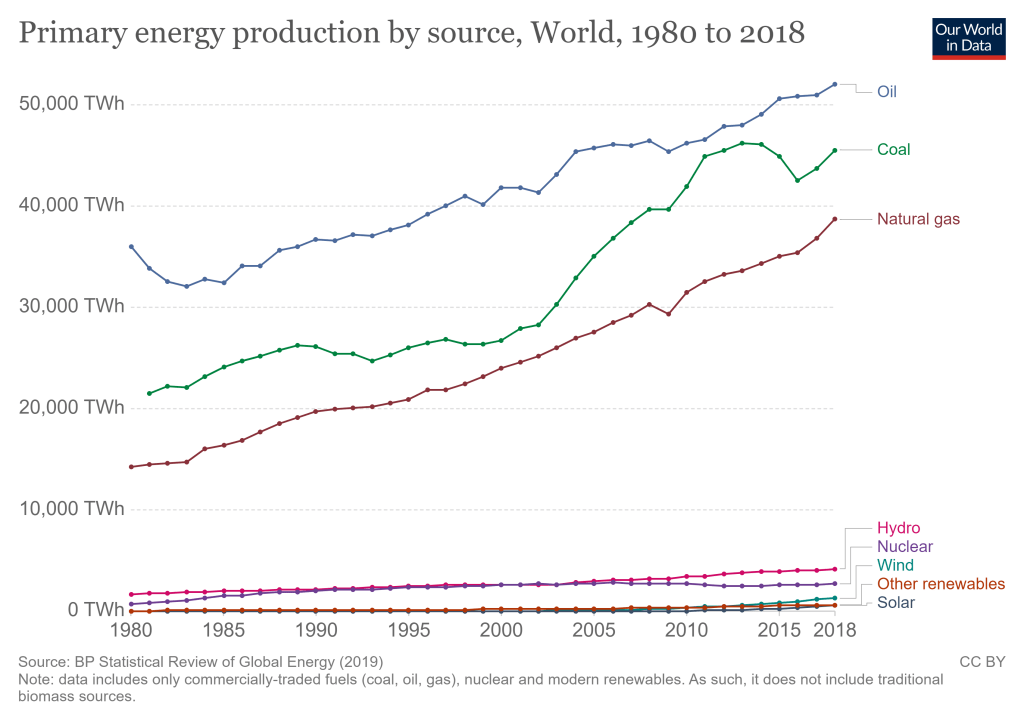
Assuming the figures used to make this graph are accurate, the image shows how well we have reduced energy production from fossil fuels, and how much we have increased renewable energy in the last 40 years.

source: https://ourworldindata.org/grapher/primary-energy-prod-source?time=1980..2018

We have failed. We have had years of climate action, discussion between nations, and targets have been set, yet the actions taken have ignored the problem and made the situation worse. The idea that technologies are largely defense mechanisms or modes of prevarication, is graphically illustrated. If we keep the same social organisation, and the same development processes going, then we are committing suicide. Whatever the appearance our States are failed States, when it comes to dealing with this problem.

We cannot rely on the State or big business to save us, or even to try to save us. We have been doing that, and this faith has not been repaid. We may need to get to work outside the State and outside big business…

This is where ideas of degrowth and community energy democracy come in. Degrowth will almost certainly not be a popular response to politicians, but it does allow us to ask questions which are otherwise not being asked. These questions have the potential to open the unconscious of our social dynamic towards destruction.

What, for example, if we tried to reduce burning fossil fuels without replacing them? This would be world changing, it would also start debates about wealth distribution, and energy distribution. What do we really need the energy for? How do we need the energy production distributed, to make these cuts possible? How can we levelise consumption to give everyone what they need to survive comfortably and freely? Can communities build and manage their own energy supplies? Can any of this be achieved along with the maintenance of rivalrous military based nation states? Will those in power who love the maintenance of violence-based hierarchies fight with all they can muster to go to destruction before surrendering their power?

I doubt such questions will be asked, but they are essential, otherwise technology is likely to primarily remain either a prevarication or a defense mechanism, which maintains our self-destruction.

Pandemic and Climate Action

April 1, 2020

The pandemic has shown the world is quickly able to organise against crisis. Charles Eisenstein claims the pandemic “breaks the addictive hold of normality.” Others propose that the coronavirus has “killed neoliberalism,” changed the practical ideology of neoliberal governments, or changed the world. Neoliberal governments have decided to support workers laid off during the pandemic, even casual workers. Retired politicians in Australia, such as ex-state premier Bob Carr, and ex-leader of the opposition, John Hewson, have been agitating for climate action following the response to the virus. George Monbiot points to the growth of bottom up, and often localised, support actions by ordinary people, as showing that communal processes are not dead. Electricity consumption is going down in some places, air flights have been cancelled, oil remains unburnt despite its low price, CO2 emissions are falling, showing what a low carbon future might look like and so on – although it is not certain that it will be long term.

Many are asking whether these systemic changes can be carried into action on climate. To explore this question we must look at the differences between pandemic, and climate, action.  Some of this may sound cynical, but it is also plausible, and given we do not (and cannot) have full knowledge of what is happening, plausibility may act as a tool to help us uncover the problems we face.

Differences

Monetary

Firstly, few organisations stand to make billions out of ignoring the virus. Cruise ships and airlines are losing money, and therefore could downplay the crisis, but they are fighting against fears that the virus comes from outside (encouraged by right wing politicians and media – the “Chinese virus” etc.), and from travellers being easily identified by authorities as infection vectors, so this is difficult. In Australia, Virgin air, despite not being profitable for seven years, is requesting a $1.4 billion government loan to get it through the pandemic. Qantas has argued that if Virgin receives this money it should “get A$4.2 billion in funds because its revenue is three times larger”. In the US, the government has offered airlines $US29 billion in payroll grants, $US3 billion to contractors and 29 billion in loans. Tony Webber, the former chief economist of Qantas, said “Every airline around the world needs help, it’s not just Qantas and it’s not just Virgin, they will run out of cash eventually.” So airlines have an interest in supporting recognition of the pandemic as it will help keep them in business 

On the other hand, many powerful, wealthy and socially central organisations (fossil fuel, mining and energy companies, car manufacturers, etc.) profit out of downplaying the climate crisis, and may lose financially from recognising it (for instance subsidising fossil fuels would look odd, if governments recognised these fuels are destroying us).

Disruption and pollution

The pandemic disrupts ordinary life styles, while pollution, ecological destruction and fossil fuels help to continue these modes of living, until it’s too late. Pollution and ecological destruction are also frequently less visible, or easier to hide away, than sickness. It is common for pollution and destruction to primarily affect the poor or be located away from large influential populations who might notice it. Coal mines are rarely in central public parks.

Escape

Wealthy and powerful people are less likely to think that they can completely escape the pandemic through their wealth and power; they may even say coronavirus does not care about wealth from within a bathtub with floating rose petals. Well-known people like Prince Charles, Boris Johnson and Australian politician Peter Dutton have caught the disease (as have presumably some of those close to them), although, as none of them have apparently died, they might come to think it has been exaggerated. Doctors have died. Even if you can escape to the high-seas in a well-armed private yacht, you still have to come to land to take in food, water and possibly disease, and you may need treatment.

While the wealthy cannot escape completely the disease will affect poorer people more severely. In the US because they cannot afford health care, or time off, and elsewhere because the essential services workers have to interact with other people and live in more crowded conditions. The rich can isolate much easier.

Precedent

We have dealt with pandemics before, the historical guidelines for action are quite clear, and we know how bad they can get. We have precedents for action on disease, but we only have recent, largely unfamiliar, models for climate change and no heritage of action. Action on disease is habitual and uncontroversial, action on climate is not, as there is no routine.

The timeline and future of a pandemic is pressing and short. Intense immediate action is required, but will probably, although not certainly, be over in a year or less. The timeline within which climate change will become an ongoing crisis is absolutely uncertain, and is not marked by a brief agreed upon period of transition from good to bad, and back again. Most people are able to behave as if climate crisis will be at least 50 years away (rather than that we may have already passed, or be passing, the tipping points), so there is apparently no reason to discomfort ourselves or engage in major political struggles against power and wealth elites now. It is easy, and less painful, to postpone action.

Command and Control

As Charles Eisenstein points out, pandemics can be handled within a ‘command and control’ power structure. Violence and penalties are implemented mainly against the general populace rather than the power elites themselves. Again this is a familiar route and, for some politicians, suspending parliament or democratic process presents them with an opportunity to extend their power, as in Hungary, decrease opposition and bring in business as in Australia, or delay elections and hinder public protests [1], [2], [3],[4] – it is hard to protest if people cannot gather in groups larger than two as in NSW. The chances of absolutely unexpected or unknown consequences from these authoritarian actions seem relatively low. With climate change, the elites resist, the chance of unintended consequences is high, and we are not sure how to proceed, or even if we can proceed, without long term disruption. Command and control is not always the best way of dealing with complex or ‘wicked’ problems, so we would have to develop new modes of acting, which adds to the difficulty of agreement.

The technology for pandemics is generally clear. Quarantine, medical treatment and working on vaccines. We do not have to hope for major breakthroughs to deal with the problem. Climate technologies are new and expensive substitutes for already functional technologies which are strongly tied into modernist power, wealth and energy structures. Climate technologies are resisted by those tied to established technologies, and are not always easy to implement without disrupting more people, as when agricultural land is taken for solar panels. The unintended consequences of these technologies are largely unknown, even if the dire unintended consequences of established technologies are known.

Mess of Information

While lots of disinformation and misinformation circulates about the pandemic, with a possible tendency to wander off into political polarisation, or even US vs China slugfests (apparently to diffuse blame for one’s own group’s, or President’s failings), there are currently no major media organisations, or corporately sponsored think-tanks, promoting an anti-medical agenda. They may want to distract from any role they played in helping the initial situation get out of hand, agitate for special compensation or make political capital out of the aspects of the response, but they are not banking on building a political alliance out of pretending the pandemic is unreal (at least not yet). Even Fox News changed its initial tune, possibly after people in the organisation became ill – although it now seems to be trying to exonerate Trump by implying China is the real source of the US’s problems [1], [2], [3], even if other countries are doing much better in the same situation.

One of the main ways of making money from the pandemic, or attempting to lower fear, is through promoting fake or untested medicines [1], [2], [3], but most large businesses are aware that this could lead them into financial, or legal, trouble. So it is mainly small concerns that benefit from this, but they gain no benefit in denying the pandemic.

An interesting perspective on disinformation is visible through the way that President Trump has changed his stance. His initial reaction was to deny there was a problem, state that it would be over quickly, that criticism of him (or alarm at the virus) was a hoax by the Democratic Party, that it was no worse than the flu, and that everything would be over by Easter. Now he is claiming that “I’ve always known this is a real — this is a pandemic. I felt it was a pandemic long before it was called a pandemic”, and if there are less than 200,000 deaths he will have done a good job. “The president repeatedly asserted that millions would have died if he hadn’t stepped in.” He may have made this change by seeing the effects of the virus on hospitals in Queens NY, and infecting people he knows, or because people from Fox told him that there was a problem. This does indicate importance of personal reference, and the vague possibility that he might be able to change track on climate change with equal speed.

Ecological Disruption and Economics

A major problem revealed by the pandemic is how important ecological destruction is to the workings of our system, despite talk of nature sending us a message. In the US the Environmental Protection Authority has announced it will not be policing pollution because of the outbreak (but see this), and rules for fuel efficient vehicles are to be scrapped. The crisis has not stopped, or slowed, the taking away of Native American land, or stopped Amazon’s anti-union, anti-worker’s rights activity [and 1]. “America’s wind and solar industries have been left out of a $US2 trillion economic stimulus package released by the federal government” leading to job losses. Various companies see the pandemic as an excuse to bring back ‘one-use’ plastic bags. Kentucky, South Dakota and West Virginia have taken the opportunity to outlaw disruptions of ‘critical’ infrastructure‘, which includes oil and gas fields, through protest or ‘riot’. Building the Keystone pipeline will begin, despite the dangers of pandemic, with massive investments and loans from the Alberta government, and was welcomed in Montana as bringing jobs shut down by the pandemic, as if contagion did not apply to construction work. One paper claimed that

The construction of the pipeline is deemed critical infrastructure by the US Department of Homeland Security and therefore is allowed to continue as planned provided measures are implemented and followed for safety under current orders.

Other promotions of US fossil fuel continued.

[T]he Interior Department wrapped up an auction to sell oil and gas leases in the Gulf of Mexico, offering up some 78 million offshore acres ― an area roughly the size of New Mexico. It proved to be a bust, bringing in approximately $93 million for just shy of 400,000 acres, the smallest total for an offshore auction since 2016…..

The Federal Energy Regulatory Commission, a panel voted 2-1 to rubber-stamp construction of both the Jordan Cove liquefied natural gas export terminal in Oregon’s already-polluted Coos Bay, and the 230-mile Pacific Connector Pipeline. The decision, The Oregonian reported, stunned Oregon Gov. Kate Brown (D), who warned that the state had not yet approved permitting in the midst of a national emergency.

Huffington Post 21st March 2020

Former US Energy Secretary Rick Perry warned that warned that US fossil fuel companies were under threat of collapse due to lack of demand and flooding of cheap oil imports.

I’m telling you, we are on the verge of a massive collapse of an industry that we worked awfully hard over the course of the last three or four years to build up to the number one oil and gas producing country in the world, giving Americans some affordable energy resources

Fox News 1 April 2020

Perry also warned of the collapse of the shale gas industry, and suggested government intervention. Other commentators say that the shale gas and fracking industry in the US has never made a profit: “companies spent $189 billion more on drilling and other capital expenses over the past decade than they generated from selling oil and gas.” Fox news reports that the fossil fuel industry and “our energy workers” are supporting the fight against the pandemic by providing energy, and they are threatened by ingratitude and any Green New Deal. So it is conceivable crisis money may be used to defend established corporations against the consequences of destructive and foolish investments, or their refusal to branch out into new forms of energy or more environmentally friendly business. Below-cost oil could also undermine energy transitions.

A $2tn US coronavirus relief package will dole out billions…. and offer low-interest loans that fossil fuel companies could compete for – without requiring any action to stem the climate crisis.

The Guardian 27 March 2020

Despite the ideology that the free market comes first, neoliberals have always been prepared to bail out and support or build up, established, and well connected, wealthy companies, and it seems like the justification for a intensification of that process is beginning. Therefore, we should probably check all the spending of taxpayers’ money to make sure it is not just the normal transfer from ordinary taxpayers upwards.

The trend of defending the past is not just manifested in the US under Trump. China issued permits for more new coal-fired energy stations in the first three weeks of March 2020 than for all of 2019 and has halved subsidies for renewables to balance the budget. The virus has slowed solar installation in Australia’s Victoria. In NSW, an Independent Planning Commission inquiry into the Narrabri gas fields will be launched despite difficulties for audiences or public participation. Coal mining has been approved under Sydney’s reservoirs. So far in NSW, building of toll-roads does not seem to have been affected by quarantine restrictions. The Federal Government is “agreeing to stimulate demand for a fossil fuel” to keep the price stable. The International Energy Agency has warned that political action to deal with the virus could derail the energy transition.

Perhaps the pandemic has been used to cover these economic actions, perhaps they are seen as necessary to recover ‘ordinary destructive order’ after the pandemic. Whatever the case, it does seem that without a lot of political pressure and action from ordinary people, the historical devotion to environmental destruction will continue, even though the pandemic has demonstrated the possibility of enacting radical and rapid social and economic change, largely for the public good.

Conclusion

So we know the modern neoliberal state can act swiftly and intervene in the Economy and life, but what have we learnt of the difficulties of acting on climate?

We have to be prepared for resistance from wealthy and powerful elites, who can pretend that their mode of destruction is necessary for the continuance of contemporary life and its improvement. For them, postponing the appearance of crisis is important for contemporary life to continue, as is postponing the realisation that climate change and ecological destruction affect everyone. If the economy is destroyed through environmental destruction, there is little in the way of further wealth production.

Bringing realisation of the crisis into the lives of the power and wealth elites is important, as they generally see prosperity as arising from their actions rather than destruction, and the media tends to reinforce this, only partially accurate, attitude. The crisis affects them, and their businesses, and they should not expect to be bailed out, when they fail.

Everyone, even the wealthy, is vulnerable to this ecological destruction. This is an important message. It is also important to make people aware of the harsh normality of this irreparable destruction rather than to participate in its cover-up. People should be encouraged to keep protesting against things like the Sydney coal mines and the destruction of water tables, online and through letters, even if they cannot gather safely together. They need to keep trying to hold governments and businesses, accountable for their actions and their spending, whatever is happening elsewhere, and to keep organising themselves to provide support for each other, both physical and emotional. We cannot assume that money will be spent primarily to defend people rather than big business.

Personal experience seems able to change misinformation. When the problem hits misinformers and the problem affects them, their associates or their local areas, then change can come. From Trump and Fox, we know people can do a u-turn while pretending otherwise. There is no point berating them for their previous misinformation, but there is a point to encouraging the spread of reality and accurate information. This does not stop overseas interests from trying to interfere and disrupt connective action, but it will lessen their impact.

There is a romantic glory in fighting against established power. This is the case with fighting for climate action and needs to be made more of. At the moment, the romantic vision is commandeered by the power and wealth elites, in an unlikely pretense of fighting against all powerful science and socialism.

We need to explore how previous civilisations fought against ecological destructions and learn from them, whether they failed or not. This gives us experience we don’t have.

Managerial theory is finally trying to get beyond command and control, to encourage bottom up organisation of the kind that is occurring spontaneously in the pandemic. People naturally function in co-operation as well as competition, but our neoliberal societies discourage co-operation unless it is organised from above, probably because of the fear of revolution or loss of elite property – after all property is a fiction usually imposed by violence and the right to exclude others, and if people refuse to co-operate with the violence and exclusion, then property could get shared and the profit appropriated be diminished.

Community democracy and self-organisation is important to fighting environmental destruction. Few people want their own living spaces to be poisoned. Neoliberalism dismisses this resistance out of hand as NIMBYism (unless it is a new industry like windfarms), in effect saying that corporate profit justifies the destruction. But if you can’t object to your own way of life and your environment being destroyed, when can you object? and if you can collectively organise your environment to be more pleasant and liveable and sustainable, and safe from corporate exploitation and destruction, is that not good?

Finally, most people do not realise the ways that contemporary forms of economic activity destroy their home. This, to me, seems a major point of understanding. Once people get this reality, and it is a reality, then they can truly start to wonder if there is another way of conduct manufacture and trade, which retains freedom to trade with lack of permission to destroy and imperil everyone. Human logic, and civilisational experience, implies there is. So we need to discover the rules by which this new game can be played – and it probably comes down to fluid democracy again, rather than to command and control businesses devoted to authoritarian ways of proceeding.

So climate action is connected to freedom to live, and to freedom to act with others, and by oneself, without being imperiled by corporate power, or by the governments that support that power over the people.

The latest from Project Drawdown

March 17, 2020

From The latest report slightly rephrased.

1) We can reach Drawdown by mid-century if we use the climate solutions already in hand at a large enough scale. We can solve our problems even without technological innovation.

2) Climate solutions are interconnected as a system, and they should reinforce each other.

3) Climate solutions have other benefits for people as well, such as no longer being poisoned by pollution, or having their land destroyed.

4) Savings significantly outweigh costs.

5) We need to accelerate moves to reduce or replace the use of fossil fuels. We need to actively stop the use of coal, oil, and gas and replace them with other sources of energy – renewables, hydrogen etc.

6) We need to simultaneously start reducing emissions towards zero and support, or expand, nature’s carbon sinks

7) Some powerful climate solutions receive comparably little attention, reminding us to widen our lens.

  • Food waste reduction and plant-rich diets
  • Regenerating eco-systems
  • Restoration of temperate and tropical forests
  • Rehabilitating peat lands
  • Encouraging Ocean based Carbon sinks (which improve fisheries)
  • Preventing leaks and improving disposal of chemical refrigerants
  • New cements, which exist
  • Building recycling responsibility into products
  • Bio-plastics
  • Electric Transport and improved public transport running on zero-emissions energy.
  • Access to high-quality, voluntary reproductive healthcare and high-quality, inclusive education

8) Solutions do not scale themselves. We need means of removing barriers and accelerating their implementation and expansion. That is, we need political and cultural action.

9) The climate crisis requires systemic, structural change across our global society and economy. Footholds of agency exist at every level, for all individuals and institutions, to participate in advancing climate solutions.

10) Greta Thunberg: “You must take action. You must do the impossible. Because giving up can never ever be an option.”

We should probably add that we need to stop, as quickly as possible, all pollution – that is all waste which cannot be processed by the ecology in the amounts that are emitted. We also need to stop deforestation, and over-fishing.

We need to phase out all subsidies for fossil fuels, whether they are taxpayer handouts, tax breaks, tax evasions, royalty holidays or anything else. If needed the recovered money could be used to help renewable development.

All of these moves will cause lots of opposition, but they are necessary. It is not just a matter of what we do, but what we refrain from doing.

What could the ALP have done better

January 2, 2020

OK. Someone said to me, its easy enough to criticize Joel Fitzgibbon, but what do I have to say that is constructive? Here are seven points, where Labor seems to have failed, and some simple fixes.

1) Too many policies. We should have learnt from the Right by now. Have a strong central narrative, and do not give details. Return to the strong central narrative, whenever you are questioned about details. This is what sticks in peoples’ minds.

Labor did not have a strong central narrative. Partly because of points 2 and 3, below.

2) Too many policies that seemed incoherent. You are going to fight climate change and promote coal and fracking? This does not make sense. It means both those who support coal and support climate action, think you are half hearted, and probably lying about something. Choose one side or the other, preferably climate action. Point out there are few jobs in coal. Point out that the Adani mine will use, and pollute, lots of water in a drought. Point out the Adani mine will very likely damage the great Artesian Basin, and thus damage agriculture and jobs all down the East Coast. Point out that Adani have already polluted the Great Barrier Reef. Etc. Etc. Point out climate change is not just an inconvenience but deadly and that, yes, some sacrifices might be required to fight for our children. Put forward policies to guarantee good jobs in mining areas for miners and their children. Make it clear there are good jobs in Renewables under Labor, and that people will not be abandoned.

Job and income security is important, and is not threatened by going green, but it is threatened by climate change.

3) Don’t fight an election on policies no one understands. Franking credits? No tax rebates on tax not being paid? Great idea, but how many people understood what you were talking about? Almost nobody. The majority of people were easily convinced you were somehow likely to take their pensions away, or start taxing them harshly. This made the Coalition’s day. They could lie continually, and you had no defense, because hardly anybody knew what you were talking about, and those who did know where probably not going to vote Labor anyway. I still hear people, in the media, say that you wanted to abolish tax-free earnings on shares.

You did not need this policy. If you have policies like this, introduce them when you are in power, and have the time to explain them carefully, and see what happens.

4) It does not matter what you say, the Murdoch Empire will attack you. So don’t worry about it. Give up trying to please them. Go for a coherent and memorable message.

5) Moving to the Right will not save you. Even if you vote with the Coalition 100% of the time, the Murdoch Empire will still brand you as ravening socialists or Nazis, because they like confusing the two. Moving to the Right will only loose you votes, as people move to independents or Greens. Moving to the Right, also serves to confirm that the Right are right, so people might as well vote for a real committed Right-wing party, not you.

You even have an allegory for what will happen. Malcolm Turnbull, continually gave into his hard-right Murdoch inspired acolytes, and never won their acquiescence or support. He simply received stronger demands, and their contempt, until nobody knew what he stood for or even if he stood for anything. The Empire will always behave like this. Accept it, and steer around it.

Remember the Right are fundamentally wrong, and make this point repeatedly.

Move to the Left if you want, it will help distinguish you from the others.

6) Its ok to attack the Coalition – they will attack you. You let the Coalition get away with 7 years of incompetence, stupidity and corruption. You did not even try to remind people of the continual scandals and idiocies that they brought forth. This allowed them to pretend that they had been a good government. Their narrative won, because there was no counter narrative, and because they kept blaming everything wrong on Labor. They stayed with their strong coherent (lying) narrative that Labor were high taxing and economically incompetent, something reinforced by point 3. You cannot expect, like the Coalition can, that the media will remind readers of your opponents’ stupidities (see point 4 again), so you have to make the points yourself. Repeatedly. This is not being nasty, this is trying to save Australia from more of these people.

We now have Scott Morrison who is worse than Tony Abbott, unbelievable as that seems, partly because you refused to remind people of what the Coalition are like.

7) The Greens would like to be friends. But you keep hitting them. It is easy to think you hate the Greens more than the Coalition. This goes back to point 4 – the Murdoch Empire will attack you for being green no matter what you say. So you might as well say you are the ‘sensible Greens’ or something, and demonstrate it, but yes be open about it. You are probably more likely to ally with the Greens than One Nation; at least everyone, on your side of politics, would probably hope this is true. By attacking the Greens as much as you do, you either look small minded or hypocritical. No one on the Right will believe you are not Green allies, whatever you say, so get over it. The Greens are not your party, and they won’t always agree with you. Get over that as well. Be prepared to negotiate, which you were not in 2009.

Remember it was the CFMEU and Clive Palmer, not the Greens, who actively campaigned against you in Queensland.

Paul Chefurka’s “Ladder of Awareness”

December 29, 2019

[Re-edit October 2020]

Paul Chefurka proposes a number of stages of awareness of climate problems, with psychological consequences, which might be useful in understanding what we can expect as we ‘progress into the depths’ of the problems and predicaments we face.

Stage 1: The Person sees that there are particular shortcomings in an organization, our morals, our economy or whatever. It’s a matter of changing the rules, or getting more of something that is already there. It’s pretty easy really, if only people saw sense. [In terms I use later in this blog, this is a partly a problem which arises because of the so-called ‘directed mind‘]

Stage 2: There is ONE Fundamental Problem which destroys everything else. Capitalism, Climate Change, government, overpopulation, Peak Oil, biodiversity loss, fossil fuels, inequality, patriarchy, sociopolitical injustice, stupid politicians, socialism, lack of spirituality, etc. If we can fix this problem, or control some other people, then we can fix everything. [This is a form of radical simplification – a refusal to acknowledge social and ecological complexity [1], [2]]

People become activists and keep bringing up this problem to explain everything, and point out how everything could be solved if we really solved this problem.

Stage 3: If we become aware that we cannot seem to solve the big problem, it is possible for awareness of their complexity to grow. Then it seems there are many problems, but the person still might still try to prioritise some problems or resist expanding the ‘problem field’, to keep things under control. They may fear that further new concerns will only dilute the effort which needs to be focused on solving the “highest priority” problems.

Stage 4: Then the person realises that the problems are interconnected and influence each other. It is hard to keep those problems bounded and separate. There is a multitude of problems. The person sees the importance of unintended consequences – a solution in one domain may worsen a problem in another. Prediction is difficult, planning seems impossible.

At this stage people may move into small like-minded groups. This can increase learning and insight as the whole set of issues is discussed, in ways in which they cannot be discussed elsewhere.

I would add these groups can also be a retreat from problems, if the people are not careful. The people involved can see themselves as an elite amongst the benighted, and just reinforce their earlier certainties, [or they can become pure and spiritual and risk separation from the world].

Stage 5: Through ongoing discussion, the set of problems can now be seen as a complex predicament, by which I think Chefurka means a condition of existence which may not be solvable at all. We become aware that the predicament encompasses all aspects of life. Chefurka keeps this realization as part of Stage 4, but I think that moving into recognition of the predicament is another stage which needs recognition – as that is a different place from the rest of Stage 4. With this realization:

The floodgates open, and no problem is exempt from consideration or acceptance. The very concept of a ‘Solution’ is seen through, and cast aside as a waste of effort.

[We can potentially open up the problem field, and see how problem areas we have kept separate are connected. As well, everything we think we know, may appear even more uncertain.]

Depression is likely at this moment – especially if we are facing the problem alone, and have not managed to form a sympathetic group. If the problems are insolvable, then what will happen to us all?

However, there are two paths which open – although they would seem to have always been open, and this realisation constitutes the stage beyond depression – I would call this Stage 6.

Again, I think it important to accept that stage 6 is also a social event. The groups and connections we have formed are not transcended. They are part of the process.

Path 1. Move into resilience, community-building and local sustainability initiatives. We recognize that the State will not solve the problem, and probably cannot solve the problem. [Big NGOs cannot solve the problem.] The Corporate Sector will not solve the problem either. But we have to help both others and ourselves survive the oncoming crash. Without community, without the ability to work together we are probably dead. At the least, without active community we are stuck, unable to move and helpless. Being alone or with our family, holding out against all comers is eventually barren, even though it could be temporarily useful. Humans, in general, do not live well without other humans. It seems we have to find what strengthens all of us to fight onward, and make a new life, using the insights of the previous stages.

What we have learned is: Life is complex. There is no one problem. We cannot solve, or survive, the mess of problems [and this is a deliberate term], especially not alone. Predicaments interact. Unintended consequences are normal. We cannot depend on old structures. We have to talk, as well as act. We have to change our psychology which was appropriate perhaps for the old consumer life.

Path 2: The Inner path. “Become the change you wish to see in the world,”  “In order to heal the world, first begin by healing yourself.”

This move is not a retreat into established religion and dogma, or to retreat from the world. That is simply pretending there is only one problem again, with one solution – sticking with the dogma and generally, imposing it on others. That is a denial of Spiritual and world complexity. The inner path is a process of attending to oneself as part of the world/creation, of one’s visions and dreams, of one’s feelings, and poetry. Other people help point out depth – our predicament is collective, and so, to some extent, is our inner world.

For me, both these paths are one. To make them separate, and bounded, is yet another denial of complexity.

Without attention to the ‘inner world’, we bring our complexes, resentments, unconsciousnesses, violence and so on to the effort to become resilient. We keep blaming others. We do not withdraw projections. We do not relate to others, and we need the others for satisfaction. We do not behave morally – and whether you want it to be the case or not, a new ethics needs to be born, out of what we find we need to do to survive the predicament.

Without attention to the ‘outerworld’ then we merely talk to ourselves, and get lost in the symbols, the fantasy, the bliss or horrors. We wander around not perceiving what is happening: we believe only what we want to believe, only what comforts us, and pass into delusion. In this solo state, we still require others for building our ‘spirit’, but we do not help them.

We test the inner by the outer and the outer by the inner. We learn the one from the other.

The ‘inner’ is only separated from the ‘outer’, when we are lost in theory. When they come together we get art as well as scientific practice amidst our daily life. And that could be good for all.

Psychology and climate?

December 23, 2019

The question of psychology, climate change, and our apparent inability to deal with the problems, is an extraordinarily complicated question, so please excuse the length of this attempted foray.

First off I’d argue that, in the case of climate change, we probably cannot isolate individual psychological inabilities to deal with the problems, from the social and political inabilities to deal with problems; they are almost certainly all related and interconnected.

We live in a society whose huge success has depended on ecological despoliation and the production of greenhouse gases (GHG). This is a reality. The ‘available energy’ we have had to innovate, to build the form of prosperity we have, and the levels of military expansion and protection we have had, depends almost entirely upon fossil fuels, concrete (with heavy GHG emissions) and steel production. The rest of the world, to a large extent (not completely), would like the same levels of prosperity for at least some people, and the same levels of military security, and those things currently appear to need expanded use of fossil fuels and steel production – although some people are trying to do it with renewable energy, but that is hard and a little uncertain.

So we live in such a society, and are psychologically adapted (to the extent we can be) to that society and to its consumerist drives. Many people find their main source of psychological satisfaction in buying products, and this keeps the economy, its production, and its energy usage going. Note I’m not arguing that buying products is necessary for human satisfaction or happiness, but simply that this is encouraged by our social arrangements – politicians and business people get worried if people are not buying things. Buying things often (not always) also encourages ecological destruction and pollution – this is the nature of our lives and social dynamics.

If people accept that climate change and ecological despoliation is occurring and occurring at a rate which is dangerous to their individual and social lives, then they are faced with what we might call an existential crisis. Their ways of living are apparently destroying those ways of living. Most of what they know about how to act is potentially disruptive of that ability to act. Much of what they do to protect their families, is potentially harmful to those families. What apparently produced stability in their worlds, now appears to produce instability, and so on. This realisation can be paralyzing.

This problem is extremely hard to deal with at an individual level. How do you find out what to do? How do you make and take effective actions, without keeping the destruction going? How can you, as an individual, stop the apparently suicidal course of world social order? How do you fight against your source of prosperity? What might result if you do? It may seem too complicated, too horrible.

Deciding what to do may be close to impossible in the circumstances. You may feel stunned, drained, anxious, depressed etc. Conception of the world proves difficult, disruptive and disturbing. There are no standard social guides to what to do. Advice from anyone, is really only conjecture – it cannot be anything else. We have not faced this problem before, on this scale. However, should you decide to act anyway, you then face another, and possibly even greater, social problem.

Faced with the same issues as yourselves, many currently more powerful people have decided to ignore the problem, or decided that it is too difficult or that it does not exist. To their minds solving the problem means potentially destroying their prosperity, potentially destroying their military security, potentially destroying stability, and potentially destroying the relations of power and wealth they apparently benefit from. If climate change is true, and its effects are potentially really bad, and we try and stop it, then it seems that some extremely powerful and large corporations can no longer make money out of selling and burning fossil fuels. Some other companies will have to stop destroying ecologies to get resources. Some companies will have to stop over-fishing, destructive agriculture and forest felling.

If all this is true, then the situation is certainly psychologically dislocating for powerful people, and the established interests of their organisations and paymasters.

Those powerful people will not act on their own. They will team up with each other, to defend their apparent interests. Hence they can spend a lot of money and a lot of effort, trying to convince you that nothing can be done, and nothing should be done. They can politicise climate change, claiming that if you are a real conservative, real Republican, or real pro-business person, you will understand that the science is a conspiracy, and that solutions to climate change are socialist and hence bad (or evil) and so on. They try to appeal to fundamental parts of your social and psychological identity, to make you ignore the problem, support existing modes of wealth and power, and to encourage you to attack those who disagree. Indeed the politicization of climate, makes it much harder for people to talk to each other about it, which reinforces psychological incapacity and silence. After all, to those who recognized climate change, it appears that ‘deniers’ are trying to kill them, through denial. This also does not help calm conversation and psychological health.

Surprisingly rather than attempting to produce solutions (which may have uncertain social consequences), these representatives of established ways tend to denounce all potential solutions – and they sometimes may have a point, not all proposed solutions will be good solutions. However, this behaviour is unusual. Normally they can put forward solutions to problems, even if it is the one solution to all problems, but not here. This problem and this inability paralyses them (and is, in turn, part of their paralysis), and it paralyses a whole body of politics, a whole part of society. They have nothing left other than denunciation, the hope that it won’t be so bad after all, that scientists are wrong, and things can continue, or perhaps the hope that Armageddon is here, and they can do nothing about that, other than walk to their doom/salvation. Again psychology is entangled with social and political life.

However, as things continue to get worse, as fire erupts in forests which have not burnt for thousands of years, as droughts become more prolonged and farms become unproductive, as heat waves last longer, as land glaciers and ice shelves melt, as floods affect living areas, as weird weather keeps hitting, people may become more and more uneasy. They still have little sense of where to go, they have new things to learn and no way of learning. The distress will likely continue to increase, and people become more and more debilitated.

Eventually the psychological social and political systems will have few options

1) They will break down under their own inertia and inability to solve problems.

or

2) The people in power will start thinking that if they don’t do something then everything really is threatened, so they had better act, even if they don’t know what they are doing, or even if preserving existing power relations is more important to them than productive change.

or

3) New people with new ideas will try and take over, and there will be a political war.

or

4) a miracle will occur….. for example a new cheap easy technology may replace fossil fuels – but if it does not replace the social organization that occurs around pollution and destructive extraction will it do more than delay the point of crisis?

In any case, it is likely that realising that both psychological incapacities and capacities have socially and politically active backgrounds may be useful to overcoming some of the incapacities, anxieties and depressions that we face.

The reality is that we are not facing these problems alone and, while we may be encouraged to face them alone by people who want us to do nothing, or by the fear of being denounced by others, there is a necessity of facing the problems together with others; especially if we are going to undo our psychological incapacities. Perhaps discussing the way we feel about climate change with others in small groups might help us to clear away some of the incapacities to act? Then we might find out how to act, or how to promote solutions. Maybe we might even come up with solutions and persuade others to act. When facing such a problem, we need to work together, but we may need to converse together first in a reasonably collaborative and non-condemning environment, so as to build trust. Working together is important as it expands our capacity to act, our capacity to think, and our capacity to effect change, and have an influence in the world.

Turning away from problems because they seem insurmountable, or trying to solve everything by ourselves, is rarely helpful either to our pyscho-social functioning or to our success in solving the problems which produce their distress. This is especially the case, when the problem arises from the social dynamics we live amidst.

Its too late to stop climate change

December 12, 2019

It is now probably too late to stop climate change.

It was not too late to stop it 10 years ago. We could have succeeded if there had not been massive political resistance to stopping it. Somewhere between then and now, we probably have passed a tipping point or two. Methane is being released from the seas and the Tundras. Forests, which were supposedly too wet to burn are burning. The Antarctic ice shelf is breaking up. Land ice is melting in Greenland. The Northwest Passage is becoming navigable. Towns and cities are without water supplies.

While we cannot stop change, disruption and chaos, we still have the option of making the results even worse, or holding the worse at bay. We also have the option of preparing for the worse, so we can deal with it as best we may, and diminish the damage. This is the best we can now aim for: mitigation and preparation.

Currently the East Coast of Australia is on fire. One of the reasons for the extent of the Bushfires is because Right Wing governments decided climate change was impossible or would not have an effect for years. They cut back experienced staff, and refused to prepare. They still seem to be holding back on helping firefighters. Even now they are trying to blame the extent and ferocity of the fires on anything other than climate change, and they are still arguing that we should increase emissions because it is profitable.

This is a classic example of how not to face a problem. They have walled themselves up. They cannot admit they were mistaken, and that they need to change. They have either never been able to propose a solution or wanted to propose a solution, and so politicised the problem so as to make doing nothing look righteous.

The Labor opposition is not much better, with their leader explicitly declaring the party in favour of coal exports as they make some money and we might as well make it. Neither of the main parties seems up to the challenge, although at least Labor might admit there is a problem. So, expecting the parties to change in time to stop total disaster, is almost certainly futile.

People who want to survive in a relatively stable society have got to keep fighting for us to prepare for the worse and to diminish the possibility of the worse, and they will have to fight inside and outside the political parties. Otherwise life will become extremely difficult, and keep getting harder and more unpredictable.

We may no longer be able to stop climate change, but we can prepare for it, and try to stop making it even worse. Hence a active climate movement is still necessary, and perhaps more necessary than ever.