Posts Tagged ‘social category theory’

Another source of information mess

April 9, 2024

Intellectual humility is usually taken to be a virtue, but recent research by Matteo ColomboKevin StrangmannLieke HoukesZhasmina Kostadinova & Mark J. Brandt reports that Intellectual humility may also have a relationship with prejudice. They state:

  • First, people are systematically prejudiced towards members of groups perceived as dissimilar.
  • Second, intellectual humility weakens the association between perceived dissimilarity and prejudice.
  • Third, more intellectual humility is associated with more prejudice overall. 

“That is, the higher a participant score on the measures of intellectual humility, the more prejudice they express on average across all of the groups…” They also tie this to justification and good evidence

The basic idea is that those high in IH will tolerate a plurality of views and values and would not be prejudiced against those views and values. However, when the groups who hold these views and values are perceived to be low in IH, this will elicit a higher overall prejudicial response in those high in IH…. our findings might be driven not by the views associated with target social groups, but by the perceived epistemic attitudes associated with them.

I guess when I think about it, the results do make sense. Intellectually humble people are quite possibly likely to be dogmatists and go with the crowd or with authority of their crowd, and think a few confirming cases of their dogma prove universality.

For example. Let us suppose my crowd believes “Theory Q”. A skeptic might wonder about the truth/accuracy of theory Q, because that is their general position – they ‘arrogantly’ assume that some other people, can be wrong. However, a humble person like myself is likely to say, “I don’t understand Theory Q, it seems contradictory, and not in keeping with my experience, but all these people I admire go along with it. Is it more likely that they are wrong, or that I am lacking in understanding?” Being aware of my own intellectual limits I must assume they are more likely to be correct and I am deficient in some way.

Accepting Theory Q, may have the secondary reinforcement that it also makes life pleasant. Most other people I know, can accept me, as I go along with their dogma and assertions. It adds to my peace. So intellectually humble persons ‘logically’ support Theory Q dogma, no matter what misery it brings to themselves or others, and do not get carried away with the conceit of skepticism.

If the people I dislike, because they are in a socially disapproved outgroup, also happen to deny Theory Q, then their obvious lack of virtue, the arrogance with which they dismiss Theory Q, etc, leads me to be glad I am with people who believe theory Q. Its part of who we are. If I disagreed with theory Q then I must be like one of the despised outgroup and that cannot be. I would loose my support and meaning in life. I may not recognise that the outgroup is not being arrogant in its dislike of Theory Q, they may even object to it mildly, but how could I see that, when it is a mystery to me?

Of course if I were already to believe Theory Q, then I can stick with it, whatever the evidence, because again people I admire and trust go along with the dogma as well. Perhaps people they have been taught to dislike do not like theory Q. In either case, this dogmatism supports the rest of the group in its dogmatism. People cheerfully bring in evidence for the position and ignore counter evidence together, and chuckle at the idiots in the outgroup who are skeptical.

If people I admire etc, tell me that all people who are Z are also Y, then why not believe them? Especially if people who are Z seem visibly in the outgroup. What would I know? If I find that a person who is Z is rude to me, or hostile to me, it confirms that the dogma is correct, even if I have encountered people who are Z and I did not know it (they are perhaps hiding because of the general assertion they are Y) or they were quite pleasant even with my prejudice against them on display.

If some of this ‘reasoning’ is correct then intellectually humble people, or people who recognise the world is terribly complicated, can perhaps easily become dogmatic and non skeptical of their socially directed biases. They might even congratulate themselves on their intellectual humility, as it leads them to believe things they would not ordinarily believe and lets them be ‘saved’ or remain part of their identity group.

Borders in the global world

May 27, 2022

National borders

First thing that has to be grasped. Fixed borders between countries seem to be a relatively recent development. In ‘olden days’ people would cross from one country, or duchy or whatever, to another as part of daily life, even when the law confined residence to a village. People on the border shifted around and generally ignored it. The borders where whatever could be held by the troops at the time – or when under challenge by other troops. The Roman and Chinese Empires did not have fixed borders as far as I can tell. Borders were fluid although often based on rough geographical features. Borders may be argued over, if they exist at all. In Hunter and Gatherer societies ‘borders’ are matters of respect, and occasionally of what you can defend – other people may wander into your territory all the time. Central sacred sites may be more important than the borders around. Lack of firm borders may not be a problem with the proper requests, or if you don’t meet each other. Borders may be marked by myths or pronounced geographical features. The land owns you, not vice versa.

In the modern world Borders can be so arbitrary they can even be lines on maps drawn on a latitude line, which is purely conceptual and does not correspond to any geographical, or mythical, features at all. These borders are not real other than in the sense that social conventions are real.

Even Islands like Australia do not have clear borders. We have had long term people movement and small trade between Australia, Indonesia, Papua Niugini and the Pacific Islands and this has not stopped, and will probably will not stop without local disruption. In the USA, large sectors of the economy seem to depend on fluid borders, and large parts of Mexico depend on income being sent home from the USA. Cutting that flow off completely may have unintended consequences for both countries.

Taking borders as real and fixed leads to problems, especially in the modern world which, whether we want it to be or not, is global. However, this does not mean that a country has no right to enforce its borders, just that this may be more complex and have more side effects than the people imposing those borders think.

Borders and Climate

Climate change is not local. It does not respect human borders. Our country’s pollution affects people as far away as India or Iceland. We are helping to cause temperatures to rise in Pakistan to 50 degrees C. (122 degrees F). Chinese decisions likewise affect us.

We need to not only work within our borders but across borders. If we make emissions worse, we make it worse for all, including ourselves. We are not safe from the emissions of the coal, gas and oil that we export when they are burnt in other countries – even if these emissions are not counted as being our emissions. Everything we do affects others and ourselves as we live on an interlinked Planet not just in a bordered country. What we do influences how others behave. If we set a bad example, then other people will excuse themselves as well, and that will affect us.

If governments do not understand this, then they have no hope of understanding climate change, or dealing with it.

Borders and Economy

We now live in a global economy. We probably have done so for a long time. However, it is now clear, that economic events in one country affect economic events in other countries. If Russia blocks exports of Ukrainian wheat, that affects the world. If banks in China collapse because of bad local loans, that affects the world. When financial companies in the US tried to defraud home loan owners in large enough quantities – that did affect the world. Money lost in one part of the world effects operations in other parts of the world. If companies go to where the labor is cheapest, and the pollution costs smallest, that affects everyone, and likely puts downward pressure on wages and environmental regulation in other places. If companies can find no tax zones that affects everyone, and lessens money for social spending. Economic crashes may not be confined within borders, especially when companies are not so confined. Inflation and depression are often cross-border events. Neither Biden nor Trump could keep inflation outside the borders of the USA.

Large corporations are commonly cross border institutions. They export something from one country and sell it in another. They make some parts in one country and use them in another. They may generally not be self-supporting in one country – they require many countries, and they ignore borders, except for the advantage that local regulation can give them. Exports and imports between countries can exist within the one company.

Companies have the wealth of small (and sometimes quite large) States, and push States around rather than vice versa. Corporations have the advantage of mobility, which States do not have. They can move from one place to another leaving destruction behind. Consequently, no country has complete control over its economy, and its economy depends on other economies. Economies do not respect borders. If you are going to understand and deal with economies you have to understand this.

Borders and the Military

Military threats also don’t respect borders. Never have. Civil wars are always destructive. It is now easy to smuggle incredibly destructive weapons into countries. The US is probably in as much, or more, danger from internal threats than from external threats. An Atom bomb set off by an internal terrorist is as physically dangerous as a bomb launched by a foreign power, and it is probably more psychologically dangerous. Putin’s Russia is facing a problem, not just because Ukraine is resisting far better than they expected, but also because the economy and resistance to the war is international, and does not respect the borders of the two warring countries. It is also forcing Russia to become dependent on China, and it seems unlikely the Chinese will be long term allies, or do not have some objective here that may not be in Russia’s interest. Ukraine used to be inside Russia’s borders, but it is not anymore. Powerful Russians seem to have thought Ukrainians thought of themselves as Russians, and as living within the Russian border, or within Russian influence, but it seems to have been wrong.

No country is immune to war because of its borders.

Borders and Fences

Borders are long and fragile. It is impossible to entirely fence off the USA from the rest of the world and stop people from crossing the fence, or to stop weather, ecology and climate from knocking the fence down. As plenty of other people have shown this is what has happened with Trump’s famous border wall/fence. It was easy to climb. It collapsed; blown over or swept away by rivers and floods. It stole private land. It was a waste of money and resources, and did not serve to protect the USA from climate problems, economic collapse, migration, or modern military challenges. At best it seems a distraction from the real problems…

Social Categories and Borders

It is generally assumed that social categories have firm borders, and people act as if this is correct, but it is often not correct. A few examples:

‘Racial’ categories, blend into each other. People breed with each other, sometimes by violence, but nevertheless they breed across cultural and racial groups People often seem to have ancestors from all over the world. People breed across borders and then inland from the borders, so the whole group is affected. It is unlikely that any country has ever been pure in ‘race’. Attempts to reinforce racial boundaries attack the reality of the mixtures.

Cultures borrow from each other, and separate from each other. They innovate and change – people are good at having new ideas. Attempts to reinforce cultural boundaries attack reality and creativity.

Class and caste borders are permeable – not only because we breed with each other, but because people do go up and down, people marry in – even in caste societies – wealth gets shared (although people can try and stop this). Attempts to reinforce class and caste borders attack reality and the distributions of talent and ability.

Male and female categories flow into each other, no matter how hard people try to police the boundaries, and punish ‘masculine’ women and ‘feminine’ men. Again, people have different abilities and it seems best if these competencies are recognised and allowed to flourish, so we can adapt to changes in reality.

More obviously, there is a tendency to treat people who identify with political parties, or positions, as if they are all the same, or at best, similar. Even a moments discussion should show people this is not true. Not all ‘right wingers’ think gays or lesbians should be exterminated or excluded. Not many ‘left wingers’ , think that people should be forced to be gay. Not all Conservatives are fans of free markets, or corporate power. Not all left wingers think capitalism and private property should be destroyed. The idea that people who support one thing, will support another is rarely correct. There is far more movement and room for alliance, than many influential people would be prepared to admit. The borders between parties are not as distant as is made out by people in power, and as was shown by the recent Australian election in which right wing candidates who firmly stated that they would promote action on climate change overthrew the established right wing who pretended that they were opposed to climate change. They attracted votes from all sides of politics (possible in the Australian voting system). The category borders appear to stop discussion, stop us from seeing what other people really think and stop the resolution of problems.

Borders

While they can be useful to mark differences, borders of all kinds are largely conceptual and conventional. They do not always solve real problems and may even make the problems worse. We need to avoid being distracted by them, or waste energy trying trying to enforce them, and reach across borders, to solve the world’s problems and to involve people in the process.

Comments on Legitimacy as a concept

October 19, 2021

I’ve never been that fond of legitimacy as a concept, partly because it often seems too simple to deal with really complicated situations. The idea of delegitimation processes being mutually connected with legitimation processes, and shaping each other, improves the situation, but perhaps not enough.

Let’s look at some obvious points.

Legitimacy, complexity, process and struggle

Legitimacy is a social phenomena.

Hence Legitimacy is a complex phenomena:

  • It occurs in complex systems and is nearly always dynamic, and possibly unstable.
  • Complex systems tend to stay in equilibrium, but they can change rapidly, perhaps coming into new stable states, that may not be an improvement for all dwellers in the system.
  • Possibly small events can have large consequences, especially if repeated.
  • Unintended consequences are normal. Attempts to impose order generate chaos etc… What is thought to produce legitimacy for a thing/process may weaken its legitimacy. Legitimacy can be risked by enforcement. For example, enforcing fossil fuels destabilises the system, which may destabilise support for fossil fuels.
  • Producing legitimacy, or delegitimacy, is not just a matter of intention, but of mutually influencing factors and forces.
  • It can be hard to draw boundaries around legitimation struggles – they spill over into other ‘factors’ – such as cosmologies, customs, habits, politics, group relationships and identities, economics, ecologies, etc.
  • The course of what happens can depend significantly on the context – or supposed external factors and vice versa.
  • Sometimes with complex phenomena you have to proceed by listing the factors involved so you don’t forget important forces.

Legitimacy is not a noun or thing, it is more a descriptive adjective applied to a thing/process.

There are degrees of Legitimacy/illegitimacy which can be attributed to a thing/process. It is not just on or off.

The attribution of legitimacy involves a process, a struggle.

Legitimation struggles often imply de-legitimation struggles, as some other factors have to be delegitimated – the success of fossil fuels require renewables to be inadequate or hindered, and climate change to be exaggerated. Legitimacy and de legitimacy often come together and shape each other.

Institutions can be fractured and this can affect legitimacy. There can be legitimacy struggles within institutions.

Attribution of legitimacy may not be uniform in society, any more than ethical norms have to be uniform. These differences can drive legitimacy processes.

Legitimacy and Ethics

Legitimacy of a thing/process seems related to ethics in that establishing or demolishing Legitimacy often involves ethical arguments. It is possible that arguments over whether a thing/process is legitimate form a subset of ethical arguments, or that ethical arguments are a subset of legitimacy arguments. We could allege ethics is about the legitimacy of actions, thoughts, existence, relationships, behaviours etc…

Ethics is not only revealed in dispute, but ethical arguments can be irresolvable, so ethical disputes can end up being temporarily terminated by deployment of violence (preferably a violence with some support and acceptance [legitimacy], such as courts, law and police), or some kind of magical terminal category. I suspect the same is true of legitimacy arguments. When the violence is used or legitimacy asserted then it can risk being challenged.

Ethics seems to involve

  • Context – events and framings, what provokes the debate, how the events are understood.
  • Cosmology – how the world works and what ethics, or legitimacy/delegitimacy delivers.
  • Custom and habit – what is done gains ethical force, and ethical legitimacy, up to a point.
  • Doing what other people that a person identifies with, or whose category they are put into, may do… Do what others do.
  • Political relations between groups – social category theory makes predictions here
  • Justification or criticism of what people are doing. Often justification can apply to oneself and one’s group, and criciticism to those in outgroups. The aim can be to persuade people ‘you’ have behaved legitimately, or that ‘others’ have not.
  • Enforcement – ultimate resolution of debate by force, or threat of force, or punishment
  • Exclusion – of some people from ethical debate, by saying they are inadequate etc., eg it seems common to allege young children, slaves or people not of the same monotheistic religion, are not capable of ethics or of deciding whether a thing/process is legitimate.

These factors also appear to affect legitimacy: they can be called ‘framings’ or ‘contexts’ for the struggle.

Legitimacy/delegitimacy: Support, Acceptance, Indifference and Rejection for a thing/process

When we talk about the adjective of Legitimacy we may also be talking about several things, that compose it, apart from ethics.

For example: Active Support, Passive Support, Acceptance, Indifference, Reluctance, Active Hostility and Rejection (you can reject something without being actively hostile to it)

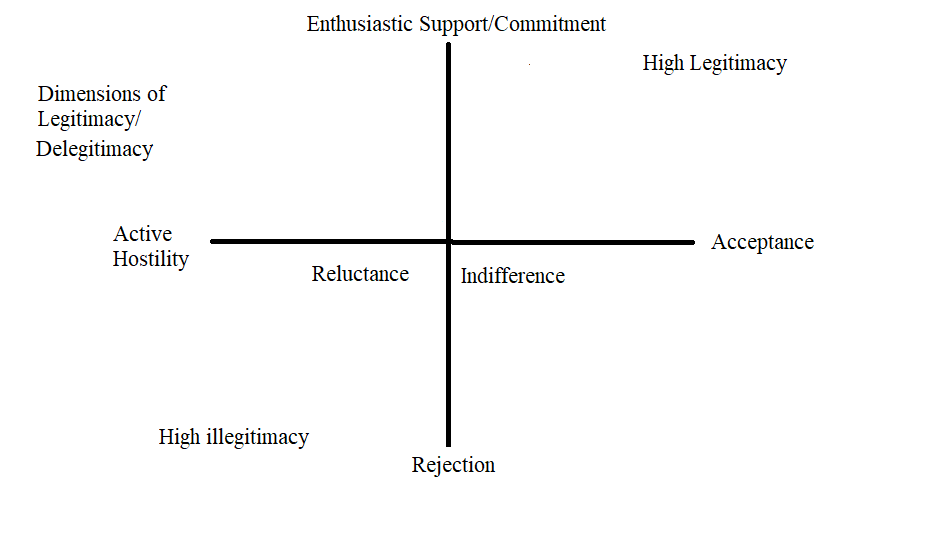
I propose to replace the single legitimation-delegitimation continuum, with two intersecting continuums:

  • Support – Rejection
  • Acceptance – Active Hostility

The central point can be called ‘Reluctance’ or Indifference

This graph allows us to specify that ‘legitimacy’ may involve acceptance and indifference, as much as it involves support. The graph could help prevent people from thinking legitimacy is just one thing. We could guesstimate plotting places for various different groups, to give some idea of the social complexity around a thing/processes’ legitimacy levels, and investigate (and possibly predict) what alliances are possible.

It also suggests a range of paths of transition towards support or towards rejection. Some of this can involve belief about legitimacy, but some of it does not – it may involve a disposition or a set of habits.

Indifference does not have to be on the path to rejection or support. Indifference can theoretically translate into either tacit acceptance or tacit rejection, so it may be less useful to replace this with a single continuum of Support / acceptance / indifference / rejection.

We realise that cumulative small events can trigger instability in the legitimation system, and alter it significantly. The question may be to find those causes of equilibrium stress.

The point here is not to present something entirely accurate, but something better, that hopefully points in more useful directions for this area of study, which allows us to ask better questions.

Ethics and undecidability

October 13, 2021

I shall argue that ethical questions are vital but fundamentally irresolvable and so the questions become:

  • How do people build and reinforce an ethical system?
  • How does, or to what extent does, that system affect human life?
  • How can we change social ethics?

Social importance of ethics

Let me posit that humans like to be regarded by themselves and others, if possible, as ‘good people’ no matter how ‘good’ is socially defined. A Viking’s idea of what makes a good person, might be radically different to that of Mother Teresa’s, and ideas of goodness might differ in a society with a person’s gender, social role, age and so on. There may be no coherent set of ethical positions across different groups in a society. However, being recognised as socially ‘good’ by some others, often builds status, privilege, trust, influence and sometimes power. Being recognised as ‘not-good’ may increase distrust, fear, the threat of exile and so on.

Sometimes what is socially good, is built up in opposition to a supposed mainstream – thus a ‘good’ criminal (as defined by others), might see themselves as tough, competent and clever, despite the mainstream seeing them as bad. Perhaps they claim to see the reality of human life, while other people are hypocrites.

Arguments about politics, decisions about courses to choose in life, seem frequently underlined by claims that the decisions and positions involve ethics. Even if people can be accused of hypocrisy, they are still making some kind of ethical decision, deciding that the decision they make is the best one, that it is a decision they should be able to live with. So we can still suggest they are being ethical, simply that they perhaps do not expect others to approve.

Ethics is complicated, and hard to demarcate, and understanding ethics seems complexified by several factors such as its lack of a non ethical basis, its connections to cosmology, its connections to group identity and politics, its connection to custom and habit, and finally (but permeating everything) its connection to context.

Lack of basis for ethics

Firstly, it seems there is no basis for ethics which is not an ethical statement which foreshadows the ethical argument that will proceed from it. In general ethical arguments do not have appeal across different forms of ethical arguments, and there seems no way to avoid this problem, despite the apparent importance of ethics for human identity.

For example, if we say it is good to behave in the same way in all situations (the so called “categorical imperative”), that itself is an ethical statement, which can be denied by other ethical arguments such as the assertion that it is our duty to behave with respect to the situation in its particulars, and not suppress those particulars in the general (what is sometimes called “situational ethics”). I would suggest we almost always categorise human events as situations similar to others, because of our intentions. We may want to classify an event as ‘bad’ or ‘excusable’ because of circumstances and context for example – is a killing murder, self defense, occurring in war, ‘crime of passion’, provoked, accidental etc…

Even something as apparently straightforward as acting to preserve the survival of as many people as possible, is already an ethical decision. Other ethical systems could suggest that humans do not necessarily deserve to survive, or that the population (usually of other people) should be culled, or that only elites, or true believers, like us (whoever we are) deserve to survive, that survival should be determined by contest, or that or that material survival (as opposed to gaining spiritual wisdom) is unimportant, and so on.

There is no necessary agreed on basis from which to argue ethics, so ethical questions are always irresolvable, although groups who share similar ethical orientations may agree on the general principles.

If groups do not share some symbolic ethical orientation, then there appears no obvious basis on which different ethical positions can be resolved, other than by different groups resolving to live together irrespective of this difference, different groups splitting or hiding, or uniformity being imposed perhaps by total control of information or through violence. And these resolution positions may also be said to be ethical positions.

We might suggest that ethics is itself revealed in argument over what should be done, and what has been done.

I will argue that to study ethics in action and the way it is built, reinforced and changed, we have to look at the following kinds of factors, all of which help resolve or limit the undecidability of ethics:

  • Cosmologies (the way people and reality works),
  • Established customs or habits – what people do regularly and publicly is supposed to be good. on the other hand changes in custom or habit may make new habits become ethically good
  • Group identities and relations to other groups. A good member of a group appears to express group values.
  • The way group boundaries are constructed and the group is positioned in relationship to other groups.
  • Contest and power relations – the other group is always bad, what we do is good, or at least acceptable in the context.
  • Dominance can become a custom which justifies the nature of the dominance. If wealthy people dominate then wealth marks virtue. If religious people dominate that piety marks virtue. If warriors dominate then boldness in combat marks virtue, and so on.
  • Context, the surrounding events may well alter ethical judgement and decision making. Cosmologies, etc can be considered to be contexts

Ethics and cosmology

Ethics always states something about a person’s cosmology. By ‘cosmology’, I refer to the ways that a person or group, thinks (theorises) that people and the world or cosmos actually work, or the ways that people have to live to survive. Good behaviour should generate ‘good’ results (however they are defined), because that is how things are – even if the good results may manifest after we die. Thus if you think that obeying the written instructions of a God is the basis of ethics, that says something about your cosmology and the way you expect behaviours to be rewarded. If you think that behaving ethically will bring happiness, you may aim to increase happiness, in the way you think that works. If you think the world is a place of endless struggle, then you will probably participate in, and train for, that struggle.

There is, for example, some evidence that believing in neoclassical capitalist economics is correlated with more selfish behaviour. Which way the causality flows is uncertain (believing in classical economics generates selfish behaviour, and selfish behaviour reinforces a belief in those forms of economic theory), but it may form a positive feedback loop. The behaviour and cosmology reinforce each other.

Sometimes behaviour and cosmology may not appear to reinforce each other, but they still set off a particular ethical dynamic. For example may believe that God is both love and an eternal torturer, this may set off a dynamic of using torture and violence to express your love and concern – which may drive guilt which drives more torture and less love, and so on. Perhaps people eventually came to think that this message was inconsistent and this helped drive the decline in Christian dominance?

Custom and habit

Anthropologists who studied traditional people often expressed surprise, when they asked the people “why do you do this?” and received the answer “because we have always done it,” or “our ancestors did this.”

The point is that if some process is familiar it can seem that that is the way of the universe, or the way things work, or are. You may not like it (individually), but most people will go along with it, because that is how the world is, and perhaps little thinking seems required. Custom and habit suggest ethical acceptance, or else they might change. They reinforce cosmologies. If it is the custom to sacrifice your first born to the gods, then while you might have personal doubts, most other people in your group will support the action, and will probably try to make you perform it – perhaps to avoid the anger of the god. If it is necessary to find a job to survive, then getting a job will seem moral. If it is customary for the Aristocracy, or the wealthy, to rule, and they seem relatively good at ruling, then it will seem good that they rule. If people get married as a mark of maturity, people may seek to get married. If a society and its habits had depended on fossil fuels for a long while, it could seem immoral to try and change, and to risk those habits that have grown up around that technology – new habits might seem impractical, unpragmatic or just wrong.

A change in habit can produce challenges to cosmologies…

Ethics politics and difference

Ethics is always political and revealed in conflict, disagreement and argument. Politics usually involves some kind of ethical appeal, even if the appeal appears pragmatic, because in some views ethics is primarily pragmatic, but what is pragmatic is also an ethical decision. Whether it is ethical to run a country either by increasing corporate profit, benefitting the people materially, or keep the ecology functional, is a matter of ethics. People often justify what they want to do by an appeal to ethics, cosmology or politics.

As political, ethics can be perceived to be part of the social relations of differences between groups and their social categories and identities. This is a context in which ethics works, and social identities are constructed. Identities often come with ethical positions, in which it is implied that exemplary members of the category will behave in particular ways, and exhibit particular virtues. One obvious basis for ethics, is that everyone we respect in our group is doing it, so we had better do it. This seems to work because of the lack of a basis for ethics

People’s ethical judgment of the behaviour of people on ‘their side’ is often more lenient, and trustful, than it is towards people on a socially defined other side. A person who seems to be a good exemplar of the groups you identify with, will probably seem to be virtuous. A person who seems to exemplify, to you, the groups you oppose, will probably seem non-virtuous, or more prone to corruption and evil. Likewise, people can justify their group’s narrow political interests while claiming it is for the greater good, or the good of all. People seem to more easily see the bad in another group than in their own, or even invent that bad in the others through some kind of shadow projection. Social categories are important for ethics. Mistreating, or ‘mastering,’ some people of certain social categories may be a requirement of virtue

The way the boundaries between groups and social categories is constructed is also important, because empathy and concern is also strong between people who are defined as similar, and who can be put into a wider category. This is similar to the ways that Benedict Anderson suggested that Nations where constructed out of popular media; the media grouped people together as worthy of concern, as sharing the same stories and the same identity, so that distance was relatively unimportant. In this case, different people were constructed as different, but still belonging to the wider notion of the nature, and for some people of humanity. However, categories can be constructed as opposed, in which case the connecting empathy may be significantly weakened, or even broken all together. We can see something like this happening in the US. Once not that long ago, people who identified as Republican or Democrat could see each other as different, but also as fellow Americans who worked together for their country and who could co-operate for the greater good. That stage now seems over. Republicans see Democrats as evil hypocrites, and Democrats see Republicans as conniving and stupid people who deny reality. There has been almost no co-operation between the parties, except for a co-operation in name calling, hostility and building polarities, for the last 12 or so years.

As a result, the US is probably in danger of falling apart, or falling into decay. There is no common story and identity group cosmologies are growing apart. The split is driven by ethics, ethical identity and group relations, and seems to be becoming a custom or habit, and hence part of practical cosmology.

Context and Framings

We can define ‘context’ as the events around (or ‘framing’) a specific event, or which the event is embedded within. Changes in context changes the meaning of an event, just as a different context can change the meaning of a text, or anything else. Framings can be conscious or unconscious. Using the term ‘framing’ is meant to suggest that the context of an event, does not have to be ‘real’ – people can bring their own framings to an event, and different groups may have different framings, so they perceive and interpret what is happening quite differently. Cosmologies can provide context. Wide scale, or local, politics can provide context. Ecologies can provide context.

If the context involves charged relationships between particular groups such as a challenge to authority, then the condemnation of a person in the opposed group might intensify and the defense of a person in a supported group might also intensify. In a war, the side committing war crimes will probably ignore them, or defend them as honorable, or aberrations. If a custom is breaking down, then those who offend against it may be excuses or more severely condemned, depending on other parts of the context. If a cosmology changes enough then it may provide a context in which the old ethics does not appear to work or make sense. In the case I will eventually get around to studying, one important context is the relationship of Governments to fossil fuel companies – this governs a lot of what is easy to happen, and what is difficult to happen

It appears to me that the somewhat precarious role of coal at the present, because of climate change (a change in context and cosmology), has not yet rendered fossil fuels completely bad, but it does seem to render other people’s coal bad, and our coal ok – it is cleaner or something.

This is one reason why it seems important to fossil fuel companies to deny climate change, deny human responsibility for climate change, find a model of the world in which burning fossil fuels is not harmful, or fantasise about technologies which would fix the problem, but don’t exist yet.

The problems of socially defining and enforcing Justice (which is an ethical position), particularly across culture and rivalrous nations, may make climate justice arguments ineffective in promoting climate action.

Conclusion

This suggests that ethics arises in making (or justifying) decisions, in conflict over those decisions, in supporting or criticising established behaviours, and within power relations. So ethics enters into human life and politics almost immediately. A wide view of ethics could easily suggest it is central to human life and to human identity.

All of the arguments above means that ethical argument may not be persuasive to others, unless you use their form of ethics and are a member of their social group, and perhaps not even then. In general there seems little to resolve ethical struggle, between people with different ethics and different ethical identities, other than violence, threat of violence, exclusion of people from discussion, or apathy.

However, ethics, in practice, seems more social, contextual and political than absolute. It may be that pointing out the incoherence, or changing the contexts, customs and cosmologies of ethics, or perhaps pointing to exemplary people in the group being targeted who are slightly closer to the desired position, is more significant than attacking the basis of the ethics.
Bregman’s Humankind

August 18, 2021

I have just finished reading Rutger Bregman’s book Humankind. It is quite simply well worth reading – and is eminently readable.

Our standard view of humanity, probably influenced by Christianity, hierarchy, capitalist economic theory and the writings of ‘statesmen’, is that humans are savage. That without the social restraint provided by religion and hierarchy we would erupt in an orgy of uncontrolled sex and violence. However, one of the problems for early anthropology was precisely why peoples without one of the ‘religions of the book’ and without generational hierarchy, a state, police and other enforcers were often (but by no means always), relatively harmonious, with quite strong sexual rules, and not human vs human – especially inside their own groups. Indeed, violence towards others tends to come with established hierarchies, such as hereditary chieftainship and ‘aristocracy’, and not always even then.

In other words the Hobbesian proposition that life without the force of hierarchy was “solitary, poor, nasty, brutish, and short”, was largely wrong – the ‘solitary’ part was completely wrong. Similarly, the classical to neoliberal economic view that we are all brutally selfish and greedy, and that order arises entirely by an act of God, from this stark competitiveness, through his invisible hand, is also not true.

Bregman argues at length that the idea of human unpleasantness is exaggerated, and that humans left alone are primarily co-operative and indeed kind to each other (hence the title). Bregman does not deny humans can be violent and deeply unpleasant, but this is not our default state, although it can be induced.

He shows that most of the evidence for the primary nature of human violence (such as the Milgram experiments, the Stanford Prison experiments, or the ‘broken window theory’) is deeply flawed; it often derives from experimenters pushing people towards violence when it was not being delivered. While this does not demonstrate humans cannot be violent, it shows the importance of context to the production of violence, and sometimes shows that people are over-easily persuaded by evidence for what they are attempting to prove, especially when their belief has deep cultural roots.

Likewise, when there are disasters and people cannot rely on help, most people generally don’t descend into looting, violence, or looking after themselves first; they work together to rebuild and help each other (despite the ‘evidence’ of novels like Lord of the Flies). This is not surprising if you think about it. What one human can do is extremely limited, we have to co-operate with others nearly all our lives; achieving almost anything requires others. We are a friendly beast, easily provoked into empathy and compassion, and this helps us survive.

As well as being a friendly beast, humans have spent most of their existence in relatively small, hunter gatherer groups, and these groups tend to be fiercely egalitarian and co-operative, trying to pull down the establishment of hierarchy and resist the enforced authority of others. This does not mean that they don’t recognise ability, or praise ability, but that praise is within bounds; they use shaming techniques to remind people that they are mutually dependent, should the person with ability think the ability entitles them to more privilege than the group agrees to. Decision making is a long and slow group affair, often requiring unanimity, and groups may relatively peaceably split, forever or for a while, if this cannot be attained.

Bregman shows that most evidence for warfare amongst hunter-gatherers, as opposed to fights, comes from people coming into contact with ‘civilisation,’ being slaughtered, having to defend themselves, or losing territory that sustained them. That includes the Yanomami who are often referred to as an exemplar of human violence. The book that argued they were continually violent was a best seller (probably because of cultural appeal), while the books arguing that that “violence is sporadic,” “never dominates social life for any length of time” and that “one cannot say that Yanomami culture is organized around warfare,” did not. The famous author also distributed steel weapons amongst the tribes people so that well may have changed behaviour, as previously injury rates may have been low. Anyway, the point is not that humans are incapable of high levels of violence, but that it is not primary and usual.

Bregman suggests that the thing that changed humanity was settled agriculture. This allowed surplus. It allowed population increase. It stopped people from wandering away if they needed to. It made land size important. It allowed raiders to take food. It forced inheritance laws to keep land in the control of someone, and thus pushed people away from being self-supporting. It allowed hierarchies to develop. It allowed hierarchical religions to develop, as explicit modes of domination and genocide. Along with all this we get the hierarchical state, to control people, hold them down, mediate all the new disputes that evolved, and to conquer more land to feed their populations and provide enclosed land for those who now need it. States are generally not friendly to hunter-gatherers wandering freely – I guess it sets a bad example. I also suspect the State and ideas of property are intertwined. I’m adding a bit to Bregman here, but his argument seems plausible.

Even with State encouragement, most humans are not good at warfare, without intensive training and bastardisation. We have to overcome our friendliness and our empathy and compassion. At Gettysburg most muskets seem not to have been fired. People seem to have spent a lot of time reloading so as to avoid shooting, and avoid getting in trouble with officers. The same in WWII. We all know the stories of the Christmas truces in WWI, in which soldiers found the opposing soldiers to be like them and surprisingly friendly. This soldier based truce was suppressed by those more distant from the battle. Truce and spontaneous friendliness had to be prevented from ever happening again. Who knows, without the officers’ efforts, the war could have stopped? Soldiers fight, not to kill the enemy, but to support each other.

So why wars? Because hierarchies select for sociopathology. Hierarchies select for people with no shame, for people who find deceit easy, for people who are nasty and brutish. In a large scale society they can hide from the knowledge of others. The idea that humans are generally brutish and need enforced discipline not only seems natural to such people, but can help them maintain their power by justifying harsh treatment of potential rebels.

I’m going to argue that social category theory can be important here. That is, the more that social categories are defined as existing in opposition to other social categories, the easier it is to have co-operation between members of a category and violent relationships between ‘opposing’ categories. If we are prevented from social participation by some other group, which happens almost as soon as we have agricultural States, then we also tend to develop either apathy or anger against others. Anger is easy to work up, because it is anger against the perceived persecution of one’s group. Working with others in one’s category to express or purge the anger leads to violence against those defined as being in the persecutory group.

The challenge for a hierarchical leader is to misdirect people’s anger away from the leader who might benefit by people’s real suppression towards someone else – another social group, another country, another religion etc. We are continually bombarded with propaganda about how all other humans endanger us, and how we have to keep the hierarchy to protect us from those evil others, when it is generally the hierarchy that increases the problems. We can see the Trump issue here – the US Right depends upon the idea that evil outgroups (Democrats, communists, immigrants, black people, professors and so on), are stripping away liberty and livelihood of those who are in-groups, so as to deflect attention away from how the party allows established corporations to continue their hierarchy and pillage of ordinary people. Without that manufactured conflict the party does not have much to offer. The idea that people are violent and selfish, helps justify the ruling groups and their violence against others.

Bregman spends the later chapters of his book explaining that strict policing, intense imprisonment, and so on, make the situation worse. We are teaching people to be violent and to fear others. This goes back to an earlier point, the more people believe that other people are selfish and violent, the more they feel justified in their violence. A warfare society will encourage this belief.

The suggested remedy is to hand power and responsibility back to the local level, to diminish the hierarchies, let people organise themselves and encourage hostile groups to intermix and work together. Bragman does give some examples of this in action. He does not discuss how capitalist economics is inherently hierarchical, depends on a State, and is prone to the destruction of liberty and opposition, but perhaps he wanted to keep a US audience.

The main problem is getting rid of hierarchy, and remove a whole slew of institutions that are based on submission of others, massive inequality, and suppression of friendliness, empathy and compassion. We may also need to get rid of religions that portray God as a tyrant, who harshly punishes people for disobedience or disbelief – that simply justifies tyranny and violence, and promotes emulation of sacred violence.

Removing these obstacles to a peaceful and settled life is difficult, as those who benefit will not go easily, and effective violence against hierarchy will probably lead to more hierarchy to re-impose peace. This has been the perennial problem of revolution.

We also have to deal with the problem that State based organisations, such as corporations, seem hostile to self-governing and egalitarian small groups and it is hard for these small groups to win conflict against a State.

Yet these are all problems worth facing. The first step may be to ask yourself, if the other people you are hostile to, are really as violent as you might think? How do you ‘know’ they are violent? Is that violence being exaggerated for political purposes?

Nazis and Socialists

June 30, 2021

Introduction

I often encounter people who say the Nazis were socialists. It seems a standard part of current day rightist theory. supporters of the proposition don’t generally present much evidence beyond the name Nationalsozialistische Deutsche Arbeiterpartei (National Socialist, German Workers Party), this implies that they will then tell me that the Democratic People’s Republic of Korea shows how bad democracy is.

Historically, the party did grow out of Anton Drexler’s Deutsche Arbeiterpartei which seems to have been both authoritarian and anti-capitalist, blaming Jewish people for the problems of capitalism, but after Hitler essentially took over (the original party lasted just over a year) any focus on the rights of German workers declined considerably, although Otto and Gregor Strasser did tie the nationalism to socialist rhetoric, perhaps to drag workers away from communism. In 1926 at the Bamberg Conference Hitler denounced the remaining socialist-inclined members as “communists” and ruled out land expropriations and popular decision-making or consultation. Otto Strasser either broke away from the Nazis in 1930 after Hitler allied with the German aristocratic and corporate elite, or he was pushed, or both. After Hitler was appointed Chancellor, through Conservative support, he soon had Gregor Strasser murdered during the Night of the Long Knives. In the 1930s the Nazis openly told business that democracy and business were incompatible, and received about two million Reichsmarks in funding from big industrialists as a result. Hitler was also financed and supported by American Corporations and the British Aristocracy because of his anti-communism and the fact he was not socialist.

Hitler was a fan of Henry Ford, and vice versa, probably because of their shared anti-Semitism. In July 1938, Hitler awarded Ford the Grand Cross of the German Eagle. Henry Ford helped lead the America First Committee, which sought to keep the United States out of World War II. Ford had a car company in Germany, helped provide war material for the Nazis, and may have used Nazi provided slave labour.

As far as I know, Hitler never seems to have been interested in supporting worker power, or redistribution of wealth to the general populace. The Nazi critique of capitalism seems to have been largely confined to criticism of international bankers (ie a code term for Jews). Inequalities in property ownership were supported and sanctified.

So we can say that even if the Nazis once had been socialists they were not before or after they got into power.  

What did the Nazis promote?

Lets look at what the Nazis were. They were:

Nationalists

Making Germany great again. Germany first. Germans are the master race etc…

Racists

Comes with the Nationalism and the master race stuff. Everyone who they defined as non-German or non-Aryan, was inferior no matter how long they had been living in Germany.

Inferior races, at best, deserved to be slaves under the control of the white Christian German people. Inferior races had no rights, they could be shot and detained at whim.

The “jewish threat” gave them internal people to hate and blame for anything that went wrong, gave them a scapegoat to produce unity, and provided an excuse for theoretical inaccuracy.

Authoritarian and Hierarchical

The Fuehrer was top of the heap. Everyone should honour and obey him. His immediate circle came next. All of life was a chain of competitive authority. Zealous obedience was a key to success. Of course non-Germans and inferior races where at the bottom of the chain, and of little value except as labour. If they could not labour then death was the reward.

Hierarchy was officially, about race, ability and heroism.

Having a hierarchy means people need to have an easy way to identify those inferior to them, so they don’t get mistaken for those inferiors and can attack them.

Nazis abolished Trade Unions as these were incompatible with Party Authority, and likely to be socialist and disrupt corporate power.

Statist

The Reich/State was the Nation, and the Nation the State – and the State was a hierarchy of obedience. The Fuehrer and the State should master everything. People should serve the State, not the State the people. State is unified by race. Self-governance by those lower down, was not acceptable. Autonomous non-government zones where not acceptable.

It is true that Hitler did not believe in rule by corporations, but he did protect them.

Ideological

Education exists to promote “Aryan values” whatever they are. The values were said to be under threat by degenerates, and foreigners, and such people must be silenced as much as possible. Education was to aim at producing people for the workforce, the military and the party. Any university person who disagreed with these values, or this position, was to be removed as a marxist or as non-Aryan. Obviously Jews should not teach – Heidegger, for example, got rid of Jewish lecturers. Aryan students should spy on their teachers and report those who deviated. Only Aryan research which supported the official ideology was to be allowed. No research which openly checked on the accuracy of party policy, economics, authority, hierarchy, racism etc. was acceptable – it was to be denounced.

Heroes

Heroism was important. This involved self-sacrifice for the Fuehrer. It involved perpetual struggle against those who would undermine the Fuehrer. It involved leaping into combat with degenerates without thinking. It meant fighting for the Reich and one’s fellow fighters without question. It meant group loyalty. You should never be disloyal to the party. Disloyal people should be punished. Heroism was also about the survival of the fittest, most talented etc. Strangely it often involved official denials that they had engaged in the violence they promoted.

Cultivation of heroism, in this case, leads to the unheroic being despised and open for slaughter.

Militarist

Another consequence of Nationalism, and the implied inferiority of others. The Germans where the supreme fighting force in the world. They were only defeated by betrayal. All Aryan men should contribute to the military effort. All other Nations where inferior and deserved to be conquered, to provide land and resources for German heroes. Military combat was the supreme expression of heroism.

There is no evidence that Hitler espoused anti-colonial policies, other than in an attempt to conquer the colonies of his enemies. He certainly did not support self-determination and independence for people Germans conquered.

Sexist

This was reinforced by the militarism. Women exist to please men, to be obedient to men, and to produce more soldiers and breeders for the Reich. That’s it.

Corporate

German corporations where the backbone of the German State. They should produce the resources and equipment needed by the State, when the State commanded. As long as corporations realised their place they were given authority, and slave labour. No workers rights or unions were to disrupt production or wealth extraction, so corporations were relatively happy.

Mystical

The Fuehrer was close to God or Spirit, mysterious and inspired with an understanding beyond that of mortal men. If you could not understand him that was to be expected, but you should should still obey. Germany was dominant because of its spirit and its fate. Many Germans seemed to find Hitler a source of religious and mystical comfort. They had a special relationship with him, even if they had never met.

Aryan Christianity was the official religion (with as much relationship to real Christianity as evangelical prosperity preachers), although the elites may have had their own rituals. They found it easy to accommodate with most Churches, who helped support them as they represented authority, and the choice of God.

“The völkisch-minded man, in particular, has the sacred duty, each in his own denomination, of making people stop just talking superficially of God’s will, and actually fulfill God’s will, and not let God’s word be desecrated. For God’s will gave men their form, their essence and their abilities. Anyone who destroys His work is declaring war on the Lord’s creation, the divine will.”

Mein Kampf p.562.

My feeling as a Christian points me to my Lord and Savior as a fighter. It points me to the man who once in loneliness, surrounded only by a few followers, recognized these Jews for what they were and summoned men to fight against them and who, God’s truth! was greatest not as a sufferer but as a fighter. In boundless love as a Christian and as a man I read through the passage which tells us how the Lord at last rose in His might and seized the scourge to drive out of the Temple the brood of vipers and adders. How terrific was his fight against the Jewish poison. 

Speech delivered at Munich 12 April 1922; from Norman H. Baynes, ed. (1942). The Speeches of Adolf Hitler: April 1922 – August 1939. Vol. 1

Propagandists

They lied about the forces against them, to build support. They did not like people checking their ‘truths’. They repeated slogans endlessly to give them the certainty of truth. They made ‘agreements’ for as long as it was convenient. This may have been a mistake as it gave Russia and the UK time to prepare for the inevitable war. Deniability was high. You may have had to divine what the Fuehrer wanted and give it to him, especially if it could be disreputable.

The truth of any statement was a matter of how much it supported the Party, Reich and triumph etc….

For what it is worth the U.S. Office of Strategic Services claimed:

His primary rules were: never allow the public to cool off; never admit a fault or wrong; never concede that there may be some good in your enemy; never leave room for alternatives; never accept blame; concentrate on one enemy at a time and blame him for everything that goes wrong; people will believe a big lie sooner than a little one; and if you repeat it frequently enough people will sooner or later believe it.

A Psychological Analysis of Adolph Hitler: His Life and Legend

Of course Nazis are unlikely to claim that they lie.

Support

Nazis were supported by many conservatives in Germany, and by many Republicans and US corporations (even after it was made illegal to trade with them), because they were not communist or socialist, and recognised property hierarchy. This helped keep the US out of the war and gave the Nazis freedom to strike.

Conclusion

Non of these features of Nazism has any necessary connection to socialism, unless you define socialism in a very odd way so as to try and make the connection ‘true’.

.

Appendix Some extra remarks

The ideologies and theories of communism and fascism are completely different as a little research in reading the original materials should show you.

Communism aspires to the withering away of the state, the birth of people power, and relative economic equality under the control of the workers. It begins by attacking the power of bosses, plutocrats, aristocracies, established churches, and bureaucrats. Its contradictory failing, is that after the revolution it needs a strong State to demolish the previous social arrangements and to defend the revolution against attack. This has always been the point of fracture between communitarian anarchists and communists.

Previously powerful and wealthy people, often have their money offshore and keep trying to undermine progress, while other states which fear revolution attack it, just as the US, Australia and the UK fought against the Soviets after the revolution, or just like Cuba has been attacked and isolated ever since the revolution, even though they initially tried to ally with the US.

Given this, the people who come to control the State then have no real inclination to give up their power and make the new state vulnerable, so the revolution never comes to fruition, even if it could.

Without fail, given this kind of situation, dictators have always arisen, even though the fundamental aim of communism was to remove authoritarian aristocrats, monarchs or plutocrats.

On the other hand, fascists aim to establish an authoritarian nationalism. Dictatorship is part of the scheme from the beginning. Usually the would-be dictator is the focus of the party, the policies of the party are whatever the leader says, the leader is proclaimed to be a genius with an indissolvable tie to the people. The only issues are how to apply the leader’s wishes, and how to purge the party of those who still cling to ideas of democracy, worker’s revolution, or fairness.

The Dictator and the party are usually supported by some of the existing power elites, such as the aristocracy or the corporate wealth elites – often, ironically, as a bulwark against communism. As they are nationalists, usually aiming to restore the nation’s greatness in the eyes of the world, and to restore discipline and obedience amongst the people, they are often supported by conservatives. Eventually the aristocracy, corporate sector and conservatives find they have supported an effective, as opposed to bumbling, dictatorship and have to go along with it to keep their positions. However, capitalists almost never find collaborating with a force that helps them make money a problem.

To keep its momentum, fascism depends on finding an internal enemy, which is not that powerful but which can be pretended to be powerful: whether it be people they can call communists, jews, blacks, academics, gays, liberals etc. This enables fascism to justify its policies, excuse its failures, and give its people something to hate and distinguish themselves from. As a result, fascism tends towards racism, incarceration or mass murder as a normal process, although it always pretends not to, as people are generally just not hard enough to want to murder whole classes of other people. Without a created enemy, it withers. The enemy gives it legitimacy when the leader challenges election results, or ignores elections altogether, as the enemy is duplicitous by definition. Constant denunciation of the enemy helps get its supporters angry and motivated – it liberates violence and a sense enemies are being defeated.

Eventually, finding internal enemies leads to finding external enemies and the use of warfare to keep the people together. Fascism tends to be militaristic in orientation: it likes uniforms, parades and mass rallies to build unity amongst the favored, and strike fear into the unfavored. This is part of its building discipline, order and lack of empathy towards victims. Initially, warfare also means more money for large parts of the corporate world, so it helps to keep corporate support.

So they are quite different in approach and hopes, even if the result is similar.

The idea the Right is logical, and the Left emotional?

June 6, 2021

Do many people primarily think logically, rather than emotionally?

Readers may remember David Hume’s comment to the effect that reason is the slave of the passions. I suspect he may be right. In other words, we think to justify our feelings, or express our feelings, and that intensifies those feelings and makes the ideas and thinking seem even more real and confirmed.

Furthermore, logic is not a guarantor of truth. If the axioms your logic is based upon are incorrect, then no amount of logic will give you a correct answer or working political policy. Garbage in, Garbage out is a common computer programmer saying, and it seems true.

People probably accept the axioms they make deductions from, because those axioms are emotionally appealing, or help make the world make sense in a way that does not challenge them too much. If so, there is no real distinction between logic and emotion; the logic is being directed by the emotions.

How often do people seriously check whether their axioms are in fact true? Not often as far as I can tell.

As a general principle, I suspect humans cannot often deduce reality logically from axioms; not just because our axioms are probably wrong, but because reality is too complex. You have to discover reality, and that requires more than just logical deduction, it requires exploration, encounter with the world, and testing.

So my guess is that few people are rational and non-emotionally biased. On top of all this, I have not noticed that people of a right wing persuasion are particularly logical and not swayed by their emotions in general.

For example, most rightwing media I have seen or read, involves a lot of shouting, abuse, heavy sarcasm, put-downs, incoherence, contradiction and a dedicated cultivation of anger and hostility towards the opposition. There is much assertion of what appears incorrect common sense or, in other words, what is taken as obviously true often seems improbable to me, and rarely has it been tested adequately to say it is true. There is, more or less, no play to real reason, or exploration. It seems to be primarily about asserting that “We” are good, and that “The Enemy” (those who disagree with us) is evil. The same is true of many rightwing politicians and intellectuals.

I’ve also noticed, that people on the right tend to be very sensitive to left wing abuse of them, and don’t even notice the perennial haze of hostility in their own media. I presume something similar happens on the left, although its not as obvious to me.

As a result I would tend to hypothesize that people notice the emotional bias of those *not* on their side with greater ease than they notice the emotions of those on their own side, perhaps because they share those emotions, and emotional biases.

Another thing that suggests it is hard to think unemotionally or unbiasedly, is the difficulty of doing science.

While science is based on common thinking and exploratory methods, it seems uncommon as a practice. It does not flourish in many cultures for long, away from day to say survival issues.

Science is about checking up your ideas to see if they are correct. Pretty basic, you might think, but this habit appears unusual. Most people seem to search for confirmation of their ideas, not to explore where their ideas do not work.

Science also regularly involves other people checking your ideas to see if they are false, without that much hostility. It involves making predictions and changing ideas if those predictions do not come true. This seems very unusual. Outside of science we seek ways of explaining why our predictions do not work, and why we are still right despite those failures, and more to the point, we then do not test those explanations. If we have a persuasive idea outside of science, it often appears that we keep running with it, even as disasters seem to pile up, rather than exploring if it is correct….

While the ideas that Einstein deduced which led to Relativity theory where logical, it was the fact that they worked in the world, and passed tests, that made them significant, not the fact they were logical.

Nowadays, in politics, if scientists generally agree on something we don’t like, we just assume we know better than they do. Sometimes we might be right, but it is not an assumption that we should have much faith in because it probably comes from emotions, such as fear of “what if the science is right?”

My bet is that if anyone thinks they are arguing entirely from reason on a social issue (in particular), they are probably being swayed by propaganda, emotion and bad thinking.

Populism and Nationalism

June 5, 2021

What is ‘Populism’?

Populism has nothing to do with popularity. You can have popular movements which are not populist.

Populism differs across the world, but as far as I can see it starts as a movement which pretends to be for the people, but ends up being for the bosses; either established bosses or for an authoritarian party and its leader.

While populist leaders promise the people power and wealth, they act to increase the power and wealth of the established, or themselves, quite ruthlessly. For example, Donald Trump recognised the crisis of the American Wage earner, and gave tax cuts to the wealthy (including himself), cut back services to the wage earners and subsidised large corporations.

In order to distract the people from this sleight of hand, populists conduct culture wars.

  • They pretend minor philosophies are inherently corrupting will lead to social collapse (especially if they identify the believers in these minor philosophies as being opposed to them);
  • They pretend there is some kind of devious and evil infiltration from outside, which is allied with a relatively powerless minority;
  • They pretend social minorities are subversive criminals who are incredibly powerful;
  • They pretend that the nation’s ‘race,’ biology or ‘blood’ is particularly significant, and sets one group of people with the right race against others with the wrong race;
  • The pretend the country is being overrun by immigrants or refugees;
  • They pretend to support tradition, while ripping tradition down – especially any tradition which hinders their power;
  • They pretend to support real Religion against terrible or Satanic enemies, or against heresies and behaviour which will draw down the wrath of God;
  • Real religion is religion which supports them;
  • They misdirect claiming that only they are standing against the forces of oppression while boosting those forces of oppression;
  • They can pretend to be for free markets, because that means that they can support the victors in the existing markets and stop people interfering with the freedom of those bosses who have succeeded;
  • They lie repeatedly because they think that whatever gives them more power is true;
  • Lying allows them to be flexible and always generate a persuasive answer. Falsity is quicker than truth which takes research, and this leaves their opposition stumbling;
  • Because they are wedded to lies, they try to suppress all those who disagree, no matter how little;
  • Obedience and virtue is shown by how much rubbish the follower can swallow;
  • The leader of a populist party is often the face of the party, the point of the party and the party autocrat. The leader is the one who sees the party’s Truth through his (or more rarely her) special insight;
  • Populists purge the party of those who openly disagree with the leader to show the consequences of thinking for yourself or attempting to follow the truth;
  • Populists in power often attempt to purge the media, or suppress hostile coverage as being biased; and
  • Populists never have to listen to anyone else, because those who are not aligned with them are inferior.

Populists apparently need to manufacture enemies out of nothing, so that they can look to be good, and they can use the fury they whip up in their followers – angry people don’t always think well, and are more likely to go along with them.

The secret of populism is that its leaders think that the people are fools, or sheep, who need to be led to the paradise of total obedience and uniformity.

Populists eventually fail, because

  • No one tells the leader, or the upper echelons of the party, the truth because they know what will happen to them;
  • You can only ignore the truth for a relatively short period of time, before it bites back fiercely; especially if there is a real crisis you wish to ignore – such as the ecological crisis.

Nationalism

Nationalism is not about love of one’s home, or homeland – it appears most people feel love for their home, to some extent.

Nationalism has historically been used to produce conformity or a sense of belonging “as long as you are like us”. In the US, nationalism seems to be used to support capitalist exploitation as representing American values and American supremacy. Nationalism is used to obliterate recognition of class difference (as the recognition that classes do not always have the same interests is a usual part of the left orientation) and by obliterating that recognition aims to help the triumph of the capitalist class by reducing opposition to the power of that class. It tries to tell the inside-people they are more important than everyone else in the world, simply because of the place of their birth. People are told they can ignore oppression by their bosses and masters, because they are ‘American’ or ‘French’ or ‘Chinese’ and special – they are part of a crowd. Nationalism often makes one ‘race’ dominant and suppresses all others because, even if they have lived there for hundreds of years, those others are not ‘really’ part of the Nation – they are considered natural victims, primitives, or enemies. Nationalism often leads to war, to demonstrate that the idea of national supremacy is justified, and because of the need of the nation’s leaders to fuse people into one through a hardship they can blame on others.

Nationalism is particularly dangerous when we have to fight global problems such as ecological catastrophe or economic dominance and failure, as it factions the world. You need co-operation between states, as well as state rivalry.

One reason we have probably failed so dismally with respect to climate change, is this sense that States are just rivals, and that they are not going to co-operate but seek their own national benefit alone.

It is probably sensible to recognise that States are rivals who need to work together, more than they need short term victory.

Conclusion

Populism often uses nationalism, because it provides an easily triggered sense of group identity, which can then be set against other identities, and build a sense of us or them, which pushes people to identify with the leader.

Nationalism and populism, often seem to be forces of oppression which, in the modern world attempt, to enforce capitalist domination and destruction.

Psychology, Climate and Suppression 01

May 19, 2021

The problem

We have had at least 35 years of public awareness of the need for climate action (since at least Margaret Thatcher in the late 1980s), and yet the situation has got worse rather than better over that time. While some of this can be explained by reactionary politics aiming at maintaining the power of those who financially benefit from the climate change causing system and who own much of the media, we might wonder at their success. How do they appeal to people in the face of destruction?

Anyone who looks at the data will realise that the situation with climate is desperate and possibly irrevocable. The work that we have to do to stop climate change getting getting really destructive is overwhelming. Some people insist that, because of effect lag, we are already going to break 1.5 degrees [1], [2] even if we stopped emissions completely tomorrow, which nobody will do. Glaciers are melting [3], [4], [5] and this will lead to world wide shortages of drinking water. World wide forest-fires [6] release huge amounts of greenhouse gases, and slow down the re-absorption of carbon dioxide, making the situation worse. That these fires can overlap, makes international collaboration to fight them harder to achieve, so they burn for longer – problems can compound. Some of the signs of irreversible tipping point are present, such as methane bubbling from the ocean depths and the tundras [7] releasing their stored methane.

To be clear the main problem is not climate change, the problem is that this climate change is rapid and unstable, rather than slow with time to adjust.

On top of this we seem to have levels of social collapse and desperation. We have uncontained pandemics throughout the world, with death and long term suffering as significant results, and no reason not to think that future pandemics could not be far worse. The US is still reeling from the effects of Trump, and the Republican party seems to be held captive by him. At the moment, there looks to be either war or slaughter arising in the Middle East, which could extend to the world, as these things often do. Everywhere we look we face significant problems.

Even if we are just tackling the total energy system we are faced with the problem that renewables provide only a very small part of total energy usage, and we have to generate the energy to build and transport massive amounts more than we have, while still keeping the system upright. There is also the problem that much of what is counted as renewable energy is biofuel which releases greenhouse gases at a much faster rate, when burnt, than the gases are absorbed back into new growth, leading to a growth in emissions.

Mainstream political parties generally do not seem able to face up to the task. They either deny there is an urgent problem or behave as if there is no urgent problem, or as if the problems can be solved without upset. In all probability these positions are fantasy.

We do face various social problems in tacking climate change so let’s list them to keep them in mind:

  • The sheer magnitude of the task, and the cost and need for global organisation to deal with it. A proper understanding of this can be overwhelming.
  • The difficulty of conceiving the problem. It is so big, so complex and so difficult to predict, and in human terms it happens slowly over decades, until it is too late and change is likely to accelerate unstoppably. In many cases the data, the figures and assumptions are also difficult to understand without a fair amount of effort and education. It is vague, and possibly overwhelming.
  • The pollution and ecological destruction causing climate change is associated with powerful established business interests, and with generally accepted models of development and social improvement.
  • The almost universal philosophy of neoliberalism, in which the interests of established business and wealth come first, and the companies and individuals associated with those businesses have the wealth and networks which allow them to finance sympathetic politicians, political parties and providers of information that denies, or diminishes, the threats of climate change. Established business and profit become God. And I mean this literally, they become the primary source of all meaning, all value, all morality and all action. Nothing should impinge upon them.
  • The neoliberal workplace is precarious, encourages constant self criticism and self evaluation, and keeps increasing work levels as it dismisses staff. This encourages the sense of being overwhelmed and tired, as well as diminishing pleasure and satisfaction.
  • Neoliberalism also encourages competition, rather than the collaboration we need to deal with the magnitude of the task, and the suspicion that altruism is a fraud. So a person might come to prefer overt frauds, rather than apparently hidden ‘cunning frauds’.
  • The politics of markets, in which markets tend to be regulated and subsidised to favour established interests – in this case the apparent interests of the causers of the problem.
  • The apparent need of capitalist economies and businesses to grow. Growth has not yet, and perhaps never can be, separated from growing extraction of raw materials and hence growing ecological destruction. Destruction is much cheaper than repair, so pro-capitalists will always try and make destruction near costless.
  • Political fractures between countries and a sense of unfairness, that leads countries to want to follow after others rather than take a lead, or reject calls for action as unjust.
  • The growing destruction of ecological cycles keeps magnifying the task – for example deforestation removes a major source of CO2 drawdown, and thus makes climate change worse.

This almost universal failure in large scale societies, to me, seems to suggest an answer in what is common to all humans: social-psychology.

Psychology

While this is clearly not an individual problem, or a problem of individuals, the responses of individuals can teach us something. Individual psychology takes place in society, not apart from it. Identity comes from the people one classifies oneself as being like, or belonging with. For example, other people with the same politics, the same religion, the same gender, the same problems, the same ‘class position’.

If a set of problems or threats is general, then they are shared, and the reactions of others to those problems, the culture around those problems, the way groups split around the problems, and the modes of communication and information, will be part of the personal psychology of the problems.

I’m not going to pretend that this argument is more than a hypothesis, and I’ve no idea how to test it, but it seems plausible, and perhaps we cannot get further without confrontation with these problems. The approach taken comes from a minimal application of depth psychology. In this blog I assume that people commonly suppress awareness of threats and misery, and the feelings associated with these threats, especially if they have no idea of how to solve the problems, or if the culture is largely not geared towards the problems, and that this ‘suppression’ (lack of awareness) has consequences.

It is impossible not to be aware of climate change as a threat. Even if you deny it is a threat, you are aware that other people think it is a threat and that they threaten to change your life to solve it. You might even think these people form an all powerful conspiracy, because you keep hearing about it, even if you dismiss it, or people you identify as part of your ingroup dismiss it. You cannot escape.

Normal human reactions to such threats include emotions of fear, despair, depression, desperation, anxiety, anger, overwhelm, loss and so on. These emotions are part of our reality (or of what makes us), but all of which appear unpleasant, particularly in contemporary consumer society. Likewise climate change suggests the death of the familiar ecology, death of society, death of normally satisfactory ways of living, and even personal death or death of loved ones. People who know children may find this potential death particularly difficult not to deny.

Getting rid of the problem

According to depth psychology and its variants, humans have reasonably repetitious ways of getting rid of these problems, through cutting off from reality as a whole. We can call these ways of acting ‘defense mechanisms’ or ‘modes of suppression’ – they are suppressing internal rebels and unpleasantnesses, moving them on as it were. This is an idiosyncratic rather than definitive list, and other cultures may use different methods.

  • Denial/Repression: where we consciously or unconsciously hold our feelings and understandings down. We may think that we don’t need those feelings: they are uncomfortable; we have to get on with life; we cannot wallow in feeling; we have things to do and feelings are a distraction. We might even fear that suicide is the only solution to ending such feelings. With denial a person may repeatedly insist the problem they feel is not real, so everything can go on as normal. We usually seek support in this suppression of feeling and awareness from others, to make it easier and seem more real, as we are all cut off and being cut off is normal. It seems to be the case that this approach uses fixed patterns of muscular tension to hold the feelings down, or to produce painful distractions, so we can forget the emotions. Suppression of feelings leads to suppression of awareness and of the body, and this produces complications in life.
  • Distraction: When a person focuses on some other minor problem or interest instead of the problems or feelings that they are really, and distressingly, facing. It is a mode of avoidance. Manic, if apparently pointless, activity seems common.
  • Displacement and Projection: where we tell ourselves and others that the problem is really something else which is manageable, or it is the fault of others who are inevitably evil and can be denounced. We displace or project our anger or fear on to something else, we can deal with, or that we dislike anyway. Often the projecting is directed upon are those who are culturally and politically legitimated targets of blame, fear or envy, and who are usually fairly harmless or remote, so that it is safe to blame them. The blamed are members of an identifiable out-group. Those people, may be selected (possibly deliberately) as those at fault, by other people we define as being in our identity ingroup, but who may side with the establishment, or their own power. This process is known as ‘scapegoating.’
  • Moral Certainty: usually involves projection and assumes we, and those in our ingroup, know what correct action is. Everyone who disagrees with us is just wrong, and to be blamed, rather than listened to. The scapegoating is morally justified, because the outgroup is morally repugnant, and if they were eliminated life would be better. Uncertainty and compassion are weaknesses if they get in the way of our certainty. We should not feel these feelings. We should suppress what troubles us: that is the way to be fully human. As the pain we feel is the fault of the immoral outgroup, getting rid of that outgroup gets rid of the pain, so we don’t have to feel distressed any more.
  • Informational focus: the information we accept structures what we perceive, and the information we are likely to accept in future. People in contemporary society tend to seek out new information that is likely to match information they have already accepted. Information and understanding can also produce feelings. Dogmatic assertions seem common, as they help bolster the suppression, or the creation of particular feelings.
  • Fantasy: occurs when the posed solutions to problems are completely unrealistic, or depend on the future not being similar to the past in an extremely beneficial manner (unspecified innovation). Again the point is to turn away from confronting the emotional pain.
  • Sublimation: occurs when a person realises the feelings and turns the energy of those feelings into a socially approved or useful action. Of course the action can involve displacement or fantasy, but it is less likely as these people are not necessarily running away from their pain.

Climate as a hyper-process

Before discussing the effects of these modes of suppression I want to briefly digress and discuss climate change in the abstract, which also gives us some idea of why it might easily become a psycho-conceptual problem, even if our responses did not involve unpleasant feelings, which we don’t want to face.

Climate change looks like what Timothy Morton has called a ‘hyper-object’. While using his general argument, I prefer the term ‘hyper-process’, to emphasise that climate change involves process and is precisely not an object.

The term ‘object’ implies the stability which climate change lacks. Climate change is closer to an ongoing, if directional, flux. Emphasising climate change is a process allows also allows easier recognition that humans, as both collectives (with degrees of unity and division), and as individuals, interact with these processes, to produce or inhibit, climate change in largely uncertain and ambiguous ways. Climate reacts to us as collectives. It is not a process disconnected from humans in general, it is Anthropocenic. The fear of climate alteration has the potential to permeate a person, and become part of their supposed inner world, as droughts, storms, flooding, thunder and lightening, ice and sea level rises (to the extent we have either experienced them, or had them presented as part of our story life) are already parts of our conceptual and feeling apparatus.

As a hyper-process, climate change involves a series of interlinked and merging events which are too big for any person, or group of persons, to encounter as a whole. It may be conceivable, but at the same time it escapes complete conception. As many 20th Century thinkers (Jung, Tillich, Voegelin etc) argued, these types of events/perceptions, tend to become ‘symbolic’ and become tied up in existing symbolic systems (which also express the inexpressible). They resist being broken up into discrete parts with discrete labels, in the ways that permanent and manipulable objects do. They overwhelm us – what can we, as an individual, do to alter them? Because of the overwhelm it might also be the case that it makes the shock harder to integrate as the shock has little form or containment.

The magnitude of the threat likewise escapes complete conception, as we have not previously experienced such a threat on a world scale. There are no precedents. As climate change is unprecedented and constantly changing (even if within some boundaries), it is impossible to describe in terms of statistical risk; normal ways of processing and estimating risk, which depend on past experience and statistics, are not remotely adequate for the job. The long fat tails discussed by Taleb and others, come into play all the time.

Likewise, because climate forms a complex system interacting with other complex systems, it is hard (perhaps impossible) to predict with accuracy. We may for example, be able to predict the sea level will rise, but we cannot predict how fast or when it will be noticed in practical terms – even if people living on low lying islands are noticing more problems than previously. Likewise we can predict that strange and destructive weather events will occur in a more exaggerated and frequent fashion, but not when and where they will happen. Likewise it is extremely difficult to tell if a particular wild storm is just a random wild storm or whether it was in anyway conditioned by climate change. This further ‘messes’ with our ability to understand what is happening or deal with it.

Information about hyper-processes not only tends to become symbolic, but tends to be not completely accurate, and is prone to modification as people learn more, and as stated above symbolic forms easily gets caught up in existing symbolic systems or conceptual formats. As a result, of this vagueness and magnitude, the field of information is likely to become political and split by existing political divisions.

When this happens, information functions as strategy – as a persuader and shaper of others’ actions. If there is a cultural ‘complex’ of collective suppression, then the information gets warped by these factors, especially if accurate information is emotionally unpleasant. Humans are likely to try and make the strange and unprecedented conventional and normal, so as to allow conventional politics, power, rebellion and stability to continue. Climate change may even function as a mode of suppression of awareness of general ecological collapse. For example, we may think/hope that generating renewable electricity will be enough.

Resolution of ambiguity, uncertainty and terror, may occur through a guiding faith/principle, identity ingroup loyalties, suppression of ambiguity, suppression of information, suppression of feeling, denunciation of largely irrelevant problems, projection onto outsiders, scapegoating outsiders, moral certainty or fantasy.

Suppression in climate change

Given that climate change is a hyper-process it is also likely that modes of suppression get triggered and become notable. These responses also act as ways of suppressing awareness of complexity or ambiguity – almost by definition because they avoid confronting the terrifying whole.

As societies, ecologies and climate are complex systems, which interact with each other, to make life even more complex. Suppression of awareness of complexity and its problems for human action (just like suppression of other unpleasant realities), will almost certainly have problematic results. Complexity is fundamental, there is no outside to get a clear view from.

So lets look at some of the ways these modes of suppression work in the next post.

Three Periods of Globalisation??

April 20, 2021

World societies, especially large scale societies, have almost always been global to some extent, with people trading and interacting over most of the globe for a long time. So any kind of modern periodisation is bound to be inaccurate. Think of this post as an experiment, and please offer corrections.

One set of modern periodisations can be described as Colonisation, Post Colonial and Neoliberal:

First Period: Colonisation and Imperialism from about the 16th Century.

In this period, globalisation largely exists in terms of benefit for the coloniser/conqueror, and depends on the relative military strength and fast transport developed in the West, and a ruthless and expansionary politics, brought about by an apparent need to increase access to resources, and a relative peace and stability amongst the dominant groups in European countries (particularly after the mid 17th Century) which helped reduce the internal feudal battles for land.

This form of globalisation involves mass movements of people both forced and relatively voluntary. First there is the collaboration of European merchants and Islamic slavers boosting the African slave trade, at the demand of the Europeans, almost unimaginably and, at a lesser level, Europeans using transported convicts and indentured labour to work ‘new’ conquered lands. Consequently, there is massive dispossession of people from their traditional lands, both in the Europe (particularly the UK with the enclosure movement dispossessing traditional farmers into the cities) and much more harshly in the Americas with the destruction and plunder of South and North American Civilisations. Many of the people dispossessed in Europe moved to the conquered lands, as there seemed only a miserable future at home, and further occupy or steal those lands. Some suggest this era sees the birth of ‘white racism’, as the conquerors needed a justification for the theft, and to prevent conversion of slaves meaning they were now part of Christendom and no longer slaves.

In summary, this period is fueled by violent theft, dispossession, slavery, plunder of gold, silver and land in the Americas, eventually moving on to theft elsewhere such as in Africa, or India, in the latter case, largely through the depredations of the East India Company and the British Government, officially trying to reign in the company. The period ends in the First World War, some suggest because the European powers had run out of planet to despoil, and is largely destroyed by the Second World War.

Second Period: post-Colonialism, post-WWII globalism

This short period is entwined with the ‘Cold War’, ‘developmentalism’, ‘modernisation’, and ‘socialism’ with developmentalism being welcomed on all sides of politics, and begins to come to an end with the oil shock and stagflation in the 1970s. This can also be considered to be the post-colonial period with many places regaining independence, while still being overshadowed by the effects of the previous period.

Basically, throughout the world, the Western US model dominated, even the communist states seemed to think that American life was worthy of emulation. This was the era of ‘scientific management’, which led in some cases to ‘accidental’ disasters such as the ‘green revolution’ or the growing of monocrops with artificial fertilisers, insecticides, and dispossession of small farmers in favour of industrial agriculture. The era consolidates progress towards the contemporary ecological crisis, but at the same raised considerable opposition and popular left wing movements against corporate domination, which had to be stopped before they threatened dominant interests. The new post-colonial states also sought to become a movement independent of the West and the oil shock can be seen as partly about showing the West it did not run everything any more. There were relatively large scale movements of colonised people into the the colonising states, which slowly began to be used to provoke internal tensions, and slow down socialism.

Third Period: The Triumph of Neoliberalism,

During the 1980s, neoliberalism began to become dominant, mostly as a solution to popular radicalism, with a kind of leave-it-to-efficient-markets globalism or the ‘Washington consensus’. However, this consensus was rejected by some successful Asian States such as Singapore. This third stage resulted in the return of financial instability, growing national inequality and increasing power for large scale business. Most places were now trapped in a global market run for business, and held to strict rules of expenditure (especially if they had debt). Sovereignty of small states was precarious because of these rules. Popular socialism was suppressed and effectively died. Mainstream left wing political parties moved to the right, to gain corporate funding. Despite growing knowledge of the ecological and climate crisis and agreements aimed at stopping the destruction, companies and governments continued the practices that boosted destruction and profit.

A left-wing anti-globalist movement developed which was opposed to the corporate and market dominance of the world, and the apparent inability of democratic states to curtail corporate power. This later mutated into the Global Justice Movement, which largely collapsed in the 2000s.

The power of globalism may well have led into a boosting of national social categories as a form of defense mechanism. Fundamentalist Islam became global (partly in response to western warfare in the middle east), as did growing nationalism and purity movements, and right-wing Christian evangelism. Right wing anti-globalisation took off in the 2010s – the popular forms aiming to boost national sovereignty, tighten borders and defend nationalist social categories, in a form of retreat or defense of the home from global pressures. The more elite forms of right wing anti-globalisation take advantage of this movement with the aim of removing any democratic governance of corporations, allocation of responsibility to corporations, remove countries from international agreements and responsibilities (such as preventing US citizens for being tried for war crimes), and to weaken national sovereignty through agreements like the Energy Charter Treaty, except when nationalism acts to get people supporting them.

A significant technological change in this era, building upon colonialism, was speed of transport. At the beginning of the second period, most people still moved across the globe by ship, by the third period, this moved into air transport. Electronic communication began in the second period, but came into popular usage in this period, linking people all over the globe, building new alliances, new conflicts, and furthering both new forms of knowledge and ignorance, while allowing the quick global transfer of money – which fostered new forms of speculative trading, and new forms of financial peril. The speed of transport boosted the likelihood of pandemic explosions, but this was largely held in check until COVID-19.

The era muddied on through completely unnecessary wars such as GW Bush’s war on Iraq – supposedly in response to the 9/11 attacks, and against truly massive popular opposition which was completely ignored. This war did not bring glory as intended, but (as predicted by many) massively destabilised the “Middle East,” as large numbers of people (possibly millions) living in the area were maimed or killed and societies rendered precarious and vulnerable to fundamentalist warfare. The war lost the USA much power and status, as well as costing billions of dollars and distracting from its real challenges. The wars overlapped with the financial crisis, dispossession of US home owners, and the taxpayer rescue of inefficient and corrupt companies, adding further stress and weakness to the USA as well, which helped compound the destabilisation.

We are still in this third phase, but it is changing with the growing dominance of China, and the growing decay of stability and consensus in the US, the apparent running down of the EU with Brexit, and the failure by anyone in the world to deal with Climate Change, Covid or economic instability.

Conclusion

Whatever the violence of the causes, and whatever happens in the future, we are now in a thoroughly global word. Wherever we humans live, we cannot be isolated from what happens in the rest of the world, and so need to pay attention to it, whether we wish to withdraw into our own borders and cultures, as a form of security, or not. The world stands together or falls apart.