Posts Tagged ‘social category theory’

This blog is about, again: Dealing with crises

April 6, 2021

This is something of a sequel to the post “What is this blog about?”

Multiple Crises

We are in the midst of several crises of ecological and social destruction, , mainly brought about by our processes of extraction and pollution. Focusing only on the climate crisis can be a distraction from, or a defense against, realising how deeply we are caught in these multiple crises.

The Eco-crises include:

  • Deforestation
  • Destruction of agricultural land, through mining, house building, over-use, erosion etc
  • Poisoning through pollution
  • Over-fishing
  • Ocean Acidification
  • Disruption of the Nitrogen and Phosphorus cycles
  • Pollution, and loss, of water supplies
  • Introduction of new chemicals and materials
  • Changes in weather patterns

There are also social crises:

  • of information,
  • of social and political fracture,
  • of wealth and power disparities, including poverty
  • of political corruption,
  • of insecurity of work and income for most people (what is often called ‘precarity’),
  • of psychological contentment (existential crises)
  • and so on.

All these various crises interact in complex ways. Loss of agricultural land, for example, will probably spur the fractures of wealth and power, increase poverty and increase insecurity.

Part of the aims of this blog is to identify the problems, the underlying causes of the problems, and the ways we might come to change our minds and actions so as to deal with those problems.

Complexity and wicked problems

Complexity [1], [2], [3] adds to the difficulties of solving the crises. However, complexity has to be part of our understanding of social problems.

The term ‘wicked problems’ is used for problems:

  • Which don’t have a standard precedent, or standard formula for action; or the precedents and formulas appear to dig us deeper into the problem.
  • With no universal formulation; every wicked problem appears to be unique.
  • The people involved are in conflict, with different opinions and different aims, and there does not seem to be a possible mutually pleasing or agreeable solution. So solutions are likely to be undermined by those participating in the process, or prove unstable in the long run.
  • There are many linked problems, factors, drivers and consequences. The problem branches out into the systems.
  • Knowledge of the situation is obviously, and perhaps dangerously, incomplete. Some important people may dispute we have any knowledge.
  • There is little certainty a solution can be found in the time available for solving.
  • The problems are likely to change over time.
  • Solutions can also change the nature of the problem, and create further problems.

Wicked problems are systemic problems within complex systems. They sound impossible to fix, and hence are psychologically disorienting.

However, I’d say it is very difficult to fix the system rather than impossible. But the longer we leave it to stop what we are doing to disrupt the system, then the harder it will get to ‘fix’ it – or to keep it livable for the kind of society we might like.

It is easy to forget that we have always lived in complex systems and, in general, humans survive quite well – it’s not as if ‘wickedness’ or complexity are new phenomena, just something we often don’t recognise in contemporary societies.

If we remember we live in complex systems with a degree of unpredictability and uncertainty, and need to modify actions as we go along (and observe what happens), rather than assume we know in advance, then this realisation can change the ways we act, and process the results of our acts.

Complexity implies learning as we go along, trial and error, and so on.

It can also be helpful to pay attention to other sources of information than just our standard orderings. Information is a real problem nowadays, partly because there is so much of it, and so much of it is evaluated by whether it fits in with the politics of our ‘information groups’ online or in the media, and sometimes information primarily relies on the techniques of magic.

Social breakdown?

We are currently not organised to solve complex problems of great magnitude, but this does not mean it is impossible.

People may note that many large scale societies seem disrupted by ‘tribalism’ I don’t like the term ‘tribalism’ because not all forms of organisation we call tribal, have the features people use the word ‘tribal’ to indicate, However, the UK was at one time incredibly split and diverse, with big breaks between people. Papua Niugini was likewise one of the most diverse and splintered countries ever, with more completely different languages than any other country in the world. Both those places are now reasonably together, PNG in a remarkably short time – even if there are still obviously problems. We can, and have reduced the problems of ‘tribalism’ in the past.

Consequently, I don’t think there is any inevitability in the idea that people cannot unify or recognise difference and be able to live with it.

We may need to look at more closely, is what kinds of patterns of social organisation promote ‘gentler competition,’ more cross-social empathy and a sense of unity and, on the other hand, what patterns promote faction. That has become a recurrent theme on this blog – observing the ways that contemporary political communication patterns depend on the creation of enemies and outgroups, to bond the ingroup together behind the rulers.

My suggestion is that the patterns of behaviour over the last 40 years have increased the factionalisation of the US, for example. Things can get better or worse. But if we think the world is hostile, and prominent people encourage this thinking, then we tend to retreat from being-together, into being against each other. If we think that different humans can get on pretty well in general, and there are fewer forces promoting separation, then we are more disposed to try and get on.

We have also had times in human history in which the difference between the top and the bottom of the wealth hierarchy was not that great in terms of poverty, we have had times in which living conditions improved for a lot of people, and we have had times of better social mobility than others. These kinds of conditions need to be investigated without dogma, and without trying to prove that our dominant groups are really the best ever, or that hierarchy is essential – hierarchy is common, but hierarchies can vary in depth and separation between levels.

I have this vague suspicion that if we had encountered eco-problems we face now, in the 50s or 60s of last century, we would have found it easy to do a better job of handling it. We had a better sense that we all were all in things together, that sometimes money was not the only thing – and we had a growing sense that the world was fragile, which was useful, if threatening to some people.

Conceptual steps

It is now not uncommon to recognise the issues around complex systems, once people become aware of them. It is not hard to gain an awareness of the dangers of ecological destruction. It is easy to gain some sense of the political confusion, and learn that this confusion is not necessary, if you are not afraid to take on established destructive powers and habits. There are lots of people working on these issues; they even get some coverage in some media. There is a lot of effort put into discrediting science, on behalf of profit, but we can still learn if we want to.

As implied above the first step is to recognise that we do live in a set of complex systems, and that we need an experimental politics that looks for unintended consequences, and is prepared to modify policies depending on results.

We then need to be able to live with some levels of uncertainty and skepticism towards our own understandings – which plenty of people do already. In this skepticism, it is useful to be aware of the difference between real skepticism and directed skepticism, in which you are only skeptical of the out-group’s ideas, and use this apparent skepticism to reinforce your own dogmas.

We need to be able to recognise the ecological crises are problems, and that we probably cannot survive without working ecologies, and that societies previously have seemed to collapse because of ecological crisis. Dealing with the problems cannot be postponed indefinitely.

We need to understand that everything operates in contexts, and that changing the context can change the whole system, or even the meaning that some events have for us.

We probably need to be able to perceive some things in terms of continua, or statistical difference, rather than as binary opposites – because it is more realistic, and allows greater communication.

We need to be able to recognise that people are hurting because of the social and eco-crises, and that we cannot afford to have that pain be commandeered by fascist-like movements who try and impose more dogmatic order on the world.

Talking to each other with as much respect and kindness as we can, is often a good start.

Practical steps

While we cannot solve the problems entirely by ourselves, and they can seem overwhelming, it is useful to make whatever start you can, by yourself if necessary.

I’ve seen books which have long lists of things people can do:

  • learn as much as you can,
  • cut your electricity usage and bills as much as you can,
  • turn the heating down, and wear warmer clothes if possible, when its cold.
  • buy food from local producers,
  • buy organic food when you can afford it,
  • eat a bit less meat,
  • sit with local plants, get to know your local environment,
  • be careful what weed killers, insecticides and fertilisers you might use,
  • don’t use bottled water unless you have to,
  • avoid buying plastic,
  • engage in recycling even if it does not work,
  • don’t use a car for short distance travel if you can walk,
  • contact your local representatives about ecological and climate problems,
  • sign online petitions (if you don’t sign them, they won’t count),
  • engage in, or help organise, street marches or blockades. Start with the easiest first,
  • talk to friends about the issues, but not aggressively,
  • write about heavily polluting local industries to the owners, managers and local politicians,
  • buy ecologically principled renewables if you can afford them, or get together to explore organising a community buy in, if you can’t,
  • if you have superannuation, try and make sure it is not invested in fossil fuels or other ecologically damaging industries,
  • if you do buy shares, buy them in beneficial businesses,
  • let politicians and business people know that climate change and preserving the environment are important to you.

I’m sure people can think of other things which could make a difference in their area – even showing your support for other people who are doing the work is good.

If you are retired or young, you get extra opportunities to practice these kinds of things, and to work out what to do.

All these actions may sound trivial, but they will help a little. The greater numbers of people who act, then the greater the effect, the more it becomes part of their habits and common sense, the more it becomes part of social common sense, and the more it carries political weight, and the further sensible action will go. Find the things you can do and do them. Even better if you can join do them with others, as that helps support your actions and widens them, but the main thing is to do them.

We are helped in this process of change because of two factors:

1) small events, especially small accumulating events, can have large effects in complex systems, and

2) people tend to emulate others; so if you set as good example as you can without forcing it on others, then people may pick up the ideas and actions themselves and these actions may spread – and that builds a movement, even if it is not organised.

If you identify as part of the ‘political right’ and you think climate change is a danger, then it could be even more important for you to set an example, as people are more likely to learn from those they identify with, or classify themselves with.

There will be opposition to your protests, but that is life….

Old regulation

One of the main things that obstructs renewables in Australia is regulation, and I’d guess that would be a factor in most places. Markets tend to be regulated to favour those who have historically won in those markets, and those regulations often make assumptions which are no longer accurate. When something new starts, it has to fight against the established regulations. There are few markets without regulation. If there are no regulations then there might be ingrained corruption.

Anyway, finding out the regulations, finding out where they stop change, and agitating to change them, or draw attention to how they work, can also be useful. Politicians, or people in the market, may not even be aware of the regulatory problems

Climate Generosity

I’m interested in the idea of climate generosity as opposed to climate justice [1], [2]. It seems to me that people living in the justice or fairness framework, often behave as if they should begin to act when it’s fair, and that other people should act first to show them it’s fair. People are always saying things like “why should we destroy our economy while they are still polluting?” and so on. Leaving aside whether action on climate change necessarily involves economic destruction, we can’t really afford to wait. So we may need to just be generous and act before others act. We might be being exploited by those others, but who cares if it encourages more people to act and we survive?

This is another reason to act, even if it seems pointless.

Generosity is quite normal human behaviour. We might give gifts to gain status, or gain advantage, but that is fine. It often feels good to be generous and helpful. How we act is up to us: we might try and gift solar panels to a community building, even better if we work with others. We might try to get our politicians to use our taxpayer funds to help gift solar panels to a village, rather than force a coal mine on them, we could try and raise money for this ourselves.

Again we might talk to people and find out what they want rather than we think they should want, and see if it’s possible to help them get it with minimal ecological damage. Gifting is fraught, but you can increase the beneficial nature of the gift, by finding out in advance whether people would like it, and whether they will accept it, and understand that no return is expected, except for them to use it and acknowledge it. There are all kinds of ways to proceed, and involve others. Most people can at least make a present of some of their time.

Generosity reputedly helps people to feel good, build relationships, creates meaning and allows action. It helps solve the existential crisis.

Environmental relating

Sitting with, and observing, your environment can be fundamental to relating to the world, and getting  a sense of how it works and changes, how important it is to you, and how much a part of it you are. Almost everywhere that people live there is some sense of environment, some form of nature.

One of the problems with renewables at the moment, seems to be that the people installing them think primarily in terms of business and money, rather than in how renewables can be installed with relative harmony, help people relate to their environment, and be socially fair and appropriate. This is partly because of the success of neoliberal ideologies in shaping people’s common sense and sense of how the world works.

The number one bad?

One of the most dangerous things that has happened in the last 40 to 50 years is the triumph of ‘neoliberalism’. Hence I write about it a lot on this blog [1], [2], [3], [4], [5] and so on.

Neoliberalism is the idea that only important social function is business. The only responsibility of business is to make profit. People are taught that business can do anything, and that what it wants to do, must be good, that wealthy people are inherently virtuous, and that the job of government is to support established business and protect them from any challenge at all. This is usually justified by a kind of naïve Marxist idea that the economy determines everything else, so a ‘free market’ must mean freedom. But the idea is nearly always used to structure the economy to support the established wealthy, who can buy policies, buy regulation, buy politicians and so on.

A standard neoliberal process is to strip away regulation of the corporate sector, particularly ecological regulation, and try and regulate ordinary people so they cannot stop corporate action. Common tools of neoliberal economic policy include taxpayer subsidies of corporations when they face trouble, selling off public goods and profit to the private sector, tax cuts for corporations and wealthy people, and cut backs in the helpfulness of social services and making social services punitive. The main idea is that the wealthy deserve even more privilege, and the poor deserve less.

As such, neoliberalism has helped lessen the sense of possibility, and collaboration, that I referred to above. I suspect that neoliberalism, and the power relations that go with it, have done more to slow our response to the problems we face than anything else. This is not to say that free markets are not useful tools, but they are not the only tools or always the best tools, and neoliberals tend to want to structure the world so that it helps markets, rather than structure the market to serve and preserve the world. Indeed many people will argue that the idea of structuring the market to serve the world and its ecologies is tyrannical. But the basis of all economies is ecology. If we don’t make sure the ecological system can regenerate all that we take from it in a reasonable time (even, or especially, in a bad year), then we are on a dangerous path. Neoliberalism seems inherently opposed to action to stop ecological destruction [1], [2].

One reason neoliberalism is harmful, is that its supporters cannot win elections if they tell people that their primary interest is transferring wealth upwards, increasing the power of corporations, rendering ordinary people powerless, and making ecologies expendable, so they have to lie, stir up culture wars, and build strong ingroups to have any chance of victory [1], [2]. Now, in the US, they appear to be trying to stop people from voting. Sadly, the end point will probably be something like fascism [3], [4], [5], [6].

Neoliberalism suggests that ordinary people have no ability to cooperate (and should not cooperate outside of their jobs), are largely competitive and selfish, poverty is a moral failing, and that money is the measure of all virtue.

Any conservative should be able to tell you:

  • a) that people are cooperative and competitive, and that for good social life we want a competition which builds cooperation amongst the population rather than destroys it,
  • b) people are selfish, but they are not only selfish, and
  • c) virtue has little to do with money.

So we have to move on from the idea that it should be forbidden to criticise markets in politics – or perhaps more precisely, the players in those markets and the way they play. Tax cuts for wealthy people are not the only economic policies which exist.

The problem of virtue – the prime dangers of renewables comes from companies not from renewables

We should never assume that because a project appears to be virtuous, and we support its virtue, it will not have harmful effects. Furthermore, our ideas about the project, and how it works, may be completely wrong.

This applies to everything. Recognising that a virtuous, useful project that we completely support can have harmful and unintended consequences is fundamental to an experimental politics, and to navigating complexity.

So far the main problem we have had with renewable energy, is that we are often (although not always) carrying out the transition through the normal ways that we have carried out business and development in the past. These ways of proceeding have traditionally harmed people, and harmed ecologies, partly I suspect because they have always put development, business and profit ahead of those people or ecologies. So we have to be careful.

For example, production of solar panels can involve ecological destruction through mining or pollution. The factories can have harmful working conditions – workers can be poisoned. Disposing of old, or broken, panels can create pollution. We face the usual consequences we might expect from attempts to increase profit, without any ecological or social concern.

Biofuels have in many places resulted in small farmers being pushed off their land, loss of casual farm work for people without land, breakdown of village relationships, deforestation (which goes against the point of the fuels), replacement of food crops with fuel crops pushing up the price of food and leaving people short of food. Biofuels have resulted in greater use of fertilisers which may harm the soils and rivers, they may consume vast quantities of water which can threaten local livelihoods, if rain is rare.

It’s pretty obvious that cultivating vast areas of monocrops takes fuel burning, and making and transporting the resulting fuels can take fuel burning. As well, it usually takes much longer to grow biofuels than to burn them, so it is not immediately obvious that, unless fossil fuel consumption is significantly curtailed by these processes, that it is actually helping at all.

Likewise, wind and solar farms can involve companies fraudulently stealing land from small farmers (people I research with have observed this in action), can involve secret agreements which split townships, unclear distribution of royalties, disruption of people’s sense of the land, agreements that do not involve local people or only involve some local people, fake community consultations, use of water which is in short supply to clean panels, destruction of jobs without replacement and so on. Sometimes it can even involve organised crime, or militia’s, intimidating opposition, forcing people to sell land, or provide ‘services’ for the non-local labour that has come in to install the renewables.

Even events like attempting to conserve forests can lead to traditional people who have lived pretty well with the forests for thousands of years, being thrown out of the forests and becoming homeless.

It should be clear to anyone, that an energy transition does not have to proceed like this, but this is how normal developments proceed at the moment. Mining is often surrounded by local protest and horrendous treatment of local residents, and even poisoning. Having a large chain supermarket arrive in your town, can destroy local business, and create unemployment amongst previous business owners. However, for some reason or other, many of the people who lead country wide protests against wind farms, do not see a problem with mining, even when destroying agricultural land completely, perhaps because they think mining is virtuous. However, it is not just renewables that cause problems, it is the system. So the system needs change, at whatever levels we can manage.

The point is we need to have more care about how we proceed, and more awareness of the problems in virtuous projects without feeling we have to abandon them. If people get dispossessed by renewable companies, behaving as companies often do, we need to stop this, as they may tend to react with hostility towards the transition in general, when the problem is company behaviour not transition.

This blog aims to explore some of these effects, and suggest possible remedies. We cannot afford for business to behave like this, so renewables companies must be regulated to engage with communities.

Perhaps this means that community based renewables are a better way to go? People working as a community are more likely to listen to each other, and to relate to the place they are working in – which does not automatically mean harmony of course. If this is true, then it again demonstrates the importance of working at a local level – even in cities.

The downside is that careful processes take longer and slow progress down, but we want a liveable world at the end of it.

Problems of Fantasy Tech

Finally, some imagined technologies like ‘clean coal,’ ‘carbon capture and storage,’ or geoengineering [1], [2], [3] often act as ways to reassure us we can continue on as we are doing, and suggest we can fix everything up with a future technological add on to the process. These technologies currently do not exist safely, or are not working at the rates we need. It is generally not sensible to imagine that a working technology must appear because we need it, or in the right amount of time to solve our problems. That is just fantasy. While we should research new technologies, we also have to act with the technologies we have now, as well as we can. Further delay, because of technological fantasy, just makes the situation worse.
Covid and Fascism

February 11, 2021

I keep reading people who argue that Lock-down to defend against covid is a form of Nazism, and that it is State tyranny.

It may be a form of unwanted intervention, but it hardly mobilises people to fight for the State and business which is the classic purpose of tyranny. In fact it prevents that from happening, makes the State unpopular amongst quite a large section of the population and crashes the economy, for no purpose except for slowing the spread of covid.

It seems to me that real fascism involves, something like the following:

  • Intense nationalism and anti-globalism.
  • Claims that the leader can make the country great again (whatever that means).
  • Rewards go to the elite in-group. Constant cronyism.
  • Finding out-groups they can denigrate and attack to blame for things that go wrong, and use to build in-group loyalty.
  • Encouraging racism, to help build national in-group.
  • Strong borders to keep out outsiders.
  • Denigration of anyone who disagrees with the leader.
  • Purging the party of anyone who disagrees with leader or stands up for principles.
  • Encouraging violence against those who disagree with the leader.
  • Hatred of ‘intellectuals’ – that is anyone who disagrees with the leader, or who might have specialist knowledge that suggests the leader could be wrong.
  • Alleging that media which is not 100% behind the leader it is biased fake news. Being 95% behind the leader is not good enough.
  • Lies, lies and more lies. Truth is whatever helps the leader get victory.
  • Claiming democracy is, or elections are, a sham if the leader does not win.
  • Trying to produce the ‘correct’ election results through intimidation of officials.
  • Mobilisation of the people to support the State and/or business.
  • If weak people die because of the mobilisation, its not a problem. It is their fault; they were to old, too unfit, decadent, of weak parentage, etc….
  • Encourage aggressive masculinity.
  • Law and Order. Law and Order, with violent enforcers.
  • Increased military spending.
  • Eventually a war.
  • Being supported by people who claim to be neo-fascists and white supremacists.

By everything real that I know of, Trumpism comes closer to fascism, than does a State applying a traditional method to slow the spread of a deadly pandemic.

Neoliberal Conspiracy 05: Shadow Politics

October 8, 2020

Introduction

This is part of the Neoliberal Conspiracy series:

There are a few other recent and relevant articles:

There are plenty of other shorter articles on this blog about neoliberalism. Such as:

The point of this particular series is to argue that the English speaking world is subject to an attempted ‘team up’, organised activity, or conspiracy to maintain the power of the already wealthy and powerful. This conspiracy seems quite capable of preferring the deaths of millions to the loss of established corporate profit. It primarily works through deliberately corrupting information flows, buying politicians and political parties, and by identifying scapegoats, and pursing a ‘shadow politics.’ This movement has the potential to lead towards a fascism, or authoritarianism, that is meant to protect the current social hierarchies of power and wealth, during the planetary ecological crisis.

The wealthy and powerful are here considered to be largely located within the upper echelons of the corporate or shareholding sector. We might call these people the neoliberal plutocracy – while recognising the possible over-simplification in that label.

For example, we can recognise, that people in the upper echelons of the corporate sector do not have to be united in everything.

Firstly, for example, they may not be totally united in support of Donald Trump, even though he appears to aims in common with many of them, such as tax cuts for the already wealthy, demolition of the vaguely helpful participatory State, militarisation of the police, intensification of culture wars, destruction of representative democracy, attacking or misdirecting anti-capitalist, anti-establishment protestors and helping to remove any restraints on the corporate destruction of ecologies.

Secondly, some of this corporate wealth elite may have remnants of a sense of obligation to ordinary people, or feel that wealth should be used charitably, while others may think this is a betrayal of the status quo. There can be all kinds of complexities that may need to be recognised as people are complicated and rarely harmonious as a class. These differences are where cross class support might happen, and a potential for some kind of helpful action might take root.

The purpose of this post is to investigate the propaganda use of what I will call ‘Shadow Politics’. This is not only shady politics, but deliberately stirs up what Carl Jung called “The Shadow”; that is the projection of our own disliked ‘evil’ onto others and then using them as scapegoats for the failure of one’s own politics and social actions.

Shadow politics is rooted in a real cause – the fact that neoliberalism disempowers, isolates, and takes hope away from large sections of the population through its support of corporately controlled “free markets”, reduction of virtue to both wealth and support of neoliberalism, privatisation of previously public goods and services, shoveling wealth to a limited group of people, destruction of general social mobility (other than downwards), and pretending that conservatism is equivalent to destruction. Most people can probably sense that their lives are being stripped away, and they know, even if only subliminally, that the world around them is being destroyed, as is their personal identity and sense of purpose. People are rightly resentful.

In the previous post in this series, on neoliberal individualism, I argued that our self-identity emerges within our interaction with others and with the world. It necessarily is situated within collective traditions, interactions and politics. Our identity is a process, which involves participation in collective systems and of building ourselves from those collective systems.

This individuation process is particularly difficult when there is a collective individualism which suggests that we are already individualised, and just have to do more of the same, or lessen our responsibilities further.

We may even be highly resistant to the idea that our individuality is social in the first place, and think we can proceed by strengthening our both socialised ego and the collective idea of individualism without tackling what we, as a collective, are unconscious of, or refrain from being conscious of. This kind of individualism helps reinforce a collective “shadow process” which lumps other other people together in (usually despised) categories, and overrides the possibility of collaboration between people on different sides, or with different views, and which distracts us from the way we are being manipulated against our better interests.

Shadow

The shadow is what we deny in ourselves, or attempt to discipline in ourselves, but can see in an exaggerated form in others, especially in others that we have defined as outsiders or as ‘bad’. As Jung says:

The shadow personifies everything that the subject refuses to acknowledge about himself [or herself], and yet is always thrusting itself upon him directly or indirectly

Jung CW9-1: #513

It is:

those qualities and impulses [a person] denies in himself but can plainly see in others—such things as egotism, mental laziness, and sloppiness; unreal fantasies, schemes, and plots; carelessness and cowardice; inordinate love of money and possessions…

Marie Louise Von Franz – Meeting the Shadow in Dreams in Man and his Symbols

This set of identifications with particular others usually depends upon social ideologies, conditioning, and information availability and acceptance. It stems from denial, or lack of acceptance, of the complex nature of the world, and is the consequence of multiple repressions, which can include repressions of that part of the psyche that we call ‘the body’. Shadow can involve suppression of what our more individuated self might see as good or useful, not just things which are socially defined as bad.

As Jung says:

The shadow [can be] merely somewhat inferior, primitive, unadapted, and awkward; not wholly bad. It even contains childish or primitive qualities which would in a way vitalize and embellish human existence, but – convention forbids!

Jung CW 11: #134

Jung’s point is that the shadow content is within us, it is cast by us (or ‘projected‘) onto others, in a mistaken attempt to make ourselves feel whole, moral, or pleasing to a God.

As it is an attempt to distract ourselves from perceiving or dealing with our own failings, where and when they occur, it is necessarily a process which makes ‘darkness’ and obscurity.

The consequences of the shadow can be socially magnified. If, for example, society worships a dangerous God, who condemns people to hell for eternity, then being truly viscous towards those socially defined as evil, becomes a way of fiercely indicating to God, and the rest of society, that we are on God’s side. Obviously, the greater the penalties for deviance, then the greater the temptation to attack others first to indicate you are one of the righteous.

We most clearly see our own shadow active in our interpretation of the behaviour of others. Shadow processes lead us to denounce criminality and weakness in others but accept it, hide it, or ignore it, in ourselves. Again, recognising this projected ‘deviance’ and engaging with it, might be where our true individuation can begin.

Individuation often involves a moral struggle – often because in our current socialised state of understanding we are caught in an apparently unsolvable moral dilemma which we refuse to acknowledge, or suppress by declaring one side of the dilemma a full solution.

For example, with Covid, we can decide that getting the economy going is worth any number of deaths, or that the deaths will be solved by an as yet unavailable piece of technology (such as a vaccine), or we can decide to wall people up – allowing them no social contact or possibly no income, and let them face death from other causes. To support our one-sided decision, we then project all our shadow evil onto those who make the other choice.

The important thing is that as well as giving us a sense of righteousness, the shadow projection can shut down further exploration of possible paths, and intensify our problems.

Shadow as process and social process

To be clearer, the shadow is not a ‘thing’ but a ‘process’. It often involves socially organised activity and culture which leads us to seek out the evil in others (usually a socially defined out-group), or seek out information about the evil in these others, and blame them for personal and social wrongs or mishaps, while making ourselves (and our ‘identity group’ or ingroup) innocent or largely innocent – and fighting evil which is located elsewhere. There is, by this process, nothing we need to change in ourselves or our group.

In shadow politics, it is always other people, other groups and othered ‘things’, and not ourselves, who are to blame, and they must be named and blamed publicly, and perhaps expelled or even killed. This process is what we call ‘scapegoating’. The most likely areas of blame depend on the information, or propaganda, you are most likely to chose to receive favourably – which is almost certainly influenced by what kind of social category you give to yourself or, perhaps, have been given by others.

Another way of putting this, is that some, if not most, parts of the shadow process are socially defined, enabled and encouraged. They arise because we attempt to fit in with our social expectations and social categories, by showing we are different from socially hated others. This blame and refusal to alter our behaviour, or consider what we are doing, helps keep the established system going (even if it is destructive), and appears to make it easier for us to survive. For example we don’t have to deal with the problems generated by the system which produces the ruling wealth elites, and their behaviours, we can just blame Bill Gates or Donald Trump.

These social expectations can come from dead authors as much as from live others.

As a brief example, in a shadow process, if we feel sexual attraction or affection to others of our own gender, and we (and our wider society) classify this as bad or weak, we might say to ourselves, that we feel those desires because of the machinations of gay people; the media which puts the idea before us; or because of some devil – not because those desires could be a humanly normal part of us. This blaming others is a way of denying the socially defined ‘evil’ in us, so that we can fit in with our group, by ‘projecting’ it on to another person or social category, usually one we condemn anyway. We may then begin to persecute those others, or guard against imaginary devils, rather than the real ones of our own (perhaps manipulated) prejudices and hatreds. The denial may also make the forbidden feelings more intense and insistent, making denial and the shadow process, even more rigid, violent or eventually hypocritical.

Ruling groups can use this process to distract the people from their failings as a ruling group. If you are encouraged, for example, to blame ‘the Jews’ then you are less likely to blame the Christian lords or the Christian capitalists, or the Christian Church for what is going wrong, and you are showing how Christian and non-Jewish you are.

It may not just be other people that we make evil. If we consider that human perfection consists of being constantly ‘rational’ or ‘spiritual’ and society has defined these virtues in opposition to, or separate from, ‘the body’ or ‘the world’ then, ‘materiality,’ our own physical forms, or even nature itself, may become subject to shadow processes and seem evil or repugnant. The body or the world may be held responsible for dragging down our over-zealous aspirations, and need to be treated harshly or suppressed.

This latter kind of shadow projection and hostility to the body and world has the potential to undermine our ability to live in this world, and we may even not care whether we destroy it or not. We certainly will not listen to it, or individuate with it.

In the shadow process, we break both the interactive connection between ourselves and the shadowy others, and obscure our role in participating in, possessing, or benefitting from, the ‘evil’ we denounce. We propose that we, and our group, are pure, and our discomfort comes from badness of others. We can then ignore our own faults by comparison with those evil others. For example we may claim that black people are more racist than white, or protesting women are more sexist than men. We can denounce the violence of rioters without seeing the violent activities of police or the actions of people ‘on our side.’ We are then free to engage in even more victimisation of those we blame for the problem, and make the situation worse.

There can also be an opposite movement which may be part of shadow process as it helps reinforce the legitimacy of our projections, in that we may also think that people we identify with, and see as good, are enthusiastically opposed to those things we see as evil, when there is no evidence that those supposedly ‘good people’ are even interested, and some evidence may even suggest they are more likely to be causing evil. As an example, we can see Trump supporters passionately believing that the President is opposed to the horrors of child rape, when there is no evidence from his twitter feed or rallies, that the President worries about it at all, and he was friends with a notorious rapist of young teens, and never bothered to denounce or help prevent that from happening, even after they broke up.

Another way of putting this process, is that we are aware of things going wrong, of the situation being bad, and of our inability to do much about it. We may not know what to do, because all of our social theories and allies do not have a real solution either. We are plagued with unease, discomfort and, probably, fear at the situation we are in. Certain groups of people become, or are made to be, ‘symbolic’ of this unease and discomfort and we project all our moral discomfort fear and unease on this group. They become symbolic of a problem which we cannot solve within our worldview and current collective psychology. But by making them the cause of all the problems, we can feel better about ourselves and the people we identify with , and feel that by attacking them we are solving the problems we face. We do not really need to change ourselves or examine our views of the world, or investigate the behaviour of the groups we like.

We can continue life as normal by attacking or getting rid of the groups that we have collectively made to symbolise the problem.

Shadow and Scapegoating

Collective shadow processes are often connected to what we can call collective ‘scapegoating processes’, as should become clear.

In the scapegoating process, all evils are placed upon, or seen as active in, a generally relatively weak creature, person, or group of people. As a result, this ‘entity’ becomes seen as the bearer and cause of most of the evils we face. By expelling, or killing this being, we expel the evil from both ourselves and society, and build unity, and hope for the future, between all those who participate in driving the expulsion or murder.

In the Bible it is said:

Then Aaron shall lay both his hands on the head of the live goat, and confess over it all the iniquities of the people of Israel, and all their transgressions, all their sins, putting them on the head of the goat, and sending it away into the wilderness by means of someone designated for the task. The goat shall bear on itself all their iniquities to a barren region; and the goat shall be set free in the wilderness.

Leviticus 16: 21-2.

It appears from the Mishna, that the scapegoat was to be pushed over a cliff to die: “he did not reach halfway of the mountain before he became separated limb from limb“.

In medieval times people identified as Jews, heretics or witches were made easy scapegoats for social and ecological failures. Disease occurred because of such people. Cows died because of these people. Children became deformed, sick or disappeared because of these people. The travails of the community were laid on their heads, but not consciously as in the ritual. The scapegoaging process involves the idea that life would move smoothly without certain evil people, and all that need be done is blame them and ‘remove’ them.

It is usual for relatively powerless people to be the one’s that the shadow is projected on to and who are blamed for disruption, as they are easier to expel or kill, and they have little political importance or influence. If a starving person steals food, it is they who are bad, not the system which deprives them of food, or allows others (such as myself) to eat too much for their own health or virtue. Attacks by force of law, justifies the attack by the presence of attack: “if we attacked them, they must deserve it.”

Working together to denounce, locate and purge the scapegoat builds group loyalties and satisfactions, so it appears to make people feel good and feel they have solved the problem. They can relax for a moment.

If you are interested in this theory of scapegoating, I suggest reading books by Rene Girard and his followers.

Denunciatory politics.

Shadow politics are denunciatory. A major clue to the probability that shadow politics are involved is the presence of denunciation without constructive policies. It is assumed that just following ‘our way,’ or ‘our leader’, and removing opposition, will solve all problems.

In shadow politics the main aim is not even self-interest, it is tearing down others that you are directed to hate, or feel normal to hate. This does us no real good, but it gets us a great deal of unity, and pleasure in the discomfiture of the others. That the hated-others can appear to suffer is enough. Eventually this can become self-destructive – if, for example, you decide garbage disposers are to be punished for being dirty, you may end up knee deep in garbage.

While it is perhaps dangerous to accuse others of shadow politics (as this could easily become shadow politics itself), it is probable people are engaged in Shadow politics if they blame others, and make victims of people (especially less powerful people), in order to explain away these unintended consequences.

Let us look at some examples. People of a more leftish political persuasion may be very upset by people like Donald Trump. He becomes a symbol for everything that is wrong with the system. This makes Trump way too important, and may even feed his ego (I don’t know of course).

However, it is likely that there is some shadow projection going on. Very few people who are concerned with climate change, probably feel they are doing enough to combat it. They are still working within the system, they possibly engage in consumerism, buy goods from overseas, drive cars, have jobs with companies or governments which are not doing much to reduce their ecological impact, or may even have to make destructive ecological impact themselves. They may also be unhelpful to the working class, increase pollution, be rude to opponents, suppress their awareness of counter-information, refuse to listen to opponents and so on. All things it is easy to see in Trump.

No matter how much they wish to act, the system they are attempting to live in requires them to be destructive, or interdependent with destruction, to survive. Trump, by his apparent indifference, cultivated ignorance, and encouragement of violence, provides a good symbolic focus for this discomfort and encourages shadow projection rather than a productive engagement with consciousness, moral dilemmas, the destructiveness of the social system as a whole, and so on. Without Trump things might be much better, although most people would know that things would still be bad, even if not quite as bad. Trump provides a symbolic resolution for recognition of the problems, but not a practical or constructive one. The reality is that Trump is not responsible for everything that is going wrong. He cannot work alone. That does not mean he should not be removed from office, but that alone will not be enough – there is more work to be done.

I recently read an article on Facebook, which I can no longer find (so please excuse the lack of acknowledgement) which alleged that Trump supporters did not care what Trump actually did, all they wanted was to upset and attack “liberals.” Seeing liberals upset, the idea of “liberal tears,” and plotting vengeance was enough for them. Now there may be some truth here – I would suspect most people on the left have encountered something like this on the Internet. However, I would doubt it was true of all Republicans or even all people who might support or vote for Trump. It creates a shadow projection by saying that a whole class of people are all the same as the supposed ‘worst’ of them. It therefore participates in the shadow dynamics by creating an enemy and effectively refusing to engage with them, other than hostilely – such people are apparently not worth engaging with, or even living with. This kind of reaction then justifies the Trump supporters’ hostility to “liberals”. These liberals really are stuck up jerks, who are out to get us, and deserve our mutual hostility.

If the statement was true in many (but not all) cases, then it would be more useful to ask “how did this arise?” This might lead away from the shadow politics. As a hypothesis, it would seem likely that people in many parts of the US and the English speaking ‘West’, do feel abandoned by the establishment, and have been abandoned by the establishment. They see themselves as ignored. They see themselves as subject to contempt. They see that their work is insecure, that their children are going to have even less chance of improvement than they do. They feel they have failed, and society has failed. Their hard work has not delivered as it is supposed to have done. They are marginalised in their own country, and in politics in general.

They likely feel this, irrespective of whether they can be categorised as working class or middle class. If these people can be categorised as middle class, they no doubt feel the threat that they could easily face poverty again, and lose all they have achieved. They have nothing to rely on other than their own strength and hard work. They have little social vocabulary to analyse their own problems other than what is provided by people like those on Fox. They blame the establishment, but not the neoliberal Republican establishment, which seems to share some of their views about hard work and independence. So they blame the “liberal establishment”; the not-always Republican media, those liberals who would apparently support and give money to people other than them – why are they missing out? Why are they the people who apparently have to pay for tackling climate change by losing the only good jobs that there are? Liberals often appear to take money from the government for doing nothing that has any resonance with them, why the hell should they listen to those people?

It should be noted that nearly all of these factors are the case for most people in the US, whatever politics they agree with.

These are real and common problems which do need to be faced, but shadow politics makes sure they are not faced, or the facing can be ignored, or displaced into hatred of a particular group (‘liberals’ or ‘Trumpites’). The resulting discontent, and possibly neurosis, serves to maintain the established system which causes the problem. It is less painful to denounce already disliked outsiders than to face up to the real problems, or the problems on one’s own side.

Neoliberal Shadows

In neoliberalism, the praise of individualism is joined with a denunciation of not only those who are ‘weak’ or ‘unfortunate’, but of those who recognise interdependence and a sense of responsibility towards others. However, we are all necessarily interdependent and part of the system that may depend on, and repress others. This is the guilt, the moral dilemma, that we are largely avoiding socially through shadow politics.

Neoliberalism encourages us to denounce, outgroups (such as the poor, the sick, the unfortunate, especially those of the wrong religion or race), as evil, dependent or criminal, whatever they do – unless, perhaps, they manage to become wealthy and neoliberal. The parasitism of the poor is condemned, the parasitism of the wealthy is ignored as it seems entirely natural. Neoliberal dependence on the government for subsidy, support, implementation of their policies, or protection is normal, any support directed at shadowy others is evil.

But “They are harmful”, you may assert, “I do not do X or desire to do X.” Or as Jung puts it “the cause of [your] emotion appears to lie, beyond all possibility of doubt, in the other person” (CW 9, 2: # 16).

The people that you accuse may also not do X or desire to do X, even if you find socially acceptable evidence that they do, or your projection tells you they do. Evidence can be faked, and in this world often is. We can easily accept evidence that confirms our projections. The despised others could possibly be harmful, but so may you or those you agree with. The fact that we live in a maladaptive system, this is the case. It also implies that we are likely to be harmful to ourselves in some ways as well as being likely to participate in harm to others, directly or indirectly.

The supposedly evil ones, may not be evil. They may simply misunderstand the nature of the world, be mistaken, be being deceived by psycho-socially knowledgably people, and their policies may make matters worse.

It is as likely, given we live in complex systems, that the other side and ourselves are simply behaving in ways which make sense for them, are well-intended but mistaken, have ways of obscuring or dismissing information which disturbs them and are being mislead by their shadows, than that they are evil as such. In a way this is a far more disturbing view as it suggests that, without extreme care, the same kinds of problem is likely to affect everyone.

Shadow politics and information

In shadow politics, information is about loyalty and denunciation, not about evidence or accuracy. If information denounces the right people then it is taken as likely to be correct.

Knowledge is rarely a lone event gained through your own independent research. It involves sources who you trust and sources you do not trust as much. It also can involve giving comfort to both your ego and shadow. Yes, your research demonstrates that people like yourself (your ingroup) are good and virtuous, and the shadowy others (your outgroups) are really evil and even perhaps worse than you thought.

Without much difficulty, given the huge mass of information available, somewhere you will be able to find knowledge to support your shadow, because you already think that is the case, or because you identify with or have sympathies with those who are telling you. The suppression of awareness of the shadow, can also make these projections compulsive. Those we put the shadow upon, may also be unconscious, and be reacting against your accusations, and so the accusations just both sides together in a self-reinforcing shadow and scapegoating process, and make relationships and change harder.

One further aspect of this is the common allegation that those people who disagree with us are ‘sheeple’ who blindly follow mainstream programming. This form of shadow abuse, allows us to believe anything. The less acceptance an idea has, the more absurd it is, the more we can see ourselves as individual, independent thinkers, and the more that those who disagree with us are sheeple and the less we need to even think about the objections they may put forward. The idea can help shut down discourse, and make our thought even more “black and white”. We don’t have to think about whether we are being deliberately mislead, selecting the information we accept to make ourselves virtuous, or going along with our own social programming.

Overcoming shadow politics

Recognising this process makes normal politics difficult. How much of what we see as bad, or troubling, in the world reflects something within ourselves that we are projecting on to others, and trying to avoid in ourselves? How do we argue about the uncomfortable or bad things in a group in which we participate, without blaming others for our own guilt? This realisation is not easy, but we need to bear it in mind for any politics aiming to be real, and if we wish to do more than purge society of those shadow people who we have chosen to blame.

This is particularly difficult, if we ourselves feel challenged by others. “We know we are virtuous and do our best – how dare they? They must be full of rage themselves, to make these acusations. It is their fault there is a problem, not mine. I have never hurt a member of their group, how can they challenge me, or say I benefit from their pain?”

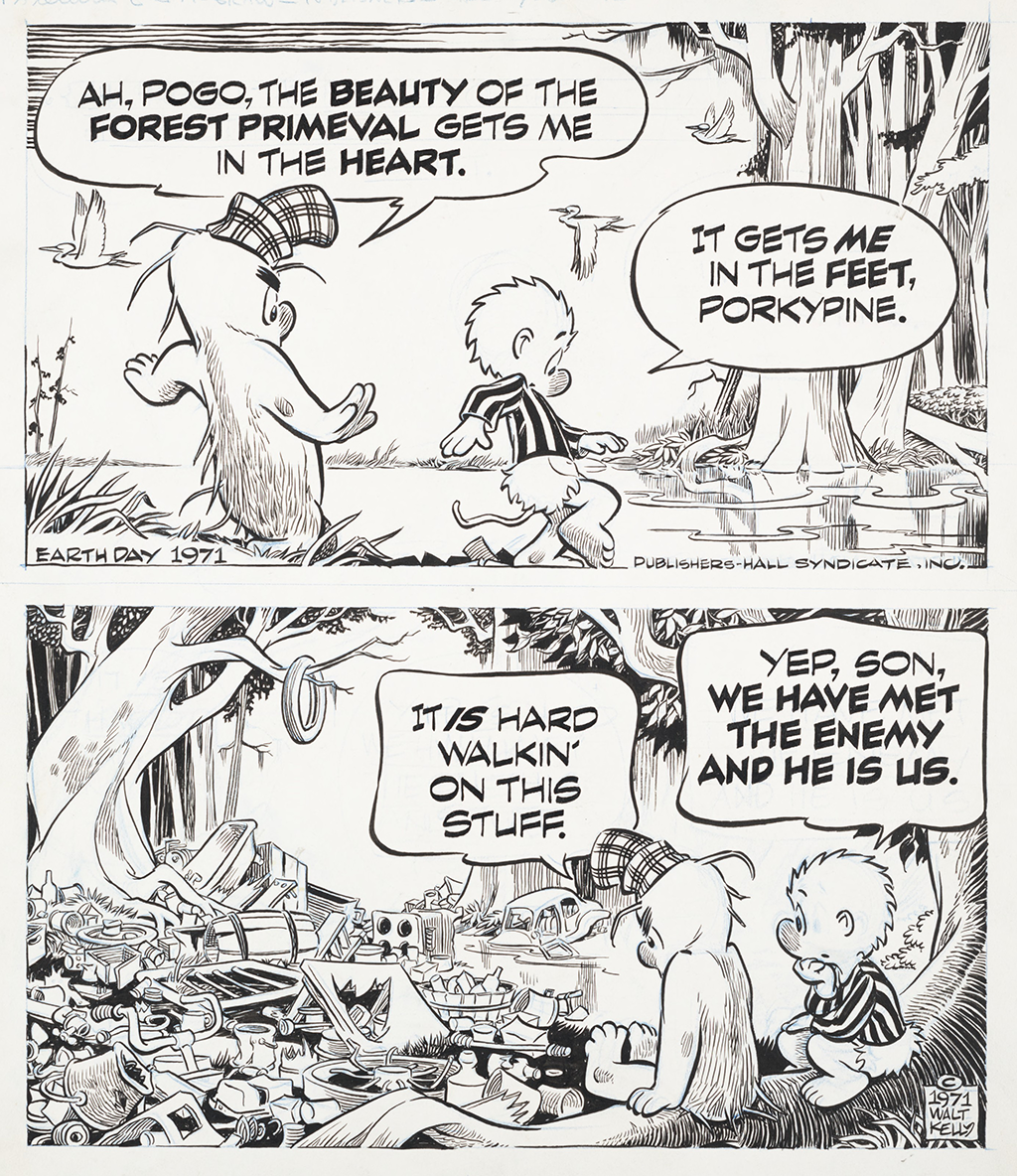
To carry out a constructive politics, it seems necessary to integrate one’s own shadow, rather than pursue the individualistic and collective assertion that the evil is elsewhere in a collectively approved target. This involves recognising that “we have met the enemy and he is us”…

Pogo, Ink and blue pencil on paper
Walt Kelly, Pogo, April 22, 1971

Then we might need to observe and deal with the social shadow of the group’s we identify with (and if we don’t think we identify with some groups against others, then we probably need to look at ourselves and our behaviour more closely).

Without this moral effort, then there is no political morality at all – there is just a process of finding suitable enemies to blame and scapegoat.

For many, recognising their shadow process in their politics may be denied, because disorientation, chaos, inaction, and moral uncertainty seem inevitable results of such an action, not to mention the potential pain of recognising that the darkness one sees in others is one’s own, or getting a sense that one’s own identity and allegiances are ‘fake’, or a way of avoiding the pain of dealing with real problems.

Conclusion

The shadow is a moral problem that challenges the whole ego-personality, for no one can become conscious of the shadow without considerable moral effort. To become conscious of it involves recognizing the dark aspects of the personality as present and real. This act is the essential condition for any kind of self-knowledge, and it therefore, as a rule, meets with considerable resistance.

Jung CW 9-2: #14

What this suggests is that, for society to be functional, we should somehow try and normalise integration of the shadow together with an engagement with individuation as opposed to accepting neoliberal individualism.

We need to somehow get ourselves first, and others later, to recognise that the main dangers do not always lie with people we already don’t like or suspect. We need to recognise systemic interdependence, the ways we distort information to back our existing cultural biases, and we need to institutionalise recognition that, in complex systems, our understanding of any specific event is likely to be a simplification at best, and probably wrong.

If we have policies, we should try them out, but not be afraid to ‘backflip’ if subsequent events show that these policies do not work, or are likely to be generating unintended and unexpected harmful consequences, that maybe almost the exact opposite to what we claimed would happen.

If we are primarily dedicated to being thought correct, righteous, or individually smart, then this stops correction of mistakes, and helps us to blame consequences on those shadowy, dark or stupid others.

The more we want to be right, the more we want to be moral, the more we want to be ‘individual’, or the more we are threatened by expulsion from our group if we are seen as bad, then the more easily we may be deceived by our shadow, and produce destruction or participate in social shadow events.

The next post considers ‘positive thinking’ as a generator of mistakes and shadow politics.

Techniques of Fascism

September 24, 2020

‘Fascism’ is a term which tends to be used to designate dislike so we need more understanding than that to use the term analytically.

Fascism is

1) NOT anti-corporate. Corporations can flourish under fascism; they can get State support, massive arms deals, monopolies, disposable slave labour, and so on. The corporate sector can support fascism with enthusiasm, and often does if they think they own it, and it will give them security and stability (which it won’t).

2) NOT a specific doctrine, or body of theory, as such, somehow related to the party of Mussolini – but it does have a set of recurring techniques, themes and strategies, some of which are described below.

Fascism involves

A Leader

Trust in the leader. There is no policy other than what the leader demands. The leader knows and understands everything, with a competence far beyond that of other people.

The leader is strong. The leader has will. Everyone must yield to the leader. Nothing should hold him back.

The leader should be emulated, even though it is impossible, he is so virtuous, with such impressive skills.

The party should be purged of those who have doubts about the leader. Having doubt or disagreement, with even the most obvious falsehoods is a sign of treachery.

Ultimately, the leader is the favoured of God or the cosmos. Disobedience to the leader is disobedience to God, or to the nature of the Cosmos. The leader has their own true revelation, of how things really are. He is inevitably correct unless mislead by traitors.

Strong and enforced social categories

Fascism depends on emphasised and hierarchical, in-group and out-group identity categories. People in the in-groups are automatically superior to those in out-groups. Men are superior to all but exceptional women. Party members are superior to non-party members. High up members of the party are superior to lower party members. People of a particular race are superior to people of all other races, which appeals to people who identify as belonging to that race who feel they should be valued above those of out-groups, and who feel they have not been. Fascism emphasises the category of ‘we good people’ vs the category of ‘those evil people’.

People of specific, or even most, out-group categories are evil subhuman enemies who must be destroyed, or captured and held where they cannot cause harm. All methods may be used to get rid of, or contain, these people.

Fascism uses scapegoating. Everything that goes wrong is the fault of out-group members. Ideally out-group members are reasonably powerless in the face of in-group police. ‘party soldiers’ and troops. This reinforces the idea that out-groups are inferior and must be controlled or exterminated. Weakness, especially in the face of violence, or the encouragement of violence, is taken as a clear mark of inferiority.

Policing of categories and of people in out-groups is intense and violent, and this violence is encouraged. Armed vigilante members of ingroups are praised and unconstrained in their attempts to police social categories and crush unrest in out-groups. The true believer must fight against these out-groups. This fight demonstrates that the true believer is part of the in-group and builds in-group loyalties and bonds. Reluctance to engage in pursuit of the out-group may demonstrate one is not really part of the in-group, which is a frightening place to be.

On the other hand, violence by out-groups, even if in self-protection, is condemned. No terrible accusation can be disbelieved when it is about out-groups, because they are already defined as completely evil.

For Fascists, the nation state is an essential in-group marker. In the early days of the regime it is claimed that the leader will make the nation great again. The Nation, before the leader arrived as saviour, was somehow inadequate, or fallen from its peak due to out-group conspiracy or dilution of the in-group with out-group members, who must now be purged.

Membership of the Nation State is restricted. The Nation State is a kin-group of related people. Migrants, or people of races not defined as the true race, are at best suspect. They need to be controlled. People identified as coming from other nations, even if they have lived in the country for generations are suspect, and subject to violent policing. The nation, as an identity category, must be kept pure.

People who do not support the leader and his party, clearly become non-members of the Nation State and an out-group subject to obliteration for their own safety.

Authority gives coherence

As should be clear, authoritarianism is a primary mark of fascism, although not all authoritarians are fascist. For Fascists, democracy is an evil which can be supported for as long as it gives the ‘correct’ result and indicates support for their authority. If it fails to do this, then results can be faked, ignored, or be said to result from out-group plotting.

Fascist politicians are not consistent in their opinions and doctrines. They are, however, always consistent in acting to benefit the power of the party and the power of the leader, and in their attempt to crush out-groups and opposition. If they have to contradict themselves to achieve those primary aims, then that is what is required. Success and power is everything. It is possible that incoherence, intense emotion and overt contradiction induce hypnotic states in people by disrupting conscious rationality and filtering, and make them more easily manipulated.

Thus for fascists violent insurrectionists can be heroic supporters of the leader or out-group provocateurs depending on who the fascists are talking to.

Fascists may claim to favour the rule of law, but the law is whatever supports the leader and the party and allows the violent suppression of evil out-groups, traitors and scapegoats. Members of the inner party cannot be corrupt by definition, unless the leader wants to get rid of them. The law and the police become militarised and an arm of the leader, because this is ‘necessary’ due to the evil of out-groups and to promote awe amongst the population.

Heroism

Fascism encourages heroic struggle, in which people risk their lives for the glory of the leader, in fighting for the Nation, and in fighting against evil and subversive out-groups and so on. Fascism needs enemies and will generate them, to have something to struggle against. Fascism is often specifically anti-communist, even when there are no communists in positions of influence. These apparently necessary communists will be manufactured.

Ordinary people can participate in the Heroic Struggle by denouncing the outgroups, participating in name calling the outgroups, making threats to the outgroups, being rude in the streets, sticking up posters, trolling outgroups on the internet, making death threats, mocking what the outgroup fears, cheering the heroic leader, and so on. They are standing up against those defined as evil, and thus being brave. This helps increase the intensity of the struggle, as well as helping the supposed victimised mainstream feel it is participating in politics as both an individual and as a group, and can no longer be ignored.

Fascism tends to be about the triumph of the will rather than accommodation to what is. The will of the leader is the will of the nation. The world should yield to that will. Failure to attain the will of the leader, shows people are not trying hard enough, and are not heroic enough. They are a disgrace, or traitors.

Other nations are default enemies and inferiors, although short term alliances may be maintained with similar kinds of authoritarian States or States which are identified as belonging to the same race – for as long as those alliances are useful. Democratic States may be pacified, but ultimately they are to be considered as weak enemies.

War and conquest is the ultimate expression of fascism, because how else is heroism best put to test, and how else are enemies brought to heel? War can initially be against those the party defines as internal evils, but it will ultimately move against external evils and inferiors, as the fascist leader fails to solve all the problems facing them through suppression – and this failure cannot be admitted, or must arise from the actions of supremely evil out-groups.

Information is about power

Education exists to inculcate admiration for the leader, the party and the nation (which cannot be separated) as well as obedience to the leader as that is the natural consequence of admiration. All history, philosophy, or religion etc. is only useful in so far as it shows the leader and the party are the inevitable climax of this exceptional nation’s struggles for self-actualisation. Education should emphasise how people from the past, who the party favours, display nobility of character and are heroes. Those who the party dislikes are clearly the villains. Out-groups have always been despicable. Only the party’s interpretation of history and politics is allowed, all other versions are cancelled and forbidden. This suppression is supposed to foster unity and national values.

Information which does not support the leader and his party is clearly wrong and must be suppressed. The leader only wants positive information, as negative information indicates that the people reporting it have not tried hard enough, or are enemies.

The party has no hesitation in lying to the people, because the will and genius of the leader and the heroic struggle of the people, makes whatever they assert to be the case, to be the case. Anything which gets the people to support the leader and the party, and fight against out-groups, is correct. Truth can change day by day, but the party and leader will never be wrong.

Fascists have no interest in political discussion with out-groups. After all, out-groups know nothing useful by definition. Fascists are interested in struggle against the out-groups, heroic assertion, together with lots of shouting (which shows dominance and strength of emotion), and whipping up loyalty amongst their own. Intellectuals must yield to the force of the leader’s will and truth, or they are clearly traitors.

Eventually not attending to accurate but unwanted information will bring the regime down but, it will have caused significant damage in the process.

Support

Initially, Conservatives can support fascism because they agree with the promotion of love of Nation/Country, hierarchy, discipline, strength and order. They see the search for the Nation’s soul and tradition as being valuable, but eventually they realise that fascists have no interest in any tradition that does not support the party, virtue that does not support the party, checks and balances that do not support the party, constitutional rules that do not support the party, religion that does not support the party and so on. They eventually become disillusioned, but have little real idea what to do about the crisis they have helped bring about.

Ordinary workers and middle class people can support fascism, because, in the current situation, they see themselves being ignored, loosing prosperity, loosing security, and facing disorder. They have lost respect for normal authority and its elites which they see as corrupt. The Party offers hope. After a while they come to see the party primarily offers fear and death for themselves, friends and loved ones, but by then it is too late. The irony is that it is usually the power of capitalist hierarchy which has produced this sense of abandonment, but the rage is channeled away from those who benefit from the the system to those who try to mollify it.

Conclusion

Fascism is ultimately an authoritarian manipulation of social categories and information, to maintain the power of the leader and the party. The aim is national and party glory. That is all.

The party is led by self-proclaimed heroes, and seeks glory fighting against opposition, even if it has to manufacture the enemies it needs to give itself, and its members, meaning. The party’s goals will never end in peace, because peace is inglorious and unheroic.

Fascists can and will believe anything that says their side is good and the other side is evil, because that has to be true.

Without enemies there is no point to fascism. Struggle is never ending, and it is triumph in that struggle which indicates a person and a nation’s value. A successful fascist State that conquered and subdued the world would eventually tear itself to pieces in seeking internal enemies and scapegoats.

Trump supporters are partially right

July 29, 2020

I’ve read a lot of pro-Trump material, and it seems to me that Trump officially recognises and publicises one main true message. Whether he does anything to make it better is another question. This message is:

  • Most of the American people have had their incomes lowered, their sense of security diminish, and their sense of participation in US political and social life scratched. They feel powerless. They feel that they have no chance of social progress. Even worse they feel ignored, and set upon. They feel mocked and scorned by the elites, and not listened to by politicians and the State. They feel most media does not ‘get’ them. They feel outsiders in their own country. Some of them also feel that they get to participate in irrelevant and pointless wars which leave ordinary people, like them, scarred, injured or dead.

These positions are pretty correct for many people, and they are angry that this is happening.

Trump is seen by most people as successful businessman – ironically largely because of promotion in the mainstream media, certainly not through most people’s encounters with him or his companies. He is seen as a person who has little to do with the elites, and who is also scorned by those elites. Unlike many politicians, he says what he thinks, irrespective of whether it’s nice or not. He speaks ‘ordinary American.’ He appears down to earth. He is not a politician and not compromised by political action. He does not listen to politicians, he listens to his own sense of the situation. Every time someone, who his supporters see as being elite, criticises Trump for being redneck, for stupidity, for lying, for adultery, for corruption, or for not understanding foreign policy, or economics or whatever, they see his outsider status confirmed. By the attacks on him he is confirmed as one of them, fighting for them. This is one reason why the President continually emphasises he is a victim, and it does not misfire with his supporters, even when he starts the fight.

Trump supporters see Trump as speaking directly, and without polish, to them via Twitter because he can’t get fair coverage elsewhere. The fact that he sometimes says silly things shows how unvarnished and genuine the comments are. His typos also show his messages are real and not vetted. If people criticise the typos, that’s just snobbish elites in action and shows how distant those elites are from real Americans. No President has previously had such an intimate and constant contact with his supporters. They tend to feel that he works to keep in touch and tries to tell them what is really going on. This appears unusual in US politics and, again, means he can be trusted – at least more than anyone else in Washington.

They see Trump as a person who keeps his promises – because that is what they are told by the President himself, and his media. It gets a bit harder when it comes down to listing what he has actually done with accuracy. But they see any failures as resulting from obstruction. Obstruction by people who are, by definition, against ordinary people. These failures through obstruction, again justify the President and his fight. But if you are confident the President’s successes would not be reported by the elite media, then the lack of reporting of those successes could be further confirmation of his struggle.

While the complaints about contemporary US life are accurate, I would suggest the diagnosis is not entirely accurate.

To be clear: Yes people are more precarious than they were, yes people no longer feel taken notice of, or being counted as part of the country. Yes people are angry about this. Some of this anger may express nostalgia for a time that never was, but some of it points to times (the 1950s and 60s) in which many people did have valid hopes of social mobility, greater prosperity, greater support, and a sense of political relevance.

However, most of this disappointment could well have been generated by what we might call the “five points of Republican policy” since Reagan turned away from Carter’s warnings of hard times to come over 40 years ago. These policies have been largely supported by the mainstream media, politicians and corporations. Most Democrat politicians have also gone along with these policies, or policies with similar consequences, but with a little more restraint. Resentment against Democrats is not undeserved, but they are not the primary culprits.

The main policies.

  1. Supporting the transfer of wealth, power, liberty and support to the corporate class, under the disguise of ‘free markets’ and ‘liberty’. This is pretty close to socialism for the wealth elites alone.
  2. Promoting the removal of wealth, power, liberty and support from the middle and working classes, also under the disguise of ‘free markets’ and ‘liberty’.
  3. Encouraging destruction of environments and the emission of pollution to help reduce corporate costs and increase corporate profit, largely under the disguise of ‘free markets’ and ‘liberty’. This also makes life for ordinary people, particularly farmers, more precarious.
  4. Encouraging culture wars to disguise the three main policies.
  5. Conduct the culture wars with marked violence and rudeness, so as to encourage the left to respond likewise, so it becomes impossible for people on either side to discuss anything across the divide, or even realise the others have a point. The aim here is to make strong social categories, which only minimally overlap, and which do not trust each other.

Such policies will generate not only precisely what Trump voters feel and live, but attempt to make sure they do not blame the parties who are mostly responsible.

The culture wars help persuade voters that “the real elite” are intellectuals, journalists, Democrat politicians, socialists etc, rather than Corporate bosses, billionaires, members of corporate think tanks, or Republican politicians etc. This works so that people generally do not blame the real elites, or look at how Republican policies largely benefit those elites alone. With the social categories established by the culture wars, the victims of the main policies may even identify as Republicans campaigning in favour of liberty and traditional morality.

This may be one reason why the Republicans have worked against public health measures, because they can claim to represent the freedom that ordinary people don’t have. Campaigning for the freedom not to wear masks is great, as it will hardly effect any of those who are wealthy enough to self isolate. It will mainly kill or injure ordinary folk. It also does not risk an attack on established wealth elites or corporate power.

If the culture wars can persuade people they are part of something great like America, which is under attack by the (fake) elites, and that the President aims to ‘Make America Great Again’, which they interpret to mean ‘to restore their lost possibilities’, then this seems to contrast with those who would exclude them from belonging to anything of value altogether (because they are ‘rednecks’ or ‘Christians’ or whatever convenient abuse can be found…).

If the Culture Wars can further convince people that some of their problems are generated by people who are, in general, equally or even less powerful than they are, or with only small amounts of privilege, such as migrant workers, feminists and black people, then you have a handy set of scapegoats. It gives the disempowered and ignored groups someone to blame who is unlikely to be able to retaliate, or whose retaliation can be crushed without sympathy.

The aim of the culture wars, and the Republican elites is to produce unity amongst supporters and passionate divisions between the supporters and everyone else. Trump is really good at intensifying this process, hence he seems the natural result of the strategy. But even if he gets voted out, and if he goes without encouraging violence and civil war, then someone else will eventually take advantage of the same system, and the situation will get worse.

Improving conditions for voters might even cause the Republicans to lose their political leverage, so it is unlikely to happen with their support for a while yet…

Privilege

July 18, 2020

A few people I know, say they have no particular privilege because they are ‘white’, so they don’t know what black people are complaining about. But I seem to have a huge number of Priviliges, that come from the social category I’ve been assigned and its historical fortunes….

Being white does seem to give privilege in some parts of the world, just as being Han Chinese gives privilege in other parts of the world. Obviously, living in Australia, I live in a part of the world, ruled and owned by ‘white’ men, with a history of violent dispossession, and action against the indigenous inhabitants. Power and fortune may be getting a bit more distributed, but it still seems primarily aimed at white males.

If you think that is entirely accidental, or a matter of talent, you are probably being naive. Power groups always claim that their power is natural, and comes from God or their essential abilities.

This ruling subsection of the population is built around established businesses, so its a bit more restricted still. However, it probably governs in the interests of white male business people, or at least governs with their perspectives. So that may well benefit me, in ways that is not overtly apparent to me, but is present.

However, far more overtly, I am privileged in many other ways, many of which people don’t seem to recognised.

I am privileged to be born, and live, in countries which overseas forces have not tried to invade or conquer through violence in the last seventy years. Even while we have tried to invade other other countries, for no apparent reason.

I’m privileged that I, and my recent ancestors, were not part of a violently conquered, enslaved or displaced group of people.

I was privileged not to be taken from my parents as a child, or have other members of my family living with trauma, because of the history of the social category to which we we were assigned.

I was privileged my parents were not crushed, violent, alcoholic or drug addled, which is relatively common especially in people in suppressed social categories, and that they supported me as best they could through my dependent years.

My parents had a sense of possibility and caution, which they passed on to me.

I was privileged because I was the right age group to avoid the Vietnam war and the war my parents lived through; in their case, in the navy and through bombing raids.

I have never lived surrounded by weapons.

I’ve never had to kill people to stay alive, and an armed person has only threatened to kill me once, and that is a privilege.

I was fortunate to be born without accidental or genetic impairment, or signs that would separate me from other people and allow me to be defined as inferior or difficult. I have not gained any such markings in my life so far.

I was privileged to be born with good mental functioning, that was recognised as such, and not hidden, or rendered ‘socially inappropriate’ or unbelievable, by my assigned social category.

I was born a race and gender which made many things easier for me because of the expectations around those categories, and I never faced much overt suppression because of my class, sexuality, or appearance.

I was not marked by my accent as inferior.

I never grew up to fear the police, the establishment, or being raped by friends, family and strangers.

The police have never attacked or chased me, or picked me up because they were looking for a suspected ‘white criminal’. The police have never knelt on my neck, or beaten me for ‘looking at the them the wrong way’.

I never had to live in a crime plagued slum, or even an ordinary, largely cooperative slum. I was never marked as a slum dweller with the scars assigned to that.

I was never that poor.

I was privileged in that the STDs I picked up in careless youth, did not kill or warp me.

I was privileged to live in a society in which men and women could apparently be friends on occasions.

I was privileged to have a good, largely free, education; in primary, high school and university. I was privileged not to be ostracised, or patronised, or beaten, in high school for my sexuality, race or ways in which I felt or thought – sure I sometimes had to be careful, but it was controllable. I was much more fortunate than some other people I knew at school.

My parents were both forced to leave school early, by social conditions and events. I was not.

I never had to live under a totalitarian religion or party who tried to restrict my reading, or knowledge through violence and removal of books, although I don’t know how long that will last. I guess you never do. [I do remember the unbanning of the Decameron, Fanny Hill , Portnoy’s Complaint, the Kama Sutra, Story of O, and so on in the early 70s.]

I was privileged to live in a society which generations of working and middle class people had fought to make one in which opportunities, reasonable wealth for most people and social mobility was possible.

I was privileged to live in a healthy economy. I never faced the poverty my parents had to live with, and everyone I knew could afford food and shelter. Most of the world’s population has never been that privileged. I don’t know how long this can continue.

Neither I, nor members of my family, or friend group, was ever indentured, enslaved, or forced into labour.

I did not have to fear the State taking me away, persecuting me, or campaigning against my existence, or blaming me for something going wrong – although the right has been trying to do this for some time (you know: alarmist, libtard, cultural marxist, socialist, cultural elite, university professor [I’m not] etc.).

My work did not endanger or kill me.

There were opportunites for business and employment which did not depend on assigned class. The economy was generally expanding and stable.

Social mobility was high during the entire first half of my life. This benefited my parents and hence me.

When I was ill for over 10 years I was privileged to have employers at Abbey’s Bookshop who designed work for me which kept me functional.

I was privileged that we had a working socialised health system which persisted in trying to find what the problem was, and did not make minor health issues major because I could not afford treatment.

On the occasions when I was unemployed, we had a working employment and relief system, with staff who were not over-regulated. They never pursued me, over occasional work, with robodebt.

I was priviliged in that I could work part time and still rent a unit in Glebe.

I was privileged that I and others could work, in the rest of our time away from part time work in a professional standard theatre company without pay.

I was privileged when I turned up again in the Sydney University Anthropology Department, and Professor Michael Allen did not flinch too much when I said I wanted to write about alchemy and Jungian theory.

I was privileged that after the alchemy thesis was finished Prof Allen fought for me to get a PhD scholarship and succeeded. This was particularly fortunate as I was then getting too bound by pain for an employer directed job. Without Michael my life might have been much more fraught.

I was privileged in that when my parents died I was left with some money rather than debt.

While it will be difficult to face old age with the ecological turmoil and social disintegration we can expect, so far I’ve been privileged and that will probably help.

Sure it is true that I worked for what I have. I could have given up, or suicided on many occasions. But other people have worked a lot harder than me for far less success.

And the fact that I worked for what I have does not prove that there is no class, racial, sexual, gender or other discrimination in our society. It proves I was lucky, and some of that luck involves who I was fortunate to be born to, where I was born, the time in which I was born, where I grew up, the social category I was assigned to, and who I had the fortune to know. This is privilege. Privilege is partly the ability to make social connections.

My success, such as it is, comes from society and me, not either one separately. But if society had been against me, then everything would have been much harder, and it probably would have been much easier for me to be really self-destructive, or to give up.

That I’ve worked enough to have had enough success to lead a decent life, and this was sometimes hard, does not mean that other people have not had it more difficult than me because of their assigned social categories and their experience of society.

It would be nice if everyone was privileged enough to make their own way, without the experience that they have been hindered in a systematic way because of who others thought they were because of their social category and the way it is treated.

Contemporary Politics and the role of disinformation

July 5, 2020

1) The first point is to really identify the power elites, and not to be diverted into attacking scapegoats.

2) In corporate neoliberalism, the power elites and the wealth elites (and those dependent on them), are pretty much the same.

3) Neoliberal media, politicians and ideologues usually pretend the elites are not the power elites, but that they are relatively powerless people, such as ‘intellectuals’ or ‘cultural marxists’. For example, in this view, Trump’s family is not an elite, neither are the owners of major corporations, nor the intellectuals who support ‘free market’ neoliberalism, or occupy roles in corporate sponsored think tanks, and help justify the real power elites… A moment’s reflection will show this is misdirection. How many people pay attention to cultural marxists or even know whether they really exist, and what power do such intellectuals have other than persuasion?; they do not command armed police for example, they cannot buy legislation or regulation.

4) For the last forty years, in the US, the Republicans have been dedicated to furthering the success of the wealth and power elites. The part of the party which is not dedicated to completely supporting the power elites is devoted to furthering the power of pro-corporate and authoritarian Christians. In either case, deliberate democracy is not high on the list of priorities, neither is improving general prosperity, other than via ‘trickle down’, which is nearly always the favoured policy of the wealthy elites (aristocratic or corporate).

5) The Republican elites, or supporters of the wealth elites, are no longer conservatives; they are dangerous radicals who wish to strip away all traditional checks, balances and restraints on the corporate sector’s wealth and power. They appear to act as if they wish society to become a monoculture of rulers and ruled.

6) The same is generally true of the Conservative party in the UK and the Coalition in Australia. With the possible exception that the Conservative party still has some conservatives in it.

7) While the Republican elites are 90% pro-corporate, the Democrat/Labor elites are about 60% pro-corporate, but generally agree that most people should not be sacrificed for corporate power. They also tend to think that people should not be suppressed because of their race, gender, sexuality or religion. They are more humanistic pro-corporates. This is not great, but it’s all we have to work with.

8) As nearly all media is owned and controlled by the corporate sector or by billionaire families, it tends to support the corporate establishment. There is no left-wing media in the US, just media that is denounced by the hard line pro-corporate authoritarian media as ‘left’. If some media do not like Trump that does not mean he is upsetting all of the ruling elites, just some of them.

9) There are factions in the corporate elite. There are for example those who are happy that Trump is delivering tax cuts to them, removing regulations that give the people any control over the corporate section, allowing them to poison people, allowing them to despoil the environment, spending heaps of money on the military, destroying public health and so on. There are others who think an impoverished population is dangerous, or who realise that climate change and ecological destruction could be a problem. Neither factor is to be thought of as enough of a problem to challenge corporate power and economics, but they can be recognised as problems. They may also fear war with US trading partners, as if you are not in the arms business then you are likely to lose out. There are also occasional genuine believers in free markets, who notice that Trump is destroying such markets, and they think this will lead to disaster.

10) The main aim of elite propaganda is to get people to either support corporate power, or to ignore corporate power.

11) The best way to achieve this, is to intensify already existing hatreds and discriminations. Thus its good to blame baby boomers for being selfish, black people for being racist and not knowing their place, women for suppressing men and so on. This helps people who’s power has been stripped away, feel that they are better because they are young, white, male or whatever. It gives them an enemy to hate which they can despise, and which is not more powerful than they are. They can pretend Trump is not one of the elite, and is trying to help ordinary people, even though it is clear he is supporting the corporate elite, and stirring hatred, or practicing ‘divide and conquer’. Encouraging these hatreds also tends to separate people from more humanistic, mildly anti-corporate politics. The media can also try to pretend that any anti-corporate movement is treacherous, violent, or authoritarian, even as the movement calls for people to be liberated. They can easily misrepresent the claims of movements and slip them into their preferred patterns of support for the corporate elites, or ignore corporate elites. They can pretend Joe Biden is as bad as Trump, when he might be just a little better. They can pretend recognising climate change and the ill effects of eco-destruction stems from socialist conspiracy. They can even pretend that thinking that humans are not part of the earth, or cannot disrupt ecologies, is radical thinking, when it is another pre-copernican set of of ideas….. However, their main step is simply to ignore ‘left wing’ protests for as long as possible, unless they can be reported as violent, while highlighting right wing protests even if they attract tiny numbers in support. Given that the media is right wing, this is to be expected.

12) That something is a media channel on youtube, does not mean it is not pro-corporate, or corporately sponsored, even if it pretends otherwise. It can claim to be leftish, while spending most of its time ignoring the actions of the right elites or the President, and focus on criticising those challenging that power, or attempting to moderate that power. This is one way of helping to destroy the opposition to corporate power.

13) As many people have argued before, thinking, and information acceptance is social. It is not, completely, about understanding the world, but about gaining an orientation to that world, and the world includes social and group processes, and belonging. Information acceptance can be based in issues of identity – of what other people we identify with, and identify against, both in terms of conflict and culture. If people we value, also value some information we like, or seems essential to our identity, we are more likely to count that information as true. If people we don’t value, value information that we (or our groups) don’t like, the easier it is to dismiss that information as false. In other words, knowledge can function primarily as a marker of identity, and as a way of fitting in to a group. So one way of reinforcing acceptance of information is to intensify social differences, or social contempt, or social fear. This is what the right elites have been trying to do for forty years, it is why their ‘news’ tends to be so angry, rude and dismissive of opposition. It is why they insist that they, and their supporters, are the real folk of the nation. They want to create a situation in which opposed groups just abuse each other, or fear each other, rather than talk. This process now seems entrenched, as the left is now almost as rude and intolerant as the right. The process may no longer be able to be challenged.

14) The main aim is to confuse and fragment ‘the people’ so that they are more easily persuaded that the real problem is somewhere else, or that they are busy fighting someone else, and the corporate elites can keep on with their power grab.

On Conspiracy Theory

November 1, 2019

You can easily be dismissed in academia for proposing conspiracy theory, indeed the very name is a dismissal in itself. However, this reaction also dismisses an important trope in modern life.

This post has frequently collapsed which is possibly evidence of conspiracy. 🙂

It continues in the next post

Plausibility of conspiracy

People naturally “team-up” to do things because people can do more together than alone, and coordinating the actions of different groups acts as a source of power, just as wealth adds to that power. Sometimes people join together without telling outsiders – although sometimes it won’t be hidden, the collaboration can just avoid publicity, perhaps through the group’s influence on the media, and perhaps because of fear of legal action. In these cases we can call it conspiracy, if we want.

As Right wing conspiracy theorist Gary Allen argued, we know relatively powerless people can produce great effects by conspiring (as with those people who organised the French and Russian revolutions), so why not accept that already powerful people could also conspire/collaborate with effect against other powerful people or against the populace?

Indeed we know powerful people team up to magnify their effect, in things like the “Minerals Council of Australia”, and the “Business Council of Australia”. We know that wealthy people subsidise news organisations to promote their ideals and politics, or to hide news that might disturb those ideals and politics. We further know that wealthy people subsidise think-tanks to support them, and provide “independent testimony” for their ideals and politics. Some of these wealth-founded media organisations, like Breitbart, and Fox news pretend to be reacting to left wing bias elsewhere and hide their embedding in elite wealth.

Conspiracy theory could always arise with investigation of how the ‘ruling classes’ go about ruling, rather than just being crazy stuff. The problem, then, is to identify that class and its actions plausibly. Before we move onto that problem let us consider a few other problems with conspiracy theory.

Problems with Conspiracy Theory

Popularity and persuasion do not equal truth The most obvious problem is that such theories can be very popular and very wrong. They can be promoted by agents of the powerful, to distract from the operations of those powerful people, and to motivate hatred against possible enemies, or because it is easier, quicker and more appealing to construct an imagined conspiracy, than to do real analysis, and to check initial bias.

As the people identified as being in a conspiracy are generally acting politically according to the conspiracy theory, then conspiracy theory tends strongly to be an arm of politics and affected by political bias and intention.

For example, it seems extremely unlikely there was ever a world wide conspiracy involving all Jewish people, or even some Jewish people, which aimed at taking over the Western World. I don’t know of any evidence other than a few obviously fake documents, and a few statements attributed to members of powerful and wealthy Jewish families, which may or may not be theirs, or which may be taken out of context. While inaccurate, the theory summarised in an acceptable symbolic form a lot of conservative nationalist problems with world capitalism. It was also based in a wide-spread anti-Semiticism which had been fueled by Christianity for a long time and so fitted in with existing pre-conceptions. As such it was obviously believable to many and the consequences of this theory were horrific, and enabled horroric acts to be carried out. This particular conspiracy theory still hangs around.

Are conspiracy theories themselves conspiracies? We may even ask whether this conspiracy theory was a result of a conspiracy against Jewish people, which aimed to make them scapegoats for problems, and use this scapegoating to gain power?

At a much lesser level, we can also think of many of the conspiracies that Hillary Clinton was supposedly involved with, from Pizzagate to the vanished emails, or the accusations she had people, who threatened her, killed. Nothing incriminating has ever come to light from the many and wide hostile investigations into her. Indeed, so little criminal activity has been revealed by people eager to attack her, that she may be the cleanest politician in US history. However, as a result of the promotion of these theories and inquiries, her name was blackened and many people in the US hate her in particular and use her as an exemplary example of a corrupt politician. Does this hatred result from a conspiracy to discredit her? Or was that ‘team-up’ an accident? While she may not have conspired, it may be interesting to ask why so many appear to have acted together against her – especially given that the failure of these investigations was not used to promote her integrity.

The consequences for the world, of the apparent conspiracy against her seem to have been pretty grave so far, and are likely to get worse.

This selective bias factor is also illustrated by the comments on a youtube video in which Noam Chomsky outlines the ways that the Right made climate change into a “liberal conspiracy” rather than a distressing fact. It seems that many people commenting were eager to accept Chomsky’s accounts of US foreign policy and military action, but thought he had sold out (or become part of a conspiracy) when he denounced the conspiracy to denounce climate change. People choose what conspiracy they believe in by their existing ideologies and biases, or by their loyalties to particular groups, not by the strength of the evidence presented.

As another example of how existing bias filters ‘facts’, Gary Allen, if I remember correctly (and I don’t have the book with me to check at this moment, but I will), argued that American capitalists subsidised Lenin. He then concluded that some wealthy people in the US establishment were Bolshevik communists, rather than concluding that (if these facts where correct) Lenin probably was doing what he was paid to do which could explain why the revolution was totalitarian and not liberatory. Allen was also celebratory that Americans had such common sense they hated communism, without knowing anything about it…. Nothing to do with US media propaganda, and the wealth elites, of course.

Other conspiracy people point to the mention of ‘Liberals’ as tools of the Elders of Zion in the Protocols to argue that modern Democrats and left-wingers are tools of international jewry, rather than bother to check that ‘Liberal’, in the days the Protocols were written, meant something more like modern Republican supporters of unrestricted capitalism, ie themselves – which would surely produce some dissonance for them. Again the bias, and group loyalties and hostilities, foreclose understanding and make links that are not likely.

People rarely ever seem to think that some conspiracy could be deliberately affecting what they think about the world at this moment. They assume their ability to track conspiracy is evidence of the conspiracy they are tracking. But, if conspiracy is a mode of politics, how can you trust the information you are using to prove conspiracy?

As implied earlier, we can assume that these supporters of the validity of the Protocols and Allen are part of the conspiracy they are supposedly denouncing; either operating as false flags, or being manipulated by those engaged in conspiracy…. and that demonstrates another problem with conspiracy theory: everything can be made to fit together neatly, by supposition and bias. This leads to another problem…..

Bias Expansion. This occurs when people accept a reasonable possibility of conspiracy and then expand it in areas which are less and less plausible.

For example, it appears that the QAnon movement reasonably argues that people with criminal aspirations, can come to power in hierarchies. These people are likely to have no empathy for others, threaten, lie, cheat, and be focused on their own power, rather than on robbing the corner store. This is plausible, we can see criminality or sociopathy in Religious organisations where we might expect otherwise, and in the management structures that we experience everyday. It is not quite so clear that these criminals always collaborate with each other. However QAnon extend this plausibility, and seem to argue that every person who they dislike is criminal and probably satanic (Hilary Clinton being a good example, because if you are pro-Republican she must be evil), and that President Trump is fighting for the American People against this criminality. Given Trump’s business record, and his actions against his enemies while in power this seems highly improbable. If he is fighting against criminals, it is probably to benefit himself or other criminals he sees as being on his side. However, the theory allows any criticism of Trump’s actions and policies to be dismissed as the work of criminals – Trump is not trying to obstruct the course of justice for example, but obstructing subversive criminals – and thus the theory supports bias in favour of Trump, which again leads to the possibility it is part of a pro-criminal-pro-Trump conspiracy.

I have also read the suggestion that QAnon is satire, directed at ‘ignorant’ Trump followers but, if so, many people (on both sides) take it as genuine. And if it is a satire, then for some people it might well be a satiric conspiracy.

Again people who suspect US foreign policy of being imperialistic, often end up extending their bias and supporting Russian intervention in Syria or Ukraine, when there is little to suggest that Russian interventions are any less imperialistic than the US, but it fits in with an anti-US bias.

There is no end.

Secrecy and projection Another problem with conspiracy theory, involves the fact that a conspiracy is usually secret and so it is hard to get evidence, but this secrecy also makes it easy to fake information (there are few sources that contradict the fakery), easy to interpret data however you want through projection (ie attributing your own vices to despised others who are not that visible) and to use the fakery politically because it seems right according to your existing biases which make the fakes seem plausible.

There is always so much happening in the world, that some evidence for anything you want to prove will probably exist somewhere, and can be linked through some mechanism to others. Such as, if people meet occasionally they must conspire together, or if people agree about something they must conspire together. However, people can agree independently of each other, and anyone can occassionally meet people they have little connection with. The FBI, the Intelligence agencies, the military and many lawyers and judges, may all agree that it looks as if President Trump is behaving in ways which will damage the US, without them having conspired together against him. They may simply agree as to the apparant facts. Just as scientists who think there is a climate crisis, do not have to have conspired together to come to that conclusion. However, if both cases if you believe that Trump is good, or that climate change cannot occur, then the conspiracy functions as an explanation for why others disagree.

Likwise, if you believe that the real reasons for US foreign policy is hidden, which is not unreasonable, and you believe that the US government hides contact with aliens (which a secretive organisation might do), then this secretive foreign policy could have something to do with the secrecy about aliens. Perhaps it is an alien inspired attempt to control the world. Perhaps President Trump (who is known for his tough stance against ‘illegal aliens’) is fighting hard against the aliens, or for the aliens…

And some people have no issue with making up evidence or accusations to support their bias (it must be true if it confirms the enemies’ badness), as seems to be the case with Clinton or Soros.

Assumptions of success Another problem of conspiracy theory is that it often assumes that conspiracies have their intended consequences, which makes them far more effective than normal political movements which fail all the time. A consequence of this is that conspiracy theories are often proposed to explain why the results of an action by the conspiracy proposer’s side did not work. This ‘proves’ that not only were the proposer’s theories correct, but the ideal results were foiled by deliberate evil, exonerating them from attempting to discover if they have innacurate theories and policies, or from making any changes to how they behave.

When one’s favoured side looses, is often a clear sign of conspiracy. Thus I read a lot of conspiracy theory alleging that US Democrats are criminals and evil because some established members of the party can conspire or collaborate together against ‘the Left’ and out-manoeuvre them. To me, this sounds like normal politics in action; calling it conspiracy when one faction defeats another is possibly going too far. Clinton was better at the numbers game than Sanders. But this is probably what we should expect, given that Sanders had only recently joined the party and had not built allegiances, and was probably seen as a something of an opportunist by many members of the party. It does not need active evil.

Again the question arises, who is making this apparently normal internal politics into a conspiracy? Why are they doing so? And are they participating in a conspiracy themselves? The articles alleging dirty tricks in the Democrats seem to aim pretty clearly to discredit mainstream Democrats and persuade people not to vote for them. This benefits the Republicans. So we can wonder if this news is a Republican conspiracy, planted amongst the Left, to split potential democrat Voters? Or are the Left doing it to themselves? The articles might benefit the Republicans without them being a Republican conspiracy: effect does not always imply intent.

One thing that might convince people these articles are a Republican conspiracy is that they seem part of the “both sides are equally bad” meme which, at the moment, benefits the Republicans, especially as nobody points out the problems of their internal politics to such a degree. Also it seems notable that when the Republicans do bad things overseas, the articles say the US is doing bad things, but if it is the Democrats doing bad things, then that is pointed out. But this is not proof, only suggestion. What would be required would be the incredibly difficult work of tracking the articles as they circulate, and who they are circulated by.

Given the massive choice of conspiracies, when I see conspiracy theories in action, I look at what people do with them. If they primarily attack one side of politics, and largely ignore conspiracies which suggest the other side of politics is bad, then I guess they are working for the side which is not blamed, whether deliberately or otherwise.

While people can claim certain allegiances, their selection of conspiracy theories may indicate others or have the effect of supporting those others. But this may not itself be conspiracy.

Conclusion of part 1

People may work together without conspiring, and without even knowing they are working together. This kind of effect happens all the way through complex societies. People make things, which help other people to act. People have similar ideas without ever talking to each other and so on. This is normal, but the interdependence probably can be manipulated.

Interdependence can suggest conspiracy, but it is normal without conspiracy.

However, it is also plausible that members of the Ruling Classes do conspire with others against each other and against those they rule. They may well make use of people who see an advantage in supporting them, or who think that their rule is good and justifies support. These people may not only conspire, but they may use conspiracy theory to hide their own conspiring.

This is not inherently implausible. As implied it is likely that the way the ruling class rules resembles conspiracy.

This discussion continues in the next post, on probable conspiracy.

https://cmandchaos.wordpress.com/2019/11/06/on-conspiracy-theory-02/

Political Rhetoric

October 17, 2019

Rhetorical tropes which are used to support, or which end up supporting, the Right in the USA

1) Both Sides are equally bad. [Therefore the Republicans are not that bad.]

2) The Republican president is vulnerable to the Deep State. [Therefore any attempt to impeach the current President for corruption is anti-democratic, and a deep state conspiracy. ]

3) America has done bad things in the past. [Therefore, what we, or the President, are doing now is not that bad really. Certainly we should be even handed about this, and excuse ourselves from any particular responsibility (see 1)]

4) Always talk about foreign policy and wars, because the parties are quite similar here. Never talk about domestic issues (other than guns), such as: wages, work security, work safety, distribution of income, or health. That way, point 1 is reinforced again

5) The left is to blame for whatever goes wrong. Everything is ok, when the Right governs, even while it is collapsing.
Eg: By questioning us the Democrats are responsible for everything bad that happens while they are questioning us, because they break morale. [Therefore they are the bad people. Everyone should just be quiet – unless they are criticising democrats]

6) Science is a left-wing political conspiracy, [unless it is sponsored by the corporate sector, and boosts profit, and even then its risky.]

7) Global warming is an example of science in action. Scientists just say there is global warming because they get grants for saying that.

8) Disagreeing with a scientific consensus shows true independent thinking. Disagreeing with the free market ‘consensus’ [which does not exist in economics] shows lunacy.

9) The Constitution allows the Right to do whatever they like, because they are Right….

10) The Left want to warp the consitution and take away your rights.

11) The left are politically correct, latte drinking, socialist, feminazi, whimps who would boldly take your guns and freedom away.

12) The Left would persecute Religious people [by objecting to religious people discriminating against others.]

13) Listening to women talk about sexual assault, leads to innocent men being persecuted and so women should be ignored [they are viscious irrational harridans to begin with].

14) People who identify as Lefist should be shot – Oh we are not being serious, the left just can’t take a joke.

15) To keep you safe we have to prevent leftists from propagating socialist propaganda like global warming. They are unAmerican at best.

16) We must reluctantly support Nazis and white-supremacist rights to free speech. Because free speech is sacred.

17) The lack of support you hear from ordinary non-shouty people, indicates they support us.

18) Helping poor people is interfering government at its worse. Helping rich people makes everyone prosperous.

19) Private charity is good. [It keeps the poor acknowledging their place and dependency.]

20) No Good, Christian, Conservative, free market loving, Anglo, gender secure, hetrosexual person would ever stoop to using identity politics. That is a leftist trick to divide us.

21) Hilary Clinton is a criminal. [All round, general purpose response to anything – despite Clinton being investigated by hostile Republicans almost continually, and never being successfully prosecuted for anything.]

Psycho-Social Analysis of Destructive Politics

September 2, 2019

This is an exposition fantasy-summary of an article by Bobby Azarian, which strikes me as interesting, but needing a shift into the social. All the good bits should be assumed to be his, the bad bits remain with me. Everything in block quotes or double inverted commas (“ ”) is from the original article.

We can begin by noting that apparently destructive politics seems triumphant at the moment, with Trump in the US, Johnson in the UK, Putin in Russia, Morrison in Australia, Modi in India, Duterte in the Philippines, Bolsonaro in Brazil, Viktor Orbán in Hungary, Andrzej Duda in Poland, and the list goes on.

These are people who deceive, appear immune when caught out, refuse to engage in genuine discussion, ostensibly lack compassion and empathy, may encourage violence, overtly benefit only small sections of the population, put their nation explicitly ahead of the world, and, on the whole, ignore climate change and other disasters, even proposing, and boasting of, acts which will make those disasters worse. For these leaders, it appears that the prime mark of competence, in their ministers (and anyone else) is loyalty to them.


Azarian’s original article is about President Trump, but it is probably expandable.

So let’s see.

First off, there is nothing much to be said about the mental state of such leaders. In a sane, well adjusted, society, they might be dismissed and have relatively little popularity or power, but today they have both. So the question has to be directed at their appeal to the ‘collective mind’. There are some severe problems with the idea of a collective mind, and how such a mind might arise outside of common social experience; consequently I will try and emphasise, or reinsert, elementary social processes into the exposition.

This helps remind us that the problems are systemic and organisational, rather than individual; the factors we might point to interact in particular social contexts, in complex ways, and may produce unexpected results. That is the main divergence from Azarian.

Azarian states:

This list will begin with the more benign reasons for Trump’s intransigent support. As the list goes on, the explanations become increasingly worrisome, and toward the end, border on the pathological. It should be strongly emphasized that not all Trump supporters are racist, mentally vulnerable, or fundamentally bad people. It can be detrimental to society when those with degrees and platforms try to demonize their political opponents or paint them as mentally ill when they are not.

We can agree with that, so let’s avoid saying people with particular political dispositions are mentally ill, or in some way being abnormal or unusual. If there is a social mind (or collective consciousness), then it is widely distributed, ‘normal’, and socially influenced or even generated. If the problem is a collection of individually ill-minds then we will probably find those minds politically distributed all over the place.

So point by point.

1. Practicality Trumps Morality
These leaders tend to benefit the wealthy, the business sector, and sometimes the locally established Church, so no surprise they get support there. They also promise material benefits to ordinary people, and show a certainty which promises lack of anxiety. This can only work when people perceive themselves as losing out, and think that with these leaders the good times might be coming back. Another step towards making a version of ‘practicality’, the basis of morality, is the suppression of empathy towards those not in one’s in-group. Such empathy becomes defined as impractical. This shall be discussed in more detail later on.

It does not matter if the leaders seem immoral, as they appear to be strong and trying to benefit their people, which the normal system does not, and neither do normal politicians. Whether these people will stay with their leaders, when the benefits do not arrive is difficult to tell. However, they would have to know the benefits are not going to arrive, and they may never be able to know that due to the ‘mess of information’ (see below: point 7a), the discrediting of counter-information as disloyal, and with continual media bias towards the leader. People often seem prepared to wait a long time in political terms for promised benefits that may never arrive – say of free markets or communism. We start off with a wide spread social situation of alienation from ‘ordinary politics’, not a set of individual psychologies. Later discussion will try and explain this alienation.

2. The Brain’s Attention System Is More Strongly Engaged by Colourful leadership
All of these leaders are colourful. They engage the emotions, and bombard people with messages. Trump keeps both attention and emotional arousal high at all times. He uses twitter constantly. He generates fuss and reaction, which keeps him in view. Media, no matter how hostile, is focused on him, and its agenda is led by him. Putin is known for his bare chest and athletic feats, Johnson for being an eccentric and annoying his enemies. These people, largely keep themselves in the public eye, in a dominant and often hectoring position. They start discussions, even if they refuse to actually discuss and primarily engage in abuse or threat. They respond without shame, and gain attention. If something is going badly for them, they can largely ignore it, or shift blame and attention elsewhere.

If leadership is partly about being looked at, recognized, and setting the parameters of speech, then they are markedly leaders.

3. Obsession with Entertainment and Celebrities
This observation is obviously supposed to be primarily about the US, but I think the point is nowadays universal, and a celebrity is a person who has developed techniques of attracting attention and interest. So this is primarily a restatement of the last point, that the leaders are colourful, known, and gain media attention.

Celebrity has become a normal part of the ‘hype’ emerging from the economic system, providing guarantees of ‘star-power,’ sales, attention time, and excitement. “You are always left wondering what outrageous thing [the President] is going to say or do next. He keeps us on the edge of our seat.” As long as he discomforts whomever we identify as the villains, then this is fun to watch. It adds excitement to an otherwise staid, boring and probably depressing routine. It lifts people into another world, where change becomes possible, and identified enemies seem on the back foot.

4. “Some Men Just Want to Watch the World Burn.”
“Some people are supporting [these leaders] simply to be rebellious or to introduce chaos into the political system. They may have such distaste for the establishment” that their only hope is to rip it down. Yet this may not be entirely pathological, it could be that the system is dysfunctional, apparently oppressing, and ignoring, the leader’s supporters or the ordinary person. The supporters’ hope might be that good may come of ripping that uncaring system and dysfunctional system down. And if that is not much hope, then ripping it down is enjoyable and liberating, given how badly people have been ignored. ‘If I’m going down, so does everyone else. Suck on that, you creeps!’

Normally, people might glumly get on with things, figuring that if they get involved they may get hurt or lose out still further, but in this situation they perceive that someone is actually acting; they don’t have to do much other than vaguely support the actor at first. Later on, when it’s clear the leader is having an effect, they can get more actively involved.

If some form of instinctual psychoanalysis is correct, then normal society requires repression of anger, hostility and selfishness (even with legitimate cause), while the destructive leader liberates these drives against both the failing society and the out-groups that have been created (see below). This is especially so if their in-groups encourage both the suppression of empathy for others, and the possibility of imagining themselves in a similar position to the weaker people. Hence the popularity of destructive leaders finding a weak group such as refugees, or unemployed people and attacking them.

There is also the possibility that by participating in this right of anger and hatred, or directly in the process of harming those weaker than themselves, people may feel empowered, gain a ‘high’ and feel temporarily liberated, even if they are destroying their own lives in the process. This sense of liberation reinforces the sense that the leader is special.

4a. The Joy and Necessity of Self-Destruction

Freud hypothesized the Death Instinct to explain why people so often go against their real self interest and seem to gain pleasure from their own self-destruction. Christians posit the Fall and Sin, as the cause. Whatever the ultimate explanation, this is something anyone can observer for themselves, by watching people destroy their own lives and families for no reason that is obvious to the people involved.

In this short discussion we can suggest that some self-destructive urges arise from a confluence of several interacting factors, which should become clearer as we progress, such as: loyalty to a punitive hierarchy; emphasized in-group and out-group construction and polarization; suppression of empathy; suppression of awareness of existential threats (or substitution of more easily dealt with threats); information mess; a sense of relative deprivation; misguided attempts at total control, and being caught in a failing society that routinely does not deliver what it has promised.

Again this is a response to a social system which has lost its way as far as normal people are concerned. They have very little invested in its continuation; investing in its destruction by others, or by themselves, has potential.

5. The Fear Factor: Conservatives Are More Sensitive to Threat
It is possible that “the conservative brain has an exaggerated fear response when faced with stimuli that may be perceived as threatening.”

a 2014 fMRI study found that it is possible to predict whether someone is a liberal or conservative simply by looking at their brain activity while they view threatening or disgusting images, such as mutilated bodies. Specifically, the brains of self-identified conservatives generated more activity overall in response to the disturbing images.

Let us presume this is a continuum, not a binary: in other words there is likely to be a fair amount of overlap throughout the population.

Conservatism is likely to be distributed, and there is nothing conservative about these destructive leaders. This may need emphasising. They are not claiming to maintain the status quo, but to demand either a reversion to a distant and imagined time, or the liberation of new, or already powerful, forces in society. If, what we are discussing is a conservatism, then it is a radical conservatism that does not conserve.

Similarly, it is only certain ‘disturbing images’ that are found frightening or else people could fear their heroes. One question is whether people feel this fear, if they think the hurt is going to be delivered to other people in some kind of out-group. In general, destructive leaders do not encourage empathy towards out-groups.

This lack of empathy, not only helps separate the in-group from the out-group, but forms the basis of official morality. At best, it is implied out-groups do not deserve compassion or help, even if this is something that it is claimed the in-group might do in safer or more settled times. Empathy is supposed to be impractical and difficult. It constitutes a hallmark of those other out-groups who would attack the leader to benefit the dismissed out-groups at the expense of the in-group. Indeed, the commitment of the in-group might well be shown by its ability to be practical and harden its heart. Once that has occurred, then abuse and harm of out-groups becomes more possible and fear of the out-group can be largely unchecked.

5a Making the Outgroup

In-groups and out-groups are normal to human social processes; we always tend to value those people we are closest too and consider most like us, or related to us. They often tend to be graded rather than binaries; perhaps people may consider they are closest to their family, then their town, then the nation, and different to people from another town or nation depending on the context. People, are usually categorised as male or female, and supposed to have things in common with other males and females, although they may feel closer to the other-gender people in their family than same-gender people elsewhere. Again, these identifications vary socially, and in different contexts. There is nothing wrong with this.

However, constructing fiercely bounded in-groups and out-groups (perhaps separated by fear), is part of the work of a destructive leader. An ideal outgroup should be easily separable from the in-group, have relatively little contact with the in-group, be easy to identify, and not be very powerful. Hence, people with different ‘racial’ characteristics, or strong cultural markers (such as dress or exaggerated non-mainstream interests), and who are in a relatively powerless minority, make good out-groups. Cultural differences can then be portrayed as marking ‘savagery,’ ‘brutality,’ ‘cunning’ or otherwise despicable people.

If the out-group is powerful, then they can probably defend themselves, and so is hard to attack. If the out-group is powerful and look like ‘us’ (as, for example, ‘the 0.1%’ may well do), then they are doubly hard to attack, and serve little motivating function.

If there is a history of conflict between the groups, then this adds to the impetus. Laws and threats can be directed at the out-group to make more tensions between the mainstream and the out-group higher. For example, voting or citizenship requirements can be made more or less impossible for the out-group to satisfy. Law enforcement procedures can be harder on the out-group and put disproportionate numbers of them in prison. The out-group becomes nervous about the mainstream, which increases the friction and inspires more separation.

For full effect, the out-group, or some of their reputed cultural behaviour, should be made to inspire visceral disgust, as well as fear. That way people’s reactions involve less chance of rational consideration, and there is less chance they may reach out to the out-group. You might know a good person in the out-group, but if you generally feel disgust, then that produces less challenge to the categorisation in the first place.

By portraying, more or less powerless, out-groups as powerful and threatening (terrorists, ethnic minorities, religious minorities, people aligned with the other main political party, intellectuals, stupid people), the destructive leader’s supporters are wired up to avoid (often fictitious) threat, and will seek safety in the Strong Man. The fear also helps explain why the system is dysfunctional, because it is under threat from these supposedly powerful, disgusting or brutal, out-groups.

5b: Making the Ingroup

The destructive in-group should be relatively easy to identify, or quite broad to attract the maximum number of people. They should be bound by identity (at least in opposition to the despised out-group). They should be portrayed as strong victims, strong to give hope and victims to give anger. They are not to blame for whatever is going on, that is primarily the fault of the out-group. The leader should, in some way, exemplify their ambitions, while being special – this is quite hard. Boundaries should be policed, and people who visibly stray from the group should be punished as an example for the others. This is probably why the leader values loyalty, and makes an example of those who appear disloyal. Or perhaps, this is the leader’s normal mode of thinking, and he/she encourages that mode of thinking everywhere.

When split into sharply bonded in-groups and out-groups, and pushed by destructive leaders, hostility can increase so rapidly that it heads to violence faster than most people will expect – as in former Yugoslavia, or Rwanda. So we shall consider some of the factors that can increase divisions quickly.

6. The Power of Reminders of Mortality and Perceived Existential Threat

humans have a unique awareness of their own mortality. The inevitably of one’s death creates existential terror and anxiety that is always residing below the surface. In order to manage this terror, humans adopt cultural worldviews — like religions, political ideologies, and national identities — that act as a buffer by instilling life with meaning and value.

Psychologist Ernest Becker, named these kinds of worldviews, ‘immortality projects’. They are the views and acts which hide death from us, or mitigate its effects by proposing immortality, or something to thoroughly occupy our attention. This behaviour is clearly normal. When reminded of mortality through perception of threat then people will defend their prime cultural worldviews and immortality projects, and the future they promise. They may even intensify those views, in an effort to ward off, or conceal, the threat.

For example, threats of climate change can provoke responses which increase people’s aggravation of climate change, in an attempt to demonstrate and reinforce their cultural worldviews and their imagined future. People may well support ecological destruction so as to protect their cultural values or, on the other hand, they may have unrealistic expectations of the capacity of renewable energy to save their culture and life from crashing. Likewise, we may observe that when religious people feel they are under challenge, they may intensify the hardness of their views and their condemnation, and outcasting of sinners, apparently to get on side with God and guarantee their safe immortality.

in a study with American students, scientists found that making mortality salient increased support for extreme military interventions by American forces that could kill thousands of civilians overseas. Interestingly, the effect was present only in conservatives.

If the author had said ‘primarily in Conservatives’, then I might be more inclined to accept this, but categories are not always that precise, as I have argued above. We could expected some overlap. But let us assume, as a hypothesis, that constant awareness of threat from outgroups (especially out-groups identified as disgusting or brutal), is more likely to lead to support for violent responses against those out-groups.

By constantly emphasizing existential threat, [these leaders] may be creating a psychological condition that makes the brain respond positively rather than negatively to bigoted statements and divisive rhetoric.

People, in contemporary society, do face real and complex existential threats: from ecological damage, from collapsing economic systems, from collapsing welfare systems, from neoliberal workplaces that do not value them, from changing communities, from development projects, from entrenched high-level corruption, etc., and they do know about them, even if they suppress this awareness. The regularity of life and their immortality projects are threatened. So they are possibly increasingly likely to favour violent responses, if ‘good’ out-group targets are identified for blame.

7. Dunning-Kruger Effect: Humans Often Overestimate Their Political Expertise
The Dunning-Kruger effect applies to all forms of expertise that are important to people, not just politics. For example, engineers seem to routinely think they understand social science without training or study. People are often unaware they are uninformed, especially if they have not studied a field in detail. They don’t know how much they don’t know. They think they can understand complex fields with a few “common-sense” cultural axioms. Indeed, they are often right, cultural common sense is good at explaining things, that is why it is common; it just may not explain them accurately. People also think that “experts,” who retail theories at odds with cultural common sense are idiots – and sometimes, of course, they are correct.

7a Mess of Information

What I have called the ‘mess of information’, is socially generated confusion of information. Trust in the accuracy of information becomes largely influenced by people’s political allegiance, and the whole of society has been politicised during the rise of the destructive leader. Belief in particular kinds and sources of information, and a generalised distrust of information becomes a part of people’s self-identity as a member of some in-group or other.

False information and hype has become a standard feature of commercial practice, with companies smearing other company’s products, and promising that their unreleased products will be the best things on the market, to prevent sales of other products becoming established. Advertising is known to be untruthful, and is prevalent. Companies will prosecute people for ‘slandering’ or telling unwelcome truths about their products. Companies will dismiss members of staff who (even anonymously) express opinions which they consider detrimental to their profit, even if the statements are accurate. People know, and experience, that information is often biased and ‘interested.’

Many supposed experts give opinions which seem compatible with their employers’ interests, but not otherwise believable. For example experts have continually promised that tax-cuts for the rich will deliver prosperity for everyone, and still make those promises. WaterNSW can argue that huge extractions of water by big irrigation businesses, who are trying to farm high-water-use crops in near desert conditions, has no effect on river flows. Similarly, we can be told that unfiltered exhaust stacks for motorway tunnels have no health effects despite the large amount of medical evidence that suggests they do. And of course, we can be told we can keep burning fossil fuels without ill-effect, that we can keep on cutting down forests with no ill-effect, that we can over-fish without ill effect, that we can keep on pouring poisons into the environment with no ill effects, and so on.

It is possible for experts (as well as ordinary people) to live in a closed world, in which their agreed truth is taken for granted, and in those cases people who are not experts can have valuable insights. The clue is whether the experts take notice of those insights or blithely ignore them.

Real experts change their minds with evidence, but mainstream culture seems to insist that real experts will stick firmly to their position because it is right, otherwise they are considered to bend with the wind. This is a cultural and social problem of information. This problem is intensified by the tendency for people to believe people who are categorised as belonging their in-group, or to similar groups to themselves, or who reinforce what they already ‘know’. Information from out-groups is almost by definition wrong. This problem increases, the more in-groups and out-groups become separated by politicians and daily experience.

Knowledge is social. What is known, or considered true, is reinforced by other people who are valued by the knower. What people come to know, may distract them from evidence that might contradict that knowing. If a person primarily talks with their in-group, this reinforces their cultural common sense, and reduces their awareness of challenges to their ideas, ‘knowledge’ and facts.

We live in a society which encourages information overload, with deceptive information rendered normal as part of advertising and commercial action. Media organisations are excused from attempting to provide accuracy, because of political convenience and commercial ownership. As a result, data to support almost any position can be found with a bit of effort, especially data which supports established cultural common sense and reduces fears of real problems. There is too much information. We cannot evaluate everything, so we evaluate most of it through trusted others who appear to belong to our various in-groups. If the information comes from an in-group we consider it more trustworthy than if it comes from an out-group. This is the information mess. The Dunning Kruger effect implies that people almost certainly think they have the ability to navigate this mess, but actually do not – all the time.

In this kind of situation, if the in-group leader denies actual knowledge through simple cultural common-sense, especially if the knowledge fits in with experience and emotions, they are likely to be accepted as truthful far more easily than the scientist who is saying something difficult or complex, that is threatening, or which suggests the in-group is partially responsible for the problems they face.

A further problem with the mess of information is that an authoritarian hierarchy disrupts the flow of accurate information. Underlings will not want to be the bearers of bad news, and will tend to adjust information to mesh with the imagined desire of their superiors. People can be thought not to be committed if they give criticism upwards, or say the plans will not work. Whistleblowers who publicise the hierarchy’s corruption, veniality or stupidity will be punished, to make sure such disloyalty to the group, and its leaders, does not occur again. This hiding of knowledge and criticism, will happen all the way up the hierarchy. The people at the top will have very little idea about what is happening on the ground, or about how the system is not working, and will not be able to correct its faults, or mistaken actions. Similarly people at the top rarely find it necessary to explain the procedures and ideas that they are really using, while covering up their known failings and frictions with others on the same level, so those below have to imagine what is desired or intended by those above.

We could also ask where is it that people are going to get accurate information about their problems from? The media are corporately owned, so if capitalism or the corporate sector are the likely cause of problems, then this is unlikely to be covered. The same for any other ownership of media. And this problem becomes worse the more media ownership becomes concentrated, and the number of media owners decline. Furthermore, the destructive leader’s techniques of gaining support, may not come out of nowhere. In the US and Australia, the right wing commentariat have been using similar techniques, to the ones described in this article to gain celebrity, to persuade people, to build in-groups and out-groups to reward loyalty and to condemn those who disagree with them. In Australia we have: Alan Jones; Andrew Bolt; Miranda Divine; Janet Albrechtsen , Gerald Henderson; Paul Murray; Peta Credlin; Ray Hadley ; the list goes on. Destructive information distortion is already common (even if the information is true), and appears to come to cover up our real problems, through arousing passion and reflex condemnation. It also helps build loyalty to the commentator (and hence profit from advertising for the commentator) and a fear of looking for information elsewhere

In a quick summary we can make the following points. Self-destructive information mess in the kinds of system we have been describing arises due to:

  • Too much information to process, and information generated to support any position is findable.
  • Loyalty to an ingroup hierarchy.
  • Fear of loss of status, or expulsion, if challenging a punitive hierarchy.
  • Fear of loss of status, or expulsion if challenging the in-group’s beliefs.
  • Looking towards the in-group for confirmation and reward, rather than checking what is happening outside; what we might call internal vs external adaptation.
  • Guilt over breaking one’s ethical codes, and suppressing empathy, to stay in place or advance.
  • Reassertion of failing “immortality projects” against the out-group’s insistence they are failing.
  • Habituation by normal media styles of commentary – used to build audiences and keep people listening.
  • The pleasure of upsetting the out-group, and building status in the in-group overwhelms self-preservation or the ability to listen to others.
  • The immediate pleasure of suppressing anxiety about what the effects of what you are doing might produce.

Eventually the destructive authoritarian system grinds down in fantasy, unintended effects and unchecked destruction. And this is social.

8. Relative Deprivation — A Misguided Sense of Entitlement

Relative deprivation is:

the discontent felt when one compares their position in life to others who they feel are equal or inferior but have unfairly had more success than them.

Life is unfair and chaotic. People with less skills than you, will have more money and success, perhaps because of their parents and the inheritance of wealth, social position and contacts, or perhaps because of sheer luck. In other words success might be distributed by class of birth. As well, we might not understand what skills are needed to have success in a particular field, so this unfairness is reinforced by the previous points about the Dunning Kruger effect, and the information mess.

This relative deprivation can lead to resentment, which reinforces, and is reinforced by, point 4 “Some Men Just Want to Watch the World Burn,” especially if the person’s failure in life can be blamed upon the cunning or special privilege that has been given to some out-group (in reality or imagination).

This problem is increased by living in a society which promises us that happiness comes from endless consumption and acquisition, and that everyone can succeed if they work hard enough. Neither promise is always true, and acceptance of either can lead to desperation and disappointment. Then, life does not seem to be working out, or being satisfactory, when you have done everything you were expected to in terms of cultural common-sense.

This idea may imply that the middle classes are particularly prone to being seduced by authoritarian leadership as they are the ones who have suffered comparative decline and feel threatened from ‘above’ and ‘below’ <https://psycnet.apa.org/record/2016-13929-004&gt;. Working class people may tend to expect that the system is rigged against them, and not feel so much deprivation or threat.

9. Lack of Exposure to Dissimilar Others
This seems common in contemporary society.

Intergroup contact, or contact with members of groups that are outside one’s own, “has been experimentally shown to reduce prejudice”. The problem of prejudice may be compounded as people seem to increasingly be selecting to be with those who are ‘like them’ and obviously part of the in-group. It is exceedingly hard to maintain internet groups which are not dominated by one particular faction, and which engage in discussion rather than name-calling.

The idea is that voters for authoritarian figures, may have experienced significantly less contact with minorities, or out-groups, than other people have. They may also have gone out of their way not to mix with out-group others, as those others are scary, don’t make sense, or whatever. Being with people who are part of one’s in-group lowers uncertainty in an uncertain world. You know what to do, and what not to do, to be accepted, to not offend others, or to receive support and sympathy. You probably won’t have to deal with that much disruptive knowledge. In this case, people can be more easily convinced of the terror of others and the necessity of keeping in-group boundaries up. So this merges with point 5, “sensitivity to threat” and the manufacture of in-groups and out-groups.

10. Authoritarian Conspiracy Theories Target the Mentally Vulnerable

The link between schizotypy and belief in conspiracy theories is well-established, and a recent study published in the journal Psychiatry Research has demonstrated that it is still very prevalent in the population.

I don’t like this idea, that mentally ill people tend to be attracted to conspiracy theories.

There is a big problem here, as we could exist in a conspiratorial world. It is relatively well documented, that neo-conservatives ‘conspired’ to have a war with Iraq before 9/11 and got one afterwards, despite the lack of evidence implying Iraq had any involvement, and despite the inconvenient evidence of possible Saudi Arabian involvement. Evidence was manufactured, or distorted to give an excuse for the wanted war, whether deliberately or not.  Neoliberals spent years ‘conspiring’ to convince people that  ‘free markets’ (in which the main aim of governments is to support big business), deliver good results for ordinary people rather than funneling wealth off to the already wealthy, and setting up an even more thorough plutocracy. Politicians do appear to have lists of talking points, so they can appear on topic and unified (no matter how abruptly the points will have surfaced), and it can appear that some media goes along with this.

Ordinary people plan together, so why can’t powerful people plan, or take advantage of others’ planning, to have an effect on the world, which could be expected to benefit them?

All people like to make sense of the world. Conspiracy theory manages to link things which otherwise appear disparate, and provides an over-arching narrative giving the believer a sense of their place in the world with others, without subjecting them to the threat of randomness. Trump and other authoritarians are good at making what, looks to me, like fictional explanations, which distract people from their real oppressors (such as Trump himself). This is not new, and may particularly arise when planning has been giving benefits to the ruling groups which are not shared with others, and the harmful consequences of that planning can be blamed on the out-groups who opposed that planning, or who happen to be generally disliked.

Because the world is complex, it may need to be stated that plans do not always have the expected consequences. The second Iraq war did not make the US dominant and safe. It demonstrated that the modern US is defeatable (or can fail in fully extending its military might) and that it rarely has a taste for a long painful war of attrition. The US has great powers of destruction, but little power of holding onto what it has gained against popular opposition and it will create popular opposition.

11. The Nation’s Collective Narcissism

Collective narcissism is an unrealistic shared belief in the greatness of one’s national group.

I’d say this occurs when a group’s previously taken for granted superiority is challenged, and they don’t know what to do about it, and they never felt that powerful anyway. It’s a consequence of apparent social decline, or loss of hope in normal social practice.

People might see a previous ethnic minority climbing up the ladder to success while they, themselves, are in decline. There might be more people who came to the country as migrants, disrupting expectations about who one will meet, and how to behave. Women might get to speak, and put forward their views, challenging males who feel they are losing privilege and respect for no observable benefit for themselves (and are indeed losing respect and power because of actions from other sources such as neoliberal economics and corporate power).

Sometimes the group, which feels in decline, can, in reality, still be dominant, even if the majority of its members remain poor or relatively powerless, while they are told out-group members are secretly dominating everything and holding them back. The upper groups in the US appear to be primarily male, but feminists can be blamed for the average male’s sense of powerlessness. Scapegoats, and scapegoat out-groups, are usually easy to find, and the expulsion or destruction of the Scapegoat is a common human process – as it can help build unity amongst the expellers.

Rather than think deeply about problems outside cultural common sense, people tend to think they are being victimized. I’m not sure this process can be called ‘narcissism’. People do struggle and don’t get ahead and this really does generate a problem. That is the way class society works, and if out-group members appear to be taking positions members of the in-group might have normally been expected to occupy, then this generates resentment, yet again.

Left-wing identity politics, as misguided as they may sometimes be, are generally aimed at achieving equality, while the right-wing brand is based on a belief that one nationality or race is superior or entitled to success and wealth for no other reason than identity.

I’ve said that before as well. Must be true 🙂

However, this point is really a further elaboration of point 8 “relative deprivation”. People feel they have lost something, which was previously there, and this may have to do with the rise of an out-group.

12. The Desire to Want to Dominate Others
People like control, which is not surprising. Not being in control can be life threatening.
However, the point the author is making is that some people:

have a preference for the societal hierarchy of groups, specifically with a structure in which the high-status groups have dominance over the low-status ones.

Hierarchy is normal, and probably gives people a sense of place. It may give them a sense of life progression, if they think they can move up the hierarchy as they age, or make an effort to do so, giving them more control over other people and more status and respect. Humans like status and respect.

Hierarchy, might also mean that there were out-groups who previously had to give you respect, perhaps because they were oppressed. This rarely happens when social disruption is widespread or democracy has spread, and people are starved of status and respect, no matter how hard they have worked or served others.

Nowadays, with high rates of social change, older people are often treated as though ignorant of the contemporary world, with nothing to contribute. Their possessions and hard work have not given them what they expected. Their experience is revealed to be useless every time they try and work out a new remote control. Their kids know more than they do. It’s unfair. It leads to resentment, a sense of meaning collapse and provides a challenge to established immortality projects. People are more likely to be happy to tear things down, in the hope established meaning can be restored. Once again, they find, through their experience, the current system does not work or fulfil its promises. Cultural common sense is threatened.

Authoritarian leaders often reinstate the hierarchies, or the idea of hierarchy, forcefully, and hence appeal to the displaced, because they are implying that those people deserve respect again, and the possibility of advancement. All they have to do is follow and trust the leader.

However, when we live in complex societies, ecologies and climate systems that are changing, total control is, in reality, impossible. Unintended effects and consequences of actions are routine. The only way to appear to approach total control, is violence, suppression of contrary evidence, and complete fantasy. Still more authority appears to be needed to deal with the compounding divergencies from the aims of the control, and the systems keep getting harder to live with. The problems are not solved.

13. Authoritarian Personality

Authoritarianism refers to the advocacy or enforcement of strict obedience to authority at the expense of personal freedom, and is commonly associated with a lack of concern for the opinions or needs of others. Authoritarian personality is characterized by belief in total and complete obedience to authority. Those with this personality often display aggression toward outgroup members, submissiveness to authority, resistance to new experiences, and a rigid hierarchical view of society. Authoritarianism is often triggered by fear, making it easy for leaders who exaggerate threat or fear monger to gain their allegiance.

If we accept that the left is ideally about increasing equality, and opportunity for everyone who has been marginalised (workers, women, gays, previously despised ethnic groups) and the right is about enforcing hierarchy and authority, then this is, by definition a right wing position.

But it is a pointless truism to say authoritarian politics, appeals to authoritarian people. I don’t know what we gain from this statement at all.

I’m inclined to dismiss this point as contributing little to our understanding, other than a reminder that authoritarianism seems as normal a human response to life, as demands for participation and democracy. Everything else is explained by the functions of hierarchy.

14. Racism and Bigotry

Not every supporter of authoritarian and destructive leadership is racist. But it goes with the processes of finding scapegoats and out-groups to blame, and the fear factor.

Destructive leaders routinely appeal to prejudice as a solution to problems, and routinely try and shut down discussion between groups to increase prejudice, which indirectly increases the information mess. Once again, this is simply a technique of increasing the bonds of the in-group and making them feel threatened by, and superior to, an out-group scapegoat of some kind. It does not seem to be a new point.

15. Pathological Structures

This point is not in the article.

There is an argument that forms of organisational patterning, like corporations and dictatorships select for pathological personality types. For example, business may select for people who can sacrifice everything for money and power. Dictatorships select for those with a loose relationship to truth, and an easy brutality. Both types of organisation select for people with low levels of concern for others, or low empathy – hence what normal people may think of as moral behaviour is truncated in both situations – but the ordinary person has to go along with it, or their existence within the organisation is threatened. They may tend to believe they are only following orders, there is nothing much else they can do, and that those they are persecuting are not that valuable anyway, and probably deserve punishment.

These dynamics cause the organisations to be even more uninhabitable by mentally ok people, who have to react by leaving, or by becoming crazy to survive – and the more people who become crazy to survive the organisation, the worse it gets….

Corporations routinely exploit people and routinely treat them as expendable or disposable. In contemporary politics, government bodies have been forced to behave in a corporate manner, as is almost every other institution. This is neoliberalism in action. Everything hinges on profit, the “bottom line,” and the latest management fad. People are restructured every couple of years and have to learn new ways of doing the same work, rather than accumulating skills, expertise and respect. Workers are usually sacked in the restructuring process, for reasons which are never completely clear, and which therefore cause worry (and more work) for everyone. After they are sacked, people face harassment from the organisations which are supposed to help them survive and find new work. If you are old enough, you know the system no longer works as well as it used to. If you are young, the advice of your elders about dealing with the situation is massively out of date. As a result, very few institutions are not malfunctional. Very few institutions support human existence.

Why should anyone have loyalty to such institutions? Why shouldn’t they feel angry and threatened? Why shouldn’t they want to rip them down? Why doesn’t the experience of work, make them crazier than they might otherwise have been?

Our society sets itself up for a fall, and the authoritarian destructive leader, delivers.

Conclusion
Looking at all this, we are constantly coming back to: identity groups; loss of social meaning; perception, and suppression, of existential threat; challenges to (or loss of) immortality projects and routines; and the consequences of information mess. Society, and its hierarchies no longer function as they are supposed to according to cultural common sense. People rarely get satisfaction and status from adhering to normal social routines. Indeed, normal routines may seem pathologically destructive. The world both looks like, and feels like, it is falling apart. Social identities are challenged, and people feel they are being left out or suffering relative deprivation. This will generate discontent. And rightly.

What the authoritarian leader does is: attract attention, find compelling scapegoats, reinforce in-groups, and help alienate out-groups, while promising to tear down the tattered remnants of the corrupt, non-functional, society which gives people nothing, and which has alienated them from power,  work and satisfaction. He will restore their lost dominance and place. The mess of information and Dunning-Kruger effect reinforce this cultural common sense, and the information system gives prominence to the leader and furthers their ability to attract attention. This gives people hope. They don’t care that much about the leader’s morality, because the morality of the society they live in seems non-existent – and certainly does not benefit them. Almost anything is better than what they have now. They are content to watch the corrupt, useless system be destroyed, and even participate in its destruction; they may find this pleasurable as well. The leader, and they way he operates, may give them a pleasurable high, or sense of liberation, which reinforces their sense he is right.

All of these factors interact and reinforce each other, but they do not set up a stable system – and in a future post I hope to explore the ways that destructive leaders and the forces which support them can be overcome.

That is an explanation for what is happening, and yes it depends on the interaction between social process and human psychology. Not one or the other, but both.