Is ‘Peak Oil’ here?

July 13, 2023

This is an important question. Basically peak oil arrives, not because oil has run out, but because the amounts of energy expended to obtain the oil, transport and refine the oil, is close to, or over, the amount of energy released by the oil.

When this happens, the “Energy Return on Energy Input” is small.

It would seem obvious that if you spend more energy to get the material which gives energy, than you get from the material itself, this is going to weaken your social and business processes.

Goehring & Rozencwajg, who are an investment firm, point out that:

  • Never before has oil supply growth been so geographically concentrated. Six counties in West Texas are now 100% responsible for all global production growth.
  • Conventional non-OPEC oil production peaked in 2007 at 46.2 mm b/d and now stands at 44.2 mm b/d – 4% below its peak.
  • Including OPEC, conventional global output peaked in 2016 at 84.5 mm b/d and now stands at 81.3 m b/d – 5% below its peak.

The argue that any growth in oil production has arisen from non-convetional oil. This is oil which requires much more energy to extract, and which can often result in ecological destruction. This includes the oil of fracking, shale oils, tar sands, or requires crop convesion.

  • [Between 2006 and 2015] US shales grew by 6.8 mm b/d (65% of all growth), bio-fuels grew by 1.9 mm b/d (19% of the growth), and Canadian oil sands increased 1.4 mm b/d (14% of the growth). Please note that out of this 10 mm b/d growth figure, the Permian represents only 1.4 mm b/d or 14%.

Between 2016 and 23

  • US shales accounted for 85% of the increase. However, whereas all the major shale basins grew from 2006 to 2015, only the Permian grew afterward. 

However, the decline in availability has not lowered the demand. More importantly, not lowering the demand shows that the world’s societies and businesses are not dealing with climate change prevention, adaptation or mitigation. More oil burning increases emissions, which increase climate change, which increases the danger of social collapse. Paradoxically, decline in energy availability, also means an increase in the possibility of social collapse.

Because of the demand:

  • Global demand in 1Q23 surpassed 102 mm barrels per day — three million barrels above the 1Q19 (pre-COVID) level and almost 2 mm b/d above the International Energy Agency’s (IEA) 1Q23 estimate. 
  • From here on out, just six counties in West Texas must meet all global demand growth [from the Permian shale].
  • [Their models suggest] The Permian is likely less than a year from peaking and starting its decline

The usual pattern for shale oil, is that once the decline starts, it declines very quickly.

Once oil decline, and resulting price increases, really start to bite, then air transport is likely over for the masses without major technological break throughs, which currently seem unlikely.

Because they are an investment company and not that bothered with the causes of climate change, they are ‘bullish’ about natural gas…. and

  • North American natural gas remains our highest conviction investment theme, and we have used the recent weakness to add to our holdings.

So the collapse continues….

************************

Addenda:

We know that when oil wells are abandoned they are rarely made safe and leak proof because that costs money. So there will be continuing pollution.

When a well is left unplugged, it can leak oil and other toxic chemicals, endanger water wells and other sources, contribute to air pollution and emit methane – a powerful greenhouse gas

Hundreds of thousands of wells across the country were not plugged by their operators and remain open to groundwater and nature, some for a century or more. These “orphan” wells have no solvent owner of record, so the cleanup liability falls on the states, federal agencies or Tribe. Unfortunately, only pennies on the dollar have been available to properly clean up these wells.

Texas could receive over $341M to plug the 6,489 currently documented orphan wells in the state.

EDF Mapping Orphan Wells in Texas

*******************

I was asked why with peak oil coming do renewables need subsidy?

Renewables appear to get less subsidy from taxpayers than fossil fuels, throughout the world and in Australia.

  • I’ve argued before that its often hard to agree on what counts as a subsidy, and some people suggest tax concessions are not subsidies, and figures of subsidies differ. But see:
  • New research shows fossil fuel subsidies over the forward estimates have increased to a record breaking $57.1b, up from the $55.3b forecast in 2022.”
  • This report provides our first estimates for 2022, which show that global fossil fuel consumption subsidies doubled from the previous year to an all-time high of USD 1 trillion.”
  • Trillions of dollars of subsidies for fossil fuels, farming and fishing are causing ‘environmental havoc’, according to the World Bank, severely harming people and the planet…. At $577bn, the explicit subsidies for coal, oil and gas in 2021 were twice as large as those for renewable energy, and almost six times higher than the climate finance promised by rich countries to developing nations.”

I suspect these weird levels of subsidy is partly about power and habit. We still expect oil to keep flowing freely, as it has done, to be the basis of our society as it has been, and it probably will be for another 10 to 20 years getting more expensive and more damaging all the time. Gas will replace some of that oil, which will keep the polluting system going longer as the investment company above celebrates.

But, even in the best cirumstances we probably need to replace the oil consumption within that 20 years or we may collapse. The Market will not do that replacement without help, because Markets are short sighted and inefficient for some things, this being one of them. The power of oil companies also warps the market and makes transition harder. They have been spewing anti-climate change crap for about 30 years and slowing the transition along with Murdoch.

So Renewables might need some subsidy to get going and build up enough energy to compensate for the energy loss that is likely to be coming.

Fossil fuels do not need subsidising, they are an established and wealthy industry which needs to go, and in the case of oil, is probably going anyway, but not without a struggle to continue its parth of destruction for as long as possible..
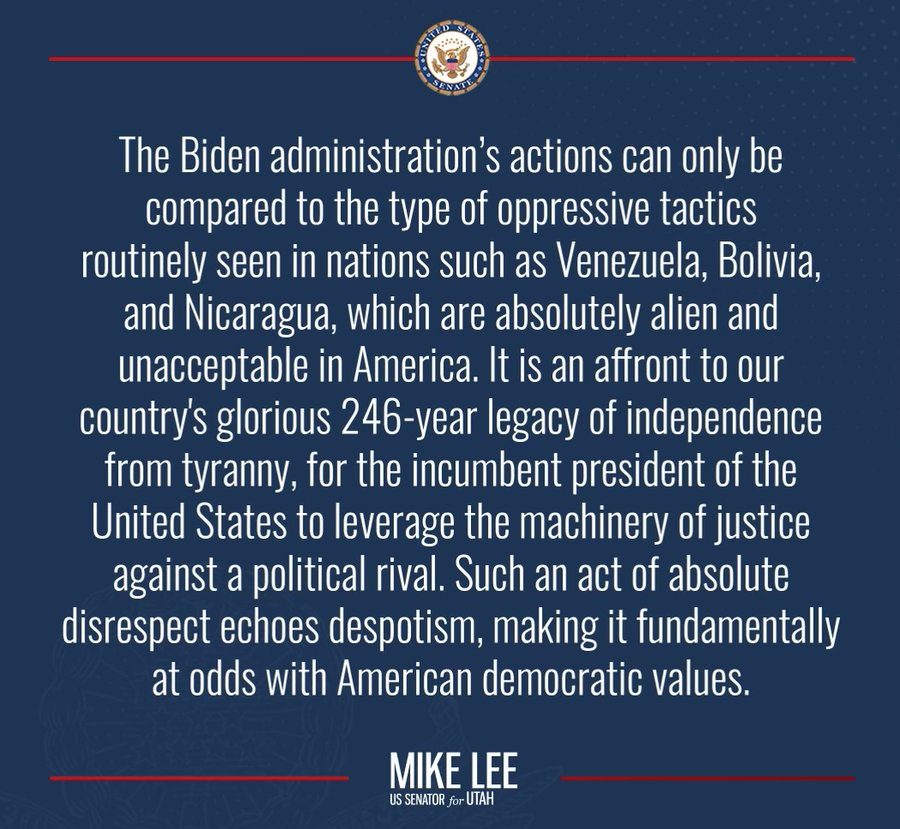
Robert Reich is wrong about Trump

June 13, 2023

In his article in todays Guardian, There will be no Civil War over Trump Mr Reich makes the classic intellectual error that people do things for clear reasons, and with good understandings. And thus they will not generate war over Trump. This proposition is simply not true. People do things for non-rational reasons; feelings of disquiet, distrust, disgust, misery, not having a vision of a beneficial future, ‘knowing’ stuff at an emotional level which they cannot express and so on.

Trump appeals to this knowing, and his inarticulateness and personal grievance, make him appear to be one of those people who, like us all, share grievances and cannot express them. People can relate to Trump, and he allows them to displace their grievance onto the State and the Democrat/Liberal ‘humanist’ elites, and distract them from the real cause of their misery. And as the State is part of the problem, it no longer appears to stand for the people, it is not a completely false target.

Most people in the English speaking world have experienced over 40 years of neoliberal policies (promoted by media, politicians and corporately sponsored think-tanks), in which corporate power has been protected from democracy, wages have stagnated or declined, working conditions have declined, social welfare and social security have become punitive and inadequate, bosses have gained arbitrary power, wealth has been siphoned off to the already hyper-rich, wealth inequality has increased along with political inequality. People’s futures have been taken over by crisis and the realisation that their children and grandchildren and not going to have it good. Community co-operation appears to be breaking down. There are apparent threats everywhere, increased violence, political corruption, corporate corruption, climate change, ecological destruction, pollution, irresponsive government, friction between social groups. Disorder seems to be increasing, and there is little attempt to put in a new order which benefits most people.

The problem people face is neoliberalism, corporate dominance and wealth syphoning. The State is part of this problem, because it has enabled all this to happen through its overt support of neoliberalism, and coporate power.This is a story which ‘the left’ does not seem to want to tell, because it (just like ‘the right’) depends on corporate donations, and fears organisations of corporate bodies, like the ‘minerals council of Australia’ or whatever, which have the huge monetary resources to make that attack count. The Media largely does not want to tell the story, because it is owned by corporations and billionaires, and depends on corporations buying advertising space. The right does not want to talk about it, because it is their fundamental policy.

Hence we have a stressed out working and middle class, who are risking descent into poverty all the time. Nobody is giving them a real explanation of their problens, or a set of policies which deal with the problems or can get traction without the promoters risking political death from corporate backlash. Trump voters know something is wrong. They know the system is not working. Trump, for all his faults, acknowledges this loss. ‘Make America Great Again’, expresses a feeling that it is possible to restore previous plenty, and this is welcomed by people. Sure Trump has few policies, and those policies almost certainly do not benefit the people who vote for him, but that is not the point. He is showing awareness and concern for the problem. He, and the Republican establishment, are generating scapegoats for the real issues, to explain why things are not better: as if drag queens, tran-sexuals and people worried about racial discrimination are responsible for economic decline and loss of futures. These people are made to symbolise all that is wrong, without threatening the market-elites, so supporting Trump seems secure to those market elites. Trump seems funded by his supporters, to an extent which seems unusual in modern politics and shows his appeal, and he is funded by the rich-elites.

In a way Trump is perfectly correct, people might need to join in a “final battle” for America -“These people don’t stop and they’re bad and we have to get rid of them. These criminals cannot be rewarded. They must be defeated.” The problem is that the people Trump wants to fight are often not America’s problem, they are just scapegoats, or people who point out that Trump is the criminal. It is as Reich says…. “a final battle over … himself,” but Trump is no longer just a corrupt politician, he has become a symbol for fears and aspirations which are real, no matter how fake he is.

As Reich reports, Trump has mainstream Republicans supporing violence to defend him. For some reason Reich decides this unimportant, rather than an indication of how Republicans are bound up with Trump and protecting Trump, and violence against Trump’s ‘enemies’.

There are many more posts on Twitter which incline more to violence than these, because people have been convinced that Trump is innocent, that the Department of Justice and the FBI are weaponsed against all ‘conservatives’, that the whole thing is an attempt to distract from Biden’s corruption, that Trump is the only honest politician and that he will smash the corruption (something also being said by Trump), that revenge is necessary on those who are really corrupt, and so on. It is endless. There seems to be a real fury out there – and it is absurd to pretend people are not being stoked for war. That may not mean war is inevitable, but the possibility is there, and little can stop it – certainly Trump being convicted is not going to stop it, whatever the evidence against him.

According to a CBS poll 76% of Republican voters think the charges are politically motivated, 61% think the charges won’t change their views about Trump, 14% changed their views for the better. 80% think that even if Trump is convicted he should be able to be President. If Trump could not run, then 74% of Republican voters want someone like Trump. 45% thought it important to punish the Democrats.

Oddly the more Trump is attacked, and shown to be criminal, the more he can be seen to be one of the masses, victimised by the powers that be. He can’t be guilty any more than ‘we’ are guilty for what is happening to us, and if he is guilty what hope is left? The rationale that the current charges he faces seem justified is completely irrelevant to Trump’s supporters. These charges are another fake, another step in the battle to keep them down.

The more that the left attacks Trump’s followers as stupid ill-educated morons (which is really common), then the more they fall into the Republican Trap, because they make it seem clear that ‘Democrat elites’ have nothing but contempt for working and middle class people, and therefore, as Republicans allege, are generating the problem. Democrats are not acknowledging the real problems people face, or their feelings as valid.

If this continues, there is no reason not to expect violence and highly disruptive violence. It may not be organised. It may be sporadic, but it will happen.

Modern weaponry means that a few well organised people can do significant amounts of damage, and protect themselves through generating fear and images of heroism.

As long as the violence is against Democrats or scapegoated outsiders, then Republicans will support it, or not object….. The violence can be repressed, which will generate more violence as more people get caught in the hunt to suppress, or the violence will be met by a violent oppositional response. What level of continued violence counts as civil war is irrelevant, what matters is using violence to promote and protect Trump and allow him to create a state of terror.

If Democrats don’t put forward a coherent world view as to what is wrong, acknowledge that wrong, acknowledge the real grievances of Trump voters, and put forward plausible solutions, then Trump will win. People seem not to appreciate that his vote increased in the last election, with people’s experience of him still fresh. It is simply optimism to think his base is moving away, that Biden will win without effort, and that there is no possibility of continuing political violence.

Non-doctrines of modern Fascism ????

June 7, 2023

Is there a philosophy behind Trumpism? I’m not sure. Sometimes I have found that pro-Trump people are even proud they can’t give reasons, other than that they are somehow fighting evil.

This makes the Trump movement even more like Fascism. One of the things I understand about fascism is that it rarely announces a coherent policy or philosophy. Its an appeal to a sense of collapse, and a sense of victimhood, so there are no reasons for supporting Trump. His supporters know their support is good.

A Fascist movement:

  1. makes people feel good, by talking about real Germans or real Americans, so that you feel special as you are part of a special nation and a special group. Maybe a master race. You are one of the chosen for victory,, because you recognise the greatness of the Leader and follow him as your duty to the country.
  2. tells you that the country and you and your children are being victimised by some relatively powerless (but in fascist mythology incredibly powerful if cowardly), minority: jews, marxists, black people, feminists, intellectuals, gay people, trans people etc.
  3. says, the only way of restoring the country’s past glories is to hold these foul people down, or get rid of them – and you can do it under the guidance of the Fuehrer or il Duce, or whatever, and all will be well as a result. You are saving your family and children as well as the country.
  4. The Leader, is an almost supernatural genius, under the guidance of GOD. He knows things. He does things. He is the best at everything.
  5. It does not matter if I, or foul and sneering intellectuals, cannot understand the leader, he works in mysterious ways!! He is guided. He is right.
  6. Anyone challenging the Leader must be one of the evil minorities or else he would not be challenging him. Opponents are evil by definition, how could they not be as they will not see the truth, and so they must be fought against and disposed of.
  7. There is a vast conspiracy against the Leader and against real America, and you can see this because the Leader is unfairly and illegally charged with criminal activities, and our enemies are not.
  8. We must fight aginst this conspiracy and put it out forever. We must control the law, so it does not happen again.
  9. Democrats being evil, are marxists, and probably agents of a foreign power.
  10. The Leader’s loyal followers are True Heroes, because they realise the truth and fight against the massive evil conspiracy run by pedophile Drag Queens. Onwards!!!!
  11. They look forward to gloating over their supposed opponents misery

Toynbee cycle again

June 7, 2023

I’ve already argued that Arnold Toynbee’s work is useful for looking at whether societies will collapse or not. Here is a slightly differen version.

One reason for societies failing, is that people, in particular the intellectual, power or riches elites, cannot face up to new problems that arise during periods of change. Given that change is always happening in complex systems (such as social relations, ecological relations etc.), this is a problem itself. Societies may be especially resistant to solving problems generated by the established elites of that society, who have made the society a success.

This seems more likely to occur in societies with a ‘conservative culture’, because

  • They believe all problems are old problems or similar to old problems and can be solved in the old ways, which have always worked previously.
  • New solutions would imply uncertainty, and conservatives do not like uncertainty, as it disrupts established patterns of behaviour, everything could change including their power and status.
  • The elites of that society will be those who are good are the old ways, and using the old solutions.
  • The Elites will discourage any investigation of their role in creating the problem through their mastery of the old ways.
  • If they control the media then they will denounce or hide information dangerous to their rule and thus most people will be unaware, or not applying their abilities to solve the problem.
  • They will probably enforce their elite position and the ‘class system’, and stop society from challenging their actions or powers, and thus entrench the problems, which will keep getting worse.
  • The government will side with the elites as they have the riches and status. The elites can buy government members, or bless them, if its a religious elite.

The policies used to get a society through a period of growth, or maximal power, are generally not the same policies that will get a society through problems it is not faced before, or it has generated through those previously succesful policies. The tendency is that new problems will be ignored until its too late and the society cannot flex enough to get around them. Conservative society will fail if there are new problems. Otherwise it might do ok.

On the other hand a less ‘conservative’ society should be able to:

  • Admit the existence of new problems, and embrace the uncertainty around finding new solutions, and experimenting with new solutions.
  • Accept the likelihood that problem solving often leads to social change.
  • Have a circulation of elites, which allows the elites to change depending upon ability, and the flexibility to deal with new situations, as new situations are always arising. The elite is not completely hereditary.
  • The presence of new members in the elites can help old elites to see the probable need for change, that old solutions have not worked, and the need for new approaches.
  • People will be prepared to accept this probability of change, and get on with problem solving, not enforcing a set of non-working solutions.
  • The government will think about the solutions independently of the other elites.

Unfortunately, as we can see through climate change, most societies on the planet are conservative and are busy not responding to the problems, and certainly not thinking about how to use the change for everyone’s advantage.….

The Polluter and Market elites, especially fossil fuel elites, have way too much power, and too much control over governments. Circulation of elites seems to have declined. Nowadays people have to start rich to get anywhere. The Polluter elites just repeat endlessly that more free markets, and more suppression of ‘workers’ and protestors is all that is needed, Any interference in the economy, which is not support of them, is to be condemned. The attitude is that nothing need change for success, or there is no problem.

Technological innovation vs. regulation in climate policy

May 31, 2023

That technological innovation is preferable to government regulation seems a common idea.

However there are a number of problems with this idea:

Technology is not magic, it will not always eventuate because we need it or because it would be nice if it arose. It may not arrive at the right time, at the right price, be easy to use, be usable at the scale required, or not have dire climate side effects.

‘The Market’ is not magic either, whatever you are told by people who are powerful in The Market. There is no reason to assume that innovative tech will be taken up, or that the best tech will be taken up. What counts, and pretty nearly always what counts, is how the company makes extra profit from it.

Because people think of tech as the magic solution, unworkable tech can be used as an excuse to keep on emitting pollution, and destroying ecologies. Indeed the tech does not even have to be installed to have this affect, as with Carbon Capture and Storage.

If PR and empty hype about technology increase profit more effectively than the technology iteself, then PR and hype will be used more than the technology is. There is no reason to think that the technology will be used.

Without regulation, there is no reason for innovative tech, to stop people from doing damage, especially if the corporation is gaining more profit from continuing as it has done in the way it knows how to.

People in corporations like other people, prefer the world to be smooth and stable, and introducing disruptive technology, may disrupt profits without foreseable good consequences. Hence they will avoid it. Computers took off, because they were an obvious way of standardising behaviour, regulating workers and allowed some tasks to be done much quicker than previously. They, in theory, got more work out of workers, which is always a corporate drive. Climate tech on the whole, does not do any of that.

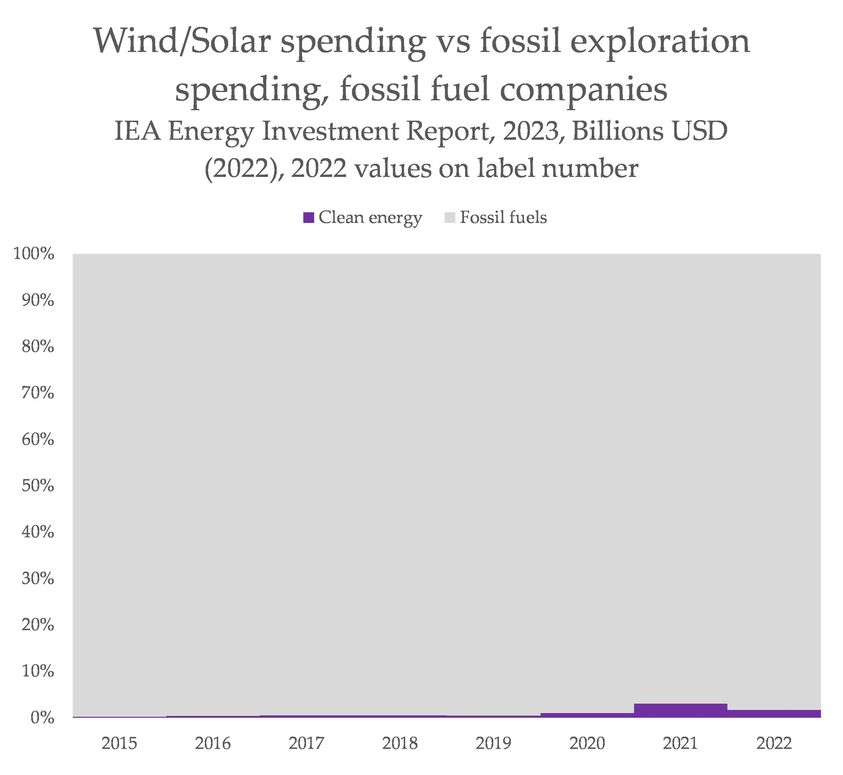
Climate tech, without regulation may do little. For example renewables can be used to increase the energy supply cheaply, without decreasing the amount of fossil fuels that are used. This seems to be standard in many places, and it is standard in fossil fuel company spending – in which spending on exploration and new fossil fuels is at least 15 to 20 times higher than their spending on renewable development, as shown in this graph, The grey area represents expenditure on exploration for fossil fuels.

There is nothing to guarrantee that a technology will only have the effects we want, and will not be commandeered by standard destructive practice.

All markets depend on regulation, and regulation that can be enforced by the State or through the courts. All markets have power imbalances, which affect the market and its regulation. Succesful and rich companies will team up and try and abuse their position of success to make regulations that favour them. This is normal, and makes useful, generally beneficial, regulation difficult.

Without regulation adding to the pressures, most companies will not actually (as opposed to in PR) change their pollution, dispersion or their destructive extraction and climate change will continue to get worse, irrespective of the tech we have, or the tech we might imagine is coming soon.

Technology is useful, but we should work with the tech we have now, rather than imaginary innovative tech that may happen sometime in the future, or may never come.

We should regulate to impose emissions and destruction reduction. Consequences for breaking regulations should be enforced and should affect profit. Hopefully this would give corporations more incentive to work on the problems.

We should also sponsor technological private and governmental research to get better tech rather than leave it to the corporate sector and the market. After all many tech innovations have come from public money, not private money, and are more easily made available if their are no restrictive patents or copyright issues to face.

On Capitalism

May 15, 2023

Capitalism

Capitalism is an organised system of domination, politics and economic power, not just a system of trade.

Capitalism tends towards producing vast inequalities of wealth, that depend upon a person’s place in the system, and not a person’s hard work or talent.

Riches are largely, although not always, decided by birth.

.Accumulation of riches tends to lead to oligopolies, in which small numbers of business control most of their specific markets, and deliberately wipe out competition.

If capitalist ‘free markets’ could exist they would destroy themselves.

In capitalism profit is the only virtue and only mode of evaluation

Capitalism is also a system in which profit is the main virtue and main goal.

If it helps make profit, then pollution, ecological destruction, low wages, industrial accidents, deception, low income misery, low income bad health, and political marginalisation of the populace will be encouraged.

Capitalism reduces all virtue and tradition to profit.

Religion becomes a way of justifying the extraction of riches from the world, or a promise that God favours the saved with riches, and hence that the rich are, as a class, the favoured of God.

This glorification of monetary profit, leads to a sociopathic system which has little care about the damage it produces. The system rewards, and selects for, those people who find it easy not to care for others or the world. Those people then select people who are like them. Consequently the system selects pathologically harmful people to lead it, which intensifies the problems with the system.

A fundamental drive of capitalist profit making is maximising cheapness of production (through low wages, cheap destruction, cheap pollution, cheap resources, cheap dispossession of poorer people etc.) and raising the price of sales.

Capitalism, government and the State

This accumulation of riches leads to plutocracy, where riches can buy any other form of power, and the rich dominate over everyone else and structure the market in their favour.

Capitalists will collaborate with each other and the State to achieve the aims described above, which benefit nearly all of them, because this is how business has to behave within the system.

Collaboration amongst capitalists makes what is called ‘crony capitalism’.

Crony capitalism is not an addition to, or blemish on, capitalism, but fundamental to its political workings and its domination over the State and over government.

As a system, capitalism cycles through boom, bust and bailout.

The rich arrange it so that ordinary citizens and tax payers protect their companies from their unrealistic, destructive or deceptive profit making practices, and the rich have bought the power and credibility to make this assumption fundamental to capitalist practice.

If poorer people suffer from the bust, that is just the price that has to be paid to keep the system going, so who cares?

Without the State to prop it up, capitalism would collapse, or decay into the rule of open violence.

To protect capitalism, the populace have to be misinformed (which is normal given corporate ownership and control over the media, advertising and PR), and people have to be convinced not to co-operate to constrain capitalism in any way.

The people are then led to find scapegoats for the troubles of the system – this can be people of other ‘races,’ other religions, other sexualities, other politics etc. It does not matter who the scapegoat is, as long as it is not the capitalist class in general. It can easily be a billionaire who makes it clear they do not worship capitalism.

Consequently, capitalism destroys social trust, constructive co-operation and compassion, as a matter of course.

Responses

If it seems impossible, or too dangerous, to overthrow capitalism, then for society and its individuals to survive, some other group must organise to restrain capitalism’s destructiveness.

The ‘easiest’ way is to take back the State, and liberate it from lobbyists, corporate bribery and the assumption that corporate elites are the only important part of society, know how to run things and know how to organise every possible process.

Taking back the State, can lead to laws which apply to all business, and encourage sharing of wealth with the workforce, making work places safe, halting environmental destruction and pollution, increasing worker representation in parliament or congress. lessen inequalities of wealth and protect people from busts and the inevitable misfortunes of life as much as possible. This all lowers the likelihood of plutocracy and increases quality of life for most people. This is a minimum.

This actually happened in the 50s, 60s and early 70s of the last century, so it is not impossible.

It should be pretty obvious that some people and parties who pretend to be taking back the State for the people, are deeply embedded in capitalist processes and have no intention of cutting back its normal excesses, even if they criticise some sectors of the economy.

Other systems of resistance, suggest that people should withdraw their support from capitalism, and become self-providing and self-governing communities that deliberately exclude big business (shopping malls, polluters, arms manufacturers, mining companies etc) from their areas, and try to constrain local riches from taking over. When a few such self controlled communities exist, they can start teaming up to become a political force, struggling against surrendering control to capitalism.

There is no reason these two constructive responses to capitalist destruction and domination cannot work together.

Summary

To repeat capitalism is a system of power relations build on top of crimes an dispossession. It needs checking if we are to survive both social and economic collapse, and the collapse of the world’s ecologies.

The World of Illusion

April 25, 2023

People can choose to live in a ‘world of illusion’ because they don’t always like to face up to challenges, particularly if they have failed to deal with challenges in the past, or they don’t want to recognise that past choices (and support) have led to them to where they are now. Sometimes realities seem too painful to face up to, and sometimes those you identify with and would like to resemble, are those causing the problems you face.

There are also mystical traditions which say that facing up to the reality of eternal bliss now, conflicts with our current ways of life and our views of our self as limited and deserving of punishment.

The point is that recognizing reality can be painful, and disorienting and threatening to our established identity

If there is a major internal, or external struggle/paradox happening then it can be less painful to decide that reality is not threatening to your identity and way of life and, that you and yours, are not creating problems for yourself and everyone.

It is much easier to sell people the idea that they don’t have to do anything, and all will be ok, than to sell them the idea that they (and others) have made bad choices in the past, and that they are likely to suffer as a result, especially if the suffering has only gradually increased.

People also often find it easier to line up to fight irrelevancies, than to struggle against the real problems.

For example:

  • It is easier to fight powerless drag queens, who have very little connection to child rape, than it is to fight people in the religions you believe in, who actually do rape children and have the power to expel you or make you an outcast.
  • It is easier to side with fossil fuel companies and denounce the ‘liberal elite’ and the ‘scientific conspiracy’ than it is to admit that your use of fossil fuels, and products using fossil fuels, is causing a problem which may lead to you losing your home, and that you need to change your whole way of life to tackle climate change. Especially given the change comes without a guide, and great uncertainty as to how you would live.
  • It is easier to say renewables will solve everything than it is to deal with the problems of renewables, or the problems of the system they are embedded in.

All of us do this all the time, unless we start to realize it. Its difficult to face up to the likelihood we have been choosing to live in a world of illusion.

Question about Entropy

April 23, 2023

I’m currently writing about energy, and I keep coming up against the concept of negentropy or negative entropy, and I just don’t get it. So it would be great if someone could explain it or point to a good URL. So far the urls or texts I have seen do not explain my issues away.

Background

You will all probably know the background ‘laws’ of thermodynamics of which two are particularly important.

0) Left to itself heat flows from a higher concentration to lower concentration. If two thermodynamic systems are each in thermal equilibrium with a third, then they are in thermal equilibrium with each other.

1) Energy can neither be created nor destroyed. The total energy of the universe remains constant.

2) Any use of energy will result in some energy being dispersed and becoming unavailable for use. This is entropy. The entropy of an isolated system [that is a system with no external source of energy] will tend to increase over time and, eventually, the system will cease to function.

3) At zero degrees Kelvin, no waste heat (entropy) is producible. [that is a paraphrase, which I hope is correct.]

Entropy is a process, not a thing. It is generally said to be irreversible. As a result, entropy marks time.

The Question

The question is what is the use and validity of the idea of ‘negentropy’. People seem to talk about the ‘consumption of negentropy’, which does not make sense to me at all. You cannot consume entropy, so how can you consume its ‘negation’? Are you violating the first law, which says energy cannot be created?

I’m assuming that negentropy arises because people want to make entropy equal to disorder, hence there is a problem of apparent increasing order as with life Life appears to build more and more complex order and repairs itself. (I think Schrodinger invents the term ‘negative entropy’ to ‘solve’ the mystery of life).

“[an organism] can only keep aloof from it [entropy], i.e. alive, by continually drawing from its environment negative entropy – which is something very positive as we shall immediately see. What an organism feeds upon is negative entropy”

What is Life p,71).

He goes on to ‘explain’:

If D is a measure of disorder, its reciprocal, 1/D, can be regarded as a direct measure of order. Since the logarithm of
IID is just minus the logarithm of D, we can write Boltzmann’s equation thus:

  • (entropy) == k log ( riD) .

….. entropy, taken with the negative sign, is itself a measure of order.

ibid: 73

I don’t like to think that I’m saying Schrodinger is talking bullshit as its hardly easy to justify, and in his defense there seem a large number of different interpretations of what he said.

What seems to be the case

However, there is nothing in the laws of thermodynamics, which says that with an external energy source, ‘processes’ cannot build what appears to be order, or even temporarily make a place exceedingly orderly. All that seems to be required to be recognised is that the building of order, maintenance, repair or regeneration etc., takes energy and disperses energy. Consequently, all of that energy is no longer accessible to the system. That is it. Energy is used and dispersed to make order. No need for negentropy, or consumption of negentropy, at all.

After a while, it takes more energy to keep the organism or information going, and it eventually breaks down (unless its a bacteria perhaps, but its not the same being after it has split many times). Again, this is connected to the Second Law in that energy is dispersed in attempting to make the order, and if something gets way too complicated it can take more and more energy to maintain, and run out of access to enough energy to maintain, and therefore starts breaking down.

Over time, the organism (or an information string if you want to tie entropy to information) tends to fail to replicate properly – there is not enough energy available to each complex organism to ensure that every replication is accurate all the time. Likewise it takes less energy to make up bullshit than it does to make up accuracy. This failure to replicate accurately can lead to evolution if failures prove ‘useful’ to further replication.

Maxwell’s demon sometimes seems to get tied in with negentropy. You all know this involves an imaginary creature opening a door to let gas particles accumulate in one side of a box. The imaginary demon’s actions (if it were to perform them) take energy. There is no apparent mystery. The box gets organised because the ordering takes and disperses energy.

So what does the idea of negentropy add to anything?

A Social science example

Let me quote:

Our main thesis is that the Anthropocene can be described as an Entropocene, insofar as the contemporary period is above all characterized by a process of the massive increase of entropy in all its forms (physical, biological, informational).

Internation. Letter to Antonio Guterres

In 1945… Lotka showed that the production of knowledge is the condition of the struggle against entropy for this technical form of life that is human life.

Internation: General Introduction

The general implication is that we must organise to defeat entropy and that life is negantropic.

However, entropy is a measure of dispersal of energy. The more energy is dispersed or wasted, the more likely that we won’t have enough energy to fix things up as they fall apart or get stressed. Therefore we need to make energy usage as efficient as possible, with as little loss as possible. Something no one aims at when energy is plentiful.

Making energy usage efficient does not stop energy being dispersed and entropy increasing. It is not negative entropy, it is not demaking entropy or consuming entropy, it just tries to make energy dispersal as minimal as possible.

footnote

Schrodinger tries to clear up his problem, saying

The remarks on negative entropy have met with doubt and opposition from physicist colleagues. Let me say first, that if I had been catering for them alone I should have let the discussion turn on free energy instead.

What is life p 74

“Free energy” as I understand the term is the available energy, which can be extracted and directed by the application of energy. For example, it takes energy to find food, eat it and digest it. The ‘free energy’ of food, has to provide more energy that it takes to find it, eat it and digest it, for it to be useful. Similarly sunlight is free, but we have to use energy to take it and convert it to electricity or warm water or whatever..

He also says

And that we give off heat is not accidental, but essential. For this is precisely the manner in which we dispose of the surplus entropy we continually produce in our physical life process.

Digestion and the uses of food energy to power and repair the body, disperses energy. There are other things going on as well such as maintenance of the body between a small range of temperatures.

This seems largely because he wants a direct equality between disorder and entropy, rather than an indirect and complex connection

umair haque on Happiness

April 12, 2023

Summary of an important article here. Read it…

Haque argues that happiness, for humans, involves social activity, possibly pointless social activity. It’s a side effect of getting to really interact with people (of all types) in your own neighborhood and building connections unintentionally.

This is important because our society (neoliberal capitalism) does not encourage this form of connection at all. It encourages selfishness, fake individualism and misery, in order to make you largely helpless consumers, and stop you collaborating with people in general. Happiness has become a business, but real happiness is free. Unhappiness has become a political tool, to drive further unhappiness.

He opens. In Europe:

I leave the house. I can’t go twenty feet without someone shouting my name. Hey, Umair! It’s the old gay couple who lives around the corner. How are you guys, I shout back, over the roar of a bus and a scooter. Me and Snowy walk on. He sees one of his buddies. This is twenty feet later. They squeal in excitement, and I’m talking to Karina, little June’s mom, about her new job. We walk on, and thirty feet later, it’s my new friend Jane, who works at the cafe I’m going to, and she’s going to sing on one of my songs, because she’s an aspiring singer. Another fifty feet. An elderly lady swoons over little Snowy. Gets misty eyed. Tells me about the dogs she’s had. We stand there talking, and I get a little emotional, too.

Half an hour’s gone by. We finally make it to the cafe, which is five minutes up the street. And there, the whole thing starts over. The crew working at the cafe says Snowy! They pet him and he grins up at them. He begins to boop random people — it’s his favorite thing — and they lean down and say hi. Plenty of us begin. There’s a girl there who’s moving over from America, a young distinguished scholar, and we make quick friends. The couple we see every other day is there, and we talk about what’s new in the neighborhood.

An hour’s gone by. And I’ve barely had my coffee and begun to have my thinking time. LOL. In America? None of this happens. Everyone walks on by, in stony silence. 

Perhaps in the US, everything is so transient, or so dependent on precarious incomes, that people defend themselves by not bonding with each other casually. He continues

My happiness levels rise because of the way life is in my little neighborhood in Europe. They rise dramatically. It’s not a small thing. It’s a big one. In America? I go a couple of weeks without this intense level of daily sociality — and I begin to feel shaky

America has no hope of happiness, because everything is neoliberal, individual, a private good. There is, in the cities, at least no building of community, and this creates unease, and danger – anyone could shoot you. Indeed, breaking connection may lead many people to madness, making the streets seem full of danger increases that madness, and leads people to embrace organised closeness and protection as in street gangs or political gangs who denounce the other side.

Psychology’s come to understand this. This open secret to happiness: sociality. And it flips everything on its head, really. Think of the way that Americans chase happiness. All those books, classes, quests. Happiness is chased the way everything else is in America: as a private good…

Happiness is not a private good. So you can’t go out there and chase it individualistically that way, like a little atom. That’s why this happiness industry in America so often appears to be selling snake oil. 

Humans are social animals, not disconnected beings. they require connection to be content or happy, even if they don’t realise it, and keep contacts down to be safe . Probably Trump supporters get more out of associating with like-minded and bonded people than they do out of Trump’s words.

What does my little daily set of interactions in Europe do? I mean that literally. Think about it. To get to a cafe that’s five minutes away, I spend half an hour chatting. Laughing. Smiling. Knowing, sharing, giving, caring. Sometimes these encounters are with my neighbors. Sometimes they’re with perfect strangers. Sometimes, they’re mundane. Sometimes, they’re deeply moving and profound. But in either way, I am enriched. Vastly enriched. I’m lighter, having shared my own worries and concerns. I’m more joyous, feeling the happiness of someone else about something good in their life.

We are connected. 

Happiness to repeat is social – working together, being together. It has nothing to do with buying things, or being alone.

What does that mean happiness is? Happiness is a public good. That might sound trite, but I assure you, it’s not. Think again about America. How is happiness framed? Titles of a few of those bestsellers about happiness: “The Art of Not Giving a F&ck.” “How to Be a Badass.” America’s approach to happiness is about individualism, about having happiness as a private good, something you possess, own — like anything else in a capitalist society, really, no different from, say, a big house all your own, a sports car, a wine cellar.

But happiness, it seems to me — and to psychology, increasingly — is not that at all. It’s a public good. And that means that either we all have it, or we don’t.

That is the social secret that could help change society for the better. But who will risk it? who will not convince themselves they already have enough of other people?

Marketplace of ideas

April 12, 2023

The idea of the marketplace of ideas is a good metaphor for what we live with.

The value of an idea is:

  • How easily it can be sold, to as many people as possible.
  • Whether it makes money.
  • Whether it supports the power and income of the firm who starts it off or promotes it.
  • Whether it helps you to buy further products or ideas from the promotor.

Not whether the idea is accurate or not.

Accuracy can:

  • Scare people so they want to ignore it, and
  • They won’t buy the idea, or further ideas from the promotor.
  • Be relatively incomprehensible if it does not meld with previously bought ideas.