Posts Tagged ‘Disinformation’

Biofuels

April 19, 2021

Biofuels have been a major part of the supposed energy transition. They have been the subject of much investment, governmental legislation and subsidy, to make them attractive and sometimes to force consumption.

The fundamental problem is that as biofuels work through burning, they produce greenhouse gas emissions now, and do not lower greenhouse gas emissions (even in theory) until the emissions released in their production are recovered through regrowth, and it is generally much quicker to burn material than to grow it back again. They may never reduce emissions if they do not replace other worse sources of emissions and pollution, rather than being used in addition to fossil fuels, or producing no incentive to lower fossil fuel consumption.

That biofuels fulfil either of these conditions is dubious, but they can also produce systemic problems:

  • Biofuels may take a lot of energy and land to produce and transport repeatedly to places of consumption, so their EREI could be extremely low while pollution could be high.
  • Farming, or extracting, these fuels, can: require fertile land and dispossess small holders, forest dwellers, and dependent labour from land (increasing food problems); bring about destruction of old growth forests (increasing CO2 emissions); decrease biodiversity; increase systemic vulnerability to plant disease; and increase price of food by taking land away from food production.
  • Using genetically modified algae for biofuels could risk ecological damage, if the algae escape.
  • Using organic waste, usually for the production of biogas, may remove natural fertilisers from the soil, and increase the energy consumed in making replacement chemical fertilisers. It may also lead to the deliberate production of ‘waste’ to fuel the biofuel plant – as with wood chipping.
  • Using plastics as sources of biofuels, is simply using fossil fuels in a rather complex way.
  • Harmful, or dubious biofuels may be used to boost the illusion of a progressing renewable energy transition, and take attention away from more beneficial technology.

All of these factors make the ecological and social situation worse.

To solve the ‘burning problem’ people and organisations have proposed using biofuels with Carbon Capture (BECCS), but this assumes carbon capture is feasible and works, and that we can store or use the extracted gas without risk of releasing it. This seems to be largely an argument from fantasy.

This does not mean that all biofuels are useless in all circumstances. There are small scale exceptions when locally made biofuels can be used locally to add power to villages which are not connected to reliable electricity, or who suffer from a lack of traditional fuels, but even then replanting trees, and regenerative agriculture may be necessary as well.

A note on neoliberalism and ignorance

April 18, 2021

Neoliberals put faith in the virtues of the market they structure to favour established corporations. They call this “THE market,” or “THE free market” so people may not wonder if markets can be structured in any other way or any significantly different way. The “THE” implies this market is the only type of market there is, the only type possible. So this is one form of ignorance that neoliberals create – there are, and have been, many types of markets and societies in human history. There is no reason we could not have a more egalitarian, less destructive, more sustainable, or effective, market – or even all of these at once…

This particular form of ignorance is fundamental to neoliberal power, and could be said to be cultivated. However, there are other indirect types of ignorance or misinformation that circulate because of neoliberalism.

For example. Let us assume we accept the idea that THE market is the perfect information processor as Hayek and others have argued. Then:

Putting faith in this market as the arbiter of truth means that it is impossible to distinguish hype from reality, other than by success. Truth is what works in the market so, if hype works and produces profit or defers the business collapse of the hypers, then the hype is effectively or ‘pragmatically ‘true’, no matter how much destruction is caused, or how false the statements.

Attempts by humans to gain knowledge are useless, or pointless, as human knowledge cannot contain (or process) the information of THE market, so ignorance is to be valued, other than when it is used to constrain the market. As all knowledge is ignorance, other than knowledge that THE market is the best we can do, then all other knowledge is to be disallowed, especially if it contradicts the perfections of THE market.

If knowledge is pointless. then it is not worth having. Neoliberals truly did not need to know about coronavirus. Neoliberals did not need to know how we have slowed pandemics in the past. Neoliberals did not need to know about the consequences of ecological destruction. Neoliberals do not need to know about Climate Change. Neoliberals do not need to know about poverty, or the condition of the working poor. Indeed Neoliberals need everyone to be as ignorant, or misinformed, on these topics as possible

All neoliberals need to know is that THE market will solve the problem (if it is a problem), if THE market is left alone to do its work, because THE market is the perfect information processor, and human knowledge is beside the point.

That is; if climate change, or the energy system, or the pandemic, is a problem then THE market will fix it, as best it is possible to hope for. If people die, that is not a problem as long as its not the hyper-wealthy.

The idea that THE market always produces the best possible, result is both Neoliberal positive thinking and positive ignorance. You can only think THE market always produces the best possible result, by cultivating ignorance of history.

For example if THE market always delivers, then the answer to any problem with government service is to privatise it. You don’t have to do any research to find out if privatisation has worked well in the past, solved the problems which were alleged, or generated efficiencies; you just know that it must have worked well. In particular you don’t have to do research in to which forms of government provided service have been replaced adequately and which have not.

The ‘perfection of THE market’ is an article of faith, which cannot be contradicted by reality. We have a true ‘Vision of the anointed,’ full of self-congratulation to use Thomas Sowell’s terms. If there was such a contradiction between reality and THE market, then THE market could not be the ultimate decider of human virtue and fate, and powerful people might be disturbed by the actions of less powerful people.

Lack of knowledge amongst ordinary people is truly a good thing, as it stops them interfering with THE market – hence Murdoch and others.

Neoliberal ignorance also depends on cultivating people’s ignorance of the idea that markets are contained within planetary ecosystems.

If anything at all is the ‘perfect information processor,’ then it is the global ecology. Anything which disrupts that ecology is likely to be eventually wiped out as the ecology moves into its new form of chaotic equilibrium – and the wipe out is likely to include THE market.

Ecologies take no notice of human requirements, or human politics, or human power. Especially if the human systems not only cultivate ignorance of the ecologies they depend upon, but attempt to destroy them or subjugate them.

Neoliberalism heads towards the destruction of everything, and celebrates the process, by blocking its ears, eyes, mouth, touch and brains.

***************

Comment

A friend writes:

How do the neoliberals square this idea of the market as always being the best approach given its failure in the dotcom bubble, and the GFC? They seem like clear counterexamples, and one only needs a single counterexample to disprove a theory.

I think that, in general, people always try and get around counter-examples rather than give up their theory, especially when its tied to their status, money, and ways of making sense of the world. However, I would agree that there seem to be a large number of counter examples as to the efficacy of THE market.

However, neoliberals always say that the crashes were caused by the government interfering with the market.

Given that the market has to have some regulation and that capitalists always seek to regulate for their own sectional benefit, they can always point to the existence of some regulation. A market which gives massively unequal wealth gives massively unequal power, and hence THE market is always structured by politics. Consequently, given the ease of blaming the government, rather than the corporately controlled market and government, they are never at a loss for a way out of the problem.

As well, the corporately owned and sponsored media tends not to blame the neoliberal, pro-corporate market for the problems of that market, and the counter examples can get hidden.

Australia made two big experiments in turning over government to private enterprise and they nearly resulted in the collapse of Victoria and West Australia.

With google I could only find one paywalled reference to Western Australia Inc. https://search.informit.org/…/INFORMIT.098371697477048

This blog is about, again: Dealing with crises

April 6, 2021

This is something of a sequel to the post “What is this blog about?”

Multiple Crises

We are in the midst of several crises of ecological and social destruction, , mainly brought about by our processes of extraction and pollution. Focusing only on the climate crisis can be a distraction from, or a defense against, realising how deeply we are caught in these multiple crises.

The Eco-crises include:

  • Deforestation
  • Destruction of agricultural land, through mining, house building, over-use, erosion etc
  • Poisoning through pollution
  • Over-fishing
  • Ocean Acidification
  • Disruption of the Nitrogen and Phosphorus cycles
  • Pollution, and loss, of water supplies
  • Introduction of new chemicals and materials
  • Changes in weather patterns

There are also social crises:

  • of information,
  • of social and political fracture,
  • of wealth and power disparities, including poverty
  • of political corruption,
  • of insecurity of work and income for most people (what is often called ‘precarity’),
  • of psychological contentment (existential crises)
  • and so on.

All these various crises interact in complex ways. Loss of agricultural land, for example, will probably spur the fractures of wealth and power, increase poverty and increase insecurity.

Part of the aims of this blog is to identify the problems, the underlying causes of the problems, and the ways we might come to change our minds and actions so as to deal with those problems.

Complexity and wicked problems

Complexity [1], [2], [3] adds to the difficulties of solving the crises. However, complexity has to be part of our understanding of social problems.

The term ‘wicked problems’ is used for problems:

  • Which don’t have a standard precedent, or standard formula for action; or the precedents and formulas appear to dig us deeper into the problem.
  • With no universal formulation; every wicked problem appears to be unique.
  • The people involved are in conflict, with different opinions and different aims, and there does not seem to be a possible mutually pleasing or agreeable solution. So solutions are likely to be undermined by those participating in the process, or prove unstable in the long run.
  • There are many linked problems, factors, drivers and consequences. The problem branches out into the systems.
  • Knowledge of the situation is obviously, and perhaps dangerously, incomplete. Some important people may dispute we have any knowledge.
  • There is little certainty a solution can be found in the time available for solving.
  • The problems are likely to change over time.
  • Solutions can also change the nature of the problem, and create further problems.

Wicked problems are systemic problems within complex systems. They sound impossible to fix, and hence are psychologically disorienting.

However, I’d say it is very difficult to fix the system rather than impossible. But the longer we leave it to stop what we are doing to disrupt the system, then the harder it will get to ‘fix’ it – or to keep it livable for the kind of society we might like.

It is easy to forget that we have always lived in complex systems and, in general, humans survive quite well – it’s not as if ‘wickedness’ or complexity are new phenomena, just something we often don’t recognise in contemporary societies.

If we remember we live in complex systems with a degree of unpredictability and uncertainty, and need to modify actions as we go along (and observe what happens), rather than assume we know in advance, then this realisation can change the ways we act, and process the results of our acts.

Complexity implies learning as we go along, trial and error, and so on.

It can also be helpful to pay attention to other sources of information than just our standard orderings. Information is a real problem nowadays, partly because there is so much of it, and so much of it is evaluated by whether it fits in with the politics of our ‘information groups’ online or in the media, and sometimes information primarily relies on the techniques of magic.

Social breakdown?

We are currently not organised to solve complex problems of great magnitude, but this does not mean it is impossible.

People may note that many large scale societies seem disrupted by ‘tribalism’ I don’t like the term ‘tribalism’ because not all forms of organisation we call tribal, have the features people use the word ‘tribal’ to indicate, However, the UK was at one time incredibly split and diverse, with big breaks between people. Papua Niugini was likewise one of the most diverse and splintered countries ever, with more completely different languages than any other country in the world. Both those places are now reasonably together, PNG in a remarkably short time – even if there are still obviously problems. We can, and have reduced the problems of ‘tribalism’ in the past.

Consequently, I don’t think there is any inevitability in the idea that people cannot unify or recognise difference and be able to live with it.

We may need to look at more closely, is what kinds of patterns of social organisation promote ‘gentler competition,’ more cross-social empathy and a sense of unity and, on the other hand, what patterns promote faction. That has become a recurrent theme on this blog – observing the ways that contemporary political communication patterns depend on the creation of enemies and outgroups, to bond the ingroup together behind the rulers.

My suggestion is that the patterns of behaviour over the last 40 years have increased the factionalisation of the US, for example. Things can get better or worse. But if we think the world is hostile, and prominent people encourage this thinking, then we tend to retreat from being-together, into being against each other. If we think that different humans can get on pretty well in general, and there are fewer forces promoting separation, then we are more disposed to try and get on.

We have also had times in human history in which the difference between the top and the bottom of the wealth hierarchy was not that great in terms of poverty, we have had times in which living conditions improved for a lot of people, and we have had times of better social mobility than others. These kinds of conditions need to be investigated without dogma, and without trying to prove that our dominant groups are really the best ever, or that hierarchy is essential – hierarchy is common, but hierarchies can vary in depth and separation between levels.

I have this vague suspicion that if we had encountered eco-problems we face now, in the 50s or 60s of last century, we would have found it easy to do a better job of handling it. We had a better sense that we all were all in things together, that sometimes money was not the only thing – and we had a growing sense that the world was fragile, which was useful, if threatening to some people.

Conceptual steps

It is now not uncommon to recognise the issues around complex systems, once people become aware of them. It is not hard to gain an awareness of the dangers of ecological destruction. It is easy to gain some sense of the political confusion, and learn that this confusion is not necessary, if you are not afraid to take on established destructive powers and habits. There are lots of people working on these issues; they even get some coverage in some media. There is a lot of effort put into discrediting science, on behalf of profit, but we can still learn if we want to.

As implied above the first step is to recognise that we do live in a set of complex systems, and that we need an experimental politics that looks for unintended consequences, and is prepared to modify policies depending on results.

We then need to be able to live with some levels of uncertainty and skepticism towards our own understandings – which plenty of people do already. In this skepticism, it is useful to be aware of the difference between real skepticism and directed skepticism, in which you are only skeptical of the out-group’s ideas, and use this apparent skepticism to reinforce your own dogmas.

We need to be able to recognise the ecological crises are problems, and that we probably cannot survive without working ecologies, and that societies previously have seemed to collapse because of ecological crisis. Dealing with the problems cannot be postponed indefinitely.

We need to understand that everything operates in contexts, and that changing the context can change the whole system, or even the meaning that some events have for us.

We probably need to be able to perceive some things in terms of continua, or statistical difference, rather than as binary opposites – because it is more realistic, and allows greater communication.

We need to be able to recognise that people are hurting because of the social and eco-crises, and that we cannot afford to have that pain be commandeered by fascist-like movements who try and impose more dogmatic order on the world.

Talking to each other with as much respect and kindness as we can, is often a good start.

Practical steps

While we cannot solve the problems entirely by ourselves, and they can seem overwhelming, it is useful to make whatever start you can, by yourself if necessary.

I’ve seen books which have long lists of things people can do:

  • learn as much as you can,
  • cut your electricity usage and bills as much as you can,
  • turn the heating down, and wear warmer clothes if possible, when its cold.
  • buy food from local producers,
  • buy organic food when you can afford it,
  • eat a bit less meat,
  • sit with local plants, get to know your local environment,
  • be careful what weed killers, insecticides and fertilisers you might use,
  • don’t use bottled water unless you have to,
  • avoid buying plastic,
  • engage in recycling even if it does not work,
  • don’t use a car for short distance travel if you can walk,
  • contact your local representatives about ecological and climate problems,
  • sign online petitions (if you don’t sign them, they won’t count),
  • engage in, or help organise, street marches or blockades. Start with the easiest first,
  • talk to friends about the issues, but not aggressively,
  • write about heavily polluting local industries to the owners, managers and local politicians,
  • buy ecologically principled renewables if you can afford them, or get together to explore organising a community buy in, if you can’t,
  • if you have superannuation, try and make sure it is not invested in fossil fuels or other ecologically damaging industries,
  • if you do buy shares, buy them in beneficial businesses,
  • let politicians and business people know that climate change and preserving the environment are important to you.

I’m sure people can think of other things which could make a difference in their area – even showing your support for other people who are doing the work is good.

If you are retired or young, you get extra opportunities to practice these kinds of things, and to work out what to do.

All these actions may sound trivial, but they will help a little. The greater numbers of people who act, then the greater the effect, the more it becomes part of their habits and common sense, the more it becomes part of social common sense, and the more it carries political weight, and the further sensible action will go. Find the things you can do and do them. Even better if you can join do them with others, as that helps support your actions and widens them, but the main thing is to do them.

We are helped in this process of change because of two factors:

1) small events, especially small accumulating events, can have large effects in complex systems, and

2) people tend to emulate others; so if you set as good example as you can without forcing it on others, then people may pick up the ideas and actions themselves and these actions may spread – and that builds a movement, even if it is not organised.

If you identify as part of the ‘political right’ and you think climate change is a danger, then it could be even more important for you to set an example, as people are more likely to learn from those they identify with, or classify themselves with.

There will be opposition to your protests, but that is life….

Old regulation

One of the main things that obstructs renewables in Australia is regulation, and I’d guess that would be a factor in most places. Markets tend to be regulated to favour those who have historically won in those markets, and those regulations often make assumptions which are no longer accurate. When something new starts, it has to fight against the established regulations. There are few markets without regulation. If there are no regulations then there might be ingrained corruption.

Anyway, finding out the regulations, finding out where they stop change, and agitating to change them, or draw attention to how they work, can also be useful. Politicians, or people in the market, may not even be aware of the regulatory problems

Climate Generosity

I’m interested in the idea of climate generosity as opposed to climate justice [1], [2]. It seems to me that people living in the justice or fairness framework, often behave as if they should begin to act when it’s fair, and that other people should act first to show them it’s fair. People are always saying things like “why should we destroy our economy while they are still polluting?” and so on. Leaving aside whether action on climate change necessarily involves economic destruction, we can’t really afford to wait. So we may need to just be generous and act before others act. We might be being exploited by those others, but who cares if it encourages more people to act and we survive?

This is another reason to act, even if it seems pointless.

Generosity is quite normal human behaviour. We might give gifts to gain status, or gain advantage, but that is fine. It often feels good to be generous and helpful. How we act is up to us: we might try and gift solar panels to a community building, even better if we work with others. We might try to get our politicians to use our taxpayer funds to help gift solar panels to a village, rather than force a coal mine on them, we could try and raise money for this ourselves.

Again we might talk to people and find out what they want rather than we think they should want, and see if it’s possible to help them get it with minimal ecological damage. Gifting is fraught, but you can increase the beneficial nature of the gift, by finding out in advance whether people would like it, and whether they will accept it, and understand that no return is expected, except for them to use it and acknowledge it. There are all kinds of ways to proceed, and involve others. Most people can at least make a present of some of their time.

Generosity reputedly helps people to feel good, build relationships, creates meaning and allows action. It helps solve the existential crisis.

Environmental relating

Sitting with, and observing, your environment can be fundamental to relating to the world, and getting  a sense of how it works and changes, how important it is to you, and how much a part of it you are. Almost everywhere that people live there is some sense of environment, some form of nature.

One of the problems with renewables at the moment, seems to be that the people installing them think primarily in terms of business and money, rather than in how renewables can be installed with relative harmony, help people relate to their environment, and be socially fair and appropriate. This is partly because of the success of neoliberal ideologies in shaping people’s common sense and sense of how the world works.

The number one bad?

One of the most dangerous things that has happened in the last 40 to 50 years is the triumph of ‘neoliberalism’. Hence I write about it a lot on this blog [1], [2], [3], [4], [5] and so on.

Neoliberalism is the idea that only important social function is business. The only responsibility of business is to make profit. People are taught that business can do anything, and that what it wants to do, must be good, that wealthy people are inherently virtuous, and that the job of government is to support established business and protect them from any challenge at all. This is usually justified by a kind of naïve Marxist idea that the economy determines everything else, so a ‘free market’ must mean freedom. But the idea is nearly always used to structure the economy to support the established wealthy, who can buy policies, buy regulation, buy politicians and so on.

A standard neoliberal process is to strip away regulation of the corporate sector, particularly ecological regulation, and try and regulate ordinary people so they cannot stop corporate action. Common tools of neoliberal economic policy include taxpayer subsidies of corporations when they face trouble, selling off public goods and profit to the private sector, tax cuts for corporations and wealthy people, and cut backs in the helpfulness of social services and making social services punitive. The main idea is that the wealthy deserve even more privilege, and the poor deserve less.

As such, neoliberalism has helped lessen the sense of possibility, and collaboration, that I referred to above. I suspect that neoliberalism, and the power relations that go with it, have done more to slow our response to the problems we face than anything else. This is not to say that free markets are not useful tools, but they are not the only tools or always the best tools, and neoliberals tend to want to structure the world so that it helps markets, rather than structure the market to serve and preserve the world. Indeed many people will argue that the idea of structuring the market to serve the world and its ecologies is tyrannical. But the basis of all economies is ecology. If we don’t make sure the ecological system can regenerate all that we take from it in a reasonable time (even, or especially, in a bad year), then we are on a dangerous path. Neoliberalism seems inherently opposed to action to stop ecological destruction [1], [2].

One reason neoliberalism is harmful, is that its supporters cannot win elections if they tell people that their primary interest is transferring wealth upwards, increasing the power of corporations, rendering ordinary people powerless, and making ecologies expendable, so they have to lie, stir up culture wars, and build strong ingroups to have any chance of victory [1], [2]. Now, in the US, they appear to be trying to stop people from voting. Sadly, the end point will probably be something like fascism [3], [4], [5], [6].

Neoliberalism suggests that ordinary people have no ability to cooperate (and should not cooperate outside of their jobs), are largely competitive and selfish, poverty is a moral failing, and that money is the measure of all virtue.

Any conservative should be able to tell you:

  • a) that people are cooperative and competitive, and that for good social life we want a competition which builds cooperation amongst the population rather than destroys it,
  • b) people are selfish, but they are not only selfish, and
  • c) virtue has little to do with money.

So we have to move on from the idea that it should be forbidden to criticise markets in politics – or perhaps more precisely, the players in those markets and the way they play. Tax cuts for wealthy people are not the only economic policies which exist.

The problem of virtue – the prime dangers of renewables comes from companies not from renewables

We should never assume that because a project appears to be virtuous, and we support its virtue, it will not have harmful effects. Furthermore, our ideas about the project, and how it works, may be completely wrong.

This applies to everything. Recognising that a virtuous, useful project that we completely support can have harmful and unintended consequences is fundamental to an experimental politics, and to navigating complexity.

So far the main problem we have had with renewable energy, is that we are often (although not always) carrying out the transition through the normal ways that we have carried out business and development in the past. These ways of proceeding have traditionally harmed people, and harmed ecologies, partly I suspect because they have always put development, business and profit ahead of those people or ecologies. So we have to be careful.

For example, production of solar panels can involve ecological destruction through mining or pollution. The factories can have harmful working conditions – workers can be poisoned. Disposing of old, or broken, panels can create pollution. We face the usual consequences we might expect from attempts to increase profit, without any ecological or social concern.

Biofuels have in many places resulted in small farmers being pushed off their land, loss of casual farm work for people without land, breakdown of village relationships, deforestation (which goes against the point of the fuels), replacement of food crops with fuel crops pushing up the price of food and leaving people short of food. Biofuels have resulted in greater use of fertilisers which may harm the soils and rivers, they may consume vast quantities of water which can threaten local livelihoods, if rain is rare.

It’s pretty obvious that cultivating vast areas of monocrops takes fuel burning, and making and transporting the resulting fuels can take fuel burning. As well, it usually takes much longer to grow biofuels than to burn them, so it is not immediately obvious that, unless fossil fuel consumption is significantly curtailed by these processes, that it is actually helping at all.

Likewise, wind and solar farms can involve companies fraudulently stealing land from small farmers (people I research with have observed this in action), can involve secret agreements which split townships, unclear distribution of royalties, disruption of people’s sense of the land, agreements that do not involve local people or only involve some local people, fake community consultations, use of water which is in short supply to clean panels, destruction of jobs without replacement and so on. Sometimes it can even involve organised crime, or militia’s, intimidating opposition, forcing people to sell land, or provide ‘services’ for the non-local labour that has come in to install the renewables.

Even events like attempting to conserve forests can lead to traditional people who have lived pretty well with the forests for thousands of years, being thrown out of the forests and becoming homeless.

It should be clear to anyone, that an energy transition does not have to proceed like this, but this is how normal developments proceed at the moment. Mining is often surrounded by local protest and horrendous treatment of local residents, and even poisoning. Having a large chain supermarket arrive in your town, can destroy local business, and create unemployment amongst previous business owners. However, for some reason or other, many of the people who lead country wide protests against wind farms, do not see a problem with mining, even when destroying agricultural land completely, perhaps because they think mining is virtuous. However, it is not just renewables that cause problems, it is the system. So the system needs change, at whatever levels we can manage.

The point is we need to have more care about how we proceed, and more awareness of the problems in virtuous projects without feeling we have to abandon them. If people get dispossessed by renewable companies, behaving as companies often do, we need to stop this, as they may tend to react with hostility towards the transition in general, when the problem is company behaviour not transition.

This blog aims to explore some of these effects, and suggest possible remedies. We cannot afford for business to behave like this, so renewables companies must be regulated to engage with communities.

Perhaps this means that community based renewables are a better way to go? People working as a community are more likely to listen to each other, and to relate to the place they are working in – which does not automatically mean harmony of course. If this is true, then it again demonstrates the importance of working at a local level – even in cities.

The downside is that careful processes take longer and slow progress down, but we want a liveable world at the end of it.

Problems of Fantasy Tech

Finally, some imagined technologies like ‘clean coal,’ ‘carbon capture and storage,’ or geoengineering [1], [2], [3] often act as ways to reassure us we can continue on as we are doing, and suggest we can fix everything up with a future technological add on to the process. These technologies currently do not exist safely, or are not working at the rates we need. It is generally not sensible to imagine that a working technology must appear because we need it, or in the right amount of time to solve our problems. That is just fantasy. While we should research new technologies, we also have to act with the technologies we have now, as well as we can. Further delay, because of technological fantasy, just makes the situation worse.
Is climate change overblown by the left?

March 23, 2021

Given that the world is, on the whole, not anywhere near necessary targets, according to the latest UN NDC Synthesis Reports issued February 2021; then if “the left” are being overblown, they are not having much influence.

This is as you would expect. Most people in the developed world, don’t want to change their lifestyles – and given that most people in that world seem to be going downhill due to neoliberal privileging of business, transfer of wealth upwards, and nannying of the wealthy, why would they want to risk going even further backwards because of attempts to fix global warming? This is the usual reason given for working class anger in the US, and for ‘populism’ (assuming that word means anything). Furthermore lots of powerful people do not want to lose the wealth they have tied up in fossil fuels, and they don’t want to risk the possibility that new forms of energy could increase democracy or impoverish fossil fuel companies.

These wealthy and powerful people can buy politicians, can buy media, and can buy the idea that climate change, global warming, massive forest fires, massive flooding, ecological destruction, over-fishing, destruction of agricultural lands, deforestation, loss of animal life etc are not really a problem, or they occur all the time, and that imagined technological invention can save us, without any political or economic change. This seems well documented to me.

They have captured mainstream parties all over the world, with the possible exception of UK conservatives, who actually seem to be trying to reduce emissions – not that this gets reported much outside the UK (remember wealthy people own the media, or advertise in it). UK conservatives, do tend to have a real conservative streak because they believe in conserving things (which is pretty unusual in the Right nowadays), and they don’t always believe in encouraging business to destroy their country….

In the developing world many countries, believe that fossil fuels and ecological destruction are necessary for development, and that it is their turn to engage in destruction for the benefit of their people, and that developed world objections to this are a form of neo-colonial racism. They say something like “get your own world in order before complaining about us.” So, on the whole, many relatively powerful people in the developing world downplay the problems as well.

Again the point is, that if the left is overblowing global warming they are not having much of an impact, and one of the leading forces for emissions reduction is not remotely left wing.

The next implied question is “are the left exaggerating the dangers?” Personally I think it is unlikely that the majority are. Some will be of course, this is what happens. Most scientists and people who study the subject, seem to think that bad things, to very bad things, could happen. Strings of high ’unprecedented’ temperatures in the Antarctic are clearly not good. World wide highly intense and ’unprecedented’ forest fires are not good. Declines in fish population are not good. The apparent death of large expanses of coral reefs is not good. Places having streams of days over 40 degrees centigrade are not good. Strings of destructive storms are not good. And this is with only 1 degree increase. What we will have with another couple of degrees will probably be really bad.

One issue here is that because ecologies and climate are complex systems we cannot predict how bad things will get. We do know, that once you knock the systems out of their balance and equilibrium, they tend to oscillate wildly, which probably means increasing wild weather, but precisely what this will mean, we can’t tell until it happens. However, the chances of good things happening for most people seem remote. I guess, if you are wealthy enough, you can move to and buy somewhere safe and remote and perhaps you can buy the people to provide you with food etc….

I don’t think it is altogether sensible to wait to see what happens before acting, because there almost certainly will be a delay. If we act now, then things will continue to get worse for a number of years. The later we act then the greater the probability that the situation will get worse for longer after we stop. So we have to stop before it gets unendurable.

I personally think the idea that action on global warming or ecological destruction is not particularly left wing at all. Real conservatives should be concerned. Even if you think that global warming has nothing to do with humans, then you might want to think about how we should prepare to adapt to changing circumstances, and how we should lessen the effects. Climate and ecological action is about dealing with, and lessening, anticipated problems, which is pretty normal across the political spectrum.

After all, ordinary people do want forests, do not want to breath coal and oil pollution, don’t want a coal mine next to their house, don’t want flooding, don’t want the price of food to go up and face food shortages, don’t want climate refugees, don’t want (if they live in hot countries) to work outside in 38 degree centigrade (100 degrees F) or more temperatures and so on. However, the wealthy elites have successfully managed to label action on these issues as ‘left wing’, probably in an attempt to make those people who identify as conservative, right wing, or libertarian shy away from action, and not think about what would be a good solution. This helps those sponsoring people maintain their power.

Climate change and eco-destruction is real and does seem to be humanly generated, (which is absolutely obvious in terms of eco-destruction). If we do discuss what to do then the arguments about what we should do, are likely to be political – and this is good.

Personally I would rather have people on the right thinking about solutions, than attempting to sabotage solutions, or attempting to prop up a failed regime, and UK Conservatives show that this is possible…

“There have been billions of years of climate change”

February 24, 2021

People quite often object to the idea of climate change, by saying that climate has always been changing. They triumphantly point out that there have been billions of years of climate change. Temperatures have been much higher than they are now and things still lived. Life will not end. Then they ask, why is it that alarmists neglect this fact?

The problem is that we ‘alarmists’ do not ignore this fact. Indeed if you believe we do, then you are probably not getting your information about alarmism from scientists. I know of no one interested in climate change who is not aware that there have been large numbers of different climates in Earth’s history and that many different kinds of creatures who have flourished or died out in these different climate regimes. No one expects life to die out completely in the current process of climate change, either.

What some people do say is that the Holocene period, which is the one in which humanity has been living, has been remarkably stable. During that stability, humans developed civilisations, which tend to fix us in place.

We currently seem to be facing a rapid period of climate change, ecological destruction and biodiversity loss; one measured in hundreds of years, not tens of thousands of years. This will almost certainly put massive stress on civilisations, the weather conditions will change, sea levels will change, water availability will change, food availability will change. As the change is rapid the chance is high that storms will increase. People will try to move from areas which no longer seem habitable to areas which do seem habitable. All of these factors will add further stress to civilisations.

So the big problem is not climate change in itself. One problem is whether it is likely that any of the current major civilisations will be able to cope with these stresses without significant social breakdown and population death. The other problem is whether any of them will do anything to significant lower the pressures, or the rate of change.

Countries are not all in a resilient place to begin with. Some civilisations may already be breaking down irrespective of climate change.

For example, many people in the US expect income and wealth inequality to grow and standards of living to continue to decline. By some accounts many of those people already suffer from unstable low incomes, food shortages, unaffordable medicine and rampant disease, and we have only just started moving into the additional problems of climate and eco-crisis. Given the US’s inability to keep its infrastructure repaired, protect its population from Covid-19 (now over half a million dead, and unknown numbers with ‘long covid’), look after people equally or rebuild after violent storms as in Puerto Rico [1], [2], or New Orleans (still), or prevent the energy consequences of a cold snap in Texas, then it seems improbable business and government will be able to cope with severe and added difficulties. They may, but it seems sensible to reduce the magnitude of the problem in advance, if that is at all possible.

Unfortunately, dealing with this change seems to threaten the power and wealth of some powerful groups of people, and they are doing their best to persuade people that it is not a problem. And they are doing this quite well. But for them its not a problem, they figure the ordinary folks will be the ones that suffer, and they can ride it out. They have wealth, they can buy violent protection, they can buy technology that will keep them safe. They may be even be correct, but do you want to sacrifice yourself, your friends and family to preserve these people’s power?

We can stick with helping the crisis to happen if we want, or we can ‘do the research’ overcome the misinformation being distributed, and try to think of solutions. If you really do think that people who are worried about climate change never consider that climate change has occurred in the past, then you might also want to think about why the people giving you your information about climate change alarmists are lying, and why.

Paying for Links

January 28, 2021

The Australian Government is proposing legislation which means that google, and Facebook, and presumably anyone else will have to pay for ‘using’ media items.

The problem for me is that Google and Facebook, do not (as far as I know) take media items and put them on their websites without acknowledgement, or steal articles as the government and its media backers allege. They put up headlines, possibly a lead image, perhaps the first couple of lines of text and a link.

Providing a link to a news media item does not seem to be stealing the product; it is linking to it – it is in effect providing a free advertisement for the content.

If a person clicks on that link they get taken to the site (unless it is behind a paywall). This then gives the publisher the eyeballs. It gives the publisher the advertising revenue and so on. If its behind a paywall then it may indicate to the clicker that the news is worth paying for.

Every article I’ve ever clicked on, on Twitter, Facebook etc works like this. Yahoo news may work differently, but I’ve always assumed they do pay- perhaps they don’t – that should be solved.

News sites who don’t want to get these free adverts can easily incorporate a piece of code into their web pages, and google, for example, will not collect the information and report it in searches. That way they easily get rid of the sense that google is stealing their news.

Most of the items, I see on facebook, are put there by people who think the articles are interesting and useful, and they, again, are encouraging people to go and read the article on the article owner’s website. This also counts as very effective advertising. It means that people I like recommend something, and that tends to be the most trusted advert.

Likewise, I can see that many online news stories use twitter posts as ‘evidence’. These link to twitter etc, but there is generally no need to travel to twitter to read them. This could be considered to be theft, and perhaps news should stop doing it. But I still think its a primarily a link, and it tells people that twitter is important and is good to use.

If I personally link to something someone wrote, I don’t think I’m stealing their work, I’m acknowledging it, or giving them some advertising.

The real problem is that if google and facebook have to pay for every item they link to, then surely every article online should also have to pay for similar links, links to evidence etc, then the sites will shut down. I cannot afford it for one.

The internet will die.

I guess Murdoch will be happy.

Endnote

There might be lots to complain about with google, such as it often does not appear to pay taxes on revenue generated in the country in which it sells the advertisements it carries. But that is a real objection. The Australian government does not seem to be interested in reality, just in stopping people from finding the news.

The 12 steps of neoliberal problem solving

January 26, 2021

If there is a problem which disturbs the established corporate sector and their hangers on, then try and deal with that problem as follows:

1) First: deny there is a problem.

2) Scream, shout at and slur those who say there is a problem.

3) If 97% of those who work in the field (economists, scientists, medical practitioners, ecologists etc) say there is a problem, then insist that the 3% who don’t, be given equal time. Hell, give that 3%, 80% of the time.

4) Call for problem recognisers to be dismissed from positions of employment. Call for the removal of problem data from government websites.

5) Hinder any attempts to do anything useful about the problem.

6) Complain solving the problem involves socialism and tyranny.

7) If the problem is so obvious it needs to be solved, then get the solutions to the problem to involve tax-payer subsidy of established industries and tax cuts for the wealthy.

8) Insist any other solution to the problem involves insufferable limits on peoples’ personal liberty to make the problem worse. Resisting recognition of the problem is vital and radical.

9) Fail dismally.

10) Argue that the failure to solve the problem, shows the Governments are useless and should not attempt to solve any problems at all.

11) Argue that everything should have been left to the private sector that did not want to recognise the problem in the first place.

12) Keep on as if nothing had happened.

QAnon?

January 20, 2021

This is an attempt to explore Q, and to write about Q, somewhat in the manner of Q.

First off, I’m not an expert on QAnon, so there is no need to take this seriously.

What was the Conspiracy?

Q does seem to be pro-Trump. However, Q does not seem to have had either Trump, or the Trump re-election committee, behind them, because it seems that Trump had little idea of what Q was talking about until relatively close to the end, when he could have taken advantage of it all along. He did occasionally retweet Q memes, but the memes were ubiquitous in the sources that Trump might read or see, so that does not mean he knew much about it. This is what he said when asked:

Trump: Yeah. I know nothing about a QAnon…. I know you told me [about QAnon], but what do you tell me doesn’t necessarily make it fact. I hate to say that. I know nothing about it. I do know that they are very much against pedophilia. They fight it very hard, but I know nothing about it….

I’ll tell you what I do know about, I know about Antifa and I know about the radical left and I know how violent they are and how vicious they are, and I know how they are burning down cities run by Democrats, not run by Republicans….

Savannah Guthrie: Just this week, you retweeted your 87 million followers a conspiracy theory that Joe Biden orchestrated to have SEAL Team Six, the Navy SEAL Team Six to kill — cover up the fake death of bin Laden. Now, why would you send a lie that to your followers? You retweeted it.

Trump: I know nothing about it. It was retweet. That was a — an opinion of somebody and that was a retweet. I put it out there. People can decide for themselves to take a position.

Interview: Savannah Guthrie Leads a Town Hall With Donald Trump in Miami – October 15, 2020. Fact base

Given Trump would seem to take advantage of anything popular which favoured him or attacked his ‘enemies’, there is no reason to think that he would refrain from using Q, if it was connected to him and he knew about it. Unless Trump was in deep cover; which means he would confirm nothing of Q, although him confirming nothing, does not confirm anything.

Trump’s display of ignorance could suggest that Q was trying to take advantage of Trump and his followers for some purpose. Is there reason to think this untrue? Q had more to gain than Trump did. They could influence Trump’s followers, while binding Trump to promises he could probably never carry out such as capturing and trying Hilary Clinton as she tried to escape, engineering mass suicides of his enemies, perhaps announcing that the Mueller Report had unearthed pedophilia in security agencies, get John McCain to resign, expose Pope Francis and so on. Trump was also expected to hold ‘the Storm’ and arrest hundreds (maybe thousands) of satanic pedophiles, which may well have proven difficult if he had tried to do it – which he does not seem to have done. Trump was even incapable of triumphing over coronavirus, which was supposedly not really that deadly. Did the prophecies fail, did Trump fail, or was he pushed by Q? Were the prophecies codes for something less palatable to Trump’s people? Who are the secret manipulators?

Was Q even designed to discredit Trump and his followers, by demanding the impossible, and then letting the followers see it all fail? Q could have been the deep state in action, only pretending to be against itself. Was Trump was doing this himself? If Q was Satanist running a false flag operation, then allowing 100,000s of innocent Americans to die, because no coherent action was taken, could count as a major success.

The background: ‘drops,’ and black magic

The idea was clever. Q is supposedly a person with a Department of Energy clearance for Top Secret information (why Department of Energy?). We don’t even know Q is a real person, or how many people post as Q. The people playing Q basically issued questions, random snippets of information, made predictions and let people construct their own fantasies (or do a lot of learning as they might put it), so they provided the data and fantasy to back Q’s assertions, and spin the Web Q started. This is one supposed Q drop from near the beginning:

Mockingbird
HRC detained, not arrested (yet).
Where is Huma? Follow Huma.
This has nothing to do w/ Russia (yet).
Why does Potus surround himself w/ generals?
What is military intelligence?
Why go around the 3 letter agencies?
What Supreme Court case allows for the use of MI v Congressional assembled and approved agencies?
Who has ultimate authority over our branches of military wo approval conditions unless 90+ in wartime conditions?
What is the military code?
Where is AW being held? Why?
POTUS will not go on tv to address nation.
POTUS must isolate himself to prevent negative optics.
POTUS knew removing criminal rogue elements as a first step was essential to free and pass legislation.
Who has access to everything classified?
Do you believe HRC, Soros, Obama etc have more power than Trump? Fantasy.
Whoever controls the office of the Presidecy controls this great land.
They never believed for a moment they (Democrats and Republicans) would lose control.
This is not a R v D battle.
Why did Soros donate all his money recently?
Why would he place all his funds in a RC?
Mockingbird 10.30.17
God bless fellow Patriots.

Qposts 29-Oct-2017

There is no ‘secret information’ here, just questions with no answers. It is all references to things people would already have heard of, if they watched Alex Jones or similar parts of the Right0Sphere – Huma, for example is a close associate of Hillary Clinton, who is supposed to have peeled faces off children in a Satanic ceremony – is there any evidence of this? It doesn’t matter as she is not being accused of anything; people are just being told to watch her.

Here is another drop. Note the repetitions between posts, which might build up truth (‘What I tell you three times is true’):

Some of us come here to drop crumbs, just crumbs.
POTUS is 100% insulated – any discussion suggesting he’s even a target is false.
POTUS will not be addressing nation on any of these issues as people begin to be indicted and must remain neutral for pure optical reasons. To suggest this is the plan is false and should be common sense.
Focus on Military Intellingence/ State Secrets and why might that be used vs any three letter agency
What SC decision opened the door for a sitting President to activate – what must be showed?
Why is POTUS surrounded by generals ^^
Again, there are a lot more good people than bad so have faith. This was a hostile takeover from an evil corrupt network of players (not just Democrats).
Don’t fool yourself into thinking Obama, Soros, Roth’s, Clinton’s etc have more power present day than POTUS.
Operation Mockingbird
Patriots are in control. Sit back and enjoy the show.

Qposts 30-Oct-2017

This primarily states that Trump will not say anything about what Q is saying, so overt confirmation is not to be expected. Is silence confirmation? Trump is also not a target, but a target of who? Perhaps that means he is a target of Q (because it is denied). Of course both these posts could be fake, but they show the style…. it seems like a textual Rorschach blot. We might wonder if, like Trump’s speeches, whether the ‘drops’ interrupt and disrupt ‘rational’ (Mind 1) thought processes and critical thinking? Why do they make so few connected propositions which can be challenged? Could they be acting as incantations, black magic, hypnotic effects, replacing rationality, with repeated phrases about how great we are, how persecuted we are, how we can overcome everything, how those who disagree with us are traitors? How better is life, if we just hand over our will and our trust to the black magician? To the Satanist who pretends to expose Satanists, but never does. Mind 2 finds the patterns which are hinted at within the hypnotic suggestions, and that becomes hypnotic truth…

Q as liar? Fantasy and community?

Q also claimed that sometimes they would issue false information deliberately, some say to misguide the real criminals. This admission protects everything Q says. False information could be said to not really come from Q, or was a deliberate deception for some reason. This meant that any vaguely clear statement which turned out to be so obviously wrong, that even Q followers could not believe it, was easy to explain away, or forget. If Q says straight out sometimes they lie – who knows what to trust? This is just like Trump. People no longer know what is intended to be true, what is just ignorance and what is deceit. How many times does Q have to lie, before it all seems untrue, more untrue than not, only accidentally true on occasions, or people bed down with a hypothetical truth that they will protect from challenge?

The end result is that whatever takes off amongst readers is what what they elaborate, what people need to hear to make sense of the world, and which gave them a sense of accomplishment – people issue youtube ‘news’ videos – “You are the news now,” “Do your own research,” “Have faith in you own research”. While this further engages the participants, it could lead to a situation where if a source disagrees with Q on anything it seems obviously false, and cannot be trusted. If you don’t hear anything that Q is talking about in the mainstream media, that is because that media is part of the conspiracy and is actively suppressing the information. If you do hear something that confirms, or makes sense of, Q it must be true. So QAnon the movement became, more or less, completely self-referential and self-reinforcing. What was true would be what other Q followers said was true. And some of them might think “disinformation is necessary,” and just lie for some higher purpose – whatever that was? Supporting Trump? Supporting the swamp Trump cultivated? Supporting the take down of Trump?

These processes of trust and distrust build community and closeness amongst those who hang out for more drops from Q or who attempt to make sense of Q. The community builds up the sense that something important is happening here concerning the future of the USA, and ‘we’ are participating. People accepted what they were told because others they respected did, while saying that was only something that happened to those outside their community. Sadly, what is to say we cannot be conditioned by any media/information, unless we are critical of it? As they say “where we go one, we go all” or “WWG1WGA,” which sounds a bit like the sheep they condemn others for being, but let’s assume that is not true, and it just indicates following where the ‘evidence’ takes them, as long as it does not invalidate Q.

Satanic pedophiles

Opposition to Q, further proves Q had something, because wouldn’t the Satanic pedophiles oppose Q in all possible ways? “Many in our govt worship Satan.” “These people worship  Satan_ some openly show it.” Although Q mentions Satan relatively little, it seems to be elaborated by followers; its a meme they magnify.

Q promises action is being taken, even if we don’t see it:

The pedo networks are being dismantled.
The child abductions for satanic rituals (ie Haiti and other 3rd world countries) are paused (not terminated until players in custody).

QPosts 1 Nov-2017

It certainly attracts attention, and I’ve certainly met people who think Trump is warring against organised high level pedophiles, despite the fact the only publicised arrests have been of friends of his, who previously escaped because of friends of his.

The elite pedophilia thing is not impossible. Organisations like the Catholic Church have behaved as if they were run by pedophiles to protect pedophiles and other rapists, so we cannot assume that no other high level organisations would be run in the same way. We also know that hidden pedophile rings do exist online. Online, anyone can find anything if they search hard enough, and police do break some of them. This is reported in the mainstream media, easily.

The odd thing is that Donald Trump could be seen as the person fighting pedophile rapists. That is hard to believe. He is a person who reveled in sexual assault, even if it was largely imaginary. Many women allege he behaved ‘inappropriately’ towards them. He seems to be a serial adulterer and user of prostitutes. He not only at one time had largely unreported, but real, charges against him of raping a thirteen year old girl. These charges were dropped as he became president, because the woman involved received death threats. He was a friend of Epstein’s who knew about Epstein’s tastes and did nothing about it, not even break off friendship, for years. He also knew, and hired, various other people who favoured Epstein. He specifically shouted out to Maxwell, when she was arrested, to wish her well. He deliberately had a woman who was repeatedly raped as a child unnecessarily executed for murder. We might as logically expect him to run a pedophile ring as be against it. Perhaps Q provides cover for this? Do the research….

The ‘Secret of Media’, is hidden

Some of Q, is not unreasonable:

What happens when 90% of the media is controlled/owned by (6) corporations?
What happens when those same corporations are operated and controlled by a political ideology?
What happens when the news is no longer free from bias?
What happens when the news is no longer reliable and independent?
What happens when the news is no longer trustworthy?
What happens when the news simply becomes an extension/arm of a political party?
Fact becomes fiction?
Fiction becomes fact?
When does news become propaganda? [more]

Qposts 22-Nov-2019

‘Of course’, there is no analysis of the normal process of monopoly, oligopoly and control in capitalism. The post relies on the standard uninvestigated rightwing meme that the US media is ‘liberal’ or pro-Democrat, rather than pro-corporate, or biasedly pro-Republican and geared at benefitting its owners and advertisers. Q does not suggest Right wing media bias. News could equally become propaganda when it belongs to Murdoch, or other ideologically committed billionaires, who stack their media with propagandists who promote the idea that any news which disagrees with their position is both lies and politically motivated. Q suggests that bad news stories about Trump, no matter how well documented, show there is a conspiracy against Trump and against decent Americans, not that Trump might be bad. Q people have to stand outside the supposed group-think of those who think Trump is a problem, and join the group-think of denying that Trump is incompetent, corrupt, not clearing the swamp, etc. – no matter how clear Trump’s failings would seem if you investigated him with an open mind. By all means, “do your own research,” but don’t assume that only pro-Trump sources are genuine, lest you want to be mindwashed.

Just remember the lamestream media could not be bothered to report the charges of Trump raping adolescents or many of his war actions, before thinking it is inherently anti-Trump.

If Trump was a Satanist, we might ask, does Trump enjoy other people’s deaths? Is this why he had people executed on his way out? Is this why he pretended Covid would not kill many Americans, even now when over 400,000 Americans (current figures, likely to get bigger) have died? Is this why he ignored Covid after the election, to pay people back for not voting him in? Is this why he allows companies more freedom to pollute and poison people? Is this why Trump media also pretends the virus is not real? It is sacrificing its watchers to some ‘higher cause’?

Did Trump pardon those who entered the Capitol Building for him, or did he pardon politicians who were convicted for defrauding people for money, or convicted of tax or financial fraud, people who committed war crimes, or high level people who were convicted for illegal acts protecting him? Is this defending the swamp and casting aside the principled? What does your media say?

Q is dead, but Q is not dead

That Q was, at best, largely fake, should be relatively clear to everyone by now. The Storm never happened. There never were any mass arrests carried out by Trump, even at the last minute. There never was any outside evidence of the plots that Q generated awareness of. There were no trials. Three years of promises with nothing to show, except winding up support for Trump. But who knows, perhaps Q can be saved by pretending the failure of the prophecies was a necessary step towards later success, that so many good people could not have been sold a line so it must be true, or that people misread the drops (not hard) and that Q did not bother to let anyone know…. In which case Q is at best unreliable, and we still are not certain Q was other than a complete fake.

Acknowledged failure does not mean Q will not start up again, or that people who are dedicated will not keep it going, but it needs a new rationale. And that may take a while to get going…. So don’t give up on it yet, only 4 years till the next attempt (at best).

Because QAnon was so widespread in the ‘Right0sphere’, the domain of dedicated Right wing theory and propaganda, people who frequent that zone are almost certainly influenced by Q memes and Q provoked fantasy, even if they have never knowingly directly engaged with the Q community, and even if they thought Q was loopy. They share some things in common to begin with, so increasing that sharing may not be hard. In that case, is the spread of Qdom limited by the presence of Q, any more? It may have its own self-generating base, and so will probably continue, even if it drops in popularity, and it may well resurface later on, when all the disproving factors have been forgotten.

Q and real politics

Part of Q’s success involves what I have called ‘shadow politics’. That is the ability to displace evil on to outgroups, or the ‘other side’ in a binary political system. Because the other side is not us, and we are good, they become the repository of all our suppressed, or unacknowledged desires. Through this thoroughly human process, we are able to truly identify the evil and fight it. Fighting that evil, and hopefully expelling it, bonds us together in community, while also making the separation between the groups sharper and more intense.

As it is harder to talk across groups, it becomes easier to believe they are deluded and evil. Because this separation is so involved in fantasy, there is no limit to what can seem to be true, in terms of their evil and our good. You can see this in action with people condemning those others involved in QAnon, almost as much as you can see it in the QAnon movement itself.

Politics and economics also tend to become caught in fantasies and projections which are collective and cultural, and indeed even make collective culture. It might even be the case that effective politics is about the creation of effective fantasies – which can then obstruct people from attending to the reality they are dealing with, and lead to destruction – because they seem so true, and they are so easy to communicate. One important thing in research is to attempt to prove you are right, the other is to explore how much you can be wrong. This is difficult when fantasies are involved, and is almost never encouraged by leaders, whose power often depends on you accepting their truth.

What Q does indicate, and what should be taken seriously, is the shear amount of alienation in the US population, and how deeply uninvolved, or frightened, at least 30% or so of potential voters feel about political process. How they feel the ruling elites do not listen to them, the intellectual elites despise them, and the media is untruthful – and, sadly, there is real point to that feeling. This is significant. For many people, it feels as if the current world is being run by evil geniuses (or evil morons), who have no morals at all.

We can assert that the ideologies of capitalism have let people down, because those ideologies have no capacity to explain what is happening to people, or give consolation. People have little hope – nothing indicates that doing what they are supposed to do (like ‘work hard’) actually works for them. They are losing money and life chances. Life is going downhill, for them and their children. It shows they feel they are the victims of forces they cannot control – and this is probably correct. It may also show they feel that God has abandoned them, or needs a lot of placating to be on their side.

QAnon also shows people’s own heroism, they were prepared to stand up for change, if they thought that change was true. They were prepared to separate from families and community for this truth. That it may not have been true, does not diminish that heroism, or their determination to find things out and take the consequences.

Do Q’s satanic pedophiles exist, at any really important level, any more than the Pizzagate ring existed? Probably not. However, it is important symbolically, as it again could represent the idea that people experience themselves as being at the mercy of predators in their daily lives, which could well be true – they are all subject to the forces of predatory capitalism, and a system which sacrifices normal people for taxcuts for the wealthy, fossil fuels, run down housing, and subsidies for the hyper-wealthy.

If this alienation from politics and from social life, is not taken seriously by people in politics (and religion) and they do not work to fix it, but continue to work to take advantage of it, or dismiss it, then the US will continue to head for tyranny, persecution of innocents and collapse. Everything may well unwind. If steps are not taken, the future could be every bit as horrific as Q suggests.

Zogopolitics

January 15, 2021

Let’s just pretend that the media was nearly all owned and controlled by one slightly divided faction – lets call them zogopolites.

Zogopolites only report news and opinion which they like. There might be a little difference between the Sydney Zogopolite and the Australian Zogopolite, but not that much. The one on the far up pretends it is sensible and centre and that the other media is far down, but they both ignore the down who don’t have any media at all, expect the papers they publish in their back sheds.

If the down have policies, ideas and information, you won’t get to hear it, but you might be told that all you hear outside the Australian Zogopolite is filthy downism, and you may get some vague distorted idea of how evil the down are.

The zogopolites distort and lie about ‘opinion’ and science they do not like, or which might cause followers to think about whether the zogopolitism was actually survivable. The media calling itself centerist, spends a lot of money hiring people who scream and shout a lot, because the point is that people should be angry and contemptuous of the down – that way they won’t listen to them, in the unlikely event they were ever to hear any.

Zogopolites all protest strongly if anyone on the up gets ‘censored’ – even if that person has access to other news media, or even their own news media – but it completely ignores censorship of the down. So people might even think zogopolitism was “fair and balanced”. What you don’t hear won’t bother you and you won’t notice it, and they more or less never report on the Down except abusively or falsely , so it seems normal. They may even deny that zogopolites exist, their ideology is commonsense after all. You must be deluded to disagree.

The up think that you should have to hear them and nothing else.

If we were living in this world we might think we have non-zogopolite media on youtube or something, but somehow most of it runs with the same kind of line; we must ascend! we must ascend! descent is bad!!!! We might flatter ourselves that we do research, when all we do is look for stuff that confirms our feelings, which have been cultivated by zogopolites – remember the shouting and lies?

Given that zogopolite media will largely not report the truth, or let other opinion in, and it is close to impossible to set up competing media, what should people in this world do?

Should they just say that is the way it is, and we will believe zogopolite reality because its there, and it owns and controls the media? or is there some other solution?

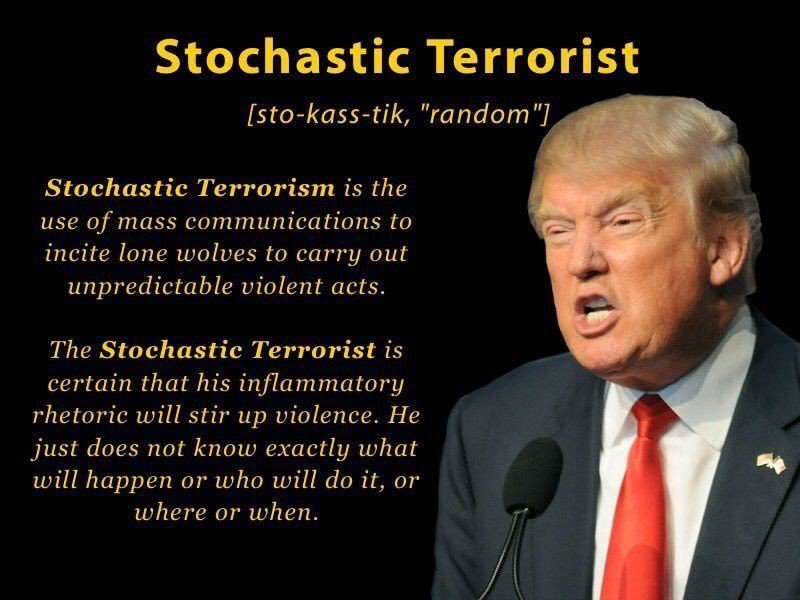
Stochastic Terrorism

January 10, 2021

I generally don’t like memes, and I’ve no idea where this originates, but its a useful idea.

Image

The Idea

The earliest account I’ve seen, and some of the wording in the meme comes from this source is an anonymous article in the Daily Kos from January 2011: Stochastic Terrorism: Triggering the shooters.

The person who actually plants the bomb or assassinates the public official is not the stochastic terrorist, they are the “missile” set in motion by the stochastic terrorist.  The stochastic terrorist is the person who uses mass media as their means of setting those “missiles” in motion.

While [the ‘terrorist’] action may have been statistically predictable… the specific person and the specific act are not predictable (yet).

We can think of this as complexity in motion. Just as we know climate change will produce storms that will destroy something valuable and important, we don’t quite know what. Its a dangerous weapon, in that it could bite the person who uses it, but I guess the media is used to direct the actor to hit someone who the stochastic terrorist does not like and has (along with other people) been denouncing.

The Problem

The stochastic terrorist then has plausible deniability: “Oh, it was just a lone nut, nobody could have predicted he would do that, and I’m not responsible for what people in my audience do.”

The expectable ‘missile’ gets arrested or killed, and the stochastic terrorist keeps their position, and possibly gets to tut-tut about how violent their opposition are, and thus encourage more missiles.

The author explains that because the missile could be a ‘lone wolf,’ they are extremely hard to pick up in advance. There is almost no trail and nothing to draw attention to them: “They are law enforcement’s and intel’s worst nightmare.” They are people who are unstable, and just need a small nudge to start planning something that will make an impact and give them notoriety. This is almost a normal part of everyday life in capitalism.

Anyone who is familiar with marketing and advertising knows how this works, and advertisers often target their messages to people who are “ready to buy” and just need a little persuading.  

Perpetrators seem inherently excusable. There is no direct link between them and the result, AND there are so many of them doing this, it becomes hard to assign any individual responsibility.

Bias as entertainment?

Many politicians and political commentators know they are not trying to convince the people on other sides. They are just trying to get their own people worked up, in a lather, vote for the right people, and keep tuned to the show (purely commercial truth distortion). But sometimes this is going to result in a missile, even if they are not being deliberate about this. Listening to the rhetoric, as when Alan Jones talked of someone killing Julia Gillard, it is hard to think they are entirely innocent – for them to be entirely innocent they would have to be entirely ignorant about people and what they are doing, which seems unlikely – but it is possible…

Some people will take talk about Democrats taking away their guns, putting Republicans in concentration camps, wanting to destroy America, injecting them with micro-chips, having health care death panels, taking away their jobs and giving them to blacks, engaging in a coup, inventing Covid and fixing the election as being true, and act appropriately. The more this kind of fantasy is repeated from show to show, and politician to politician, the more likely people are to believe it. The more it is fantasy, the less it needs anything to do with reality, the more profound and hidden it can seem, and the more it is likely to mesh with someone’s prior beliefs.

While Beck, Limbaugh, Hannity, Carlson, and O’Reilly (or Alan Jones, Andrew Bolt, Peta Credlin etc.) don’t (or didn’t) do non-verbal violence themselves, they give an unstable someone else all the ‘alternative facts’ and conceptual violence, they need to suffer fear, gain a grudge and take action. They reinforce each other’s effect, as if people hear similar things from others they classify as similar to themselves (“Republican”) then what they hear tends to be taken as true.

Even if Trump does not know what he is doing, he picks the technique up from the media he watches.

The Advantage

Stochastic terrorists also have a great advantage. They don’t have to be reasonable, logical or coherent in their arguments. They don’t have to care about the truth, or accuracy, of what they say. They don’t have to even attempt to specify what is known and what is supposition. They can pretend they are comedy or satire and they can pretend they are 100% true at the same time. They can say whatever they like as long as it’s passionate and resonates with their audience and keeps that audience listening. They can change their mind in nothing flat, as long as the target remains the same. They can be ambiguous and say that what you think they said is not what they said.

For example:

Hillary wants to abolish, essentially abolish, the Second Amendment. By the way, and if she gets to pick –if she gets to pick her judges, nothing you can do, folks. Although the Second Amendment people, maybe there is, I don’t know. But I’ll tell you what, that will be a horrible day, if — if — Hillary gets to put her judges in.

Speech: Donald Trump in Wilmington, NC – August 9, 2016

Many people took this false statement (Clinton did not want to abolish the Second Amendment, ‘essentially’ or otherwise) as an invitation for gun lovers to kill her or ‘her judges’ in advance of her getting “to put her judges in.” But a person from the campaign said:

It’s called the power of unification – 2nd Amendment people have amazing spirit and are tremendously unified, which gives them great political power.

Trump Campaign Statement on Dishonest Media

Note the press release title. Always say the others are lying, they have to be evil, that is part of the strategy.

More recently Trump has cast serious aspersions on electoral office workers, Democrat scrutineers and fellow Republicans who would not go along with his attempt to fix the election vote. He has denounced them furiously. Some of them seem to have been stalked and received death threats. This was to be expected. So far no one has died or been seriously assaulted (as far as I know), but it is possible. The big problem is whether this will scare off those who consider that they should be making sure the election is safe and legal, and only encourage those who are sure their job is to make sure their side wins. In any case Trump would deny he was encouraging terror.

This procedure becomes almost impossible to argue with, and the impossibility of arguing against the stochastic terrorist, then shows their followers how true the arguments are. And if you care about ‘free speech’ how could you stop them, whether they know what they are doing or not?

Right Wing Terror?

The foaming at the mouth, abusive, anger raising news commentary originated with the Right and still comes primarily from the Right, so we could expect that this would increase Right wing violence.

American ABC wrote in May 2020 that:

a nationwide review conducted by ABC News has identified at least 54 criminal cases where Trump was invoked in direct connection with violent acts, threats of violence or allegations of assault…..

in at least 12 cases perpetrators hailed Trump in the midst or immediate aftermath of physically assaulting innocent victims. In another 18 cases, perpetrators cheered or defended Trump while taunting or threatening others. And in another 10 cases, Trump and his rhetoric were cited in court to explain a defendant’s violent or threatening behavior….

the vast majority of the cases – 41 of the 54 – reflect someone echoing presidential rhetoric, not protesting it.

Levine, ‘No Blame?’ ABC News finds 54 cases invoking ‘Trump’ in connection with violence, threats, alleged assaults. ABCNews, 30 May 2020

This number of cases may be trivial. But Christopher Wray, Director of the Federal Bureau of Investigation (FBI), reinforces the general impression, by saying:

The greatest threat we face in the homeland is that posed by lone actors radicalized online who look to attack soft targets with easily accessible weapons. We see this lone actor threat manifested both within domestic violent extremists (DVEs) and homegrown violent extremists (HVEs), two distinct sets of individuals that generally self-radicalize and mobilize to violence on their own. DVEs are individuals who commit violent criminal acts in furtherance of ideological goals stemming from domestic influences, such as racial bias and anti-government sentiment. HVEs are individuals who have been radicalized primarily in the United States, and who are inspired by, but not receiving individualized direction from, foreign terrorist organizations (FTOs)….

the underlying drivers for domestic violent extremism—such as perceptions of government or law enforcement overreach, sociopolitical conditions, racism, anti-Semitism, Islamophobia, misogyny, and reactions to legislative actions—remain constant. 

the FBI is most concerned about lone offender attacks, primarily shootings, as they have served as the dominant lethal mode for domestic violent extremist attacks. More deaths were caused by DVEs than international terrorists in recent years. 

Worldwide Threats to the Homeland, FBI.gov 24 September 2020 [emphasis added]

The UN claims “a 320 per cent rise in attacks conducted by individuals affiliated with [right wing] movements and ideologies over the past five years” (emphasis added).

The University of Maryland Global Terrorism Database states that in the US between 2015 and 2019, anti-government types killed 64 people, anti-semites killed 17 people, incels killed 13 people, neo-nazis 12 people, white supremacists 64 people, and jihadis 84 people (p.6). [Glen Beck and his ilk can perhaps be excused the jihadis, but the principle remains, no matter who does it. ]

the vast majority of terrorist attacks in the United States in 2019 were non-lethal (84%, excluding perpetrator deaths), and these attacks were also motivated by diverse ideological influences, including antifascist, anti-government, anti-LGBT, anti-Muslim, anti-Semitic, anti-white, left-wing, pro-choice, and white supremacist/nationalist extremism

Global Terrorism Database p.3.

The Centre for Strategic Studies says:

Between 1994 and 2020, there were 893 terrorist attacks and plots in the United States. Overall, right-wing terrorists perpetrated the majority—57 percent—of all attacks and plots during this period, compared to 25 percent committed by left-wing terrorists, 15 percent by religious terrorists, 3 percent by ethnonationalists, and 0.7 percent by terrorists with other motives.

right-wing terrorism not only accounts for the majority of incidents but has also grown in quantity over the past six years.

The Escalating Terrorism Problem in the United States, CSS, 17 June 2020

I would suspect that ethnonationalists tend to be of the right, just as the neo-nazis and white supremacists tend to support Trump, so that is 60% of all attacks.

For those who need to be told these things, I am not saying right wing terrorism and assault is the only form terrorism, assault, or riot. That would be stupid. This is about the ways the terror can be ‘organised’ through apparently random events, and that can apply everywhere. I merely assert that it is likely to be more common on the right, at the moment.

To be even clearer. The 316 deaths from ‘terrorism’ between 2015 to 2019, is far less than other deaths. For example its less than 10% of the official deaths from Covid-19 in 2020. In 2017 alone US police shot and killed 987 people (a relatively bad year). In 2019, 793 workers aged 65 years and older died due to an occupational injury, obviously far more workers died because of injury at work in total – the death rate is about 3.5 occupational injury deaths per 100,000 employed workers. Given there are about 130.6 million full time workers in the US in 2019, then that is a large number of deaths from work.

It is far more sensible to be terrified of US police and US employers than of terrorists.

There is no Conclusion

Obviously it is easy to accuse people of working up terrorism stochasically. In a zone of free speech it is hard to ban speech or writing on the grounds it may induce harm (even if it almost certainly will), although conspiracy laws and incitement laws exist. My guess is that it will also be impossible to curtail this kind of ‘news’ and incitement as it is now standard – especially in Mr. Murdoch’s empire. We also cannot expect people to dismiss hysteria and lies as showing that these opinion hosts and politicians have no good ideas or no valid arguments. Indeed it is likely that because this way of emoting is successful, and generates the hatred which justifies its use, it will spread even further.

It is likely more people will die, and more people will believe comforting lies (“we couldn’t have really lost!”) and discussion between groups will continue to lessen and break down. As I’ve said before, there is a case that this politics of abuse and culture war started as a deliberate neoliberal strategy to protect a Right wing politics of further entrenching wealth and the power of wealth, but it now perhaps has consequences which were not originally intended.

If people become terrorised that they might be killed or beaten up for expressing a view, or a researched finding because others will hate them, then society will die, because the information about the world that we use to steer it as best we can, will no longer be accurate, and we will flounder before our problems.

This already seems to be the case – see ecological destruction.

The author of the Daily Kos article quotes an article which says:

“It’s not fair to blame Beck for violence committed by people who watch his show.”

and responds:

I say it damn well is fair to blame them when it happens again and again and predictably again.

Once is a tragedy, twice is a coincidence, three times is enemy action.