Posts Tagged ‘Disinformation’

The Trump Putsch 01

January 9, 2021

There are many things that can be said about yesterdays ‘insurrection’ at the US Capitol building. These are some of them.

Rough Timeline: Firstly the protestors started knocking the fences down at about 1:00 p.m. At about 1.20 Trump arrives back at the White House – some say his security detail said they could not protect him at the protest. He watches the riot on live TV. 1:34 pm Mayor Bowser of Washington, DC requests assistance from Secretary of Army. About 1.40 demonstrators break into the House. The Senate and House chambers were evacuated at 2:30 p.m, about the same time the Washington Mayor orders a 6pm Curfew. At about 3.40pm the National Guard arrives (?). Crowds start dispersing around 5 pm. About 8 pm, Capitol police declared the building secure. At 8.15 pm the House starts working again.

1) “Trump Media”

Parts of the Trump media and media groupings (One America Network, Parler, 4 chan, Q-Anon, Brietbart, Newsmax), after supporting Trump’s fake claims of election fraud, and calls for insurrection, are now saying things like “we all know Republicans don’t riot, consequently the rioters were not Republicans and the whole thing was a false flag operation”. The rioters were busloads of Antifa.

There is no evidence of antifa involvement and, even if there was, it does not give us new evidence about who was calling for the events, and who was cheering the events on. This includes those who are now claiming they had nothing to do with it, which appears to include those Republican members of Congress who were trying to overturn the election results, while depending on the election results for their own seats.

This is simple cowardice. Childlike cowardice. They could say, “I made a mistake and don’t like the results of that mistake,” or they could stand with the people they encouraged. But these people decide to hide their encouragement of violence behind blaming their opposition, or saying they suddenly came to understand what Trump was like.

By trying to blame others they at least show they recognise there is a problem they don’t want to be associated with. Interestingly even the leader of the Proud Boys supposedly announced ahead of the march:

“We will not be wearing our traditional Black and Yellow. We will be incognito and we will spread across downtown DC in smaller teams,… And who knows….we might dress in all BLACK for the occasion [like Antifa],” Mr. Tarrio posted on the social media service Parler. “The night calls for a BLACK tie event.”

Proud Boys leader says members will be ‘incognito’ for next pro-Trump protest in D.C. Washington Times, 29 December 2020

We can presume they wanted to hide and not be held responsible, although Tarrio later apparently said or wrote: “Proud Of My Boys and my country….”Don’t ****ing leave.”

Those who need to know, know they were involved.

2) Trump himself

From the wandering speech made directly before the riots, it is not clear what Trump wants, except to complain that he could not have lost because of statistics and fake claims, and that Mike Pence could fix it up by decree. [See endnote].

During the riots. Trump tweeted [Times on these tweets are from storage and not local times, the one immediately below is apparently from 2.24 pm during the riots.]:
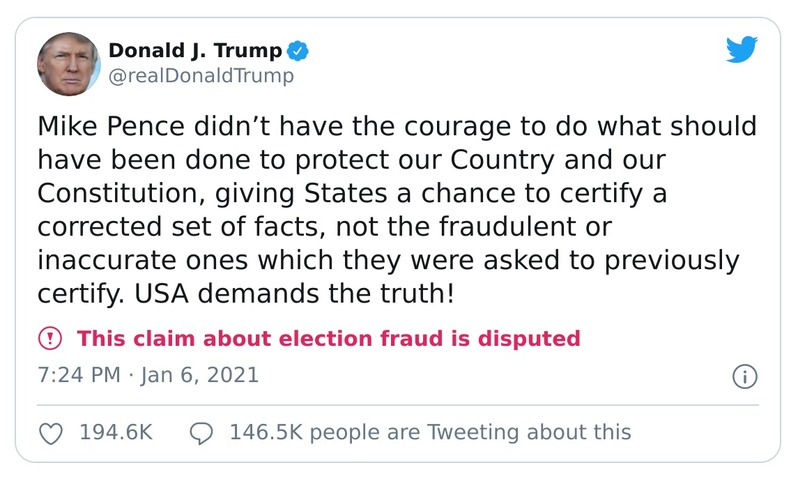
More or less immediately after the Riots, Trump tweeted:
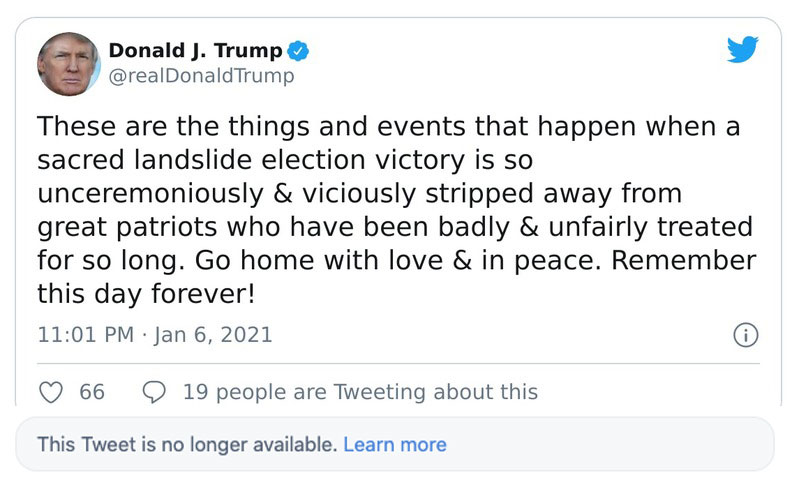
[And in case the tweet copy gets deleted:

These are the things and events that happen when a sacred landslide election victory is so unceremoniously & viciously stripped away from great patriots who have been badly & unfairly treated for so long. Go home with love & in peace. Remember this day forever!

twitter Jan 6 – see also Fox News and Forbes

So Trump defended his supporters for a while. Trump later claimed that violence was not what he wanted and that we should seek peace together.

My focus now turns to ensuring a smooth, orderly and seamless transition of power.

This moment calls for healing and reconciliation…..

We must revitalize the sacred bonds of love and loyalty that bind us together as one national family.

Donald Trump Concedes Election, Condemns Rioters Video Speech Transcript January 7. Rev 7 January

Trump has never seemed to want peace before, other than the peace of everyone submitting to himself. It is however, reasonably possible to suggest that he did not think his speech would be followed by the events which followed it; that, for him, the march on the Capitol was purely a game for him. However it is equally possible he deliberately tried to engineer deniability, and he will keep feeding and inciting rage, while pretending not to.

Personally I think he is stabbing his supporters in the back because he does not want to loose the benefits and salary of an ex-President if he should be suspended or impeached, but who knows? Anyway, the point again is he could say, “I made a mistake and I’ve changed my mind”, or he could stand by his supporters and what he has been encouraging them to do since the last election or earlier, or even say he was surprised at how people reacted, but no, its all their fault. I suspect he will soon be telling us it was all the Democrats’ fault. For Trump, it seems like it is always someone else’s fault.

For those who wonder if the President would throw his supporters, workers and creditors under the bus, for personal advantage, just look at his career. This is what he has done his entire life. This and continuous falsehood, are his distinguishing marks, even for people in politics and business.

He has also refused to attend the inauguration. This is one way of making peace… but attending would show that he might put his own resentments on one side, and thus encourage his followers to do so as well – but that would not give him any political advantage, he needs to keep hatred going to have any chance of influence or another shot at the Presidency.

While so far it is rumour and third hand reports, so this paragraph will possibly be changed, there is some evidence to say that:

  • Trump watched the riot on live TV (was there live TV coverage?)
  • He did tweet about Mike Pence’s failure to steal the election for him
  • He ignored calls from Republicans trapped in the House
  • He only tweeted against the riots when it was clear they had not achieved any of their aims, beyond occupation.

If so, then we may assume that Trump did seek violence to change the election result and intimidate people in the House.

Mitch McConnell is reported as saying, after he helped acquit Trump,:

There’s no question, none, that President Trump is practically and morally responsible for provoking the events of the day… The people who stormed this building believed they were acting on the wishes and instructions of their president… He did not do his job. He didn’t take steps so federal law could be faithfully executed and order restored… No. Instead, according to public reports, he watched television happily — happily — as the chaos unfolded… Even after it was clear to any reasonable observer that Vice President Pence was in serious danger.

Sprunt After Voting To Acquit, McConnell Torches Trump As Responsible For Riot. NPR 13 Feb 2021

What Trump does not appear to have done is even more significant. He did nothing to help organise a response. He did nothing to calm the situation down. He appears to have made no protest against what was happening while it was happening – and this is especially notable if he was watching on live TV.

It does not seem unreasonable to see Trump’s first public comments on Jan 12, as directed towards his riotous supporters as they defend the wall with Mexico, which seems to be a defense against illegal immigrants and emphasises the race issue. “We completed the wall,” he says which does not seem to be true, and he more or less admits is not true in the next line “They may want to expand it. We have the expansion underway.” But then:

We’re stopping a lot of illegal immigration. Our numbers have been very good. There does seem to be a surge now because people are coming up. So caravans are starting to form because they think there’s going to be a lot in it for them, if they’re able to get through, but we’re able to stop it

Donald Trump’s First Comments Since Capitol Riots: Says He Wants “No Violence”, Rev.com 12 January 2021

Then he implies the violence is against him, and that impeachment could lead to violence:

we want no violence, never violence. We want absolutely no violence. And on the impeachment, it’s really a continuation of the greatest witch hunt in the history of politics. It’s ridiculous. It’s absolutely ridiculous. This impeachment is causing tremendous anger as you’re doing it. And it’s really a terrible thing that they’re doing. For Nancy Pelosi and Chuck Schumer to continue on this path, I think it’s causing tremendous danger to our country and it’s causing tremendous anger. I want no violence.

Donald Trump’s First Comments Since Capitol Riots: Says He Wants “No Violence”, Rev.com 12 January 2021

And the riot had nothing to do with him, all the fault of other people:

if you look at what other people have said, politicians at a high level, about the riots during the summer, the horrible riots in Portland and Seattle and various other places. That was a real problem, what they said, but they’ve analyzed my speech and my words and my final paragraph, my final sentence. And everybody to the T thought it was totally appropriate. 

Donald Trump’s First Comments Since Capitol Riots: Says He Wants “No Violence”, Rev.com 12 January 2021

His later speech was almost entirely about keeping illegal aliens out, and could be seen as a shout out to the ‘mob’. So he will almost certainly continue.

3) The Really Thin Blue Line

The Capitol was badly defended. There were hardly any police, and the national guard was not called in until way too late – apparently a guy Trump appointed to the job refused to let them be called in. In Washington DC the mayor does not command the National Guard, the President does. The guard eventually arrived because Republican and Democrat members of the house arranged it? (This is all very complicated, but see this timeline, which may or may not be accurate. The then chief of the Capitol Police, Steven Sund, “says he requested assistance six times ahead of and during the attack on the Capitol. Each of those requests was denied or delayed”). Trump tried to take credit for their arrival, but this does not seem to be accurate.

Many people ([1], [2], [3], [4] more could be given) have compared the thin lines of police with the heavy lines of police who faced Black Lives Matter protestors. and who seemed relaxed about using heavy violence to control and clear BLM protestors even if it was just for Presidential photo-ops. The police for the Trump protest seem to have been vastly outnumbered and under armed – I’ve seen videos of a few US police trying to hold back protestors with waist high portable fences, fists (!?) and no back-up. They had no hope against these white rioters.

I also read that 60 police where hospitalised with injuries and one police officer more or less definitely received deadly injuries from a thrown fire extinguisher. Video suggests one policeman was pulled down some stairs and beaten and kicked. One of the people beating him was using a flag pole with a US flag on it, and the crowd shouted “USA, USA”. Comments by Police Chief Contee also suggest rioters used pepper spray on the police. The police were not initially using tear gas and some had no gas masks. Pipe bombs and Molotov cocktails were also apparently found near the building outside the Republican National Committee and Democratic National Committee [5], [6].

This is where supporting people who claim to support the police, while they are suppressing others, gets you.

4) Police Complicity?

Some people say the police let the rioters in, and posed with rioters for selfies. This could be a cunning way of both getting photo ID of the perps, and/or avoiding being beaten up. There are pictures of police (or security guards) quietly standing by as occupiers walk past them. Perhaps some police where more gentle than people on the Left might expect them to be from their experience, and got out of the way, but this is not the same as deliberately letting people in.

If there was an inside job, it probably came from those people who ignored weeks of noise and warnings [7], [8], [9] and put in a thin blue line and blocked the National Guard. If you want to blame anyone, then blame the Trump Administration. They made the appointments and preparations. This obvert lack could also seem like pre-meditation.

5) Security Chaos

The failure of the police meant the Capitol was defended by security officers who had been trained to shoot terrorists and assassins. It is no wonder one person was shot, and amazing that more were not killed. Three of the four protestors who died are currently said to have died of medical complications. One was possibly crushed to death in the crowd.

The security at the Capitol was surprisingly low key. It appears to advertise that if any real and moderately competent terrorist organisation had wanted to, they could have invaded and shot up Capitol Hill without problem.

6) Lack of Revolutionary Aims

The rioters seemed to have no idea what to do when they achieved their aims. Some people have said they were going to burn the electoral college votes, but they failed to do that, and there is no evidence that was an aim shared by the majority of people – any more there is evidence the pipe bombs were the work of many people. While burning the votes might have been a great piece of symbolism, it would achieve nothing. There was no attempt to seize centres of power, to control the airwaves or barricade themselves in, or even bring automatic weapons into the building.

Most of the rioters seemed happy enough to frolic around, break into offices, steal souvenirs and pose for photos. This was not a crowd of organised revolutionaries. I’m not sure they can be called terrorists either, despite the Federal Code of Regulation definition that terrorism is:

the unlawful use of force and violence against persons or property to intimidate or coerce a government, the civilian population, or any segment thereof and furtherance of political or social objectives

As quoted by D.C. Mayor Muriel Bowser Press Conference Day After Capitol Riot Transcript January 7

Discontents is probably better. If it were not for the injured cops this might have been disorderly ‘fun’.

Image

On the other hand, some people wore neo-nazi symbols and apparently called for the execution of Mike Pence (who knows how seriously) for not obeying Trump’s call to neutralise the result. People have alleged there were plans to capture Nancy Pelosi, but the evidence seems conjectural at this moment. However, Neo-Nazis reportedly boasted they were there, and the Proud Boys reputedly sent out a message saying:

For several hours, our collective strength had politicians in Washington in absolute terror. The treacherous pawns (cops) were also terrified…

The system would have you believe that you are alone. That’s why they want to ban all ‘radicals’ from social media. They want you to feel alone. But the truth is that you are not alone. We are everywhere.

Things will get difficult soon but don’t lose heart. We are growing and our unity will terrify the evil elites running this nation.

Proud Boys Boast About Politicians ‘in Absolute Terror’ During Capitol Raid. Newsweek, 7 January.

So some people had ambitions, perhaps after the event. The FBI says ‘Antifa’ does not seem to have had much if any presence. Earlier reports claiming this was not the case have since been discredited.

So let us be clear about this. Mainstream people on the Right are blaming a group for the riots, who almost certainly were not there, while ignoring right wing extremists who certainly were there, who are claiming responsibility for the occupation and the violence, and who are promising more of the same.

And these same people want unity and no prosecution of Trump for anything? Some of them because they fear what might come next. This again is cowardice, and indicates the possible take over of the Republican party by fascists.

7) Spread

The event was not confined to the Capitol in Washington. There were similar, generally peaceful, if less successful, protests across the country: in Arizona (which involved breaking glass and a guillotine), Colarado, Florida, Georgia, Kansas, New Mexico, New York, Ohio, Oregon, Texas, Utah, and probably elsewhere. It is notable that many people were also protesting against coronavirus lockdowns and did not wear masks. So we can see this movement as a spreader event. Perhaps deliberately to generate more chaos for the new Administration to deal with, but more probably to do with disbelief.

With the Internet it is not necessary for there to be an organising body, but apparently the main event was organised by “Women for America First” and it allegedly involved people from the Presiden’ts 2020 campaign. When asked the Trump Campaign apparently said

We did not organize, operate or finance this event. No campaign staff was involved in the organization or operation of this event. If any former employees or independent contractors for the campaign worked on this event, they did not do so at the direction of the Trump campaign.

Trump allies helped plan, promote rally that led to Capitol attack. ABC NEWS (America) 9 January

As you would expect, they avertised the event to their followers, through twitter and facebook. For example:
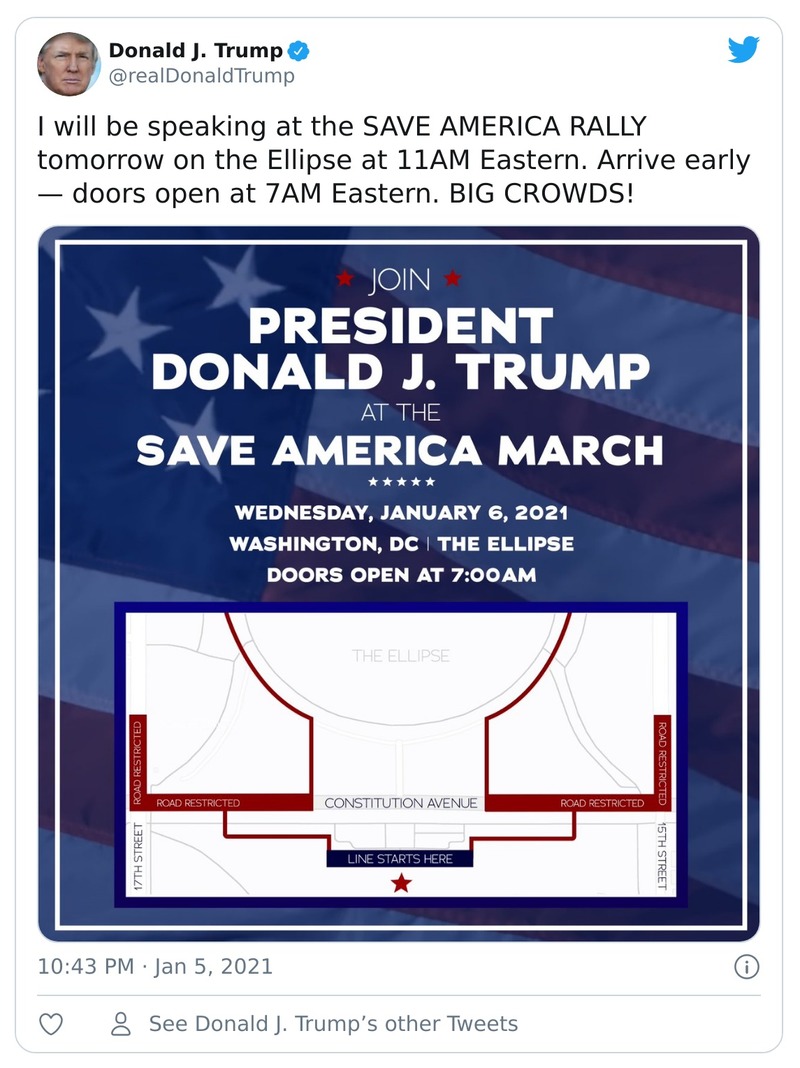
and
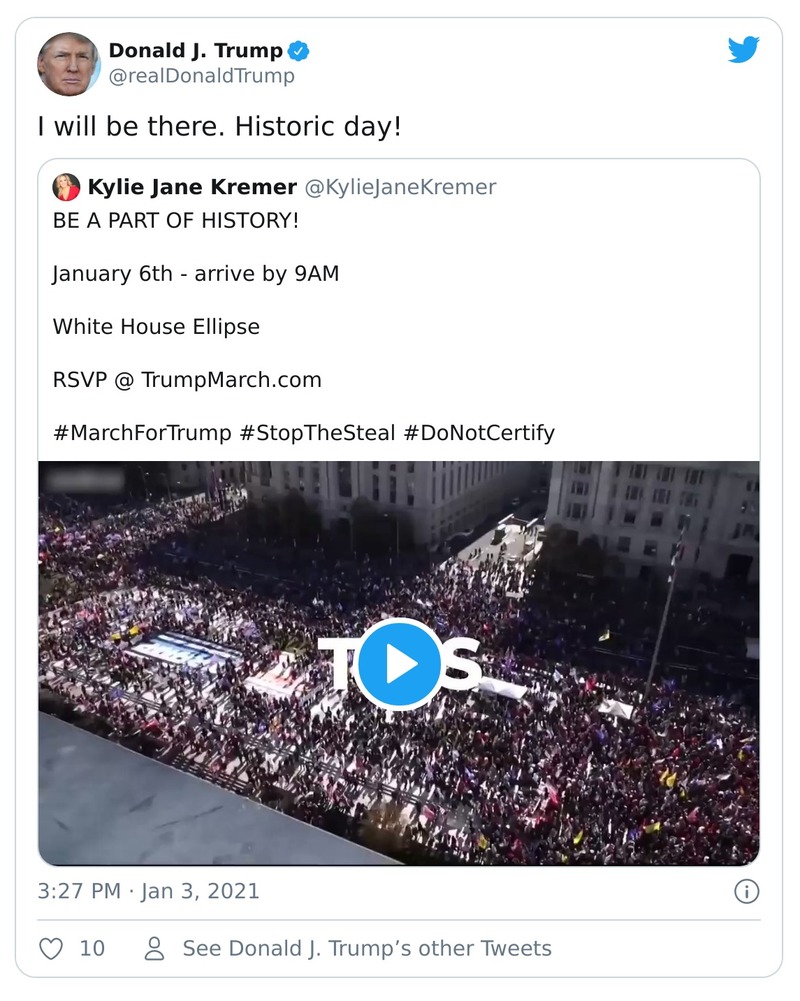
Women for America First announced:

We are saddened and disappointed at the violence that erupted on Capitol Hill, instigated by a handful of bad actors, that transpired after the rally

Trump allies helped plan, promote rally that led to Capitol attack. ABC NEWS (America) 9 January and “Statement on Violence at the Capitol

And did the expected blame shifting, it’s got nothing to do with them and everything to do with people they don’t like:

Unfortunately, for months the left and the mainstream media told the American people that violence was an acceptable political tool. They were wrong. It is not. 

Trump allies helped plan, promote rally that led to Capitol attack. ABC NEWS (America) 9 January and “Statement on Violence at the Capitol

Apparently, no one ever listens to the right wing media…

The Women for America First website with the statement on it seems to have disappeared. Other people involved in the event appear to have included: “Stop the Steal,” “Wild Protest.com” “Turning Point Action,” “Rule of Law Defence Fund,” “Tea Party Patriots,” Eighty Percent Coalition”, not to mention “Proud Boys”, “Three Percenters” and the like – who do seem to have some familiarity with threatening violence.

Some allege that some of the misinformation and promotion of violence came from ‘big oil’ and those who promote climate denial [10], [11] which, if correct, shows how terrified they are of even the minor climate efforts Biden has promised to make. It is true, that Trump would have kept subsidies and profits up for a while longer if he ‘won,’ and fossil fuel companies have never shown much concern over democracy.

Fear is also part of the spread of misinformation. One Republican Representative is reported as saying:

“One of the saddest things is I had colleagues who, when it came time to recognize reality and vote to certify Arizona and Pennsylvania in the Electoral College, they knew in their heart of hearts that they should’ve voted to certify, but some had legitimate concerns about the safety of their families. They felt that that vote would put their families in danger,”

Amash’s Successor Peter Meijer: Trump’s Deceptions Are ‘Rankly Unfit. Reason 8 January 2021

If true, this is fascism in action again, and not being denounced.

8) Fantasy

The following report may not be accurate, but while some protestors were disappointed in Trump, and his failure to produce evidence for the “storm” that many people on the Right had been expecting and inciting for so long (when the deep state Satanist pedophiles would be arrested and charged), some of the rioters or riot supporters claim that Trump’s apparent backdown is a deep fake video, or perhaps:

“He has a plan here President Trump would not back down that easily… We need to stand strong, keep watch and pray. Something big is coming and Gid [God] is going to see it through.”

“Trump did not concede. He used language to buy a little extra time because the senators and congressmen who support him are being threatened with dirty bombs and their families’ lives by the Deep State and/or communist Chinese … I have it on good grounds that Trump will be moving with the military And regarding the transition to a new administration, means Trump with a new VP Pence is obviously a traitor and is ‘fired’”

Donald Trump fans cry betrayal as he rebukes Capitol violence. The Guardian, 8 January 2021

If the Storm has not happened by now, we can assume it will never happen, and would never happen.

9) It is not Necessarily ended

Some have compared this event to the Munich Beer Hall putsch of 1923. Hitler’s failed attempt to take over Bavaria. From that event we learn that Hitler was no brave war hero, but he came back some years later and produced a lot of death. The point of the comparison is just to remind us that failure does not always mean that a movement is ended. Ten years from now, maybe Trump or someone like him will succeed in inspiring people who feel displaced and take over the government.

If politicians get the message that these people (like most people) cannot be controlled and selling one’s soul (for power) to a proto-fascist is not a good deal, then something has to change. The problems faced by real people trying to live in neoliberal America have to be taken seriously and people have to feel that government is something they can participate in without needing force. Neoliberalism has to go, because this is where it leads.

However, Republican leaders are generally not condemning either the rioter’s or their party’s association with neo-fascism and white supremacy, never mind putting the wealthy first. Hence we can assume they are happy to go along with things as they are. This increases the likelihood of that party being taken over by those forces and being used by those forces, just as QAnon appears to have tried to use Trump for its purposes, through the cultivation of fantasy and resonance.

The information mess of information society, is another problem. Propaganda is effective, and can easily promote these kind of events and this kind of resentment. Fascism is easy, not impossible because of some national spirit. It can happen anywhere. We somehow need to establish a truth which can be shared amongst all, but fascist propagandists seek a truth that splits and makes the acceptors superior. Or perhaps we need to establish a more general, non-directed skepticism. I don’t know a solution, but an approach is needed.

10) Election Inquiry?

Personally I would go for an independent open and public inquiry into the Election process. It would include all the alleged events that Trump mentions. This would allow them to be refuted in public. It would also include: investigation into Gerrymandering; voter suppression; refusals to have enough pre-poll booths; attempts to crush mail-in voting through sabotaging the post office or any other way; intimidation or attempted bribery of electoral officials and workers; the apparently deliberate delays in voting in certain areas; explanations about the way voting trends can change; and so on. It perhaps should investigate the rules around the electoral college or the consequences of its abandonment. It perhaps should recommend a public holiday to make voting possible for many people. It would have the power to charge the ex-President, and anyone else with offenses before a court, if they should be demonstrated. It should also consider making Washington DC, and Puerto Rico into States for electoral purposes. If people say this should not happen because Republicans would never win without restricting the vote, then let them think about their commitment to democracy or lack of useful policies.

Endnote: Trump Administration Speeches

Trump’s big speech before the riot, starts as it goes on.

This was not a close election. I say sometimes jokingly, but there’s no joke about it, I’ve been in two elections. I won them both and the second one, I won much bigger than the first. Almost 75 million people voted for our campaign, the most of any incumbent president by far in the history of our country, 12 million more people than four years ago. I was told by the real pollsters, we do have real pollsters. They know that we were going to do well, and we were going to win. What I was told, if I went from 63 million, which we had four years ago to 66 million, there was no chance of losing. Well, we didn’t go to 66. We went to 75 million and they say we lost. We didn’t lose.

By the way, does anybody believe that Joe had 80 million votes? Does anybody believe that? He had 80 million computer votes. It’s a disgrace. There’s never been anything like that. You could take third world countries. Just take a look, take third world countries. Their elections are more honest than what we’ve been going through in this country. It’s a disgrace. It’s a disgrace. Even when you look at last night, they’re all running around like chickens with their heads cut off with boxes. Nobody knows what the hell is going on. There’s never been anything like this. We will not let them silence your voices. We’re not going to let it happen. Not going to let it happen….

if Mike Pence does the right thing, we win the election. All he has to do. This is from the number one or certainly one of the top constitutional lawyers in our country. He has the absolute right to do it. We’re supposed to protect our country, support our country, support our constitution, and protect our constitution. States want to revote. The States got defrauded. They were given false information. They voted on it. Now they want to recertify. They want it back. All Vice-President Pence has to do is send it back to the States to recertify, and we become president, and you are the happiest people.

Donald Trump Speech “Save America” Rally Transcript January 6. Rev 6 January


Despite being full of falsehood, denunciation of the election result, and self praise (he “had to beat Oprah, [who] used to be a friend of mine”), the speech does not seems to be a direct incitement to riot. There is little to no evidence for his impeachment on those grounds here [although see this analysis, which I think its a bit strained]. Indeed Trump said:

I know that everyone here will soon be marching over to the Capitol building to peacefully and patriotically make your voices heard….

we’re going to the Capitol and we’re going to try and give… [ellipsis in original to indicate change of track] The Democrats are hopeless. They’re never voting for anything, not even one vote. But we’re going to try and give our Republicans, the weak ones, because the strong ones don’t need any of our help, we’re going to try and give them the kind of pride and boldness that they need to take back our country. 

So let’s walk down Pennsylvania Avenue. 

Donald Trump Speech “Save America” Rally Transcript January 6. Rev 6 January

He did not walk with them, although it is not clear why. Perhaps he wanted to be elsewhere if violence broke out – it would be safer for him. The only overtly but vague instruction for riot he gave was:

I said, “Something’s wrong here. Something’s really wrong. Can’t have happened.” And we fight. We fight like Hell and if you don’t fight like Hell, you’re not going to have a country anymore.

Donald Trump Speech “Save America” Rally Transcript January 6. Rev 6 January

This could easily be defended as a figure of speech. The violence, seems to have been plotted beforehand, and not at the speech. Trump may have been simply a focus for other people to make that move – perhaps this is something he wanted to take advantage of, but not be directly involved in.

During the riot he tries to steer both sides, those of the rioters and those who were not impressed by the riots:

I know your pain. I know you’re hurt. We had an election that was stolen from us. It was a landslide election, and everyone knows it, especially the other side, but you have to go home now. We have to have peace. We have to have law and order. We have to respect our great [pause] people in law and order. We don’t want anybody hurt. It’s a very tough period of time. There’s never been a time like this where such a thing happened, where they could take it away from all of us, from me, from you, from our country. This was a fraudulent election, but we can’t play into the hands of these people. We have to have peace. So go home. We love you. You’re very special. You’ve seen what happens. You see the way others are treated that are so bad and so evil. I know how you feel. But go home and go home at peace.

Trump Video Telling Protesters at Capitol Building to Go Home: Transcript. Rev 6 January and Facebook

This is a line made clear by his press secretary Kayleigh McEnany as well.

What we saw yesterday, was a group of violent rioters, undermining the legitimate First Amendment rights of the many thousands who came to peacefully have their voices heard in our nation’s Capitol. Those who violently besieged our Capitol, are the opposite of everything this administration stands for. 

White House Press Secretary Kayleigh McEnany Press Briefing on Capitol Riot Transcript

This massive backdown, implies either cowardice or that he was being used by other more competent people for their own purposes, to start something off, or to be a figurehead. QAnon seems to be that kind of movement, as the President seemed to make little use of it, or have little familiarity with its arguments and misinformation, even when it would have been useful for him. This probably means ‘Q’ not only does not have many ties with the President, but probably not with the Republican Party itself. This again makes impeachment hard.

Trump and the campaign against Democracy

January 3, 2021

Trump does not have to do anything other than convince most of his followers that the election was stolen, and that he and they are victims of a vast and clearly powerful conspiracy. He was preparing for this before the election [footnote1], and claimed victory after the election, without any particular evidence that I know of – that is, he made an over-optimistic or deliberately false claim, not a mistaken claim [footnote2]. We might well assert that Donald Trump can never admit to losing or failing, he will pretend he was successful or he will blame others for cheating. This seems to be a long established characteristic.

However, his claims are working. A small Reuters Ipsos poll taken on Nov. 13-17 found only 29% of Republican voters said that Biden had rightfully won and 68% of Republicans said they were concerned that the election was “rigged.” A poll from Vox and Data for Progress taken on 16 November stated:

73 percent of likely Republican voters say that the allegations of voter fraud have made them question Joe Biden’s victory, a statement that 44 percent of all likely voters agreed with as well. Similarly, 75 percent of likely Republican voters said they believed voter fraud took place during the election that benefitted Biden, something that 43 percent of likely voters overall also stated.

Vox poll: 73 percent of Republican voters are questioning Biden’s victory

A poll taken in early December, by Quinnipiac University found that Republicans “say 70 – 23 percent that they think Biden’s victory is not legitimate…  38 percent [of all registered voters] say they believe there was widespread fraud.” Rather oddly “Republicans say 77 – 19 percent they believe there was widespread voter fraud,” so there are presumably Republicans who think that there was widespread Republican fraud.

Whatever the case, a large majority of Republicans appear to think that Biden did not really win legitimately.

So, because of these claims, assuming he gets into the White House, Joe Biden will not be accepted by a large portion of the US population, no matter if he won the popular vote by 7 million votes or not (over c.81,281,000 to c.74,224,000).

Consequently, Trump’s side of politics can refuse all co-operation and bog the nation down in do-nothingness, while the US is raddled with uncontrollable pandemics, poverty and so on. The only allowed solution to which is more Trump, and more neoliberal Republicanism.

To achieve his aim, Trump does not need evidence that holds up in court. He only requires a few out of context videos, a few non tested testimonies, a heap of rumour, and the assertion that things were weird, and that he could not loose, and for his supporters not to hear the refutations of Trump’s assertions – which will happen due to the ways right wing media works.

This is probably why his lawyers have not presented evidence to the courts that was not easily dismissed as hearsay. All he needs is the allegation of there being evidence repeatedly backed up by people and media on his side. This allegation will be joined to the allegation that everyone who disagrees with the evidence he has alleged to be true and meaningful, is either naïve, brainwashed or part of the conspiracy. These assertions will be repeated over and over.

Then his followers are trapped. They have to agree, or they face exile, rage and mockery – and they think it could possibly be true, as after all so many people are asserting there is irrefutable evidence…. And no one who asserts otherwise can be trusted.

His followers are the victims, of a failed society, and they experience that every day, why should they have faith in its institutions?

Trump attempted to change certifications and called those people in his party who were responsible for certifications in order to change their minds. Lindsay Graham reputedly rang the Georgia Secretary of State, to have votes thrown out. Trump appears to have sought to have large numbers of votes thrown out with little to no evidence presented, other than the fact that he did not think he could lose. [For more see Footnote 3].

The assumption seems to be that if there was any cheating, it had to be Democrat cheating, but it is at least conceptually possible that the reason why Biden did not win by as much as expected is that there was Republican cheating. We know that Republicans tried to prevent people from voting in advance, or by mail, and that was probably to scare off those who believed Covid was a problem, who seem to be primarily Democrat. So there is form here. Trump quote figures for fake votes without any apparent sources, or with ambiguous videos so, if there were fake votes then they could be for anyone. Furthermore, if the votes for the Senate and the House were accurate, which Republicans seem to expect, these are made at the same time, so why were they not faked?

One high level Trump supporter called for a military take over, another said of Chris Krebs, who declared the election secure, “that guy is a class A moron. He should be drawn and quartered. Taken out at dawn and shot.” The same person also remarked of those Republicans who said the election was fair: “the governors in these states are a bunch of losers, along with their secretaries of state. I’ve never seen such wimps wearing an R [being Republican]…. You know, they’re going to have to be dealt with politically. It’s the only way you deal with these people.” Other people received death threats and slurs, apparently from Trump followers, with little objection from Republican representatives.

Michigan’s secretary of state, Jocelyn Benson, said dozens of armed protesters gathered in a threatening manner outside her home on Saturday evening chanting “bogus” claims about electoral fraud.

Armed pro-Trump protesters gather outside Michigan elections chief’s home. The Guardian, 8 December 2020

The idea seems to be to intimidate and bribe. If so, this is fascism in action. This is the real cancel culture.

People on the Democrat side tend to believe in things like the rule of law, playing fair, and not lying all the time, so consequently they don’t even see that democracy is crumbling, despite the refutations of Trump by ‘experts’, people who were present where there was supposedly cheating, courts, and so on. This is also despite the number of votes Trump requested be nullified.

Refutations mean nothing, as Trump knows. To Trump’s followers the refutations, and their consistency, only prove the depth of the conspiracy against them. The 60 or so failed court cases, again demonstrate the size, ruthlessness and power of the opposition against him, not the fact that only one of the cases was any good.

By his followers’ lights, Democrats who can engineer all this failure for the super-businessman, must be evil. Evil stops at nothing, so evil cannot be believed, and evil must be crushed forever. Trump will not give in. He will take revenge on all who have stopped him being declared winner as was his right. His followers will agree and cheer.

So people on his side in the next election, will probably only step in to scrutinize results if they already know Republicans should win, and any Democrat victories are the result of fraud. They know the cost of ‘being truthful’ and going against Republican declarations of fraud. So not only will Republicans intensify their demonstrated opposition to any possible non-Republican votes, but they will try and fix the counts, to get at the real truth of America.

And when the next Republican gets in, he will not have to listen to Democrats at all because people on his side know that Democrats fixed an election and are evil. Democrats can slowly be rounded up because they are evil and corrupt, and many people will have no sympathy for them. And it won’t take much of that before most Democrats decide the results of this election probably were faked and they should go along with it. The media will go along to keep going along, and nobody will report the threats and so they will not exist.

Only a few people will even notice that democracy has gone, because it all will be done in defense of democracy.

*********************

[Footnote 1] A brief history of Trump and allegations of electoral fraud

After the election of Obama. Trump tweeted:

Donald J. Trump @realDonaldTrump
This election is a total sham and a travesty. We are not a democracy!

Twitter Nov 7, 2012

A deleted tweet said:

He lost the popular vote by a lot and won the election. We should have a revolution in this country!

Donald Trump Freaks Out on Twitter After Obama Wins Election, Mashable 7 November 2012

and

The phoney electoral college made a laughing stock out of our nation. The loser one!

as above

Actually Obama seems to have won the popular vote by about 5 million votes. However, it is clear that loosing the popular vote but wining in the electoral college is no longer a problem in 2016.

In 2016, he lost the Iowa primary to Ted Cruz and wrote:

Donald J. Trump@realDonaldTrump

Ted Cruz didn’t win Iowa, he stole it. That is why all of the polls were so wrong and why he got far more votes than anticipated. Bad!

Twitter 12: 47 am Feb 4, 2016

and

Donald J. Trump@realDonaldTrump

Based on the fraud committed by Senator Ted Cruz during the Iowa Caucus, either a new election should take place or Cruz results nullified.

Twitter 1: 28 am Feb 4 2016

Even later he tweeted:

Donald J. Trump@realDonaldTrump
I will be interviewed on @foxandfriends at 9:00 A.M. I will be talking about the rigged and boss controlled Republican primaries!

Twitter 10:00 PM · Apr 16, 2016

In the 2016 presidential election against Hillary Clinton, he tweeted.

Donald J. Trump @realDonaldTrump
This election is being rigged by the media pushing false and unsubstantiated charges, and outright lies, in order to elect Crooked Hillary!

Twitter Oct 15, 2016

A section of a debate with Hilary Clinton went like this:

Donald Trump: She shouldn’t be allowed to run. She’s guilty of a very, very serious crime. She should not be allowed to run. And just in that respect, I say it’s rigged. Because she should never-… she should never have been allowed to run for the presidency based on what she did with emails and so many other things.

Chris Wallace: (01:04:31)
But sir, there is a tradition in this country. In fact, one of the prides of this country is the peaceful transition of power and that no matter how hard for what a campaign is that at the end of the campaign, that the loser concedes to the winner. Not saying that you’re necessarily going to be the loser or the winner, but that the loser concedes to the winner and that the country comes together in part for the good of the country. Are you saying you’re not prepared now to commit to that principle?

Donald Trump: (01:04:57)
What I am saying is that I will tell you at the time. I’ll keep you in suspense.

Hillary Clinton: (01:05:01)
Well, Chris, let me respond to that because that’s horrifying. Every time Donald thinks things are not going in his direction, he claims whatever it is is rigged against him. The FBI conducted a year long investigation into my emails. They concluded there was no case. He said the FBI was rigged. He lost the Iowa caucus. He lost the Wisconsin primary. He said the Republican primary was rigged against him. Then Trump University gets sued for fraud and racketeering, he claims the court system and the federal judge is rigged against him. There was even a time when he didn’t get an Emmy for his TV program three years in a row and he started tweeting that the Emmy’s were rigged against him.

Donald Trump vs. Hillary Clinton 3rd Presidential Debate Transcript 2016

Some days later he commented:

I would like to promise and pledge to all of my voters and supporters and to all of the people of the United States that I will totally accept the results of this great and historic presidential election, if I win,

Donald Trump: ‘I will totally accept’ election results ‘if I win’ 20 October 2016 – emphasis added.

Possibly a joke?, But its only fakery if he looses, yet he became one of the few Presidents to claim his victory was in a faked election

Donald J. Trump@realDonaldTrump
In addition to winning the Electoral College in a landslide, I won the popular vote if you deduct the millions of people who voted illegally

Twitter Nov 28, 2016

He continued his claims of fraud into 2017

Donald J. Trump@realDonaldTrump
Look forward to seeing final results of VoteStand. Gregg Phillips and crew say at least 3,000,000 votes were illegal. We must do better!

Twitter Jan 28, 2017

The UK based Independent commented:

VoteStand is an amateur app that allows people to send in their own reports of voter fraud. The app has been downloaded just a few thousand times and is barely used…. The VoteStand Twitter account has only 614 followers.

Even if the app detected genuine instances of voter fraud, so few people use it that it would be impossible for three million infractions to have taken place [and been reported].

Votestand: Donald Trump relies on unknown app to back up claims of voter fraud. The Independent, 27 January 2017

His administration even threatened to investigate the supposed fraud, and Trump reportedly alleged again that millions of illegal immigrants voted in the 2016 election. No evidence was presented.

Let us be clear, if President Trump wanted to set up a commission to ensure US elections were secure, well-regulated, and reflected the will of the people, he had plenty of opportunity to do so. Republicans controlled the Senate and the House for his first two years so, even if Democrats had objected (which is unlikely, if the commission was not phrased as a witch hunt), a commission could easily have been set up to consider all the available evidence, and to find ways of better securing the results. He did not do this.

A reasonable conclusion from his comments, is that he only wants to challenge the voting system when votes don’t go his way.

He began this 2020 election pointing out a problem with mail-in voting….

Donald J. Trump @realDonaldTrump

Republicans should fight very hard when it comes to state wide mail-in voting. Democrats are clamoring for it. Tremendous potential for voter fraud, and for whatever reason, doesn’t work out well for Republicans. @foxandfriends

Twitter 10:20 PM · Apr 8, 2020 Emphasis added.

For what it is worth, one mid year survey estimated that:

“More than one-third of Americans intend to vote by mail in the November presidential election”….

Among them, 48% of voters who plan to vote for Democratic presumptive nominee Joe Biden said they are likely to vote by mail, according to the survey. That’s more than twice the 23% of voters backing President Donald Trump who said they are likely to vote by mail. 

Biden voters twice as likely than Trump supporters to vote by mail in November, survey finds, USAToday 18 August 2020

So we can agree with the President that mail in ballots were going to be bad for Republicans. We could also suspect that if the mail in votes were counted after the polling day results, then there would be a significant swing in Biden’s direction, late in the counting. Some votes might be post-marked before the election and delivered after the election, especially given the apparent run down of the post-office.

As I understand it, in the USA, mailed ballots are safe for several reasons

  • They are signed by the voter.
  • The signature on the ballot is matched to one on file.
  • They are individually barcoded to keep track of the votes and voters, and check what forms are used.
  • All this information is stored and put on the electoral role, to catch people who vote by mail and then in person.
  • The US military use mailed ballots.

Most research appears to show mail-in votes are safe [2]. The Right wing Heritage Foundation reported only 1,308 proven instances of voter fraud since the 1990s. Only a subset of these votes were mail-in.

However, governments do sometimes send out multiple application forms, and sometimes people seem to think this is the actual voting form.

in California, the governor sent, I hear or sending millions of ballots all over the state. Millions to anybody. To anybody. People that aren’t citizens, illegals, anybody that walks in California is going to get a ballot. We’re not going to destroy this country by allowing things like that to happen. We’re not destroying our country. This has more to do with fairness and honesty and really our country itself because when that starts happening, you don’t have a fare. You have a rigged system. You have a rigged system and that’s what would happen.

We’re not going to let it happen because you’re subverting our process and you’re making our country a joke and the Democrats are doing it because in theory, it’s good for them. Although last week we two big races. We won in Wisconsin and one in California. California, 25. We won a tremendous race in California.

Transcript: Donald Trump Remarks on Protecting Seniors with Diabetes May 26, 2020

I think we’re going to have a lot of people show up. I’m very worried about mail-in voting because I think it’s subject to tremendous fraud and being rigged. Do you see that Paterson, New Jersey, where I believe it was 20% of the vote was fraudulent? It was all sorts of things happened. I understand a mailman was recently indicted someplace for playing games with the mail-in ballots….

You’ll have tremendous fraud if you do these mail-in ballots. Now, absentee ballots are okay, because absentee ballots, you have to get applications. You have to go through a process. If I’m here, and I vote in Florida, you get an absentee ballot. But you have to go through a process. Absentee ballots are great, but mail-in voting, where a governor mails millions of ballots to people all over the state. California, millions and millions of ballots, as an [inaudible 00:56:15]… and then they come back, they don’t come back. Who got them? Did you forget to send them to a Republican area or a Democrat area, I guess you could say? But if you take a look at all of the unbelievable fraud that’s been involved with mail-in voting over the last even short period of a while, but look at Paterson, New Jersey. It was a massive error and a massive miscalculation and there was incredible fraud. Look at the city council, what’s happened to it. This is one place, but you have many places and they’re all over. Yes, please?

Donald Trump Rose Garden Press Conference Transcript July 14, 2020

The Patterson New Jersey case is interesting, but it does not seem to be really about voter fraud, it is about procedural violations. Voters are supposed to either submit or mail in their votes themselves. They can authorise another person to do this, but such people are limited to delivering 3 votes. What seems to have happened is that some people took on far more than three votes from voters. They did not appear to fake them, and they were caught. The judge commented the vote was “rife with mail in vote procedural violations.” [3], [4] The case concerns an election for a city council ward, which is probably a little less protected than a Presidential Election.

Now it’s very bad what’s going on with mail-in ballots. Okay? As differentiated from absentee ballots where you have to go and you go through a process because you can’t be there for some reason, but the mail-in ballots is going to be, they’re going to be rigged. They’re going to be a terrible situation. And you have to be careful in Georgia, but you have to be careful everywhere where they’re doing it.

And there’s been tremendous corruption, tremendous corruption on mail-in ballots. So absentee ballot, great, mail-in ballot, absolutely no good. It makes no sense. A governor sends out millions of ballots all over the place. They don’t know where they’re going. They’re going to wherever. I have a friend who got one for his daughter, another one for his daughter, and then a second one for the first daughter. They didn’t know what to do with them. I had another friend, a really wonderful guy who lost his son seven years ago, Robert, his son, Robert, and his son was sent a mail-in ballot. He called me, he said, “What do I do? I just got a mail-in ballot for Robert? Robert died seven years ago.” So it’s a terrible situation if they decide to use it. 

Donald Trump Atlanta Speech Transcript on Rebuilding Infrastructure July 15 2020

Again we have the problem of whether he was sent a mail-in ballot, or sent an application form for a mail in ballot. In interview with Chris Wallace, Trump was asked:

But can you give a direct answer, you will accept the election?

Donald Trump: I have to see. Look, I have to see. No, I’m not going to just say yes. I’m not going to say [inaudible 00:38:24 ‘or not‘???], and I didn’t last time either.

Donald Trump Chris Wallace Interview Transcript July 19 2020

In New Jersey, 20% of the ballots were defective, fraudulent, 20%. And that’s because they did a good job. Okay? So this is just a way they’re trying to steal the election and everybody knows that. Because the only way they’re going to win is by a rigged election. I really believe that. I saw the crowd outside. For every sign we had for Trump Pence, every single sign. 

Donald Trump Speech Transcript August 20, 2020: In Joe Biden’s Hometown

This argument is that because he has crowds he will win….

the only way we’re going to lose this election is if the election is rigged, remember that. It’s the only way we’re going to lose this election… So we have to be very careful. Look, we have more than this election, that’s a big statement. The only way they’re going to win is that way.

Donald Trump Speech Transcript Wisconsin August 17 2020

******

Footnote 2: Trump on the 2020 Election

I’d like to provide the American people with an update on our efforts to protect the integrity of our very important 2020 election. If you count the legal votes, I easily win. If you count the illegal votes, they can try to steal the election from us. If you count the votes that came in late, we’re looking to them very strongly, but a lot of votes came in late….

I’ve already decisively won many critical states, including massive victories in Florida, Iowa, Indiana, Ohio, to name just a few. We won these and many other victories despite historic election interference from big media, big money, and big tech. As everybody saw, we won by historic numbers, and the pollsters got it knowingly wrong. They got it knowingly wrong. We had polls that were so ridiculous and everybody knew it at the time.

There was no blue wave that they predicted. They thought there was going to be a big blue wave. That was false. That was done for suppression reasons…..

our opponents major donors were Wall Street bankers and special interests. Our major donors were police officers, farmers, everyday citizens. Yet for the first time ever, we lost zero races in the House….

I’ve been talking about mail-in voting for a long time. It’s really destroyed our system. It’s a corrupt system and it makes people corrupt, even if they aren’t by nature, but they become corrupt. It’s too easy. They want to find out how many votes they need, and then they seem to be able to find them. They wait and wait, and then they find them, and you see that on Election Night….

We were ahead in vote in North Carolina by a lot, a tremendous number of votes, and we’re still ahead by a lot, but not as many because they’re finding ballots all of a sudden. “Oh, we have some mail-in ballots.” It’s amazing how those mail-in ballots are so one-sided too….

Likewise in Georgia, I won by a lot, a lot, with a lead of over getting close to 300,000 votes on Election Night in Georgia. And by the way, got whittled down and now it’s getting to be to a point where I’ll go from winning by a lot to perhaps being even down a little bit…. The election apparatus in Georgia is run by Democrats….

Despite years of claiming to care about the election security, they refuse to include any requirement to verify signatures, identities, or even determined whether they’re eligible or ineligible to vote….

The officials overseeing the counting in Pennsylvania and other key states are all part of a corrupt Democrat machine that you’ve written about. And for a long time, you’ve been writing about the corrupt Democrat machine.

Donald Trump White House Press Conference as Election Counts Continue Transcript November 5

Donald J. Trump @realDonaldTrump
I WON THE ELECTION!

Twitter Nov 16, 2020

*******************

Footnote 3: Trump tries to fix the election

This will get more documentation over time, but these two cases bring out the point.

Judge Brann remarked of Trump’s Pennsylvania case:

In this action, the Trump Campaign and the Individual Plaintiffs (collectively, the “Plaintiffs”) seek to discard millions of votes legally cast by Pennsylvanians from all corners – from Greene County to Pike County, and everywhere in between. In other words, Plaintiffs ask this Court to disenfranchise almost seven million voters. This Court has been unable to find any case in which a plaintiff has sought such a drastic remedy in the contest of an election, in terms of the sheer volume of votes asked to be invalidated. One might expect that when seeking such a startling outcome, a plaintiff would come formidably armed with compelling legal arguments and factual proof of rampant corruption, such that this Court would have no option but to regrettably grant the proposed injunctive relief despite the impact it would have on such a large group of citizens.

That has not happened. Instead, this Court has been presented with strained legal arguments without merit and speculative accusations, unpled in the operative complaint and unsupported by evidence. In the United States of America, this cannot justify the disenfranchisement of a single voter, let alone all the voters of its sixth most populated state.

IN THE UNITED STATES DISTRICT COURT FOR THE MIDDLE DISTRICT OF PENNSYLVANIA…. No. 4:20-CV-02078

A taped Phone call from January 2nd exists in which Trump asked Georgia Secretary of State Brad Raffensperger, to find more votes, as:

I won this election by hundreds of thousands of votes. There’s no way I lost Georgia. There’s no way. We won by hundreds of thousands of votes. I’m just going by small numbers, when you add them up, they’re many times the 11,000. But I won that state by hundreds of thousands of votes….

Donald Trump Georgia Phone call Transcript. Rev 4 January 2021

Trump reiterated this argument a few times – he must have won because he felt it, and people said he should have won….

We won very substantially in Georgia. You even see it by rally size, frankly. We’d be getting 25-30,000 people a rally, and the competition would get less than 100 people. And it never made sense…..

I mean, you know, and I didn’t lose the state, Brad. People have been saying that it was the highest vote ever. There was no way. A lot of the political people said that there’s no way they beat me. And they beat me. They beat me in the . . . As you know, every single state, we won every state [hardly because if they had, they would not need to be ringing the people in Georgia]….

I mean, we have many, many times the number of votes necessary to win this State and we won the State and we won it very substantially and easily and we’re getting… We have… Much of this is they’re certified, far more certified than we need. But we’re getting additional numbers certified too. [Again only if you believe him in the first place is this assertion correct]….

Brad, is we have other people coming in now from Alabama and from South Carolina and from other states, and they’re saying it’s impossible for you to have lost Georgia. We won. You know in Alabama, we set a record, got the highest vote ever. In Georgia, we set a record with a massive amount of votes. And they say it’s not possible to have lost Georgia. And I can tell you by our rallies, I can tell you by the rally I’m having on Monday night, the place they already have lines of people standing out front waiting. It’s just not possible to have lost Georgia, it’s not possible. [So what? He knows already how many people turn up at a Rally?]

I won this election by hundreds of thousands of votes. There’s no way I lost Georgia. There’s no way. We won by hundreds of thousands of votes. I’m just going by small numbers, when you add them up, they’re many times the 11,000. But I won that state by hundreds of thousands of votes.

Donald Trump Georgia Phone call Transcript. Rev 4 January 2021

Trump even made this bizarre claim for his evidence:

President Trump: (30:39)
What about the ballots, the shredding of the ballots, have they been shredding ballots?

Ryan Germany: (30:44)
The only investigation that we have into that, they have not been shredding any ballots. There was an issue in Cobb County where they were doing normal office shredding, getting rid of old stuff, and we investigated that. But this stuff from past elections.

Trump : It doesn’t pass the smell test because we hear they’re shredding thousands and thousands of ballots, and now what they’re saying, “Oh, we’re just cleaning up the office.” You know.

Raffensperger : Mr. President, the problem you have with social media, they — people can say anything.

Trump : Oh this isn’t social media. This is Trump media. It’s not social media. It’s really not; it’s not social media. I don’t care about social media. I couldn’t care less. Social media is Big Tech. Big Tech is on your side, you know. I don’t even know why you have a side because you should want to have an accurate election. And you’re a Republican. [Ah media which agree with Trump are both reliable and not Big Tech]

Donald Trump Georgia Phone call Transcript. Rev 4 January 2021

Trump abused Raffensperger and pleaded with him.

The people of Georgia are angry, the people in the country are angry, and there’s nothing wrong with saying, you know, um, that you’ve recalculated.

Donald Trump Georgia Phone call Transcript. Rev 4 January 2021

“So what are we going to do here folks? I only need 11,000 votes. Fellas, I need 11,000 votes. Give me a break…. You would be respected, really respected, if this can be straightened out before the [Georgia runnoffs] election….”

When Trump claimed that over 5,000 ballots were cast in the state by dead people, Raffensperger responded: “The actual number was two. Two. Two people that were dead that voted. So that’s wrong..”

Donald Trump Georgia Phone call Transcript. Rev 4 January 2021 and Trump’s phone call to Brad Raffensperger: six key points. The Guardian 4 January 2021

Trump also claimed:

And the minimum, there were 18,000 ballots, but they used them three times. So that’s, you know, a lot of votes. And they were all to Biden, by the way. That’s the other thing we didn’t say….

Every single ballot that she did through the machines at early, early in the morning went to Biden. Did you know that, Ryan?

Germany : That’s not accurate, Mr. President.

Trump : Huh. What is accurate?

Germany : The numbers that we are showing are accurate….

Trump : No, they were 100 percent for Biden. 100 percent. There wasn’t a Trump vote in the whole group. Why don’t you want to find this, Ryan? What’s wrong with you? [How would he know they were 100% for Biden?]

Donald Trump Georgia Phone call Transcript. Rev 4 January 2021

Earlier the multiple counting came up

Trump: Brad, why did they put the votes in three times? You know, they put ’em in three times.

Raffensperger: Mr. President, they did not put that. We did an audit of that, and we proved conclusively that they were not scanned three times….

Germany: We had our — this is Ryan Germany. We had our law enforcement officers talk to everyone who was, who was there after that event came to light. GBI was with them as well as FBI agents….

Trump: Well, there’s no way they could — then they’re incompetent. They’re either dishonest or incompetent, okay?

Donald Trump Georgia Phone call Transcript. Rev 4 January 2021

People were supposed to have voted from outside Georgia or returned in suspicious circumstances.

Mitchell: The number who have registered out of state after they moved from Georgia. And so they had a date when they moved from Georgia, they registered to vote out of state, and then it’s like 4,500, I don’t have that number right in front of me.

Trump: And then they came back in, and they voted.

Germany : We’ve been going through each of those as well, and those numbers that we got, that Ms. Mitchell was just saying, they’re not accurate. Every one we’ve been through are people that lived in Georgia, moved to a different state, but then moved back to Georgia legitimately.

Trump: How may people do that? They moved out, and then they said, “Ah, to hell with it, I’ll move back.” You know, it doesn’t sound like a very normal . . . you mean, they moved out, and what, they missed it so much that they wanted to move back in? It’s crazy. [I guess that is an insult to Georgia].

Germany: They moved back in years ago. This was not like something just before the election. So there’s something about that data that, it’s just not accurate.

Donald Trump Georgia Phone call Transcript. Rev 4 January 2021

And so it goes on:

Trump: Do you think it’s possible that they shredded ballots in Fulton County? Because that’s what the rumor is. And also that Dominion took out machines. That Dominion is really moving fast to get rid of their, uh, machinery.

Germany : This is Ryan Germany. No, Dominion has not moved any machinery out of Fulton County.

Trump : But have they moved the inner parts of the machines and replaced them with other parts?

Germany : No.

Trump : Are you sure, Ryan?

Germany : I’m sure. I’m sure, Mr. President.

Donald Trump Georgia Phone call Transcript. Rev 4 January 2021

You know what they did and you’re not reporting it,…. You know, that’s a criminal — that’s a criminal offense. And you know, you can’t let that happen. That’s a big risk to you and to Ryan, your lawyer. That’s a big risk. But they are shredding ballots, in my opinion, based on what I’ve heard. And they are removing machinery, and they’re moving it as fast as they can, both of which are criminal finds…. So look. All I want to do is this. I just want to find 11,780 votes, which is one more than we have. Because we won the state,

Donald Trump Georgia Phone call Transcript. Rev 4 January 2021

As USA Today said:

Georgia officials tallied votes for the presidential election three times in the state, including in an audit required by state law and a recount requested by the president. Each count determined that President-elect Joe Biden won the state, the first Democrat to do so since 1992…

On Dec. 5, Trump urged Georgia Gov. Brian Kemp to demand the state legislature act to overturn Biden’s victory in Georgia. Kemp refused and has been subjected to a steady barrage of Trump attacks in the weeks since….

Neal Katyal, who was acting solicitor general during the Barack Obama administration, said the Trump call to Raffensperger “demonstrates an impeachable, perhaps criminal, offense. It is a behind the scenes look at how Trump carries out the presidency, abusing his power for his gain.”

Brown, Trump pushes Georgia secretary of state to ‘find’ votes during phone call, Washington Post reports, USAToday 3 January 2021

Trump’s response was.

Donald J. Trump@realDonaldTrump
I spoke to Secretary of State Brad Raffensperger yesterday about Fulton County and voter fraud in Georgia. He was unwilling, or unable, to answer questions such as the “ballots under table” scam, ballot destruction, out of state “voters”, dead voters, and more. He has no clue!

Twitter 12:57 AM · Jan 4, 2021

If Trump really believes he has iron clad evidence, then why does he just not present it to a court? The phone call sounds like Trump has a complete incapacity to believe he could lose, or that he could be refused the opportunity to change things without proof. It sounds like a fishing expedition for access to materials to pronounce them fake. It veers from expecting the officials could just change things because its not that many votes they have to ‘find’ or disallow to give him victory, to odd threats and name calling. It even seems he was incapable of recognising the opportunities he had been given by the people in Georgia to establish his case, perhaps because he cannot.

It may need to be said, that even if Trump did win Georgia, he would not win the election. Therefore, we can presume, he is engaging in similar tactics elsewhere, but it has not leaked to the media. Georgia is probably more open as he is trying to get people out to vote in the runoffs by telling them that unless they vote in huge numbers, they will lose.

In a speech a few days later in Georgia he reportedly said:

Your governor, your secretary of state are petrified of Stacey Abrams,” he said, referring to a Democratic voting rights activist who lost to Kemp in 2018. “What’s all that about? They’re say they’re Republicans. I really don’t think they can be.”

The president added ominously: “I’m going to be back here in a year-and-a-half and I’m going to be campaigning against your governor and your crazy secretary of state.”

‘Fight like hell’: grievance and denialism rule at Trump Georgia rally. The Guardian, 5 January 2021

This is perhaps the end point of the ‘Republicans in Name Only’ (RINO) campaign. You are only a real Republican if you support Trump no matter what, and will commit any crime requested to gain the Party victory. Loyalty and obedience to ideology is required, otherwise you will be attacked or dismissed.

If a Democrat had behaved like this, then it would probably be clear to Republicans, that this was an effort to corrupt the election and generate fake votes.

Basic Complex Systems for eco-social analysis again

December 25, 2020

This is another go at formulating a list of basic systems which need to be considered for eco-social analysis. For earlier versions see here, here and here.

Introduction

As a guide to the factors involved in eco-social relations we can point to a number of different, but interacting systems. This list is not claiming to be complete, but it can be used as a set of reminders when we try to make analyses of our contemporary situation, and we may be able to make some general statements about how they interact. The order of relative importance of these systems is a matter for investigation, and the order of their presentation, in this blog post, is not a claim about their relative importance.

The seven main systems, discussed here, are

  • Political;
  • Economic (extraction);
  • Energy;
  • Waste, pollution and dispersal;
  • Information;
  • Technological;
  • Planetary Boundaries (geography) :

All these systems are complex systems, and it is generally impossible to predict their specific course. They are also prone to rapid change, gradual instability, and the ‘seeking’ of equilibrium.

Political System

The political system, includes:

  • the modes of struggle encouraged, discouraged, enabled or disabled,
  • the patterns and divisions (the ‘factioning’) within the State and wider society,
  • the differing effects of different bases of power: such as monetary power, communication power, power through violence or threat, hierarchical power, religious and cosmological power (the power to delimit the official views of the way that the cosmos works), organisational power, etc.,
  • who gets into positions of power and how, and so on,

Politics can affect all the other human systems. What activities (extraction, energy use, organisation etc.) are encouraged or discouraged, the kinds of regulation that apply, what counts as pollution or risk, what information is easily available, and who is to be trusted, and so on.

Political systems can forcibly ignore pollution or the consequences of energy production, economic extraction, the wage system, and so on, effectively rendering them part of a general unconscious, which eventually ‘bites back’.

Economic System

Most of the dominant economic systems currently in action can be described loosely as ‘capitalist’. The economic system involves modes of appropriation, extraction, property, commodification, exchange, circulation of ‘products’, technological systems, energy use, as well as accumulation of social power and wealth and so on. Most of which depend upon the State for their existence and reinforcement, although they may also challenge organisation and politics within the State. There is no inherent stability in current economic systems.

In many sociological theories the patterns of economic organisation and behaviour are known as the ‘infrastructure’ and are held to be determinate of most other social behaviours, primarily because the economic system seems the most obvious determinate of what people have to do in order to survive.

This organisation may have apparently unintended consequences, such as producing periodic crashes, or destroying the ecological base of the economy, and therefore threatening that organisation. They also may have quite expectable consequences, which are downplayed. In capitalism, political and economic patternings tend to be describable as ‘plutocratic’; as wealth allows the purchase of all other forms of power. However, different factions in the State can ally with different or competing factions in the economic system. For example, different government departments or political factions can support different types of energy: fossil fuels, renewables, or nuclear. The political system legitimates and enforces, allowable modes of extraction, property and pollution, and regulates economic behaviour among different social groups. Economics always involves political as well as economic struggle; politics is part of ‘the market’. ‘Crony Capitalism’ is normal capitalism.

Extraction

The Extraction system is part of the economic system, but it might be useful to separate it out from the economic system because extraction is one of the prime ways in which economies interact with ecologies and because different kinds of economies can use similar extraction systems. Extraction not only involves extraction of what gets defined as ‘resources’ (minerals, naturally occurring substances such as oil, coal or timber, and so on) but also the ways that human food gets extracted for consumption, via agriculture, gathering, hunting, industrial fishing, and so on. Ecologies are not passive, and they respond to human or other actions in ways which are often unpredictable in specific, but still disruptive. Ecologies seem to need attention, for survival to be possible in the long term.

Extraction in capitalist and developmentalist societies, often seems harmful to the functioning of ecologies, perhaps because of the need for continual growth, and thus a need for increasing extraction. Clearly, not all forms of extraction need to be destructive of the ecologies and geographies they depend upon. Extraction systems can allow the ecologies to repair after extraction, or attempt to rehabilitate the land. However, repair of ecologies can be considered an expense leading to reduction of profit, and hence is not attractive in a profit emphasising system.

As such, we can distinguish recoverable extraction, in which the ecologies and economies repair the damage from extraction, from irrecoverable extraction in which the ecologies and economies do not repair the damage from extraction within a useful time frame.

The Global Footprint network, suggests that:

Today humanity uses the equivalent of 1.6 Earths to provide the resources we use and absorb our waste. This means it now takes the Earth one year and eight months to regenerate what we use in a year. 

Global Footprint network. Ecological Footprint

If this is correct, then the current extraction and pollution systems are generally irrecoverable, and deleterious for human and planetary survival. Investigating the differences between harmful and less harmful modes of extraction may well produce useful insights.

Economies are not the only possible harmful extractive systems – cosmologies can also require irrecoverable extractive behaviour to build temples, or to show the ‘other-worldly’ specialness of humans, and so on.

Energy System

All life and its resulting ecologies involve transformation of energy. These transformations stretch from transformation of sunlight by plants, the digestion of plants, to thermal gradients in the deep sea, to atomic power. Eco-systems require a system of energy release, energy generation and energy transformation.

Transformation of energy, together with effective ecological functioning, is necessary for any human actions to occur. The human energy system powers all other human systems. Because food is necessary for human labour, cultivation of food can be considered to be part of the energy system. The energy system and its ‘infrastructure’, could seem to be as important as the economic infrastructure.

The human energy system is organised, at least in part, by the political and economic systems, and by the environmental systems available. The environmental system includes possible energy sources from plant material, animal strength and docility, fossil fuels, sunlight, wind and moving water. Human labour, and its organisation, is (and has been) part of the energy system, and while not yet, if ever, superseded completely, can be supplemented and possibly overpowered by technological sources of energy. Coal and oil power, for example, provide masses amounts more directed energy than can human labour, and this ability is important to understanding the patterning and possibilities of the economic and extraction system, and its relationship to colonial/imperial history. Modern military expansion and colonialism, largely depends on this ability to apply large amounts of energy to weaponry, movement and organisation.

Important parts of the energy system include the amounts of energy generally available for use, and the capacity for energy to be directed and applied. Non-directable energy is often wasted energy (entropy), and usually unavailable for constructive use.

Another vital point is that human production of, or using of, energy takes energy. No energy is entirely free.

The availability of energy is influenced by the Energy Return on Energy Input (EREI) or ‘Energy Return on Energy Investment’. The larger amount of units of energy applied to gain a unit of humanly directable energy output, the less excess energy is available.

Fossil fuels have historically had a very high EREI, but it is possible that this is declining otherwise nobody would be tempted by fracking, coal seam gas, tar sands, or deep sea drilling. All of which require large amounts of energy to begin with, have very high risks of extractive destruction, and fairly low profit margins when compared to the dangers.

Renewables and storage currently have a high energy cost to manufacture (and possibly a high extractive cost as well) but for most renewables, after they are installed, the EREI changes, as very little labour, or energy expenditure, is required to gain an energy output – it is more or less free – whereas fossil fuel energy generation requires continual energy use to find and process new fossil fuels and keep the power stations turning, and produce continual pollution from burning.

Social power and economics may affect the ways that energy is distributed, what uses are considered legitimate and so on. However, the energy system also influences what can be done in other systems, and in the costs (social, aesthetic, ecological or monetary) which influence choices about the constituents of energy systems The system’s pollution products, which may be significant factors in producing climate and ecological change, may eventually limit what can be done.

As the energy system determines what energy is available for use, it is not an unreasonable assumption that social power and organisation will be partly built around the energy system, and that changes in energy systems will change energy availability, what can be done or who can do it, and thus threaten established social orders. Threats to established orders will be resisted. If an energy transition does go ahead, it is likely that the established orders will try and preserve the patterns, of organisation, wealth and social power which have grown up under the old system.

One important question is ‘how do we transform the energy system without continuing a damaging extraction and pollution system?’

Waste, Pollution and Dispersal systems

Transformation of materials through energy use, or through energy production, produces ‘waste’. The simplest human society imaginable (and this is an overt simplification), turns edible material into energy and human excreta, which in this case can usually be processed by the ecology – although, even then, dumping excreta into rivers may not help those downstream.

Understanding the Waste, Pollution and Dispersal systems is also vital to understanding possible energy and economic transformations.

In this book we will define ‘Waste‘ as material which can be re-processed, or recycled, by the economy or eco-system, and ‘Pollution‘ as material which is not re-processable within an arbitrary useful time frame, say over hundreds of years or more. ‘Dispersal’ occurs when some essential material is dispersed into the system, and becomes largely unavailable for reuse without ‘uneconomic’ expenditures of finance or energy – as occurs with helium and phosphorus.

When too much waste for the systems to re-process is emitted, then waste becomes pollution. This is what has happened with CO2. CO2 is normally harmless, even required for the system to work, but too much CO2 changes the ways eco and climate systems work. CO2 has also been dispersed into the atmosphere which makes CO2 extraction, which is stated to be essential by the IPCC and IEA for climate stability, difficult and costly in terms of energy expenditure.

These concepts, along with ‘extraction’, directly import the ecosystem into the economy, while pointing out that what counts as allowable waste, pollution or dispersal can change, economically, politically, scientifically and ‘practically’.

Waste, pollution and dispersal from the energy system and from modes of extraction, enter into the political system because that system decides and regulates what can be emitted, and where, and who is too valuable to be poisoned by the pollution. The political makes the laws allowing, diminishing or preventing, pollution. Often localisable pollution is dumped in ‘wasted’ zones or on poorer, less noticeable and less powerful people.

Energy and extraction may not the only significant sources of pollution, and other sources of pollution need to be curtailed, or turned into sources of waste.

Information about pollution from the fossil fuel energy system and from the extraction systems, provide a major driver for energy transformation, partly because this issue seems ‘economically’ politically and energetically solvable, while other sources of pollution seem more difficult to deal with.

However, even facing the problem, provokes a likely politicisation of the information system. How would people, in general, become aware of pollution and who primarily suffers from its effects, especially when it threatens established systems of power?

Information System

What people become aware of, what can be understood or done depends on the Information System. This system determines what feedback is available to conscious humans, about what is happening in general. The information system, in theory, could allow humans to recognise eco-feedback in response to systems such as waste and pollution, or extraction. Information is vital to social functioning, and part of social functioning. Accurate information is even more useful.

Unfortunately, information about complex systems, such as societies or ecologies, is almost always limited and inadequate. Some information may tend to be symbolised rather than literal, because of the difficulties of representing the information in a literal form (these difficulties can be political as much as in terms of human capacity).

Information systems can also hide, or distort, ecological feedback, because of flaws in their design, or because powerful people do not want it to bring the problems to general attention. This adds to confusion, and to the possibilities, that the information system primarily reflects human psychological projection, fantasy and shadow politics.

The political and economic systems also directly impact on the information systems, as politics often centres on propagation of politically or economically favourable information and the inhibition of politically unfavourable or economically information. Economic power, ownership and control of sources of information can also influence what information is collected, processed and made widely available.

Information is not so much ‘received’ as interpreted, so Cosmologies and politics which provide a framework for interpretation, play a big part in how the information is interpreted and, then, what kind of information is transmitted.

Government, Religious, Economic, or military (etc) regulation can be a further important part of both the information and political systems, sometimes affecting what is likely to be transmitted. Information systems, in turn, indicate the availability or coherence of regulation and the understanding of problems and predicaments. Regulation is based on information selection as well as political allegiance, and regulations can be opaque, or hidden, as well as easily decodable. For example, until recently it seemed very difficult to find out what the NSW governments regulations for Renewable Energy Zones, meant in terms of business, building, or connection to the wider system.

The information system does not have to be coherent, thus we can be both informed and disinformed of the progress of climate change and energy transformation by the system. Certain groups are more likely to be informed than others, even though everyone tends to frame themselves as being well informed – especially in an ‘information society’ when being well informed is a matter of status. Information does not have to be accurate to have an effect, it is also part of socially constructed propaganda – as we can see with climate and covid denial, and this can influence political process, victories and inaction.

In summary, most information distortion comes from: economic functions such as business hype, secrecy and deception; from organisational functions such as hierarchy, silo-isation, lack of connection and channels; from politics where information is distorted for strategic advantage; and from the complexity of the systems that the information tries to describe and the inadequacy of the language or approach being used.

Technological Systems

Technological systems enable the kind of energy use, direction and availability, a society can have, the kinds of extraction it can engage in, the range at which political and economic systems can have an effect, the modes of transmission of information, and the types of waste pollution and dispersion which are likely to happen. Technologies also necessarily use properties of the environment and ecologies around them in order to work, and thus interact with those environments and again cause unintended consequences.

People use technology to extend their power over others, extend their capacity, escape regulation, or render previous technologies less dominant, and hence technologies tend to be caught in struggles between groups, thus provoking unintended social consequences.

We could hypothesise that technologies, as used under capitalism (and perhaps elsewhere), tend to extract people out of their environment, and break the intimacy between humans and ecology, or shift human perception onto the technology rather than the world, therefore making it easier to regularly engage in processes of destruction.

In the contemporary world, technologies become objects of fantasy, and metaphors by which we think about the cosmos in general. For example the clockwork universe is now almost replaced by the information processing universe.

Planetary systems and boundaries

Finally we have planetary boundaries. The planetary boundaries are ways of conceiving the limits and constitution of ecosystems, and are, as such, fairly abstract. These boundaries represent systems necessary for human and planetary functioning.

They do not necessarily form the one system, and can be separated out for purposes of analysis. They act as guidelines, and probable reactive limits which are essential for the consideration of ‘eco-social’ relations, and the likely long term success of those relations. Measuring the boundaries may have a wide margin of error, as due to the complexity of these systems and their interactions. We will not know for sure when they will collapse until they do, and once they start collapsing they will affect the resilience of other boundaries. So the known limits on the boundaries will change as we take more notice of them, and keep challenging them.

Exceeding the boundaries almost certainly leads to the rundown, or breakdown, of ecological functioning, and this breakdown then adds difficulties to maintaining other systems. If they are maintained ‘artificially’ then this requires extra energy expenditure, and may have further consequences. Kate Raworth’s ‘donut economics’ presents a quick and easy way of conceiving functional economies in terms of ecological boundaries and human betterment [1], [2], [3].

Any global system which does not preserve or reinforce planetary systems will probably give impetus to global ecological collapse.

The systems are usually listed as involving: climatic stability, biospheric integrity (distribution and interaction between lifeforms, balance between species, rates of extinction etc), water flows and cycles (availability of drinkable, non-poisonous water, and water for general ecological functioning), biochemical flows (phosphorus and nitrogen cycles, dispersal of valuable materials which literally form the ‘metabolic rift’, etc), ocean acidity or alkalinity (which affects the life of coral reefs, plankton and so on), levels of particulates or micro-particulates (which poison life forms), ozone levels, and the introduction of novel entities into the global ecology and their unknown systemic consequences (new chemicals, plastics, microplastics etc.). [4]

It is the functioning and disruption of these boundary systems which make processes of pollution and extraction problematic. Thus they impact directly on society, and appear to limit the kinds of economic growth, extraction, energy and technological systems that can be deployed safely.

Capitalism and developmentalism tend to recognise boundaries only to ignore them, and claim that ingenuity and willpower, will overcome those boundaries forever without limit.

Geographic Systems

Then we have Geographic systems as a subset of planetary boundaries. Geography affects the layout of energy systems, the potential reach of political and economic systems, the ‘natural’ flow of air and water, changes in temperature, the availability of sunlight, and the kinds of extractions which are ‘economic’ or economic in the short term, but deleterious in the long term. Geography is relational, giving layout in space between spaces and constructions. Geography shapes and is shaped by politics, social activity, economics, pollution and so on.

Mountain ranges, forests, plains etc may affect the layout of Renewable Energy, or the RE may affect the land, if trees are felled, fields converted etc. Wind may be severe, putting a limit on size of turbines, or the angles of solar panels. Winter darkness, or heavy seasonal rain can affect the possibilities of solar power.

Geography constitutes the human sense of home, and transformation of geography or relations of geography can produce a sense of ‘unhoming’, or dislocation in place and in the future of place.

Conclusion and Provisional Advice

Recognition of the interactions of these systems, with their differing but interacting imperatives, seems vital to getting a whole and accurate picture of the problems and opportunities presented by energy transition.

All the systems that have been discussed here, are complex systems. They are composed of ‘nodes’ which modify themselves or change their responses in response to changes in the ‘system as a whole.’ The systems are unpredictable in specific. The further into the future that we imagine, the less likely our predictions are to be specifically accurate. We can, for example, predict that weather will get more tumultuous in general as we keep destroying the ecology, but we cannot predict the exact weather at any distance. Complex systems produce surprise and actions often have unexpected consequences. If we seek to apply a policy, we cannot expect it to work exactly as we think it should. For example, the political move to make ‘markets,’ the most important institution, did not deliver either efficiency or liberty, as was expected, almost the opposite in fact. In all cases of actions within complex systems we should seek for unintended consequences. Sometimes the only realistic way to approach unintended consequences is to realise that our theory could not predict those events, and without looking we might never even have seen the events, or realised their connection to what we did. Working in complex systems, all politics becomes experimental.

While complex systems adapt or seek balance, they do not have to arrive at the best conditions for human beings. From a human point of view, they can be maladaptive. For example, a social system can be maladaptive and destructive of our means of living. The ecology could arrive at a balance within which many humans could not live.

People involved in promoting Energy Transformation have to deal with the various complex systems we have discussed above. The complexity does not mean we cannot make any predictions, although we need to treat them cautiously.

  • People engaged in transition have to consider the effects of the political systems involved, and be aware that politics influences what is likely to be possible. A transition may be delayed by political action, and political patterning, no matter how sensible or affordable the transition is.
  • The Economic system will be entangled in the political system, and those who dominate the economic system will have disproportionate input into the political system, and this can cause problems. This recognition reinstates the economic process as both a political and a business process.
  • A transition has to fit in with existing economic patterns, or its supporters may have to be prepared to change those patterns.
  • Patterns of extraction, pollution and dispersal have to be less harmful than previous patterns or the harm will be continued, even if in a different manner.
  • Changing the energy system is a political problem, and may require a change in the economic system as well as in power relations.
  • We need to have the available energy to build the transformed system. As we are supposedly aiming to replace the existing harmful system without lowering the energy availability, this may prove difficult. Where does the energy come from to build the new system if not from the old? And we need to demolish the old system, because of its dangers.
  • We need to avoid using renewables to simply add to energy availability, without reducing energy from fossil fuels.
  • The new system and the path of transformation, has to reduce pollution and extraction damage, or ecological and climate crises will continue, and planetary boundaries will be given no chance to recover. A transition plan which does not consider this problem is probably futile.
  • Considering these problems may lead to conclusions about the necessity of some kind of degrowth.
  • Transition plans should consider diminishing the dispersal of rare and valuable materials. More of what is currently pollution and dispersal has to be transformed to waste, in amounts the systems can process.
  • The current information system does not seem to be functioning in favour of the transition. It seems highly politicised and does not report ecological feedback accurately, either denying crisis, or delaying the supposed arrival of crisis.
  • Our current information system is largely owned and controlled by the neoliberal fossil fuel based establishment, which is defending its power, wealth and ways of living in the world. Without an independent information system, it will be impossible to win the political struggle. At the same time accurate information will be attacked and dismissed as political.
  • Likewise, many people will see accurate information as political, because it potentially disrupts their way of living, or because of interpretation and projection issues.
  • At the least, people engaged in energy transformation have to be aware of the nature of complex systems and the normal arising of unintended and unexpected consequences. We need an information system that allows us to perceive such consequences, without attacking the transformation as a whole.
  • Geography will affect the layout and possibilities of the transition. Renewables appear to require far more land than fossil fuels per unit of energy although fracking and coal seam gas seem to require similar amounts of land and do far more permanent damage to that land.
  • Renewables should probably never be installed through deforestation.
  • Renewables should not monopolise agricultural land. They should co-exist with previous land use, or help rehabilitate the land.
  • We should note the capacity of any new form of energy generation, or large scale technology, to ‘unhome’ people. Fossil fuels are especially bad at this, and often also poisonous, but the information systems tend to find this easier to ignore.
  • The energy transformation should aim to avoid disrupting the planetary boundary systems as much as possible. They should be installed with the longer term target of restoring those systems.
  • Pointing to the range of boundaries will possibly remind people that climate change is not the only problem we face, and it should be clear that no energy, or social, system is going to survive if it violates these boundaries in the long term.

Neoliberal Conspiracy 08: Is the idea of neoliberal conspiracy plausible?

December 20, 2020

[This post is a slightly revised version of the original, and now deleted, end of the post Neoliberal Conspiracy 07]

Is the neoliberal conspiracy theory plausible?

Wealthy people do have power. The more wealth they have the more power they can exert if they choose to. The fewer non wealth based sources of power that are around, or are not phrased as businesses, the more power they can exert. They can buy all the other kinds of power from political representation and legislation, through violence, to communication and information. They can buy status, because they must have virtues if they are wealthy; they must be wealth generators for everyone, and deserve special privileges. Neoliberalism appears to both increase their power and hide opposition to that power. So wealth-power and neoliberalism fit together quite harmoniously or, as in a previous blog post, we can say that crony capitalism is normal capitalism, and neoliberalism intensifies crony capitalism.

It is not difficult to find the main propaganda points of neoliberal ideology in the media and elsewhere. It is widespread, although the analysis of what neoliberals actually do, and aim to achieve, is not. This lack is also significant.

Thus it is easy to find people extolling the virtues of business, the talents of business people, the centrality of ‘the economy’ to prosperity and freedom, the importance of growth, the importance of tax-cuts, the importance of cutting regulation, the importance of free markets, the connection of free markets to liberty, the idea that governments are always useless, the parasitic nature of people on welfare, the evils of socialism and the left, the evils of ‘greentape’, the need to encourage the economy whatever, and so on. Business news is expected, even if ordinary people don’t read it or watch it, union (marxist, or communitarian anarchist) news is not. Neoliberal ideas are widely and repetitively propagated. This is hardly surprising given corporate control of the media.

Thus not only do neoliberalism, crony capitalism and increasing the power of wealth (plutocracy) fit together but the main points of the ideology are so prevalent that they can be taken as ‘common sense.’ They can be referred to and accepted, without needing justification. They must be true. They can seem true a priori.

This does not mean the wealth elites are totally united. For instance, some of them don’t like Trump, even if he is carrying out most of the neoliberal programme, doing quite well at hiding it and cultivating passionate followers to help keep the project going. It is as equally possible they don’t like him because he defrauds other businesses and his word means nothing, as that they dislike him because he is doing something mysterious to benefit ordinary Americans, as is frequently alleged. Some people in dominant groups actually believe in climate change as well, but the media rarely explains why it is happening, and it usually reports climate change in a way suggesting its not that much of a problem for neoliberalism, or we just need to act as individuals. This is the more humanistic version of the conspiracy in action. The result is much the same; maintaining elite wealth and power comes before dealing with climate.

All this implies, the idea of Neoliberal conspiracy is plausible.

Neoliberal explanations of the problems

On the other hand, Neoliberals tend to explain the current crisis of democracy in terms of ‘government,’ which they control but pretend is controlled by others. These controlling and malevolent others appear to include ‘cultural marxists,’ ‘critical race theorists’, postmodernists, socialists or whatever is today’s evil figure. The problems that we face result from some big and dangerous conspiracy of the Left, or are invented by the conspiratorial Left out of thin air (i.e. the climate fraud, the covid fraud, the Biden victory). This is heavily implausible.

I’ve no real idea what cultural marxism or critical race theory is, and I’m not sure the general public would understand the main points of these ideologies either, as put forward by their supposed proponents. These theories don’t seem as widely distributed and explained as they would be if they were important to a major power group. So, if these movements exist, they are clearly not being promoted by a particularly powerful or influential class. They are not widely taken for granted by people. And the general approach in the media, would seem to suggest that you can just say ‘Cultural Marxism,’ or ‘Critical Race theory’ and know that your audience will assume whoever is being associated with these theories must be evil, even if the audience don’t know what they are. Jordan Peterson seems to have made a career out of behaving like this.

From this alone, it seems likely that the opponents of these cultural marxists, whoever they are, have all the relevant power, or the strategy would not work.

[My initial hypothesis was the neoliberals and their supporters could not use the old horror of revolutionary Marxism, because it was nowadays so rare, and so they turned cultural criticism (which is a standard from of Western behaviour, since Plato or the Reformation, depending on your choice) into a dismissible evil, by calling it cultural Marxism. But then I remembered how a few people who got together to protect some protestors from attacks by fascists, became portrayed as a vast, violent and subversive movement who conveniently wore black clothes and supported Joe Biden. So the neoliberals could have pretended that revolutionary Marxists were still a problem, and perhaps by magnifying anti-fa they did.]

Academics, who I suppose are supposed to promote these things, don’t have much power. Universities are nowadays run as neoliberal business, with generally relatively high level business executives in charge (often such overt neoliberal ideologists as Maurice Newman). Universities nowadays aim to bring in money, not change the world. Academics frequently have to ally with the corporate classes for research money, so the days of investigative independence is fading. In Australia academics were among the only people not eligible for the highest government support if their jobs were made redundant by Covid. Again not a mark of power. So the chances are high that those who tell you academics are powerful are lying to cover their own power and give you a relatively powerless enemy to dislike.

Then I guess there are scientists. Obviously neoliberals will argue that scientists are less trustworthy than businesses or the hunches of demagogues (Trump is great at that). The idea seems to be that, if science clashes with neoliberalism, it is necessarily wrong, despite all the successful stuff it does elsewhere. I’m more than a bit skeptical about that position. This does not mean scientists cannot be wrong; they are human (just like neoliberals), but they are the best we have got at the moment, and science tends to be self-correcting. That is how it works, and it is also why scientists and doctors can seem to change their minds quite often; they are ideally persuaded by the evidence, and new evidence is always arising. Yes they defend the positions they are currently holding, but eventually those positions fade – they are not held to be true a priori, and beyond challenge, like neoliberal economics. Scientists are often persecuted by governments and businesses, who remove data from websites, sometimes from libraries, forbid them to talk, smear them when it is handy, or sack them if they don’t give the correct neoliberal response. So they don’t appear to have much that much power as a class. They often can’t even get people in power to consider the desperate state of the planetary ecology. They also don’t have political unity as a class, as there is no particular politics necessarily associated with physics, geology, biology or whatever. Science is not like economics, where neoliberalism will get you places.

There is less obvious basis for scientific power outside the corporate sector anymore, and that is likely subject to neoliberal control. This is why we should not particularly trust pharmaceutical companies, insecticide and genetic engineering companies and so on. They are less concerned with scientific truth than with profit, and in neoliberalism profit is the true measure of everything.

There are a few billionaires who run charities, like Bill Gates and George Soros, and a few tech billionaires who routinely get blamed for the crisis and for deep conspiracies. But the odd thing is that the billionaire class is generally not mentioned as a class, and most members are not named. The people who attack Gates and Soros, rarely attack Rupert Murdoch even though he is clearly political and heavily involved in determining contemporary policies and issuing propaganda. They don’t furiously attack Meg Whitman, Jim Justice, Bill Haslam, Silvio Berlusconi, Suleiman Kerimov, Gautam Adani, Clive Palmer, Gina Rinehart, Sheldon and Miriam Adelson, Tom Steyer, Tommy Hicks Jr, Harold Glenn Hamm, Charles Schwab, Paul Elliott Singer, Joe Ricketts, Betsy DeVos, Linda McMahon, or Charles Koch (founder of the Cato Institute, Americans for Prosperity Foundation, Freedom Partners and the Koch Network) just to give a few names directly involved in political influencing unlike Bill Gates. Most people probably do not know many other billionaire’s names as they stay out of the media. We can conclude that while the billionaire influence on politics is pronounced, the neoliberal denunciation is highly selective.

Then of course there are those people protesting against being shot by police. This is obviously such a vast and powerful conspiracy they can’t even get the police to stop killing them, and the Republicans can just ignore them as they have such little influence, and some Republicans can support people who shoot at them, or drive into them. Not much ability for masses of evil power there, even if a few statues do get toppled.

Then there are the socialists. Well the Right fusses about them, but I haven’t seen nationalisation, as opposed to privatisation, of an industry for quite a while. In the US getting a general basic wage that people can live on, has not happened, and does not seem to have much hope of success. The US can’t even get a health system which does not bankrupt sick poor people, no matter how much Trump promised he would fix it easily. Furthering control of government by the working classes rather than the corporate class seems to have failed all over the Western World. ‘Socialism’ seems generally used as a swear word, and calling some idea socialist is the supposed end of many arguments. Again this could not happen if socialists had any power.

Not surprisingly because the corporate sector control the media, ‘left wing’ thinking and action, is passively censored; it is hardly mentioned, other than by its opponents, who are not always that accurate in their descriptions. If you want to find out what the Greens stand for, for instance, then you have to go to the Greens, or perhaps approach some lonely person selling a weekly or monthly newspaper on a street corner. The Left does not control the mainstream media or normal talk, so this takes effort and most people cannot be bothered. Why would they be? they are constantly told the Left is evil and idiotic. To most people this is just the way things are, even if they think they have worked it out for themselves.

At the end of all this, we can see that according to neoliberals, the enemies of liberty are a few named billionaires (Gates and Soros) who don’t fully subscribe to neoliberal theory (the huge majority of billionaires can be ignored as they support the establishment, or at least don’t overtly attack it), a few largely disorganised protestors and a bundle of academics who have next to no power in a system devoted to promoting fake news. These people have little in common, other than being despised by neoliberal followers. They do not seem a plausible danger, and if they form a conspiracy it seems extremely badly run and powerless.

Conclusion

Comparing the two ideas, it seems to me, that the idea of neoliberal conspiracy easily wins the plausibility stakes.

Praxeology, Culture, Ecology

December 20, 2020

This post continues to explore the apparent lack of consideration given to context in the basic axioms of Austrian economics; in this case culture and ecology.

Not Recognising ‘Culture’

Discussing purposeful action, which is supposedly basic to the economy, Rothbard goes on to argue that a human must have certain ideas about how to achieve their ends. Without those ideas there is little in the way of complex human purpose.

However, this sidesteps the issue of where does this person get the ideas from, as well as the language to think about those ideas? The ideas are unlikely to be purely self-generated, with no precursors. In reality, ideas arise through interconnection with other people and previously existing ideas. This of course does not mean people never have original ideas, but without interacting with other people it is doubtful they would have complex ideas or language at all. Indeed, the people they interact with may have a massive influence on the ideas, and approaches, available to the person. Ideas are socially transmitted.

Even our individuality is based in the groups we have encountered, the ways we categorise our selves in relationship to others, and the child rearing we experience. It is not as if we are born fully conscious and evaluative, able to deduce everything all by ourselves from first principles….

However, in response to criticism, Rothbard states: “We do not at all assume, as some critics of economics have charged, that individuals are ‘atoms’ isolated from one another.”

  • (Note the way that his economics becomes all economics as opposed to ‘my economics’ or ‘our economics’).

Where is the evidence of this recognition in the initial axioms, from which all else is derived? Its certainly not clear to me that this recognition exists, other than to be wheeled in to get rid of objections. “You think people are isolated from each other” “No we don’t. I mention this in a footnote.” This recognition seems an add on – whereas it seems more likely that humans are both individual and collective from birth onwards. To some extent we can even say that humans have the capacity to learn to be individuals, to individuate, but it is not always easy.

I suspect that if we included culture’s (and social organisation’s) effects on exchange and economic action, then we might not be able to perform a supposed universal justification for capitalism, and its exemption from attempts to control it or regulate it to be less harmful. And this justification and protection, seems to be the purposeful action of Austrian economics from its beginning.

Ecologies

All action takes place within a web of actions – which is sometimes known as an ‘interactive network,’ or a ‘set of complex systems’ and sometimes, in Austrian economics, as a catallaxy, or as Hayek says “the order brought about by the mutual adjustment of many individual economies in a market.”

It is possible that, with this term, Hayek is pointing towards what is now known as “emergent order,” which involves far more than just ‘individual economies,’ adjusting in a ‘market’ – as markets cannot be separated from other processes, including social and ecological process which also adjust to each other.

While it is often assumed to be the case, it should be noted that the ‘order’ which emerges from a complex system or ‘catallaxy’, does not have to be hospitable to humans. Historically we can observer that the ecological order is often changed by humans disasterously and, as a result, humans can no longer flourish in those new ecological orders.

Sometimes this ecological collapse occurs because some form of behaviour which once helped survival has been intensified to a level at which it:

  1. becomes destructive,
  2. blocks information flow and perception of danger which challenges the behaviour, or
  3. simply prevents change through entrenched power.

Hayek’s formulation uses the cultural assumption that order is ‘good’ for humans, to imply the market always brings ‘good’ results, when it may not, even if the ‘order’ arises ‘spontaneously’.

Economies occur within general ecologies: they can be said to be context dependent. An impoverished ecology is likely to produce an impoverished economy for most people, even if the wealthy are very wealthy and well provided for.

  • [Rothbard uses the term ‘catallactics‘ to refer to the “the analysis of interpersonal exchange”, or “study of money exchanges” which do not seem to be quite the same things as not all interpersonal, or intergroup, exchange involves money, although it is interesting that Libertarian economics tries to reduce all exchange and interaction to money. Neither does this usage seem to refer to the same kind of process as Hayek’s catallaxy].

Rothbard states on page 4: “With reference to any given act, the environment external to the individual may be divided into two parts: those elements which he believes he cannot control and must leave unchanged, and those which he can alter (or rather, thinks he can alter) to arrive at his ends”.

Earlier he talks about rearranging elements of the environment…

All this suggests that Rothbard thinks of the environment as a largely passive backdrop to human action, not a participant in that action, or even likely to react to that action. The environment is portrayed as essentially passive or dead, or humanly controllable, neither of which seem to be the case. Again the aim seems to be to reduce everything to the human individual, who determines what is to be done.

The approach not only does not recognise the importance of groups but appears to be anti-ecological, or anti the recognition of the necessity, and force, of ecological processes. This could be accidental, but perhaps it occurs because neoliberalism grew up to be anti-ecological in the roots of its thinking (thinking that humans are detached from each other and the world), perhaps because social movements recognising the importance of ecologies were seen as a threat to corporate profit and liberty, or perhaps it is just their overconfidence in the culturally backed idea of human specialness and isolation.

Rothbards adds that acts involve means, and this involve technological ideas. Both true, but forms of government and organisation can also be thought of as technologies. It is easier to hunt with hand weapons if we organise to hunt together, and use strategy and planning in that hunt.

“In the external environment, the general conditions cannot be the objects of any human action; only the means can be employed in action.”

I’m not sure what this means, but it seems to be suggesting that we cannot work with environments….

However, economies are enmeshed in environments. Economies do not exist without ecologies and, at the moment, without naturally livable ecologies. (Possibly in the future large numbers of humans may be able to live in purely constructed environments, but not now).

We have to grow food, we have to survive climate, we have to survive in the atmosphere, we need drinkable water, we need ‘raw materials’, we need energy supplies (more than just food and water if we are going to survive with any technological complexity). We need functional waste recycling systems and pollution processing, and so on.

If ecologies are destroyed then economies are highly likely to collapse, and in any case the aim of the economy becomes reduced to survival, and radically simplifies. Social support and social action is still vitally important.

Economies are also enmeshed in environments of social and political life, as people attempt to use rhetoric and persuasion and sometimes violence to protect their markets, regulate and structure the markets and so on. Wealth, earned on markets, gives power and that power is used to ensconce and intensify the position of the wealthy. At the least, all economies are political economies, in the sense that economic action involves politics and vice versa.

It seems to be the case, that extracting something called an economy from both social and ecological life, is a massive and probably dangerous over-simplification.

More Accurate Foundations

In these last two posts on praxeology, I have implied you cannot ignore history or social studies to formulate a study of economics, because that forms the conscious (or unconscious) data you draw your a prioris from. I’m not asserting that a prioris of any kind do not exist, they may, but it seems unlikely that social science a prioris exist, and that the a prioris of Austrian economics are inadequate and dependent upon unacknowledged (or unconscious) cultural foundations.

Let us reformulate the initial propositions as simply as possible, from the discussion above.

  • Human action is defined simply as purposeful behavior.
  • Purposeful action almost always involves humans acting with or against other humans, human groups, and environments – often several at the same time.
  • Most human motives and means are learnt from, with, or against, other humans and the environment (often through trial and error).
  • Purposeful action often involves trying to influence, or sway, other people’s action and/or gain approval in some other humans’ eyes.
  • People are not always aware of the origins of their purposeful action – they can be unaware of their true purpose.
  • Human action normally results in unintended consequences.
  • What we interpret as disorder is as normal as what we interpret as order, and vice versa
  • Human being is social. People act in groups all the time, and belong to groups. Without some group backing, most humans would die when young. It may be easy to say people are individuals but it is not entirely correct, and so will take us to incorrect conclusions.
  • A group acting together is not just the sum of the individuals acting – this is one reason why humans act together.
  • Human groups tend to regulate, or govern, themselves, so as to act together. They team up to achieve individual and group objectives – which may just include company and conversation, or it may include world conquest, acquiring new resources through violence, teaming up to get governmental policy which favours the group, overthrowing the state or the lack of a State and so on.
  • Government is normal. Corporations and business involve forms of government both ‘internally’ (in relation to themselves) and ‘externally’ (in relation to the government of others). Like other forms of government, they can use threats and violence.
  • Corporations and businesses may attempt to influence the government of others.
  • Market action involves politics, persuasion and building of trust – it is based in social life.
  • Markets involve interaction with ecologies for food and resources. They can destroy the ecologies they require to function. The orders which arise from market/ecology interaction can be hostile to humans. That is, markets can suffer from unintended consequences. It is magic to expect that the order which emerges will always be ‘good’.
  • Interpretations of other people’s actions and ideas, can be false, but are generally based on cultural expectations. Economics is a tool of interpretation
  • Economics cannot be isolated from social, political, ethical, and ecological life.
  • Economic functioning depends on social and ecological functioning.

Praxeology as Purposeful Politics?

December 20, 2020

This post starts to look at praxeology as politics, with the hope of making some more accurate starting points in a second post about the left out background of Austrian economics. In these two posts, I move on from Mises to the first few pages of Murray Rothbard’s Man Economy and State – to show that Mises was not an aberration.

Human Purpose

On page 1 Rothbard begins his recapitulation of Austrian praxeology by stating: “Human action is defined simply as purposeful behavior”.

We probably should add, as necessary and fundamental and relatively well known, that the purpose can, but may not, have much to do with the result. The world is not easy to control (which is a point free market people often make), although people do often attempt to control it. We cannot deny attempts at control exist and are normal or routine, and that they often fail or apparently make things worse.

Unintended consequences are normal.

If people do have unconscious processes, then they may well be unaware of the real purpose behind their action, and suggest something socially appropriate instead as their purpose, as can happen with post-hypnotic suggestion.

A purpose may include targets such to make more profit, or to control the market (or people in the market), as well as possible. Purposiveness can also include lying, or mistaken ideas.

People often have the purpose of trying to influence, or sway, other people’s behaviour – which is one mode of attempting control.

Markets also involve the building of trust and connection, as the more likely people feel connection and trust the more likely they will purchase, and pay back. So markets involve purposive social action.

Everyone may know these factors already, but let us put them up front.

Interpretation

“Human action… can be meaningfully interpreted by other men.” The interpretation by those “other men” does not have to be correct, but there will be some shared (although not uniform) cultural ways of interpreting behaviour, and similarly shared, but not uniform, expectations about human behaviour, which people can use to make interpretations.

Different people, in different groups, may interpret observed behaviour differently. This is clearly observable in the way different groups interpret Donald Trump’s behaviour. Some people almost always excuse it, say he is doing wonderful things, that his statements are not literal (or are aimed at owning liberals) or claim that much of the information about him is fake news, and some people see the behaviour as constituting a selection of abominable, corrupt, incompetent, conflictual and self-seeking or self-pleasuring behaviour.

Is it possible to suggest people respond to their interpretation of other’s behaviour more than they react to the behaviour itself? Economics (amongst other ideas), provides tools for interpreting human behaviour and human actions. Inadequate tools will probably produce inadequate interpretations, and the strategic ignorance of certain facts. As such economics can risk becoming a part of political rhetoric, rather than a quest for testable knowledge – especially when it denies that its axioms need no testing for accuracy.

So, do we understand these processes of purpose and interpretation properly, and apply them to what we are doing, or do we pretend we always have direct, and unmediated, access to truth?

Individuals and Groups

Means and motives, are not purely individual constructions. They may well be culturally specified, or limited. People are ‘thrown’ into an environment not entirely of their own making, or resulting from forethought. This is important. Not everyone may want to make a fortune, or be able to make one, and that realisation is probably needed for some kinds of economic analysis. It is unclear what ‘profit’ might mean to everyone, and I suspect that Austrian economics would admit that, but make it secondary.

Economic actions blend into other actions.

Rothbard tells us the “fundamental truth” of Praxeology is that people act. Fair enough. However, this statement that people act, is then shifted into a more dubious proposition.

“The first truth to be discovered about human action is that it can be undertaken only by individual ‘actors.’ Only individuals have ends and can act to attain them.”

Indeed individual actors can and do act. People can act to undermine the groups they belong to. No question of that. But can we really dismiss social groups, and the social background, as of no fundamental, or a priori, importance?

Do groups of people never decide to act together for certain ends? The answer to that would seem to be ‘Yes. It happens all the time.’

Recognising that people make decisions in groups, and act together, does not mean that everyone is necessarily submerged in some kind of immaterial group mind, or that people think the same thing and have the same abilities. Or that individuals always get pushed into doing things. It means they cooperated, and supported each other, to a degree. Neither does it mean that people only belong in the one group at the one time….

On page 3 Rothbard asserts “‘groups’ have no independent existence aside from the actions of their individual members.” Yet the coordination of groups gives the possibility of an effect greater than the sum of its parts, and which sometimes changes the possibility of action considerably. Indeed the reason why people act together is known to Mises; acting together has the potential to produce greater effects, or even previously impossible effects. The buzz term nowadays is ‘synergy.’

Groups also can have existence beyond individuals. Groups frequently continue to exist, or manage to maintain some kind of continuity and identity, despite an ongoing slow and complete change of membership. If a group is just individuals, then this happening should probably not be quite as common as it appears to be.

It is commonly remarked that people do ‘bad actions’ when in groups they may not have done alone. If so, then the group is changing their behaviour; the individual’s action may go into a different ‘dynamic’, or the groups produces different motives and means of action for individuals.

A useful and relatively accurate economics should probably involve the study of some of these group effects and group dynamics, as well as individual effects and dynamics.

It would seem to be a possible a priori that humans are both based in groups and individuality, so the analysis needs to go in both directions, to groups and to individuals.

Purposeful behaviour almost always involves humans acting with or against other humans, human groups, and environments – often several at the same time.

As said earlier, studying this bifold nature of action (individual and collective), is often difficult to analyse of describe, but difficulty does not mean that the fact is not real, or should be abandoned at the base of analysis.

Politics?

It seems to be that the idea of Austrian economics, is to eliminate consideration of these complex effects, on the grounds that simplification is not just distortion, and that the complex effects and uncertainties can be explained purely through considering simple units in combination.

The political consequences of this step just happen to favour corporate and business groups, by ‘pure accident’ (actually this political consequence will probably be denied).

I suspect that one idea underlying all of this apparently oddly deficient thinking, is to make formal ‘government’ something unnatural, rather than something people do all the time.

As implied above, many groups exist with some kind of decision making process. They have some expectations of loyalty, some purposes, some social control? Probably most – especially those important to an individual.

Corporation and businesses rarely exist without some mode of organisation, and some mode of government. They have ways of making decisions about action, about what people lower down the hierarchy should do, about motives, about ends that affects the individuals involved which may change those individuals.

Indeed, I cannot remember ever seeing a free market person, no matter how hostile to government, who objects to a corporations governing its members – even if there is not the slightest attempt at democracy or representation.

Teaming up amongst the lower orders is to be discouraged, especially if it is team-up against the true elites, while it appears that team-ups amongst the hyper-wealthy is to be ignored, or blamed on ‘the government’ which is defined as having nothing to do with, or no dependence on, those hyper-wealthy people and their organisations.

Attempts at organising to achieve group and individual ends seem pretty fundamental, and it is questionable if the effects of this organising can always be reduced simply to individual motives.

The proposition that groups can be methodologically (?) reduced to individuals has the function of making it non normative for people to think of teaming up together to combat the real power of corporations, as all ‘real ethical people’ are pure individuals – even the corporation is just individuals and does not exist, and it has no drives of its own.

This psuedo individualism allows a person who goes along with neoliberalism to think they are proudly individual by going along with it – which in Rothbard’s society is great praise. “I’m an individual because I’m a free market person.”

We could hypothesise that people who believe people are naturally self focused, or have a limited range of sympathy (say limited to their family) might tend to behave more selfishly like they think everyone else does. It becomes a mode of interpreting what others do, which is self reinforcing. Given these assumptions, we have to defend against the self-focus of others, and can’t expect help from others in our groups.

This brings forward the issue that by prescribing how people act, economics is also making ethical claims as to how people should act. It is becoming a primarily political tool. I’d expect all social theory to act as a political tool, as well as a tool for understanding, but it should probably not deny this, as it should not begin by lying, and it should not make lying its end – the end is to be as realistic as possible. But, as ethical statements, these point have no, or carry no, compulsion.

Thus Austrian economics claims people should act as individuals, should shun government, and should leave life to both the market and those who attempt to control the market to benefit the corporate business sector. Established profit is the only good. People who fail, in a free market, are inadequate and deserve only what they get. People who help other people for no return are stupid or corrupting those people, so it should not happen. Free markets do not emphasise virtue, just abstinence from protest. That appears to be the Austrian ethical life.

It might be a bone fide political or ethical objective to convince people that they are individuals living purely in contractual agreements (even if they have never agreed to a contract in their lives), but it is not necessarily descriptive of a priori ‘human nature’. It is also a political act, so it is situated in relationship to other people from the beginning.

We would expect the neoliberal abolition of the recognition of groups as a basic form of life, would mean that they would disapprove of corporate personhood, and the effective diffusion of responsibility in corporations. That is, they should insist it is not the corporation which makes decisions and which takes responsibility, but individuals; from the deciders in management, or on the board of directors, to the people who carry out the instructions, and to the shareholders who provided the capital and who aim to profit from the companies decisions. If a company commits harm, then people should not be able to hide behind the company, or the excuse of obeying orders. They are, and should be, responsible for their actions, and be held to account. However, as we cannot ignore the company structure, the higher the management that approved the action, or ignored the action, then the more responsible the people should be.

I personally do not know what the free marketeer position on this matter is, at the moment. Hopefully I will find out. If the movement is primarily about benefitting corporate power, then it will protect those who benefit from that power and wealth, and shift responsibility away from them, or downwards, perhaps even to those who are hurt or harmed.

Ignoring voluntary and compelled co-operation between people might lead to as fundamentally a wrong set of assumptions and governance, as those which ignored voluntary (and compelled) competition.

Conclusion

Ignoring the power of groups, the basis of human life in social groups, and reducing human life through methodological individualism does help simplicity, but it does not help accuracy. We have to be aware of the background to the existence of individual action if we want to understand a collective process like the economy or social life.

In the next post I will further discuss the missing social and ecological background in more detail, and then propose some new starting points.

Neoliberal Conspiracy 07: Summary

December 6, 2020

[20 December 2020 – the original blog post has now been broken into two posts. The part here can be considered the summary of the argument, The part now placed here is a consideration of the plausibility of the argument]

What is the theory of Neoliberal Conspiracy?

The idea of ‘neoliberal conspiracy’ is simple. It is that many of those in the wealth elites, or working for them, have acted to increase established corporate power and wealth at the expense of the general public, while pretending that ‘free markets’ result in liberty and prosperity for all.

Neoliberalism has been the dominant real politics in the English speaking world since Thatcher, Reagan, and Keating, although (in the conspiratorial mode) it often presents itself as a minor oppressed player, that is struggling valiantly against government and socialists.

Effects of the Neoliberal Conspiracy

Neoliberalism’s effects are most clearly shown in the decline in the share of wealth going to ordinary people over those last 40 years.

Over the last four decades since 1979… those in the top 0.1% had wages grow… 340.7%. In contrast those in the bottom 90% had annual wages grow by 23.9% from 1979 to 2018. 

Top 1.0% of earners see wages up 157.8% since 1979. Economic Policy Institute, 18 December 2019

People are also less likely to increase their wealth class than they used to be. Some even claim that in the US and UK life expectancy has recently begun to decline [1], [2], [3] (possibly due to suicide and drugs) and hunger appears to be increasing in the US [4] (the pandemic response does not help) and elsewhere.

After steadily declining for a decade, world hunger is on the rise, affecting 8.9 percent of people globally. From 2018 to 2019, the number of undernourished people grew by 10 million, and there are nearly 60 million more undernourished people now than in 2014

World Hunger; Key facts and Statistics

Wealth seems spread so that while the top 10%, or so, of the population can be said to be comfortable, or extremely wealthy, the bottom 90% (especially younger people below 35) are heading towards a precarious existence, while the middle class is shrinking.

there is a recognition amongst these people of the novelty of their socio-economic circumstances, and thus frustration and disquiet at the nature of these circumstances. The ‘new normal’ is in fact recognised as abnormal. 

[However] they focus on how they can succeed within this inherited structure rather than on pursuing structural change. There is a degree of resignation to a situation wherein precarity is deemed largely immutable…. many young people understand the prospect of improving labour market outcomes in terms of personal development and their ability to successfully navigate this more competitive environment

Craig Berry and Sean McDaniel Young people and the post-crisis precarity: the abnormality of the ‘new normal’ LSE BPP 20 January 2020

Neoliberal media, rarely suggest an approach based on structural or economic change, that might challenge the dominant power relations, or they aim to misidentify those power relations. Another important marker of neoliberal effect, is that there appears to have been growing concentrations of economic power, with higher profits going to fewer people [5].

We used to think that high profits were a sign of the successful working of the American economy, a better product, a better service. But now we know that higher profits can arise from a better way of exploiting consumers, a better way of price discrimination, extracting consumer surplus, the main effect of which is to redistribute income from consumers to our new super-wealthy. 

Joseph Stiglitz “America has a monopoly problem – and it’s huge” Pearls and Irritations 15 November 2020

Corporations are now as wealthy as nations: “Of the world’s top 100 economies, 69 are corporations.” This implies they easily have the powers of wealth to buy States, especially if they ‘crony up’.

I probably don’t have to remind people, that the neoliberal response to almost every problem involves tax cuts for the wealthy and the corporate sector, possibly mixed in with some taxpayer subsidies for established big businesses not doing that well. It would seem obvious that this might help boost the wealth differentials, and gives the wealthy even more money to invest in political control. Of course they say this boost to the wealthy helps the lower classes, but the wealthy always make that argument, and it never seems to work. One study of 18 OECD countries, simply remarks:

We find that major reforms reducing taxes on the rich lead to higher income inequality as measured by the top 1% share of pre-tax national income. The effect remains stable in the medium term. In contrast, such reforms do not have any significant effect on economic growth and unemployment.

Hope & Limberg 2020. The Economic Consequences of Major Tax Cuts for the Rich. LSE Working Paper 55.

Let us be clear. It is a reasonable hypothesis that distribution of wealth results, not from the nature of life, but from deliberate social struggle, or social engineering. In which case, the way wealth is being distributed now, as opposed to 50 years ago, marks the triumph of class war against the people. As Warren Buffett said in the context of a discussion on taxes:

BUFFETT: Yeah. The rich people are doing so well in this country. I mean, we never had it so good.

DOBBS: What a radical idea.

BUFFETT: It’s class warfare, my class is winning, but they shouldn’t be.

Buffett: ‘There are lots of loose nukes around the world’

He is also reported as saying in an interview with the New York Times “There’s class warfare, all right,…. but it’s my class, the rich class, that’s making war, and we’re winning.”

Part of that class war undoubtedly involves the attack on, and the decline of unions, which gave workers the power to organise and challenge employers who were richer than whole countries, and who cronyed up together with other employers. Unions also meant that workers had direct input into party politics, as opposed to mainly business having input.

The period is also marked by growing ecological crisis, as capitalists and developers abandoned restraint, found profit in attacking science and in locking people into expanding fossil fuel use.

Neoliberalism appears to have generated a growth of alienation from politics experienced by ordinary people, as the political system consistently ignored their interests, no matter how large the protests (such as those against the second Iraq War, or against climate inaction). This alienation seems to have lead to an increase in culture wars, and polarisation, as the neoliberal Right sought to retain support and votes by whipping up an identity politics of self-justification and hatred against ‘out-groups’. For example, making claims that the left says you are racist simply because you are white (no other reason is possible), and that the only real racists are active black people, the only sexists are feminist women and so on. This leads to the part of the neoliberal conspiracy I will discuss later in this blog.

We don’t need to look so much at what neoliberals claim they believe, some of which might be well intentioned and genuine, but look at what neoliberal politicians actually do.

Neoliberals and the Government takeover

With the mixed economies, Keynesian interventionism, and union power, of post-world war II Europe, US, UK and Australia we had a steady rise in living standards, working conditions and increasing levels of political participation. This was alarming for the corporate elites. We could have ended up with a participatory democracy. This situation has now changed.

The first part of the current version of the neoliberal conspiracy has to be to negate the obvious point that “We’ve had forty years of free market boosting, and the world is not getting better.” As we might expect, the main idea that neoliberals want to promote is that we need more neoliberalism, and more of their ‘free markets’ to fix the mess generated by neoliberalism and their ‘free markets’ – truly what you might call ‘positive thinking’: lets ignore the counter evidence and persist in destruction as long as it pays us off. Thus almost their first effort is to convince people that most of the problems we currently observe, do not stem from neoliberalism, but from the ‘fact’ we have “too much government”, by which they mean too much government which might attempt to be responsive to the people.

Now they have a point. Governments can, and often are oppressive. Sometimes this is because of “one size fits all policies” which don’t fit all (like ‘free markets’), sometimes it is because the governors want total order and rule of one principle alone (like ‘free markets’), sometimes it is because they want to build things or go to war (say in favour of protecting investment and ‘free markets’), and sometimes it’s because they govern on behalf of a particular class (like neoliberals do). Scrap the last point, we are not meant to think about the last point, we are meant to think neoliberals are against government, not trying to commandeer it, away from you.

Neoliberals tend to pretend, that in a free market, business and the State (‘government’) have nothing to do with each other, rather than that they interact all the time. In neoliberal rhetoric, government and business are somehow completely different, or their intersection is of no consequence. Thus I can be told, by quite a few people over the years, that obviously crony capitalists only have an effect because of the government, and not because of the existence of cronyism, or the intersection of business interests with the State, or business influence over the State. This argument occurs while neoliberal politicians are overtly trying to win over the State completely so they can change it, and change the regulations of that State to benefit them.

Pretending to roll back the State is part of the strategy of increasing corporate power. Rollback of the State under neoliberalism is not remotely anarchistic. It is about rolling back those parts of the State that were moderately helpful, sensitive or responsive to the people, while keeping the parts of the state which are helpful to maintaining corporate power, and providing taxpayer subsidy to that power and suppression of protest. This is one reason why government size, regulation and ‘heaviness’, has not decreased, despite the years of neoliberals apparently pushing for a smaller State. At best it has just increased the powers of bosses, in general, over their employees.

As part of the process of increasing their power, Neoliberals attempt to remove any regulations which hinder corporate ability to freeload on the public; such as regulations which impose restrictions on their ability to injure and poison people, or pollute and destroy ecologies. Trump and other hardline neoliberal politicians have been extremely helpful in removing these kinds of regulations. Such regulations can diminish profits, although they may increase the possibility of prolonging people’s lives and physical comfort. Neoliberals think that if people want prolonged lives or comfort then they should pay for it, not rely on nature.

It is fundamental to neoliberalism, being a politics of established wealth, that any living being should only get what they can afford, and if they cannot afford to live, or fight against action that harms them, then they should suffer as the judgement of the market, is against them, and they are of no worth. Neoliberalism considers protecting established capitalism more important than protecting life.

Neoliberals buy government policy which benefits corporate power, and then, when it turns out badly for people in general, claim that the situation would be much better if, rather than supporting the harmed, we did not have any government intervention at all and we just left everything to the corporate class to sort out – as if benefits inevitably flow through to those who don’t participate, and the people who caused the problems will necessarily fix them by accident.

The great thing about the strategy of pretending to be anti-State while using the State to enforce their rule, is that whenever the neoliberals use the State to shaft their supporters they can claim they could have had nothing to do with it. It was the dreaded socialists of the ‘deep State’ that are to blame. And they get even more leeway to rollback the State useful to others and build up the State useful to them.

It is common sense in neoliberal land for corporate lobbyists, or ex corporate executives to write legislation or even occupy positions in government departments. Despite his claims of employing outsiders this is what Trump has done in a big way [6], [7].

Steve Mnuchin from Goldman Sachs became the first Treasury Secretary. Gary Cohn president and chief operating officer of Goldman Sachs was picked to head the National Economic Council and manage economic policy. Steve Bannon once worked for the same organisation, before becoming a Breitbart executive chair and also obviously worked for the administration. Jay Clayton, Securities and Exchange Commission chairman, was a partner with the law firm Sullivan & Cromwell, and Goldman Sachs was a client. ExxonMobil CEO Rex Tillerson was made Secretary of State.

At the EPA, nearly half of the political appointees hired by the Trump Administration have had strong ties to industries regulated by the agency industry, according to research by the Associated Press.  About a third of these EPA appointees – including the current acting administrator – formerly worked as registered lobbyists or lawyers for fossil fuel companies, chemical manufacturers, or other corporate clients….

The Administration has been pursuing a de-regulatory agenda that benefits many of these same industries by rolling back air and water pollution control regulations. This inverts the purpose of the agency, which is to protect the environment and public health, not industry profits.

Who’s Running Trump’s EPA, EPA Conflict of Interest Watch. Environmental Integrity Project nd.

The number of lobbyists Trump appointed was quite extraordinary

A lobbyist for every 14 political appointments made… The number of lobbyists who have served in government jobs is four times more than the Obama administration had six years into office. And former lobbyists serving Trump are often involved in regulating the industries they worked for….

It’s a “staggering figure,” according to Virginia Canter, ethics chief counsel for the D.C.-based legal nonprofit Citizens for Responsibility and Ethics in Washington.

Update: We Found a “Staggering” 281 Lobbyists Who’ve Worked in the Trump Administration. ProPublica, 15 October 2019

A report from early in Trump’s administration states:

The president-elect, in filling out his transition team and administration, has drawn heavily from the vast network of donors and advocacy groups built by the billionaire industrialist [Koch] brothers, who have sought to reshape American politics in their libertarian image.

From White House Counsel Don McGahn and transition team advisers Tom Pyle, Darin Selnick and Alan Cobb to Presidential Inaugural Committee member Diane Hendricks and transition-team executive committee members Rebekah Mercer and Anthony Scaramucci, Trump has surrounded himself with people tied to the Kochs….

many more Koch-linked operatives are expected to join Trump’s nascent administration in the coming weeks, according to Trump transition-team sources.

Vogel and Johnson Trump’s Koch administration. Politico 28 November 2016.

This network of lobbyists appeared to influence the taxpayer handouts to business during the Covid response:

lobbyists with ties to the president have successfully secured billions in aid for their clients—and several lobbyists may be violating President Donald Trump’s own executive order on ethics in the process.

Trump-Connected Lobbyists Are Getting Billions In Federal Coronavirus Aid, Report Finds, Forbes 6 July 2020

Instead of staring down “the unholy alliance of lobbyists and donors and special interests” as Trump recently declared, the influence industry has flourished during his administration.

Trump’s Cabinet Has Had More Ex-Lobbyists Than Obama or Bush. Fortune, 18 September 2019

No clearing ‘the Swamp,’ but a lot of importing alligators.

Neoliberalism deliberately tends to ignore how much government intervention there was in the economy in the years of rising prosperity for everyone, or tries to portray these years as some kind of disaster. They buy revisionist history, so that we can argue the Great Depression was actually caused by government and that the recovery was hindered by the New Deal. The point is that capitalism depends on a State, and capitalists attempt to control the State, so there is always state action which can be blamed, and used to direct attention away from how business was behaving, or what it was attempting to do. For example, if Hoover’s trade embargos and tariffs were the only factors causing the Great Depression, then what businesses was he defending, and why are Trump’s tariffs not going to be equally destructive?

The question about governments really should be, “Who controls the rule making and enforcement, that allows the market to be maintained?” And the answer to that, is the established corporate sector and not the people. So the market is structured and regulated to benefit the established corporate sector and not the people. That is why the proportion of wealth distributed to the people is going down, and the proportion of wealth going to the wealth elites is increasing.

Ronald Reagan was a classic example of neoliberal action, cutting taxes for the wealthy, cutting back social security and making welfare more onerous and expensive, while massively increasing military spending which benefitted corporate arms manufacturers, and increased the deficit. The idea was that the deficit should eventually be curtailed by ‘reluctantly’ cutting ‘helpful-to-the-people’ spending. Reagan’s ‘free market reforms’, not only crashed the S&Ls which severely impacted many ordinary people, but it allowed much of US industry to be asset stripped and destroyed. This helped produce the US’s current manufacturing problems and rampant business oligopolies, as small scale business was harmed. Neoliberals may say they are in favour of small business, but their actions nearly always help destroy small business, as do the actions of Wall-Mart and the other large retailers who they support.

The big difference between US Republicans and Democrats is that Republicans are hardline neoliberals who pretend to like rightwing Christians, while Democrats are more humanistic neoliberals who are suspicious of Rightwing Christians being Christians at all, and who think that people don’t need to be suppressed and persecuted by big business all the time. For example, Obama thought that bailout money given to established financial institutions should be paid back, and should not explicitly pay for parties and executive bonuses, unlike his predecessor. He did not, however, think bailout money should go to people who were going to lose their home through financial institutions calling in misleading loans, as a democratic socialist might do.

Neoliberal Media

On the whole the media is pro-capitalist, as it is largely (if not totally) funded and controlled by corporations or billionaires. Who else has the money? Most of it is hardline neoliberal, taking neoliberalism as the only position possible – especially media associated with the Murdoch Empire (like Fox, the Wall Street Journal and The New York Post in the US, or Skynews in Australia, The Sun and The Times in the UK), other Trump supporting media is similar, but it also includes Facebook and Twitter, who helped Trump win the previous election because they happily sold data to neoliberal conspirators like Cambridge Analytica, and gave them a free playground. Social media (Facebook, Youtube, Twitter) also keeps channeling people into more extreme forms of the neoliberal conspiracy if they show any interest in going along with it – so they act as advertising channels for this material. There is little escape – the internet, as currently organised, does not widen the opinion and news people are exposed to; it narrows it.

The basic principle for any analysis, given the neoliberal environment, is that no media should be trusted, and that includes small media. Small media can as easily be funded by billionaires as large media; it requires less capital and is more disposable when it has served its purpose, so it may be a better investment. Some big-billionaire-media like Breitbart or Skynews may pretend to be ‘alternate’, but they are just heavily controlled neoliberal propaganda channels – which sometimes seem coordinated in their decisions about what counts as news and what does not. They are certainly not going to portray the situation accurately or impartially.

Neoliberal Science

It is a remarkable co-incidence that nearly all science which might cause constraints on corporate action is attacked by supporters of neoliberalism, while science which allows corporations to build or manufacture products is not. Thus climate science has to go. Ecological science has to go. And the idea of pandemics has to go, even it pharmaceutical companies can make money out of vaccines.

Neoliberal Covid

Covid-19 policy and responses can be analysed in terms of their support for neoliberal principles. The main aim of neoliberal government is to keep the economy going, and keep the power relations of the established economy intact. If it cannot do that then the aim is to protect and subsidise the wealth elites during the crisis rather than the people. It is a response based defending corporate power and liberty to use workers, even if it hurts the workers. If quarter of a million, and now many more, die to keep the economy roughly intact, then that is surely a small price to pay for corporate comfort?

Neoliberal responses may not have caused redistribution of wealth, but it is clear that in the US those responses have been used, under Trump and the Republicans, to further redistribution of wealth with massive subsidies and tax breaks going to wealthy people and wealthy organisations. Some of this going to oil and fracking companies, who were already doing badly without Covid [8], [9], [10], [11]. It is well known that many billionaires have increased their wealth substantially during the crisis, as you would expect of such a pro-established wealth based response [12], [13], [14].

Interestingly I have noticed amongst Republican friends and news sources a marked hostility to the increase in the wealth of info-tech billionaires in particular, without much protest about the increases in the wealth of other kinds of billionaires.  I’m not aware of any subsidy, regulatory favours, tax breaks etc, which were specifically, or only, aimed at Info tech, or at Gates, Bezos, Zuckerberg etc. However, this kind of thing tends not to get reported in the mainstream media, so if these special government aids exist, then I would welcome being informed about them, as it would add to the evidence about how the system works.

However, that some industries flourish and get ridiculously rich while others suffer and decline, would seem to be what we would expect from the free market in action. This is how the market supposedly works, and how it is meant to work, culling inefficiency, bad management and unwanted products and massively rewarding services that people need. So I’m not sure why this should be praised in some circumstances and damned in others. My current hypothesis is that the Republican party and its elites are owned by established industries and big business, and are hostile to newcomers, but I have no real idea if that is correct.

Surprisingly (?) it does not appear that many of these billionaires (tech or otherwise) have used their increased wealth to protect their workers, or make sure they have good health leave. Indeed:

One in eight workers has perceived possible retaliatory actions by employers against workers in their company who have raised health and safety concerns during the pandemic.
Black workers are more than twice as likely as white workers to have seen possible retaliation by their employer.

National Employment Law Project Silenced About COVID-19 in the Workplace

Well it might lower profits, and if some people get really ill and have lasting consequences, or some people die, its for a good cause.

The Republicans, in the US, are also demanding protection for companies from any liability law suits which claim they not properly looking after workers [15], [16], [17]. Mitch McConnell, Republican leader in the US Senate, said:

as the Majority Leader I can tell you no bill will pass the Senate that doesn’t have the liability protection in it…..

Republicans almost to a person support the liability reform and that’s not about companies. It includes companies. It’s about hospitals and doctors and nurses and teachers and universities and colleges and K-12. This is not just liability protection for businesses. They’re included along with everyone else dealing with this brand new disease. Unless you’re grossly negligent or engage in intentional misbehavior, you’ll be covered. And it will be in a bill that passes the Senate.

McConnell on CNBC’s “Closing Bell”

Strange to protect companies from being sued over a condition which Republicans apparently claim is not real, or not that harmful.

This reminds us that the majority of times we are censored, or self-censored, or forced to do unpleasant things it is not because of the government, but because of our employer. Neoliberals want most people to be subservient to bosses. Again neoliberalism is not anarchism or the activation of liberty.

Discouraging social distancing, has the side effect of boosting pharmaceutical company profit, just as Trump’s promotion of unproven drugs helped boost their profits, and as will reliance on vaccines. However, this result may not be entirely deliberate, only a ‘fortunate’ consequence of the general approach to business.

To repeat, neoliberalism has no concern over whether ordinary people survive, or not. It holds that if people can’t afford to survive, they should suffer.

What I hope is the final part of this ‘Neoliberal Conspiracy’ project, will be a simple consideration of whether the Neoliberal Conspiracy is plausible.

Is coronavirus engineered? The case for Intelligent Design

December 3, 2020

Paranoid time.

Points in favour of design:

1) Conoravirus is amazingly contagious.

2) Most people who get coronovirus will not have symptoms but they will spread the disease, increasing the infection rate by stealth – other people will not engage in protective behaviour around supposedly healthy people, and supposedly healthy people will be less likely to protect others from their unknown sickness.

3) Minor quarantine/hygene efforts can slow the apparent infection rate down, while the disease keeps spreading secretly. Then the bang hits.

4) Coronavirus looks like flu, heart attack, stroke, lung embolism, lung failure, liver failure and so on.

5) Coronavirus looks like other diseases, because it often damages the organs it lodges in – it appears to stop cells from doing what the cells are supposed to do.

6) Therefore it is really easy to mistake Covid-19 for something else.

7) If you are not looking for it, then deaths will often just be recorded as something normal, and the disease will keep spreading.

8) It would be normal to undercount the fatalities from Covid-19 for a long time, until someone wonders why so many different illnesses are off the charts. Then people might start looking for a common cause. They might not see it until too late.

9) Some people, getting organ or muscle damage, get what is now known as ‘long coronavirus’ – the disease effects last for months after they are supposedly healed. They consume medical and social resources long after they have supposedly recovered, which lowers resources for other people. We as yet do not know the average length of long coronavirus.

10) There is dispute about how long immunity lasts, however, it does seem pretty likely that some people who healed have got it again, thus becoming new sources of vulnerability.

11) This possible lack of long term immunity, may undermine vaccination efforts.

12) Anyone who now tells you Covid-19 is flu, or like a flu, is misinformed or lying. They may even be part of the war team – assuming it exists. After all the war team would want to downplay the severity of the disease, and persuade others it was not dangerous, so as to maintain its spread.

13) The death rate is quite high; not so high that its immediately noticeable, and so again deaths will appear minor until they start accelerating by the normal processes of exponential contagion. Deaths seem to have started to accelerate badly in the US since October.

14) Some of the acceleration has occurred because the President and his supporters have consistently played down the danger, and played at being positive (engaging in hype) – because that’s how business works. At the moment, the President is preoccupied with casting doubt on the election result (as he promised he would, if he didn’t win), the disease has even less organisation acting against it, at a time in which many US citizens have family celebrations and effectively will spread the disease. His most recent comment, which shows his focus:

The Democrats had this election rigged from the beginning. They used the pandemic, sometimes referred to as the China virus; where it originated; as an excuse to mail out tens of millions of ballots, which ultimately led to a big part of the fraud.

Speech: Donald Trump Makes an Unscheduled Pre-Recorded Speech on the Election – December 2, 2020

Or, trying to keep people safe is part of a plot, and:

Donald J. Trump@realDonaldTrump·

European Countries are sadly getting clobbered by the China Virus. The Fake News does not like reporting this!

twitter

Obviously he does not read any decent news and I guess that is possible in the US, but given it is ‘clobbering’ Europe, which it is, then the virus is not fake news itself. It is not a hoax, or something which should be ignored…. None of this helps people survive.

15) Further, many states want to keep the labour and the profits going, and neoliberalism is about sacrificing people for profit, so if people die for the economy that is ok.

16) We could suggest that the more unequal and authoritarian the State, the more likely it will fail to deal with the problem, as the elites think they can escape – until they realise otherwise.

Other remarks

The disease seems to have been around in Europe since at least November last year (2019). There is a suggestion it was in Italy as early as September 2019, but this is not confirmed.

The first time it was identified as a new disease was in China in December 2019. The first case confirmed in Australia was announced on 25 January 2020. The first US cases confirmed on 21st January.

Let us be clear without the Chinese efforts to identify the disease, and let people know (however slowly, although a month or so for a new disease is not slow), the world would be in a much worse situation than it is. The disease could have spread with little check. There would likely be no relatively safe spots anywhere.

Real explanations?

So given it is the kind of disease we may not have noticed until the deaths were so high that societies could not function, is Covid-19 engineered?

The US informally accuses China. China accuses the US, as do Iran and Russia.

There are problems with this hypothesis. Firstly, any sensible person should have realised that with the amount of global air traffic we had pre-covid, that any camouflaged disease would be worldwide in a month at the most, and coming back into their own country very quickly. So they would need vaccines before launching it – and even then that might not be enough. They might of course think God, or destiny, was on their side and therefore be committing unintentional suicide.

Any sensible regime would not engineer bioweapons in the first place. And particularly would not engineer something potentially uncontainable like Covid-19.

Having said that, there are a few non-sensible regimes in the World. Trump’s US for example. But there are other places which you can probably guess for yourselves. Some of which claim remarkably low infection rates. I don’t think China is likely to have done a deliberate release, because why tell everyone else?

The other possibility is that the disease escaped before protection was ready. This could have happened anywhere, but again we are assuming people would have generated a bio-weapon which could wipe themselves out. I don’t see any sensible State doing that either.

The final and most plausible possibility, is that viral evolution now functions amidst human protective regimes, and that diseases will evolve to spread despite those regimes – or even through those regimes.

Global interconnection acts to spread (and incubate) diseases very quickly after they have hit people who travel.

Given the contemporary ecology of human prevention, it was probably only a matter of time before something like Covid-19 developed to look like intelligent design, through the processes of interaction, random mutation, survival and replication.

Directed Skepticism Summarised

December 2, 2020

I want to return to a form of skepticism, which seems common in the contemporary world, which does not seem skeptical at all to me, and just summarise the other rather long articles on this blog [1], [2], [3], [4].

I’ve called it ‘directed skepticism’.

in its simplest form it appears as “I am a real skeptic. I am skeptical about everything, but I cannot speak to anyone who is skeptical of my positions, as those positions are true, and any skeptics of those positions are stupid and immoral.”

Another possible way of phrasing this view is:

“I do not like this information. It is unpleasant. It comes from someone I justifiably do not like or am suspicious of. I am very skeptical of it. I’m a real skeptic.”

The above statement then often seems to be followed by another implied statement of the form:

“This information I do like. It supports my side of politics. It is reassuring. It comes from someone I like. Therefore it is probably true. I’m still a skeptic, because if I can be convinced its false, then I never really believed it in the first place, even if I’m likely to believe it again if I hear it from another source I like. I’m always skeptical of its refutation, or of the good intentions of those who disagree. I am a real skeptic.”

In general, people might say they are skeptical because they use their senses but, in effect, often what they are saying cannot come ‘directly from their senses’ as the subject being discussed is too big for overall perception, and too slow for the changes to be perceptible, as with climate change, pandemics, the cause of wars etc..

In these cases, our perception is likely to be mediated by what we have heard from others, no matter how much we insist on our independent thinking. That is, what we think is opinion, not knowledge to use an old (and probably largely invalid) distinction. We only have hypothesis.

This might all sound like caricature, but lets look at a few situations….

Climate change.

It seems common for people to say that they are skeptical of climate change. They may even allege that it is obvious that climate change is not a problem, or that climate scientists are lying.

We could allege that the idea that one’s own ‘side’ is undermining one’s life and the life of our children is difficult. It is far more comfortable to believe climate change is not real, than that our imagined allies are killing us (deliberately or not). However, a skeptic might be skeptical about the idea that our side cannot be harmful to us….

I personally do not know how the fakery and harmlessness of climate change could be obvious. Climate change is a big phenomena. No one can observe directly everything relevant that is happening, so it seems odd for a skeptic not to accept even the possibility that climate scientists may be persuaded by the evidence, or the cumulation of evidence, even if they are still mistaken. Whether it is wise to assume they must be mistaken is another question.

However, those people skeptical of the information and motives presented by climate scientists often appear to have little skepticism about the information and motives of the people on youtube or in the ‘mainstream media’ or in their favoured political party who tell them there is ‘no problem’ or that it is ‘not that bad’, or that ‘we can solve it through [imaginary??] technology’.

The ‘skeptical’ person may argue that the consequences of climate change are bad for the economy, and we should therefore be skeptical of those actions and keep the economy going as we need it, and let the free market sort it all out. With this argument, there is no obvious skepticism directed at the idea that the free market will be able to solve all problems. This is not obvious. It would appear to be a dogma. IThe skeptic is showing no skepticism of the idea we need an economy which is destructive to us, or of the motives of those promoting this idea.

It may be that the people telling the ‘skeptics’ there is nothing to worry about are not climate scientists, and have no apparent long-term experience with the issue. These people may still be right, and climate scientists wrong, but it is not inherently likely that this is the case. It is possible, but are non-climate scientists the best people to trust? Can we be skeptical about deciding that people who are not climate scientists must know much more about climate than all those people who have spent years studying the subject? This is skepticism of non-climate scientists is generally not allowed by climate skeptics.

Acceptance of the ‘no case’ case also tends to demand acceptance of the idea that climate scientists are conspiring, or that science is now completely corrupt (when it conflicts with the skeptics dogma). Is it clearly the case that a world wide conspiracy of climate scientists and leftist politicians is more plausible than a conspiracy involving some fossil fuel companies (who directly benefit from ignoring climate change), and some rightwing media and politicians. If it is not clearly the case, then this could sound like choosing to believe what is comforting.

In my experience, directed skeptics may refer to scientific papers as evidence for their view, which they may not have read, as often the papers do not appear to say what they say they say, or perhaps they just wanted to hear something nice which confirms their skepticism.

The skepticism appears to be entirely directed at justifying a particular point of view. It is not applied evenly to the person’s own positions.

Covid

The same appears to be true of Covid. I, at least, met many people skeptical that Covid is real or dangerous. Diagnosing a new disease, and predicting its trajectory, is difficult. It is another process which seems beyond our direct sense perception – we cannot perceive every virus, and every infected person, all over the world as these develop. So there is every reason for being skeptical of the proposition that we know everything we should know, or need to know, about the disease. It could be something we can adapt to painlessly after a while.

However again, these directed skeptics seem largely unskeptical of people who say its a hoax, or a summer flu, or that the death figures for the US are made up, possibly by doctors to get money or to allow Joe Biden to form a dictatorship. Why should we not be equally skeptical of Trump’s claims that covid would just go away, and that it would disappear after the election, when there was no evidence of this at the time.?


Donald J. Trump@realDonaldTrump
·

ALL THE FAKE NEWS MEDIA WANTS TO TALK ABOUT IS COVID, COVID, COVID. ON NOVEMBER 4th, YOU WON’T BE HEARING SO MUCH ABOUT IT ANYMORE. WE ARE ROUNDING THE TURN!!!

Twitter

These people may quote doctors worried that long term lock-down will probably have some bad psychological and health effects for some people, as being evidence that Covid is not really a problem, or that dealing with Covid is worse than ignoring it. Another conclusion might be more like recognising that doctors may well be right that there are problems with lock-downs, and these problems should not be ignored.

Again the skepticism seems to be directed at a particular and reassuring result – we are safe all of our family is safe, and the people we support are not sacrificing us.

News

I often seem to be being told that I should not rely on ‘mainstream media’ for political news. This seems good advice as again I cannot observe everything that happens politically as it happens (and I would need to interpret what is happening anyway, direct perception is limited), and the mainstream media has similar limited perception and comprehension. It also probably displays political and other bias, most likely in favour of its corporate or billionaire owners and advertisers. However, it then seems these people assume that Fox or Breitbart or some youtube channel, that appear to have noticeable political slants, can be trusted most of the time and despite their size and influence are not mainstream, corporately controlled media. This is odd. Surely these news sources are at least equally worthy of skepticism?

Elections

We are currently being told at great volume that we should be skeptical of the US Presidential election results (not the House or Senate results, only the Presidential election results). This is also worthy of skepticism.

Election results are often not representative. Electorates can be gerrymandered. Attempts at fairness, or unfairness, can mean particular parts of the population get more representatives than other parts of the population, as when smaller population states get to elect more members per head than do large population states. Small margins in some electorates can change the result of a whole election, which might otherwise have gone another way. People can be turned away from polling booths, some sections of the population can be disenfranchised by what could look like reasonable political action, voting machines could be hacked. There may be attempts to stop mail in voting, or pre-poll voting. ‘The people’ may not be as binary as the major parties claim. Voters can be ‘conservative’ or ‘liberal’ or ‘socialist’ and not support all the policies of the party they vote for. There is even a social theorem which states that a fair and rational voting scheme is impossible.

The idea that political parties in government always represent the ‘general will’ (or something) and have a ‘mandate’ to do whatever they like, deserves skepticism as few people are likely voting for everything the party has proposed or might propose in the future.

However, in this current case, we are just being asked to be skeptical about the voting system being accurate, and policed, enough to award Donald Trump the victory.

We are furthermore being asked to be unskeptical of a person who argued that he could only loose if the other side cheated. We are to be unskeptical that this person has good evidence of cheating which they have so far refused to present in court, where it can be tested, and perjury can be penalised. We are asked to be unskeptical of claims that the majority result of the vote must be wrong by close to 8 million. We are being asked not to consider whether the known frauds were equally, or even majorly, Republican attempts at cheating. We also have recounts which have not changed the results, and the Attorney General, who appeared to have misrepresented the Mueller report in favour of the President, also states there is no evidence of fraud. But we still have to remain unskeptical of a person who does not have a reputation for peacefully going down, or telling the truth.

At the moment, given who is alleging the claims of truly massive cheating, it would seem ‘rational’ to be skeptical of those claims. Especially given that he appears to want to disenfranchise hundreds of thousands (to millions?) of voters by not counting their votes, in order to win.

Conclusion

These directed skeptics, do not appear to have a sense that skepticism which is only directed in one direction is not skepticism – it is a form of belief which refuses to test its own desired truths.

In this case, directed skepticism seems to be being used to further particular dogmas.

Trump and the deal

November 15, 2020

One of the things that has surprised me about Trump, is that I thought he might do deals – that is what he is supposedly famous for, and people keep telling us he is not a politician and he is always open to a deal. His famous book is The Art of the Deal

But he seems incapable of doing what normal people might call deals.

In normal business, my understanding is that a ‘deal’ leaves all sides relatively happy. In Trump world a deal seems to be an agreement in which Trump wins. Or as the co-author of the Art of the Deal remarks:

To survive, I concluded from our conversations, Trump felt compelled to go to war with the world. It was a binary, zero-sum choice for him: You either dominated or you submitted. You either created and exploited fear, or you succumbed to it — as he thought his older brother had….

In countless conversations, he made clear to me that he treated every encounter as a contest he had to win, because the only other option from his perspective was to lose, and that was the equivalent of obliteration. Many of the deals in “The Art of the Deal” were massive failures — among them the casinos he owned and the launch of a league to rival the National Football League — but Trump had me describe each of them as a huge success….

From his perspective, he operated in a jungle full of predators who were forever out to get him, and he did what he must to survive.

Tony Schwartz I wrote ‘The Art of the Deal’ with Trump. His self-sabotage is rooted in his past. Washington Post. 16 May 2017

The above is, of course, opinion from a person who listened to Trump for a long time, but there are plenty of people around, who allege that in their direct experience of him, as a business person, Trump’s idea of a deal was to not pay contractors or suppliers, and threaten them with legal warfare if they complained.

Obviously I don’t know how true any of these assertions are, but it seems characteristic of his visible politics, and he supposedly was involved in over 3,500 law suits before entering politics (see here for for an expanded list) – and some of his frauds like Trump University [2] and the Trump Foundation [3], [4] are quite well known – so its not implausible. It also appears that he took money from his presidential campaign funds and transferred it to his own businesses.

One example of the failure to make a deal is that, despite the Republicans controlling the Senate and the Reps for two years, Trump was unable to get a deal to improve Obamacare. He kept promising that one will turn up in the next fortnight, but it never happens. He could not even get the Republicans to fund his fence with Mexico. He even threatened to close the government over it towards the end of 2017, without any one yielding to the deal. He blamed Democrats, despite having Republican majorities, but he did not, would not, or could not, do a deal with Democrats. He had to take the money from other programmes. I quote from wikipedia to save space:

Trump signed a declaration that the situation at the southern border constitutes a national emergency.[101] This declaration ostensibly made available $600 million from the Treasury Forfeiture Fund, $2.5 billion from the United States Department of Defense[b] (including anti-drug accounts), $3.6 billion from military construction accounts, for a total of $8 billion when added to the $1.375 billion allocated by Congress.[103] Around February 21–22, it emerged that more than a third of those funds had already been spent for their original purposes, and were therefore unavailable.[104][105]

https://en.wikipedia.org/wiki/Trump_wall#cite_note-105

When both the Democrats and Republicans passed a motion to stop the US participating in Saudi Arabia’s war with Yemen, Trump did not deal, he vetoed it.

Some people say he has sabotaged two peace deals with the Taliban – but he has carried out his threat to bomb the shit out of them, apparently dropping more bombs than were used in all Bush Jr’s wars.

But then he has apparently carried out more attacks on Somalia than any other US President – and Somalia is not exactly a threat.

And the US is no longer required to report how many people it has killed through drone warfare – an achievement, but perhaps not a deal.

He did not do a deal in Syria, he just abandoned the US’s Kurdish allies, even while he kept troops there. He did not do a deal with the Iraqi government when they insisted he remove troops, he just kept the troops there.

He did not do a deal with Iran, he just withdrew. He seems to have deliberately destabilised a peace agreement and pushed Iran towards nuclear weapons. He could be looking for a war there. That is one reason he could be stacking the Pentagon.

He did not manage a deal with China. China is still pressing in the South China Seas, and suppressing democracy in Hong Kong. The Trade War with China, which he thought was easily won, is still going, with no obvious advantage to the US – although lots of taxpayers money has been used to prop up big agribusiness. It might be possible to think this is a good thing, but its not a deal.

He failed to get a deal with North Korea, and testing nukes continues.

He did not improve the deal with Paris agreement. He just withdrew.

The usual impression I get from international meetings is that few world leaders think Trump is great at making deals, and they seem to have little evidence he is any good. He appears to spend most of his time at such meetings saying how wonderful he is, how bad everyone else is, and talking with Putin in secret.

I don’t know of anything the US has got from his deals with Putin, but perhaps he benefits a bit.

The only deal I know that seems decent was the economic treaty between Serbia and Kosovo. I don’t know how much he had to do with that. I have read that he claimed he was ending centuries of bloodshed, in a war which ended 20 years ago, and Serbia still does not recognise Kosovo’s right to exist.

The middle East treaty seems to have been about giving Israel what they wanted, abandoning the Palestinians and getting signatures from people who were not at war and shared no common borders.

He seems to have even refused to talk with people in the US who were protesting about black people being shot and beaten up by police. Instead he seems to have encouraged the police violence that started the riots, and praises white guys for shooting bullets and paint pellets at rioters. No deal there. He seems to have decided it was to his political advantage to keep the situation tense, rather than to do a deal.

Likewise rather than deal, he seems to have overridden States’ rights, so as to push higher pollution levels on States that wanted to make their own laws about what was acceptable.

So he does not deal that well.

Most politicians would probably not insist on total subservience and loyalty to themselves. That seems to be Trump’s idea of a deal. Consequently it is not really a surprise that after years of FoxNews’ unswerving support, and the kind of lovey-dovey interviews he can cope with, he threatens to destroy them after they reported he lost.

To most people this could seem like a political attack on free speech – but hey its Trump and he is not a politician.

I don’t know of any deals done with the Democrats, but his 4th July Speech seems to reveal his attitude to deals again. This is traditionally a speech in which Presidents try to draw Americans together. Trump used it to blame the ‘the left’ (which to his audience would mean Democrats) for everything that was wrong. He tried to make them appear Unamerican.

as we meet here tonight, there is a growing danger that threatens every blessing our ancestors fought so hard for, struggled, they bled to secure.

Our nation is witnessing a merciless campaign to wipe out our history, defame our heroes, erase our values, and indoctrinate our children…

In our schools, our newsrooms, even our corporate boardrooms, there is a new far-left fascism that demands absolute allegiance.  If you do not speak its language, perform its rituals, recite its mantras, and follow its commandments, then you will be censored, banished, blacklisted, persecuted, and punished.  It’s not going to happen to us….

That is why I am deploying federal law enforcement to protect our monuments, arrest the rioters, and prosecute offenders to the fullest extent of the law….

 The violent mayhem we have seen in the streets of cities that are run by liberal Democrats, in every case, is the predictable result of years of extreme indoctrination and bias in education, journalism, and other cultural institutions….. [and so on and so on]

Remarks by President Trump at South Dakota’s 2020 Mount Rushmore Fireworks Celebration | Keystone, South Dakota. White House 4 July

Yet again, it appears that if you don’t completely admire and agree with Trump, you are evil and his enemy – there is no deal. There is certainly no attempt to understand what is going on.

That seems to be his main political strategy: Don’t deal, and stir up the conditions for civil war, to stop the other side from winning.

And now he won’t go, and personally I worry about what might happen next.

And he is ignoring Covid, so it will get worse and at best make Biden’s job harder. Biden has to deal with the Republicans, misinformation, and the disease, plus handle climate change.

It might be suggested that aiming to win, or stop the other side from winning, all the time, is not compatible with Democracy or dealing. Democracy needs people to be able to win, lose and share with other citizens.

****

For References for the “Trump at war” section see:

https://www.motherjones.com/politics/2020/09/donald-trump-defense-contractors

https://www.aljazeera.com/news/2020/01/record-7423-bombs-dropped-afghanistan-2019-report-200128142958633.html

https://www.theguardian.com/us-news/2020/jan/28/us-afghanistan-war-bombs-2019

https://ips-dc.org/ending-the-myth-that-trump-is-ending-the-wars/

https://ips-dc.org/remember-trumps-choices-war-walls-and-wall-street/

https://upstatedroneaction.org/wp/trumps-military-drops-a-bomb-every-12-minutes-and-no-one-is-talking-about-it/

https://foreignpolicy.com/2020/05/22/obama-drones-trump-killings-count/

https://theintercept.com/2020/10/29/trump-yemen-war-civilian-deaths/

https://foreignpolicy.com/2020/11/02/trumps-plan-to-withdraw-from-somalia-couldnt-come-at-a-worse-time/